Friday, June 28, 2019

World premiere of “33 1/3” at Dobama


Viewing a new theatrical production is always an intriguing experience.  This is especially true if the offering is a musical and has not had many workshops or readings.  It is in these venues that the material is tested and adjusted based on reviewer and audience reactions. 

33 1/3” has been seen once, in a workshop in Canada, but the presentation by Cleveland’s “off-Broadway” theatre, is the first full staging of the material.

In evaluating a production, a viewer of any musical has to take into consideration the material (story line, concept development, clarity and accomplishment of the author’s intent), the music and lyrics, as well as the staging, acting, musical presentation and technical effects.

33 1/3” with book, music and lyrics by Jay Turvey and Paul Sportelli is both a coming-of-age and coming-out tale.

As described in the public relations for the production, “It’s 1974 and Jules finds small-town existence stifling. He lives for listening to the latest records with his best friend Jill, but dreams of an exciting life in New York City. While Jules’ mother is in the hospital, his father is trying his best at home with his only son. Jules encounters Francis, an openly gay, Bowie-loving young man and romance begins to bloom as Jules slowly discovers and acknowledges his sexuality. Jules also encounters Victor, an angry young man from a troubled home who seeks relief by pounding on the drums in his basement. All four young people experience a tumultuous New Year’s Eve and younger Jules makes a decision that will change his life and all those around him.”

Jules decision is to go to New York, leaving Jill and Francis behind him.  (No big plot reveal here.  This action is obvious from the start.)

The narrator of the story is Jules, as an adult, who is looking back and explaining how he got to the place in his life where he presently emotionally and physically resides.

The coming out story has been told many, many times.  There is nothing extremely unique in this version of the tale. There are no big surprises, no extremely jolting harassment or rejection events that make us want to cheer for Jules to succeed.  In fact, even as his adult-self tells the story, we don’t see what real success he has had, other than being out of the small town and not feeling penned up.  That is progress, but not enough on which to build a compelling musical tale.

The characters are somewhat underdeveloped.  Jules is a nice guy who we like.  Jill is a math savant who is also likeable.  It’s pretty hard to figure out why Victor is even included other than to illustrate, as is the case of Jules and Jill, that people in quandary tend to find someplace to hide.  In this case, in recordings and the worship of musicians.  Francis is there as a lover and sexual guide for Jules and to provide a stereotyped gay flamboyant character.

Not a bad tale, just not a totally compelling one that keeps us on the edge of our seats waiting for what trauma or gleeful event is going to come up next.   It doesn’t have the holding power of such coming-out tales as “The Edge of Seventeen” or the charm of “Love Simon.”  

As for the music.  The songs tend to blend nicely into the story, as is the case with the newly developing genre of musical drama. 

In general, the music is unmemorable.  As I sit to write this, less than 12 hours after seeing the show, I can’t hum or even remember the sound of any of the songs, or the titles or their lyrics. Since my mind tends to be a trap for musical show tunes, this lack of cognition is not a good sign.  It might have helped if the titles of the songs were listed somewhere in the program.

I often found that the songs were too word-loaded, too complex to grasp a major idea. These are not of the quality of the music found in such recent musical dramas as “Dear Evan Hansen” or “Next to Normal.”

The lack of memorable music is a surprise as both Jay Turvey and Paul Portelli are award-winning authors.  Sportelli is also the Music Director of Canada’s Shaw Festival.

As for the production of Dobama’s “33 1/3,” director Matthew Wright keeps the slow developing plot moving along.

The cast puts out full effort.

Jim Bray gives an impressive nicely textured performance as both Older Jules, our guide to the story and also as Jules’ over-whelmed father. 

Handsome Benjamin Richardson-Piche is appealing as Jules, but often lacks the emotional depth to carry us on his journey.  He, as does Hanna Shykind (Jill), Tyler Tanner (Francis) and Jay Lee (Victor) perform rather than be.  They are actors, playing roles not real people.  All have pleasant, not Broadway ready voices.  

Holly Handman-Lopez has designed choreography that fits the era and the music.  As with the character development, the cast has some difficulty in making the moves look natural rather than planned and rehearsed.

The psychedelic electronic scenic effects visually set the correct moods. 

Mathew Dolan’s musical direction was generally good, though there were times when the vocals were lost because of the over-zealous pounding of the drums.  Musical’s sounds are there to back up the singers, not over-power them. 

33 1/3” is a work in progress. Few, if any musicals, make it out of the gate as finished products.  The American musical theater lore is filled with a number of shows that needed major or minor changes to help them become viable.  

The first performance of “If/Then” clocked in at over 4 hours, as was the case with “The Addams Family.”  They both had to be heavily pared down. “Fiddler on the Roof” became a hit when a new director came in after weeks of frustrating rehearsals and asked what the show was about.  When they decided it was about tradition and not about a milkman and his daughters, and inserted “Tradition” as the opening song, the show transformed from a march of members of the audience to the exits, into one of the genres greatest shows.  The same is true of “Funny Thing Happened on the Way to the Forum” when a pretty love song which was to be the opening number was pulled and “Comedy Tonight” inserted to set the right tone. 

Jules could use an “I want” song that tells his hopes and dreams and sets his character.  A “Noise” song in one or both acts would “wake” up the audience and texture the musical sounds.  A “Next to the Last Scene” acting or musical number would get the audience ready for what should be a stronger ending that wraps up the story.    

Hopefully the authors will take the feedback about the script and music and go back to the drawing board and make some needed changes.

Capsule judgment: “33 1/3,” in its world premiere at Dobama, is a work in progress.  It will be interesting to see what, if any changes the authors make as the piece moves forward.  You might want to see it here, so you can say “I saw it in its infancy.”

(Side note:  A percentage of the ticket sales from Dobama’s “33 1/3” will be donated to LGBTQ support causes.)

33 1/3” runs through July 14, 2019 at Dobama, 2340 Lee Road, Cleveland Heights.  Call 216-932-3396 or http://www.dobama.org/ for tickets.

Monday, June 17, 2019

“Ragtime The Musical” tells a story that must be heard @ Cain Park


It is entirely appropriate in this era of rising anti-immigrant feelings, the re-emergence of the White Supremacy movement, increased anti-Semitism, and having a President who believes in nationalism and Eugenics, that Cain Park revisit the historical foundations of this country via the musical “Ragtime.” 

The history lesson is based on E. L. Doctorow’s epic 1975 novel “Ragtime.”

The musical has a book by Terrence McNally, lyrics by Lynn Ahrens, and marches, cakewalks, gospel and ragtime music by Stephen Flaherty.

The Broadway production, which opened on January 18, 1998, and ran for two years, was met with mixed reviews, but still garnered 13 Tony nominations.  It introduced such up-coming super stars as Lea Michele, Brian Stokes Mitchell and Audra McDonald. 

The musical “tells the story of three groups in the United States in the early 20th century: African Americans, represented by Coalhouse Walker Jr., a Harlem musician; upper-class suburbanites, represented by Mother, the matriarch of a white upper-class family in New Rochelle, New York; and Eastern European immigrants, represented by Tateh, a Jewish immigrant from Latvia.” 

All of these present a picture of this country when the phrase “I lift my lamp beside the golden door” meant that those who needed a place to escape, to look for their “golden medina” (Yiddish meaning promised land), were welcome.

Upper-class white Christian families had established a pattern of privilege and were secure in having their needs and wants met.  Blacks and the immigrants were subjected to prejudices and misunderstandings because they were not part of the “in-group.”  


“Ragtime” confronts the contradictions inherent in American reality: experiences of wealth and poverty, freedom and prejudice, hope and despair.
 

The tales and attitudes of real celebrities, such as J. P. Morgan, Henry Ford, activists such as Booker T. Washington and fiery orator and union organizer Emma Goldman, and entertainers such as Harry Houdini are woven into the well-told tale. 

The score is powerful and is the tool that carries the story telling. 

Songs such as “Prologue: Ragtime” and “Goodbye, My Love,” foreshadow the story’s development.  “A Shtetl iz Amereke” sets the wishes and dreams of the new immigrants.  “His Name Was Coalhouse Walker” and “Getting’ Ready Rag” introduce the plight of Blacks, the only immigrants who didn’t have a choice about coming to this country, and their fears and frustrations. 


“Henry Ford” provides the picture of industrial America and its role in the development of the “American” way.   The powerful “The Night that Goldman Spoke at Union Square” placed a spotlight on the abuse of workers by the likes of Ford, and the need for unionization. 


The powerful “Justice” highlighted the oppression and abuse of Blacks by white nationalists. 


“Till We Reach That Day” is a moving anthem to the need for respect for all.  


“Sarah Brown Eyes” is an anthem to love, while “Make Them Hear You” is an appeal to the need for respect and tolerance.


Those who have been to the Alma Theatre in Cain Park will need to adapt their expectations as the entire theatre has been reconfigured.  The proscenium stage has been replaced by a center platform in an oval configuration, with the audience surrounding the elongated stage on two sides.  (Be aware that it can be a precarious adventure to navigate the uneven levels to get to some of the new seating.)


The present format allows the audience to be close to the action and become emotionally involved in the show.  This script was aided by the new stage.  


On the other hand, as is often a problem with stage formats where the audience surrounds the actors, hearing can be problematic.  In the case of “Ragtime,” the lack of sound balance between the orchestra and the singers meant that the sound battle often resulted in the loss of hearing the lyrics to the songs.  That’s too bad, because those words are vital to understanding the intent and purpose of the author.


Joanna May Cullinan’s focused directing helped develop the story line.  She was aided by a cast which could act, sing and dance with proficiency and purpose, and purposeful choreography by Imani Jackson.


Young Jake Spencer was delightful as Edgar, the little boy who acted as the show’s narrator and commentator.  Bridie Carroll was compelling as Mother, a woman ahead of her time.  Her “Goodbye My Love” and “Back to Before” were emotionally moving.


Mariah Burks presented a Sarah who sang and acted with clarity.  Her version of “Your Daddy’s Son” was exceptional.  “Wheels of a Dream,” which she sang with Coalhouse, was one of the production’s highlights.


Though at times he could have been more verbally and physically dynamic as an actor, Eugene Sumlin (Coalhouse), has a powerful vocal range and demanded attention and respect in “Justice” and “Make Them Hear You.”


Will Price was superlative.   I’ve seen this show a half-dozen times and he ranks as one of the best Mother’s Younger Brother that I’ve reviewed.


Kate Leigh Michalski didn't portray Emma Goldman; she WAS Emma Goldman!  Her performances in both “That Night That Goldman Spoke at Union Square” and “He Wanted To Say” almost brought the audience out of their seats to march with her to support her cause.


Scott Esposito made Tateh into a compassionate and wise “mensch.”  He has a solid singing voice and was appealing in his presentation of “Gliding.”  “Our Children,” sung with Mother, was charming.


The rest of cast, especially the African American dancers, were excellent.


CAPSULE JUDGEMENT: “Ragtime” tells an important tale that needs to be seen and heard.   Except for an over-enthusiastic orchestra and some audio balance problems, this production does the script justice.  It’s well worth the sit!

 
The show runs through June 30, 2019 in the Alma Theatre in Cleveland Heights’ Cain Park.   For tickets call 216-371-3000 or go to http://www.cainpark.com/

Saturday, June 15, 2019

“Man of La Mancha” seeks and finds the impossible dream at Porthouse


On November 23, 1965, I entered New York’s ANTA Washington Square Theatre, which was built so the audience looked down upon the theatre-in-the round stage in a configuration that resembled a hospital surgical suite, to see “Man of La Mancha.”  The show had opened the night before. I knew nothing of the production.  Little was I aware that it would be one of the most mind-blowing experiences in my theater life.

“Man of La Mancha,” has a book by Dale Wasserman, lyrics by Joe Darion, and music by Mitch Leigh.  It was adapted from Wasserman's non-musical 1959 teleplay “I Don Quixote,” which was, in turn, inspired by Miguel de Cervantes’s 17th-century novel.

The 1965 Broadway production ran for 2,328 performances and won five Tony Awards, including Best Musical. 

That production starred Richard Kiley, whose performance, in my opinion, was one of the greatest in professional musical theatre history. 

When the lights went off, after Kiley’s last speech, which was performed with pin spots on the actor’s eyes, which slowly expired as he exhaled his last breath, and the choral singing of “The Impossible Dream,” I sat frozen, unable to leave the image on stage and return to the real world.

That image remained so strong that when the touring production of the show came to the Hanna Theatre several years later, I walked into the lobby of the theatre, and made an instant decision not to see the show, as I did not want to erase that past memorable moment of wonder.

Besides Kiley, the original Broadway production starred Columbus-born Joan Dienar as Eldonza.  Her vocal range was so unusual that musical conceiver Mitch Leigh said: "Joan had a three-and-a-half-octave range. We tailored the music to her voice." 

The musical’s enthralling score includes such classics as "It's All the Same,” "Dulcinea"
 "I'm Only Thinking of Him,” "I Really Like Him,” "What Does He Want of Me?," "Little Bird, Little Bird," "Golden Helmet of Mambrino," "To Each His Dulcinea, and, of course, one of musical theater’s most memorable songs, "The Impossible Dream."

The tale, set in the late sixteenth century, relates the story of “a failed author-soldier-actor and tax collector, Miguel de Cervantes, who has been thrown into a prison, along with his manservant.  They have been charged with foreclosing on a monastery. Their fellow prisoners attack them, eager to steal the contents of the large trunk Cervantes has brought with him. However, a sympathetic criminal known as the Governor suggests setting up a mock trial instead. Only if Cervantes is found guilty will he have to hand over his possessions.  A cynical prisoner, the Duke, charges Cervantes with being an idealist and a bad poet.  Cervantes pleads guilty, but then asks if he may offer a defense, in the form of a play, acted out by him and all the prisoners. The Governor agrees.”

Thus, with makeup applied and in costume, we see Don Quixote, the knight-errant and his squire, Sancho Panza, go off on an adventure to fight the unbeatable foe, meet his
Aldonza, confront a four-armed giant, which in reality is a windmill, collapse, recover long enough to sing his final thoughts, and tell the tale of a quest well done and hope for the future.  

The priest sings a psalm for the dead.  Sancho is distraught at his friend's death. Aldonza tries to comfort him, saying that Alonso Quijano may be dead but the spirit and will of Don Quixote lives on.  Yes, as his words state, “And I know if I'll only be true to this glorious quest. That my heart will lie peaceful and calm when I'm laid to my rest. And the world will be better for this, that one man, scorned and covered with scars, still strove with his last ounce of courage, to reach the unreachable star.”

What a message to be aware of in this, a world of chaos and misdirection, where decisions are often made “without question or cause!”

The Porthouse production, under the adept and sensitive direction of Terri Kent, is graced with the creative, distinctive, compelling choreography of Martin Céspedes, who, once again, proves why he is considered one of the best of the local choreographers and visionary of stage pictures. 

Céspedes, incidentally, was in a national touring production of La Mancha.

Kent and Céspedes have taken a different approach to the staging.  Instead of the common frenetic and often-laugh inducing presentation, the duo has chosen, instead, to take slow-down-the-action and sound, all the way from the music pace to the actor’s movements, to stress the underlying philosophical meaning of the script.  Their Don Quixote is delusional, in a quest to save the world, rather than a crazy man in search of an unknown foe. 

The slow, exaggerated dance and physical movements, much in the form of a slow-motion film, whether it be in the rape or taunting scenes, or the speeches, are purposeful. 

The artful lighting, effectively designed by Cynthia Stillings, accentuates what must be seen and aids in developing the intended moods.

The dancers are perfectly honed.  They move as a unit, developing the meaning.  Even the human horses help create the reality. 

The vocalizations are superb.  Meanings of lyrics are stressed.  It’s not only the sound that impresses, it is the clarity of concept development!
 
Johnathan Swoboda and his orchestra support the singers, rather than drowning them out, as is commonly done. 

Congrats to Parker Strong, the sound mixer, for nicely balancing the music and voices.

The costumes, especially those for the Knight of Mirrors scene, were era and attitude correct.

Patrick Ulrich’s impressively designed set, three dark-textured pillars, levels and a descending staircase, enhanced the visual appeal and aided in creating the right images.

Kudos to the cast for their authentic Spanish pronunciations, which added to the reality of the message.

Fabio Polanco created a sensitive and heart-felt Miguel de Cervantes/Don Quixote.  His was a realistic quest to fulfill the character’s impossible dream, rather than a theatrical gimmick-laden image.  His proficient singing voice, surety of character development and emotional involvement in creating the right image, was impressive.

Timothy Culver’s Sancho was that of a true believer, an admirer of his master’s blind search for truth, rather than the common development of the man as a buffoon.  Well done!

Genny Lis Padilla, she of fiery personality and superb voice, was mesmerizing as Aldonza.  Again, through clear directing concept, the role came to life as telling the tale that even a woman born in a dung heap deserves to be treated as a valued human.  Impressive!

Strong performances were also given by Brian Chandler (The Governor/Innkeeper), Cody Hernandez (The Duke/Dr. Carrasco/Knight of Mirrors), Zoe Dongas (Antonia), Jay White (Padre) and the Muleteers.

CAPSULE JUDGMENT:  Terri Kent’s soul of humanness and Martin Céspedes’s creativity and visual perception are stamped all over this captivating production.  It is a “Man of La Mancha” for the 2019s.   It’s a musical drama which has an important story to tell.  GO!  Experience theater at is finest!


“Man of La Mancha” runs at Porthouse Theatre through June 29.  For tickets call 330-672-3884 or go online to http://www.porthousetheatre.com/.

NEXT UP AT PORTHOUSE: “Tintypes,” the “Yankee Doodle Boy” Americana musical revue from July 4-20.

Friday, June 14, 2019

Audience taken on an emotional roller-coaster ride by superlative “DEAR EVAN HANSEN” at the Connor PalaceDEAR EVAN HANSEN


Rogers and Hammerstein’s “Oklahoma” ushered in the era of book-centric American musicals that have been designated as “musical comedies.”  The beginning, middle and ending structured stories normally contain singing, dancing, show stoppers, comedy, a few conflicts, and a satisfying ending, in a two-act format.

In the near recent-present shows like “Next to Normal,” “Come From Away,” “The Color Purple” and “Spring Awakening” have brought the genre to a new probing of sociological and psychological issues including schizophrenia, incest, rape, homosexuality and social responsibility, thus ushering in the format of the “musical drama.”  These scripts center on dramatic story-telling and less on glitz and spectacle.

“Dear Evan Hansen,” now on stage at the Connor Palace, as part of the Key Bank Broadway Series, places its spotlight on social anxiety, suicide, family angst, and teenage drug addiction as major plot issues.


“Dear Evan Hansen,” which opened on Broadway in December 2016 to universal rave reviews, was nominated for nine awards Tony awards, and won six statues, including those for Best Musical and Best Score.  The show is still running to packed-houses on the Great White Way.


The musical is loosely based on an incident that took place during the musical’s composer and lyricist Benj Pasek’s high school days, when a teenager invented an important role for himself, leading to credit that he did not earn and, therefore, did not deserve.
 

The show’s musical sound is that of pop-contemporary musical theatre, borrowing format elements from modern compositions.  It is art songs and narrative story-telling.  This is not the style of Rogers and Hammerstein or Lerner and Loewe, but that of new voices, such writers as Jason Robert Brown (“Parade” “Last Five Years”), Jonathan Larson (“Rent”), Lin-Manuel Miranda {“In the Heights” and “Hamilton”), and Tom Kitt and Brian Yorkey (“Next to Normal”).  Their music uses pop and rock to tell provocative, boundary-pushing stories.

The story of “Dear Evan Hansen” centers on a teenager with social anxiety.  Upon the advice of his therapist, in order to expose himself to the positive parts of life, Evan writes letters to himself detailing what was “good” about each day. 


Besides Evan and his mother, Heidi, Jared, Evan’s only “friend,” and their attention-starved school-mate, Alana, the story-circle also includes Connor and Zoe Murphy and their parents, Larry and Cynthia.
 

Conner is a troubled teenage drug-user, with anger management issues.   Zoe is the girl that Evan crushes on from afar.  In spite of their wealth, the Murphy family is in major crisis and appears to be falling apart due to parental conflicts and Conner’s drug and conduct issues.
 

At school, one day, Connor makes fun of Evan’s awkwardness and knocks Evan to the ground.  Zoe apologizes for Connor’s actions. 
 

That same day Connor encounters Evan again, and unexpectedly offers to sign the cast on the boy’s broken arm.  Connor accidentally finds one of Evan's self-encouragement letter in the computer lab’s printer, reads it, becomes furious at the mention of Zoe, and storms out, taking the letter with him.

Several days later Evan is called to the principal's office and told that Connor has committed suicide.  Evan’s letter was found in Connor’s pocket, but it is assumed to be Connor’s suicide note addressed to “his friend Evan,” since it started, “Dear Evan Hansen” and was signed “Me.”
 

Evan is invited to the Murphy house to explain his supposed friendship with Connor.  Though he intends to "nod and confirm" to avoid making things worse, Evan, in a fit of panic, lies, pretending he and Connor had been best friends, emailing each other from a secret account. 

Thus the story spins into a tale of humorous and angst-laden misinterpretations, a growing closeness of Evan and Zoe, an on-line fund raiser to honor Connor, growing conflict between Evan and his mother, and Evan admitting his lack of friendship with Connor. 


The emotional tale ends as Evan writes himself a last letter, admitting to finally being at peace with who he is.


The touring production is generally mesmerizing.  From the opening number, “Anybody Have a Map?,” to Connor’s I want/am song, “Waving Through a Window,” to the emotion-draining “Requiem” and finally to the first act ending, the gut-wrenching “You Will Be Found,” which found many in the audience vocally sobbing, the first act is an emotional roller-coaster.

Though interesting, the second act is somewhat anti-climactic.  Part of the issue is that it lacks the humor and drama of the opening stanza.  Secondly, the pacing is slower, and finally, though the song “Finale” is affirming, much of the play’s final spoken speech, given by Jessica Phillips, as Evan’s mother, was lost in a low volume mumble.  It, unfortunately, was not the only speech that was lost due to poor modulation by the sound team, but, since it is the pivotal communication, leading to the play’s moral, the loss of hearing the words was upsetting.


Slender, stoop-shouldered, sensitive Ben Levi Ross, was spell-binding in his development of the socially inept Evan.  He gave his own spin to the role, totally immersing himself into the psyche of the ego-weak Evan.  He didn’t portray Evan, he was Evan!  He didn’t just sing songs, he presented meanings to the words of the score. 

(Side notes:  Having seen Tony winner Ben Platt on Broadway as Evan, local audiences can be assured that Ross’s interpretation, while different, is as effective.  Also be aware that the role is played by Stephen Christopher Anthony on Saturday and Sunday matinees.)
The rest of the cast was strong.  Ciara Alyse Harris, who stood in for Maggie McKenna who normally plays Zoe, was believable as the only member of her family that was emotionally on course.

Jared Goldsmith was delightful as Jared Kleinman, the sex-obsessed, computer nerd. 

Marrick Smith’s interpretation of Connor would have been aided by a clearer intensity and a more obvious development of the character’s mood swings.

Phoebe Koyabe was properly self-centered as Alana.

As the adults, Aaron Lazar (Larry), Christiane Noll (Cynthia) and Jessica Phillips (Heidi) all nicely textured their roles. 

For the younger generation, the extensive use of newsfeed, and computer and I-phone communication, will illuminate “life-as-it-is.”   Others might find the constant bombardment of visual stimulation to be over-load.  The changes aren’t a-comin’, they are here!  The growing use of computer generated sets and special effects, like the contemporary musical sounds, is part of what makes for the modern musical drama.


CAPSULE JUDGEMENT: “Dear Evan Hansen” is a mesmerizing evening of contemporary musical theater.  Complete with pop-contemporary music sounds, complete with art songs and narrative story-telling tunes, and a relevant story line, it is one of the finest examples of the new wave of musical dramas.  Don’t go expecting show-stoppers and an escapist plot, this is life as it is being lived, with all its angst and issues.  The touring production is excellent and is an absolutely must see!!  


“Dear Evan Hansen” runs through June 30, 2019 as part of the Key Bank Broadway Series.  To purchase tickets, visit playhousesquare.org, call 216-241-6000 or go to www.playhousesquare.org

Sunday, May 26, 2019

Elton John and Tim Rice’s epic AIDA entertains at Karamu


Originally planned to be a Disney animated movie, as a follow-up to Elton John and Tim Rice’s mega-hit, “The Lion King,” the stage musical, ”Aida,” is based on Antonio Ghislanzoni and Giuseppe Verdi’s opera by the same name.  The decision to do the script as a live production, based on its critical and audience success, was seemingly wise.

The musical clocked over 1800 performances during its 4-year Broadway run.  It won four Tony Awards and was named by Time magazine as one of the top ten theatre productions.

Elton John’s score contains a mélange of musical styles including reggae, Motown, gospel, pop and even has some African musical influences.


The story starts in the Egyptian wing of a museum.  A man and woman catch eyes as a statue of Amneris, a female Pharaoh, starts to relate a tale about Ancient Egypt centering on Radames, captain of the Egyptian army who has just returned from a battle with the country’s long time enemy, Nubia.   Unknown to him is that among the Nubians he captured and has brought back to Egypt is Aida, who is the princess of Nubia.  


Radames, of course, falls in love with Aida complicating his father, Chief Minister Zoser’s plans for the death of the Pharaoh via poisoning, having Radames marry Princess Amneris, thus making Radames the next ruler of Egypt.
As in any good musical, the songs tell the tale: “Every Story is a Love Story” and “Fortune Favors the Brave” and “It is Written in the Stars” that the star crossed-lovers will be joined together in eternity, as they are sealed in a tomb together for life-ever after.  


The musical ends, as it began, back in the museum, where the spirit of Amneris reveals that as she became Pharaoh, "the lovers' deaths gave birth to a reign of peace between Egypt and Nubia.  She watches as the modern man and woman are strangely drawn to each other. They are the reincarnations of Aida and Radames, finding each other in a new beginning.

The scenic design by Inda Blatch-Geib works well.  The costume designs are outstanding.  The clothing is made with flair and creativity.   The same, however cannot be said for the musical direction and sound design.  The overly loud orchestra often drowned out the actors and singers.  There were also microphone sound squeals. 

Treva Offutt’s choreography was creative, but, unfortunately, the enthusiastic, but challenged performers, were sometimes out of step.

The vocal and choral sounds were outstanding!


Mary-Francis R. Miller was captivating as Aida.  She has a strong singing voice and did an excellent job of singing meanings, not words, while creating a believable strong princess.

There was a seeming lack of physical connection between Miller and Darrell Hill, who portrayed Radames, as a caricature, rather than a real person.  Their duets, “Enchantment Passing Through,” “Elaborate Lives,” and “Written in the Stars” were excellent.   

Joshua McElroy was character right for Mereb, the Nubian servant to Radames.  Sidney Edwards did a wonderful Valley Girl imitation as Amneris.  She has a strong singing voice, effectively belting “Every Story is a Love Story.”

Capsule judgment: In evaluating productions, it is important that a reviewer take into consideration the venue and the company doing the show.   Karamu’s “Aida” cannot be compared to the Broadway or professional touring company. None of the youngish cast are Equity members.  They range from being seasoned community and educational theater performers to stage newbies.  That taken into consideration, audiences should enjoy themselves with this Tony Sias directed production.

For tickets to “AIDA,” which runs through June 16, 2019 call 216-795-7077 or go to http://www.karamuhouse.org/

Relevant topic probed in STATEMENTS AFTER AN ARREST UNDER THE IMMORALITY ACT at convergence continuum 


Apartheid was a political and social system in South Africa that existed from 1948 and until 1994, when a new constitution was ratified which abolished segregation.  Apartheid was used to deny many basic rights to non-White people, mainly Blacks.

The law allowed white people to be in most areas of the country.  Black people, on the other hand, had to carry special passes or have permission to travel outside their designated region. Laws outlawed interracial marriage, use of public facilities such as libraries, as well as forbidding of socializing of Blacks and whites.

Many works of literature and drama have been written about this period in South African history.  Probably no dramatist was more noted for his stand against apartheid than white South African Harold Athol Fugard. 

His writing followed the form of Bertolt Brecht who not only wrote about social situations, but encouraged audiences to act rather than merely watch the play.

Fugard became an international spokesperson by writing works which were penetrating and pessimistic of South African society.  His “Blood Knot” dealt with brothers who fall on opposite sides of the racial color line.  Other noted award winning works were “Boesman and Lena,” “Master Herold and the Boys,” “My Life,” and “The Coat.”

“Statements After An Arrest Under the Immorality Act,” which is now in production at convergence-continuum, under the direction of Terrence Spivey, is noted as a lessor of the author’s writings, and follows the form of “derived imaginative in a shapeless drama,” which does not follow a chronological format.

On the surface, ”Statements,” is the tale of a forbidden sexual relations between a white female librarian and a black man. 

He comes to the library, from which he cannot take out or use the books he needs for his educational research.  They develop a relationship as she finds material for him.  The connection blossoms into an intimate affair.  

The lovers (white Freida and Black Philanderer) are discovered, arrested, and tried.  Her testimony, plus pictures of the affair, tell the tale.

The understanding of the depth of the story depends on the audience being able to read into the actions and spoken lines the implications of both apartheid and human feelings. Feelings which go beyond skin color.

The talky script is not well-written.  The lines tend to be speeches and rants, rather than narrative conversations.  Repetition permeates. 

The clarity of what drives Philanderer to contemplate leaving his wife and child is not made clear, especially considering that there is no place for the white-black duo to exist in the South African system of regulations.


The lonely, seemingly friendless Frieda’s need for some type of relationship is much easier to pinpoint.

Con-con’s production ranges from static to frantic.  Part of this is a writing issue, the rest is the director’s staging, pacing and line-interpretation decisions.

Both Freida Joubert (Jill Kenderes) and Errol Philanderer (Corin Self) proficiently develop their characters and seem confident performing most of the play while nude. 

On the other hand, Soren Russell screams and over-acts as Policeman-Detective Seargent.  His is an over-blown characterization, not the creation of a believable person.  This is out of context as it adds a farcical component to a horrific realistic situation.

Errant lighting issues on opening night caused problems, but these should work out as the crew becomes more familiar with the cues.


Capsule Judgment:  With the recent election of a new President of South Africa, resulting in a probe of the economic and social status of blacks in that country, con-con’s play choice is relevant.  Informing of the horrors of apartheid, which seem to parallel the desires of some of present-day US citizens, also makes the topic germane.   Unfortunately, the quality of the script and some of the directorial decisions leave the audience wanting.


“Statements After An Arrest Under the Immorality Act” runs through June 15, 2019 at 8 pm on Thursdays, Fridays and Saturdays at convergence-continuum’s artistic home, The Liminis, at 2438 Scranton Rd. in Cleveland’s Tremont neighborhood.  For information and reservations call 216-687-0074 or go to http://www.convergence-continuum.org/

http://www.convergence-continuum.org

Next up at con-con: “Tom at the Farm” (July 12-August 3, 2019) -- After the sudden death of his lover, Tom travels to a remote farm community for the funeral, and finds a religious family who knows nothing of his existence. Tom is threatened by the deceased’s brother and is drawn into a brutal, sexually-charged game.

Sunday, May 19, 2019

Superb performances enhance compelling “Two” at none too fragile


Jim Cartwright, the author of “Two,” which is getting an outstanding production at none-too-fragile theater, is an English dramatist who writes about the lives of the working classes. 

His style of writing is often compared to that of Anton Chekov because of the poetic lyricism of his narration.  He has the ability to dig into angst and also inject humor in the most tragic of situations, whether he is describing starvation, domestic violence, the death of a child, or cancer.

Cartwright examines the themes of the “individual within versus the community; the nature and power of memory; and oneself as one's own worst enemy.”

His style often has a narrator setting the scene, introducing characters, and providing social and political comments, while remaining in character. 

His plays, as evidenced in “Two,” commonly are a series of vignettes interspersed with monologues, which take the form of a stream of consciousness.

“Two,” which is funny as well as heartbreaking, takes place on one night in a pub in northern England.  Two actors play 14 characters who reveal a cross-section of the pub’s town. 

As the scenes unfold the pub’s patrons down liquid refreshment and munch on chips as they tell of their dreams, ambitions, desires, disappointments and frustrations.

We meet the pub’s owners, a bickering husband and wife, and a range of characters whose tales take us on a rollercoaster ride of emotional highs and lows. 

The pub guests vary from a small meek man who is controlled by his wife, a male who does not speak but interacts with the proprietors, to an abusive husband and his terrified wife.

And so it goes until a young boy is left alone by his father and is mothered by the Landlady.  When the father returns, and the boy exits, we quickly realize the trauma that the departure has on the woman.  Raw feelings erupt between the barkeeps and an incident that shattered this couple is revealed.

The play finishes with the lines: Landlord: “I love you.” Landlady: “I love you too.” But, is that their real feelings?  And how long will the truce last?

Derdriu Ring and David Peacock are nothing short of marvelous as the pub keepers and the many characters they portray.  The accents, the levels of emotions, and the completely believable characters that are created, are all meticulously done.  These are award winning portrayals!

As has come to be expected, Sean Derry’s direction is spot on.  The pacing and the keying of laughs and angst, are etched with care and purpose.  


Capsule judgment: “Two” proves once again that none-too-fragile is the consistently best off-off Broadway theaters in the Greater Cleveland area.  The quality of play choices, the prime acting and the spot-on directing, makes going to this venue a theatrical wonder.  

For tickets for “Two” which runs through March 31, 2018, call 330-671-4563 or go to nonetoofragile.com

Up next: “Woody’s Order” is a solo show written and performed by Ann Talman.  It tells the tale of the decision that must be made by Ann, an actress/comedian, who is torn between her Broadway career and being her nonverbal, cerebral palsied brother’s caregiver.  Presented from August 16-31.

Special event:  N-T-F’S “Boogieban” last year was one of the area’s most awarded shows. The production received recognition from both the Cleveland Critics Circle and Broadway World.  David Peacock and Travis Teffner were co-winners of the Cleveland Critics Circle award as Best Actors in a Non-Musical.  N-T-F will be presenting the show in both Chicago and New York later this year.  Before it leaves the local area it will be staged again at none-too-fragile on August 2 and 3, 2019.  Tickets will go fast.  Call immediately to reserve your seats. 

Thursday, May 16, 2019

Welcome to the Renaissance--touring “Something Rotten!” delights at EJThomas


Theater history books refer to “The Black Crook,” which opened in 1866 in New York, as the first book musical.   According to “Something Rotten!,” by Karey Kirkpatrick and John O’Farrell (book) and Wayne and Karey Kirkpatrick (music and lyrics that honor should go to “Omelette.”

Never heard of “Omelette?” Unless you’ve seen the hysterically funny “Something Rotten!” you don’t realize that “Omelette” is an in-joke at the center of a farcical plot that exposes how the Bottom brothers outsmarted the Elizabethan era’s literary rock star, William Shakespeare, in producing the world’s first musical. 

Nick and Nigel Bottom, an actor and his playwright brother, live in the theatrical shadow of the Bard of Avon.  They desire to take some of the attention away from Will. 

How to do it?  They pay a soothsayer, a maybe-relative of the famous Nostradamus, to look into the future.  His predictions?  Shakespeare’s greatest hit is going to be a play named, “Omelette” and the next big trend in theatre is going to be musicals, where the actors sing many of their lines.   So, the duo starts to one-up Will by writing a musical play about eggs.

Their efforts result in a kick line of dancing omelettes, a silly story line, and ridiculous farcical actions.  The musical number “Make an Omelette,” ranks with “Springtime for Hitler” from “The Producers” as one of the funniest dances in musical history choreography.

We observe Shakespeare as "a hack with a knack for stealing anything he can,” who swipes not only the title, but plot devices and lines from the naïve Nigel, which turns out to be “Will’s” “Hamlet.” (Oh, “Hamlet,” not “Omelette!”)  As the soothsayer says, to audible groans, laughter and applause from the audience, “Well, I was close!”

From its opening, the creative “Welcome to the Renaissance,” to the “Finale,” the musical is classical theater gone awry, complete with show-stoppers (“A Musical,” “We See the Light,” and “It’s Eggs!”), encore after encore, ridiculous sight gags, double entendres, sexual allusions, and male costumes with huge codpieces, which are often used as pockets, with delightful effect.

There are numerous references to the Bard’s plays and Broadway musicals. Anyone not familiar with either of these topics might not get all the subtext.  But even they will find enough to laugh about.

How can a show with a score which contains such titles as “The Black Death,” “Bottom’s Gonna Be on Top,” “Welcome to the Renaissance” and “To Thine Own Self” be anything but be filled with ridiculous delight?

Farce is hard to perform well because of the need for broad realism where the audience laughs with the performers, not at them.  The cast makes the difficult look easy.  This is even more impressive in that this is not the original Broadway or touring performers.  Kudos to director and choreographer Casey Nicholaw.


The ensemble is outstanding.   Matthew Baker amuses as Shakespeare, who struts around the stage in sensual leather biker gear with ripped abs exposed, the obvious superstar of the Renaissance. Matthew Michael Janisse delights as the obsessive Nick Bottom whose mission in life is to out-bard the Bard.  Richard Spitaletta is charming as the shy poet and writer, Nigel Bottom.  Mark Saunders swishes with gleeful ease as Brother Jeremiah.  Greg Kalafatas is hilarious as the bumbling Nostradamus. 

The talented supporting performers all dance and sing with talent and enthusiasm.

Capsule judgment: “Something Rotten” is a theatrical treat…a wonderfully conceived and performed musical farce.  Unfortunately, this is the must see musical, only ran for two nights in Akron.  But, despair not, Beck Center will be doing their version of the show July 10 – August 9, 2020 (note: 2020).

Sunday, May 12, 2019

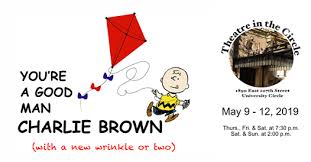
CHARLIE BROWN, with a kind of new twist at Theatre in the Circle


In the Spring of 1967 a group of theater students from Lorain County Community College went to New York to get their first experience with Broadway.

One of the shows they saw was YOU’RE A GOOD MAN CHARLIE BROWN.  Fortunately, due to a friendship between one of the LCCC faculty and Clark Gesner, who wrote the music and lyrics for the show based on the “Peanuts” characters created by cartoonist, Charles M. Schulz,” the students not only got to meet the writer, but spent time socializing with the cast. 

This connection led to LCCC’s drama department getting permission to stage one of the first amateur productions of the work. 

“Peanuts” is often thought of as just a cartoon about kids.  It is, but in fact, it is infused with philosophical, psychological, and sociological overtones.  Not only are relationships, concepts about the American educational system, family connections and the angst of childhood showcased, but as stated in the book, “The Gospel According to Peanuts,” “it sheds more light on the Christian faith and how it is to be lived than many more serious theological works.”

“Peanuts” is among the most popular comics with 17,897 strips published.  At its peak in the mid-to-late 1960s, the strip ran in over 2,600 newspapers, with a readership of around 355 million in 75 countries, and was translated into 21 languages.

The strip focuses on a social circle of young children, where adults exist but are rarely seen or heard. 

The main character, Charlie Brown, is a meek, nervous boy who lacks self-confidence.  He is unable to fly a kite, win a baseball game, or kick a football held by his irascible friend, Lucy, who always pulls it away at the last instant.  “Good grief Charlie Brown!”

The musical, which, during its off-Broadway and subsequent revivals, has starred such theater and television stars as Gary Burghoff (Radar on “Mash”), Anthony Rapp (RENT) and Kristin Chenoweth (WICKED).  The LCCC production featured Crissy Wilczak, who went on to Great White Way fame in A CHORUS LINE, 1940s RADIO HOUR, SEESAW and was featured in TV’s “Mork and Mindy.”

The musical opens with Charlie Brown sitting alone as his friends give their various opinions of him.  Today everyone is singing “You’re a Good Man Charlie Brown,” rather than berating him for the many stumbles as he follows his life path.

The usually depressed Charlie Brown is happy and hopeful, that is, until he notices the Little Red-Haired Girl, who he secretly loves.  He decides to go sit with her. However, in typical Charlie Brown fashion, he cannot find the courage to do so, winding up putting his lunch bag over his head in utter frustration. 


As the tale goes on, Lucy expresses her deep infatuation with Schroeder and asks him what he thinks of the idea of marriage. Schroeder remains aloof as he continues to play his piano. Sally is sad because her jump rope tangled up. And so the tale of Charlie Brown and his “pals” goes on, with humor, pathos and such songs as “My Blanket and Me,” “Queen Lucy,” “The Kite,” “The Book Report,” “Suppertime” and “Happiness” are sung.

 
Theatre in the Circle presented YOU’RE A GOOD MAN CHARLIE BROWN by adding a “new wrinkle or two.”  Though the show is usually done with adults playing Charlie and the gang, this production features actors of “a certain age.”  These are not spry young twenty-somethings.  They are closer to having to use canes and walkers to traverse the stage.  No amount of makeup is going to conceal the frown and laugh lines of lives well spent.


George Roth is properly introspective as Charlie Brown.  Former “Scene” drama critic, Christine Howey, was born to play the sarcastic, grumpy, self-centered Lucy.  Agnes Herrmann is adorable as Patty.  Bob Navis, Jr. is piano-centric as Schroeder.  Kevin Kelly, the king of overacting and shtick, has a wonderful time as Snoopy.  Noah Budin is endearing as thumb-sucking, blanket-obsessed Linus.  


Director Bill Corcoran keeps the show zipping right along (well, as zipping as he can get a cast of slow moving seniors to move.)


CAPSULE JUDGMENT: “Happiness” is watching a mainly “mature” opening night audience delight in seeing YOU’RE A GOOD MAN CHARLIE BROWN (with a new wrinkle) at Theatre in the Circle.  (Unfortunately, the show only had a one-weekend run so there is no chance to see it.)


All TITC performances are staged at the historic Judson Manor, 1890 E. 107th St, Cleveland, OH 44106. Curtain times are Thursday, Friday and Saturday @ 7:30 pm and Saturday and Sunday @ 2 pm.  Ticket cost:  Adults $20, Seniors $18, Judson/South Franklin Circle residents $15, Students $12. For tickets call 216-282-9424 or go to theatreinthecircle.com. There is free parking.

Saturday, May 11, 2019

MILLION DOLLAR QUARTET…Great Balls of Fire! @ GLT


Part concert, part history lesson, a lot of rock ‘n roll, and a heck of a good time-- that’s MILLION DOLLAR QUARTET, now on stage at the Great Lakes Theater.

The venue is playing host to Elvis Presley, Jerry Lee Lewis, Carl Perkins and Johnny Cash.  Well, four performers portraying those icons of rock and roll, in a stage show that attempts to duplicate the one time that the four actually did get together for an informal rock session.  The event took place in the recording studios of the legendary Sun Records on December 4, 1956.

Pretend it’s 63 years ago, four emerging music icons, all of whom were good old Southern boys, identified and molded by Sam Phillips, are in his Memphis Sun Studios.  They improvised an evening of gospel, blues and rock ‘n roll music. 

Whether the actions happened exactly as portrayed is not known, but the fact that there was such a jam session is a reality.  A recording of the session, and a picture of the four, documented the event and became the basis for the musical with a book by Colin Escott and Floyd Mutrux. 

The event was chronicled by a reporter from the Memphis Press-Scimitar.  The next day the article discussing the event stated, “This quartet could sell a million.”  Little did the reporter realize that though that number sounded like a lot, these four would go on to sell many, many millions, and become individual musical icons.

The GLT production, under the direction of Hunter Foster, is on target.  The production is filled with well-timed humor and a little drama.  And, of course, there is a Whole Lotta Shakin’ Goin’ On.

The stage literally explodes with hit after hit, including Blue Suede Shoes, That’s All Right, Sixteen Tons, I Walk the Line, Great Balls of Fire and Party.  Then, there was a curtain call which featured the likes of Hound Dog, Riders in the Sky, and See You Later Alligator.

The cast members don’t exactly look or sound like the big four of Rock and Roll and Rock-a-Billie, but they sing well, and play their own instruments.


Sean Michael Buckely faintly looks like Elvis, and imitates the prescribed hip swivels, pelvis thrusts and toe twists.  He’s missing the bedroom eyes and full lips and Elvis’s search-light sexuality. Appropriately, the last line heard from the stage at the conclusion of the production was the famous exit line of the King of Rock, “And Elvis has left the building.”

Gabe Aronson, who gives a new meaning to ADHD, delights as the undisciplined, dynamic pianist and performer, Jerry Lee Lewis.  He is often electric on stage, hardly able to contain the character’s twitching, jumping, and hillbilly persona.  

Sky Seals is Johnny Cash-light.  Dressed in Cash’s signature black uniform, his deep voice makes for an acceptable stand-in for the real thing.

James Barry develops nicely the conflicted Perkins, whose fame was eclipsed by Presley, all the way from the King taking Perkins’ Blue Suede Shoes and making it into a hit that exceeded the original author’s recording, but generally overshadowing the man known as the King of Rock-a-Billie. 

James Ludwig gives a human portrayal of Sam Phillips, Kristen Beth Williams is fine as Presley’s girl friend of the moment, bass player Eric Scott Anthony and drummer Dave Sonneborn, are excellent musicians who add much to the show.

Capsule judgement: MILLION DOLLAR QUARTET is one of those enjoyable evenings of theater.  It’s filled with great music and good enough performances that led to screaming, yelling, clapping, and multi-standing ovations given by the audience.  Yes, Memories Are Made of This!

MILLION DOLLAR QUARTET plays Great Lakes Theater through May 26, 2019.  For tickets call 216-241-6000 or going to http://www.greatlakestheater.org/.

Monday, May 06, 2019


CLEVELAND THEATER CALENDAR—June-August, 2019

Roy Berko
(Cleveland Critics Circle, American Theatre Critics Association)

Though it seems like it will never be here, there will be summer and the Cleveland theater scene will heat up.  Here’s a list of some of the offerings that are being staged. 

BECK CENTER

216-521-2540 or http://www.beckcenter.org
8 p.m. evenings, 3 p.m. matinees

MATILDA (July 12-August 11) -- Based on the novel by Roald Dahl, the musical tells the tale of Matilda who takes a stand against oppressive forces, thus taking her destiny into her own hands.  (SAVE!  Use code MISSHONEY before July 12 when ordering tickets and get $5 off on adult or senior tickets.)

BLANK CANVAS


440-941-0458 or www.blankcanvastheatre.com

THE TOXIC AVENGER (July 12-27) -- Melvin Ferd, the Third, wants to clean up Tromaville, the most polluted town in New Jersey.  Foiled by the mayor's bullies, Melvin is dumped into a vat of radioactive toxic waste, only to reemerge as The Toxic Avenger, New Jersey's first superhero.  A musical delight!

LOBBY HERO (August 23-September 7) -- A young security guard with big ambitions clashes with his stern boss, an intense rookie cop and her unpredictable partner.

DOBAMA
216-932-3396 or www.dobama.org

33 1/3 A WORLD PREMIERE MUSCAL (June 26-July 14)— A musical tale of four young people who experience a tumultuous New Year's Eve and make a decision
that will change all of their lives.

CAIN PARK
216-371-3000 or http://www.cainpark.com
Thursday-Saturday 7 pm, Sunday 2 pm

RAGTIME (June 13-30 Alma Theatre)— Called, “The Ultimate Musical of Our Time,” this sweeping musical portrait of early-twentieth-century America tells the story of three families in the pursuit of the American Dream. Together, they confront history's timeless contradictions of wealth and poverty, freedom and prejudice, hope and despair...and what it means to live in America.

FOR GOOD:  THE NEW GENERATION OF MUSICALS, VOL.4 (July 17 Alma Theatre) -- In partnership with The Musical Theater Project--From the cutting edge BE MORE CHILL to the contemporary KINKY BOOTS, musicals produced since 2000 have awakened audiences to new possibilities for America's great art form.  Hosted by Nancy Maier and Sheri Gross the production features singers Bridie Carroll and Eric Fancher.

THE LAST FIVE YEARS (July 25-27 Alma Theatre) -- Jason Robert Brown’s classic musical about love, loss and the moments we wish we could do over. (Presented by The Passion Project.)

CLEVELAND SHAKESPEARE FESTIVAL

Free admission, except where noted. 
For times and places go to http://www.cleveshakes.com

O FOR A MUSE OF FIRE (June 8)— 6-10 pm at Ensemble Theater—food, cash bar, silent auction, raffle--$25 (a benefit for The Cleveland Shakespeare Festival)

HENRY V (June 21-July 7)—  The political situation in England is tense: King Henry IV has died, and his son, the young King Henry V, has just assumed the throne.  A quest for power follows!

MUCH ADO ABOUT NOTHING (July 19-August 4) -- A respectable nobleman lives in the idyllic Italian town of Messina.  He shares his house with his lovely young daughter, his playful, clever niece, and his elderly brother. What ensues is Shakespeare at his creative best!

convergence continuum

convergence-continuum.org or 216-687-0074
Thursday-Saturday @ 8
 

STATEMENTS AFTER AN ARREST UNDER THE IMMORALITY ACT (May 24-June 15) -- Set in apartheid South Africa, where interracial relationships were a criminal offense, a black man and white woman meet secretly in the library to share their hopes and fears.
 

TOM AT THE FARM (Jul 12-Aug 3) -- After the sudden death of his lover, Tom travels from the city to a remote farm for the funeral, and finds a religious family who know nothing of his existence. Tom is threatened by the deceased’s brother and is drawn into a brutal, sexually-charged game.

SHAKESPEARE’S R & J An Adaptation (Aug 30-Sep 21) -- In a boys' boarding school, four students discover a forbidden text of Shakespeare’s play and secretly enact the play in a deluge of agitation, terror, and fierce desires that parallel their own lives.


OBERLIN SUMMER THEATRE FESTIVAL

Hall Auditorium, 67 N. Main Street, Oberlin and other venues
Free admission, reservations requested—440-775-8169

BUTTERFLIES ARE FREE by Leonard Gershe, William Shakespeare’s MEASURE FOR MEASURE, LONG DAY’S JOURNEY INTO NIGHT by Eugene O’Neill, and A MUSICAL CABARET, run in repertoire.   For details and dates go to www.oberlinsummertheaterfestival.com

OHIO SHAKESPEARE FESTIVAL

Stan Hywet Hall and Gardens (outdoor performances)
714 N. Portage Path, Akron
ohioshakespearefestival.com or 1-888-718-4253 opt.1

HAMLET (June 28-July 14)— The king is dead. His brother had taken the throne and married the queen. For young prince Hamlet, something is rotten in the state of Denmark.

MEASURE FOR MEASURE (July 26-August 11) -- Intrigues, disguises, and amorous plots propel this twisted, comedic adventure to its unexpected conclusion.
   
PLAYHOUSE SQUARE

216-241-6000 or go to www.playhousesquare.org.

PORGY AND BESS (June 1)— Cleveland Opera presents this most famous American opera which includes such songs as “Summertime,” “A Woman Is A Sometime Thing,” “My Man's Gone Now,” “I Got Plenty of O’ Nuttin’.”

ROCK OF AGES TENTH ANNIVERSARY TOUR (June 6 @ 7:30)— A musical that captures the iconic era that was the big bad 1980s Hollywood, featuring the music of hit bands such as Styx, Poison and Twisted Sister.

DEAR EVAN HANSEN (June 11-30)— Winner of six Tony Awards, this is a deeply personal and profoundly “must see” contemporary musical about life and the way we live it. (Part of the Key Bank Broadway series.)

COME FROM AWAY (July 9-28) -- A true story of 7,000 stranded airline passengers and the small town of Gander, Newfoundland that welcomed them on 9-11. Cultures clashed, but uneasiness turned into trust, music soared into the night, and gratitude grew into enduring friendships.  (Part of the Key Bank Broadway series.)

THE LION KING (August 7-September 1)— Giraffes strut. Birds swoop. Gazelles leap. The entire Serengeti comes to life. And as the music soars, Pride Rock slowly emerges from the mist. This is Disney's THE LION KING, making its triumphant return to Playhouse Square! (A Huntington Bank feature performance.)

PORTHOUSE

http://www.porthousetheatre.com or 330-929-4416 or 330-672-3884

MAN OF LAMANCHA (June 13-29)— The “Impossible Dream” musical inspired by Miguel de Cervantes' masterpiece DON QUIXOTE, follows the journey of a dying man determined not to abandon his ideals or passion.

TINTYPES (July 4-20)— A collection of snapshots of America prior to World War I featuring such patriotic and ragtime classics as "The Yankee Doodle Boy," "Stars and Stripes Forever," "Meet Me in St. Louis," "America the Beautiful," and "You're a Grand Old Flag."

THE MUSIC MAN (July 25-August 11)— The “Seventy-Six Trombones” musical story of a fast-talking salesman who arrives in River City, Iowa to con the townspeople and hurry off with their money, but he doesn't count on falling for the town librarian in the process.  (See this classic at Porthouse before its scheduled fall Broadway revival.)

Sunday, May 05, 2019

Should we laugh or cry? State of civility examined in NATIVE GARDENS at CPH


Negative racial and ethnic stereotypes, anti-ageism, political philosophical differences, and border conflicts are not usual topics for a comic play.  But, author Karen Zacarías, whose “Native Gardens” is now in production at Cleveland Play House, believes “humor humanizes” when what could be the basis of a blood bath becomes a pool of laughter with a purpose.

“Native Gardens” is a comedy.  Yes, a Neil Simon type of comedy, not a dark comedy with underlying meanings and hidden intentions where things are manipulated to fool the audience.  Everything in “Native Gardens” is clearly sown on the landscape.  In fact, the landscaping of two yards is the center of the comic gem.

No punches are pulled.  Phrases like “you people,” “privileged class,” “old people, “Mexican,” “Latino” and other non-pc words flow easily off the tongues of Frank, Virginia, Pablo and Tania as they battle over a fence, property lines, and the kinds of vegetation to be planted.

“Native Gardens” is a perfect piece to define and explain the political and societal climate of today. 

The bright, witty and clever story tells the tale of the families Butley and Del Valle.


Virginia Butley is an engineer for a defense contractor.  Frank, her husband, is now retired but was formerly a consultant for a government agency.  They are wealthy, conservative Republicans who believe in the “American” way of life. 


Pablo Del Valle, a rising attorney who is the token Hispanic at a prestigious law firm, and his very pregnant wife and doctoral candidate, Tania, have just purchased the home next to Frank and Virginia in the up-scale Georgetown neighborhood of DC. 

The backyard of their houses are complete opposites.  Frank is an obsessive gardener, fanatically pursuing the Gardener of the Year award from the local horticultural association.  He uses a number of fertilizers and insecticides to insure the visual beauty of his garden. To hell with the environment.

Tania, an environmentalist, plans to make their backyard into an oasis for native plants, shrubs, butterflies and nature. No pesticides here. 

The De Valles duo loves their backyard’s century-old tree, while Frank hates the tree and its falling nuts and leaves which defile his meticulously cropped lawn and flowers.

At first the neighbors get along well, but when the Pablo and Tania find out that Frank has, by intent or not, planted on two-feet of their backyard, all hell breaks loose.

As the fence line issue soon spirals into an all-out border dispute, both couple’s notions of race, taste, class and privilege bloom.  As the backyard brawl escalates, cultures collide and mudslinging ensues…literally.

The CPH production is nicely guided by Robert Barry Fleming.  The humor stays comic, not bridging over into farcical ridiculousness.  The characters are finely etched.  The battle lines are clear.

Wynn Harmon creates a perfect caricature for Frank as an up-tight, tightly wound, khaki pants, button-down-collared, starched-shirt wearing conservative.

Charlotte Maier etches a clear role as the snobbish Virginia, a woman-of-privilege and wealth.  She is a “refined,” wine-drinking lady, until the gloves come off and her claws are revealed.

Natalie Camunas, a second-gen Latinx actor, has the soul of Tania, and unfurls it with ease and purpose.

Grayson DeJesus, gives a nice realistic depth and texture to Pablo.

Jason Ardizzone-West’s scenic design is breathtaking.  Every detail, every flower, tree and shrub reeks real!  As someone in the audience said, “I want to move into that house (referring to the perfectly conceived House and Garden domicile of Frank and Virginia.)
 

CAPSULE JUDGMENT: “Native Garden” is that perfect script which grabs and holds an audience with humor and good story telling, while clearly making its philosophical point. It gets a picture-perfect production at CPH.  It is a wonderful piece to define and explain the political and societal climate of today.  Go!  See!  Enjoy and learn!!

“Native Gardens” which runs ninety-minutes without an intermission, can be seen in CPH’s Allen Theatre through May 19, 2019.  For tickets call 216-241-6000 or go to http://www.clevelandplayhouse.com.