Showing posts with label Cleveland State--Summer Stages. Show all posts

Monday, August 02, 2010

The Elephant Man & Curtains


'ELEPHANT MAN' and 'CURTAINS' at CSU

‘THE ELEPHANT MAN’ gets acceptable production at 2010 Summer Stages

‘THE ELEPHANT MAN’ is a 1977 play by Bernard Pomerance. It centers on John Merrick, an Englishman with severe deformities who was exhibited as a human curiosity. Because of his thick and lumpy skin, enlarged lips, and heavy legs, he was nicknamed The Elephant Man.

Merrick became well known in London society after he went to live at the London Hospital after being removed from a freak show.

The play opened on Broadway in 1979 after being produced in London.

One of the staging difficulties of the script is Pomerance’s insistence that no prosthetic makeup be used on the actor portraying Merrick. The actor must, before the eyes of the audience, transform himself into a twisted grotesque being with malformed face and body.

The CSU 2010 Summer Stages production, under the direction of Everett Quinton, is acceptable. This is a difficult show to stage. Not only must the lead actor transform himself, but he must keep in physical character throughout. Because the play does not contain much physical action, concentrated pacing and clear characterizations need to be developed. In addition, the setting is England, so consistent British accents must be maintained throughout. As is, the pacing dragged in parts and the cello interludes, which were effective at the start became tedious after a while. The accents came and went.

Eric Perusek did a nice transition into the ill-formed Merrick and generally held it through out the play. The changeover to his being “normal” would have been helped by his being difficult to understand at the beginning and then improving. Ursula Cataan was excellent as Mrs. Kendall, who became Merrick’s friend and tutor, and Geoff Knox did a nice job as Frederick, Merrick’s doctor.

CAPSULE JUDGEMENT: ‘THE ELEPHANT MAN’ got an acceptable production, but would have been improved by a faster pace and some attention to the development of clearer characterizations by some of the cast.

Misselected, Misdirected ‘CURTAINS’ at CSU’s 2010 Summer Stages

‘CURTAINS,' the musical that CSU’s 2010 Summer Stages chose to present, was probably DOA (dead on arrival) at the Factory Theatre. Peter Stone, who wrote the original book, died just before the play opened leaving it unfinished. Fred Ebb, who wrote the lyrics, also died before the musical was completed. So, is it a coincidence that the ridiculous piece was a disaster?

New York reviews stated, “’CURTAINS' lies on the stage like a promisingly gaudy string of firecrackers, waiting in vain for that vital, necessary spark to set it off," "It's not so much a whodunit as a whydoit" and “A somewhat clunky, piece of entertainment."

Well, not quite a total disaster. David Hyde Pierce, who played the major role did get the Tony for his leading actor performance.

The story centers on a detective who is called in when the untalented leading actress is killed on the opening night of ‘ROBBIN' HOOD OF THE OLD WEST.’ The play within the play is a western musical. The detective, who is an amateur actor “saves the show” with some “spiffy” suggestions, falls in love, and catches the killer. The entire production is filled with unmemorable music including, “In the Same Boat 1,” “In the Same Boat 2,”“In the Same Boat Completed,” “Coffee Shop Nights,” “Kansasland,” and “The Woman’s Dead.”

Under the direction of Michael Mauldin, CSU’s production stumbles along. It is poorly paced, few songs are well interpreted, the acting is generally flat, actors stand in straight lines often having to duck out behind other performers in order to say their lines. Even Martin Céspedes, the crown prince of local choreographers, couldn’t save this debacle. He tried hard, but the cast wasn’t up to carrying out the movements.

Jessica Duer as Nicki, who adorably looks like she is right out of a 1920s musical, and Jean Kauffman as the comedic producer, do themselves proud. Most of the rest of the cast have problems with inconsistent accents, weak singing, and weak character development.

CAPSULE JUDGEMENT: ‘CURTAINS’ misses on almost every count….weak script choice, poor directing, undistinguished performances. ‘nuf said!

Saturday, July 18, 2009

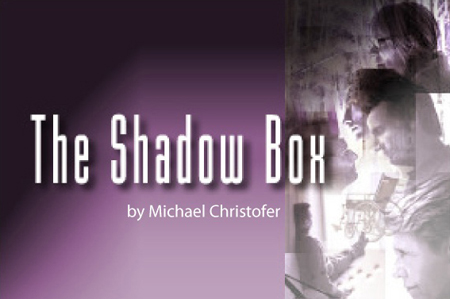
The Shadow Box


‘’THE SHADOW BOX’ emotionally draining at CSU

“This lifetime doesn’t take forever.” “Every life has to make sense on its own terms.” With these two sentences ringing in my ears, and emotions welling, I left Cleveland State University’s 2009 Summer Stages production of ‘THE SHADOW BOX.’

Michael Cristofer’s ‘THE SHADOW BOX came to Broadway on March 31, 1977, with a cast that included, Mandy Patinkin and Geraldine Fitzgerald. It went on to win a Tony Award for Best Play and a Pulitzer Prize for Drama. The script was made into a television movie in 1980, which was directed by Paul Newman.

In the act of shadow boxing, a person fights with an imaginary opponent, often while encased in a psychological container, which holds his/her thoughts and may allow others to look inside. Since in Cristofer’s play we get to “eavesdrop” into the lives of three terminally ill patients as they live the last weeks of their lives in hospice cottages on the grounds of a hospital, the title is quite appropriate.

Adding to the shadow box effect is the writer’s device of having the characters sitting on an isolated stool and being asked questions about the dying process by a voice which represents the audience’s thoughts. And, there is also the fight each is having, boxing with the illusion of their upcoming death.

It helps in viewing the play to be aware of Elizabeth Kubler-Ross’s theory of the five stages which a person, and those in relationships with them, often go through when diagnosed with a terminal illness. These stages are: denial (“This can’t be happening”), anger (“It’s not fair”), bargaining (“I’ll do anything not to die”), depression (“There is no point of treatment”) and acceptance (“I accept that my life is over”). As we watch ‘THE SHADOW BOX,’ we see the participants in or transition into these stages.

Joe, a middle-aged, blue-collar family, man has accepted his fate, but his wife Maggie is in denial. She refuses to even step into the hospice cottage as this action will take her into acceptance.

Brian, a bisexual English professor is being cared for by his lover, Mark. Each appears to be in acceptance, yet Brian is escaping into a world of illusion by submerging himself into nonsensical writing. And, when forced to face reality during a visit by Brian’s ex-wife, Mark shows that he is actually in depression. His reality climaxes in a brilliantly written monologue which, in part says, “We are dying here, lady. That's what it's about. Brian looks at me and I can see it in his eyes. One stone slab smack in the face, the rug is coming out from under, the light is going out. It's sick and putrid and soft and rotten and it is killing me.”

And then there is Felicity, a crusty old woman who has been living a life of delusion, a delusion that is keeping her alive.

CSU’s production, under the direction of Everett Quinton, hits most of the right notes. The pacing is good, the emotional levels held in proper check, the intensity is well defined. The staging, in which we see all three families working in the same set, at the same time, yet in isolation, is extremely creative. The weakness is the lack of balance in the level of acting between the Equity cast members and the student performers.

Greg Violand (Brian) walks his character’s fine line between reality and escapism. He is totally believable as the intellect who attempts to fool both himself and all about him, that he has accepted his fate.

Tom Woodward (Joe), looking gaunt and gray, is totally natural in his characterization. The emotional strain between Joe and his wife Maggie is like viewing a tightly pulled rubber band, ready to snap, with each actor on an opposite end. Ursula Cataan is totally on target as the denying wife.

Story Comeaux, as Beverly, Brian’s flighty ex-wife, who keeps her emotional distance from the death issue, has some excellent scenes. Lydia Chanenka, (Felicity), the strongest of the non-professional cast members, is appropriately pathetic as the old lady.

The rest of the cast is acceptable, but not outstanding. Justin Steck, does fine as the unseen narrator, but is on the acting surface when he appears before our eyes. Randy Muchowski as Mark, is fine in most of his scenes, but doesn’t have the acting depth to plumb out what should have been the play’s most emotionally wrenching monologue. (Oh, to have seen the then young Mandy Pantinkin wring pathos out of that speech.) Denise Astorino as Agnes, Felicity’s daughter, gives a properly emotional portrayal. Charles Hargrave has little to do as Joe and Maggie’s son.

Don McBride’s set design works beautifully, Dennis Dugan’s lighting was spotty. In some scenes there were light spillages that allowed for the wrong actors to be highlighted, and, at times, light shone into the eyes of audience members. Alison Garrigan’s costumes hit the 1970s well. It would have been helpful if the program had indicated the date of the play so that Garrigan’s clothing didn’t have to carry the whole burden.

The selection of “Don’t Sit Under the Apple Tree” as the play’s final music, was era and emotionally wrong. It is a 1942 song (incidentally, written by Clevelander Sam Stept), which came on loud and sprightly after the play’s serious emotional ending, jarring the audience’s senses.

CAPSULE JUDGEMENT: ‘THE SHADOW BOX’ is a very well written, purposeful, and emotion-laden script. It gets a very serviceable production at CSU, that is worth seeing.

Monday, July 13, 2009

RETURN TO THE FORBIDDEN PLANET


‘RETURN TO THE FORBIDDEN PLANET” a silly delight at CSU

The theatre people at Cleveland State University are trying to tell us their 2009 Summer Stages’ ‘RETURN TO THE FORBIDDEN PLANET,’ is a musical version of Shakespeare’s ‘THE TEMPEST.’ Well, don’t believe them. What it is, is a zany blend of faux Shakespeare (think of it as Fakespeare), mixed with science fiction, a whole canon of quips and puns, all highlighted with rock-and-roll hits. This is a zany hoot!

Don’t attend with any idea that you are going to take the goings on seriously. Go expecting to get beach balls thrown at you. Balls which will continue to be tossed about by the audience, while you are holding your hands on your head, doing squats, and trying to stop from laughing at the ridiculousness.

The hardest thing to believe about the whole experience is that this bizarre show won the 1990 Olivier Award (the British Tony Award) for Best Musical, beating out ‘MISS SAIGON.’

This is the kind of script and production that cult shows are made of. Think ‘THE ROCKY HORROR SHOW,’ ‘EVIL DEAD’ and ‘SPAMALOT.’

This is the “tale of the future.” Well, actually the past of the 1950s when the atomic bomb had everyone scared, Mad Scientists ran amok, and fear was in the air. Fear of fear of science, fear of sex, fear of the Russians, fear of ourselves, and the fear of rock and roll! It was a time when the most innocent lab experiments could result in giant monster bugs and mutated humans.

Specifically, we participate as the crew of a routine spaceship flight is drawn mysteriously to the planet D'Illyria where mad scientist Doctor Prospero and his lovely daughter Miranda are marooned. (Sounds like a 1950 black and white television show, huh?)

For music, conceiver Bob Carlton uses many rock and roll oldies, which are dropped in between lines, often for no reason. Songs include “Great Balls of Fire,” “Shake, Rattle and Roll,” “Don't Let Me Be Misunderstood,” “Good Vibrations,” and “Only the Lonely.” I defy you to stop your bouncing legs and swaying bodies as musical director/keyboardist John Kroll, and the “ship” musicians, wail.

The CSU production, under the creative direction of Michael Mauldin, is well staged and has all the right ridiculousness needed to make this a fun production. Lynn Deering’s fine choreography adds to the hilarity.

The cast is universally excellent. Handsome Lew Wallace plays the Ken doll-like thick-headed, emotion absent, captain of our ship, with the right degree of seriousness. He has a fine singing voice and dances well. Greg Violand, he of great singing voice, whose career has seen him transition from ingénue to nasty old man, is properly fake-evil as scientist Prospero, who gives his life to “save us.” John Paul Soto sparkles as a endearing roller-skating robot. Tracee Patterson sings and mugs her way through the role of the bad/good Gloria. Her limp rag doll segment is nothing short of hysterical. The rest of the cast is up to the task of creating the right degree of the faux seriousness. This is a difficult undertaking, because there is often a temptation in this type of show to over- do the action. This would have brought about a less comic result.

Don McBride’s set (with the exception of a door design flaw which caused problems on opening night), Alison Garrigan’s costumes and properly horrific wigs, Dennis Dugan’s lighting and Jim Swonger’s sound designs all enhance the production.

CAPSULE JUDGEMENT: ‘RETURN TO THE FORBIDDEN PLANET’ is a laugh delight at CSU’s 2009 Summer Stages. This is a must go-see for summer entertainment!