Did you know that Julie Taymor, director of THE LION KING, John Kander, composer of the scores for 15 musicals, including CABARET and CHICAGO, and Alison Bechdel, author of FUN HOME, are graduates of Oberlin College?
Do you realize that until this Fall, Oberlin did not have a degree in Musical Theater?
Both of these statements are true!
As stated by College President Carmen Twillie Ambar, “Oberlin is known throughout the world for its deep commitment to the arts, theater, and music. It therefore seemed perfectly appropriate to add music theater to our repertoire of excellence.”
The commitment goes beyond just adding the program, it entails an investment in space and specialized faculty—industry professionals with decades of experience in the field.
Designed by local award-winning J. Kurtz Architects, a new facility has been located on the ground level of the Peter B. Lewis Gateway Center alongside the Hotel at Oberlin. It will serve as the home for music theater teaching and training and be the central space for music theater majors as they discover, experiment, and realize their fullest potential at Oberlin.
The first floor of the hotel, originally designed to be commercial space, has been converted into nine faculty offices. The glass-fronted area is now two state of the art dance studios and 4 practice rooms.
The facility also contains the William and Helen Birenbaum Innovation and Performance Space (The Birenbaum). It is an off-Broadway theatre with 100-flex space seating. The program will also use multiple shared performance spaces on campus, including the 501-seat Hall Auditorium and the Wurtzel flexible black box theater that can accommodate up to 300 seats. Just recently, music theater majors performed along with students throughout the conservatory in a welcome concert for new and transfer students and their families inside a packed 1,200-seat Finney Chapel.
Heading up the program is Victoria Bussert, who has directed more than 500 shows on stages across four continents and has established herself as one of the premiere music theater educators.

Besides Bussert, the Oberlin music theater faculty consists of experienced teacher-performers dedicated to providing individual instruction and mentorship in a curriculum that supports professional careers in music theater.
The initial faculty are Matthew Webb, Laura Welsh, Lauren Marousek, Colin Briskey, Gregory Lee Harrell and Broadway veterans Cassie Okenka and Alex Sanchez. (Sanchez has appeared in 10 Broadway productions and was nominated for 2024 Lucille Lortel and Drama Desk Awards for co-choreographing THE GARDENS OF ANUNCIA and Okenka has clocked more than a decade as a Broadway performer including her stints as an original Broadway company member of BONNIE AND CLYDE and SCHOOL OF ROCK and headlining as Glinda in the first national tour of WICKED.)

The Oberlin Musical Theatre program is part of an evolution of the art. The first of such curricula was in 1969 at the Cincinnati Conservatory. Many of the programs which followed duplicated the Cincy curriculum and teaching methods. The Oberlin program, with the motto, “At Oberlin, music theater isn’t an afterthought—it’s an art form,” according to the program director, will start from scratch, creating a unique approach.
Though it will have its own faculty, students will take core classes from the conservatory faculty.
Following the announcement of the major on August 19, 2024, over 600 applications for the Freshman class were received. After prescreening their videos, there were 456 live auditions and an incoming class of 20 were selected. In addition, 55 transfer students, sophomores through seniors, from multiple schools, were invited to join this year’s program. Ideally, in the future, each academic grade-level will have 18-20 students.
In order to make their education affordable Oberlin will meet all students’ demonstrated need, ranging from full scholarships to limited aid.
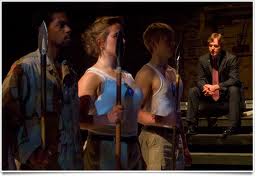
This coming year, students will participate in on-campus productions including NATASHA, PIERRE & THE GREAT COMET OF 1812 (Wurtzel Theater, December 3-10), TICK, TICK. . .BOOM! (The Cat and the Cream, March 12-13),the academic premiere of STRANGER SINGS! THE PARODY MUSICAL (Birenbaum Theater, April 23-May 3), SPRING AWAKENING (at Beck Center for the Arts, February 12-March 1) and THE WORLD GOES ROUND, a musical review of the music of writing team of John Kander and Fred Ebb, presented by Great Lakes Theater at the Hanna Theatre in Playhouse Square (May 16-17) and at Hidden Valley, located in the foothills of the Santa Lucia Range in the Carmel/Monterey, CA area (January 30-February 1).
In addition, a fourth-year student showcase will be presented in New York March 23 and 24 at the Alvin Ailey Theatre for agents, managers, and casting directors.
The evening of March 24 following their final showcase, students will perform a concert at 54 Below.
Seniors will have an earlier opportunity to strut their stuff in NYC in October as part of "Broadway Sings," produced by Cory Mach, another one of Vicky's grads to make a career on and off-Broadway.
One of the program’s goals is to help every student meet the requirements to get their Equity card by the time they graduate.
An exciting aspect of the program is the master class series that invites 10 New York agents, managers, and casting directors to campus to hear students sing and offer their critiques. This allows music theater faculty to immediately incorporate real-world feedback to better equip students for careers post-graduation.
Additionally, representatives of 10 summer stock and regional theaters are invited to campus each year to audition students for summer work.
It is with great anticipation that the theater world looks to Oberlin to observe the development of its new program and count how many of its students will be added to the list of “Vicky’s Kids” who have made it in the professional world of the theater.