skip to main |
skip to sidebar

Most musicals follow the tried and true pattern of being written in a format that it is expected to be examined and redone through a series of readings, rewrites, staged readings, rewrites, previews, more rewrites, and, if lucky, a full-staged production. As the process continues the script and score are improved to attempt to ensure that they are well-integrated.
Unfortunately, from the developmental perspective, “Chess” was first a concept album, then there was an attempt to develop a stage musical. This is not totally unusual. Other shows, such as “Jesus Christ Superstar” and “Evita” followed this format and did fairly well, but most shows, whose names you don’t know because they never “made it,” haven’t fared so well.
Why would a writing and producing team choose to break the mold, when the odds are against the venture being successful? Usually it is because they don't have the capital to go through the usual process, so they figure that selling the album will raise the money to mount a production.
In the case of “Chess” the concept album was released in the autumn of 1984. The recording was such a hit that, even when the show itself received such reviews as being described as "a suite of temper tantrums, [where] the characters ... yell at one another to rock music," and that "Chess” assaults the audience with a relentless barrage of scenes and numbers that are muscle-bound with self-importance," the West End production ran three years. The same fate did not greet the much-altered US-version premiered on Broadway in 1988, which barely survived for two months.
The script tends to be contrived. The music may work well as a concert piece, but is not totally appropriate for a musical. And the production was rudderless as illustrated by the fact that the first preview on the West End “ran 4 hours with a 90-minute intermission.”
Opinions vary as to why the show was never a real hit. The easiest description was that the book for the story line was never well-developed and the music /lyrics never fit smoothly into the story. As such, in trying to make the show better, many different versions of the show have been put on over the years, featuring modified plots, different selections of music, and various casts of characters.
Though the musical plays out as a chess match, inspired by some of the political machinations surrounding the 1972 Fischer-Spassky World Championship competition, the script basically tells of a love triangle between two chess playing grandmasters and a woman who serves as a manager to one of the players but falls in love.
Oh, if it were only that simple. All sorts of other disparaging themes emerge including the Hungarian revolution against the Soviet Union, the personal eccentricity of the reclusive American chess aficionado, the Cold War political posturing between the US and Russia, the rocky marriage of the Russian chess player, and am attempt at political asylum, just to name a few of the side trips.
Despite the fact that the musical itself could never seem to settle on a single format that worked, the music from “Chess” composed by Benny Andersson and Björn of the pop group ABBA, (the same ABBA whose tunes are used in the juke box musical “Mamma Mia”) with lyrics by Ulvaeus and Tim Rice, has remained popular.
“Tim Rice admitted that after the comparative failure of “Chess,” his all-time favorite, he became disillusioned with theatre." He commented, "It may sound arrogant, but “Chess” is as good as anything I've ever done. And maybe it costs too much brainpower for the average person to follow it."
Or, maybe if time had been spent developing a solid story and book before shoe-horning in pre-written songs that often have nothing to do with the plot, the result would have been different.
The question may well be raised as to why Near West Theatre chose to do “Chess.” Maybe, part of the answer lies in the theatre’s mission.
“Near West Theatre builds loving relationships and engages diverse people in strengthening their sense of identity passion, and purpose, individually and in community through accessible, affordable and transformational theatre arts experiences. Near West is an open and affirming organization.”
Though many of their shows are of high production quality, the organization’s social service mission, making sure that those who participate, on and off stage, are in a safe zone, are respected no matter their race, religion, ethnicity, body shape, sexual orientation or age, holds paramount.
To carry out their inclusive nature shows tend to have large casts, putting Equity actors on stage is not a priority and human process is as important as theatrical product. In addition, shows are often chosen to aid the mostly tween and teenagers to learn history and sociological lessons. “Chess” does exactly that.
Near West’s production, under the direction of Kelcie Nicole Dugger, has some excellent, textured performances, e.g., Grant Bell (Anatoly Sergievsky) and Sarah Farris (Florence Vassy) both develop very believable personas and have excellent voices. Unfortunately, others tend to posture and act rather than react, scream rather than develop intense emotions.
Many of the chorus admirably stay in character, listening and reacting to the dialogue, while others draw attention to themselves, upstaging the speeches and song lyrics of the soloists through over-wrought gestures and over-done facial expressions.
Scott Pyle’s musicians play well, though sometimes they get a little overly enthusiastic and drown out the vocals.
The interestingly designed choreography by Josh Landis insured that all the members of the chorus were given the chance to perform.
Todd Plone’s scenic design sets the correct moods, and were intensified by Adam Ditzel’s lighting. Melody Walker and Lady Jen Ryan did an excellent job of designing period correct costumes.
(Side-comment: Congrats to Trinidad Snider, a Near West Theatre alum, and one of the area’s premiere musical theater performers, on her appointment as NWT Artistic Director.)

Capsule judgment: “Chess” is not a well-conceived script. The Near West Theatre’s production was, generally, more effective than the material.
" Chess" runs through August 4, 2019. For tickets 216-961-6391or go to http://www.nearwesttheatre.org/tickets

This past season, NBC aired “Rise.” The television show spotlighted a high school in a conservative working class neighborhood. The school’s new drama teacher, portrayed by Josh Rado, decided rather than staging a traditional, escapist musical, that the students and community would grow from doing “Spring Awakening,” an exploration of “young people navigating a world full of pain, frustration, growing up and peopled with not only teens, but adults who often don’t have the best intentions.”
The musical includes incidents of sex, nudity, incest, teen pregnancy, abortion, homosexuality, suicide and abuse.
On the unfortunately now-cancelled “Rise,” the town was galvanized on whether the show should go on as liberal and conservative factions put pressure on the school board to win favor of their point of view. As is, the musical had one showing and then was closed down.
Fortunately, Near West Theatre, which is now staging “Spring Awakening,” has a board and production staff who, unlike the community on “Rise,” are supportive of exposing their casts and audiences to the realities of life.
“Spring Awakening” is based on an 1891 German play written by Frank Wedekind in response to the author’s belief that his society was stifling and hypocritical toward sexuality and their treatment of youth.
The story centers mainly on Wendla Bergmann, Moritz Stiefel and Melchoir Gabor. Denied proper teaching about puberty, sex, and existence, they flounder through life with repercussions of their suffocating adolescence, and are forced to live with the consequences of the actions of their misguided parents and sadistic teachers.
Musician Duncan Sheik and lyricist Steven Sater took Wedekind’s material and transformed the tale into a vivid and moving musical, which, on Broadway, starred Lea Michele as Wendla, Jonathan Groff as Melchior, and John Gallagher Jr. as Moritz. The staging won eight 2007 Tony Awards, including Best Musical. Its original cast album received a Grammy Award.
In the story, angst prevails.
Wendla asks her mother for an explanation of where babies come from. Her mother avoids the issue so the girl doesn’t realize that her love affair with Melchoire could lead to pregnancy.
Moritz, whose father is verbally abusive, has high anxiety. When he misquotes a Latin line, his over-bearing teacher chastises him harshly, sending the boy on a tailspin toward suicide.
One of the school girls, Martha, accidentally admits to her friends that her father abuses her physically and sexually and that her mother is either oblivious or uncaring. Martha makes the girls promise not to tell anyone, lest she end up like Ilse, a friend from childhood, who now wanders homeless after her similarly abusive parents kicked her out of their home.
Two schoolboys, Hänschen and Earnst, meet, talk, kiss and reveal their forbidden love for each other.
Melchoire, in an attempt to educate his friend about the sex act, writes a paper which illustrates the deed. He is sent to reform school for his indiscretion.
The Near West production under the generally sensitive and creative direction of Kelcie Nicole Dugger is compelling, clearly showcasing societal hypocrisy and its consequences.
Robert Kowalewski is character perfect as the rebellious Melchior. He has a grasp of not only the character, but that he is acting as the fulcrum around which the plot revolves. His vocalizations are strong.
Sarah Farris is properly naïve and tender as Wendla. Zack Palumbo creates a sensitive and realistic character as Moritz. Antonio DeJesus (Hänschen) and Matthew Brightbill (Earnst) are believable as the homosexual couple.
Mike Obertacz properly textures his various adult male roles as does Amanda Bender in the adult female roles, but one must wonder why she used the ridiculous accent as the female teacher…causing laughter in a play which is anything but humorous.
The music under the direction of Scott Pyle rocks!
Based on their goal that “Near West Theatre builds loving relationships and engages diverse people in strengthening their sense of identity, passion, and purpose, individually and in community, through transformational theatre arts experiences,” the venue uses mass casts in order to include as many youths as possible. This often creates over-crowded stages and meaningless characters. Though this cast is huge, they are well used due to creative staging and blocking.
Capsule judgment: Near West Theatre’s “Spring Awakening” is a masterful production that well fulfills the philosophy and production excellence of the venue. The script is powerful, as is the show. Congrats on a job well done!
"Spring Awakening" runs through August 12. For tickets 216-961-6391or go to http://www.nearwesttheatre.org/tickets

JOSEPH AND THE AMAZING TECHNICOLOR DREAMCOAT, the Andrew Lloyd Webber and Tim Rice musical, had an unusual path to being one of the oft-produced musicals of all time. It has been estimated that world-wide, over 20,000 school, community and professional theatres have produced the work.
As the creation story goes, in 1967, when Webber was 19 years-old, he was asked to write a pop cantata for the school choir to sing at their Easter end of term concert. He asked his friend, Tim Rice, to write lyrics for the project. They decided to base the work on the story of Joseph from the Biblical book of Genesis.
JOSEPH started as a twenty-minute choral piece. The show gradually developed into what is now a full script. It is, however, a different type of script than most musicals. In fact, it is not a script at all, just a collection of twenty songs arranged in chronological order, with no narrative and no stage directions. This is why each production of the show takes on a different approach.
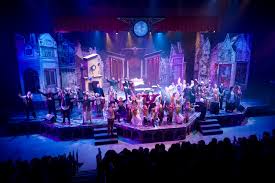
Sometimes the presentation is done in two acts, sometimes in one. It has been staged as a bedtime story in pajamas, a Biblical epic complete with clothing of the time of Jacob, a fantasy costumed in out-of-this world clothing, and with and without a chorus. The Near West Show theme centers on Joseph and His Son’s Construction Company. It’s been done by a cast of twenty or, as is true of the Near West Theatre’s production, 52 performers appear.
The Narrator explains, in the “Prologue,” the background to the story, that this is a tale of Joseph, whose clairvoyant powers, intelligence and charm lead to both his being his father’s favorite and the wrath of his 11 brothers (“Jacob and Sons”). The envy increases when Jacob gives Joseph, a symbol of respect (“Joseph’s Coat”). His “bros” get rid of him by attempting fratricide, but change their minds sell him to some passing Ishmaelites (“Poor, Poor Joseph”), who take him to Egypt. They explain his “death” to their father in “One More Angel in Heaven.”
Joseph eventually becomes the Pharaoh’s favorite when he successfully enciphers the leader’s nightmares (“Pharaoh’s Dreams Explained”), saves Egypt from famine, becomes the second in command, eventually forgives his brothers when they come to beg for food (“Grovel/Grovel”) and, in an emotional climax, reunites with his father (“Jacob in Egypt”).
The play concludes with the audience on its feet clapping as the cast sings ‘Any Dream Will Do” and “Give Me My Colored Coat".
Like many of Andrew Lloyd Webber conceptions, which includes CATS, THE PHANTOM OF THE OPERA, JESUS CHRIST SUPERSTAR, EVITA, ASPECTS OF LOVE, and SUNSET BOULEVARD, much of the music is infectious. There are parodies of French ballads ("Those Canaan Days"), rock and roll ("Song of the King"), western ("One More Angel In Heaven"), 1920s Charleston ("Potiphar"), Calypso ("Benjamin Calypso"), and go-go music ("Go, Go, Go Joseph").
Tim Rice, the lyricist and Webber’s longtime collaborator, not only has written for Broadway, but for such Disney shows as ALADDIN, BEAUTY AND THE BEAST and THE LION KING.
JOSEPH AND THE TECHNICOLOR DREAMCOAT is an ideal show for Near West Theatre, which serves as both a production house and a safe place for youngsters, tweens, teens and adults. Its audience is as divergent as its performers and technicians. Few theatres have the massive stage to allow for the huge cast, and gimmicks such as a real golf cart to be incorporated into the show.
Kelcie Nicole Duggar, the Narrator, has a fine voice and the ability to sing meanings, not just words. Her “Prologue” set a perfect tone to start the show. Robert Kowalewski is not the studly leading man image, but has a sweet quality that made Joseph into a charmer. His “Close Every Door” was well interpreted and sung.
At times, due to the mass of bodies on stage, Joshua Landis’ choreography looked like mass chaos rather than coordinated movements. The same could be said for much of Bob Navis Jr’s staging. Maybe, in the future, consideration should be given to double casting roles, with performers on alternate nights, or only having part of the cast appear in some numbers.
Navis has incorporated many shticks and gimmicks into the show, adding a joyousness to some scenes, eliminating some of the cleverness in others. Someone sitting behind me commented in disappointment that the “Elvis Song,” (“Song of the King”) didn’t have the traditional white-suited, hip swiveling rock-a-billy sound and visual imagery. (Cory Markowitz, the Pharaoh, did a nice job with the “new” arrangement of the song.)
Navis kept the show moving right along, though some of the set changes seemed overly long.
Ben Malkevitch’s musicians did a nice job of supporting, rather than drowning out the performers, especially in the solos.
It must be a major challenge to costume such a giant cast. In general, April Rock’s costumes worked, but Joseph’s coat of many colors was under-whelming. The words to the song list the many colors of his coat. A short jacket with fringe, with a couple of color patches, does not “a coat of many colors” make!
Capsule judgement: JOSEPH AND THE AMAZING TECHNICOLOR DREAMCOAT is a fun show for audience of all ages. As evidenced by the extended applause at the end of the show, and the many instances of audience delight displayed during the production, the cast and crew’s efforts were appreciated. Near West Theatre should be praised for carrying out its mission of empowering children, teens and adults through transformational arts.
JOSEPH AND THE AMAZING TECHNICOLOR DREAMCOAT runs at New West Theatre through December 11, 2016 at their new home, 6702 Detroit Avenue. Valet parking is available Friday and Saturday for $6 and a parking lot and street parking are also available. Call 216-961-6391 or go to http://www.nearwesttheatre.org for tickets and information.
Near West Theatre’s next show is THE WIZ (FEBRUARY 10-19, 2017--Youth Cast, 9-15) , followed by MARY POPPINS (May 5-21, 2017) –Intergenerational Cast, Ages 7+.
“There’s Another National Anthem, folks. For those who never win . . . for the ones who might have been.” A line from a Trump election advertisement? No, its from the Stephen Sondheim, John Weidman musical, Assassins, now on stage at Near West Theatre.
Assassins seems an ideal script to choose at this time of year, as the Republican convention is in town and there is a general feeling of discomfort and mistrust sweeping the nation. Political conflicts, racial distrust, police shootings, and left/right belief disagreements are running rampant.
Assassins is based on a concept of Charles Gilbert, Jr.. It examines, in musical review style, men and women who have attempted to assassinate Presidents of the United States. The musical score parallels the music popular at the time of each President.
Never noted as one of Sondheim’s great musicals, it has some interesting ideas and does contain a “signature song,” “Everybody’s Got The Right To Be Happy.” The defining song is a common element in Sondheim musicals. Think, “Agony,” Into the Woods, “Tonight,” West Side Story, “Another Hundred People,” Company, and “Johanna,” Sweeney Todd. They keynote a major element of the script.
The musical opened off-Broadway in 1990 and ran only 73 performances. A review stated, “Assassins will have to fire with sharper aim and fewer blanks if it is to shoot to kill.” There have been productions in London and numerous other cities. None of them seemed to have completely dealt with the show’s problems.
There are three different versions of the script (original, London and Broadway). The major difference is the treatment of the song, “Something Just Broke,” which was added for the London production, but dropped from the 2004 Broadway revival. (The Near West Side production includes this song.) Also, in some scripts the Balladeer and Lee Harvey Oswald are blended into a single role. NWS has them as separate characters, alleviating some confusion as to the relationship between Oswald and the Balladeer.
Near West is a family-oriented theatre, with many of the cast members and audience tweens and teens. It is therefore surprising that they chose to do Assassins, which contains mature content, gun use, representations of death and violence, and very strong language. It is bold, disturbing and alarming.
But, director Bob Navis, Jr. decided to put aside the possible negatives, confront the issues of today, accept the language and subject matter of the script, and, the results is that he has staged a winner. The interpretation, singing, stage movements, choreography and, most importantly, the quality of the acting that makes real people, not caricatures, of the assassins, is impressive.
Cameron Caley Michalak’s massive set works well. Matthew Dolan’s musical direction has the cast singing impressively and the orchestra in good tune. Rob Wachala has created unique and appropriate lighting that aids the tone of the staging. Same for Josh Caraballo’s sound design. Sarah Russell has dressed the very large cast in era correct designs.
The cast is strong, and considering they are high school and college students, they are nothing short of amazing.
Strong performances were given by Marco Colant as Lee Harvey Oswald, Molly Walsh as Sara Jane Moore, Anna Parchem as Lynette “Squeaky” Fromme, Leah Windahl as The Proprietor, Patrick Hanlon as Leon Czolgosz, Edward Gale as John Hinckley, Peter Bradley as Charles Guiteau, Antonio DeJesus as Giuseppe Zangara, Dylan Toth as Samuel Byck and Michel Knobloch who persevered in a long, important speech, when his microphone went out.
The Balladeers—Clye Black, Jabri Johnson, Scott Pyle and Nick Sobotka sang and danced well, bridging the segments of the show nicely.
Though the almost two-hour intermissionless play stressed the attention and bladder span of some, the long sit was worth it!
Capsule judgement: Near West Theatre’s Assassins is an impressive production. The cast shows maturity well beyond their years and well develops the concept, “Everybody’s got the right to be happy,” even if the person is delusional. Congrats to Bob Navis, Jr., the cast and crew for weaving a fine evening of theatre. This is a production well worth seeing!
Assassins runs at New West Theatre through July 31, 2016 at their new home, 6702 Detroit Avenue. Valet parking is available Friday and Saturday for $6 and lot and street parking is available. Call 216-961-6391 or go to http://www.nearwesttheatre.org for tickets and information.