Showing posts with label Reviews. Show all posts

Saturday, February 18, 2017

Dynamic choreography lights up the stage in Beck Center’s Bring It On: The Musical


Mention Lin-Manuel Miranda and the musical sensation Hamilton comes to mind.  If not, then, In the Heights, which had a run at Beck Center last year, is noted.  Few know Miranda also wrote both the music and lyrics, along with Tom Kitt and Amanda Green for Bring It On:  The Musical, with book by Jeff Whitty, which is loosely based on the 2000 film of the same name.  The script centers on the competitive world of cheerleading, with side stories about bullying, teen angst and determining what’s important in the world.

The story centers on Campbell Davis (Kailey Boyle) who has achieved her goal of being elected captain of the Truman High School co-ed cheerleading squad.  Through manipulation of the school district boundaries by the mother of Eva (Abby DeWitte), a devious sophomore, Campbell and her friend Bridget (Shelby Griswold), who can’t make the cheer squad because of her heft, are transferred to Jackson High, a predominately black school, with (horror of horrors) no cheerleading squad.

In her exile, Campbell leaves behind, Steven (Jonathan Young), her studly boyfriend, her chances at a national cheerleading championship and her role as “queen bee.”

As must happen in tales of teenage angst, Campbell and Bridget win over the originally hostile students at their new school, forms a cheerleading squad, and go on to compete in the national competition. 

Though the outcome is not what “after school specials” are usually made of, the conclusion is pleasing, the moral well honed. 

If the standing ovation and tween girls who were seated in front of me, who sat on the edge of their seats, often jumping up and down with squeals of excitement, are representative, the audience will love this show in spite of its soap opera tale.

Bring It On: The Musical opened on Broadway in August, 2012 and closed in December of that year.  Termed “a high-energy stage spectacle,” it opened to generally positive reviews, with special praise for its dance numbers.  It was also praised for Manuel’s “sassy libretto.” It was nominated for Tony Awards for Best Musical and Best Choreography.

The power of Beck/Baldwin Wallace College’s staging is Martin Céspedes’ spot-on choreography and Mary Sheridan’s cheerleading stunts which take the show to a high level of pleasurable excitement.

Céspedes creatively lets loose.  Constant motion rocks the stage with hip hop, poppin’, breakdancing, freestyle moves, isolations, jerkin’, krumping and freezes being showcased.  This is a lesson in modern street dancing vocabulary and forms. 

What’s compelling is that the moves are being performed by music theatre majors, not trained cheerleaders and free form dancers.  The BW cast are performing dangerous human pyramids and athletic movements which normally take years to perfect and do safely, and dancing which requires years to learn the body control to achieve the moves. 

Director Will Brandstetter keeps the show moving swiftly along and has done a nice job of helping the large cast develop realistic characterizations.

The cast, Baldwin Wallace University musical theatre majors, is excellent.  They are well trained as performers, and it shows in their performances.

Shelby Griswold (Bridget) has a wonderful sense of comic timing. Her mobile face and line interpretations light up the stage.  David Holbert (Twig, Bridget’s boyfriend) also displays strong comic chops.

Kailey Boyle not only looks like the stereotype blond, cute cheerleader, but is convincing in creating a real Campbell.  Shayla Brielle effectively wails and dances up a storm as Danielle, the leader of the “Queen Bees” of Jackson High.  Mike Cefalo is appealing as Campbell’s new boyfriend.

Michael Canada’s convincing and humorous cross-dressing performance La Cienega made him an audience favorite.

CAPSULE JUDGEMENT: Bring It On: The Musical is not a great script, but with a talented cast, high energy dancing, creative choreography, compelling gymnastics, and a dynamic musical score, Beck appears to have another cash cow on its hands as large audiences should fill up the theatre.

Bring It On: The Musical is scheduled to run until February 26, 2017 at Beck Center for the Arts.  For tickets and information call 216-521-2540 or go on line to http://www.beckcenter.org
Next at Beck: The regional premiere of A Great Wilderness tells the tale of a gay conversion therapy camp in the remote Idaho woods. (March 3-April 9, 2017)

Sunday, January 29, 2017

Farcical Sherlock Holmes’ mystery, Baskerville, at the Cleveland Play House


Ken Ludwig is the crown king of writing modern farcical plays.  He and the Cleveland Play House seem to have a “thing” for each other.  Ludwig has had world premiere productions of his scripts A Comedy of Tenors (2015), The Games Afoot (2011) and Leading Ladies (2004) on CPH stages.

Ludwig is a play writing machine.  The author of 18 plays and 3 musicals, he has had 6 shows on Broadway.  His stage creations have been performed in more than 30 countries and have been translated into over 20 languages. 

Success came quickly to Ludwig. In 1989, his first Broadway play, Lend Me a Tenor, was bannered as “one of the two great farces by a living writer.”  It went on to win three Tony Awards.  His second play, Crazy for You, ran for over five years and won every important award for Best Musical. 

The likes of Carol Burnett, Lynn Redgrave, Frank Langella, Alec Baldwin and Anne Heche have starred in his writings.

Baskerville is based on the book, “The Hound of the Baskervilles,” the third of the crime novels written by Sir Arthur Conan Doyle, which featured Sherlock Holmes.  The book has been listed in the top 200 in the BBC’s “The Best Read Poll” and as the top Holmes novel by the Sherlockian scholars.

Like the book, Baskerville takes place in both London and Devonshire, England in the late 1890s.  The tale starts when Dr. James Mortimer asks Sherlock Holmes to investigate the death of his friend, Sir Charles Baskerville, who had been killed at his Devonshire estate, Baskerville Hall.  There is fear that Sir Charles’s nephew, and his sole heir, a Texan who is about to assume ownership of the estate, Sir Henry Baskerville, will meet the same fate. 

This fear is based on the “family” curse, which dates back to the English Civil War, when Hugo Baskerville supposedly sold his soul to the devil for help in abducting a woman.  Hugo was reportedly killed by a giant dog dubbed “The hound of Baskerville.”  Since that time, there have been reported howling and the evidence of giant footprints, credited to the massive creature.

Though retaining the traditional Sherlock Holmes observations of wonder, Baskerville is written as extended farce, a murderously funny adventure.  As is the usual case, much to the delight of the Conan Doyle fans, the play is filled with Holmesisms such as, “That was a curious incident,” "Is there any point to which you would wish to draw my attention?,” “When you have eliminated the impossible, whatever remains, however improbably, must be the truth,” and, of course, “Elementary, my dear Watson.”

To find their ingenious killer, Holmes and Watson must brave the desolate moors before the family curse dooms its newest heir. And, of course, there must be a twist at the end, so our heroes can solve yet another case!

CPH’s production, creatively directed by Brendon Fox, leaps over all the farcical barriers to create mayhem.  Sets zoom on and off stage, costumes morph from being one thing to being another, lighting and sound effects create mystery and intrigue.  The audience is taken on a silly overly dramatic journey as the intrepid investigators escape a dizzying web of clues, silly accents, disguises, and deceit as five actors portray more than 40 characters. 

The first act plodded along, with actors sometimes giving the feeling that they were not sure where the laughs were going to take place, so they paused and waited to see. In the second act, all the plugs were pulled and giggling and fun resulted.  

Though not looking like the traditional tall, thin image created by the movies and television of Sherlock Holmes, Rafael Untalan, created a believable character.  Jacob James looked like the stereotypical Doctor Watson and created a nicely textured interpretation.  The rest of the cast, Brian Owen, Evan Alexander Smith, and Nisi Sturgis were outstanding in morphing from character to character.  Though sometimes overdone accents got in the way of understanding, the intent and purpose of each character was clear.

Kudos to Candace Brown, Janel Moore, Christina Spencer, the off-stage dressers, for pulling off the numerous costume changes.  They well deserved their curtain call.

Timothy R. Mackabee’s scenic design, Lex Liang’s costumes, Peter Maradudin’s lighting, Victoria Deiorio’s original music and sound design all helped to create the right aesthetic images.

CAPSULE JUDGMENT:   Is Ken Ludwig’s Baskerville: A Sherlock Holmes Mystery, a great play?  No!  Is it even a very good play?  Probably not.  What it is is a play that will delight many.  Especially those who like to solve mysteries, who are enamored with farcical delights, and enjoy a cast who is having a lark playing lots of characters and changing costumes a great deal.  And, no spoiler alert here, the butler didn’t do it!

Baskerville
runs through February 12, 2017, at the Allen Theatre in PlayhouseSquare.  For tickets call 216-241-6000 or go to http://www.clevelandplayhouse.com.


Next up at CPH:  Laura Kepley directs Paula Vogel’s Pulitzer Prize winning How I Learned to Drive, March 4-26, 2017 @ Allen Theatre.

Sunday, January 22, 2017

THE NIGHT ALIVE, a downer which confounds @ Dobama


Conor McPherson, author of THE NIGHT ALIVE, now on stage at Dobama Theatre, is considered one of the important new breed of playwrights who delve into the lives of people.  In this case, Irish people, usually Irish men.  He has an eye for loneliness and despair.  His plays often are “meditations on regret, guilt and confusion.”  

Often in McPherson’s writing, and THE NIGHT ALIVE is no exception, he writes in a form of “self-conscious realism, which, weirdly, reveals few truths, universal or particular.”

As the lights come up, Tommy (Joel Hammer), who lives in a large unkempt room in his Uncle’s house, stumbles into his living space with Aimee (Anjanette Hall), a woman who is beaten and bloody.  She tells a tale of having been attacked by a man who was giving her a ride.  As the real story unravels we find that she has been beaten by her boyfriend, Ken (Val Ozlenko), and makes a living as a prostitute.

Tommy, a middle-aged man, separated from his wife and children, is wandering through life without a purpose.  He comes up with crackpot schemes, ekes out a living doing odd jobs, such as disposing debris from others’ property, but is incapable of cleaning up his own life. 

Tommy’s only friend is Doc (David Peacock), who keeps getting into trouble due to his limited abilities.  Like Tommy, Doc is desperate for a purpose in life and a place in the world.

Maurice (Robert Hawkes), the owner of the house, has been in deep depression since his wife died.  He covers up his psychotic swings with alcohol.

Tommy, unrealistically, fantasizes a relationship with Aimee that will give meaning to his life.  In reality, it brings him false hopes, betrayal, an attempted theft, a beating, and being involved in a murder.

The Dobama production, under the direction of Leighann Delorenzo is well performed.  The cast is universally excellent.  Joel Hammer, as is his custom, well-textures his performance as Tommy as a complex, confounded, frustrated man, with little meaning and purpose in his life.

Anjanette Hall develops a clear characterization of Aimee who uses her body as a tool to get through her desperate existence.   

Robert Hawkes gives no doubt of Maurice’s depressive state and Val Kolenko is properly brutish as the psychotic Kenneth, Aimee’s abusive boyfriend.

In his Cleveland debut, David Peacock, who has a long history of world-wide theatrical training and experience, shows strong acting abilities and comic timing skill in an astounding performance as Doc.   Bravo!

CAPSULE JUDGEMENT:   THE NIGHT ALIVE, which is about the lives of a few lost souls, gets a strong staging.  Unfortunately, the play is about people who don’t engender a reason to be cared about. 

THE NIGHT ALIVE runs through February 12, 2017 at Dobama Theatre.  Call 216-932-3396 or http://www.dobama.org for tickets.

Sunday, January 15, 2017

THE PHANTOM TOLL BOTH not all it could be at Ensemble


Much like Lewis Carroll’s ALICE’S ADVENTURES IN WONDERLAND and L. Frank Baum’s THE WONDERFUL WORLD OF OZ, Norton Juster’s THE PHANTOM TOLL BOOTH is a fantasy adventure.  All three are perceived as tales for children, but, in reality, though they are intended to teach youngsters, the messages are often so complex that they go over the heads of their intended audience.

All three have been reformatted as plays.  A version of THE PHANTOM TOOL BOOTH is now on stage at Ensemble Theatre.

Juster’s tale centers on Milo, a young boy who is both bored and creative.  He “receives” a magic toy toll booth one day, which sets his imagination off.  He conjures up a story of driving his toy car into the Kingdom of Wisdom, which is experiencing troubled times.  The problems center on exiling the princesses Rhyme and Reason from the Castle in the Air due to a conflict between believers in math being the most important communication tool and those who believe that words are most relevant. 

Milo, along with his sidekicks Tock, his faithful dog, and Humbug, a maker of improbable tales, traverse the dangers to bring Rhyme and Reason back to the Kingdom of Wisdom and restore order to the land.

In the process, of course, Milo applies all that he has learned in school, realizes the value of knowing about language and numbers, the importance of reasoning to reasonable conclusions, and to love life and not be bored.

Children’s theatre is hard to stage.  Though they often have great imaginations, youngsters also have short attention spans and a strong need for exciting stimuli.  Holding attention has become even more difficult in this age of electronics as very young people are visually stimulated with I-pads, computers, fantastic movies and vivid television.

Ensemble’s THE PHANTOM TOOL BOOTH, an adaptation by Susan Nanus, under the direction of Brittni Shambaugh Addison, puts out full efforts, but fails to command attention.  It lacks the necessary joyous spontaneity needed to make the fantasy aspects spark to life.

Part of the problem is the general aura of the staging.  Though creative in many ways, there is a lack of physical slapstick, fun and frenzy.  The whole thing is just too serious.

The cast (Natalie Grace Sipula, Davion T. Brown, Andrew Keller, August Scarpelli, Evan Thompson, Kayla Davis, Derek Green, Samantha Cocco, Rose Scalish and Rebecca Moseley) is quite competent, but, they, like the stage action, generally just don’t let loose.  There appears to be a lack of understanding of the playfulness needed.  This is not HAMLET, it is MONTY PYTHON AND THE HOLY GRAIL, not DEATH OF A SALESMAN, but THE BOOK OF MORMON.

To the surprise of many, acting in a children’s play and getting it right is often more difficult than playing a great dramatic role.

Instead of acting, the rest of the cast needed to take the lead of Evan Thompson, who created in each of his characterization’s zany presence that elicited giggles and wonder.  He has a natural ability to grow characters into bigger than life beings.  This is hard to do.  It’s often beyond the abilities of most actors.  It takes the talent of a Danny Kaye, Carol Burnett, Tim Conway, or Lucille Ball to pull this off well.  His multi-faceted Dodecahedron was a feat of comic timing, and visual presence, as was his Spelling Bee.

As one little tyke, at intermission, asked her father the night I saw the show, “Why was the boy a girl?,” in referring to Milo.  The father couldn’t answer the question, and neither can I.

The visual image would have been enhanced by the use of the book’s original Jules Feiffer cartoons being projected onto the back walls.  

A talkback with children in the audience being brought onto stage and sitting with the members of the cast, and an educator leading them in a discussion of the relevance of learning and other morals of the play would also have added to the experience.

CAPSULE JUDGEMENT:  Ensemble Theatre should be commended for bringing live children’s theater to an audience.  There are far too few opportunities for youngsters to be exposed to the theatrical arts.  Though not a totally effective production, there is enough positive about THE PHANTOM TOLL BOOTH to encourage parents to bring their children and, hopefully, then discuss the implications of the script with them.

THE PHANTOM TOLL BOOTH, which runs 85 minutes with a ten-minute intermission, runs Thursdays, Fridays and Saturdays @ 7 pm and Saturdays @ 3 pm and Sundays @ 2 pm through January 22, 2017 at Ensemble Theatre, housed in the former Coventry School, 2843 Washington Blvd, Cleveland Heights.  For tickets call 216-321-2930 or go online to http://www.ensemble-theatre.org

Ensemble’s next staged production is August Wilson’s RADIO GOLF!, the final installment in the writer’s ten-play Pittsburgh cycle.

To see the views of other Cleveland area theatre reviewers go to:  clevelandtheaterreviews.com

Saturday, January 14, 2017

Amy Schwabauer wretches her soul in THIS IS NOT ABOUT MY DEAD DOG @ Playwrights Local


A present trend in entertainment is story telling before an audience.  “The Moth:  True Stories Told Live,” is one of Public Radio’s highest rated offerings.   The publicity for the show states, “The Moth is deeply rooted in the desire [of humans] to connect with each other through shared experiences in stories.”  According to its blog site, though there are many opportunities nation-wide to experience first-hand “The Moth” readings, none are being staged in the Cleveland area.

Don’t let that deter you from having a story-telling experience.  Playwrights Local is presenting a world premiere of THIS IS NOT ABOUT MY DEAD DOG, Cleveland playwright and actor Amy Schwabauer’s one-woman confession, as she knows it, or what she wants us to know about it.

Schwabauer, a Cleveland State University 2011 graduate, studied sketch comedy writing at The Second City Theater in Chicago.  The improv and sketch training is obvious in both the script and the well-acted presentation of the piece which was originally workshopped in Playwright Local’s 2016 Play Lab.  The show is directed by Dale Heinen, director-in-residence at Playwrights Local, who is a director/dramaturge focusing on new works.

Presented in 20+ sketches, Schwabauer, takes us on a journey through her “so-called” life, much of which took place in Cleveland Heights.  It is performed on a platform, with the audience curving around it.  On the stage are a series of props which the actress/playwright uses to help tell her stories.  Included are a desk, chair, two hassocks, a doll and dollhouse, and a rag rug.  The back wall of the theatre is adorned with three headboards.

The intermissionless staging finds a drunk Amy, wine bottle in hand, looking into the water of the lagoon situated in front of the Cleveland Museum of Art, observing the goldfish (carp) and wondering what the fish do when the water freezes in winter.  As we learn later, the carp descend deep into the water, below the three-foot ice crest, and go into a state of dormancy, saving themselves from being frozen.

Through other interjections we are exposed to what happens to a whale who gets separated from its pod, tries to find a new group, but whose voice and language is not recognized by whales in other pods, so the isolate must remain alone.  In addition, we learn how human reactions to full moons, the traditions of the Catholic church regarding sex, having a “fake boyfriend,” and the carp tale, all have to do with this Amy.

The “morals” are interspersed, sometimes in chronological order, sometimes randomly in “real” stories which include:  Amy’s belief when she was growing up that she was a boy without a penis, her exposure to alcohol at her brother’s house party when she was 6, her love for her dog “Scout,” her status as the family’s bonus baby, a trip to DC to visit her sister where she realized she was invisible, the tale of the “Larchmere” tree, her grandfather’s suicide in the family garage, why she cut off her hair, the trials of being in junior high, life in Catholic school, a tale of Rum drinking in the bathroom with a boy, her first fling at making out, the tribulations of “required” virginity, the problems with Tampons, a sonnet she wrote to Brad, the search for a boyfriend, why college is the worst idea in the world, how to be shy at a party, why her attempts to stalk a man named Tyler lead to her being designated as a “make out whore,” why she is not good at sex, and how an intervention by the Cleveland Heights police helped her become aware of who she really is.

Sounds like a lot.  It is.  The script could be cut by at least ten minutes, the number of drunk scenes compressed, the death of Scout told only once, a lot of the vomiting sequences eliminated and some bright light among the darkness being interjected.  Only so much self-pity works.  After a while the whole thing becomes an endless loop of drunk “mea culpa, mea culpa, mea culpa,” and loses some of its impact.

Capsule judgment:  The largely mid-twenties female sold-out audience responded well to the tales of self-loathing.  Some even shed tears at the end.  The stories obviously hit a chord with them.  Some adjustments in the script could expand the appeal to a wider audience and provide a better theatrical experience.

Playwrights Local, a development and production center, is dedicated to fostering diverse talents and presenting locally written theatrical works.  “It strives to increase the impact of original theater on the community and to raise the profile of area playwrights both within Greater Cleveland and beyond.”

The group has quickly made its mark on area theatre.  In 2016 the organization was recognized by Broadway World in its “BWW-Cle Theater Tributes” for three citations:  OBJECTIVELY/REASONABLE (COMMUNITY RESPONSE TO THE SHOOTING OF TAMIR RICE) was chosen as one of the areas outstanding non-musical productions, Ashley Aquilla, was recognized as having given one of the outstanding performances by a female in a non-musical, and the organization was singled out for “creating a venue for local playwrights to develop their works.”  A recognition was also accorded the organization by the Cleveland Critics Circle in their 2016 awards.  

(Side note:  if you missed OBJECTIVELY/REASONABLE, it will be revived from February 17-March 11, 2017 at Playwright Local’s home theatre, Creative Space at Waterloo Arts.)

Playwrights Local 4181, which is located at 397 East 156th Street, has a parking lot adjacent to the building.  For information and ticket orders go to:  http://playwrightslocal.org/

Friday, January 13, 2017

Innovative INTO THE WOODS examines “happily ever after” at Connor Palace


Contemporary musical theater and jazz, are two major contributions to the arts of the world that have come from the United States.  Originally filled with escapist reviews and song and dance shows, with no story or purpose other than to entertain, the American musical has evolved into a format to tell tales of importance (HAMILTON), highlight sociological and societal changes (HAIR) and make pleas for understanding (RENT).

Probably no composer/lyricist understands the affect that musical theatre can have more than Stephen Sondheim who has examined such themes as revenge (SWEENEY TODD) and actions on the course of history (ASSASSINS and PACIFIC OVERTURES).   Sondheim doesn’t write escapist works.  Even his hilarious A FUNNY THING HAPPENED ON THE WAY TO THE FORUM showcased the role of slavery and deception.

Sondheim is a master at telling tales with a spotlight on consequences.  INTO THE WOODS, a version of which is now on stage as part of the Key Bank Broadway series, which on the surface is a mash-up of fairy tales, has a strong warning of “be careful of what you wish for” and that one’s communication can affect others.

Awareness that the light-hearted entertainment in the first act, where we are introduced to Jack, of Beanstalk fame, Little Red Riding Hood (and the wolf), Cinderella (and her Prince Charming), and Rapunzel (she of long blond hair and her own Prince), all of whom get their wishes granted, can quickly do a flip-flop and roll out to have dire consequences.  At its core, INTO THE WOODS is about reality and the curse of wish fulfillment.

Reality is keyed by the song “No One Is Alone,” whose melodic theme runs throughout the score.  The words to the song remind us that we are intertwined with those around us and our actions affect them, and their actions affect us.  We are inextricably interconnected.  Once an action has taken place, blaming is irrelevant.  In the play, for example, Jack’s stealing the hen that lays golden eggs and the golden harp, and the presence of the giant, and later his wife, can’t be wiped out by an “I’m sorry.”  His actions have consequences as do the actions of the characters in the fairy tales.

Sondheim indicates that “We cannot act in isolation, nor should we want to for we can accomplish individually only a fraction of the things we can accomplish communally. Appreciate what you have, realize what you want, accept what you can't have, but discover what you are capable of.  It is only when we start accepting each other's faults and acknowledging each other's strengths, then we can join together to combat the giants that face us all.”

Viewers who go to see INTO THE WOODS thinking it is an escapist show will be surprised that it contains “anxiety, rage, anticipation, suspicion, denial and dread.”

This is not a show for children, unless time is going to be spent talking about implications of false “happily ever after endings.”

Though the first act ends with everyone’s wishes having come true, in Act II, all the sweet marzipan falls to pieces.  The giant’s wife goes on a killing spree, the princes cheat, the Baker and his wife blame and bicker, each character questions their original wishes and what they had to “sell” to get the desires to come true and eventually realize that in reality, few, if any, live happily ever after.

The show’s score, typical of Sondheim, is complex and compelling.  Songs, such as “Agony” and “It Takes Two,” are delightful.  “I Guess This is Goodbye” is emotion-provoking.   The powerful “Children Will Listen,” is one of the greatest musical theatre songs every written.  (Side note:  One needs little more to understand the power of the lyrics to that song than knowing that Sondheim’s mother wrote him a letter stating her only regret in life was giving birth to him.)

The Fiasco Theatre production is a creative, innovative, oft compelling version of INTO THE WOODS.  Those who have seen other productions or the movie version, will be surprised by actors playing musical instruments, the lack of lush orchestrations, a set consisting of ropes, crystal chandeliers, and piano sounding boards, and pure focus on the characters and their messages.

This is an inspired, artistic, resourceful production with a superlative cast.  Special spotlights must be shined on the beautiful Vanessa Reseland (the Witch), whose renditions of “Witches Lament” and “Last Midnight” were compelling.  Phillipe Arroyo was charming as the wide-eyed Jack and created a special moment with his rendition of “Giants in the Sky.”

Darick Pead displayed a wonderful flair for comic delight as Milky White and Rapunzel’s Prince.  “Agony,” a duet by Pead and Anthony Chatmon II (Cinderella’s Prince) was a production humor highlight.  Laurie Veldheer (Cinderella) enchanted with “On the Steps of the Palace.”

Derek McLane’s scenic design, Christopher Akerlind’s lighting, and Darron L West and Charles Coes’ sound design, all enhanced the production.

CAPSULE JUDGEMENT:  The Fiasco Theater staging of INTO THE WOODS, part of the Key Bank Broadway series, is not a flashy production filled with special effects.  It is a visionary piece of directing excellence by Noah Brody and Ben Steinfeld, who looked beyond the surface and came up with a concept which gave new life to an oft-produced play.  Will everyone like it?  No.  Those who live for escape, want conflict-free stories, who are tired of seeing yet another production of this script, and those who don’t appreciate Sondheim’s musical genius, may well be turned off.  The rest of us will revel in a magical evening of theatrical creativity.

Tickets for INTO THE WOODS, which runs through January 29, 2017, at the Connor Palace, can be ordered by calling 216-241-6000 or by going to www.playhousesquare.org.

Tuesday, December 06, 2016

Applause, but no standing ovation for CABARET at Blank Canvas, but big time accolades for Allen Cumming in Concert


Cabaret.  It’s 1931 in Germany, a country of unrest.  We find ourselves at the Kit Kat Klub, a seedy cabaret, a place of decadence and emotional abandonment.  Hanging over the entire scene is the aura of the growth of the Nazi party and the impending reign of terror.

Cabaret.  An award-winning musical based on John Van Druten’s play I Am A Camera, which was adapted from Christopher Isherwood’s Goodbye To Berlin, with music by John Kander and lyrics by Fred Ebb.

Cabaret.  A glimpse at Sally Bowles, an English cabaret singer, her seedy life as a performer, her doomed relationship with American writer Cliff Bradshaw, and a strong subtext of another doomed relationship between German boarding house owner Fraulein Schneider and her suitor Herr Schultz, a Jewish fruit vendor.  Not to be overlooked is the Master of Ceremonies at the Kit Kat Klub, who oversees the entire affair, not aware that he is also on a doomed path.
 

Cabaret.  A version of which is now on stage at Blank Canvas.
 

Cabaret opened on Broadway in 1966.  Upon entering the theatre, the audience was struck by the difference between this and other shows.  The curtain was up, a large convex mirror reflected each person back at themselves, out of proportion, as they walked down the aisle. 
 

Lights up, the theatre’s brick side and back walls were all exposed.  Ironically, the staging was reflective of exiled German Jewish playwright Bertolt Brecht’s theory of theater: “alienation” (awareness that you are watching a theatrical production), “epic” (that which was presented is bigger than life), and “historification” (a message from the past, which the viewer is to bring into the present, and learn from the experience).
 

The original cast included award winning Clevelander Joel Grey as the Emcee.  Grey went on to also star in the 1972 movie version which featured Liza Minnelli as Sally.
 

In the London revival of 1993, under the direction of Sam Mendes, the show took on a new persona.  The emcee morphed from an asexual, malevolent character to a highly sexualized homosexual (brilliantly portrayed by Allen Cumming) who, at the end of the play, along with all the other “decadents”—Jews, Communists, physically disabled—are taken off to the concentration camps.  

Reference was added to Cliff's bisexuality, including a scene where he kisses one of the Cabaret boys.  A 1998 Broadway revival, which also starred Cumming, further refined the script, added wandering musicians to bring out the alienation and identified each character with a musical sound.

Basically using the Mendes rewrite, the Blank Canvas production, under the direction of Patrick Ciamacco, works on some levels, stumbles on others. 

The staging creates many illustrations of the impending horror.  On the other hand, some questionable casting, a potential horrific ending was so fast in developing that the effect was lost, and some questionable costume choices, all added up to a less than stellar production.


On the positive level, young, angelic looking and sounding Colin Myers’ “Tomorrow Belongs to Me” is a haunting prelim to the horror that is to follow.  The reprise by Kimberly Eskut was emotionally haunting.
 

Bernadette Hisey is properly pragmatic and tender as Fraulein Schneider, whose purpose in life is to survive at all costs.  John J. Polk is wonderful as Herr Schultz, the Jew who thinks he is a German and naively assumes that the forces that are coming will assume the same.  The duos’ versions of “It Couldn’t Please Me More” and “Married” were charmingly tender.  Hisey‘s “What Would You Do?” was wrenching.
 

David Turner (Bobby), with a snarl and a sneer, makes for a proficient Kit Kat male dancer and Cliff’s former lover.  Stuart Hoffman (Ernst) is properly despicable as a scheming Nazi.  Kimberly Eskut is spot on as Fraulein Kost, Fraulein Schneider’s roomer, who offers sexual favors for pay to numerous sailors.
 

Tricia Bestic does the near impossible.  She not only doesn’t do a Liza imitation, but actually sings the meaning of “Cabaret.”  This is a song of great emotional depth, not a cutesy pop tune as is often the style in which it is presented, which gives the final clue to both Sally and Germany’s impending destruction.  Her beat down, rather than up-beat Sally Bowles, adds a unique dimension to the character.
 

Katie Zarecki’s choreography helped set the right decadent and sensual mood.
 

On the other hand, Devon Turchan tries hard, but winds up posturing at being the Master of Ceremonies, using surface vocal and physical gimmicks, in his failed attempt to imitate Allen Cumming.
 

Handsome Noah Hrbek, who has a nice singing voice, doesn’t get beyond the surface as Cliff.  
 

Luke Scattergood’s costumes were era correct but failing to put yellow Star of David on Herr Schultz’s jacket in his exit scene and avoiding using the pink triangle on the Emcee’s coat before he is hauled off to the furnaces, may have robbed the audience of the needed visual images that lead to the emotionally wrenching last scene.
 

The heavily brassed orchestra wailed the score.
 

Capsule judgement:  Cabaret gets a serviceable, yet flawed production at Blank Canvas.  The very fact that the production I saw received applause, not a Cleveland automatic standing ovation, gives a message that the show did not get the most out of the script.
 

Cabaret continues until December 17, 2017 in its near west side theatre, 1305 West 78th Street, Suite 211, Cleveland.  Get directions to the theatre on the website. Once you arrive at the site, go around the first building to find the entrance and then follow the signs to the second floor acting space.  For tickets and directions go to www.blankcanvastheatre.com


Endearing Allen Cumming in concert

It’s ironic that the same weekend as Cabaret, one of the shows for which he is best known opened at Blank Canvas Theatre, Allen Cumming appeared live in concert at the Connor Palace Theatre.

The talented Scotsman, not only gained fame from his sensual award-winning portrayal as the MC in three productions of the Kander and Ebb tale of the rise of Nazism in Germany, but for being Eli Gold in television’s “The Good Wife.”  His performance resume, which includes classical as well as musical theatre, television, commercials and writing, runs deep!

What few know is that Cumming has a commanding full, mellow, singing voice, is a delightful story teller, and has a magnetic personality, which, even in the cavernous confines of the Connor Palace, allowed him to grab and hold the attention of the audience.  In truth, the performance was better suited to a cabaret venue.

Using personal experiences and show business inside stories, Cumming even set up and coaxed the audience into giving him an extended curtain call.

Accompanied by a pianist, drums and a carbonite cello, his tales included his misguided decision to get his then-boyfriend’s name tattooed on his right hip.  The story of its removal and then the introduction of the now replaced lover, was highlighted by the appearance of the man, who is now a Clevelander, who displayed Cumming’s first name inked on his hip.

A Lisa Minelli tear-jerker, but fake tale, delighted, as did the story of doing a condom commercial, the review his penis got when he wore tight leather pants on stage, and his search for information about his mother’s father, all added to the audience’s delight.   

Cumming became emotionally wrought when he sang a song about his abusive father, bringing not only himself, but the audience to tears.

The only thing missing from the very entertaining evening was a rendition of at least one of the songs from Cabaret.  Oh well, you can go to the Blank Canvas production of the show to hear the songs.

Saturday, December 03, 2016

Delightful THE LITTLE MERMAID @ Beck Center


One of the difficulties of doing the Disney Theatrical, The Little Mermaid, is how to do the underwater scenes.  Yes, much of the story of Ariel, the daughter of King Triton, the master of the sea, in her search for “a world in which I feel truly realized in my own terms,” takes place, as the songs states, “Under the Sea,” in contrast to “The World Above.”  

Beck Center, with the aid of Projection Designer, Adam Zeck, from the University of Cincinnati, and a very expensive new projection system, solved the water problem by adding water motion, fish, underwater plant images, and a realistic storm.  The addition of undulating gossamer cloth, which created waves, added to the visual imagery. 

Scott Spence and his design team did everything except reverting to the Broadway use of “merblades,” wheeled footwear to allow the mermaids and fish to “float” across the stage, to making the whole fantasy aspect of the show work well. 

Then, Spence cast a wonderful blend of professional and amateur actors and singers, and turned the movement and dance over to award winning choreographer Martin Céspedes, to complete the visual and aesthetic delight.

The Little Mermaid is based on the 1989 Disney film of the same name, which brought to the big screen Hans Christian Anderson’s tale of a mermaid who dreams of wanting to be her true self.  In contrast to many Disney heroines, Ariel’s desire goes beyond finding Prince Charming, though, as is the case in most fairy tales, she does find and marry a Prince. 

The script made its Broadway debut in January of 2008 and ran 685 performances and fifty previews.   The Beck show is an interpretation developed in 2012 which strongly stresses that Ariel’s ambitions are bigger than the search for a man to complete her, moving Disney into the more modern era.

As the tale starts, Ariel (Kathleen Rooney), her side-kick, Flounder (J. R. Heckman), her sisters, the fish and crustations of the sea, frolic through the “Overture” and “The World Above.”  Meanwhile, Prince Eric (Shane Patrick O’Neill) and his adviser, Grimsby (Brian Pedaci) are aboard a ship at sea and discuss in the song, “Fathoms Below,” the mythical merfolk who live under the sea. 

Much to the delight of King Triton (Darryl Lewis), the court composer, Sebastian (Wesley Allen), a fuss-budgeting crab, has the Mersisters, Triton’s daughters, minus the always daydreaming Ariel, sing “Daughter of Triton.”

Eric, aboard ship, hears a lovely voice, is immediately captivated by the sound, thus laying the groundwork for his eventual pursuit for the source of the music.  It, of course, is Ariel.

A storm, Eric being saved by his yet unrecognized lady love, Ariel, who is fascinated by the “real” world, the plotting by Ursula to play revenge on Triton for taking away her “deserved” inheritance as the equal controller of the seas, the conflict between King Triton and Ariel for her breaking the rule against contact between merfolk and the human world, a deal between Ariel and Ursula in which the young beauty exchanges her singing voice for legs to replace her mermaid tail thus becoming a human, Ariel and Eric spending time together, (spoiler alert!) a conflict between Ariel, Triton and Ursula in which the magic seashell is broken and the bad aunt is destroyed, Eric proposing marriage, the declaration of peace between humans and the merfolk, and, as in all good fairy tales, the royal joining in marriage of Ariel and Eric takes place. 

The stage version, much to the frustration of some of the little ‘uns in the audience, one of whom was heard whining, “That’s not the way it was in the movie!” makes some changes from the film.  The main alterations include that an initial shark chase was dropped, more emphasis on the conflict between King Triton and his exiled sister, Ursula, and Ursula’s spying on Ariel, instead of being via the magic seashell, is done by her henchmen, Flotsam and Jetsam.  In a  major change, Ursula’s ultimate destruction, thus freeing Ariel from a nasty spell, is completed when the magic seashell is destroyed.  It was the latter that elicited the whine from the chiffon dressed little stickler for the movie’s version of happenings.

The Beck production is well conceived, creative and a delight for young and old.  The staging is magical, the visual elements far above anything done on local theatre stages due to the encompassing electronic visuals.  Martin Céspedes has outdone himself with creative, stimulating choreography which covers calypso, ballroom, soft-shoe, line dancing, and some balletic moments.


The cast is point-on.  Lovely Kathleen Rooney, a hometown girl and Baldwin Wallace Musical Theatre grad, was born to play a Disney heroine, which she has done on professional stages.  She has a lovely presence, a well-trained singing voice, and acts and dances with complete believability.

Sean Patrick O’Neil makes for a charming Prince Eric.  Well known for his many appearances in Musical Theatre Project concerts, he has a strong voice well displayed in “Her Voice” and “One Step Closer.”

Natalie Blalock knows how to play bad, and her Ursula is bad to the core.  Her version of “Poor Unfortunate Souls” made her an enemy of everyone in the audience.  Even in the curtain call she was growling at the audience, scaring the little kids in the first couple of rows into utter panic.

Darryl Lewis, he of huge voice and physical presence, was King Triton right-on.  Zachary Vedermann (Scuttle), Wesley Allen (Sebastian) and Robert Pierce (Chef Louis) delighted the audience.


J. R. Heckman, winner of the 2016 Playhouse Square’s Dazzle Award for Best Actor in a Musical for his performance of Donkey in Solon High School’s Shrek the Musical, is an especially talented young performer who sings, dances and acts with total competence.  His Flounder was absolutely charming.  Watch for this kid’s name in Broadway lights.

Alan Menken’s music was lushly played by Larry Goodpaster and his large orchestra.

Douglas Puskas is not only an excellent scenic designer, who created a set for this complicated musical, but must be a master logo practitioner.  The Beck stage has no backstage, wing space or fly gallery.  How he managed to fit and figure out how to move the stage pieces in place with ease and proficiency is impressive.

Jeff Herrmann’s lighting added many specially needed effects and, for the first time in many a musical, the sound system, this time designed by Carlton Guc, actually made the performance audible, with no squeaks, squeals or dead spots. 

The costumes, provided by Music Theatre Wichita, were outstanding.

CAPSULE JUDGEMENT:  The Little Mermaid is a total delight and absolutely a  must see for anyone who likes well-performed and conceived fantasy musicals.   What a wonderful evening of theater for audiences of all ages.

THE LITTLE MERMAID is scheduled to run through December 31, 2016 at Beck Center for the Arts.  For tickets and information call 216-521-2540 or go on line to http://www.beckcenter.org

Monday, November 28, 2016

Well written, well performed THE NIGHT THOREAU SPENT IN JAIL at Ensemble


Henry David Thoreau was a rebel.  A rebel with many causes.  He opposed taxation, contested war on foreign soils, was a strong advocate for the abolition of slavery, refused to pay fees for things that he thought were earned and therefore should not cost money (e.g., as a Harvard graduate he rejected paying the dollar required for getting his official graduation certificate).  He believed in the interdependence of man and nature, independent thinking, education through discovery, and he rebuffed organized religion. 

An educated man, he was unusual in his mid-nineteenth century era where few even went to what is now known as high school.  He was a deep thinker whose essay "Civil Disobedience" is an argument for nonconformity to an unjust state, and is quoted even today.

His creativity is reflected in his many life-teaching quotes, including: “To make a deep mental path, we must think over and over the kind of thoughts we wish to dominate our lives.” And, “This world is but a canvas to our imagination.”

On the surface, Jerome Lawrence and Robert Lee’s 1970 play, The Night Thoreau Spent in Jail, which is now on stage at Ensemble Theatre, appears to be a histro-drama about Thoreau.  In reality it is more than that.  Besides giving a snapshot of the man’s life and philosophy, it is a Vietnam-era exploration of resistance to war, a central Thoreau concept.  

The script, like many Lawrence and Lee writings, draws on events from United States history that speak to contemporary issues.   Their Inherit the Wind addressed intellectual freedom and McCarthyism.  The Gang’s All Here examined 1920 government corruption.  Even their delightful Auntie Mame cast an evil eye on conformity and hypocrisy.

Lawrence and Lee are local guys.  Lee was born and grew up in Elyria.   Jerome Lawrence Schwartz was born in Cleveland, graduated from Glenville High School in 1933 and went to Ohio State. Ironically, The Night Thoreau Spent in Jail received its first production at OSU in 1969.

Based on a real historical fact, Thoreau did spend a night in jail in Concord, Massachusetts, for refusing to pay a poll tax because the money might be used to pay for the Mexican-American war.  He refused to leave jail when his aunt paid his tax bill.  

It is easy, after the recent election of a xenophobia who shows little regard for science, women, the physically and mentally ill, minorities, and those of different views, to see the ideological relevance of the play to contemporary educated liberal thinking audiences. 

The script jumps in time order, opening with Ralph Waldo Emerson, Thoreau’s friend, remembering the “man of Walden.”  We then see Thoreau in jail, interacting with Baily, an illiterate wanderer accused of arson.  A trip further back in time including Thoreau’s youth, presents years at Harvard, frustration in trying to teach children to think but being thwarted by the lock-step school curriculum, and the unappealing requirement to flog students.  It exposes Henry’s close relationship with his brother John, with whom he founded an unsuccessful outdoor school, the death of John when he accidentally cut himself and bled to death, his conflicts with Emerson and many of the Concord residents, and the hints of what is to come that leads to Thoreau’s future as a major luminary of the intelligencia.

The play is well-written.  The direction, under the focused guidance of Ensemble’s Artistic Director Celeste Cosentino, is equally encompassing.   The cast is outstanding.

Geoff Knox, undoubtedly one of the best young local professional actors, embraces the roll of Thoreau with complete focus.  He not only has the perfect “New England” language sound and cadence, but develops a real characterization.  It is worth the price of admission to see Knox/Thoreau in action.

Terry Burgler is totally believable as Emerson, the champion of individualism, who is noted as essayist, lecturer, and poet who led the transcendentalist movement of the mid-19th century.  He is nicely balanced by Leslie Stager, as Lydian Emerson, the great man’s compassionate wife.

The rest of the cast, mainly, Joseph Pine (John, Henry’s brother), Sara  Bogomolny (Ellen, John and Henry’s love interest), Allen Branstein (Bailey, Henry’s cellmate), and Davion Brown (Williams, a freed slave who Henry befriends), are all solid in their performances.

Stephen Vasse-Hansell’s set design, mainly a platform with electronic graphics changing to set the place, works well.

CAPSULE JUDGEMENT: A well-conceived script gets an excellent production.  It is not an escapist theatrical experience filled with laughs and physical movement, but a presentation which will please many due to its philosophical message.  It’s a must see for anyone interested in good theater!

The Night Thoreau Spent in Jail
, which runs around two hours with intermission, will be on stage Thursdays through Sundays through December 11, 2016 at the Ensemble Theatre, housed in the former Coventry School, 2843 Washington Blvd, Cleveland Heights.  For tickets call 216-321-2930 or go online to http://www.ensemble-theatre.org/

Ensemble’s next full staged production is The Phantom Toll Booth on stage from January 13-22, 2017 (Friday and Saturdays @ 7, Saturdays @3, Sundays @2.  It’s
the tale of Milo’s adventures in the Land of Wisdom which forces him to think about many new things.

To see the views of other Cleveland area theatre reviewers go to:  clevelandtheaterreviews.com

Tuesday, November 22, 2016

Huge and enthusiastic cast tells the tale of JOSEPH @ Near West Theatre


JOSEPH AND THE AMAZING TECHNICOLOR DREAMCOAT, the Andrew Lloyd Webber and Tim Rice musical, had an unusual path to being one of the oft-produced musicals of all time.  It has been estimated that world-wide, over 20,000 school, community and professional theatres have produced the work.

As the creation story goes, in 1967, when Webber was 19 years-old, he was asked to write a pop cantata for the school choir to sing at their Easter end of term concert.   He asked his friend, Tim Rice, to write lyrics for the project.  They decided to base the work on the story of Joseph from the Biblical book of Genesis. 

JOSEPH started as a twenty-minute choral piece.  The show gradually developed into what is now a full script.  It is, however, a different type of script than most musicals.  In fact, it is not a script at all, just a collection of twenty songs arranged in chronological order, with no narrative and no stage directions.  This is why each production of the show takes on a different approach.

Sometimes the presentation is done in two acts, sometimes in one.  It has been staged as a bedtime story in pajamas, a Biblical epic complete with clothing of the time of Jacob, a fantasy costumed in out-of-this world clothing, and with and without a chorus.  The Near West Show theme centers on Joseph and His Son’s Construction Company.  It’s been done by a cast of twenty or, as is true of the Near West Theatre’s production, 52 performers appear.

The Narrator explains, in the “Prologue,” the background to the story, that this is a tale of Joseph, whose clairvoyant powers, intelligence and charm lead to both his being his father’s favorite and the wrath of his 11 brothers (“Jacob and Sons”).   The envy increases when Jacob gives Joseph, a symbol of respect (“Joseph’s Coat”).   His “bros” get rid of him by attempting fratricide, but change their minds sell him to some passing Ishmaelites (“Poor, Poor Joseph”), who take him to Egypt.  They explain his “death” to their father in “One More Angel in Heaven.”

Joseph eventually becomes the Pharaoh’s favorite when he successfully enciphers the leader’s nightmares (“Pharaoh’s Dreams Explained”), saves Egypt from famine, becomes the second in command, eventually forgives his brothers when they come to beg for food (“Grovel/Grovel”) and, in an emotional climax, reunites with his father (“Jacob in Egypt”).

The play concludes with the audience on its feet clapping as the cast sings ‘Any Dream Will Do” and “Give Me My Colored Coat".

Like many of Andrew Lloyd Webber conceptions, which includes CATS, THE PHANTOM OF THE OPERA, JESUS CHRIST SUPERSTAR, EVITA, ASPECTS OF LOVE, and SUNSET BOULEVARD, much of the music is infectious.  There are parodies of French ballads ("Those Canaan Days"), rock and roll ("Song of the King"), western ("One More Angel In Heaven"), 1920s Charleston ("Potiphar"), Calypso ("Benjamin Calypso"), and go-go music ("Go, Go, Go Joseph").

Tim Rice, the lyricist and Webber’s longtime collaborator, not only has written for Broadway, but for such Disney shows as ALADDIN, BEAUTY AND THE BEAST and THE LION KING.

JOSEPH AND THE TECHNICOLOR DREAMCOAT is an ideal show for Near West Theatre, which serves as both a production house and a safe place for youngsters, tweens, teens and adults.  Its audience is as divergent as its performers and technicians.   Few theatres have the massive stage to allow for the huge cast, and gimmicks such as a real golf cart to be incorporated into the show.

Kelcie Nicole Duggar, the Narrator, has a fine voice and the ability to sing meanings, not just words.  Her “Prologue” set a perfect tone to start the show.  Robert Kowalewski is not the studly leading man image, but has a sweet quality that made Joseph into a charmer.  His “Close Every Door” was well interpreted and sung. 

At times, due to the mass of bodies on stage, Joshua Landis’ choreography looked like mass chaos rather than coordinated movements.  The same could be said for much of Bob Navis Jr’s staging.  Maybe, in the future, consideration should be given to double casting roles, with performers on alternate nights, or only having part of the cast appear in some numbers.

Navis has incorporated many shticks and gimmicks into the show, adding a joyousness to some scenes, eliminating some of the cleverness in others.  Someone sitting behind me commented in disappointment that the “Elvis Song,” (“Song of the King”) didn’t have the traditional white-suited, hip swiveling rock-a-billy sound and visual imagery.  (Cory Markowitz, the Pharaoh, did a nice job with the “new” arrangement of the song.)

Navis kept the show moving right along, though some of the set changes seemed overly long. 

Ben Malkevitch’s musicians did a nice job of supporting, rather than drowning out the performers, especially in the solos.

It must be a major challenge to costume such a giant cast.  In general, April Rock’s costumes worked, but Joseph’s coat of many colors was under-whelming.  The words to the song list the many colors of his coat.  A short jacket with fringe, with a couple of color patches, does not “a coat of many colors” make!

Capsule judgement:  JOSEPH AND THE AMAZING TECHNICOLOR DREAMCOAT is a fun show for audience of all ages.  As evidenced by the extended applause at the end of the show, and the many instances of audience delight displayed during the production, the cast and crew’s efforts were appreciated.  Near West Theatre should be praised for carrying out its mission of empowering children, teens and adults through transformational arts.

JOSEPH AND THE AMAZING TECHNICOLOR DREAMCOAT runs at New West Theatre through December 11, 2016 at their new home, 6702 Detroit Avenue.  Valet parking is available Friday and Saturday for $6 and a parking lot and street parking are also available.  Call 216-961-6391 or go to http://www.nearwesttheatre.org for tickets and information.

Near West Theatre’s next show is THE WIZ (FEBRUARY 10-19, 2017--Youth Cast, 9-15) , followed by MARY POPPINS (May 5-21, 2017) –Intergenerational Cast, Ages 7+.

Sunday, November 06, 2016

RASHEEDA SPEAKING features strong performances @ Karamu


As the lights come up on Joel Drake Johnson’s RASHEEDA SPEAKING at Karamu, a shadow of a woman can be seen through the textured door window of a doctor’s office. 

Inside, Dr. Williams is discussing with Ileen, a long-time employee, and newly appointed office manager, the fact that Jaclyn, the other secretary, has been off sick for the last five days, and he is not thrilled to have her back.  He shares with Ileen that he doesn’t think Jaclyn “fits in” and has discussed with human resources the possibility of replacing her. 

In order to accomplish the coup, the doctor must have proof of Jaclyn’s incompetency.  He tells Ileen that in her new administrative position, she is to write down all of Jaclyn’s actions. 

As the conversation comes to a conclusion, the door opens revealing Jaclyn, who has been waiting outside.  She is African-American, the other two white.

Within a few minutes Jaclyn is complaining about the status of her plants and how the office is filled with toxins. She is abrupt on the phone, treats Mrs. Saunders, an elderly patient, with disdain, upsetting the already confused old lady.   Jaclyn later confides to Ilene that she knows the doctor doesn’t like her.

Is Dr. Williams a racist, or, as Jaclyn has demonstrated, is she not a good fit in an office where she has to deal with patients?

In a revealing scene, Jaclyn tells of an instance where, on her Chicago bus, young white professional men refer to “stern, frozen-faced middle-aged black women like her, as ‘Rasheedas.’”

The tension between Ileen and Jaclyn increases as the latter secretly mixes up items in the former’s desk drawers, misplaces folders on Ileen’s desk, brings the office manager a present and then asks for it back.  Jaclyn keeps changing personalities as she is first nasty to Mrs. Saunders, then is overly nice, nasty on the phone, then sugary-nice.

Ileen’s demeanor changes from pleasant to suspicious to fearful. Conflicts arise.  Where is the hole punch to be kept?  Does the water spilled on the floor while Jaclyn tends to her plants cause a potential slipping danger?  Who is to bring the morning pastry?  Is Jaclyn to be included in the daily patient information sessions?

The script leaves you scrambling to puzzle out its implications, which would not be bad, if there were any real implications to draw.  

While the tension and power struggle spinning out of control is often fascinating and comical, it all seems contrived.  The behaviors of all the characters are often too erratic, and occasionally so extreme that it seems the playwright is just playing with the audience, interested in teasing and taunting with no real purpose.  Instead of getting a true picture of racism in the work place, or the conflict of black-white relationships, or differences of members of a race interpreting the verbal and nonverbal patterns of others, we find ourselves in search of a purpose for the script.

The problem is not caused by director Sarah May or her cast. 

May nicely paces the action, keys the laughs, and has worked for clear stage pictures and effective character development. 

Treva Offutt nicely textures her performance as the eccentric and manipulative Jaclyn. Mary Alice Beck wilts before our eyes as the “nice” Ileen who becomes a gun-carrying basket case of emotions.  John Busser is consistent in his character development of Doctor Williams, and long-time Cleveland-area award-winning actress, Rhoda Rosen, delights as Mrs. Saunders.

CAPSULE JUDGEMENT:  The play has lots of laughs and some intriguing situations, but RASHEEDA SPEAKING proves that fine acting and good directing cannot always cover up for a rudderless script. 

RASHEEDA SPEAKING continues through, November 4, 2016 at Karamu, 2355 East 89th Street, which has a fenced, guarded and lighted parking lot adjacent to the theatre, and provides free parking.  For ticket information call 216-795-7077.

Watch for big changes at Karamu.  Starting in January major renovations will take place to create “new” Jelliffe and Arena Theatres, with funding supplied by a $1.8 million grant from the Ohio Facilities Construction Commission.   These changes will necessitate production venue changes for the rest of this season.  Check on the website, http://www.karamuhouse.org/, to ascertain where future shows will be produced.

Well performed ANNAPURNA ends fall season at none too fragile


Ulysses, a former college professor and well-published poet, has been living off the grid for over twenty years.  His wife and son assumed he was dead. 

A search of her mother’s home, after the old woman dies, allows Emma, Ulysses’ former wife, to find several boxes of letters and poems that Ulysses had sent to Sam, his son, but were never delivered to the partially deaf boy.

With information from the letters, and the help of a private investigator, Emma searches out Ulysses and finds him in a desolate town in Colorado, living in a run-down trailer park, nearly penniless.  When she arrives she finds him dressed only in an apron, a backpack containing his oxygen tank, and in the final stages of emphysema.

Emma enters the trailer carrying suitcases, bags of food, and years of pent-up hatred.   She, fled one night with then five-year-old Sam, has lots of stuff to unload…both physically and emotionally.

The couple bicker, spar about Emma invading his life, his rejection of medical help, an on-going feud with a neighbor, and that their Sam may soon be arriving.

Truths unravel and the defining moment that caused the disintegration of their lives together, is revealed in an emotionally charged scene.

The title, ANNAPURNA, refers to the mountain in the Himalayas, the tenth tallest in the world, which is one of the most dangerous to climb.  Ironically, in Sanskrit Annapurna means “full of food.”

The play is Sharr White’s modern day parallel to Homer’s 8th century poem, “The Odyssey.”  That epic tells the tale of Ulysses, who was sent on a long journey because he displeased the god Poseidon.  Like the Ulysses of old, the modern day Ulysses was also on a journey, an expedition of escape and regret, filled with a failed career, drunkenness, illness and self-hate.

none too fragile’s production, under the adept direction of Sean Derry, is both funny and emotionally charged.  The performance quality exceeds the script itself, which is generally formulaic in structure. 

As is always the case, Derdriu Ring (Emma) develops a beautifully textured, clear characterization.  She rides the emotional waves and milks a great deal from the lines.

Jeffrey Grover creates a bitter and deflecting Ulysses’ in escape from pain and reality.  His final emotionally wrought scene is a masterstroke of performance.  

Capsule judgement:  ANNAPURNA is the tale of two highly damaged people, caught in an impossible climb to the top of an impregnable mountain, confronting their lives.


For tickets to “ANNAPURNA which runs through November 19, 2016, at none too fragile theater in Akron, call 330-671-4563 or go to nonetoofragile.com

The theatre has announced its ambitious 2017 season which includes:  THE WHALE, A SKULL IN CONNEMARA, SALVAGE, IMPENDING RUPTURE OF THE BELLY, LAST OF THE BOYS and A STEADY RAIN.  Check its website for information about the plays and how to obtain season tickets and receive an artist Don Drumm creation.

Wednesday, November 02, 2016

FINDING NEVERLAND, a PETER PAN prequel, pleases at the Connor Palace


Peter Pan has had quite a life.  Since his conception by J. M. Barrie, the boy who refused to grow up has been associated with books, plays, films, costumes, art work, a television series, and music, as well as having his name given to a race horse, a food product, a bus line, an emergency health rescue service, a psychological syndrome, and a rock band.

Such publications and films as PETER PAN (J. M. Barrie), PETER PAN—3 Classic Tales (J. M. Barrie), PETER AND THE SECRET OF RUNDOON and PETER AND THE SWORD OF MERCY (Dave Barry and Ridley Pearson), PETER AND THE STARCATCHER (Rick Elice), PETER PAN AND WENDY (Alyn Cardarelli), PETER PAN IN SCARLET (Geraldine McCaughrean), HOOK (Steven Spielberg), RETURN TO NEVER LAND (Disney), and PAN (Joe Wright) have centered on some aspect of Peter’s existence. 

Peter, who symbolizes the nonchalant, fearless, cocky, forgetful and self-centered charmer, whose everlasting youth is due to his exposure to “star stuff,” a “magical substance which has fallen to earth,” is an international celebrity.

Peter’s latest Broadway life, FINDING NEVERLAND, crafted by James Graham (book) and Gary Barlow and Eliot Kennedy (music and lyrics) is now on stage at the Connor Palace as part of the Key Bank Broadway Series.

How did Peter come to be?  As far as history can reveal, he is named after a real boy, Peter Llewelyn Davies, the son of Sylvia Davies, a woman with whom Barrie had a platonic relationship, and Pan, a minor deity of Greek mythology, who represents nature and a free spirit.

As we learn in FINDING NEVERLAND, J. M. Barrie was a fairly successful playwright, whose plays, after a while were all basically the same.  He needed to find some inspiration to change his pattern. 

In 1903, Barrie and the widow Sylvia Davies, became acquaintances from their meetings in Kensington Park, London, where Barrie befriended Davies’ grieving but spirited boys, and eventually became their father figure.  From observing the boys and encouraging their imagination, especially that of Peter, the eldest of the four, Barrie, unleashed his own imagination.  Through Peter, he explored the power of creativity to open up new worlds.

Through his experiences with the Davies boys, PETER PAN is written, and staged to the chagrin of the stuffy and uptight company of actors in producer Charles Frohman’s theatre.  Produced to great accolades, as the old adage goes, “the rest is history!”

FINDING NEVERLAND had a healthy 17 month run on Broadway and is now on its US national tour. 

This is an impressive professional production.  The tour’s press and marketing director, Cleveland area local, Anita Dloniak, indicated in an interaction before the opening night curtain rose, that the massive show’s sets, costumes and props were shipped here in seven trailers.  It took close to 60 workers about 16 hours to load the 12.5 tons of scenery and lighting onto the stage. 

Included in the eye-popping staging, which has numerous electronic graphics, is the musical number, “Stronger (Part 2)” in which a pirate ship, complete with billowing sails, rope ladders, and towering masts, is constructed before our eyes and sails into a raging storm.

The production, according to director Diane Paulius, “is orchestrated within an inch of its life!”  This is both an advantage and disadvantage.  The show zips along with impressive precision, as does three-time Emmy Award winner Mia Michaels’ well-conceived choreography.  But, there is sometimes a lack of spontaneity and realism in the flow of lines, movements and character development.  Everything is actually too precise, making for an almost on-autopilot format in Act I.  Act II seemed a little more spontaneous.

Though FINDING NEVERLAND is a story for all ages, this staging may not be well suited for very young viewers.  If they’ve seen the animated PETER PAN or a stage production in which Peter, Wendy and Michael actually go aloft, they may be disappointed as the “flying” scenes are done by actors carrying the trio…no spectacular “I’m Flying” here.

The score has elements of contemporary and an “old fashioned musical.”  It is well-played by the orchestra.  There are several songs, however, in which the lyrics are drowned out by over-amplified instruments.

The well-conceived score, which includes “Neverland,” ”Imagination,” “We Own the Night,” the four part “Circus of the Mind,” “The World is Upside Down,” and “When Your Feet Don’t Touch the Ground,” is well sung.

The cast is universally strong.  Cincinnati’s Kevin Kern, who appeared on the 6th game night of the World Series for the curtain call wearing a Cleveland Indian’s uniform, is spot on as J. M. Barrie.  The charming actor, who has appeared on Broadway as Fiyero in WICKED, was also seen in WEDDING SINGER and LES MISERABLES.  He has a pleasing voice, develops a clear characterization, and has a wonderful time interacting with the boys and the large, energetic floppy Sammy, a charming dog who portrays Porthos.

Tom Hewitt creates an appealing Charles Frohman, the first producer of PETER PAN, who is both a curmudgeon and a hyper-charged businessman.  Lovely Christine Dwyer presents a Sylvia Davies who is compassionate and appealing.  Her “All that Matters” was well sung and interpreted as was her duet, “Neverland” with Kern.

The Llewelyn Davies children vary in their casting from performance to performance.   Opening night, Eli Tokash was outstanding as Peter.  The young man showed great sensitivity and developed a clear concept of the importance of the role.  The other boys for that night, Jordan Cole, Finn Faulconer and Mitchell Wray were also excellent.

Special kudos to Paul Kieve for the spectacular stage illusions, Daniel Wurtzel for the air sculpture, Jon Driscoll for the projections, and William Berloni, an animal trainer, for the delightful performance by the crowd pleasing Sammy.

CAPSULE JUDGEMENT:  The touring production of FINDING NEVERLAND is a technically impressive and nicely conceived, if somewhat stilted production.  It clearly lays the prequel story of Peter Pan with a strong score and clear story.

Tickets for FINDING NEVERLAND, which runs through November 20, 2016 at the Connor Palace, can be ordered by calling 216-241-6000 or going to www.playhousesquare.org.

Saturday, October 29, 2016

Compelling, well written and performed SEX WITH STRANGERS @ Cleveland Play House


As the lights come up on the thrust stage in Cleveland Play House’s Outcalt Theatre, revealed was a large comfortable room, and a woman snuggled up on a chair by a free-standing fireplace, reading a book.  Outside a large span of windows, snow could be seen cascading down.  Suddenly a car is heard and headlights glared through the window.  Pounding is heard at the door.  Who is there?  What’s going on?  Sounds like the opening scene of a mystery.  But, no, this is the start of Laura Eason’s SEX WITH STRANGERS, a charming and intriguing play of “lust, love and the complex nature of identity in our digital-dominated era.”

Eason, who has written over 20-full lengths plays, and serves as the Artistic Director of Lookingglass Theatre, is a Renaissance woman.  Besides her successful administrative and writing life, her resume banners her abilities as an actress, musician, singer, songwriter, band member and circus performer on the trapeze.  Many know her for her four seasons as a writer for Netflix’s HOUSE OF CARDS.

Her well-written comedy/drama, SEX WITH STRANGERS, centers on Olivia, who is holed up in a remote bed-and-breakfast, an informal writer’s retreat in the Michigan woods, and Ethan, an on-line Millennial guru who has come to the B&B to finish a writing task.

Olivia is an attractive forty-year old, typical Generation Xer, whose debut novel was not well received by the critics and basically tanked. 

Ethan, 28, is a charming, youthful stud with the personality of a playful puppy, who is a well-known blogger and has already written two best selling books that were on the New York Times best seller’s list for a record number of weeks under the pseudo-nom “Ethan Strange,” in which he reveals a series of sexual  hookups.

She is shell-shocked from her literary “disaster,” and though she has written another novel, it is hidden away from public view.

He, a self-described “asshole,” is about to be made even more famous as his graphic details of his experience having “sex with strangers” is about to be made into a film.

The internet at the B&B is out and there are zero bars available for cellular contact.  She is fine with this, he is hyper.  She likes being cut off from the world, she can happily lick her wounds in the privacy, while he doesn’t know how to operate without his electronic toys and connectivity.  She is of one generation, he of another.

He is like a hyperactive child, filled with braggadocio, possessing lots of charm.  She is a mature, third grade teacher, who has dealt with “children” like him in her classrooms.  He is warmed with something she knows nothing about...he knows her former writing teacher, has read her book, and knew she would be at the B&B.

Ever the delightful con-artist, he showers her with praise for her writing, and quotes line and verse from her novel.  She is thrown off guard.  And, of course, they are soon locked in a torrid embrace. 

The next morning, she, wearing his sweat pants and t-shirt, and he, wearing only black boxer briefs, negotiate a type of relationship while sparring over her disdain for e-books and the invasion of electronics into modern-day society.  His concern is that his many followers on the net are going to think he is dead since he has not been on-line.

He has snuck downstairs during the night and read the manuscript of her novel, against her wishes.  Using his unbridled charm, he offers to put her new novel into the blogosphere.  She desires it to be published by a “legit” publisher in a printed form that she can hold and turn the pages and smell the paper and print.

The play unwinds with questions of whether he helps her get an agent for ulterior motives, whether good sex conquers all, whether she can forgive him for his past sexual infidelities, why he released her book without her permission, what happens when we invent our identity—online and off, and what happens when our skills, talents and self become part of the public domain.

Wisely, Eason, who writes sharp, clever, meaningful, funny dialogue, doesn’t make the script into a soap opera by rolling out a feel good, happily-ever-after ending.  She leaves the audience, as many good modern day writer do, with questions to ask and attempt to answer.

The CPH production, under the adept direction of Joanie Schultz, is perfection personified.  Schultz gets all instances of drama and comedy right.  Nicely paced, she has blended the visual and performance elements into a joyous experience.

Beautiful Monette Magrath textures her performance as Olivia so well that there is no acting involved, just Macgrath living as Olivia.  The character’s pain and conflicted pattern of making decisions, after being subjected to harsh criticism for her writing, which represents her very essence, and believing that she must listen to those outside voices, is readily apparent.   Her sensitivity not to trust and be pulled in again, causes her not to trust Ethan’s motives.  This is a fine and focused performance.

Sean Hudock, he of handsome face, gym-toned body and charming demeanor, was made to play Ethan.  With a sly grin, a twinkle in his eye, and spoken charm, he brings Ethan to life.   He is so good at making the audience “believe” that he cons us into trusting the character’s machinations.  Once we think we have caught onto his games and pull away, we are brought back by his beguiling ways. 

The chemistry between Magrath and Hudock is magnetic.  They exude connection.

On opening night one of the doorknobs to Olivia’s apartment came off in Hudock’s hand, the other knob hit the floor.  Without missing a beat, he picked up the knobs, tossed them behind a pillow on the couch and exited by walking around the stage right end of the set.  Since there was no way to reattach the knobs, he continued to make exits and entrances around the set.  Though some of the audience may have been confused by why the door wasn’t being used, this was a capital instance of “the show must go on.”

Chelsea Warren’s scenic design worked well.  Michael Boll’s lighting design, Thomas Dixon’s sound and Whitney Locher’s costumes all enhanced the production.

CAPSULE JUDGMENT:  SEX WITH STANGERS is a well-written script which gets a compelling production.  The acting is top-notch, the direction spot-on.  The must see show will delight and tantalize the audience.  It well deserved the standing ovation it got on opening night.

SEX WITH STRANGERS runs through November 13, 2016, in the Outcalt Theatre in the Cleveland Play House complex of PlayhouseSquare.   For tickets call 216-241-6000 or go to http://www.clevelandplayhouse.com.

Monday, October 24, 2016

Blank Canvas challenges audience sensibilities with SILENCE! THE MUSICAL


Pat Ciamacco, the curmudgeon of glee and horror, is at it again.  While it seems almost by chance, the artistic director of Blank Canvas selects the likes of OUR TOWN, TWELVE ANGRY MEN and OF MICE AND MEN.  But most often Ciamacco digs up such scripts as THE WILD PARTY (a play about decadence and uninhibited sexual behavior),  REEFER MADNESS (the “truth” about using marijuana), BAT BOY THE MUSICAL (the tale of a large-eyed fanged human child), TRIASSIC PARQ THE MUSICAL (a songfest 65-million years in the making), DEBBIE DOES DALLAS (a stage version of the 1978 pornographic film), and TEXAS CHAINSAW MUSICAL (the story of a handsome serial killer and his overly affectionate momma, staged complete with a “blood zone,” where members of the audience chose, if they desired, to be bathed in fake blood!) 

His newest offering is SILENCE!  THE MUSICAL, which opened to an appreciative sold-out audience.  It is based on THE 1991 psychologically thrilling film about Hannibal Lecter, a cannibalistic serial killer and his relationship with Clarice Starlin, a young FBI trainee, who seeks the killer’s advice to apprehend Buffalo Bill, another serial killer.

No blood this time.  Instead,, we have a herd of sheep, an errant ballpoint pen that sets the fiend free, full frontal “male” nudity, and adult language.

Yes, as a New York newspaper said in its review, ”This Lambs parody is as irreverent, filthy and funny as THE BOOK OF MORMAN!”  If you need any more proof that this is not THE SOUND OF MUSIC or even FUN HOME, the score includes “If I Could Smell Her C*nt,” “I’d F*ck Me,” “Put the F*cking Lotion in the Basket,” and, if it weren’t enough the first time, a reprise of the C*nt song.

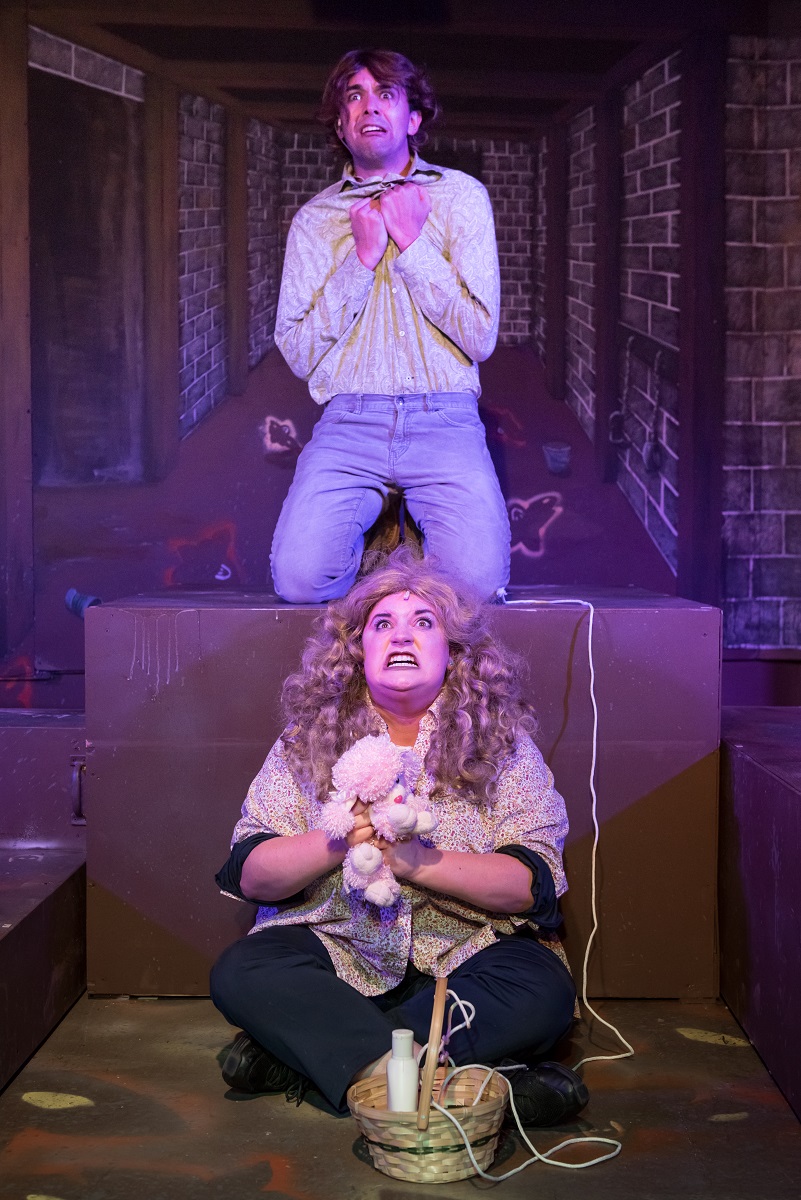
It may surprise many to know that in 2005 this script was selected as the Outstanding Musical at the New York International Fringe Festival, was listed in The 2011 Time Magazine Top 10 Plays and Musicals, and in 2012 it was anointed with the Off-Broadway Alliance Award for Best New Musical.

The story, which is told by an flock of lambs (Tonya Broach, BJ Colangelo, Dawn Sniadak-Yomokoski, David Turner, Connor Reese and Kat Glover), who act as a Greek chorus who sings, dances, and narrates the goings on.  The plot centers on Clarice Starling (Kelly Strand), a lisping student at the FBI Academy who hopes to work with the Behavioral Science Unit tracking down serial killers.  Her desire comes from an attempt to emulate her deceased father’s career.  She is sent to interview Dr. Hannibal Lecter (Brian Altman),  a brilliant psychiatrist and cannibalistic serial killer.  He helps her solve the FBI’s latest case, the mass killings of “zoftig” size-14 women by James Gumb (Joe Virgo), better known as Buffalo Bill.  BB believes himself to be transsexual, but is so psychotic he can’t qualify for sex assignment surgery.  He kills overweight women so he can remove their skin and fashion a “woman suit” for himself. 

Things get dicey when hefty Catherine Baker Martin (BJ Colangelo), the daughter of Senator Ruth Martin (Dawn Sniadak-Yamokoski) is kidnapped by Buffalo Bill.  A full scale FBI search is undertaken, headed by Jack Crawford (Mitch Manhey), the agent-in-charge of the FBI at Quantico, Virginia.  The bumbling and lecherous Dr. Frederick Chilton (Trey Gilpin), the director of the Chesapeake State Hospital where Lecter is confined, keeps getting in the way of the investigation.  Eventually Clarice, with clues provided by Lecter, tracks down Buffalo Bill, Catherine is set free, Lecter moves to a tropical island and calls Clarice to say goodbye.   (Honest, that’s the story.  Could I make stuff up like that?)

The production moves right along.  The vocals are adequate, with a few of the lambs and leads (mainly Dawn Sniakak-Yamokoski) hitting the right musical notes, the acting is farcically correct, and the dancing cleverly klutsy.  Most importantly, the laughs roll along.  

The BC band (Heidi Herczeg, David W. Coxe, Colin Dees and Jason Stebelton) has to be congratulated for keeping the volume down and not, as has been the case at this theatre, of drowning out the performers.

CAPSULE JUDGMENT:  SILENCE! THE MUSICAL is a typical Blank Canvas escapist musical comedy which will entertain the cult audience which the theatre has developed. Ciamacco knows his patrons and their tastes and has hit another home run with this script!
Blank Canvas’s SILENCE! THE MUSICAL  runs though November 5 , 2016 in its near west side theatre, 1305 West 78th Street, Suite 211, Cleveland.  Get directions to the theatre on the website. Once you arrive at the site, go around the first building to find the entrance and then follow the signs to the second floor acting space.  For tickets and directions go to www.blankcanvasthetre.com


Next up at BC is local playwright Stuart Hoffman’s KISS KISS BANG from November 10-13.  That is followed by CABARET, yes, the “Wilkommen,” “Maybe This Time,” and “Right This Way Your Table’s Waiting” musical.