Thursday, July 25, 2013

MEASURE FOR MEASURE…politics, power, and humor


Though Shakespeare, himself, classified his 1604 MEASURE FOR MEASURE as a comedy, modern literary thinkers refer to it as a problem play, a term developed in the late 1800s.

In problem plays, a social issue is examined comically, but contains tragic overtones.  The endings often seem contrived since they solve troubling issues in a superficial way, with no clear dénouement.  This format is well illustrated in MEASURE FOR MEASURE.

MEASURE FOR MEASURE deals with such issues as mercy, justice and their relationship to pride and humility.  The concept is highlighted by the script’s line, “Some rise by sin, and some by virtue fall.”

The play starts with Vincentio, the Duke of Vienna, relating that he is going to leave the city on a diplomatic mission.  He, in fact, is not going to leave, but wants to observe the goings on in the city which has been turned over to the very righteous Judge Angelo, a pontificator of strict morals. 

It doesn’t take long for Angelo to assert his power.  He has Claudio, a young nobleman and Juliet, his pregnant wife-to-be, arrested for having premarital sex, which is against the law.  He declares that Claudio is to be put to death.  When Lucio, goes to Isabella, Claudio’s sister, who is a novice nun, with a plea for her to intercede with Angleo on behalf of her brother, the major issues of the play unfold.  

It soon becomes clear that Angelo harbors lustful thoughts for Isabella and makes a proposal that her brother’s life will be saved if she agrees to a liaison with him.  The virginal Isabella refuses.
Meanwhile, the Duke, disguised as a friar, is observing.  He befriends Isabella and arranges to thwart Angelo’s evil intentions.  A “bed trick” is arranged in which Angelo will have sex with Isabella, but it will be in a dark room in which Mariana, to whom Angelo was previously engaged, but who was jilted by him when her dowry was lost at sea, will substitute for the nun. 

After getting his way, Angelo refuses to free Claudio, and demands that the boy be executed and his head be sent to him.  A Shakespearean plot device, know as the “head trick,”  ensues.  The head of a man who died of natural causes in prison is sent to Angelo, thus providing evidence that Claudio is dead.

The play concludes when the Duke returns to take back his throne, Angelo’s deeds are exposed, he is sentenced to execution, but is allowed to live if he will marry Mariana.  The Duke proposes to Isabella.  (If Isabella accepts, based on Shakespeare’s writing format, this would make the play a comedy as all’s well that ends well, but the dialogue ends in silence.  We know not whether Isabella agrees to the marriage.  Thus the script is dubbed a “problem play.”)

The Stratford production is well conceived by director Martha Henry.  The action is nicely paced, the characters clearly etched, and the technical aspects aid in developing the plot.  The inserted farcical shticks work, adding a needed lightness to what could be an oppressive plot.  One might question why the director chose to change the date of the play to 1949.  The language and the concept are much more fitting to a past time.

Standout performances include Geraint Wyn Davies as Duke Vincentio, though, at times, his projection fell off.  Stephen Ouimette is delightful as Lucio, a manipulative liar and gossip.  Tom Rooney is evil incarnate as Angelo.  Carmen Grant is properly austere as Isabella.  The rest of large cast well develop their roles.

Capsule judgement:  Shakespeare’s MEASURE FOR MEASURE gets a solid production at the Stratford Festival.  Its message of mercy, justice and their relationship to pride and humility is clearly etched.  Those who like the Shakespearean style of writing and plot development should be pleased with this staging.

MEASURE FOR MEASURE runs through September 21, 2013 at the Stratford Festival. For information call or go to: 800-567-1600 or go on-line to http://www.stratfordfestival.ca

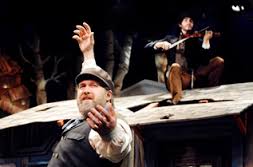
Festival’s FIDDLER ON THE ROOF will entertain many, but . . .


When Joseph Stein, Sheldon Harnick and Jerry Bock joined forces to write FIDDLER ON THE ROOF, now recognized as one of the greatest of American musicals, they did so in order to create an homage to their heritage.  A heritage which included hundreds of years of Jews in eastern Europe, whose life style and lives had been destroyed by pogroms (uprisings), forced evacuations, and ultimately by the “final solution,” the Holocaust. 

This was a life spent in the shtetels (villages) where they developed a culture of traditions, traditions which included the way they prayed, ate, dressed, did business, got married, and interacted not only with each other, but those non-Jews who controlled the politics of the regions.  They spoke Yiddish, a language that not only held words which carried their traditions, but had a spoken cadence that was identifiable. There was music (the haunting cantorial sound and Klemzer melodic beats), as well as literature, and artistic styles.

These traditions are the guts of FIDDLER ON THE ROOF, for, as Tevya, the central character indicates, without these traditions these people had no guidelings for how to live their lives.

The musical is set in the tiny village of Anatevka, in Tsarist Russia, in 1905.  It is loosely based on TEVYE AND HIS DAUGHTERS, written by the Yiddish writer and humorist, Sholom Aleichem (which in Hebrew means “peace be with you).  The action centers on a poor milkman with five daughters and his attempts to maintain his religious and societal customs, while internal attitude changes and outside influences exert their control over his people.  His faith is challenged when his three older daughters break from the accustomed patterns and the Tsar evicts all the Jews from his village.

The story is carried through not only words, but significant and meaningful music and lyrics.  The score includes such classics as “Matchmaker,” “If I Were a Rich Man,” “To Life,” “Sunrise, Sunset,” “Now I Have Everything,” “Do You Love Me,” and “Far From the Home I Love.”

FIDDLER is a story of people, who, over many centuries, have fought to create an existence held together by their religion and way of life.  Therefore, any production of FIDDLER has to be steeped in the sounds and practices of those specific customs.  Unfortunately, the Stratford production, under the direction of Donna Feore, only hints of that.  It misses out on developing the cadence of the language, the beauty of some of the traditions, and even the pronunciation of the spoken Hebrew. 

Feore explains these choices in her program comments, “A Story That Speaks to Us All.”  Yes, as she states, Fiddler is about generalized human values, but, most importantly, as conceived by the writers, it is about a micro-Jewish society, not a universal society.  As such, there must be fidelity to the customs of that specific society.  If the director and the cast don’t understand those rituals, the foundation of the musical is lost. 

Feore goes on to say that, “FIDDLER’S vocabulary of movement must be consistent with the culture.”  She did that well in the dance numbers, but missed in the real vocabulary, the spoken vocabulary and the vocabulary of customs.

On the positive side, the three older daughters, as portrayed by Jennifer Stewart, Jacquelyn French and Kelly Hutton sing well and develop clear and believable characterizations.  André Morin and Mike Nadajewski, both of whom have nice singing voices, are excellent as Motel and Perchik.

The choreography, the orchestration and the set, complete with visual reference to famous Jewish painter, Marc Chagall’s symbolic flying figures, is excellent.

Scott Wentworth, though he feigns the movements and the sounds, doesn’t succeed in creating a real Tevya.  He doesn’t seem to have the life experiences, nor has he been properly directed, to develop the needed vocal cadence, Tevye’s hand and body movements which are based on keeping time with the cantorial music, nor the bend at the knees and twisting movement commonly done while praying.  In addition, at times, rather than displaying the underlying wonder of the character, who even when pontificating is a well intentioned man, resorts to angry shouting.   This is not Sholem Alcheim’s Tevya.

Barbara Fulton, an understudy for Golda, misses the qualities that underlie the woman’s loving nagging, the very essence of the “Yiddisha” momma.  She has none of the required sound cadence. 

Gabrielle Jones’s misguided attempts at a “Jewish accent,” is more mocking than real.  Why is Paul Nolan (Fyedka), the only Russian with a heavy accent? 

One must wonder why the usually emotionally laden “Sabbath Prayer,” besides being expressively flat, did not portray the community coming together illustrating the traditional religious belief present in all of the village.  Why are traditional Jews entering and leaving places of habitation without kissing the doorframe mezuzah?  Why are the married women not wearing shaytles (wigs)? Why is the beloved rabbi being played like a fool, to garner laughs, rather than a delightful character.  The questions could go on and on.

Capsule judgement:  Those who are unfamiliar with real Eastern European Yiddish/Jewish traditions, will find Stratford’s FIDDLER ON THE ROOF to be an acceptable, maybe even a delightful experience.  Those who know the customs should be outraged by Feore’s tradition-light approach with her attempt to make the woes of Anatevka and the annihilation of Eastern Europe Jewry, into a universal story.

FIDDLER ON THE ROOF runs through October 20, 2013 at the Stratford Festival.  For information and tickets call or go to: For individual tickets call 800-567-1600 or go on-line to http://www.stratfordfestival.ca

Thought-provoking, farce-infused WAITING FOR GODOT


Having endured the great depression, the rise of Fascism and Imperialism, the Holocaust, the dropping of the atomic bomb, and the physical destruction of much of Europe and Asia, following World War II the people of the earth were in psychological chaos.   Since the arts represent the era from which they come, it was only natural that new forms of theatre were developed to mirror the state the inhabitants.

The Theatre of the Absurd, a reflection of existentialism, which asks, “Why do we exist,?” is showcased in the works of Edward Albee and Samuel Becket.  Their plays look at creating meaning out of chaos.  Their works don’t give answers, they ask questions.  Albee used high level drama (think, WHO’S AFRAID OF VIRGINIA WOOLF), while Beckett, a lover of slapstick comedy (think the Marx Brothers, Charlie Chaplin and Buster Keaton), wrote in the farce format.  He looked at an existence of things that were not only out of kilter, but were ridiculous.

WAITING FOR GODOT, which was recently ranked as number 8 by Daniel Burt in his book, THE DRAMA 100:  A RANKING OF THE GREATEST PLAYS OF ALL TIME, is Beckett’s classic.

The play finds two unkempt men, shabbily dressed in a desolate setting…a white swash of land in the midst of space, a rock, a tree, and a suspended mechanical moon-like sphere.  They are waiting for Godot.  They wait, they talk, they wait, they sleep, they search for ideas, they forget, they meet two strangers, they wait, they are told by a young boy that they will have to continue to wait as Godot will come tomorrow, and then another tomorrow.  They leave and return to only wait some more.

A succinct early review of the play stated that this was a production in which nothing happens--twice.  Yes, not much seems to happen in the first act, and the same futility is present in the second act.   Nothing happens?  Not true.  While there is limited action, the audience is involved in a continuous game of mindful questions.

Who are these men?  Where are they?  Why are they waiting?  Who is Godot?  Why are they emotionally bound to each other?  Why, as one states, “Is nothing certain?”  Why is there such discomfort in silence?  Why do they even exist?  And, most importantly, how does this reflect and exemplify each of us and our lives?  What are we each waiting for? Is each of our lives a search for meaning and purpose?

The Stratford Festival’s GODOT has many strong high-points, but opens itself to questions.  Major among the issues is why did director Jennifer Taver conceive a production in which the first act is bland, while the second act explodes with farce and meaningful action?  Did she create a play which develops Beckett’s intents and purposes? 

On the positive side, The show is well paced, the shticks and gimmicks that are inserted work, and the characterizations generally effective.

Stephen Ouimette is excellent as Estragon.  He nicely textures his lines, well develops the farcical aspects, while maintaining a realness in his characterization.  Tom Rooney is not as successful as Vladimir.  There are times when Rooney seems to divorce himself from the stage and feigns rather than lives the role, saying words rather than ideas with meaning.  

Brian Dennehy effectively underplays Pozza in the first act, while adding a special texturing to the “blind” Pozza in the second act.  Randy Hughson creates a believably pathetic Lucky.  His extended monologue, when he breaks from his controlled shell and spews a Beckett-speak message of anguish, is compelling.

The set, lighting, and interlude music all add positively to the production.

Capsule judgement:  As illustrated by the curtain call to WAITING FOR GODOT, this is a love-it or hate-it experience.  While half of the sold-out audience was on its feet shouting, “Bravo,” the remainder were passively sitting in their seats, shaking their heads in confused wonder. 

WAITING FOR GODOT THE runs through September 20, 2013 at the Stratford Festival.  For information call or go to: 800-567-1600 or go on-line to http://www.stratfordfestival.ca
THE THREE MUSKETEERS--swashbuckling farcical intrigue at The Festival

 
The hallmarks of France’s most widely read author are sword fights, battles for the honor of beautiful women, court intrigue, sexual liaisons, and comradeship.  Yes, Alexandre Dumas, known for his high adventure serials, books and plays, is the king of farcical, melodramatic epics.  Among his works is THE COUNT OF MONTE CRISO, TWENTY YEARS AFTER and THE THREE MUSKETEERS.  The latter has been transformed into a stage play by Peter Raby and is being staged at The Stratford Festival of Canada.

Dumas’s recounting of debauchery seems to have had a sound personal knowledge base.  He is noted as having at least 40 affairs and fathered at least four legitimate and illegitimate children.  His writing of sword and political intrigue also comes from experience.  He participated in the revolution that ousted Chares X and replaced him on the throne with the Duke of Orléans.

There is some question as to whether Dumas was the sole author of THE THREE MUSKETEERS.  As was the custom during his era, writing with partners was in vogue.  The purported Musketeer co-author was August Maquet, who took Dumas to court to try and get authorial recognition and payment for his work.  He was successful in getting some money, but not a byline.

As the curtain rises, we are in the midst of a savage sword fight.  We soon learn that the combatants are D’Artagnan and his father.  The young man is about to go off in search of achieving his goal of becoming a Musketeer of the Guard and is honing his skills.

Through the course of sword fights, conflict, wine, women, and poetry, we find D’Artagnan and his three fellow musketeers, Athos, Porthos and Aramis, fighting for king, country and love.  We are exposed to devious Cardinal Richelieu and equally evil Milady de Winter who attempt assassinations, and incite plots and counterplots.  And, of course, in the end, virtue wins out over evil as the musketeers live by the motto, “All for one and one for all,” and defeat the “bad guys.” 

Those who want more of this fun need to read TWENTY YEARS AFTER, Dumas’s follow-up book.

The Stratford production, under the creative direction of John Tiggeloven, is delightful.  For anyone who loves the swashbuckling serials of old, likes big costume shows, and are lovers of farce, this is your thing!   The two and a half hour show time flies by.

The cast has a great time playing heroes, evil villains and rogues.  The sword fighting scenes are realistic and well choreographed.  The flexible set and quick changes of location make the production almost cinematic.  The extended farce is well timed.

Handsome Luke Humphrey is charming as D’Artagnan.  He transitions with ease from naïve boy, who wants to be a do-gooder, to an upstanding musketeer who attempts to save the world.  He adds a nice youthful air to the action. 

He is well assisted by his band of merry men, the three inseparables, Jonathan Goad (Porthos), Mike Shara (Aramis) and Graham Abbey (Athos).  

Steven Sutcliffe creates evil incarnate as Cardinal Richelieu (boo!), while Deborah Hay creates a MILADY DE WINTER (double boo!)  into a devious lady who no one should trust.

Antoine Yared adds humor as Planchet, D’Artagnan’s servant.  Bethany Jillard is charming as D’Artagnan’s love.  The rest of the cast is also excellent.

(Parents be aware that charged language is used and non-graphic sexual scenes take place.)

Capsule judgement:  Stratford’s THE THREE MUSKETEERS is a melodramatic delight filled with swashbuckling action, farcical interludes, and bigger than life characters.   It tells the triumphant tale of good winning out over evil.  The production should delight those who want to escape the real world and live out the fantasies of days gone by.

THE THREE MUSKETEERS runs through October 19, 2013 at the Stratford Festival.   For information call or go to: 800-567-1600 or go on-line to http://www.stratfordfestival.ca

MARY STUART reigns mightily at Stratford


It is no wonder that the Stratford Festival’s MARY STUART has been extended three times due to sold out houses.  This production, under the meticulous director, Antoni Cimolino, is as perfect as dramatic theatre can get.  The acting is superb, the pacing spot on, the emotional levels well honed, the visualizations clear.  In other words, this is theatre as it should be!

Peter Oswald’s new version of Friedrich Schiller’s MARY STUART centers on a fictional meeting between Mary, the deposed Queen of Scots and Elizabeth I, Queen of England.  The intrigue centers on who is the “real” queen, which extends into a mockery of justice, religious bigotry, jealousy and court intrigue.  Though the meeting never really took place, the queens were, indeed, bitter rivals and enemies.

From a historical perspective, Mary and Elizabeth share Tudor blood, are cousins, and rivals for the British throne.  Mary, a Catholic, was in fact, accused of plotting her husband’s murder, and unwisely fled to Protestant England.  Her real crime, however, was her desire to be Queen of England. Elizabeth’s continued reluctance to have Mary killed is centered on a realization that with the Scots many friends and allies, especially in France, a dead Mary might well be worse than an imprisoned Mary.  After a 19 years of imprisonment Mary is finally put to death for treason.

Mary and Elizabeth are quite different as people.  Mary got married and begat a son, a potential heir to the throne.  Elizabeth, often called the “virgin queen,” dedicated her life to her throne, putting aside her person life.

Schiller plays a little loose with history.  The script develops strong sympathy for Mary through the playwright’s altering some facts, creating people who were never part of the intrigue, and actions unsupported by any written record.  But this is historification theatre and not a treatise on historical fact.  These alterations help make for a play which may be more dramatic than the real tale.

Lucy Peacock takes on the cloak of Mary and becomes that martyred monarch.  This is a well-developed characterization with an eye on consistent emotional and physical fidelity.  It is performance at its finest.

Seana McKenna is Peacock’s equal, developing a flawless portrayal of Elizabeth.  She does not act Elizabeth, McKenna becomes Elizabeth.

The rest of the cast is superb.   Patricia Collins (Hanna Kennedy), Ian Lake, (Mortimer), Brian Dennehy (Earl of Shrewsbury), and Geraint Wyn Davies (Earl of Leicester), among others, create believable personages.

Beautiful costumes, an efficient set, well selected music, and effective lighting all add to the creation of a marvelous and compelling production.

Capsule judgement:  Stratford’s MARY STUART is classical theatre at its finest.  Seeing this production is an experience which no theatre-goer should miss out on!  Bravo to the director, cast and technical staff!

MARY QUEEN OF SCOTTS is in an extended run through October 11, 2013 at the Stratford Festival.  Tickets are limited due to strong demand.  For information call or go to: 800-567-1600 or go on-line to http://www.stratfordfestival.ca

Wednesday, July 24, 2013

Is that Leonard Bernstein or Hershey Felder on stage at Cleveland Play House?


Leonard Bernstein is noted as the first conductor of a major orchestra who was born in America.  His talent as a composer, author, music lecturer and pianist has made his name a household word.  Besides his long tenure as the musical director of the New York Philharmonic, he is noted as the composer of such Broadway shows as WEST SIDE STORY, CANDIDE, WONDERFUL TOWN, and ON THE TOWN.  His most noted classical composition was MASS, dedicated “To the memory of John F. Kennedy.”

Canadian Hershey Felder is recognized as a pianist, actor, playwright, and composer.  His fame has mainly centered on his portraying well known composers and performers.   An accomplished pianist, performing in such pieces as GEORGE GERSHWIN ALONE, MONSIEUR CHOPIN, BEETHOVEN: AS I KNEW HIM, Felder not only takes on the persona of the man whose life he is presenting, but also plays the person’s music.

His latest creation is MAESTRO:  LEONARD BERNSTEIN A PLAY WITH MUSIC. 

As the audience enters the Allen Theatre, on a large background consisting of a page of music, a video of the late Leonard Bernstein giving one of his masterful lectures on how to conduct, is seen.  Also present is a piano, several chairs and a television camera.  At one point in the video, in a smooth transition, Bernstein’s image is replaced by that of Hershey Felder.  At that moment Felder appears on the stage as Bernstein.

What follows is a personal exposition with Felder (Bernstein), in present tense language, telling of his transition from a young son of Orthodox Jewish Russian immigrants to his untimely death. 

We learn of his tenuous relationships with his father, mother, wife, and male lover, as well as his tenacity in meeting and becoming an associate with many kings of the classical and theatrical world including Aaron Copeland, Serge Koussevitzky, Adolph Green, and Jerome Robbins. 

He shares the startling story of his assent into the rarified world of conducting when, on November 14, 1943, while serving as assistant conductor of the New York Philharmonic Orchestra, without any rehearsals, he was thrust on stage to replace conductor, Bruno Walter, who had suddenly become ill.  A fairy tale ending results in Bernstein’s quick assent into recognition as a major conductor.

As Felder has proved when he appeared on the Cleveland Play House stage in 2008 and 2010, he is a master storyteller and a competent pianist and vocalist.  His MAESTRO: LEONARD BERNSTEIN is by far his best imitation of a life lived.

He looks somewhat like the maestro, has developed the vocal and physical affectations of Bernstein, and melds himself so well into the character, that it is difficult to separate the two.  The script is well written.  The performance effectively acted and played.

CAPSULE JUDGMENT:  MAESTRO:  LEONARD BERNSTEIN is a compelling evening of discovery which exposes not only the life of a real person, but is an intriguing probe into the world of music and life in the arts.  This is a must see for anyone interested in music and theatre.

MAESTRO:  LEONARD BERNSTEIN runs through August 6, 2013 at the Allen Theatre in PlayhouseSquare.  For tickets call 216-241-6000 or go to http://www.clevelandplayhouse.com.

Monday, July 15, 2013

Compelling 12 ANGRY MEN @ Blank Canvas


Little did Artistic Director Pat Ciamacco realize when he elected to produce Reginald Rose’s 12 ANGRY MEN that his selection would be fortuitous.  How could he have known that the Casey Anthony and George Zimmerman trials would be the major news stories, with the latter being decided the day Blank Canvas’s production opened.

With all the recent attention on the jury process, and the effects of the attitudes, prejudices, perceptions, and argumentative skills of the attorneys, observing the process up close, is an engaging experience.

12 ANGRY MEN is a drama about an all New York male jury, which, in 1957, is charged with deciding the fate of a teenager charged with killing his father.  Though the audience doesn’t sit in on the trial, itself, they are privy to the deliberations in the jury room.  As is the case in most criminal jury cases, the panel must unanimously agree on the verdict.  Failure to do so will result in a hung jury.  The guilty verdict will result in the death penalty.  The original tally of the jurors indicates an 11 to 1 vote for a guilty verdict.  As the debates go on jurors reveal racial prejudices, personal problems which enter into their thought processes, and business and historical situations which cause conflicts. 

Rose has written several versions of the play, including an all female and mixed jury editions.  Interestingly, each of these was not as successful as the all male version.  Rose has a keen understanding of male speech and conflict patterns.  He understands that males spare for dominance, interrupt each other, display strong emotions including outbursts of both physical and verbal attack  and often let emotions cloud logical reasoning.  All of these are clearly displayed in the 12 ANGRY MEN dialogue.

Director Patrick Ciamacco, again, in this production, proves he is one of the best of the area directors.  The staging is meticulous.  Each actor has a clear understanding of his character and the person’s underpinnings.  Throughout, the cast reacts physically to on-going activities, not just waiting to say their lines, with focused eye contact, body movements and facial reactions.  Different accents, pacing, and vocal intensity are displayed.  

There is not a weak characterization by any cast member.  Mitch Manthey stands out as the guilt-conflicted father.  Strong performances are also put in by  Robert Hawkes, Scott Esposito, Perren Henderson, Tom Hill, Tim Tavcar, and John Polk.

The set design creates the claustrophobic and needed warm atmosphere to develop the script’s setting and make the audience, who is seated within close proximity to the action, feel the oppressive heat.  Most of the costumes are era correct.

CAPSULE JUDGMENT:  Blank Canvas’s 12 ANGRY MEN is a compelling production which should be a must see for anyone interested in the justice system, fine acting, and a special evening of theater.  BRAVO to the cast and director!

Blank Canvas’s  12 ANGRY MEN runs though July 27 in its near west side theatre, 1305 West 78th Street, Suite 211, Cleveland.  Get directions to the theatre on the website.  Once you arrive at the site, go around the first building to find the entrance and then follow the signs to the second floor acting space.  It’s an adventurous battle. For tickets and directions go to http://www.blankcanvastheatre.com

Sunday, July 14, 2013


SPAMALOT:  silly fun at Beck

You know you aren’t in for the typical Broadway musical, when, at the start of SPAMALOT, now on stage at Beck Center, a historian gives a brief overview of medieval England and a Finnish village appears with dancers slapping each other with dead fish as they perform the “Fisch Schlapping Song.”   That opening, complete with women knocking down their male partners, is just the start of the bizarre goings on.

You don’t go to see SPAMALOT to learn the history of Britain, or gain a political or social message. You go to have a fun time watching a musical version of the 1975 film, MONTY PYTHON AND THE HOLY GRAIL, an irreverent parody of the King Arthur legend, with lots of ditsy sidetracks.

The Broadway production, which starred Tim Curry, David Hyde Pierce and Hank Azaria, was written by Eric Idle, with music by John DuPrez.  It won three awards at the 2004-2005 Tony ceremonies.

We gleefully watch as King Arthur travels the lands with his servant Patsy, trying to recruit Knights for his famous round table in Camelot.  Don’t confuse this with Lerner and Lowe’s CAMELOT.  That version of the story offers the idea of the perfect time, place, and love story.  This look-see shreds the idyllic with hysteria.

In the process of the “plot” development, we are introduced to the Lady of the Lake, a political radical mother and son who think the king should be elected, an Excalibur resort, the presence of and the word of God, the search for the Holy Grail, lewd French soldiers, a Trojan rabbit, cancan dancers, a holy hand grenade, the search for shrubbery, an explanation of why you can’t do Broadway musicals without Jews, the revelation of a gay “princess,” the outing of Lancelot, and the importance of the Beck theatre’s seat A101.

Songs such as “I’m Not Dead Yet,” “Laker Girls Cheer,” “The Song That Goes Like This,” “You Won’t Succeed on Broadway,” “The Diva’s Lament,” “Here Are You,” “I’m All Alone,” and “Always Look on the Bright Side of Life” carry  us on the convoluted journey.

Beck’s production, under the direction of Scott Spence, wisely goes for guffaws.  Though even more exaggeration and a faster pace would have been appropriate, to the delight of the audience, most of the farcical shticks work.

Martin Céspedes, the master of getting non to mediocre dancers look like real hoofers lets lose his creative juices.  The stage explodes with tap, jazz, South American and modern dances.  The classic FIDDLER ON THE ROOF bottle dance, the can-can and a hip hop repertoire add to the fun. 

Musical director Larry Goodpaster’s orchestra plays excellently, but they sometimes get over-enthusiastic and drown out the singers.  Since hearing the words being sung is vital to understanding the show and inciting the laughs, this, and some overdone accents, turns out to be a detriment.  The vocal sound of the chorus and cast members is excellent.

The cast is universally good.  Dougfred Miller displays the right pomp and self-effacing dimwit attitude to give us a very credible King Arthur.  Pat Miller delights as Patsy.  Miller and Miller’s “I’m All Alone” is laugh infused glee. 

Brian Altman has the right attitude for the macho, yet closeted Lancelot.  Matthew Ryan Thompson uses his comic talents well as Sir Robin.

Tim Allen is fun as Prince Herbert (or should it be Princess Herbert?).  His “Where Are You” and “Here Art You,” are show highlights.  Jessica L. Cope, she of powerful voice and well-endowed body, wails as Lady of the Lake.  Her “The Diva’s Lament (Whatever Happened to My Part?),” was delightful.  

The female dancers are strong.  The males vary in their abilities, with Storm Hurwitz and Christopher Sanders giving standout performances.

Trad Burns’ set design and Aimee Kluber’s costumes, add the right era touches.

CAPSULE JUDGEMENT: As my grandson Noah, one of the kid reviewers who goes along to give me a fresh eye to shows, said as we exited the theatre, “That was fun.  I really liked it!”  Anyone who is in the mood for silliness and exaggerated humor should  totally enjoy Beck’s ”you’ve got to see this,” SPAMALOT!

SPAMALOT is scheduled to run through August 18 at Beck Center for the Arts.  For tickets and information call 216-521-2540 or http://www.beckcenter.org  

Sunday, June 23, 2013


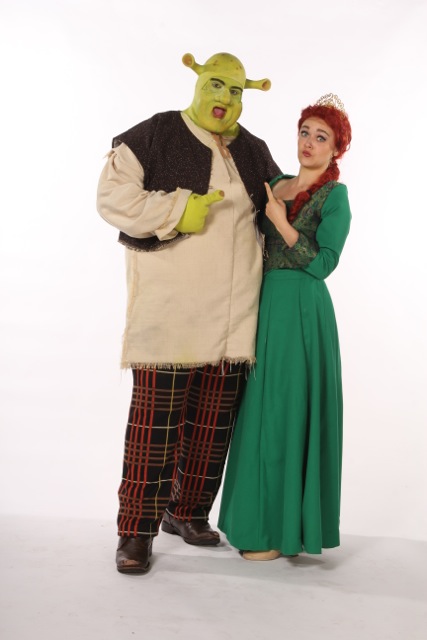
SHREK should please many at Mercury Summer Stock

SHREK has music by Jeanine Tesori and book and lyrics by David Lindsay-Abaire. It is based on the 1990 book SHREK! by William Steig, as well as the 2001 DreamWorks film.  The musical opened in New York in December of 2008, after much rewriting and many cast changes,  and ran for 441 performances.  The script was changed for the touring production, and has been altered more since it was released for nonprofessional productions.  There were additions and deletions of songs, for example, a new opening and I’m a Believer, one of the most endearing tunes, was changed from exit music for the audience to being the last song of the show.

The story concerns a swamp-dwelling ogre who, as a child, was sent away by his parents to find his own path.  Big, green and ugly, the belching, gas passer, goes on a life-changing adventure when his land is invaded by a slew of fairy tale characters (e.g., Pinocchio, Wicked Witch, Sugar Plum Fairy, the 3 Bears, Peter Pan, Ugly Ducking and Big Bad Wolf) and by the mean, vertically challenged Lord Farquaad.  In order to get his land back, Shrek must rescue Fiona, a cursed lovely princess, fight a dragon, and figure out what to do with a smart-mouthed talking donkey, who becomes his “best friend.”  Hey, this is a fairy tale, remember?  All in all, the ridiculousness in the script works, and works well.  And, yes, there is a happily ever after ending.

The music is infectious.  I defy anyone to sit through “I’m a Believer” and not rock and roll in your seat.  Other highlights include:  “I Know It’s Today,” “Who I’d Be,” and the very funny “Don’t Let Me Go.”

Several years ago, when I reviewed the Key Bank Broadway touring production of SHREK, The Musical, my capsule judgement was:  “I’m a sucker for a well staged, fun musical.   SHREK fits the bill.  I left humming the songs and smiling as many of the kids and adults walked out proudly stating that they had became believers!”

I wish I could say the same thing about Mercury Summer Theatre’s production of the script.  To be honest, I can’t, but that’s not to indicate that others might not be delighted by the production.

One of the things that many theatre-goers don’t take into account when they see a play is that there are different production levels of theatres, with resulting different levels for what happens on stages.   These differences affect how reviews of a show are written.

It’s my belief that when I see a show on Broadway, I should be expecting the best of the best.  Same goes for a Broadway touring production and to a somewhat lesser degree at the Cleveland Play House and Great Lakes Theatre.  These are all professional theatres who employ actors, directors, choreographers, costumers, and other technical people who are, are should be, at the top level of production skills.  Local theatres, such as Beck Center for the Arts and Dobama, who pay their casts and performers are doing so because they are trying to get the best  of the best of those who are available on the local scene.   Their cast lists are filled with names followed by a *, indicating that the actor is in Actors Equity.  They also employ paid production teams.

Community theatres, who usually depend on lots of volunteers who find theatre “fun,” or who are putting out effort to learn the craft of theatre, often don’t reach the level of the “pros.”  That’s not to say just because someone gets paid, or has a union card, that they are better than the volunteers, but the latter often don’t have the experience, training or time to be major participants in the theatre.

Mercury Summer Stock is a community theatre.  Though they have actors in their casts who are Equity, most of their performers are high school and college students who do theatre for the love of doing theatre.  The company also uses short rehearsal times.  They operate on a shoestring budget and have limited staffs.

Therefore, seeing a production at Mercury normally can’t be compared to the Broadway, touring or local professional theatres.  That’s not a knock on Mercury, just an explanation of why, in spite of saying their production, no matter if your child, grandchild or next door neighbor is in the cast, or your friends are an integral part of running the theatre, to say that their productions are “better than Broadway,” usually isn’t so.  The same can be said for Weathervane, Chagrin Valley Little Theatre or any of the other community theatres.   Again, it’s not a knock on them, just reality.

MSS’s SHREK will delight many.  Several members of the cast are outstanding for a production at this level.  Kudos to Sara Masterson, who makes for a beautiful Princess Fiona and makes such songs as Morning Person and Who I’d Be (sung with Patrick Ciamacco--Shrek, and Justin Woody--Donkey) show pleasers.

Justin Woody is generally joyful as Donkey, but needed a little more abandonment, especially in the first act.   By the second stanza, he was flying high.

Patrick Ciamacco is the vision of Shrek, though, at times, he needed to further texture his role and up-play some of the farcical scenes.   I Think I Got You Beat, his duet with Masterson, was delightful as was their burping and passing gas scene.  His strong voice soared in the reprise of Big Bright, Beautiful World.

Kelvette Beacham wailed as the Dragon in Forever, while Elise Pakiela was princess-cute as Young Fiona and Brian Marshall delights as the puppet garbed dwarfed Lord Farquaad.

Ed Carney’s orchestra was excellent, but there were vocal blend issues with some of the chorus segments.

Pierre-Jacques Brault’s choreography was enthusiastic and generally creative, but not always smoothly executed.  Some of the staging worked well, while straight lines, and people ducking behind others after speaking their lines created some distracting stage pictures.  Many individual characterizations were on target (e.g., Max Joseph as Peter Pan).  Others, especially the actors who attempted to “sound” like their fairy tale characters, squeaked and screeched to the detriment of clarity of characterization and being understood.

The puppet designs by PJ’s Puppets were delightful.  Falcon Stage Productions sets, especially the hand manipulated center stage turntable and the folding flats, distracted from the flow of the show.

CAPSULE JUDGEMENT:  SHREK is a creative script.  The Mercury Summer Stock production will delight many.  This is a community theatre production, and, a fairly acceptable one.
SHREK runs through June 29 at Mercury Summer Stock.  Call 216-771-5862 or go to www.mercurysummerstock.com for tickets.

Mercury’s next show is RAGTIME, from July 5-20, in the company’s home at Notre Dame College in South Euclid.

Saturday, June 22, 2013


SMOKEY JOE’S CAFÉ, a pleasant summer escape at Cain Park

A musical review, by the very nature of its structure, is usually not of great interest to those theatre-goers who want a story line or an over-riding theme.  Someone attends a musical review because there is a tuneful style or type of music that you like or there are some singers performing who you want to hear.  

SMOKEY JOE’S CAFÉ, now on stage at the Alma Theatre in Cain Park, showcases 39 rock and roll, and rhythm and blues songs that were composed by Tony Award winners Jerry Lieber and Mike Stoller.    Its claim to fame is that it ran long enough after its 1995 Broadway opening to claim the title of the “longest-running musical review in Broadway history.”

The list of songs is impressive.  They include Falling, Trouble, Fools Fall in Love, Yakety Yak, Spanish Harlem, Loving You, Hound Dog, There Goes My Baby, Fools Fall in Love and Stand By Me.  Yes, there are novelty songs, romantic ballads, and the sounds of Elvis.  But, what there isn’t is a theme.  That means there is no story line or hooks to tie the songs together.

The lack of a story, makes it difficult for director Scott Plate and choreographer Gregory Daniels to create anything but a series of individual entities.  It’s like 39 one-act plays without any of them having anything to do with the other 38.

Plate and Daniels make every effort to devise concepts for each number.  They mostly succeed, but even these talented guys run out of ideas. 

Musical Director Nathan Motta stands stage right, in front of his great sounding  band, and dances and sways to the musical sounds.  It adds a nice feel, but his gyrations sometimes upstage the performers by drawing attention away from their dancing and movements.

There is a great sax solo by David Kasper during the rock and roll segment in Act 2.

The cast (Ellis Dawson, Eugene Sumlin, Malik Victorian, Darryl Lewis, Julia Rose Hines, Kelly Autry, Nyla Watson, Katherine Deboer and Nicole Sumlin) have good voices, move well, and generally sing meanings rather than words, thus creating sense out of most of the songs. 

Trad Burns’ set design is distracting.  Rather than setting a café in which the format would make sense, he places the production in what looks like a factory.  Performers duck under set levels and basically crawl out of a short uppermost doorway.  There is a grungy lack of intimacy, in spite of the performers being almost within touching distance of the audience. 

Words to the songs often get lost in the tent like Alma Theatre.  Soft walls, hard floors and outside noises makes sound designer Richard Ingraham’s task difficult.

Tesia Dugan Benson’s costume designs are often confusing.  Clothing sometimes doesn’t fit the mood of a song.   After a while the hodge-podge of colors and materials became a suffocating blur.

Highlight numbers included Dance With Me and Searchin’, which were peppered with cute shticks, On Broadway, which had clever and enthusiastic choreography, Saved, which showcased unbridled enthusiasm, the smile-inducing Charlie Brown, and I Am Woman, probably the best sung song of the evening.

CAPSULE JUDGEMENT:  If you are interested in an evening of pleasant singing and dancing SMOKEY JOE’S CAFÉ will be your thing.  Me?  I like musicals with a story line or at least an attempt to make the “pieces parts” fit together.
Tickets for SMOKEY JOE’S CAFE, which runs through June 30 at Cain Park’s Alma Theater, can be obtained by calling 216-371-3000 or going on line to www.cainpark.com


BOOK OF MORMON, is a must see delight at The Palace

“Hello, my name is Elder Price and I would like to share with you the most amazing book,” states the lead actor in THE BOOK OF MORMON, now on stage at the Palace Theatre.

“Hello, my name is Roy Berko and I would like to share with you my enthusiastic endorsement for a most amazing musical,” states the writer of this review!

Trey Parker and Matt Stone, the long-time writers of SOUTH PARK, are satirical comics extraordinaire.  Their writing marriage to Robert Lopez, the co-creator of the Tony Award winning AVENUE Q, is a union made in heaven (or at least in the Broadway version of heaven). 

THE BOOK OF MORMON is a satirical musical filled with lots of explicit language.  It lampoons organized religion and, in its own way, not only follows the format, but mocks traditional musical theatre. 

It tells the story of two naïve and optimistic Mormon missionaries who are sent to a remote village in northern Uganda.  A brutal warlord is threatening the locals.  While the duo is trying to sell the locals on Mormon scripture, the populations is more concerned with famine, poverty, female circumcision, war and AIDS.  Oh, what to do, what to do?

How did the duo get to Uganda or even get matched together?  Elder Price is the poster boy for the Ken doll, clean cut, striving for perfection Mormon missionary.  Elder Cunningham is a rotund, friendless nerd, who relies on half-truths and a vivid imagination to get by.  They were cast as a duo through total serendipity, an act of heaven, and some clever comic writers, to go out and ring the doorbells of the world.

Uganda?  Price prays to go to Orlando, a stand-in for Mormon heaven.  Sure, it’s immaculately clean, all things well planned, and the setting for a perfect life.    What can go wrong in a “Small, Small World,” where Dumbo really flies, and the future is ready for all who want to enter the Magic Kingdom?  Sending them to Orlando wouldn’t have been funny so to Uganda they go, to learn life altering lessons.

As Elder Cunningham, who admits never having read the mythical Book, makes up fantastic tales, which, in reality, aren’t far from the actual imaginative tales of Adam Smith, Brigham Young, the golden tablets, and the migration of the Mormons from upstate New York to Salt Lake City, he wins over converts. 

After he baptizes the entire town, the church’s elders come to witness the miraculous success.   The villagers share their understanding of the Cunningham version of their new religion in a reenactment, which parallels in form to The Small House of Uncle Thomas in the KING AND I, with illusions to Climb Ev’ry Mountain from THE SOUND OF MUSIC.  Of course chaos results, then everything turns out fine, and we leave the theatre singing, I Believe.

The touring show is spectacular.  It plays visually and emotionally on all the senses.  From its giddy opening number (think the Telephone Hour at the start of BYE, BYE, BIRDIE), to its mocking use of four letter words, to its bigger than life melodrama, to the over-the-top mythology (often paralleling the belief system to STAR WARS), we are sucked into the idea that , as one of the words to the many delightful songs states, “tomorrow is a doper, phatter latter day.”  (I won’t even go into the concept of the song MA HA NEI BU, EEBOWAI! [“F-You to Heavenly Father], you just have to experience it to experience it!)

The settings, music, costumes, lighting effects, perfect comic timing of the cast, and creative choreography all work.

Though Mark Evans (Elder Price) and Christopher John O’Neill (Elder Cunningham) aren’t as brilliant as Andre Rannells and Josh Gad, who were in the original cast of the 2011 Broadway cast, they are excellent, and quickly captivate the audience.  Samantha Marie Ware is enchanting as Nabulungi.  Derrick Williams, is both hysterically funny and evil incarnate, as General Butt-F**cking Naked, the war lord.  The rest of the cast also shines. 

Casey Nicholaw and Trey Parker’s direction is spot on.  Farce, especially musical farce is hard to accomplish due to its required spoken and sung controlled abandonment, but these guys guide their cast with laser perfection.  Nicholaw’s  choreography is fun and well executed (ever thought you’d see a dancing kick line of Mormons?).

As the curtain fell on the second night’s performance, my seventeen-year old grandson smiled at me and yelled, “That was a perfect musical.  It had a solid score, meaningful words, the story was not only fun-filled, but made its points well, the dancing was spectacular, the performances were great.” Why are his reactions important?   Readers often comment that reviewers don’t see shows through the eyes of the general audience member.  Alex has been accompanying me to musicals for many years as “the kid reviewer” and sees shows through fresh eyes.  And his eyes were beaming!

CAPSULE JUDGEMENT:  THE BOOK OF MORMON is an absolute go see production for anyone who is not a language prude or a religious fanatic.  It is filled with total delight, magical showmanship, a marvelous score, creative dancing and fine staging.  It’s everything a modern musical that is meant for pure entertainment, with a sip of philosophy, should be!
The few remaining tickets for THE BOOK OF MORMON, which runs through July 7, 2013 at the Palace Theatre, can be ordered by calling 216-241-6000 or going to www.playhousesquare.org.

Sunday, June 16, 2013


SOUTH PACIFIC lights up Porthouse

Richard Rogers and Oscar Hammerstein, Jr. are considered the fathers of modern American musical theatre.  Their OKLAHOMA opened the door to musicals with meaningful storylines, and the integration of lyrics, dancing and music to help move the plot along.

As with all of Rogers and Hammerstein’s musicals, there is a strong societal and moral base.  This aspect of their scripts is usually highlighted by a key song.  In SOUTH PACIFIC, which is the opening show of Porthouse Theatre’s 2013 season, it’s the poignant You Have to Be Carefully Taught which keys the concepts of racism and prejudice that underscores the story.

Premiering in 1949, the original Broadway production, which starred Mary Martin and Ezio Pinza, became the second longest running musical of its time.  That production won ten Tony Awards.  A 1958 film and a 2008 revival were also critical and audience successes.

Based on James Michener’s Pulitzer Prize winning book, THE TALES OF THE SOUTH PACIFIC, the World War II story relates a tale of Nelly Forbush, an army nurse from Little Rock, Arkansas, who falls in love with Emile De Becque, a middle-aged French expatriate plantation owner who has two mixed-race children, and a parallel love story between Lt. Cable, also an American southerner, and Liat, a Tonkinese woman.  Because of  Forbush and Cable having been imbued with racial biases, both love affairs run into difficulties.

The show is imbedded with wonderful songs including Cockeyed Optimist, Some Enchanted Evening, Bali H’ai, Younger Than Springtime, Happy Talk, and Dites-Moi.

Artistic Director Terri Kent knows her Porthouse audience well, and SOUTH PACIFIC is definitely their kind of show.  She directs for audience enjoyment, creating a show filled with joy, sprinkled with pathos.  She succeeds well.

Mary Ann Black’s choreography is sprightly, Ben Needham’s set creates the right Pacific Island atmosphere, and musical director Jonathan Swoboda does a good job with the chorus and lead performers’ vocal sounds.  The dual pianos sound rather naked playing the lush score.  This was a production that could have been aided by a full orchestra.

Though her needed Southern accent came and went, pretty Kayce Cummings (Green) generates the right level of cutesiness to make for a charming Nellie.  Her I’m Gonna Wash That Man Right Outa My Hair was delightful.

Cleveland area favorite Gregg Violand has advanced to the age level where he can use his powerful voice to aid in developing a convincing Emile.  His consistent French accent adds to the creation of a believable character.  His This Nearly was Mine was beautifully interpreted and sung. There is a nice connection between Cummings and Violand.

Tim Welsh delights as the scheming con-man Luther Billis.  Honey Bun, sung with the Cummings, was an audience favorite.

Kaishawn Thomas was lovely as Liat and, though she didn’t quite play enough for the requisite laughs, Coleen Longshaw was an acceptable Bloody Mary.

CAPSULE JUDGMENT: Under the directing abilities of Terri Kent, the Porthouse production of SOUTH PACIFIC makes for a fine evening of summer entertainment.
SOUTH PACIFIC runs until June 29 at Porthouse Theatre, on the grounds of Blossom Music Center.  For tickets call 330-672-3884 or go online to www.porthousetheatre.com.

NEXT UP AT PORTHOUSE:  WORKING, runs July 4-20, followed by FIDDLER ON THE ROOF, July 25-August 11.  Curtain time is 8 PM Tuesdays through Saturdays and 2 PM Sundays. The picnic grounds at Blossom open 90 minutes prior to curtain time.

Friday, June 14, 2013


Oft brilliant, but flawed MEDEA, introduces new professional theatre company

Mamaí,  Cleveland’s newest professional theatre, opened its summer season with a monumental undertaking, a staging of the U.S. premiere of Brendan Kennelly’s translation and script modification of Euripides’ classic tragedy, MEDEA. 

The company’s mission is “to create intelligent, relevant classical theatre that offers an artistic home for Cleveland’s theatre artists, and equal opportunity for women in the professional theatre community.”

MEDEA, considered by many theatre aficionados as one of the greatest plays every written, relates the tale of revenge by Medea, the wife of Jason (of the Argonauts).  Medea, noted as a sorceress, was the daughter of Acetes, king of Colchis, who aided Jason to accomplish his quest for the Golden Fleece.  Medea fell in love with Jason, killed or assisted in killing her brother, and betrayed her father, in order to assist the handsome and manipulative Jason.  They flee to Corinth, where they live for about ten years, rearing two children in relative peace, until Jason, an opportunist, leaves Medea and marries Glauce, the King of Creon’s daughter, with his eye on the throne. 

Medea’s reaction is one of a scorned woman.  Jason’s betrayal turns her into a vindictive psychopath intent on getting revenge at all costs.  She writhes in agony, rants with rage, plots destruction, and acts with no conscience.  Asking “Why must a man always be seeking something?” she contends she “will not be a woman civilized by men,” and rages against Jayson’s infidelity and lack loyalty.  The result is fiery death for Glauce and her father, the infanticide of her children, and Jayson losing love, political position, and his heirs. 

Euripides leaves the viewer aware that Medea has wreaked her revenge, but, he asks, “At what cost?”

MEDEA holds great importance in my theatrical training.  While attending the University of Michigan I had the astonishing experience of working on a production of the script with Dame Judith Anderson portraying Medea, and Jason Robards, Jr, as Jason.  That script was the traditional translation by poet Robinson Jeffers, who was also on the Wolverine campus to share his views regarding the play.

Though the basic story is the same, Brendan Kennelly’s translation and enhancement makes changes in the plot and its development.   The chorus is mainly fragmented into individual characters (a newscaster, several attorneys, a neighbor and a barista).   The children are girls rather than boys who would have been Jason’s heirs, carrying on his sperm and name.   Medea no longer flees in a dragon-pulled chariot provided by her grandfather, the Sun-God.  Jason does not collapse in defeat as his dreams of power disappear, realizing his wrongs—a component of classical tragedy.

Kennelly and/or the director, Bernadette Clemens, have added modern touches to the traditional aspects of the story.  Present are cell phones, i-pads, lawyers, picket fences, and current language being overlaid over traditional rhyme patterns.  Ancient staging devices, such as speaking directly to the audience, are accompanied by interactive spoken lines.

Mamaí’s production is filled with brilliance and frustrations. 

Tracee Patterson’s emotional-breakdown performance is amazing.  She grabs and holds every scene in which she appears.  Her only flaw, which is minor compared to the outstanding level of her acting, is the difficulty in understanding some of her lines.  This was caused by her bending heavily at the waist to illustrate angst, and the director’s pattern of having performers speak to the back wall, cutting off understandable sound.  Yes, Ensemble’s Theatre’s stage, on which the play is being performed, is a small space, but the hard walls and high ceilings causes sound problems even when the actors are facing the audience, but when they don’t, the words get totally lost.

Also strong is Anne McEvoy’s presence as Medea’s lawyer.  Mary Jane Nottage’s opening monologue was well presented, but much too long.  Robert Hawkes was excellent as Creon, but one might question why the role had overtones of comedy in both costume and tone.

In fact, the whole presence of farcical shticks, whether during the scene changes, the song selections, the constant primping by Natalie Green, as the newscaster, or the shenanigans of Jean Cummins as the drunk neighbor, is open to debate.  These actions often upstaged, drew attention away, from important speeches and characters.  Inciting audience laughter during high dramas scenes seemed inappropriate.  Was this done to relieve the angst or was this attempts at humor.  If the latter, why was this done in a tragedy?  Only the director knows.

Jason Kaufman, though displaying the sensual presence of Jason, seemed divorced from performance involvement.  Even in the wrenching scene in which the dead bloodied bodies of his children were brought on stage for his viewing and touching, there appeared to be only surface level reaction.  (Why the bodies were brought out at all is another of those directorial decisions that begs for explanation, especially with the audience only a few feet from their overwhelming presence.)

CAPSULE JUDGEMENT:  MEDEA, a masterpiece example of classical tragedy, is one of the Western world’s greatest plays. It is a daunting undertaking.  Some directorial decisions and story interpretation in this staging seem questionable, but the production is blessed with a brilliant performance by Tracee Patterson.  It’s worth going just to see this amazing actress spin her maniacal magic.

Mamaí’s MEDEA runs through June 30 at the Ensemble Theatre, housed in Coventry School, 2843 Washington Blvd, Cleveland Heights.  For tickets go to:  http://www.mamaitheatreco.org

Saturday, June 01, 2013


Beck’s THE PITMEN PAINTERS:  truth is often more meaningful then fiction

Have you looked at a painting and asked, “What does that mean?” What would the world be like without the arts?  Does art have to have meaning?  Does the learning of artistic technique thwart a painter’s discovery and creativity?  What happens when a group of uneducated, unsophisticated men are encouraged to let their emotions create their world?  These and many more questions are confronted in Lee Hall’s THE PITMEN PAINTERS, now on stage at Beck Center.

The play is loosely based on William Feaver’s book THE PITMEN PAINTERS:  THE ASHINGTON GROUP 1934-84, the tale of a group of miners in Northern England who in 1934 took an art appreciation class at the Workers Education Hall offered by Robert Lyon, an esoteric college professor, start experimenting with painting as they tried to figure out the “meaning” of art, and eventually became the darlings of the British art world.

The story showcases the power of individual expression, self respect, community pride, and collective spirit, while examining art, class and politics.

The play, which is written by the author of BILLY ELLIOT, ran to sellout audiences in London, before it was transferred to Broadway in 2010, with the original cast, for a very successful limited run.

The first act of the play sizzles with clowning, laughter, exposition, and growing artistic and personal awareness.  The well-developed individual personalities of the five miners, an amalgamation of the hundreds of workers who actually participated in the classes, was clearly spotlighted.  The insights and expansion of the world view of those who participated was clear. 

Unfortunately, the second act was flat, filled with debates, political flag-waving and an ending that may have worked in England as the population embraced socialism, but seemed corny, almost television sitcom.

One of the script’s highlights was a discussion of Van Gogh by the miners, as they grasp the influence of a person’s life, sufferings and joys, as a basis for expression.  The profound conclusion reached, “If art was easy it wouldn’t mean anything.”

The Beck production, under the focused eye of Sarah May, works as well as the script will allow.  Each of the individual cast members completely embraces his/her role, and the pacing of the overlong script, was fine.

Dana Hart is excellent as Robert Lyon, the art professor who grows from a befuddled frustrated purveyor of art theory, into a proud inspirer of emerging artists.  Pride spontaneously shows on his face as the students question, find answers, and grow.

Christopher Bohan, as the most artistically talented of the group, develops Oliver into an inspired man who is not only aware, but gifted in his creativity.  The scene where he explains why he can’t become a recipient of the offer of art patronage is a well developed speech that shows the community loyalty of the group.

Bob Boddard, as George, the union leader, Patrick Carroll, as the naïve Jimmy Floyd, Brett Radke, as the Young Lad who goes off to war, John Busser, as Harry the dentist, Mary Alice Beck as Helen, the wealthy art collector, Katie Nabors as Susan who is brought in by Lyon to be a nude model so the painters can expand their subject matter, and James Alexander Rankin, as a successful painter, each are excellent.

The projection designs by Ian Hinz enhance the visual allusions by displaying both the actual art work and the ever-changing settings.

Dialect coach Matthew Wright did an excellent job of modifying the heavy pronunciation of the Northumberland accent of the miners so there was little difficulty in understanding the dialogue.

CAPSULE JUDGEMENT:  The first act of THE PITMEN PAINTERS was filled with laughter and a marvelous series of lessons of art appreciation.  Unfortunately, the second act was flat, losing much of the awe of the subject matter.  The direction, acting, and technical aspects of the production make the staging worth seeing, in spite of the author losing his writing focus.

THE PITMEN PAINTERS is scheduled to run through JULY 7, 2013 at Beck Center for the Arts.  For tickets and information call 216-521-2540 or go on line to http://www.beckcenter.org  

Sunday, May 26, 2013


CROWNS is a celebration of “hattitude,” at Karamu

CROWNS, now in production at Karamu Theatre, is a musical which not only features gospel music, but takes a short meander into hip hop, while featuring storytelling, dance and cultural history.  All of this centers on the black female Southern community’s pride in their crowns, hats that have been “bought and paid for and all they have to do is wear them.”  They wear them with pride, understanding, and compassion.

Regina Taylor’s script, which is an adaptation of a book of photographs of church-going African American women by Michael Cunningham and a collection of oral histories by Craig Marberry, centers on Yolanda, a Brooklyn girl with attitude, who is sent down South to live with her grandmother, Mother Shaw, after her brother is murdered.  At first she rejects all things Southern…religion, speech patterns, clothing styles, and the tales of the women, who speak from experience about prejudice, discrimination, sit-ins, and how it took the civil rights movement to “get hats off their heads.”

The stories told range from an undertaker figuring out how to accommodate a dead woman’s wearing her favorite hat in her coffin to familial stories to the role of the church, faith, emotional support, and pastor, in the lives of these woman.  Through a tapestry of music, dance, singing and spoken voices of the women in her grandmother’s life, we observe the once negative Yolanda transcend her previous attitude and accept her place in her own culture.

Yolanda transitions from a baseball-cap-wearing “New Yowka,” to a reluctant hat wearing girl, to a person who has been taught the “hat queen rules” of etiquette.  She is embraced by the community, deals with her sadness and longing, and allows the traditions of her ancestors, as exemplified by the church women, to carry her through to baptism, her show of acceptance of the traditions.

Yolanda’s journey is summarized in her emotional speech, “The more I study Africa, the more I see that African Americans do very African things without even knowing it.  Adorning the head is one of these things . . . whether it’s the intricate braids or the distinct hairstyles or the beautiful hats we wear on Sundays.  We know inside that we’re queens.  And these are the crowns we wear.”

The strength of Karamu’s production, which is under the direction of Terrence Spivey, with musical direction by Sharolyn Ferebee, is the singing.  Though sometimes the overly loud drumming drowns out the singers, the voices are strong, the song interpretations often inspiring, and the dancing nicely integrated into the staging.

A strong acting and vocal performance by Joyce Linzy, as Mother Shaw, well-keyed humor and dynamic singing by Cherlie McElroy-Burch, and nuanced characterizations by Christina Johnson and Nina Jones-Respress, help develop the concept. 

Jonah Lathan and Dominique Paramour nicely interpret the modern dance interludes.  Nathan Lilly has a strong singing voice and does a nice job of developing each of the multiple characters he portrays, especially the Bible-thumping preacher.

Unfortunately, though she has some nice moments, Imani Jackson doesn’t display the acting depth to develop the needed attitude adjustment of Yolanda.

The staging is often confusing.  Straight lines, performers blocking each other from the view of the audience, and some questionable vignette interpretations, draw away from the many strengths of the script.

The intermissionless production, which runs a little under two hours, could have used some faster pacing and the script cut as the stories and dance make their point long before the final blackout.

CAPSULE JUDGEMENT:  CROWNS tells an important story of perseverance and faith among the women of the Southern African American community, as represented by their “hatitude.”  The Karamu production, which has some strong performances, is somewhat tarnished by some directorial decisions, but is worth seeing.

CROWNS continues through June 16 at Karamu, 2355 East 89th Street, which has a fenced, guarded and lighted parking lot adjacent to the theatre, and provides free parking.  For ticket information call 216-795-7077.

Monday, May 20, 2013


What makes a man a man explored at Actors’ Summit 

Until the late 1960s and 70s, the age of women’s liberation, the writings and speeches of Gloria Steinem, Betty Friedan, and Bella Abzug, MS magazine, and the National Women’s Caucus, men knew what it was like to be a man.   They were the center of the patriarchal family.  They were the bread winners, the disciplinarians, role models, because father knew best.  The macho man!

That’s not the pattern any longer.  Men are going to stylists, getting plastic surgery to look younger, changing diapers, taking over the role of childrearing, being sensitive, using words like “male bonding” and “relationship,” and wearing clothing of such colors as purple, red and, even pink.  Most importantly, they aren’t sure what their roles are as lover and husband.

Sean Christopher Lewis, the National New Play Network (NNPN) playwright in residence, seized upon the male befuddled state of mind and wrote MANNING UP, a play getting its world premiere at not only Akron’s Actors’ Summit, but at Riverside Theatre (Iowa City, IA) and Salt Lake Acting Company (Salt Lake City, UT).  NNPN champions the development of new plays by giving each of three theatres $7000 to champion the selected new work.  So far, 29 new plays have been produced.

Lewis, either from experience or observation, knows his subject well.  It’s impossible to watch the goings on of two men (Raymond and Donnie) in a basement “man cave” and not realize that their “I am man, see me roar” world has collapsed around them.  In fact, they are planning on attending a “maninar,” a seminar that teaches the modern man how to navigate the new world in which he must travel.

As the duo, both of whom are expectant fathers, discuss, in panic and confusion, such topics as “men don’t have best friends,” “I’m afraid of losing who I am,” “existing as an idiot savant of manliness,” the meaning of being “emotionally absent,” and that “the difference between men and government bond, is that eventually a government bond matures.”  Through using the empty chair technique of Gestalt counseling, we find out much about the men’s insecurities.

As Lewis describes the goings on, the duo is “Looking at the dads they’ve seen and grown up with, though this doesn’t seem the best proposition.  Maninars, Primal Screams and therapy sessions fill their night in Raymond’s basement as they wonder how to be the men they need to for the women upstairs.”

Raymond is an actor who is fighting any semblance of being a modern sensitive man.  He’s afraid of losing who he is, especially since he had such a poor father figure to emulate.

Donnie is a college professor of 14th century English literature, who is filled with fear, acts with caution, is sexually naïve, and displays high anger control.  He is in total fear of fatherhood.

Lewis’s script is more television sitcom than play, but it evokes laughter by pulling out the ridiculousness of the plight of a modern suburban man and how he has been emasculated by the women’s movement and lives in fear of doing the wrong thing because men no longer have the manual on how to be a man.

Director Neil Thackaberry pulls out all the farce plugs, including knocking down doors and overblown hysteria, to set a furious pace.

Peter Voinovich (Raymond) and Keith Stevens (Donnie), who are real-life brothers-in-law and have recently gone through the throes of new fatherhood, have a great time on stage.  They both develop clear characters.  Stevens, whose mobile face often reflects the “deer caught in the headlights look” of a timid academic, unused to operating without a lesson plan, is excellent.  Voinovich, the bigger, more gruff of the two, rants and raves with great buffoonery.  Since the play takes place in New Jersey, the goings on would have been enhanced by hearing some “Joisey” accents.

Capsule judgement: MANNING UP, like the more entertaining comic sitcoms (think EVERYBODY LOVES RAYMOND or SUBURGATORY), delights while making a few thought provoking points about the plight of the modern male.  If you are looking for a fun evening of escapism, this is it!

For tickets to, which runs through, call 330-374-7568 or go to www.actorssummit.org

Sunday, May 19, 2013


Unnerving musical about the crime of the century at convergence continuum

Musicals have come from various sources.  There has been the tale of an illiterate flower girl who was transformed into a proper woman (MY FAIR LADY), a Biblical Jewish youth who became a leader in Egypt (JOSEPH AND THE AMAZING TECHNICOLOR DREAMCOAT), a prince who kept searching for his corner of the sky until he realized that it was right where he was (PIPPIN), and a big nosed sassy New York girl who transformed herself into a famous vaudeville star (FUNNY GIRL).

Stephen Dolginoff thought that the story of two wealthy genius teenagers, who in 1924 abducted and killed a young boy, would make for a musical evening of theatre.  Yes, he has transformed Chicago wunderkinds, Nathan Leopold and Richard Loeb, and their kidnapping and carrying out a gruesome murder, into a musical.

Don’t get the idea that Dolginoff envisioned a joyful, song-filled show with fabulous dance numbers or pretty love duets. He didn’t.  In THRILL ME:  THE LEOPOLD LOEB STORY, a version of which is on stage at convergence-continuum, what he produced was a script, to be played by two actors, with haunting music, that tells the tale, or his version of the morbid story.

Nathan Leopold and Richard Loeb came from affluent backgrounds.  They were both brilliant.  Loeb, who was obsessed with crime, and was the youngest person ever to graduate from The University of Michigan, was purported to have an IQ of over 200 (average is 100).  A student of Nietzsche, he perceived the duo to be Übermenschen (supermen) and believed that legal obligations didn’t apply to those like he and Nate, because of their exceptional intelligence. 

They boys were lovers, supposedly with the charismatic Loeb holding the power to withhold affection and manipulate the shy, nerdy Leopold.  Richard made a deal with Nathan that in return for his help in conducting some crimes, he will grant Nate the sexual favors he desires.  Eventually, the petty crimes turn into a murder plot.

The duo spent a long time planning the crime, though the musical almost makes it look like it was a spur of the moment event.  According to Leopold’s book, LIFE PLUS 99 YEARS, the original target of the attack was unavailable when he was taken to a dental appointment by his family’s chauffer, so they substituted Bobby Franks at the last minute.  Franks, Loeb’s second cousin, knew the pair, so getting him into the murder car was probably easy. 

Stories vary as to who actually killed the youth, but, he was definitely murdered.  Also up for question, was the exact motivation.  Causation theories include their desire to pull off the perfect crime, that even though they were rich there was still a need for money, the thrill of the chase, as a sexual stimulant, and that they were privileged kids with nothing else to do.  

The perfect crime was foiled when Leopold dropped his glasses near the place where Frank’s body was hidden.  The hinges on the glasses were unique and were only were only used on three pair of frames.  The police, through a series of maneuvers, tracked the glasses to Nathan and then got confessions. 

A judicial proceeding, rather than a jury trial, found the famous Clarence Darrow as counsel for the defense.  The lawyer’s summation centered on the evils of capital punishment as a means of retribution, rather than rehabilitation.  Leopold and Loeb were found guilty, and each sentenced to ninety-nine years, plus life. 

Loeb was killed by a fellow inmate in 1936.  Leopold, who had an exemplary record in prison, including developing a new penitentiary education system, volunteered to participate in a malaria drug experiment, was released  from jail in 1938.  He went on to live a productive life in Puerto Rico, where he wrote CHECKLIST OF BIRDS OF PUERTO RICO AND THE VIRGIN ISLANDS,
a definitive ornithology book.

Dolginoff’s script adds and omits information about the tale, and should be taken as a story based on the boys and their crime, not as a documentary.  It compresses time, spends a great deal of time on the homosexual aspects of the duos lives, omits the police interrogation that settled the case, mentions Loeb’s getting killed but avoids Leopold’s life after being released, and does not give the actors the words needed to illustrate their super intelligence.  In spite of these flaws, the story development and the production are emotionally charged.

There are no memorable songs, though some of the titles illustrate the serious undertones including, “A Written Contract,” “Thrill Me,” “Superior,” and “Ransom Note.”

The lyrics tend to be overly dependent upon a labored rhyme scheme and the writer seems to be more obsessed with the sexual aspects of the story than the murder itself.  There is also a contemporary sound to the spoken words and song lyrics, which remove the material from its era. 

Con-con’s production, under the focused direction of Clyde Simon, is well paced and the concepts nicely developed.  Use of era an correct typewriter, long handled telephones and clothing help enhance convergence continuum’s first musical endeavor.

The cast is generally convincing.  Both are better actors then singers, but that weakness is tempered by the fact that Dolginoff’s music is mostly talk-sing based, not requiring great singing voices, though, at times, both fell into the trap of following the rhyme pattern rather than the meaning pattern. 

Zac Hudak as Richard Loeb, with evil glinting in his maniacal eyes, generally displayed the cocky attitude of a person who knows how to manipulate the love-starved Leopold.

Mike Majer mirrors the desperation for attention, the need for affection, and the nerdy bird-watching fascination of the easily manipulated Leopold.

Though Anthony Ruggiero’s piano accompaniment was well played, without additional instruments, the musical sound was somewhat hollow.

Con-cons 50 seat theatre, with its runway stage, brings the action up close and personal, enhancing the chilling effects of the action.

Capsule Judgement:  The Leopold-Loeb story has retained its fascination, even after all these years.  Though THRILL ME: THE LEOPOLD & LOEB STORY has a somewhat flawed script and musical score, convergence continuum’s production is very well worth seeing.  It should grasp and hold the attention of the audience.

The dark musical THRILL ME:  THE LEOPOLD AND LOEB STORY
runs through June 8 at 8 pm Thursdays, Fridays and Saturdays at convergence-continuum’s artistic home, The Liminis, at 2438 Scranton Rd. in Cleveland’s Tremont neighborhood.  For information and reservations call 216-687-0074.

Tuesday, May 14, 2013

Acting overshadows esoteric script at Cleveland Public Theatre

Philip Ridley, the author of TENDER NAPALM, now being staged at Cleveland Public Theatre, was trained as an artist.  His paintings, like his plays, are characterized by using a palate of colors, splashed all over.  There is also a bizarre quality to his writing which is fairly typical of 1990s British “In-Yer-Face” theatre.  Theatre that is filled with fantasy, dark surrealism, which leaves the audience asking, “What the hell is going on?”

TENDER NAPALM, finds a married couple in a room in which they act out a series of fantasies.  Or are they realities?  The audience is entwined in a rambling plot that invites such questions as: “Who are these people?” “Where is this set?” “What caused this invasion of fear, terror, desire and darkness?” “What does the title mean?” Why are they terrorizing each other about the outside world? And, “Do these infantile games have any meaning?”

The “In-Yer-Face” movement attracted young audiences and repulsed traditional critics.  Its subjects included storytelling that resembled the rambling imagination of children.  The movement’s writers examined sexuality, family guilt, racial hatred, and destruction of the traditional structures of society without using traditional organized plot structures.

TENDER NAPLAM, which is only ninety-minutes in length, makes for a long sit.  Within that intermissionless time, sexual decapitation, unicorn fantasies, palaces, monkeys, flying saucers, Neptune the God of the Seas, aliens, a party in a mansion, bombs, parallel universes, space ships, destruction of sexual organs, a child, and islands are all discussed and acted out in a single kitchen-type space.  Actors cavort, jump on and off various set pieces, act out battle scenes, and taunt each other.

While the script, itself, does not satisfy the theatrical requirement for gaining knowledge or entertaining, it acts as a wonderful device for theatricality.  The long speeches and bizarre nature of the goings on are perfect devices for acting exercises.  Director Denise Astorino and performers Melissa Crum and Matt O’Shea use the opportunity well.

Astorino, CPT’s 2013-2014 Joan Yellen Horvitz Director Fellow, pulls out all the emotional stops, guiding with an eye for ferocity of feelings.  She is blessed with a cast that gets beyond the play’s weaknesses and creates vivid visual and emotional pictures.

Both Crum and O’Shea are superb in milking the over-wrought vignettes.  They scream, rant, confront each other, throw their bodies around like rag dolls, leap onto tables and counters, physically exhausting themselves and the audience.   These are premiere performances.

Capsule judgement: TENDER NAPALM is an “In-Yer-Face” flow of pseudo-intellectual double talk and esoteric mumbo jumbo, splattered like colors into a mélange of existential gibberish.  Its real value, however, is that it allows two superb actors (Melissa Crum and Matt O’Shea) to display their talents.  That’s the only reason to go see this production, and that may be reason enough.

TENDER NAPALM runs through May 18 at Cleveland Public Theatre.  For tickets call 216-631-2727 or go on line to http://www.cptonline.org.

Monday, May 13, 2013


Poet, painter and printmaker William Blake was considered to be mad by many of his contemporaries due to his out-of-the-time attitudes.  The mid-eighteenth and early nineteenth century writer is also considered to be one of the leaders of the Romantic Age, but his work was mainly unappreciated until after his death.  Part of this was because of his hostility toward organized religion, that he wrote for the common man rather than the aristocrats, and he created ideas from his imagination rather than paying homage to nature and God.  

It is only appropriate that Mickel Maher, who is noted for his ridiculous and deliberate writing of dry intellectually rigorous academic matters, to pen a play about two eccentrics who teach at a failing small college in a wooded area.  Yes, THERE IS A HAPPINESS THAT MORNING IS should have made Blake proud because the protagonists are cerebral rebels who find themselves in conflict with the institution’s authority, and speak from their emotional centers while searching for their versions of truth.

The literate, profound, quirky, and absurd script, which had its world premiere in 2009, is written in subtle verse.  It centers on the lectures of two poetry professors whose specialty is the poetry of William Blake.  The duo had a publicly observed romp in the bushes the night before and we now observe while each appears before their classes (the audience) to explain both Blake and their actions.  They have been told to apologize for their behavior or lose their jobs.

Bernard, a middle-aged lecturer, a former folk singer who is short on scholarship and long on boundless optimism, gleefully explains, in blank verse, paralleling his thoughts to those of Blake’s poems about love, complete with writing them not only on the blackboard, but the floor, while he rants and challenges the students. 

Ellen, his pessimistic partner in the public show of affection, is angry about having to apologize to the college President who she detests.  Her biting words use language that is sardonic, gross and lowbrow. 

Bernard espouses more than he should.  Ellen rants in rhyme schemes, cadences and poetic tone.  They debate in earnest, often with humorous results until the college’s President emerges from a classroom seat, adds a bizarre twist to the proceedings, and hysteria reigns supreme.

Brian Pedaci is earnestly delightful as Bernard.  He portrays well the lecturer who knows little about Blake, yet waxes brilliantly about him. 

Derdriu Ring is dogmatically perfect as, Ellen, the put upon professor who is indignant that her credentials and abilities are being brought into question by a college leader who she neither respects nor recognizes.

Matthew Wright steals the show as President James Dean, whose obsessive love has cost him his fortune and ethical center.  His performance is a not to be missed experience.

Todd Krispinsky’s set, which cleverly combines a classroom and the woods, helps develop the bizarre mood of the play.

In the hands of a less competent director than Beth Wood, and a superb cast, this overly talky rhyming script would fall flat on its face.  Instead, it becomes a somewhat profound and definitely entertaining evening of theatre.

Capsule judgement: If you went to college, and took a course in poetry, you’ll find yourself morphing back and wishing that your professors had had a romp in the grass, and expressed themselves with such absurd hysterical language, as the duo in THERE IS A HAPPINESS THAT MORNING IS, which is getting a fine production at CPT.

THERE IS A HAPPINESS THAT MORNING IS runs through May 25  at Cleveland Public Theatre.  For tickets call 216-631-2727 or go on line to www.cptonline.org.