Tuesday, May 22, 2012


Top 5 picks…OFF THE BEATEN PATH CLEVELAND AREA SUMMER THEATRE OFFERINGS


Roy Berko
(Member, American Theatre Critics Association and Cleveland Critics Circle)

The Cleveland area has a full schedule of professional summer entertainment. But, instead of examining the traditional city offerings, let’s look at some non-traditional suggestions.

OBERLIN SUMMER THEATER FESTIVAL

The fabled Oberlin College is within easy driving distance of the Cleveland area. The Oberlin Summer Theater Festival’s 2012 season will include: William Shakespeare’s comedy “A Midsummer Night’s Dream,” William Inge’s romantic comedy, “Bus Stop,” and Marc Blitzstein’s hard-hitting musical, “The Cradle Will Rock.” The productions will feature professional Equity actors in leading roles and will run in rotating repertory from July 6 through August 4 in Oberlin’s Hall Auditorium, state Route 58 between the Oberlin Inn and the Allen Memorial Art Museum. Tickets are free, but reservations are recommended. For tickets call 440-775-8169.

PORTHOUSE THEATRE

Bannered as, “SEE A LITTLE HEAVEN AND RAISE A LITTLE HELL!,” Kent State University’s summer theatre, performed on the grounds of the Blossom Music Center in Cuyahoga Falls, will perform Damn Yankees, from June 14-30. It will star the dynamic duo of Eric van Baars and MaryAnn Black. Kander and Ebb’s The World Goes ‘Round, with songs from Chicago, Cabaret, Funny Lady, Kiss of the Spider Woman and New York, New York, coupled with witty comic numbers, follows from July 5-21. The season ends with the most beloved sing-along musical, The Sound of Music and star Kayce Cummings Green, being staged from July 26 through August 12.

Curtain time is 8 PM Tuesdays through Saturdays and 2 PM Sundays. The picnic grounds open 90 minutes prior to curtain time. For tickets call 330-672-3884 or go online to http://dept.kent.edu/theatre/porthouse/index.html

THE OHIO LIGHT OPERA

In its thirty-third year, the resident professional company of the College of Wooster performs from June 16 through August 11 in the campus’s Freedlander Theatre. This year’s offering, which are performed in repertoire are: GUYS AND DOLLS, A CONNECTICUT YANKEE, THE MIKADO, THE CHOCOLATE SOLDIER, BLOSSOM TIME, UTOPIA LIMITED and MISS SPRINGTIME. For tickets and show descriptions go to www.ohiolightopera.org or call 330-263-2345.

MERCURY SUMMER STOCK

Though its been in existence since 1998, in an itinerate existence, Mercury Summer Theatre has finally found a home. They will be performing at Notre Dame College in South Euclid.

Headed by Artistic Director Pierre-Jacques Brault and his life partner, managing director Brian Marshall, the professionally-based, not for profit stock company, performs popular, but rarely done scripts.

This season’s offerings are: CATS, June 15-30, ONCE UPON A MATTRESS, July 6-21 and ALL SHOOK UP, August 3-18. Performances start at 7:30.

For tickets go online to http://www.mercurysummerstock.com or call 216-771-5862.

CAIN PARK

Noted as a venue for music concerts and dance programs, Cain Park, located in Cleveland Heights, produces a musical play each season. This year’s offering is AVENUE Q. The show previews on June 14, opens on June 15 and runs through July 1 in the Alma Theatre. For the $15 tickets call 216-371-3000 or go to www.cainpark.com

Clybourne Park


CLYBOURNE PARK…a fascinating view of neighborhood integration and gentrification


Have you ever wondered, after seeing a play, what might have happened to the characters or even the physical structure in which the story is set, before the play began or after it ended? Bruce Norris’s CLYBOURNE PARK does exactly that.

Flash back to 1959, where, at the conclusion of Lorraine Hansberry’s A RAISIN THE SUN, the black Younger family is about to move into the all-white Clyborune Park area of Chicago. Before the move, fearing the lowering of housing costs and white flight, the neighbors sent Karl Lindner, a bigoted community leader, to offer the Youngers money for not finalizing the deal. As it turned out, Lena, the matriarch of the family, refused the offer and the Youngers moved to a house numbered 406.

(Side note: the story parallels the plight of Hansberry’s family. In 1937, her father bought a home in Chicago’s segregated Washington Park area. The restricted covenants were challenged, resulting in a legal case (Hansberry v. Lee, 311 U.S. 32). The Hansberrys won, moved in and the house now has National Landmark Preservation status.)

(Enter Norris) CLYBOURNE PARK takes us into 406, several days before the Youngers were to move in. Bev and Russ, the owners of the property, are grief stricken. Their son, Kenneth, who was accused of war crimes in the Korea, had committed suicide in his bedroom. The family, which has been ostracized, decided to sell the house. We are never sure whether they sold to a black family to get back at their neighbors, or, as they state, were “unaware of the race of the new owners.” Lindner, the character from RAISIN, comes to plead with Bev and Russ to withdraw from the deal. After an emotional confrontation in front of a group of neighbors, the sellers refuse. (Exit Norris.)

(Re-enter Norris). The second act of CLYBOURNE PARK takes place in 2009. The same actors as in Act 1, playing different characters, are present. There is conflict as to whether the house, in what is now becoming a gentrified community, will be sold, leveled and a new structure built by a white family. African American Lena and her husband represent the local neighborhood association, and mention that her Great-Aunt moved her family to that house in 1959. (It is probably not by chance that the young lady has the same name as her Great-Aunt.) Racism enters as the blacks, who have rebuilt the neighborhood, don’t want white suburbanites to buy and change the character of the houses, many of which have been rebuilt to mirror their historical past.

Does the viewer have to know all of the intertwining stories in order to appreciate the Norris play? No, but it does add a psychological jolt to realize that we are watching the blending the ideas of two great playwrights. It is also eye-opening to realize that Hansberry, whose RAISIN IN THE SUN is considered the seminal black civil rights play, did not win a Pulitzer Prize for her script, but Norris did for his. One can only wonder if gender and race, subjects of both scripts, was a factor in Hansberry’s denial decision.

The play, under the adept direction of Pam MacKinnon, is spell binding. The pacing is excellent, the characters clearly developed, the settings are era correct and work well to convey the passage of time and neighborhood change.

Norris, an actor as well as a playwright, writes characters that live. This is a unified cast production, in which each participant carries equal weight for the success of the production. Fortunately, the cast, Crystal Dickinson, Brendan Griffin, Damon Gupton, Christina Kirk, Annie Parisse, Jeremy Shamos and Frank Wood each effectively textures his/her dual roles.

Capsule Judgement: Pulitzer Prize winning CLAYBOURNE PARK is an emotionally moving script that effectively highlights the still present distrust between members of different races. It gets an impressive production under Pam MacKinnon’s direction. It’s a significant play worth seeing.

(The on-Broadway production opened April 26, 2012 in the Walter Kerr Theatre for a 16-week limited engagement. )

End of the Rainbow


Tracie Bennett inhabits Judy Garland in END OF THE RAINBOW


Judy Garland, who was born Ethel Gumm, started in show business at the age of two-and-a-half. She later was coupled with her older siblings as the Gumm Sisters to become a well known vaudeville act.

Renamed Judy Garland, she was signed to a Hollywood contract and, in the late 1930s starred in the Andy Hardy movies with Mickey Rooney. She became America’s sweetheart in such films as The Wizard of Oz, Strike Up the Band, Babes on Broadway, For Me and My Gal and Meet Me In Saint Louis. Songs such as “Somewhere Over the Rainbow,” “The Trolley Song,” “Have Yourself a Merry Little Christmas,” and “Zing Went the Strings of My Heart” became synonymous with her name.

As was the case with many child stars, in adulthood, she was deeply troubled. She became known as being unreliable and unstable and her career ebbed and waned.

She married for the first time at age 19 to bandleader David Rose. It was a short-lived union. She went on to marry Vincent Minnelli, bore daughter Liza, and soon was again divorced. And so the pattern of her life was set. Short-term relationships were ever present.

On June 22, 1969, at age 47, she died from an overdose of pills. She left behind a legacy of great performances, special memories, and a number of fanatic fans. Her popularity, over fifty years after her demise, is still strong.

Peter Quilter’s END OF THE RAINBOW, which is loosely based on the book, WEEP NO MORE MY LADY by Mickey Deans, Garland’s fifth and final husband, focuses on the latter stages of her life.

In the play, Garland is scheduled to appear at The Talk of the Town, in London. She is financially broke, helplessly addicted to drugs and booze, and has had an affair with the much younger Deans, thus bringing to an end her marriage to Mark Herron.

The drama with music makes it appear that Deans, who is portrayed as having an abusive personality, was attempting to save Judy from herself by restricting her addiction consumption. Some sources allude to Deans using Garland for his own advantages, such as making money from the tell-all book, which followed her death. Whatever the truth, the power of the play comes out loud and clear.

This is a well written script, with many emotional highs and lows, some laughs, and, of course, some glorious vocal sounds. As the program notes indicated, we are exposed to the elegant Judy (The Man Who Got Away), the befuddled Judy (When You’re Smiling), the out-of-control Judy (Come Rain or Come Shine). And, of course, there is Judy saying goodbye emotionally emoting Over the Rainbow.

The production, under the eye of Terry Johnson, is mesmerizing.

The cast is strong. Michael Cumpsty, as Judy’s gay long-time accompanist, is compelling as the only person in Judy’s later life who appears to have her best interests at heart. Cumpsty is totally believable in the role and is an excellent pianist.

Tom Pelphrey (Mickey) walks the fine line between caring and manipulative, giving just enough smarminess to make us question whether he is a good or bad guy. Jay Russell is fine in multiple minor roles.

The star of the show is the amazing Tracie Bennett as Garland. Bennett, who is making her Broadway debut after an impressive theater, film and television, career, claims to be “an actress by definition and not a singer.” She is compelling in both capacities. She doesn’t do a Garland imitation; she inhabits the persona and soul of Judy. She compels us to believe, to accept that the real Judy is on stage. This is a fine performance, worthy of standing ovations and awards!

The on-stage musicians are excellent. They play well and support rather than draw away attention from the action.

The technical aspects of the production are top notch. William Dudley’s scene and costume designs and Christopher Akerlind’s lighting enhance the style and mood.

Capsule judgement: END OF THE RAINBOW is a compelling script that gets a top-notch production under the guidance of Terry Johnson. Tracie Bennett is superlative, inhabiting the living presence of Judy Garland. Bravo!

(In an open-ended run at the Belasco Theatre.)

Ghosts, The Musical


GHOST THE MUSICAL…there are a lot of illusions going on!

There’s an adage in the theatre…the audience should not leave of the theatre mainly talking about the special effects and sets. GHOST THE MUSICAL proves that wrong. After the final curtain, the audience was excitedly raving about the on-stage special illusions, commenting about the comic level of Bruce Joel Rubin’s script, while humming the pleasant, if not memorable score, by Dave Stewart and Glen Ballard.

The production is based on the 1990 box office smash movie, GHOST, also written by Rubin. It starred Patrick Swayze, Demi Moore, and Whoopi Goldberg, who won the Academy Award as best supporting actress.

The musical closely follows the film’s story line. Sam, a young successful banker, who has recently moved in with Molly, discovers that there is manipulation of finances at the bank at which he worked. While returning from a restaurant, in which, once again Sam has difficulty verbalizing his love for Molly, the duo is robbed. Sam is killed.

He finds himself in the nether world, frustrated over his lack of truly communicating his feelings to Molly and concerned for her safety because of the awareness that Carl, his best friend and fellow bank employee, is the source of the financial manipulation. He enlists the help of Oda Ma Brown, a con artist and fake medium, to channel his thoughts to Molly. The results are amusing, and the plot twist open the door to numerous ghostly effects. Of course, as in all such stories, all ends well.

While some may be turned off by the unrealistic plot, this is an old fashioned two-Kleenex “chick flick,” meant as escapist entertainment. To appreciate all the positive aspects of the show, requires a suspension of literal belief.

The cast is excellent. Foremost are the comic talents of Da’vine Joy Randolph, who hilariously channels the medium, Oda Mae Brown. Brown doesn’t imitate Goldberg’s film antics, but develops a set of her own moves and sounds. Her Are You a Believer? is a show stopper, as is the scene in which she finds herself the short term possessor of 10 million dollars.

Richard Fleeshman (Sam) is the Broadway musical theatre matinee idol prototype...tall, handsome, gym sculpted body, good acting chops, and a great singing voice. His Unchanged Melody is well presented. He and Caissie Levy (Molly) have a realistic emotional connection, creating a believable relationship.

Levy, like Fleeshman, is natural and emotionally acceptable in the role. She has a nice singing voice, which she uses well in With You and Nothing Stops Another Day.

Bryce Pinkham’s vocals are musically on target, and he is effectively snarly as the friend turned bad.

Lance Roberts (Hospital Ghost), creates a poignant moment as he sings You Gotta Let Go.

Ashley Wallen’s well-executed choreography combines creative staging action and dance movements that enhance the story.

Jon Driscoll and his crew’s video and projection designs and execution are beyond impressive. The overall effect of street movements, ghost appearances and disappearances, and visual explosions, are visually awesome. Hugh Vanstone’s lighting, Paul Kieve’s illusions, and Bobby Aitken’s sound effects, all add significantly to the overall positive effect.

Capsule judgement: GHOST THE MUSICAL may not be a great musical, but it is a production that entertains, is filled with emotional tenderness and humor, and makes for a nice escapist theatre experience.

(In an open-ended run at the Lunt-Fontanne Theatre.)

Monday, May 14, 2012

Hellcab


Life examined through the eyes of a cabbie at Blank Canvas


Blank Canvas, the area’s newest professional theatre, has done it again. Will Kern’s HELLCAB is the company’s third production. It’s another winner.

HELLCAB takes the audience on a seventy-minute ride through twenty-two different fares a Chicago cabbie has in a single day.

The story is a social and moral commentary on the lives of people as it probes religion, race, urban life, prejudice, normalcy and desperation. The cabbie endures a trio of druggies, a bragging wealthy man who has little regard for women, a numbed rape victim, a smug lawyer, a frustrated middle-aged woman, a couple of loud-mouthed New York Yankee fanatics who yell obscene comments at Chicago Cubs fans, a woman about to give birth, an architect, a potential robber, and a Pakistani. It’s all capped off by a touching final scene.

The entire show is staged on a turntable in the middle of Blank Canvas’s theatre-in-a-square stage on which is placed a replica of a yellow cab. As the play proceeds, the auto turns so the audience gets to see the scenes from various viewpoints. The small size of the theatre, in which no one is more than four rows away from the action, adds to the intimacy and realism.

Mark Moritz’s directing is right on course. The scenes are well paced and flows nicely. The six actors who play over 25 different roles switch and hold their characters well. The use of costume and wig changes, as well as vocal variations and pronunciations, help create the various people.

The star of the show is the talented Patrick Ciamacco who never leaves the stage throughout the production. Ciamacco textures the role of the cabbie with emotions that range from being tired, to irritation, to rage, to fear, to empathy. His mobile face changes from blank stares to grimaces, rolling eyes, disgust, and fear, with purposeful ease. What makes his performance even more impressive is that Ciamacco stepped into the role less than 24 hours before opening night.

The rest of the cast, Sonya Barnes, Kenneth Bryant, Joe Dunn, Doug Kusak, Katie Nabors and Carla Petroski, are all excellent. There is not a weak link in the acting chain.

CAPSULE JUDGMENT: HELLCAB is a thought provoking, sometimes humorous glimpse into life in a big city which exposes the foibles and lives of people who use a cab as their means of transportation. It’s na evening of impressive performances and well worth seeing.

Sunday, May 13, 2012

I Love You, You're Perfect, Now Change


I LOVE YOU, YOU’RE PERFECT, NOW CHANGE: a nice escape at Actors’ Summit

Every once in a while it’s nice to go to a theatre, relax, hear some pleasant music, enjoy stories of love and life, and smile. That’s the situation at Actor’s Summit with their present offering, I LOVE YOU, YOU’RE PERFECT, NOW CHANGE.

ILY,YP, NC is a review by Joe DiPietro (book) and Jimmy Roberts (music) which takes a journey from dating and waiting to fall in love, to marriage. Then it lightly probes into the agonies and triumphs of newborns, children, and the pick-up attempts of geriatrics. Not mind blowing, not even mind bending, just a series of songs, some light hearted vignettes, and an occasional emotional twist.

The music is nice. Not memorable, but pleasant. No top ten hits on the play list here, but also nothing grating, ear splitting, or heavy bass.

The Actors’ Summit cast have nice voices, interpret the songs well, hit the right emotional levels and make the ideas flow right along. Stephen Brockway, Aubrey Caldwell, Abigail Allwein, and Keith Stevens play multi-roles with comfort.

It is ironic that Stevens does a charming song, complete with baby talk about the joys of fatherhood, since he is a very, very recent new daddy!

New grandpa Neil Thackaberry’s directing keeps the show moving at a pleasant pace. And, new grandma MaryJo Alexander does a great job with the costumes and props.

CAPSULE JUDGEMENT: I LOVE YOU, YOU’RE PERFECT, NOW CHANGE makes for a pleasant afternoon/evening of theatre.

Devil Boys from Beyond


Farcical romp at convergence continuum doesn’t quite romp enough


Convergence-continuum, known among the local theatre folk as cc, has as its purpose a request to the audience to, “leave behind the conventional reality of everyday life and cross the threshold into an experience of the alternate reality.” The theatre goes out of its way to find off-beat, often mind blowing scripts. Their loyal audience knows what to expect, and usually gets it.

Buddy Thomas and Kenneth Eilliott’s script, DEVIL BOYS FROM BEYOND, has Artistic Director Clyde Simon’s “produce me-stamp” embossed all over it. Picture this: aliens from outer space, cross dressing, 1950 space age television characters come to life, men with their shirts off, lots of special effects needed…come on, this is a cc dream script.

DEVIL BOYS FROM BEYOND is a campy spoof of the 1950’s sci-fi movies with a drag show twist. It won the 2009 NY Fringe Overall Excellence Award for Outstanding Play and was a nominee for the 2010 GLAAD Award for Outstanding New York Off-Off Broadway production.

The story centers on a Pulitzer prize-winning woman journalist flying off to Lizard Lick, Florida, the hickiest hick-town in all of America, to investigate the sighting and landing of men from Pluto. The script is filled with flying saucers, backstabbing reporters, hissy-fits, muscle hunks, and men with fake boobs in pumps!

The New York production was called: “Hilarious,” “One of the funniest shows in a long time” and “A honey of a laugh riot.”

As can be expected, there is lots of ridiculous. But, and I thought I’d never write of a Simon staging: the production needed more romp. It also needed a more consistent 1950 black-and-white television approach. It’s not that the audience, at least the typical cc audience won’t enjoy themselves. They will. But there could have been hysteria, rather than bursts of giggles.

Amy Bistok-Bunce, as Mattie Van Buren, has the perfect cadence and sound to create Lois Lane, of TV’s Superman fame, come to life. Her enunciation and vocal pattern harks back to early ’50 shows. She even has the staccato moves down pat.

Zac Hudak, as the cross dressing Lucinda Marsh, Mattie’s rival, hisses and cat fights well, but shows inconsistency in character development. Jonathan Wilhelm, as the bouncing-bosomed Dotty Primrose, one of the locals, whose pot-bellied husband has been whisked away by the aliens and replaced by studly Geoffrey Hoffman (Tattoo), has some fine moments. Clint Elston (Gort) flexes well as another of the aliens who replaces a hapless Lizard Lick resident.

Tim Coles doesn’t get the Perry White editor of Superman down pat. He’s much too real. The rest of the cast needed some time watching videos of early television drama to figure out how to create the characters alluded to in the script. Oh, for true creation of characters as seen in FRONT PAGE DETECTIVE, SPACE PATROL and CASEY, CRIME PHOTOGRAPHER.

Capsule Judgement: DEVIL BOYS FROM BEYOND is fun. It could have been hysterical with a more farcical, 1950’s stylistic performance approach.

Wednesday, May 09, 2012

Come Fly With Me


COME FLY AWAY takes audience on a song and dance trip of romance

Combine the vocal sounds of Frank Sinatra, the king of sophisticated mellow sounds, the master of “cool,” with the creative energies of choreographer Twyla Tharp, queen of unique dance interpretations, and the result is an evening of masterful joy.

COME FLY AWAY was greeted on Broadway with tepid reviews. Taking note of the negatives, and building on the positives, the touring production is half an hour shorter, some songs were dropped, the intermission eliminated. Now, about 80 minutes long, it is tighter, less repetitive and holds the audience’s attention with the feeling that Sinatra is in the house.

The sound design gives the illusion that Sinatra is standing in the wings while the wonderful on-stage big band (reeds, trumpets, trombones, bass, drums and piano) supplement the fine signature recorded musical arrangements of the boss. No one sings Sinatra, the vocals are his! In fact, it’s so well done that it was almost expected that the man would appear on stage during the curtain call. Well, in fact, he does…the result of visual electronics. And the audience reaction was the same as if he had returned from the dead.


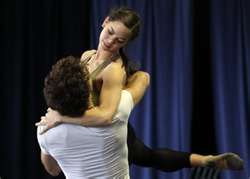
The setting is a night club. We watch as four couples flirt, conflict, fall in and out of love, while dancing to the crooner’s seductive vocals. The dancers move with ease, invading each other’s space, overlapping in vignettes, change and shed clothing to display their superbly toned bodies. The dance style is modern dance with ballet overtones, not ballroom movements. There are traditional balletic lifts, partner coupling, hand extensions, flowing moves on and off stage, coupled with modern dance, gymnastics, flips, jive, and lots of enthusiasm.

Don’t expect a story line. That isn’t part of this format. Tharp doesn’t usually tell stories. She shapes characters, each unique, who repeat their strongest dance abilities, keeping true to their designated form. As the show is fluid in casting, the lineup seen one night may not be what is seen the next. This gives a freshness to each performance.

On opening night Ramona Kelley and Christopher Vo danced as a cute young couple who shyly meet and by the end of the show, are in love. They were both superb, with Vo getting laughs for his awkward attempts to impress Kelley.

Ron Todorowski displayed strong abilities with body abandonment in his flips, cartwheels and gymnastic skills. Beautiful Meredith Miles displayed fine balletic dancing talent. Toned Stephen Hanna’s strong balletic skills, which was also highlighted in the musical BILLY ELLIOT, was well showcased.

The rest of the opening night lead dancers, Ashley Blair Fitzgerald, Tanairi Sade Vazquez and Anthony Burrell all displayed excellent dance skills. The corps was strong.

The on stage band, which supplemented the recorded music, was superb. Strong solos performances aided in the overall quality of the musical sounds.

CAPSULE JUDGEMENT: If you’re a Sinatra fan, you’ll have an evening of nostalgia with old blue eyes. If you’re a dance aficionado, you’ll experience an evening filled with the visual delights of Twyla Tharp. If you are a lover of musical theatre filled with a strong story line and message, this isn’t going to be your thing. Me? I really, really enjoyed myself.

Saturday, May 05, 2012

Alvin Ailey-2012


ALVIN AILEY, DANCE AT ITS FINEST!


How many superlatives are there in the English language that can be used to describe Alvin Ailey American Dance Theater’s May 4 performance at the State Theatre? I could start with superlative, then transition into exciting, mesmerizing, compelling, creative, and then add powerful and dynamic. I could go on from there, but the point has been made.

The Alvin Ailey company brought the crowd to its feet several times during the production and had them standing, clapping, and dancing in the rows and aisles at the end. This was not an automatic Cleveland standing “O,” this was a well deserved tribute to one outstanding evening of dance!

Since the numbers aren’t necessarily going to be repeated in the other two presentations this weekend, going into detail about each segment isn’t necessary. It’s enough to make some general comments.

In 1958 Alvin Ailey and a group of young African-American modern dancers came onto the scene and captivated the dance world. They became legends who have performed before an estimated 23 million people in 71 countries.

When Ailey died in 1989, Judith Jamison, Ailey’s personal choice for the position, took over as Artistic Director. The question of whether the company would retain its high quality was raised. The query was answered when, in 2008, the company was recognized by a U.S. Congressional resolution for their being “a vital American cultural ambassador to the world which celebrates the African-American cultural experience.”

When Robert Battle become Artistic Director on July 1, 2011, again one of the questions was whether he could duplicate the fabled performances. Fear not dance aficionados. If the State Theatre presentation is any indication, the company is not only in good hands with Battle, but it seems to have gained a new presence.

The dancers are well-trained, skilled in dance techniques. There are no leads, no feature dancers, they are a melded unit. My notes reveal such words as powerful, gymnastic, motionless freezes, well supported lifts, torrid pace, fine interactions, lighting enhanced movements and sounds, flowing, total abandonment, strong hip thrusts, total body control, gorgeous visualizations, beautiful integration of music and movements, well selected musical pieces.

Though the entire evening was exciting, the best was saved for last, Ailey’s 1960 signature piece, REVELATIONS. Danced to traditional gospel music, highlighted by Rocka my Soul, the ten-segment composition bursts off the stage, leaving the audience standing, clapping and screaming. It’s an experience not to be missed. That number will close all three local performances.

Capsule judgement: It can only be hoped that it isn’t too long before the Alvin Ailey American Dance Theater returns to the area. This is a world class dance company that deserves to be seen over and over! Hallelujah!

Wednesday, May 02, 2012

Blank Canvas/Patrick Ciamacco


Welcome to BLANK CANVAS: The evolution of a new theatre
The story sounds right out of a 1930s Andy Hardy movie: with the cry, “Let’s put on a play,”Patrick Ciamacco and his merry band of henchman, decided, about 6 years ago to create a new theatre. At first they thought of the title Ghostlight Theatre, but since the name was already taken, and not wanting to tempt a lawsuit, the decision was made to call it Blank Canvas. Yes, a space void of substance, opening up the possibility to design and formulate what they wanted,with no restrictions.

After making a splash as the Laughter League, housed in Medina, Blank Canvas was offered a space in The 78th Street Studios. The owner wanted a permanent theatre tenant, the group wanted a space to do what they wanted without having restrictions placed on them such as union requirements. It was a match made in heaven. Well, almost. The owner cut a great deal, but the creative team had toinvent on the run as they needed to quickly mount a show.

Their opening production, THE TEXAS CHAINSAW MUSICAL, an adult rock musical coming of age story about a 1970s handsome serial killer,played to half-filled houses through the first weekend, then, as the word spread, the 85 seat theatre was sold out for the rest of the run.

The writers of CHAINSAW came, loved it, and incorporated thechanges that director Ciamacco made into their Las Vegas edition of theshow.

Their second production, OF MICE AND MEN, based on John Steinbeck’s epic tale of two farmhand drifters, received rave reviews, and also did well at the box office.

Ciamacco indicates that “a lot of people responded favorably to the differences in the types of the first two shows, as well as the theatre space which is an intimate, right there space, with no audience member more than 15 feet from the stage.”


How is it financed? Ciamacco and some friends donated the start up costs. The income from the Laughter League helps. The Near West Theatre donated the BLANK CANVAS’s seats. Relationships with other theatres helped get a lighting board, and sound instruments were borrowed or rented at low costs. Some of the area’s best technicians volunteered their time free, and the actors were cooperative and helpful, building and painting scenery. Yes, it’s Andy Rooney comes to Cleveland.

What should audiences expect from Blank Canvas? Ciamacco admits the philosophy isevolving, changes have already been made in the description of who the audience is and what will be the final production, but right now, he wants low tickets prices for a quality show, a season with something for everyone, possibly someOhio premiers, and a place where non-traditional theatre-goers will feel welcome.

Their next production is Will Kern’s HELL CAB. It consists of 70 minutes of vignettes about modern city life and the people we meet for a brief moment but who touch us long afterwards. Six actors play 25 roles, while a cabbie, seated in a real yellow cab on stage, acts as the audience’s guide. The show runs May 4-20.

Ciamacco, who is young, creative, idealistic, and probably a little naïve, has great plans for the Blank Canvas. Based on the first two productions, this dynamo may be on the path to developing another fine area venue.
The theatre is located in the 78th StreetStudios, 1301 West 78th Street, Suite 211. For tickets, which are $15, or other information call 440-941-0458 or go to www.blankcanvastheatre.com

Sunday, April 29, 2012

Gruesome Playground Injuries


Ensemble’s GRUESOME PLAYGROUND INJURIES good, but not all it could be


Last year Ensemble Theatre produced playwright Rajiv Joseph’s HUCK AND HOLDEN. It was filled with humor and creative storytelling. Those attending Ensemble’s newest venture into Joseph’s work, GRUESOME PLAYGROUND INJURIES, will experience the same type of storytelling, but will probably find the production less satisfying.


Joseph, who was born and raised in the Cleveland area, is a graduate of Cleveland Heights High School, a Pulitzer Prize nominee, and wrote the third season of TV’s NURSE JACKIE. He is the author of BENGAL TIGER AT THE BAGHDAD ZOO, which ran last year on Broadway, and starred Robin Williams.


GRUESOME PLAYGROUND INJURIES is a different kind of love story that examines the interlocking lives of two damaged people who are in psychological agony. We first meet the duo as eight-year olds in a parochial school infirmary. Kayleen is supposedly there because of a stomach ache. Doug has just ridden his bike off the roof of the school, resulting in numerous physical injuries. Before the 30 years of the play’s actions are over, the duo manages to physically slice, bloody, bruise and/or mutilate most of their bodies. In addition, they become more and more psychological invalids.


The obvious question is why they self-abuse. Kayleen, we find out, as the script plays out in various hospital rooms, a funeral parlor, and a mental institution, is the product of an emotionally absent father, has been abandoned at an early age by her mother, and has no friends. A depressive, she turns to hypochondria, self mutilation, and self-pity as her defense.


Doug, on the surface, seems like a daredevil, with little instinct control. In fact, though he comes from a positive home environment, he is hyperactive and lacking in both intellectual and social skills.


We see snippets of their togetherness, in non-chronological scenes, at ages 8, 23, 13, 28, 33, 23 and 38. We note that the duo’s relationship, though it remains mostly platonic, is filled with emotionally bonding need. These lost souls desperately need each other, yet never commit to a lasting relationship. Each bounces from person to person, but always returning, after a period of separation, for the healing that only they can provide for the other.


Even at the play’s ending, which caught many in the audience by surprise, there is a non-conclusion to their relationship. They remain floating in tortured space, needing each other, not fully understanding why, and probably popping up in each other’s lives sometime in the future.


The Ensemble production, under the direction of Fred Sternfeld, though interesting, often drags. Much of the stage time is spent watching each character change makeup to fit the injury or age they are about to present, or make complete wardrobe alterations. Thus, the actual time when we are hearing dialogue is limited. The long changing time slows down the flow.


It could be argued that there is a need for us to watch as each heals, removes the blood and signs of their injuries, but, in reality the healing is only superficial. Unfortunately, some of the impact of that message is lost due to the length of the transitions.


The acting is strong. Celeste Cosentino is filled with angst as the depressed Kayleen. She leads us on a path through her tortured life, deflecting true feelings by ranting, “shut up” and “you’re retarded” to protect herself from emotionally bonding with Doug. We clearly see she recognizes that Doug is the only person in her life who gives her any meaningful attention, the only human who is human to her.


Dan Folino, he of fawn eyes and mobile body, transitions from 8-year old to crippled 38-year old, with visual clarity. At times, there is some over-acting, but, in general, he is believable. By the end, his battered body becomes a clear symbol of the failed life of the duo, the crumpled mass of wasted humanity.


In addition to the constant makeup and clothing changes, the shifting of rectangle and cube blocks that are used to create the set, becomes tedious. All that movement is not needed. Like the clothing, suggestions of location might have sped up the flow and helped to hold the audience’s attention.

CAPSULE JUDGEMENT: Ensemble Theatre again takes on a Rajiv Joseph script. Though, due to some staging decisions, it is not as audience engaging as it could be, GRUESOME PLAYGROUND INJURIES is a thought provoking concept, that is filled with pathos.

Saturday, April 28, 2012

Carmen: Story of Passion


VERB BALLETS: creative CARMEN: STORY OF PASSION

Verb Ballets is in the midst of a reinvigoration project. The company has added several much needed new male dancers. The results were positively displayed in their production of CARMEN: STORY OF PASSION, their entry in DANCEWORKS 2012.

CARMEN is a sensual ballet based on Georges Bizet’s four-act opera. The music is noted for its melody, harmony and emotionality. It creates the proper mood for compassionate dance.

Choreographer Richard Dickinson has created a short story piece which takes advantage of the quality of the music, Verb’s new male dancers, and its fine female corps. 

Physically, the audience is seated in a formation that resembles a bull fighting ring. It fits the story of Carment, the fiery gypsy, who seduces men including Don José, a naïve soldier. In a fit of rage, Don José kills Escamillo, the glamorous toreador, who is another of Carmen’s lovers. The story highlights jealousy, immorality, lawlessness, seduction, sorrow, and revenge.

The entire company sets the proper moods. The audience is seduced into complicity as the dancers use empty chairs in the seating segment between exits and entrances.

The night I attended, Kara Madden, with flashing eyes and seductive moves, convincingly portrayed the hot tempered Carmen. Arthur Prettyman well danced Don José, Katie Gnagy portrayed Micaela, Don José’s jilted lover, with yearning tenderness. 

Brian Murphy’s take on Escamillo was refreshing. Usually the role is sung (in the opera) and danced (in the ballet version) with the egocentric disdain of an idolized toreador. Murphy, instead, gave a human quality to the characterization. Or Sagi, as Lieutenant Luniga, has a captivating stage presence which gives an added dimension to the male Verb presence.

Janet Bolick’s costumes fit the mood and era of the setting.

The missing element for many was the absence of the famous bull ring cape routine which is one of Verbs’ signature pieces. Though a wonderful visual image, it was wisely omitted. It would have distracted rather than added to the Dickinsonian image of the piece.

Tuesday, April 24, 2012

TWO ONE-ACTS (ELEGY FOR A LADY and THREE WOMEN


Fine acting featured in Two One-Acts Plays at Cesear’s Forum

Arthur Miller is considered one of America’s greatest playwrights. He, along with William Inge and Tennessee Williams, are often termed the fathers of American modern theatre.

An east coast liberal, he often is called “the social conscience of America.” He continued to probe social wounds of culture and exposed his personal issues for the sake of his art. He constantly strikes emotional chords as he probes, “Is this the best way to live?.”

His ELEGY FOR A LADY finds a distraught and seemingly grief-stricken man entering a gift store under the pretense of purchasing a present for his dying mistress. The woman has denied him involvement in her suffering and he apparently needs to share his feelings with someone. The owner of the shop encourages him to share his thoughts, thus serving as a surrogate confidante.

The play is filled with ambiguity and leaves the authenticity of the happenings in question. Miller is noted for his meticulous choice of words. Due to the unnatural flow of language in ELEGY FOR A LADY, one has to question whether this is an experience of surrealism rather than journey of realism.

Both Dana Hart as the man and Ursula Cataan as the shop owner are excellent in their presentations. The goings on are well paced and hold the audience’s attention.

THREE WOMEN is a tone poem by Sylvia Plath. Originally written as a radio drama in 1962, it is Plath’s only play. It was written about a year before the poetess died.

The epic traces three different views of pregnancy and childbirth. The traditional birth resulting in a healthy baby, a miscarriage, and a young woman who gives birth, but gives the baby up for adoption. Some of her thoughts must have been quite personal as after giving birth, she later had a miscarriage.

As with any piece of poetry, many of the ideas are abstract and require concentration to grasp Palth’s ideas.

Ursula Cataan, Kristen Levy and Katrina Melanie Walker all give credible performances, making clarity out of the numerous metaphors and motifs.

Capsule Judgement: Cesear’s Forum’s production philosophy centers on making social commentary while presenting experimental theatre. Though not a traditional type of production, the evening of one-acts is a good example of thoughtful theatre.

Sunday, April 22, 2012

God of Carnage


Hysterically funny GOD OF CARNAGE at Dobama

What’s more ridiculous, two tween boys having a fight or their parents trying to deal with the conflict?

The answer to that question can be found at Dobama Theatre where Yasmina Reza’s GOD OF CARNAGE is now on stage. It’s a comedy whose New York production was dubbed “a hysterical night of name-calling, tantrums and tears.”

The name-calling tantrums are the actions of the tweens in a playground tiff, right? Wrong! It’s their parents trying to deal “rationally” with Benjamin having knocked out two of Henry’s teeth with a twig. Before the meeting is over, there is a rolling on the floor hair pulling battle, taunting, a smart phone destroyed by a dunking in a vase of tulips, vomiting, some more vomiting, alcoholic consumption, constantly changing alliances, and insults about everything from the pastry being served to the belief systems of the participants. The topics of misogyny, racial prejudice, political attitudes, drug company misdeeds, and homophobia all rear their ugly heads. Rationality is replaced by riot!

Alan, Benjamin’s father, never gets off his cell phone, sharing intimate legal secrets about one of his drug client’s questionable compounds. Annette, his wife, who is a “management expert” tries to be above the fray. Well, at least at the start. Michael, Henry’s dad, who has just destroyed the family’s pet gerbil, enjoys talking about his “bad boy” days as a member of a suburban “gang.” Veronica, the “oh-so offended,” moralistic mother of the boy with the missing teeth, is a pseudo-intellect who fawns over art volumes while telling about her project of writing a book about the conflicts in Darfur. (She has never been to Darfur.) To add to the goings on, the phone keeps ringing with cries of distress from Michael’s Florida living senior citizen mother with knee problems.

The play, which opened in London in 2008, and moved to New York the next year, was originally written in French. Guess America isn’t the only place with adults who act more childish than their children.

The Broadway production starred Jeff Daniels, James Gandolfini, Hope Davis and Marcia Gay Harden. All were nominated for Tony Awards. The production received the Tony for Best New Play.

The script was the source for the 2011 movie CARNAGE, which was directed by Roman Polanski and starred Jodie Foster, John C. Reilly, Christopher Waltz and Kate Winslet.
Dobama’s production of GOD OF CARNAGE, under the adept direction of Joel Hammer, is a total delight. The show is well paced, the many laugh lines are cued for the right responses, and the author’s intent is well developed.

The cast is universally strong. Tracee Patterson is nothing short of perfect as Veronica. She embraces both the comedy and farce aspects of the role. Derdriu Ring’s Annette starts out controlled and competently builds into a vomiting, opinionated hellcat. Scott Miller effectively forms Alan, the smart phone obsessed lawyer, into an obnoxious bore.   John Hedges is both funny and pathetic as the gerbil destroying dad. The quartet plays well off each other and creates lots of laughs with good timing and farcical abandonment.

Laura Carlson’s scenic design makes for a perfect visual of an upper middle class suburban living room.

CAPSULE JUDGEMENT: GOD OF CARNAGE is a well written comedy that evokes constant laughter. It gets a top-notch production at Dobama. If you want an evening of totally delightful entertainment, to experience rationality being replaced by riot, this is a must go-see!

Thursday, April 19, 2012

In The Next Room (or the vibrator play)


VIBRATOR is stimulating on Cleveland Playhouse’s Second Stage

As reviewers and special guests came up to the media table in the lobby of the Allen Theatre, before the opening night performance of IN THE NEXT ROOM (or the vibrator play), they were given a bag of “goodies” supplied by the show’s sponsor, Ambiance, which bills itself as “the store for lovers.” Without going into detail about the gifts, the contents were a perfect hint of what was to come once the lights went up on CPH’s Second Stage.

During the late nineteenth century, terms like “hysteria” and “frigidity” were used to describe maladies associated with the “weaker sex.” Everyone, from Thomas Edison to Sigmund Freud to the medical profession, jumped into the fray trying to get women to transform into “their finer selves.”

Without knowing it, the men were acknowledging puritanical attitudes, which deemed that women were to be subservient to their husbands, and their duty was to make sure their husbands were satisfied. Male controlled views of life resulted in females not reaching emotional or sexual climax and, therefore, were in a state of constant frustration.

It is ironic that now, in the twenty-first century, women are still being controlled and demonized by a political system in which respect for the female body and the ability to control their own destinies are being subjugated by religious groups and a political party.

Sarah Ruhl’s IN THE NEXT ROOM (or the vibrator play) is an often funny, emotional and revealing tale which examines female sexual desire, motherhood, breastfeeding, jealousy, personal discovery and the rigidities of society.

The setting is a prosperous town outside of New York City in the 1880s. Dr. Givings is a young doctor who has a fascination with technology and believes through physical and mechanical vaginal manipulation he can cure women of their moodiness, hysteria and depression.

Catherine, Givings’ wife, has recently given birth to a baby, but does not have enough natural milk supply to satisfy the child. A wet nurse is hired. The baby bonds quickly with the caring, emotionally and sexually satisfied, Elizabeth. Catherine, not only is frustrated from a lack of attention from her husband, but is now in a state of having no outlet for her satisfaction of emotional and female needs.

In the meantime, Sabrina Daldry comes to Dr. Givings for help. She transforms under the care of the doctor and Annie, a nurse-midwife. Sabrina and Catherine soon form an alliance to discover why their lives have been so angst filled. Part of the reason, they believe, includes that their “husbands creep quietly into their beds at night and only use the missionary position,” thus satisfying themselves but leaving their wives unfulfilled.

A free love painter, snow (the symbol of love), making snow angels, some level of awareness on the part of men of the needs of women, the binding restrictions of the female clothing of the era, use of the electronic device on a male, sage advice from a wet nurse, and a piano interlude, all come together to provide heightened awareness.

Though the play is a little too long, especially the protracted second act, and the staging of the ending is a big over the top, CPH’s production, under the direction of Laura Kepley is well done. The show is well-paced, the acting is top notch, the stage set by Michael Raiford is visually stimulating, Michael Boll’s lighting creates the proper moods, and David Kay Mickelsen’s costume designs, especially the women’s clothing, are era-correct and breathtaking.

Nisi Sturgis walks the fine line between angst and giddy with precision as Catherine Givings. Jeremiah Wiggins, as the educated yet clueless Dr. Givings, is excellent. Gail Rastorfer makes the uptight nurse, Annie, a symbol for the need for women to act on their impulses. Birgit Huppuch is delightful as Sabrina Daldry, transitioning perfectly from “hysterical” to freed from frustration. Donald Carrier is so very “proper” as Mr. Daldry. Rachel Leslie, as the Black wet nurse, Elizabeth, develops a character that clearly displays a satisfied woman who, relieved of the Victorian “white person’s” attitudes, responds to life on a real level. Zac Hoogendyk gives the right free-spirited attitude to painter Leo Irving.

Be aware that the play contains sexual reenactments, full male nudity, and explicit language.

CAPSULE JUDGMENT: IN THE NEXT ROOM (or the vibrator play) is filled with laughter, views of the needs of women, naïve treatment of the “weaker sex” by men, excellent acting, and a beautiful set and costumes. This is a production well worth seeing.

Tuesday, April 17, 2012

KSU's Roe Green Visting Director's Series


KSU'S VISITING DIRECTOR'S SERIES--2012

Local arts patron and activist Roe Green is at it again! Much of Cleveland theatre is stamped with the Roe Green tag. She’s the sponsor of the Cleveland Critic’s Circle’s ClevelandTheaterReviews.com. She’s the fairy godmother to the Kent State University’s theatre program, as her foundation recently built their new theatre and dance center. She serves on the KSU Foundation, School of Theatre and Dance and Porthouse Theatre’s Advisory Boards. She serves on the board of The Cleveland Play House and has been the honorary producer for their Fusion Fest. She sponsored the theatre program at the Jewish Community Center for many years. She has also donated to other area theatres.

Her latest foray into the arts is KSU’s Roe Green Visiting Director’s Series which brings in a playwright to work with students and create an original theatre piece. This year’s director/playwrite is Ami Dayan. Dayan, who has studied and worked professionally in the U.S., Europe and Israel, was recently commissioned by The Denver Center Theatre Company and the Colorado Shakespeare Festival to craft new works. He is the president of Maya Productions, an independent theatre company (see www.mayaproductionsinc.com).

Dayan has adapted Gotthold Ephraim Lessing’s 1779 literary masterpiece NATHAN THE WISE, one of the earliest pieces celebrating religious tolerance into a play with music. In actuality, it is a full-ledged musical drama. The script is a plea for religious tolerance between Judaism, Islam and Christianity.

The KSU production succeeds on many levels. It is entertaining, tells its tale in an audience involving mode, and has some interesting, if not memorable music. As is the case with any work-in-progress, it needs some tweeking.

The student cast members do a nice job of developing their roles. The singing is generally very good, the musical sounds enhanced the show supporting rather than drowning out the performers.

Again, thanks to Beachwood High School grad Roe Green for her continued support of the arts.

Up Cabaret


UP CABARET—a new entertainment in the Cleveland area


On Saturday, April 14 the lights went up on a new small entertainment stage in Cleveland area. The space, upstairs of the Cleveland Public Theatre, is the home of UP Cabaret, the brain child of Paul Hoffman.


CPT’s Artist Raymond Bobgan agreed with Hoffman that Cleveland could benefit from a regular Cabaret room. It’s a place where live entertainment night club acts will appear on a regular basis. For six weeks this spring, UP CABARET will light up the stage at 10:20 p.m. on Saturday night. (Doors open at 9:30) Cabaret tables, a cash or credit wine and beer bar, and local stars will be available for an entrance fee of only $5 (payable at the door).


The series opened with Cabaret Smack Down
featuring Lora Workman and Monica Olejko. The rest of the spring series will be:


April 21--SOLE MATES starring Nicole Mclaughlin, singing about her love of shoes.


April 28--NOT MENOPAUSE, featuring Tina Stump, Jean Zarzour, Paula Klein Messner, June Lang, Maryann Nagel, and Dyan Beder, the original cast of the local production of MENOPAUSE. Ton Bonezzi serves as the Musical Director.


May 5--Adina Bloom and Paul Hoffman entertain in THE TWO OF US, a show about relationships in 5 sighs and 15 songs. Heidi Hertzog will be the musical director.


May 12--Laurel Held and company (Wendy Morgan Cove, Michelle Moye, Isabell Tuma and Ayeshah Douglas star in SONG BIRD, MUSIC OF EVA CASSIDY.

David Dettloff is the musical director.


May 19--Donnie Long explains I SLEPT WITH MY MOTHER ON HER 70TH

BIRTHDAY with David Dettloff as the musical director.