Sunday, August 27, 2006

Nat King Cole (Actors' Summit)


Audience likes Nat King Cole tribute at Actors’ Summit

What do the songs "Pretend," "Route 66," "Chestnuts Roasting on an Open Fire," "Rambling Rose,” “It’s Only a Paper Moon,” “Nature Boy,” “Mona Lisa” and “Too Young” all have in common? They are all hit songs recorded by Nathaniel Adams Cole, better known as Nat King Cole whose life is showcased in Actors’ Studio’s ‘NAT “KING” COLE’ by Kent LeMar & A. Neil Thackberry. Most think of Cole as a singer, but he was actually trained to be a classical pianist and never considered himself to be a singer, but as a jazz musician.

In 1943, Cole recorded "Straighten Up and Fly Right," which was based on one of his preacher father's sermons. It became a smash hit and changed his musical life.

Cole had many firsts. He was the first black jazz musician to have his own weekly radio show and the first black to have a weekly network television show.

A heavy smoker, he died of lung cancer in 1965, but his music lives on.

Based on audience reactions, and the need to extend the show several times due to positive reviews and comments, ‘NAT “KING” COLE’ is a hit. It is indeed a very pleasant evening of musical reminiscences for those brought up during the 50s and 60s.

Do not go, however, expecting to see or hear Cole. What LeMar does is give a Cole impression, not a recreation. Though he has a nice voice, LeMar isn’t a Cole duplicate. We’ve seen duplicates on the Actors’ Summit stage. In past seasons Thackaberry transformed himself into Clarence Darrow and Wayne Turney morphed into Harry Truman.

LeMar feigns Cole facial expressions, attempts to articulate the Cole speaking sound and give the deep jazz based sounds of the great singer. He is inconsistent in those attempts. Cole prided himself on his diction. He held his consonants and breathed life into his words. LeMar, though he tries, just doesn’t give us the sound that allows us to close our eyes and hear Cole. His most Cole-esque interpretations were: “A Nightingale Sang In Berkeley Square, “ “Sweet Embraceable You,” “Christmas Song” and “When I Fall In Love.”

The script, though it does fill us with details of Cole’s life, isn’t well structured. Many of the songs are dropped in, they don’t help develop the story as in a well integrated reviews. “Let There Be Love,” “Too Young,” “When I Fall in Love,” “Wild Root Cream Oil” and “Smile” fit in. Most of the other songs don’t. The script is being rewritten and it can only be hoped that more effort will be made to integrate the songs into the story.

Because Cole was noted for sitting at the piano and singing, the fact that pianist David Williams plays most of the music, is off-setting. Williams is wonderful , but if this is supposed to be the real Cole performing for us, then Williams’ presence doesn’t make sense. This aspect is confusing as LeMar is an excellent pianist.

CAPSULE JUDGEMENT: ‘NAT “KING” COLE’ is an audience pleaser. Due to its appeal, the show will be reprised on September 7 and run until the 24th on Friday and Saturday evenings and Sunday matinees, with some rewriting, including the addition of more musicians to emulate The King Cole Trio

Saturday, August 05, 2006

Pointe of Departure (Cain Park)


Is Pointe of Departure the answer to the area’s ballet void?

With the apparent demise of Ohio Ballet, the Cleveland area is left without a major ballet company. Yes, there is Ohio Ballet Theatre, Denise Gula’s Oberlin based group, but it mainly performs in Lorain County, though it is expanding into the Cuyahoga County area, and has only a small company of dancers.

A void exists. Can that void be filled by Pointe of Departure?

Pointe of Departure, which originated in 1998 as a collaboration between Lev Polyakin, Karen Gabay and Raymond Rodriguez, recently performed at Cain Park to a fair-sized house. The program notes state, “The future of the company is to expand the length of the season and to offer more performances throughout the year.” It can only be hoped that this is true.

Gabay and Rodriguez are best known as the wunderkinds of the now-departed Cleveland-San Jose Ballet. For years, their local performances were met with critical and public adulation The duo still performs with the company which now makes San Jose its home. They are getting rather old to continue to dance full time, and their emotional fan base is in the Cleveland area, so it is an obvious place for the duo to put down their choreographic and teaching roots.

Making the company into a permanent resident company will take lots of money. With corporations abandoning the local area, some of the financial fund raising base is gone. However, if the county commissioners’ proposed cigarette tax is enacted, and some local donors, who gave heavily to the previous professional company, can be convinced that this group will not lavishly over spend, like the previous artistic director did, then the purse strings may loosen.

Pointe of Departure, as it is presently constituted, is not a world class, nor even a high-level dance company. Since it performs only sporadically, the dancers have little time to meld together. This was obvious in their Cain Park performance, where uneven timing of corps movements was the general case. In addition, the professional dance level of the performers is also questionable. Yes, Gabay and Rodriguez were superb, especially in their pas-de-deux ‘MOON REFLECTION OVER CRYSTAL SPRING,’ which got a spontaneous and well-deserved screaming standing ovation, but there was weakness among the others.

The women, especially lovely and sprightly Jim Zhang, DeAnn Petrushke and Erena Ishii, were quite good; but the males were generally weak. Travis Walker, though rather stone-faced, was the most consistent of the gentlemen. He performed some fine jumps, did a good job of partnering and had an air of confidence. Jurijs Safanovs performed a competent Zorba-inspired segment, but was awkward in other roles. Peter Kozak seems comfortable with the contemporary moves, but was lacking in the classical segments. Maximo Califano was all affect, feigning hand movements and facial expressions and doing a great deal of posing, but was short on partnering skills and dance style.

Karen Gabay has good choreographic instincts. Her ‘HOORAY FOR HOLLYWOOD,’ though a little long, had many highlight segments. Rodriguez and Gabay’s ‘NAPOLI’ staging was innovative.

With strong modern and contemporary companies, such as Verb Ballets, Groundworks and Inlet Dance that segment of the local dance scene seems well covered. It will be interesting to see what develops on the classical dance scene. Hopefully, Pointe of Departure, or some similar group, will come along and fill the void. It would be a shame that an area with such a strong arts reputation should be lacking in this performance area.

Sunday, July 30, 2006

Sunday in the Park With George (Lakeland Theatre)


A pleasant ‘SUNDAY IN THE PARK WITH GEORGE’ at Lakeland


Painter Georges Seurat and musical theatre composer and lyricist Stephen Sondheim have much in common. Though noted as being successful in their fields, both
had personal and career highs and lows.

Seurat, who is the subject of Sondheim’s ‘SUNDAY IN THE PARK WITH GEORGE,’ like Sondheim was revered and disliked because of his penchant for breaking out of the lines.

Seurat broke from traditional realism and embraced a style of painting based on dabs, rather than brush strokes. Using his scientific knowledge, he placed the dots in such proximity to each other that they created light, shadow and color. The technique, entitled “pointillism,” was disliked by traditional painters of his time. Seurat was considered an
outcast and was refused participation in the major art shows of his day. Seurat, it is rumored, did not sell a single major painting while he was alive.

Sondheim is also controversial. With few exceptions his works are intellectual, not intended only to entertain, but also to enlighten. Often they contain a negative-toned woman, who, like Sondheim’s own mother, is all-controlling. Think Mamma Rose in ‘GYPSY’ and the Wicked Witch in ‘INTO THE WOODS.’

Sondheim also doesn’t write songs that can be easily removed from the script and be placed on the top hits lists. He writes songs for his characters to sing that fit completely into the dialogue, reveal something about the person, or helps develop the plot. Though popular among theatre performers, the vast amount of his work is unknown to the general public.

Though Sondheim, like Seurat, is assumed to be a total success (‘GYPSY,’ ‘SWEENEY TODD,’ ‘COMPANY,’ ‘WEST SIDE STORY,’ ‘FUNNY THING HAPPENED ON THE WAY TO THE FORUM”), this assumption is not true. He had
minor successes such as ‘ANYONE CAN WHISTLE’ and ‘PACIFIC OVERTURES, ‘and outright flops like ‘SATURDAY NIGHT’ and ‘MERRILY WE ROLL ALONG.’ After ‘MERRILY’ Sondheim quit the theatre. He was, however, lured back by James Lapine, with the idea of writing a musical based on the life of Seurat and his painting, “A Sunday Afternoon on the Island of La Grande Jatte.” Though the musical never achieved greatness, it did run for almost a year and a half and has some wonderful songs.

In ‘SUNDAY IN THE PARK’ Sondheim wrote music in the artistic style of Seurat. As one critic put it, "Sondheim’s work has such reach, there is so much emotional resonance, that many observers take it personally and become as fascinated with the artist as with the art.”

He won the Pulitzer Prize in Drama for ‘SUNDAY IN THE PARK,’ though Jerry Herman's ‘LA CAGE AUX FOLLES,’ a traditionally formatted show, was selected by the Tony Awards for Best Musical and Best Score.

The first act takes place in nineteenth-century France. Georges struggles with his art and his personal life. He is completely engrossed in his artwork and not with his pregnant girlfriend/model, Dot. She leaves him to find a more supportive man. The act introduces the audience to many of the subjects in the painting (a fisherman, nurse, old
lady, American tourists, teenage girls and Dot).

Act Two, is set in New York and Paris in 1984. Georges' great-grandson, George, is struggling to find inspiration in his artwork. He is helped when the spirit of Dot returns with some wise words as he visits La Grade Jatte.

The first act is stronger than the second. In fact, the final act was finished only days before the show opened on Broadway and failed to receive the polishing needed.

The musical is a difficult undertaking for any theatre. Considering that Lakeland’s production has only one equity performer (young Emma Wahl), and she does not have a major role, the production is impressive. Much credit goes to Martin Freedman, the show’s director and Sondheim devotee.

Amiee Collier is excellent as Dot and later as George’s grandmother. She has a strong singing voice and interprets meanings, rather than just singing words. This is imperative in a Sondheim show. She also develops clear characterizations. Mary Jane Nottage is endearing as the “old lady.”

Andrew Tarr puts out a yeoman’s effort into developing the roles of Georges and George but he does not have the acting or the vocal prowess to pull off the roles. One only had to have seen Mandy Patinkin in the Broadway production or listen to his vocalizations on the CD of the show to hear the complexity of the music and of the character.

Keith Nagy’s sets and lighting designs add much to the production as does the musical direction of Larry Goodpaster. Unfortunately, the theatre’s poor sound system caused vocal distortions.

CAPSULE JUDGEMENT: Seurat contended that a painting is composed of design, order, composition, light and harmony. The same can be said of a musical. Lakeland
should be proud of its artistic composition.

Sunday, July 09, 2006

Shaw Festival, a review


SHAW FESTIVAL brims with superb offerings


The Shaw Festival, located in Niagara-on-the-Lake, Ontario, Canada is the only theatre in the world that specializes in plays by G. B. Shaw and his contemporaries. The plays of that era are often excellent and challenging. Fortunately, for this year’s audiences, this is a stellar year for the Shaw. With few exceptions, play after play is exceptional.

‘THE CRUCIBLE’ gets a brilliant production

Arthur Miller, one of America’s greatest modern playwrights, penned ‘THE CRUCIBLE’ as a protest against Joseph McCarthy’s witch-hunt for Communists in the government and entertainment industry during the early 1950s. The country was in hysteria for fear of Russia and its emergence as a major power. McCarthy fed on that hysteria, much like the religious fanatics of Massachusetts colony set upon so-called witches because of the hard times facing the people of the late 17th century.

This play is relevant today as the Bush administration, using the hysteria of 9-11, has conducted witch hunts and taken away citizen civil rights. Much of this philosophy centers on a line right out of Miller’s play, “You are either with us or against us.” The play also reflects attitudes of the present day religious right, who, much like the Salem religious fanatics, hunt out those not agreeing with their interpretation of what is right and wrong. They attack homosexuals, those who believe in abortion, and those who champion stem cell research, for “poisoning” the “good” folk.

The story concerns an accusation against Goode Proctor by a teenaged girl who, after having a sexual affair with Proctor’s husband, John, accuses Goode Proctor and others of being witches. The chief magistrate, much like Joseph McCarthy, or today’s right wing judges, closes his eyes to facts and is swayed by his own agenda. In the process, the question of one’s reputation comes center stage. Proctor, after standing up for those who are being killed in the name of “righteousness,” cries out, after refusing to sign a document in which he would falsely agree that he has seen the devil, “My name, I must have my name.”

The Shaw production is brilliant. This is the finest staging of ‘THE CRUCIBLE’ that I have ever seen. It is flawless. The acting, the pacing, the staging, the tension are all perfectly honed.

Director Tadeusz Bradecki has created a scary, yet true illusion. Peter Hartwell’s set design enhances the visual and emotional imagery.

Benedict Campbell is brilliant as John Proctor, as is Kelli Fox (sister of Michael J. Fox) as Elizabeth. Jim Mezon is scary as the closed minded “holier than thou” Deputy Governor. Charlotte Gowdy, as Abigail Williams, the lying teenager, is so real, she is spooky with her total disregard for the truth. The rest of the cast is equally superb.

The audience sat in shocked silence at the conclusion of the play...a perfect tribute to as perfect a theatrical experience as one might ever experience.

It is a shame and a blessing that a play like ‘THE CRUCIBLE’ has to exist. However, as witch-hunts continue, the theatre must have a voice like Miller’s to protest the taking away of rights. And, if such messages must be given a life, then they should be presented as brilliantly as the Shaw production!


‘THE HEIRESS’ gets as perfect a theatrical production as one will experience The year is 1850. The setting is a well-appointed parlor in New York’s very fashionable Washington Square. We are introduced to the Sloper family--an embittered doctor who lost his wife in childbirth, his widowed sister, and his extraordinarily shy daughter (Catherine). This is a family in which civility, a lack of feelings, and frustrations are ever-present. Into this setting comes a handsome young bachelor (Morris), a potential suitor for Catherine. Is the penniless man a fortune-hunter after Catherine’s money or does he really love her? Only the startling conclusion reveals the answer.

Director Joseph Ziegler has created a well-thought out production. The play is well paced, clearly builds the tensions, is perfectly acted, and leads the audience to a collective verbal gasp at the conclusion.

The sets and costumes are elegant.

The drama and humor are perfectly keyed. Michael Ball creates a totally believable embittered Dr. Slopes. Tara Roisling is flawless in her portrayal of the tortured Catherine. Her transition in the closing scene of the play is an acting tour-de-force. Mike Shara is such a cad as Catherine’s suitor that several audience members booed as he came out for his curtain call, unable to separate the actor from the role. As in ‘THE CRUCIBLE,’ the supporting cast is superb.

Shaw’s ‘THE HEIRESS” is as perfect a theatrical piece as one will experience.

Hysterical ‘LOVE AMONG THE RUSSIANS’
The words “Anton Chekhov” and “funny” are not usually found in the same sentence. Chekhov, the theatrical voice that predicted major changes in Russia in the early 1900s, is credited with being the foremost arts commentator on the cracks in the veneer of the aristocracy of the pre-Soviet Union. As one of the fathers of the realistic movement in the theatre, his writing is often philosophical and is dramatic with occasional humorous overtones. What many people don’t know is that Chekhov was a popular faceur. Interspersed between his “THREE SISTERS’ and ‘THE CHERRY ORCHARD’ there were short plays with hilarious glimpses of love and courtship, and about peoples’ foibles beyond political and social lessons.

Two of Chekhov’s Russia-lite pieces are ‘THE BEAR’ and ‘THE PROPOSAL,’ which have been coupled by the Shaw Festival into a 50-minute noon-time delight entitled, ‘LOVE AMONG THE RUSSIANS.’

Plot lines are really irrelevant here. The important matter is that Director Eda Holmes has created two hysterically funny, audience-loving, enjoyable tidbits. Only a person totally devoid of humor could leave the tiny Court House theatre after seeing ‘LOVE AMONG THE RUSSIANS’ and not have had a wonderful time. As a woman behind me said to her friend as we exited, “I laughed so hard, I think I wet my panties.” Her friend responded, “I don’t have to think about it, I know I did!” What better commentary can I give to this delightful production?

‘ARMS AND THE MAN’ done as a delightful farce
A director of George Bernard Shaw’s ‘ARMS AND THE MAN’ has a decision to make. Should the play be staged s a comedy or as an outright no-holds barred farce? The former approach allows Shaw’s lines to carry the humor and create the message. The latter requires that the audience be primed to laugh at what is happening on stage, in other words, to laugh at the outlandishness of the actors, the setting, and even the costumes. The message then sneaks in.

Jackie Maxwell, the Shaw’s Artistic Director, has decided to present ‘ARMS AND THE MAN’ as a no-holds-barred farce.

The characters are so much bigger than life that they are totally unbelievable. The lines are so broadly presented that everything short of holding up “laugh now” signs are present.

Even the costumes are overdone and outlandish. The flamboyant military uniforms are brilliant red and decorated with numerous metals and braid. The brightly colored female costumes are harem dancer-influenced, though the play takes place in Bulgaria.

The sets are also overdone. A huge library, supposedly the only library in the country, contains less than ten carefully placed books. Even the set changes are overdone.

This is a production played for laughs, which highlight Shaw’s usual messages including women’s rights (“People don’t live up to their ideals.”), the ridiculousness of the upper classes (“Everything I think is mocked by everything I do.”), the stupidity of war (“War is a sham, like love.”), and the absurdity of existence (“Life’s a farce.”).

The story, into which the messages are encased, concerns Raina, the wealthy young daughter of a rich nobleman and her relationships with a pompous weak-minded yet extremely handsome military bumbler as well as the “Chocolate Soldier,” an intelligent, charming mercenary who is befriended when he sneaks into her bed chamber in order to avoid being killed by her countrymen. Through a series of unbelievable and silly incidents, which is what farce is all about, everyone and everything turns out exactly as it should.

The production is a laugh-loaded delight. Don’t go in looking for the message, arrive ready to have a good time and you’ll enjoy the goings-on. If you don’t like the outlandish, the over-the-top plea for laughs, and slapstick comedy, you’ll be utterly frustrated. If you trust Maxwell and her cast and you’ll have fun and might accidentally learn something.

‘DESIGN FOR LIVING’ is Noel Coward at his best

Noel Coward is the crown prince of sophisticated comedies.

As a life-long friend of Alfred Lunt and his wife Lynn Fontainne, often considered the most famous acting couple in the English-speaking theatre, ‘DESIGN FOR LIVING’ has a somewhat historical glow of the menage-de-trois bisexual relationship between the trio.

The play opened at the Hanna Theatre in Cleveland on January 2, 1932 to rave reviews before going to Broadway, where the reaction was not quite as positive.

The show is a laugh delight as the trio trades partners, insults and generally causes havoc in the society and art worlds of New York, Paris and London.

The sets and costumes are wonderful. The production qualities are of equal excellence. The cast is well-balanced, play well off each other, and create a grand-old-time for the audience.

‘HIGH SOCIETY’ misses the production mark
‘HIGH SOCIETY’ is the musical version of Philip Barry’s play and George Cukor’s movie ‘THE PHILADELPHIA STORY.’ A romantic love story, which uses cleverness to hide darkness and underlying pain, concerns a wealthy family’s attempts to find happiness in all sorts of configurations. Don’t get the idea that this is a great script. It’s not. It fails to live up to its birth sources.

Cole Porter is the crown prince of clever musical theatre lyrics. He writes outrageously fascinating rhyme schemes. In a unique twist, this musical’s score wasn’t really written for this script. In 1997, long after Porter’s death, Arthur Kopit, who wrote the book, was given permission by the Porter estate to draw freely from the composer’s songbook in his quest to develop the story. If necessary, words were allowed to be adapted to help the song-script union. This unusual composing development permits songs to be dropped in, rather than integrated into the story. The musical sounds often don’t fit seamlessly into some of the scenes into which they have been transplanted. The result is a very choppy show.

The Shaw’s production is not bad, it just isn’t great. The show has a Canadian form of aloofness which is not the same as New England sophistication. (Think Katharine Hepburn as an illusion of what the lead character should be.) This is a play of polite cleverness rather than out-and-out US American bite and edge.

The singing voices are good, the visual illusions are fine. There is a degree of slapstick that doesn’t fit the Porter, Barry or Cukor concept which bother my sensibility, but probably won’t get in the way of many enjoying the production.

Melissa Peters steals the show as a youngster, wise beyond her years, who manipulates the adults like a master puppeteer.

THE INVISIBLE MAN’ suffers from special effect lite

H. G. Wells perceived the future through a set of eyes that saw images of what was going to be. Many much of his scientific and sociological visions have come true in one form or another. In his book ‘THE INVISIBLE MAN,’ Wells created a situation in which a man could take a drug and become invisible. Though this hasn’t been achieved yet, per se, such devices as x-rays, MRIs have been developed to allow us to see into the interior of humans.

The Shaw production gets waylaid by a series of happenings. Special effects in movies and on-stage have become so vivid and real that anything less than real and spectacular leave much to be desired. Staging the show in such an intimate theatre also makes faking the needed illusionary effects impossible. In addition, Michael O’Brien’s script is not well conceived. The actions and ideas often don’t flow clearly. Adding to the problem is the size of the Royal George Theatre’s tiny stage. Everything seems cramped and actors have to dodge around each other, creating awkward stage pictures.

Of all the plays I saw at Shaw this season, ‘THE INVISIBLE MAN’ was the weakest script and production and the one which received the least applause from the audience.

CAPSULE JUDGEMENT: Shaw soars this season! Of the plays I saw, I’d strongly recommend ‘THE CRUCIBLE,’ ‘THE HEIRESS,’ ‘LOVE AMONG THE RUSSIANS, ‘ARMS AND THE MAN’ and ‘DESIGN FOR LIVING.’

Side note: Be aware that the days of low cost due to the high value of the American dollar against the Canadian dollar, are over. The exchange rate is almost equal, dollar for dollar. (If you are interested in info about the whole theatrical season, which runs well into November, and where to stay, what to do and where to eat, go to www.royberko.info and search in the 2006 review summaries for the Shaw listings.)

Our Town (Porthouse Theatre/KSU)


‘OUR TOWN’ is effectively and uniquely staged at Porthouse


I consider ‘OUR TOWN,’ which is now being performed at Porthouse Theatre, on the grounds of the Blossom Center, to be one of the greatest plays of the 20th century. It not only won the Pulitzer Prize in 1938, has become one of the most performed and studied plays in the English language.

On the surface the play appears to be a rendition of the daily activities found in small town America in the first third of the twentieth century. In reality, it is a tribute to basic humanistic views of life. Each time I see, direct, teach or have appeared in the play I bask in the after-glow and find myself a better person.

Playwright Thornton Wilder, who was brought up in Hong Kong and China, was imbued with an Asian perfectionist attitude. His education at Oberlin and Yale centered on the classics. These influences are deeply imbedded into the ‘OUR TOWN’ script. The stage manager represents the classical Greek chorus and the guide in Asian theatrical forms. The direct speeches to the audience create a theatricalism that stops the viewers from transferring their thoughts to the play’s characters and focuses their thoughts on themselves. He is exact in his descriptions of the sun rising and setting and where stores and houses are placed on the stage, yet these places only exist in our minds.

Interestingly, the exactness is misleading. Wilder states that Grover’s Corners, New Hampshire, where the play takes place, is located at 42 degrees, 40 minutes latitude and 70 degrees, 37 minutes. Exact? Hardly. That would not place the town anywhere near New Hampshire. In another scene, Mrs. Webb and Mrs. Gibbs are stringing beans. Sorry, but beans don’t grow in New Hampshire in May. Why does Wilder do this? He wants the play to carry a universal message. This is not about the existence of those in Grover’s Corners, it is about all of us, all of our lives.

Wilder writes exact stage directions in the script. No scenery, the lines say, but some suggestions are made. Usually two trellises, two ladders, and chairs and tables are used. The New England dialect is another specific device. The “ay yehs” and other area sounds are on the printed page. It is here that you must be warned about the ‘OUR TOWN’ at Porthouse. Matthew Earnest, the show’s director, has thrown much of the traditional Wilder devices to the wind. No ladders, no trellises, no New England accents. He has given the show a whole new feel. Instead of slowly paced, the actors and scene people charge around the stage, the stage manager is a theatre stage manager, not a town spokesman, per se. He plays for laughs, but doesn’t lose the pathos.

If you are a Wilder traditionalist, it’s going to take you a while to adjust to Earnest’s concept. I wiggled through much of the first act as the barefoot actors ran hither and yon. But then I found myself fascinated by how the interpretation, instead of ruining my experience, heightened it. I finally concluded that this production worked, and worked well!

Wilder divided the play into three segments, each with a clear title: Act I: Daily Life, Act II: Love and Marriage, and Act III: Death. Earnest has highlighted the differences by pacing them to fit the specific actions of the act. Again, very creative.

The cast is excellent. Monica Bell and Elizabeth Ann Townsend are superlative as Mrs. Gibbs and Mrs. Webb. Rohn Thomas has the right touch for Doc Gibbs. His father-son talk with his son George (Ryan Stutz) was a delight as was the scene between George and his father-in-law (Christopher Seiler). Lenne Snively was endearing as Mrs. Soames, the town busy-body.

John Woodson gave a whole new interpretation to the role of the Stage Manager. He did it effectively with creativity and confidence.

Emily Pote was physically picture-perfect as Emily and did a creditable job, though I would have preferred a less cocky attitude. Her “goodbye to life” speech in the third act was a little fast, not getting the emotional feel out of the scene. This is one of the most plaintive scenes in American theatre. How can anyone not be touched by her plaintiff question, “Do people ever really appreciate life when they’re living it?” Or, the answer, “Some, saints and poets, maybe.”

Stutz was very good as George, though he didn’t fit Wilder’s description of a “great gangling thing;” but, his acting was right on and his boyish innocence worked nicely.

Harlowe R. Hoyt, in his review of a production of ‘OUR TOWN’ at the Jewish Community Center, stated in the April 25, 1958 Plain Dealer, “The burgeoning of love at the soda fountain between Ilene Latter and Roy Berko is one of the most delightful scenes of the play.” About the Pote and Stutz enactment of the same scene I say, “ditto!”

I was disappointed in the lighting by well known designer Severn Clay. There were dark spots on stage and actors sometimes were in the dark or partly in the dark for no theatrical reason. This was very apparent in Act III.

S. Q. Campbells’s costumes were era correct, though all the white was sometimes distracting.

CAPSULE JUDGEMENT: If you’ve ever seen a traditional production of ‘OUR TOWN,’ you are going to have to leave your pre-conceptions at the theatre’s entrance or you’ll fight with the interpretation. Just sit back, take director Matthew Earnest’s concept as a legitimate alternative, and you’ll enjoy it. If you haven’t seen the play before, and need a good shot of appreciation for life, go see the Porthouse production.

Buddy (Carousel Dinner Theatre)


‘BUDDY’ rocks the Carousel

If I didn’t know better, I’d assume Buddy Holly was presently performing at Carousel Dinner Theatre...but more about that later.

The musical, ‘BUDDY: THE BUDDY HOLLY STORY,’ which is basically a rock concert overlaid with a biographic story line, tells of the rise and tragic death of rock-and-roll superstar Buddy Holly. It was written by Alan Janes and Rob Bettinson.

Holly was born Charles Holley in Lubbock, Texas. He had a love for music and was a local bluegrass entertainer until 1955 when, after seeing Elvis Presley sing, he turned to rock-and-roll. After an appearance on the same bill as Bill Haley & His Comets, Holly was offered a contract with Decca Records, who not only changed the spelling of his name to “Holly” but tried to get him to return to his bluegrass roots. The young man, who once said, “Buddy Holly does things his way,” refused and was dropped by the record label.

Shortly afterwards, Holly, drummer Jerry Allison, and bass player Joe Mauldin formed the band “The Crickets.” They cut a record at a small studio in Clovis, New Mexico, entitled, “That’ll Be the Day,” and the rest is history. Songs such as “Peggy Sue,” “Everyday,” “Not Fade Away,” ”Oh Boy,” “Raining in My Heart,” “Rave On” and “Johnny B Good” followed.

Holly's musical sounds and lyrics were quite sophisticated for their day and led to his being a primary force in the evolution of rock-and-roll. He bridged the gap between white and black rockers. Paul McCartney cited Holly as a primary influence on the Beattles. Even the band's name was later chosen partly in homage to Holly's Crickets. The Rolling Stones also fell under the influence of Holly’s style.

In 1959, Holly split from the Crickets and began a solo tour with other notable performers, including Ritchie Valens and J.P. Richardson ("The Big Bopper").
Following the February 2 performance in Clear Lake, Iowa, Buddy Holly chartered a small airplane to transport Valens, Richardson and himself to their next gig. The plane crashed shortly after take-off, ending Holly’s short but meteoric career.

The Carousel production, under the able direction of Victoria Bussert, though a little long, is right on target. The show is generally well cast. Steve Parsons’ musical direction is tone right. Paul Black’s lighting and Russ Borski’s set all work to enhance the production.

John Rochette, as drummer Jerry Allison, is a terrific musician as is base player Tobia D’Amore (Joe Mauldin). Michael Busillo lights up the stage as the hip wiggling Ritchie Valens and Ryan Dunkin does a great enactment of the Big Bopper. The musical backups and character actors are all excellent.

The success of this production, however, depends entirely on the believability of the actor playing Holly. And, fortunately, Canton born Pat McRoberts doesn’t portray Holly, he lives Holly, he sings Holly, he dances Holly and he musically is Holly. McRoberts is Holly in every nuance. This is an amazing performance! Repeat....THIS IS AN AMAZING PERFORMANCE!

CAPSULE JUDGEMENT: Are you a rock-and-roll fan? Do you appreciate the music of Buddy Holly? Do you like a well put-together production? If so, you’ll love ‘BUDDY: THE BUDDY HOLLY STORY’ now on stage at Carousel. Even if you don’t love rock-and-roll, I defy you not to wind up dancing in the aisles during the curtain call.

Thursday, July 06, 2006

Verbs Ballets (Cain Park)

Verb Ballets presents another sold-out concert

No, it wasn’t a rock group or a nationally known entertainer at Cain Park. It was Verb Ballets presenting a dance concert. As has become the pattern at the company’s presentations, it was sold out.

Featuring the well-conceived choreography of Hernando Cortez, and the well disciplined dancing of his company, Verb has established itself as the “in” large dance company of Cleveland.

The Cain Park program, which had no overall title, was composed of four selections. The evening opened with ‘PRELUDE AND SIX EASY PIECES’ danced to the music of Jonathan Sheffer as recorded by pianist Michael Schneider. A quiet and lovely piece, the modern moves to the classical sounds was more soothing than compelling. The highlight segment was the “Prelude” duet by blonde and statuesque DeAnn Petruschke and powerful Mark Tomasic. “Prelude after Chopin” received a lovely interpretation by Catherine Meredith and Anna Roberts.

“SPEED (The Icarus Project)” is a delightful crowd pleaser based on the ‘SPEED RACER’ kid’s television show. It features Tomasic as Speed/Icarus and Danielle Brickman, Catherine Meredith and Anna Roberts as Wings/Trixie. The audience thoroughly enjoyed the piece.

‘BOLERO,” danced to the music of Ravel, and choreographed by the late Heinz Poll was created in 1996. The version presented was restaged by Amy Miller of the Groundworks company. The precise movements, done with closed eyes, found the performers dancing basically in place as their bodies moved to the sensual music. It was a brilliant presentation whose conclusion was met with a screaming response from the audience.

The first time I viewed ‘TWO HOURS THAT SHOOK THE WORLD,’ Cortez’s tribute to 9/11, I thought it failed to fully get the desired impact. Again, this time around, I found my mind wandering as the piece failed to command my full attention. My views appeared not to be personal as the audience’s response was polite applause.

In spite of its reputation, Verb Ballets may be at a crossroad. Their female company is excellent, but, their male corps is lacking. Except for Mark Tomasic, who it is rumored may soon be retiring, the company has no strong male dancers. Jason Ignacio is a good dancer, but because of his short stature, he is limited in the roles he can undertake. In the recent program, Christopher Morgan was brought in. Morgan does not fit well with the company’s style. He lacks the power and precision for Cortez’s choreography. It can only be hoped that Cortez will seek out some excellent male dancers. With the apparent demise of Ohio Ballet, there may be some of their corps, in particular the excellent Brian Murphy, who could fill the void.

Saturday, July 01, 2006

Groundworks (Cain Park)


GROUNDWORKS expands repertoire at Cain Park

David Shimotakahara is unique among dance company artistic directors. He is not only a perfectionist when it comes to developing precise dance numbers, and is a superb dancer, but he is also willing to take risks. He schedules his company into various venues...churches, public buildings, parks, traditional theatres and botanical gardens with an eye for reaching out to various publics. He also stretches his company by inviting new works by other choreographers, and has a stable of exciting musicians whose creations become new dance pieces.

The company’s recent performances at Cain Park’s Alma Theatre, which is a perfect venue for a company whose work invites close proximity, was a fine evening of entertainment.

‘IRON LUNG,‘ the opening piece, was the least crowd appealing. Choreographed by Kelly Garfield whose work has been described as “crazy smart, poetically subversive and brutally fun,” ‘IRON LUNG’ examines loss and recovery. It was not unified, often failing to flow together. The movements did not parallel the words of the music by Aqualung. It also failed to play to the company’s strengths...the ability to have controlled and meaningful movements. This was definitely not the same quality as Shimotakahara’s conceptions. Though well-danced, the company did not display its usual emotional involvement.

‘ELEVENELEVEN ,’ a world premiere dance choreographed by Artistic Associate and company member Amy Miller, with music by wonderkindt Ryan Lott, saw bodies flowing in parallel to the creative music. Exploring connectedness, there was a nice feeling created by the dancers working as one. The powerful ending brought a positive reaction from the audience. Like Miller herself, the piece was powerful and was greatly aided by Dennis Dugan’s well designed lighting.

Shimotakahara’s newest work, ‘LATITUDE,’ was a total audience pleaser. The ending was met with screaming praise and a standing ovation that continued well after most displays of appreciation. The movements, which fit the creative music of Hal Walker, were perfectly executed. Walker, who was on stage during the performance, and was even incorporated into the dancing itself, searches out and uses varying non-traditional instruments. He alternately and sometimes even simultaneously played the concertina, harmonica, Jews harp, and several instruments which defied definition. This was a delightful piece which found the dancers adding to the musical sounds by hand/thigh slapping. The company would be well-advised to have Walker conceive more music for them to develop into dances to add to their repertoire.

Damien Highfield added his talent to the company’s four unbelievably competent dancers: Felise Bagley, Amy Miller, Mark Otloski and David Shimotakahara. He fits well into the controlled meld of the others. Also dancing was Jennifer Lott, who has been with the company in recent performances. Lott, though she has developed under Shimotakahara’s coaching, still does not have the power of Miller or the grace of Bagley. Her style needs more honing to match the other company members.

CAPSULE JUDGEMENT: GroundWorks Dancetheater once again proved, in its Cain Park presentation, that it is the area’s premiere small modern and contemporary dance company.

Sunday, June 25, 2006

Lies and Legends: The Music of Harry Chapin (Beck Center)


Lies and Legends: The Music of Harry Chapin is another gem at Beck

Beck Center is on a roll! Right on the heels of the outstanding ‘A MAN OF NO IMPORTANCE,’ which ran to sold out audiences, the theatre has another surefire hit on its hands: ‘‘LIES AND LEGENDS: THE MUSIC OF HARRY CHAPIN.’

Harry Chapin told stories through song, and his music has been an integral part of American culture for decades. Creations like “Cats in the Cradle,” “Circle,” and “Tax” are classics that tell stories. These are not just songs, each writing is a tale in-and-of itself.

Born into a wealthy family, Chapin, like fellow born-with-a-silver-spoon-in-the-mouth John F. Kennedy, understood the plight of the American lower and middle classes. He had a keenly developed social conscience. He helped establish the Hungerthon and threw much of his energy into helping the poor and dispossessed. He had an eye and an ear for the lonely and disappointed. He expressed awareness as regret and anxiety in his compositions.

Chapin was killed in an auto accident in July of 1981 at the age of 38. An obituary in Rolling Stone stated that Chapin often described himself as a third-rate folk singer. “Yet Harry Chapin was something more than that. For many who knew him, he was a legitimate hero, not so much for his music as for his consistent and conscientious willingness to fight the right battles, to stand up for a just cause, no matter how hopeless.”

‘Lies and Legends’ is not a musical written by Chapin. It is a review of some of his compositions that was developed after his death. The show opened in New York in April, 1985, ran 79 performances, and has had numerous performances around the country.

Beck Center presented the show 15 years ago. It was directed by William Roudebush, as his first production as Beck’s Artistic Director. The cast consisted of Paul Allesandro, Mickey Houlahan, Monica Olejko, Tracee Patterson and Kent Benz. It was present-day Artistic Director Scott Spence who decided to revive the production. Fortunately, Roudebush and all of the original cast, with the exception of Kent Benz, who died in 1994 at the age of 37, were available, though all but Patterson and Olejko have left the area. Benz’s songs were assigned to Beck Center favorite Dan Folino (who, incidentally is the son of cast member Monica Olejko).

The production is as close to flawless as you will see. Roudebush keeps the scenes moving right along, the stage pictures are ever-changing and interesting, Olejko’s choreography is meaningful and well executed, Nancy Maiers musical direction is note perfect. Don McBride’s multi-level set and Trad Burns lighting enhance the production. The cast’s singing, song interpretation and movement are superlative. Highlights abound.

Monica and Mickey sing dual stories in “Mr. Tanner,” with such precision that both tales can be clearly understood. Tracee’s “Old College Avenue” is poignant. Monica and the boys do a do-op version of “Winter Song,” which is a show stopper. Paul and Monica’s rendition of “Get on With It” is charming. “Dance Band on the Titanic” is a hoot. Dan’s “Odd Job Man” is just out-and-out fun, as is Mickey’s “Six String Orchestra.” I could go on and on and mention every song in the show as a highlight, but you get the point.

CAPSULE JUDGEMENT: The Beck Center’s ‘LIES AND LEGENDS: THE MUSIC OF HARRY CHAPIN’ is a gem. If you love Chapin’s stories and music, if you love good singing, if you love creative staging....GET YOURSELF TO BECK....NOW!!!!!!

Saturday, June 24, 2006

Kiss Me Kate (Cain Park)


‘KISS ME KATE’ off-mark at Cain Park


Cole Porter, who wrote the music and lyrics for ‘KISS ME KATE,’ now on stage at Cain Park, is noted for his witty, sophisticated and barbed words. He takes ordinary language and makes it extra-ordinary.

His shows contain hit song after hit song. For example, his musical ‘OUT OF THIS WORLD’ included "From This Moment On" and "I Am Loved." ‘CAN-CAN’ rendered, "I Am In Love" and "I Love Paris." The score of ‘SILK STOCKINGS’ included ’"All Of You" and "Paris Loves Lovers."

The score for ‘KISS ME, KATE’ includes such standards as, "Another Openin’, Another Show", "Brush Up Your Shakespeare", "I Hate Men", "So In Love" and "Too Darn Hot."

The show, which opened in 1948, ran for 1,077 performances on Broadway, and was made into a popular 1953 MGM film.

It tells the tale of two once-married, now-divorced musical theater actors who are performing opposite each other in a Broadway-bound musical version of William Shakespeare's ‘THE TAMING OF THE SHREW.’ The duo develops an emotional war mid-performance. The only thing keeping the show together are threats from a pair of gangsters who are intent on collecting a debt which is to be paid for by box office receipts. In classic escapist musical comedy fashion, madness ensues, and the lovers ultimately reconcile.

To be successful, a production of ‘KISS ME KATE’ must be able to create the intense zaniness of the characters, stress Porter’s wonderfully witty lyrics, make the characters so real that they become bigger than life, and create a visual illusion that sparkles. Unfortunately, the Cain Park production generally fails on all of these levels.

The very young cast simply doesn’t look or sound right. Characters, such as a military general, can’t be portrayed by an early twenty year-old. Especially one who attempts a General Douglas MacArthur imitation without the slightest sense of who the General was other than a stereotype of his visual appearance.

The staging must create appealing and realistic stage pictures. Standing in straight lines, singing directly to the audience (ignoring that love songs are sung by the lovers to each other, not directed at the audience) does not create the right setting for Porter.

The most surprising thing about the production is that it is directed by the very talented Carol Dunne. Last season Dunne directed Cain Park’s smash hit, ‘SONGS FOR A NEW WORLD,’ which I thought was one of the very best musicals in the local area. Somehow Dunne seems to have gotten side-tracked. Maybe it was the use of such a young cast, but that was her casting choice. In productions of such shows as ‘HAIR,’ ‘GREASE’ or ‘RENT’ the age of cast members might not have been a problem, but in KISS ME KATE it is. The age of the characters is basically written into the script. They can’t be fudged.

As usual, Martin Cespedes’s choreography was excellent, but the execution was left wanting. Part of the problem was Russ Borski’s set which pushed the entire set close to the apron of the stage, giving the dancers little space to move. This created a cramped look which led to visual chaos as performers were squashed together, sometimes even running into each other.

In the lead roles, Steel Burkhardt (Fred Graham/Petruchio) displayed a nice singing voice, but like his counterpart Emily Krieger (Lilli Vanessi/Katharine Minola) there were places where they off-key. They both, as did most of the cast, sang words, ignoring the meanings behind the words.

Burkhardt’s other problem was his surface level character development. He just was not believable in the role. It may have been the difficulty in portraying someone of the character’s age or it may have been a lack of understanding of the nuances of the role.

Krieger fared better in her acting, though her characterization lacked the consistency of the necessary real and feigned shrewness. The duo did have a wonderful moment during the scene where Petruchio tames Katherine.

Katie Greiner (Lois Lane/Bianca) and Cornelius Bethea (Bill Calhoun/Lucentio) never developed clear characterizations. Ms. Greiner’s “Always True to You in My Fashion,” usually one of the show’s highlights, illustrated little understanding of Porter’s rhythm and rhyme pattern. Bethea did not have the vocal or personality dynamics needed for the razzle-dazzle cad.

The highlights of the show were Paul Floriano (one of the few adults in the show) and Andrew Schmidt’s delightful “Brush Up Your Shakespeare” and the creative “Tom, Dick, or Harry.”

Musical Director Larry Hartzell did an excellent job with the orchestra, but not so well with the chorus numbers which sometimes found the singers out of sync.

CAPSULE JUDGEMENT: Cain Park’s ‘KISS ME KATE’ was less than a satisfying theatrical experience. The youthful cast tried hard, but was not able to create the proper mood or meaning for this Cole Porter gem.

Friday, June 23, 2006

Canadian Shakespeare Festival--2003


The highlights and lowlights of this season's Canadian Shakespeare Festival

‘KING AND I’ SUMPTUOUS

I have seen many productions of Rogers and Hammerstein’s ‘THE KING AND I’. I have never seen a more sumptuous, gorgeous, effective version than that being presented this summer at the Statford Festival of Canada.

Rogers and Hammerstein laid the foundation for what is now dubbed “the book musical.” Starting in the 1950s they transformed what had been basically songs surrounded by meaningless dialogue into a concept of adding music to a story in order to develop the plot. Based on a true story, ‘THE KING AND I’ shows the clash between East and West and what happens when traditions are questioned and destroyed. This is a delightful musical with a definite purpose.

In all of their scripts the duo had a key song which highlighted their play’s message. In ‘THE KING AND I,’ “A Puzzlement” illustrates the frustration caused by the conflict between culture biases and the realities of a changing world.

The score includes such classics as, “Whistle a Happy Tune,” “Hello Young Lovers,” and “Something Wonderful.” This production showcases the enchanting “Shall We Dance?,” the powerful, “I Have Dreamed,” and the charming “Getting to Know You.” “The Small House of Uncle Thomas” is very creatively and effectively staged.

The cast is wonderful. Victor Talmade makes the role of the King his own. This is not a Yul Brenner caricature. Lucy Peacock has a strong singing voice and her Anna is visually correct and a flawless character. Helen Yu is ethnic perfect and sings powerfully as Lady Thiang. Anne Marie Ramos has a radiant voice and her Tuptim matches impeccably with Charles Zulay as Lun Tha. There is not a shallow performance in the entire cast. Even the little children have been honed to believability.

Few theatrical productions fall into the range of perfect. “THE KING AND I” at the Stratford Festival is as perfect as a theatrical production can be! Costume Designer Roger Kirk and Set Designer Debra Hanson have gone all out to assist Director Susan Schulman and choreographer Michael Lichtefeld to put together this rendition of the classic story. Their sets and costumes far outshine even the Broadway production. The show features fine acting, beautiful voices and a clear development of the authors’ theme with visually startling aesthetics. What more could any theatre-attender ask for?

‘GIGI’ IS AUDIENCE PLEASING BUT MISDIRECTED

Alan Jay Lerner and Frederick Loewe are two of the world’s most well-known musical theatre writers. Their central theme was to illuminate the perfect time, the perfect place and the perfect love story. Think ‘MY FAIR LADY’, ‘BRIGADON’ and ’ CAMELOT.’ Or, as did the Stratford Festival of Canada, think ‘GIGI.’

‘GIGI’ was developed in a different pattern than most musicals. It was born as a movie in 1958 and later became a staged show. The film went on to be named Best Picture of the Year, as well as being awarded eight other Academy Awards. The stage version opened on Broadway in 1973. It played only four months after mediocre reviews.

The story-line was adopted from a 1944 novella by Colette. It is a charming story set during the Belle Epoque period in France that follows the adventures of Gigi, a girl woman, her doting grandmother, and her plotting aunt. As with Eliza in ‘MY FAIR LADY’ Gigi is shaped into an idealized image for male approval. Each finds herself winning over a man who doesn’t want to be won over, but who falls under her spell.

Unlike most Lerner and Loewe scripts, few restagings of “GIGI” are done. Why it is not is a mystery. The show has an engaging story and contains wonderful music such as “Thank Heaven for Little Girls,” “It’s a Bore,” “I Remember it Well,” and “I’m Glad I’m Not Young Anymore.”

The production seemed to delight most of the audience. Unfortunately, much of the delight came due to misdirecting by Richard Monette. He took a charming story and made it into a farce. He lost the warmth because of all the gimmicks. Rather than letting the natural flow of the music and story prevail, he resorted to prat falls, over acting and affectations. A lovely pastiche became an over-layered cake. It was good to look at, but the true flavor was missing.

Highlights of the production were “The Night They Invented Champagne” and the winsome “I Remember It Well.” These, along with the wonderful costumes, visually appealing sets and fine orchestrations, aided the overall effect.

Jennifer Gould was a charming Gigi. Dan Chameroy has a very nice voice, but was directed into a one-dimensional interpretation of Gaston, Gigi’s eventual suitor. Patricia Collins was overly effected as Aunt Alicia, who teaches Gigi how to trap the right man. Domini Blythe was wonderful as Mamita, Gigi’s grandmother. James Blendick did a veneer version of Honore, the part played so stylishly by Maurice Chevalier in the movie. He displayed no true emotional involvement. What should have been charm turned out to be surface show.

Statford’s version of ‘GIGI’ will please many, even if it misses the original intent of the authors.

EXCITING, ENRAPTURING ‘THE ADVENTURES OF PERICLES’

Critics have argued for years whether Shakespeare actually wrote ‘THE ADVENTURES OF PERICLES.’ It appears, because of the style and problematic text that Shakespeare probably had a collaborator on the project.

Whoever the author, the Stratford Festival of Canada does the scribe proud. This is a meticulous, visually glorious presentation. Every aspect of the complex play is purposeful. The supernatural visions, the arcane ceremonies, the use of a chorus are all there.

The story concerns the travels of Pericles, Prince of Tyre, as he seeks a bride, finds trouble, flees, becomes shipwrecked, marries the daughter of a king, has a child, attempts to return to Tyre, is caught in a storm, “loses”his wife, entrusts his baby daughter to a devious duo, wanders the seas, and finally finds total happiness.

Jonathan Goad is Pericles incarnate. His is a superb performance. Thom Marriott, as Gower, the narrator and chorus, captures the stage whenever he is present. Michael Therriault is delightful as the Boult. Karen Anceta is lovely as Thaisa, Pericles’s wife. Nazneen Contractor enraptures as Marian, daughter to Pericles and Thaisa.

As the program states, “Pericles challenges not only the creativity of directors and actors, but also the openness and imagination of contemporary audiences.” Leon Rubin, the director, succeeded admirably. The actors are consistently superb. Designer John Pennoyer has given the production a visual grandeur seen on few stages. The Stratford Festival of Canada version of ‘THE ADVENTURES OF PERICLES,, is an absolute, must see production!

‘ANTONY AND CLEOPATRA’ FAILS TO EXCITE

Shakespeare’s ‘ANTONY AND CLEOPATRA’ has been dubbed by some scholars as “probably the greatest play in the English language...the most comprehensive and universal of Shakespeare’s tragedies.” It may well be, but the production at the Stratford Festival of Canada was anything but great.

This is not an easy play to stage. It contains 42 scenes shifting to numerous settings, from Italy to Egypt, from land to sea. The play’s sprawling structure places a burden on the director and cast, causing the focus to be entirely on the performances to keep us on course. Director Martha Henry keeps us on course. The play is not difficult to follow. Unfortunately, she has failed to texture the performances. The pace is too slow, the separation of characters not clear, and the full-bodiedness of the play lost. The dramatic action, instead of being grand, grinds along.

The story concerns a period in history following the assassination of Julius Caesar when Rome was ruled by a triumvirate consisting of Octavius Caesar, Lepidus and Mark Antony. Conflict ensues when Mark Antony takes up with Cleopatra, the voluptuous queen of Egypt. A truce, followed by betrayal, battles, and subterfuge leads to the ultimate destruction of both Mark Antony and Cleopatra.

The acting is uneven. Peter Donaldson, as Mark Antony, lacks the needed charisma. He shouts and pouts, but fails to convince of his great leadership. Diana D’Aquila’s Cleopatra is less than a grand and powerful woman. Paul Dunn’s Caesar is a whining, non-heroic wimp. Wayne Best is right on character as Enobarbus. Tim Askew delighted in the small role as the messenger, who becomes Cleopatra’s foil when he reports Antony’s marriage of convenience to Octavius Caesar’s sister.

The production of ‘ANTONY AND CLEOPATRA’ is less than entrancing. Audience members were overheard using phrases like, “dull” and “boring” to describe their experience.

‘THE HUNCHBACK OF NOTRE DAME’ RINGS WRONG BELLS

‘THE HUNCHBACK OF NOTRE DAME’ is a play about outcasts. Quasimodo was abandoned as an infant on the steps of Notre Dame. He is hideously deformed but saved from drowning and then raised by Archdeacon Frollo, himself a depraved man. Quasimodo becomes the cathedral’s bell ringer and is made deaf by his constant contact with the loud pealing. Esmeralda is beautiful, but a member of a despised group of gypsies. Gringoire is a misguided.poet. Their paths all cross when Frollo tries to act upon his lust for Esmeralda. She is saved by Gringoire, who falls in love with her. She is later accused of killing him, but is again saved, this time by Quasimodo. A surprising revelation and tragedy mark the conclusion of this tale of misguided love and the lack of compassion for the outsiders of the world.

Victor Hugo’s ‘HUNCHBACK OF NOTRE DAME’ is a sprawling novel. It was made into a moderately successful animated film. Unfortunately, it doesn’t translate to stage very well, at least not in its production at the Statford Festival of Canada. Whether it is playwright Rick Whelan’s inability to write a smoothly transitioned play with a meaningful flow of lines and action, or director Dennis Garnhum’s uninspired and static directing, the production just doesn’t work. Even scenic designer Alexander Dodge’s set doesn’t help. It is visually ponderous and cumbersome.

None of the performers fared completely well. Peter van Gestel, standing in for Nicolas Van Burek, who normally plays Quasimodo, was basically fine, but lacked the physical grotesque disformaty needed to bring about the revulsion feigned by the acting company at the sight of the hunchback. Stephen Russell’s Frollo, lacked the needed depth of villainy. Dan Chameroy made an acceptable Gringoire, but did not truly convince of his undying love for Esmeralda. Jennifer Gould looks the role of Esmeralda but, at times, loses the characterization.

Word on the streets of Stratford is that the play has been universally ill-received. It’s too bad, for there is a fine tale here to tell.

DELIGHTFUL SHREW TOTALLY TAMED

One of the problems facing any director of Shakespeare’s ‘THE TAMING OF THE SHREW’ is how to handle the ending of the play. If interpreted one way, it pleases the women’s liberation viewers. Played the other, it could bring feminist wrath. As director Miles Potter states in his program notes, “I trust Shakesepare. I no longer feel the need to filter what he is doing at the end of the play.”

What’s the fuss? The story-line of Shrew centers on the loves and wills of two women of Padua. Biancha is demure and popular. Kate is sharp-tongued and ill-tempered. We observe as each is wooed and wed. In the traditional version Kate is tamed and becomes obedient to her husband. Some modern interpretations have Kate saying the closing lines with satirical undercurrent, thus allowing the audience to believe that she has not changed and, in truth, has tamed her man.

Whatever your political views, it will be hard not to fall in love with this production. Almost everything works. The setting, which has been transformed from ancient Italy to the American west, enhances the understanding. The added music, the wonderful costumes, the fun sets, and the enhanced character interpretations all work!

Seana McKenna sparkles as Kate, the hellcat who is transformed into a tamed tiger. Deborah Hay’s Bianca is cute though a little overacted. At times her voice becames shrieking and grating. Graham Abbey is wonderful, wonderful, wonderful as Kate’s husband Petruchio. His is a purposeful and well-developed character. Though sometimes hard to understand, Wayne Best’s Grumio, Petruchio’s sidekick, becomes a delightful Gabby Hayes sound-and-look-alike.

Director Potter has woven a wonderful tale. This is one of the season’s highlight shows.

SUMMARY JUDGEMENT OF THE SEASON, SO FAR: In general, so far, this is an excellent season for the Stratford Festival of Canada. Four out of the six productions reviewed were positive, three of those rated raves. That’s better odds than that of most production companies.

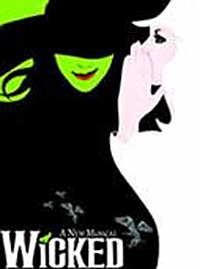
Wicked (Play House Square Center)

Wonderful ‘WICKED’ wows audience at the State Theatre

In a great injustice, ‘WICKED’ was not selected as the best musical in the 2004 Tony Awards competition. The recognition went to ‘AVENUE Q,’ an X-rated puppet show. As evidenced by the screaming, standing ovations the touring production of ‘WICKED,’ now on stage at Playhouse Square’s State Theatre is receiving, and you’ll know the audience’s feelings about what should have been the prize winner.

The show has everything to make for a hit! Great music, fine performances, creative staging, and a delightful yet philosophical story line with an important message which includes comments which can be applied to the Bush administration’s diminishing of the population’s personal rights and what happens when a small group of zealots determines what is “best for everyone.”

‘WICKED,’ which is the “behind the story” tale of two young women, Glinda and Elphaba in the ‘WIZARD OF OZ’ story. You know them better as the good and the wicked witches.

Think you know who is really the good and who is the wicked witch? Are you aware of how the tin woodsman came to be? How about the cowardly lion or the scarecrow? Think that the wicked witch really was melted by a bucket of water? All of these questions are answered in the Stephen Schwartz, Winnie Holzman musical which is based on the novel by Gregory Maguire.

The show’s music, by award winner Stephen Schwartz, known for ‘PIPPIN,’ ‘THE MAGIC SHOW,’ and ‘GODSPELL,’ is typical Schwartz. There are lovely ballads (“I’m Not That Girl”), delightful ditties (“Popular” and “Wonderful”), large scale production (“Dancing Through Life” and “March of the Witch Hunters”), and light rock (“As Long As You’re Mine”).

Touring productions can be of questionable levels. Worry not if you are lucky enough to have tickets for the three-week sold out run of the show. This is Broadway at its very best! The sets are amazing. They include a dragon whose wingspan is the same as a Cessna 172. There is enough electrical current on stage, according to the show’s press release, to supply twelve houses with power. Monkeys fly, Glenda descends in a magical bubble, large gears grind, 250 pounds of dry ice produce the haze and magical poofs, bubble machines spray rainbows and 175,000 pounds of scenery cover the stage. The costuming is magical. The musical sound is good. But, most importantly, the show is well directed and superbly performed.

Julie Murney, made up in green makeup throughout the show, gives a lustrous performance as Elphaba, generally known as the Bad Witch. Bad, as we find out, she isn’t. Her voice is glorious, her character development clear. She radiates.

Kendra Kassebaum as Glinda, the blond, air-headed Good Witch, is also superb. She glows on stage. Murney and Kassebaum blend beautifully in several songs.

Kirk McDonald, makes for a charming Boq, the munchkin. K. Todd Freeman (Doctor Dillamond) is appealing as the goat who loses his human voice. Sebastian Arcelus has a wonderful singing voice and effectively develops the role of Fiyero, the playboy whose goodness shines through. PJ Benjamin is fine as the Wizard, as is Alma Cuervo as the evil Madame Morrible.

The show has a strong Cleveland connection. Matthew Rego, Michael Rego and Hank Unger are ARACA Group, one of the shows producers. The young trio, who are from the Western Cleveland suburbs, besides producing ‘WICKED’ have been represented on Broadway by ‘NIGHT, MOTHER,’ ‘THE GOOD BODY,’ ‘URINETOWN THE MUSICAL,’ ‘FRANKIE AND JOHNNY IN THE CLAIR DE LUNE’ and ‘MATCH.’ Their off-Broadway shows have been: ‘DEBBIE DOES DALLAS,’ ‘THE VAGINA MONOLOGUES,’ ‘THE LARAMIE PROJECT’ and ‘SKYSCRAPER.’ Forthcoming are the film versions of ‘URINETOWN’ and “DEBBIE DOES DALLAS.’

Tuesday, June 20, 2006

Icarus (convergence-continuum)


‘ICARUS’ attempts to fly at convergence-continuum

“Sometimes beauty is a curse.” “Sometimes hope is disguised.” “Sometimes with love you can touch the sun.” These three lines summarize the concepts stressed in Edwin Sanchez’s play, ‘ICARUS,’ now on stage at convergence-continuum.

As with most of the theatre’s productions, Artistic Director Clyde Simon and Executive Director Brian Breth have found a script which challenges the audience to think. The dynamic duo seeks scripts which other local theatres can’t or won’t produce because they are too controversial, too abstract, or not appealing to general audiences.

Sanchez, is among the new breed of elite contemporary playwrights. His plays, from his breakout script, ‘TRAFFICKING IN BROKEN HEARTS’ concern chance meetings, impossible love, and the cold realities that get in the way of dreams. His plays take a group of oddball characters--all searching, all damaged--and have them affect each other’s lives.

In ‘ICARUS,’ as one play analyst states, “Like the Greek myth from which the play takes its name, ‘ICARUS’ is about super-charged dreamers whose wax wings melt when they fly too close to the sun. ‘ICARUS’ plays out like an inverted ‘BEAUTY AND THE BEAST’ fairy tale, though there's no magic to whip up a happy ending. But there are moments of grace that fill the play's one hundred minutes when the characters are momentarily released from their own traumas and attempt to help one another in unassuming but meaningful ways...in an enchanted setting, dreamers almost win, lovers nearly find happiness, and beauty kisses those who most deserve its fleeting glory. Reality ultimately kills the fairy tale."

The story concerns the facially disfigured Altagracia who who has found a beach house, apparently abandoned for the off-season, into which she moves her wheelchair-bound brother, Primitivo. Setting a goal for Primitivo to swim until he reaches the sun, Altagracia encourages him by stoking his dreams of fame and fortune. Mr. Ellis accompanies the duo with a stuffed cat named Betty. He also carries a valise filled with "dreams" which he taunts others to try and reach for. Beau, a friend of the owner of the house, arrives wearing a ski mask supposedly to hide the effects of a terrible accident. He is surprised to find the house occupied and wants the invaders to leave. After some negotiating everyone remains. Instead of the solitude he was expecting, Beau ends up getting, and giving, some vigorous lessons. In the house next door lives "the Gloria," a faded Hollywood legend who occupies a world of illusions about her now faded beauty.

Sanchez’s poetic writing, the abstractness of the storytelling, the use of the name Icarus yet not stressing the parallel to the actual Icarus tale, makes for abstraction which the audience may not easily grasp. Sanchez uses the myth as a point of reference, but this is not a modern retelling of it.

Convergence-continuum’s production is good, but not great. It is overly slow and needed some visual effects to induce the audience to create reality. Director Caleb Sekeres needed to pick up the pace and highlight the eccentricity of the characters even more than he did. As is, the play makes for a somewhat long sit.

Jovana Batkovic is generally effective as Altagracia, though more anguished pain needed to be obvious as she fights for normalcy while dealing with her crippled brother and her personal disfiguration. Brin Metzendorf is often on the surface as Primitivo. He needed to be more anguished until he finally finds a real purpose in life and tries to “fly” in order to free his world (his sister) from her constraints.

Clyde Simon is perfect as Mr. Ellis. He is a wonderful blend of the eccentric and the wise, in the costume of a fool. Lucy Bredeson-Smith was born to play the role of the Gloria. She creates a pathetic and vulnerable blond Gloria Swanson with ease and eerie realism.

Geoffrey Hoffman is excellent as the psychologically destroyed yet physically beautiful Beau. Hoffman, as he has proven in numerous convergence productions, seems to have the knack to take any role and make it his own.

The performance space both works for and against the performers. The limited size allows for emotional closeness to the actors. On the other hand, running through curtains as an exit to the sea ruins the illusion. Fading the lights on the main stage while the sun spot shines brightly as a visual image, as each of the characters runs into the ocean, may have made the exits more palatable.

CAPSULE JUDGEMENT: For those who like convergence-continuum’s selection of though provoking pieces, the script of ‘ICARUS’ will satisfy their desires. In a slightly better paced and conceived production, the experience would have satisfied the entire audience’s wants.

Sunday, June 18, 2006

Stratford Festival of Canada, 2006 review

Stratford Festival not up to its expected excellence

The Stratford Festival of Canada, in Stratford, Ontario, Canada, is considered to be one of the best repertory companies. In past years, I have never left the venue without seeing several outstanding productions.
This year, of the five productions I saw, none was outstanding, two were good (‘THE BLONDE, THE BRUNETTE AND THE VENGEFUL REDHEAD’ and ‘HENRY IV PART I’). One, (‘OLIVER’), which was an audience pleaser, was a lesser production than I had expected. Several others (‘MUCH ADO ABOUT NOTHING’ and ‘CORIOLANUS’) were sub-par. The latter two were surprising, as they are Shakespeare scripts which Stratford specializes in and should be finely staged.

To be fair, I didn’t see all of the shows offered. Canadian friends, whose evaluations I trust, saw ‘HARLEM DUET’ and were very impressed, and “enjoyed” ‘SOUTH PACIFIC.’ Local reviewer Tony Brown of the Plain Dealer, who I met while at the Festival, saw ‘DUCHESS OF MALFI’ and commented favorably on the creative staging. Additional shows, which will open later this summer include, ‘’TWELFTH NIGHT,’ ‘DON JUAN,’ ‘GHOSTS,’ ‘FANNY KIMBLE,’ and ‘THE LIAR.’


‘THE BLONDE, THE BRUNETTE AND THE VENGEFUL REDHEAD’

Australian playwright Robert Hewett’s ‘THE BLONDE, THE BRUNETTE AND THE VENGEFUL REDHEAD’ is a one-women show. The actress must portray 7 uniquely different characters aided only by costume and wigs changes. The persons range from a revenge driven woman, to a young boy, to a cheating husband, to an elderly lady.

In order for the play to work, an outstanding actress must take on the role. Fortunately, Stratford has such an actress in the person of Lucy Peacock. Peacock is nothing short of outstanding in clearly developing each of the characters.

The story, which is a little preposterous and unhinged in parts, concerns a suburban housewife whose husband leaves her for another woman. Rhonda, the wronged wife, turns her angst against a woman who she perceives is her husband’s mistress. Unfortunately, through a series of quirky events, she attacks and kills the wrong person. The story is woven together so that we hear from the husband, a neighbor, the jilted woman’s best friend, the murdered woman, her lesbian partner and their son, as well as the woman herself.

Anyone who appreciates superior acting should enjoy this production.


‘HENRY THE IV, PART I’

‘HENRY THE IV, PART I’ is one of Shakespeare’s historical plays. Richard II has been overthrown by King Henry IV. He faces a rebellion. His son, Prince Hal, is more playboy then heir-apparent, much to Richard’s dismay. In cahoots with Falstaff, an overweight scoundrel, Hal sows his wild oats until it becomes time for him to act as a leader in a battle to keep the throne. We see, in his growth into manhood, that Prince Hal, who eventually becomes Henry V, has the potential for greatness.

The play has many delightful moments as well as many dramatic ones. Unfortunately, Richard Monette’s direction is inconsistent. Oft-times the play soars. At other points it drags.

David Snelgrove makes for a good Prince Hall. He is both physically and performance believable. James Blendick is delightful as Sir John Falstaff. Adam O’Byrne, is nicely caustic as Henry Percy. On the other hand, Scott Wentworth does not clearly develop a believable King Henry IV and some of the other characters are often hard to understand and fail to create clear characterizations.

The costumes and the music, which was specifically written for the production, are excellent.

In spite of the strength of some of the parts, as a whole, ‘HENRY THE IV, PART I’ is not a quality production.


‘OLIVER!’

On June 30, 1960 I had one of my most memorable theatrical experiences when, while visiting London, England, I saw the world premiere performance of Lionel Bart’s ‘OLIVER!’ I screamed and applauded at curtain call after curtain call for the performances of Ron Moody (Fagan), Georgia Brown (Nancy) and David Jones (Artful Dodger) who went on to fame as one of the pop group, The Monkees.

The musical is based on Charles Dickens’ ‘OLIVER TWIST.’ It is the story of a boy who, along with other castoffs, endures the miseries of the orphanages of England. In the case of Oliver, however, as happens in all good musical comedies, he is saved by a wealthy man who turns out to be his grandfather. Filled with such wonderful songs as “Who Will Buy?,” “Consider Yourself at Home,” “Where Is Love” and such show stoppers as “I’ll Do Anything” and “You’ve Got to Pick a Pocket or Two,” audiences leave the show humming the score.

Because of my amazing first-nighter experience, I hold productions of ‘OLIVER!’ to a high standard. Though an obvious audience pleaser, as witnessed by shrieks of joy and a standing ovation, I did not think the Stratford production, under the choreographic and directing lead of Donna Feore, is as good a production as should be done at the Stratford Festival.

On the positive side, Blythe Wilson was excellent as Nancy. Her rendition of “As Long As He Needs Me” was powerful. Brad Rudy was a menacing Bill Sikes. Mary Ellen Mahoney was a delightful Widow Corney and Bruce Dow was fun as Mr. Bumble. The vocal chorus was excellent, as was the orchestra.

In his first-ever theatrical role, Tyler Pearse, has a fine singing voice and the innocent look for the lead role of Oliver, but fails give the character any dimension. His expressionless face, and uncertain stage presence, lessened the effect of the character. (Yes, he is only 10 and this is his virgin role, but his performance must be evaluated against others who have played Oliver and his falls short of many.) Scott Beaudin has a nice singing voice and moves well, but didn’t have the pizzazz needed for the role of the Artful Dodger.

The acceptable choreography was often not well executed. The biggest disappointment, however, was the performance of Colm Feore as Fagin. One of Canada’s best known actors, his interpretation of the cunning rogue just didn’t’ have the dimension needed for the multi-faceted character. The always delightful “Reviewing the Situation” fell flat.


’CORIOLANUS’


‘CORNIOLANUS,’ which was the last tragedy written by Shakespeare, is another of his plays that illustrates the strengths and weaknesses of heroes. In this case, Caius Martius is a successful warrior, but an individual who can’t put aside his high personal and ethical standards and understand that not all can live by his ideals. As a result of his perceived arrogance, and because of the fear of church leaders that his rise to power will diminish their influence, crowds of commoners, who were at first loyal followers, are persuaded through treachery to turn on Martius. Underlying the political issues is the role of family, especially the roles of son and father, which, again, is a common Shakespeare topic (think Hamlet and his father). In the end, as happens in all of the Bard’s tragedies, the fatal flaw of the hero turns out to the be the cause of his final destruction.

Many, including writer T. S. Elliot, consider ‘CORIOLANUS’ to be Shakespeare’s greatest achievement.

The Stratford production is visually spectacular. Burning fires, metal statues, meaningful musical bridges, period correct costumes and well conceived supporting props and scenery help create the right mood. Unfortunately, some of the performances do not support the technical efforts.

Director Antoni Cimolino has sacrificed effect for affect. Shouting substitutes for meaning. Overacting and feigned characterizations buried many of Shakespeare’s ideas.

Unfortunately, Colm Feore, as he did in his portrayal of Fagin in ‘OLIVER!,’ misses the mark as Coriolanus. He shouts his way through the first act making many of his speeches unintelligible. He creates no empathy for the character so, when he is threatened by the deceitful church leaders, we care little for him or about him. The screaming creates an illusion of someone out of control. This is not a man out of control. This is a man of deep conviction. He knows he is right and therefore dedicates himself to his personal cause. If only Feore had taken the lead of Graham Abbey, who, as Tulus Aufidus, Coriolanus’s near warrior equal, underplayed his role, thus creating a person who is real rather than an overacted image.

The second and third acts of the play were much better than the first as Feore ceased screaming and became more intelligible and developed a somewhat more believable character.

Paul Soles, in the key role of Meneius, was unbelievable in his role. On the other hand, Martha Henry, as Martius’s mother, was excellent as were Don Carrier and Bernard Hopkins as the conniving church leaders.


‘MUCH ADO ABOUT NOTHING’

‘MUCH ADO ABOUT NOTHING’ is one of Shakespeare’s most oft-done comedies. Having some of the same caustic dialogue as “TAMING OF THE SHREW,’ the play centers on the battle of the sexes as Beatrice and Benedick wage a merry war of words and insults as they move toward their inevitable mating.

An underlying subplot is one of supposed betrayal as the beautiful Hero is accused of having an affair by Claudio, her betrothed, because of rumors thrust forward by a shunned suitor. The entire conflict comes to a happy ending when the bumbling Malaprop-speaking Constable Dogberry, and his merry band of keystone cops, accidentally foil the plot against Hero.

The Stratford Festival’s production is acceptable, but not what it should be. There is some shallow acting, the pace is quite slow and some of the delight of the script is missing. On the other hand, the costumes are beautiful and the musical interludes are fine.

Robert Persichini is delightful as Dogberry. He beautifully bumbles through his lines. Diane D’Aquila is quite humorous as Hero’s maid. Though they are very acceptable, Lucy Peacock (Beatrice) and Peter Donaldson (Benedick) aren’t as sharp-tongued as they could be so that their accepting their joined destiny doesn’t bring about the fully delightful wrap-up that might be expected.

Part of the problem with the staging may have been caused by the departure of the show’s original director, Stephen Quimette, to be replaced by Marti Maraden. The change of directors may have caused the lack of a unified concept.

CAPSULE JUDGEMENT: All in all, from the productions I saw, I would have to declare that this is not a stellar year for the Stratford Festival. There are just too many weak productions to balance off the several good ones.

If I was going to the Stratford Festival later this summer or fall, and I enjoyed superb acting, I’d see Lucy Peacock’s performance in ‘THE BLONDE, THE BRUNETTE AND THE VENGEFUL REDHEAD. In spite of its weaknesses, ‘OLIVER’ will entertain most viewers. If you decide to do a Shakespeare, the production of ‘MUCH ADO ABOUT NOTHING’ should entertain all except the most sophisticated theatre-goer..

Saturday, June 17, 2006

Dames at Sea (Porthouse)


‘DAMES AT SEA’ floats happily into dock at Porthouse

Unless your are a theatre buff, while viewing the Porthouse Theatre production of ‘DAMES AT SEA,’ you’ll probably assume that the George Haimsohn, Robin Miller and Jim Wise show was written in the 1930s. The show is filled with depression day references, and celebrity names of that era pepper both the song lyrics and the dialogue.

Don’t be fooled. The show was written in 1969 and is actually a spoof on the 30s style escapist Hollywood and Broadway musicals which had one production number follow another and a slight story line that loosely hooks the songs and dances together.

Another little know fact is that the original show starred 17 year-old Bernadette Peters in the leading role. Peters went on to become a major Broadway star (‘THE MOST HAPPY FELLA’, ‘SUNDAY IN THE PARK WITH GEORGE,’ ‘INTO THE WOODS,’ GYPSY,’ ANNIE GET YOUR GUN,’ and ‘THE GOODBYE GIRL.’

The campy, musical is a small cast tongue-in-cheek tribute to the large cast Busby Berkeley film musicals. Pithy lyrics, staging that mainly consists of stylized over-acting, lots of shticks and gimmicks, tap dancing, kick-lines, and contrived events complete the picture.

The story (?) concerns Ruby, a just-off-the-bus showbiz hopeful who rockets to stardom by stepping in for a Broadway star. Ruby, named for Warner Brothers' film dancer Ruby Keeler, falls in love with hometown boy Dick, named for Dick Powell. This happens as Dick goes from wide-eyed swabby to celebrated Broadway composer in the same lickety-split time span. Also on hand are the good-natured Joan, named for Joan Blondell, and Lucky, who represents every sidekick who ever sang and/or tapped alongside a leading man (think Donald O’Connor, the sidekick to Gene Kelly). (I told you this wasn’t a great story line.)

The lines are often stilted, which is part of the writing style, but that doesn’t matter as you may not hear much of the spoken words as they are often drowned out by the production’s overly loud musical accompaniment.

The show is filled with hummable tunes, some of which have become minor Broadway classics. The score includes: “It’s You,” “Broadway Baby,” “”Good Times are Here to Stay,” “Star Tar,” and the finale, “Let’s Have a Simple Wedding.” Most of the songs are show-stopper dance numbers, with a few pretty ballads snuck in.

To work, the show has to be in the right hands. In general, Porthouse’s production is on target. Director Eric van Baars (who ironically starred in this show some years ago on the Porthouse stage with Terri Kent, the theatre’s Artistic Director), has a nice feel for the show, but is often too restrained in giving his cast the green light to really ham it up. That is, with the exception of Mary Ann Black, who dominates the goings-on with her appropriately over-done Mona Kent, the drama queen of drama queens. Black is nothing short of wonderful in “The Beguine” in which she makes a scarf into a major performance piece. Her “That Mister Man of Mine” is another delightful interlude.

Emily Leonard is picture perfect as Ruby. She is tiny, adorable and compelling. She lights up the stage. Her “The Sailor of My Dreams” was charming, as was her “Raining in My Heart, which featured umbrellas with twinkling lights on the ribs.

Though he physically fills the role of Dick, Ruby’s beau, Alex Jorth’s “aw shucks” Iowa sound becomes a bit grating after a while. He sounds like he is holding back air as he speaks. He has a very pleasant, but slight singing voice.

Jodi Beck is delightful as the outspoken Joan. She looks and sounds like Bette Midler, in the very best of ways. She is brash, brassy and sings and acts and dances well.

Erik Floor should have been given freer reign to really let loose as Lucky, Dicks’ happy go-luck side-kick. At times he sparkled, especially in some of his antics, but he needed to be more the male counterpart of Joan. His dancing was easy and loose and well done.

Sean Morrissey’s choreography was good. There were times, however, when some more razzle dazzle could have been added. Strongest numbers were “Star Tar” and “Good Times are Here to Stay.”

CAPSULE JUDGEMENT: If you like dancing and singing and don’t give a darn about a believable story line, you’ll go away from ‘DAMES AT SEA’ a happy theatre goer.000000

Sunday, June 11, 2006

Fefu and Her Friends (Cleveland Public Theatre)

‘FEFU AND HER FRIENDS’ is theatre at its best at CPT

Maria Irene Fornes, the author of ‘FEFU AND HER FRIENDS,’ now being creatively and impressively staged at Cleveland Public Theatre, is generally recognized as one of the most important feminist writers of the day. When asked to explain her style and what playwriting is Fornes stated, "You are in heaven. It's like a love affair. And everybody else can disapprove of it and think you're an idiot, but when you had it, you never forget it, and that is really what lives inside you..."

Fornes, a poet/playwright of Cuban-American stock, writes poetically, often with an absurdist bent. She makes things appear out of kilter by the use of the ridiculous, the overblown, the abstract. She allows the audience to come to their own conclusions as she asks questions and creates scenes which often have an abstract quality.

‘FEFU AND HER FRIENDS” concerns eight bright, unique women who gather to plan a program for the educational society to which they belong. Along the way, they explore with humor and anguish their relationships with men, other women, and, most importantly, each other. The year is 1935, long before the era of feminism.

The play, as conceived by Fornes, has a fascinating staging concept. The first act takes place in the performance theatre space which is mounted as a living room in an upper class New England home. As the act develops, the women arrive. For the second act, the audience is divided into four groups and is led by a docent to varying parts of the Cleveland Public Theatre complex. The audience finds themselves sequentially in a garden, a study, a bedroom and a kitchen. As each segment is acted, the sounds of the other scenes can be heard in muted tones. It makes for a fascinating experience...it’s as though you are eavesdropping on others while experiencing your part of the world. The third act returns us to the living room set.

The staging device was not created by CPT director Raymond Bobgan. When the play was first written it was staged in a New York loft Fornes took advantage of the rooms in the space by dividing the audience and moving them from place-to-place. The device gets the audience involved in the process of the play and makes the attender an active part of the experience.

What does the play mean? A Fornes’ expert states, “Though written in 1977, the message of ‘FEFU AND HER FRIENDS’ remains ever the same: women don't know what to do with feminism. Or rather, they don't know what to do with themselves. It's a strange, unsettling play, not least because the strong women characters are at a loss with each other and with themselves. Without a man to center around, they disintegrate into cattiness and then madness.” That’s one person’s view. Yours might be quite different and that’s what makes the piece so fascinating. You see the actions, you hear the words, you then get to think for yourself about the meaning.

CPT’s production, under Raymond Bobgan, the venue’s new artistic director, is superb. The cast is flawless, the pacing perfect, the devices all work. As in his past CPT works, ‘BLUE SKY TRANSMISSION: A TIBETAN BOOK OF THE DEAD’ and ‘THE CONFESSIONS OF PUNCH AND JUDY,’ this is an impressive production. Theatre goers can only look forward to more and more of his creativity in plays to come.

The actors are a unity cast. No one stands out, they all stand out. Jill Levin, (Fefu), Chris Seibert, Elizabeth Wood, Holly Holsinger, Anne McEvoy, Denise Astorino, Christine McBurney and Maggie Arndt each develops a unique and complete image. Each clearly achieves the character’s self-definition. They don’t act, they are.

The sets all work well. No set designer is listed in the program, but he or she deserves praise. Joan Horvitz’s costumes and Donald Wasson’s hats help set a perfect era-correct feel. Trad Burns lighting aids the illusion.

CAPSULE JUDGEMENT: CPT’s ‘FEFU AND HER FRIENDS’ is one of the best local productions of the season. Be warned, however, that if you are an advocate of escapist comedy or light musicals, this may not be your cup of tea. The play requires a probing mind to allow the attender to achieve the maximum effect. Those who come to the theatre with that curiosity will be overjoyed by the experience!

Saturday, June 10, 2006

Stratford Festival of Canada, a preview (Stratford-on-Avon, Canada)

THE STRATFORD FESTIVAL OF CANADA, a preview

The Stratford Festival of Canada takes place in Stratford, Ontario, Canada. The ride from Cleveland is about six hours through Buffalo. Go on-line to the festival to get directions. (The routings offered by both the AAA and Yahoo maps are confusing and miles longer.)

Stratford plays are done in four theatres. This season’s productions are: ‘CORIOLANUS’ (William Shakespeare)--now through September 23; ‘MUCH ADO ABOUT NOTHING ((William Shakespeare)--now through October 22; ‘OLIVER! (music, lyrics and book by Lionel Bart)--now through October 29; ‘TWELFTH NIGHT’ ((William Shakespeare)--July 30-October 28; ‘THE GLASS MENAGERIE’ (Tennessee Williams)- now through October 22; ‘SOUTH PACIFIC’ (music by Richard Rodgers and lyrics by Oscar Hammerstein II)--now through October 28; ‘LONDON ASSURANCE’ (Dion Boucicault)--now through October 21; ‘DON JUAN’ (Moliere)--English performances from August 1-October 10, French performances from October 12 to 20; ‘HENRY IV, PART I’ ((William Shakespeare)--now through September 24; ‘GHOSTS’ (Henrik Ibsen) -July 25-September 23; ‘THE DUCHESS OF MALFI’ (John Webster)--now through September 23’ ‘HARLEM DUET’ (Djanet Sears)--June 20-September 22; ‘THE BLONDE, THE BRUNETTE, AND THE VENGEFUL REDHEAD’ (Robert Hewett), June 27 September 24; ‘FANNY KEMBLE’ (Peter Hinton)--July 18-September 23; ‘THE LIAR’ (Pierre Corneille)--August 9-September 23.

Besides the regularly scheduled plays the Festival offers public readings, Monday night music, a Celebrated Writers Series, buffet lunch and dinner table talks, special lectures, stage side chats, backstage and costume warehouse tours, and garden tours. The Family Explorer series offers events and activities for the entire family including song and dance workshops and dress rehearsals with the actors.

What’s the lodging like? Hotels, motels and bed and breakfasts abound to fit any wallet. I enjoy the B&Bs where you get to meet local people who operate the facilities and fellow travelers from around the world. My favorite is “The Jennie Forbes Cottage” a charming regency cottage erected in 1857 (www.jennieforbescottagebb.com). Owners Don and Kathy Spiers are wonderful hosts.

As for shopping, I recommend Davis Canadian Arts (106 Ontario Street). This is a wonderful art gallery that offers Canadian traditional and contemporary sculptures, ceramics and paintings. For women’s quality clothing make sure to stop at The Touchmark Shop (137 Ontario Street). The establishment offers unique and one-of-a kind products at excellent prices.

Hungry? For moderate cost and high quality, try The Annex Room (38 Albert Street). For a relaxed and fairly inexpensive breakfast treat try Demetre’s Family Eatery (1100 Ontario Street). Cleveland theatrical legends Dorothy and Reuben Silver, who are Statford regulars, recommend The Waterlot Restaurant and Inn (17 Huron Street behind the Royal Bank) in New Hamburg, which is about 20 minutes away “and well worth the trip.”(www.waterlot.com) Also on their favorites list is The Keystone Alley Cafe (34 Brunswick Street) in Stratford (www.keystonealley.com) which has an outdoor patio.

Stratford Escapes, a division of Niagara Falls Tours, is an efficient way to make reservations. For information call 877-356-6385 or go on line to www.niagarafallstours.com. For individual tickets call 800-567-1600 or go on-line to www.stratfordfestival.ca.

Helpful hint: To satisfy board requirements carry some official form of identification (passport, or driver’s license with a picture).

Go to Canada, find out what lovely hosts these people are, and see some great theatre!