Saturday, March 17, 2007

Song and Dance (Beck Center)


BECK’s ‘SONG AND DANCE’ a solid winner in spite of the concept

Sometimes a theatre-goer sees a production and realizes that the end is better than the means. This is the case with ‘SONG AND DANCE,’ now on stage at the Beck Center. Beck’s production, co-directed by the theatre’s artistic director Scott Spence and Verb Ballets’ artistic director Hernando Cortez is an audience pleaser in spite of the problems created by the format of Andrew Lloyd Webber’s script.

The song part of ‘SONG AND DANCE’ (Act 1) tells the tale of a young English woman (Emma) who arrives in New York, ready to find love and happiness in the Big Apple. But through a string of unsuccessful relationships, she finds something more important: self-awareness. The second act (Dance) concerns one of her lovers (Joe) and his attempt to find himself, his awareness of his love for Emma, and her ultimate rejection. Well, that’s kind of what the second act is about.

The reason for the disparity between the acts centers on the very way in which the show was conceived. The final product is a combination of two Webber pieces. The first, his ‘VARIATIONS ON PAGANINI'S CAPRICE IN A MINOR,’ which was developed in 1978 and the second, ‘TELL ME ON A SUNDAY,’ a song cycle written in 1980, which is based on “A Minor Caprice No. 24 by Paganini.” The latter was conceived by Webber for his cellist brother Julian, and was not intended to be a theatrical presentation. When listening to the second act, if the music sounds familiar, it is if you’ve seen ‘CATS.’ The score was also incorporated into that Webber musical.

Variations and ‘TELL ME ON A Sunday’ were wed when producer Cameron Mackintosh proposed they be combined under the umbrella title, ‘SONG AND DANCE,’ thus explaining the different acts of the show. The results may well confuse the audience which is probably looking for some clear hook between the two acts, which is hinted at, but isn’t really there.

The show, which originally premiered in London, was greatly altered before it opened on Broadway in 1985. The ending was changed from a situation in which the separated lovers realize their errors and reunite (London) to: he wants to reunite, but she realizes that she was looking for love in all the wrong places (Broadway), so they go their separate ways. In spite of very mixed Big Apple reviews, the show ran 474 performances. Many feel that the only reason the production lasted as long as it did was the star power of Bernadette Peters, who gained the Tony Best Actress award for the role.

The first act is a solo piece. Except for the scene changers and a non-speaking cameo by one of Emma’s lovers, the actress sings eighteen songs, including the beautiful “Tell Me On a Sunday,” and “Unexpected Song.” And the compelling, “Come Back With the Same Look in Your Eyes.”

Tracee Patterson is wonderful as Emma. Though her voice is a little shallow in the upper registers, she is such a strong actress that all is forgiven as she sings meanings not words to make each song a clear tale in itself. Her smiles, her tears, her emotional torment all shine clearly through. This is a very difficult role and Patterson carries it off with panache.

The second act is more problematic. It is beautifully danced by members of Verb Ballets. It features Mark Tomasic, one of the very best of the local male dancers, who is ably supported by the female members of the corps. The only weakness in the dance troupe is Sydney Ignacio, who does great gymnastics, but falls short when appearing on stage with such strong dancing talents as Tomasic and Brian Murphy.

Tomasic, who is not only a proficient dancer, but an accomplished actor, is excellent. It would be interesting to see him cast in a theatrical production in a role such as Curly in ‘OKLAHOMA,’ where he could not only sing and act the role, but dance the Dream Ballet as well.

One can only wonder why Cortez, who is a very creative and inventive choreographer, didn’t just create a second act which more clearly tells the story of Joe (Tomasic) so that it parallels the search that Emma goes through in the first act. This is hinted at, but never becomes the total focus. A clear story line would have made the dance, balance the song.

Larry Goodpaster’s orchestra is excellent. Ismael Kabar’s cello solos in the second act are finely crafted.

CAPSULE JUDGEMENT: Beck’s ‘SONG AND DANCE’ is well worth seeing. It is another feather in the crown of the production center which has become the best over all theatre in the area...taking on musicals, dramas and comedies--and doing them extremely well.

Friday, March 16, 2007

'10!' (MorrisonDance)


Morrison Dance uninspiring as part of DanceWorks 07

After each of the pieces of ‘10!,’ Morrison Dance Company’s program of short pieces, which they are presenting as part of DanceWorks 07, there was polite applause. This, in spite of the fact that it was opening night and many of the audience members were friends or family of choreographer Sarah Morrison, or her dancers. The tepid response was right on target.

Though Morrison is a very proficient dancer, her choreography lacks dynamism. It lacks vitality. Most of what goes on during her staging is static. At no time is there a “wow” factor.

Even her signature piece, SKETCHES OF RODIN,’ lacked the imagery of Rodin’s sculptures, which supposedly inspired the piece. Rodin’s works are strong, command attention, make themselves stand out. Morrison’s piece, which consisted mainly of Kalindi Stockton rolling around the floor moving a piece of “marble,” was understated and anything but breathtaking.

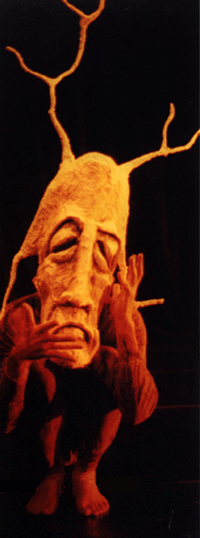
The highlight of the evening were the masks created by Scott Radke, Morrison’s husband and artistic collaborator. Too bad the choreography wasn’t up to the visual impact of the artwork.

Capsule judgment: If Morrison Dance is ever to develop a strong following like Groundworks, Inlet and Verb Ballets, Sarah Morrison is going to have to expand her repertoire by either letting lose with her own creative juices or supplement her work with some other choreographers who are capable of taking the dancers to a new level.

Saturday, March 10, 2007

THE CLEAN HOUSE (Cleveland Public Theatre)

Quirky ‘THE CLEAN HOUSE’ at CPH

‘THE CLEAN HOUSE,’ Sarah Ruhl’s award winning play, which is now in production at the Cleveland Play House, is the kind of show audiences will either love or hate. The overheard comments by exiting patrons at the conclusion ranged all over the place regarding their thoughts of the production.

The play was a finalist for the 2005 Pulitzer Prize and won the Susan Smith Blackburn Prize for best play written in English by a female playwright in 2004. Yet, reviews of the show’s productions in New York and elsewhere were very mixed. It was added to and taken off several theatre’s production schedules due to questions over audience appeal.

Ruhl indicates that the germ for the play came from real life. According to the author, the opening monologue, “I didn’t go to medical school to clean my own house,” came from a comment she overheard at a cocktail party. Ruhl took this statement and rolled out a play which explores relationships and our need for purpose, while examining the Great American class divide. Isn’t it interesting that the upper and middle classes who want clean homes, hire the lower middle and lower classes to do the work!

One of the most fascinating aspects of the play is that the author look at the rituals of cleaning and death as parallel processes. According to Ruhl, “the byproducts of life are waste and chaos, every time we clean we try to keep chaos at bay.” She parallels that to the role of the doctor, the occupation of her lead character, who spends her days helping her patients fight the byproducts of their diseases, but won’t apply the same principles to her life and her home.

Don’t get the idea that ‘THE CLEAN HOUSE’ is a tragedy. It has very serious undertones, but it is also about jokes and ice cream and apples. In fact, the most important writing element of the script is the attempt to create the perfect joke. Our heroine finally conceives it, but, like life itself, we never quite hear it, we never really “get” it.

With that philosophical exposition, what’s the play about? Lane, a successful and exacting American doctor, believes her home should be spotless but wants nothing to do with the cleaning of it. Mathilde, the Brazilian maid hired to clean Lane’s house, is completely uninterested in housecleaning – her parents were the funniest people in their village and she is obsessively focused on her search for the perfect joke. Virginia, Lane’s sister, has a cleaning fetish and believes it immoral not to clean one’s home. Lane’s surgeon husband has fallen deeply in love with one of his patients, a dying woman who has a unique view of life and death. All this combines to make for a potentially thought-provoking experience.

The Cleveland Play House production has an excellent cast, is well paced by director Davis McCallum and has a startling attractive set by Andromache Chalfant. The use of projections to interpret the Portugese spoken lines is creative.

Ursula Cataan, who has a Salma Hayek personality and resemblance, is delightful as Matilda. Patricia Hodges is properly uptight as Lane. Beth Dixon gives a practical base to Virginia, Lane’s sister. Janis Dardaris shines as the dying Ana. Only Terry Layman disappoints as Lane’s husband. He never seems real. Part of this may be due to the unrealistic lines he is given by the playwright and the equally non-believable situation of trekking in Alaska with the goal of finding a tree which supposedly will cure Ana’s cancer. (Would a doctor do that?)

CAPSULE JUDGMENT: Seldom do I leave a theatre with a feeling of ambivalence. This was not the case with ‘THE CLEAN HOUSE.’ I didn’t love it, I didn’t hate it, I can’t recommend not seeing it, but I can’t say, “go.” I guess I’ll just have to go clean my house and delve into the psychology of the activity.

Sunday, March 04, 2007

Shorn


Juliette Regnier showcases talents in ‘SHORN’ at Dobama

Juliette Regnier readily admitted during the after-show discussion of ‘SHORN,’ now being performed at Dobama Theatre, that she is an actress, not a playwright. In spite of this, Regnier has penned what, for lack of a better description, is a performance piece entitled ‘SHORN.’

‘SHORN’ brings to life the stories of three French women, who had sex with Nazis during World War II. Much like Hester Prynne in Nathaniel Hawthorne’s ‘THE SCARLET LETTER,’ who was branded with wearing the scarlet “A” to identify her as an adulterer, these “collaborators” had their heads shaved and were marched through the streets as models of shame.

It mattered little that one was truly in love with the young German, another needed food and the third plied her trade as a prostitute and it would not have mattered what nationality her sex partner was.

‘SHORN,’ according to Regnier “looks at women as ‘collateral damage’ during war time through the lens of French women accused of being ‘complicit’ with the Nazis. She has obviously achieved this, at least in the eyes of the women who responded during the play’s after discussion.

In spite of what I consider to be a very compelling bit of acting, I have some problems with Regnier’s piece of work.

The first is the piece’s format. ‘SHORN’ starts and stops with several interludes. The pieces don’t really flow together. The use of a mime/clown to make bridges isn’t clearly defined. Most of the time the clown appears to be exactly what it is, a theatrical bridging device to loosely hold the parts together. If Regnier is going to go further with this piece, she needs to more completely develop why a clown was chosen and what the purpose of that figure is. As is, it’s just gimmick for the sake of gimmick.

In addition, it would seem to serve Regnier’s message better if she stressed her self inscribed purpose of, “And suddenly I was faced with the non-judgmental question of just how would a woman/I respond during the war?” Maybe her “clown” might challenge the audience with that question, thus developing the theme.

And, I did not find the woman clearly etched. Each should be more clearly fleshed out so that their underlying motives and their reasoning for their actions would clearer.

Capsule judgment: ‘SHORN,’ which is getting its world premiere at Dobama is an interesting evening of theatre, one that is thought provoking. Yet, because of its flawed script, ‘SHORN’ leaves one wishing for a more complete experience.

Thoroughly Modern Millie


‘THOROUGHLY MODERN MILLIE’ lights up at Carousel

There is an old adage in the theatre, “The show must go on!” There are lots of legends about performers going on stage in the midst of tragedies and illnesses. Carousel Dinner Theatre has a reality tale to add to the list. On Saturday, Hollie Howard, who plays the title role of Millie in Carousel’s THOROUGHLY MODERN MILLIE,’ fell off the stage during the afternoon preview performance of the show. That evening was opening night!

What to do?

In the make believe world of theatre, as exemplified in such shows as ‘42ND STREET’ the understudy goes on, does a smash-up job and becomes a star. Well, that’s not what happened at Carousel. They mount their shows in a week, so the understudy doesn’t really get to learn her/his part until the show is running.

Howard, complete with taped ankle, went on after some adjustments to the choreography. Ironically, this was not the first injury for this production. Director Marc Robin, early in rehearsals, tripped over a piece of scenery, and hurt himself. Opening night was his first night off crutches.

Howard’s being hobbled hurt no one. In fact, if the announcement hadn’t been made before the show, the audience wouldn’t have known the difference. Howard danced well, sang even better, and portrayed the role to perfection.

In contrast to many musicals which are turned into films, ‘THOROUGHLY MODERN MILLIE’ was first a movie. It opened in 1967 and stared Julie Andrews, Mary Tyler Moore, John Gavin and Carol Channing.

In the early 2000s, the movie was adapted for the stage. It maintained the basic story line of the movie but, in an effort to be politically correct, it toned down the stereotypical traits of the Asian characters in the film. (Some will still find those stereotypes offensive.)

The plot revolves around Millie Dillmount, who, in 1922 comes to the Big Apple from Kansas determined to marry her wealthy boss. She sheds her country girl image and becomes a “modern” flapper in order to hook her man. On her first day in NY, she accidentally trips Jimmy Smith, an apparently ne'er-do-well paper clip salesman. Yep, you guessed it. He isn’t a ne’er do well, and in the tradition of trite musicals, after a few obvious plot twists, they go off into the sunset. Well, into the bright lights of Broadway, to live happily ever after.

The show, which is filled with lots of upbeat songs and many dance numbers, including some great tap dance routines, is dynamic, thanks to Robin’s setting a lightening quick pace, clearly developing the characters, and adding some fun gimmicks (such as having the Chinese lines projected in English on screens on the sides and above the stage). But most of all, he explodes the stage with creative choreography.

The cast is excellent. Howard brings Millie to musical and dramatic life. Brian Ogilvie is properly wholesome as Jimmy Smith. He dances and sings well. Donna Ryan is so bad as the scheming Ms. Meers, that she is good. Christin Mortenson effectively lets loose her big voice in “Only in New York.” Lindsey Clayton is fun as Miss Flannery, an uptight boss who turns into a goodie. Jim Sorenson is Broadway handsome and effectively develops the over-bloated Trevor Graydon, the richie on whom Millie has her sights set. Even the male dancers, who are often the weak link in many musical productions, are excellent.

The music, the sets, the costumes all work.

CAPSULE JUDGEMENT: Carousel’s ‘THOROUGHLY MODERN MILLIE’ is everything that makes for good dinner theatre...a sprightly production, featuring a well chosen cast, guided by excellent direction. If you like theatre-light and don’t want to think a lot, but have a good time, you’ll dance happily out of ‘THOROUGHLY MODERN MILLIE.’

Saturday, February 24, 2007

Red Light Winter


Disturbing, unnerving ‘RED LIGHT WINTER’ at Bang and Clatter

Akron’s off-off Broadway theatre, THE BANG AND THE CLATTER, is presenting Adam Rapp’s controversial play, ‘RED LIGHT WINTER.’ This show is not for the feint of heart. It’s not for those who can’t tolerate full-frontal nudity, gross language, depiction of graphic sex, or don’t like to have their senses assaulted.

To be honest, I don't like the script, but I can't and won't deny that the raw smells, tastes and visions got into my senses and won’t get out. I don’t like the people. I don’t like what they represent. I don’t like that they can’t and or won’t save themselves from their destructive paths. Yet, I can’t get them out of my mind.

The name Adam Rapp may sound familiar, even if you aren’t a theatre person. A novelist, film maker and playwright, his book ‘THE BUFFALO TREE’ was brought to national attention when it was censored by the Muhlenberg School Board in Reading, Pennsylvania for its language and subject matter.

Rapp uses graphic language, sexual content and themes that are repulsive to some. Personally, I’m not shocked or turned off by his language or subject matter. But I am turned off by his style. I just think he writes speeches which don’t sound like they would be spoken by a normal person, writes characters that are overdrawn, and puts shock before substance. I find that he throws in gimmicks to move along the plot that often make no sense.

‘RED LIGHT WINTER’ begins in a small bedroom in a hostel in Amsterdam, where nerdy, unsuccessful playwright Matt attempts to kill himself. Right after his half hearted attempt fails, his traveling mate Davis turns up. The two are friends from college and are vacationing together in Europe. Davis has a present for Matt—a prostitute named Christina.

Christina appears to be French but, as Matt deduces, is actually an American. She undresses Matt, takes him to bed, then she exits, leaving behind a tape recorder and the fancy red dress she changed into just before bedding the somewhat shy and inexperienced young man.

Act Two takes place in New York, in Matt's apartment. If any more of the plot is revealed the effect of the evening will be ruined, so I’m stopping here with just the comment that the play has no curtain call and that is one of the dramatic highlights of the evening.

Okay, here are my issues with Rapp and his script. Yes, opposites may attract and people turn to those who are unlike themselves in order to get some thrills. But, that obsessive-compulsive insecure Matt would be friends with Davis, who has no redeeming qualities, is questionable. As written, Davis wouldn’t be an actual friend to anyone, least of all Matt, whose girl friend Davis stole some years back. As for Christina, she's something of an enigma throughout. At first I thought that it was the fault of Laurel Johnson, who plays the role. She has a bad French accent, is a weak singer, and her lines often lack unity of thought. Nope, it’s not Laurel’s fault. The character is poorly and manipulatively drawn by Rapp. Her language and lines don’t ring true. Questions abound: Why the false French accent? Why does she leave her dress and the tape recorder behind? Of all the people in the world, why does she seek out a scumbag like Davis when she comes to New York? The answer is that these are all plot development devices.

What is surprising is that ‘RED LIGHT WINTER’ was one of the finalist for last year’s Pulitzer Prize. With the quality of this script, no wonder no award was given.

As they are apt to do, the Bang and Clatter gives the play a good production. In fact, the production, outclasses the material, though trimming the first act (one hour and thirty minutes was way too long) and picking up the pace in the second act, would have helped.

Doug Kusak is generally on target as Matt. He probably has the clearest of the characters to interpret, even with the question of his loyalty to Davis. I found his interpretation of the closing scene a little unclear, but otherwise, it was a good acting exercise.

Mark Mayo knows no boundaries as Davis. He is way, way over-the-top. It can only be assumed that Director Sean McConaha really, really wanted us to hate Davis. He succeeded. I wonder what would have happened if Mayo had pulled back the character a little. If he had not screamed almost every line, over-acted ever gross action and syllable that spewed forth from his mouth.

The second act confrontation scene between Davis and Christina was so finely tuned it was pure emotional agony. It was almost unwatchable because of the uncompromising reality of the performers.

Gorgeous Laurel Johnson does what she can with the poorly written role of Christina/Christine/ Annie. Her physical change between the first and second acts is amazing. She perfectly transforms into a Keene painting of a hollow-eyed child looking at finality.

Capsule judgement: ‘RED LIGHT WINTER’ has to be one of the, if not the most disturbing productions I’ve ever seen. I’m writing this 24 hours after having seen the show and I’m still in a state of shock!

Death of a Salesman (Actors' Summit)


ACTORS’ SUMMIT does a good job of selling a Miller classic

Cleveland has become an Arthur Miller kind of town! Running concurrently are the master playwright’s THE PRICE (Ensemble Theatre) and THE DEATH OF A SALESMAN (Actors’ Summit). And, to the pleasure of local theatre-goers, both productions are excellent!

Arthur Miller, who died in 2005 at the age of 89, is considered to be one of America’s greatest modern playwrights. He authored many highly regarded works including ‘THE CRUCIBLE,’ ‘A VIEW FROM THE BRIDGE’ and ‘ALL MY SONS.’

Many consider his greatest work to be ‘DEATH OF A SALESMAN,’ which premiered on Broadway on February 10, 1949, starring Lee J. Cobb. The play won a Tony Award, a New York Drama Critics' Award and a Pulitzer Prize. It was the first play ever to win all three of those awards.

Miller, who continued in his writing to probe, “Is this the best way to live,” features that theme in Salesman, which by most counts is the most studied American play in high schools and colleges.

The plot centers on Willy Loman, a salesman who has spent his whole life “way out there in the blue, riding on a smile and a shoeshine,” proud of his ability to sell anything to anyone and to provide for his family. In reality, this is a dream of the reality...he is not successful, nor well liked, nor providing for his family. As the play unfolds, he loses his job, the respect of his sons, and finally, his hope. He finds himself needing to face reality, but unable to do so.

Miller uses flashbacks to create a stream of conscious to illustrate Willy’s lack of reality. He is a modern day tragic hero, whose flaws lead to his destruction. He dies, as he has lived, by creating a false illusion. Is this the best way to live?

The play takes place in a small house in Brooklyn. Originally in the country, the home in the play is now surrounded by high-rise buildings. The house really exists. The Miller family lived there. Ironically, it is around the corner from my aunt and uncle’s apartment and, when I visited them, I would walk over to see the residence, and realized that it, much like Willy, was overwhelmed and lost by the reality of the world which surrounds it.

Actors’ Summit’s production, under the direction of Alex Cikra is quite good. Though a little slow in places, the play’s intent is clear.

A. Neil Thackaberry, coming off an amazing performance in Actors’ Summit’s ‘QED,’ gives Willy the right physical and emotional dimensions. Here is a stoop-shouldered hunk of a man who walks as if defeated, weighted down by not only his salesman’s valises, but by his self-created delusions. Interestingly, Thackaberry’s occasional stumbling over lines adds to the chaos in the character’s mind.

Paula Duesing does well as Linda, Willy’s brow-beaten enabler wife. One of her two major speeches is outstanding. Known as the “respect must be paid” soliloquy, in which she summarizes Willy as an undistinguished man whose name will never appear in a newspaper, Duesing is emotionally right on target. Unfortunately, the final speech, the requiem, when Linda states that she is unable to cry and questions why, now that “We’re free and clear” Willy has killed himself, lacks the emotional gut-shaking reality that is needed to close the curtain on Willy’s delusions.

This production, however, belongs to Nick Koesters as Biff, the only Loman capable of finally realizing that he is not the superstar that Willy has dreamt up. Koesters is outstanding. In the scene in which he finds out the truth about his philandering father, his body sags, his eyes well, his lips tremble, the life goes out of his eyes as his world crashes down. Bravo!

John Galbraith is fine as the clueless Hap, the other son, who is well on his way to becoming another Willy.

Cikra’s decision to multi-cast Marc Moritz as five different people is questionable. Though Moritz is excellent, several scenes lose their focus because Moritz is forced to literally play two people at once.

The set does more to distract than enhance the production. Not using see-through walls, which Miller meticulously describes in the play’s notes, distracts from our ability to separate Willy’s realities from his illusions.

CAPSULE JUDGEMENT: ‘DEATH OF A SALESMAN’ is a brilliant play. Actors’ Summit generally does a fine job of showcasing this important work.

Sunday, February 18, 2007

Natural Selections--Verb Ballets

‘NATURAL SELECTIONS’
--disappointing VERB BALLETS


Verb Ballets is one of the premiere dance companies in the Northeastern Ohio area. It was disappointing therefore, to watch a flow of patron bodies out of the Natural History Museum at intermission of the company’s recent ‘NATURAL SELECTIONS’ program. It was off-putting to hear the polite but generally unenthusiastic applause as the program finished. It was disappointing to hear comments following the concert such as, “That was a little raw” and “I thought this was a first class company.” It is more disappointing that after so many positive, usually rave reviews of Verb, that I have to write this column and question the program design of Artistic Director Hernando Cortez.

Cortez decided that his dancers needed to spread their wings and show their choreographic skills. This was an admirable idea. It was not wise, however, in my opinion, to do it by having an entire evening devoted to that mission. Especially an evening in which people paid for the “real” Verb Ballets. It might have been fine for a free performance, like the company does during the summer, but not in the middle of the regular season. Even one or two pieces sandwiched in might have worked, but a solid diet of “world premieres” by unknown and untested choreographers, was a questionable decision.

The final result was more like a college senior dance recital than an evening with a professional company. The ballets, in general, went from bland to promising, the dancing from undisciplined to nicely done, but not up to the level of the Verb Ballets that has received critical raves.

The evening opened with ‘PLEASE,’ choreographed by Catherine Meredith. Though generally well-danced by Erin Conway, Brian Murphy, Catherine Meredith and Mark Tomasic, the dramatic-toned piece failed to capture attention. It was pleasant but not compelling. Most strange was the ending. Without any climax, the dancing just ended. What was the conclusion? Where was the climax message of romantic love and romantic loss billboarded in the program notes?

Marcela Alvarez’s ‘VAGARIES,’ was uncreative. There was no true separation between the so-called dreams and nightmares, and no clarity of message. What was the piece supposed to say? In addition, the dancers were undisciplined and coordination of corps movements was sloppy. This was the low-point of the evening.

In ‘FOREVER IN MY MIND,’ Brian Murphy’s piece, the movements and the music blended beautifully . The dancers were quite disciplined. The story, which was billed as a poetic narrative, however, was not clear. Yes, the meaning of poetry is in the mind of the beholder, but a message must be there or the piece fails to have a total impact. It was nice to watch, but left out the important element of clarity of intent.

Of Erin Conway’s ‘FLUCTUATING HEMLINES’ the choreographer states that what we are watching is “pure show-stopping dance.” I only wish that had been the case. The piece failed to let loose. Often, the dancers were not coordinated. The promised athleticism was not present. The highlight segment was the duet between Anna Roberts and Mark Tomasic.

The most ambitious segment of the evening was Mark Tomasic’s ‘LUIS.’ Based on a story by Richard Selzer, a Brazilian doctor turned author, it is the dual tale of Luis and Selzer (named Cherubini in the selection).

Luis, a street urchin is poisoned when the glowing disk he thinks is a piece of a fallen star that will give him luck, turns out to be a radioactive part from a discarded medical instrument from Selzer’s hospital. Selzer, who led a life which he termed as, “a blind love for science, for technology, which produced a passionless barbarity,” after meeting and attempting to treat the dying Luis turns toward a passion for helping others.

With a script adaption by celebrated Cleveland playwright Eric Coble, Tomasic choreographed a well danced, but not completely successful tale. A lot of floor groveling, standing still, and dialogue failed to develop the needed pathos.

Jason Ignacio acceptably danced the role of Luis, but even though he wore a microphone, he was almost impossible to hear and his words were often unintelligible. Tomasic and the rest of the cast had the speaking volume, but except for Tomasic, the acting levels were poor. Erin Conway, for example, an excellent dancer, spoke flat lines. Someone needed to work with the cast on creating characters and speaking lines that had meaning.

Dr. Cherubini’s awakening, didn’t ring true. All we saw was him removing his rubber doctor gloves, stepping over and wandering through the people in the dump, not helping, raising, curing, or displaying compassion for them.

The piece has potential. Tomasic needs to expand the concept to create a more involving and evolving story through dance. It might be wise to step away from dancing the role of Dr. Cherubini and spend his entire time as the choreographer. However, considering the few males in Verb’s company, this might be impossible. (Side-note: the company must do something about its paucity of male dancers.)

To add to the evening’s problems was Raymond Kent’s lighting, which mainly consisted of dark stages with some accenting lighting. Missing was the company’s usual lighting designer Trad Burns ‘ creative and mood setting designs.

CAPSULE JUDGEMENT: Going to a Verb Ballets’ presentation has been consistently a delightful experience. Unfortunately, this was not true with their latest offering, ‘NATURAL SELECTIONS.’

Review of the Reviewer's Reviews (Jeffrey Grover)

Roy,

Thanks for your continued good work bringing attention to important Cleveland performances, Roy.

All best,

Jeffrey Grover

Review of the Reviewer's Reviews (Alan Dawson)

I really enjoy your reviews. Keep up the good work.

Alan Dawson of Canton, OH

Saturday, February 17, 2007

Chita Rivera, A Dancer's Life


Chita Rivera lights up stage at the Palace

On September 26, 1957, ‘WEST SIDE STORY’ opened at the Winter Garden Theater in New York. I saw the show on September 27. I went into the theatre not having read the rave reviews in the paper that AM. I was completely blown away. The Arthur Laurents, (book) Leonard Bernstein (music), Stephen Sondheim (lyrics) conceived show was everything a Broadway musical should be. It told a modern version of ‘ROMEO AND JULIET,’ featuring the conflict between Puerto Ricans and “white” Americans. The music and lyrics were exciting. The cast superb. The person who totally enthralled me was Chita Rivera, playing the fiery and lusty Anita.

The dancer, singer, actress is presently telling her life story in ‘CHITA RIVERA, THE DANCER’S LIFE’ at the Palace Theatre in Playhouse Square. And it is a story worth telling.

Some interesting facts roll out in the production. Her first professional stage appearance was in Akron as a dancer in ‘CALL ME MADAM.’ Her first starring role was in ‘BYE BYE BIRDIE.’ She has twice appeared in major shows with Liza Minnelli (‘CHICAGO’ and ‘THE RINK). She has worked with the greatest choreographers in modern theatre including Jack Cole, Bob Fosse, Jerome Robbins and Michael Kidd.

The most enticing part of ‘CHITA RIVERA, THE DANCER’S LIFE” is the segment in which she talks about the choreographers and behind her, in silouhette, a line of dancers emulate each of the dance styles of these men.

Rivera, who starred on Broadway in such shows as ‘THE RINK’, ‘SWEET CHARITY’ and ‘CHICAGO,’ still has “it!” She is compelling on stage.

The well-preserved 74-year old can still flash the magical smile, move those sensual hips and kick moderately high though she needs some sit-down breaks. What is most interesting is that by all rules of medicine she should not even be on that stage.

In 1986 she was hit by a car. Her leg was shattered, requiring 16 screws to repair the damage. She was told she might not ever walk again. Her guts and determination transformed themselves into a will power that has allowed her not only to walk, but to dance for almost an hour-and-a-half in her present show.

Capsule judgment: If you love musical theatre, if you want to see the consummate musical theatre performer in what is maybe her final appearance in the spotlight, you’ll love ‘CHITA RIVERA, THE DANCER’S LIFE.’

The Price (Ensemble Theatre)


‘THE PRICE’ is right at Ensemble!

Arthur Miller, author of ‘THE PRICE’ now on stage at Ensemble Theatre, is one of the greatest of American playwrights. In his scripts, he asks, “Is this the best way to live?” He is a moralist, who holds humanity up to the highest standards. This philosophy is woven into such classics as ‘DEATH OF A SALESMAN,’ ‘ALL MY SONS,’ ‘THE CRUCIBLE,’ and ‘THE PRICE.’

‘THE PRICE’ takes place in the 1960’s in a cramped top floor of a Manhattan brownstone that is going to be demolished. The attic holds the used furniture of a once wealthy family. Victor, a middle–aged policeman near retirement, awaits the arrival of an agent to give him a price for the attic’s contents. The room is filled with memories. Memories of the 1929 Wall Street crash when the family’s money disappeared, of spending most of his youth caring for a father who gave his love to Victor’s oldest brother who had basically abandoned the man in his time of need. Into this setting comes Solomon, a 89-year old semi–retired dealer. He offers Victor a price which is accepted just as Vic’s brother returns, supposedly not to interfere, but to attempt to heal a sixteen-year rift.

Questions abound. Queries about power, the purpose of life, ethical responsibility, how decisions are made, and what people do to physically and emotionally survive. Paramount is the question, “What price do we pay for the decisions we make?”.

Ensemble’s production, under the adept direction of the crowned queen of local theatre, Dorothy Silver, is superb. The message is clearly revealed. The pacing is right. The performances on target. This is theatre at its finest, molded by a directing magician.

Charles Kartali as Victor, the brother who, in his thinking, made the “ethical” decision to give up his personal desires in order to be the “good” son, walks a fine line between being a martyr and a hero with the ability of a high-wire professional. He never crosses into the melodramatic, though that would have been very easy to do. His angst, his moral indignation, his certainty over his lack of certainty, is readily apparent. This is a fine, fine performance.

Reuben Silver, the elder statesman of Cleveland theatre, creates a fascinating character as Solomon, the used furniture dealer who must decide what price he must pay to continue to live his life in a productive manner. He imbues the character with mirth, emotional torture and reality. We feel sorry for him, while we admire his ability to go forward. Wow!

Maryann Elder, who portrays Victor’s frustrated wife, a woman torn between her desire for the better life she wants and loyalty to her husband, creates a clear characterization.

Joel Hammer as Walter, Victor’s brother, is believable and real. Do we accept his tale of why he abandoned the family? Do we accept that he is a “changed man” due to an awaking that came as a result of nervous breakdown? Again, the performance walks a fine line between drama and melodrama, with success.

Ron Newell’s set is amazing. There is more junk on stage then one could imagine. Where oh where did he unearth all the furniture and kitsch that totally populates the space?

CAPSULE JUDGEMENT: Kudos to director Dorothy Silver and her amazing cast for a highlight production. This is MUST SEE theatre.

Wednesday, February 14, 2007

Cuttin' Up (Cleveland Play House)


Play House’s ‘CUTTIN’ UP’ a valiant try, but...

Every once in a while a play has good intentions, but misses the mark. This is the case with ‘CUTTIN’ UP,’ now on stage at the Cleveland Play House

In his book Cuttin' Up: Wit and Wisdom from Black Barbershops, Craig Marberry, who conducted interviews in black barber shops across the country, delves into the world of black men and their relationships. In his research he found that the barber shop is, to many African American males, the place to talk, “solve the world’s problems,” and get a unique haircut which is a significant part of their identity. It is for men what the church is for many Black women.

Charles Randolph-Wright’s script, which is based on Marberry’s book, is set in a barber shop in Cleveland. Unfortunately, rather than having a central theme which follows a logical course, the script jumps around, often not completing one story before it segues into another. The material would have been much better as a series of vignettes that took 60 minutes, rather than an almost two-and-one-half hour production. The intermission

Director Craig Marberry doesn’t help the matter. The pace is slow, the action sparce, and the impact generally missing.

The cast ranges from adequate to excellent. In the latter category is Dorian Logan as the youngest of the barbers. He has a vitality and a “real” quality which is missing in some of the other performers. Darryl Alan Reed (Andre) , as the barber with a past, gives a creditable performance. Adolphus Ward as the wise veteran haircutter fails to project and many of his lines are lost. His character comes and goes, making this a surface level performance. Of the rest of the cast, who often play multi-roles, Bill Grimmette is delightful as the pompous Reverend Jenkins and Don King.

This is an intimate play. The large stage of the Bolton Theatre does not lend itself to a small three-chair barber shop, in spite of a spiffy set design by Michael Carnahan. The poor acoustics of the Bolton cause hearing problems. Many of the lines get lost in the towering ceiling and side balconies. It’s really a shame that the Play House does not have an intimate thrust or black box theatre that lends itself to a play like ‘CUTTIN’ UP.’

Capsule judgement: It’s too bad that “CUTTIN’ UP’ is such a weak script and receives such a weak production because the message it attempts to present is important and could have added significantly to Black History Month.

Sunday, February 04, 2007

The Music of Jacques Brel


Kalliope’s ‘THE MUSIC OF JACQUES BREL is enjoyable, but ....

As I sat watching Kalliope Stage’s ‘THE MUSIC OF JACQUES BREL,’ my mind wandered back to the early 1970s when I saw the opening night of Berea Summer Theatre‘s JACQUES BREL IS ALIVE AND WELL AND LIVING IN PARIS.’ This magical production starred Cliff Bemis, David Frazier, Providence Hollander and Terri Pieto. It was directed by Joe Garry, with musical direction by David Gooding.

In 1973 Garry was approached to bring the musical to the defunct State Theatre in downtown Cleveland. The projected two-week run become so popular that it was performed for the next two-and-a-half-years. It heralded the revival of what is now the Playhouse Square Foundation, the second largest theater facility outside of New York City’s Lincoln Center. Many think, if not for Jacques Brel, the theatres in Playhouse Square would have been bulldozed and the history of Cleveland forever changed.

Brel, contrary to common belief, is Belgian, not French. He made his impact, however, as a French cabaret singer and a commentator on life. His songs are generally about love, death and the struggles that life is, but he also wrote about the ironic nature of existence. He incorporates strong emotional perceptions and creates visual images with meaningful poetic vocabulary.

Instances from the BW/Playhouse Square production stand out. Gary and Gooding’s show flowed seemlessly from song-to-song, creating a unity of life’s highs and lows. Another factor was the quality of the voices and acting of the cast. There were no weak segments in that production. Emotions were felt and clearly displayed. There was no posing nor feigning of feelings. Especially exciting were the renditions of “Carousel” a glorious song about how we are euphorically carried on the merry-go-round of life, and the final selection,“If We Only Have Love,” a tribute to all that is good about living.

Interestingly, as nicely done as Kalliope’s ‘THE MUSIC OF JACQUES BREL’ is, it lacks many of the special components. The cast can sing well, but they generally lack the immersion, the magical qualities that are need to make the show great. They sometimes sing words, not meanings. They sometimes feign emotions.

Director Paul Gurgol’s concept doesn’t meld the songs. There are unnecessary blackouts between many numbers which break the mood.

For some inexplicable reason, Michael Hamilton, the musical arranger and/or Gurgol decided that “Carousel” is a song about getting out of sync with life, that life is frustrating confusion. And, try as they might, “If We Only Have Love,’ fails to explode with emotion and invite us to leave the theatre on an emotional high ready to face whatever the world throws at us.

Yes, this is not the same script. Kalliope’s ‘THE MUSIC OF JACQUES BREL’ and ‘JACQUES BREL IS ALIVE AND WELL AND LIVING IN PARIS’ are different, but they are still Brel. And, no matter how you slice it or dice it, Brel’s musical sounds, meanings and passions are present. Hamilton’s arrangements often weaken the meaning of the songs. One tune has almost a country sound, several are given farcical interpretations which, though they may be audience pleasing, don’t do justice to Brel. Hamming it up, isn’t Brel. Feigning feeling is not Brel.

This is not to indicate the Kalliope production is bad. It isn’t. The average theatre-goer, as apparently did the majority of the opening night audience, will enjoy the experience. The musical fits into Kalliope’s intimate performance space. The cast, Jodi Brinkman, Joan Ellison, Chaz Statham, Adina Bloom and William Marshall have strong and clear voices. There are some nice moments. There is some good humor. But, there isn’t the consistent greatness of Brel. There is a quality of ordinariness that doesn’t inspire us to understand and appreciate the greatness that is Brel.

CAPSULE JUDGEMENT: Director Paul Gurgol chose to do ‘THE MUSIC OF JACQUES BREL’ rather than ‘JACQUES BREL IS ALIVE AND WELL AND LIVING IN PARIS,’ because he wanted to put his “own stamp” on the happenings. He did so. He has produced a pleasant, but not totally inspiring theatrical experience.

Saturday, February 03, 2007

Equus


‘EQUUS’ at BECK is a brilliant and compelling MUST see!

Every once in a while a theatre-goer has an experience which almost defies words.

After the final curtain of Beck Center’s production of Peter Shaffer’s Tony Award winning drama ‘EQUUS’ I sat stunned. I had just seen what I consider to be the best over-all local production in my viewing experience. I don’t say that lightly. Readers of my reviews know that I am guarded in making sweeping generalizations. In this case I honestly and whole heartedly believe that I saw total brilliance at the show’s opening night performance.

Words flood my mind. Words like “brilliant,” “splendid,” and “captivating.” Later, I spent a fitful night, tossing and turning as I attempted to sleep, but, instead, lived and relived the theatrical experience.

‘EQUUS’ concerns Alan Strang who appears to be an introverted, obedient, not overly bright 17-year old with a passion for horses. One night he blinds six horses with a hoof pick. What drove him to do it? He is placed under psychiatric surveillance. He is an unresponsive patient who is woken each night by terrible nightmares, and his yelling “eck” over and over. Psychiatrist Martin Dysart eventually is able to help his patient grasp the answer to the psychological puzzle. In the process, Dysart finds out as much about himself as he does about his client. Dysart reflects: "That boy has known a passion more ferocious than I have felt in any second of my life. That boy stands in the dark for an hour, sucking the sweat off his god's hairy cheek!"

Shaffer based the play on a true English crime. From sketchy details, Shaffer constructed a fictional account of what might have caused the incident. Many theatre critics consider ‘EQUUS’ to be one of the most significant English language plays of the last half of the 20th century.

William Roudebush’s reimagination of the script brings forth meanings I never knew the play contained. I saw the original Broadway production in 1975. I find this production to be superior.

From the moment one enters the theatre to see six buffed males wearing only skin colored dance belts going through stretching exercises and watch as they morph into horses who paw the ground, flex their powerful flanks, whinny and gallop, until the startling conclusion, the viewer knows this is a special experience. Roudebush, aided by Martin Cespedes’ amazing choreography, has created a focused and involving experience that is not all show, but one that develops the author’s intent and purpose.

Roudebush doesn’t use gimmicks, such as having the horses created by the use of wire head sets, as was the case on Broadway. He and Cespedes transform men into horses. He doesn’t flaunt the full-frontal nudity, which is drawing ticket buyers to see Daniel Radcliff (of Harry Potter fame) in the forthcoming revival of the play in London. The nudity is so natural, so well ensconced into the essence of the play, that it is neither lewd nor intended to whet the prurient appetite to see an actor and actress perform unclothed.

Matthew Wright who portrays Martin Dysart, the psychiatrist, rivals Anthony Perkins’ performance in the original Broadway production. Wright clearly creates a human with unique abilities to work with those with mental illnesses, but who has personal frailties. The psychiatrist’s strengths and vulnerabilities are obvious in this intelligent character study.

Dan Folino’s Alan Strang, has a vulnerability and introspection that I think exceeds Tom Huce, who played opposite Perkins. Folino, known to local audiences mainly as a marvelous singer (e.g., ‘BEAUTY AND THE BEAST’) creates a tortured soul who is totally believable in his angst. Folino knows just when and how to not only go inside his soul but collapse in a primal scream. Folino’s performance is dazzling.

The rest of the cast is absolutely on target. Rose Leininger, Alison Garrigan, Geoffrey Darling, Lenne Snively, Jeffrey Glover and Bernadette Celemens each develop clear and consistent characters.

As the horses, Franklyn Singley, Jose Ayala III, Bill DePetro, E. Ray Goodwin, Jr., Ryan Lahetta and Vincent Martinez are mesmerizing. We never see men, we see horses. WOW!!

Don McBride reformatted Beck’s stage from a proscenium, having part of the audience sit on the stage, facing the rest of the audience, who populate the regular auditorium seating, allowing the spectators to become an intimate part of the action. This reformatting means that, at times, members of the cast are facing away from some audience members. Though there is a minor loss of sound, it does not cause the missing of many lines and is more than compensated for by the overall experience.

Light designer Trad A. Burns creates effects which greatly enhance the entire experience. The casting of shadows, the key-color lighting of certain parts of the stage, and the making for clear transitions, was a work of genius. Richard B. Ingraham’s sound design was also well conceived.

CAPSULE JUDGEMENT: Beck’s ‘EQUUS’ is not a go-see, it is MUST-see. If you only go to one theatrical production this year, make it ‘EQUUS.’ It is brilliant, amazing, compelling and awesome!!!

Tuesday, January 30, 2007

Permanent Collection (Karamu)


‘PERMANENT COLLECTION,’ thought provoking, but inconsistent at Karamu

‘PERMANENT COLLECTION’ by Thomas Gibbons is presently in production at the Arena Theatre of Karamu. On the surface the play is about museums, race and culture. But, as one probes deeper, it is about how each of us perceives the world from our own perspective.

Gibson took his inspiration from the true story of the Barnes Foundation, an educational organization focused on art, located in Merion, Pennsylvania, just outside Philadelphia. The Foundation, which boasts one of the greatest collections of post Impressionist art in the world, has suffered great public turmoil since its eccentric founder, Dr. Albert Barnes, died in 1951. In a mind boggling action, Barnes left the foundation’s operation to Lincoln University, a historically black school. Eventually, because of a perceived racial divide, a number of lawsuits drained the Barnes of its endowment.

In the story, Gibbons explores the conflict between the newly-appointed African American director and the museum's longtime Caucasian education director who holds strongly to the museum's charter which forbids any changes to be made in the way the museum’s art is displayed. Fueled by an overzealous newspaper reporter, the private debate becomes public, and both men face off across the great racial divide.

The conflict is captured in a speech by the African American director who states, 'We pretend all things are equal, no culture is higher than another -- but in our hearts we know it's a lie. Shakespeare is better than folk tales. Bach is better than rap."

The play lays bare assumptions, beliefs, and bigotry as it defines itself.

Audience members are very likely to state, “He (Sterling North, the African American director) is right.” “No, (Paul Barrow, the caucasian director) is right.” No, North. No, Barrow. Gibbons’ well conceived use of language and plot devices carries us along on a journey of ever shifting darkness and light.

One of the most fascinating aspects of the play is that Gibbons is a white male. As he did in his wonderful ‘BEE LUTHER HATCHEE,’ which got a fine production at Karamu several years ago, Gibbons treads the line between the races with a deft and articulate hand.

The Karamu production does not live up to the potential of the script. The cast is inconsistent. Director Terrence Spivey failed to work with some of the actors on texturing their performances. Many of the lines are tossed away and lose their meaning. Yelling consistently substitutes for frustration and distress. In spite of this, some of the performances are acceptable.

John Busser is excellent as Barrow, but even he fades in the final scenes and seems to lose his characterization. Joseph Primes (Sterling North) has some excellent scenes as the museum director, especially those in which he is presenting controlled feelings. But he loses control of his voice and the character when he needs to show frustration and strength and fades into an unbelievable shell of the character.

Katrice Monee Headd nicely develops the role of Kanika, the African American assistant. Anne McEvoy consistently develops the role of a reporter, though she needed to be more cunning trying to develop the conflict into her fifteen-minutes of journalistic fame.

Rollin Mac Michael displays no understanding of how to effectively develop a role. He overacts and screams unnecessarily. Iris D. Tucker-Berry says words, avoiding the fact that those words have meaning.

John Konopka’s set design is wonderful. The floor of the theatre-in-the-round is a series of well-created impressionist art. Richard Morris, Jr.’s lighting design allowed for clear transitions.

CAPSULE JUDGEMENT: ‘PERMANENT COLLECTION’ is an excellent script which has a powerful and though-provoking message. Unfortunately, the Karamu production fails to give full-life to the author’s powerful words and message.

‘PERMANENT COLLECTION’ runs through February 11 at the Arena Theatre of Karamu. For tickets call 216-795-7077.

Karamu’s next productions are the world premiers of ‘GREENSBORO FOUR,’ which runs from January 27 through February 18 in the Jelliff Theatre, and ‘JIM: FLESH AND BLOOD,’ a play about football player Jim Brown.

Sunday, January 28, 2007

Groundworks Dancetheatre 1/07


GROUNDWORKS continues to entrance audiences

It’s been 9 years now since David Shimotakahara left Ohio Ballet to found his own dance company. GroundWorks Dancetheater bills itself as a highly innovative company of ballet trained artists dedicated to the development and presentation of new choreography and encourages collaboration with other art disciplines. It is that, and more!

It is one of the few companies that revels in not having a home of its own. The troupe can be found performing in churches, dedicated entertainment venues (such as Cleveland Public Theatre) and public buildings (e.g., The Cleveland Botanical Garden).

Its mottos include: “undiluted,” “unfiltered,” and “unprocessed.”

In its short history, GroundWorks has established itself as a major force in Cleveland dance. As evidenced by the sold-out performances at their recent run at the Botanical Garden, David and his dancers, have gained a loyal following. The dance-ophiles show up no matter the venue.

In their most recent program, part of the Landmarks Series 2007, the company premiered, “U ME U,” choreographed by Artistic Associate Amy Miller.
Centering on the theme “the repetition of an idea in continually changing contexts,” the piece was a collaborative effort between Miller, dancers Felise Bagley and Mark Otloski, and guitarist/music composer James Marron. The selection, though very precise in its movements, had the feeling of being created on the spot. The visual interaction between the dancers and the musicians, who seemed to pick up their cues from each other, was strong. As Marron’s strumming slowed, the dancers moved slowly. When the performers sped up, so did the music. The sounds varied from discordant, to riffs, to a flow of melodic sound. The piece was, at times, serious, at other times playful. This kind of performance takes a special relationship between the choreographer, musician and dancers. Fortunately, Groundworks has all three in place! “U ME U” is a fine addition to the company’s repertoire.

The remaining two segments, Shimotakahara’s ‘MAJOR TO MINOR” and “THE MUSIC ROOM” were restagings of former presentations. Both were danced to a collection of musical creations.

“MAJOR TO MINOR” used such music as “I Wished On The Moon,” “The Way You Look Tonight,” and “Every Time We Say Goodbye” to investigate the bittersweet and sometimes humorous take on people in the pursuit of love.” Dancers Felise Bagley, Amy Miller, Mark Otloski and David Shimotakahara were excellent in making the transition from jazzy, to finger snapping, to humorous, with ease. The highlight was the delightful segment created around the song, “Peanut Vendor.”

“THE MUSIC ROOM” centers around a door, created by Narelle Sissons’, which becomes the sixth performer as it moves, flips, is slammed and opens and closes as it serves as a means for entrances, exits, being a barrier, a hindrance, and finally, a piece of bewilderment.

One must wonder how long some of the company members will continue to carry on their arduous dancing. Several of the group are no long youngsters and have passed the age at which dancers tend to slow down or retire. It would be a shame for Groundworks to cease its wonderment because of the lack of new performers. It is rumored that the company has been holding tryouts to expand its dancing corps. It’s going to be hard to have anyone come in and match the skills of Shimotakahara, Miller, Bagley and Otloski. We’ve seen the difficulty that Jennifer Lott, a well trained dancer has had in matching the precision of the present company. When she dances in tandem with Bagley or Miller, as happened in the Botanical Garden program, the differences in technique and polish shine through. It can only be hoped that when necessary, Shimotakahara can find the likes of the present company.

Capsule judgment: Groundworks is one of the top dance companies in the area and deserves the adulation it is receiving.

Thom Pane (based on nothing)


‘NOTHING’ is something at DOBAMA

During the day on Friday, I spent a class period trying to explain the workings of the human mind to my Psychology class. I recounted that the brain is the product of both heredity and environment. I shared that it often goes off on tangents for no presently identified reason. I also shared that sometimes, based on the situation and our mood and motivation, disorganization of ideas, emotional breakdowns, and the resulting flow of thoughts can reveal a great deal about a person.

Oh how I wish my students had been able to share with me the opening night performance of Dobama Theatre’s ‘THOM PAIN (based on nothing)’. My “brilliant” lecture actually came to life through the talented one-man performance of Scott Plate as Thom Pain.

Will Eno’s ‘THOM PAIN (based on nothing)’ was a finalist for the 2005 Pulitzer Prize in Drama. It has been called funny, edgy, honest, engaging and raw.

It can’t be defined by traditional terms used for a theatrical script—drama, comedy, tragedy or farce. It defies description. What it is, is a look at life, the terror of life, the greatness of mortality, and the fragility and realities of existence. It is an odd and intoxicating affirmation of the value of being alive, with an underbelly probing into the uselessness and sometimes joy of being alive. It has the qualities of a Sartre and Camus existential probing into why one lives. It screams, “Why do we exist?”

The story is told with many stops and starts, pauses and digressions. The language is sometimes gross and often poetic. An ill-fated love affair is explained away with, “I disappeared in her and she, wondering where I went, left.” The language often contradicts itself. The character is so inconsistent that we never know whether we should believe anything he says.

Sound weird? It is. It’s probably one of the oddest plays you’ll ever see. For some it will be exciting, for others off-putting.

Someone actually got up about ten minutes into the play and walked out. He crossed right through the acting area to get into the cold night air. Was he a plant meant to highlight the nature of the production? When the man departed, Plate seemed confused. After a momentary pause, he launched into an “ad libbed” speech that tied the exit to his flow of thought and then used the device throughout the rest of the production to bridge ideas together. The same thing happened later when he “spontaneously” brought an audience member on stage and used him as a prop for yet another rambling tale.

I should have figured that this was going to be one of “those” evenings when, at the start of the show, Plate started to talk to the audience while he was standing in the dark. Was there a blown light cue by the techie in charge of illumination? The lights suddenly flashed on as the actor was telling us about the dark. The contradictions were startling.

Even the ending was not traditional. At one point, mid-sentence, Plate just left the stage and didn’t return. The audience sat, quietly, waiting to figure out whether we were in intermission, the actor had forgotten his lines and panicked, or the whole experience was really over. There was no closing curtain, no sudden rise in lighting level to signal, “it’s over.” Someone finally got up and left. Others followed. Yes, our experience was over.

Plate is marvelous! His confusion is real. The tears he sheds, the bodily shakes, the confused look in his eyes, the underplayed manic expressiveness on his face are real. Plate’s pain and Pain are real!

The show was directed by Joel Hammer, but who knows what his role was. Is this Plate’s conception or Hammer’s creation? It’s all part of those questions about the play that will never be answered.

CAPSULE JUDGEMENT: ‘THOM PAIN (based on nothing)’ is a 70-minute, no intermission or late seating, compelling piece of theatre. Is it for everyone? No. If you like escapist comedy or light musicals this is not for you. But, if you want to think, and see a marvelous performance, get down to Shaker Square and have a meaningful, if thought confusing experience.

Wednesday, January 24, 2007

QED (Actors' Summit)


Outstanding ‘QED’ at Actors' Summit

I’m about to tell you that a lecture about physics makes for fascinating theatre.

You might think, “This reviewer has gone off the deep end.” Whether the latter statement is true or not isn’t the issue. The fact remains that physics, cancer treatment and musical theatre blended with marvelous acting and focused directing, does make for an enticing evening of theatre. Where? It’s on stage Actors’ Summit which is presenting Peter Farnell’s play ‘QED’ about Richard Feynman, the renowned physicist, professor and Nobel Prize winner.

QED stands for Quantum Electrodynamics, which was Feynman's field. QED is also the abbreviation for 'quod erat demonstrandum,' which basically means 'that proves it.' And what Farnell proves is not only that Feynman was a genius, who was part of the team that developed the atomic bomb, but a person of enormous warmth, creativity and passion. He was a real person who was as at home at the blackboard figuring out abstract formulas as playing the King of Bali Hai in a college production of ‘SOUTH PACIFIC.’

Alan Alda portrayed Feynman in both the Los Angeles and Broadway productions of ‘QED.’ A review stated of his Big Apple performance, “Alda's everyman demeanor is perfectly suited to this play; he is capable of winning over the audience immediately and guiding them, with a gentle hand, through what might otherwise be impossibly difficult subject matter. It is, however, always Feynman onstage. Alda has no problem vanishing into the character of Feynman here, with his manic mannerisms and strong adaptation to the ‘stream of consciousness’ style of Parnell's script.”

The reviewer could have penned those words about Neil Thackaberry’s performance. His is a tour de force enactment.

Under Wayne Turney’s capable directing, Thackaberry spends his almost one-and-a half hours on stage in what is close to a solo piece, talking to the audience, yakking on the phone and briefly interacting with a female student (Miriam, capably portrayed by Jocelyn Roueiheb), who may be as interested in him as an intellect as a potential sex mate.

Throughout, we remain fascinated. We are compelled to share in his intimate decisions about whether or not to have yet another operation to curb his raging cancer, his dealings with a group of visiting Russian dignitaries, and his performance in the musical.

CAPSULE JUDGEMENT: Actors’ Summit seems to deal exceptionally well with solo shows. Their ‘CLARENCE DARROW: A ONE MAN SHOW,’ which starred Thackaberry and ‘GIVE ‘EM HELL HARRY,’ which starred Turney, the play’s director, were both outstanding. Add ‘QED’ to that list! This is a must see performance.

Sunday, January 21, 2007

Fat Pig (The Bang and The Clatter)


A MUST SEE! ‘FAT PIG’--thought provoking, well performed at BANG AND CLATTER

The Bang and The Clatter is dedicated to producing “innovative, challenging works, of exceptional quality and imagination with a particular emphasis on modern American plays.” They intend not only to entertain, but “to push the envelope, and lick it.” They accomplish those objectives in ‘FAT PIG,’ which is getting its local premiere at B&C.

Neil LaBute, the play’s author, is noted for his ability to expose the underbelly of human behavior. He often focuses on the casual cruelty that one person can inflict on another, either intentionally or unintentionally. His recent feature film, ‘IN THE COMPANY OF MEN,’ showcases two male co-workers who relieve their boredom by deciding to both court a deaf woman, build up her self-esteem, and then simultaneously dump her.

‘FAT PIG’ highlights the pettiness and meanness of people who deride others because of their physical appearance. It showcases the effect of peer pressure to conform to arbitrary evaluation of others. To make matters even more pointed, LaBute writes in such a way that we laugh through our tears. He makes the viewer feel guilty about laughing, even psychologically restricting the audience from applauding at the end of brilliantly written and conceived scenes.

The script centers on a romance between an attractive guy (Tom) with an upscale career and an amply endowed Rubenesque woman (Helen).

Tom and Helen have their first encounter at a self-service restaurant. She is eating three slices of pizza and dessert while he pecks away at a salad. They talk, she is charming and full of self-put downs over her weight. He, after a series of bad relationships, including one with a co-worker, is charmed with her unaffected realism. They begin to date. He hides the fact from his co-workers. Eventually, the need to face reality hits and leads to an emotionally drenched ending.

The Bang and The Clatter production, though a little slowly paced, is enveloping. Director Sean McConaha has finely honed the skills of his actors. He highlights the emotional highs and lows, effectively keys the pauses, glances and awkward moments. He is aided by a cast which ranges from brilliant to effective.

Jenna Messina, as the full-bodied Helen, takes on a very difficult role. The actress who plays the role must not only physically fit the part, but have a personal attitude that allows the audience to truly believe that in real life she is proud of who she is, yet vulnerable to the attacks of others. Messina plays the role with total believability. This is a tour-de-force performance!

Sean Derry is not as physically attractive as might be expected for the actor playing Tom . He doesn’t have the Brad Pitt looks that make women weak-kneed, but he is such a fine actor that he makes us believe the illusion is true. He is brilliant in the final scene as he glances toward where his friends are congregated, probably making fun of the hefty Helen, while carrying on a conversation with the woman he supposedly loves.

Tony Waver shines as Tom’s caustic co-worker who exemplifies all the shallowness of our advertising-driven culture which stresses superficiality and appearance over substance. Alana Romansky is convincing as Jeannie, a co-worker who yearns for a permanent relationship with Tom, but, at times her character slips and we get words rather than meanings.

The production is aided by a well-conceived scenic design by Sean Derry. Sean McConaha’s selection of musical interludes helped bridge the often overly long between-scenes pauses.

In other productions of the play, the titles for each of the seven scenes are projected on a screen. The device reinforces the theme of each segment. It is an effective device which could have helped the B&G’s excellent production to be even more pointed.

Capsule judgment: Several years go, while visiting in Washington, DC, I saw a production of ‘FAT PIG.’ The show was outstanding and went on to win several Helen Hayes’ Citations, DC’s equivalent of the Tony Awards. The Bang and The Clatter production is every bit as effective as the presentation in the nation’s capital. THIS IS A MUST SEE THEATRICAL EXPERIENCE!!!!!

Sleep Deprivation Chamber (Cleveland Public Theatre)


Purposeful, but poorly written SLEEP DEPRIVATION CHAMBER at CPT

Racial profiling, using race as a primary determinant in the characterization of a person considered likely to commit a particular type of crime, is alive in the United States. Whether for traffic stops, following certain people in grocery or department stores, or checking and rechecking individuals in airports, the practice is carried on. It affects African Americans, Arabs and all others who those in-charge might consider to be of “questionable character.”

Adrienne and Adam Kennedy’s ‘SLEEP DEPRIVATION CHAMBER,’ now on stage at Cleveland Public Theatre, highlights an authentic case in which a Black college student (in real life, Adam Kennedy) is pulled over for having a non-functioning rear taillight on his car, and is beaten by the arresting officer. Eventually, after a period of excruciating experiences which affect not only the young man, but his entire family, the charges are dismissed by a judge after hearing the “facts” of the case.

While well-meaning, the Kennedy’s script is not well written. It is often redundant and adds much material that elongates the experience with little pay-off. The flash-forward and flash-back format causes confusion. This story would make an effective 15-minute one act, but should not have been crafted as a 90-minute presentation.

Besides the script problems, the production gets lost in the large Gordon Square Theatre. This is an intimate piece which would have been much more appropriate for CPT’s smaller Levin Theatre space.

Clevelanders will find themselves familiar with many of the play’s references. Local streets and comments about the Indians and Bob Feller pepper the dialogue. But after a while, even that loses its effect.

Director Caroline Jackson Smith does an acceptable job of staging. She uses all parts of the facility...the main stage and the overhanging loges for settings for the scenes. She has not, however, honed the skills of some of her actors. Some of the performances are excellent, others quite poor.

Lisa Langford is effective as the narrator and mother of Teddy Alexander, the young man accused of the “crime.” At times, however, she is difficult to hear in the vastness of the auditorium.

Daniel H. Taylor, is excellent as Teddy, the falsely accused son. He is very natural and is believable in his role development.

Stuart Hoffman is a cast highlight as the Caucasian officer who shows disdain and lacks remorse for his actions. Derek Koger portrays Teddy’s lawyer with accuracy.

On the other hand, Yolanda Wilson (lawyer) and Dolores Boda (the Assistant DA) lack meaning in their line presentations.

Capsule judgment: ‘SLEEP DEPRIVATION CHAMBER’ sends an important message regarding racial profiling. Unfortunately, the script is not well conceived, and the presentation not convincing, which leads to an overly long performance experience.

Wednesday, January 17, 2007

Allen White reviews the reviewer

I was one of the fortunate people who got to see the
> show (THE LIGHT ON THE PIAZZA)in New York, and
> again last night. After seeing the NYC production I
> told people the show was "stunningly beautiful", and the performances, especially Victoria Clark and Kelli O'Hara, were incredible.
>
> My wife did not see the New York production, and
> didn't understand what I saw in the show. She was mostly bored, and felt that Margaret was completely lost. On the way out of the theatre I heard others who wanted to know why this show won the Tony Award for best musical, because it certainly wasn't very good. (It didn't, but it was nominated for that honor --Victoria Clark did win the Tony for Best
> Actress in a Musical.)
>
> Mr. Berko's review was accurate, because the beauty of the show was mostly
> lost in last night's performance. I fear much of that was because of the
> understudy not having the range to portray a role as complicated as
> Margaret. I can say that I love the song "Dividing Day", because of its
> complicated message of love somewhere lost, and I barely recognized it last
> night.
>
> The show requires the woman playing Margaret to have incredible range, both
> in acting and in singing. Perhaps the woman scheduled to play her has that
> range, but Ms. Brockman certainly does not. I wouldn't say that you should
> avoid the show, because it's a wonderful show, but last night was certainly
> not representative of that.
>
> Allen White

The Light in the Piazza (Playhouse Square Center)


A dim ‘LIGHT IN THE PIAZZA’ at the Palace

A rather surprising thing happened at the Palace Theatre in Playhouse Square on the opening night of the touring production of ‘THE LIGHT IN THE PIAZZA. During the curtain call following the show, no one stood up. Yes, it was Cleveland, Ohio, the home of the automatic standing ovation, and nary a soul jumped out of a seat!

‘THE LIGHT IN THE PIAZZA,’ Craig Lucas and Adam Guettel’s musical, based on the novel by Elizabeth Spencer, tells the story of a mother ((Margaret) and daughter (Clara) traveling through Italy, the daughter's romance with a Florentine (Fabrizio), and the mother's determined efforts to keep the two apart.

Margaret is in a loveless marriage and has brought her daughter to Florence, home of art and beauty, to escape the mother’s reality and flashback to a happier time. Clara was kicked in the head as a child by an errant pony at a birthday party. Though she has the body of a woman, she has the emotions of a 10-year old. Fabrizio is a twenty-year old Italian who, in a chance meeting, falls in love with Clara. As happens in all good soap operas, true love wins out in the end.

The show garnered six 2005 Tony Awards. The score by Adam Guettel, who is the grandson of Richard Rogers of ‘SOUND OF MUSIC’ fame, has been praised for its ability to create the mood of falling in love and evoking strong emotional feelings.

So, with all these positives, why did the touring production receive luke-warm applause from the less than sold-out opening night audience?
•Maybe it was the fact that the play is an intimate experience, which was nurtured by the small New York theatre in which it was performed, while it was lost in the vastness of the Palace.
•Maybe it was because the role of Margaret was portrayed by Jane Brockman, an understudy who gave a stiff, one-dimensional veneer to the character and had only an acceptable singing voice.
•Maybe it was because the score, in spite of the superlatives that have been used to describe it, doesn’t have a single hummable or memorable song.
•Maybe it was because the soap-opera/melodramatic story line didn’t evoke the emotional response in the audience that it should have because the show is almost more operetta than musical theatre. In fact, this show may have given life to a new format in theatre, the soap operetta.
•Maybe because the show failed to live up to the image of the traditional musical. There is no dancing or show stopper in this vehicle, no message to carry from the theatre..

That is not to say there are not highlights in the production. Handsome David Burnham has a strong and well-trained operatic voice and develops a well-textured Fabrizio. And, as Clara, Elena Shadow is totally believable as the waif-like woman/child. She has a lovely singing voice. The duo are worth seeing.

The full orchestra was excellent. The sets and costumes quite acceptable.

Capsule judgment: Don’t Go To See ‘THE LIGHT IN THE PIAZZA’ with the expectation of being “blown away.” It is a pleasant diversion which never reaches the level of expectation of a six Tony Award winner.

Saturday, January 13, 2007

Of Mice and Men (Cleveland Play House)


Emotional 'OF MICE AND MEN' at CPH

‘OF MICE AND MEN,’ John Steinbeck’s play, which is now on stage at the Cleveland Play House, was the author’s attempt at writing in a format which he entitled a play novelette.

Steinbeck envisioned that the novel and the play would have the same format and be interchangeable. For example, each chapter is arranged as a scene, and each scene is confined to a single place.

In spite of the fact that the book is a classic which is read by most high school and college students, and sold over 120,000 before it was even published in 1937, Steinbeck considered the work a failure in the sense that it did not accomplish his goal since the play version was rewritten by George Kaufman, who directed its first production.

The novel/play which was transformed into five films, an opera and numerous stage productions, is not without controversy. In the 1990s several school libraries banned the book for “promoting euthanasia.” In fact, the book is number six on the list of the American Library Association’s 100 Most Frequently Challenged Books.

The play, which is set on a ranch in the Salinas Valley in California during the Great Depression of the 1930s, centers on George Milton and Lennie Small, two migrant workers who dream of owning their own farm. Unfortunately, like the line in Robert Burns’ poem, “To a Mouse,” which laid the foundation for the title and the script’s theme, “The best laid plans of mice and men often go awry,” the dream is not achieved.

George, is large, strong, unintelligent and innocent at heart. He lives to touch soft and furry things (rabbits, mice, soft materials), but often acts out physically when the animal nips or someone pulls away from him. George is his caretaker, friend and conscience. George and Lennie are like mice in the maze of life. Their extraordinary friendship distinguishes them from other lonely migrant workers who are individualists, afraid to show their softer feelings or bond with another person.

The CPH production, under the direction of Seth Gordon, is generally effective. The cast, with a few exceptions is excellent.

Jeffrey Evan Thomas is outstanding as Lennie. This is a difficult role. There is a temptation to overdo the character and make him pathetic or comic. Thomas walks the fine line with perfection. This is an amazing performance.

Harry Carnahan is believable as George. His affection and desire to protect Lenny from hurt, including his making a startling decision at the play’s final curtain, is clear. Even his oft repeated “If I was alone I could live so easy,” is clearly developed as a ploy to cover his need for the bonding.

Chet Carlin is convincing as Candy, the old man who has little for which to live. Jeremy Holm develops the role of Slim well , as does Wiley Moore as the “nigra.”

Amanda Rowan weakly stays close to the surface as the daughter-in-law of the ranch’s owner. Vayu O’Donnell is not believable as her husband. Caleb Sekeres (Whit) who uses a flat, no-affect delivery, fails to develop any characterization.

Hugh Landwehr’s multi-set design works well and James C. Swonger’s sound design helps develop the mood.

The first act is well-paced, but the second act lagged.

The power of the conclusion was disrupted by Gordon’s decision to bring up the lights too quickly, startling the audience back to reality, thus breaking their emotional envelopment.

CAPSULE JUDGMENT: ‘OF MICE AND MEN’ is a generally effective presentation with two srong performances by Jeffrey Evan Thomas and Harry Carnahan. It is a production that should be attended not only by the many students who study the show, but by those who like a good script which gets a good production.

Sunday, January 07, 2007

Both Sides of the Family (Charenton Theater)


‘BOTH SIDES OF THE FAMILY,’ a thought provoking probe at Charenton

She is an Episcopalian, married to a Jew, who is bringing up her daughter in the Hebrew faith.


He is a Jew, married to a Catholic, who is feeling guilty because he knows little about his heritage, has allowed his son to be brought up out of the faith, realizes that he wants to probe his roots, and is frustrated because he can’t pass on his history to his son.


Thus, we have the premise for Maryann Elder Goldstein’s ‘BOTH SIDES OF THE FAMILY, which recently had its world premiere at Charenton Theater Company.

The one-hour play, has an interesting format. Its two characters, who are on stage throughout the production, never speak to each other, don’t interact, and only at the end have a passing but significant connection.

Both humorous and poignant, Goldstein has probed not only inter-religious marriage, but the purpose of religion, the importance of tradition, and the bond of family. The dialogue is natural. The humor is appropriate to the situation, not gimmicky. The angst is nicely developed. This is a good script!

The Charenton production, under the adept directing of Jacqi Loewy, is nicely paced, the concepts stand out, and the acting realistic. Author Maryann Elder Goldstein, who may well be playing her real-life self, is totally believable as She. Jeff Grover, who, besides playing He, added material to the script. He was realistic as the frustrated He.

Capsule judgement: ‘BOTH SIDES OF THE FAMILY’ is a well-written script which received a fine production at Charenton.
Charenton, which finds itself in the same nomadic state as Ensemble and Dobama, is looking to make their home in Gallery 324 at the Galleria. They are looking for an “angel” to finance their desire into a reality. Potential donors may contact the theatre at www.cherenton or call 216-469-9160.