Monday, November 13, 2006

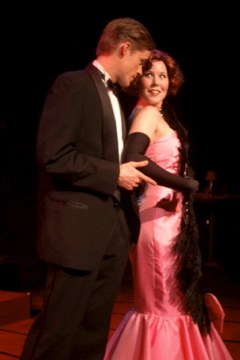
Nite Club Confidential (Kalliope Stage)


Kalliope’s ‘NITE CLUB CONFIDENTIAL’ short on substance

Since its inception three years ago, Kalliope Stage has had many exciting and well executed shows such as ‘THE SUMMER OF ‘42,’ OPAL,’ ‘CABARET’ and ‘BABY.’ Unfortunately, their latest offering, ‘NITE CLUB CONFIDENTIAL’ can’t be added to that list.

The shallowness of the show is surprising since, according to program notes, the show, as directed by Kalliope’s artistic director Paul F. Gurgol, was nominated for five Barrymore awards in Philadelphia. How? I’m not sure. The story line is weak, many of the songs in the cabaret-formatted script are bland, and the staging lacks dynamism.

At the start, the theatre goes black. Three shots are heard, sirens sound, the lights come up and a body is sprawled on the stairs. The corpse rises and he tells us that we are going to view a dramatic parody that highlights an Eisenhower administration/jazz-era time period musical, and have a glimpse of club glamour of the times.

‘NITE CLUB CONFIDENTIAL,’ with book by Dennis Deal and songs and arrangements by Deal and Albert Evans, revolves around the fading career of Kay Goodman, a Sinatra wannabe Buck Holden, and a group named The High Hopes.

The score includes “Comment Allez-Vous?,” “Love Isn’t Born, It’s Made,” “Nothing Can Replace a Man,” “The Canarsie Diner,” “He Never Leaves His Love Behind,” and “Crazy New Words.” Never heard of them,? Don’t worry, you haven’t missed much. On the other hand, “Goody Goody,” “I Thought About You,” and “That Old Black Magic” may be familiar.

The story doesn’t hold together well, the lines are often corny, the reprises are excessive and the personalities don’t ring true.

Gurgol’s directing doesn’t help much. Segments drag, the choreography is stilted, and the characterizations are often flat. With the exception of the song “Cloudburst,” the song renditions aren’t memorable. At intermission a jazz aficionada was overheard commenting on the lack of effective arrangements.

The cast is uneven. Slight, handsome Steve Parmenter fails to create a believable character as Buck, the manipulating limited in talent singer/dancer who attempts to sleep his way to the top. As with the script, Parmenter is more show that substance.

Trudi Posey tries too hard as the washed up former star. She is quite unbelievable. There is no sexual energy between her and Parmenter, a requisite for the parts. The same can be said for Parmenter and Liz O’Donnell, who portrays Trudi, supposedly Buck’s real love. O’Donnell comes out as the strongest performer and singer in the production. Charles Statham and Mark Ludden sing well but are less than convincing as the remaining members of The High Hopes.

Technically, the show is solid. Kim Brown’s costumes, especially the women’s dresses are smashing. Lance Switzer and Steven Shack’s lighting design and Krystyna Loboda’s red and black tacky set works well. Musical Director Michael Hamilton and his orchestra are quite good.

CAPSULE JUDGEMENT: Kalliope Stage has proven it is so much better than their present staging of ‘NITE CLUB CONFIDENTIAL.’ Let’s hope the real talent of the director and the cast comes forth in their next production.

Sunday, November 12, 2006

Singing in the Rain (Carousel Dinner Theatre)


The sun almost shines at SINGING IN THE RAIN at Carousel

A recent survey revealed that the five most liked movie musicals are ‘CHICAGO,’ ‘WEST SIDE STORY,’ ‘THE SOUND OF MUSIC,’ ‘THE WIZARD OF OZ,’ and ‘SINGING IN THE RAIN.’ The first three were original plays which transformed into cinematic form. The latter two were transformed from the silver screen to the stage. While Oz is an enchanting story with lots of societal implications, Rain is a piece of escapism that was brought to fame because of the wonderful performances of Donald O’Connor, Debbie Reynolds and Gene Kelly.

The story is based at a time when Hollywood was making the transition from silent films to talkies. Don Lockwood and Lina Lamont are the king and queen of the silent screen. (Think Douglas Fairbanks, Sr. and Mary Pickford.) Unfortunately, after the ‘JAZZ SINGER’ became a hit, the day of the silent film was gone. Lamont, a dumb blond with a squealing voice, can’t make the transition, so an idea is hatched to have the charming and vocally proficient Kathy Seldon lip-sinc for her. As happens in feel-good musicals, all turns out well as Lamont is revealed for what she is, and Seldon winds up with stardom and Lockwood.

Macio Herb Brown and Arthur Freed’s musical score is filled with audience pleasers including “Fit as a Fiddle,” “You Stepped out of a Dream,” “You Were Meant for Me,” “Good Morning,” and “Would You.”

Because of a slightness of the Betty Comden and Adolph Green plot, the stage version, which closely follows the movie story line, must have three super talents to pull it off. The Carousel Dinner Theatre production does have two of the necessary three. Amanda Rose is pretty, charming and gifted. Her Kathy is delightful. Richard Strimer is wonderful as Cosmo, the Donald O’Connor character. He sings, dances and clowns well. His only clunker is the usually delightful “Make “Em Laugh’ which fails to amuse. It isn’t his fault, he gives his all, but the segment is poorly conceived by director/choreographer Marc Robbin.

The missing performance element is the character of Don Lockwood, the Gene Kelly role. This is a case of miscasting. Curt Dale Clark doesn’t physically look like nor does he effectively act the role of the handsome and charming swashbuckler. He has an adequate singing voice and his dancing leaves much to be desired. In comparison to Strimer, who lights up the stage, the chunky Clark barely lifts his feet. In the usually wonderful “Singin’ in the Rain” number he spends most of his time splashing the audience with water. None of the Gene Kelly magic here.

Besides the performances of Strimer and Rose, the Carousel show does have many other positives. Rain, yes real rain, falls on the stage several times. The patrons in the first several rows have been given slickers so they don’t get totally soaked. The wet gimmick is a sure audience pleaser.

In addition, Barbara Helms is wonderfully obnoxious as the scheming Lina Lamont and Dominic Sheahan-Stahl displays a fine voice in “You Are My Lucky Star.” The singing and dancing choruses are fine.

CAPSULE JUDGEMENT: Carousel’s ‘SINGING IN THE RAIN’ has enough laughs and gimmicks to please most audience members. Too bad for the miscasting of the lead male role. With the right person in that part, this could have been a total winning production.

Arms and the Man (Actors' Summit)


‘ARMS AND THE MAN’ highlights Shaw’s message at Actors’ Summit

George Bernard Shaw’s ‘ARMS AND THE MAN’ is presently in production at Actors’ Summit.

A director of ‘ARMS AND THE MAN’ has a decision to make. Should the play be staged as a comedy or as a no-holds-barred farce? The former approach allows Shaw’s lines to carry the humor and create the message. The latter allows the audience to have a whale of a good time laughing at the outlandishness of the actors, the setting, overblown concept, and even the costumes.

When the Shaw Festival of Canada produced the show earlier this year, the director did it as a no-holds-barred farce. The characters were much bigger than life. The lines were so broadly presented that everything short of holding up “laugh now” signs was present.

The result was that Shaw’s messages, including women’s rights (“People don’t live up to their ideals.”), the ridiculousness of the upper classes (“Everything I think is mocked by everything I do.”), the stupidity of war (“War is a sham, like love.”), and the absurdity of existence (“Life’s a farce.”) were often not on the surface for all to grasp, but the audience had one heck of a good time.

A. Neil Thackaberry, the director of the Actor’s Summit production, decided to follow Shaw’s own words, “Life isn’t a farce,” and present the play as a comedy. In general, the languid pace and Shavian message-centered-approach worked well.

The story concerns Raina, the wealthy young daughter of a rich Bulgarian nobleman and her relationships with a pompous, weak-minded yet extremely handsome military bumbler, as well as the “Chocolate Soldier,” an intelligent, charming mercenary who is befriended when he sneaks into her bed chamber in order to avoid being killed by her countrymen. Through a series of unbelievable and silly incidents, everything turns out exactly as it should.

The production is blessed with some wonderful performances by Alicia Kahn, Dana Hart, Dorothy Silver and Reuben Silver.

Kahn creates her Raina as a spoiled, dreamer of fairy-tale love, who is also a pragmatist. She is both charming and delightful in creating a consistent characterization.

Hart, as Captain Bluntschli, is right on key as the clever mercenary, who, like his beloved chocolate creams, is crusty on the outside, but soft on the inside. He creates an appealing “chocolate soldier.”

The Silvers, as always, texture their characters as Raina’s parents, with meaningful double-takes and delightful character development.

On the other hand, Joe Bishara as the supposedly arrogant Sergius, just isn’t pompous and self-puffed up enough. He looks the role, but plays at being Sergius, rather than being the character. His inconsistency is the major weakness of the production. Sally Groth as Louka, the servant, is adequate, but doesn’t have the spark, the incendiary characteristics needed to make her more royalty than servant.

Working on a limited budget, Mary Jo Alexander’s costumes are quite representative of the era, but lack of the quality to make for total believability. The set was not of the opulence that would be expected by the “only family in Bulgaria to have a library.” The humor of the “only library” was ruined because the room was missing books. There should have been a few clearly highlighted volumes to draw the irony of Shaw’s stressing the literary storage area. (This is another of Shaw’s hits on the inept educational system and showmanship rather than actual edification of the upper classes.)

CAPSULE JUDGEMENT: Actors’ Summit’s ‘ARMS AND THE MAN’ makes for a pleasant evening of theatre, which has a languid pace that cuts down on the gaiety, but does increase understanding of Shaw’s concepts, making it a production worth seeing.

Thursday, November 02, 2006

RFK (Cleveland Play House)


Interesting, but not compelling view of Robert Kennedy at CPH

“War. It’s a terrible tragedy.” “Violent revenge is not American.” “We don’t know why we are at war.” “The dollars are being wasted on the war.” Sound like assertions from 2006 political advertisements? No, these are statements made by Robert Fitzgerald Kennedy, President John F. Kennedy’s youngest brother, who is the subject of ‘RFK,’ now on stage at the Cleveland Play House.

‘RFK,’ which enjoyed an extended run Off-Broadway, is a one-man show which was written by and stars Jack Holmes .

The production notes for the play, which was originally entitled, ‘THE AWFUL GRACE OF GOD: A PORTRAIT OF ROBERT F. KENNEDY,’ state, “By late summer 1964, Attorney General Robert F. Kennedy, still in shock and consumed with grief over the assassination of his older brother was at a crossroad in his life. The presidential election was approaching and President Lyndon Johnson finally called him to the White House to end months of speculation over whether or not he would be Johnson’s Vice Presidential running mate. The result of that meeting, and the subsequent direction of RFK’s life, are the focus of the play. Going backward and forward in time, we see Kennedy grow from husband to father to grieving brother to New York senator to outspoken critic of the war in Vietnam to Democratic Presidential candidate."

The play tries to earnestly trace RFK’s successes, his bi-polar like personality, and his conflicts with Lyndon Johnson and Edgar Hoover. Unfortunately, the action is too obvious, often too patterned to grab and hold our attention. Part of the problem may be that, from the start, anyone who knows history, knows the outcome. There is no mystery. And, though there are humorous moments, especially when the words seem like 2006 comments about President Bush and his administration, the goings-on often sound like a long campaign speech and commercial sound bites.

As Holmes transitions from Kennedy’s various offices, to the senate floor, to stops on the campaign trail, to his chaotic home, the audience is lead by David Weiner’s effective lighting, James C. Swonger’s impactful sound design and Neil Patel’s visually clarifying back wall of patchwork of geometric shapes, which change from flags to mood enhancers.

Though his accent waivers, and he too systematically and too often fixes his flopping hair, Holmes is generally effective. In fact, his acting is basically better than his writing. There is a lot of sentimental language, platitudes and slogans which attempt to represent reality. It skims the surface without always delving into causes for the speeches and reactions.

Yes, Robert F. Kennedy was shy, yet intense. He, according to the script, “Saw wrong and tried to right it…saw suffering and tried to heal it…saw war…and tried to stop it.” But, what really caused a rich kid from a politically astute family who married a strong dominant woman, to be who he was. We really don’t find that out.

CAPSULE JUDGEMENT: For those who are fascinated by the Kennedy legend, who like biographies, and are willing to put aside the shallowness of the writing, ‘RFK’ should be of interest. It’s not great theatre, it’s good theatre.

Saturday, October 28, 2006

And Baby Makes Seven (convergence-continuum)


Another thought-provoking and weird experience at convergence-continuum


At intermission, the woman sitting next to me at the opening night production of Paula Vogel’s ‘AND BABY MAKES SEVEN,’ at convergence-continuum theatre, said, “Well, it’s another one of those Clyde Simon thought-provoking, weird experiences.”

Yes, thought-provoking and weird are the general rule at convergence, Cleveland’s off, off, way off Broadway home of scripts that no one else in the Cleveland area drama scene will produce.

On the surface, the play seems to be straight forward. Two lesbians (Ruth and Anna) decide to have children with the help of Peter, their gay male friend. Okay, no problem there. That’s what you think. Vogel’s creativity lets lose, and in order to prepare for the impending birth, she has the women develop child alter-egos. The fantasy rug rats aren’t your run of the mill kids. Orphan is a feral wild-child raised by dogs at the New York Port Authority, who may or may not have rabies. Henri is a misplaced Parisian, borrowed from the movie ‘THE RED BALLOON.’ Cecil is a savant and Darwinian, to boot. (You are probably thinking, “What? No way.” Come on, would I make this up?) In the final week before their real baby is due, Peter suggests they need to clear their apartment of the make-believe children. The trio decide to “kill them off.” They supposedly accomplish their deed, but, of course, to make the plot thicker, when the real baby shows up, the pretend kids return. So, baby does make 7!

The script has been called, “funny, allusive and edgy." At times, the audience gets off tracked as Vogel throws in lines from ‘TEA AND SYMPATHY,’ Shakespeare and snippets from lots of pop songs that may well be beyond the reach of the youngish audiences we tend to show up for convergence productions. As we watch, there is a tendency to play amateur psychologist and figure out whether the fantasy children are really flashbacks to personal histories of the women.

The convergence production is quite good. Denise Astorino, who is quickly establishing herself as a local superstar, is excellent. Not only does she make her human character real, but her dog-like feral child and French speaking Red Balloon kid are right-on.

Jovana Batkovic is equally fine as the real Anna, and the fantasy Cecil, she of child actions but adult wisdom. Her pregnancy out-of-control hormones scene is hysterical.

Only Geoffrey Hoffman falters slightly. Hoffman is one of my favorite local actors. He has good character-centered instincts and is usually on target. Therefore, I cannot understand why either he, or director Simon, decided that he needed to be fay, sound affected and feigned an over-extended “gay” presence. His saving grace? His giving the baby a bath scene is priceless. Oh, and for those who have become accustomed to seeing Hoffman showing off his gym-toned body on the convergence stage, yes, fear not, Simon makes sure that he does scenes with his shirt off.

CAPSULE JUDGEMENT: So, what’s the verdict? I guess Simon’s onslaught of off kilter plays has finally gotten to me. I surrender, I found myself interested, even absorbed. As for you, the bottom line is, either you want to play Vogel's fantasy game, or you don't. If the answer is, “yes” then go, think, and be weirded-out.

Saturday, October 21, 2006

Modern Orthodox (Jewish Community Center/Cuyahoga Community College)


‘MODERN ORTHODOX’ pleases some, upsets others at JCC

When ‘MODERN ORTHODOX,’ the play now being produced by the Jewish Community Center in association with Cuyahoga Community College, opened in New York, it was met with very mixed reviews. Most theatre observers forecast a short run. In actuality it stayed open for six-months. This neither made it a hit nor a flop, kind of in-between.

An on-line site surveyed people coming out of the Big Apple production. Their comments included: “It’s hysterical.” “It's an awful, unfunny, sexist, overly schticky, cliched, trite show.” “I loved it!” “I hated it!” “It’s insulting.” Listening to reactions at the opening night of the local production, opinions were about the same. Thumbs up, thumbs down, and some hands wiggled from side-to-side.

Daniel Goldfarb’s ‘MODERN ORTHODOX’ attempts to examine love, relationships and sex from a Jewish cultural stereotypic viewpoint. The use of stereotypes isn’t necessarily wrong, it’s just that Goldfarb doesn’t have the writing ability to pull off the comedy while making relevant points. This doesn’t mean there isn’t humor. There are plenty of laughs. But at the end of the play the question arises as to what was the author’s intent? Comedies are intended to have a message. Neil Simon, for example, wrote for laughs, but his plays make a point. What is Goldfarb trying to tell us?

Maybe from Goldfarb’s view, religion and relationships are inextricably linked. His two major characters, Ben Jacobson and Hershel Klein, are at opposite ends of the religious spectrum. Ben is a "high holiday Jew," while Hershel is Orthodox in dress, speech, and behavior. Ben wants to buy a diamond ring from Hershel so he can propose to Hannah, his live-in girlfriend of six years. Hershel disapproves of the live-in arrangement. As they bicker, Ben's innate distaste for Orthodox Jews becomes evident, even taunting Hershel to remove his yarmulke in order to seal the deal. Hershel does so. The question must be raised as to the significance of that act. Is this a comment on the role of the Jew being more in love with money than religion? This is not the only unanswered question in Goldfarb’s script. He wanders around making fun of orthodox sexual practices, Jewish dietary concepts, wedding rituals, the guilt of those who aren’t “true” believers, attitudes toward women. And, for what purpose? For laughs? To make a point? You got me...I’m not sure. It’s always been my belief that comedy writers use humor to make a point. What’s Goldfarb’s point?

Logical questions arise. Why, when Herschel appears at his doorstep doesn’t Ben toss him out on his tuchis (Yiddish for rear-end)? Is Herschel’s presence enough to stimulate Ben and Hannah having a relationship crisis? Why is Rachel, a woman with a master’s degree who Ben finds as a potential wife for Hershel on the on-line Jewish dating service so shallow? Is she so desperate to have sex that she’ll marry anyone?

The local production, under the direction of Fred Sternfeld, generally does a nice job with what they have to work with. Brian Zoldessy is hilarious as Hershel. Zoldessy, as is his classic trademark, flits around with his feet hardly ever hitting the stage. He is appropriately a “cheleria” (nervous wreck) of the highest order. It’s worth going to the production just to see him in action.

Larry Nehring, is believable in his “nice guy” role, often looking like a puppy dog whose purpose in life is only to please. Unfortunately, the script never gives us a clue as to why he would act this way.

Lara Mielcarek makes Hannah as real as she can be with the lines she’s been given. The kissing scene with Hershel, while hysterically funny, is again one of those unexplainable Goldfarb moments.

Holly Facer, is off-key as Rachel, Hershel’s intended wife. Part of the problem is her inappropriate costume. No orthodox Jewish woman would be seen in costume designer Aimee Kluiber’s ill designed garb. Long sleeves, long skirt are requirements, not low cut revealing clothing. Facer doesn’t seem to get the underlying motives of the character to crave sexual attention because she isn’t allowed to express natural desires. She is not a sex-pot as Facer seems to make her.

Ben Needham has the difficult task of attempting to design a supposedly small New York apartment in the massive CCC theatre stage.

Richard Ingraham’s musical interludes are appropriate to the script.

CAPSULE JUDGEMENT: Its difficult to predict any audience member’s reaction to this production. There are lots of laughs, but for what purpose? There is the potential to offend many in the audience, yet please others. “All I can say is OY VEY.”

Saturday, October 14, 2006

Pillowman (Dobama Theatre)


Dobama’s ‘THE PILLOWMAN’--another memorable theatrical experience

Dobama may not have a permanent home, but it is surely reestablishing itself as the place to find to see well-honed, thought-provoking important new plays. No theatre in the area can match the performance center which was Don Bianchi’s dream and is now Joyce Casey’s life work. Their latest works, ‘A NUMBER,’ ‘NIGHT BLOOMERS,’ and “GOAT OR, WHO IS SYLVIA’ have all been superlative. That streak continues with Martin McDonagh’s ‘THE PILLOWMAN.’

After a 2003 opening in London, the show moved to Broadway in 2005. It starred Jeff Goldblum and Billy Crudup. It won the Drama Critics Circle Award for Best Foreign Play, and was nominated for a Tony as best play.

A serious drama with ironic overtones, it tells the tale of Katurian, a fiction writer living in a police state who is interrogated about the gruesome content of his short stories, and their similarities to a number of bizarre incidents occurring in his town. Before it’s over we are exposed to four lives that have all been subjected to abuse and the effect it has on their existence.

Big Apple critics called the play, "the season's most exciting and original new play" and stated that "Those who skip it will miss the best play of the season."

It is interesting that the two strongest plays on Broadway in 2005, ‘DOUBT’ and “THE PILLOWMAN’ both concerned child predators. These plays are art reflecting life. ‘DOUBT’ examines priest pedophilia and McDonagh presents a series of parables of what happens when the human brain conceives a concept and through a series of ironic twists, the parables become realities.

Those who know McDonagh as the author of ‘THE BEAUTY QUEEN OF LEENANE’ will not be surprised by the script’s strong, metallic voice that has established him as one of today’s theatre wunderkinds. As with his other writing, there is a Kafka-like examination of bureaucratic violence. Even Katurian's name (his first and middle names are also Katurian) makes him a linguistic kin to Humbert Humbert of Nabokov's ‘LOLITA’ and Major Major of Heller's ‘CATCH-22,’ two other Kafkaesque writers.

Dobama’s production, under the able guidance of Sonya Robbins, holds the audience’s attention during the long show. The cast is strong, yet uneven.

Todd Krispinsky as Katurian, the writer, is outstanding. He is totally believable in both his confusion and suffering. His final speech is emotionally and visually wrenching.

Joel Hammer as the chief detective, is properly harsh and cunning. Daniel McElhaney is compelling as Katurian’s child-like older brother. John Kolibab fails to develop any texture to his role as the “bad” cop. He yells from his initial speech, giving his character no place to go when emotional changes are needed. Laura Stitt (mother), Michael Regnier (father) and Jessica Gill (child) are acceptable in their character development.

The meaning of the title? Can’t give that away. You’ll have to see the show.

CAPSULE JUDGEMENT: As a line in the play states, “There are no happy endings in real life.” So, too, is the case with this disturbing play. You don’t go to see ‘THE PILLOWMAN’ to be entertained, you go to be fascinated and disturbed. Keep it up Dobama!

Thursday, October 12, 2006

My Fair Lady (Cleveland Play House)


Must see ‘MY FAIR LADY’ at CPH

Cleveland area theatres are in the midst of a series of “let’s take a different approach to scripts” experiences. A male Hamlet, an all male Shakespeare presentation and now, Cleveland Play House’s totally off-beat production of ‘MY FAIR LADY,’ a very, very traditional musical.

‘MY FAIR LADY,’ with lyrics and book by Alan Jay Lerner and music by Frederick Loewe opened on Broadway is in 1956 . In contrast to popular belief, it was not a direct adaptation of George Bernard Shaw’s ‘PYGMALION,’ but was based on a screenplay adopted by Gabriel Pascal which had been based on the Shaw play, which was based on the Roman myth of Pygmalion. The stage musical was made into a popular film in 1964. A contemporary version of the Pygmalion motif was developed in the 1980s play, ‘EDUCATING RITA.’

The Broadway version, which starred Rex Harrison and Julie Andrews, ran for 2717 performances, a Broadway record at the time. It introduced the world to “Why Can’t the English,” “With a Little Bit of Luck,” “Wouldn’t It Be Loverly,” “I Could Have Danced All Night,” “Get Me to the Church on Time,” and “I’ve Grown Accustomed to Her Face.”

The play, which takes place in 1910, centers on Henry Higgins, an opinionated linguistics professor and confirmed bachelor, who makes a bet that within six months he can transform an uneducated cockney flower seller, Eliza Doolittle, into a lady who can take her place in high society. Eliza agrees to take the lessons in order to fulfill her dream of working in a flower shop. Higgins wins the bet, but doesn't bargain for the profound effect Eliza has had on his life. Melded into the story line are Shaw’s attacks on the British social structure and educational system.

The original Playbill and cast album included art by Al Hirschfeld, which depicted Eliza Doolittle as a marionette being manipulated by Henry Higgins, whose own strings are being pulled by a heavenly puppeteer who looks like George Bernard Shaw. Some Shaw experts were quite offended by Hirschfield’s depiction, because they felt that Shaw’s statement regarding the battle of women to be independent beings was misrepresented by the puppet characterization.

Going to see yet another production of ‘MY FAIR LADY’ did not excite me. I’ve seen the play over twenty times. Well...I was in for a big surprise! The CPH production breaks the traditional staging patterns used for a presentation of ‘MY FAIR LADY.’ There is no set, per se, and no orchestra in the pit. Instead, two pianos stand center stage surrounded by bleachers on which the chorus sits throughout the show. For the various roles the chorus puts on costumes which have been distributed around the stage. Instead of a realistic look, we are confronted by the alienation style of Bertolt Brecht. We know that we are in the theatre, we see all the costume and setting changes. For some this will be off-setting, but for those who are willing to trust director Amanda Dehnert’s concept, the results are glorious.

Dehnert takes the audience into the story with creative staging, wonderful shticks and gimmicks and clarity of song lyrics. Except for making the audience continually blink away the glaring electric lights of a MY FAIR LADY sign above the action, the alienation works to enhance the goings-on.

Devon Painter’s costumes are splendid. She even breaks the tradition of having the Ascot racing scene done in black and white costumes. (BTW...the reason for the traditional dominance of black clothing in that segment was because King Edward VII died on May 6, 1910, the traditional opening date of the Ascot season, the year in which the play is set.)

Don Wadsworth does a great job of working with the dialects. Kelli Wicke Davis’s choreography lacks panache, and he is hampered by the Bolton’s small stage and having a cast that is mainly actors and singers and not dancers.

Vocal Supervisor Tim Robertson has done an excellent job making sure Lerner’s lyrics, which integrate perfectly into the spoken script, are given meaning. This is usually not the case in many productions where the musical sound is often stressed over the ideas of the lyrics. Except for some blending problems with the male chorus, and some upper range issues with Rachel Warren (Eliza), the music was wonderful. It was also nice to have a Henry Higgins who can actually sing, rather than using a cadence count for the songs. Backing up the dual pianos (well played by Bill Corcoran and Tim Robertson) with random violins and a cello, enhanced the musical sound.

The cast is wonderful. Rachael Warren gives a non-Julie Andrews take to Eliza. She is more appropriately earthy, even when she becomes a “lady.” Timothy Crowe, is a more human Henry Higgins than was Rex Harrison. He embodies the role with clueless arrogance. George McDaniel makes the understanding Colonel Pickering a perfect counter to the emotionally retarded Higgins. Larry Daggett is right on target as Eliza’s father. The chorus fulfills their multi-roles with acting quality.

CAPSULE JUDGEMENT: Amanda Dehnert’s take on ‘MY FAIR LADY’ gives new life to the show. The CPH production is one for everyone to see...both those who have experienced the script before and those who have not had the delightful pleasure of seeing Shaw’s ideas morphed into a musical through the talents of Lerner and Loewe.

Sunday, October 08, 2006

M4M (Cleveland Public Theatre)


Marvelous ‘M4M’ AT CPT


A quick look at local entertainment listings might lead someone to believe that Cleveland has become the off-beat Shakespeare center of the theatre world. A female Hamlet, a production of a Bard-light script that many think shouldn’t even be part of the Shakespeare portfolio, and an all-male version of ‘MEASURE FOR MEASURE’ which has a spotty history, at best.

The Cleveland Public Theatre production of ‘MEASURE FOR MEASURE, ‘ dubbed by the theatre, ‘M4M’ is the best of the trio.

‘MEASURE FOR MEASURE’ had only one recorded production during Shakespeare’s life time. In addition, it was not staged after that initial display for over a century because it was said to have “offensive characters and dialogue.” In fact, one Bard critic called it “a hateful work.”

From my perspective, the evaluators of those days were all wrong. ‘MEASURE FOR MEASURE’ makes strong social points, is an excellent example of a tragic-drama (it was originally called as a tragic-comedy), and is a wonderful vehicle for a talented director and company.

Fortunately, CPT has both the talented director, in the person of Craig J. George and a very, very talented ensemble of actors.

George’s vision for the play is totally creative. He envisions scene after compelling scene using only a large white tarp, a desk, a table, a hanging platform, and some black curtains. He is aided by Jenniver Sparano’s costumes which flip on and off bodies as fast as rabbits can be pulled out of a magician’s hat. As an audience, you can’t see all the clothing changes but dressers Curt Arnold and Sparano must be the best quick change artists for dressing and undressing the 6 male members of the cast who play 16 different roles. Not once is there confusion over who is who.

The cast is universally excellent. Michael Mauldin, the only equity member, mesmerizes as the Duke and Friar. He controls the stage with his commanding presence.

Geoff Knox, portraying Angelo, the acting Duke while the real Duke takes a break from his reign, as well as a Friar, a prostitute and several other roles, makes the transitions with ease. This is a very talented young man.

John Paul Soto portrays many of the female roles with wonderful dexterity. He embodies each with a unique characterization.

Rob Mayes plays the condemned Claudio, a pregnant Juliet (who is carrying Claudio’s child), and numerous other roles with a high degree of acting and singing excellence.

Ashley Davenport is properly pompous as Escalus, a court aide, as well as an executioner. He transitions well between characterizations.

Andrew Marikis is not as adept as the other members in the cast in creating meaningful characters, but he does well in breathing life into the lying Lucio.

I think CPT did a disfavor to potential audience members by stressing the production’s use of men playing all the roles. The ads and public relations releases gave the idea that this might well be an S&M, gay take of Shakespeare, a transvestite show. It’s not. Yes, there are tight black pants and bare male chests and simulated sex but it is not the major theme. Men played all the roles in Shakespeare’s day, and there is no reason that they shouldn’t do the same today, especially if they do it as well as the “M4M’ cast.

CAPSULE JUDGEMENT: CPT’s ‘M4M’ is one of the better of this season’s theatrical productions, well outshining the other Shakespeare shows in the area, and deserves to be seen by anyone interested in seeing a creatively directed and expertly acted production.

Gospel! Gospel! Gospel! (Karamu)


GOSPEL! GOSPEL! GOSPEL! rocks Karamu

There is an emotional love-in going on at Karamu House! The audience is singing, hand-clapping, foot stomping, shouting out and paying homage. Why? They are enveloped in ‘GOSPEL! GOSPEL! GOSPEL!,’ a historical investigation of the role gospel music has played in the life of blacks from the 1920s until today.

Conceived by Otis Sallid, the Karamu production is a world premiere before it starts on a national tour. It is being produced by James Pickens, Jr., a Clevelander and Karamu alum, who portrays Dr. Richard Webber, the hospital director on TV’s “Gray’s Anatomy.”

The show starts with a prologue which sets the tone and the story line into action. That transitions into 1920 which is represented by such songs as “Precious Lord,” and “Peace in the Valley.” The 30s finds “Just A Closer Walk With Thee” and ”I Love the Lord He Heard My Cry.” Yes, these are all the gospel songs that were sung in churches and gave hope and faith to the believers. The 40s found Negroes the victims of Jim Crow laws (“Goin’ on With The Spirit”) and leaving the South for the North (“Packin’ Up”). The World War II armed forces experiences made for attitudinal changes among both whites and blacks (“Surely God is Able”) and ushered in the 1950s (“Didn’t It Rain”/”How I Got Over”/”Walk With Me”) and the civil rights movement (“Where Is Your Faith In God,” “Why Am I Treated So Bad,” and “We Shall Overcome”). Following enactment of integration laws, gospel transposed from religious into secular music and became mainstream (”A Change Is Gonna Come” and “Hallelujah, I Just Love Her So”).

The songs, hooked together with spoken transitions, make for a very revealing story.

The Karamu production is blessed with some excellent voices. Michael Burns has a nice sound and a playful presentation. His “Two Wings” is a show highlight. Eddie Sands had the audience howling as he sang the moving “Peace Be Still.” Angela Love sang a pretty version of “Perfect Praise.” Bernita Ewing wailed her way through “My Tribute,” “I Looked Down the Road” and “I Ain’t Gon’ Let Nobody Turn Me ’Round.” Leathia Williams, who has a big voice, sang a compelling version of “Peace in the Valley.”

Too bad the whole show isn’t songs, because, in general the cast isn’t much on acting or dancing. In fact, the spoken transitions were often flat and missing meaning. Neal Hodges, as the narrator, was often difficult to hear and understand. Many of his lines were poorly phrased and lacked meaning. The same can be said about Don Harris’s attempts at narration, though he made up for it with a nice song version of “Praise Is What I Do.”

What are the professional commercial prospects of the show? The script, with some transition changes and the elimination of extraneous songs, has potential. As for the production qualities of this show, there are enough weaknesses in the cast in their acting and dancing to make it questionable whether an audience, other than one as tied to the performers and the venue as the Karamu throng, will be willing to pay the big bucks needed to mount such an undertaking.

CAPSULE JUDGEMENT: Karamu’s GOSPEL! GOSPEL! GOSPEL! is an engaging experience. Members really get into participating in the goings-on, something which could be off-setting for some more traditional audience members not used to singing and speaking the praises of the Lord. All in all, though not a professional level production, the show is worth seeing in its present form.

Saturday, October 07, 2006

Love's Labour's Lost (Great Lakes Theatre Festival)


Slight ‘LOVE’S LABOUR’S LOST’ at GLTF

‘LOVE’S LABOR’S LOST,’ which is now appearing in repertory at the Great Lakes Theatre Festival, is one of Shakespeare’s lesser plays. In fact, many scholars believe that it should not even be listed in the Bard’s portfolio.

Written in the mid-1590’s during the London plagues, when theatres were closed for fear of spreading diseases to those who assembled in large groups, it is conjectured that Shakespeare was commissioned to write ‘LOVE’S LABOR’S LOST’ for a small social gathering. One of Shakespeare’s earliest works, the script has been described as “A laughing play about wry couples, rhymed couplets, and the impossibility of securing true love in two hours.

The script is written in regular meter and rhyme and is filled with lots of puns which often go right over the heads of modern day viewers due to their lack of present day references.

The story concerns the King of Navarre, who, along with his trio of lords, has sworn that for three years they’ll forswear sleep, food, and the company of women in favor of pious study. So what are sworn men to do when a beautiful Princess and three attractive attending ladies arrive on diplomatic business? Ah, that’s the rub!

The Great Lakes Theatre Festival’s production is creative and a pleasant, though not a compelling experience. Director Drew Barr has inserted lots of schticks and gimmicks to spice up the goings-on. The issue is not Barr or the performers, it’s that the play itself is just not compelling.

Tom Ford as the King and David Anthony Smith, Lynn Robert Berg and Matt Lillo as the lords attending the King, are all fine. Andrew May is his usual hysterical self as Don Adriano De Armado, a fantastical Spaniard, who not only looks but acts like Salvador Dali. Jeffrey C. Hawkins properly overdoes the role of Costard, a clown. Laura Perrotta, is fine as the Princess of France. Julie Evan Smith, Julie McKay and Laura Welsh are charming as the ladies in attendance to the Princess.

The sets, the costumes, the lighting and the sound are all well done.

CAPSULE JUDGEMENT: GLTF does all it can with ‘LOVE’S LABOR’S LOST.’ Unfortunately, it’s not enough to make a mediocre script into a great production. For those who are interested in seeing a Shakespearean play that is not often performed, the GLTF production is a good choice because this is about as good as it will get.

Wednesday, October 04, 2006

Spamalot (Playhouse Square Center)


Funny, funny, funny SPAMALOT at State and oh, it's funny.

Anyone who can sit through ‘MONTY PYTHON’S SPAMALOT,’ now on stage at the State Theatre, and not hysterically laugh their way through most of the show’s skit-like segments, should try out for the part of the Muppet’s Oscar the Grouch.

The show, which self-proclaims it is “a new musical lovingly ripped off from the motion picture ‘MONTY PYTHON AND THE HOLY GRAIL’,” is outlandishly, hilariously, creatively, well-conceived and performed.

As a song in the show says, “this is a very expensive forest.” The entire production is an expensive and expansive undertaking. Nothing has been spared in bringing this touring production of the still-running Broadway show to town. The sets, the costumes, the special effects are over-the-top. If you are sitting in the first dozen rows, you’ll wind up being showered with shiny circles of plastic, one member of the audience will be dragged on stage to get a special award, horses gallop (well, the horses aren’t actually there, but it matters little), clouds ascend and descend, a Las Vegas show room appears complete with a row of high kicking scantily clad dancers, castles come and go, and even God appears (well, at one point his legs and at another point his hand).

Now, be aware that not everything is in good taste...there are lots of sexual innuendos, lots of passing gas jokes, almost every ethnic and religious group is skewered. The skit which insists you can’t do a Broadway show without lots of Jews, is nothing short of uproarious and the ballet scene between a priest and a nun is offensively delightful.

So, what’s it all about? With book by Eric Idle, and music and lyrics by John Du Prez and Eric Idle, the 2005 Tony Award for Best Musical centers on King Arthur and his Knights of the Round Table and their search for the mythical (or mystical) Holy Grail, which could be a vessel, a bowl or an idea. Matters not, this is not a religious play, it is an irreverent romp.

For those who have seen the film, the musical differs in many ways, so those who haven’t seen the flick need not worry. More than anything else, the musical parodies the Broadway theatre (skewing everything from ‘FIDDLER ON THE ROOF’ to ‘FUNNY GIRL’ to ‘RENT.’

Under the direction of Mike Nichols, there is highlight after highlight. “I Am Not Dead Yet” is nothing short of side-splitting as is “Knight of the Round Table.” “Find Your Grail,” and “Come With Me” are belted by the wondrous Pia Glenn (Lady of the Lake). “Always Look on the Bright Side of Life,” complete with an umbrellas-twirling kick line, is pure cotton candy. (Be prepared to do a sing-along to this at the end of the show.) The three song unit, “Where Are You?,” “Here Are You” and “Lancelot” is a gender bending scream.

Only “Run Away,” a French Castle conflict between the British and the French grates a little, but with the negative relationship between the Tea-swiggers and the Frogs it may just not be something an American can appreciate.

The touring cast is terrific. Between all the cross-dressing and double casting, you’ll find it hard to keep track of who’s who, but it matters little, for there isn’t a weak cast member. Standouts are Pia Glenn who has a voice so fine and loud it can, and does, shatter a chandelier. Jeff Dumas is pure joy as the put-upon Patsy. Michael Siberry is a perfect foil as King Arthur. David Tuner shines as the less-than-brave Sir Robin. Rick Homes (Sir Lancelot) and Tom Deckman (Prince Herbert) play their gay-discovers-gay scenes with charming abandonment.

Capsule judgment: From its delightful overture through its over-the-top ending, ‘MONTY PYTHON AND THE HOLY GRAIL’ is just plain fun. If you don’t have a sense of humor, are easily offended, or are a red state fanatic, this isn’t going to be for you, but for the rest of us, it’s a romp. Oh, you might consider wearing Depends as your ability to control your bladder may be compromised by your non-stop laughing.

Sunday, October 01, 2006

Hamlet (Beck Center)


Gender bending ‘HAMLET’ at BECK

What do Asta Nielsen, Sarah Bernhardt, Charlotte Crampton, Anna Dickinson, Clare Howard, Bertha Kalisch, Alice Marriott, Wineta Montague, Alma Murray, Louise Pomeroy, Julia Seaman, Janette Steer and SarahMorton all have in common? They are all females who have played the role of Hamlet in Shakespeare’s epic play of the same name. Of these, locals probably know best the name of Sarah Morton, who is presently on stage in the gender-bending role at Beck Center for the Arts.

There is nothing unusual about actors playing opposite-sex roles in Shakespearean productions. In the Bard’s time, women were not allowed on stage, so boys or young men played female roles. But, with Hamlet there is a slightly different twist. There is some conjecture among Shakespeare experts that Hamlet actually was a female, pretending to be a male. This, again, isn’t far fetched as many of Shakespeare’s plays had females dresses and pretend to be males.

The Hamlet script, however, has some differences. Many references are made to “him” in the dialogue. Even in the birth scene at the beginning of the play there is reference to Hamlet being the heir to the throne. That role was reserved for males.

Actually, after a while of watching director David Hansen’s interpretation of the play one almost forgets that a female is playing the role except for some very feminine like reactions...the style of crying, the tenderness, the body carriage often displayed by Morton. Feminine, in this case is as described in the research of Sandra Bem, who has carefully documented masculine and feminine traits.

Hansen adds to the questioning by throwing in a passionate kiss at the end of the play, which either has some homoerotic overtones, or clearly indicates that Hamlet was a woman in love with her best friend, Horatio.

The play’s plot, in its simplest form, centers on Prince Hamlet, the son of the late King Hamlet. The young Hamlet is charged by the ghost of his father to avenge the king’s murder by his brother, which the young Hamlet finally succeeds in doing, but only after the rest of the royal house has been wiped out and he has been mortally wounded with a poisoned rapier at the end of the play.

Beck’s production is effective in some ways, lacking in others. This is an uneven, yet creative and bold production. At times it could have been hoped that Hansen had more carefully heeded Shakespeare’s words, “Suit the words to the action and the action to the purpose.” At other times, the intent was clear.

Using many theatrical techniques...projections which give the setting and titles to each segment, stylized acting mixed with realistic presentations, reinterpretation of the script that might drive traditional Shakespearean viewers to scream in protest...the long production, is often off-setting. Part of this is the inconsistent quality of the acting, part is the breaking of the flow by throwing in gimmicks, some of which seem gimmicks for the sake of gimmicks, and the choppiness of the pacing. Some of the pacing problems may sort out as the players get more comfortable.

Don McBride’s set of off-kilter flats and off-balanced levels, works well to create this interpretation of the script. Richard Ingraham’s sound, especially the music and echoing voice of the king, also add to Hansen’s interpretation. Alison Garrigan’s costumes, like the production, run from “right on” to why does the queen not look queenly and why is Polonius’s garb so different from the rest of the cast?

The dumb-show segments were creatively choreographed by Alison Garrigan and the fights, especially considering the closeness of the audience to the action, were well developed by Joshua Brown and Kelly Elliott.

Sarah Morton is generally on-key as Hamlet. At
times, Morton, seemed absorbed in the role, at other times her concentration wavered and caused some meaning discord. Often played like the words of a total madman, or a psychotic on the brink of suicide, the famous “To Be or Not to Be” speech, was underplayed, giving it a thought provoking interpretation not often heard.

Nicholas Koesters was excellent as Horatio. He created a clear character as did George Roth as Polonius.

On the other hand, Mark Cipra was unbelievable as Claudius. His interpretation was all over the place. Some of his lines were meaningful, some meaningless, others overacted, some mumbled. The same can be said for Anne McEvoy who played Gertrude, she of a weird hairdo, and lack of consistency and clarity of character. Rachel Lee Kolis’s early scenes as Ophelia were shallow, but she created a properly paethic and psychotically grief stricken orphan after Polonius, her father, was killed by Hamlet.

CAPSULE JUDGEMENT: ‘HAMLET’ is an awesome undertaking. David Hansen has developed a production which can be very off-setting in its inconsistency and interpretation, yet it is a brave attempt to create a different slant on the most-oft produced of Shakespeare’s plays.

Saturday, September 23, 2006

Rabbit Hole (Cleveland Play House)


Realistic ‘RABBIT HOLE’ opens the season at CPH

‘RABBIT HOLE,’ which is now in production at the Cleveland Play House, is, as one reviewer of the New York production stated, “almost unbearable to watch at times due to its insistence on presenting a tragedy and its consequences with utter candor, and without sentimentality.” This comment is a tribute to the play. In addition, it is generally true of the CPH production.

The story involves a 4-year-old boy whom we never meet, and a car that swerves in the wrong direction at the wrong time. What we share is the fall out.

David Lindsay-Abaire has created an emotional play. But, unlike many plays broaching the topic of death, he does it with humor, pathos and a strong psychological understanding of the situation. It isn’t a morbid play. It is a realistic look at how not only the family, but the teenager who was driving the car are affected by a momentary incident.

I must admit, I had difficult sitting comfortably in my seat during the production. Having lost a grandson, my mind keep shooting off-stage to my life and that of our family and our reactions then and the legacy the experience has left. Though the incident was not the same, the same raw emotions are. In addition, I counsel people who are survivors of trauma. So be aware that I can’t be unbiased in my thoughts and feelings about the play.

Becca and Howie Corbett have everything a family could want. The accidental death of their son turns their world upside down. They are left adrift in their feelings and thoughts, floating further and further away from each other as one turns to a support group and the other turns inward. Each finds that their method of coping doesn’t work.

I found the CPH production, under the guidance of Artistic Director Michael Bloom, to be basically on target. This is a difficult play to stage. With the wrong approach it could be a maudlin experience, or if overdone, a melodrama. Neither of these outcomes is the intent of the author. Bloom and his cast stay true to the script’s intent by allowing the humor to come through, the pathos to be present, and the melodrama nonexistent.

As Becca, the woman who gave up her career to become a mother, only to suffer a catastrophic loss, Angela Reed nicely walks the thin line between emotional control and hysteria. Her contained emotion parallels many trauma sufferers, who believe that “being strong” entails having no feelings. And, finally, when her body screams loudly enough so that she cannot hold the emotional angst in any longer, her primal scream is heard and felt by her and the audience. This is a fine performance.

Danton Stone is not quite as successful as Becca’s husband, Howie. At times, especially at the beginning of the production, he acts rather than reacts to the lines and their intent and comes across as disingenuous. He seemed to grow into the part as the evening progressed.

Troy Deutsch is right on target as the teenage driver of the death car. His nervous inappropriate giggle on his first entrance, his awkward stance and facial expressions, his halting speech were typical of being over-stressed and confused as he attempts to state the feelings and thoughts which can’t be said with clarity.

Much of the comic relief in the play comes from Becca's encounters with her less than perfect mother and sister, who keep dropping by to keep her company. Both sense her unspoken disapproval of them, but they love her too much to let that get in the way of being there. These parts, which wavered between being overly self-absorbed and empathetic, were well played by Kat Skinner (Nat) and Genevieve Elam (Izzy)

CAPSULE JUDGMENT: I found the ‘RABBIT HOLE’ experience absorbing, at times humorous, but, most importantly, realistic. It is a snapshot of our family and all the other people who have gone through similar experiences. It’s a production worth seeing.

Monday, September 18, 2006

A Funny Thing Happened On the Way to the Forum (Great Lakes Theatre Festival)


‘FUNNY THING’ is a very funny thing at GLTF

The program for Great Lakes Theatre Festival’s ‘A FUNNY THING HAPPENED ON THE WAY TO THE FORUM’ asks the question, “What is funny?” The answer, at least in Cleveland for the next five weeks is, ‘A FUNNY THING HAPPENED ON THE WAY TO THE FORUM.”

‘FORUM’ is a musical based on two plays by Titus Marrius Plautus, who is considered to be the father of comedy in the Western world. It was Plautus who invented the devices of theatrical comedy which have lasted to this very day. Most of his techniques, such as prat falls, cross-gendered misidentities, visual double takes, having characters who are bigger than life, makes the audience laugh at them and their actions rather than with them. It’s the kind of stuff that made Buster Keaton, Charlie Chaplin and the Three Stooges funny.

The story follows Plautus’ standard structure. While the Master and Mistress are away, sons and slaves will play. In this case, Pseudolus, a slave who wants to be free, decides to help Hero, the son of Senex and Domina to elope with Philia, a virgin who has been sold to the nation’s greatest warrior. Chaos ensues via comical misadventures, coverups and plot twists.

The book was written by Burt Shevelove and Larry Gelbert, while the music and lyrics are by Stephen Sondheim. In spite of such wonderful songs as "Free," "Lovely," "Pretty Little Picture," and "Everybody Ought to Have a Maid,’ Sondheim’s score was cooly received by critics when the show opened on Broadway in 1962. However, the production’s run of 966 performances is Sondheim’s longest running Big Apple show. The original production starred the
irrepressible Zero Mostel, who was also the lead in a moderately successful 1966 film version.

The script was revived on Broadway in 1972 with Phil Silvers, and again in 1996 with Nathan Lane as Pseudolus. Lane was replaced during the run by Whoopi Goldberg.

Great Lakes Theatre Festival’s production, under the adept directing of Victoria Bussert, is nothing short of hysterical. Bussert and her wonderful cast pull out all the stops. Every shtick and gimmick possible has been incorporated into the happenings. To add to the doings is the fine musical direction of John Jay Espino, the creative choreography of Janet Louer, Jeff Herman’s traditional scenic design and Nicole Frachiseur’s era correct creative costumes.

Usually, the role of Pseudolus is the key role in this play. However, as good as Tom Ford is in that role in this production, he is overshadowed by Jeffrey C. Hawkins whose Hysterium is hysterical! It’s worth the price of admission to see Hawkins in action.

Also adding to the laugh-fest is Dudley Swetland as Erronius, a doddering old man; Laura Perrotta as Domina, an overbearing wife and a woman with implants gone bad; Aled Davies, Hero’s father and sex-obsessed husband of Domina; and Scott Plate as Miles Gloriosis,
a pompous warrior. As the star-crossed lovers, Matt Lillo and Kate Rockwell are fine. Their “Lovely” was a smile inducer. Credit also must be given to Wilson Bridges, Dougfred Miller and M. A. Taylor, the omnipresent clowns whose roles vary from eunuchs to soldiers.

Highlights include the opening number, “Comedy Tonight,” the show-stopping ”Everybody Ought to Have a Maid” and the delightful “Lovely Reprise.”

CAPSULE JUDGEMENT: GLTF’s “A FUNNY THING HAPPENED ON THE WAY TO THE FORUM,” is a laugh delight. It’s the kind of production that audience members will totally
enjoy. Congrats to Victoria Bussert and her cast and crew for a wonderful production.

Sunday, September 17, 2006

The Wild Party (Kalliope Stage)


There is a 'WILD PARTY' going on at KALLIOPE


A friend who had seen Kalliope's 'THE WILD PARTY'related a story that an elderly man, about halfway through the second act of the show, got up from his seat, said, "I've had enough of this depravity," and stumbled toward the exit. Hey, man, you hit on one of the play's central cores...the depravity of some relationships and the depravity of much of society. Moral...if you are like the offended man, are easily put off by nudity, a simulated orgy, and raunchy words, you might want to avoid the corner of Lee and Cedar for a while. If, on the other hand, you are interested in seeing passions out of control and investigate moral decadence, 'THE WILD PARTY' is your thing.

Andrew Lippa, who wrote the book, music and lyrics for 'THE WILD PARTY,' is one of the new breed of musical theatre creators. He's in the mold of Jonathan Larson, the conceiver of 'RENT' and Jason Robert Brownwho developed 'SONGS FOR A NEW WORLD.' They see lifeand place it on the stage with all its realties, flaws and warts.'

THE WILD PARTY' won the Outer Critics Circle Awardfor best Off-Broadway musical of 2000. It was nominated for 13 Drama Desk Awards including best new musicalAdapted from a book-length poem by Joseph Moncure March, the story takes place in the Roaring Twenties.

It tells of one wild night in the Manhattan apartment shared by Queenie and Burrs, a vaudeville dancer and a vaudeville clown. In a relationship marked by abuse, which mirrors the prohibition and gangster-controlled era in which they live, the duo throws a party to "end all parties." The event is attended by uninhibited guests including Black, a handsome and smooth operator and Kate, who has a "thing" for Burrs. Queenie and Burrs set out to make each other jealous. After a long night of no-holds-barred, Burrs' jealousy erupts and he is killed by Black. Queenie steals out, leaving in her wake the passed out revelers and a former life.

The music is a combination of jazz-era sounds, coupled with contemporary tones. Though none of the songs will be remembered for long, the overall effect of the music is excellent.

The Kalliope Stage production, under the direction of Paul Gurgol fulfills the authors intentions. The realistic, yet stylized staging works well. The script needed some cutting, however. After a while it felt that we were being overwhelmed with filth--enough is enough. Make the point and get on with it.

'WILD PARTY' contains some of the very best dancing and choreography seen on local stages. Michael Medcalf, the founder and leader of Cleveland Contemporary Dance Theatre, pulls out all the stops in his creative concepts. This is dancing and choreographic staging at its best!

The beautiful and talented Melody Moore is excellent as Queenie. Her "Maybe I Like It This Way" and her duet "What Is It About Her," which was sung with Tommy Foster (Burrs), were compelling. Moore is matched by Kalliope favorite Jodi Brinkman (Kate). Both as an actress and a singer, Brinkman continues to impress every time she appears on the theatre's stage. Her version of "Life of the Party"was a highlight.

Medcalf stops the show with his dancing in "Jackie's Last Dance." He absolutely lights up the stage whenever he moves. He reeks sexuality.

Kyle Wrentz is physically, vocally and performance right as Black. His version of "I'll Be Here" was well sung and interpreted. Madelaine True added to the decadence as the overboard lesbian. Her "An Old Fashioned Love Story" was well performed.

Tommy Foster, though looking overly made up (e.g., pencil lines on the forehead for feigning age), is generally believable at Burrs, though his singing varied from good to slightly off-key. The dancers were fine.

Showing special talents were Dezare Foster, Cedric Hall and the very talented Kathleen J. Turner.Musical director Michael P. Hamilton's sounds were well conceived and played. Lance Switzer's lighting design and Kim Brown's era-right costumes added much to the production.

CAPSULE JUDGEMENT: 'THE WILD PARTY' is definitely not for everyone. For those who are willing to be challenged and view the unscrubbed version of how some lead their lives, and want to see a well-staged and generally well performed but unnecessarily long play, Kalliope is one place to party.

Porgy and Bess (Beck)


Challenging ‘PORGY AND BESS’ being performed at BECK

‘PORGY AND BESS,’ now on stage at The Beck Center, has a fascinating history. In 1926 George Gershwin read ‘PORGY’ by DuBose Heyward. He wrote the author suggesting that they collaborate on a folk opera basedon the novel. Heyward was enthusiastic, but it
wasn’t until almost a decade later that Ira Gershwin joined Heyward to write the script which had been germinating in his brother George's imagination.

Termed an operetta, it was assumed that it would be staged in an opera hall; however, Gershwin chose to have it performed in a traditional Broadway theatre. The Alvin Theatre production lasted only 124 performances, losing much of its backers’ investments.

Following the Broadway showing, though the script was not produced much in this country, many of the songs achieved popularity through recordings, and the musical was performed extensively in Europe where it was considered a true American opera. It wasn’t until 1970, when the Houston Grand Opera performed an uncut version of the script that the show received itsdeserved US attention. There is a local connectionto the show’s history. In 1976 Lorin Mazel and the Cleveland Orchestra made the first complete recording of the score.

The story is set in Charleston, South Carolina, at the turn of the century, in a small black enclave called Catfish Row. It tells about Porgy, a crippled beggar who falls in love with Bess, a woman of uncertain reputation who is under the domination of the villainous Crown. Crown kills a Catfish Row inhabitant during a craps game and flees. When he returns for Bess he is killed in a fight with Porgy. Porgy goes to jail, and Bess is enticed to New York by Sportin'
Life, a scheming gambler. At the show's end, Porgy, who has been released from jail, heads to New York in search of “his” Bess.

The show’s score includes such songs as “Bess, You Is My Woman,” “I Loves You Porgy,” “I Want My Bess,” and “Lawd, I’m On My Way.”

Now generally classified as a folk opera--a folk tale in which people would naturally sing folk music--the show receives few productions due to its difficult casting, singing and acting requirements. It is this challenge which has been undertaken by Scott Spence, Beck’s Artistic Director, the cast and the technical crew.

Having seen a dress rehearsal, I can only do some supposition of what will happen as the cast settles into their roles and gets comfortable with the material.

From what I perceived, it’s worth seeing the show if, for no other reason, to be enthralled by the singing and acting of William Clarence Marshall as Porgy. He has a powerful and emotion-laden voice. He interprets songs effectively, which is so important in this operatic format. His acting is completely believable. Wow!

Also strong are Shellie Wyatt, whose rendition of “Summertime” opened the show on a positive note. Her reprise of that song was one of the show’s emotional highlights. Brian Keith Johnson is properly snarly as Crown. He has strong vocal abilities. His “Red-Headed Woman” was well rendered. Karen Clark-Green (Serena) interpreted warmly the emotional “My Man’s Gone Now.” The chorus generally sings well.

Unfortunately, though she has a fine singing voice, Dione Parker Bennett, did not have the physical attributes or the acting skills to effectively develop the role of Bess. It was difficult to believe that she was the sultry and beauteous woman that men would
fight over. Devon Settles was also hard to accept as Sportin’ Life. He needed to be more snake-like. His version of “It Ain’t Necessarily So” failed to develop the proper under belly meaning of the song. He didn’t move or dance in a manner that fit the role.

Trad Burns lighting, especially during the storm scene, was impressive. At times, Stuart Raleigh’s overly enthusiastic orchestra drowned out the vocalists. This is very problematic in a show that requires the audience to hear the words of the songs.

CAPSULE JUDGEMENT: ‘PORGY AND BESS’ is an awesome undertaking. Beck Center should be praised for bringing this important American theatre classic to the stage. When the cast settles into their roles, it should result in a very positive experience. As is, it’s worth attending just to see and hear the wondrous William Clarence Marshall.

Sunday, September 10, 2006

Respect (Hanna Theatre)


‘RESPECT’ leaves ‘em screaming and dancing at the Hanna

Over the last century, the lives of women, have gone through a major transformation. This topic has been the subject of a number of musical and straight plays. ‘RESPECT: A MUSICAL JOURNEY OF WOMEN,’ now on stage at the Hanna Theatre, is another in the series. Judging from the opening night audience, this journey is going to have a lot of travelers on board.

Dorothy Marcic, the show’s author, based the script on her book, ‘RESPECT, WOMEN AND POPULAR MUSIC.’ That manuscript analyzed the top-40 female song lyrics since 1900. She conceived the show in a chronological sequence, mainly centering on the experiences of one woman, her female relatives and the individuals with who they came in contact, or were the movers and shakers during the 60-some year journey.

The author states, “ For more than the first half of the last century, the voices of women in Top-40 popular music has been one of neediness and dependency. I'll do anything for you; just be my baby, even if you're no good and treat me bad; just LOVE me and I'll stand by my man. By the end of the century, things were quite different. Popular music had come far enough so that women looked for the hero within themselves, were urged to get on their feet and make it happen, ready to stand on her own with or without a man.”

The conclusion that Marcic reaches is "I am woman-hear me roar," and "I will survive." Thus, women should find and follow their own dreams. Where this leaves men is another topic, one not dealt with in this script.

The script generally flows well with logical verbal and vocal transitions. Though a little long, a 90 minute one-act, rather than a two-act production would be preferable. Some songs could be easily dropped such as, “How Much Is That Doggie in the Window,” the television tunes segment, and “Video” even though it was cleverly choreographed.

The Hanna show is well directed by David Arisco, with strong music supervision by Phil Hinton and musical direction by Gary Rusnak. Russ Borski’s scenic design, Jean Tessier’s lighting design and Mary Lynn Izzo’s creative costumes add to the quality of the production. Though no choreographer is listed, the dance sequences were cleverly conceived.

The stars of the show, besides the songs, are the cast members. Working their way through the likes of “Bird In a Gilded Cage,” “Someone to Watch Over Me,” “I Enjoy Being a Girl,” “You Don’t Own Me,” and “R-E-S-P-E-C-T,” the four woman cast generally acted, danced and sang with purpose. They accomplished the goal of clearly interpreting the songs and using verbal transitions to further the author’s purpose.

Tina D. Stump, who is pure soul, wailed her way through “I Will Survive” and ripped her way through “Hard Hearted Hannah.” The woman controls the stage and every song she warbles.

Tricia Bestic is a dynamic and endearing performer. Her version of “As Long As He Needs Me” was electrifying. “I Wanna Be Loved By You” was a smile highlight as was “These Boots Are Made for Walking.”

Melissa Barber was generally fine, but, at times, she displayed some inconsistency in her vocalizations and song interpretations.

Paula Kline-Messner was excellent as the narrator. She was totally believable in the spoken segments and sang well.

Capsule judgment: ‘MENOPAUSE’ ran and ran and ran at the 14th Street Theatre in Playhouse Square. Judging by the opening night audience’s reactions, the same production group has another hit with RESPECT.
‘URINETOWN’ is okay, but not great at Carousel

Last year, when Beck Center, produced URINETOWN, THE MUSICAL! I stated, “Beck’s’ production is outstanding! The cast is excellent...not a weak link in the chain.” I’d love to say the same thing about the Carousel Dinner Theatre production, but I can’t. That’s not to say the production was bad, it just didn’t live up to my previous experiences with the show.

The show is fun, in fact, a total delight, but it also has a serious underbelly. This is a tale of greed, corruption, love and revolution in a city where water is worth its weight in gold. Messages pervade, such as what happens when big business is given the right to control our lives. Think of the pharmaceutical and medical companies and their stranglehold over our health. What is it like to be lied to continually in an attempt to push a political and economic agenda? Think of the amount of money being made by the oil and military-industrial complex and influential public officials. Think of the rape of the environment caused by loosening the clean air act. The fantasy of the situation described in ‘URINETOWN: THE MUSICAL’ has become near reality.

The first act of the Carousel show, as directed by Jennifer Cody dragged. The cleverness was missing. The cast seemed to be moon walking through their roles, often not connecting with the audience. The second act, however, sparkled. The pacing intensified and a feeling of abandonment set in. The transition centered on Brian Loeffler’s excellently choreographed act two opener, “What is Urinetown.” This, “Cop Song” and “Run, Freedom, Run” were the show’s highlights.

Chris Murrah has a good singing voice and developed a clear character as Bobby. Karen Katz was a delightful scene stealer as Little Sally. She and Murrah were absolutely consistent in their high quality level.

Al Bundonis was not playful enough as Officer Lockstock. Much of the success of the production centers on his characterization. Unfortunately, he never quite hit the right stride. Patrick Carroll was totally ineffective as Senator Flipp. Robert Stoeckle was not slimy enough as the bad guy, Caldwell B. Cladwell. Without the audience hating him, much of the play’s core erodes. Also adding to the problems was the tinny sound of the overly keyboarded orchestra.

Carousel deserves kudos for taking a severe bend in their usual safe production road by producing this controversially titled and subject-mattered script. Hopefully, they will continue to challenge their audiences.

CAPSULE JUDGEMENT: ‘URINETOWN THE MUSICAL’ can be a delightful and meaningful experience. The Carousel production comes close, but has too many weaknesses to be a stellar production.

Wednesday, September 06, 2006

Verb Ballets (Nature Center)


VERB BALLETS, a treat at the Nature Center


On the way out of opening night of Verb Ballets’ ‘NATURE MOVES 2,’ which was staged at the Cleveland Museum of Natural History’s auditorium, a woman who
attends almost every dance program in the area gushed, “They are absolutely consistent. What a treat.”

Yes, she is right. Verb is consistent and they are a treat. Artistic Director Hernando Cortez has molded his company into a very effectively operating dance machine. The dancers are well-trained and perform with purpose and focus.

‘NATURE MOVES 2’ consisted of four pieces. The opening offering, danced in well designed black and white costumes by Suzy Campbell, was “Shadow of Nes-min.” It was based on The Book of the Dead, a collection of prayers and spells believed to provide
aid for the spirit of the deceased. The live piano music, excellently played by Michael Schneider, was proficiently interpreted by the dancers. Consisting of a number of dramatic poses and intricate body moves, the segment was danced well by the company. It is not a show stopper, but served as a good curtain raiser to show the skills of the company.

‘KU’U HOME,’ a company premiere, was pleasantly danced by newcomer Sydney Ignacio. He is a proficient dancer who, under the guidance of Cortez, should develop
well. He needs to learn to exude confidence and solidly stick his landings on leaps.

For those interested in classical ballet, Cortez incorporated ‘ANDANTE SOSTENUTO’ into the program. Choreographed originally by Heinz Poll, it is an
interpretation of Felix Mendelssohn’s “Second Movement Piano Concerto #2 in D minor. Anna Roberts, who never looked completely comfortable, danced the female role in this pas de deux. She displayed some nice toe work. Brian Murphy very competently partnered. It would have been nice to see Murphy given more of an opportunity to display his strong balletic skills.

‘WOLFGANG STRATEGIES,’ is a sprightly piece, set to several musical compositions of Wolfgang Mozart. A modern ballet with classical overtones, the world premiere, was an audience pleaser. Danced with flowing hands and high jumps, a feeling of abandon and glee was present as the dancers and audience alike smiled throughout. As in all the pieces in the program, Trad Burns lighting helped set the mood and visually guide the audience.

Burns’ and Cortez’s accomplishments in being able to create excellence is amazing as the Nature Museum’s space is a lecture hall, with a long narrow stage and none of the lighting instruments usually found in auditoriums. Bravo!

As I have stated in the past, Cortez needs to figure out where he is going next regarding the company’s personnel. He took a major step forward in putting Brian Murphy under contract. He has also added Sydney Ignacio to his corps of dancers. Ignacio is a work in progress. The women of the company continue to be excellent. Cortez has a major task. Competent male dancers are hard to find and the fact that Verb is a core rather than a star-centered company makes finding males even more difficult.

CAPSULE JUDGEMENT: Verb Ballets continues to impress in its climb to its position as the area’s best and most consistent mid-sized dance company!

Sunday, September 03, 2006

Let Freedom Ring (Ensemble)


‘LET FREEDOM RING’ an audinece pleaser at Ensemble

The arts are representative of the era from which they come. They reflect the activities, the attitudes and the people of a particular time period. ‘LET FREEDOM RING,’ Bill Rudman and Eric Coble’s musical review, stresses the concept of era representation built around the theme of social conscience as reflected in the American musical.

Composed of 40-some songs from 75 years of American musical theatre, they echo lyricist Sheldon’ Harnicks’ belief that the songs are social documents. “They tell us who we were and who we are--as individuals, as members of a community, as citizens of a nation.” They are most-often the writings of those lyricists who had a social conscience and spoke their beliefs in the words to the songs included in musicals.

Rudman believes that Yip Harburg was the most politically committed lyricist. Others might argue that Oscar Hammerstein, who built his shows with Richard Rodgers around a social theme expressed in each show’s major song, eg., “You Have to Be Carefully Taught” in ‘SOUTH PACIFIC’ and “It’s a Puzzlement” in ‘THE KING AND I.’ That, not withstanding, Rudman and his co-conceiver, the prolific playwright Eric Coble, have constructed a generally well-integrated review.

Integration, blending the songs into a unified theme with clear transitions, is a major problem with many reviews. With the exception of the passage from their love segment (“Who Cares,” “I Only Have Eyes for You” and “What Good Is Love?”) into the work segment (“Song of the Sewing Machine” and “Millwork”) and the first act finale “The Silent Spring” transition to “Joe Worker,” the verbal, dance and spoken bridges work well. One might also question, however, the choice of “Joe Worker” which seems to fit better into the work segment, as an act finale. Usually, the last song of an act leaves the audience with unfinished business which they must come back to solve or is a dynamic presentation which leaves the audience buzzing.. “Joe Worker” didn’t succeed on either of those levels.

The Ensemble production, under the apt direction of Eric Schmiedl, is very entertaining. David Shimotakahara’s and Pandora Robertson’s choreography is outstanding. In fact, it is the show’s strongest element.

High point numbers are “Status Quo,” “It’s the Right Time to Be Rich,” “Everybody Says Don’t” and “A Wonderful Way to Die.”

Nancy Maier does an excellent job of piano accompaniment. Todd Krispinksy’s scenic design is attractive and functional. Steven Schultz’s projections are purposeful and often include creative whimsy.

The cast is effective, but uneven. Placing Mick Houlahan, a consummate professional singer and actor on stage with a group of still learning college kids made for a startling contrast. Houlahan is confident, knows how to sing meanings instead of just words, and can control an audience with a smile or a twinkle of the eye. Though the kids try, they just look and sound like they are close to being ready for prime time, but not quite there. This production, with the likes of Dan Folino, Tracee Patterson, Monica Olejko and Kyle Primous, would have been astounding.

This is not to say that Hannah DelMonte, Erin Childs, Javar Parker and Michael Russo are bad, they aren’t. They were just outclassed by Houlahan and the requirements of the material.

The strongest of the youth quartet is DelMonte. She has a pleasant but not outstanding voice, a compelling presence and lights up the stage when she speaks. Childs has an affable voice in the lower registers, but has trouble projecting in the higher range. Some of her acting is shallow.

Parker was inconsistent. Some of his vocals (e.g, “Just Don’t Make No Sense”) were excellent, while at other times he sang without much meaning. Russo has a pleasant voice, but little stage presence. He never appears completely relaxed, especially in songs like “The Locker Room” in which he seems to be uncomfortable with the material. Often he makes distracting facial configurations, singing out of the sides of his mouth.

CAPSULE JUDGEMENT: ‘LET FREEDOM RING!’ is a sure-fire audience pleaser. With a more experienced cast and a few adjustments in the script, this could have been a complete winner.

Friday, September 01, 2006

A Murder of Crows (convergence-continuum)


Another Wellman script at convergence-continuum

Convergence-continuum is up to its old tricks. Since it was founded the venue has produced out-of-the-loop, out-of-the-norm, outside-the-mainstream-audience productions. Many of them have been written by language trickster Mac Wellman, a friend of Clyde Simon, the theatre’s artistic director.

The theatre’s latest Wellman play is ‘A MURDER OF CROWS,’ an environmental tragic comedy that centers on a teenager who is waiting for a major calamity to occur. She is surrounded by a dysfunctional family (what else can you expect, this is a Wellman play). Her mother is an emotionally drained skeleton; her brother, who suffers from post-traumatic stress syndrome, is a golden monument in the front yard; an aunt and uncle secretly transport shopping bags full of money; and a father who returns from a gruesome death in which he was buried headfirst in a sludge pit. (Honestly, I’m not making this up.)

The group lives in an unspecified heartland area, downwind of what appears to be a toxic waste dump. It’s an area that Wellman has written about so much that his fans call it “Macland.”

Also populating the area is a murder of crows. Murder of crows, that ‘s a group of them, like a pride of lions, tower of giraffes, or gaggle of geese. These crows sing and act like a Greek chorus and comment on the goings on. (Again, I’m not making any of this up.)

The convergence production is under the usual adept directing guidance of Clyde Simon who does double duty as Raymond, the father.

Lucy Bredeson-Smith, who is one of the most consistently excellent actresses in the area, is mesmerizing as Nella, the mother. Geoffrey Hoffman is excellent as the gold coated son. Denise Astorino misses some of the right notes as the girl obsessed by the impending doom. Lauri Hammer is appropriately obnoxious as the bigoted aunt. Wes Shofner gives his usual excellent performance as the father. The crows aren’t much as singers, though they must have been watching the movements of our feathered black friends, as they do everything except fly around the theatre in their attempts to imitate the birds.

CAPSULE JUDGEMENT: Wellman is definitely an acquired taste. I still haven’t learned to savor his concoctions. That doesn’t mean you won’t. If you like abstract concepts, in a well-packaged production, you’ll enjoy ‘A MURDER OF CROWS.’ If not, more traditional offerings are opening at other local theatres.

Sunday, August 27, 2006

Nat King Cole (Actors' Summit)


Audience likes Nat King Cole tribute at Actors’ Summit

What do the songs "Pretend," "Route 66," "Chestnuts Roasting on an Open Fire," "Rambling Rose,” “It’s Only a Paper Moon,” “Nature Boy,” “Mona Lisa” and “Too Young” all have in common? They are all hit songs recorded by Nathaniel Adams Cole, better known as Nat King Cole whose life is showcased in Actors’ Studio’s ‘NAT “KING” COLE’ by Kent LeMar & A. Neil Thackberry. Most think of Cole as a singer, but he was actually trained to be a classical pianist and never considered himself to be a singer, but as a jazz musician.

In 1943, Cole recorded "Straighten Up and Fly Right," which was based on one of his preacher father's sermons. It became a smash hit and changed his musical life.

Cole had many firsts. He was the first black jazz musician to have his own weekly radio show and the first black to have a weekly network television show.

A heavy smoker, he died of lung cancer in 1965, but his music lives on.

Based on audience reactions, and the need to extend the show several times due to positive reviews and comments, ‘NAT “KING” COLE’ is a hit. It is indeed a very pleasant evening of musical reminiscences for those brought up during the 50s and 60s.

Do not go, however, expecting to see or hear Cole. What LeMar does is give a Cole impression, not a recreation. Though he has a nice voice, LeMar isn’t a Cole duplicate. We’ve seen duplicates on the Actors’ Summit stage. In past seasons Thackaberry transformed himself into Clarence Darrow and Wayne Turney morphed into Harry Truman.

LeMar feigns Cole facial expressions, attempts to articulate the Cole speaking sound and give the deep jazz based sounds of the great singer. He is inconsistent in those attempts. Cole prided himself on his diction. He held his consonants and breathed life into his words. LeMar, though he tries, just doesn’t give us the sound that allows us to close our eyes and hear Cole. His most Cole-esque interpretations were: “A Nightingale Sang In Berkeley Square, “ “Sweet Embraceable You,” “Christmas Song” and “When I Fall In Love.”

The script, though it does fill us with details of Cole’s life, isn’t well structured. Many of the songs are dropped in, they don’t help develop the story as in a well integrated reviews. “Let There Be Love,” “Too Young,” “When I Fall in Love,” “Wild Root Cream Oil” and “Smile” fit in. Most of the other songs don’t. The script is being rewritten and it can only be hoped that more effort will be made to integrate the songs into the story.

Because Cole was noted for sitting at the piano and singing, the fact that pianist David Williams plays most of the music, is off-setting. Williams is wonderful , but if this is supposed to be the real Cole performing for us, then Williams’ presence doesn’t make sense. This aspect is confusing as LeMar is an excellent pianist.

CAPSULE JUDGEMENT: ‘NAT “KING” COLE’ is an audience pleaser. Due to its appeal, the show will be reprised on September 7 and run until the 24th on Friday and Saturday evenings and Sunday matinees, with some rewriting, including the addition of more musicians to emulate The King Cole Trio

Saturday, August 05, 2006

Pointe of Departure (Cain Park)


Is Pointe of Departure the answer to the area’s ballet void?

With the apparent demise of Ohio Ballet, the Cleveland area is left without a major ballet company. Yes, there is Ohio Ballet Theatre, Denise Gula’s Oberlin based group, but it mainly performs in Lorain County, though it is expanding into the Cuyahoga County area, and has only a small company of dancers.

A void exists. Can that void be filled by Pointe of Departure?

Pointe of Departure, which originated in 1998 as a collaboration between Lev Polyakin, Karen Gabay and Raymond Rodriguez, recently performed at Cain Park to a fair-sized house. The program notes state, “The future of the company is to expand the length of the season and to offer more performances throughout the year.” It can only be hoped that this is true.

Gabay and Rodriguez are best known as the wunderkinds of the now-departed Cleveland-San Jose Ballet. For years, their local performances were met with critical and public adulation The duo still performs with the company which now makes San Jose its home. They are getting rather old to continue to dance full time, and their emotional fan base is in the Cleveland area, so it is an obvious place for the duo to put down their choreographic and teaching roots.

Making the company into a permanent resident company will take lots of money. With corporations abandoning the local area, some of the financial fund raising base is gone. However, if the county commissioners’ proposed cigarette tax is enacted, and some local donors, who gave heavily to the previous professional company, can be convinced that this group will not lavishly over spend, like the previous artistic director did, then the purse strings may loosen.

Pointe of Departure, as it is presently constituted, is not a world class, nor even a high-level dance company. Since it performs only sporadically, the dancers have little time to meld together. This was obvious in their Cain Park performance, where uneven timing of corps movements was the general case. In addition, the professional dance level of the performers is also questionable. Yes, Gabay and Rodriguez were superb, especially in their pas-de-deux ‘MOON REFLECTION OVER CRYSTAL SPRING,’ which got a spontaneous and well-deserved screaming standing ovation, but there was weakness among the others.

The women, especially lovely and sprightly Jim Zhang, DeAnn Petrushke and Erena Ishii, were quite good; but the males were generally weak. Travis Walker, though rather stone-faced, was the most consistent of the gentlemen. He performed some fine jumps, did a good job of partnering and had an air of confidence. Jurijs Safanovs performed a competent Zorba-inspired segment, but was awkward in other roles. Peter Kozak seems comfortable with the contemporary moves, but was lacking in the classical segments. Maximo Califano was all affect, feigning hand movements and facial expressions and doing a great deal of posing, but was short on partnering skills and dance style.

Karen Gabay has good choreographic instincts. Her ‘HOORAY FOR HOLLYWOOD,’ though a little long, had many highlight segments. Rodriguez and Gabay’s ‘NAPOLI’ staging was innovative.

With strong modern and contemporary companies, such as Verb Ballets, Groundworks and Inlet Dance that segment of the local dance scene seems well covered. It will be interesting to see what develops on the classical dance scene. Hopefully, Pointe of Departure, or some similar group, will come along and fill the void. It would be a shame that an area with such a strong arts reputation should be lacking in this performance area.