Tuesday, November 22, 2016
Huge and enthusiastic cast tells the tale of JOSEPH @ Near West Theatre
JOSEPH AND THE AMAZING TECHNICOLOR DREAMCOAT, the Andrew Lloyd Webber and Tim Rice musical, had an unusual path to being one of the oft-produced musicals of all time. It has been estimated that world-wide, over 20,000 school, community and professional theatres have produced the work.
As the creation story goes, in 1967, when Webber was 19 years-old, he was asked to write a pop cantata for the school choir to sing at their Easter end of term concert. He asked his friend, Tim Rice, to write lyrics for the project. They decided to base the work on the story of Joseph from the Biblical book of Genesis.
JOSEPH started as a twenty-minute choral piece. The show gradually developed into what is now a full script. It is, however, a different type of script than most musicals. In fact, it is not a script at all, just a collection of twenty songs arranged in chronological order, with no narrative and no stage directions. This is why each production of the show takes on a different approach.
Sometimes the presentation is done in two acts, sometimes in one. It has been staged as a bedtime story in pajamas, a Biblical epic complete with clothing of the time of Jacob, a fantasy costumed in out-of-this world clothing, and with and without a chorus. The Near West Show theme centers on Joseph and His Son’s Construction Company. It’s been done by a cast of twenty or, as is true of the Near West Theatre’s production, 52 performers appear.
The Narrator explains, in the “Prologue,” the background to the story, that this is a tale of Joseph, whose clairvoyant powers, intelligence and charm lead to both his being his father’s favorite and the wrath of his 11 brothers (“Jacob and Sons”). The envy increases when Jacob gives Joseph, a symbol of respect (“Joseph’s Coat”). His “bros” get rid of him by attempting fratricide, but change their minds sell him to some passing Ishmaelites (“Poor, Poor Joseph”), who take him to Egypt. They explain his “death” to their father in “One More Angel in Heaven.”
Joseph eventually becomes the Pharaoh’s favorite when he successfully enciphers the leader’s nightmares (“Pharaoh’s Dreams Explained”), saves Egypt from famine, becomes the second in command, eventually forgives his brothers when they come to beg for food (“Grovel/Grovel”) and, in an emotional climax, reunites with his father (“Jacob in Egypt”).
The play concludes with the audience on its feet clapping as the cast sings ‘Any Dream Will Do” and “Give Me My Colored Coat".
Like many of Andrew Lloyd Webber conceptions, which includes CATS, THE PHANTOM OF THE OPERA, JESUS CHRIST SUPERSTAR, EVITA, ASPECTS OF LOVE, and SUNSET BOULEVARD, much of the music is infectious. There are parodies of French ballads ("Those Canaan Days"), rock and roll ("Song of the King"), western ("One More Angel In Heaven"), 1920s Charleston ("Potiphar"), Calypso ("Benjamin Calypso"), and go-go music ("Go, Go, Go Joseph").
Tim Rice, the lyricist and Webber’s longtime collaborator, not only has written for Broadway, but for such Disney shows as ALADDIN, BEAUTY AND THE BEAST and THE LION KING.
JOSEPH AND THE TECHNICOLOR DREAMCOAT is an ideal show for Near West Theatre, which serves as both a production house and a safe place for youngsters, tweens, teens and adults. Its audience is as divergent as its performers and technicians. Few theatres have the massive stage to allow for the huge cast, and gimmicks such as a real golf cart to be incorporated into the show.
Kelcie Nicole Duggar, the Narrator, has a fine voice and the ability to sing meanings, not just words. Her “Prologue” set a perfect tone to start the show. Robert Kowalewski is not the studly leading man image, but has a sweet quality that made Joseph into a charmer. His “Close Every Door” was well interpreted and sung.
At times, due to the mass of bodies on stage, Joshua Landis’ choreography looked like mass chaos rather than coordinated movements. The same could be said for much of Bob Navis Jr’s staging. Maybe, in the future, consideration should be given to double casting roles, with performers on alternate nights, or only having part of the cast appear in some numbers.
Navis has incorporated many shticks and gimmicks into the show, adding a joyousness to some scenes, eliminating some of the cleverness in others. Someone sitting behind me commented in disappointment that the “Elvis Song,” (“Song of the King”) didn’t have the traditional white-suited, hip swiveling rock-a-billy sound and visual imagery. (Cory Markowitz, the Pharaoh, did a nice job with the “new” arrangement of the song.)
Navis kept the show moving right along, though some of the set changes seemed overly long.
Ben Malkevitch’s musicians did a nice job of supporting, rather than drowning out the performers, especially in the solos.
It must be a major challenge to costume such a giant cast. In general, April Rock’s costumes worked, but Joseph’s coat of many colors was under-whelming. The words to the song list the many colors of his coat. A short jacket with fringe, with a couple of color patches, does not “a coat of many colors” make!
Capsule judgement: JOSEPH AND THE AMAZING TECHNICOLOR DREAMCOAT is a fun show for audience of all ages. As evidenced by the extended applause at the end of the show, and the many instances of audience delight displayed during the production, the cast and crew’s efforts were appreciated. Near West Theatre should be praised for carrying out its mission of empowering children, teens and adults through transformational arts.
JOSEPH AND THE AMAZING TECHNICOLOR DREAMCOAT runs at New West Theatre through December 11, 2016 at their new home, 6702 Detroit Avenue. Valet parking is available Friday and Saturday for $6 and a parking lot and street parking are also available. Call 216-961-6391 or go to http://www.nearwesttheatre.org for tickets and information.
Near West Theatre’s next show is THE WIZ (FEBRUARY 10-19, 2017--Youth Cast, 9-15) , followed by MARY POPPINS (May 5-21, 2017) –Intergenerational Cast, Ages 7+.
Labels:
Near West Theatre,
Reviews
Sunday, November 20, 2016
Cleveland’s effect on Broadway and relevant capsule comments
Several weeks ago, in my review of Baldwin Wallace University’s production of WEST SIDE STORY I stated, “BWU’s Music Theater program is nationally recognized for its quality, as evidenced by the number of its graduates who have light up the Broadway theater scene and touring productions. Of those in the WEST SIDE STORY cast I stated: “Broadway bound? Colton Ryan, though not the tall macho leading man type, should find a place on the Great White Way in roles for the young, clean scrubbed type who have big voices.”
It didn’t take long for the prophecy to come true. It has been announced that Ryan, a “BW senior music theatre major, has been cast as the main off-stage voice for Ben Platt the lead in DEAR EVAN HANSEN, a new musical by Benj Pasek, Justin Paul and Steven Levenson, that opens at the Music Box Theatre on December 4.”
Other BW students on Broadway this season are: Caitlin Houlihan, WAITRESS, Steel Burkhardt, ALADDIN, Shannon O’Boyle and Kyle Post in KINKY BOOTS, Cassie Okenka SCHOOL OF ROCK, Malik Akil, HOLIDAY INN, and Will Brandstetter in EAT YOUR SCIENCE.
Many locals go to New York and request evaluation of shows that are now on the boards. Here are a few capsule judgments of some shows I saw on a recent visit.
CAGNEY
Capsule judgement: CAGNEY is a high energy song and dance bio-musical that grabs and holds attention through infectious singing and dancing, and an award-winning performance by Robert Creighton. The show has deservedly done so well at the box office that the original limited run has been extended and an additional weekly matinee has been added. This is a show well-worth seeing. (To read a complete review of this show go to: http://royberkinfo.blogspot.com/2016/11/energizing-cagney-lights-up-stage-with.html )
FALSETTOS
Capsule judgement: The well written, sung and acted revival tells the tale of Marvin (Christian Borle, who won Tony Awards for both PETER AND THE STARCATCHER and SOMETHING ROTTEN), as a gay married man who leaves his marriage, and Whizzer (Andrew Rannells, Tony nominee for THE BOOK OF MORMAN), as a Reagan-era nuclear family who galvanize as they cope with their relationships, planning a bar mitzvah, and confronting the AIDS crisis. Though somewhat dated due to medical advancements in treating AIDS, the script still elicits strong emotional reactions.
A BRONX TALE
Though not open for reviewing since it is still in previews, A BRONX TALE, with book by Chazz Palminteri, music by Alan Menken and lyrics by Glen Slater, features Bobby Conte Thornton, who appeared in the world premiere of Ken Ludwig’s farce, A COMEDY OF TENORS, which opened Cleveland Play House’s 100th anniversary season. Side note: Look for A BRONX TALE to be one of the hits of the 2016-2017 Broadway season.
Saturday, November 19, 2016
Energizing CAGNEY lights up the stage with song and dance
Born on July 17,1899, not on the Fourth of July, James Francis Cagney, Jr., better known to the public as Jimmy Cagney, was, in fact, a Yankee Doodle Dandy. A product of the lower east side of Manhattan, he was of Irish decent, a tough kid who learned his boxing, tap dancing and acting skills on the streets. Noted for his distinct vocal style, short stature, and penguin-like walk, his “bad guy/gangster” performances in such films as “White Heat” earned him much fame, probably capped off when he shoved a grapefruit into Mae Clark’s face in “The Public Enemy.” The action was supposedly ad-libbed by Cagney.
He went on to win an Academy Award as Best Actor for “Angels with Dirty Faces.” This was followed by an Oscar for his portrayal of George M. Cohan “Yankee Doodle Dandy.”
His career in show business started when he appeared as woman in a song and dance comedy skit in “Every Sailor.” This followed years in vaudeville as a dancer and comedian.
He spent much of his early film life as a $500-a-week contract actor at Warner Brothers. Those years highlighted by many clashes with Jack Warner, the company’s leader, over his efforts regarding unionization for better working conditions and pay for performers.
A bio-musical, CAGNEY is now running off-Broadway. As in most musicals based on the lives of famous people, such as FUNNY GIRL (Fanny Brice), GYPSY (Gypsy Rose Lee) and FIORELLO (Fiorello LaGuardia), dramatic liberties are taken that make the “real story” more entertaining.
Blending together Cagney’s life with the songs identified with the actor, such as “Grand Old Flag” and “Yankee Doodle Dandy” (words and music by George M. Cohan), and those that tell his personal story, “Black and White,” “Mean,” “81st Street Rag,” “Tough Guy,” and “Some Other Guy,” the score, which features music and lyrics by Robert Creighton and Christopher McGovern, is tune-filled and of high energy.
The book by Peter Colley has some soap opera moments, but, due to the dynamics of the performances and the creative staging by director Bill Castellino, and Joshua Bergasse’s equally inventive choreography, the over-all effect is exciting and energizing.
Robert Creighton, yes, the same guy who co-wrote the music and lyrics, was born to play Cagney. Of the same physical build, high emotional level, and singing and dance skills, Creighton doesn’t portray Cagney, he is Cagney.
Creighton is backup by a multi-talented cast, all of whom play multi-roles. His mother, brother, Jack Warner, Bob Hope, and others, are all effectively created by Jeffry Denman, Danette Holden, Bruce Sabath, Josh Walden and Ellen Zolezzi.
Martha Bromelmeier’s era-correct costume designs and James Morgan’s simple, but effective scenic designs, add to the effectiveness of the staging.
Capsule judgement: CAGNEY is a high energy song and dance bio-musical that grabs and holds attention through infectious singing and dancing, and an award-winning performance by Robert Creighton. The show has deservedly done so well at the box office that the original limited run has been extended and an additional weekly matinee has been added. This is a show well-worth seeing.
THE FACTS:
What: CAGNEY
Where: Westside Theatre/Upstairs, 407 W. 43rd Street, between 9th and 10th
Previewed: March 16, 2016, opened: April 3, 2106, run through May 28, 2017
Matinees: Wednesday, Thursday, Saturday, Sunday
Evenings: Tuesday, Wednesday, Friday, Saturday
Time: 2 hours 20 minutes with one intermission
Labels:
Broadway Theatre
Monday, November 14, 2016
BODYTRAFFIC (Dance Cleveland), upcoming dance offerings
A near sold-out audience rose as one following the BODYTRAFFIC dance concert at the Ohio Theatre. They had witnessed a variety of creative, well-executed, serendipitous dance numbers.
BODYTRAFFIC, a Los Angeles dance company founded by Lilian Barbeito and Tina Finkelman Berkett, transplanted New Yorkers, centers on “invention, attitude and urban edge.”
The company members defy traditional dance body types and ages. Usually, the mention of dancers engenders a vision of anorexic young females and zero-body fat/gym-toned bodied males. Not so with BODYTRAFFIC. This is a body-type blind company. All ages, sizes and ethnicities are in the company. A light as air moving male dances next to hulking brother probably ten years his junior. A solid built female twists and twirls besides a delicate sister.
Not only the body sizes and age differ, but the three-segment program at the beautifully refurbished Ohio Theatre showed the variance in the company’s repertoire.
Israeli choreographer Barak Marshal’s “And at midnight, the green bride floated through the village square…” told the “true story” of a family of eight sisters and one brother who were neighbors of his mother’s family in Aden, Yemen.
Danced to Yiddish, Israeli, Sephardic, Ladino, Yemenite, Ashkenazik and gypsy music songs and sounds, the offering included solo and group precision dancing. Using exaggerated melodramatic gestures and movements, the company energetically, often humorously, told a series of short tales of fighting, screaming, cursing, reconciliation that enacted the family’s rage, unhappiness and loneliness.
“Once again, before you go,” choreographed by Victor Quijada, with music by Jasper Gahunia, used his b-boy background to fuzz movements from across the dance genres. The program included acrobatic movements, interweaving of bodies, creative lifts, twisting and springing to create aesthetic pictures of emotions and feelings.
“O2Joy,” was the obvious audience favorite. Combining the vocal and musical jazz sounds of Oscar Peterson, Billie Holiday, Ella Fitzgerald and Glenn Miller the company flowed through Richard Siegal’s creative choreography. Highlight segments were “On the Sunny Side of the Street” and “All of Me.” Guzman Rosado floated through air as he mesmerized the audience with his fluidity and ease.
Capsule Judgement: If you missed BODYTRAFFIC, fear not. Pam Young and her Dance Cleveland planners are sure to have a repeat performance of this marvelous and entertaining company!
UPCOMING DANCE CLEVELAND CONCERTS
Dance Theatre of Harlem, January 21, 2017--3 and 7:30 PM at Ohio Theatre
Jessica Lange Dance, March 4, 2017—7:30 PM at Ohio Theatre
Ballet Biarritz presents “Cinderella”—April 1, 2017 @ 7:30 PM and April 2, 2017 @ 3 PM at Ohio Theatre
Tickets: 216-991-9000 or dancecleveland.org
CLEVELAND BALLET
On January 27, 2017, A CELEBRATION OF DANCE AND MUISIC returns to the Hanna Theatre. The program, a remounting of the company’s October 11, 2016 successful program, includes original dances choreographed by Artistic Director Gladisa Guadalupe and Ramon Thielen.
Tickets: playhousesquare.org
CLEVELAND ORCHESTRA and PENNSYLVANIA BALLET, “The Nutcracker”
Two world class arts organizations combine to stage George Balanchine's “The Nutcracker,” the favorite holiday ballet. Performed at the State Theatre in PlayhouseSquare: November 30 through December 4.
Tickets and information: playhousesquare.org
Labels:
Dance Cleveland
Saturday, November 12, 2016
BWU’s WEST SIDE STORY, a step above the rest
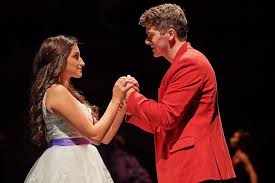
WEST SIDE STORY, the Jerome Robbins (concept development), Leonard Bernstein (Music), Arthur Laurents (book), and Stephen Sondheim (lyrics), had an interesting road from idea to Broadway production to revivals. The script is now in production by the Baldwin Wallace Department of Theatre and Dance and the Conservatory of Music’s Musical Theatre Program.
In 1974 Jerome Robbins conceived the idea of a contemporary musical adaptation of Shakespeare’s ROMEO AND JULIET. His idea was to center the focus on the conflict between an Irish Catholic family and Jewish family living on the Lower East Side of Manhattan set during the Easter-Passover season. The Catholic “Jets” and the Jewish “Emeralds” were “gangs” in conflict.
Originally titled, EAST SIDE STORY, Bernstein proposed an operatic musical score. The idea was rejected and a “lyric theater” concept was accepted. Difficulty with the book and music caused the idea to be dropped.
A number of years later, the idea re-emerged as WEST SIDE STORY, with Laurents changing the characters’ backgrounds to Polish and Irish descent and the formerly Jewish Maria to Puerto Rican. Variances with the original ROMEO AND JULIET story were altered, especially Juliet’s faking her death.
As the score and script developed, there was much adjusting of where various songs would appear and comic relief to increase the impact of the play’s tragic ending were added. Effort was made, however, to ensure that the show would be a musical drama, not a musical comedy.
Gang warfare in New York, just as the show was to open, made the topic relevant.
Cast members, especially the dancers, were treated as actors, not just as bodies to be choreographed, which opened a new way for chorus members to be treated, and laid the foundation for such shows as A CHORUS LINE.
The original production opened on Broadway in September, 1957, to strong positive reviews, ran 732 performances, went on national tour and returned to run another 253 performances. Several revivals followed, including a 2009 version in which some of the lyrics and spoken lines were spoken and sung in Spanish.
The script for WEST SIDE STORY appears regularly on the Best American Musical’s lists and is considered to be one of the most difficult shows to stage due to the complex music and required dancing. The film version won ten Academy Awards, in spite of the fact that the vocals for many of the songs were dubbed, as the roles were played by Hollywood actors rather than accomplished singer-actors.
The story is set in an Upper West Side neighborhood in New York in the mid-1950s, where gang rivalry for “turf” and “face” are the superficial source of conflict. Tony, a former member of the Jets, realizes the ridiculousness of being a member of a gang from “womb to tomb” and has withdrawn. At a dance, he falls in love at first sight with Maria, the sister of the leader of the Sharks. Tragedy follows as gang members are killed, in spite of Tony’s attempt to quell the fight.
This is a musical with a “dark theme, sophisticated music, extended dance scenes, and focus on social problems.” It is credited with changing the course of the American musical by introducing the musical drama, serious social subjects, and a turn from escape to serious-minded story telling.
Baldwin Wallace University’s Music Theater Department is ranked as one of the best in the nation. Their undertaking the difficult WEST SIDE STORY is an expected action for the program as the show gives the “Broadway with stars in their eyes” students a chance to stretch their acting, singing and dancing skills.
The show is double cast. Since I only saw the opening night performance by the Shark Cast, all of the reviewing comments center on that group of actors.
The production, under the direction of Victoria Bussert and choreographer Gregory Daniels, was an overall success.
Starting slowly and methodically, probably due to opening night nerves, the presentation shifted from automatic pilot to full-throttle somewhere during the middle of the first act.
The “Jet Song” opening dance number lacked spontaneity. Though well- choreographed, every move seemed preplanned, not establishing any real tension, a necessity for telegraphing the angst that is the guts of the story. “The Dance at the Gym-Blues” also was somewhat emotionally flat. Second act large dance numbers such as “Ballet Sequence,” hit the stride, leading up to an emotional conclusion that found the audience properly shell-shocked.
The “Officer Krupke” number was clearly the audience’s favorite “escape from angst” offering, while the “Ballet Sequence” was beautifully enacted, and “America” delighted.
The same emotional static involvement pattern followed with the vocals. In his opening song, “Something’s Coming,” Colton Ryan (Tony) had difficulty articulating words in his lower range. As the show proceeded, he seemed to relax, being, not performing, and his strong and expressive voice gained full vocal power.
Nadina Hassan created a beautiful and expressive Maria, growing emotionally from shy new-immigrant, to strong bereaved woman. Her “I Feel Pretty” was truly delightful.
Shayla Brielle created a clearly sexually explosive Anita. The drugstore scene, where she lays the foundation for the show’s climax, was aggressively focused.
Amy Keum was delightful as Anybody’s, the “I want to be a gang boy.” Michael Canada nicely textured the multiple personality levels of Chino, and Elizabeth Rosenberg sang “Somewhere” with clear emotional meaning. Dan Hoy was credible as Riff.
The production was enhanced by Jeff Herman’s lighting and Statue of Liberty on-its-side setting, Charlotte Yetman’s costumes, and David Gotwald’s sound design.
Broadway bound? Colton Ryan, though not the tall macho leading man type, should find a place on the Great White Way in roles for the young, clean scrubbed type who have big voices. Nadina Hassan has the potential for pretty ingénue roles.
The large orchestra was excellent, though in several instances their size and volume drowned out the performance.
CAPSULE JUDGEMENT: BWU’s Music Theatre program is nationally recognized for its quality, as evidenced by the number of its graduates who have lit up the Broadway theatre scene and touring productions. WEST SIDE STORY is a difficult show to “get right.” As should be expected from the quality students and proficient staff, the production was a step above what other colleges could do. Better than Broadway?…no. But, definitely the incubator where future Broadway stars bud and grow. Anyone who hasn’t seen this wonderfully conceived musical should attend this production.
WEST SIDE STORY is scheduled to run through November 22, 2016. For tickets and information call 440-826-2240 or go to www.bw.edu/tickets
Wednesday, November 09, 2016
Introducing Bill Rudman, the man behind the Musical Theater Project and “Footlight Parade”
Bill Rudman, Artistic Director of the Musical Theater Project who hosts the radio show “Footlight Parade” and often co-hosts the MTP live performances, has had an interest in musical theater since he was five and his parents let him stay up late to watch Mary Martin in Peter Pan on television. As Rudman said in a recent interview, “That did it!”
How did Rudman, who is noted as one of the country’s most knowledgeable theater buffs, gain his encyclopedic knowledge of the field? He “started to read about musicals when he was ten, and he’s been reading/listening/attending ever since.” He shared, “that makes 55 years of study.” He has not only sponged up the material, but, when he was a student at Hiram College, he “taught a full-credit course in musical theater history.”
Rudman’s interest became a profession when he decided to “follow my bliss.” He had been affiliated with Great Lakes Theater. He left in 1996 with the intent of creating a nonprofit organization that would “house a radio show, a concert series, a school program, and eventually a record label.” Obviously, his “bliss” has been accomplished as his dream has become a nationally recognized accomplishment.
Besides being a knowledgeable expert in theater, he acted and sang as a college student. He still sings in MTP concerts. But, he admits, “performing and directing were never part of the plan.” He thinks of himself as a writer/historian/commentator, writing scripts for and hosting the radio show and concerts.
As for the concerts themselves, they are already tentatively planned through the 2017-2018 season. Where do the subjects come from? “There are thousands and thousands of songs written for musicals. I, myself, make new discoveries all the time.” It appears that Rudman will never run out of possible program ideas.
The concerts were originally co-hosted by Rudman and jazz pianist Joe Hunter and were presented by the Tri-C JazzFest. “Joe is still featured in the more jazz-oriented shows, such as January’s salute to Broadway composer, Cy Coleman, which we’re doing in partnership with Cleveland Jazz Orchestra.” Presently, Rudman partners with Nancy Maier. “I can’t remember how we [he and Maier] met, but we first worked on a show at Cain Park about 12 years ago, and one thing led to another. She’s a marvel and is now associate artistic director of The Musical Theater Project.”
The radio show, “Footlight Parade,” went on the air on WCLV in 1983, is heard on 100 public stations around the country, and was “picked-up by Sirius XM eight years ago,” which brought national attention to Rudman.
How does Rudman find “hidden treasures” that are included in the concerts and radio shows? Rudman stated, ‘It’s just part of who I am. I’m plugged into a collectors’ network in NY and I’m constantly learning new things. One of the greatest joys in my life — and this goes back to my childhood — is sharing what I find. I think of everything we do at TMTP as acts of giving. In a country that increasingly spews hate, we celebrate an art form that has always been about hope and love.”
As for the famous musical theatre personalities and how he makes arrangements for their appearances, he told the story that “last year we brought in the Tony Award-winning Karen Ziemba to co-host a John Kander concert with me. I had gotten to know him [Kander] through a 2-CD set we produced of his works, and he promised to attend but said he was too shy to co-host. So I thought of Karen, who has done more Kander work than anyone except Liza [Minnelli]. Karen and I had a blast!”
As for inside scoops, a favorite story is about Lerner and Loewe, who are the subject of MTP’s next concert. “Oh, it’s how they met! But I’m not going to tell you— come see the show and you’ll hear it.” He did state, “I think of them as the last of the Great Romantics — not just about love, but about life. Artistically they were meant for each other. So their musicals all come from a deep place of shared sensibilities.”
If Rudman had the opportunity to go to any musical production, past or present, what would it be? “Probably Rodgers and Hammerstein’s Allegro (1947), their only truly experimental musical. It took risks like crazy, and moves me deeply.
What are his favorite three musicals? He stated, “I’m not ranking them: R&H’s Carousel and Sondheim’s Follies and Sunday in the Park with George. They all make me weep unashamedly.” The greatest musical ever conceived? “Probably Follies and the way it plays with time and space while telling a powerful story about the death of at least part of the American dream.”
So, that’s a little of history of Bill Rudman, the Musical Theater Project, and “Footlight Parade.”
Next up for MTP? “Almost Like Being in Love: The Songs of Lerner and Loewe” on November 20 at the 2 PM at the Hanna Theatre. Join Bill Rudman, Nancy Maier, singer Benjamin Czarnota, Clare Eisentrout, with violin and cello arrangements by Cleveland composer Ty Alan Emerson. Some of the songs to be included are: “If Ever I Would Leave You,” “Wouldn’t It Be Loverly,” “They Call the Wind Maria,” “On the Street Where You Live,” and “The Night They Invented Champagne.” And, of course, you’ll learn how Lerner and Loewe met.
In January, 2017, MTP offers “Hey Big Spender! The Cy Coleman Songbook” on Saturday, January 28 (8 PM) and Sunday, January 29 (2 PM) at the Hanna Theatre in PlayhouseSquare.
For tickets to either of these concerts call 216-241-6000 or go to http://www.playhousesquare.org/
Labels:
Celebrity Interviews
Sunday, November 06, 2016
RASHEEDA SPEAKING features strong performances @ Karamu
As the lights come up on Joel Drake Johnson’s RASHEEDA SPEAKING at Karamu, a shadow of a woman can be seen through the textured door window of a doctor’s office.
Inside, Dr. Williams is discussing with Ileen, a long-time employee, and newly appointed office manager, the fact that Jaclyn, the other secretary, has been off sick for the last five days, and he is not thrilled to have her back. He shares with Ileen that he doesn’t think Jaclyn “fits in” and has discussed with human resources the possibility of replacing her.
In order to accomplish the coup, the doctor must have proof of Jaclyn’s incompetency. He tells Ileen that in her new administrative position, she is to write down all of Jaclyn’s actions.
As the conversation comes to a conclusion, the door opens revealing Jaclyn, who has been waiting outside. She is African-American, the other two white.
Within a few minutes Jaclyn is complaining about the status of her plants and how the office is filled with toxins. She is abrupt on the phone, treats Mrs. Saunders, an elderly patient, with disdain, upsetting the already confused old lady. Jaclyn later confides to Ilene that she knows the doctor doesn’t like her.
Is Dr. Williams a racist, or, as Jaclyn has demonstrated, is she not a good fit in an office where she has to deal with patients?
In a revealing scene, Jaclyn tells of an instance where, on her Chicago bus, young white professional men refer to “stern, frozen-faced middle-aged black women like her, as ‘Rasheedas.’”
The tension between Ileen and Jaclyn increases as the latter secretly mixes up items in the former’s desk drawers, misplaces folders on Ileen’s desk, brings the office manager a present and then asks for it back. Jaclyn keeps changing personalities as she is first nasty to Mrs. Saunders, then is overly nice, nasty on the phone, then sugary-nice.
Ileen’s demeanor changes from pleasant to suspicious to fearful. Conflicts arise. Where is the hole punch to be kept? Does the water spilled on the floor while Jaclyn tends to her plants cause a potential slipping danger? Who is to bring the morning pastry? Is Jaclyn to be included in the daily patient information sessions?
The script leaves you scrambling to puzzle out its implications, which would not be bad, if there were any real implications to draw.
While the tension and power struggle spinning out of control is often fascinating and comical, it all seems contrived. The behaviors of all the characters are often too erratic, and occasionally so extreme that it seems the playwright is just playing with the audience, interested in teasing and taunting with no real purpose. Instead of getting a true picture of racism in the work place, or the conflict of black-white relationships, or differences of members of a race interpreting the verbal and nonverbal patterns of others, we find ourselves in search of a purpose for the script.
The problem is not caused by director Sarah May or her cast.
May nicely paces the action, keys the laughs, and has worked for clear stage pictures and effective character development.
Treva Offutt nicely textures her performance as the eccentric and manipulative Jaclyn. Mary Alice Beck wilts before our eyes as the “nice” Ileen who becomes a gun-carrying basket case of emotions. John Busser is consistent in his character development of Doctor Williams, and long-time Cleveland-area award-winning actress, Rhoda Rosen, delights as Mrs. Saunders.
CAPSULE JUDGEMENT: The play has lots of laughs and some intriguing situations, but RASHEEDA SPEAKING proves that fine acting and good directing cannot always cover up for a rudderless script.
RASHEEDA SPEAKING continues through, November 4, 2016 at Karamu, 2355 East 89th Street, which has a fenced, guarded and lighted parking lot adjacent to the theatre, and provides free parking. For ticket information call 216-795-7077.
Watch for big changes at Karamu. Starting in January major renovations will take place to create “new” Jelliffe and Arena Theatres, with funding supplied by a $1.8 million grant from the Ohio Facilities Construction Commission. These changes will necessitate production venue changes for the rest of this season. Check on the website, http://www.karamuhouse.org/, to ascertain where future shows will be produced.
Well performed ANNAPURNA ends fall season at none too fragile
Ulysses, a former college professor and well-published poet, has been living off the grid for over twenty years. His wife and son assumed he was dead.
A search of her mother’s home, after the old woman dies, allows Emma, Ulysses’ former wife, to find several boxes of letters and poems that Ulysses had sent to Sam, his son, but were never delivered to the partially deaf boy.
With information from the letters, and the help of a private investigator, Emma searches out Ulysses and finds him in a desolate town in Colorado, living in a run-down trailer park, nearly penniless. When she arrives she finds him dressed only in an apron, a backpack containing his oxygen tank, and in the final stages of emphysema.
Emma enters the trailer carrying suitcases, bags of food, and years of pent-up hatred. She, fled one night with then five-year-old Sam, has lots of stuff to unload…both physically and emotionally.
The couple bicker, spar about Emma invading his life, his rejection of medical help, an on-going feud with a neighbor, and that their Sam may soon be arriving.
Truths unravel and the defining moment that caused the disintegration of their lives together, is revealed in an emotionally charged scene.
The title, ANNAPURNA, refers to the mountain in the Himalayas, the tenth tallest in the world, which is one of the most dangerous to climb. Ironically, in Sanskrit Annapurna means “full of food.”
The play is Sharr White’s modern day parallel to Homer’s 8th century poem, “The Odyssey.” That epic tells the tale of Ulysses, who was sent on a long journey because he displeased the god Poseidon. Like the Ulysses of old, the modern day Ulysses was also on a journey, an expedition of escape and regret, filled with a failed career, drunkenness, illness and self-hate.
none too fragile’s production, under the adept direction of Sean Derry, is both funny and emotionally charged. The performance quality exceeds the script itself, which is generally formulaic in structure.
As is always the case, Derdriu Ring (Emma) develops a beautifully textured, clear characterization. She rides the emotional waves and milks a great deal from the lines.
Jeffrey Grover creates a bitter and deflecting Ulysses’ in escape from pain and reality. His final emotionally wrought scene is a masterstroke of performance.
Capsule judgement: ANNAPURNA is the tale of two highly damaged people, caught in an impossible climb to the top of an impregnable mountain, confronting their lives.
For tickets to “ANNAPURNA which runs through November 19, 2016, at none too fragile theater in Akron, call 330-671-4563 or go to nonetoofragile.com
The theatre has announced its ambitious 2017 season which includes: THE WHALE, A SKULL IN CONNEMARA, SALVAGE, IMPENDING RUPTURE OF THE BELLY, LAST OF THE BOYS and A STEADY RAIN. Check its website for information about the plays and how to obtain season tickets and receive an artist Don Drumm creation.
Labels:
None to Fragile Theatre,
Reviews
Wednesday, November 02, 2016
FINDING NEVERLAND, a PETER PAN prequel, pleases at the Connor Palace
Peter Pan has had quite a life. Since his conception by J. M. Barrie, the boy who refused to grow up has been associated with books, plays, films, costumes, art work, a television series, and music, as well as having his name given to a race horse, a food product, a bus line, an emergency health rescue service, a psychological syndrome, and a rock band.
Such publications and films as PETER PAN (J. M. Barrie), PETER PAN—3 Classic Tales (J. M. Barrie), PETER AND THE SECRET OF RUNDOON and PETER AND THE SWORD OF MERCY (Dave Barry and Ridley Pearson), PETER AND THE STARCATCHER (Rick Elice), PETER PAN AND WENDY (Alyn Cardarelli), PETER PAN IN SCARLET (Geraldine McCaughrean), HOOK (Steven Spielberg), RETURN TO NEVER LAND (Disney), and PAN (Joe Wright) have centered on some aspect of Peter’s existence.
Peter, who symbolizes the nonchalant, fearless, cocky, forgetful and self-centered charmer, whose everlasting youth is due to his exposure to “star stuff,” a “magical substance which has fallen to earth,” is an international celebrity.
Peter’s latest Broadway life, FINDING NEVERLAND, crafted by James Graham (book) and Gary Barlow and Eliot Kennedy (music and lyrics) is now on stage at the Connor Palace as part of the Key Bank Broadway Series.
How did Peter come to be? As far as history can reveal, he is named after a real boy, Peter Llewelyn Davies, the son of Sylvia Davies, a woman with whom Barrie had a platonic relationship, and Pan, a minor deity of Greek mythology, who represents nature and a free spirit.
As we learn in FINDING NEVERLAND, J. M. Barrie was a fairly successful playwright, whose plays, after a while were all basically the same. He needed to find some inspiration to change his pattern.
In 1903, Barrie and the widow Sylvia Davies, became acquaintances from their meetings in Kensington Park, London, where Barrie befriended Davies’ grieving but spirited boys, and eventually became their father figure. From observing the boys and encouraging their imagination, especially that of Peter, the eldest of the four, Barrie, unleashed his own imagination. Through Peter, he explored the power of creativity to open up new worlds.
Through his experiences with the Davies boys, PETER PAN is written, and staged to the chagrin of the stuffy and uptight company of actors in producer Charles Frohman’s theatre. Produced to great accolades, as the old adage goes, “the rest is history!”
FINDING NEVERLAND had a healthy 17 month run on Broadway and is now on its US national tour.
This is an impressive professional production. The tour’s press and marketing director, Cleveland area local, Anita Dloniak, indicated in an interaction before the opening night curtain rose, that the massive show’s sets, costumes and props were shipped here in seven trailers. It took close to 60 workers about 16 hours to load the 12.5 tons of scenery and lighting onto the stage.
Included in the eye-popping staging, which has numerous electronic graphics, is the musical number, “Stronger (Part 2)” in which a pirate ship, complete with billowing sails, rope ladders, and towering masts, is constructed before our eyes and sails into a raging storm.
The production, according to director Diane Paulius, “is orchestrated within an inch of its life!” This is both an advantage and disadvantage. The show zips along with impressive precision, as does three-time Emmy Award winner Mia Michaels’ well-conceived choreography. But, there is sometimes a lack of spontaneity and realism in the flow of lines, movements and character development. Everything is actually too precise, making for an almost on-autopilot format in Act I. Act II seemed a little more spontaneous.
Though FINDING NEVERLAND is a story for all ages, this staging may not be well suited for very young viewers. If they’ve seen the animated PETER PAN or a stage production in which Peter, Wendy and Michael actually go aloft, they may be disappointed as the “flying” scenes are done by actors carrying the trio…no spectacular “I’m Flying” here.
The score has elements of contemporary and an “old fashioned musical.” It is well-played by the orchestra. There are several songs, however, in which the lyrics are drowned out by over-amplified instruments.
The well-conceived score, which includes “Neverland,” ”Imagination,” “We Own the Night,” the four part “Circus of the Mind,” “The World is Upside Down,” and “When Your Feet Don’t Touch the Ground,” is well sung.
The cast is universally strong. Cincinnati’s Kevin Kern, who appeared on the 6th game night of the World Series for the curtain call wearing a Cleveland Indian’s uniform, is spot on as J. M. Barrie. The charming actor, who has appeared on Broadway as Fiyero in WICKED, was also seen in WEDDING SINGER and LES MISERABLES. He has a pleasing voice, develops a clear characterization, and has a wonderful time interacting with the boys and the large, energetic floppy Sammy, a charming dog who portrays Porthos.
Tom Hewitt creates an appealing Charles Frohman, the first producer of PETER PAN, who is both a curmudgeon and a hyper-charged businessman. Lovely Christine Dwyer presents a Sylvia Davies who is compassionate and appealing. Her “All that Matters” was well sung and interpreted as was her duet, “Neverland” with Kern.
The Llewelyn Davies children vary in their casting from performance to performance. Opening night, Eli Tokash was outstanding as Peter. The young man showed great sensitivity and developed a clear concept of the importance of the role. The other boys for that night, Jordan Cole, Finn Faulconer and Mitchell Wray were also excellent.
Special kudos to Paul Kieve for the spectacular stage illusions, Daniel Wurtzel for the air sculpture, Jon Driscoll for the projections, and William Berloni, an animal trainer, for the delightful performance by the crowd pleasing Sammy.
CAPSULE JUDGEMENT: The touring production of FINDING NEVERLAND is a technically impressive and nicely conceived, if somewhat stilted production. It clearly lays the prequel story of Peter Pan with a strong score and clear story.
Tickets for FINDING NEVERLAND, which runs through November 20, 2016 at the Connor Palace, can be ordered by calling 216-241-6000 or going to www.playhousesquare.org.
Labels:
Playhouse Square Center,
Reviews
Saturday, October 29, 2016
Compelling, well written and performed SEX WITH STRANGERS @ Cleveland Play House
As the lights come up on the thrust stage in Cleveland Play House’s Outcalt Theatre, revealed was a large comfortable room, and a woman snuggled up on a chair by a free-standing fireplace, reading a book. Outside a large span of windows, snow could be seen cascading down. Suddenly a car is heard and headlights glared through the window. Pounding is heard at the door. Who is there? What’s going on? Sounds like the opening scene of a mystery. But, no, this is the start of Laura Eason’s SEX WITH STRANGERS, a charming and intriguing play of “lust, love and the complex nature of identity in our digital-dominated era.”
Eason, who has written over 20-full lengths plays, and serves as the Artistic Director of Lookingglass Theatre, is a Renaissance woman. Besides her successful administrative and writing life, her resume banners her abilities as an actress, musician, singer, songwriter, band member and circus performer on the trapeze. Many know her for her four seasons as a writer for Netflix’s HOUSE OF CARDS.
Her well-written comedy/drama, SEX WITH STRANGERS, centers on Olivia, who is holed up in a remote bed-and-breakfast, an informal writer’s retreat in the Michigan woods, and Ethan, an on-line Millennial guru who has come to the B&B to finish a writing task.
Olivia is an attractive forty-year old, typical Generation Xer, whose debut novel was not well received by the critics and basically tanked.
Ethan, 28, is a charming, youthful stud with the personality of a playful puppy, who is a well-known blogger and has already written two best selling books that were on the New York Times best seller’s list for a record number of weeks under the pseudo-nom “Ethan Strange,” in which he reveals a series of sexual hookups.
She is shell-shocked from her literary “disaster,” and though she has written another novel, it is hidden away from public view.
He, a self-described “asshole,” is about to be made even more famous as his graphic details of his experience having “sex with strangers” is about to be made into a film.
The internet at the B&B is out and there are zero bars available for cellular contact. She is fine with this, he is hyper. She likes being cut off from the world, she can happily lick her wounds in the privacy, while he doesn’t know how to operate without his electronic toys and connectivity. She is of one generation, he of another.
He is like a hyperactive child, filled with braggadocio, possessing lots of charm. She is a mature, third grade teacher, who has dealt with “children” like him in her classrooms. He is warmed with something she knows nothing about...he knows her former writing teacher, has read her book, and knew she would be at the B&B.
Ever the delightful con-artist, he showers her with praise for her writing, and quotes line and verse from her novel. She is thrown off guard. And, of course, they are soon locked in a torrid embrace.
The next morning, she, wearing his sweat pants and t-shirt, and he, wearing only black boxer briefs, negotiate a type of relationship while sparring over her disdain for e-books and the invasion of electronics into modern-day society. His concern is that his many followers on the net are going to think he is dead since he has not been on-line.
He has snuck downstairs during the night and read the manuscript of her novel, against her wishes. Using his unbridled charm, he offers to put her new novel into the blogosphere. She desires it to be published by a “legit” publisher in a printed form that she can hold and turn the pages and smell the paper and print.
The play unwinds with questions of whether he helps her get an agent for ulterior motives, whether good sex conquers all, whether she can forgive him for his past sexual infidelities, why he released her book without her permission, what happens when we invent our identity—online and off, and what happens when our skills, talents and self become part of the public domain.
Wisely, Eason, who writes sharp, clever, meaningful, funny dialogue, doesn’t make the script into a soap opera by rolling out a feel good, happily-ever-after ending. She leaves the audience, as many good modern day writer do, with questions to ask and attempt to answer.
The CPH production, under the adept direction of Joanie Schultz, is perfection personified. Schultz gets all instances of drama and comedy right. Nicely paced, she has blended the visual and performance elements into a joyous experience.
Beautiful Monette Magrath textures her performance as Olivia so well that there is no acting involved, just Macgrath living as Olivia. The character’s pain and conflicted pattern of making decisions, after being subjected to harsh criticism for her writing, which represents her very essence, and believing that she must listen to those outside voices, is readily apparent. Her sensitivity not to trust and be pulled in again, causes her not to trust Ethan’s motives. This is a fine and focused performance.
Sean Hudock, he of handsome face, gym-toned body and charming demeanor, was made to play Ethan. With a sly grin, a twinkle in his eye, and spoken charm, he brings Ethan to life. He is so good at making the audience “believe” that he cons us into trusting the character’s machinations. Once we think we have caught onto his games and pull away, we are brought back by his beguiling ways.
The chemistry between Magrath and Hudock is magnetic. They exude connection.
On opening night one of the doorknobs to Olivia’s apartment came off in Hudock’s hand, the other knob hit the floor. Without missing a beat, he picked up the knobs, tossed them behind a pillow on the couch and exited by walking around the stage right end of the set. Since there was no way to reattach the knobs, he continued to make exits and entrances around the set. Though some of the audience may have been confused by why the door wasn’t being used, this was a capital instance of “the show must go on.”
Chelsea Warren’s scenic design worked well. Michael Boll’s lighting design, Thomas Dixon’s sound and Whitney Locher’s costumes all enhanced the production.
CAPSULE JUDGMENT: SEX WITH STANGERS is a well-written script which gets a compelling production. The acting is top-notch, the direction spot-on. The must see show will delight and tantalize the audience. It well deserved the standing ovation it got on opening night.
SEX WITH STRANGERS runs through November 13, 2016, in the Outcalt Theatre in the Cleveland Play House complex of PlayhouseSquare. For tickets call 216-241-6000 or go to http://www.clevelandplayhouse.com.
Labels:
Cleveland Play House,
Reviews
Monday, October 24, 2016
Blank Canvas challenges audience sensibilities with SILENCE! THE MUSICAL
Pat Ciamacco, the curmudgeon of glee and horror, is at it again. While it seems almost by chance, the artistic director of Blank Canvas selects the likes of OUR TOWN, TWELVE ANGRY MEN and OF MICE AND MEN. But most often Ciamacco digs up such scripts as THE WILD PARTY (a play about decadence and uninhibited sexual behavior), REEFER MADNESS (the “truth” about using marijuana), BAT BOY THE MUSICAL (the tale of a large-eyed fanged human child), TRIASSIC PARQ THE MUSICAL (a songfest 65-million years in the making), DEBBIE DOES DALLAS (a stage version of the 1978 pornographic film), and TEXAS CHAINSAW MUSICAL (the story of a handsome serial killer and his overly affectionate momma, staged complete with a “blood zone,” where members of the audience chose, if they desired, to be bathed in fake blood!)
His newest offering is SILENCE! THE MUSICAL, which opened to an appreciative sold-out audience. It is based on THE 1991 psychologically thrilling film about Hannibal Lecter, a cannibalistic serial killer and his relationship with Clarice Starlin, a young FBI trainee, who seeks the killer’s advice to apprehend Buffalo Bill, another serial killer.
No blood this time. Instead,, we have a herd of sheep, an errant ballpoint pen that sets the fiend free, full frontal “male” nudity, and adult language.
Yes, as a New York newspaper said in its review, ”This Lambs parody is as irreverent, filthy and funny as THE BOOK OF MORMAN!” If you need any more proof that this is not THE SOUND OF MUSIC or even FUN HOME, the score includes “If I Could Smell Her C*nt,” “I’d F*ck Me,” “Put the F*cking Lotion in the Basket,” and, if it weren’t enough the first time, a reprise of the C*nt song.
It may surprise many to know that in 2005 this script was selected as the Outstanding Musical at the New York International Fringe Festival, was listed in The 2011 Time Magazine Top 10 Plays and Musicals, and in 2012 it was anointed with the Off-Broadway Alliance Award for Best New Musical.
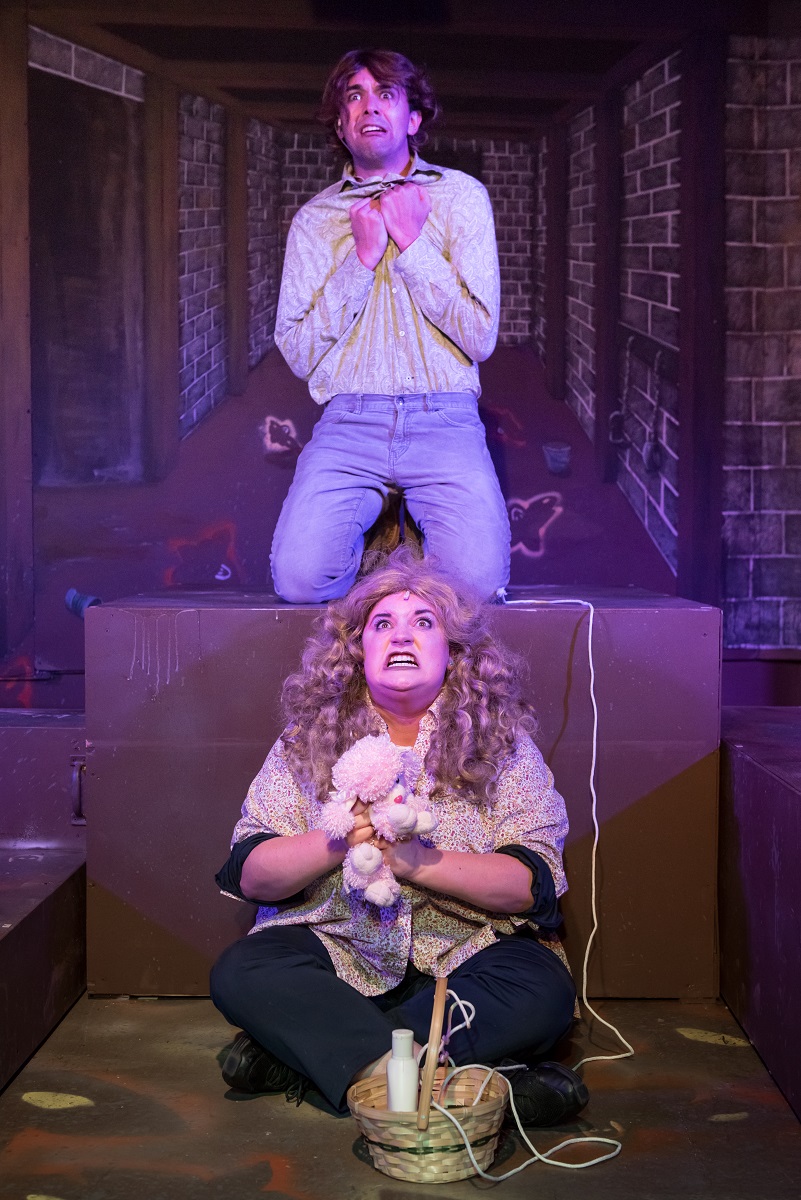
The story, which is told by an flock of lambs (Tonya Broach, BJ Colangelo, Dawn Sniadak-Yomokoski, David Turner, Connor Reese and Kat Glover), who act as a Greek chorus who sings, dances, and narrates the goings on. The plot centers on Clarice Starling (Kelly Strand), a lisping student at the FBI Academy who hopes to work with the Behavioral Science Unit tracking down serial killers. Her desire comes from an attempt to emulate her deceased father’s career. She is sent to interview Dr. Hannibal Lecter (Brian Altman), a brilliant psychiatrist and cannibalistic serial killer. He helps her solve the FBI’s latest case, the mass killings of “zoftig” size-14 women by James Gumb (Joe Virgo), better known as Buffalo Bill. BB believes himself to be transsexual, but is so psychotic he can’t qualify for sex assignment surgery. He kills overweight women so he can remove their skin and fashion a “woman suit” for himself.
Things get dicey when hefty Catherine Baker Martin (BJ Colangelo), the daughter of Senator Ruth Martin (Dawn Sniadak-Yamokoski) is kidnapped by Buffalo Bill. A full scale FBI search is undertaken, headed by Jack Crawford (Mitch Manhey), the agent-in-charge of the FBI at Quantico, Virginia. The bumbling and lecherous Dr. Frederick Chilton (Trey Gilpin), the director of the Chesapeake State Hospital where Lecter is confined, keeps getting in the way of the investigation. Eventually Clarice, with clues provided by Lecter, tracks down Buffalo Bill, Catherine is set free, Lecter moves to a tropical island and calls Clarice to say goodbye. (Honest, that’s the story. Could I make stuff up like that?)
The production moves right along. The vocals are adequate, with a few of the lambs and leads (mainly Dawn Sniakak-Yamokoski) hitting the right musical notes, the acting is farcically correct, and the dancing cleverly klutsy. Most importantly, the laughs roll along.
The BC band (Heidi Herczeg, David W. Coxe, Colin Dees and Jason Stebelton) has to be congratulated for keeping the volume down and not, as has been the case at this theatre, of drowning out the performers.
CAPSULE JUDGMENT: SILENCE! THE MUSICAL is a typical Blank Canvas escapist musical comedy which will entertain the cult audience which the theatre has developed. Ciamacco knows his patrons and their tastes and has hit another home run with this script!
Blank Canvas’s SILENCE! THE MUSICAL runs though November 5 , 2016 in its near west side theatre, 1305 West 78th Street, Suite 211, Cleveland. Get directions to the theatre on the website. Once you arrive at the site, go around the first building to find the entrance and then follow the signs to the second floor acting space. For tickets and directions go to www.blankcanvasthetre.com
Next up at BC is local playwright Stuart Hoffman’s KISS KISS BANG from November 10-13. That is followed by CABARET, yes, the “Wilkommen,” “Maybe This Time,” and “Right This Way Your Table’s Waiting” musical.
Labels:
Blank Canvas Theatre,
Reviews
Sunday, October 23, 2016
Must see AN OCTOROON will confound and frustrate some @ Dobama
Theater represents the era from which it comes! In 1859, when THE OCTOROON opened in New York, the United States was in racial chaos. The slaves of the South had been “freed,” but, in reality, they weren’t free from their years of enslavement. Yes, blacks, the only mass group of people who came to this country against their free will, were the center of much controversy.
THE OCTOROON, a play by Dion Boucicault, based on Thomas Mayne Reid’s novel, THE QUADROON, was extremely popular when it was produced. It was an antebellum melodrama, generally regarded as the second most important of such plays. The number one hit was, of course, UNCLE TOM’S CABIN.
The play was produced during the era when romanticism (characterized by an emphasis on emotions, exemplified by displaying apprehension, horror, terror and awe) and the melodramatic (overdone, unrealistic, exaggerated characters and overly dramatic situations intended to appeal to the emotions) was at the fore. (Think of the soap opera stories and acting of non-talky movies.)
The production sparked major debates about abolition of slavery as well as the role of theater in politics. The latter centered on whether theatrical productions were intended to simply entertain or to also insight thought and discussion.
Skip forward about 175 years, it is now 2014 and Branden Jacobs-Jenkins, an African-American playwright and professor with credentials bannering Princeton, NYU and Julliard, adapts the Boucicault play.
The adapted play, AN OCTOROON, premiered off-Broadway, and was subsequently awarded the Obie for best new American play. The issue of the now-called “African Americans” was still the center of much controversy.
Jacobs-Jenkins’ reframing used the original characters and plot, much of the original dialogue, and inserted modern theatrical devices including the concepts of Bertolt Brecht’s “historification,” “epic” and “alienation.”
Historification is using past historical events, which run parallel to today, to create a contemporary lesson!
AN OCTOROON is set in the old South, and though it does not use modern experiences, the situations are parallel to today. Racial profiling and the beating of and punishing African Americans and Indigenous peoples still exists, with law enforcement, court systems and economic parameters acting much like slave owners.
The script uses Alienation, making sure the audience knows they are in the theatre. The author wants each observer to think of the implications of the play’s message for today. To achieve this the production lets the scenery, lighting, makeup, and acting techniques be so obvious that they don’t lull the audience into transferring their attention to the production as being real.
Jacobs-Jenkins recognizes that this topic is Epic. His message is big, important, something that has major meaning.
On October 21, 2016, when AN OCTOROON opened at Dobama Theatre, the issue of African Americans is still front and center. Yes, bigotry, violence, racial profiling, work and housing discrimination, xenophobia and prejudice runs rampant on the political, business and social landscape of the United States.
To achieve a Brechtian effect, Dobama’s staging starts with the first actor on stage talking directly to the audience. He explains that he is the playwright and he is going to use theatrical devices to tell his tale.
The acting is exaggerated, with overdone gestures. The costumes are stereotypes which exaggerate. The vocal presentations are not of traditional spoken structure. The accents are overpowering, often inconsistent. Makeup is put on before the audience and it is obvious that whites are portraying blacks and American Indians, while African Americans are portraying whites, yet some blacks are playing blacks and whites, whites.
The tale has characters, incidents and twists and turns that represent plantation life, the treatment of slaves and indigenous people, which are depictions but obviously theatrical devices to tell the story and bring the present-day audience to recognize that though we may give lip service to the concept that, “things have changed,” that much has not changed as it relates to the racial divide in America. We realize that “make American great again,” may not be such a good idea if this is what America was like.
The play takes place on the Plantation Terrebonne in Louisiana. The “Massa” of the plantation has just died, his wife is ill. George, his nephew, has come to oversee the property, including the slaves, which have been treated “fairly” (haven’t been whipped or starved), but still are slaves, working in the fields, not being paid, living in shacks, and not free to be educated.
The plantation is near financial ruin due to gambling debts and the poor economy. George falls in love with Zoe, the illegitimate daughter of the deceased plantation owner and one of the slaves. Yes, she is an Octoroon, a word with varying definitions, but which generally means a person of mixed-race, commonly a person born of white and black lineage. In some southern states it was legally defined as a person who is at least one-eighth black.
The plantation and all the slaves are to be sold, including Zoe. Of course, the mustached, black hat wearing, evil neighbor, M’Closky is going to be the purchaser.
We are told of a stolen record of money that would have saved the plantation from the auction block, a murder, a plot by the slaves to get themselves sold to a nice riverboat owner, a photo with incriminating evidence, the possibility of Zoe being bought by a wealthy young woman in love with George, and all the other sidetracks that make melodramas so theatrically untraditional.
In a melodrama there is one segment, a “sensation scene” in which the moral of the story is put forth. A truth is revealed such as who the real villain is and who the innocent victim is or how dastardly deeds were done. It is staged in a sensational, spectacular way which insights the senses.
In AN OCTOROON, the play stops about two-thirds way through, the playwright enters and explains the writing technique he is going to use to lead to the conclusion of the play. He illustrates this by staging a near lynching, a trial, the revelation of the letter that M’Closky stole, his having killed a young black boy who was bringing the mail to the plantation which contained the evidence of money that would save the plantation, and a blazing fire takes place.
The play concludes with a “resolution scene,” which, as happens in all good melodramas, evil is defeated and the moral is presented. We are left with the idea that race, represented by white, black and red faces which have been created with makeup, is simply a social construct, a theory put forth by sociologists and anthropologists, which has been expanded into a societal way of life.
AN OCTOROON, under the focused direction of Nathan Motta is excellent. This is said recognizing that some may find the goings-on too long, others will be confused as to why the ”old fashioned” story is relevant today, some will be put off by the melodramatic staging, some will find the humor off-putting due to its dependence on” offensive” and non-politically correct words.
The Dobama production showcases the best quality of theatre…taking a script and staging it in such a way that it develops the intent and purpose of the author.
The cast (Ananias J. Dixon, Abraham Adams, Arif Silverman, Natalie Green, Katrice Monee Headd, India Nicole Burton, Anjanette Hall, Maya Jones and Nathan A. Lilly) understand the concept of melodramatic acting, a necessity for developing this author’s intent and purpose. The technical aspects…lighting, costumes, makeup…all aid the concept of the play.
CAPSULE JUDGEMENT: The hottest play of 1859 is back, but this time it is aimed at a 2016 audience with a plea for understanding and realization that things, regarding the blacks and Indigenous peoples, haven’t changed very much in the last 175 years. Seeing this production can be an important theatrical experience and challenge your belief system--“GO SEE!”
AN OCTOROON runs through November 13, 2016 at Dobama Theatre. Call 216-932-3396 or http://www.dobama.org for tickets.
Tuesday, October 18, 2016
44 PLAYS FOR 44 PRESIDENTS is an American history geek’s turn-on at CPT, but . . .
Yes, in a period of two hours and twenty minutes, plus intermission, 44 plays whoosh across the Cleveland Public Theatre stage. During that time the audience is exposed to all of the United States of America’s Presidents. Well, to be honest, there are 45 plays…one, based on the audience vote, an add-on vignette of a supposition about either Hillary Clinton or Donald Trump’s reign as the next President.
44 PLAYS FOR 44 PRESIDENTS is a chronological, biographical recap of the lives and presidencies of those who have held the office. Some of the playlets are a couple of lines long, others many minutes in length. In the process, some of their successes and/or errors are heralded. How do you know which giant of politics is being spotlighted? First, their picture appears on the. Second, the actor portraying the office holder wears a blue and red star-spangled coat that symbolizes the presidency.
The comedy/drama/experimental/political/historic play is the brain-child of Chicago writers Andy Bayiates, Sean Benjamin, Genevra Gallo-Bayiates, ChloĂ« Johnson and Karen Weinberg, with Bayiates dubbed the “Founding Father” since he conceived the concept. There are also musical compositions dropped into and between the segments. These are the doings of Steve Goers, Laura McKenzie and AndrĂ© Pleuss.
The show is a time travel beginning with George Washington in an almost Eden-like setting, John Adams being “Second Fiddle,” a roast of Thomas Jefferson with Benjamin Franklin as the emcee, to William Henry Harrison being hailed as an “Indian Slayer,” Lincoln and the “freeing of the slaves,” to the assassination of Ohio’s own William McKinley, the Hooverville 1930 depression days, FDR’s live speeches and videos of the public’s reactions to his death, to “Tricky Dickey” Nixon’s rise and fall from power, the reign of George H. W. Bush (“The Bargain: Prelude to a Great Divide”), George Bush’s wrestling the election away from Al Gore, and the “Can he?” period of Barack Obama.
Few, other than U. S. presidential history geeks, will grasp all the innuendoes. Of course, there is also the question of the validity of the material. The audience is helped by an electric sign stating, “direct quote” when the material being presented was said by the holder of the office or some other credited source. (The 2016 debates could be helped by this device!)
The show is presented in Val Kozlenko’s red, white and blue pillared stage set, with a video screen up-stage center, which reveals a picture of the President being highlighted in each segment as well as visual images of some of their times in office (e.g., the assassination of JFK), highlighted by Michael Boll’s lighting, and enhanced by Eric M. C. Gonzalez’s inserted taped recordings (e.g. radio broadcasts of the assassination of Robert Kennedy and Martin Luther King, Jr.).
The CPT production has done color blind casting. The on-stage assemblage is both black and white. However, the same cannot be said for gender. All of the performers play multi-roles. They portray Presidents, wives, members of the various cabinets, assassins, and various others. The entire cast is female, though the reason for that choice is not clear.
Co-directors Dan Kilbane and Caitlin Lewins were faced with the difficult task of holding the audience’s attention as the segments went on and on. The “singing, dancing, declaiming, laughing, eating, expounding, carousing, jumping, falling, running and many, many other ‘-ings’” is almost mind-numbing.
Things are not helped by the constant moving on and off stage of boxes, podiums, and other paraphernalia. Having a blackout after almost every scene to arrange the pieces, added much time to the production and broke the dramatic flow.
The cast must collapse in exhaustion after the show. Molly Andrews-Hinders, Chennelle Bryant-Harris, Melissa Therese Crum, Sally Groth, Tanera Hutz, Coleen McCaughey and Carrie Williams act, sing and dance with vigor. Unfortunately, though they try hard, some of their lines are lost due to the echo in the theatre, the inconsistent vocal projection by some actors, and the use of accents which are sometimes difficult to understand.
The conclusion, a rap song (a HAMILTON take-off) by Hillary Clinton (she won the audience vote regarding who would win the 2016 election the night I saw the show), could not be understood. Putting the words on the screen would have helped in figuring out what was being said.
Capsule judgement: 44 PLAYS for 44 PRESIDENTS is a timely production, coming just before the contentious 2016 presidential election. Though it is much too long, and has some staging and sound problems, history buffs should still rejoice. Others may enjoy the dancing, singing, and humor presented by the all woman cast.
44 PLAYS FOR 44 PRESIDENTS runs through October 29, 2016 at Cleveland Public Theatre, 6415 Detroit Avenue in the Gordon Square Arts District. There is plenty of free parking within an easy walk to the theatre. For tickets call 216-631-2727 or go on line to www.cptonline.org.
Labels:
Cleveland Public Theater,
Reviews
Sunday, October 16, 2016
LIKE I SAY, a script in search of a purpose @ convergence-continuum
Len Jenkin, the author of LIKE I SAY, which he refers to as a "sober-minded comedy," is the recipient of three Obie Awards and received an Emmy nomination.
He explains that LIKE I SAY is "a Candide type of tale. A journey through darkness, through failure, disease and death to a kind of hope. A survivor’s hope."
Unfortunately, Jenkin’s explanation is easier for him to say than the abstract script is to display.
The play, which has stories overlaid onto stories, is often hard to follow and is excessively long. It is a tale, oft told by a dreamer, in which the dreams “turn nightmarish and heavenly.”
The tale basically takes place in the Hotel Splendide, a once grand hotel situated on the American coast. It is now a barely habitable wreck, walls covered in a so-called artist’s stick figures related to DĂa de Muertos (the day of the dead).
Assembled are Helena Skate (Lauren B. Smith), the inn keeper, and her helper, “Little Junior” (August Scapelli). In occupancy are Isaiah Sandoval (Logan Smith), a once prolific writer who is in a state of depression as a result of his wife and child having been killed in a car crash for which he was responsible. His “nurse,” Rose (Linda Sekanic) tries to keep him on his meds, while chaos spins around them.
Also present is Mr. Schwarzberg (Robert Hawkes) an alcoholic painter and tattoo artist and Leon Vole (Clyde Simon) and Tanya Vole (Marcia Mandell), down and out puppeteers, who have falsely been told that Sandoval has a suitcase filled with money.
In his delusional states Sandoval tells tales about Coconut Joe (Robert Branch) who is looking for the perfect consignment of coconuts for the biscuit factory for which he works. The search takes him to Berlin, where he is betrayed by a woman. He winds up as a prisoner in a nuclear waste plant, escapes, goes to Venice, boards a ship which sinks after being attacked by pirates and survives on a life raft. Also on the flotation device is a Pirate Queen. They are washed ashore at a resort for those who are kept young and alive by injections of lemur blood.
And…well, to be honest, who cares. This excessive babble makes little sense and who cares about these people and what happens to them.
The con-con production, under the direction of Tyson Douglas Rand does what it can with a script. The casts’ performances are erratic, but one can conjecture that it is the fault of the script.
Capsule Judgement: LIKE I SAY is an overly long, irrational script. One can only wonder why it was chosen by the theatre to perform and why a group of actors and a director would want to spend their precious time in producing it. Con-con has performed some excellent works. This isn’t one of them.
LIKE I SAY runs through November 5, 2016 at 8 pm on Thursdays, Fridays and Saturdays at convergence-continuum’s artistic home, The Liminis, at 2438 Scranton Rd. in Cleveland’s Tremont neighborhood. For information and reservations call 216-687-0074 or go to http://www.convergence-continuum.org
convergence-continuum’s next show is Robert Hawkes appearing in his self-written script, GIVE ME THE MAP, from November 17-19, 2016, followed by the world premiere of local writer Jonathan Wilhelm’s THE KNIFE IS MONEY, THE FORK IS LOVE.
Labels:
Convergence Continuum,
Reviews
Monday, October 10, 2016
Unique, well-acted LANFORD WILSON: TAKE 5 @ Cesear’s Forum
Caffe Cino, which was founded in 1958, is noted as the site that gave birth to off-off Broadway theatre. It was the invention of retired dancer Joe Cino, who offered a place to do inexpensive creative works in New York City and not have to conform to Equity rules. Cino bankrolled the adventure. The shows were staged on a make-shift small platform.
Cleveland has similar theatres. They are venues which are the inventions of a single person who scavengers for money from foundations and donors and produces shows on a shoe-string budget. These off-off Euclid Theaters include Patrick Ciamacco’s Blank Canvas, located at West 78th street (http://www.blankcanvastheatre.com), Clyde Simon’s convergence-continuum, 2438 Scranton Rd. in Cleveland’s Tremont neighborhood (http://www.convergence-continuum.org), and Greg Cesear’s Cesear’s Forum, which performs in Kennedy’ Down Under, down under the Ohio Theatre in Playhouse Square (http://www.cesearsforum.com).
It is ironic that Cesear’s Forum is showcasing Lanford Wilson’s TAKE 5 as Wilson’s first plays were staged at Caffe Cino. The smallish platform on which the scripts were welcomed into the world was about the same size as that found in Kennedy’s which opened in 1921 as a bar.
Wilson, a Lebanon, Missouri native, who died in 2011 at age 73, was noted as one of the significant writers of the 20 th century. He was one of the first playwrights to move from Off-Off-Broadway, to Off-Broadway, then Broadway. He received the Pulitzer Prize for Drama in 1980.
His first significant play was HOME FREE in 1964. Other well known scripts were: THE RIMERS OF ELDRITCH, THE GINGHAM DOG (his first Broadway show), THE HOT L BALTIMORE, FIFTH OF JULY, BALM IN GILEAD and TALLEY’S FOLLY.
It is the goal of Cesear’s Forum to “present works of social commitment and theatre experimentation.” TAKE 5, which is composed of five one-act plays, have been cobbled together into an evening of theater by the producer, Greg Cesear. The evening features six performers playing various roles, and fits well into the theater’s purpose.
Adorable Tricia Bestic serves as the absent-minded narrator, introducing each of the one acts. She bumbles the intros, messes up the titles of the plays, and interacts with the audience, creating a warm and comfortable atmosphere.
WANDERING covers 40 years of a guy’s life in 4 minutes. He confronts parental conflicts, applying for jobs, being a conscious objector, being lost, relationships, and facing the reality of life, through a barrage of attacks.
The main character (Beau Reinker) , who starts as a teenager, stays the same throughout, but the minor characters-- his parents, wife, friends, doctors, nurses, secretaries—interchange in their roles.
SEXTET (YES) is compromised of the thoughts and recollections of six characters, who wander and sit at random places as they react to each other's revelations with a quiet, "yes." Out of the pattern of their memories and the interweaving of their destinies, emerges a sense of their frailty, humanity, and the disquieting vulnerability of life itself.
A BETROTHAL is a delightful cat and mouse conversation which keeps the audience guessing about what is being discussed as two lost souls, a school librarian (Adina Bloom) and an associate gardener (Brian Zoldessy), who have come into a tent in order to get out the rain, express irritation with the way they have been treated by the judges. Judges? What does this have to do with a betrothal?
As the obtuse conversation about Little Soldier and Little Tanya takes place the duo spars, accuses, insults, attempts friendly conversation, and surprisingly come to an uneasy peace. They agree to mate there flowers, his for its beauty and hers for its strength, thus creating an iris which will even dazzle the obtuse judges.
The physical and verbally dominant Bloom and the slender, nervous, bumbling Zoldessy are delightful as they advance, lunge, attack, feint, and parry as they conduct their verbal fencing match.
BRONTOSAURUS is considered as one of Wilson’s best one-act plays, and why he is regarded as the “greatest functioning playwright of the last quarter of the century.”
A young man (Beau Reinker) arrives at a plush Park Avenue apartment. He is there to live with his aunt (Mary Alice Beck), who will provide housing and also support his NYU collegiate education.
She is a sophisticated, cynical, wealthy New York antiques dealer. He is withdrawn and secretive. She is a wise-cracking wine drinking, non-believer. He is reticent, unemotional and claims he is going to study theology because he underwent a mystical experience.
She becomes more chatty, a defense she has honed to keep the world away, thus reinforcing her awareness of the superficiality of her life and the futility of her existence. He leaves to find his place in the world, leaving behind his much photographed bedroom with the view of central park.
Reinker, who often serves as a sound designer at local theatres, would be wise to get more involved in stage endeavors. He is handsome, has solid acting abilities, displays a nice level of sensitivity, and effectively textures his performance. Beck is a fine actress, who develops a woman with a veneer of protection.
In A POSTER OF THE COSMOS a young black is sitting in a Manhattan police station interrogation room.
Tom (Sean Booker), a baker, has been accused of killing his lover, who had been in the hospital in the last stages of death caused by AIDS. Tom’s emotionally presented insights regarding the duo’s relationship, the attacks on them by an uncaring and ignorant society, and the stereotypes against him as a young black man provide great insight. His pleas are answered by the interrogator’s derogatory refrain, “You don’t look like the kinna guy’d do somethin’ like dat.”
The play deserved its inclusion in BEST SHORT PLAYS OF 1989, and Booker deserves a standing ovation for his insightful, emotional, tear-filled development of the bereaved, shocked Tom, whose lover died in his arms.
Capsule judgement: Cesear’s Forum, which has won both Cleveland Critics Circle and Times Theatre Tribute recognition for past performances, again proves, with LANFORD WILSON: TAKE 5, that it doesn’t take a big budget, massive sets and ornate costumes to present wonderful and effective theater. Kudos!!
LANFORD WILSON: TAKE FIVE runs Friday and Saturday through October 29, 2016 as well as Sunday, October 9 and 16, 2016 @ 3 in Kennedy’s Down-under. Enter through the Ohio Theatre lobby and go down the steps to the theatre. For tickets call 216-241-6000 or go to http://www.playhousesquare.org
Labels:
Cesear's Forum,
Reviews
Saturday, October 08, 2016
Flawed people fighting for connection populate Beck’s disappointing BODY AWARENESS
Annie Baker won the 2014 Pulitzer Prize in drama for THE FLICK, a thoughtful drama concerning three employees of an art-house movie theatre.
Her first play, BODY AWARENESS, which is now being staged at Beck Center, was the initial writing in her “Vermont plays,” a series which take place in the fictional town of Shirley, VT. The other parts of the series were CIRCLE MIRROR TRANSFORMATION and THE ALIENS.
BODY AWARENESS centers on Phyllis a psychology professor and her lesbian partner, Joyce, a high school social studies teacher. Phyllis has organized a campus Body Awareness Week at her college. Though programs include an eating disorder seminar, there are also such activities as a dance troupe of refugee Palestinian children and a puppet show, which are not normally part of such a seminar.
Phylis and Joyce live with Jared, Joyce’s 21-year-old son from a previous marriage. The boy considers himself autodidact (self-educated). Jared displays some symptoms of Asperger’s Syndrome, which is a form of autism. He has obsessive compulsive disorder habits, poor social skills, is verbally explosive, and is physically awkward.
Frank, a photographer of nude women, is one of the conference speakers and is a guest in Phyllis and Joyce’s home.
Conflict, which is present in the home, is increased as Phylis, is inexplicably offended by Frank’s nude female photos. Tension increases when Joyce agrees to pose for the photographer and Jared asks the man how to attract women, resulting in the boy acting out inappropriately.
When a playwright writes a play they usually have a purpose in mind. They wish to entertain through humor, explain a point of view, tell a history lesson, or maybe highlight a concept. They have an intent and purpose. A common theatre axiom of the need to have a purpose for a play is that “the author should have a voice.”
In explaining BODY AWARENESS Baker said, "My goal for the play is to not judge anyone, to get at that point where everyone is equally right and equally wrong, so the humor comes from that... I wanted to write a play about issues that wasn’t an 'issue play.’”
To Baker’s credit, she does get the viewer to think about the awareness of the bodies and souls around them. She does present flawed people, fighting for connection.
Unfortunately for the viewer, though Baker’s play has some interesting moments, it is the very matter of not writing an “issue play” that seems to get in the way. It is difficult to ascertain specifically what Baker’s voice is, what she is trying to accomplish.
The other aspect of the Beck staging that confounds is that in previous productions BODY AWARNESS has been commented upon as being “hilarious,” and “funny, skewering everything from pretensions to blunt sex talk.” Unfortunately, on opening night, there were very few laughs and though some of the lines could have been perceived as skewering, the way they were presented usually didn’t bring about the desired effect.
Since the play has been presented in other venues with reviewer comments on success, a question must be raised as to the director David Vegh’s approach to achieving the needed humor and skewering.
Anne McEvoy gives a nicely texture performance as Joyce, the frustrated mother and parent, caught between her need to nurture the exasperating Jared and have a positive connection with the dominating, if inconsistent, Phyllis.
Richie Gagen, as Jared, has mastered many of the traditionally evident signs of Asperger’s Syndrome. His awkwardness, obsessive repetition of continually straightening his hair, and bursting out emotionally with no provocation, all help in creating a real sufferer of the illness.
Julia Kolibab is inconsistent as Phyllis. Whether it is the way the role is written or the director or her interpretation of the part, she often comes across on a surface level.
Rick Montgomery Jr. is an acceptable Frank. Unfortunately, the actor has a tendency to swallow the endings of lines, so the intent of his speeches are sometimes lost.
Aaron Benson has the unenviable task of having to design a three-area set in a very confined place. He does a very creditable job. He is assisted by Marcus Dana’s lighting design.
CAPSULE JUDGEMENT: Beck’s ninety-minute intermissionless BODY AWARENESS has some high points, but doesn’t showcase the requisite humor built into the script. Though not a great play, it appears that author Annie Baker learned from writing this, her initial script, and has gone on to expand her voice as evidenced by her receipt of a Pulitzer Prize for a later work.
BODY AWARENESS is scheduled to run through November 6, 2016 in the Studio Theater at Beck Center for the Arts. For tickets and information call 216-521-2540 or go on line to http://www.beckcenter.org
Labels:
Beck Center,
Reviews
Subscribe to:
Posts (Atom)