Showing posts with label Mercury Summer Stock. Show all posts

Sunday, June 23, 2013


SHREK should please many at Mercury Summer Stock

SHREK has music by Jeanine Tesori and book and lyrics by David Lindsay-Abaire. It is based on the 1990 book SHREK! by William Steig, as well as the 2001 DreamWorks film.  The musical opened in New York in December of 2008, after much rewriting and many cast changes,  and ran for 441 performances.  The script was changed for the touring production, and has been altered more since it was released for nonprofessional productions.  There were additions and deletions of songs, for example, a new opening and I’m a Believer, one of the most endearing tunes, was changed from exit music for the audience to being the last song of the show.

The story concerns a swamp-dwelling ogre who, as a child, was sent away by his parents to find his own path.  Big, green and ugly, the belching, gas passer, goes on a life-changing adventure when his land is invaded by a slew of fairy tale characters (e.g., Pinocchio, Wicked Witch, Sugar Plum Fairy, the 3 Bears, Peter Pan, Ugly Ducking and Big Bad Wolf) and by the mean, vertically challenged Lord Farquaad.  In order to get his land back, Shrek must rescue Fiona, a cursed lovely princess, fight a dragon, and figure out what to do with a smart-mouthed talking donkey, who becomes his “best friend.”  Hey, this is a fairy tale, remember?  All in all, the ridiculousness in the script works, and works well.  And, yes, there is a happily ever after ending.

The music is infectious.  I defy anyone to sit through “I’m a Believer” and not rock and roll in your seat.  Other highlights include:  “I Know It’s Today,” “Who I’d Be,” and the very funny “Don’t Let Me Go.”

Several years ago, when I reviewed the Key Bank Broadway touring production of SHREK, The Musical, my capsule judgement was:  “I’m a sucker for a well staged, fun musical.   SHREK fits the bill.  I left humming the songs and smiling as many of the kids and adults walked out proudly stating that they had became believers!”

I wish I could say the same thing about Mercury Summer Theatre’s production of the script.  To be honest, I can’t, but that’s not to indicate that others might not be delighted by the production.

One of the things that many theatre-goers don’t take into account when they see a play is that there are different production levels of theatres, with resulting different levels for what happens on stages.   These differences affect how reviews of a show are written.

It’s my belief that when I see a show on Broadway, I should be expecting the best of the best.  Same goes for a Broadway touring production and to a somewhat lesser degree at the Cleveland Play House and Great Lakes Theatre.  These are all professional theatres who employ actors, directors, choreographers, costumers, and other technical people who are, are should be, at the top level of production skills.  Local theatres, such as Beck Center for the Arts and Dobama, who pay their casts and performers are doing so because they are trying to get the best  of the best of those who are available on the local scene.   Their cast lists are filled with names followed by a *, indicating that the actor is in Actors Equity.  They also employ paid production teams.

Community theatres, who usually depend on lots of volunteers who find theatre “fun,” or who are putting out effort to learn the craft of theatre, often don’t reach the level of the “pros.”  That’s not to say just because someone gets paid, or has a union card, that they are better than the volunteers, but the latter often don’t have the experience, training or time to be major participants in the theatre.

Mercury Summer Stock is a community theatre.  Though they have actors in their casts who are Equity, most of their performers are high school and college students who do theatre for the love of doing theatre.  The company also uses short rehearsal times.  They operate on a shoestring budget and have limited staffs.

Therefore, seeing a production at Mercury normally can’t be compared to the Broadway, touring or local professional theatres.  That’s not a knock on Mercury, just an explanation of why, in spite of saying their production, no matter if your child, grandchild or next door neighbor is in the cast, or your friends are an integral part of running the theatre, to say that their productions are “better than Broadway,” usually isn’t so.  The same can be said for Weathervane, Chagrin Valley Little Theatre or any of the other community theatres.   Again, it’s not a knock on them, just reality.

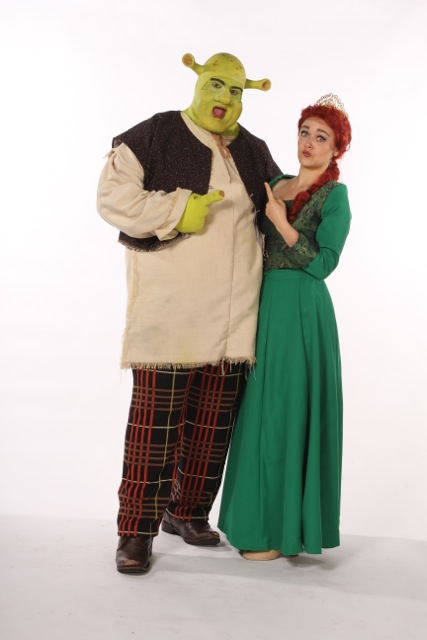
MSS’s SHREK will delight many.  Several members of the cast are outstanding for a production at this level.  Kudos to Sara Masterson, who makes for a beautiful Princess Fiona and makes such songs as Morning Person and Who I’d Be (sung with Patrick Ciamacco--Shrek, and Justin Woody--Donkey) show pleasers.

Justin Woody is generally joyful as Donkey, but needed a little more abandonment, especially in the first act.   By the second stanza, he was flying high.

Patrick Ciamacco is the vision of Shrek, though, at times, he needed to further texture his role and up-play some of the farcical scenes.   I Think I Got You Beat, his duet with Masterson, was delightful as was their burping and passing gas scene.  His strong voice soared in the reprise of Big Bright, Beautiful World.

Kelvette Beacham wailed as the Dragon in Forever, while Elise Pakiela was princess-cute as Young Fiona and Brian Marshall delights as the puppet garbed dwarfed Lord Farquaad.

Ed Carney’s orchestra was excellent, but there were vocal blend issues with some of the chorus segments.

Pierre-Jacques Brault’s choreography was enthusiastic and generally creative, but not always smoothly executed.  Some of the staging worked well, while straight lines, and people ducking behind others after speaking their lines created some distracting stage pictures.  Many individual characterizations were on target (e.g., Max Joseph as Peter Pan).  Others, especially the actors who attempted to “sound” like their fairy tale characters, squeaked and screeched to the detriment of clarity of characterization and being understood.

The puppet designs by PJ’s Puppets were delightful.  Falcon Stage Productions sets, especially the hand manipulated center stage turntable and the folding flats, distracted from the flow of the show.

CAPSULE JUDGEMENT:  SHREK is a creative script.  The Mercury Summer Stock production will delight many.  This is a community theatre production, and, a fairly acceptable one.
SHREK runs through June 29 at Mercury Summer Stock.  Call 216-771-5862 or go to www.mercurysummerstock.com for tickets.

Mercury’s next show is RAGTIME, from July 5-20, in the company’s home at Notre Dame College in South Euclid.

Saturday, August 04, 2012

All Shook Up!


Mercury Summer Stock closes its summer season with ALL SHOOK UP!

Jukebox musicals are a trend in modern American musical theater. The format force-feeds a story line around already created music. The sources are usually the works of groups (GOOD VIBRATIONS, the music of the Beach Boys, MAMMA MIA, the songs of ABBA) or singers (COME FLY WITH ME, the songs of Frank Sinatra and MOVIN’ OUT, the songs of Billy Joel).
ALL SHOOK UP, now on stage at Mercury SummerStock, takes the songs of Elvis Presley and tries to sandwich them into Shakespeare’s TWELFTH NIGHT. The story is credited to Joe DiPietro.

TWELFTH NIGHT, as do many of The Bard’s comedies, centers on mistaken identity. In the Shakespearean version, which takes place in the kingdom of Illyri, there are shipwrecks, storms, a dead or alive twin brother, sea captains, a girl dressed as a page to the Duke, and lots of plot twists. Almost none of that story is in ALL SHOOK UP! Yes, a girl dresses as a boy and there are lots of invented twists and turns, but that’s about it.

If, after hearing of the connection between TWELFTH NIGHT and ALL SHOOK UP!, you think are going to see something like the well-constructed WEST SIDE STORY, based on ROMEO OR JULIET or KISS ME KATE, based on the Bard’s TAMING OF THE SHREW, forget it.

ALL SHOOK UP! opened in March of 2005 in New York and closed after only 213 performances, after receiving very mixed reviews. Gotham’s leading paper stated, “Yet another synthetic jukebox musical opened last night on Broadway, fresh off the assembly line.” It went on to extol the shallowness of the plot.

The show has, however, proven to be a cult hit. In fact, it is one of the most produced musical reviews at regional theatres, colleges and high schools. It is the type of show, given the right production, that can please audience members familiar with Elvis, wanting an escapist evening of theatre, who aren’t interested in a well-constructed play, and are out to see their relatives and friends on stage.

The plot finds Chad, a motorcycling sex symbol, he of mobile pelvis, thrusting crotch, sneer, and sultry singing voice, dropping in on a small Midwestern town, supposedly because his bike broke down. The burg has a decency proclamation instituted by its uptight lady mayor. As can be expected, chaos reigns as hormones hop, love sweeps in, and the status quo is no longer status or quo.

In the course of singing the likes of Jailhouse Rock, Heartbreak Hotel, One Night With You, Blue Suede Shoes, Love Me Tender and Don’t Be Cruel, a young female garage mechanic, her widowed father, the mayor’s son, a waitress, and the town’s nerd, all fall into the throes of love. Don’t expect the songs to fit smoothly into or advance the story line. They most of them don’t.
Mercury SummerStock’s continued strength is director/choreographer Pierre-Jacques Brault’s dance designs. He continues his winning ways with this production. The highlight number is Can’t Help Falling in Love.

Conductor/pianist Eddie Carney’s orchestra performs well. Janet Conley’s scenic art works, especially on the Eisenhower era correct proscenium arch.

Performance highlights include Jesse Markowitz (Dean, the mayor’s son), who, as in his recent starring role in Cain Park’s AVENUE Q, lights up the stage with his effervescent smile, fine singing voice, let-loose dance style, and spot on character development. His scenes with the equally talented Lauryn Alexandria Hobbs (Lorraine) are charming. It’s Now or Never is one of the show’s highlights.

Brian Marshall is engaging as Dennis, the town’s love-sick nerd. He gets to show off his singing prowess in It Hurts Me.

Klevette Beacham, who has made high comedy her performance genre, does it again as Sylvia, she of hard outside and soft-hearted inside. Her There’s Always Me brought deserved “hurrahs.”
Dani Apple has one of the best trained and biggest voices on local stages. Though the Elvis songs don’t fit well into her power vocal sound, she does a nice job with the songs in her range. Forcing her to reign in her sound to fit into lower register songs takes away her usual ability to mesmerize audiences.

Dana Aber, one of the two Equity members in the cast, plays well the aloof Miss Sandra, the director of the art museum. Her Let Yourself Go, is well done and nicely staged.

CAPSULE JUDGEMENT: If you like Elvis’s songs, are in the mood for escapist theatre wrapped in a nearly non-existent plot, and want to see lots of high school and college kids have a good time performing, ALL SHOOK UP! could be your thing.

Sunday, July 08, 2012

Once Upon A Mattress


Farcical ONCE UPON A MATTRESS at Mercury Summer Stock


What do Carol Burnett, Jack Gilford, Dody Goodman, Imogene Coca, Buster Keaton, Sarah Jessica Parker, Jane Krakowski, Bernadette Peters, Wally Cox, and Elliot Gould all have in common? They all have been in professional productions of ONCE UPON A MATTRESS.

ONCE UPON A MATTRESS is a musical farce based on the Hans Christian Anderson short story, THE PRINCESS AND THE PEA. It opened off-Broadway in 1959, and despite mixed reviews moved onto Broadway later that year. Much to the surprise of many, it was nominated for Best Musical, but to the surprise of none, Burnett, in her Broadway debut, was nominated for Best Leading Actress.

It went on to become a television special in 1964, again in 1972 and 2005, all of which starred Burnett. There was a Broadway revival in 1996. It’s now on stage at Mercury SummerStock.

The fairy tale takes place in a fictional kingdom ruled by the overbearing, control freak, Queen Aggravain, and her mute husband, King Sextimus the Silent. The king can’t speak because of a curse placed on him. Prince Dauntless the Drab, their son, is in search of a wife. The Queen doesn’t want to lose her nebbish off-spring, so she devises all sorts of tests to insure that none of the possible princesses who are recruited for the role passes, and wins Dauntless’s hand in marriage.

When Princess Winnifred swims the palace moat to get into the competition, Aggravain meets her match. The free-spirited Winnifred wins the heart of the prince and his court, and with the help of the Minstrel, Jester and the King, passes the royal test. Of course, the King gets his voice back, Winnifred and Dauntless get togetherness, and everyone, except the evil Queen, lives happily ever. (Come on now, this is a fairy tale.)

ONCE UPON A MATTRESS is a musical farce. Of all types of theatre, farce is undoubtedly the hardest to perform. It takes perfect timing, the right control over exaggeration, and outlandish believability. Think Lucille Ball, Tim Conway and Harvey Korman.

The Mercury cast, under the direction of Pierre-Jacques Brault, gets a lot of the farce correct thanks to some good portrayals by dynamic, uninhibitted Kelvette Beacham as Princess Winnifred, Dan DiCello as Prince Dauntless, and Brault, who cross-dresses as Queen Aggravain. Eddie Carney, the musical director/pianist, gets laughs as the silent, but, “dirty-old-man” King Sextimus.

Brian Marshall sings, winks, and smiles his way through the role of the Minstrel, adding ad libs about John Travolta, the Kardashians, Bambi, acid reflux and the unzipped fly of his pants. He even throws in an audience pleasing negative aside about the reviewer whose article you are now reading. (The fact that the script can be tampered with shows the lack of depth of the storyline development. Believe me, this is not a great epic, but it is fun.)

Highlight numbers include Shy, Song Of Love and Man To Man Talk.

Brault adds visual elements including puppets, takes on the LION KING, and costuming that relates to many other fairy tales, including dressing the ladies and gentlemen of the court in identifiable character garb. Kaitlyn Dessoffy is adorable as Tinkerbelle, Aubrey Fink makes for a fine Belle (from BEAUTY AND THE BEAST) and Anne Bakan is a vision of Snow White. Tasha Brandt (Jester) sings well, as does Brittany Lynne Eckstrom (Lady Larkin).

On the other hand, some of the cast just isn’t up to the acting level needed to pull off farce, overdoing their affectations or totally missing the creation of a character.

Jonathan Anderson’s costume designs are excellent. The set, consisting of suspended gold picture frames works well. The piano accompaniment by Eddie Carney is well played, but gets lost in the large auditorium.

CAPSULE JUDGEMENT: If your purpose for going to the theatre, as the program suggests, is to” escape, laugh and let your imagination soar,” then you’ll enjoy ONCE UPON A MATTRESS. It’s filled with much cleverness, laughs and visual pleasure, but misses out on more due to some misguided performances.

Tuesday, June 19, 2012

Cats


CATS prowl as Mercury Summer Stock finds new home

Like many local theatres, Mercury Summer Stock, has experienced a vagabond existence. Founded by Pierre-Jacques Brault and Brian Marshall, the summer theatre seems to finally have found a permanent home in the Regina Auditorium at Notre Dame College in South Euclid. The large venue, with a huge stage, lends itself to the free wheeling choreography and staging by Artistic Director Brault.

Along with a change of venue, the organization has altered its mission. Previously billed as a professional theatre, though they seldom had more than one equity performer appear in any production, that aspect of its theatrical explanation has been dropped, opening the door for evaluating the shows based on expectations for their usual high school and young college student performers.

A new home, new performance schedule (the addition of Sunday matinees), and a new goal statement which includes ”advancing theatre as a means of educating, challenging and inspiring through family-friendly programming rarely seen” are all part of the changed vision for the company.

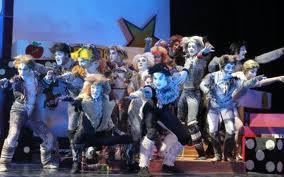
Mercury’s 2012 opening production is Andrew Lloyd Webber’s CATS. Based on OLD POSSUM’S BOOK OF PRACTICAL CATS by T. S. Eliot, the show is a series of poems set to music. There is a loose story line about a tribe of cats called the Jellicles and the night they make the choice of who will ascend to the Heaviside Layer and come back to new life.

The only memorable song in the score is Memory, whose lyrics were written by Trevor Nun, based on the Eliot poem, Rhapsody on a Windy Night. It was made famous by Betty Buckley, who played Grizabella in the original Broadway production.

The show originally opened in London in 1981 and ran for 21 years. The Broadway production, which opened in 1982, ran for eighteen years, and was performed 7485 times, making it the second longest continually running show in history. (THE PHANTOM OF THE OPERA, which is still going in New York, is the extended-run leader.)

CATS is a difficult show to produce, even for professionals, let alone for a group of high school and college students who are just learning their craft. Almost every song requires a production number, so the key element of the staging is dance. In addition, the score has shades of opera and is difficult to sing. Another major issue is that since there is little drama or no humor, holding the audience’s attention is difficult.

As evidenced by the three tween girls who were sitting in front of me, wiggling, slumping in their seats, and generally showing boredom, this is not a show for children and may be a challenge for adults.

The Mercury production, directed and choreographed by Brault, has some high moments, but these are eclipsed by some issues.

On the positive side, Brault’s choreography is creative. He has cast some good dancers. Especially strong is Jake Washabaugh who appears well trained in ballet and controls the stage when his long thin body whips high turns, does flexible leg kicks, and executes powerful lifts. Also strong are Zach Pfeil, Katlyn Dessoffy, and Taylor Bryan.

Traditionally, the action takes place in a junk yard. For some inexplicable reason Brault decided to switch that to a child’s room, complete with board games, a toy car, balls and building blocks. Nothing in the show references such a setting. Maybe he thought making the whole thing into TOY STORY would help. It only confuses. Why would 20 cats be prowling a child’s room?

Brault’s costume designs are clever. He suggests cats, rather than creating authentic cats. The same is true of the cast. They did not consistently become cats, they represented them, with a minimal number of cleaning, preening and stretching gestures.

Eddie Carney’s orchestra puts out full sound, but, unfortunately, the large playing space gobbled up the five pieces, making the sound slight. This was not helped by the squealing sound system, and weak projection by some of the cast. Blinking lights at weird times also didn’t help.

Staging highlights included The Old Gumbie Cat, The Jellicle Ball, and Mr. Mistoffelees.

CAPSULE JUDGEMENT: CATS was not all that could have been hoped for as an opening show in Mercury’s new venue, but, considering the difficulty of the show, and the developing abilities of the cast, Brault and company can be commended for a “nice try.”

Sunday, August 14, 2011

Show Boat


SHOWBOAT, the first musical play, sails courtesy of Mercury Summerstock

Pierre-Jacques Brault, Artistic Director of Mercury Summerstock, is not known for thinking small. He confronts projects that other theatre producers wouldn’t even think of undertaking. No matter that he is working on a shoestring budget, is using a tiny stage, and his company consists of one professional actor and a small group of dedicated performers. Brault “just keeps rolling along,” ignoring the odds.

SHOWBOAT is a musical with music by Jerome Kern and book and lyrics by Oscar Hammerstein II. It was based on Edna Ferber’s novel of the same name.

SHOWBOAT is one of the most important musicals ever written. It was responsible for the transition of the American musical theatre from simple minded operettas, follies, musical revues and shows that featured vaudeville acts. It was not, as OKLAHOMA would be some years later, a true, well-integrated musical in which all the elements—story, songs and dancing—blended together in a way that one was totally dependent on the other, but it laid down the path to be followed. It ushered in a new genre for the theatre, the musical play.

The plot chronicles the lives of those living and working on the Cotton Blossom, a Mississippi River show boat, from 1880 to 1927. Like so many of the Hammerstein stories to follow, the show's dominant theme is social justice. In this case, racial prejudice. And it ushered in another Hammerstein theme, that of tragic and enduring love. (Think CAROUSEL.)

Kern’s libretto is exceptional, especially considering the era from which it comes. Classic songs include Make Believe, Can’t Help Lovin’ Dat Man of Mine, Life Upon the Wicked Stage, You Are Love, Why Do I Love You? and After the Ball.

The Mercury cast, especially the African American performers and chorus, are outstanding. Brain Keith Johnson’s version and reprises of Old Man River brought extended cheers. Kelvette Beacham (Queenie) was a total delight presenting Queenie’s Bally-Hoo and Mis’ry’s Comin’ Aroun’.

Brian Marshall has the handsome looks needed for Gaylord Ravenal the river gambler who wins the heart of Magnolia, the daughter of the riverboat’s owners. He used his excellent singing voice well, but for some reason kept switching accents (e.g., Southern, Irish, general American) and started out playing the role as a caricature and then switched to realism.

Jennifer Myor (Magnolia) has a lovely voice and nice stage presence. Maria Thomas Lister, as the mixed race Julie, sang her role well, but never got below the surface in developing a characterization.

Hester Lewellen was a fine, stiff-backed Parthy, Magnolia’s mother. Mark Seven feigned facial and line stereotypes as Captain Andy. Kaitlyn Dessoffy made for a lovely Kim, Magnolia’s daughter. She has a nice stage presence and fine vocal abilities.

Ryan Neal’s musical direction brought a good sound from his limited sized orchestra, but needed to inspire volume control when underscoring speaking scenes.

Brault’s staging was impressive, especially considering that the show is usually done with numerous massive sets, a huge cast, lots of period costumes and a full orchestra.

CAPSULE JUDGEMENT: SHOWBOAT is a big, important script that is seldom performed because of the cost and staging necessities. It gets a very acceptable production at Mercury. It’s worth going just to hear Brain Keith Johnson curl your toenails as he sings Old Man River.

Thursday, July 28, 2011

Grand Hotel


THE GRAND HOTEL at Mercury Summerstock

GRAND HOTEL, whose 1989 production had a healthy run on Broadway, is the kind of show that seems dated and tired, even with an enthusiastic production.

Based on the 1929 Vicki Baum novel and play, Menschen im Hotel (people in a hotel), and the 1932 MGM feature film, the musical focuses on events taking place over the course of a weekend in an elegant 1928 Berlin hotel.

The story line centers on an overlapping view of various hotel guests. Included are an ill Jewish bookkeeper who is originally the victim of anti-Semitism, but finally is given a room; a temperamental past-her-prime ballerina who becomes involved in a cougar-cub relationship with a destitute Baron who is in deep debt and is being threatened with death; a lying businessman; and a typist who dreams of a career in Hollywood.

The book/music and lyrics are by Luther David, Robert Wright and George Forrest, with additional music and lyrics by Maury Yeston. Never heard of them? Well, you probably haven’t heard of most of the music from the show either. Titles include: Fire and Ice, Villa on a Hill, I Want to Go to Hollywood, Love Can’t Happen, and You Bring New Light. Not exactly stuff that populates your I-pod.

The Mercury cast puts out full effort. Pierre-Jacques Brault’s direction is creative and much of the singing is on key. Brault’s choreography well fits the music and is nicely done, especially considering the tiny stage space he has to work with. Keeping the entire cast on stage so they flow in and out of scenes was a nice touch. The problem is a script and the score. They just don’t go any place, don’t light up the stage, lack being memorable.

Brian Marshall is a combination Groucho Marx and Charlie Chaplin as Otto Kringelein, the ill put-upon Jewish bookkeeper. (Michael Jeter won several awards for the role the original Broadway production.) Marshall has some fine moments, especially in At the Grand Hotel.

Nate Huntley does an acceptable job of acting the role of Baron Von Gaigern, but has difficulty with the higher register singing.

Amiee Collier (Raffaela), Holly Feiler (Elizaveta Grushinskaya) , Emily Grodzik (Flemmchen) all create consistent characterizations. Collier’s What She Needs and Grodzik’s I Want to Go to Hollywood were show highlights. Jonathan Ramos does a nice vocal singing You Bring New Light.

The show runs without intermission.

CAPSULE JUDGEMENT: Mercury’s production is an acceptable evening of theatre, but GRAND HOTEL is one of those musicals that makes you wonder

Saturday, June 18, 2011

Dr. Doolittle

DR. DOOLITTLE, long on special effects at Mercury Summerstock

What happens to a man, a doctor, in fact, who can’t relate to people? What happens to a person who doesn’t know how to communicate with people—only animals? Of course, he becomes best friends with Polynesia (a parrot), Gub-Gub (a pig), Jip (a dog), Dab-Dab (a duck), Chee-Chee (a monkey), Too-Too (an owl), and the Pushmi-pullyu. Make sense? Well, it’s really not supposed to make sense in the traditional sense, but it does make for a smile-inducing story.

DOCTOR DOOLITTLE, now in production at Mercury SummerStock, tells the tale of a doctor, who lives in the small town of Puddleby, England. He finds himself on trial for murder for supposedly throwing a woman over a cliff. As it turns out, the woman is really a seal, who told Doolittle that she wants to be set free from the circus where she is performing, and meet up with her seal husband in the North Pole. Dolittle obliges by dressing her up as a woman, sneaks her out of the circus, and thrusts her into the sea. Insisting that he can actually talk to the animals, the doctor defends himself in court by telling the tale with the help of his talking parrot (the finest animal linguist in the world), a devoted friend, Matthew Mugg, a young boy, Tommy, a menagerie of animals, and the judge’s niece. (Of course there has to be a love interest thrown into the mix.) Eventually the entire assemblage goes off in search of the Pink Snail, with delightful results.

Doctor John Doolittle is the central character in a series of beloved children's books by Hugh Lofting, whose first efforts were illustrated letters to children during World War I. Eventually they were published as a series of books, all set in Victorian England.

The stories found stage life in a British stage production with music and lyrics by Leslie Bricusse (Jekyll & Hyde; Stop the World — I Want to Get Off; The Roar of the Greasepaint — The Smell of the Crowd and Victor/Victoria). It was also transformed into a film staring Rex Harrison and Anthony Newley. A production of the stage version toured Cleveland several years ago with the good doctor being played by Tommy Tune.

Mercury Summerstock, now in its 13th season, presents three shows a summer. There is a naïve Judy Garland-Mickey Rooney, “let’s put on a play” attitude about their productions.

The company is the brainchild of Pierre-Jacques Brault and Brian Marshall who met while students at Baldwin-Wallace College. They thought there was a need for a summer theatre that gave an outlet to the talents of both local professionals and amateurs, with an emphasis on the latter. The theatre is like the wandering minstrels, finding performance spaces where they may. Presently, they are in the Brooks Theatre of the Cleveland Playhouse. What’s next? Who knows, but this tenacious group, will find a way, find a place, and present plays to their loyal audiences.

Mercury’s production is delightful on many fronts, wanting on others. Director/choreographer Brault, doesn’t let simple things like a postage-stamp sized stage, a limited budget and moderately experienced performers get in his way. He just goes on presenting mini-extravaganzas. (This season ends with SHOW BOAT.) The present production is no exception. There are grand costumes, more gorgeous puppets than a major theatre would put on stage, big dance numbers and lots of scenery being dropped form the fly space and shoved around the stage.

On many levels DR. DOOLLITLE is a delight. Brault, not only directs and choreographs, but he plays the lead role. And performs it well. He’s been off the stage for many years and, based on this performance, he deserves to be back where he belongs. He sings, dances and smiles with glee.

His life-partner and stage buddy, Brian Marshall, after a slow start, glows in the second act as Matthew Mugg, an Irish imp. Kelvette Beacham delights as Straight Arrow. Her “Save the Animals” is a fine appeal for animal protectionism. Jennifer Myor has a nice singing voice and makes for a convincing Emma, who finally makes Dolittle realize that people may be as acceptable as animals. Lynette Turner is fun as Polynesia, the smart-mouthed parrot.

All is not perfect with the production. There is some weak acting and character development, some of the dancers aren’t up to Brault’s movements, and the vocal blends don’t always work. The single piano sounds of Ryan Neal, though well played, sound thin as the single musical accompaniment. The first act pacing is slow and performers often cut off applause and laughs by making physical and verbal entrances too early.

Though the show may appear to be ideal for children, some little ones will probably get restless, while adults will be more prone to appreciate the staging devices.

CAPSULE JUDGEMENT: DR. DOOLITTLE gets a pleasing, but not spectacular production, at Mercury Summerstock. The puppets, hummable music and Pierre-Jacques Brault’s staging and performance all are positive aspects of the production.

Monday, August 09, 2010

The Scarlet Pimpernel

‘SCARLET PIMPERNELL, a pleasant surprise at Mercury Summerstock

What happens when a small budget summer stock theatre, with one professional actor in its company, which performs on a postage stamp-sized stage, decides to produce a grand musical requiring numerous period correct costumes, a large male chorus that can sing, dance and act proficiently, a score that requires a grand orchestra sound, leads with very strong near opera quality singing voices, quality farce characterizations, French and English accents, and lots of scene changes? In the case of Mercury Summerstock, you get a very creditable production.

‘THE SCARLET PIMPERNEL,’ with music by Frank Wildhorn (‘JEKYLL & HYDE’ and ‘THE CIVIL WAR’) and lyrics and book by Nan Knighton (‘SATURDAY NIGHT FEVER’), is based on the novel of the same name by Baroness Orczy. The show is set in England and France during the Reign of Terror of the French Revolution. It concerns an audacious hero and his followers who use "tricks and games" against the cruel “citizen leaders.” They leave in their wake their calling card, the red, star-shaped wildflower known as the scarlet pimpernel.

The musical has a strange history. It originally opened in 1997. The production developed a cult following and, in June, shortly before the Tony Awards were announced, the show was slated to close. The show's fans known as "The League" decided it should have another try. So, new producers, rewriting, a new theatre, and two new leads (Rex Smith and Rachel York), stretched out the run until May 30, 1999.

The Mercury production, directed by Pierre-Jacque Brault, generally pleases. It moves along at a good pace. The singing, especially the male chorus, is excellent. The characterizations are appropriately broad, developing the right swash-buckling and farce feeling. The massive number of costumes are period correct, thanks to the designer Margaret Ruble. The orchestra plays well, backing up rather than enveloping the singers. The choreography is excellent and generally well done, especially considering the minute size of the stage and the required number of performers.

Creative use of chairs to set up stage divisions and new settings is employed. Accents waver, but all in all it’s a good show, especially taking into account that this is mainly an amateur cast who put the show together in ten rehearsals.

Jennifer Myor as Marguerite, the female lead, has a fine singing voice and develops her character well. Brian Marshall, the only Equity member in the cast, had some vocal problems at the start, but warmed up well as the show continued. His characterization was enjoyably funny. Shane Patrick O’Neill, who possesses an excellent singing voice, was properly villainous in the role of Chauvelin. Ryan Bergeron, as Elton, one of the merry band of Pimpernel henchmen, who play affected dandies to cover their real identities, is delightful, as are most of the rest of the male chorus.

Show highlights included: “Into the Fire,” “When I Look at You,” “Where’s The Girl?,” “The Creation of Man,” “The Scarlet Pimpernel,” and “She Was There.”

CAPSULE JUDGEMENT: Mercury Summerstock’s ‘THE SCARLET PIMPERNEL, while not perfect, is an excellent production of a very difficult show that should please most theatre-goers. You won’t confuse this with the touring production of ‘PHANTOM OF THE OPERA’ now at the Allen Theatre, but at one-fifth the cost per ticket, “The Pimp” is well worth attending.

Sunday, July 18, 2010

Li'l Abner


‘LI’L ABNER’ cute but lacking at Mercury Summerstock

This month the U. S. Postal Service issued it’s “funnies” series. The stamps honor the likes of Archie, Dennis the Menace, and Calvin and Hobbes. Unfortunately, missing from the list are two comic strips that led to Broadway musicals: Little Orphan Annie and Li’l Abner. A version of the latter is now on stage at Mercury Summer Theatre.

‘LI'L ABNER,’ with book by Norman Panama and Melvin Frank, music by Gene De Paul, and lyrics by Johnny Mercer is a satirical look at the inhabitants of Dogpatch, USA (Kentucky). The comic strip, written and drawn by Al Capp, ran from August 13, 1934 through November 13, 1977. The Broadway production, directed and choreographed by Michael Kidd opened on November 15, 1956 and ran for 693 performances.

The somewhat dated musical is a spoof of hillbillies but also points zingers at the incompetent federal government, corrupt politicians, and perceptions of masculinity.

Just before the traditional Sadie Hawkins Day race when Daisy Mae is again “yurnin’ to ketch” the handsome, muscle bound, emotionally void Li’l Abner, Dogpatch is declared the "most unnecessary town" in the U.S. and is set to be turned into a nuclear testing site. The only thing that will save it is to locate something that makes the area a national treasure. Of course, in the end, as is true of all musical spoofs, things “turns out fer the best.”

Besides Li’l Abner, whose family name, “Yokum,” cartoonist Al Capp conjured up by combining “yokel” with “hokum,” and Daisy Mae, she who gave the signature name to short-shorts, all the well known comic strip’s characters are present including Mammy and Pappy Yokum, Marryin’ Sam, Earthquake McGoon, Evil Eye Fleagle, General Bullmoose, Stupefyin’ Jones and Senator Phogbound.

The original Broadway cast starred Peter Palmer in the title role, Edie Adams as Daisy Mae, and the marvelous Stubby Kaye as Marryin' Sam. A film based on the stage musical was released in 1959, with most of the Broadway cast reprising their roles.

The clever words and the catchy music include “A Typical Day,” “If I Had My Druthers,” “The Country’s in the Very Best of Hands,” and the cute ballad, “Namely You.”

The Mercury production, under the direction of Pierre-Jacques Brault, has many creative moments and some right-on performances. However, to make this show work, the staging and attitude must be one of comic strip level farce and attitude. No tongue and cheek here. Out-and-out comic mayhem must let loose, as was the case with the Broadway production. Unfortunately, though the performers try, the Mercury cast just doesn’t make the show explode.

When I saw the show in the Big Apple, my feet were constantly tapping and I had a feeling of total glee. In the Mercury production I smiled and appreciated the many creative moments conceived by Brault, but I wanted more. I wanted more of what Brian Marshall created with his over-the-top Pappy Yokum. Though they gave good performances, I still wanted even more exaggeration from Kelvette Beachman as Mammy Yokum and Dan DiCello as Marryin’ Sam. We needed a more stupefying Stupefyin’ Jones and more macho braggart Earthquake McGoon. Why did Evil Eye Fleagle, whose quirky actions were well developed by Ryan Thompson, have a Russian accent? Capp said of the character, “The zoot suit-clad Fleagle was a native of Brooklyn, and his burlesque New York accent was unmistakable.”

Jason Leupold has the face, hair, height and the singing voice for Abner, but he lacked the physique and vulnerable manhood. Leupold gave us sweet boyhood. Annie Hickey had the Daisy Mae look, except for the ill coifed wig. Her voice was a little shallow but she developed a charming rendition of “I’m Past My Prime,” with Marryin’ Sam. The male chorus sang and danced well, but didn’t fit the part of super studs when they were supposedly transformed into Abner-duplicates by Mammy’s potion.

Fun numbers were “Jubilation T. Cornpone” and “Progress Is the Root of All Evil.” On the other hand, “The Sadie Hawkins Day Ballet” went on and on and on, wearing out the cast and the audience.

As usual, Musical Director Eddie Carney did a great job of keeping his well-tuned orchestra under control so they backed up, rather than drowned out the singers.

CAPSULE JUDGEMENT: Mercury’s ‘LI’L ABNER’ is a pleasant evening of diversion, but could have been so much more fun if it had been played even broader and the cast had really let loose.

Saturday, June 19, 2010

Joseph And The Amazing Technicolor Dreamcoat


Creative ‘JOSEPH’ at Mercury Summerstock

“Way way back, many centuries ago, not long after the Bible began,” Joseph, Jacob’s favorite son, is sold into slavery by his jealous brothers, becomes he pride-and-joy of the Pharaoh, and is reunited with his siblings when they come to Egypt for food during a famine. This is how the tale of ‘JOSEPH AND THE AMAZING TECHNICOLOR DREAMCOAT’ develops. The script is filled with all sorts of musical treats ranging from western to calypso, to laments, to ballads, and includes such great songs as “Any Dream Will Do,” “Poor, Poor Joseph,” “Close Every Door,” and “You Are What You Feel.”

A version of the Joseph legend is now on stage at the Brooks Theatre of the Cleveland Play House, under the sponsorship of Mercury SummerStock, Cleveland’s summertime theatre, that much like the Jews of old, keeps wandering in the desert (urban desert, that is) in search of a home. Their latest camping site, Parma Little Theatre, was lost due to budgetary cuts in the city’s schools. So, for a short time, Mercury is making a sojourn into the oasis called, Cleveland Play House, before it goes off looking for its promised land.

The script for ‘JOSEPH’ has an unusual history. It was originally conceived by Tim Rice and Andrew Lloyd Webber to be a short school skit. It eventually grew into a series of songs that were sung as a concert. It was never intended to be a staged musical. In fact, there is no actual script, just a series of songs. There are no spoken lines and the authors have given no directions for the staging. Because of this, every production of the play has a personality all its own.

Mercury’s Artistic Director, Pierre-Jacques Brault’s vision is a black-and-white early Hollywood movie. As Brault explains it, “Set on an MGM soundstage in the Golden Age of cinema, Cecil B. Demille’s latest epic ‘Joseph,’ is fixed to star the iconic characters that made headlines through the 1920’s and 1930’s. Rudolph Valentino, W. C. Fields, Mae West, The Little Rascals, Charlie Chaplin and the Marx Brothers are all on hand to playfully spin the Old Testament tale.”

And, in general, that’s what we see on the Brooks’ stage. The costumes are almost all black and white, the old time stars are generally recognizable, and most of the machinations fit into the songs. But the rub is that Brault doesn’t always pay attention to the words which the musically gifted cast is singing.

We are told Joseph’s coat is composed of over 30 different colors. Well, Joseph’s cutaway is basically black with a few other colors, but definitely not “azure, and lemon and russet and gray.” Nor, does it ever get “ripped up.” In “Those Canaan Days” we see a delightful Charley Chaplin depiction of his balloon “shtick” (nicely done by Brian Marshall). Cute, yes, but the song is about the brothers being so hungry that “no one comes to dinner now, we’d only eat them anyhow.” Hmm? Okay, so Joseph and his brothers finally reunite, supposedly after Joseph “hands them sacks of food” (oops, those are orange crates which easily reveal that he has “planted a cup in Young Benjamin’s sack.” And, then there’s the big climax when “Joseph went to meet him [Abraham] in his chariot of gold.’ (Nope, Abraham walks over to Joseph.) Am I being picky? Probably, but words to songs are written for a purpose and must be adhered to, especially in a show that is totally depended on the meanings of the words of the songs.

So, do these deviancies from the author’s intentions ruin the production? Not really. The show is generally audience pleasing, which was evidenced by the screaming ovation at the end of the show the night I saw it. But, were they listening to the words?

The cast is filled with excellent voices and some good actors. Brault’s dividing up the role of the narrator gives each of the cast members solos. Nice idea to show off their individual talents.

Going against type, Jonathan Ramos portrays Joseph. The part is usually portrayed by a singer with a big voice and stud body. The slightly built Ramos has a pleasant sound, with a limited range. He adds a cute vulnerability to the role, which may not be what we want in a Biblical hero, but it works in its own way.

The cast has some difficulty carrying out Brault’s creative choreography because there are just too many people for the postage stamp-sized stage. Less bodies in the dance, or using the aisles might have helped the dancers from bumping into each other and allowing Brault’s choreography to be clearly displayed.

Musical Director Eddie Carney goes a great job of keeping his well-tuned orchestra under control so they back up, rather than drown out the singers.

Margaret Ruble’s black and white costumes are creative and lend credence to the old movie theme.

CAPSULE JUDGEMENT: Mercury’s ‘JOSEPH’ is audience pleasing, in spite of some lapses in words versus image issues. Most people attending will enjoy it, and it’s a good production for the whole family to see. So, “Go, Go Joseph.”

Monday, February 15, 2010

Peter Pan--A Musical Adventure


You’ve never seen Peter Pan like this before!


Peter Pan, the boy who refuses to grow up, has been seen in various versions: book, film, television and on stage. But he’s never been seen locally in the form being performed by Mercury Summer Stock for their “Just Beyond the Stars” gala.

Peter first appeared in a section of The Little White Bird, a 1902 novel written, ironically, for adults. A play about the boy and his fellow “lost” boys, debuted in 1904. A stage musical came forth in 1950, with music and lyrics by Leonard Bernstein. That version starred Jean Arthur as Peter Pan and Boris Karloff in the dual roles of George Darling and Captain Hook. It was initially intended as a full-blown musical, with Bernstein composing a complete score, but was staged with only five songs – "Who Am I?", "Pirate's Song", "Plank Round", "Build My House", and "Peter Peter," to accommodate the limited vocal ranges of the principal actors.

The boy really took off when, in 1953, Walt Disney’s animated version of ‘PETER PAN’ was released.

In 1954, the popular, and often produced stage version, most recently performed locally at the Beck Center, was conceived. With music by Mark "Moose" Charlap, additional music by Jule Styne, and lyrics written by Carolyn Leigh, Betty Comden and Adolph Green, it starred Mary Martin as Peter and Cyril Ritchard as Captain Hook, and earned Tony Awards for both stars. A major new stage production was performed in Summer 2009 in Kensington Gardens.

Entitled ‘PETER PAN--A MUSICAL ADVENTURE,’ it is this new British version, complete with a totally different score and book, that will be presented by Mercury Summer Stock on February 20 at 7:30 at the Breen Center, on the campus of St. Ignatius High School. It has music by George Stiles and Anthony Drewe, composers of the Broadway hit ‘MARY POPPINS,’ which was a smash hit in its recent Cleveland showing as part of the Broadway Series, and book by Willis Hall.

The Mercury production, only the second time the musical will be performed in the United States, will be a staged reading. The cast includes Matthew Wright as Captain Hook, Maria Thomas Lister as The Storyteller, Natalie Green as Tiger Lily, Jeff Grover as Mr. Darling, Jen Myor as Mrs. Darling, Kelly Monaghan as Wendy and Brian Marshall as Peter Pan. The show will be staged by Pierre-Jacques Brault. Musical director is Bill Corcoran.

“My First Musical” program, is the educational arm of Mercury’s programming. Through it, children under the age of twelve from the Parma City School District and other educational institutions of the Greater Cleveland community, are given access to experiencing live musical theatre by attending, free of charge, each show of the Mercury season. They have interactive pre- and post-performance workshops to foster an interest in, and appreciation of the theatre.

Sunday, August 09, 2009

Me and My Girl


‘ME AND MY GAL,’ Mercury Summer Stock’s attempt at farce


On the surface, ‘ME AND MY GIRL,’ which is now on stage at Mercury Summer Stock, appears to be a light, escapist show that should be easy to stage, since its goal is out and out fun. Nothing could be further from the truth. The script is farce, and to make it more difficult, British farce. That style of theatre is very, very difficult to pull off well. It takes good underplaying, exquisite timing, and the perfect balance between realism and fantasy.

This musical tale concerns a cockney lad who inherits an earldom when his aristocratic father, who has had an affair with the lad’s working class mother, dies. Billy is tracked down, and the family finds out, much to their snobbish horror, that the only male heir, is everything they abhor….gross, out spoken and from Lambeth, a low class area of London. Chaos ensues, until, of course, all can live happily ever after, with the various romantic confusions settled nicely.

The musical, with book and lyrics by L. Arthur Rose and Douglas Furber, and music by Noel Gay, had its original London production in 1937, and ran four years. A revised London version had an even longer run in 1985 and the Broadway version, which opened in 1986, ran 1,420 performances.

Interestingly, the production’s show stopper, “The Lambeth Walk”, became a political cause, when in 1938, The London Times stated, “While dictators rage and statesmen talk, all Europe dances — to The Lambeth Walk.”

The Mercury production tries hard to create the right feel for the show. Maybe it tries too hard. Director Pierre-Jacques Brault pulls out all the stops, and shtick follows shtick which follows shtick. Normally, in British farce, the director lets the material develop its own image. Here Brault doesn’t seem to trust the script’s natural fun and inserts puppets, bubbles, over exaggeration of characters, use of every stereotype he could think of, and putting his lead actor in physical danger to do prat fall after prat fall.

Does he succeed? Depends on your viewpoint. The audience, the night I saw the show, laughed and laughed (but didn’t give it the traditional Mercury standing ovation). The elderly man sitting behind me audibly repeated every gimmick to his wife between giggles. On the other hand, what would have happened if Brault had let the book and lyrics speak for themselves? As Billy, the lead character might say, “Dun’t knuw. Din’t see et.”

His choreography is often quite clever, though some of the dancers struggle to do the steps without verbally counting.

Mercury Summer Theatre, though it bills itself as a “professionally based,” theatre is, for all practical purposes, an amateur community theatre populated by high school and college kids, with one professional thrown in, along with some adults of various theatrical backgrounds. This makes the acting pool rather inexperienced. Considering that, Brault gets some good performances.

Jennifer Myor sparkles as Sally, Bill’s “girl.” She has a nice singing voice, good stage presence, and a nice touch with humor. Cleveland favorite, Hester Lewellen, has the right airs as Maria, Bill’s stuffy aunt. Cindi Verbelun has a cute bit as Joan of Arc.

Brian Marshall, the only equity member of the cast, is very talented, but, in this role seems to have no restraint. He sings and dances well, but he literally throws himself all over the stage in attempts at humor. He did not need to be all Three Stooges rolled into one.

Some of the others feign and exaggerate; acting, rather than reacting to their lines and motivations.

The sets and, costumes, considering the minimal budget the theatre has, are quite impressive. Especially creative are the Pearly costumes, with their numerous button patterns.

Eddie Carney does a nice job of musical direction and his orchestra is very good.

CAPSULE JUDGEMENT: If you love slapstick and a production full of uncontrolled shticks, you’ll appreciate Mercury’s ‘ME AND MY GIRL.’

Thursday, June 18, 2009

Cinderella


Creative ‘CINDERELLA’ at Mercury Summer Stock

Mercury Summer Stock, which is now staging Rogers and Hammerstein’s ‘CINDERELLA,’ lists itself as “a professionally based, not-for-profit, and community-supported theatre. Located in Parma, it basically serves the west side communities by offering low-cost plays, which are usually family friendly.

Recently, MSS added a “My First Musical Program” to its program. It is intended to make the theatrical experience open to children who, because of financial and other issues, would not normally be exposed to live stagings. As evidenced by the young lady, who, at a special Wednesday early evening performance, spent most of the second act of ‘CINDERELLA’ hanging onto the edge of the stage and who immediately followed Cinderella and Prince Charming down the aisle at the close of the show as they exited to the lobby to spend time interacting with the audience, the concept worked!

‘CINDERELLA’ is the only Rodgers and Hammerstein musical written for television. It was originally broadcast on March 31, 1957 as a vehicle for Julie Andrews, who played the title role. It is based upon the fairy tale of the same name, which concerns a young woman forced into a life of servitude by her cruel stepmother. With the help of her Fairy Godmother, Cinderella is transformed into a Princess and finds her Prince. The stage musical contains all the elements that make for a dream-like fantasy, including a prince, a pumpkin which becomes a carriage, a glass slipper, and a fairy god mother. And, of course, there is the must have “happily ever after” ending.

The melodic score includes: “The Sweetest Sounds,” “In My Own Little Corner,” “Impossible; It’s Possible,” “Do I Love You Because You’re Beautiful,” and “A Lovely Night.”

The Mercury Summer Stock production, under the direction of Pierre-Jacques Brault, with musical direction by Eddie Carney (who accompanies the singers on the piano), is quite creative. Brault has a nice flair for the bizarre and uses the piano, which is set center stage, as the stage coach, uses puppets for the mice who become the coach’s horses, adds ingenious costumes, and incorporates extensive physical and verbal farce.

I saw the show during a special staging aimed at children. This affected the performance. For example, Rob Gibb, who plays the cross-dressing wicked step mother, and Brian Marshall, who portrayed the Herald (court jester) were quite tame during the performance. This, according to Brault, was intentional as he was afraid the children wouldn’t get the extended farce. In reality, I thought the duo should have over done what they normally did in performance, as the kids giggled with delight when something was over-exaggerated, such as the actions of the wicked step sisters.

As is my pattern, since this show was child friendly, I took the “Kid Reviewers,” my grandsons Alex (13) and Noah (12), to see the production. They liked the farce, thought that the singing voices were generally okay, but that almost all of the performers needed to project more. (We were in the third row and often couldn’t hear the words.) “Maybe,” said Alex, an accomplished pianist and member of the Cleveland Orchestra’s Children’s Chorus, “the pianist should have played more softly, but it’s really the responsibility of the cast to sing loud enough.” Both boys thought that in the movie version, the special effects helped make the production more visually appealing, but realized that the special effects couldn’t be done on stage. They both would have liked the stepmother and the Herald to “play around more.” Noah, in particular, thought the choreography was excellent. They liked the step sisters “a lot.” Alex gave the show a 7 on a scale of 10, Noah a 6, with the recommendation that the story was mainly aimed at those 8 and under, and was of interest “mainly to girls.” From my perspective the boys were right on.

Nicholas Varricchio has the right physical attributes to be Prince Charming. He has a nice singing voice, but was often difficult to hear. Emily Grodzik was generally charming as Cinderella, but had vocal projection problems. Kelvette Beacham and Jennifer Myor were delightful as the bickering stepsisters. Their plastic wigs in the ballroom scene, were a hoot and their ‘Stepsister’s Lament” duo was fun.

CAPSULE JUDGEMENT: Mercury’s ‘CINDERELLA’ is a very pleasant evening of summer theatre, well tailored to children. Be sure to read both the adult and children’s versions of the program. The latter is delightful. Who knew that Brault was an ‘ALICE IN WONDERLAND’ expert, Prince Charming wants to be a Dalmatian when he grows up, and the Herald wants to grow up to be a French fry.

Saturday, June 21, 2008

Honk

Mercury’s ‘HONK,’ pleasant, but could have so much more

‘HONK,’ which is now being staged by Mercury Summer Stock, is one of those charming little shows which should enchant and regale audiences. It is a retelling of Hans Christian Anderson’s ‘THE UGLY DUCKLING,’ complete with a theme of tolerance.

It has a gentle and pleasant score by George Stiles and Anthony Drewe which does not come close to the wonderful music that Frank Loesser wrote for the film, ‘HANS CHRISTIAN ANDERSON, which starred Danny Kaye, and included a segment on the ugly duckling. It is, however, a quite serviceable score.

The stage version opened in 1993 in England and was originally called ‘THE AESTHETICALLY CHALLENGED FARMYARD FOWL.’ In 1997, when the script was revised, the title changed to ‘HONK!”. It went on to win the 2000 Olivier Award, the British equivalent of the U.S. Tony Award, beating ‘THE LION KING’ for the honor.

The story is set in the countryside and features an “ugly duckling,” who somehow is hatched by a hen, who discovers his inner beauty as he becomes a swan. In the process of his journey from odd to beautiful, he is taunted, runs away from home with a cat who wants him for his dinner, meets a wisecracking bullfrog and a lovely female swan. In the process he, and members of the ensemble, sing such songs as "A Poultry Tale," "Warts and All," "Look at Him," "You Can Play With Your Food," "Now I've Seen You," and the charming "Different."

This is a deceptive script. On the surface it appears to be an easy show to stage. It isn’t. There is a strong message, there are creative vaudeville-like actions which require that it become a comic strip in action. It is very British in its base which mandates an understanding of broad British humor.

The Mercury production, under the direction of Pierre-Jacques Brault with production staging by Joanna May Hunkins, is pleasant, but could have been so much more. Mercury prides itself on being able to stage a show in two weeks. In this case, with Brault also working on ‘THE WIZ’ at Cain Park, the short preparation time causes the staging to suffer. Brault’s usual creativity isn’t completely present. That’s not to say the show is bad. It isn’t. It just isn’t all that it could have been with a little more time, insight and focus.

Alex Wyse, one of my favorite local actors, plays The Ugly Duckling. (He was awarded a Times Theatre Tribute for his outstanding performance in Kalliope’s ‘SUMMER OF ’42’ several years go.) Wyse has the correct happy, yet forlorn face, to portray the many moods of the gleeful yet questioning duck who transforms into a gracious swan. He has a nice singing voice and creates a clear character. Danielle Renard as Ida, Ugly’s mother, also has a nice singing voice, but lacks the depth to create a complete character.

Brian Marshall as Drake, Ugly’s dad, kind of walks through the role, losing his accent along the way. Shane O’Neil’s cat just isn’t cunning enough, and his French accent comes and goes, along with a consistent characterization. Sara Hymes is charming as Penny, the lovely swan who gives Ugly insight into himself. Brian Marshall has some excellent moments as Bullfrog, but there was a lot more humor that could have been developed. The rest of the cast varies from good to okay.

As is my custom when there is a child-friendly show, I took the “Kid Reviewers,” my grandsons Alex (12) and Noah (11) to see and comment on the show. The boys liked the show, giving it an 8.5 on a scale of 10. They really liked Wyse, though Alex thought he could have projected more during his solos. Noah indicated that the sets could have been better. “Every place they went still had the barnyard behind them.” They both thought that there was some good humor, but “lots of the funny lines were not stressed” and wondered whether the “little” kids would get some of the adult jokes. They both thought the morals, “It’s more important what you are on the inside than on the outside and don’t pick on others because they are different” were clear.

Capsule judgement: ‘HONK!’ is a clever script, appropriate for everyone from about 4 on up. The Mercury production was “pleasant,” but could have been so much more with a more concentrated effort to develop the multi-facets of the script.

Sunday, August 19, 2007

Seussical! The Musical

Entertaining ‘SEUSSICAL! THE MUSICAL’ at Mercury Summer Stock

Pierre-Jacques Brault, the founder and Artistic Director of Mercury Summer Theatre, which is now staging ‘SEUSSICAL! THE MUSICAL,’ has a difficult task. He is working with a company that has a shoe-string budget, performs in a Parma theatre with little stage space, and needs to locate performers and technicians who are willing to spend long rehearsal hours for little or no pay.

In spite of these drawbacks, Brault finds a way to stage audience-pleasing productions. The talented, enthusiastic and ever-smiling Brault, has accomplished this by building a group of loyal disciples who follow the person who, one of his advocates describes as, “The heart and soul of Mercury” and “who I’d do anything for.”

Now, make no grandiose assumptions. Mercury’s productions are not shows that compare with stagings by the area’s professional theatres, but that’s not the mission of Mercury. They want to “serve the community by entertaining, enlightening and celebrating the best of human spirit through art.” And, with all their limitations, they do a nice job.

Mercury’s final production of their 2007 season is ‘SEUSSICAL! THE MUSICAL.’
The show, which is based on the books of Theodor Seuss Geisel, better known as Dr. Seuss, had its debut on Broadway in 2000. During the Broadway run, such luminaries as Rosie O'Donnell and Cathy Rigby played the role of the show’s narrator, The Cat in the Hat.

The play's story is an amalgamation of many of Seuss' most famous books.
The lynch pin of the show is Horton, the sweet and naive elephant, who endeavors to protect the people of Who-ville while sitting on an abandoned bird’s egg.

Lynn Ahrens and Steven Flaherty’s music and lyrics include such delights as “Alone in the Universe,” “Oh, The Thinks You Can Think!” and “It’s Possible.”

Brault’s staging is generally cute and clever. His choreography fits the level of the dancers. The cast, as is the case with most community theatre amateur productions, is uneven.

Daniel Marshall switches personas easily as the Cat In The Hat. Though his singing quality is inconsistent, he is endearing. Dan Dicello, is appealing as the lovable Horton, though he is also erratic in his vocalizations.

Molly Richards is absolutely delightful as Gertrude McFuzz. Her “The One Feather Tail of Miss Gertrude McFuzz” is a show stopper. Kelvette Beacham wailed as Sour Kangaroo.

Noah Weinstein and Annie Hickey were right on as Thing One and Thing Two while Miles Sternfeld had some nice moments as Jojo. Brian Marshall and Danielle Renard were wonderful as the Mayor of Who and the Mayor’s wife.

As is the case when a play is child-appealing, I took a member of my “kid’s reviewing squad” to ‘SEUSSICAL!.’ Eleven year-old Alex Berko gave the show an 8 1/2 on a scale of ten. He loved the comedy elements, but thought the singing was “not as good as it should have been.” He thought the Cat, who was one of his favorites, made every joke work. He loved Gertrude McFuzz and thought Jojo was “really good.” He felt the show started slowly, but said, “I guess they had to tell the audience who everyone was, because not everyone has read the Seuss books, but it did slow things down.” As a musician (he’s a talented pianist), he thought the orchestra sounded a “little tinny.” The show’s messages? “A person’s a person no matter how small” and “we all need someone to believe in.”

CAPSULE JUDGEMENT: Mercury’s ‘SEUSSICAL! THE MUSICAL,’ is a pleasant theatrical experience. Smaller kids may have a little trouble sitting through it as the story doesn’t follow each Seuss tale in order or detail. But, in general, they should do fine and adults will enjoy themselves as well.

Saturday, June 23, 2007

Big River, The Adventures of Huckleberry Finn


Mercury Summer Stock’s ‘BIG RIVER’ gets a 7 out of 10 from my side-kick kid reviewers


Remember the scenes in the Judy Garland-Mickey Rooney movies when they get a group of kids together to do a play? The results, because of their enthusiasm and dedication, were fun, amateur productions. That’s the feeling one gets from Mercury Summer Stock, which is now performing ‘BIG RIVER, THE ADVENTURES OF HUCKLEBERRY FINN.’

Mercury has as its goal “providing local performers opportunities to work on and off stage during the summer season.” Though they are listed as a “professional based” theatre, in their present production only one equity member is listed. It matters not. If you go in expecting to see young performers who really love the theatre, putting out full-effort, the evening is fulfilling.

Based on Mark Twain's classic 1884 novel, ‘THE ADVENTURES OF HUCKLEBERRY FINN,’ the show features music in bluegrass and country styles, in keeping with the setting and era of the novel. The Broadway production, which won a Tony for Best Musical, ran for over 1,000 performances.

The Broadway production opened on April 25, 1985 and ran for 1,005 performances. A revival opened in the Big Apple in 2003. It was staged by the Roundabout Theatre Company and Deaf West Theatre, and about half the characters, including the leading role of Huck, were played by deaf or hard-of hearing performers. Having seen the production, I can assure you it was both entertaining and enlightening.

The story follows Huck Finn as he helps Jim, a slave, escape to the north to gain his freedom. Along the way, they encounter a fake duke and king, slave hunters, and are participants in a stolen money scheme, a plot to free Jim after he is captured, and Huck’s first love affair. All in all, the script and music (“Muddy Water,” “River in the Rain,” “Worlds Apart,” and “Free at Last”) are both moving and of high quality.

Mercury’s production is under the deft direction of Pierre-Jacques Brault, a 2001 graduate of Baldwin-Wallace College's Music Theatre Department. His directing credentials are impressive for one so young. His youthful enthusiasm has been infused into the cast, who appears to be having a great time on stage.

The production’s accomplishments are even more impressive when one realizes that they are performing on a tiny stage, with no fly gallery or wing space, and a very limited budget. This causes all sorts of complications of a show that requires a number of sets, set changes and extensive costumes.

The production is uneven, but that’s to be expected with such a young cast. Brian Marshall, the theatre’s Managing Artistic Director, makes for a fine Huck. Though appearing a little too old for the role, he has a nice voice and a good grasp of the nuances of the part.

Charles Walker (Jim) has fine vocal and acting abilities. His rendition of “Free At Last” was powerful. Daniel Marshall (Duke), the only listed union performer, is delightful as the overblown Shakespearean actor, as is Arthur Wise (King) as his scheming sidekick. Corey Joseph Mach is Tom Sawyer personified. Some of the singing and dancing by those in minor roles was a little ragged, but the vocal blends, especially of the boys chorus, were excellent.

As is the case when a show has youth attendance potential, I took my grandsons Alex (11) and Noah Berko (10) to see the production. On their grading scale, they gave the production a 7 out of 10. Alex summarized, “It was a good play, but I didn’t understand all of the jokes, but lots of it was funny. (Sidenote: as a fifth grader he hasn’t quite been exposed to Shakespeare and southern folk humor.) The singing was really good and I liked Charles Walker who played Jim, the African American slave. I don’t think people should own slaves, it’s dumb!” Noah agreed. He also expressed concern because the set wasn’t realistic enough to portray the raft moving down the river. They both liked Huck and Tom. Alex added, “They used the “N” word a lot and they swore 26 times.” Noah stated, “That might offend some people.”

CAPSULE JUDGEMENT: BIG RIVER is a well-conceived script. In the hands of Pierre Brault and his Mercury youthful, enthusiastic cast, it gets an uneven but pleasing production. It’s worth a “go see.”