Showing posts with label Kalliope Stage. Show all posts

Wednesday, October 03, 2007

Dear World

‘DEAR WORLD’ a pleasant diversion at Kalliope

‘DEAR WORLD,’ which is now being staged by Kalliope Stage, is one of those plays that, on the surface, has all the elements that should have made for a long running Broadway hit. The musical, which opened in 1969, starred Angela Lansbury, was written by Cleveland native Jerome Lawrence and Elyria’s Robert E. Lee (‘MAME’ and ‘INHERIT THE WIND’) and had music and lyrics by Jerry Herman (‘HELLO DOLLY!,’ ‘MAME,’ and ‘LA CAGES AUX FAUX.’ To add to the mix, it is based on Jean Giradoux’s much acclaimed play ‘THE MADWOMAN OF CHALLIOT.’

So, why did ‘DEAR WORLD’ open to terrible reviews and run only 132 performances? The script went through many rewrites, songs were cut and others added, directors were hired and fired, choreographers came and went, artistic differences between Lansbury and each of the directors emerged. Most important, in the minds of some of the show’s cult followers, was that the intimate show was overwhelmed by massive production qualities and the theatre in which it opened was too large for what should have been an intimate show.

‘DEAR WORLD’ is the story of three "madwomen" (Aurelia, Constance and Gabrielle) who deviously scheme to stop some businessmen who plan to drill for oil in the neighborhood of Chaillot in Paris. And, as in all good musical farces, eventually the forces of “poetry, love, and idealism win over those of materialism, science, and greed.”

Kalliope’s 75-seat, four row theatre, is a perfect intimate venue. Be aware that Kalliope is staging a different script than the Broadway flop. The show has been rewritten and cut songs restored. The revised version received a 2000 production at Goodspeed Musicals and at Sundance Theatre in 2002. Both of these stagings received more positive reviews than the original Big Apple production.

Kalliope’s production is entertaining. Juliette Regnier (Mme. Constance) and Marla Berg (Mme Gabrielle) are total delights. They are the epitome of farce well played…broad, but believable. Omri Schein’s comic timing and mobile face light up the stage each time he appears as the Sewerman. Dash Combs is pleasing as the Mime. Jodi Brinkman, as always, sings and acts with positive effect.

Liz Rubino, who was forced into action twenty-four hours before the show opened, sang the role of Countess Aurelia well. She failed to develop the comic madwoman approach on opening night, but she is a talented actress and as the show runs, she should develop that aspect of the role.

Jared Sampson has matinee idol good looks and a nice voice. Unfortunately, his performance abilities don’t match his other attributes. He acts his lines and feigns facial expressions rather than experiencing them. The three Presidents were generally played much too subtly, not making the characters bigger than life…a requirement for bad guys in farces. (BTW..that fake cigar did little to enhance President One’s character.)

Russ Borski’s set worked well, especially considering the postage sized stage he had to work with. Unfortunately, the quality and design of his costumes left much to be desired.

CAPSULE JUDGEMENT: ‘DEAR WORLD’ is not a classic musical theatre script. In spite of a fine pedigree, the piece doesn’t command awe. With that said, Kalliope’s production, under the direction of Paul Gurgol, is entertaining and most attendees will enjoy themselves.

Sunday, February 04, 2007

The Music of Jacques Brel


Kalliope’s ‘THE MUSIC OF JACQUES BREL is enjoyable, but ....

As I sat watching Kalliope Stage’s ‘THE MUSIC OF JACQUES BREL,’ my mind wandered back to the early 1970s when I saw the opening night of Berea Summer Theatre‘s JACQUES BREL IS ALIVE AND WELL AND LIVING IN PARIS.’ This magical production starred Cliff Bemis, David Frazier, Providence Hollander and Terri Pieto. It was directed by Joe Garry, with musical direction by David Gooding.

In 1973 Garry was approached to bring the musical to the defunct State Theatre in downtown Cleveland. The projected two-week run become so popular that it was performed for the next two-and-a-half-years. It heralded the revival of what is now the Playhouse Square Foundation, the second largest theater facility outside of New York City’s Lincoln Center. Many think, if not for Jacques Brel, the theatres in Playhouse Square would have been bulldozed and the history of Cleveland forever changed.

Brel, contrary to common belief, is Belgian, not French. He made his impact, however, as a French cabaret singer and a commentator on life. His songs are generally about love, death and the struggles that life is, but he also wrote about the ironic nature of existence. He incorporates strong emotional perceptions and creates visual images with meaningful poetic vocabulary.

Instances from the BW/Playhouse Square production stand out. Gary and Gooding’s show flowed seemlessly from song-to-song, creating a unity of life’s highs and lows. Another factor was the quality of the voices and acting of the cast. There were no weak segments in that production. Emotions were felt and clearly displayed. There was no posing nor feigning of feelings. Especially exciting were the renditions of “Carousel” a glorious song about how we are euphorically carried on the merry-go-round of life, and the final selection,“If We Only Have Love,” a tribute to all that is good about living.

Interestingly, as nicely done as Kalliope’s ‘THE MUSIC OF JACQUES BREL’ is, it lacks many of the special components. The cast can sing well, but they generally lack the immersion, the magical qualities that are need to make the show great. They sometimes sing words, not meanings. They sometimes feign emotions.

Director Paul Gurgol’s concept doesn’t meld the songs. There are unnecessary blackouts between many numbers which break the mood.

For some inexplicable reason, Michael Hamilton, the musical arranger and/or Gurgol decided that “Carousel” is a song about getting out of sync with life, that life is frustrating confusion. And, try as they might, “If We Only Have Love,’ fails to explode with emotion and invite us to leave the theatre on an emotional high ready to face whatever the world throws at us.

Yes, this is not the same script. Kalliope’s ‘THE MUSIC OF JACQUES BREL’ and ‘JACQUES BREL IS ALIVE AND WELL AND LIVING IN PARIS’ are different, but they are still Brel. And, no matter how you slice it or dice it, Brel’s musical sounds, meanings and passions are present. Hamilton’s arrangements often weaken the meaning of the songs. One tune has almost a country sound, several are given farcical interpretations which, though they may be audience pleasing, don’t do justice to Brel. Hamming it up, isn’t Brel. Feigning feeling is not Brel.

This is not to indicate the Kalliope production is bad. It isn’t. The average theatre-goer, as apparently did the majority of the opening night audience, will enjoy the experience. The musical fits into Kalliope’s intimate performance space. The cast, Jodi Brinkman, Joan Ellison, Chaz Statham, Adina Bloom and William Marshall have strong and clear voices. There are some nice moments. There is some good humor. But, there isn’t the consistent greatness of Brel. There is a quality of ordinariness that doesn’t inspire us to understand and appreciate the greatness that is Brel.

CAPSULE JUDGEMENT: Director Paul Gurgol chose to do ‘THE MUSIC OF JACQUES BREL’ rather than ‘JACQUES BREL IS ALIVE AND WELL AND LIVING IN PARIS,’ because he wanted to put his “own stamp” on the happenings. He did so. He has produced a pleasant, but not totally inspiring theatrical experience.

Monday, November 13, 2006

Nite Club Confidential (Kalliope Stage)


Kalliope’s ‘NITE CLUB CONFIDENTIAL’ short on substance

Since its inception three years ago, Kalliope Stage has had many exciting and well executed shows such as ‘THE SUMMER OF ‘42,’ OPAL,’ ‘CABARET’ and ‘BABY.’ Unfortunately, their latest offering, ‘NITE CLUB CONFIDENTIAL’ can’t be added to that list.

The shallowness of the show is surprising since, according to program notes, the show, as directed by Kalliope’s artistic director Paul F. Gurgol, was nominated for five Barrymore awards in Philadelphia. How? I’m not sure. The story line is weak, many of the songs in the cabaret-formatted script are bland, and the staging lacks dynamism.

At the start, the theatre goes black. Three shots are heard, sirens sound, the lights come up and a body is sprawled on the stairs. The corpse rises and he tells us that we are going to view a dramatic parody that highlights an Eisenhower administration/jazz-era time period musical, and have a glimpse of club glamour of the times.

‘NITE CLUB CONFIDENTIAL,’ with book by Dennis Deal and songs and arrangements by Deal and Albert Evans, revolves around the fading career of Kay Goodman, a Sinatra wannabe Buck Holden, and a group named The High Hopes.

The score includes “Comment Allez-Vous?,” “Love Isn’t Born, It’s Made,” “Nothing Can Replace a Man,” “The Canarsie Diner,” “He Never Leaves His Love Behind,” and “Crazy New Words.” Never heard of them,? Don’t worry, you haven’t missed much. On the other hand, “Goody Goody,” “I Thought About You,” and “That Old Black Magic” may be familiar.

The story doesn’t hold together well, the lines are often corny, the reprises are excessive and the personalities don’t ring true.

Gurgol’s directing doesn’t help much. Segments drag, the choreography is stilted, and the characterizations are often flat. With the exception of the song “Cloudburst,” the song renditions aren’t memorable. At intermission a jazz aficionada was overheard commenting on the lack of effective arrangements.

The cast is uneven. Slight, handsome Steve Parmenter fails to create a believable character as Buck, the manipulating limited in talent singer/dancer who attempts to sleep his way to the top. As with the script, Parmenter is more show that substance.

Trudi Posey tries too hard as the washed up former star. She is quite unbelievable. There is no sexual energy between her and Parmenter, a requisite for the parts. The same can be said for Parmenter and Liz O’Donnell, who portrays Trudi, supposedly Buck’s real love. O’Donnell comes out as the strongest performer and singer in the production. Charles Statham and Mark Ludden sing well but are less than convincing as the remaining members of The High Hopes.

Technically, the show is solid. Kim Brown’s costumes, especially the women’s dresses are smashing. Lance Switzer and Steven Shack’s lighting design and Krystyna Loboda’s red and black tacky set works well. Musical Director Michael Hamilton and his orchestra are quite good.

CAPSULE JUDGEMENT: Kalliope Stage has proven it is so much better than their present staging of ‘NITE CLUB CONFIDENTIAL.’ Let’s hope the real talent of the director and the cast comes forth in their next production.

Sunday, September 17, 2006

The Wild Party (Kalliope Stage)


There is a 'WILD PARTY' going on at KALLIOPE


A friend who had seen Kalliope's 'THE WILD PARTY'related a story that an elderly man, about halfway through the second act of the show, got up from his seat, said, "I've had enough of this depravity," and stumbled toward the exit. Hey, man, you hit on one of the play's central cores...the depravity of some relationships and the depravity of much of society. Moral...if you are like the offended man, are easily put off by nudity, a simulated orgy, and raunchy words, you might want to avoid the corner of Lee and Cedar for a while. If, on the other hand, you are interested in seeing passions out of control and investigate moral decadence, 'THE WILD PARTY' is your thing.

Andrew Lippa, who wrote the book, music and lyrics for 'THE WILD PARTY,' is one of the new breed of musical theatre creators. He's in the mold of Jonathan Larson, the conceiver of 'RENT' and Jason Robert Brownwho developed 'SONGS FOR A NEW WORLD.' They see lifeand place it on the stage with all its realties, flaws and warts.'

THE WILD PARTY' won the Outer Critics Circle Awardfor best Off-Broadway musical of 2000. It was nominated for 13 Drama Desk Awards including best new musicalAdapted from a book-length poem by Joseph Moncure March, the story takes place in the Roaring Twenties.

It tells of one wild night in the Manhattan apartment shared by Queenie and Burrs, a vaudeville dancer and a vaudeville clown. In a relationship marked by abuse, which mirrors the prohibition and gangster-controlled era in which they live, the duo throws a party to "end all parties." The event is attended by uninhibited guests including Black, a handsome and smooth operator and Kate, who has a "thing" for Burrs. Queenie and Burrs set out to make each other jealous. After a long night of no-holds-barred, Burrs' jealousy erupts and he is killed by Black. Queenie steals out, leaving in her wake the passed out revelers and a former life.

The music is a combination of jazz-era sounds, coupled with contemporary tones. Though none of the songs will be remembered for long, the overall effect of the music is excellent.

The Kalliope Stage production, under the direction of Paul Gurgol fulfills the authors intentions. The realistic, yet stylized staging works well. The script needed some cutting, however. After a while it felt that we were being overwhelmed with filth--enough is enough. Make the point and get on with it.

'WILD PARTY' contains some of the very best dancing and choreography seen on local stages. Michael Medcalf, the founder and leader of Cleveland Contemporary Dance Theatre, pulls out all the stops in his creative concepts. This is dancing and choreographic staging at its best!

The beautiful and talented Melody Moore is excellent as Queenie. Her "Maybe I Like It This Way" and her duet "What Is It About Her," which was sung with Tommy Foster (Burrs), were compelling. Moore is matched by Kalliope favorite Jodi Brinkman (Kate). Both as an actress and a singer, Brinkman continues to impress every time she appears on the theatre's stage. Her version of "Life of the Party"was a highlight.

Medcalf stops the show with his dancing in "Jackie's Last Dance." He absolutely lights up the stage whenever he moves. He reeks sexuality.

Kyle Wrentz is physically, vocally and performance right as Black. His version of "I'll Be Here" was well sung and interpreted. Madelaine True added to the decadence as the overboard lesbian. Her "An Old Fashioned Love Story" was well performed.

Tommy Foster, though looking overly made up (e.g., pencil lines on the forehead for feigning age), is generally believable at Burrs, though his singing varied from good to slightly off-key. The dancers were fine.

Showing special talents were Dezare Foster, Cedric Hall and the very talented Kathleen J. Turner.Musical director Michael P. Hamilton's sounds were well conceived and played. Lance Switzer's lighting design and Kim Brown's era-right costumes added much to the production.

CAPSULE JUDGEMENT: 'THE WILD PARTY' is definitely not for everyone. For those who are willing to be challenged and view the unscrubbed version of how some lead their lives, and want to see a well-staged and generally well performed but unnecessarily long play, Kalliope is one place to party.

Monday, May 01, 2006

110 in The Shade (Kalliope Stage)


Kalliope’s ‘110 IN THE SHADE’ pleases in spite of obstacles

Harvey Schmidt and Tom Jones are masters of writing the “small” musical. Best known for ‘THE FANTASTICS,’ the longest running off-Broadway musical, ‘I DO, I DO’ and the seldom done ‘CELEBRATION,’ the duo writes lovely music with lyrics that help develop the plot. Though ‘110 IN THE SHADE,’ which is now being produced by Kalliope Theatre, is not up to the level of ‘THE FANTASTICS,’ it is quite charming.

The musical opened on Broadway in 1963 and ran for 331 performances. It starred Robert Horton and Inga Swenson. Songs include, "Love, Don't Turn Away," "Poker Polka," "Everything Beautiful Happens at Night," "You Ain't Fooling Me," "Old Maid," "Raunchy," and "Is It Really Me?".

‘110 IN THE SHADE’ is based on N. Richard Nash’s play ‘THE RAINMAKER,’ which was also turned into a film which starred Burt Lancaster and Katherine Hepburn.

It’s the middle of a heat wave in 1930's Texas. Everyone is longing for rain. Lizzie Curry, in spite of wit, intelligence and skills as a homemaker can’t find a husband. Even the bachelor town sheriff, for whom she harbors a secret yen, won't take a chance. Suddenly, Starbuck, a con man, passing himself off as a rainmaker, appears. (Think ‘MUSIC MAN’ and Dr. Harold Hill, the slick salesman of dreams but this time with a divining rod.) Lizzie's world is turned upside down and, as in all good fairy tale musicals, there is a happy ending, but with an unusual twist.

Kalliope’s production, under the direction of Paul F. Gurgol, is generally effective, in spite of some weakness in character development.

Joan Ellison was totally believable as Lizzie. Unfortunately, on the night I saw the production, she lost her voice and talked the song lyrics during the second act. She did it very effectively.

Daniel Henning was delightful as Lizzie’s youngest brother. He, along with Elizabeth Kelly (Snookie) displayed excellent dancing ability in the show’s only really choreographed number, “Little Red Hat.” Justin Tatum was properly up tight as Lizzie’s older brother and Leslie Feagan was endearing as Lizzie’s dad.

Don Circle, Jr. had some excellent moments as the sheriff. He has a good singing voice, but seemed somewhat stiff in the role.

Allan Snyder (Starbuck) is lead-male handsome and has an excellent singing voice, but his acting was all on the surface. He entered with too much vocal dynamics and was hyper throughout, making for audience discomfort in the intimate theatre.

Many members of the supporting company were too automatic in their actions.

Though effective, the slight musical accompaniment did not do justice to Schmidt’s music.

CAPSULE JUDGEMENT: Kallliope’s production of ‘110 IN THE SHADE’ makes for a pleasant evening of musical theatre.

Monday, April 17, 2006

A Little Night Music (Kalliope Stage)


Kalliope Stage presents an acceptable ‘A LITTLE NIGHT MUSIC’

Earlier this year Kalliope Stage opened its second season with an amazing production of the musical ‘SUMMER OF ‘42.’ Their present production of ‘A LITTLE NIGHT MUSIC’ doesn’t live up to the ‘42 experience.

‘A LITTLE NIGHT MUSIC,’ with music and lyrics by Stephen Sondheim and a book by Hugh Wheeler is based on the Ingmar Bergman film “SMILES OF A SUMMER NIGHT.” The show originally opened on Broadway in 1973, with a cast which included Glynnis Johns in the lead role. It won the New York Drama Critics Circle Award and the Tony Award for Best Musical. It was made into a less-than-successful movie starring Elizabeth Taylor.

‘A LITTLE NIGHT MUSIC’ tells the story of a Fredrik Egerman an older lawyer who is married to a very young wife, Anne, who, despite the fact that they have been married almost a year, is still a virgin. An old flame, Desiree Armfeldt is appearing in a play at a local theatre. His romantic interest in her is rekindled when he and Anne attend the production. Desiree, who has an illegitimate daughter, is known for her liaisons. She is having an affair with a jealous and married military man, Carl-Magnus. Complicating matters is Egerman's divinity student son, Henrik, who is in love with his stepmother. The play culminates in a weekend at the country estate of Desiree's mother, Madame Armfeldt where everything turns out for the best.

Much of the show’s music is written in waltz (3/4) time which helps classify the work as an operetta rather than standard musical comedy. The operetta definition is furthered by the fact that the lyrics carry much of the play’s meanings. The score contains one of Sondheim's best-known songs, "Send in the Clowns," as well as "The Glamorous Life," "Every Day a Little Death," "Liaisons," "A Weekend in the Country" and "The Miller's Son."

Seindheim is noted for the complexity of his musical arrangements and requires cast members to sing his songs stressing the meaning of the words, not just mouthing lyrics. It is song interpretation that causes the Paul Gurgol-directed cast the most problem. Many of the cast sings word, not meanings, which results in the ideas being thrown away.

The KALLIOPE cast is uneven. The lead females are wonderful, while the males fail by comparison.

Marla Berg creates a clear characterization as Desiree Armfeldt. She has a fine singing voice and her rendition of “Send In the Clowns” is emotion-perfect! Kathleen Huber is very believable as Madame Armfeldt, but her solo “Liaisons” would have been more effective of it was sung or spoken with a musical cadence as Hermione Gingold did it on Broadway rather than spoken and ingnoring the music. Kimberly Koljat portrays well the role of Anne Egerman but the role should have been cast with a younger actress. Laurel Held Posey is youthfully right as Petra. Katrya Oransky-Petyk has a wonderful comedic flair which works well as Countess Malcolm. As the maid Petra, Laurel Held Posey displays a fine singing voice and a nice sense of comedy.

On the other hand, Frederick Hamilton is miscast as Fredrik Egerman. He is too young for the role, his characterization comes and goes, and he doesn’t interpret his songs well. The always delightful “You Must Meet My Wife,” fell flat. The same must be said for Tony Lehmenkuler who gives a less than stellar performance as Carl-Magnus. His “In Praise of Woman” was musically sung well, but with little attempt to create lyric meaning. Of the males, Brad Herbst came the closest to creating a meaningful character as the melancholy son, but his acting abilities fall short of making the character totally believable.

The vocal chorus, which acts as the narrator, was excellent. The musical accompaniment was much too shallow. The show needs a lush sound not capable of being produced by the few instruments used by musical director Brad Wyner.

Set designer Russ Borski continues to amaze in his ability to satisfy the needs of big shows placed on a postage-stamp sized stage. Borski and Aimee Kluiber’s costumes were awesome. This was the finest costumed show seen on local stages this year.

CAPSULE JUDGEMENT: Kalliope’s “A LITTLE NIGHT MUSIC’ is an acceptable, but not outstanding presentation thanks to some strong female performances and wonderful costume sand set design.

Wednesday, February 15, 2006

Coming to America (Kalliope Stage)


Kalliope’s ‘Coming To America’ is enjoyable

On the way out of Kalliope Stage after the opening night performance of ‘COMING TO AMERICA’ the woman in front of me said, “That was fun.” She was right, every once in a while it is nice to go to the theatre and just laugh a little, hear some good old-time songs, watch generally talented performers, and appreciate the creativity of a director who starts with a script and makes it into a visual reality.

James Hindman and Ray Roderick’s ‘COMING TO AMERICA,’ is having its world premiere at Kalliope. The duo authored ‘PETE ‘N’ KEELY,’ which garnered an Outer Critics Circle Award nomination and two Drama Desk mentions. That script was presented in 2004 at Kalliope.

Billed as a “poperetta,” ‘COMING TO AMERICA’ takes on the format of a vaudeville show with over 60 American standards and forgotten songs. This is no ‘WEST SIDE STORY’ or ‘CHORUS LINE.’ It is not even ‘TINTYPES’ which takes the same theme , but does it better. But, the production overcomes the trite script and the results are an enjoyable evening.

Songs include the likes of the well known “They Didn’t Believe Me,” “Alexander’s Ragtime Band,” “Oh! How I Hate to Get Up in the Morning,” “Over There,” “The Streets of New York,” “You’re a Grand Old Flag,” and “America the Beautiful.” It also features some ditties that few know including, “All the World Is Swaying,” “An Irish Husband,” “It Takes An Irishman to Make Love,” “Antonio,” “If You Don’t Want My Peaches,” and “Samiostisa.”

The singers/dancers/comedians portray a dozen people. Each character, who comes to this country in the early 1900s, is changed by America and America changes them.

The first segment examines the coming-to-America experience--the harrowing ship ride, seeing the Statue of Liberty for the first time, landing at Ellis Island, and entering the US. The rest of the production centers on the becoming a “Yankee” experience.

Kimberly Koljat, portraying an Irish lass, sparkles. Her eyes glisten, her face glows. Her singing voice is excellent. She dances well and her characterizations are well developed. She won the audience with “Just You Watch My Step.”

Christopher Sena is Ambrose, an Italian. He is generally effective, but sings with a nasal quality. His version of “Everything in America is Ragtime” with Jaron Vesely was a show stopper.

Vesely portrays Yankel, a Jewish immigrant. He displays appealing stage presence in a charmingly boyish way. His versions of “Papirosen” and “Ephraham Played the Piano” were delightful. He is also an excellent dancer.

Beth Kirkpatrick has a full and vibrant voice which she displays well as the Swedish Pernilla . The audience gasped with awe as she hit her high notes. Her rendition of “Nobody Knows” was enchanting.

Jason Winfield, who sometimes sings flat, has some nice moments. His highlight number was “When I Lost You.”

Director Paul Gurgol, who is a master at inventing creative “shticks” to enhance acting scenes and dance sequences, does not disappoint. This is a staging, with much creative staging and choreography, that gives pleasure well beyond the over-used premise of the script.

Anthony Ruggiero, the pianist and musical director does an excellent job. Russ Borski’s set design creates the right mood, while his costume designs are impressive. Lance Switzer’s lighting adds the correct moods.

CAPSULE JUDGEMENT: Forty percent of the people in the United States can trace their families through Ellis Island. Each of those descendants, and any others who appreciate a well-directed show with good singing and dancing, will enjoy Kalliope Stage’s ‘COMING TO AMERICA.’

Monday, November 21, 2005

Opal (Kalliope Stage)


Kalliope Stage does area premiere of ‘OPAL’

‘OPAL,’ the Richard Rodgers and AT&T Award-winning musical by Robert Lindsey Nassif, is getting its local premiere at Kalliope Stage. Nassif ,who penned the book, music and lyrics, is known to Cleveland audiences for his authorship of ‘HONKY TONK HIGHWAY,’ and ‘ ELIOT NESS IN CLEVELAND,’ which had local productions.

Opal is a full-length musical in one long act, that explores a young girl's attempt to "make earth glad" by helping those around her fulfill their needs and desires. Billed as the true story of Francoise D'Orleans, who, as a child, was shipwrecked off the Oregon coast. It is a bittersweet story that supposedly grew out of Francoise's own diary entries.

The reality, however, was that ten months after the diary was published, D’Orleans was accused of fraud. Critics said she fabricated her biography, especially her claims that she was adopted by the Whiteleys and that her parents were actually French aristocracy. She was also accused of writing the diary as an adult, not when she was a child.

After the untruthful revelations, Opal fled America and was found in England more than 20 years later wandering through the rubble and burned-out buildings left in the wake of World War II. She was committed to an insane asylum, identified as Schizophrenic, and remained there the rest of her life. She died in 1992, just weeks before the New York debut of the musical based on her writings.

No matter the veracity of the tale, the bottom line is that Opal’s story is compelling, mysterious and tragic.

The play opens with the shipwreck and illustrates what happens when Francoise is taken in by The Mamma, an embittered woman. The child, who believes her parents will come back one day, is given the name Opal, the same name as The Mamma’s dead daughter. To psychologically survive, Francoise creates a world of fantasy which includes naming things by cultural connections in her background. For example, she names her pet pig “Peter Paul Rubens.” She gives nicknames to the people of the town: “the thought-girl with far away look in her eyes,” “the girl that has no seeing,” and “the man that wears gray neckties.” Her extraordinary imagination affects the lives of those around her.

This isn’t the traditional musical theatre feel-good fluff story with a neatly packaged happy ending. This is a story that is a mix of happiness and sorrow.

Kalliope Stage’s production, under the adept directing of Paul F. Gurgol, is generally excellent. Gurgol does a masterful job of using the theatre’s small stage to its maximum. He has cast members linger around the stage, doing various tasks such as needle-point, knitting, and sawing wood to the best effect. The scenes flow well and transition effectively. The pacing is excellent. The opening storm scene is quite realistic and his creation of visual pictures, such as the human tree, is impressive.

There are some very strong performances. Marla Berg as Sadie McKibben, the washer woman who befriends Opal, has a fine singing voice and develops a clear character. Kris Comer, the blind girl, creates a perfect image of a woman who is vulnerable and in need of love. Scott Posey has a powerful voice and also hits all the acting notes right as The Shy Man that Wears Gray Neckties. His future bride, The Thought-Girl with the Far Away Look in her Eyes, is nicely developed and sung by Jodi Brinkman. Each of the narrators is effective.

On the other hand, Ayeshah Douglas as The Mamma fails to texture her role. Her lines often miss depth of meaning and she acts, rather than reacts to Opal and the other characters.

Evaluating a play that has a child lead is often a difficult task. No matter the quality of character development and singing abilities, it is expected that the child, due to her age, is to be judged as “wonderful.” However, I feel that it is unfair to use one criteria for the rest of the cast and another for child actors, especially ones in musicals like ‘ANNIE,’ ‘OLIVER,’ and ‘OPAL’ where they are the pivotal centers of the show. With that said, eleven year-old Dani Apple makes for an acceptable Opal. She has a nice singing voice. Her acting is not quite as good. She often says lines, rather than creating meanings. Her speaking voice sometimes gets into the high registers which is hard on the ears. Gurgol needed to work with her on emotional development which stretched beyond yelling when she was distraught, and looking directly into the eyes of other characters as she speaks.

The choral work is excellent as are the musical sounds created by Brad Wyner and Anthony Ruggiero. Russ Borski’s set design is effective and Lance Switzer’s lighting works well.

CAPSULE JUDGEMENT: ‘OPAL’ is an arresting play that gets a very good production at Kalliope Stage.

Saturday, September 17, 2005

Cabaret (Kalliope Stage)


Kalliope’s ‘Cabaret’ pulls out all the stops!

Christopher Isherwood, an American writer, lived in Germany from 1929 to 1933. He witnessed, first hand, the social and political changes that would soon explode into the rise of Hitler, the second world war, the destruction of 6 million Jews and many thousands of homosexuals. He turned his observations into the book ‘BERLIN STORIES,’ which was transformed into the play ‘I AM A CAMERA.’ This, in turn, not only became the musical ‘CABARET,’ one of the longest running shows on Broadway, and but an award-winning movie. The stage version of “CABARET’ is being produced at Kalliope Stage.

The original musical production, with book by Joe Masteroff, lyrics by Fred Ebb, and music by John Kander, opened on Broadway in 1966 and starred Clevelander Joel Gray as the Emcee It used a classical writing and staging method developed by Bertolt Brecht which included historification, alienation and epic. Historification concerns placing a play in a specific era, but making the audience aware that they could apply the lessons learned to modern day. Alienation forces the audience to know they are in a theatre by suspending the lights and creating settings that don’t depict exact reality. Epic centers on making the production grand, bigger than life, bigger than that on stage thus encouraging the viewer to examine the world around himself/herself. In the original production, a large convex mirror greeted theatre-goers and reflected each of them in grotesque shapes they proceeded to their seats. The Emcee spoke to the audience and cast members went out into the audience.

The 1987 Broadway revival kept that same style. In 1998 the show took on a new sheen and became one of even more decadence. It stressed the homoerotic nature of the era and the Emcee, portrayed by Alan Cumming, became a sensual gay symbol. This extended the story beyond just the impending persecution of the Jews, but that of homosexuals as well.

On the surface the story is about Clifford Bradshaw (Isherwood’s alter-self). After finding housing, Cliff visits the sleazy Kit Kat Club and meets English singer, Sally Bowles. Though Cliff is gay, the writer and singer soon fall in love. Meanwhile, Clifford's elderly landlord, Fraulein Schneider, gets engaged to a Jewish greengrocer, Herr Schultz – not an easy decision given the increasing influence of the Nazis. Clifford discovers that he has been inadvertently helping the Nazis by delivering packages to Paris for a German friend. He decides to return to the United States but Sally, after aborting a baby, remains in Berlin. The story’s implications go well beyond the basic story.

Kalliope Stage’s production is both exciting and disturbing. It is engrossing and off-putting. At times it is brilliant and at other times amateurish.

Director Paul Gurgol pulls out all the stops. This production is not for prudes. There is female nudity, males often appear in leather thongs and assorted revealing garments. The language is in-your face. There is simulated Sadomasochism and blunt revelation of Hitler’s march to power. This is a show and production which flaunts decadence, titillation, and vulgarity.

The power of the production, especially the very final scene (a brilliant concept by Gurgol), overshadows much of the performance’s inconsistencies.

Jodi Brinkman is quite good as Sally. Her voice is strong, her acting good. Unfortunately, there is little emotional connection with Rick Hamilton (Cliff) and that diminishes her characterization. Her “Maybe This Time” is beautifully performed.

Rick Hamilton doesn’t quite convince as Cliff. His characterization stays much on the surface, his singing voice is acceptable.

Jay Strauss (Herr Schultz) and Kathleen Huber (Fr. Schneider) are both excellent in voice and character development. Huber’s “What Would You Do?” is poignant.

Kimberly Koljat (Rosie) and Katherine DeBoer (Lulu) are delightful in the song and dance number “Two Ladies.”

Joseph Haladey III almost steals the show as Hans, a clown character. He makes the final scene of the show chilling.

John Paul Boukis tries hard in the role of the Emcee. He simply does not have the sensuality to pull off the role as needed for this interpretation. Also, and this is Gurgol’s fault, not that of Boukis, the power of the Emcee being dragged off stage near the conclusion of the show is diminished since most of the audience was unaware this was done because he was gay. The wearing of a pink triangle could have increased this awareness.

CAPSULE JUDGEMENT: Kalliope Stage’s ‘CABARET’ lets out all the stops. It is a show worth seeing for those who are amenable to have their senses assaulted and are willing to put up with some of the production’s inconsistencies.

PS...There is excessive smoking in this production. Due to the closeness of the audience to the performance area this can cause allergic reactions.

Saturday, June 25, 2005

Baby (Kalliope Stage)

Kalliope Stage delivers a fine "Baby"!

Lyricist-librettist Richard Maltby and composer David Shire's musical ‘BABY,’ which opened in New York in 1983 and ran for 276 performances, is considered by many theatre buffs to be one of the most underrated concept musicals ever written. It is now being performed at Kallliope Stage.

This is a musical not about babies but about the life-altering challenges of having a baby. It takes place at an unnamed American college, where three couples face pregnancies. They are a pair of unmarried juniors, a set of married 20 something athletic coaches, and a 40-something couple that has just sent their kids off to college. We follow them through nine months that lead to lots of laughs, some truthful awareness and some eye-welling moments.

I wouldn’t go so far as a reviewer who stated that “‘BABY’ is a masterpiece and Sybille Pearson's book is one of the strongest original libretti ever written for Broadway,” but I would say that when I first saw the musical at Berea Summer Theatre many years ago, I was enthralled. I wouldn’t classify this with ‘WEST SIDE STORY’ or ‘CHORUS LINE,’ but it has so much charm, pathos and wonderful songs, that it holds its own against many musicals.

So, why is ‘BABY’ underrated? The Broadway show, which opened on December 4, 1983, probably suffered from an accident of timing. Debuting in the same season as ‘SUNDAY IN THE PARK WITH GEORGE,’ ‘THE RINK’ and ‘LA CAGE AUX FOLLES,’ it was never able to win the attention -- or the Tonys -- it deserved. This, in spite of excellent reviews.

Another reason is that this is a small theatre musical. Kalliope Stage is a perfect venue for the show. It, like intimate musicals such as ‘I DO, I DO’ and “THEY’RE PLAYING OUR SONG,’ need the audience to be up-close so the ideas speak directly to the audience. The Broadway house in which it played was anything but intimate.

The Kalliope production is adeptly directed by Paul F. Gurgol. He has perfectly paced the show, creatively staged it, and gets wonderful performances out of his talented cast.

Andrew Smith and Carrie Hall play the college students. Smith is an all around performer. He develops a clear character, sings well, has a fine sense of timing and dances with ease. This is a very talented young man. Hall has a big and well-pitched voice. She lacks the physical looks probably needed for the role, but makes up for it with her singing. The duo’s “What Could Be Better” was cute and well sung. There did, however, appear to be a lack of emotional connection between them throughout the show...kisses weren’t real, the handholding was tentative, there was a lack of direct connection when they spoke and sang.

Scott Posey (Nick) and Kris Comer (Pam) were right on as the athletic coaches who have trouble conceiving. They both have strong singing voices and keen acting talent. Their “With You” was so tender that there was an emotional pause on the part of the audience following it’s conclusion followed by appreciative applause.

The always engaging Adina Bloom (Arlene) and the excellent John Jensen (Alan) were surperb as the older couple faced with the decision of whether they wanted to start their lives all over as “older” new parents. Their voices soared and their scene development was perfectly keyed. They played off each other as the performance pros they are. Their version of “And What If We Had Loved Like That” was an emotional show-stopper.

Kimberly Koljat and Rita Linger added their fine vocal talents in supporting roles.

Show highlights included the trio of Hall, Comer and Bloom belting out “I Want It All” and the male quartet of Smith, Posey, Jensen and John Paul Boukis presenting a cleverly staged “Fatherhood Blues.” Another show highlight was a very funny scene in which Boukis, portraying a doctor with new contact lenses, explains why one of the couples was having difficulty conceiving. Normally this wouldn’t be perceived as a funny scene, but Boukis took the concept and worked it to perfection.

The only flaw in the show was the poor costume choices. The play takes place in 1983, but many of the costumes were inappropriate for the era and often were ill-fitting.

CAPSULE JUDGEMENT: If you don't know the musical ‘BABY,’ it is high time you made its acquaintance. If you’ve seen it before, you won’t see a better production than that at Kalliope Stage!

Saturday, November 27, 2004

The Christmas Carol Rag (Kalliope)


Kalliope’s ‘THE CHRISTMAS CAROL RAG’ a lesser holiday gift


‘Tis the season to be jolly. Well, that may be true for most of us, but this is a tough time of year for theatrical producers. There just aren’t enough good holiday shows. Yes, there’s the old chestnut, ‘A CHRISTMAS CAROL’ but how many times can a theatre do that script and still grab audiences? Okay, Great Lakes Theatre Festival has been doing the show for a million years (or so it seems) and keeps pulling in the crowds, but most theatres aren’t that lucky and don’t want to duplicate the same thing. So, the search for a viable holiday show becomes a major headache for theatres.

In this search, Kalliope Stage, Cleveland’s only venue dedicated to musical theatre, stumbled upon ‘THE CHRISTMAS CAROL RAG.’ The show comes with good credentials. It received the 2002-2003 Charles MacArthur Award for Outstanding New Musical, given by the Washington, DC theatre critics. Of course this was for the Signature Theatre’s staging by the their brilliant Artistic Director Eric Schaeffer. Eric (yes, I can call him by his first name, having volunteered at the theatre while I was spending an extended sabbatical in the DC area), in his search for a holiday show probably said, "We can dig up the old Scrooge chestnut, cast a female lead, put in some turn-of-the-century ragtime tunes, set it in New York and we'll have a blast." And, in Shaeffer’s hands and ingenious mind, it worked well. In lesser hands, well....

Playwright Norman Allen has adopted Dicken’s ‘CHRISTMAS CAROL’ by shifting the emphasis from a male Scrooge to a female. Evelyn Scrooge is a bitter older woman. As has happened in the umpteen staged editions,14 film versions and 27 TV movies about the male version of the character, the ghosts that come to visit and make this female version of the originator of the phrase “bah-humbug” see the evilness of her deeds. In this edition, we understand why she is so bitter. A meager upbringing, the death of her beloved sister and a failed love affair all have given her a nasty disposition. But, true to the spirit of the season, all comes out well in the end.

That is, all comes out well for the characters. As for the audience who attend the Kalliope Stage version, I’m not so sure.

Part of the problem with the production is that the music doesn’t always fit into the story line. For those of us who like plays to have a beginning, middle and end in which all the parts fit together, the format is a little unnerving.

Then there are the production qualities. The Kalliope Stage is postage stamp small. This is an advantage in such shows as their superlative ‘THE SUMMER OF ‘42,’ but is problematic when director Paul Gurgol tries to shove 19 performers onto the small platforms. Often the sight is that of a mob scene with people dodging around each other.

Gurgol shows little of his usual directing genius in this show. For example, he had Mrs. Scrooge (Adina Bloom) sing all three of her major songs in exactly the same spot on stage, looking exactly the same way, all with no gestures and controlled facial expressions. Bloom is noted for her dynamic vocal sounds and overblown facial gyrations. She is best when she does her Ethel Merman thing. Restricting her physically while singing takes away some of her power. The songs sounded good, but could have been so much more if she hadn’t been physically hand- cuffed.

The vocal elements of the show were generally fine, but much of the acting was overdone and unbelievable. Yes, the tale is a fable, but we still must believe the characters are real.

Highlights of the show include: “Where Did Robinson Crusoe Go?” (I told you the songs don’t fit into the story line), was well executed. This is a vaudeville act with tap dancing by Gurgol. “Go Tell It on the Mountain” (can you believe a Dickens-based show with that spiritual) rocked the house. On the other hand, “If I Were On The Stage” was over the top with affected acting and a mockingly bad Yiddish accent by one of the characters was embarrassing. Bottom line--if you can’t do an accent well, don’t use one!

Brad Wyner’s piano accompaniment was top notch as were performances by Bloom, Chris Pohl, Elizabeth Rubino and Marni Task.

CAPSULE JUDGEMENT: Maybe in the hands of Eric Schaeffer at DC’s Signature Theatre ‘THE CHRISTMAS CAROL RAG’ was an award winner. The same can’t be said for KALLIOPE STAGE’s version. The show isn’t terrible, but it sure isn’t the best gift for the holiday season.

Sunday, October 03, 2004

Summer of '42 (Kalliope Stage)


Tender, delightful 'SUMMER OF '42' opens Kalliope's 2nd season

Kalliope Stage, one of Cleveland’s newest theatres and the only area theatre dedicated to producing only musicals, has opened its second season with a wonderful production of ‘SUMMER OF ‘42.’

Does the show’s name sound familiar? It should. ‘SUMMER OF ‘42’ was the hit coming-of-age movie in 1971.

The plot concerns Hermie, an awkward, gawky, confused teenager whose summer of fun becomes a bittersweet lesson in love when he falls in love with a young war bride in a seaside town.

The play, which is based on the novel and screenplay by Herman Raucher, has words and music by David Kirschenbaum and a book by Hunter Foster. The duo has remained faithful to the film and even improved upon it. They have created a fully integrated work, where dialogue and songs interweave seamlessly, complementing each other with precision. The addition of the music adds a dimension of reality and tenderness to the story.

Kirshenbaum's score makes use of World War II-era music and incorporates self-perceptive and emotionally laden ballads which add more to the happenings than Michel LeGrand's Oscar-winning score for the movie, which centered on the song "The Summer Knows."

Kalliope Stage’s production, under the watchful eye of Paul Gurgol, is excellent. Gurgol gets all of the laughs, the tenderness and the reality out of the script. He allows the audience to become swallowed up in the era He is aided greatly by Russ Borski’s mood setting and workable set, Kim Brown’s period right costumes, Marcus Dana’s lighting design and Chad Helm’s sound design. The playing space also aids. This is a play that needs intimacy and since no viewer is more than 15-feet from the action in Kalliope’s small theatre, the personal tie to the performers is easily accomplished.

The Kalliope cast is excellent. Beachwood High School senior Alex Wyse was born to play Hermie. His skinny frame, which features flailing arms and weak-kneed legs, gives him a look which is perfect for the role. But more important is Wyse’s total control over the character. His small, yet well-pitched voice, is plaintive in the love songs, his yearnings perfectly revealed. It’s worth seeing the show just to share Hermie’s anguish and angst as Wyse lives them.

Jodi Brinkman is the perfect Broadway-leading lady. She is a wonderful actress, beautiful and possesses a compelling and big vocal sound. She makes for a perfect Dorothy. Wyse and Brinkman not only sing well together, but seem to have a powerful emotional connection.

Jay Strauss, a veteran New York actor, plays the drug store owner, Walter Winchell and the aged Hermie with total delight. He is a wonderful character actor.

Both Dan O’Neil (Benjie) and Aaron Dore (Oscy) portray Hermie’s teenage friends well. O’Neil hits the role of the bird-watching intellect right on. Dore would be more effective if he would let his natural personality carry him, rather than trying to act his role. He often appears to be trying too hard to be the hormone driven Oscy.

Jamie Finkenthal, Elizabeth Kelly and Julie Marx are fine as both as the younger version of Andrews Sisters-type singers and teenage girls.

Highlights of the show include the drugstore scene in which Hermie attempts to buy condoms, the hysterically funny movie scene in which the boys attempt to make their first “scores,” and the “unfinished business” scene in which the boys are getting ready for their first conquests. Cheat notes have never been so hilarious!

CAPSULE JUDGEMENT: The recent trends in American musicals are in your face offerings such as ‘RENT’ and ‘ASSASSINS.’ Sometimes it’s just nice to see a musical offering that is charming, full of smiles and laughs, and contains pleasant music. It also helps if the production is of high quality. If that’s what your looking for, Kalliope Stage’s second season opener, ‘SUMMER OF ‘42’ will delight you.

Monday, July 12, 2004

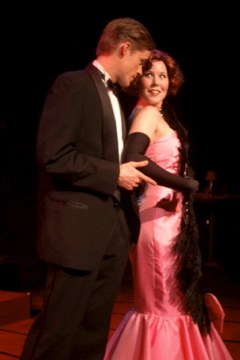
Pete 'n' Keely (Kalliope Stage)


‘PETE 'N' KEELY’ closes Kallliope's season

When an artistic director of a theatre picks a play to be presented there is a reason. Sometimes it fits the theatre’s avowed purpose. Think Great Lakes Shakespeare Festival choosing to do ‘HAMLET’. Often it’s because the script has something important to say such as ‘DEATH OF A SALESMAN’ and ‘DARK AT THE TOP OF THE STAIRS. Maybe it’s because the show’s writer insures great audience attendance. Neil Simon or Steven Sondheim come to mind. It could be that the theatre has the personnel who fit the script or a special star is available. Think Bernadette Peters as the lead in ‘ANNIE GET YOUR GUN’ or Bette Midler as Mamma Rose in ‘GYPSY.’ On occasion, the play fits the theatre’s space well. Whatever the reason, there usually is a rationale behind the selection.

Paul Gurgol, the Artistic Director of Kalliope Stage, Cleveland’s only venue completely dedicated to doing musicals, chose ‘PETE ‘N’ KEELY’ to close the theatre’s first season. Yes, it does fit two criteria, it is a musical and the two person cast fit well the intimate confines of the 50-seat Cleveland Heights theatre. Besides that, it’s difficult to figure out why Gurgol made the choice.

Now, don’t get me wrong, the production isn’t terrible. It just begs the question, “Why spend time, effort, talent and money on such an endeavor?”

Okay, let’s examine the story. The plot centers on a reunion between a former husband and wife as stars of a “bring ‘em back together” TV show. (Kind of the Sonny and Cher reunion.) The music is a hodge-podge of mostly pop songs from the ‘60s with a few weakly conceived new works thrown in. Musical numbers include “Lover,” “Besame Mucho,” “This Could Be the Start of Something Big” and “Too Fat to Fit.”

The script is by James Hindman with original music by Patrick Brady and lyrics by Mark Waldrop. Hindman, who is a fairly well-know New York actor is making his virgin attempt at writing a play. It includes many lame lines including the likes of “age is a number and mine is unlisted.” The writing tries too hard to be witty and suave but fails to grab and hold the audience’s attention. (Ask the woman in the front row who slept through both the first and the second act.)

The Kalliope production is blessed with Kathryn Kendall who has a strong voice and good stage presence. Christopher Vettel also has a nice singing voice, but has some upper range flatness and a distracting habit of singing out of the side of his mouth, which contorts his face and creates a humorous look during some serious songs. Unfortunately, as well as they sing, there appears to be no on stage charisma between the performers and their vocal blends are not always aesthically pleasing.

Gurgol, who directs the production, has incorporated some clever visual and choreographic moments. “The Cross Country Tour” is a wonderful musical collage, “That’s All” is presented in a nice “scat” style and “”Have You Got A Lot To Learn” was very creatively staged.

The musical accompaniment is excellent, keeping in mind that the musicians are back-ups to the singers and their purpose is not to drown out the lyrics of the songs.

Capsule Judgement: If you like review type shows in an intimate setting, want to support a new local theatre, and enjoy songs of the 50s, ‘PETE ‘N’ KEELY’ might be to your liking.

Friday, March 26, 2004

A Grand Night For Singing (Kalliope Stage)


Kalliope Stage, the North Coast's new musical theatre

It’s always a dangerous undertaking to start a new theatre. It is even more tenuous in these times of economic wariness. In spite of the odds, the Cleveland area has seen the birth of several new theatrical enterprises in the last year or so. The newest is Kalliope Stage which has settled into a space at the corner of Lee and Cedar Roads, diagonally across from the Cedar Lee movie theatre. Kalliope has a unique role in the area…it is the only venue dedicated exclusively to the American musical.

The American musical, for all practical purposes is the child of Richard Rodgers and Oscar Hammerstein. They conceived ‘OKLAHAMA!’ the first true book musical, in which the music, the lyrics and the storyline all melded into one. In contrast to previous musicals, the dancing, the singing, the spoken lines of ‘OKLAHOMA’ were all integral to the story, which cannot be told if any of the elements is missing. The Rodgers and Hammerstein scheme gave birth to works by Lerner and Loewe (e.g., ‘MY FAIR LADY’), Steven Sondheim (‘FOLLIES’), Stephen Schwartz (‘PIPPIN’), Leonard Bernstein (‘WEST SIDE STORY’) and a number of others.

It is only fitting that Kalliope Stage open its doors with a tribute to the fathers of the American musical. Their production of ‘A GRAND NIGHT FOR SINGING’ is a review which blends together songs from such hit shows as ‘CAROUSEL,’ ‘THE KING AND I,’ ‘SOUTH PACIFIC,’ and ‘THE SOUND OF MUSIC.’ The title comes from the song “It’s a Grand Night For Singing, written for ‘STATE FAIR’ the only movie musical the duo wrote.

Kalliope’s theatre is a spanking brand new, intimate space, consisting of about 50 comfortable seats, placed in three rows. The audience is right up front and there isn’t a bad seat in the house. The box office personnel, ticket taker, ushers and theatre staff are warm and welcoming. They even hand out chunks of home made chocolate “thingies” to every patron.

It would be wonderful to say that Kalliope Stage’s opening production was superlative. Unfortunately, it wasn’t, but it was entertaining. It was extremely well sung. The music was well played. The production is filled with some very fine moments. But, there are also some problems.

On the plus side, all five cast members individually sing extremely well. Unfortunately, because they are all essentially soloists, the choral sounds were not as blended as they could have been.

The women, both in their acting and singing, were fine. Lisa Spinelli was a total delight flashing her sparkling eyes and playing perfectly the fallen innocent in “I Cain’t Say No.” She captures the stage as soon as she makes an entrance.

Joan Ellison’s “Something Wonderful” was wonderful. She does a nice job of altering her presentational style to fit the mood and ideas of each song.

Allison Hedges has a beautiful voice but needed more glee in “A Wonderful Guy” and more passion in “If I Loved You.” Joan and Allison did a delightful version of “Stepsisters’ Lament” from ‘CINDERELLA.”

Robert Burian has a full and powerful voice. Unfortunately, has not learned to visualize images of the things he is singing about. When he sings a love song, he has to feel the love, we have to see it in his eyes and observe it in the way he looks at and touches his partner. Often he sings off in space, eyes blank, his gestures automatic, not powered by emotion. It’s too bad because he has a gorgeous voice. His ‘We Kiss In A Shadow” for example, had a wonderful vocal sound.

Though he doesn’t have Burian’s vocal abilities, John Paul Boukis does have a pleasant voice. Unfortunately, as with Burian, he seldom makes emotional contact with the person with whom he is singing. His finest moments were during “All At Once You Love Her” and “Maria.”

Reviews often get bogged down in song after song with little variation. Paul Gurgol, the show’s director, made sure this didn’t happen by adding some very creative moments to the show. Having males sing traditional female songs and vise versa was a nice touch. “Kansas City” was delightfully staged as was “It’s Me.” Unfortunately, some of the “schticks” were over-the-top. The twister game in “Don’t Marry Me” put singers in positions where singing was nearly impossible. The constant moving of the hay wagon/table was distracting. In fear of falling into the “bogged down trap,” he over directed, trying to make too much of songs that may have done with less trappings.

Technically, the lights and set were nicely conceived. Especially effective were the trees, with trunks in the form of human bodies and branch like arms reaching out to enfold the audience. On the other hand, Kim Brown’s costume designs detracted rather than added. The costumes often drew attention to the clothing rather than assisting the performer to develop his or her character.

CAPSULE JUDGEMENT: Kalliope Stage is a welcome addition to the Cleveland theatre scene. It takes guts and determination to give birth to a new theatre. The theatre’s directors, John Paul Boukis and Paul F. Gurgol, can only be wished the very best. Their ‘A GRAND NIGHT FOR SINGING’ was a pleasant way to start the season.