Showing posts with label American Ballet Theatre. Show all posts

Sunday, March 19, 2006

Le Corsaire (American Ballet Theatre)


American Ballet Theatre’s ‘LE CORSAIRE’ fine, but not wonderful

American Ballet Theatre is one of the finest dance companies in the country. Over the past four years they have become fixtures in the Ballet Series at Playhouse Square Center. Their ‘GISELLE’ was breathtaking. ‘WITHIN YOU WITHOUT YOU: A TRIBUTE TO GEORGE HARRISON’ and ‘PILLAR OF FIRE’ were what ballet should be. “SWAN LAKE’ was exciting beyond description.

With that said, I was less than enraptured by “LE CORSAIRE, THE PIRATE.,’ ABT’s most recent Playhouse Square offering. Maybe it was due to the light-weight story line, maybe it was the overly stylized concept, maybe it was the bows after every solo which broke the flow of the story, maybe it was the confusing costuming which found tutus mixed with pirate and Arabic costumes, maybe it was because the male lead (on opening night) did not have the charisma and sensuality required for the swashbuckling image of a pirate. Whatever, ‘LE CORSAIRE,’ though perfectly acceptable, and if presented by a company other than ABT might have been declared as “good,” simply wasn’t up to ABT standards.

On the plus side, Irina Dvorovenko was lovely as Medora, the young Greek woman with whom Conrad, the pirate, falls in love. Her toe-work was impressive as was her ability to make the role her own. Equally rapturous and proficient was Stella Abrera as Medor’s friend. Jose Manuel Carreno, though he was overly dramatic to the point of upstaging the lead dancers as he wandered the stage while others danced and exaggerated his gestures while standing still, was magnificent when he danced. He literally threw himself around the stage while doing his circle turns and captured the audience with his fluid body control. Also impressive was Gennadi Saveliev as Lankendem, the owner of the bazaar.

On the other hand, Maxim Berloserkovsky just wasn’t physically commanding as the pirate. Though his second act pas de deux with Dvorovenko, his real-life wife, was captivating, most of his other dancing was simply acceptable. The same can be said for Hector Lopez, as Conrad’s friend and betrayer. Veronika Part, one of the Odalisques, was consistently out-of-time with her partners and had trouble holding freezes.

A wonderful addition to the proceedings was the inclusion of many local young ballerinas who were impressive in their concentration and dancing abilities.

Conductor Ormsby Wilkins’ full orchestra was excellent.

CAPSULE JUDGMENT: Though quite good, American Ballet Theatre’s ‘LE CORSAIRE, THE PIRATE’ did not capture the local audience as other ABT presentations have done. There was strong applause, but not the leaping and screaming standing ovations the company has received here in the past.

Friday, March 11, 2005

American Ballet Theatre's 'Swan Lake' (Playhouse Square Center)


Americam Ballet Theatre pereforms 'SWAN LAKE' at State Theatre

‘SWAN LAKE,’ now on stage at Playhouse Square’s State Theatre, is among the most revered of classical ballets. Interestingly, the score and balletic components did not appear in a blaze of glory. Early recorded critical comments called the choreography “weak in the extreme” and “is this not torture?” The music was credited with being ‘undanceable’.

Even the exact origins of the ballet are uncertain. What has been gleaned reveals that ‘SWAN LAKE’ was Tchaikovsky’s first attempt at a composition for the art form. He was commissioned by the Russian Imperial Theatre in Moscow to write the score in 1875 for the sum of 800 rubles.

It is also known that the ‘SWAN LAKE’ most balletophiles have seen is not that which was originally performed. For example, The Petipa/Ivanov version of the ballet, which is considered the "standard" for its staging, was not created until after Tchaikovsky’s death. And, even many traditional features of the choreography, such as the beautiful White Swan pas de deux, are revisions of the Petipa/Ivanov version.

The story itself is of a prince finding his true love in the forest, finding out that she is cursed to remain a swan until a virginal prince saves her, how seduction and fate makes it impossible for the prince to break the spell, which leads to the lovers self-imposed death.

The swan connection centers on many legends about women who are turned into birds. The graceful swan was particularly favored as it is considered womanhood at its purest.

Tchaikovsky was not alone in picking a legend as the basis for his creation. According to modern psychologists the popularity of “love gone astray” legends may be based on the concept that when we are not loved as we need to be loved, we often survive the deprivation through fantasy, our own making or perhaps a more universal fantasy we share with other persons searching for acceptance and love. Tchaikovsky's "SWAN LAKE" fits this theory through a story of love searched for, love unrequited, and love's redeeming power.

The version of ‘SWAN LAKE’ being performed by ABT is that of its Artistic Director Kevin McKenzie based on the work of Marius Petipa and Lev Ivanov. McKenzie’s conception incorporates much walking, posing and posturing encased in grandeur. It does not have the creativity or psychological impact of Matthew Bourne’s recent Broadway production, but it does satisfy those interested in seeing a “close to the original” version.

This is a stunning production. The costumes, the sets and the special effects are grandiose, all the way from the Monet-like lake scene on the front curtain, to the sun rising at the end of the production.

The first and second acts dragged. Though proficiently performed, the initial segments lacked passion and spark. But the orchestra and the company seemed to adopt to the stage and the third and fourth acts were excellent.

Julie Kent as Odette-Odile, the swan, after a less than inspired start, blossomed. She has wonderful body control, her point is strong, her fluttering swan-like moves accented her long, thin body. The only missing factor was facial expression to help us feel her angst, and the final frustration that led to her leap to death.

Jose Manuel Carreno failed to convey any true feelings as Prince Siegried. He spends too much time posing and posturing and feigning emotion. There were no signs of emotional connection between the Prince and Odette. He is handsome and a proficient dancer, but lacks the extra quality to make him a great dancer. In fact, he was outshone by Herman Cornejo portraying Benno, the prince’s friend. Cornejo’s leaps, which carried him well above the stage floor and his rapid flying leaps, were much superior to Carreno’s. Cornejo showed emotional involvement and joy in his dancing, traits missing from Carreno.

The Pas de Trois danced by Erica Cornejo, Xiomara Reyes and Herman Cornejo was charming. The Act III dances of nations was a show highlight. Especially strong were the Czardas and the duet of Carlos Lopez and Craig Salstein.

Jesus Pastor was properly sensual and evil as von Rothbart, the evil sorcerer.

Note: The lead dancers in the various productions will change, so Kent and Carreno may not be the principles seen at other stagings.

CAPSULE JUDGMENT: After a slow start on opening night the ABT staging of ‘SWAN LAKE’ proved why the company has its strong reputation. For those who are uninitiated in the ballet this is a good production to cut your eye teeth on. For the seasoned ballet attender it gives the opportunity to see a modification of the Petipa/Ivanov choreography.

Wednesday, March 24, 2004

Verb Ballet, Inlet Dance, Antaeus Dance, American Ballet Theatre--March, 2004


QUICK COMINGS AND GOINGS: VERB BALLET, INLET DANCE, ANTAEUS DANCE, ABT

One of the problems with short run productions is that before the word can get out, they are gone. This is especially true with many of the performances of local dance companies, which usually run one weekend. A case in point is the Cleveland Public Theatre’s “Dance Works ’04.” Some of the area’s finest choreographers are being showcased. Unfortunately, each group gets a one weekend three-performance slot. Since you can’t get to see what has been, maybe you can get ready for what’s going to be. If you see that these companies are presenting, go before they are gone once again.

Cleveland is blessed with some wonderful choreographers and company artistic directors. Three of the very best are being showcased in the “Danceworks ‘04” series. Two have already had their works presented: Hernando Cortez of Verb Ballets, and Bill Wade of Inlet Dance. Here are mini-reviews of what was presented.

VERB BALLET

The company’s ‘CONTEMPORARY ARTISTS COLLECTION 04’ was a wonderful and creative evening of dance. The dancers worked with assurance and displayed a complete understanding of each the choreographer’s works. Mark Tomasic and Tracy Vogt were superb in “In Passing.”

Dancing on boxes, in ballet shoes on toe, “The Last Sun” showcased wonderful dancing by Meghan Haas and DeAnn Petruschke. Unfortunately, Robert Wesner’s affected movements and lack of body control were distracting.

“The Envelope” was an absolutely delightful piece centering on the passing of an envelope from dancer to dancer. The melodramatic music and quick short moves delighted the audience.

“A Twist of Fate” was brilliant! It was a powerful, unsettling piece, accomplished with wonderful shadows projected onto the back scrim by lighting designer Cheanult Spence.

“Mozart Piano Trio in C Major” was danced to the fine live accompaniment of Eric Ziolek and Sara and Jeffrey Schimpelfenig. The classical music and contemporary stylized movements blended to give a sprightly conclusion to a wonderful evening of dance.

All in all, this was an entertaining, eclectic evening of dance. As a patron said as he walked out, “I could see that again.” I agree!! For information about Verb Ballets and their next performances call 216-397-3757.

INLET DANCE

Inlet Dance is at its very best when the company is performing to the ingenious choreography of Bill Wade. This was well-illustrated in their “Dance Works ‘04” program. Every one of Wade’s staged pieces was compelling. The works of the other choreographers left much to be desired.

Wade’s “B’roke,” danced to a Vivaldi violin concerto, was beautifully presented. He created involving stage pictures through the inter-twining of bodies. Each physical move perfectly fit the musical underscoring. Jennifer Lott lit up the stage. Marget Ludlow, M. Leila Pelhan and Devon Schlegelmilch were outstanding in this and each piece in which they performed.

“Doppleganger” was the evening’s highlight. Featuring 16-year old African American twins, Bryan and Ryan Peoples, who helped develop the choreography, the dancers displayed amazing physical strength and body control and blended into a co-joined tandem of gymnastic dance movements. Wow!!

“ImPAIRED” saw Leila Pelhand and Christopher Whitney impressively performing the entire piece blindfolded. The slow gymnastic movements were beautifully executed. This was a powerful piece, well conceived and well executed.
Less effective were “Tides and Solitude” which Sally Wallace choreographed using long poles which were used by the dancers to propel themselves across the stage. The effect worked for a while but the extended music and repeated movements became tedious and the piece called for cutting.

Jennifer Lott danced her own choreographed piece, “Duet” competently. The single dancer partnered with a square of light. The choreography failed to captivate.

“Dante’s First Night,” staged by Leilani Barrett, failed to coordinate the tone of the music with the dance movements. The repetitious music and lack of group unity hurt the piece. Interestingly, it was the performance of the choreographer that was most responsible for the lack of precision.

Steve Rooks’ “You Are Now Connected” missed the mark. The dancers, though they valiantly tried, were not capable of interpreting the rap music’s intent.

For information about Inlet Dance call 216-382-0201 or email inletdancetheatre@sbcglobal.net.

ANTAEUS DANCE COMPANY

Starting with a series of bangs and cymbal clashes, choreographers Dough Lodge and Joan Meggitt’s “Moments of Repose” had an impressive beginning. But, as the piece went on and on, repeating and repeating the same musical tones and movements, the audience lost interest. It was too much of the same. Supposedly inspired by Frank Gehry’s Peter B. Lewis Building on the campus of Case-Western Reserve, the piece should have, like the building, flowed, flashed, attracted emotional attention, brought about strong emotional reaction. It didn’t. After a while more attention was paid to Greg D’Allessio’s solo manipulation of the musical instruments than to the dancers. The female dancers—Jenita McGowan, Sherri Mills, Latifa Sage, Beth Salemi and Shanna Sheline--were all very proficient.

A shortened piece, programmed with something of a different feeling, would have made the evening much more satisfying.

For information about Antaeus Dance Company call 216-486-2874.


AMERICAN BALLET THEATRE

Performing as part of the Ballet Series at Playhouse Square Center, American Ballet Theatre proved why it is a world class company. The program, danced to a full orchestra, opened with “Raymonda,” a classical piece with folkloric overtones. Well staged, it featured Irina Dvorovenko and Maxim Beloserkovsky in lead roles. Maxim and Carlos Lopez’s high scissors leaps and the precision dancing and toe work of Erica Cornejo were the piece’s highlights.

“Pillars of Fire,” was a somber, beautifully danced piece which combined traditional movements with modern staging. The result was a moving choreographic concept in which the moods of the dance and the music became one.

“Within You Without You: A Tribute to George Harrison” was the lesser segment of the evening. Though it was interesting to see the former Beattle’s music set to dance, there was a lack of consistency in interpreting many of Harrison’s lyrics to the movements. This was especially true in “Something.” “I Dig Love,” with its interesting lift patterns and inter-weavings of bodies, was more on target as was “While My Guitar Gently Weeps” which featured powerful gymnastic movements. “Isn’t It a Pity” consisted of a series of countermoves created by having the dancers work in lines. “Within You Without You” evoked little emotional feeling, while “My Sweet Lord” was a high spirited gleeful dance.

All in all, if you missed ABT, you missed a dance season highlight. They will undoubtedly be returning to the area. Make sure to see them.

Wednesday, October 16, 2002

Gisselle (American Ballet Theatre)


American Ballet Theatre brings top stars to dance 'Gisselle'

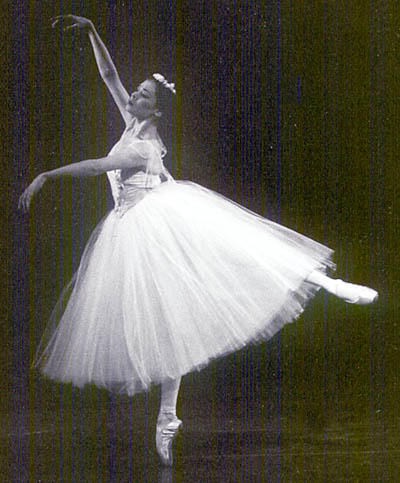
My first exposure to ballet was seeing the Bolshoi Ballet Company dance 'GISELLE' in the Soviet Union. It is therefore, with great anticipation, that I look forward to the American Ballet Theatre bringing 'GISELLE' to Cleveland’s State Theatre from October 30 through November 3. The storybook ballet will be performed by ABT’s stop stars including principal dancers Nina Ananiashvili of Russia’s Bolshoi Ballet and Irina Dvorovenko, who performed with the National Opera and Ballet Theatre of Kiev, Russia. Xiomara Reyes, who danced with Cuba’s national Ballet and the Royal Ballet of Flanders in Belgium will be featured as Giselle.

To appreciate Ballet, the viewer is wise to understand that the first half of the 19th century in Europe was known as The "Romantic Movement" period. Painting, music and literature were swept up in Romantic ideals: questioning the rules of the past, stressing individual expression and experimentation, and moving away from classic themes to the inclusion of more local color, supernatural beings and melodrama.

Ballet was a latecomer to the Romantic style, led by 'GISELLE,' a ballet conceived by Theophile Gautier. The music was composed by Adolphe Adam. The ballet was first performed at the Paris Opéra in 1841. The piece was a success on all levels, gaining critical and public acclaim for the choreography, music, designs and the dancing of all. The strongest endorsement was the fact that a style of hat and a type of fabric were named after the ballet.

Capsule judgement: 'GISELLE' offered audiences an escape to a world of mystery, beauty, danger, and death, a vision that stirred the imagination. What secures its place as the apex of romantic ballet is that in place of the usual happy ending, in which virtue is rewarded, a tragic death followed by a ghostly resurrection is substituted.