Tuesday, June 19, 2012

Cats


CATS prowl as Mercury Summer Stock finds new home

Like many local theatres, Mercury Summer Stock, has experienced a vagabond existence. Founded by Pierre-Jacques Brault and Brian Marshall, the summer theatre seems to finally have found a permanent home in the Regina Auditorium at Notre Dame College in South Euclid. The large venue, with a huge stage, lends itself to the free wheeling choreography and staging by Artistic Director Brault.

Along with a change of venue, the organization has altered its mission. Previously billed as a professional theatre, though they seldom had more than one equity performer appear in any production, that aspect of its theatrical explanation has been dropped, opening the door for evaluating the shows based on expectations for their usual high school and young college student performers.

A new home, new performance schedule (the addition of Sunday matinees), and a new goal statement which includes ”advancing theatre as a means of educating, challenging and inspiring through family-friendly programming rarely seen” are all part of the changed vision for the company.

Mercury’s 2012 opening production is Andrew Lloyd Webber’s CATS. Based on OLD POSSUM’S BOOK OF PRACTICAL CATS by T. S. Eliot, the show is a series of poems set to music. There is a loose story line about a tribe of cats called the Jellicles and the night they make the choice of who will ascend to the Heaviside Layer and come back to new life.

The only memorable song in the score is Memory, whose lyrics were written by Trevor Nun, based on the Eliot poem, Rhapsody on a Windy Night. It was made famous by Betty Buckley, who played Grizabella in the original Broadway production.

The show originally opened in London in 1981 and ran for 21 years. The Broadway production, which opened in 1982, ran for eighteen years, and was performed 7485 times, making it the second longest continually running show in history. (THE PHANTOM OF THE OPERA, which is still going in New York, is the extended-run leader.)

CATS is a difficult show to produce, even for professionals, let alone for a group of high school and college students who are just learning their craft. Almost every song requires a production number, so the key element of the staging is dance. In addition, the score has shades of opera and is difficult to sing. Another major issue is that since there is little drama or no humor, holding the audience’s attention is difficult.

As evidenced by the three tween girls who were sitting in front of me, wiggling, slumping in their seats, and generally showing boredom, this is not a show for children and may be a challenge for adults.

The Mercury production, directed and choreographed by Brault, has some high moments, but these are eclipsed by some issues.

On the positive side, Brault’s choreography is creative. He has cast some good dancers. Especially strong is Jake Washabaugh who appears well trained in ballet and controls the stage when his long thin body whips high turns, does flexible leg kicks, and executes powerful lifts. Also strong are Zach Pfeil, Katlyn Dessoffy, and Taylor Bryan.

Traditionally, the action takes place in a junk yard. For some inexplicable reason Brault decided to switch that to a child’s room, complete with board games, a toy car, balls and building blocks. Nothing in the show references such a setting. Maybe he thought making the whole thing into TOY STORY would help. It only confuses. Why would 20 cats be prowling a child’s room?

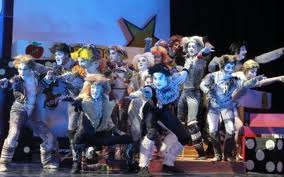
Brault’s costume designs are clever. He suggests cats, rather than creating authentic cats. The same is true of the cast. They did not consistently become cats, they represented them, with a minimal number of cleaning, preening and stretching gestures.

Eddie Carney’s orchestra puts out full sound, but, unfortunately, the large playing space gobbled up the five pieces, making the sound slight. This was not helped by the squealing sound system, and weak projection by some of the cast. Blinking lights at weird times also didn’t help.

Staging highlights included The Old Gumbie Cat, The Jellicle Ball, and Mr. Mistoffelees.

CAPSULE JUDGEMENT: CATS was not all that could have been hoped for as an opening show in Mercury’s new venue, but, considering the difficulty of the show, and the developing abilities of the cast, Brault and company can be commended for a “nice try.”

Sunday, June 17, 2012

Avenue Q


AVENUE Q, X-rated fun at Cain Park

What can be said about a delightful, thought provoking, Tony award winning, Sesame Street for adults? How about, it’s fun and you should go see it!

AVENUE Q, a production now on stage at Cain Park’s Alma Theatre, is an often hilarious and heartfelt story about Princeton, a bright-eyed college grad who comes to New York with his hopes, little money, and a trusting soul. He moves onto Avenue Q, a place populated by weird and wonderful characters that are part puppets and part human.

Through song, dance and humor we follow Princeton as he and his new found group of twenty-something friends, struggle to find jobs, dates, but most importantly, their ever-elusive, purpose in life. Among others, there’s Kat Monster, Christmas Eve, Trekkie Monster, and Gary Coleman, all searching for purpose and making commentary on education, politics, human sexuality, and life in general.

Winner of the triple crown of Tonys—Best Musical, Best Score and Best Book—the show has music and lyrics by Robert Lopez and Jeff Marx, and book by Jeff Whitty. The satire is high, as represented by such songs as It Sucks to be Me, What Do You Do with a B.A. in English?, Everyone’s a Little Bit Racist, The Internet is for Porn, and I’m not Wearing Underwear Today. Doesn’t sound like the score from they typical musical theatre piece? Well, this is not the typical musical theatre script or score.

The Cain Park production, under the wise direction of Russ Borski, milks the script for all it is worth. The characterizations are generally clear, the staging crisp, songs are mostly well sung, most of the actors are easily understood, the orchestra backs up rather than drowns out the singers, and the dancing is delightful.

The wonderful puppet designs and fabrication are a local effort, executed by Terry Pieritz and Russ Borski, with the aid from puppet consultant Larry Nehring. After a while the stuffed-beings and their live partners meld into single beings.

Cherubic faced Jesse Markowitz is adorable as Princeton. He has a wonderful singing voice, moves well, and lights up the stage with his effervescent smile, twinkling eyes, and believable presentation. His rendition of Purpose is endearing. This is one very talented young man!

Patty Lohr gives a nice quality to Kate Monster. Her drunk scene is delightful. Sean Szaller adds humor as Nicky. John Paul Boukis, with his huge eyes flashing and high-pitched voice of fear, is nothing short of sensational as the closeted Rod. Todd Hancock, as the porn addicted Trekkie Monster, almost steals the show. Michelle Berkowitz and Zachary Lamb are properly mischievous as the Girl and Boy Bad Idea Bears. Dan DiCello (Brian) makes for a good, bad stand-up comedian. Joanna May Hunkins personifies every kid’s nightmare as Mrs. T, the kindergarten teacher.

Be aware, if you are a prude, that there is a vivid sex scene (yes, puppets having intercourse), lots of four-letter words, and some unpolitically-correct stereotyping. For the rest of us, those scenes and language, just add to the overall delightful outlandishness of the production.

(The show is dedicated to the memory of Paul Gurgol, who was to co-direct the show but died shortly before the start of rehearsals.)

CAPSULE JUDGEMENT: The award winning AVENUE Q, Sesame Street for adults, gets a well-honed production at Cain Park. Show highlights include spot-on performances by Jesse Markowitz, John Paul Boukis and Todd Hancock. This is a must see for the more liberal minded.

Damn Yankees


DAMN YANKEES…an enjoyable evening of escapist theatre at Porthouse
Probably the golden age of musical theatre in the US was from 1950 to 1960. Great scripts like King and I, My Fair Lady, and West Side Story were staged. Also produced were such flops as SALAD DAYS, ZULEIKA, ANKLES AWAY, THE VAMP, SHANRI-LA, SHNBONE ALLEY AND FREE AS AIR. Most shows were of the neither great nor flop variety. These included the likes of CALL ME MADAM, GUYS AND DOLLS, PAINT YOUR WAGON, CAN-CAN, WONDERFUL TOWN, FANNY and THE PAJAMA GAME. Also included in that list is DAMN YANKEES, now on stage at Porthouse Theatre.

With a book by George Abbott and Douglass Wallop, and music and lyrics by Richard Adler and Jerry Ross, it is a modern retelling of the Faust legend which takes place in the 1950s in Washington, DC. It’s an escapist piece that makes no attempt to make a philosophical point nor give a snapshot of the real world.

The story concerns Joe Boyd, a long suffering fan of the Washington Senators’ baseball team. He fantasizes that the Senators will beat the hated New York Yankees. He also has a secret desire to be an all-star who plays for his favorite team. As the saying goes, “be careful what you wish for.”

The devil, in the form of red-sock-wearing, horned-headed Mr. Applegate, mysteriously appears to offer Boyd a chance for his desires to come true. The only hitch is that Joe has to give his soul to the devil when the season ends. Boyd, in desperation, agrees.

As the Senators’ fortunes soar, Joe realizes he’s losing his beloved wife (Goodbye Old Girl) and looks for a loophole. Enter temptress Lola (Whatever Lola Wants, Lola Gets), a charter member of the Home Wreckers Hall of Fame who surprisingly turns out to be his ally. What will happen? Will the devil prevail? Come on now, this is a musical comedy.

The show’s track to success was not easy. The 1955 Broadway opening was met with mixed, mostly negative reviews. The next day the writing team got together, cut one number, switched another from the second act to the first, cut twenty minutes of dialogue, and rewrote the ending. The changes went in that very evening. An invitation to the reviewers brought them back to the theatre and garnered much more positive comments. This was enough to make the show a modest 1019 production run. By comparison, MY FAIR LADY’s original Big Apple run was 2717 showings.

DAMN YANKEES is a good script choice for the Porthouse audience who tends to like folksy musicals, with lots of dancing and fantasy. They do not tend to be the NEXT TO NORMAL, RENT or SPRING AWAKENING crowd. Give them patter, humor and happy endings and they seem content to stand and cheer the final curtain.

The production, under the sprightly direction of Terri Kent, moves along quickly, has dynamic production numbers, and pleases. Kent is fortunate to have MaryAnn Black and Eric van Baars, Kent State faculty members and Porthouse favorites, to cast.

Black, who defies age, high kicks, struts her stuff, and wiggles her fanny with the best of them. While contemporaries, the likes of Gwen Verdon, who played the role of Lola in the New York production, have faded, Black continues to entrance audiences. This is one talented lady who knows how to control a stage. Her versions of A Little Brains, a Little Talent and Whatever Lola Wants were show stoppers.

van Baars, who often comes front and center when Porthouse needs a character to do shtick, inhabits the role of Mr. Applegate, made famous by Ray Walston on Broadway, with ease. While there are times when there could have been a little more devil-like scheming, as a whole, sported by hysterically appropriate devilish costumes, he makes us believe the devil is amongst us. His Those Were The Good Old Days was fun.

As Joe Hardy, the reinvention of Joe Boyd, boy-next-door handsome Michael Glavan, is typecast perfect. He looks and acts baseball jock in an unassuming and “aw schucks” folksy way. He has an excellent singing voice, moves well, and gives a nice texturing to the role. His A Man Doesn’t Know was charming.

Mary Anne Prevost develops a clear character as Boyd’s wife. Lenne Snively and Lissy Gulick are hoots as two ditzy baseball-addicted fans, Marc Moritz has some nice moments as Joe Boyd, and Rohn Thomas is believable as the Senator’s manager. Each of the chorus of baseball players develops a unique character, singing and dancing with vigor and ability.

Highlight numbers included: The Game, Two Lost Souls, Shoeless Joe from Hannibal, MO, and Heart.

John Crawford’s choreography fits the mood of the production. Jonathan Swoboda’s musical direction is on target. His musicians support rather than drown out the singers. Ben Needham’s turntable set works well. Jan Evans’ costumes, especially those designed for van Baars, help create the proper mood.

CAPSULE JUDGMENT: DAMN YANKEES is not a great script, but quality singing and dancing, and a solid cast, headed by MaryAnn Black, Eric vanBaars and Michael Glavan, create an enjoyable evening of summer entertainment.

Monday, June 11, 2012

BLOODY BLOODY ANDREW JACKSON


BLOODY BLOODY ANDREW JACKSON rocks at Beck


Several weeks ago a study listed George W. Bush among the worst presidents of the United States. Also on that list was Andrew Jackson. However, in contrast to Bush, Jackson was also on the roll of the best presidents. That dichotomy is well noted in BLOODY BLOODY ANDREW JACKSON, now rocking the Studio Theatre at The Beck Center for the Arts.

Jackson, known as the common man’s President, unified the country. He did so through a bloody reign of terror in which he slaughtered and dealt devilishly with his hated enemies: the Indians (who killed his parents), the British, the Spanish and the Washington politicians. He was a drunk, bigamist, and undisciplined man. He has sometimes been noted as the American Hitler due to his maniacal obsessions.

After being denied the presidency by the Supreme Court after winning the popular vote, in an incident similar to the Bush-Gore saga, Jackson became possessed. Four years later Jackson founded the Democratic party and could not be denied. He took over the White House, opened its doors to the multitudes, turned the lawns into grazing areas for livestock, and generally ruled in organized chaos.

BLOODY BLOODY ANDREW JACKSON, as written by Alex Timbers, with words and music by Michael Friedman, is an audacious, irreverent rock musical which was a hit off-Broadway, and paints the picture with modern references, including the presence of electronics (cell phones, Ipads, head sets), lots of hard rock music, imaginative if not always accurate historical references, and lots of swearing, blood and guts. Though there are some weaknesses in the script, the production more than compensates for that.

Director Scott Spence puts aside all inhibitions and gives free range to filling the stage with visual and audible pyrotechnics.

Choreographer Martin Céspedes uses the foot stomping dance moves of the prairie as the basis for his creative choreography. Like Jackson himself, the dancing is not coordinated, but a creative use of impromptu movements. Céspedes incorporates a sequence of dynamic fight moves, has the musicians high stepping, and creates a dervish of visual treats. The song The Corrupt Bargain leaps off the stage.

Larry Goodpaster and Dennis Yurich’s musical direction is the foundation on which the production is built. The band, Yurich, Ingrid Lang and Jason Giaco, supported by various cast members, is musically dynamic. They would have made a great rock concert in and of themselves.

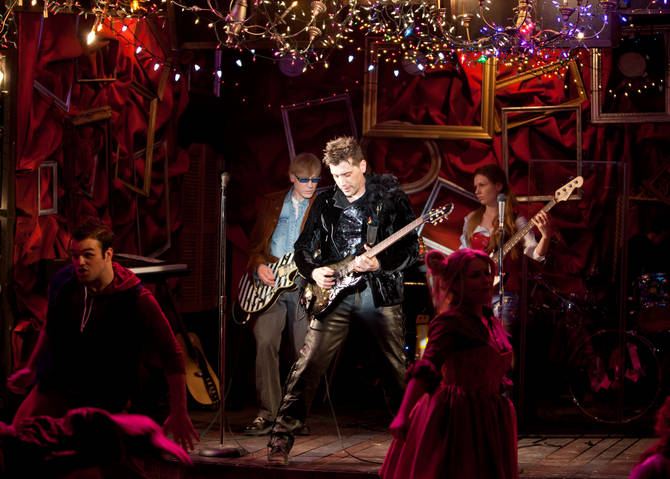
Trad Burns’ set design, an amalgamation of old suitcases, picture frames, newspapers, guns, and levels, creates the perfect working space for the actions.

The cast is multi-talented. At one point all of the assemblage plays guitars, sings and dances, with proficiency and abandonment.

Dan Folino, in the title role, is nothing short of perfection. He sings with full voice, his rock style is well honed, he creates a clear character, and transitions well between segments. It’s worth seeing the show just to experience the Folino magic in action.

Hester Lewellen is a hoot as the old lady storyteller, zipping around the stage in a battery operated wheel chair. Trey Gilpin is delightful as a fey Martin VanBuren. Chris McCarrell, playing one mean guitar, displays a great vocal in Second Nature. Gilgamesh Tagget has some great moments as the Indian chief, Black Fox. Elliot Lockshine is endearing as Lycoya, Jackson’s adopted Indian son. The chorus is vocally and performance strong.

CAPSULE JUDGEMENT: Though not for everyone due to the pounding music and uncensored language, BLOODY BLOODY ANDREW JACKSON, is one exciting and well conceived show. In my mind, it’s a sure MUST SEE!

Sunday, June 10, 2012

Sondheim on Sondheim: The Revue of a Lifetime


Disappointing SONDHEIM ON SONDHEIM at Hanna Theatre


In the self-revealing probe of his life, principles, writing philosophy and revelations about musical theatre, Stephen Sondheim, in both of his recently published books, FINISHING THE HAT and LOOK, I MADE A HAT explains that “content dictates form,” “less is more,” and that “theater lyrics are not written to be read but to be sung.” He illustrates how a writer’s philosophy, life experiences and beliefs are revealed in what he writes about and the way in which he expresses his ideas.

Stephen Sondheim, with few exceptions, writes musical dramas. He usually takes on serious subjects—the inability to make commitment (COMPANY), revenge (SWEENEY TODD THE DEMON BARBER OF FLEET STREET), false illusions (FOLLIES), world issues (PACIFIC OVERTURES), haunted souls (SUNDAY IN THE PARK WITH GEORGE), misguided motivations (ASSASINS).

What’s surprising about Sondheim’s approach is that he was a protégé of Oscar Hammerstein II, who was among the kings of musical theatre. His productions often had an undercurrent of comedy, while stressing homey community centered themes, with a philosophical message. These are not Sondheim's techniques.

Early in life, following the divorce of his parents, and his mother’s realization that she did not want to be a parent, Stephen was turned over to Hammersteins, who were family friends, for tutelage. Hammerstein, according to Sondheim, taught him most of what he knows about music and musical theatre.

With this background in mind, I went to see the co-produced PlayhouseSquare and Great Lakes Theatre, SONDHEIM ON SONDHEIM THE REVIEW OF A LIFETIME, with great anticipation. It would make the written words of the Sondheim books live….make the lyrics soar, make the story vivid by hearing the great man in his own words, supported by a professional cast of singers and dancers.

In general, what a disappointment. Yes, Sondheim was there. But, instead of the chronological development of his books, the ideas jumped around with no organizational format, sometimes repeating themselves. The staging lacked the dynamic quality of Sondheim’s ideas. The singing was mediocre. The vocal blendings were sometimes off. The orchestra often drowned out the words to the songs…words that we must be able to clearly hear. The choreography was often flat. The cast sometimes looked like they were walking through their numbers with little joy or pizzazz. They often sang words, not meanings. Articulation was sometimes mushy. Hopefully I saw the show on an off-night and during the rest of the run some of these issues don’t rear their ugly heads.

There were some high points, beyond hearing Sondheim explain himself and his works. Production numbers such as A Weekend in the Country, The Best Things That Ever Happened, and Losing My Mind were successful. The humor highlight was a YouTube compilation of various people, from the famous (Frank Sinatra, Barbra Streisand and Liz Taylor) to unknowns, doing their renditions of Send in the Clowns. The setting, a series of white levels, lent itself well to the free flowing staging. A number of gold frames were effectively used to place visual borders around the action and to create a screen for the Sondheim video clips.

But these were balanced off by the indistinguishable lyrics in Getting Married Today, the questionable interpretation of Happiness, and the less than funny, usually hysterical, Comedy Tonight.

How could this be? Thirteen months was spent putting the script together and getting permissions to produce the piece. It incorporated the work of James Lapine, long time Sondheim collaborator. There were all the hours of Sondheim interview tapes. Over 1200 performers were auditioned in Cleveland and New York. Victoria Bussert, the reigning local queen of musical theatre directors and a nationally recognized theatrical wizard staged the show. Matthew Webb, an accomplished musical director was on staff. Gregory Daniels, who has a proven record as a choreographer, planned the dancing.

As a friend who I spoke to following the show stated, “I was bored and frustrated with the level of performances and lack of focus.” Whatever the reason for the derailment, it led to a less than standout evening of theatre.

CAPSULE JUDGEMENT: SONDHEIM ON SONDHEIM, in its regional premiere, was a major disappointment. I wanted so much to be involved, to be excited, to gain a further appreciation of the “amplifications, dogmas, harangues, anecdotes and miscellany” that makes Sondheim Sondheim.

Saturday, June 09, 2012

Akarui [Bright]


AKARUI [Bright] confounds at Cleveland Public Theatre


Cleveland Public Theatre’s mission is to raise consciousness and nurture compassion through ground breaking new, adventurous work. Under the guidance of Artistic Director Raymond Bobgan, the theatre challenges audiences mainly strong works. Included in the winners have been this season’s ANTELBELLUM, and past offerings such as DARWINNI, THE COMUPPANCE OF MAN, BLUE SKY TRANSMISSION: A TIBETAN BOOK OF THE DEAD, and INSOMNIA THE WAKING OF HERSELVES. Some other offerings have confounded more than excited.

Unfortunately, AKARUI [Bright], which closed the 2011-2012 season, tends to fall into the less than successful offerings category.

The overly long and over-staged work transports the viewer to a rave cave (scenic designer Todd Krispinski’s effective metal scaffold set) at the supposed end of the world. Akarui, a disk jockey, spins songs that summon the lost and the desperate to examine their transitions.

Yes, all things are in transition. Transsexuals, transition from one gender to another. The dead find themselves in the nether world after their demise. Those who commit crimes against others are caught changing as their guilt develops. In evolutionary terms, fish transition from swimming to crawling to standing erect humans. The butterfly is the result of a transition from being a larva. Scientists develop theories and change as their successes and failures mount.
AMENT, AN EVENING OF W. B. YEATS’ E BOOK OF GRACE

These are all situations which writer Jen Silverman rolls out in AKARUI. These are the images that director Raymond Bobgan places before the viewer.

Silverman’s writing is often poetic. She proposes that until transgender people complete their process of transition, they are only “half done.” That people “climb out of their nightmares.” And, “you slap girls but you punch boys.” Her script is filled with allusions and metaphors. These often combine to make the obvious abstract. Though the author’s concept is clear, the continued repetition of the same idea, makes for a long sit.

The same could be said for Bobgan’s staging. The oft repeated stomping choreography, drumming and chanting just became too much after their original impact, stretching the production to a tedious level. A combination of editing of both script and actions would have aided to make this a more audience-friendly production.

The cast includes some excellent performances. Beth Wood as Baba Yaga, the doctor/witch, James Alexander Rankin as Joshua, a youth brutally killed who finds himself in the nether world, and Molly Andrews-Hinders, as DC, who is transiting from female to male, show understanding of their roles. David Aguila’s transition from fish to human is visually mesmerizing. The chorus carries out Bobgan’s intentions well.

Benjamin Gantose’s lighting and Michael Roesch and Raymond Bobgan’s sound designs work well.

Capsule judgement: AKARUI [Bright] brings to an end another theatre year for Cleveland Public Theatre. Though a challenging concept, the play and production just didn’t have the same positive effect as some other offerings by CPT.

Tuesday, May 22, 2012


Top 5 picks…OFF THE BEATEN PATH CLEVELAND AREA SUMMER THEATRE OFFERINGS


Roy Berko
(Member, American Theatre Critics Association and Cleveland Critics Circle)

The Cleveland area has a full schedule of professional summer entertainment. But, instead of examining the traditional city offerings, let’s look at some non-traditional suggestions.

OBERLIN SUMMER THEATER FESTIVAL

The fabled Oberlin College is within easy driving distance of the Cleveland area. The Oberlin Summer Theater Festival’s 2012 season will include: William Shakespeare’s comedy “A Midsummer Night’s Dream,” William Inge’s romantic comedy, “Bus Stop,” and Marc Blitzstein’s hard-hitting musical, “The Cradle Will Rock.” The productions will feature professional Equity actors in leading roles and will run in rotating repertory from July 6 through August 4 in Oberlin’s Hall Auditorium, state Route 58 between the Oberlin Inn and the Allen Memorial Art Museum. Tickets are free, but reservations are recommended. For tickets call 440-775-8169.

PORTHOUSE THEATRE

Bannered as, “SEE A LITTLE HEAVEN AND RAISE A LITTLE HELL!,” Kent State University’s summer theatre, performed on the grounds of the Blossom Music Center in Cuyahoga Falls, will perform Damn Yankees, from June 14-30. It will star the dynamic duo of Eric van Baars and MaryAnn Black. Kander and Ebb’s The World Goes ‘Round, with songs from Chicago, Cabaret, Funny Lady, Kiss of the Spider Woman and New York, New York, coupled with witty comic numbers, follows from July 5-21. The season ends with the most beloved sing-along musical, The Sound of Music and star Kayce Cummings Green, being staged from July 26 through August 12.

Curtain time is 8 PM Tuesdays through Saturdays and 2 PM Sundays. The picnic grounds open 90 minutes prior to curtain time. For tickets call 330-672-3884 or go online to http://dept.kent.edu/theatre/porthouse/index.html

THE OHIO LIGHT OPERA

In its thirty-third year, the resident professional company of the College of Wooster performs from June 16 through August 11 in the campus’s Freedlander Theatre. This year’s offering, which are performed in repertoire are: GUYS AND DOLLS, A CONNECTICUT YANKEE, THE MIKADO, THE CHOCOLATE SOLDIER, BLOSSOM TIME, UTOPIA LIMITED and MISS SPRINGTIME. For tickets and show descriptions go to www.ohiolightopera.org or call 330-263-2345.

MERCURY SUMMER STOCK

Though its been in existence since 1998, in an itinerate existence, Mercury Summer Theatre has finally found a home. They will be performing at Notre Dame College in South Euclid.

Headed by Artistic Director Pierre-Jacques Brault and his life partner, managing director Brian Marshall, the professionally-based, not for profit stock company, performs popular, but rarely done scripts.

This season’s offerings are: CATS, June 15-30, ONCE UPON A MATTRESS, July 6-21 and ALL SHOOK UP, August 3-18. Performances start at 7:30.

For tickets go online to http://www.mercurysummerstock.com or call 216-771-5862.

CAIN PARK

Noted as a venue for music concerts and dance programs, Cain Park, located in Cleveland Heights, produces a musical play each season. This year’s offering is AVENUE Q. The show previews on June 14, opens on June 15 and runs through July 1 in the Alma Theatre. For the $15 tickets call 216-371-3000 or go to www.cainpark.com

Clybourne Park


CLYBOURNE PARK…a fascinating view of neighborhood integration and gentrification


Have you ever wondered, after seeing a play, what might have happened to the characters or even the physical structure in which the story is set, before the play began or after it ended? Bruce Norris’s CLYBOURNE PARK does exactly that.

Flash back to 1959, where, at the conclusion of Lorraine Hansberry’s A RAISIN THE SUN, the black Younger family is about to move into the all-white Clyborune Park area of Chicago. Before the move, fearing the lowering of housing costs and white flight, the neighbors sent Karl Lindner, a bigoted community leader, to offer the Youngers money for not finalizing the deal. As it turned out, Lena, the matriarch of the family, refused the offer and the Youngers moved to a house numbered 406.

(Side note: the story parallels the plight of Hansberry’s family. In 1937, her father bought a home in Chicago’s segregated Washington Park area. The restricted covenants were challenged, resulting in a legal case (Hansberry v. Lee, 311 U.S. 32). The Hansberrys won, moved in and the house now has National Landmark Preservation status.)

(Enter Norris) CLYBOURNE PARK takes us into 406, several days before the Youngers were to move in. Bev and Russ, the owners of the property, are grief stricken. Their son, Kenneth, who was accused of war crimes in the Korea, had committed suicide in his bedroom. The family, which has been ostracized, decided to sell the house. We are never sure whether they sold to a black family to get back at their neighbors, or, as they state, were “unaware of the race of the new owners.” Lindner, the character from RAISIN, comes to plead with Bev and Russ to withdraw from the deal. After an emotional confrontation in front of a group of neighbors, the sellers refuse. (Exit Norris.)

(Re-enter Norris). The second act of CLYBOURNE PARK takes place in 2009. The same actors as in Act 1, playing different characters, are present. There is conflict as to whether the house, in what is now becoming a gentrified community, will be sold, leveled and a new structure built by a white family. African American Lena and her husband represent the local neighborhood association, and mention that her Great-Aunt moved her family to that house in 1959. (It is probably not by chance that the young lady has the same name as her Great-Aunt.) Racism enters as the blacks, who have rebuilt the neighborhood, don’t want white suburbanites to buy and change the character of the houses, many of which have been rebuilt to mirror their historical past.

Does the viewer have to know all of the intertwining stories in order to appreciate the Norris play? No, but it does add a psychological jolt to realize that we are watching the blending the ideas of two great playwrights. It is also eye-opening to realize that Hansberry, whose RAISIN IN THE SUN is considered the seminal black civil rights play, did not win a Pulitzer Prize for her script, but Norris did for his. One can only wonder if gender and race, subjects of both scripts, was a factor in Hansberry’s denial decision.

The play, under the adept direction of Pam MacKinnon, is spell binding. The pacing is excellent, the characters clearly developed, the settings are era correct and work well to convey the passage of time and neighborhood change.

Norris, an actor as well as a playwright, writes characters that live. This is a unified cast production, in which each participant carries equal weight for the success of the production. Fortunately, the cast, Crystal Dickinson, Brendan Griffin, Damon Gupton, Christina Kirk, Annie Parisse, Jeremy Shamos and Frank Wood each effectively textures his/her dual roles.

Capsule Judgement: Pulitzer Prize winning CLAYBOURNE PARK is an emotionally moving script that effectively highlights the still present distrust between members of different races. It gets an impressive production under Pam MacKinnon’s direction. It’s a significant play worth seeing.

(The on-Broadway production opened April 26, 2012 in the Walter Kerr Theatre for a 16-week limited engagement. )

End of the Rainbow


Tracie Bennett inhabits Judy Garland in END OF THE RAINBOW


Judy Garland, who was born Ethel Gumm, started in show business at the age of two-and-a-half. She later was coupled with her older siblings as the Gumm Sisters to become a well known vaudeville act.

Renamed Judy Garland, she was signed to a Hollywood contract and, in the late 1930s starred in the Andy Hardy movies with Mickey Rooney. She became America’s sweetheart in such films as The Wizard of Oz, Strike Up the Band, Babes on Broadway, For Me and My Gal and Meet Me In Saint Louis. Songs such as “Somewhere Over the Rainbow,” “The Trolley Song,” “Have Yourself a Merry Little Christmas,” and “Zing Went the Strings of My Heart” became synonymous with her name.

As was the case with many child stars, in adulthood, she was deeply troubled. She became known as being unreliable and unstable and her career ebbed and waned.

She married for the first time at age 19 to bandleader David Rose. It was a short-lived union. She went on to marry Vincent Minnelli, bore daughter Liza, and soon was again divorced. And so the pattern of her life was set. Short-term relationships were ever present.

On June 22, 1969, at age 47, she died from an overdose of pills. She left behind a legacy of great performances, special memories, and a number of fanatic fans. Her popularity, over fifty years after her demise, is still strong.

Peter Quilter’s END OF THE RAINBOW, which is loosely based on the book, WEEP NO MORE MY LADY by Mickey Deans, Garland’s fifth and final husband, focuses on the latter stages of her life.

In the play, Garland is scheduled to appear at The Talk of the Town, in London. She is financially broke, helplessly addicted to drugs and booze, and has had an affair with the much younger Deans, thus bringing to an end her marriage to Mark Herron.

The drama with music makes it appear that Deans, who is portrayed as having an abusive personality, was attempting to save Judy from herself by restricting her addiction consumption. Some sources allude to Deans using Garland for his own advantages, such as making money from the tell-all book, which followed her death. Whatever the truth, the power of the play comes out loud and clear.

This is a well written script, with many emotional highs and lows, some laughs, and, of course, some glorious vocal sounds. As the program notes indicated, we are exposed to the elegant Judy (The Man Who Got Away), the befuddled Judy (When You’re Smiling), the out-of-control Judy (Come Rain or Come Shine). And, of course, there is Judy saying goodbye emotionally emoting Over the Rainbow.

The production, under the eye of Terry Johnson, is mesmerizing.

The cast is strong. Michael Cumpsty, as Judy’s gay long-time accompanist, is compelling as the only person in Judy’s later life who appears to have her best interests at heart. Cumpsty is totally believable in the role and is an excellent pianist.

Tom Pelphrey (Mickey) walks the fine line between caring and manipulative, giving just enough smarminess to make us question whether he is a good or bad guy. Jay Russell is fine in multiple minor roles.

The star of the show is the amazing Tracie Bennett as Garland. Bennett, who is making her Broadway debut after an impressive theater, film and television, career, claims to be “an actress by definition and not a singer.” She is compelling in both capacities. She doesn’t do a Garland imitation; she inhabits the persona and soul of Judy. She compels us to believe, to accept that the real Judy is on stage. This is a fine performance, worthy of standing ovations and awards!

The on-stage musicians are excellent. They play well and support rather than draw away attention from the action.

The technical aspects of the production are top notch. William Dudley’s scene and costume designs and Christopher Akerlind’s lighting enhance the style and mood.

Capsule judgement: END OF THE RAINBOW is a compelling script that gets a top-notch production under the guidance of Terry Johnson. Tracie Bennett is superlative, inhabiting the living presence of Judy Garland. Bravo!

(In an open-ended run at the Belasco Theatre.)

Ghosts, The Musical


GHOST THE MUSICAL…there are a lot of illusions going on!

There’s an adage in the theatre…the audience should not leave of the theatre mainly talking about the special effects and sets. GHOST THE MUSICAL proves that wrong. After the final curtain, the audience was excitedly raving about the on-stage special illusions, commenting about the comic level of Bruce Joel Rubin’s script, while humming the pleasant, if not memorable score, by Dave Stewart and Glen Ballard.

The production is based on the 1990 box office smash movie, GHOST, also written by Rubin. It starred Patrick Swayze, Demi Moore, and Whoopi Goldberg, who won the Academy Award as best supporting actress.

The musical closely follows the film’s story line. Sam, a young successful banker, who has recently moved in with Molly, discovers that there is manipulation of finances at the bank at which he worked. While returning from a restaurant, in which, once again Sam has difficulty verbalizing his love for Molly, the duo is robbed. Sam is killed.

He finds himself in the nether world, frustrated over his lack of truly communicating his feelings to Molly and concerned for her safety because of the awareness that Carl, his best friend and fellow bank employee, is the source of the financial manipulation. He enlists the help of Oda Ma Brown, a con artist and fake medium, to channel his thoughts to Molly. The results are amusing, and the plot twist open the door to numerous ghostly effects. Of course, as in all such stories, all ends well.

While some may be turned off by the unrealistic plot, this is an old fashioned two-Kleenex “chick flick,” meant as escapist entertainment. To appreciate all the positive aspects of the show, requires a suspension of literal belief.

The cast is excellent. Foremost are the comic talents of Da’vine Joy Randolph, who hilariously channels the medium, Oda Mae Brown. Brown doesn’t imitate Goldberg’s film antics, but develops a set of her own moves and sounds. Her Are You a Believer? is a show stopper, as is the scene in which she finds herself the short term possessor of 10 million dollars.

Richard Fleeshman (Sam) is the Broadway musical theatre matinee idol prototype...tall, handsome, gym sculpted body, good acting chops, and a great singing voice. His Unchanged Melody is well presented. He and Caissie Levy (Molly) have a realistic emotional connection, creating a believable relationship.

Levy, like Fleeshman, is natural and emotionally acceptable in the role. She has a nice singing voice, which she uses well in With You and Nothing Stops Another Day.

Bryce Pinkham’s vocals are musically on target, and he is effectively snarly as the friend turned bad.

Lance Roberts (Hospital Ghost), creates a poignant moment as he sings You Gotta Let Go.

Ashley Wallen’s well-executed choreography combines creative staging action and dance movements that enhance the story.

Jon Driscoll and his crew’s video and projection designs and execution are beyond impressive. The overall effect of street movements, ghost appearances and disappearances, and visual explosions, are visually awesome. Hugh Vanstone’s lighting, Paul Kieve’s illusions, and Bobby Aitken’s sound effects, all add significantly to the overall positive effect.

Capsule judgement: GHOST THE MUSICAL may not be a great musical, but it is a production that entertains, is filled with emotional tenderness and humor, and makes for a nice escapist theatre experience.

(In an open-ended run at the Lunt-Fontanne Theatre.)

Monday, May 14, 2012

Hellcab


Life examined through the eyes of a cabbie at Blank Canvas


Blank Canvas, the area’s newest professional theatre, has done it again. Will Kern’s HELLCAB is the company’s third production. It’s another winner.

HELLCAB takes the audience on a seventy-minute ride through twenty-two different fares a Chicago cabbie has in a single day.

The story is a social and moral commentary on the lives of people as it probes religion, race, urban life, prejudice, normalcy and desperation. The cabbie endures a trio of druggies, a bragging wealthy man who has little regard for women, a numbed rape victim, a smug lawyer, a frustrated middle-aged woman, a couple of loud-mouthed New York Yankee fanatics who yell obscene comments at Chicago Cubs fans, a woman about to give birth, an architect, a potential robber, and a Pakistani. It’s all capped off by a touching final scene.

The entire show is staged on a turntable in the middle of Blank Canvas’s theatre-in-a-square stage on which is placed a replica of a yellow cab. As the play proceeds, the auto turns so the audience gets to see the scenes from various viewpoints. The small size of the theatre, in which no one is more than four rows away from the action, adds to the intimacy and realism.

Mark Moritz’s directing is right on course. The scenes are well paced and flows nicely. The six actors who play over 25 different roles switch and hold their characters well. The use of costume and wig changes, as well as vocal variations and pronunciations, help create the various people.

The star of the show is the talented Patrick Ciamacco who never leaves the stage throughout the production. Ciamacco textures the role of the cabbie with emotions that range from being tired, to irritation, to rage, to fear, to empathy. His mobile face changes from blank stares to grimaces, rolling eyes, disgust, and fear, with purposeful ease. What makes his performance even more impressive is that Ciamacco stepped into the role less than 24 hours before opening night.

The rest of the cast, Sonya Barnes, Kenneth Bryant, Joe Dunn, Doug Kusak, Katie Nabors and Carla Petroski, are all excellent. There is not a weak link in the acting chain.

CAPSULE JUDGMENT: HELLCAB is a thought provoking, sometimes humorous glimpse into life in a big city which exposes the foibles and lives of people who use a cab as their means of transportation. It’s na evening of impressive performances and well worth seeing.

Sunday, May 13, 2012

I Love You, You're Perfect, Now Change


I LOVE YOU, YOU’RE PERFECT, NOW CHANGE: a nice escape at Actors’ Summit

Every once in a while it’s nice to go to a theatre, relax, hear some pleasant music, enjoy stories of love and life, and smile. That’s the situation at Actor’s Summit with their present offering, I LOVE YOU, YOU’RE PERFECT, NOW CHANGE.

ILY,YP, NC is a review by Joe DiPietro (book) and Jimmy Roberts (music) which takes a journey from dating and waiting to fall in love, to marriage. Then it lightly probes into the agonies and triumphs of newborns, children, and the pick-up attempts of geriatrics. Not mind blowing, not even mind bending, just a series of songs, some light hearted vignettes, and an occasional emotional twist.

The music is nice. Not memorable, but pleasant. No top ten hits on the play list here, but also nothing grating, ear splitting, or heavy bass.

The Actors’ Summit cast have nice voices, interpret the songs well, hit the right emotional levels and make the ideas flow right along. Stephen Brockway, Aubrey Caldwell, Abigail Allwein, and Keith Stevens play multi-roles with comfort.

It is ironic that Stevens does a charming song, complete with baby talk about the joys of fatherhood, since he is a very, very recent new daddy!

New grandpa Neil Thackaberry’s directing keeps the show moving at a pleasant pace. And, new grandma MaryJo Alexander does a great job with the costumes and props.

CAPSULE JUDGEMENT: I LOVE YOU, YOU’RE PERFECT, NOW CHANGE makes for a pleasant afternoon/evening of theatre.

Devil Boys from Beyond


Farcical romp at convergence continuum doesn’t quite romp enough


Convergence-continuum, known among the local theatre folk as cc, has as its purpose a request to the audience to, “leave behind the conventional reality of everyday life and cross the threshold into an experience of the alternate reality.” The theatre goes out of its way to find off-beat, often mind blowing scripts. Their loyal audience knows what to expect, and usually gets it.

Buddy Thomas and Kenneth Eilliott’s script, DEVIL BOYS FROM BEYOND, has Artistic Director Clyde Simon’s “produce me-stamp” embossed all over it. Picture this: aliens from outer space, cross dressing, 1950 space age television characters come to life, men with their shirts off, lots of special effects needed…come on, this is a cc dream script.

DEVIL BOYS FROM BEYOND is a campy spoof of the 1950’s sci-fi movies with a drag show twist. It won the 2009 NY Fringe Overall Excellence Award for Outstanding Play and was a nominee for the 2010 GLAAD Award for Outstanding New York Off-Off Broadway production.

The story centers on a Pulitzer prize-winning woman journalist flying off to Lizard Lick, Florida, the hickiest hick-town in all of America, to investigate the sighting and landing of men from Pluto. The script is filled with flying saucers, backstabbing reporters, hissy-fits, muscle hunks, and men with fake boobs in pumps!

The New York production was called: “Hilarious,” “One of the funniest shows in a long time” and “A honey of a laugh riot.”

As can be expected, there is lots of ridiculous. But, and I thought I’d never write of a Simon staging: the production needed more romp. It also needed a more consistent 1950 black-and-white television approach. It’s not that the audience, at least the typical cc audience won’t enjoy themselves. They will. But there could have been hysteria, rather than bursts of giggles.

Amy Bistok-Bunce, as Mattie Van Buren, has the perfect cadence and sound to create Lois Lane, of TV’s Superman fame, come to life. Her enunciation and vocal pattern harks back to early ’50 shows. She even has the staccato moves down pat.

Zac Hudak, as the cross dressing Lucinda Marsh, Mattie’s rival, hisses and cat fights well, but shows inconsistency in character development. Jonathan Wilhelm, as the bouncing-bosomed Dotty Primrose, one of the locals, whose pot-bellied husband has been whisked away by the aliens and replaced by studly Geoffrey Hoffman (Tattoo), has some fine moments. Clint Elston (Gort) flexes well as another of the aliens who replaces a hapless Lizard Lick resident.

Tim Coles doesn’t get the Perry White editor of Superman down pat. He’s much too real. The rest of the cast needed some time watching videos of early television drama to figure out how to create the characters alluded to in the script. Oh, for true creation of characters as seen in FRONT PAGE DETECTIVE, SPACE PATROL and CASEY, CRIME PHOTOGRAPHER.

Capsule Judgement: DEVIL BOYS FROM BEYOND is fun. It could have been hysterical with a more farcical, 1950’s stylistic performance approach.

Wednesday, May 09, 2012

Come Fly With Me


COME FLY AWAY takes audience on a song and dance trip of romance

Combine the vocal sounds of Frank Sinatra, the king of sophisticated mellow sounds, the master of “cool,” with the creative energies of choreographer Twyla Tharp, queen of unique dance interpretations, and the result is an evening of masterful joy.

COME FLY AWAY was greeted on Broadway with tepid reviews. Taking note of the negatives, and building on the positives, the touring production is half an hour shorter, some songs were dropped, the intermission eliminated. Now, about 80 minutes long, it is tighter, less repetitive and holds the audience’s attention with the feeling that Sinatra is in the house.

The sound design gives the illusion that Sinatra is standing in the wings while the wonderful on-stage big band (reeds, trumpets, trombones, bass, drums and piano) supplement the fine signature recorded musical arrangements of the boss. No one sings Sinatra, the vocals are his! In fact, it’s so well done that it was almost expected that the man would appear on stage during the curtain call. Well, in fact, he does…the result of visual electronics. And the audience reaction was the same as if he had returned from the dead.


The setting is a night club. We watch as four couples flirt, conflict, fall in and out of love, while dancing to the crooner’s seductive vocals. The dancers move with ease, invading each other’s space, overlapping in vignettes, change and shed clothing to display their superbly toned bodies. The dance style is modern dance with ballet overtones, not ballroom movements. There are traditional balletic lifts, partner coupling, hand extensions, flowing moves on and off stage, coupled with modern dance, gymnastics, flips, jive, and lots of enthusiasm.

Don’t expect a story line. That isn’t part of this format. Tharp doesn’t usually tell stories. She shapes characters, each unique, who repeat their strongest dance abilities, keeping true to their designated form. As the show is fluid in casting, the lineup seen one night may not be what is seen the next. This gives a freshness to each performance.

On opening night Ramona Kelley and Christopher Vo danced as a cute young couple who shyly meet and by the end of the show, are in love. They were both superb, with Vo getting laughs for his awkward attempts to impress Kelley.

Ron Todorowski displayed strong abilities with body abandonment in his flips, cartwheels and gymnastic skills. Beautiful Meredith Miles displayed fine balletic dancing talent. Toned Stephen Hanna’s strong balletic skills, which was also highlighted in the musical BILLY ELLIOT, was well showcased.

The rest of the opening night lead dancers, Ashley Blair Fitzgerald, Tanairi Sade Vazquez and Anthony Burrell all displayed excellent dance skills. The corps was strong.

The on stage band, which supplemented the recorded music, was superb. Strong solos performances aided in the overall quality of the musical sounds.

CAPSULE JUDGEMENT: If you’re a Sinatra fan, you’ll have an evening of nostalgia with old blue eyes. If you’re a dance aficionado, you’ll experience an evening filled with the visual delights of Twyla Tharp. If you are a lover of musical theatre filled with a strong story line and message, this isn’t going to be your thing. Me? I really, really enjoyed myself.

Saturday, May 05, 2012

Alvin Ailey-2012


ALVIN AILEY, DANCE AT ITS FINEST!


How many superlatives are there in the English language that can be used to describe Alvin Ailey American Dance Theater’s May 4 performance at the State Theatre? I could start with superlative, then transition into exciting, mesmerizing, compelling, creative, and then add powerful and dynamic. I could go on from there, but the point has been made.

The Alvin Ailey company brought the crowd to its feet several times during the production and had them standing, clapping, and dancing in the rows and aisles at the end. This was not an automatic Cleveland standing “O,” this was a well deserved tribute to one outstanding evening of dance!

Since the numbers aren’t necessarily going to be repeated in the other two presentations this weekend, going into detail about each segment isn’t necessary. It’s enough to make some general comments.

In 1958 Alvin Ailey and a group of young African-American modern dancers came onto the scene and captivated the dance world. They became legends who have performed before an estimated 23 million people in 71 countries.

When Ailey died in 1989, Judith Jamison, Ailey’s personal choice for the position, took over as Artistic Director. The question of whether the company would retain its high quality was raised. The query was answered when, in 2008, the company was recognized by a U.S. Congressional resolution for their being “a vital American cultural ambassador to the world which celebrates the African-American cultural experience.”

When Robert Battle become Artistic Director on July 1, 2011, again one of the questions was whether he could duplicate the fabled performances. Fear not dance aficionados. If the State Theatre presentation is any indication, the company is not only in good hands with Battle, but it seems to have gained a new presence.

The dancers are well-trained, skilled in dance techniques. There are no leads, no feature dancers, they are a melded unit. My notes reveal such words as powerful, gymnastic, motionless freezes, well supported lifts, torrid pace, fine interactions, lighting enhanced movements and sounds, flowing, total abandonment, strong hip thrusts, total body control, gorgeous visualizations, beautiful integration of music and movements, well selected musical pieces.

Though the entire evening was exciting, the best was saved for last, Ailey’s 1960 signature piece, REVELATIONS. Danced to traditional gospel music, highlighted by Rocka my Soul, the ten-segment composition bursts off the stage, leaving the audience standing, clapping and screaming. It’s an experience not to be missed. That number will close all three local performances.

Capsule judgement: It can only be hoped that it isn’t too long before the Alvin Ailey American Dance Theater returns to the area. This is a world class dance company that deserves to be seen over and over! Hallelujah!

Wednesday, May 02, 2012

Blank Canvas/Patrick Ciamacco


Welcome to BLANK CANVAS: The evolution of a new theatre
The story sounds right out of a 1930s Andy Hardy movie: with the cry, “Let’s put on a play,”Patrick Ciamacco and his merry band of henchman, decided, about 6 years ago to create a new theatre. At first they thought of the title Ghostlight Theatre, but since the name was already taken, and not wanting to tempt a lawsuit, the decision was made to call it Blank Canvas. Yes, a space void of substance, opening up the possibility to design and formulate what they wanted,with no restrictions.

After making a splash as the Laughter League, housed in Medina, Blank Canvas was offered a space in The 78th Street Studios. The owner wanted a permanent theatre tenant, the group wanted a space to do what they wanted without having restrictions placed on them such as union requirements. It was a match made in heaven. Well, almost. The owner cut a great deal, but the creative team had toinvent on the run as they needed to quickly mount a show.

Their opening production, THE TEXAS CHAINSAW MUSICAL, an adult rock musical coming of age story about a 1970s handsome serial killer,played to half-filled houses through the first weekend, then, as the word spread, the 85 seat theatre was sold out for the rest of the run.

The writers of CHAINSAW came, loved it, and incorporated thechanges that director Ciamacco made into their Las Vegas edition of theshow.

Their second production, OF MICE AND MEN, based on John Steinbeck’s epic tale of two farmhand drifters, received rave reviews, and also did well at the box office.

Ciamacco indicates that “a lot of people responded favorably to the differences in the types of the first two shows, as well as the theatre space which is an intimate, right there space, with no audience member more than 15 feet from the stage.”


How is it financed? Ciamacco and some friends donated the start up costs. The income from the Laughter League helps. The Near West Theatre donated the BLANK CANVAS’s seats. Relationships with other theatres helped get a lighting board, and sound instruments were borrowed or rented at low costs. Some of the area’s best technicians volunteered their time free, and the actors were cooperative and helpful, building and painting scenery. Yes, it’s Andy Rooney comes to Cleveland.

What should audiences expect from Blank Canvas? Ciamacco admits the philosophy isevolving, changes have already been made in the description of who the audience is and what will be the final production, but right now, he wants low tickets prices for a quality show, a season with something for everyone, possibly someOhio premiers, and a place where non-traditional theatre-goers will feel welcome.

Their next production is Will Kern’s HELL CAB. It consists of 70 minutes of vignettes about modern city life and the people we meet for a brief moment but who touch us long afterwards. Six actors play 25 roles, while a cabbie, seated in a real yellow cab on stage, acts as the audience’s guide. The show runs May 4-20.

Ciamacco, who is young, creative, idealistic, and probably a little naïve, has great plans for the Blank Canvas. Based on the first two productions, this dynamo may be on the path to developing another fine area venue.
The theatre is located in the 78th StreetStudios, 1301 West 78th Street, Suite 211. For tickets, which are $15, or other information call 440-941-0458 or go to www.blankcanvastheatre.com

Sunday, April 29, 2012

Gruesome Playground Injuries


Ensemble’s GRUESOME PLAYGROUND INJURIES good, but not all it could be


Last year Ensemble Theatre produced playwright Rajiv Joseph’s HUCK AND HOLDEN. It was filled with humor and creative storytelling. Those attending Ensemble’s newest venture into Joseph’s work, GRUESOME PLAYGROUND INJURIES, will experience the same type of storytelling, but will probably find the production less satisfying.


Joseph, who was born and raised in the Cleveland area, is a graduate of Cleveland Heights High School, a Pulitzer Prize nominee, and wrote the third season of TV’s NURSE JACKIE. He is the author of BENGAL TIGER AT THE BAGHDAD ZOO, which ran last year on Broadway, and starred Robin Williams.


GRUESOME PLAYGROUND INJURIES is a different kind of love story that examines the interlocking lives of two damaged people who are in psychological agony. We first meet the duo as eight-year olds in a parochial school infirmary. Kayleen is supposedly there because of a stomach ache. Doug has just ridden his bike off the roof of the school, resulting in numerous physical injuries. Before the 30 years of the play’s actions are over, the duo manages to physically slice, bloody, bruise and/or mutilate most of their bodies. In addition, they become more and more psychological invalids.


The obvious question is why they self-abuse. Kayleen, we find out, as the script plays out in various hospital rooms, a funeral parlor, and a mental institution, is the product of an emotionally absent father, has been abandoned at an early age by her mother, and has no friends. A depressive, she turns to hypochondria, self mutilation, and self-pity as her defense.


Doug, on the surface, seems like a daredevil, with little instinct control. In fact, though he comes from a positive home environment, he is hyperactive and lacking in both intellectual and social skills.


We see snippets of their togetherness, in non-chronological scenes, at ages 8, 23, 13, 28, 33, 23 and 38. We note that the duo’s relationship, though it remains mostly platonic, is filled with emotionally bonding need. These lost souls desperately need each other, yet never commit to a lasting relationship. Each bounces from person to person, but always returning, after a period of separation, for the healing that only they can provide for the other.


Even at the play’s ending, which caught many in the audience by surprise, there is a non-conclusion to their relationship. They remain floating in tortured space, needing each other, not fully understanding why, and probably popping up in each other’s lives sometime in the future.


The Ensemble production, under the direction of Fred Sternfeld, though interesting, often drags. Much of the stage time is spent watching each character change makeup to fit the injury or age they are about to present, or make complete wardrobe alterations. Thus, the actual time when we are hearing dialogue is limited. The long changing time slows down the flow.


It could be argued that there is a need for us to watch as each heals, removes the blood and signs of their injuries, but, in reality the healing is only superficial. Unfortunately, some of the impact of that message is lost due to the length of the transitions.


The acting is strong. Celeste Cosentino is filled with angst as the depressed Kayleen. She leads us on a path through her tortured life, deflecting true feelings by ranting, “shut up” and “you’re retarded” to protect herself from emotionally bonding with Doug. We clearly see she recognizes that Doug is the only person in her life who gives her any meaningful attention, the only human who is human to her.


Dan Folino, he of fawn eyes and mobile body, transitions from 8-year old to crippled 38-year old, with visual clarity. At times, there is some over-acting, but, in general, he is believable. By the end, his battered body becomes a clear symbol of the failed life of the duo, the crumpled mass of wasted humanity.


In addition to the constant makeup and clothing changes, the shifting of rectangle and cube blocks that are used to create the set, becomes tedious. All that movement is not needed. Like the clothing, suggestions of location might have sped up the flow and helped to hold the audience’s attention.

CAPSULE JUDGEMENT: Ensemble Theatre again takes on a Rajiv Joseph script. Though, due to some staging decisions, it is not as audience engaging as it could be, GRUESOME PLAYGROUND INJURIES is a thought provoking concept, that is filled with pathos.

Saturday, April 28, 2012

Carmen: Story of Passion


VERB BALLETS: creative CARMEN: STORY OF PASSION

Verb Ballets is in the midst of a reinvigoration project. The company has added several much needed new male dancers. The results were positively displayed in their production of CARMEN: STORY OF PASSION, their entry in DANCEWORKS 2012.

CARMEN is a sensual ballet based on Georges Bizet’s four-act opera. The music is noted for its melody, harmony and emotionality. It creates the proper mood for compassionate dance.

Choreographer Richard Dickinson has created a short story piece which takes advantage of the quality of the music, Verb’s new male dancers, and its fine female corps. 

Physically, the audience is seated in a formation that resembles a bull fighting ring. It fits the story of Carment, the fiery gypsy, who seduces men including Don José, a naïve soldier. In a fit of rage, Don José kills Escamillo, the glamorous toreador, who is another of Carmen’s lovers. The story highlights jealousy, immorality, lawlessness, seduction, sorrow, and revenge.

The entire company sets the proper moods. The audience is seduced into complicity as the dancers use empty chairs in the seating segment between exits and entrances.

The night I attended, Kara Madden, with flashing eyes and seductive moves, convincingly portrayed the hot tempered Carmen. Arthur Prettyman well danced Don José, Katie Gnagy portrayed Micaela, Don José’s jilted lover, with yearning tenderness. 

Brian Murphy’s take on Escamillo was refreshing. Usually the role is sung (in the opera) and danced (in the ballet version) with the egocentric disdain of an idolized toreador. Murphy, instead, gave a human quality to the characterization. Or Sagi, as Lieutenant Luniga, has a captivating stage presence which gives an added dimension to the male Verb presence.

Janet Bolick’s costumes fit the mood and era of the setting.

The missing element for many was the absence of the famous bull ring cape routine which is one of Verbs’ signature pieces. Though a wonderful visual image, it was wisely omitted. It would have distracted rather than added to the Dickinsonian image of the piece.

Tuesday, April 24, 2012

TWO ONE-ACTS (ELEGY FOR A LADY and THREE WOMEN


Fine acting featured in Two One-Acts Plays at Cesear’s Forum

Arthur Miller is considered one of America’s greatest playwrights. He, along with William Inge and Tennessee Williams, are often termed the fathers of American modern theatre.

An east coast liberal, he often is called “the social conscience of America.” He continued to probe social wounds of culture and exposed his personal issues for the sake of his art. He constantly strikes emotional chords as he probes, “Is this the best way to live?.”

His ELEGY FOR A LADY finds a distraught and seemingly grief-stricken man entering a gift store under the pretense of purchasing a present for his dying mistress. The woman has denied him involvement in her suffering and he apparently needs to share his feelings with someone. The owner of the shop encourages him to share his thoughts, thus serving as a surrogate confidante.

The play is filled with ambiguity and leaves the authenticity of the happenings in question. Miller is noted for his meticulous choice of words. Due to the unnatural flow of language in ELEGY FOR A LADY, one has to question whether this is an experience of surrealism rather than journey of realism.

Both Dana Hart as the man and Ursula Cataan as the shop owner are excellent in their presentations. The goings on are well paced and hold the audience’s attention.

THREE WOMEN is a tone poem by Sylvia Plath. Originally written as a radio drama in 1962, it is Plath’s only play. It was written about a year before the poetess died.

The epic traces three different views of pregnancy and childbirth. The traditional birth resulting in a healthy baby, a miscarriage, and a young woman who gives birth, but gives the baby up for adoption. Some of her thoughts must have been quite personal as after giving birth, she later had a miscarriage.

As with any piece of poetry, many of the ideas are abstract and require concentration to grasp Palth’s ideas.

Ursula Cataan, Kristen Levy and Katrina Melanie Walker all give credible performances, making clarity out of the numerous metaphors and motifs.

Capsule Judgement: Cesear’s Forum’s production philosophy centers on making social commentary while presenting experimental theatre. Though not a traditional type of production, the evening of one-acts is a good example of thoughtful theatre.