Saturday, July 30, 2011

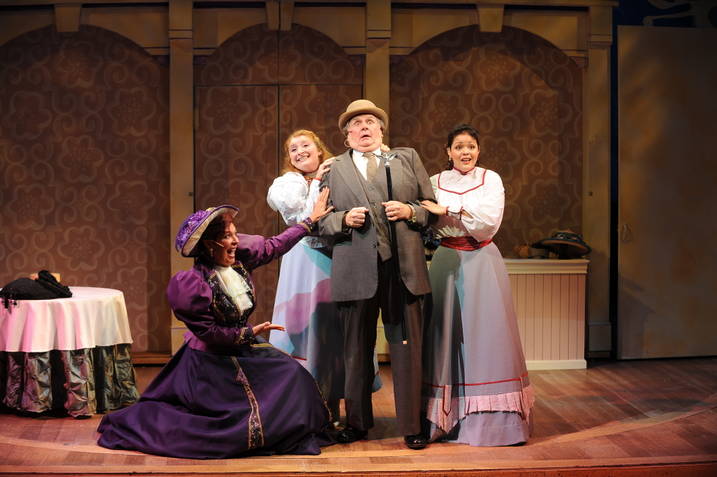
Hello Dolly


HELLO DOLLY, a love affair between Terri Kent and the audience


It was obvious from the pre-performance speech by the iridescent Maryann Black, to the shouting cheer for Terri Kent’s entrance on stage as Dolly Levi, to the rousing curtain call, that the open night audience was there to pay tribute to the long time Artistic Director of the Porthouse theatre. No matter her near laryngitis from extensive rehearsals, the throng loved her.

Kent, returning to the stage after a thirteen year hiatus, portrayed Dolly Gallagher Levi, as the scheming, irascible matchmaker. The role is the signature piece of the ageless Carol Channing and was also a character made famous by Barbara Streisand in the film version of the show.

HELLO DOLLY!, which has lyrics and music by Jerry Herman and a book by Michael Stewart, is based on Thornton Wilder's THE MERCHANT OF YONKERS, which Wilder revised and retitled THE MATCHMAKER.

The musical was first produced in 1964, winning the Tony Award for Best Musical. It was also made into a 1969 film that was nominated for seven Academy Awards.

Interestingly, though most think of Carol Channing as Dolly Levi, the role was originally written for Ethel Merman, who decided not to do the part. Dolly was offered to Mary Martin, who also declined. Eventually, Channing was hired and made the role not only hers for life, but made the show an international hit.

The story centers on a meddlesome widow who, out of need for money, and her natural exuberance for controlling others and searching for a satisfying life, turns matchmaker, striving to bring romance to others as well as herself.

The memorable score includes such hits as It Takes a Woman, Put on Your Sunday Clothes, Before the Parade Passes By, Elegance, It Only Takes a Moment and the title song, Hello Dolly.
Porthouse’s production, under the direction of Victoria Bussert, is enjoyable, with many highs and some okays.

John Crawford’s choreography is creative, though maybe a stretch for some of his dancers, some of whom had difficulty with the lifts and timing. Jonathan Swoboda’s musical directing is on key, staying under the spoken and sung words, thus not obliterating the words. Most of the vocal blendings were good.

Scenic Designer Nolan O’Dell did the cast a disservice by creating a set that was too far downstage, giving little room to move freely and forcing dancers and actors to continually watch carefully as they walked up and down platforms, thus causing the performers to break concentration while trying to avoid tripping. His choice of bland paint colors for this vivid show is also questionable.

Judith’s costumes were era correct. But, watching the actors sweating profusely in the heavy costumes, on the very hot night, was a little uncomfortable.

Kent was delightful in her portrayal of Dolly. Chuck Richie, as Horace Vandergelder, the focus of Dolly’s husband interest, was excellent in the role. He displayed just enough huff and puff and underbelly vulnerability.

Eric van Baars did what he does best, mugging and having one heck of a good time as Cornelius Hackl, the 33-year old (oh, come now!) boyish clerk in Vandergelder’s store. Jason Leupold was delightful as Barnaby, Cornelius’s sidekick. Jessica Cope was charming as Irene Molloy, Vandergelder’s intended who winds up with Cornelius. Rebecca Wolfe was adorable as Minnie Fay, Irene’s shop assistant.

Highlight numbers included: Dancing, Hello Dolly, It Only Takes a Moment and Put on Your Sunday Clothes.

CAPSULE JUDGMENT: The sold out opening night audience got what they came for—cheering the return to the stage of the charming Terri Kent, and, incidentally, seeing a nice evening of musical theatre!

Thursday, July 28, 2011

Grand Hotel


THE GRAND HOTEL at Mercury Summerstock

GRAND HOTEL, whose 1989 production had a healthy run on Broadway, is the kind of show that seems dated and tired, even with an enthusiastic production.

Based on the 1929 Vicki Baum novel and play, Menschen im Hotel (people in a hotel), and the 1932 MGM feature film, the musical focuses on events taking place over the course of a weekend in an elegant 1928 Berlin hotel.

The story line centers on an overlapping view of various hotel guests. Included are an ill Jewish bookkeeper who is originally the victim of anti-Semitism, but finally is given a room; a temperamental past-her-prime ballerina who becomes involved in a cougar-cub relationship with a destitute Baron who is in deep debt and is being threatened with death; a lying businessman; and a typist who dreams of a career in Hollywood.

The book/music and lyrics are by Luther David, Robert Wright and George Forrest, with additional music and lyrics by Maury Yeston. Never heard of them? Well, you probably haven’t heard of most of the music from the show either. Titles include: Fire and Ice, Villa on a Hill, I Want to Go to Hollywood, Love Can’t Happen, and You Bring New Light. Not exactly stuff that populates your I-pod.

The Mercury cast puts out full effort. Pierre-Jacques Brault’s direction is creative and much of the singing is on key. Brault’s choreography well fits the music and is nicely done, especially considering the tiny stage space he has to work with. Keeping the entire cast on stage so they flow in and out of scenes was a nice touch. The problem is a script and the score. They just don’t go any place, don’t light up the stage, lack being memorable.

Brian Marshall is a combination Groucho Marx and Charlie Chaplin as Otto Kringelein, the ill put-upon Jewish bookkeeper. (Michael Jeter won several awards for the role the original Broadway production.) Marshall has some fine moments, especially in At the Grand Hotel.

Nate Huntley does an acceptable job of acting the role of Baron Von Gaigern, but has difficulty with the higher register singing.

Amiee Collier (Raffaela), Holly Feiler (Elizaveta Grushinskaya) , Emily Grodzik (Flemmchen) all create consistent characterizations. Collier’s What She Needs and Grodzik’s I Want to Go to Hollywood were show highlights. Jonathan Ramos does a nice vocal singing You Bring New Light.

The show runs without intermission.

CAPSULE JUDGEMENT: Mercury’s production is an acceptable evening of theatre, but GRAND HOTEL is one of those musicals that makes you wonder

Tuesday, July 26, 2011

Rockin' Summer, Verb Ballets 7/11


ROCKIN’ SUMMER: Verb Ballets at Cain Park

It was a hot night in the open-air Cain Park Evans theatre. On stage was Verb Ballets performing a program with a world premiere by a former Cleveland School of the Arts dancer/choreographer and a duo of company premiers.

CONTIUUM, choreographed by Antonio Brown, with a Remix of music by Brown, featured mood setting lighting by Trad Burns.

The piece, whose movements well fit the changing moods of the sounds, was the highlight of the evening. Filled with energetic movements, the dancers performed with confidence and discipline. The creation was a moving collage of weaving bodies, aerobic dynamics, flowing arms, contrasting forms and visual energy.

Brown not only created a strong piece, but obviously found a way to work with the company’s many new, as well as the experienced dancers. Bravo Antonio, we want to see more of your work!

SONG WITHOUT WORDS is choreographer Heinz poll’s tribute to those lost in the Holocaust. It was performed to the live playing of pianist David Fisher, who performed for years with the Ohio Ballet under Poll. Fisher created the music’s arrangement.

The story ballet, was enhanced by dark mood lighting, highlighted by the darkening skies which could be seen over the black backdrop in front of a line of the park’s shimmering trees.

Poll’s purposeful choreography showed the strife of those who became victims of the Nazis. Poll based the story on the poem Butterfly by Czech poet, Pavel Friedman who spent much of the war in Thereisenstadt where the poem was found after the war. He died after being transferred to Aushwitz. The poem ends with the poignant line, “That butterfly was the last one. Butterflies don't live in here, in the ghetto.”

Though there was a lack of cohesion in several parts, an excellent duet by Brian Murphy and Stephanie Krise, some strong dancing by Rebecca Nicklos and Kara Madden, a nice trio by Katie Gnagy, Jason Wang and Danielle Brickman, and an angst filled solo by Jarrod Sickles, were the piece’s highlights.

The unspecific costumes didn’t visually set the mood nor identify the people. If these were Jews, why no yarmulkes, tizzies or the required gold stars of David?

The opening number, JANIS & JOE, a 2011-2012 company premiere, was ragged. The ballet, as choreographed by Christopher Fleming, seemed under rehearsed, with many tenuous movements, poor corps timing, and some weak partnering. Maybe all the new male dancers, and the inclusion of a group of youngsters, was just too much to coordinate, but, this was a disappointing and underwhelming performance.

Capsule judgement: Verb Ballets’ ROCKIN’ SUMMER was an uneven evening of dance. The performance’s highlight was CONTINUUM, choreographed by Cleveland School for the Arts’ graduate Antonio Brown.

Sunday, July 24, 2011

Stratford Festival of Canada 2011 reviews


The Stratford Shakespeare Festival of Canada is in full production


The Stratford Festival of Canada, located in Stratford, Ontario, is waiting for you! Great theatre, good food, and nice scenery.

My reactions to the plays I saw were:

Superb, totally involving THE LITTLE YEARS

Every once in a while a play and production so captures the imagination, and is so emotionally moving, that it deserves the designation of “superb,” in a class of its own. Stratford’s THE LITTLE YEARS is such a play and production.

In his masterfully written script, John Mighton examines how life’s circumstances, societal attitudes, and our significant others affect our psyche. The author rightly describes his creation as being, “about lost opportunities and lost potential.”

Kate, a math and science prodigy, is persuaded by her mother and teachers that her ambitions and perspectives are unrealistic for a young woman in 1950. Her brother William, however, is celebrated and nurtured for his genius.

As we watch, a transition of twenty years takes place and we experience the horrific effects of the decisions made. Kate is a self and other outcast, William’s star has burst. She puts her thoughts and feelings into a set of diaries, which when later found and read, brings about dramatic changes in the lives of both Kate and William’s daughter.

This is a poignant chronicle of a meaningful life unlived, but allows for a potential bright future for another person because the life was lived in the way that it was.

The festival’s production, under the laser focused direction of Chris Abraham, is compelling. Abraham has taken Mighton’s words and created one of the finest pieces of theatre I’ve ever seen. Irene Poole is mesmerizing as Kate. This is an award winning performance. The rest of the cast works as a focused unit to bring about an ending that brought tears and cheers from the audience.

Capsule judgement: The Festival’s THE LITTLE YEARS is an amazing accomplishment. It is an absolute must see. I seldom give a play a standing ovation. At the conclusion of the production I was on my feet screaming as soon as I was able to get my emotions under control.

TWELFTH NIGHT delights

Twelfth Night is a romantic comedy. Despite the fact that the play offers a happy ending, in which the various lovers find one another and achieve bliss, Shakespeare shows that love can cause pain.

The play, which has been called, “one of Shakespeare’s transvestite comedies,” contains plot ideas which include that the clear lines of gender are uncertain and ambition is folly.

Like many of Shakespeare's comedies, this one centers on mistaken identity. The leading character, Viola, is shipwrecked on the shores of Illyria during the opening scene. She loses contact with her twin brother, Sebastian, whom she believes to be dead. And thus the elements are set for love, comedy and fun.

Des McAnuff’s directing is focused. The cast is outstanding, the timing wonderful, the visual and special effects attractive, the sets add to the production, and Michael Roth and Des McAnuff’s musical interludes are wonderful. Tom Rooney shines as Malvolio, Cara Ricketts is wonderful as Maria, and Stephen Ouimette steals the show as Sir Andrew Aguecheek.

Capsule judgement: TWELFTH NIGHT is a delightful production which nicely holds the audience’s attention.

The un-MERRY WIVES OF WINDSOR

It’s pretty bad when the best part of a theatrical production is the intermission.

This is the sixth time that the Festival has produced THE MERRY WIVES OF WINDSOR. In the past lives, the productions have been called fun, even giddy. Unfortunately, that’s not the case with the present poorly directed, poorly paced, mainly humorless production.

Merry Wives looks at life in sixteenth century Italy. Sir John Falstaff arrives in Windsor very short on money. He decides to court two wealthy married women, Mistress Ford and Mistress Page. Through a series of fanciful incidents, Falstaff finds himself in a clothing hamper, thrown into the Thames, and generally disgraced. Duels, threats, sexual innuendoes, sarcasm, and rejection open the door for potential delight.

Unfortunately, in the misguided hands of director Frank Galati, the script falls flat. Geraint Wyn Davies is not funny as Falstaff. Nigel Bennett can’t be understood as Doctor Calius. Janet Wright develops no characterization as Mistress Quickly. And, that’s only the tip of the complaints.

As someone in the audience said at intermission, “This is the unfunniest funny play I’ve ever seen.” His companion said, “Let’s get some wine, maybe that will make the second act better.”

Capsule judgement: THE MERRY WIVES OF WINDSOR is a poorly conceived production that is not only boring, but close to embarassing!


TITUS ANDRONICUS…a compelling horror of revenge

In this age of racial, cultural and religious conflicts, civil incivility, and political intractability, it seems only proper that the Festival showcases a horror play about the folly of revenge.

TITUS ANDRONICUS is one of Shakespeare’s least produced shows. It is no wonder. Featuring rape, severing of hands and a tongue, torture, beheadings, rape, vile verbal outbursts, a live burial, cannibalism, and mass murders, this is not a play for the weak of stomach. It is a nonstop tale of abominations.

The play is set during the latter days of the Roman Empire, and tells the fictional story of Titus Andronicus, a general who returns from years of war as a conquering hero, but with only four out of twenty-five sons still alive. He has captured Tamora, Queen of the Goths, her three sons, and Aaron the Moor. In compliance with Roman rituals, Andronicus kills Tomora’s eldest son to avenge the death his own fallen children. This act earns him Tamora's promise of revenge. Thus the path is etched for the ensuing blood bath.

The production, under the focused directing of Darko Tresnjak holds back nothing. Performed in a thrust stage with the audience close to the action, almost too close as every vivid detail jumps out, the action is visually and emotionally startling.

The cast is universally strong, with John Vickery totally believable as Titus, the beautiful Amanda Lisman heartbreaking as his raped and disfigured daughter Lavinia, Claire Lautler, properly hellish as Tomara and Dion Johnstone evil incarnate as Aaron.

Capsule judgement: Filled with visually repulsive action TITUS ANDRONICUS is a repugnant lesson about revenge that is not an easy sit in spite of getting a transfixing production.

CAMELOT, a perfect place, a perfect time, a perfect love story!

Allan Jay Lerner and Frederick Loewe often center their musical plays on finding the perfect place, time and love story. What could be a better place than Camelot, (“in short, there’s simply not a more congenial spot for happ’ly ever-aftering”); the era of King Arthur and his “might for right” round table of knights; and the love of Arthur and Guenevere (or is it Guenevere and Lancelot?)?

The fantasy has wonderful music: I Wonder What the King is Doing Tonight?, The Simple Joys of Maidenhood, How to Handle a Woman, What Do The Simple Folks Do?, I Love You in Silence, and the theme song.

The sets, costumes, lighting, music, and performances are all top notch. Director Gary Griffin’s directing is traditional, but effective, and the choreography is in keeping with the music and the time period.

Geraint Wyn Davies makes for a picture perfect King Arthur. Kaylee Harwood is radiant as Guenevere. Her voice is lovely and she is totally believable in the role. Jonathan Winsby is handsome and sings and acts the role of Lancelot well, but he just doesn’t have the physicality needed for the role.

Capsule judgement: “Don’t let it be forgot, that once there was a spot, for one brief shining moment, that was known as Camelot.” Right now that place is Stratford’s Shakespeare Festival where the show is getting a fine production.

I did not get to see JESUS CHRIST SUPERSTAR. Sources I trust raved about it.

Hotels, motels and bed and breakfasts abound. I like Avery House, 330 Ontario Street (800-510-8813) where Sue makes wonderful breakfasts and Judy is Mrs. Clean! Park your car and walk everywhere.

Hungry? For moderate cost and high quality, try The Annex Cafe (38 Albert Street) and Simply Fish and Chips With a Twist (118 Downie Street), which subscribes to the Ocean Wise program for fish stability.

My wife can’t get out of the Touchmark Shop (137 Ontario Street), which was awarded the Chamber of Commerce 2010 Excellence Award, without bags full of original Canadian clothes and jewelry.

Packages can be arranged by Stratford Escapes (theatrevacations.com), is an efficient way to make reservations. For individual tickets call 800-567-1600 or go on-line to www.stratfordfestival.ca.

Go to Stratford, Canada! Find out what lovely hosts Canadians are, and see some great theatre!

Friday, July 22, 2011

Shaw Festival--2011 reviews


THE SHAW FESTIVAL quality theatre in a lovely setting

The Shaw Festival, which is located in Niagara-on-the-Lake, Canada is celebrating its 50th season. The “most beautiful city in Canada” is in full bloom.

Here are my reactions to the shows I saw. There are others which I couldn’t fit into my schedule.

Marvelous MY FAIR LADY

It is only appropriate for The Shaw to stage a production of MY FAIR LADY for it is based on PYGMALION, which was written by the Festival’s namesake. With memorable music by Frederick Loewe and vivid lyrics by Alan Jay Lerner, the show is generally regarded as one of musical theatre’s greats.

My Fair Lady centers on Eliza Doolittle and her quest to become a proper lady under the tyrannical tutelage of Henry Higgins, a phoneticist, who, like Shaw himself, believed that one’s class in society was determined by the language one spoke and how it was spoken. Of course, as is the case with most Shaw plots, the British educational system, politics, and class system all come under attack.

The score includes such memorable songs as With a Little Bit of Luck, I Could Have Danced all Night, On the Street Where You Live, Get Me to the Church on Time, and I’ve Grown Accustomed to Your Face.

The musical opened to unanimously glowing reviews, one of which said “Don't bother reading this review now. You'd better sit right down and send for those tickets.” My review of the Shaw production would have said the same thing if the lines hadn’t been used already.

With one exception, the production, under the creative and watchful eye of Molly Smith, is marvelous. Wouldn’t It Be Loverly if all musicals had such a score, lyrics, book and production quality!

The choreography, set design, musical sounds, lighting, and chorus blends are all spot on. Only the costumes, specifically the Ascot scene, were off hue. Instead of stuffy, prim and proper British, we were instead confronted by reggae Mardi Gras garish colors and patterns.

Benedict Campbell makes Higgins all his. No Rex Harrison imitation here. He has a tender underside to his cantankerous outer self. And this is a Higgins who sings, rather than talks the songs. Deborah Hay, though not the visual image of the traditional Eliza, sings, acts and creates a feisty cockney who becomes a believable fine lady. Patrick Galligan (Pickering) makes for a perfect contrast to the erupting Higgins, and Neil Barclay is a hoot as Liza’s free-will father. The rest of the cast is of equal quality.

Capsule judgement: A message to The Shaw: “You Did It,” you created a MY FAIR LADY that is memorable and will delight audiences who, “With a Little Bit of Luck,” will be traipsing “On the Street Where You Live.”


THE PRESIDENT, delightful satirical mockery of the business world

What does a person do when you are a British guardian of a young heiress and she announces her secret marriage to a communist taxi driver shortly before her parents arrive for a visit? If you are the all powerful president of a large bank, you totally remake the bloke. You dress him in the finest clothes, give him a high position in the bank, and provide him with lots of money. In other words, create an egomaniac with new found power and wealth.

THE PRESIDENT, Ferenc Molnár's comedy, which was a hit in the Shaw Festival's 2008 season, has returned with many of the original cast, including the delightful Lorne Kennedy as the bank president.

How Kennedy remembers, let alone perfectly orally machine gun fires all of his lines, is amazing. The rest of the cast is up for the rollicking happenings.
Capsule judgement: THE PRESIDENT is an hour of total hilarity and a must see!

THE ADMIRABLE CRICHTON---a slight pastiche

Though he wrote many plays and other pieces of literature, J. M. Barrie is probably best known as the author of PETER PAN. The ADMIRABLE CRICHTON, one of his fantasies, is Barrie's slight satirical jab at class consciousness.

Although the play deals with serious issues, it is so mild in its rebuke, doing little to seriously advance the cause of changing the social structure of England. As a play it is a slight piece of pastiche, neither compelling attention nor gaining much laughter. It’s G. B. Shaw lite!

The story centers on William Crichton, an efficient butler in the London household of the Earl of Loam and his family. Though Crichton is the true master of the household, he knows his place, honoring the structure of the highly regulated social structure of late-nineteenth century England.

On a trip to the South Seas, on the Earl's yacht, the family and its servants are shipwrecked. They are marooned on an island, and only Crichton has the skills and resourcefulness to keep everyone alive. Within a few months, the social order has been reversed with Crichton taking control, while his former employers become his willing servants. Eventually they are rescued, return to London, and the master-servant status quo is restored. The moral of the tale is questionable, and that’s the major problem with the script.

The Shaw production is pleasant. The acting is efficient, though Steven Sutcliffe (Crichton) could have been a little more pompous in the earlier scenes thus making his transition to the “guv” more ironic.

There are clever bits with various animals leading the audience through song and dance through the tale. The highlight of the production is the rollicking curtain call.

Capsule judgement: Shaw’s THE ADMIRABLE CRICHTON is a pleasant evening of theatre which says little to modern day audiences. It’s the kind of theatrical experience
that fifteen minutes after its over, you’ll forget you saw it.

ON THE ROCKS rocks politics

ON THE ROCKS, G. B. Shaw’s rarely performed political comedy, finds a Prime Minister in the grips of economic forces that are beyond his human control and, because of his caring concern, is heading for a personal emotional collapse. His views are out of sorts with the conservatives who are an integral part of his coalition cabinet. He goes on a self-imposed retreat. On his return, refreshed and invigorated, he embarks on a wholesale liberal agenda of nationalization, with jarring consequences.

Watching this play, a U.S. citizen can only make an immediate transfer to the present governmental stalemate. With a few minutes of time, a writer could change the names of the players, substitute Obama and Boehner, and make the first act of ON THE ROCKS into a reflection of the inside of the Beltway’s ridiculous goings on.

As is often the case with Shaw, he argues that English politics does not bear thinking about; and since democracy is a myth, it would be better to embrace Fascism and dictatorship wholeheartedly.

One of the show’s major criticisms is that the characters mainly sit around and talk. But they also scream, pontificate and clearly illustrate the folly of politics. The second act gets bogged down with Shaw’s obsession with communism, based on the fact that he had recently returned from a trip to Russia, where he developed a love-affair with the Soviet system.

The prime minister role is well played by Peter Krantz and Steven Sutcliffe is dogmatically scary as Sir Dexter Rightside, the conservative minister. They are surrounded by an excellent cast.

Capsule judgement: Though it is well done, ON THE ROCKS will be of interest to a select few….political junkies and Shavians.


CANDIDA delights as a woman reigns supreme

George Bernard Shaw was a man of convictions. He strongly expresses his views of the Victorian notions of love and marriage and the role, power and intelligence of women, in his delightful and well-crafted CANDIDA.

This is the story of Candida, the wife of a Christian Socialist clergyman, who is adored by his parishioners and is the constant guest speaker at political functions. Candida returns home briefly from a trip to London with Eugene, a teenage romantic poet who is not only in love with her, but wants to rescue her from what he presumes to be her dull life. Ultimately, Candida must choose between the two men and, in a typical Shaw speech, selects the "weaker of the two." During the dialogue Shaw weaves his political and sociological attitudes.

Clair Jullien is charming as Candida, Nigel Shawn Williams is excellent as The Reverend, but it is Wade Bogert-O’Brien who steals the show as Eugene. His is role which could easily become farcical, thus ruining the meaning of the play. Bogert-O’Brien textures the characterization, drawing a clear line between smitten love and the out-of-control feelings of a hysterical, hormone driven teen.

Capsule judgement: CANDIDA is a meaningful script that gets a delightful production at The Shaw. Go see Wade Bogert-O’Brien weave his boyish angst.


HEARTBREAK HOUSE, a very long sit!

On the eve of World War I, Ellie Dunn, her father, and her fiancé are invited to one of Hesione Hushabye’s infamous dinner parties. Unfortunately, her fiancé is a scoundrel, her father is well meaning but ineffectual, and she’s actually in love with Hesione’s husband.

Shaw’s HEARTBREAK HOUSE is a dream play, a mystery, a fantasy and a puzzlement, which contains inane and seemingly insane banter, yet is prophetically real. Shaw spends sixty-five pages of introductory material explaining his views and what he is trying to say. He spends a long three hours writing about these ideas in the script.

Shaw warns that at this point in history, just at the start of World War I, "cultured, leisured Europe" was drifting toward destruction, and that "Those in a position to guide Europe to safety failed to learn their proper business of political navigation". The script, a mix of low comic farce and tragedy, is an indictment of the generation Shaw thought was responsible for the First World War.

Michael Ball is wonderful as the cantankerous Captain Shotover, Benedict Campbell is appropriately obnoxious as Boss Mangan, and Robin Evan Willis is spot on as Elle, who is the queen of innocent manipulation. The rest of the cast is also excellent.

The house/boat set is appropriate, but creates movement problems for the actors who are constantly climbing up, down and over stacks of books and ladders and makes for some confusion in the second act.

Capsule judgement: HEARTBREAK HOUSE is a long, very long sit. In spite of being a good theatrical production, and containing many of Shaw’s prophetic messages, there isn’t a lot to appeal to a present day audience.


The Niagara area is dotted with wineries, many of which, besides offering wine tastings and sales, have fine dining facilities.

There are some wonderful restaurants including the Dining Room located at the Niagara Culinary Institute (www.niagaracollege.ca/dining. And my in town favorite, The Grill on King Street (905-468-7222, 233 King St.)

The area has many excellent hotels and bed-and-breakfasts. Our home away from home is the beautiful and well-placed Wellington House (www.wellington.house@sympatico.ca), directly across the street from The Festival Theatre. For information on other B&Bs go to www.niagaraonthelake.com/showbedandbreakfasts.

For theatre information, a brochure or tickets, call 800-511-7429 or go on-line to www.shawfest.com. Ask about packages that include lodging, meals and tickets. Also be aware that the festival offers day-of-the-show rush tickets and senior matinee prices.

Helpful hint: A passport is a border crossing requirement!

Go to the Shaw Festival! Find out what lovely hosts Canadians are, and see some great theatre!

Monday, July 11, 2011

Review of the Reviewer's Reviews: Joel Arndt


Roy,

We saw The Sunshine Boys Saturday night and your review is spot on. Our comments echoed yours. Exactly one member of the audience gave this production a standing ovation. Love Neil Simon's work, but time to retire this one.

Regards,

Joel

Hairspray


Beck’s HAIRSPRAY pleases audience, but. . .

The setting: Baltimore, Maryland, June 1962. “Balmur, Murlun,” where they “warsh in a zink,” cheer for the baseball “erls” (Orioles), and everyone is known as “hon.” Baltimore, circa 1962, a segregated southern city where North Avenue was the line, much like the Berlin Wall, that divided the city. In this case it divided whites from blacks, and never the twain shall interact. This was mainly true even in the 80s when I lived in Charm City.

HAIRSPRAY, THE BROADWAY MUSICAL centers on "pleasantly plump" Tracy Turnblad, a teenager who is in love with life, pursues stardom as a dancer on a local TV show, and rallies against racial segregation. When she isn’t in detention because of her against-the-rules oversprayed flip hairdo, she rushes home from school with best friend, Penny, to catch The Corny Collins Show. It’s a teenage dance show based on the real-life Baltimore classic Buddy Deane Show. At home is Edna, Tracy’s shy, plus-sized mother and her father, the owner of a store which sells gags, including large-sized whoopee cushions.

When, by some quirk, Tracy wins a role, she becomes a celebrity overnight and launches a campaign to integrate the show and make every day, “negro day” instead of the token display of blacks once a month. Along the way, Tracy finds love, Edna finds it’s okay to be “big and beautiful,” and hopefully, the audience gets a history lesson about segregation and enjoys themselves.

HAIRSPRAY, THE BROADWAY MUSICAL, is based on the 1988 John Waters’ movie. Waters, a life-long Baltimore resident and “trash” and cult film maker, wrote the script, a more serious undertaking than his early flicks, to chastize his hometown residents for their segregationist views.

The musical's original Broadway production opened on August 15, 2002 and won eight Tony Awards. It ran for over 2,500 performances and stared Marissa Jaret Wionokur as Tracy and Harvey Fierstein as Edna. It was followed by a movie staring John Travolta as Edna, Nikki Blonsky as Tracy, and Queen Latifah as Motormouth Mabel.

HAIRSPRAY, with music by Marc Shaiman, lyrics by Scott Wittman and Shaiman, and a book by Mark O'Donnell and Thomas Meehan, has wonderful 1960s-style dance music and "downtown" rhythm and blues. The memorable score includes “The Nicest Kids in Town,” “Mama, I’m a Big Girl Now,” “Big, Blonde & Beautiful,” and ”You Can’t Stop the Beat.”

The score turned out to be controversial with conflict over “I Know Where I’ve Been,” sung by Motormouth Mabel, the black owner of a record store. As one of the production team explained it, the song was “inspired by a scene late in the [1988] movie that takes place on the black side of town. It never dawned on us that a torrent of protest would follow us from almost everyone involved with the show.” He went on to say that many felt is was too preachy. “[But] we simply didn’t want our show to be yet another show-biz version of a civil rights story where the black characters are just background.”

And this philosophy makes this musical unique. Though many find the show to be out and out fun, it is much, much more. HAIRSPRAY is a social commentary on the injustices of much of the country in the 1960s. And, that’s where, in some respects, the Beck production stumbles.

The opening night audience laughed and applauded with glee, cheered the songs, marveled at the wonderful choreography by Martin Cespedes, the master designer of dancing of many local theatre musicals. But, I’m not sure, due to some directing and staging issues, that the message of the show came across.

There were times when visual images on stage failed to separate blacks and whites. Instances where inappropriate interactions of the races, and blending of interracial groups, made the “race thing” not stand out.

The cast varied from great to barely acceptable. Brittany Lynne Eckstrom was a strong Tracy. Her vocals were all excellent. “Good Morning Baltimore” set the proper tone for the show, and her part of “I Can Hear the Bells” was great (but one must wonder why rather than using bells the chorus was “ringing” Coke bottles, eliminating the needed audio sound).

Tina D. Stump was nothing short of sensational as Motormouth. She had the right attitude throughout and her “I Know Where I’ve Been” stopped the show.

Kevin Joseph Kelly, playing the role of Edna in drag, which has become a tradition in the various productions, wisely underplayed the role, not making it into a cross dressing parity. A little more sass and intensity, however, could have helped when Edna finally comes out of her shell. Kelly’s duet “You’re Timelss to Me,” with husband Wilbur (Mark Heffernan) was nicely done.

Alexis Generett Floyd was delightful as Little Inez, Motormouth’s daughter. Anna Bradley, who was fun as the nerdy Penny, was sometimes a little hard to understand, especially in her overly high pitched singing. Laurel Held stayed on the surface as the supposedly bigoted Velma. Her “Miss Baltimore Crab” was void of humor.

The role of Link Larkin is one of those “stereotype” parts that requires a Ken doll who can sing, dance and act. (Think Zak Efron who played the role in the film.) Unfortunately Cody Zak had only his Ken doll looks going for him. Antwaun Holley, as Seaweed, Motormouth’s son, dances well and has a nice sense of comedy, but had great difficulty with the singing aspects of the role. Mark Heffernan was generally bland as Tracy’s supposedly quirky dad.

There was a lack of vocal depth from the choir. There were too few bodies on stage to develop the needed big sound that the show requires.

Ben Needham’s sets worked, but the barless jail cell made the breaking out scene void of impact.

CAPSULE JUDGEMENT: If opening night is any indication, audiences will really like Beck’s HAIRSPRAY. I wish more attention had been paid to making sure the purpose of the script had been more clearly developed and more care had been exercised in casting.

Sunday, July 10, 2011

Idina Menzel


IDINA MENZEL AT BLOSSOM

On July 2, Idina Menzel, the star of the Broadway shows WICKED and RENT, and who was featured on the television show GLEE this past season, performed with the Cleveland Orchestra. It was a magical night filled with Broadway theatre tunes, delightful personal stories and a love affair between the performer, the orchestra and the audience. It was a night not to have been missed!

Capsule judgement: Bravo!

The Sunshine Boys


An attempt at a nostalgic visit: THE SUNSHINE BOYS at Porthouse

Neil Simon has held the title of “the crown prince of theatrical comedy” for many years. He is a Tony and Emmy award winner. He holds the distinction of having four shows playing on Broadway at the same time during the 1966 Broadway season: SWEET CHARITY, THE STAR-SPANGLED GIRL, THE ODD COUPLE, and Barefoot in the Park.

Simon is the author of both comedies and musicals including CHAPTER TWO, THEY'RE PLAYING OUR SONG, I OUGHT TO BE IN PICTURES, BRIGHTON BEACH MEMOIRS, BILOXI BLUES, BROADWAY BOUND, THE GOODBYE GIRL, and LAUGHTER ON THE 23RD FLOOR. In general, his strongest works are those that recount his personal life.

THE SUNSHINE BOYS, now on stage at Porthouse Theatre, not only has a long theatre life, but was made into a film and television show.

The play concerns a fictional vaudevillian team known as Lewis and Clark, a duo that played the circuit for forty-odd years. Their working relationship came to an end when Lewis decided that vaudeville was dying, the cantankerous Clark was driving him crazy, and “enough was enough.” After Lewis’s retirement, Clark tried to continue on his own, but old age, forgetfulness, and his stubbornness got in his way.

In the play we find Willy Clark living alone in a Manhattan hotel apartment, constantly reading Variety for show biz news, observing the deaths of his contemporary performers, and driving his agent-nephew crazy. When The Ed Sullivan television show wants to do a special about the history of comedy, they invite Lewis and Clark to headline. Bringing the duo together, as can be expected, results in conflicts and laughs.

Simon supposedly used the real vaudeville team of Smith and Dale as the basis for the duo in the play. But, unlike Lewis and Clark, Smith and Dale were inseparable lifelong friends. So he looked to another team, Gallagher and Shean, who were noted for their argumentative style during their onstage performances for the conflicting underbelly.


THE SUNSHINE BOYS opened on Broadway on December 18, 1972 and ran for 538 performances. The original cast included Sam Levene as Lewis and Jack Albertson as Clark.

For THE SUNSHINE BOYS to work, the actors must be able to duplicate the comic timing of the Jewish entertainers of vaudeville days, who honed their skills by doing the Borscht Belt circuit in the Catskill mountains. There is a cadence to Yiddish speaking that translates into the outlandish sounds and material developed by these English speaking entertainers. Without that tonation, pausing, and sound pacing, the material falls flat. It is very difficult to do. It takes a Groucho Marks, Jack Benny, Milton Berle, Weber and Fields to make the material work.

Though they try hard, George Roth (Willie Clark) and Marc Moritz (Al Lewis) just don’t get the timing or the sound right. The famous “The Doctor is In” routine fell flat. As someone sitting behind me said at the conclusion of that section of the production, “Was that supposed to be funny?” Unfortunately, at least on preview night, it wasn’t.

Roth seems more comfortable with the material than Moritz. But, Roth screams his way through much of the action, forgetting sometimes to texture and build up to emotional climaxes. But, he at least tries to develop the cadence in the skit and show the motivations of the character.

Moritz underplays the entire exercise to the point of near boredom, giving a tuna and white bread read to the role, rather than a corned beef on rye interpretation.

Director Rohn Thomas needed to work with the duo on the needed variance of emotions and getting the right comic vaudeville timing. He should have heeded the vaudeville biz edict, “Dying is easy. Comedy is hard.”

The script may have outlived its lifetime. Younger audiences, unfamiliar with the whole Borscht Belt era and days of vaudeville, will be lost in the references and probably not identify with the humor and ego in-fighting of the era. This is a script that needs a New York audience of the mid-nineteen hundreds to appreciate the idea completely.

CAPSULE JUDGMENT: THE SUNSHINE BOYS is a Neil Simon show that gets an acceptable, but not a commanding performance at Porthouse Theatre. Some might enjoy the old-time humor.

Saturday, July 02, 2011

The Miracle at Naples


Laugh, but be warned—convergence continuum’s MIRACLE AT NAPLES

David Grimm’s THE MIRACLE AT NAPLES is the kind of script that convergence continuum’s Artistic Director, Clyde Simon loves. It’s filled with sexuality, bawdiness, in-your-face language, has a convoluted plot, and offers lots of opportunities for slapstick.

THE MIRACLE AT NAPLES has a commedia dell'arte backbone. That type of Italian theatricality laid the foundation for the laughs in early slapstick films (think Marx Brothers, The Keystone Cops and the Three Stooges). It centers on misunderstanding, mistaken identities, mix-ups, trickery, and sexual innuendos.

Don Bertolino Fortunato, the conniving leader of a motley band of traveling players, arrives in a Neapolitan town square on September 19, 1580. The people of Naples are awaiting the annual miracle: the liquefaction of the blood of the city's patron saint. Unfortunately, the miracle won't occur, and therefore, neither can the feast of San Gennaro. That means that the penniless troupe can’t perform. They have nothing to do with their free time other than to cause chaos and become lustful lovers. In the process, one of the performers announces her pregnancy, two of the male cast not only have a liaison with a local lass, but fall in love with each other, and Fortunato, himself, rekindles an old love affair.

A Boston director of the show stated, "David's genius is that he matches the play's bawdiness and boisterousness with incredible emotional depth and wit. This play is a gorgeous human exploration of love in its multiple forms, from the improvised and instinctual, to the courtly and classically romantic. David is a real poet of both the beauty of instant pleasure and the search for enduring meaning. He is equally adept at writing a deeply textured scene about love as a good dirty joke, and this play has plenty of both!" I wouldn’t go so far as referring to the script as having incredible emotional depth, but it is very, very funny and well written.

How can a script with such lines as, “She has a face like a smacked ass” and “You are the joke, I am the punch line,” not delight?

Con-con’s production, under the direction of Geoffrey Hoffman, is fun. He builds a nice level of pace and panic and seems to have a touch with the sexual overtones. Maybe his forthcoming marriage has keyed his sensual senses.

Robert Hawkes hits all the right notes of outrageousness of Don Bertolino Fortunato, the father and theatrical director from hell. Lucy Bredeson-Smith is a laugh hoot as the overbearing Francescina, nanny to the sweet, teenaged Flaminia. Francescina’s plot for her ward can have sex and still be a virgin, is only one of many hysterical plot developments. Beautiful Emily Pucell is the perfect Flaminia, a bundle of pulsating hormones with love on her mind.

Stuart Hoffman, he of overdone pronunciation and posturing, has an old-time comedian Joey Brown face that he molds into all kinds of uptight smirks as the pompous Giancarlo. Petite Lauren Smith, who both loves and hates Giancarlo, who has impregnated her, is a laugh riot.

Ray Caspio, as Tristano is delightful as the sexually confused Matteo. The star of the show is Zack Hudak, who plays the simple Matteo, who acts on emotional impulses…logic be damned. Hudak, with his doe eyes, mobile face and great comic timing, is a delight to watch. This kid knows how to create comedy! Caspio and Hudak’s “happy dance” brought forth spontaneous applause as did their extended lip lock!

The set is excellent, creating just the right mood. The Liminis, the con-con performing space, only has 50 seats so tickets may be scarce for this production.

Be warned: Horror of horrors, there are swear words spoken, male-male kissing, and the touching of female breasts.

Capsule Judgement: From its very first line, "To hell with my virginity!" to its obvious happily ever-after ending , convergence continuum’s THE MIRACLE AT NAPLES is raunchy, ribald and funny. It is definitely recommended for mature audiences who are looking for summer entertainment and aren’t uptight.

Tuesday, June 28, 2011

FAT CAMP (a preview)


A chance to see a Broadway show develop before your eyes!

Have you ever wondered how a potential Broadway show goes from script to stage? Have you been curious about what goes on during the rehearsals of a professional play? Have you ever wanted your voice to be heard about what you like and dislike about a musical? Well, if the answer to any of these questions is “yes,” you are about to get your chance. And, you don’t have to go to New York. The process is going to take place right here, in Cleveland.

PAGE TO STAGE is a new PlayhouseSquare project whose purpose is to invite theatre writers to develop Broadway-aimed productions, while allowing local audiences to provide response and feedback as the creators hone the work.

From July 13-24, the Hanna Theatre will be the center of historical theatrical activity, as FAT CAMP, a musical about a group of plus-sized teens at a sleep-away camp, is developed. The process started in 2009 when the script was showcased as part of the New York Musical Theatre Festival and was awarded “The Best of the Fest.” It also received a 2010 workshop. Now, it’s ready for the Cleveland intervention. It’s a work-in-progress and, hopefully, by the end of the PAGE TO STAGE experiment, it will be closer to stage ready.

FAT CAMP features a book by Randy Blair and Timothy Michael Drucker and music by Matthew roi Berger, with lyrics by Blair. The show will be directed by Casey Hushion (whose credits include Assistant Direction THE DROWSY CHAPERONE and IN THE HEIGHTS on Broadway). The cast are professional actors who have been selected in New York tryouts. The show will be staged with minimal costumes and sets.

The producer of the show is Dodgers, a prolific staging company. Some of their Broadway hits were JERSEY BOYS, THE SECRET GARDEN, INTO THE WOODS, URINETOWN, TITANIC, FOOTLOOSE, 1776, A FUNNY THING HAPPENED ON THE WAY TO THE FORUM, THE KING AND I, THE WHO'S TOMMY, GUYS AND DOLLS, BIG RIVER and PUMP BOYS AND DINETTES.

Tony-winning Dodger co-founder, Michael David, recently said, "We are most excited to be back in Cleveland at PlayhouseSquare, participating in their inaugural PAGE TO STAGE.” He went on to say, "The Dodgers have had a long history developing shows at PlayhouseSquare and we are most appreciative for the opportunity to nurture this young, new production; to get it up on stage and to experiment, to refine, to try to find our feet with the support of the Playhouse staff, and the audiences of Cleveland."

Gina Vernaci, Vice President of Theatricals at PlayhouseSquare, states, “Audience feedback is not only encouraged it is crucial to the success of both PAGE TO STAGE and FAT CAMP.

How do you get involved? From July 13 through the 24th, audiences will be able to sit in on a series of performances, creative conversations with cast members and the production team, listen to curtain speeches, chat one-on-one with the cast, and fill out comments cards that will be used to hone the show. Tickets for each show will begin as low as $10. Half-price bar drinks will be sold and there will be special performances for teens on July 13 and 20th (use code TEEN). For a complete rundown of what’s going on, go to www.playhousesquare.org/pageto stage. For tickets call 216-241-6000.

Saturday, June 25, 2011

Pippin

PIPPIN tries hard, but misses the message at Weathervane

To many people, Stephen Schwartz’s musical, PIPPIN, which is now in production at Weathervane Theatre, is a slight musical that is cute, harmless and a little bit naughty. To me, it is a story of meaning and significance. We observe as Pippin, a young prince, searches for purpose in his life. A life he wishes to be “something more than long.”

Schwartz’s music and lyrics paint a clear tale of Pippin as he searches for his “corner of the sky.” He doesn’t understand why, “I don't fit in anywhere I go?” He has daydreams, and perceives that “thunderclouds have their lightening” and “eagles belong where they can fly,” but he can’t seem to find purpose for his existence. He wants to go where his “spirit can run free.” This is heady stuff. And, if interpreted correctly by a director and a cast, there is a reverent, almost spiritual underbelly to the goings-on.

I agree with musical theatre scholar Scott Miller who, in From Assassins to West Side Story, stated, "PIPPIN is a largely under-appreciated musical with a great deal more substance to it than many people realize.”

The musical uses the premise of an acting troupe, led by a Leading Player, who tells the story of characters, based on real-life people who lived in the middle ages. Yes, there was a Pippin and a Charlemagne, but the images in Schwartz’s tale don’t have much historical accuracy.

The show opened on Broadway in 1972, played almost 2000 performances, and at present ranks as the 30th longest-running Big Apple show, exceeding SOUTH PACIFIC, MARY POPPINS and HAIR. It starred Ben Vereen as the Leading Player, Jonathan Rubenstein as Pippin, Jill Clayburgh as Catherine (the female love interest), and Irene Ryan as Berthe (Pippin’s outlandish grandmother).

The wonderful score includes: Corner of the Sky, Glory, Simple Joys, With You, Morning Glow and Love Song.

The Weathervane Playhouse’s production, under the direction of Eric van Baars, is slight on theme development and long on fun. Characters are broadly portrayed, with much feigning and surface performances. The choreography is nicely conceived, the music well performed, the singing often quite good.

Connor Simpson, who doesn’t fit the usual physical image of the actor who plays the role of Pippin, has a nice singing voice and has some fine moments.

Jayson Kolbicz, who dances well and has a pleasant vocal tones, but overacts, feigns emotion and is too flamboyant as the Leading Player. He overshadows and loses the importance of the character with an overdrawn fey characterization.

Samantha Rickard makes for a lovely and believable Catherine, while Maria Work never quite found a consistent identity for Fastrata.

Karen Wood needed to have more fun as Berthe, especially in Simple Joys. Henry Bishop was a fine Charlemagne. Cody Hernandez played at being Lewis, rather than being Lewis, often substituting pseudo-feminine gestures and over-extended facial expressions for meaningful actions.

CAPSULE JUDGEMENT: Weathervane’s production of PIPPIN is long on glitz and short on meaning. It’s not bad, just, in my opinion, misses the opportunity to use the story and wonderful music to tell a purposeful message.

Jersey Boys (2011)


JERSEY BOYS back at the State…Again, ”Oh What a Night”!


There is a special aura about New Jersey, excuse me, “Nujoisy.” “De joisy fowks” talk different. “Dey” have an “addetude dat” reeks of testosterone (even the women), and find glee in being “in-ya face.” They live by “der own ruhls.” This combination of being and doing flows onto the stage in JERSEY BOYS.

The buzz of the audience before the curtain went up indicated that they were expecting something special. And, did they get it! At the end of the show they were on their feet screaming for more. (In this instance, this was not an automatic Cleveland standing ovation given for anything from good to bad to very bad productions. This was a deserved standing O!)

As Alex, the 15 year-old kid reviewer, said after the show, “Wow, that was special!” The award winning composer went on to rave not only about the music, both the writing and the playing, but the quality of the voices, the acting, and the choreography.


Yes, as one of the show’s songs rocks out, “Oh, What a Night.”

JERSEY BOYS is a story about Frankie Valli and The Four Seasons: Frankie Valli, Bob Gaudio, Tommy DeVito and Nick Massi. It supposedly is the story of how a group of blue-collar boys from the wrong side of the tracks became one of the America’s biggest pop music sensations. They supposedly wrote their own songs. They invented their own sound and sold 175 million records worldwide - all before they were thirty.


You’ll note in the last paragraph I said “it supposedly is the story” and they “supposedly wrote their own songs.” There is some controversy over how much the script’s writers, Marshal Brickman and Rick Elice, deviated from the real story. There is also some question about whether Bob Gaudio did write all of the songs. Be that as it may, there is no question about the entertainment value of the Four Seasons or the production. As one of the songs states, “Can’t Take My Eyes Off Of You.” You won’t be able to take your eyes off the stage and keep your feet still as the beat goes on and on and on.

The show opened in November of 2005 in New York. It won four 2006 Tony Awards including Best Musical and continues to break box office records on Broadway.


This production includes Matt Bailey as Tommy DeVito, the founder of the group. DeVito’s wild way of living, his spending and gambling, caused the quartet problems and eventually was the reason for its break up. Bailey is appropriately ego-centered in the role. He sings and moves well.


Steve Gouveia portrays Nick, Tommy’s older brother, who was basically along for the ride. Aubrey fits well his part and sings effectively.


Quinn VanAntwerp, not only looks like the real Bob Gaudio, but has the same boyish charm. Portraying the “intellect” of the group, VanAntwerp wraps himself in the role and is completely believable.


The star of the evening is Joseph Leo Bwarie as Frankie Valli. Bwarie was here in the previous tour and, if anything, reaches even higher levels this time. Earlier this week he released his debut album Nothin' But Love which is for sale in the State Theatre lobby. (Be aware that John Michael Dias portrays Valli on Wednesday and Thursday matinees and some Sunday evenings.)


Everything about this production is professional. The sets, the orchestrations and the costumes all work.


CAPSULE JUDGEMENT: Go, go, go see ‘JERSEY BOYS.’ You will have one hell of a time and feel like “The Big Man [or Woman] In Town” as you go out of the theatre humming, “My Eyes Adored You.”

Sunday, June 19, 2011

Five Course Love


FIVE COURSE LOVE, a pleasant musical review at Actors’ Summit

Neil Thackaberry and MaryJo Alexander, the producers at Actors’ Summit, know their clientele. Mature, somewhat conservative and loyal describes the group. The loyalty has been built on years of the producers picking the right shows to appeal to this demographic. Musical reviews, light comedies, and non-controversial scripts are the norm. Their latest offering, FIVE COURSE LOVE fits the bill well.

In 90 minutes, with no intermission, 3 actors play 15 different characters in 5 different restaurants, on the hunt for true love. Scene 1 takes place in Dean s Old-Fashioned All-American Down Home Bar-B-Que Texas Eats, where a blind date goes wrong. At the Trattoria Pericolo, a mob wife has a secret rendezvous behind her husband’s back with devastating results. In the scene at Der Schlupfwinkel Speiseplatz, a waiter, a sexy German siren, and her kept man discover that they are all dating each other. Yes, gasp, a ménage à trois. In Ernesto’s Cantina, a Mexican restaurant, a bandit and his rival battle for the hand of the beautiful Rosalinda, a hot salsa-woman. And at the Star-Lite Diner, a romance novel reading waitress pines for her true love and gets a little help from Cupid in making her dreams come true as the jilted blind dater from Scene 1 finally comes full circle to find love. Throughout the evening, “There is trouble in the kitchen.”

FIVE COURSE LOVE is slight summer fun. The little bit of tantalizing double entendre humor brought giggles, the finding of true love resulted in “aws” of glee, and all in attendance seemed to have a good time.

Gregg Coffin’s serviceable score combines pop, light rock, and ethnic musical sounds. None of the songs are well known and have such titles as Morning Light, Risk Love, The Ballad of Me, and Hey Cupid. These are names not likely to appear on Billboard’s top ten list.

The show, which is co-directed by Thackaberry and Alexander, moves along quite well, but needed more exaggerated farce to get across the intended ridiculousness of various scenes. This was especially true in Der Bumsen Kratzentanz and If Knicky Knew.

The three person cast is highlighted by Keith Stevens, whose premiere number is A Very Single Man, concerning a lonely geek who really wants to find love. His facial and body reactions on Nicky Knows were delightful. The pretty Aubrey Caldwell, has a nice voice and was delightful in I Loved You When I Thought Your Name was Ken. Stephen Brockway performed several nice duets, but struggled with various characterizations and accents.

Marcia Snavely’s musical execution was well done.

CAPSULE JUDGEMENT: FIVE COURSE LOVE is a musical review which gets an acceptable production at Actors’ Summit. It’s the kind of show that should please their targeted audience.

Saturday, June 18, 2011

Dr. Doolittle

DR. DOOLITTLE, long on special effects at Mercury Summerstock

What happens to a man, a doctor, in fact, who can’t relate to people? What happens to a person who doesn’t know how to communicate with people—only animals? Of course, he becomes best friends with Polynesia (a parrot), Gub-Gub (a pig), Jip (a dog), Dab-Dab (a duck), Chee-Chee (a monkey), Too-Too (an owl), and the Pushmi-pullyu. Make sense? Well, it’s really not supposed to make sense in the traditional sense, but it does make for a smile-inducing story.

DOCTOR DOOLITTLE, now in production at Mercury SummerStock, tells the tale of a doctor, who lives in the small town of Puddleby, England. He finds himself on trial for murder for supposedly throwing a woman over a cliff. As it turns out, the woman is really a seal, who told Doolittle that she wants to be set free from the circus where she is performing, and meet up with her seal husband in the North Pole. Dolittle obliges by dressing her up as a woman, sneaks her out of the circus, and thrusts her into the sea. Insisting that he can actually talk to the animals, the doctor defends himself in court by telling the tale with the help of his talking parrot (the finest animal linguist in the world), a devoted friend, Matthew Mugg, a young boy, Tommy, a menagerie of animals, and the judge’s niece. (Of course there has to be a love interest thrown into the mix.) Eventually the entire assemblage goes off in search of the Pink Snail, with delightful results.

Doctor John Doolittle is the central character in a series of beloved children's books by Hugh Lofting, whose first efforts were illustrated letters to children during World War I. Eventually they were published as a series of books, all set in Victorian England.

The stories found stage life in a British stage production with music and lyrics by Leslie Bricusse (Jekyll & Hyde; Stop the World — I Want to Get Off; The Roar of the Greasepaint — The Smell of the Crowd and Victor/Victoria). It was also transformed into a film staring Rex Harrison and Anthony Newley. A production of the stage version toured Cleveland several years ago with the good doctor being played by Tommy Tune.

Mercury Summerstock, now in its 13th season, presents three shows a summer. There is a naïve Judy Garland-Mickey Rooney, “let’s put on a play” attitude about their productions.

The company is the brainchild of Pierre-Jacques Brault and Brian Marshall who met while students at Baldwin-Wallace College. They thought there was a need for a summer theatre that gave an outlet to the talents of both local professionals and amateurs, with an emphasis on the latter. The theatre is like the wandering minstrels, finding performance spaces where they may. Presently, they are in the Brooks Theatre of the Cleveland Playhouse. What’s next? Who knows, but this tenacious group, will find a way, find a place, and present plays to their loyal audiences.

Mercury’s production is delightful on many fronts, wanting on others. Director/choreographer Brault, doesn’t let simple things like a postage-stamp sized stage, a limited budget and moderately experienced performers get in his way. He just goes on presenting mini-extravaganzas. (This season ends with SHOW BOAT.) The present production is no exception. There are grand costumes, more gorgeous puppets than a major theatre would put on stage, big dance numbers and lots of scenery being dropped form the fly space and shoved around the stage.

On many levels DR. DOOLLITLE is a delight. Brault, not only directs and choreographs, but he plays the lead role. And performs it well. He’s been off the stage for many years and, based on this performance, he deserves to be back where he belongs. He sings, dances and smiles with glee.

His life-partner and stage buddy, Brian Marshall, after a slow start, glows in the second act as Matthew Mugg, an Irish imp. Kelvette Beacham delights as Straight Arrow. Her “Save the Animals” is a fine appeal for animal protectionism. Jennifer Myor has a nice singing voice and makes for a convincing Emma, who finally makes Dolittle realize that people may be as acceptable as animals. Lynette Turner is fun as Polynesia, the smart-mouthed parrot.

All is not perfect with the production. There is some weak acting and character development, some of the dancers aren’t up to Brault’s movements, and the vocal blends don’t always work. The single piano sounds of Ryan Neal, though well played, sound thin as the single musical accompaniment. The first act pacing is slow and performers often cut off applause and laughs by making physical and verbal entrances too early.

Though the show may appear to be ideal for children, some little ones will probably get restless, while adults will be more prone to appreciate the staging devices.

CAPSULE JUDGEMENT: DR. DOOLITTLE gets a pleasing, but not spectacular production, at Mercury Summerstock. The puppets, hummable music and Pierre-Jacques Brault’s staging and performance all are positive aspects of the production.

Friday, June 17, 2011

Chicago


CHICAGO jazzes it up at Porthouse

In a good production, CHICAGO, the musical, sizzles with creative dancing exciting music and fun characterizations. The Porthouse Theatre production sizzles, and is creative and fun! ‘Nuf said.

In the words of my 15 year-old “kid reviewer” grandson, Alex, “That was great!” The award winning composer enthused, “The music was not only well written, but well played. The acting is right on. The singers sang meanings, not just words. The dancing was creative, and except for some unity problems in a couple of the numbers, was well done! The vocal blendings were excellent. Grandpa totally agreed with him.

CHICAGO, which is set in Prohibition era Chicago, is a satire on the Windy City’s well known police and judicial corruption. The mayhem gave birth to celebrity criminals whose fame came and went as newer and more outlandish crimes and payoffs came forth.
The musical is based on a play of the same name written by Maurine Dallas Watkins, a Chicago Tribune reporter who was assigned to cover the 1924 trials of murderesses Beulah Annan and Belva Gaertner.
Annan, who was acquitted of murder through a reported series of payoffs, became the model for the Roxie Hart. Velma is based on Gaertner, a cabaret singer who was also conveniently acquitted of murder. Billy Flynn, the lawyer character, is a composite of the two lawyers in the real cases.

The musical’s path to production started in the 1960s. Superstar Gwen Verdon read the play and asked her husband, the great Broadway choreographer, Bob Fosse, about creating a musical adaptation. Fosse approached playwright Watkins numerous times to buy the rights, but Watkins, who had become a born-again Christian, refused as she believed her play glamorized a scandalous way of living. Upon her death the rights were obtained and Fred Ebb began work on the musical score. Ebb and Fosse penned the book and Fosse directed and choreographed. And, as the saying goes, the rest is history.

The original Broadway production ran for 936 performances and starred Chita Rivera as Velma, Gwen Verdon as Roxie and Jerry Orbach as Billy. The script was revived in 1996 and holds the record for the longest-running musical revival on Broadway, now clocking over 6,000 performances. The 2002 film version, which starred Catherine Zeta-Jones, Renee Zellweger, Richard Gere, John C. Reilly and Queen Latifah, won the Academy Award for best picture.

Porthouse’s production, under the direction of Terri Kent, is excellent. The show moves along at a fast pace, building on the vaudeville motif by having musical director Jonathan Swoboda serve not only as the orchestra leader, but as the narrator. It’s a clever technique which adds to the show’s whimsy.

Choregrapher Mary Ann Black’s has modified the original Fosse choreography to fit the talents of the dancers and the thrust stage venue. Though I would have liked the dancers to get lower to the ground and have more definitive hand and arm gestures, ala Fosse style, the enthusiasm and effect comes through loud and clear.

Swoboda’s band is excellent. The musical sounds don’t drown out the singing and fills the space with the right jazz beat.

Black, who not only choreographed, but plays the cute, conniving Roxie, is terrific in the role. She dances, mugs, feigns innocence and creates a delightful killer. Her solos Funny Honey and Roxie, were show highlights.

Sandra Emerick, Velma, sings, acts and dances well. Her All That Jazz lights up the stage. Her duets with Black, My Own Best Friend, Nowadays and I Know a Girl/Me and My Baby brought gales of applause.

Eric van Baars is fine as Billy. His singing and dancing are solid. He may have added to the role with a little more swagger and arrogance.

Timothy Culver, who portrays Roxie’s nebbish husband, brought down the house with Mister Cellophane.

Dylan Ratell confounds as the cross-dressing Mary Sunshine. He sings with a castrato voice that is outstanding. (Castrato is a male with a singing voice equivalent to that of soprano or mezzo-soprano.) Wow!

Melissa Owens’ Matron Mama Morton, lacks the hard edge and commanding presence needed for the role. Her When You’re Good to Mama lacked the needed power, presence and conniving tone.

Stick around for the song and dance routine after the closing lines. Black and Emerick delight.

CAPSULE JUDGMENT: CHICAGO, Porthouse style, sizzles and delights. It makes for a perfect summer treat. Go! See! Enjoy!

Sunday, June 12, 2011

Dreamgirls


Cain Park’s DREAMGIRLS, audience pleasing, but needs emotional texturing

DREAMGIRLS has a dynamic musical score and story. These elements turn out to be both the boon and problem with Cain Park’s production of the script.

The DREAMGIRL story centers on a trio of female R & B (rhythm and blues) singers who strive for stardom. Think The Supremes. In fact, some believe that the plot is a disguised version of the story of Diana Ross, her emergence from being the backup singer in the original group, and her rise to fame. There is also enough similarity to the stories of James Brown and Jackie Wilson to lead to the conclusion that several of the male characters are based on these men.

We follow "The Dreams" as they rise from amateur talent show losers to becoming backup singers and then superstars, and those who played roles in their lives.

The musical opened on Broadway in 1981 and was nominated for thirteen Tony Awards. It was directed and choreographed by Michael Bennett and was mainly responsible for making Jennifer Holliday a major star.

A 2006 film adaptation starred Jamie Foxx, Beyoncé Knowles, Eddie Murphy, Danny Glover and former AMERICAN IDOL contestant Jennifer Hudson. Hudson won the Oscar for Best Supporting Actress for the movie.

Henry Krieger’s music is hard-driving and compelling. Tom Euyen’s story is full of conflicts that help the storyline move along. To make the complexities work, the actors must not only get across the intense meaning, but understand the need to texture the spoken and sung lines. Unfortunately, Director Victoria Bussert has allowed her actors to start screaming from the outset, which leaves them no place to go to develop the needed emotional variances as the story develops.

After a while the screaming got so intense that an audience member sitting next to me mumbled, “Stop all the yelling.” He was right on. Actors need to realize that once you’ve screamed there is no place to up-the-ante when the intensity is really needed. Because of all the bellowing, many of the lines were lost in explosions of air.

Adrianna Cleveland as Effie, the member of the group who is dropped because of her domineering personality and hefty size, wails. This lady has one impressive voice. Her (And I’m Telling You) I’m Not Going was the show’s emotional and musical highpoint. It would have been even more impressive if the first act lines and music leading up to it had been more subtle, as the entire act leads up to that song. I Am Changing, under-sung with strong emotion, was beautiful and showed what happens when underplaying rather than excessive power is used. Cleveland could have made the character more dimensional by texturing the verbal expression of her spoken speeches.

The beautiful Ciara Renée has a very pleasant singing voice and developed a clear characterization as Deena, who is thrust into the lead singing role against her desires.

Kyle Primous as Jimmy, an emerging superstar, got lots of laughs and strong positive reactions for his superb dancing. At times he went overboard and lost the character because of too much affect. His Baby, Baby was a show stopper.

Antwaun Holley as C. C. White, displayed excellent dynamics and was consistent throughout.

Rod Lawrence was disappointing as the wheeling-dealing Curtis. He spoke and yelled words rather than meanings and never quite made the character real. The usually proficient Darryl Lewis screamed his way through the role of Marty, as did David Robbins in various parts.

Song and production highlights included Fake Your Way to the Top, Steppin’ to the Bad Side, and the reprise of Dreamgirls.

Gregory Daniels’ choreography was creative. Unfortunately, at times it was too ambitious for the cast, causing mistiming on group movements.

Russ Borski’s costume designs were fabulous. The amount of fabric used on this show was unbelievable.

Rob Kovacs’s musicians were excellent, though the volume and dynamics needed variance. The sound needed to be big, but, in the small venue, had to be tempered. Loud is not always better!

CAPSULE JUDGEMENT: DREAMGIRLS is quite good on many levels and will please many. However, it could have been so much better if restraint, texturing of moods, and less pounding and screaming of musical and spoken sounds had been achieved.