Tuesday, June 28, 2011

FAT CAMP (a preview)


A chance to see a Broadway show develop before your eyes!

Have you ever wondered how a potential Broadway show goes from script to stage? Have you been curious about what goes on during the rehearsals of a professional play? Have you ever wanted your voice to be heard about what you like and dislike about a musical? Well, if the answer to any of these questions is “yes,” you are about to get your chance. And, you don’t have to go to New York. The process is going to take place right here, in Cleveland.

PAGE TO STAGE is a new PlayhouseSquare project whose purpose is to invite theatre writers to develop Broadway-aimed productions, while allowing local audiences to provide response and feedback as the creators hone the work.

From July 13-24, the Hanna Theatre will be the center of historical theatrical activity, as FAT CAMP, a musical about a group of plus-sized teens at a sleep-away camp, is developed. The process started in 2009 when the script was showcased as part of the New York Musical Theatre Festival and was awarded “The Best of the Fest.” It also received a 2010 workshop. Now, it’s ready for the Cleveland intervention. It’s a work-in-progress and, hopefully, by the end of the PAGE TO STAGE experiment, it will be closer to stage ready.

FAT CAMP features a book by Randy Blair and Timothy Michael Drucker and music by Matthew roi Berger, with lyrics by Blair. The show will be directed by Casey Hushion (whose credits include Assistant Direction THE DROWSY CHAPERONE and IN THE HEIGHTS on Broadway). The cast are professional actors who have been selected in New York tryouts. The show will be staged with minimal costumes and sets.

The producer of the show is Dodgers, a prolific staging company. Some of their Broadway hits were JERSEY BOYS, THE SECRET GARDEN, INTO THE WOODS, URINETOWN, TITANIC, FOOTLOOSE, 1776, A FUNNY THING HAPPENED ON THE WAY TO THE FORUM, THE KING AND I, THE WHO'S TOMMY, GUYS AND DOLLS, BIG RIVER and PUMP BOYS AND DINETTES.

Tony-winning Dodger co-founder, Michael David, recently said, "We are most excited to be back in Cleveland at PlayhouseSquare, participating in their inaugural PAGE TO STAGE.” He went on to say, "The Dodgers have had a long history developing shows at PlayhouseSquare and we are most appreciative for the opportunity to nurture this young, new production; to get it up on stage and to experiment, to refine, to try to find our feet with the support of the Playhouse staff, and the audiences of Cleveland."

Gina Vernaci, Vice President of Theatricals at PlayhouseSquare, states, “Audience feedback is not only encouraged it is crucial to the success of both PAGE TO STAGE and FAT CAMP.

How do you get involved? From July 13 through the 24th, audiences will be able to sit in on a series of performances, creative conversations with cast members and the production team, listen to curtain speeches, chat one-on-one with the cast, and fill out comments cards that will be used to hone the show. Tickets for each show will begin as low as $10. Half-price bar drinks will be sold and there will be special performances for teens on July 13 and 20th (use code TEEN). For a complete rundown of what’s going on, go to www.playhousesquare.org/pageto stage. For tickets call 216-241-6000.

Saturday, June 25, 2011

Pippin

PIPPIN tries hard, but misses the message at Weathervane

To many people, Stephen Schwartz’s musical, PIPPIN, which is now in production at Weathervane Theatre, is a slight musical that is cute, harmless and a little bit naughty. To me, it is a story of meaning and significance. We observe as Pippin, a young prince, searches for purpose in his life. A life he wishes to be “something more than long.”

Schwartz’s music and lyrics paint a clear tale of Pippin as he searches for his “corner of the sky.” He doesn’t understand why, “I don't fit in anywhere I go?” He has daydreams, and perceives that “thunderclouds have their lightening” and “eagles belong where they can fly,” but he can’t seem to find purpose for his existence. He wants to go where his “spirit can run free.” This is heady stuff. And, if interpreted correctly by a director and a cast, there is a reverent, almost spiritual underbelly to the goings-on.

I agree with musical theatre scholar Scott Miller who, in From Assassins to West Side Story, stated, "PIPPIN is a largely under-appreciated musical with a great deal more substance to it than many people realize.”

The musical uses the premise of an acting troupe, led by a Leading Player, who tells the story of characters, based on real-life people who lived in the middle ages. Yes, there was a Pippin and a Charlemagne, but the images in Schwartz’s tale don’t have much historical accuracy.

The show opened on Broadway in 1972, played almost 2000 performances, and at present ranks as the 30th longest-running Big Apple show, exceeding SOUTH PACIFIC, MARY POPPINS and HAIR. It starred Ben Vereen as the Leading Player, Jonathan Rubenstein as Pippin, Jill Clayburgh as Catherine (the female love interest), and Irene Ryan as Berthe (Pippin’s outlandish grandmother).

The wonderful score includes: Corner of the Sky, Glory, Simple Joys, With You, Morning Glow and Love Song.

The Weathervane Playhouse’s production, under the direction of Eric van Baars, is slight on theme development and long on fun. Characters are broadly portrayed, with much feigning and surface performances. The choreography is nicely conceived, the music well performed, the singing often quite good.

Connor Simpson, who doesn’t fit the usual physical image of the actor who plays the role of Pippin, has a nice singing voice and has some fine moments.

Jayson Kolbicz, who dances well and has a pleasant vocal tones, but overacts, feigns emotion and is too flamboyant as the Leading Player. He overshadows and loses the importance of the character with an overdrawn fey characterization.

Samantha Rickard makes for a lovely and believable Catherine, while Maria Work never quite found a consistent identity for Fastrata.

Karen Wood needed to have more fun as Berthe, especially in Simple Joys. Henry Bishop was a fine Charlemagne. Cody Hernandez played at being Lewis, rather than being Lewis, often substituting pseudo-feminine gestures and over-extended facial expressions for meaningful actions.

CAPSULE JUDGEMENT: Weathervane’s production of PIPPIN is long on glitz and short on meaning. It’s not bad, just, in my opinion, misses the opportunity to use the story and wonderful music to tell a purposeful message.

Jersey Boys (2011)


JERSEY BOYS back at the State…Again, ”Oh What a Night”!


There is a special aura about New Jersey, excuse me, “Nujoisy.” “De joisy fowks” talk different. “Dey” have an “addetude dat” reeks of testosterone (even the women), and find glee in being “in-ya face.” They live by “der own ruhls.” This combination of being and doing flows onto the stage in JERSEY BOYS.

The buzz of the audience before the curtain went up indicated that they were expecting something special. And, did they get it! At the end of the show they were on their feet screaming for more. (In this instance, this was not an automatic Cleveland standing ovation given for anything from good to bad to very bad productions. This was a deserved standing O!)

As Alex, the 15 year-old kid reviewer, said after the show, “Wow, that was special!” The award winning composer went on to rave not only about the music, both the writing and the playing, but the quality of the voices, the acting, and the choreography.


Yes, as one of the show’s songs rocks out, “Oh, What a Night.”

JERSEY BOYS is a story about Frankie Valli and The Four Seasons: Frankie Valli, Bob Gaudio, Tommy DeVito and Nick Massi. It supposedly is the story of how a group of blue-collar boys from the wrong side of the tracks became one of the America’s biggest pop music sensations. They supposedly wrote their own songs. They invented their own sound and sold 175 million records worldwide - all before they were thirty.


You’ll note in the last paragraph I said “it supposedly is the story” and they “supposedly wrote their own songs.” There is some controversy over how much the script’s writers, Marshal Brickman and Rick Elice, deviated from the real story. There is also some question about whether Bob Gaudio did write all of the songs. Be that as it may, there is no question about the entertainment value of the Four Seasons or the production. As one of the songs states, “Can’t Take My Eyes Off Of You.” You won’t be able to take your eyes off the stage and keep your feet still as the beat goes on and on and on.

The show opened in November of 2005 in New York. It won four 2006 Tony Awards including Best Musical and continues to break box office records on Broadway.


This production includes Matt Bailey as Tommy DeVito, the founder of the group. DeVito’s wild way of living, his spending and gambling, caused the quartet problems and eventually was the reason for its break up. Bailey is appropriately ego-centered in the role. He sings and moves well.


Steve Gouveia portrays Nick, Tommy’s older brother, who was basically along for the ride. Aubrey fits well his part and sings effectively.


Quinn VanAntwerp, not only looks like the real Bob Gaudio, but has the same boyish charm. Portraying the “intellect” of the group, VanAntwerp wraps himself in the role and is completely believable.


The star of the evening is Joseph Leo Bwarie as Frankie Valli. Bwarie was here in the previous tour and, if anything, reaches even higher levels this time. Earlier this week he released his debut album Nothin' But Love which is for sale in the State Theatre lobby. (Be aware that John Michael Dias portrays Valli on Wednesday and Thursday matinees and some Sunday evenings.)


Everything about this production is professional. The sets, the orchestrations and the costumes all work.


CAPSULE JUDGEMENT: Go, go, go see ‘JERSEY BOYS.’ You will have one hell of a time and feel like “The Big Man [or Woman] In Town” as you go out of the theatre humming, “My Eyes Adored You.”

Sunday, June 19, 2011

Five Course Love


FIVE COURSE LOVE, a pleasant musical review at Actors’ Summit

Neil Thackaberry and MaryJo Alexander, the producers at Actors’ Summit, know their clientele. Mature, somewhat conservative and loyal describes the group. The loyalty has been built on years of the producers picking the right shows to appeal to this demographic. Musical reviews, light comedies, and non-controversial scripts are the norm. Their latest offering, FIVE COURSE LOVE fits the bill well.

In 90 minutes, with no intermission, 3 actors play 15 different characters in 5 different restaurants, on the hunt for true love. Scene 1 takes place in Dean s Old-Fashioned All-American Down Home Bar-B-Que Texas Eats, where a blind date goes wrong. At the Trattoria Pericolo, a mob wife has a secret rendezvous behind her husband’s back with devastating results. In the scene at Der Schlupfwinkel Speiseplatz, a waiter, a sexy German siren, and her kept man discover that they are all dating each other. Yes, gasp, a ménage à trois. In Ernesto’s Cantina, a Mexican restaurant, a bandit and his rival battle for the hand of the beautiful Rosalinda, a hot salsa-woman. And at the Star-Lite Diner, a romance novel reading waitress pines for her true love and gets a little help from Cupid in making her dreams come true as the jilted blind dater from Scene 1 finally comes full circle to find love. Throughout the evening, “There is trouble in the kitchen.”

FIVE COURSE LOVE is slight summer fun. The little bit of tantalizing double entendre humor brought giggles, the finding of true love resulted in “aws” of glee, and all in attendance seemed to have a good time.

Gregg Coffin’s serviceable score combines pop, light rock, and ethnic musical sounds. None of the songs are well known and have such titles as Morning Light, Risk Love, The Ballad of Me, and Hey Cupid. These are names not likely to appear on Billboard’s top ten list.

The show, which is co-directed by Thackaberry and Alexander, moves along quite well, but needed more exaggerated farce to get across the intended ridiculousness of various scenes. This was especially true in Der Bumsen Kratzentanz and If Knicky Knew.

The three person cast is highlighted by Keith Stevens, whose premiere number is A Very Single Man, concerning a lonely geek who really wants to find love. His facial and body reactions on Nicky Knows were delightful. The pretty Aubrey Caldwell, has a nice voice and was delightful in I Loved You When I Thought Your Name was Ken. Stephen Brockway performed several nice duets, but struggled with various characterizations and accents.

Marcia Snavely’s musical execution was well done.

CAPSULE JUDGEMENT: FIVE COURSE LOVE is a musical review which gets an acceptable production at Actors’ Summit. It’s the kind of show that should please their targeted audience.

Saturday, June 18, 2011

Dr. Doolittle

DR. DOOLITTLE, long on special effects at Mercury Summerstock

What happens to a man, a doctor, in fact, who can’t relate to people? What happens to a person who doesn’t know how to communicate with people—only animals? Of course, he becomes best friends with Polynesia (a parrot), Gub-Gub (a pig), Jip (a dog), Dab-Dab (a duck), Chee-Chee (a monkey), Too-Too (an owl), and the Pushmi-pullyu. Make sense? Well, it’s really not supposed to make sense in the traditional sense, but it does make for a smile-inducing story.

DOCTOR DOOLITTLE, now in production at Mercury SummerStock, tells the tale of a doctor, who lives in the small town of Puddleby, England. He finds himself on trial for murder for supposedly throwing a woman over a cliff. As it turns out, the woman is really a seal, who told Doolittle that she wants to be set free from the circus where she is performing, and meet up with her seal husband in the North Pole. Dolittle obliges by dressing her up as a woman, sneaks her out of the circus, and thrusts her into the sea. Insisting that he can actually talk to the animals, the doctor defends himself in court by telling the tale with the help of his talking parrot (the finest animal linguist in the world), a devoted friend, Matthew Mugg, a young boy, Tommy, a menagerie of animals, and the judge’s niece. (Of course there has to be a love interest thrown into the mix.) Eventually the entire assemblage goes off in search of the Pink Snail, with delightful results.

Doctor John Doolittle is the central character in a series of beloved children's books by Hugh Lofting, whose first efforts were illustrated letters to children during World War I. Eventually they were published as a series of books, all set in Victorian England.

The stories found stage life in a British stage production with music and lyrics by Leslie Bricusse (Jekyll & Hyde; Stop the World — I Want to Get Off; The Roar of the Greasepaint — The Smell of the Crowd and Victor/Victoria). It was also transformed into a film staring Rex Harrison and Anthony Newley. A production of the stage version toured Cleveland several years ago with the good doctor being played by Tommy Tune.

Mercury Summerstock, now in its 13th season, presents three shows a summer. There is a naïve Judy Garland-Mickey Rooney, “let’s put on a play” attitude about their productions.

The company is the brainchild of Pierre-Jacques Brault and Brian Marshall who met while students at Baldwin-Wallace College. They thought there was a need for a summer theatre that gave an outlet to the talents of both local professionals and amateurs, with an emphasis on the latter. The theatre is like the wandering minstrels, finding performance spaces where they may. Presently, they are in the Brooks Theatre of the Cleveland Playhouse. What’s next? Who knows, but this tenacious group, will find a way, find a place, and present plays to their loyal audiences.

Mercury’s production is delightful on many fronts, wanting on others. Director/choreographer Brault, doesn’t let simple things like a postage-stamp sized stage, a limited budget and moderately experienced performers get in his way. He just goes on presenting mini-extravaganzas. (This season ends with SHOW BOAT.) The present production is no exception. There are grand costumes, more gorgeous puppets than a major theatre would put on stage, big dance numbers and lots of scenery being dropped form the fly space and shoved around the stage.

On many levels DR. DOOLLITLE is a delight. Brault, not only directs and choreographs, but he plays the lead role. And performs it well. He’s been off the stage for many years and, based on this performance, he deserves to be back where he belongs. He sings, dances and smiles with glee.

His life-partner and stage buddy, Brian Marshall, after a slow start, glows in the second act as Matthew Mugg, an Irish imp. Kelvette Beacham delights as Straight Arrow. Her “Save the Animals” is a fine appeal for animal protectionism. Jennifer Myor has a nice singing voice and makes for a convincing Emma, who finally makes Dolittle realize that people may be as acceptable as animals. Lynette Turner is fun as Polynesia, the smart-mouthed parrot.

All is not perfect with the production. There is some weak acting and character development, some of the dancers aren’t up to Brault’s movements, and the vocal blends don’t always work. The single piano sounds of Ryan Neal, though well played, sound thin as the single musical accompaniment. The first act pacing is slow and performers often cut off applause and laughs by making physical and verbal entrances too early.

Though the show may appear to be ideal for children, some little ones will probably get restless, while adults will be more prone to appreciate the staging devices.

CAPSULE JUDGEMENT: DR. DOOLITTLE gets a pleasing, but not spectacular production, at Mercury Summerstock. The puppets, hummable music and Pierre-Jacques Brault’s staging and performance all are positive aspects of the production.

Friday, June 17, 2011

Chicago


CHICAGO jazzes it up at Porthouse

In a good production, CHICAGO, the musical, sizzles with creative dancing exciting music and fun characterizations. The Porthouse Theatre production sizzles, and is creative and fun! ‘Nuf said.

In the words of my 15 year-old “kid reviewer” grandson, Alex, “That was great!” The award winning composer enthused, “The music was not only well written, but well played. The acting is right on. The singers sang meanings, not just words. The dancing was creative, and except for some unity problems in a couple of the numbers, was well done! The vocal blendings were excellent. Grandpa totally agreed with him.

CHICAGO, which is set in Prohibition era Chicago, is a satire on the Windy City’s well known police and judicial corruption. The mayhem gave birth to celebrity criminals whose fame came and went as newer and more outlandish crimes and payoffs came forth.
The musical is based on a play of the same name written by Maurine Dallas Watkins, a Chicago Tribune reporter who was assigned to cover the 1924 trials of murderesses Beulah Annan and Belva Gaertner.
Annan, who was acquitted of murder through a reported series of payoffs, became the model for the Roxie Hart. Velma is based on Gaertner, a cabaret singer who was also conveniently acquitted of murder. Billy Flynn, the lawyer character, is a composite of the two lawyers in the real cases.

The musical’s path to production started in the 1960s. Superstar Gwen Verdon read the play and asked her husband, the great Broadway choreographer, Bob Fosse, about creating a musical adaptation. Fosse approached playwright Watkins numerous times to buy the rights, but Watkins, who had become a born-again Christian, refused as she believed her play glamorized a scandalous way of living. Upon her death the rights were obtained and Fred Ebb began work on the musical score. Ebb and Fosse penned the book and Fosse directed and choreographed. And, as the saying goes, the rest is history.

The original Broadway production ran for 936 performances and starred Chita Rivera as Velma, Gwen Verdon as Roxie and Jerry Orbach as Billy. The script was revived in 1996 and holds the record for the longest-running musical revival on Broadway, now clocking over 6,000 performances. The 2002 film version, which starred Catherine Zeta-Jones, Renee Zellweger, Richard Gere, John C. Reilly and Queen Latifah, won the Academy Award for best picture.

Porthouse’s production, under the direction of Terri Kent, is excellent. The show moves along at a fast pace, building on the vaudeville motif by having musical director Jonathan Swoboda serve not only as the orchestra leader, but as the narrator. It’s a clever technique which adds to the show’s whimsy.

Choregrapher Mary Ann Black’s has modified the original Fosse choreography to fit the talents of the dancers and the thrust stage venue. Though I would have liked the dancers to get lower to the ground and have more definitive hand and arm gestures, ala Fosse style, the enthusiasm and effect comes through loud and clear.

Swoboda’s band is excellent. The musical sounds don’t drown out the singing and fills the space with the right jazz beat.

Black, who not only choreographed, but plays the cute, conniving Roxie, is terrific in the role. She dances, mugs, feigns innocence and creates a delightful killer. Her solos Funny Honey and Roxie, were show highlights.

Sandra Emerick, Velma, sings, acts and dances well. Her All That Jazz lights up the stage. Her duets with Black, My Own Best Friend, Nowadays and I Know a Girl/Me and My Baby brought gales of applause.

Eric van Baars is fine as Billy. His singing and dancing are solid. He may have added to the role with a little more swagger and arrogance.

Timothy Culver, who portrays Roxie’s nebbish husband, brought down the house with Mister Cellophane.

Dylan Ratell confounds as the cross-dressing Mary Sunshine. He sings with a castrato voice that is outstanding. (Castrato is a male with a singing voice equivalent to that of soprano or mezzo-soprano.) Wow!

Melissa Owens’ Matron Mama Morton, lacks the hard edge and commanding presence needed for the role. Her When You’re Good to Mama lacked the needed power, presence and conniving tone.

Stick around for the song and dance routine after the closing lines. Black and Emerick delight.

CAPSULE JUDGMENT: CHICAGO, Porthouse style, sizzles and delights. It makes for a perfect summer treat. Go! See! Enjoy!

Sunday, June 12, 2011

Dreamgirls


Cain Park’s DREAMGIRLS, audience pleasing, but needs emotional texturing

DREAMGIRLS has a dynamic musical score and story. These elements turn out to be both the boon and problem with Cain Park’s production of the script.

The DREAMGIRL story centers on a trio of female R & B (rhythm and blues) singers who strive for stardom. Think The Supremes. In fact, some believe that the plot is a disguised version of the story of Diana Ross, her emergence from being the backup singer in the original group, and her rise to fame. There is also enough similarity to the stories of James Brown and Jackie Wilson to lead to the conclusion that several of the male characters are based on these men.

We follow "The Dreams" as they rise from amateur talent show losers to becoming backup singers and then superstars, and those who played roles in their lives.

The musical opened on Broadway in 1981 and was nominated for thirteen Tony Awards. It was directed and choreographed by Michael Bennett and was mainly responsible for making Jennifer Holliday a major star.

A 2006 film adaptation starred Jamie Foxx, Beyoncé Knowles, Eddie Murphy, Danny Glover and former AMERICAN IDOL contestant Jennifer Hudson. Hudson won the Oscar for Best Supporting Actress for the movie.

Henry Krieger’s music is hard-driving and compelling. Tom Euyen’s story is full of conflicts that help the storyline move along. To make the complexities work, the actors must not only get across the intense meaning, but understand the need to texture the spoken and sung lines. Unfortunately, Director Victoria Bussert has allowed her actors to start screaming from the outset, which leaves them no place to go to develop the needed emotional variances as the story develops.

After a while the screaming got so intense that an audience member sitting next to me mumbled, “Stop all the yelling.” He was right on. Actors need to realize that once you’ve screamed there is no place to up-the-ante when the intensity is really needed. Because of all the bellowing, many of the lines were lost in explosions of air.

Adrianna Cleveland as Effie, the member of the group who is dropped because of her domineering personality and hefty size, wails. This lady has one impressive voice. Her (And I’m Telling You) I’m Not Going was the show’s emotional and musical highpoint. It would have been even more impressive if the first act lines and music leading up to it had been more subtle, as the entire act leads up to that song. I Am Changing, under-sung with strong emotion, was beautiful and showed what happens when underplaying rather than excessive power is used. Cleveland could have made the character more dimensional by texturing the verbal expression of her spoken speeches.

The beautiful Ciara Renée has a very pleasant singing voice and developed a clear characterization as Deena, who is thrust into the lead singing role against her desires.

Kyle Primous as Jimmy, an emerging superstar, got lots of laughs and strong positive reactions for his superb dancing. At times he went overboard and lost the character because of too much affect. His Baby, Baby was a show stopper.

Antwaun Holley as C. C. White, displayed excellent dynamics and was consistent throughout.

Rod Lawrence was disappointing as the wheeling-dealing Curtis. He spoke and yelled words rather than meanings and never quite made the character real. The usually proficient Darryl Lewis screamed his way through the role of Marty, as did David Robbins in various parts.

Song and production highlights included Fake Your Way to the Top, Steppin’ to the Bad Side, and the reprise of Dreamgirls.

Gregory Daniels’ choreography was creative. Unfortunately, at times it was too ambitious for the cast, causing mistiming on group movements.

Russ Borski’s costume designs were fabulous. The amount of fabric used on this show was unbelievable.

Rob Kovacs’s musicians were excellent, though the volume and dynamics needed variance. The sound needed to be big, but, in the small venue, had to be tempered. Loud is not always better!

CAPSULE JUDGEMENT: DREAMGIRLS is quite good on many levels and will please many. However, it could have been so much better if restraint, texturing of moods, and less pounding and screaming of musical and spoken sounds had been achieved.

Thursday, June 09, 2011

Next to Normal


Mind blowing, must see NEXT TO NORMAL at Palace/PhSquare

When I first saw the New York production of NEXT TO NORMAL, the Brian Yorkey (books and lyrics) and Tom Kitt (music) musical, which was the 2010 Pulitzer Prize winner, I had a set of questions.

As a theatre reviewer I was, of course, curious about the value and production quality of the show. As a mental health counselor, I wondered how a musical was going to grapple with the subject of mental illness without a simplistic, mocking or evasive approach. My answers to both questions were quickly answered.

NEXT TO NORMAL is a well-crafted and outstanding script. It is an emotional and accurate depiction of the problems of coping with bipolar disorder and situationally-induced depression.

The Pulitzer Prize Board called the show "a powerful rock musical that grapples with mental illness in a suburban family and expands the scope of subject matter for musicals." From my perspective, and as evidenced by the screaming standing ovation at the opening night of the show at the Palace Theatre, they were right on. Remember, the reaction was for a serious-themed musical, not a light escapist piece of fluff.

NEXT TO NORMAL, which in its early development was entitled, FEELING ELECTRIC, due to the use of ECT (electric convulsive therapy), commonly known as shock therapy, concerns a mother who struggles with a worsening bipolar disorder and the effect that her illness has on her family. The musical also addresses such issues as grieving a loss, the difficulty of maintaining a marriage in the wake of psychological problems, drug abuse, ethics in modern psychiatry and teenage angst.

Sounds like a downer. No way! Yes, it showcases disturbing issues, but it does so in a probing way that adds humor and illuminates truth. It is realistic and shares the fact that 1 in 17 American adults suffer a serious degree of mental illness which not only affects them, but their families.

The play starts as no other musical has. Suburban mother Diana Goodman waits up late for her curfew-challenged son, comforts her anxious and overachieving daughter, hurries off for some sex with her husband, then rises to help prepare her family for Just Another Day. But when her lunch-making takes a turn for the bizarre with sandwiches covering the table, chairs, and floor, the family realizes something is not right. From here, the story unfolds. The goings on get more and more out of sync and we watch in ever expanding awareness that this is a family in crisis.

The score is infectious, the lyrics compelling. The songs are so integrated into the story that there is no separation between the spoken and sung word. This is not a speech, song, dance, speech script. It is a perfectly integrated message. The song titles develop a clear idea of the show’s content, Let There Be Light, Perfect, More…More…and More, and Who’s Crazy/My Psychopharmacologist and I.

The musical opened on Broadway in April 2009 to rave reviews, and ran for over 700 performances. It was nominated for eleven 2009 Tony Awards with the Best Performance by a Leading Actress in a Musical going to Alice Ripley.

Ripley, a Rocky River native and BFA musical theatre graduate from Kent State, stars in the touring production. She is amazing. The role requires her literally to have a nervous breakdown every night. In spite of all the times she has played the role, tears flow, she transitions from mood to mood with astonishing ease. This is a performance not to be missed!

The rest of the cast is up to Ripley’s high level. Several are reprising roles they played or understudied in the Big Apple production.

Asa Somers (Dan, the husband) develops a characterization that make us wonder how he can confront the issues and stay on course. He is outstanding.

Curt Hansen, as Gage, the son, flows around the stage like a shadow. He is physically compelling, has a great voice and inhabits the role.

Emma Hunton as Natalie, the daughter, shows clearly the effect of being the survivor child who has been pushed aside due to parental grief and psychological issues.

Preston Sadleir gives a focused performance as Natalie’s druggie boyfriend. And, Jeremy Kushnier, who starred in JERSEY BOYS (which ironically will run June 22 to July 17 at the State Theatre), is professionally correct, as the two psychiatrists who attempt to treat Diana.

Though there was some instances when the band drowned out the actors, in general the music was well performed. The set creatively allows for multi-illusions as the see-through screens slide to reveal and conceal the goings-on and the three levels of scaffold encourage seeing the many angles of the action.

Capsule judgement: NEXT TO NORMAL is the highlight production of this year’s Broadway Series. This is an absolutely must see, production. Go, learn, experience a compelling script and a finely tuned production!!

Saturday, May 14, 2011

My Barking Dog


Cleveland playwright asks lots of questions at CPT

Eric Coble, one of the area’s most prolific and award winning playwrights, who often asks more questions than he answers, is at it again. In the past, Coble has inquired, “How far would you go for your child?” BRIGHT IDEA. “In this plugged-in world of email, text-messaging and camera phones, do a bride and groom really need to be in the same country to go on a honeymoon?” FOR BETTER. What happens when someone goes where they shouldn’t?” GOLD IN THE BONES. “Will the collapse of civilizations be heralded by 7 words: "Human Resources wants to meet with you?" HR. And, “Is the world sliding towards apocalypse?’” NATURAL SELECTION.

This time, in MY BARKING DOG, which is getting its world premiere at Cleveland Public Theatre, Coble asks, “Can we balance control and chaos in a way that allows and encourages life?”

The theatre is publicizing the show with the statement, “Two lonely people's lives take a dramatic turn for the bizarre when a starving coyote starts appearing at their doorsteps.” Yes, that’s the short of it, but there is so much more.

Toby (Nick Koesters) is an out of work lonely man who spends his days searching the internet for a job. He’s been out of work for 9 months and is quickly coming to the conclusion that he has unremarkable skills and is running out of financial and emotional resources. His neighbor, Melinda (Heather Anderson Boll) lives alone, works alone and has little purpose in her life. The two meet when they discover that a coyote, who supposedly lives in a park near their dwelling, visits their back apartment stoops. Melinda starts feeding the animal. The duo spends inordinate amounts of time in their shared venture of waiting for and observing the creature. Reality transitions into fantasy as they both seemingly become obsessed with the animal, nature and the paradox of the options that life offers.

This is a perfect script to be staged by the imaginative Jeremy Paul, who has established himself as one of the area’s most gifted directors. The quirky nature of the material and the need to look beyond the script for motivations and sense-making is perfect for Paul, and he does not let the audience down. The experience is often mesmerizing. Of course, the fact that he is blessed with two superlative actors does not hurt.

Nick Koesters does not portray characters, he inhabits them. His construction of Toby is just another of his outstanding creations. Unfortunately for Cleveland audiences, in July he leaves the area to become part of the resident company of the Barter Theatre in Abingdon, Virginia. It’s too bad that Koesters has to go elsewhere to ply his trade, while professional companies, such as Great Lakes Theatre Festival and the Cleveland Play House go outside the area in search of talent, and abandon locals, forcing them to look elsewhere. (The area also lost the talented Dan Folino to Barter.)

Heather Anderson Boll compels in her transition from the shy, routine-oriented Melinda, to the woman with a blinding and incendiary obsession. This is one talented lady!

Richard Ingraham’s sound design and Scott Chapman’s lighting design add the right tones to the production.

Capsule judgement: MY BARKING DOG may be too abstract for some, too bizarre for others, but it is worth going to see if for no other reason then to enjoy two totally professional actors ply their immense talents.

Eifman Ballet of St. Petersburg


EIFMAN BALLET OF ST. PETERSBURG, proficiency personified

Standing in the lobby of the State Theatre on opening night of the world famous EIFMAN BALLET OF ST. PETERSBURG’s was like being in a Russian performance hall. The echo of the sounds of the Russian language pervaded the space.

Many of the audience members were former residents of the Soviet Union. Hugs, kisses and zdravstvuj (the Russian word for greeting someone with whom you’re on an informal/friend-basis) and dobryj vyechyer! (good evening) filled the space. At the curtain call, as is the custom in Russia, many audience members flowed toward the stage, shouting to the performers. The large, local, fairly-recent Russian immigrant population had come to see each other and welcome their cultural arts heritage. It was quite an experience.

Also quite an experience was watching the Eifman Ballet in action. Appearing in Cleveland for the first time in nine years, the extraordinary company is noted for revolutionizing dance and for its creative blend of traditional balletic moves within a contemporary dance modality, to create dance dramas. There is an adventurous and innovative feel to the movements.

DON QUIXOTE has been transformed from the normal setting to being placed in an insane asylum, and renamed FANTASIES OF A MADMAN. Choreographer Boris Eifman has created an interesting twist on the famous Spanish author Miguel de Cervantes’ tale of an idealist who takes on all opponents as he dreams the impossible dream of curing the world of its ills.

We watch as the company uses pails, a hula hoop, balls, and a balloon to tell the tale with pathos and whimsy. Eifman combines the traditional with the modern as dancers on-pointe dance besides those using gymnastic and modern dance moves. Traditional classic lifts and partnering combine with marching and bull-fighting movements. There is a marvelous pas de deux as well as trust leaps.

Capsule judgement: Viewing the Eifman Ballet is a treat. Not only is the company grande and fun, but it is an opportunity to see classic ballet in a city without a true ballet company. Spasiba (thank you) to Gina Vernaci, Vice President of PlayhouseSquare Theatricals for bringing in this world class company.

Inlet Dance/CPT DanceWorkd '11


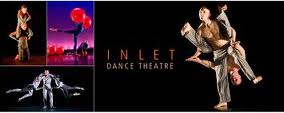
INLET DANCE THEATRE continues to prosper

Inlet Ballet is in the midst of its tenth season! The past has seen the company perform and educate, their two missions. The recent recipient of financial grants, a new phenomenon for the company, has put Bill Wade’s troupe on strong financial ground, and while other companies entrench due to the nation’s financial situation, Inlet looks to grow.

Their present program, part of Cleveland Public Theatre’s DanceWorks ’11, explores various aspects of human relationships while sharing repertory from their history. They also premiere WATER, the first movement of a four element series based on the personality types developed by Laurie Beth Jones, whose THE FOUR ELEMENTS OF SUCCESS has become a major thought force for Wade.

The evening includes WONDROUS BEASTS, a gymnastics-centered piece in which insect-like creatures, individually and collectively co-existence, serves as “metaphors for informing and inspiring choices for life journeys.” This is one of my favorite company selections.

DREAM OF SLEEP is based on sleep studies by Dr. Kingman Strohl. Bodies move in various sleep states from calm reflection through twitches and nightmarish uncontrolled body reactions to create a fascinating look at what humans do as they slumber.

WAR EFFORT EVES, which was created as a reaction to 911, showcases a USO performer, a Hollywood dancer/actress from the big musicals era and Rosie the Riveter. The performance, the evening’s weakest, lacked unity, intensity and dynamics.

OFFAXIS, an exploration of character, showcased Joshua Brown, one of the area’s finest dancers, as he found himself leaning outside the box of cultural norm. Flowing movements and powerful bodily control were highlights of this well-conceived offering.

MEMORITE highlighted the message, “Human life is valuable,” by focusing on the issues facing the elderly and their care-givers. Ryan Lott’s score, composed of verbal sound bites from interviews and the sounds of life, was a sounding board for looking at Parkinson’s, little old ladies in tennis shoes, pain and loss.

The only new piece on the program, WATER, is a pretty but uninspiring composition. Consisting of lifts, carries, and rolling (like waves), there was a lack of a focal center in the attempt to view the aqua personality type. Hopefully WATER is a work in progress and not a final product as it needs more development.

Capsule judgement: Inlet Dance’s Danceworks 11 program is an excellent introduction to their proficient skills.

Saturday, May 07, 2011

Fresh Inventions


Verb Ballets presents FRESH INVENTIONS

For the last several years Verb Ballets has used their Cleveland Public Theatre’s DANCEWORKS presentation time to do some inventing and innovating. Last year they selected new works by local composers and matched each selection to a local choreographer. Given a short period of preparation and rehearsal time, and the use of any or all of the company of dancers, the presentations were an opportunity for local dance aficionados to see new works invented.

This year Verb tried a different approach. Couple a member of the dance company and a piece of sculpture and see what happens. The results were very mixed. But, it must be remembered that the pieces were works in progress, not complete and tested dances.

The evening opened with Brian Murphy’s choreography of WAR ELEGY, based on music of the same name by Katharine O’Connell, and played live by talented cellist Regina Mushabee. The melancholy musical score and dance were inspired by a series of grotesque sculpture pieces which were pictured in the program. Though generally well danced, the piece lacked the clear story line needed to make a strong emotional impact.

RECALLING TENSIONS OF MIND was choreographed by Stephanie Krise to music by Stephen Smith and played by a live string quartet. Using sculptural poses and tandem movements, the movements fit the abstract music.

BREACH, choreographed by Erin Conway Lewis, was performed to Michael Leese’s Klavierstück. Played on a synthesizer by Nicholas Underhill, the music had a strong undertone that was reflected in the movements. Unfortunately, there was errant coordination and a lack of precision among the dancers.

The only piece that did not fit the company choreographer/company dancer theme/sculpture piece was NOUMENON MOBILUS, a 2010-2011 season company premiere, which was originally conceived in 1953. It was choreographed by Alwin Nikolais, who also wrote the music and did the lighting concept. The futurist selection was performed by Kara Madden and Rebecca Nicklos, who were each encased in a Mylar-material bag. Sitting on and moving around stools, the duo moved by stretching the materials in cadence to the music. The overall effect was audience pleasing.

ECHOES OF SILENT SCREAMS was performed without music. Voices related the stories of seven people who had been interviewed by choreographer Antwon Duncan. The conceiver’s intent was to “spread awareness and courage to all the unheard screams out there.” Though the idea was well intentioned, the overall effect was lacking. A bad sound system made the stories almost unintelligible and the piece was way too long and repetitious.

The highlight of the evening was Terrence Greene’s CALLIGRAPHY work in progress. Set to various musical selections, the constant feeling of ribbons floating in space were visualized by the hand and body movements of the dancers. Rebecca J. Nicklos and Brian Murphy effectively represented Ernestine and Malcolm Brown, local art benefactors who were being honored.

Guest dancer Mariano Moreno Albano did little to add to the male members of the company. He appeared to lack concentration and was late in many of his corps movements.

Capsule judgment: FRESH INVENTIONS was another in the series of introducing local audiences to new ideas and choreography. The idea has merit, but doesn’t always reach high levels of performance. This can be expected since these are works in progress.

Huck and Holden


Go See the Delightful HUCK AND HOLDEN at Ensemble

What happens when an Indian student (Indian from India, not a Native American) comes in contact with an American culture that challenges all of his values, traditions and plans for life? That conundrum is at the core of Rajiv Joseph’s HUCK AND HOLDEN.

Joseph, who was born and raised in the Cleveland area, is a graduate of Cleveland Heights High School, a Pulitzer Prize nominee, wrote the third season of TV’s NURSE JACKIE, and is the author of BENGAL TIGER AT THE BAGHDAD ZOO. Tiger is now playing on Broadway in a production staring Robin Williams. He is the author of numerous plays. HUCK AND HOLDEN was his first work.

According to the author, HUCK AND HOLDEN is based on his father's experiences in coming to the States. It is also about his being of mixed race. His mother is of French and German ancestry and his father emigrated to the States from India. Joseph states, "Being mixed-race has always been a part of my identity. You are never fully one thing or the other. You always feel a little apart, a little bit of an outsider, even when you are with your own family. That's an interesting perspective for looking at the world." He takes that perspective and, in HUCK AND HOLDEN, creates a delightful piece of theatre.

Navin, an Indian student attending an American university, is the dutiful son of traditional Hindu parents. He’s been brought up to believe in arranged marriages, virginity until matrimony, being a serious student and reincarnation.

His path toward accomplishing his life goals is interrupted when in his required English lit course, the professor gives the assignment, “Write an essay comparing and contrasting Huck and Holden’s respective journeys and how society informs their characters and affects their feelings of self worth.” Who are Huck and Holden? What is “self worth?” What does this have to do with his success as an engineering student? Navin’s life is about to change.

Off to the library goes our hero. He meets Michelle, a free spirit music major, who knows less about Huck and Holden than Navin, but she is sassy, beautiful, African American and obsessed with the Kama Sutra. Not a stranger duo could the fates have brought together.

Things are complicated, but with the help of his imaginary friend, a former schoolmate named Singh, a Sikh whom Navin admired during school days for his audacity and coolness, Navin pursues Michelle despite his hesitation and guilt. The path is aided, or made more complicated by the appearance of Kali, the black Hindu goddess of internal energy. The results are a hysterical series of scenes in which the sweating, stumbling, babbling, pineapple-and-onion addicted pizza eater, discovers sex and personal freedom.

Why the title? Holden Caulfield of CATCHER IN THE RYE and Huckleberry Finn in Mark Twain’s novels, share the qualities of being adolescents, runaways from society, seeking independence, growth and stability in their lives. Navin, in fact, is following the same path. Huck and Holden both encountered tests for them to pass on their way to adulthood, and so does Navin.

Under the spot-on direction of Celeste Cosentino, the Ensemble production is wonderful. Every element of the production works.

Daniel Caraballo is a total delight as the mumbling, confused, frustrated Navin. He has an expressive face, puppy dog eyes and possesses a great feel for comedy timing. It’s worth going to the production just to see this talented young man in action!

Kristi Little makes Michelle a real person, filled with gut-level reactions to life’s issues. Like Caraballo, her comic timing is right on target. The duo seems born to play these roles.

Ammen Sulieman is on target as Singh, Navin’s Jiminy Cricket, but in this case his anti-conscience and guide. Neda Spears is a hoot as the multi-armed goddess Kali, complete with a necklace of simulated baby’s heads. Kyle Carthens, as Michelle’s on-again, off-again boyfriend, does a show stopping hysterical scene in which he teaches Navin the facts of life including a move called waxing the booty. I assure you, this one isn’t in the Kama Sutra, especially when done with the help of a pizza box!

Joseph Mitchell’s set design is wonderful, adding to the whimsy. Charles Ritchie has done a fine job of working with the Puerto Rican Caraballo, to create a very acceptable Indian accent.

CAPSULE JUDGEMENT: Ensemble’s HUCK AND HOLDEN is a well performed, quirky, charming, modern comedy that is a total delight. This is a go see! (Caveat: if you are up-tight, the simulated sex scenes and references might not to be your liking. And, this is definitely not a play for the kiddies.)

Thursday, May 05, 2011

West Side Story


A new version of WEST SIDE STORY is at Palace

In the fall of 1957, I had a mind blowing experience. I saw the newly opened Broadway production of WEST SIDE STORY. At the time, all I knew about the show was that it was based on ROMEO AND JULIET and it had opened to positive reviews two days before. I left the show with aching hands from clapping and clapping and clapping during the extended curtain calls. I became a WEST SIDE STORY junkie, seeing the show time after time on the Great White Way before it closed, as well as many other stagings since!

The original production was directed and choreographed by Jerome Robbins, starred Larry Kert as Tony, Carol Lawrence as Maria and Chita Rivera as Anita. That staging ran for 732 performances, toured, and then returned to Broadway in 1960 for another 253 performances. Of course, I saw it in its return engagement.

In 2007, Arthur Laurents decided it was time to adjust the script. His “new” WSS opened on March 19, 2009. The production wove Spanish lyrics and dialogue into the English libretto. The show had an attitude adjustment, more serious, with some of the lightness eliminated. The characters were made more authentic. The choreography was altered and the orchestrations adjusted.

The music for WEST SIDE STORY is by Leonard Bernstein and the lyrics by Stephen Sondheim. It is set in New York in the mid-1950s and centers on the rivalry between two teenage street gangs. The Sharks came from Puerto Rico, and the Jets, are a collection of white working-class hoodlums. Tony, one of the Jets, falls in love with Maria, the sister of the leader of the Sharks, with disastrous results.

This is not a light hearted show. It is a musical with a serious theme, sophisticated music, extensive dancing and an investigation of social problems. The memorable score includes Something's Coming, Maria, America, Somewhere, Tonight, I Feel Pretty, and A Boy Like That.

Interestingly, the WSS on stage at the Palace Theatre has little resemblance to the show that was originally planned. Historical legend indicates that in the late 1940s Jerome Robbins approached Bernstein and Laurents about collaborating on a contemporary musical adaptation of ROMEO AND JULIET. He proposed that the plot focus on the conflict between an Italian American Roman Catholic family and a Jewish family living on the Lower East Side of Manhattan, during the Easter–Passover season, and be titled EAST SIDE STORY. Eventually it was perceived that a different tack was needed and the present theme and title emerged.

The touring production, directed by Arthur Laurents, has many high points and some effects that didn’t work so well.

On the positive side, Joey McKneely’s reproduced and reinterpreted choreography is dynamic and well executed. The interspersing of Spanish, used when the Puerto Ricans speak to each other, or are upset, is a fine realistic touch. The sets work well. The costumes allow for stylistic character identities. (The Jets’ orange bandanas is a clever gang identifier.) The cast is generally young and fit the long established images of the characters.

Michelle Aravena sizzles as Anita, the girlfriend of Bernardo, the leader of the Sharks. German Santiago was on target as Bernardo. The role of Maria is triple cast. On opening night Ali Ewoldt portrayed the role. Though her acting was on target, especially in establishing a strong emotional bond with Cary Tedder, portraying Tony that night, her high pitched voice and carriage made her almost too sophisticated. Tedder, has a nice vocal sound and a acting believability, but, as with most of the Jets, he was too boy next door in looks and manners. These are inner city New Yorkers hoods, not soccer playing suburban kids.

The show ended abruptly, before the emotional impact of what had transpired could fester, followed by a quick curtain raise for the curtain call, which added to a feeling of “okay, we’re done, now go home!” Why the original ending in which the gangs blend to help carry the now dead Tony off-stage was dropped, I can’t figure out.

CAPSULE JUDGEMENT: WEST SIDE STORY is near the top of my list of all-time great musicals. I liked many of the adjustments that have been made in the script (except for the ending), the adjustments in the musical scoring, and the newly interpreted choreography, but I don’t think the production I saw on opening night, was the show at its finest. Many of the audience comments I heard on the way out of the theatre, echoed my thoughts.

Monday, May 02, 2011

Company


COMPANY is go see theatre at FPAC

As Stephen Sondheim, who wrote the music and lyrics for Company, which is now on stage at Fairmount Performing Arts Conservatory, stated of the musical’s story, “A man with no emotional commitments reassesses his life on his thirty-fifth birthday by reviewing his relationships with his married acquaintances and his girlfriends. That is the entire plot.”

COMPANY is unlike most modern musicals, which follow a clearly delineated plot. It is actually a concept musical composed of short vignettes, presented in no particular chronological order, linked by a birthday party.

COMPANY was among the first musicals to deal with adult problems through its music. For example, Bobbie confronts the five couples. He asks, “Why get married?” “What do you get from it but someone to smother you and make you feel things you don't want to feel?” In spite of his arguments, which seem more for himself than for his listeners, he comes to the conclusion, in the emotional curtain-closing song, that he, in fact, needs someone to share his life with, someone to help and hurt and hinder and love, someone to face the challenges of Being Alive.

The show opened on Broadway on April 26, 1970 and ran for 705 performances in spite of mixed reviews. Numerous revivals have been undertaken, often tweaking the script, the staging and the score. The latest was a recent New York Philharmonic Concert whose all-star cast included Neil Patrick Harris as Bobby and Craig Bierko, Stephen Colbert, Jon Cryer and Patti LuPone.

The Fairmount production, under the adept direction of Fred Sternfeld, is excellent. Simple staging, creative choreography by Bebe Weinberg-Katz, Trad Burns turntable set, and Benjamin Gantose’s lighting design, all add to the quality of production. Musical director Jonathan Swoboda’s orchestra plays well and underscores rather than drowning out the performers. The choral blends are very good.

The cast is universally strong. Standouts include Ursula Cataan (Amy) whose fast-paced doubletalk Getting Married Today is a showstopper. Natalie Green’s (Marta) plaintiff Another Hundred People is another highlight. Tracee Patterson (Joanne) gave just the right drunk, tourchy, vibrance to her characterization and the plaintive The Ladies Who Lunch.

Connor O’Brien (Robert) has a well-trained operatic voice which he uses well in the thoughtful Someone Is Waiting, the delightful Side by Side and the powerful Being Alive. His acting is not of the same level as his vocalizations, as he often feigns facial expressions and emotions. He acts, rather than reacts, thus sometimes giving a superficial feel to the role.

CAPSULE JUDGEMENT: COMPANY is a go-see production! The quality of staging and performances gives good service to this Sondheim adult musical.

Review of the Reviewer's Reviews: Bonnie Barenholtz


hi roy,

manny and i had a fabulous evening last
nite.....thanx to you. we called it our "new York
Nite in cleveland".....

we had cocktails and apps at the bar at blue point, and
then headed for PASSING STRANGE....... this play
was amazing !!!! what energy, what stage presence,what talent,
what life, and what a wonderful story....... it was ALL you
said it was in your review. ......which is the ONLY
reason we went to see it.

so, THANK YOU THANK YOU
for the reviews you send us. they are "right on"......even
when some of my favorite actors do not receive your
accolades.

BEST WARM REGARDS,
bonnie b.

Saturday, April 30, 2011

Passing Strange


PASSING STRANGE showcases BW students at their best!

Baldwin Wallace College is noted for having one of the country’s premiere musical theatre programs. No more proof is needed than seeing PASSING STRANGE, now on stage for a short run in the 14th Street Theatre. This is a perfect choice to showcase these talented stars in the making. The characters are their age, the parts require unabashed showmanship, and the music is of their era.

Cudos to Victoria Bussert, the inspiration behind the college’s program and Gina Vernaci, the dynamo Playhouse Square’s Vice President for Theatricals, for conceiving the collaboration between the two institutions, which is now in its fourth year. Past shows have included BROOKLYN THE MUSICAL, [TITLE OF SHOW], and CHESS: THE LONDON VERSION. All were quirky scripts that gave the students a chance to spread their wings and perform in a professional venue. They are also the type of shows that Bussert does best…small creative wonders.

PASSING STRANGE is a musical with lyrics and book by Stew and music by Stew and Heidi Rodewald. It examines part of the life of a black musician (the Youth), who finds himself, in the late 1970s, as a teenager, rebelling against his middle class upbringing, including rejection of the church, his mother’s teachings, and trying to pass as something he is not, as he traverses through Amsterdam and Berlin. These experiences open him to drugs, sex and rock and roll, while forcing him into introspection.

The title of the play not only highlights Youth’s passing from teenager into early manhood, but harkens to the term “passing” as used in Black English to indicate “passing as white, being someone you are not, as well as the passage of time.”

The play’s history is quite different than the usual path that shows take. Stew, a popular New York club performer, was commissioned by The Public Theatre of New York to develop a story of a young bohemian who charts a course for his life. After tryouts in California and Off-Broadway, the show opened on Broadway in 2008, ran 165 performances and was made into a film directed by Spike Lee. The original production starred Stew, himself, as the narrator, who weaves the tale together.

Ironically, as the show was in local rehearsal, Stew (Mark Stewart) and his band, The Negro Problem, were performing at the Cleveland Play House’s Fusion Festival. Stew and the band hung out with the BW cast and sat in on rehearsals. The experience, as explained by the students in the opening night after show talkback, was “mind opening.” They not only gained an understanding of the story, which is a biodrama based on Stew’s life, but found the where-with-all to transform the message not into a black experience, but into a universal one.

This opportunity to come in contact with professionals is just another aspect of what makes the BW-PHSquare collaboration so valuable.

The production is double cast. I saw the “Stew Cast” which featured Rod Lawrence as the Youth and Alex Syiek portraying three roles.

Lawrence is an exceptional talent. He has a fine voice, moves with ease and has a stage presence which is often hypnotic. His face shows great introspection, he feels and taps into the emotions of the character he portrays. Tears rolled down his face during a striking eulogy near the play’s ending.

Syiek transfers nicely into his various roles…playing swishy, macho and straight with conviction. Adrianna Cleveland (Mother) has a strong singing voice and a nice stage presence. Ciara Renée compels when she is on stage. She sings well, is beautiful, and develops clear characterizations. Jessica Dyer, and Jude McCormick also are excellent in various roles. Sara Budnik, as the band’s vocalist, displays a nice singing voice. Jay Ellis (Narrator) has a strong singing voice and interprets lines well. Unfortunately, he sometimes shouts rather than developing power with nuance.

Ryan Fielding Garret, the show’s musical director, and his band (Kevin Johnson, Rob Chase and Dylan Hayden), are excellent. They fade under spoken lines and allow the singers’ words to be heard, while developing the rock, spiritual and blues score.

Not only do the BW students get a chance to have a professional experience, but the Arts Management’s majors get to work with the Playhouse Square staff in marketing, education and operations. This is another advantage of the collaboration.

Capsule judgement: Unfortunately, the wonderful PASSING STRANGE is only onstage through May 1. It’s a shame. This could have been a long running show that would have built a cult audience. Bravo to the outstanding cast and let’s hope that the BW-PHSq collaboration continues!

Thursday, April 28, 2011

A Jew Grows in Brooklyn


You don’t have to be Jewish or from Brooklyn, but it “vouldn’t hoit”

The family of Jake Ehrenreich went from being one of the wealthiest in Poland to laborers in the work camps of Siberia. Doesn’t sound like the stuff that entertainment is made from, but Ehrenreich, who is now on stage in his solo show at the Hanna Theatre in A Jew Grows in Brooklyn, succeeds in taking us on a trip filed with pathos, comedy and some awakening.

Ehrenreich, who is 55, has appeared on Broadway in DANCIN, BARNUM and They're Playing Our Song. He has also performed in Songs of Paradise and The Golden Land, off-Broadway shows written in Yiddish, the language of the Jews of central and Eastern Europe.

He is a good singer, actor and musician. A proficient drummer, he once was considered for inclusion in the band KISS, which ironically numbers among its members, two children of Holocaust survivors.

Performing with a live band, and using multi-media video and photos, Ehrenreich takes the audience on a journey through childhood, the Catskill Borscht Belt days, to his mother’s and sisters’ early Alzheimer’s disease, and to his present day life as husband and father. He paints a picture which reveals the underbelly of who he is and how he got there.

Hanging over the entire evening are the living and dead members of his family. Though it may sound maudlin, there is enough balance of exposition and joy to make the evening an interesting experience.

One of the show’s highlights is a selection of Yiddish songs including Romania, which is considered by some to be the Yiddish national anthem. I wonder if Ehrenreich knows that both Mickey Katz, and his son Joel Grey, who both made that song important parts of their repertories, are Clevelanders.

As for the production, which starts slowly and contains a lot of redundancy, its pretty hard not to appreciate Ehrenreich’s experiences. His life, which is not unlike that of many children of Holocaust survivors, including the silent parents who hid their suffering behind closed emotions, makes for good theatre. Is the message universal? Maybe, maybe not. And, will it affect you if you aren’t Jewish or from Brooklyn? It’s not a requirement, but, of course, it vouldn’t hoit.

CAPSULE JUDGEMENT: A JEW GROWS IN BROOKLYN is a pleasant evening of theatre. The writing could have been a little sharper and more textured, and the opening a little more emotionally moving, but the shticks work, and the singing and story telling accomplish the production’s ultimate goal of sharing the whys of Ehrenreich’s life.

Monday, April 25, 2011

insomnia the Waking of Herselves

Insomnia and dreams come vividly to life at CPT

Dreams are successions of images, ideas, emotions and sensations occurring involuntarily in the mind during certain stages of sleep. Though the meaning of dreams is not truly understood there has been a great deal of speculation on their meanings.

Sigmund Freud peaked interest in scientific study of the field of dreams (oneirology) when he attempted to ascertain the relationship between dreams and the development of personality.

INSOMNIA THE WAKING OF HERSELVES, now in its world premiere at Cleveland Public Theatre, is a joint writing collaboration between Holly Holsinger and Chris Seibert, who appear in the production, and Raymond Bobgan, the play’s director.

We are ushered into the world of dreams and insomnia in the attic of a home. One woman, then two and finally three appear. We are unsure of who these people are, whether they are, in fact real, alive or figments of our imaginations and whether we are viewing reality or have been ushered into someone’s dream. As the story unfolds we find that one of them has insomnia and when she does sleep, her fitful dozing is filled with dreams of her insecurities and past and present yearnings. It is only at the end that we gain some understanding of who is real and who is an invention of the imagination.

English neurologist John Hughlings Jackson once wrote, “Find out all about dreams and you will find out all about insanity.” Is one or more of these women insane? Is she or they fighting to figure out who she is? What clues are in the dreams?

INSOMNIA is a challenging theatrical experience. Though there is little physical action, the story is riveting as the audience attempts to use the often bizarre clues to establish exactly what is going on. Songs, limericks, role plays and games hint, enhance, confuse and enlighten.

The acting quality is outstanding. This is one fine and talented cast. The characters are each carefully etched and remain engrossing throughout. Bravo to Holly Holsinger, Christ Seibert and Anne McEvoy. It’s worth attending the production just to see these three in action.

Bobgan’s directing is precise, the pacing excellent. Thoughthere are places where the script could be tightened, for a first production, there is much more positive then negative.

Joan Horvitz’s attic design is excellent. Maybe a little more clutter was needed, making the visual attic feel more realistic.

Capsule judgement: CPT’s INSOMNIA THE WAKING OF HERSELVES is blessed with flawless acting and is well paced. Anyone who is interested in good acting and a challenging theatrical experience should go to this production.

Saturday, April 23, 2011

Circle Mirror Transformation


CIRCLE MIRROR TRANSFORMATION fails to reach its potential at Dobama

Watching a group of want to be actors, all of whom have troubled lives, taking a class on how to become actors, sounds like a strong plot idea with a potential for drama, revelation and even possible fun. That’s the situation at Dobama, which is presently staging Annie Baker’s CIRCLE MIRROR TRANSFORMATION.

The Obie Award-winning play centers on an acting class being offered in a small Vermont town’s community center. Marty, the instructor, rather than using play scenes, employs improvisational concepts to help the creative process. The techniques include both imaginative and absurd activities for the class of five, which includes a flirty former actress, a pouty 16-year-old, a divorced carpenter and Marty's husband.

The students pose as trees, beds and baseball gloves. They create human statues portraying their families. They invent scenes using only the words goulash and ak-mak. They pretend to be one another and write dark secrets on scraps of paper and read them out loud.

The New York Times called Baker’s play, “absorbing, unblinking and sharply funny.” Unfortunately, Dobama’s production is anything but absorbing and there is practically nothing funny going on. The problem is that the extremely slow pacing, blackout after blackout, and lack of full blown interactions, turn the evening into an exercise similar to watching paint dry…not much going on.

Not all of the problem is caused by director Juliette Regnier. She is given a script that is a series of 30-second to 5-minute scenes. Unfortunately, Regnier has inserted blackouts between the segments that are often as long, if not longer, than the scenes. Yes, maybe between the supposed week-long separations between classes, a little more time is needed for costume changes, but, as is, the audience spends more time in the dark than they do in the light. Also there is too much introspection rather than out-and-out physical and verbal angst going on.

The cast is generally fine. But the blend between them falls short because Regnier doesn’t take advantage of the free form of the script, which would have allowed for their true quirkiness and the internal conflict and potential fun to come forth.

The role of Marty, the deeply troubled instructor, who experiences night tremors due to an early life experience, is nicely developed on a surface level by Molly Cornwell, but the depth of her hurt isn’t always apparent.

Bob Ellis, portraying Marty’s quirky husband, James, needed a more troubled and bizarre tone so that the audience could understand his problematic personality.

Joe Milan is properly pathetic as Schultz, the recently divorced and lonely man looking for some physical connection. Again, a little more angst and desperateness would have fleshed out the underlying torture he is experiencing.

Leighann Niles DeLorenzo has the right spark as Theresa, the supposed New York actress who has returned to the small town to get away from her boyfriend. There is a deeper story behind that escape. DeLorenzo needed even more extremes of character portrayal to allow for insight into this troubled lady.

Allison Bencar as Lauren, the product of a troubled home, gave the illusion of the conflicted teen, but there was much below the surface that needed to come out.

Sounds like we need more drama? No, just clearer character development which would have led to more emotional and bizarre interplays between the personalities.

Mark Kopak’s clean line dance studio, complete with mirrors that could have been used more to allow the characters to really see each other, and the audience to see themselves in blurred visions of reality, would have helped. The word mirror is in the title for a reason.

CAPSULE JUDGEMENT: CIRCLE MIRROR TRANSFORMATION is a long sit. There are just too many long blackouts and a lack of playing off the author’s clear characters to get the full effect of the script.

PS…within the last several months Dobama has lost several of its historically important figures. We say a sad farewell to Peggy Buerkel and Everett Dodrill. Without their efforts and dramatic skills Dobama would not be the fine theatre it is today.

Thursday, April 14, 2011

Legacy of Light


LEGACY OF LIGHT illuminates science and women at CPH

“Everything changes, but nothing is lost.” This is the mantra of Karen Zacarias’ LEGACY OF LIGHT, now on stage at the Cleveland Play House. It is also the last line of the last play that will be performed by CPH at its present location. In the fall, the venerable company moves into their new digs at the Allen Theatre in PlayhouseSquare.

LEGACY OF LIFE, won the Steinberg/ATCA Award for best play of the year that premiered outside of New York. The selection is made by the membership of the American Theatre Critics Association.

The script was commissioned by The Arena Theatre in Arlington, VA and, according to the author, went through fifteen rewrites before it opened. The play’s success can be illustrated by the fact that it is being done by numerous theatres. In fact, according to the author, there are two other productions being done simultaneously with the one at CPH.

The script confronts the issue of how women attempt to balance a passionate yearning for learning with a maternal instinct. The viewer is introduced to two women living 260 years apart, and juxtaposes their stories, as each fulfills her passion for advancing science. Zacarias uses the overlapping writing device to equate the laws of physical science with that of human love. We watch as the women who not only hunger for human continuity but also lust for knowledge, and are driven to exhaustion “to do something that matters.”

One of the women is the real 18th century scientist, Émilie du Châtelet, a married woman who was Voltaire’s lover, the leading light of the Age of Enlightenment. Châtelet has been credited with translating, interpreting and challenging Isaac Newton's monumental works regarding gravity.

The tale also introduces us to the modern-day Olivia, a fictional scientist, who is supposedly on the verge of discovering a new planet. One of the parallels between the two, of course, is the thread of Newton and the concept of gravity. Another connection is child bearing. One dies as the result of birthing, the other comes to life because of it, but, as we find out later, there is an additional connection which is revealed late in the goings-on.

The CPH production, under the direction of Bart DeLorenzo, is slowly paced. There is some humor, some drama, and much exposition about the Age of Enlightenment. The intertwining stories are not easy to follow, but with a moderate amount of concentration, the ideas become clear. In addition, the script does not contain much physical action, so some may find the experience less than stimulating.

Cerris Morgan-Moyer as Emilie is charming, developing a clear picture of a woman driven by her motives to succeed and make a difference. Michelle Duffy is excellent as the Olivia, who finds herself torn between her desire to be a scientist of importance, while questioning her role of being a wife without a child. Amelia Pedlow is a delight as Millie, the young, free-spirited, Olivia’s surrogate.

Lenny von Dohlen, who looks eerily like the real Voltaire, starts slowly, but builds into the role. His portrayal may give the idea that Voltaire was somewhat of an airhead, which weakens the image of the Father of Enlightenment. The rest of the cast is very acceptable in their character developments.

Takeshi Kata’s set design, composed of sliding screens and trees with the requisite apples which fall on cue, Matthew Richards’ lighting design, and David Kay Mickelsen’s costumes, all add to the experience. Tiffany Goff’s original music helps in mood development.

CAPSULE JUDGMENT: Cleveland Play House brings down the curtain on the facility that has been its long-time home, with a pleasant and thought provoking production. They might have wanted to transfer to their new home with a return to stage of some of their stars from the past and a splashier play, but LEGACY OF LIGHT is an acceptable send-off.