Saturday, July 31, 2010

The Phantom of the Opera


Phenomenal Phantom at Allen Theatre


By the time the farewell national touring production of ‘PHANTOM OF THE OPERA’ leaves Cleveland on August 22, around 600,000 audience members will have experienced the show since its first local performance in 1993.

Not only is the production a local success, but, the show, which is credited with starting the mega musical trend, is still running on Broadway. It became the longest-running show in Broadway history in 2006. In 2007, it became the first show in on-Broadway history to celebrate 20 uninterrupted years in production.

The mega musical designation comes from the cost and number of sets, costumes and special effects which create the illusions of the opulent show. For instance, the replica of the Paris Opera house chandelier features 6,000 beads, and weighs over a ton. The show takes 125 cast, crew, orchestra members and house personnel to create a single showing. Originally costing a record $8 million to mount, it would take about $13 million in 2010 dollars to reproduce the show. It took over 20 tractor-trailers to bring the sets, costumes and sound equipment to town for this staging.

‘PHANTOM’ is a musical by Andrew Lloyd Webber, based on the French novel Le Fantôme de l'Opéra by Gaston Leroux. It opened in London’s West End in 1986, and then on Broadway in 1988. The music was composed by Lloyd Webber, with lyrics by Charles Hart and additional lyrics by Richard Stilgoe.

The plot revolves around Christine Daaé, who becomes the obsession of a mysterious, disfigured musical genius known as The Phantom of the Opera. Mostly an opera within an opera, the story centers on the Phantom’s lusting for Christine, while she covets Raoul. The score contains such classics as “Think of Me,” “The Music of the Night,” “I Remember,” and “Wishing You Were Here.”

Both the London and Broadway productions originally starred Michael Crawford as the Phantom and Sarah Brightman as Christine.

The touring production is every bit as visually stunning as the original. Yes, the famous chandelier suspends above the audience and crashes to the stage, the sets are numerous, the costumes are beautiful, the musical sounds created by the orchestra is exciting, and the sound system is crisp allowing for easy hearing of the libretto.

Though he does not have Michael Crawford’s mesmerizing vocal sound, Tim Martin Gleason is excellent as the Phantom. He adds his own twist to the role, creating a characterization which is well textured and allows the audience to experience the character’s emotional torment.

Brunswick native, Trista Moldovan (Christine), a 2002 musical theater graduate from Baldwin-Wallace College, is beautiful and has a stunning soprano voice. In contrast to Brightman’s maturity, Moldovan has a youthful vulnerability which works perfectly in her creation of the role. It’s exciting to see a local talent make good!

Handsome Sean MacLaughlin has a fine voice and the right attitude to portray Raoul, Christine’s love interest.

The choreography, vocal sounds, chorus actions and technical aspects of the show are all excellent.

CAPSULE JUDGEMENT: The touring company of ‘PHANTOM’ lives up to all its hype and is a must see, especially if you have never seen the show. No local theatre will be able to reproduce it at this level of extravagance.

Thursday, July 29, 2010

Bye Bye Birdie


‘BYE BYE BIRDIE,’ dated, but still fun at Porthouse

The original Broadway production of ’BYE, BYE BIRDIE,” which is now being staged at Porthouse Theatre, ran 607 performances and won the Tony for best musical of 1960. It starred Dick Van Dyke, Chita Rivera and Paul Lynde. The script’s popular 1963 film featured Van Dyke , Maureen Stapleton, Janet Leigh and Lynde.

The Michael Stewart (book), Charles Strouse (music), Lee Adams (lyrics) traces the adventures and misdeeds of what happens when a theatrical agent (Albert Peterson) arranges for his client, rock star (Conrad Birdie), who has been drafted into the army, to come to Sweetwater, Ohio, to give one last kiss to the president of his local fan club (Kim McAfee) before he leaves for the service. Complications set in when Kim's frustrated father ,and her beau (Hugo), place stumbling blocks in the way of the public relations gimmick. Peterson’s possessive mother and his longtime girl friend (Rosie), who are in a constant battle for Peterson’s affection, add to the delight.

Notable songs in the score, which is credited with being the first Broadway musical to recognize the rock ‘n roll craze, are: “Put on a Happy Face,” “A Lot of Livin' to Do,” Talk to Me,” and ”Kids.”

The original production was credited with being “filled with a kind of affectionate freshness,” and “clever cultural references.” Not any longer. As I left the theatre two tweens, who had come to the production with their parents, were overhead saying, “I didn’t understand a lot of things.” No wonder. The times have changed, the media has changed, attitudes have changed and what might have been fresh in the 1960s is stale today.

When ‘BYE BYE BIRDIE’ opened on Broadway, Ed Sullivan’s variety show was the king of Sunday night TV, Elvis Presley had been drafted into the army, getting pinned was the “in” high school relational activity, Mussolini was still known as the former leader of Italy, and “The Shadow” was on the radio.

In spite of the datedness of the script, the Porthouse production was fun filled. Director Terri Kent paced the show well. John Crawford’s choreography was not only clever, but he had talented and enthusiastic dancers who could do the many synchronized moves with ease and flair. Though, at times, the music dragged a little, the words could be clearly heard over the muted orchestra. A wonderful blended quartet was one of the musical highlights.

The cast, with one major exception was excellent. Though she started the show screaming, Sandra Emerick, settled down and was delightful as Rose Alvarez. Her song interpretations were excellent and her “Spanish” fire burned brightly. Nick Koesters, who is noted as one of the area’s best actors, has developed a wonderful singing voice and style, and though at times he could have hammed it up a little more, he made an excellent Albert. His “Put on a Happy Face” was delightful. Cassie Rea, who has a younger Ann Margaret look, has a fine singing voice and was a sweet Kim. Marc Moritz, was hysterically funny as Mr. MacAfee. Danny Lindenberger, he of slight body and high pitched voice, was character right as Hugo. Lissy Gulick was obviously the crowd favorite as the passive aggressive Mae Peterson.

Unfortunately, Dan Grgic was miscast as Conrad. He didn’t have the attitude, the body, the steely look, the hip movements, the compelling voice or the sensuality for the role. Not that he didn’t try, but his Conrad didn’t engender the needed quality to make girls swoon. He was not helped by wearing poorly fitting and designed costumes that didn’t’ help the characterization.

CAPSULE JUDGMENT: Porthouse’s ‘BYE BYE BIRDIE,’ though dated, is still fun. With slightly different casting it could have been even more endearing. And so, the 42nd season of KSU summer theatre comes to a close.

Monday, July 26, 2010

Hunter Gatherers


‘HUNTER GATHERERS’ absurdity in action at convergence continuum

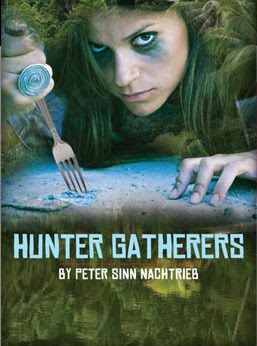
Within the first five minutes of Peter Sinn Nachtrieb’s ‘HUNTER GATHERERS,’ now on stage at convergence-continuum, you are aware that this is not going to be a traditional play. A live lamb is in a cardboard box. As you watch, Geoffrey Hoffman, portraying the alpha-male Richard, chops the animal into morsel-sized pieces ready for cooking. Sound ghastly? In the hands of the actors, under the direction of Clyde Simon, what is repulsive turns out to be bizarrely humorous. That is, if you aren’t a member of PETA or a similar animals rights group.

‘HUNTER GATHERERS,’ the winner of both the 2007 ATCA/Steinberg New Play Award and the Will Glickman Award, is obviously not a play for everyone. Few scripts produced by con con are. There is a select audience which has tuned into Clyde Simon’s weird sense of humor and curiosity, who have become cult followers of the theatre. ‘HUNTER GATHERERS’ will satisfy their tastes (no pun intended).

Pam and Richard are hosting their best friends, Wendy and Tom, for a monthly dinner get-together. The animal sacrifice is followed by sex, violence, deception, wrestling, more sex, and dancing. This is an evening where the line between civilized and primal man is blurred, and where not everyone will survive long enough to enjoy the brownies for dessert. In fact, the ending makes Macbeth seem like a lark.

Nachtrieb has been compared to a modern Edward Albee. He examines repression and hypocrisy by dissecting motives and actions. For him, as for Albee, no taboo is beyond violation. But, in contrast to Albee, Nachtrieb uses excess outrageousness to make his absurdist point. He uses flipped out characters and extreme sexuality to examine the fine line between civilized behavior and animalistic actions.

Neanderthal Richard, intent on spreading his “man seed,” self-centered Wendy who wants a baby and relishes Richard’s sperm, Wendy’s geeky and suppressed homosexual husband Tom, and Richard’s mild-mannered wife, Pam, are the participants in this game of desperation. A game which has dire consequences.

The con con’s production is vivid, but unevenly paced. The deep intensity needed to really give the true absurdist message is on the surface, not in the fiber of the acting. The characters are caricatures, not real people, so identifying with them is difficult.

Though Geoffrey Hoffman is on the verge of maniacal, there is too much surface emotion, and a lack of alpha male consistency. Whether this is the fault of the script or the actor is debatable. The same goes for Laurel Johnson. She needs more earthy sensuality. This is a woman who wants a baby at all costs. Tom Kondilas is on target as the nerdy Tom who finally, in the midst of having sex with Pam, seems to accept who he is, but as it turns out, too late. Laurel Johnson’s naivety and sweetness were fine until she needed to do a stronger character twist to make the ending truly her personal denouement. Simon arranges for the participants to keep their clothes on, at least most of the time.

Jim Valore’s set design works well and Terrii Zernechel’s lighting is extremely effective.

Capsule Judgement: ‘HUNTER GATHERERS,’ as with many convergence shows, isn’t for everyone. It is worth the time for those who are interested in contemporary theatre, the messages of new authors, and aren’t offended by overt sexuality.

Sunday, July 25, 2010

Review of the Reviewer's Reviews: Tom Kuby


How we value your opinions, insights and capsule judgments. They powerfully influence our decisions, especially since we go to the [Shaw]Festival each year. We appreciate being on your mailing list for your most incitful reviews. Thanks a million.

Tom Kuby

Shaw Festival, 2010


THE SHAW FESTIVAL 2010…worth the ride!

The lovely village of Niagara-on-the-Lake is the home of The Shaw Festival. A generally excellent season of theatre, lovely flowers, classic home architecture and inviting well-stocked shops and galleries allow an inviting experience.

The Niagara area is dotted with wineries, many of which, besides offering wine tastings and sales, have fine dining restaurants.

There are some wonderful restaurants including Niagara Culinary Institute, 905-641-2252, ext. 4619 (www.niagaracollege.ca/dining), at which student chefs hone their skills. A new favorite is The Grill on King Street (905-468-7222, 233 King St.)

Because of the economy, there are more empty storefronts than in the past, but downtown still has an abundance of stores to satisfy shopping needs. Though the Canadian and US dollar are about on par, there are some good buys. I purchased a Corragio leather jacket for two-thirds off at Leonardo's (33 Queen Street). The Prospect, 92 Queen Street, has a vast collection of Crocks, not the ugly garden digger variety, but fashionable and comfortable ones for both men and women.

Our home away from home is the beautiful and well-placed Wellington House (www.wellington.house@sympatico.ca), directly across the street from The Festival Theatre. For information on other B&Bs go to www.niagaraonthelake.com/showbedandbreakfasts.

For theatre information, a brochure or tickets, call 800-511-7429 or go on-line to www.shawfest.com. Ask about packages that include lodging, meals and tickets. Also be aware that the festival offers day-of-the-show rush tickets and senior matinee prices.
To satisfy border requirements carry your passport.

REVIEWS OF SHAW 2010 productions:

HALF AN HOUR’—thirty-six minutes very well spent!
(Royal George Theatre through October 9)

Have 36 minutes to spare? If so, and you are in Niagara-on-the-Lake, go see J. M. Barrie’s ‘HALF AN HOUR.’

Barrie, who is known to many for his examination of boys who refuse to grow up and the women who are their caretakers, as expressed in his classic, PETER PAN, has a philosophical side as well.

In ‘HALF AN HOUR’ he illustrates how life can change in thirty minutes. Ironically, those precious few minutes are not only the subject of his play, but also approximately the play’s length, which is counted off to the audience.

The story concerns Lady Lilian Garson, described by the author as a “frozen flower,” who decides to escape from her confining husband. Is she successful? The plot includes a run for Egypt, a civil engineer, a left note, a wedding ring, a necklace, a taxi, and a case of hidden identity. It would ruin the experience to tell you the conclusion, but the route to the ending is compelling. But, as a hint to how this all turns out, remember the author’s words, "Those who risk all and lose have to face the consequences."

The cast is universally excellent. Michael Ball delights as the gentleman butler, Diana Donnelly is properly rigid and perplexed as the wife, Peter Krantz is excellent as the unflexible and controlling husband, and Peter Millard adds the correct confused and controlled characterization as Dr. Brodie.

Tyler Sainsbury’s set design is cleverly conceived.

CAPSULE JUDGEMENT: ‘HALF AN HOUR’ is a lovely pastiche that proves that a lot can be said in thirty six minutes, and in the hands of a creative director and a talented cast, it doesn’t take a lot of time to entertain.

‘JOHN BULL’S OTHER ISLAND’ examines British and Irish relations
(Court House Theatre, until October 9)

George Bernard Shaw is noted for his caustic humor and strong political views. Being an Irishman, he had strong opinions about the Irish, the Brits, the church, socialism, the role of women and businessmen. His 1904 play, ‘JOHN BULL’S OTHER ISLAND,’ is a comedy centering on Larry Doyle, who was originally from Ireland, who has moved to England, become a successful civil engineer and has returned to his home town in order to obtain land and build a golf course and other facilities.

Doyle, who has forsaken an Irish lass, brings Tom Broadbent, his English partner with him. Broadbent is taken in by the romance of the place and soon is displaying the Irish ability to talk-the-talk. He becomes a candidate for Parliament , and steals away Nora Reilly, who has been pining many years for Doyle. Peter Keegan, a defrocked priest, is Shaw’s moral voice in the script.

The term John Bull is the name of a character in British satire, Law Is a Bottomless Pit. He is represented as a stout Englishman wearing a top hat, waistcoat, knickers and high boots and has become the symbol of the British empire. In the case of this play, he is the stereotype of the Brit who thinks it is his duty to take care of and guide the Irish for “their own good.”
This play played an important role in Shaw becoming a major theatrical writer. The story goes that a command performance was given for King Edward VII. He laughed so hard he broke his chair. This incident was widely reported, the play became a “must see.” and Shaw’s reputation was set.

The Shaw’s production, under the adept direction of Christopher Newton, consistently develops the plays intent and purpose. Though a little long, it grabs and holds attention.
The cast is very strong. Especially effective are Jim Mezon as Keegan, Graeme Somerville as Doyle and Benedict Campbell as Broadbent.

William Schmuck’s stage design is excellent, considering that the numerous scenes are done on a three-quarter round stage which, due to sight-line requirements, restricts the placement of set pieces so that all the audience can see.

CAPSULE JUDGEMENT: While not being one of Shaw’s great plays, ‘JOHN BULL’S OTHER ISLAND’ is filled with laughs and makes its well-conceived points. It is well worth attending and is a must-see for Shavians as the script is seldom staged.

‘THE WOMEN’—poorly directed and acted!
(Festival Theatre through October 9)

Clare Boothe Luce’s ‘THE WOMEN’ became a cult hit when it was made into a 1939 film starring Joan Crawford, Rosalind Russell, Paulette Goddard and Joan Fontaine. The author’s acidic wit and overdone caustic realism featured catfights never seen before on screen.

The story concerns the pampered lives and power struggles of wealthy Manhattan socialites and the backstabbing chitchat that propels and damages their relationships. In both the play and the film, Luce probes into the role of the modern woman, marriage and divorce, female friendship, the power of gossip, beauty standards and socio-economic class.

The original Broadway production opened on December 26, 1936 and ran for 666 performances, making it a major box office hit.

For a production of ‘THE WOMEN’ to be successful takes unbridled realistic exaggeration. It must show the nasty underbelly of dialogue that has been described as “sparkling” and “glittering.” Unfortunately, the Shaw production has none of that.

Director Alisa Palmer does not seem to understand Luce, the New York society women who are present, or the necessity of using correct accents to stress the language that Luce writes.

The actresses don’t seem to get it either. Maybe they should have watched the 1939 film to see how US Americans took on these roles. The problem may well be that Canadians are too nice, they don’t understand and can’t duplicate the likes of caustic New Yorkers.

The results of all these missteps is a disastrous production which is too slowly paced, misses the pointed wit, and seems dated.

Though they seemingly try hard, none of the cast is character correct.

CAPSULE JUDGEMENT: While walking down the street, I overheard a discussion between two women who had just left ‘THE WOMEN.’ One said to other, “That was probably the worst production I’ve ever seen!” I wouldn’t go that far, but from my perspective, she wasn’t far from wrong.

‘DOCTOR’S DILEMMA’ makes effective house call
(Festival Theatre through October 30)

George Bernard Shaw was a social critic. His prime targets were the church, the political establishment, the lack of women’s rights and the British class system.

In ‘THE DOCTOR’S DILEMMA’ he chooses to skewer the medical establishment. Of course, this wouldn’t be a Shaw play without some socialist and anti-vivisectionist viewpoints as they relate to the topic.

Unfortunately, his 1906 complaints are still present today. Less so in England and Canada, who have universal health care, but still a major issue in the United States. Shaw’s antipathy for doctors may have been caused, in part, because as a young man he had a bout of smallpox which left him scarred on his right cheek, leading him to grow his signature beard to cover the mark.

The theme of the play centers on what treatments should be used, how doctors decide on treatments, and who should pay for medical care. It is thought that the passage of the British National Health Service Act of 1946 was passed, in part, because of Shaw’s strong stance for the service.

The story’s core centers on a doctor who has developed a cure for tuberculosis, but has only enough serum for one patient. Should he chose a poor medical colleague who treats the needy for very little personal gain, or an extremely gifted but very unpleasant young artist whose attractive wife the doctor wants for his own?

In spite of some extra-long monologues and excessive pontification on the part of the author, the Shaw production works well. Director Morris Panych points the actors in the right direction, paces the show well, and creates clarity of purpose.

The cast is excellent. Patrick Galligan is believable as Ridgeon, the doctor who developed the tuberculosis treatment. Jonathan Gould is excellent as the self-centered conniving artist, Thom Marriott (Bonington) and Michael Ball (Cullen) play the doctors more interested in individual profit and ego-satisfying than cure, with the right amount of humor and guile.

Ken MacDonald’s set designs and Charlotte Dean’s costumes aid in the plays development.

CAPSULE JUDGEMENT: ‘THE DOCTOR’S DILMEMMA’ gets a strong production at The Shaw. It is a production well worth seeing, especially in regard to recent conflicts over health care in the U.S.

‘ONE TOUCH OF VENUS’—dated show without much of a storyline
(Royal George Theatre through October 10)

It wasn’t until 1943, when Rogers and Hammerstein penned ‘OKLAHOMA,’ that the American musical began to stress the story line and integrated the songs and dances into the script. Before that, almost every musical had no story line or a thread of a plot. Songs and dances could be added and dropped without changing the impact of the show. A classic example of that non-integrated musical is Kurt Weill, Ogden Nash and S. J. Perelman’s ‘ONE TOUCH OF VENUS.’

Loosely based on Thomas Gutherie’s novella The Tinted Venus, the show satirizes newly emerging American suburban values, artistic fads and romantic and sexual mores.

The original 1943 Broadway production, which starred Mary Martin, ran 567 performances. It is most noted for the featured choreography of Agnes de Mille.

The story concerns a long-lost, priceless statue of the goddess, Venus, which is found and placed on display in an art museum in New York. The sculpture comes to life. Complications ensue when human males fall in love with the now “real” Venus. As in all good light fairy tales, all’s well that ends well, and Venus is returned to her natural state and the now real Venus moves to the suburbs and lives happily ever after.

Though it gets a nice production, as directed by Eda Holmes, with choreography by Michael Lichtefeld, the show goes basically no place and there is little to hold the viewers’ attention. The music, which is basically bland, is not-memorable. The show has only one well-known tune, “Speak Low,” and it is so irrelevant to the plot that it is sung three times, all in different contexts.

CAPSULE JUDGEMENT: Shaw’s ‘ONE TOUCH OF VENUS’ is not bad, it’s just that unless you are interested in musical theatre history, there isn’t much of a reason to see the production. The final curtain was met with politic applause and the audience left the theatre without reacting much to what they had just seen.

Wilde’s ‘AN IDEAL HUSBAND’ is ideal!
(Festival Theatre through October 31)

A gifted poet, playwright, and wit, Oscar Wilde was a phenomenon in 19th century England. He was noted for preaching the importance of a grand style in life and art, and of attacking Victorian narrow mindedness. Probably his most famous play was ‘THE IMPORTANCE OF BEING EARNEST.’ Also of note was his only novel, ‘THE PICTURE OF DORIAN GRAY’ which caused controversy as the book attacked the hypocrisy of England and its aristocracy.

Oscar Wilde, who was married, had an affair with Lord Alfred Douglas, whose father did not approve of the gay relationship and accused Wilde of sodomy. Wilde, unwisely, tried to sue the Marquess. His case was dropped when his homosexuality, which was outlawed in England, was exposed. Wilde was sentenced to two years hard labor in prison. When released, he was penniless and died shortly thereafter at the age of 46.

Wilde’s ‘AN IDEAL HUSBAND’ has a close tie to his trial and imprisonment. The play opened on January 3, 1895. In April of that year, Wilde was arrested for 'gross indecency' and his name was taken off the play. When the manuscript was published in 1899, Wilde was not listed as the author.

‘AN IDEAL HUSBAND’ is a comic-farce that tells the story of two women who want their husbands to be perfect. Through wit and pointed humor, exposing blackmail and political corruption, and examining private honor, Wilde exposes the difficulty of living according to limited perspectives.

Wilde said of the play’s purpose, "Sooner or later, we shall all have to pay for what we do." To which it can be added, as the play states, “Truth is a complex thing.”

Shaw’s production, under the meticulous direction of Jackie Maxwell, is superb. From the creative set changes, to the sure pacing, to the stylized character interpretation, the play sizzles with humor.

Steven Sutcliffe fully inhabits the role of Viscount Goring, who is the flamboyant Oscar Wilde, thinly veiled. Wendy Thatcher is delightful as the uptight gossip, Lady Markby. The rest of the cast is equally of high quality.

Judith Bowden’s design, Kevin Lamotte’s lighting and John Gzowski’s original music, all add to the quality of the production.

Capsule Judgement: ‘AN IDEAL HUSBAND’ gets a wonderful production under the masterful guidance of director Jackie Maxwell. It is one of the highlights of this season at The Shaw.

HARVEY
(Royal Geroge Theatre through October 31)

I did not see ‘HARVEY,’ but friends whose opinion I trust raved about the production.

Monday, July 19, 2010

The Producers


‘THE PRODUCERS’ produces laughs at Beck

Mel Brooks, who co-authored the script for the musical, ‘THE PRODUCERS,’ is noted as an off-the-wall, hysterically funny film director, screenwriter, composer, lyricist, comedian, actor, and producer. He is one of the few artists who has received an Oscar, Emmy, Tony, and Grammy. Among his zany works is The 2000 Year Old Man in the Year 2000 with Carl Reiner. He was a comedy writer for Your Show of Shows, The Dick Van Dyke Show, and The Steve Allen Show. His list of movie, TV and stage shows is endless. This is one talented man.

Brook’s first feature film was the satire, The Producers, a dark comedy. Because the major production number was entitled "Springtime for Hitler," studios wouldn't touch it. He finally found an independent company which released it as an art film. It went on to win an Oscar for Best Original Screenplay and became a cult hit. Brooks later turned the script into a musical, which became hugely successful on Broadway, receiving twelve Tony awards. It is this script which is now being presented at the Beck Center for the Arts.

‘THE PRODUCERS’ centers on a theatrical producer (Max Bialystock), noted for his many flops who, along with a nebbish accountant (Leo Bloom), schemes to collect an enormous amount of money, produce a flop, steal the money and fly off to Rio. Unfortunately, their ‘SPRINGTIME FOR HITLER’ becomes a hit and they wind up in trouble with the law. This is not before Bloom falls in love with the curvaceous Ulla, a group of old ladies perform a dance using walkers, a coop of pigeons do the “sieg heil,” and ridiculous accents, caricatures of homosexuals and Nazis are presented.

The musical takes much of its format and humor from the film, but deviates enough so that it becomes its own entity. It is much more upbeat and doesn’t have the flick’s darker side.

The original production opened on Broadway on April 19, 2001, starring Nathan Lane and Matthew Broderick, and ran for 2,502 performances.

Judging from the reaction of the nearly sold out Sunday matinee audience I attended, the Beck production, under the directorship of Scott Spence, delights. This, in spite of the fact, that some of the characterizations were slightly off and laugh lines were lost due to timing and nuance issues.

Mark Heffernan physically fits the role of Bialystock. He has a fine singing voice but lacks the comic timing and development of the shtick that is needed to fully flesh out the conniving producer. His “Betrayed” was well done, but “The King of Old Broadway” was emotionally flat. Brandon Isner, as Bloom, has a well-tuned singing voice but could have been more neurotic at the start so that we see a more drastic change as he “matures.” His “I Wanna Be a Producer” needed a harder sell, a more exciting presence. Both men need to grow into their roles, be more spontaneous and react, rather than act. They feign rather than are.

Betsy Kahl has the physical attributes for Ulla, but her accent keeps coming and going, especially when she is singing. Her “When You’ve Got It, Flaunt It” lacked the necessary overdone sexiness.

Kevin Joseph Kelly displays a big voice and personality as Roger DeBris, the fey director. His “Keep It Gay” was cleverly conceived and well done. Gilgamesh Taggett was properly overboard as Franz, the pro-Nazi. His “In Old Bavaria” was well done.

“Springtime for Hitler” should be a hysterical show stopper. As is, it was entertaining, but could have been so, so much more outlandish and fun.

The show moves quickly along, aided by well-timed set changes and May Ann Black’s nicely conceived choreography as performed by the huge but sometime laboring cast. Larry Goodpaster’s peppy orchestra does a nice job of playing and not overshadowing and drowning out the singers.

CAPSULE JUDGEMENT: Beck’s ‘THE PRODUCERS’ gets lots of laughs, though it misses some others. This show should be a total romp. When the cast settles in and stops begging for laughs and lets Brook’s natural humor and ridiculousness come through, the show should be even more pleasing.

Sunday, July 18, 2010

Li'l Abner


‘LI’L ABNER’ cute but lacking at Mercury Summerstock

This month the U. S. Postal Service issued it’s “funnies” series. The stamps honor the likes of Archie, Dennis the Menace, and Calvin and Hobbes. Unfortunately, missing from the list are two comic strips that led to Broadway musicals: Little Orphan Annie and Li’l Abner. A version of the latter is now on stage at Mercury Summer Theatre.

‘LI'L ABNER,’ with book by Norman Panama and Melvin Frank, music by Gene De Paul, and lyrics by Johnny Mercer is a satirical look at the inhabitants of Dogpatch, USA (Kentucky). The comic strip, written and drawn by Al Capp, ran from August 13, 1934 through November 13, 1977. The Broadway production, directed and choreographed by Michael Kidd opened on November 15, 1956 and ran for 693 performances.

The somewhat dated musical is a spoof of hillbillies but also points zingers at the incompetent federal government, corrupt politicians, and perceptions of masculinity.

Just before the traditional Sadie Hawkins Day race when Daisy Mae is again “yurnin’ to ketch” the handsome, muscle bound, emotionally void Li’l Abner, Dogpatch is declared the "most unnecessary town" in the U.S. and is set to be turned into a nuclear testing site. The only thing that will save it is to locate something that makes the area a national treasure. Of course, in the end, as is true of all musical spoofs, things “turns out fer the best.”

Besides Li’l Abner, whose family name, “Yokum,” cartoonist Al Capp conjured up by combining “yokel” with “hokum,” and Daisy Mae, she who gave the signature name to short-shorts, all the well known comic strip’s characters are present including Mammy and Pappy Yokum, Marryin’ Sam, Earthquake McGoon, Evil Eye Fleagle, General Bullmoose, Stupefyin’ Jones and Senator Phogbound.

The original Broadway cast starred Peter Palmer in the title role, Edie Adams as Daisy Mae, and the marvelous Stubby Kaye as Marryin' Sam. A film based on the stage musical was released in 1959, with most of the Broadway cast reprising their roles.

The clever words and the catchy music include “A Typical Day,” “If I Had My Druthers,” “The Country’s in the Very Best of Hands,” and the cute ballad, “Namely You.”

The Mercury production, under the direction of Pierre-Jacques Brault, has many creative moments and some right-on performances. However, to make this show work, the staging and attitude must be one of comic strip level farce and attitude. No tongue and cheek here. Out-and-out comic mayhem must let loose, as was the case with the Broadway production. Unfortunately, though the performers try, the Mercury cast just doesn’t make the show explode.

When I saw the show in the Big Apple, my feet were constantly tapping and I had a feeling of total glee. In the Mercury production I smiled and appreciated the many creative moments conceived by Brault, but I wanted more. I wanted more of what Brian Marshall created with his over-the-top Pappy Yokum. Though they gave good performances, I still wanted even more exaggeration from Kelvette Beachman as Mammy Yokum and Dan DiCello as Marryin’ Sam. We needed a more stupefying Stupefyin’ Jones and more macho braggart Earthquake McGoon. Why did Evil Eye Fleagle, whose quirky actions were well developed by Ryan Thompson, have a Russian accent? Capp said of the character, “The zoot suit-clad Fleagle was a native of Brooklyn, and his burlesque New York accent was unmistakable.”

Jason Leupold has the face, hair, height and the singing voice for Abner, but he lacked the physique and vulnerable manhood. Leupold gave us sweet boyhood. Annie Hickey had the Daisy Mae look, except for the ill coifed wig. Her voice was a little shallow but she developed a charming rendition of “I’m Past My Prime,” with Marryin’ Sam. The male chorus sang and danced well, but didn’t fit the part of super studs when they were supposedly transformed into Abner-duplicates by Mammy’s potion.

Fun numbers were “Jubilation T. Cornpone” and “Progress Is the Root of All Evil.” On the other hand, “The Sadie Hawkins Day Ballet” went on and on and on, wearing out the cast and the audience.

As usual, Musical Director Eddie Carney did a great job of keeping his well-tuned orchestra under control so they backed up, rather than drowned out the singers.

CAPSULE JUDGEMENT: Mercury’s ‘LI’L ABNER’ is a pleasant evening of diversion, but could have been so much more fun if it had been played even broader and the cast had really let loose.

Saturday, July 03, 2010

The Foreigner


Blossom fireworks enhance laughter at Porthouse’s ‘THE FOREIGNER’

Just at the moment when a plot-changing explosion took place during Porthouse Theatre’s production of ‘THE FOREIGNER’ on opening night, a giant explosion of fireworks let loose following the conclusion of the “1812 Overture” at the Blossom Center Pavilion, which shares the grounds with Kent State’s Summer Theatre. The Porthouse audience broke out in thunderous and prolonged applause and laughter at the coincidence. How the cast held straight faces is a wonder, but they did, and continued on as if it was a planned occurrence.

The incident was a fitting conclusion to a hilarious evening of theatre!

Larry Shue’s ‘THE FOREIGNER’ is a comedy. In spite of a common belief that comedy is easy to do, it is one of the most difficult types of theatre to stage and perform. There is a tendency for directors and actors to overdo and milk laughs by overacting and adding much farcical goings on. This usually detracts rather than adds to the hilarity. Good comedy, based on clever lines which are presented in well-timed and delivered performances, leads to much more delight than overdone mannerisms. And, believe me, director Rohn Thomas and his well primed and talented cast, gets every deserved laugh out of Shue’s script!

‘THE FOREIGNER’ finds the pathologically shy Englishman, Charlie Baker, being brought to a resort-style fishing lodge in rural Georgia by Staff Sergeant Froggy LeSueur. In order to protect Charlie, Froggy concocts a story that Charlie is a resident of a “foreign” country and does not understand a word of English. Before long, Charlie finds himself privy to assorted secrets and scandals freely discussed in front of him by the other visitors, including knowledge of a pregnancy and an attempt by the Ku Klux Klan to get the lodge as their meeting hall. Besides the English duo, the characters include a spoiled but introspective heiress, her dim-wit Forest Gump-like brother, her preacher fiancé who has a dark underside, a racist county property inspector, and the lodge’s owner.

Though the script will not challenge the quality of Shakespeare’s comedies, or even the writing of Neil Simon, it did win several Obie Awards and two Outer Critics Circle Awards. Unfortunately, the author, Larry Shue , who incidentally acted in the show’s original production, died in a plane crash a year after the show opened, not living to see the lasting popularity of his oft-performed script.

Eric van Baars, who has a wonderful ability to play comedy, is right on target as Charlie. His timing was impeccable. Tony Zanoni, as the dim-witted Ellard, is nothing short of brilliant. Paula Duesing is fun as the lodge’s owner and Robert Ellis is properly obnoxious as the hate mongering Owen. Though Amy Pawlukiewicz could have been a little more belle-like in order to enhance her transition into a “real” person, John Kolibab could have screamed a little less as Froggy, and Darren Nash could have developed a more realistic Reverend, the over-all effect is just out and out fun.

Ben Needham’s set design, Thomas Kouyeas Jr.’s lighting design, and Jason Potts’ sound design all enhance Thomas’s fine directing.

CAPSULE JUDGMENT: Porthouse’s ‘THE FOREIGNER’ is just out and out fun. Though other audiences won’t get the thrill of hearing the extra added fireworks explosions from Porthouse, there is more than enough verbal excitement and glee going on to assure patrons of a perfect night of summer-time hysterical escapism.

Sunday, June 20, 2010

Review of the Reviewer's Reviews: Tom Kuby


Always have praise and appreciation for your thoughtful, cogent reviews; they always influence whether we go or not. I join the many others - vocal or not - thanking you.

Tom Kuby

Romance


Hysterical, compelling ‘ROMANCE’ at None Too Fragile theatre company

David Mamet, the author of ‘ROMANCE,’ which is now being staged by None Too Fragile Theatre, is an American author, essayist, playwright, screenwriter, and film director. He is known for his clever, terse, sometimes vulgar dialogue and exploration of masculinity.

Though ‘ROMANCE’ is billed as a comedy, and believe me it is funny, it is also an exploration of the American judicial system, and the world’s lack of ability to live in peace. It showcases the underlying hatred of people, even well-meaning ones, which comes out in times of high stress.

Though the audience is unaware of it, Mamet's style of writing dialogue gives clear messages to the director and actors of his scripts, on exactly how to interpret the lines. He illustrates his often edgy language with italics and quotation marks to highlight particular words. His style often finds characters interrupting each other and leaving ideas unfinished. Mamet has criticized writers, including himself, for “writing pretty at the expense of sound and logical plots.” He is the recipient of a Pulitzer Prize and several Tony nominations.

‘ROMANCE’ takes place in a courtroom. Present are a Jewish chiropractor, a Catholic defense lawyer, a fey prosecutor, a pill-popping judge, and a black bailiff. As a Middle-east Peace Conference convenes nearby, an ambiguous court case is side-tracked by domestic squabbles, ethnic slurs, and a hallucinating adjudicator. Chaos reigns as Mamet asks, “Why can't we all just get along?”

We are challenged to consider whether “Shakespeare was Jewish”, “Christ was a fag,” and whether “picking a gentile lawyer is like going to a straight hairdresser.”

The None Too Fragile Theatre, which is an outgrowth of the now defunct Bang and Clatter, presents another top-notch production. Director Sean Derry has selected a talented cast and has formed them into a cohesive whole. The cast, as well as the audience, leaves the play exhausted from the super-speed speaking and the physicality of the staging.

Jim Viront is hysterical as the pill-popping sexually perverted judge. The uptight prosecuting attorney, who is a closeted gay man living with a flamboyant boyfriend, is perfectly developed by Richard Worswick. Ryan McMullen is delightful as Bunny, the prosecuting attorney’s “wronged” lover who flounces around in bikini underwear and high-heeled shoes. Gabe Riazi , is on target as the Jewish defendant who, after concocting a ploy which his gentile lawyer won’t buy, states, “Why did you go to law school if you don’t want to lie?” Robert Samuel Grant III is fun as the light-fingered bailiff who plies the judge with drugs. Dane Lee is not quite believable as the defense attorney and Eric Wagner makes little of his cameo appearance as a doctor.

The 90-minute play, done without intermission, is hysterically funny, but also broaches many thought provoking topics.

CAPSULE JUDGEMENT: Mamet’s ‘ROMANCE’ gets a great production at None Too Fragile Theatre. It’s worth the drive to Cuyahoga Falls to view this production.


Saturday, June 19, 2010

Joseph And The Amazing Technicolor Dreamcoat


Creative ‘JOSEPH’ at Mercury Summerstock

“Way way back, many centuries ago, not long after the Bible began,” Joseph, Jacob’s favorite son, is sold into slavery by his jealous brothers, becomes he pride-and-joy of the Pharaoh, and is reunited with his siblings when they come to Egypt for food during a famine. This is how the tale of ‘JOSEPH AND THE AMAZING TECHNICOLOR DREAMCOAT’ develops. The script is filled with all sorts of musical treats ranging from western to calypso, to laments, to ballads, and includes such great songs as “Any Dream Will Do,” “Poor, Poor Joseph,” “Close Every Door,” and “You Are What You Feel.”

A version of the Joseph legend is now on stage at the Brooks Theatre of the Cleveland Play House, under the sponsorship of Mercury SummerStock, Cleveland’s summertime theatre, that much like the Jews of old, keeps wandering in the desert (urban desert, that is) in search of a home. Their latest camping site, Parma Little Theatre, was lost due to budgetary cuts in the city’s schools. So, for a short time, Mercury is making a sojourn into the oasis called, Cleveland Play House, before it goes off looking for its promised land.

The script for ‘JOSEPH’ has an unusual history. It was originally conceived by Tim Rice and Andrew Lloyd Webber to be a short school skit. It eventually grew into a series of songs that were sung as a concert. It was never intended to be a staged musical. In fact, there is no actual script, just a series of songs. There are no spoken lines and the authors have given no directions for the staging. Because of this, every production of the play has a personality all its own.

Mercury’s Artistic Director, Pierre-Jacques Brault’s vision is a black-and-white early Hollywood movie. As Brault explains it, “Set on an MGM soundstage in the Golden Age of cinema, Cecil B. Demille’s latest epic ‘Joseph,’ is fixed to star the iconic characters that made headlines through the 1920’s and 1930’s. Rudolph Valentino, W. C. Fields, Mae West, The Little Rascals, Charlie Chaplin and the Marx Brothers are all on hand to playfully spin the Old Testament tale.”

And, in general, that’s what we see on the Brooks’ stage. The costumes are almost all black and white, the old time stars are generally recognizable, and most of the machinations fit into the songs. But the rub is that Brault doesn’t always pay attention to the words which the musically gifted cast is singing.

We are told Joseph’s coat is composed of over 30 different colors. Well, Joseph’s cutaway is basically black with a few other colors, but definitely not “azure, and lemon and russet and gray.” Nor, does it ever get “ripped up.” In “Those Canaan Days” we see a delightful Charley Chaplin depiction of his balloon “shtick” (nicely done by Brian Marshall). Cute, yes, but the song is about the brothers being so hungry that “no one comes to dinner now, we’d only eat them anyhow.” Hmm? Okay, so Joseph and his brothers finally reunite, supposedly after Joseph “hands them sacks of food” (oops, those are orange crates which easily reveal that he has “planted a cup in Young Benjamin’s sack.” And, then there’s the big climax when “Joseph went to meet him [Abraham] in his chariot of gold.’ (Nope, Abraham walks over to Joseph.) Am I being picky? Probably, but words to songs are written for a purpose and must be adhered to, especially in a show that is totally depended on the meanings of the words of the songs.

So, do these deviancies from the author’s intentions ruin the production? Not really. The show is generally audience pleasing, which was evidenced by the screaming ovation at the end of the show the night I saw it. But, were they listening to the words?

The cast is filled with excellent voices and some good actors. Brault’s dividing up the role of the narrator gives each of the cast members solos. Nice idea to show off their individual talents.

Going against type, Jonathan Ramos portrays Joseph. The part is usually portrayed by a singer with a big voice and stud body. The slightly built Ramos has a pleasant sound, with a limited range. He adds a cute vulnerability to the role, which may not be what we want in a Biblical hero, but it works in its own way.

The cast has some difficulty carrying out Brault’s creative choreography because there are just too many people for the postage stamp-sized stage. Less bodies in the dance, or using the aisles might have helped the dancers from bumping into each other and allowing Brault’s choreography to be clearly displayed.

Musical Director Eddie Carney goes a great job of keeping his well-tuned orchestra under control so they back up, rather than drown out the singers.

Margaret Ruble’s black and white costumes are creative and lend credence to the old movie theme.

CAPSULE JUDGEMENT: Mercury’s ‘JOSEPH’ is audience pleasing, in spite of some lapses in words versus image issues. Most people attending will enjoy it, and it’s a good production for the whole family to see. So, “Go, Go Joseph.”

Wednesday, June 16, 2010

Fiddler on the Roof


Harvey Fierstein fashions his unique take as Tevya in ‘FIDDLER’ at the Palace

‘FIDDLER ON THE ROOF’ is unique and generally considered a classic in the musical theatre genre. Harvey Fierstein, who stars as Tevya in the production which is now on stage at the Palace Theatre as part of the Broadway Series, is also unique, and is likewise considered a classic. The duo meet head on in this production, billed as 'FIDDLER ON THE ROOF': THE FAREWELL TOUR.’

‘FIDDLER,’ a Tony award winning musical, is based on the stories of Yiddish writer Sholom Aleichem, which were published in 1894. With music by Jerry Bock, lyrics by Sheldon Harnick, and book by Joseph Stein, its memorable score includes such rousing and emotionally laden songs as, "Tradition," "Matchmaker, Matchmaker," "If I Were A Rich Man" and "Sunrise, Sunset."

It is Tsarist Russia in 1905. Tevye, the father of five daughters, attempts to maintain traditions while outside influences encroach upon century-long patterns. His three older daughters each make life changing decisions, which moves them further from customs of their faith, and an edict from the Tsar, that evicts the Jews from their village, further destroys life as Tevye has known it. This is a tale of humor and pathos that can have universal identification.

The original Broadway production of the show, which opened in 1964, was the first run of a musical to surpass the 3,000 performance mark. In spite of original doubts that it would only be of interest to Jewish audiences, the show has been extraordinarily financially profitable and well received. Critically, the original production was nominated for ten Tony Awards, winning nine, spawned four Broadway revivals, a 1971 film adaptation, and countless international, community and school productions.

The show’s title stems from the painting "The Fiddler" by Marc Chagall, one of many surreal paintings he created of Eastern European Jewish life. The fiddler, which is often found in Chagall’s works, is a metaphor for survival, through tradition and joyfulness, in a life of uncertainty and imbalance. Chagall’s art was also the inspiration for the original sets for the show.

Zero Mostel was the first Broadway Tevye. Others nootables who have played the pivotal role in one of the shows many productions show are Herschel Bernardi, Theodore Bikel, Leonard Nimoy, Paul Lipson and Chaim Topol. Topol opened the 'FIDDLER ON THE ROOF': THE FAREWELL TOUR’ in January of last year. He left the tour in November due to torn muscles in his arms. Enter Harvey Fierstein, who had played Tevya in the 2005 Broadway revival of the show.

Fierstein is noted as the writer and lead actor in the Tony Award winning ‘TORCH SONG TRILOGY.’ He also wrote the book for ‘LA CAGE AUX FOLLES,’ which won the Tony Award in 1983 and was again recognized at the recent Tony ceremony. Fierstein won an acting Tony Award for the role of Edna Turnblad in the original Broadway production of ‘HAIRSPRAY.’

Your reaction to Fierstein’s portrayal of Tevya will depend on your perception of the script and how much you like Fierstein and his techniques. One thing is for sure, he does not do an imitation of Mostel. His gravely voice, which often sounds like he has both laryngitis and is in the midst of teenage puberty vocal change, adds a humorous texture to Tevye which serves well in the comic sense, but doesn’t help set up the pathos scenes. Fierstein has a great sense of comedy which he develops by the use of extended pauses, eye rolls and sighs. To some it may appear he is begging for laughs, to others, it is part of his comedic charm.

Genius Jerome Robbins laid the foundation for ‘FIDDLER’ through his faithfulness to Jewish traditions (having actors kissing the mezuzah on door frames, adherence to Hebrew pronunciation in prayers, and using the cantorial sounds of the music as the basis for his choreography). Though the present touring production holds to the original choreography, some of Robbins’ touches have been modified. Not so that ‘FIDDLER’ newbies will notice, but apparent to those who saw the original or reenactments of the dancing.

There is a cadence to the way Yiddish is spoken. It is not an accent, but a rhythm. Much of that is void in this production. Yenta (the matchmaker) and Golda (Tevya's wife), for example, sound like they are from modern day New York, rather than the shtetl of Anateva. Accents need not be used, but the cadence is necessary to help create the “tam,” the taste of the script.

Matthew Marks (Fyedka), Jamie Davis (Hodel) and the chorus are excellent vocally. Zal Owen is delightful as Motel, the tailor. The dancing is strong. Highlight numbers include “Tradition,” which sets the mood of the show, “Sabbath Prayer,” and “Do You Love Me?”

The use of the fiddler in this production adds an interesting dimension to the goings on. His presence, as the center of the traditions, and his dismissal as the traditions are broken, adds to the story development.

CAPSULE JUDGEMENT: 'FIDDLER ON THE ROOF': THE FAREWELL TOUR,’ doesn’t carry all of the emotional impact of many productions of the show, but there is an extended humor level that many will enjoy. If you delight in Harvey Fierstein, you’ll love this production.

Monday, June 14, 2010

Sweeney Todd


Music drowns out well conceived SWEENEY TODD at Cain Park!

‘SWEENEY TODD,’ the 1979 Tony Award winning musical, that has music and lyrics by Stephen Sondheim and a book by Hugh Wheeler (‘A LITTLE NIGHT MUSIC,’ ‘CANDIDE.’ ‘PACIFIC OVERTURES,’ ‘MEET ME IN ST. LOUIS’), is now on stage in Cain Park’s intimate Alma Theatre. It is based on Christopher Bonds’ 1973 play of the same name.

It tells the story of Benjamin Barker, aka Sweeney Todd, who returns to London from Australia after spending fifteen years in prison on false charges. When he learns from his former landlady, Mrs. Lovett, that his wife poisoned herself after being raped by the Judge who wrongly imprisoned him and who took Barker’s daughter to be his ward, Barker, as Todd, vows revenge. The plot, full of twists, turns, gore and more gore, is not the stuff from which musicals are usually crafted.

The score, which contains some of Sondheim’s most memorable music, includes “Johanna,” “Pretty Woman,” the repulsively hysterical “A Little Priest,” and the brilliant, “Not While I’m Around.”

Cain Park’s small Alma Theatre creates problems for staging the play. ‘SWEENEY TODD’ is not an intimate play. It is bigger, much bigger than life itself. Many special effects are needed to make the visual images real. It also is not an easy space for a musical. Since it is basically open aired, the vocal sounds often float out into trees and open spaces and the sounds of the street sometimes invade the performance space. The speaker system is far above the heads of the audience, making hollow spaces in the first half dozen rows, even though the cast wears microphones. The humidity also absorbs the sounds.

In such a setting, a musical director must be careful to tone down the orchestra. Unfortunately, Jodie Ricci does not take into consideration that her orchestra is not the center of the universe, the words to the songs are, and her having the instruments playing at full blast drowns out the voices. Since Sondheim’s vocals carry the meaning of the play, this leaves the audience frustrated in trying to grasp the ideas.

Ricci’s lack of control of the musical sounds basically ruins a focused directing job by Paul Gurgol and mars the strong singing abilities of the cast.

Since the play’s style is based on the French Grand Guiginol melodramatic structure , which centers on a violent plot and terrifying stage effects, consistent melodrama is needed. If this is done, the visual horror of the play subsides and almost a humorous reaction results from the violence. Unfortunately, there is some inconsistency on the cast’s part in whether the play is realistic or melodramatic.

Benjamin Czarnota is properly brooding as the bloodthirsty-for-revenge Sweeney Todd. He has an excellent singing voice. He often makes distracting facial expressions and, like many in the cast, seems so concerned about his British accent, that some of his lines are unintelligible.

Valerie Reaper sings well and physically fits the role of Johanna, Todd’s long lost daughter. Chris McCarrell also sings well, but does not have the physical presence needed as Anthony Hope, Johanna’s suitor and savior.

Nick Koesters’ is lecher-right as Judge Turpin, the deviant official who sentenced Todd to exile and has taken Joanna to be his ward. He is evil incarnate.

Patty Lohr lacks the underlying humor often present in Mrs. Lovett, who lusts after Todd, but she is consistent in her characterization.

Bob Russell does a good job developing The Beadle, a pompous public official. Max Joseph adequately develops the role of Tobias, a waif who is taken in by Mrs. Lovett and Todd. Unfortunately, his version of the beautiful and haunting “Not While I’m Around” lacks concept. He sings words, not meanings.

Aimee Collier clearly develops the pathetic Beggar Woman.

Strong points of the production include the opening number, “Pretty Woman,” “Epiphany, and “The Letter.” “Pirelli’s Miracle Elixir” and “A Little Priest” needed to be much more fun.

Russ Borski’s set and lighting designs are excellent.

CAPSULE JUDGEMENT: If an effort is made to tone down the orchestra so that the words to the numerous songs could be clearly heard, Cain Park’s ‘SWEENEY TODD’ could be a positive experience. As is, unless you already know the score, you won’t grasp much of the meaning in spite of some good acting and singing.

Sunday, June 13, 2010

The 25th Annual Putnam County Spelling Bee


Porthouse’s SPELLING BEE is “f-u-n”

At the start of opening night of Porthouse Theatre’s ‘THE 25TH ANNUAL PUTNAM COUNTY SPELLING BEE,’ four members of the audience were called onto the stage. As the production proceeded, they were asked to spell words such as “astrobleme,” “Hasenpfeffer,” “origami, “Weltanschauung” and “Cenacle.” For the privilege of being a spelling bee failure, these people were singled out because of their relationship to Porthouse personnel (for example, Charles Kent, director Terri Kent’s father) or gave a $100 donation. Upcoming spellers include arts patron Roe Green and “kid reviewer” Alex Berko.

SPELLING BEE, which is based on ‘C-R-E-P-U-S-C-U-L-E,’ an original improvisational play created by Rebecca Feldman, is one of those fun musicals, with some underlying messages, including tolerance, teen angst, and parenting styles. But, most of all, it’s just plain out and out joy.

The show has music and lyrics by William Finn and book by Rachel Sheinkin. It centers around a fictional spelling bee set in the Putnam Valley Middle School gym. Six quirky adolescents and three adults, who are as much children as the contestants, compose the cast.

The musical treats the audience as if they were at the bee. Cast members single out attendees and, in some cases, talk directly to the assemblage, sometimes with hysterical results. For example, last year’s “winner,” Chip Tolentino (Eric Tsuchiyama), who is in the throes of testosterone-gone-wild, is distracted by an attractive female audience member, resulting in a physical reaction and a misspelling. (Yes, though older kids will like this show, be aware that there are a few sexual overtones. My 14, 13 and 10 year old grandsons saw the recent Beck Center production, and loved it.)

Originally conceived as a one-act, 90 minute production, the Porthouse version has a break in the middle. Having seen the show in a single sitting in New York, I think the local production’s format works better.

Do any of the non-actors turned spellers do well? Usually they make it through one or two rounds, but when Katharine Close, the 2006 winner of the Scripps National Spelling Bee, was invited to be a guest speller, she survived 14 rounds.

The Porthouse production, under the direction of Terri Kent, is fun. Some of the characterizations could have been broader, but that should come as the cast starts reacting to and playing more with the audience and each other.

Highlight performers included Danny Lindeberger, as the eccentric Leaf Coneybear. His rendition of “I’m Not That Smart,” was tender and delightful. Maren Ritter as Olive, whose mother is on a world quest to “find herself” has a fine voice and her “The I Love You Song,” was well done. Though he still could make the character broader, Dane Castle gives a nice shine to the “foot speller,” William Barfee. “Magic Foot” is a show highlight. Sandra Emerick, as the former spelling bee winner and “mother superior” of the contest, sings well and developed a believable characterization. Marc Moiritz (Vice Principal Panch), Rumi Oyama (Marcy), Casie Rea (Logainne), and Jason Samuel (Mitch) all do their part to add to the fun.

Happily, Eric van Baars’ choreography is pleasant and Jonathan Swoboda keeps his musicians under control so that the singers’ words can be heard.

CAPSULE JUDGMENT: If you want to smile and have a good time, and see some talented young people sing and dance, pack a picnic basket, go early, sit at one of the many tables with multi-colored umbrellas on the theatre’s lawn, and see Porthouse’s ‘THE 25TH ANNUAL PUTNAM COUNTY SPELLING BEE.’ It is a pleasant evening of summertime theatre.

Monday, May 24, 2010

Dark Ride


A ‘DARK RIDE’ at convergence continuum

You don’t go to convergence-continuum to see traditional theatre fare. You go to see what off-the-wall script Artistic Director Clyde Simon has pulled out of his theatrical hat. Simon’s motto seems to be, “The weirder, the better.” And, if that’s what draws you to con-con, you’ll be thrilled with his most recent find, ‘DARK RIDE.’

A dark ride or ghost train is the British term for an indoor amusement ride where the participants are guided through specially lit scenes that typically contain animation, sound, music, and special effects. The effect is surreal. This concept is the basis for Len Jenkin’s ‘DARK RIDE,’ in which peculiar actions increasingly create “convoluted disquisitions on the nature of coincidence.”

As one past reviewer of a production of the script stated, "’DARK RIDE’ offers quirky entertainment for an audience that is not terribly concerned about making sense of what is going on.” To which I say, “Right on!”

The cast of characters includes a book reading young woman whose boyfriend has disappeared, the boyfriend (a thief), a couple who from time to time appear to run a carnival, a would-be translator of what is possibly a fake third-century-B.C. Chinese document, a blustering soldier of fortune, a waitress, and a woman who is an expert on coincidence, and assures us that “Jonah was in the belly of the whale for three days and Jesus was entombed for three days. What a coincidence!”

Jenkin weaves the mélange together into a whole that he assumes the viewer will, somehow, be able to merge. But like a fun house ride, he also allows for the fact that the whole doesn’t have to blend together. By the end, as the young man sitting next to me stated, “I’m not interested in philosophy, just tell me how it ended and why.”

Geoffrey Hoffman has the task of directing the play. Despite that on opening night there were numerous line flubs, all in all, he does a nice job. There were many laughs from the sold out opening night audience, some because of the plot’s ridiculousness, some from actually funny lines.

Lucy Bredeson-Smith, she of tall angular body and “creative make-up,” fills the role of the laughing lady of coincidence at the amusement park, with her usual bizarre sense of humor and high quality acting. The rest of the cast fulfills their roles in blending together the ride, with various levels of success.

Capsule Judgement: ‘DARK RIDE’ isn’t for everyone. It takes a special person, with a strange sense of the ironic and flexible logic, to enjoy the machinations of Len Jenkin’s mind. If you are one of those, you’ll appreciate con-con’s latest offering.

Saturday, May 22, 2010

Summer, 2010 theatre dance calendar


A list of Summer theatre and dance offerings

According to local weather forecasters, warm weather may be approaching, so it’s time to examine what’s going on this summer in theatre and dance. Here’s a partial list of what’s on the boards:

PORTHOUSE
The 25th Annual Putnam County Spelling Bee running June 10 – 26. This hilarious musical chronicles the experience of six adolescents vying for the spelling championship. Some audience members are picked to display their prowess as spellers.
The Foreigner by Larry Shue is a story about Charlie, a painfully shy Englishman, who, while on a vacation, concocts a plan to avoid speaking to others by posing as a mysterious foreigner who speaks no English. Running July 1 – 17.
Bye Bye Birdie, the Elvis goes to the army musical, with book by Michael Stewart, lyrics by Lee Adams and music by Charles Strouse. Running July 22 – August 7.
Curtain times are 8 PM Tuesdays through Saturdays and 2 PM Sundays.
Box Office--330-929-4416 or 800-304-2363.

SUMMER STAGES, CSU
The Elephant Man, July 8 – August 5. The true story of John Merrick, a man hideously deformed at birth, which questions the ideas of perception and what it means to be beautiful.
Oh Dad, Poor Dad, Mama's Hung You in the Closet and I'm Feeling so Sad by Arthur Kopit, July 9 – August 6. Madame Rosepettle is fabulously wealthy. She travels around the world according to her fancy, dragging along her neurotic son, an endless pile of luggage, and the body of her deceased husband.
Curtains, July 10 – August 8. A musical of murder mystery plots. Can a police detective who moonlights as a musical theater fan save the show, solve the case, and maybe even find love before the show opens, without getting killed himself?
All shows run Thursdays, Fridays and Saturdays at 8:00 pm and Sundays at 2:00.

CONVERGENCE CONTINUUM
Dark Ride (May 21-June 19) Cross the threshold into a phantasmagoric carnival.
Hunter Gatherers (Jul 16 – Aug 14) Cross the threshold into a primal universe.
Say You Love Satan (Sep 3 - 25) Cross the threshold into a dating hell.

To make reservations: 216-687-0074 or go on-line to https://www.ticketleap.com

PLAYHOUSESQUARE
The Phantom Of The Opera
Andrew Lloyd Webber’s International Award-Winning Musical returns to PlayhouseSquare in Cleveland in its FINAL Ohio Engagement, July 28 – August 22
Tickets: 216-241-6000 or www.playhousesquare.

THE CLEVELAND SHAKESPEARE FESTIVAL
The Cleveland Shakespeare Festival, Cleveland’s only for free outdoor Shakespearean theater, presents Titus Andronicus and The Merry Wives of Windsor in repertory on Saturdays and Sundays at various outdoor locations throughout Northeast Ohio. Audience members are encouraged to bring lawn chairs or blankets and seat themselves prior to each outdoor performance.

For more information on The Cleveland Shakespeare Festival go to www.cleveshakes.org.

INGENUITY FESTIVAL
Ingenuity is hosting Speakeasy 2.0 on Friday, July 23rd in the West Side subway tunnels and catacomb spaces of the Detroit-Superior Bridge.

This fundraiser begins at 6 PM with cabaret performances, classic cocktails, food, and drinks. Tickets for this portion of the evening will be $100. At 9 PM there’s a more casual party with DJs, drinks and dancing. Guests can enter for this part of the evening for $20, which includes two drink tickets. Details and ticket information at www.ingenuitycleveland.com/speakeasy or by calling 216-589-9444.

CAIN PARK
Theatre and dance offerings at Cain Park are:

Sweeney Todd: The Demon Barber of Fleet Street, Alma Theatre, June 10-27, Thursday through Saturday, 7 pm, Sat and Sunday, 2 pm. The award winning Sondheim musical tells the story of exiled Sweeney Todd, who returns to London to find his wife and daughter in the hands of evil Judge Turpin. Due to the subject matter no one under the age of 13 will be admitted without an adult.

Famous Son, Alma Theatre, June 22 @ 7 pm. A concert reading of a show with book and lyrics by John Paul Boukis which centers on John Quincy Adams’ quandary between defending his family’s place in history or taking another path. Free admission.

Groundworks Dancetheater, July 16 and 17 at 7 pm, Sunday at 2 pm, Alma Theater. Led by artistic director David Shimotakahara, the program includes a world premiere, a dramatic restaging and a mysterious and striking new collaboration.

Neos Dance Theatre, July 22, Evans Amphitheater @ 8 pm, and a children’s matinee on July 21 at 1 pm, the eclectic company performs ballet and contemporary movement and tap dance under the artistic direction of Robert Wesner.

Inlet Dance Theatre, July 29, 8 pm and a children’s matinee on July 28 at 1 pm, features a repertoire of original works alongside collaborative pieces from nationally recognized choreographers that address social issues and the human condition. Free admission.

Verb Ballets, August 6, 8 pm, Evans Amphitheater. Cleveland’s premiere dance repertory company celebrates the contributions of Jewish artists including Danial Shapiro, Woody Guthrie, and excerpts from other new works.

After June 5, tickets for all Cain Park offerings: 216-371-3000, or now at Ticketmaster outlets or by calling 800-745-3000.

MERCURY SUMMER STOCK
Joseph And His Amazing Technicolor Dreamcoat (June 11-26)
Li’l Abner (July 9-24)
The Scarlet Pimpernel (August 6-21)
New location: The Brooks Theatre in The Cleveland Play House. For reservations and more information call (216) 771-5862 or go to www.mercurysummerstock.com

SUMMER THEATRE AT NOTRE DAME
The first season of Summer Theatre At Notre Dame will present:
Titus Andronicus directed by Allan Byrne, Friday and Saturday, June 18, 19 @ 7pm
The Merry Wives of Windsor directed by Tyson Rand, Friday and Saturday, June 25, 26 @7pm
Location: NDC Steps of the Administration Building, bring lawnchairs & a picnic! Rain space available. Free admission
The Fantasticks directed by Elizabeth Presley, Fridays and Saturdays, July 9, 10, 16, 17 @ 7pm
Location: NDC Performing Arts Center. Donations accepted, no charge

Monday, May 17, 2010

Wanderlust: A History of Walking


Thought-provoking WANDERLUST: A HISTORY OF WALKING at CPT

‘WANDERLUST: A HISTORY OF WALKING,’ which is getting its world premiere at Cleveland Public Theatre, is both a fascinating history of walking and a challenging piece of theatre.

Matthew Earnest has adapted Rebecca Solnit’s book into a play about bipedalists. It examines almost every aspect of walking -- from pilgrimages to modern protest marches, from the back-to-nature movement to street-walking, as well as the mentality of putting one foot in front of the other. The adaptation basically holds true to Solnit’s intellectual rigor and poet’s voice, while accepting her premise that 21st-century Americans are missing out by our obsessive reliance on the automobile.

At the start of ‘WANDERLUST,’ we are confronted with a large playbox filled with sand and a back wall consisting of large black panels. A Cleveland team of paleoanthropologists examines the bones of a recently discovered 3.2 million year-old hominid they have named Lucy. This unfolds into a series of vignettes which include a Greek modern tourist lecture while walking the Acropolis, a sequence on mountaineering, Martin Luther King's civil rights marches, an AIDS Walk and ultimately, to Solnit's symbol of a post-Walking America, Las Vegas. Sin City, the site which allows Americans to “walk” around the nation and the world, seeing the Eiffel Tower, New York, Venice and numerous other famous sights while driving around in an automobile. (This scene is absolutely hysterical and the show’s highlight.)

The challenge to Earnest, who is a very creative director, is how to stage what is basically a collection of instances, into a cohesive unit that will hold the audience’s attention. He succeeds on a high level.

Earnest choreographs much of the action. One very clever bit was having the cast reenact Lucy’s movements by manipulating the bones, while the “real” Lucy walks. He also helps the audience follow the actions by having the cast chalk the settings on the black back wall. It might have been helpful to put them in the order in which they were performed as, after a while, the markings overlapped and became confusing.

The 100-minute intermissionless piece is a little too long for a comfortable sit, but the well prepared cast is excellent. Nicole Perrone, Kevin Charnas, Trae Hicks, Jonathan Ramos, Pandora Robertson, and Adam Thatcher are all excellent. Alexis Generette Floyd stands out as the reincarnation of Lucy, walking and dancing with ease, and playing the violin with great proficiency.

I don’t know who dragged that ton of sand up to the second floor of CPT, but he, she, or they must not be looking forward to the end of the run when they have to drag it down all those stairs.

Capsule judgement: ‘WANDERLUST: A HISTORY OF WALKING’ is an interesting theatre piece, which may be too talky for some, but will be a fascinating theatrical experience for others. Whatever, if you see it, you’ll never take a step without thinking of the ease of your gait, while understanding the evolution of the act.

Sunday, May 16, 2010

Open Mind Firmament


Compelling staging is highlight of ‘OPEN MIND FIRMAMENT’ at CPT

Raymond Bobgan, the artistic director at Cleveland Public Theatre, is at his best when he is confronted with material that requires innovative staging. Several seasons ago, his ‘BLUE SKY TRANSMISSION: A TIBETAN BOOK,’ was nothing short of brilliant.

For his banner offering this year, Bobgan has chosen to take an esoteric theatrical piece, ‘OPEN MIND FIRMAMENT,’ in which he stages a series of William Butler Yeats, “unstageable plays,” and creates a visually compelling piece of theatricality, poetry, singing, and dance. As someone said on the way out of the performance, “I didn’t understand much of what was going on, but I sure liked what I saw.” How’s that for parallel opposites?

Most people know Yeats as one of the greatest English-language poets of the 20th century, but he also wrote prose, plays and was a politician. He received the Nobel Prize for Literature in 1923. He was one of the founders of the Irish National Theatre Society and in the early 1900s, worked as the theatre’s director, writing several plays which were staged there.

Several clues for understanding ‘OPEN MIND FIRMAMENT’ include an awareness that Yeats did not appreciate European realism of the prose, poetry and theatre of the late 19th and early 20th century. He wrote plays and poetry like impressionists and cubists painted…illuminating feelings with an eye for underlying thoughts and images, not reality. He had a strong interest in mysticism, which also rears its head in FIRMAMENT.

Yeats wrote a series of six plays about the Irish Heroic Age. At the center of the plays was Cuchulain, an Irish folk hero who had great strength, a raging temper and strong sexual urges. The style of the scripts centered on the Japanese Noh theatre, which encases much symbolism, rich poetry and stylized body movement. In writing these plays Yeats enhanced the Cuchulain stories by weaving in his own life experiences.
In ‘OPEN MIND FIRMAMENT,’ Barton Friedman, Yeats scholar and former faculty member at Cleveland State University, took the poet’s concept and refined it. Bobgan, in staging the script, further adapted it.

Viewing the production, which is dedicated to Friedman, is a fascinating experience. Bobgan’s imagination runs wild. He takes a complex story and makes it a visual cacophony of sounds, movements and sights. Ladders magically stand without support, and are used to weave actors and ideas through a flow of precarious movements. Water flies freely to anoint. Chants set moods. Every part of the theatre, which has been transformed into a series of platforms, levels and ramps, is used.
Actors sing and emote above the audience’s heads, besides them, and even verbally confronted the attendees. The story is told by a scholar (maybe Friedman, himself), the poet (Yeats) speaks, and Cuchulain’s life (and that of Yeats) is acted out.

Though the audience, most of whom probably do not know the Chuchulain legends, may be confounded by the avalanche of names, poetic illusions and immense amounts of material being presented, the general ideas do come forth and the staging is so fascinating that even without grasping the total meaning, the whole experience enfolds the participant in the journey.

This is a cast show. Though some individuals have more lines, the entire cast works as a unit. They are all an integral part of the complex movements and sounds. Bobgan has molded them into a cohesive one.

It is difficult to point fingers at any of the performers, but special recognition must be given to Rett Keyser who is mesmerizing as Poet (Yeats), Raymond McNiece who populates the personage of Cuchulain and John Stuehr who leads us on the journey as the Scholar.

Trad Burns’ lighting aids us on our journey. His set design, a massive undertaking which transformed the theatre from a proscenium to a theatre-in-the-square, is impressive and adds to the entire experience. Richard Ingraham’s sound design leads us through many scences.

Capsule judgement: ‘OPEN MIND FIRMAMENT, AN EVENING OF W. B. YEATS’ is a fascinating experience. Don’t’ be put off by what might appear to be an abstract creation. Clear and single-minded understanding was not Yeats purpose. Go and be swept up by Raymond Bogan’s fertile imagination which paints his expressionistic images of the conception of Nobel Prize winning W. B. Yeats and scholar Barton Friedman.

Saturday, May 15, 2010

Review of the Reviewer's Reviews: Monica Olejko

Roy-

I cannot express the way I felt when I read your review. For the first time in a long time, it was nice to be known as something other than "Dan Folino's mom". I am of course the proudest mother in the world of The Boy, but this means the world to me. A nice note on which to take my final bow. I thank you for your gracious review. I am so glad you made it.

Overwhelmed-

-mo [Monica Olejko]

Friday, May 14, 2010

Gypsy

Brecksville’s ‘GYPSY’ exceeds expectations

‘GYPSY’ by Jule Styne, Stephen Sondheim, and Arthur Laurents, is a musical theatre classic. It is based on Gypsy the memoirs of Gypsy Rose Lee, the famous striptease artist and her relationship with her mother, Rose, the aggressive show business mother, who appears to be using her daughters to achieve what she never could. In spite of, or maybe because of Rose, Gypsy became a star, and sister June Havoc also achieved acting fame.

I normally don’t review community theatre shows, but I made an exception when I found out that Monica Olejko was coming out of a self-imposed retirement to star as Mama Rose in Brecksville Theatre on the Square’s ‘GYPSY. ‘

I was not disappointed. In fact, the production turned out to be much better than I anticipated. Olejko controls a stage. When she’s on, all eyes are on her. It’s not that she is a scene stealer, it’s just that she is so talented that almost all her moves are right on point. Her versions of “Some People,” “Mr. Goldstone” and “Everything’s Comin’ Up Roses,” were all excellent. Her verbal and physical attack of “Rose’s Turn,” often called Rose’s Lament, was strong and clearly developed the message of Rose’s understanding of why she pushed her daughters to be what she couldn’t be. Wow!

Robb Gibb was excellent as Herbie. “You’ll Never Get Away From Me,” his duet
With Rose, was delightful.

Bridget Chebo was exceptional as Louise. She has an excellent voice and much stage presence.

A strong performance was turned in by Shane Joseph Siniscalchi as Tulsa.

Heather Hersh, Jeanette Stack Luli, Kimberly Bush, and the audience, had a wonderful time during the trio’s bump and grind routine, “You Gotta Get A Gimmick.”

Musical director Georgiann Bodle did an excellent job of making sure her musicians backed up, rather than overpowered the singers.

Director Geoffrey Short kept the show well paced. It would have been nice if he could have worked with some of the support cast to develop clearer and consistent characterizations, but this is community theatre, and that means the quality of the talent can’t be expected to be consistently top drawer.

CAPSULE JUDGEMENT: Thanks to Monica Olejko, Rob Gibb and Bridget Chebo , Brecksville Theatre on the Square’s ‘GYPSY’ was better than most community theatre productions of this show. Nice job!