Wednesday, October 29, 2008

Nixon's Nixon


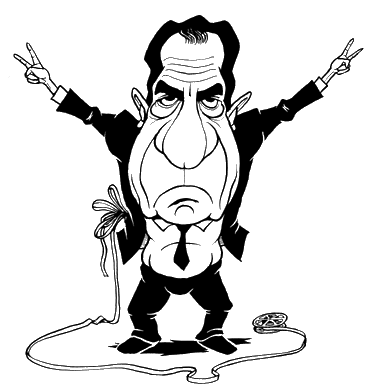
‘NIXON’S NIXON’— a probe into the past at ACTORS’ SUMMIT

Russell Lees' ‘NIXON’S NIXON,’ now on stage at Actors’ Summit, is a historical docudrama which imagines the conversation that might have taken place when then-President Richard Nixon summoned Secretary of State Henry Kissinger to the White House on August 7, 1974. This was the night before Nixon resigned from the Presidency due to the Watergate scandal. Though no one, except the two men knows the content of their conversation, Lees imagines that the duo relived past glories, conjured up their political legacies, and wrestled with their personal insecurities.

The ninety-minute play, performed without an intermission, is at times compelling, while at other times gets a little tedious. At times it is humorous, at times humorless.

We see a Nixon who alternates between being desperate, shrewd, paranoid, but, most important, utterly baffled by the situation in which he finds himself. How could his “friends” be demanding his resignation? How could his loyal public not come to his side, like Napoleon’s former warriors did when he returned from exile? This is a man who is on the brink of a total psychological melt-down. No sooner does one thought come into his head than another arrives before he has fully articulated the first. His language is obscene. His always inept smile, his inability to see reality, is present.
Kissinger, who starts off as a statesman who sees reality, but soon falls prey to his ego and desire to continue to be at the hub of the US foreign policy, starts conceiving illogical plots to save the duo. His fertile imagination includes various "Dr. Strangelove"-like possibilities including starting a war on the Russian-Chinese border.

Unfortunately, Lees fails to build all the needed tension of the high-stakes poker game he’s set up. The script often meanders.

Though both A. Neil Thackaberry (Nixon) and George Roth (Kissinger) are generally excellent, there are times when the portrayals need some polishing and a reality check. For example, Roth continually hides his head in his hands looking very child like. This would work if his actions following this departure from his usual logical control, were more keyed. His accent comes and goes. Thackaberry often misses the maniacal look that Nixon had, foreshadowing one of his deceptive actions. His body, complete with the traditional almost cartoon like gestures, sometimes loses the image. The “tricky Dickey” is only there part time.

The production yells for a keen eye to detail and the needed frenetic pacing to highlight Nixon’s closeness to being totally out of touch with reality and Kissinger’s near desperation, the qualities that garnered critical claim in its New York run.

Things are not helped by director Constance Thackaberry’s direction. Part of the problem may be the director’s youth. As she indicates in the program, the era and the characters were a historical discovery for her. Maybe someone who had lived through the Nixon days might have had a clearer awareness of the almost bipolar swings of the man and the tension of the era. And, her lack of directing background may also come into play here as the eye for detail is often missing.

CAPSULE JUDGEMENT: “NIXON’S NIXON’ is a good exposé of the Nixon era. The production, though sometimes slow, is interesting, if not compelling, and is worth a go-to for those interested in historical events and political intrigue.

Tuesday, October 21, 2008

Goldstar, Ohio


Emotionally draining ‘GOLDSTAR, OHIO’ at CPT

Being in the audience opening night at the world premiere of ‘GOLDSTAR, OHIO’ at Cleveland Public Theatre was a surreal experience. Many of those in the sold out crowd were wearing pictures or badges with the facial images of members of the 325th Marine unit who were killed in the Iraq war during the first week of August, 2005.

‘GOLDSTAR, OHIO’ is a play based on interviews conducted with the families of the fallen marines. Four families continued to speak to Michael Tisdale, the interviewer and author of the play for two-and-a-half years after the original in-take of information. They are the center of the script. The result is an in-time and personal revelation which, at times, becomes emotionally draining.

The first act lays the foundation of what happened. The second act, reveals reactions to and experiences following the killed Marines bodies arriving home.

Unfortunately, the play is at least forty-five minutes too long. It’s too bad that most of the excess is in the second act. But, it is also there that the words of families twist the heart. Jill Levin speaks words which rip into George W. Bush and his failed policy of taking the country into a senseless war which has resulted in over 4000 American deaths and multiple mental and physical injuries. I can’t perceive anyone sitting through that speech and not be repulsed by the actions of this administration and all those who support and supported the Iraq war. As the script states, “The casualties and fatalities of war will affect our communities for years to come.”

The cast, who play numerous roles, is universally excellent. This is a unit cast performing as a unified team. Applause to Jill Levin, Anne McEvoy, Dana Hart, Justin Tatum, Sarah Marcus, Bob Goddard, Casey Spindler, and Chuck Tisdale for a job well done.

Some might fear that the play may be too graphic. Be aware that there are no events that show the actual deaths. In addition, there is comedy that relieves the stress.

Kudos to Director Andy Paris, who, in his initial directing experience, did a masterful job. His stage pictures were involving. The creative use of the set was symbolically strong. Bows to Trad Burns for both the set and lighting design.

Capsule judgement: “GOLDSTAR, OHIO,’ in spite of its excessive length, is a compelling and meaningful presentation. It’s a go see!

Thursday, October 16, 2008

A CHORUS LINE


‘A CHORUS LINE’: NOT WHAT IT SHOULD BE!

So there is no question about the basis of this review: I am ‘A CHORUS LINE’ fanatic. I love the show! This affection carries with it a problem...I go into productions of the show with the fear that the director/choreographer/actors are going to give me visual and emotional mind-burn.

Unfortunately, the touring production of ‘A CHORUS LINE,’ now on stage at the Palace Theatre, is a major disappointment! It lacks energy. It lacks the quality of acting, dancing and singing that makes the show a theatrical feast.

The results are very surprising considering that the tour has only been on the road since the beginning of May, so there is no reason for the general look of exhaustion from the cast. It is directed by Bob Avian, who was the co-choreographer of the original show which opened on-Broadway in 1975, won nine Tony Awards and ran for nearly 15 years, and closed in 1990 after 6,137 performances. This can’t be the show that opened in a Big Apple revival to rave reviews in 2006 and was billed as “exhilarating,” “endearing,” and “a masterpiece.”

‘A CHORUS LINE’ was originally conceived, directed, and choreographed by Michael Bennett, the recognized genius of theatre choreographers. It has music by Marvin Hamlisch and lyrics by Edward Kleban. The book was assembled by Elyria native James Kirkwood and Nicholas Dante.

The script was not written by the traditional means of a writer conceiving a plot. ‘A CHORUS LINE’ began as a workshop "share" session. A group of dancers met after rehearsals for other shows to talk about their personal and professional lives. The sessions were tape recorded, written down, and a libretto was pieced together. Their combined work, guided closely by Bennett, resulted in a staging scheme that filled the songs and book with overlapping layers.

The final result was a story set in a Broadway theater. Young hopefuls are auditioning for a job in the chorus line of a musical. As each speaks, sings and dances, we learn about their hopes, insecurities and dreams. And eventually, their individuality becomes blurred as they become part of the chorus line, blending together into a unit of one…a chorus line.

What has always stood out in the show was Michael Bennett’s amazing choreography. Unfortunately, in the touring production Baayork Lee, who restaged the moves, didn’t demand Bennett’s perfectionism, the use of what he called “cinematic staging.” The Bennett signatures of slanted bodies, tilted heads, precise hand and arm movements, the flick of the wrist that turns the hats, aren’t there in total harmony.

Bennett used a constant "jump-cutting" so the audience's attention is shifted from one figure to another. This draws focus to the character by placing the visual spotlight on that person. Bennett also used a series of mirrors to spotlight performers and make them stand out bigger than life in the eyes of the audience. This production lost many of those qualities.

The cast is uneven. Gabrielle Ruiz’s (Diana) “Nothing” was well interpreted, but her “What I Did for Love” ” failed to capture the mood and meaning of the song. Hollie Howard (Maggie) has a great voice, Derek Hanson (Don) has the Bennett dance attitude and moves, and Emily Fletcher has the right attitude as Sheila. Kevin Santos hits Paul’s emotional self-revealing monologue right on, not only bringing tears to his eyes but to the eyes of many in the audience.

On the other hand, Nikki Snelson doesn’t display the dancing, acting or singing skills to pull off the pivotal role of Cassie. Elise Hall (Val) fails to get the necessary humor from “Dance; Ten; Looks: Three). She doesn’t compare with Elyria’s Crissy Wilzak, who played the role during part of the original Broadway run.

CAPSULE JUDGEMENT: The touring production of ‘A CHORUS LINE’ misses the mark of being a “singular sensation,” which it should have been. It’s not, as a line from the show says, “nothing,” but it should have been so much more!

Sunday, October 12, 2008

Noises Off


‘NOISES OFF’ at Cleveland Play House is entertaining, but…

‘NOISES OFF,’ now on stage at the Cleveland Play House, is a farce. In fact, it is considered to be one of the best written of the modern farces.

A farce, as the CPH program states, is “a comic dramatic work using buffoonery and horseplay, typically including crude characterizations and ludicrously improbably situations.” As anyone who has ever attempted to direct or act in a farce knows, it is hard work. It is probably the most difficult of theatrical formats to do well.

Though they try hard, the cast and director of ‘NOISES OFF’ just don’t get it totally right. Not that the production is bad, it’s not, it is quite entertaining. But it is not of the quality, for example, of the great production I saw in London of this show.

Maybe seeing a British play requires the British to do it. The accents, the natural over-exaggeration, the bigger than life characters, need that special Anglo touch.

The original staging opened in 1982 in London to rave reviews. A version of it opened in New York in 1983, starring Dorothy Loudon. It had moderate success, running 553 performances. A film version was made with Carol Burnett, Michael Caine, Christopher Reeve and John Ritter. Good cast, bad flick. A well respected critic wrote that the film was "one of the worst ever made."

The plot to ‘NOISES OFF’ centers on a play within a play. The fictional ‘NOTHING ON’ is a sex comedy which finds the cast often running around in their underwear, running in and out of doors, with no real purpose.

The ‘NOISES OFF’ segment finds us viewing three acts. The first, a rehearsal the night before opening with the cast still fumbling with entrances and exits, missed cues, misspoken lines, and bothersome props, most notably several plates of sardines.

Act Two portrays a performance one month later which reveals the deteriorating personal relationships among the cast that have led to offstage shenanigans and onstage bedlam.

In Act Three, we see a performance near the end of the ten-week run, when personal friction has continued to increase and everyone is bored and anxious to be done with the play. It contains one of the most delightful death-defying down-the-stairs falls you’ll ever see.

Much of the comedy should emerge from prat falls and general on and off-stage chaos. There should be a sharp contrast between players' on-stage and off-stage personalities.

The CPH version, under that direction of David Bell, tries hard for the slapstick. But, because of inconsistent pacing, some of it doesn’t work as well as possible. As for the on-stage/off-stage personalities, the cast generally fails. The personalities generally blend into one.

The play’s success depends, to a great degree on the set. Here, the CPH production shines as James Leonard Joy has created the perfect setting. In fact, the set is so effective that the audience universally sat in their seats at the set change between the second and third act. Unfortunately, after giving the viewers a taste of how the set would be altered, the curtain was dropped and the rest of the change hidden from view. Bad choice. The audience moaned and there were actually a couple of boos when the curtain closed. They wanted to see the stage hands do their thing.

Standouts in the cast are Christopher Kelly who is quite good as the mumphering Garry/Roger and Linda Kimbrough as Dotty/Mrs. Clackett, the maid.

CAPSULE JUDGMENT: The CPH production of ‘NOISES OFF’ is quite entertaining, but doesn’t reach the level of farce needed to really get the audience into a hysterical mood. As the play runs, maybe the cast will pick up the pace and separate the on-stage from the off-stage characterizations.

Into the Woods


'INTO THE WOODS' delights at Great Lakes Theater Festival

Have you ever asked yourself what happens following the “and they lived happily ever after” at the conclusion of most fairy tales? Do you think everything is rosy for the prince and his beloved, or for Jack and his mother after they get the hen that lays the golden eggs? Well, after watching ‘INTO THE WOODS’ at Great Lakes Theatre Festival, you might change your mind.

Stephen Sondheim and James Lapine’s musical, which was inspired by Bruno Bettelheim's THE USES OF ENCHANTMENT, intertwines the plots of several Brothers Grimm fairy tales in the first act and then explores the consequences of the characters' wishes and quests in the second act. The main characters are taken from “Little Red Riding Hood,” “Jack and the Beanstalk,” “Rapunzel,” and “Cinderella,” tied together by a story involving a Baker and his wife and their quest for a family.

‘INTO THE WOODS’ premiered on Broadway in 1987. Bernadette Peters' portrayed the Witch, and Joanna Gleason was the Baker's Wife. It won Tony Awards for Best Score, and Best Book in a year dominated by ‘THE PHANTOM OF THE OPERA.’

This is one of Sondheim’s most beautiful and accessible scores. It includes the poignant “No More,” “No One is Alone,’ and “Children Will Listen.” The music lingers in your mind long after the production.

As proven by Great Lakes Theatre Festival’s ‘MACBETH,’ which opened last week and now ‘INTO THE WOODS,’ GLTF is on a roll. It might be their new refurbished home in the beautiful Hanna Theatre, or it may be a change in attitude; but, whatever it is…audiences are in for a treat.

Director Victoria Bussert and choreographer Martin Cespedes create ever-involving stage pictures, which are framed by Scenic Designer Jeff Herman’s creative set. (Be sure to look for the faces and figures cleverly interwoven into the trees, which overlook the happenings.) Charlotte Yetman’s costumes, Norman Coates lighting and Stan Kozak’s sound design help complete the illusion.

Musical Director John Jay Espino and his well-tuned orchestra generally do a good job of backing up rather than drowning out the singers.

The cast is uniformly excellent. Jodi Dominick sings well and creates the right empathy as the Baker’s wife. Tom Ford, he of sad and mobile face, is excellent as the Baker. Jessica L. Cope has a compelling singing voice and creates a Witch who is delightfully witchy. Derrick Cobey makes for a great wolf, but overacts and postures too much as Cinderella’s Prince. Maryann Nagel is a fine fuss-budget as Jack’s mother. Tim Try is perfectly nerdy as Jack. Mark Moritz does a nice job of transitioning between being the Narrator and the Mysterious Man. Emily Krieger creates the right image as Cinderella, but is often difficult to hear during her songs.

CAPSULE JUDGEMENT: GLTF’s ‘INTO THE WOODS’ is a delightful production which entertains completely. It’s a go see!

Sunday, September 28, 2008

Macbeth (Great Lakes Theater Festival)


‘MACBETH’ highlights new GLTF home at the refurbished Hanna

‘MACBETH,’ the first production in The Great Lakes Theater Festival’s new 14.7 million dollar new home, shows off all the elements of the refurbished Hanna Theatre. From the very first drum beat, director Charles Fee uses the intimate facility to its maximum effect. Electronic platforms make actors and set pieces rise and fall from the thrust stage area. Special light effects, possible with the enhanced illumination system, are ever present. The audience is brought into the action by actors passing within inches of them as the performers charge up and down the aisles.

For those concerned about what happened to the Hanna, worry not. In spite of the change in seating patterns, the balcony, a favorite viewing area for many, still exists, complete with its ornate plaster front decorations. In fact, all of the colorfully painted ornateness is still there. The wonderful auditorium ceiling, the proscenium arch and the decoration on the side boxes have all been retained. Only the paint color on the walls has been adjusted. A bland beige has been used to cover the original color.

One of the wonders of the theatre is the acoustics. No mikes are needed for the actors to be easily heard throughout the theatre. No mike squeals or uneven balance between actors’ spoken words. Hurrah! This is theatre as it should be.

Yes, the initial attention on opening night seemed to center on the trappings, the new bar area, the spacious and more comfortable seats, the wider aisles. But, the attention soon shifted to the stage, where Fee has created a wonder-filled production.

‘MACBETH,’ which is among the best-known of Shakespeare's plays, is loosely drawn on the historical account of King Macbeth of Scotland. Originally conceived in four acts, it tells of the dangers of the lust for power and the betrayal of friends.

The main action centers on Macbeth, whose wife, Lady Macbeth, hatches a plan to murder the king and secure the throne. Although Macbeth raises concerns about the regicide, Lady Macbeth eventually persuades him, by challenging his manhood, to follow her plan. Unfortunately, the prophecies of three spirits that Macbeth encounters in the woods, who state that his heirs will not inherit the throne come true. They tell him to "beware Macduff", but that "none of woman born shall harm Macbeth." These actions carry forth the plot.

The play is filled with great scenes including the one in which Lady Macbeth, racked with guilt from the crimes she and her husband have committed, sleepwalks and tries to wash imaginary bloodstains from her hands, all the while speaking of the terrible things she knows.

There are many superstitions centered on the belief that the play is somehow "cursed", and many actors will not mention the name of the play aloud, referring to it instead as “The Scottish Play.” Great Lakes was not immune from the curse. Associate Artistic Director Andrew May, who was to portray Macbeth, was injured prior to production and had to be replaced.

As for the GLTF staging, Fee has been nothing but creative. He utilized on-stage percussionists performing Japanese taiko drumming; reconceptualized the witches into spirits who transform themselves into blackbirds, trees and images; remolded the play into two acts, thus shortening it without losing any impact; used a Japanese flavor which influenced not only the startling set but the costumes and stage movements; underplayed rather than overacted Macbeth and Lady Macbeth’s famous speeches; and, called on general American pronunciation which makes for ease in understanding.

The cast is uniformly excellent. Questions can be raised. Did Dougfred Miller (Macbeth) and Laura Perrotta (Lady Macbeth) give great performances? Bottom line, both are quite adequate and do not detract from the overall effect. Should the actor’s speeches be given to each other rather than directed to the audience? Probably yes. Do the drum sounds lose their effect after a while? I didn’t find that true though some members of the audience seemed to think so. Were Phil Carroll and Tim Try strong enough as Duncan’s sons? No.

Some factors are clear. The witches, Sara Bruner, Laura Welsh Berg and Cathy Prince are outstanding. Drummers Seth Asa Sengel and Matthew Webb grab and hold attention. David Anthony Smith (Macduff), Dudley Swetland (Porter), Aled Davies (Duncan, King of Scotland) and Lynn Robert Berg (Banquo) are excellent.

Kudos to Scenic Designer Gage Williams, Costume Designer Star Moxley, Lighting Designer Rick Martin and Fight Choreographer Ken Merckx, who incorporate Kabuki-like movements and gymnastics into the fighting, for creating the technical aspects which enhanced the production.

CAPSULE JUDGEMENT: GLTF’s new home is spectacular and their opening production does the venue proud! This is a ‘MACBETH’ which should be seen in a facility that should be enjoyed.

Sidenote: An excellent ‘TEACHER PREPARATION GUIDE’ has been prepared by Daniel Hahn, Kelly Schaffer Florian and Cherly Kleps to be used by instructors who are bringing their students to see the play. They can be obtained by contacting Hahn at 216-241-5490.

Main-Travelled Roads


Charming ‘MAIN-TRAVELLED ROADS’ at Actors’ Summit

‘MAIN-TRAVELLED ROADS,’ now on stage at Actors’ Summit, is a charming musical penned by Richard Rodgers Award winners Dave Hudson and Paul Libman.

It is based on the short stories of Hamlin Garland, whose tales of American rural life is said to have inspired such writers as John Steinbeck and Theodore Dreiser.

The musical is set in turn-of-the-century Wisconsin, and portrays Midwestern farm life and the struggles of young lovers as they come in contact with the area’s various cultures and traditions.
The story revolves around several young couples. One duo, Will and Aggie, split up over a misunderstanding caused by a broken wagon wheel. As a result, Will leaves town and Aggie marries someone she is not in love with because she wants to escape the emotional pain of the loss of Will. Unfortunately, she finds herself in an abusive relationship. Then there is the “creamery man” who is looking for a wife and has his eyes on a wealthy young woman, who is not interested in him. Meanwhile, Nina, a Dutch woman has eyes for the “creamery man” and they eventually wind up together.

This is a light, happy musical, so all’s well that end’s well. So, after a six-year absence, Will shows up on Aggie’s doorstep. He professes his undying love. And they run off to New England, where he is now a wealth young business tycoon. And, of course, the creamery man and Nina live happily every after.

The plot might sound a little complicated but the show is easy to follow as the well-integrated songs bridge the segments together. Whether lighthearted, serious, or silly, each musical interlude gives a slice of each character’s personality, hopes and dreams. Such songs as “Small Town Telegraph” and “Creamery Man” bring smiles and “You Can’t Come Home” makes the eyes well.

Though she has over-directed several of the scenes, distracting from the words by drawing attention to movements, the Actors’ Summit production, under the direction and choreography of Sasha Thackaberry generally works well.

The four actors slip in and out of their 11 characters easily. The vocal sounds are generally good, the musical accompaniment by Evie Morris, is excellent.

Kathleen Culler sparkles as Aggie. She has a fine singing voice and lights up the stage. She does an excellent job of creating and maintaining her characterizations.

C. J. Bonde has some delightful moments as Nina and shows good tenderness as Delia, an understanding town folk.

Keith Stevens is charming as Will and has some excellent musical moments. His role as the mop-coiffed, cross-dressing Mrs. Haldeman (Nina’s mother) brought prolonged laughter in each of his appearances.

Stephen Brockway is properly nasty as Dave (Aggie’s husband) and charming as the “creamery man.”

Special notice: Paul Libman and David Hudson, the shows authors, will be in attendance at the Saturday night, October 4 performance of ‘MAIN-TRAVELLED ROADS.’ Besides viewing the show, Actors’ Summit’s Artistic Director, A. Neil Thackaberry, will discuss with them the possibility of producing the duo’s new musical based on the works of John Steinbeck.

CAPSULE JUDGEMENT: ‘MAIN-TRAVELLED ROADS’ is a charming musical which gets an excellent production at Actors’ Summit. If you want to spend a pleasant evening at the theatre, see this show

Saturday, September 20, 2008

Caroline or change


Dobama & Karamu unite for a “go see” ‘CAROLINE, OR CHANGE’

On the surface, ‘CAROLINE, OR CHANGE,’ now being co-produced by Dobama and Karamu at the Karamu Performing Arts Center facility, is a glimpse at a personal childhood experience of author Tony Kushner.

The musical centers on Caroline Thibodeaux, a divorced, middle-aged African-American, $30 a week maid, who works for a Jewish family in the suburban enclave of Lake Charles, Louisiana, in 1963. Caroline is resistant to the sweep of change she sees around her. She seldom talks, and almost never smiles, even to her own children or friends. She appears to be protecting herself from an explosion of rage or tears.

The Gellmans' young son, Noah, who is feeling abandoned due to the death of his mother, the emotional withdrawal of his father, and the insertion into his life of a well-meaning but rigid stepmother, is enamored with Caroline, even though she doesn’t reciprocate. In order to teach Noah responsibility, his stepmother tells Caroline that she should keep the change Noah carelessly leaves in the pockets of his clothes which are given to Caroline to wash. Caroline is loathe to take money from the child, but her own children desperately need food and clothing. The status quo goes awry over a $20 bill, which Noah received as a Hanukah present and leaves in his pants pocket, causing a rift between Caroline and the Gellmans. But, as with all aspects of this well-crafted script, that’s only the obvious reason.

The play’s title has at least a four-pronged implication. The obvious is the change that Noah leaves in his pockets and its ramifications. What should be done with that change? Second, America in the 1960s is filled with a change in racial relations and rage over the murder of JFK and MLK. How should/does Caroline react? She also finds herself in the middle of conflict among the Gellmans as they try to make changes in their family dynamics. What possible change does this mean for Caroline? And, there are the changes she faces as her daughter takes stands that challenge the patterns of the past forcing Caroline to decide how to manage not only the changes in own her life but those of her family.

In 2003 the off-Broadway production of ‘CAROLINE, OR CHANGED’ opened. Due to its success it was moved to Broadway, where it had a disappointingly short 136 performance run, but still was nominated for 6 Tony Awards.

The script, like all of Kushner’s works, such as ‘ANGELS IN AMERICA’ and ‘HOMEBODY/KABUL,’ is thought provoking and has strong social and political messages. Jeanine Tesori's score is melodic, vibrant and ranges from neo-operatic to R & B to Klezmer. It is very unlike her ‘THOROUGHLY MODERN MILLIE’ score.

The Dobama/Karamu production, under the direction of Sarah May, is often compelling, and always interesting. May understands that the underbelly of the script is the angst of the leading characters and has conveyed this to her cast. This script is a very difficult undertaking and May did a masterful job of guiding the production.

Sheffia Randall Dooley is compelling as Caroline. She has a fine voice, wraps herself into the role and lives the part. She is Caroline! Her underlying rage and sadness are always present on her face, in her body, and portrayed by her voice. Bravo!

Christian Flaherty’s Noah is a bundle of internal chaos. Noah is a sad little marionette whose strings often just don’t work right. Flaherty’s plaintive singing voice and nerdy movements all are character right.

Katherine DeBoer is quite acceptable in her portrayal of Rose, Noah’s stepmother. The rest of the members of the Gellman family don’t fair as well as there is a surface level quality to their performances.

In supporting roles, talented Aric Generette Floyd lights up the stage as Jackie, one of Caroline’s children. His real-life sister Alexis sings well and makes Emmie, Caroline’s daughter, into an authentic person.

Colleen Longshaw gives a fine performance as Caroline’s friend Dotty.

The musical supporting cast are all excellent, especially Rebeca Morris as The Moon and Ayeshah Douglas as the Washing Machine.

Musical Director Ed Ridley and his band are wonderful…underscoring rather than over powering the singing and playing the ever-changing musical genres with ease.

Richard H. Morris Jr. has designed a functional set which doesn’t get in the way of the action.

CAPSULE JUDGEMENT: ‘CAROLINE, OR CHANGE’ is not a show that will appeal to everyone as it is not an escapist musical with a happy ending. However, it is a must-go-to for anyone interested in the theatre and seeing a well-honed production. Thanks to Karamu and Dobama for giving Clevelanders a chance to experience CAROLINE, OR CHANGE.

Friday, September 19, 2008

Glass Menagerie


‘GLASS MENAGERIE’ GETS A THOUGHT PROVOKING INTEPRETATION AT CPH

‘GLASS MANAGERIE,’ now on stage at the Cleveland Play House, was Tennessee Williams’ first successful professional play. In spite of the fact that theatre critics are often maligned, Williams’ career as one of America’s greatest modern playwrights may never have taken place if not for two determined Chicago reviewers.

When ‘MENAGERIE’ opened in Chicago in December of 1944, due to bad weather and the lack of a well known author, the play had such low pre-sales that the producers considered closing the show after the first week. Critics Claudia Cassidy and Ashton Stevens were so enamored with the play they actually pleaded with readers to attend. Their efforts were successful and resulted in not only a successful Chicago run, but also inspired a New York production. The end result was the birth of one of America’s great plays. It also allowed Williams to have successful productions of such masterpieces as ‘A STREETCAR NAMED DESIRE,’ ‘THE ROSE TATTOO,’ and ’ CAT ON A HOT TIN ROOF.’

From a local perspective, it is interesting to note that the year before “MENAGERIE’ opened in the Windy City, The Cleveland Play House presented the world premier of Williams’ ‘YOU TOUCHED ME,’ a play based on a story of D. H. Lawrence, which is little remembered.

The 1945 Broadway production of ‘MENAGERIE,’ which won the New York Drama Critics Circle Award, starred Laurette Taylor, who had been a star in the 1920s and 30s, but had withdrawn from the theatre scene due to sever alcoholism. Her portrayal of the mother, Amanda, received outstanding reviews and ushered in a comeback. Other notables who have played the role include Jessica Tandy, Julie Harris and Maureen Stapleton.

The story centers on Tom, who narrates a tale of his memories of his past. Much as a traditional Greek chorus, he introduces characters and comments on the action. We meet his mother, Amanda, a faded southern belle who has been abandoned by her husband, and is living in the past while trying to navigate in the present. One wonders, are her tales real or is she living the great lie, clinging to her sanity by telling stories over and over until even she isn’t sure if they are real or illusions of her imagination. He introduces us to Laura, his physically and emotionally fragile sister who has magnified a slight limp into a major ailment to use as a device to cut herself off from reality. A reality that centers on an escape into a small animal glass collection which includes a unicorn, which much like Laura is different because of its horn. And, finally we meet Jim, a former high school acquaintance who now works at a shoe factory with Tom, who is brought home in hopes that he will marry Laura. Tom, who sat next to Laura in school choir, and with whom she has been in love her entire life.

As with many of Williams’ scripts, it concerns escape, escape from reality, from the harshness of life. It contains a signature southern deluded female who finds herself in a society that doesn’t understand her and which she doesn’t understand (think Blanche in ‘STREETCAR NAMED DESIRE’). It contains much symbolism. The fire escape, which is the only means of escape from the life in the oppressive apartment; the victrola and glass animals, which Laura uses for her escape from reality; the magic show and films, Tom’s means to escape from a life he hates; and the gentleman caller, Amanda’s hope for Laura to escape her present life.

The Cleveland Play House production, under the direction of Michael Bloom, is a good representation of Williams’ work. As with any production, the director’s vision sets the play’s attitude and the character interpretations. Bloom has a clear vision of the role of the characters, and since this is a character, not a plot driven script, that sets the tone.

His Amanda, as portrayed by the talented Linda Purl, is delusional, often comic, causing the audience to laugh at her, rather than feeling empathy and pathos for her. That approach adds a lightness and a humor level to the show, not usually seen. Purl consistently carries through Bloom’s interpretation. Personally, I feel about Amanda as I do of Blanche in “STREETCAR.” They are women forced to live in circumstances which are so beyond their control and recognition that they became psychotic. They are pathetic not humorous. But, that’s my view, and I’m not the director of this production. Bloom is.

Alison Lani often stays on the surface of Laura. She has some brilliant moments, as when she realizes that the Gentleman Caller is not going to return and her life, like the broken horn of her beloved unicorn, is not going to be repaired, saved. Yet, at other times, she seems to be feigning the character…overusing her “misshapen” hands, contorting her face rather than letting internal motivations set her expressions.

Daniel Damon Joyce is right on target as Tom. He is totally believable. He balances his internal and external rage with ease. (Having played the role twice, I am aware of the difficulty of making what appears to be a straightforward role into a tour-de -force performance.)
Sorin Brouwers gives Jim, the Gentlemen Caller, a nice edge of cockiness combined with vulnerability. His is a nicely texture performance.

Michael Lincoln’s lighting gives the right glow and darkness to the goings on. This is a play with lots of psychologically dark corners and Lincoln helps create them. Michael Roth’s underscoring music is effective, though at times it gets lost in the action. Susan Tsu’s costumes were not only period correct, but helped create the proper image for each character. Robert Mark Morgan deviated from Williams’ set description, but created a workable stage.

CAPSULE JUDGMENT: ‘THE GLASS MENAGERIE’ is one of America’s great modern plays. For those who have not seen it, they will get a vision of not only the work of a great playwright, but an interesting interpretation at CPH. For those who are familiar with the play, Bloom’s interpretation, especially his concept of Amanda, should be good fodder for conversation.

Saturday, September 13, 2008

Urinetown, 2008


Beck’s revival of ‘URINETOWN’….is flushed with success!

‘URINETOWN: THE MUSICAL’ graced the stage at Beck Center three years ago. The results were packed houses and joyous laughter. Scott Spence, the theatre’s artistic director, decided to revive the show this season, with basically the same cast and production team.

The idea for the play came to author Greg Kotis when he visited Luxembourg and was confronted with having to use the city's pay-per-use toilets. He, along with his friend Mark Hollmann, developed the show.

Theatrical producers took one look at the title and subject matter and wouldn’t take on the project. Luckily, Kotis and Hollmann happened upon three of Cleveland’s own, who at that point in their careers were fledgling New York want-to-be legends. Westsiders Matt and Mark Rego and Hank Unger had produced ‘VAGINA MONOLOGUES’ and were ripe for another hit. They optioned the script, mounted an off-Broadway production, and, against the odds, they became the Big Apple’s new “wunderkinds.” They have gone on to produce the likes of ‘WICKED.’

Don’t think of the show as a light bit of escapism. It is fun, in fact, a total delight, but it also has a serious underbelly. This is a tale of greed, corruption, love and revolution in a city where water is worth its weight in gold. Messages pervade, such as what happens when big business is given the right to control our lives. Think of the pharmaceutical and medical companies and their stranglehold over our health. What happens when citizens have their rights taken? What is it like to be lied to continually in an attempt to push a political and economic agenda (Think Bush and Chaney)? Think of the missiles of mass destruction hoax, resulting in the Iraq war, and the amount of money being made by the oil and military-industrial complex and influential public officials. Think of the rape of the environment caused by loosening the clean air act and the attitude of “drill, drill, drill.” The fantasy of the situation described in ‘URINETOWN: THE MUSICAL’ has become reality.

Beck’s’ production is delightful! Scott Spence pulls out all the stops to completely capture the necessary farce without losing meaning. He controls the temptation to go overboard with shticks.

Choreographer Martin Cespedes has reconceptualized the dancing. His new approach works well. He is lucky to have Zac Hudak’s dancing feet to anchor the choreography. Larry Goodpaster gets a nod of approval for this musical direction even though some of the music under the spoken scenes was too loud and drowned out the actors. Don McBride’s scene design, parallels the Broadway sets. Alison Garrigan did her usual “run to the thrift store” to find the right grubby clothing.

The cast is excellent...not a weak link in the chain. Matthew Wright is delightful as Officer Lockstock, the narrator. He builds a wonderful rapport with the audience and can do a double take with the best of them. Betsy Kahl (Little Sally) is terrific as his foil. Whether singing or whining her lines, she is delightful.

Colin Cook, who has a strong singing voice, bulked up since the last production and has lost some of his boyish charm. He interacts effectively with Maggie Stahl (Hope), his love interest, who is the daughter of the tyrant who controls the local urinals. Stahl’s’ rendition of “I See a River” is a show highlight. “Privilege to Pee,” “What is Urinetown,” “Snuff That Girl,” and “Run, Freedom, Run” are all choreographic gems.

Greg Violand, who normally plays the mature love interest in productions, takes a turn at being a bad guy in this show. He does it well with a big dynamic vocal range and strong acting talents. His version of “Don’t Be a Bunny” is hilarious.

The choral sounds are excellent, especially in several a capella segments.

CAPSULE JUDGEMENT: Beck Centers ‘URINETOWN’ is as strong this time as it was the last go around. If you haven’t seen it before, do so now. If you have seen it, go again> It’s as much or more fun the second time. Beck not only succeeds, but should be justly proud of being flushed with success!

Friday, August 29, 2008

Fall 2008 Theatre Calendar

FALL THEATRE OFFERINGS EXCITE!

The leaves will soon be falling, and local theatres’ curtains will soon be rising. Here’s what’s coming up:

Beck Center for the Arts, 17801 Detroit Avenue, Lakewood, 216-521-2540 An encore production of the uproarious Tony Award-winning comedy, ‘URINETOWN THE MUSICAL,’ opening on the Mackey Main Stage September 12 and running through October 12, 2008. This show, which critics called the “must see” production of 2005, will feature the return of the original cast and creative team from Beck’s production.

Workshop Players, 44820 Middle Ridge Road, Amherst, 440-988-5613
‘LYING IN STATE,’ a spoof of politics and funerals. September 11-28. For information go to www.workshopplayers.com.

The Bang and Clatter Theatre, 224 Euclid Avenue, Cleveland, 330-606-5317 or www.bnctheatre,com
The Ohio Premiere of ‘THE LIEUTENANT OF INISHMORE’ by Martin McDonagh, which has been called a cunningly constructed, deeply and intensely felt, bitterly blood curdling and breathtakingly funny.” Runs September 5 through October 11, Thursdays through Sundays.

Playhouse Square, 216-241-6000 or online at playhousesquare.org
The electrifying, bashing, crashing, banging, kicking, joyous ‘STOMP’ returns to Cleveland for four performances, October 3 -5, 2008. The return of the percussive hit also brings some new surprises, with some sections of the show now updated and restructured and the addition of two new full-scale routines, utilizing props like tractor tire inner tubes and paint cans.
‘A CHORUS LINE’ October 14-26, 2008, Palace Theatre. Winner of nine Tony Awards, including “Best Musical” and the Pulitzer Prize for drama, this singular sensation is the longest-running American Broadway musical ever. This is the musical for everyone who’s ever had a dream and put it all on the line. Come meet the new generation of Broadway’s best.

Dobama Theatre/Karamu co-production, Karamu House, 2355 E. 89th Street, 216-795-7077 or 216-932-3396, www.dobama.org,
Tony Kushner and Jeanine Tesori’s groundbreaking musical ‘CAROLINE, OR CHANGE’ revisits the early 1960’s, a period of sweeping change in race relations as it affects two families, one Southern Jewish and the other African American. The Gelman's son, Noah, worships Caroline, their dignified African American domestic, as a surrogate mother figure. Their tentative and touching relationship is at the heart of this powerful story, infused with an exhilarating mix of music: classical, R&B, Motown, Klezmer, and Negro spirituals. September 19-October 12.

Great Lakes Theatre Festival, Hanna Theater (the new home of GLTF), www.greatlakestheater.org, 216-241-6000
Fall repertory September 24-November 8. ‘MACBETH’ and ‘INTO THE WOODS.’ See politics and magic meld in Shakespeare’s unforgettable masterpiece and also experience Stephen Sondheim’s bewitching collection of classic fairy tale characters as they romp though a “once upon a time” kingdom in a magical Broadway musical.

Cleveland Play House, 8500 Euclid Avenue, Cleveland, 216-795-7000, clevelandplayhouse.com
Tennessee William’s semi-autographical masterpiece, ‘THE GLASS MENAGERIE,’ on stage from September 12-October 5, followed by the hysterical British farce ‘NOISES OFF’ being staged from October 3rd to the 26th, then Lorraine Hansberry’s classic tale ‘ A RAISIN IN THE SUN’ from November 7-30, followed by a revival of ‘ A CHRISTMAS STORY’ from November 28-December 21.

Cleveland Public Theatre, 6415 Detroit, Cleveland, 216.631.2727, x501
GOLDSTAR, OHIO’ is a new play by Cleveland native Michael Tisdale that tells the stories of the 22 Marines from the Brook Park, Ohio based 325 Battalion who lost their lives in Anbar Province, Iraq. The play is a work of non-fiction created from transcripts of interviews with the families of the fallen Marines. October 16 - November 8.

Ensemble Theatre, Studio One Theater of the Cleveland Play House, 216-3421-2930
From Sept. 19 - Oct. 5, Edward Albee’s Theatre of the Absurd ’WHO’S AFRAID OF VIRGINIA WOOLF?’ This existentialistic masterwork from the 1960’s revolves around the conflictive marriage of George & Martha. A biting and timeless American classic! From Nov. 21-Dec. 7 in Brooks Theatre, Beth Henley’s ‘THE LUCKY SPOT’ will be on stage. This is a whacky comedy set in a depression dance hall in Louisiana which asks, “what hope might be found by the hopeless?”

SEE YOU AT THE THEATRE!

Monday, August 18, 2008

Altar Boyz

‘ALTAR BOYZ’ entertaining at Beck, but…

The recently concluded run of ‘ALTAR BOYZ’ at Beck Center was met with sizeable crowds and good word of mouth. That’s the positive part. The other aspect is that the show, both the script and the production, though entertaining, were somewhat lacking.

Yes, the show received numerous awards, and has brought younger audience’s into the theatre, but what is it intended to be? It’s not really a spoof, or a satire or a parody. It’s a ‘NUNSENSE,’ ‘FOREVER PLAID,’ and ‘GODSPELL’—kinda’ thing. It pokes fun at boy bands and brushes Christian/Catholic positions on evolution, homosexuality, and unwed mothers, among others, and, of course, turns the other cheek when necessary. But, for what purpose? As one out-of-town reviewer said, “It’s amiable, but its also aimless.” And, being a message guy, that’s my problem with the script.

The show, for those who didn’t see it, is a supposedly real-time concert, in fact the last concert of the Altar Boyz “Raise the Praise” tour. The five-member group sing, have some lines that bridge the songs together, dance, and try and get the audience to repent. Their level of success is measured on a “sinner’s meter” which keeps track of those in the audience who are still on their way to hell. Finally, we are down to four hold-outs. And, no surprise, they are members of the Altar Boyz. All the members except the Jewish kid. Yep, one of the Catholic Altar Boyz is Jewish. Why, I’m not sure, but I’m certain that Kevin Del Agula, the script’s writer, figured he could use the yarmulke wearing kid for some laughs and use him as the only one who doesn’t “sell out.” Hmmm..is there a religious message here?

The show had its debut in September of 2004 at the New York MusicaTheatre Festival and opened Off Broadway in March,2005 and has had a prosperous run.

The show's music and lyrics were written by Gary Adler and Michael Patrick Walker and the idea was hatched by Ken Davenport and Marc Kessler.

As for the Beck production. It was an enjoyable experience, but could have been much more. Now, to be fair, I saw the last show, a matinee mainly populated by senior citizens. There was mild response to the requests for participation and some audience members seemed lost in the material. One lady sitting near me was offended by the “sacrilegious” nature of the material. Since this is the kind of show that requires reaction from the audience, this might have been the reason for some flatness.

The obvious “star” of this production was John Riddle, who portrayed the fey Mark to perfection. He minced and over-gestured with panache. He has an excellent singing voice and appeared to be the only real dancer on stage. His “Epiphany” was delightful.

John Rhett Noble, who has portrayed Gaston in the numerous recreations of Beck’s ‘BEAUTY AND THE BEAST,’ gives an adequate performance as Matthew, the leader of the group. He lacked the necessary vocal and personality dynamics to control the stage. His “Something About You” was well done.

Connor O’Brien who portrayed Abraham had some projection problems. Part way through the show he ripped off his microphone, losing his head covering in the process, and did the ending with no electronic aid. His articulation needed work as many of his lines were lost. His character development was not always believable.

Dan Grgic, portraying the less than bright southerner Luke, overdid the accent causing comprehension problems and portrayed a characterization rather than a character.

Ryan Jagru was appealing as the Hispanic Juan, but often overdid the accent and at times lost the characterization.

Hernando Cortez’s choreography was creative and purposeful. Unfortunately, he didn’t have the dancers to execute the polish and perfection which Cortez demands of his Verbs Ballet company.

Scott Spence’s direction was basically on course, but there were times when there needed to be more life, more enthusiasm, more naturalness from some of the cast members.

Larry Goodpaster’s musical direction was excellent, but one could have wished that he had worked with the cast on better pronunciation. Some song lyrics were garbled.

CAPSULE JUDGEMENT: Beck’s ‘ALTAR BOYZ’ was an enjoyable theatrical experience. A listening to the off-Broadway cast CD gives an idea of what the show could have been with a little more abandonment and dynamics.

Thursday, August 14, 2008

HAROLD AND MAUDE: AN INTIMATE MUSICAL


Charming, tender HAROLD AND MAUDE at Cain Park

Yes, ‘HAROLD AND MAUDE, AN INTIMATE MUSICAL’ is based on the cult 1971 film ‘HAROLD AND MAUDE.’ Devotees of the film will have to accept that the musical not only changes the plot a bit, but softens up the chilly, darkly comic mood of the original. This is with good reason. A movie distances the viewer from the reality, theatre doesn’t allow for this. The insertion of music also changes the flow of the production. In addition, when one media is transformed into another, changes naturally take place. A classic example is the comedy film version of ‘THE PRODUCERS’ versus the musical version.

Does this mean that ‘HAROLD AND MAUDE, AN INTIMATE MUSICAL’ is a great piece of theatre? No. But, it has personal values that make for a charming and tender evening of theatre. And, if the reaction of the audience the night I attended is any indication, then there is much to like about Victoria Bussert’s staging and interpretation.

The plot line centers on an attention-starved young man so fascinated with death that he attends strangers funerals, frequently fakes his own suicide and decapitation, but eventually finds love and self-respect in the presence of a 79-year old bohemian Holocaust survivor who sees the world as a place to explore and appreciate rather than view through a prism of rules and frustration.

Tom Jones (“THE FANTASTICS”) and newcomer Joseph Thalken have written an often smart, funny, irreverent, tuneful score. Again, the movie-obsessed will complain because the period-and mood-defining Cat Stevens soundtrack has been replaced. Again, so what!

As for the Cain Park production. Are Corey Mach (Harold) and Maryann Nagel (Maude) the parallels to Bud Cort and Ruth Gordon of film fame? No. And, I, for one, am glad. They don’t attempt to duplicate those performances. (Just as Nathan Lane doesn’t do a Zero Mostel imitation in ‘THE PRODUCERS.’)

Yes, Nagel, with her beautiful complexion and youthful voice isn’t 79. After a short while, it matters little. Her charm and naturalness shine through, and with her wonderful singing voice, she enfolds us in the character’s philosophy of life. Her renditions of “Two Sides of a River,” “The Real Thing,” both sung with Mach, and “The Chance to Sing,” her plaintive solo, are all fine!

Tall, lanky and talented Mach is very believable as Harold. The opening scene, in which he sings a suicide note, climbs on a stool, puts his neck into a noose and steps off into the air and hangs there as his mother walks in, glances dismissively at the hanging body a few times, and reacts in horror with the line, "White socks with brown shoes!" is hysterical. He does a fine job of making the transition from an emotionally dead youth to a sensitive young man who seems to have found a purpose in life, thanks to Maude.

Jacqueline Cummins generally misses the mark as Harold’s mother. Yes, she is creating a caricature, but she does so inconsistently with little reality.

On the other hand, Devon Yates and Patrick Janson, who portray all of the other characters, are delightful. It’s worth the price of admission to watch Yates, as Sunshine, an off-the-wall performer, sing and act out the hysterical ‘Montezuma.”

Bussert paces the show well, and though there were some opportunities for even more delight, she does well in keeping the audience involved. Jodie Ricci’s musical direction is right on key!

CAPSULE JUDGEMENT: I found ‘HAROLD AND MAUDE, AN INTIMATE MUSICAL’ full of endearing melodies, quirky-humor and uplifting charm. For those who wanted this is to be a reenactment of the film version, get over it!

Monday, July 07, 2008

Alice


Magical ‘ALICE’ at Porthouse

Three years ago Matthew Earnest, who is now directing ‘ALICE’ at Porthouse Theatre, staged a version of ‘OUR TOWN’ which stuck to the Thornton Wilder’s original intent, but framed the production with a creative and contemporary style.

Last year Earnest’s directing genius was displayed with the inventive and audience-appealing ‘PETER PAN.’ This year, the Roe Green sponsored Visiting Director at Kent State University, is staging a fantastical, psychedelic journey into Wonderland. This is not your traditionally staged ‘ALICE IN WONDERLAND.’ It is a visually enchanting production, with amazing costumes and some interesting original music.

Earnest, besides directing, also adapted Lewis Carroll’s ‘ALICE’S ADVENTURES IN WONDERLAND’ and ‘THROUGH THE LOOKING-GLASS.”

‘ALICE'S ADVENTURES IN WONDERLAND,’ which was published in 1865, is a surreal work of literary nonsense written by English author Charles Lutwidge Dodgson under the pseudonym Lewis Carroll. It tells the story of a girl named Alice who falls down a rabbit-hole into a fantastic realm populated by peculiar and anthropomorphic creatures.

The tale is filled with allusions to the author’s friends and enemies. It has been examined from many perspectives…as an attack on the British educational and social systems, as a world looked at through a drug haze induced by eating hallucinogenic mushrooms, and as a mathematical puzzle. Some just regard it as nonsense which intellects attempt to make into sense and reality.
Whatever, it is a lasting piece of literature which has been the subject of plays, movies, cartoons, and television adaptations.

Whether you do or don’t gain a message from Porthouse’s ‘ALICE’ is almost irrelevant. What you will gain is an appreciation for creative staging, excellent performances, and how a script placed in the hands of a very competent director can become exciting theatre.

The cast, most of whom play multi-roles, is uniformly excellent. Especially endearing is Emily Pote. The talented young lady who played Emily in ‘OUR TOWN’ and Wendy in ‘PETER PAN,’ at Porthouse is a waif who lights up a stage. She is utterly charming as the now tall, now short, now energetic, now pensive Alice.

Nick Koesters, he of mobile face and good comedy timing, is especially effective as the Cheshire Cat and the White Knight.

The original music by Cocteau Twins and Thomas Dolby adds a dimension to the production. Pat Johnson’s costume designs may be the overall hit of the staging. His creativity in making enchanting illusions out of daily household goods is astounding. Scenic Designer Steve Pauna adds much with his white-on- white multi-doored set. Matthew Earnest’s choreography also adds to the delight, as does T. C. Kouyeas Jr.’s lighting.

JUDGEMENT: ‘ALICE’ is one of those special productions which is a joy to experience. Matthew Earnest has fast become one of my favorite directors, gaining respect for his creativity and ability to craft lasting illusions. Bravo! Bravo!

Monday, June 30, 2008

Groundworks--Cain Park 6/08


GROUNDWORKS adds a delightful dance to their repertoire and a new company member


Groundworks, David Shimotakahara’s innovative dance company, showcased its newest company member, Kelly Brunk, at their recent Cain Park performances. In addition, ‘LIGHTS UP,’ a creative humorous piece, was added to the group’s repertoire.

During the last two years Groundworks has gone through major changes in their composition. Damien Highfield and Sarah Perret joined the company last year. Kelly Brunk, who blended well with the rest of company, was impressive in his recent debut. Tall and thin, Brunk, who graduated with honors from New York University’s Tisch School of the Arts, has danced in Austria, Vietnam and San Francisco. He has choreographed as well as performed. He displayed the necessary proficiency and discipline to meld into Groundworks’ controlled dance form.

‘LIGHTS UP’, the third number in the recent program, is a welcome addition to the repertoire, which often tends to be very serious. This piece, performed to live music composed and played by Gustavo Aguilar, Nathan Douds and Howie Smith, was both humorous and creative. Shimotakahara’s choreography, which was a collaborative work created by the entire company, centers on interesting combinations of duets and trios. It was fresh, happy and joyful. It contained an excellent jazz segment performed by Sarah Perrett. As always, Amy Miller and Felise Bagley sparkled.

The program also included ‘ANNIE REDUX,’ choreographed by David Parker, which used music from Irving Berlin’s ‘ANNIE GET YOUR GUN.’ The songs were recorded for the 1950 MGM film adaptation of the Broadway show which was to star Judy Garland and Howard Keel. Before the movie was completed, Garland had to withdraw, but her vocal renditions had been recorded. Though it was exciting to hear Garland’s versions of the song, Parker’s choreography is lacking. As a friend, who had not seen the piece before commented, “The words and the movements didn’t match.” I had stated this the first time I reviewed the piece. The movements were creative, with the use of interesting angles, arm lifts, freezes and poses. The quality of the dancing was excellent. However, the lack of parallelism between meaning and actions was distracting.

‘MIGRATION,’ the program’s other dance number, was performed to live music composed by Gustavo Aguilar and performed by Aguilar and his wife Gaelyn. The plaintive sounds were pleasingly interpreted by the sarong clad duo of Amy Miller and Damien Highfield. About ‘things in flux, the motion of change, how far can we journey and still be connected to a place, to each other,” the overall effect was compelling. The dancers were physically disconnected, though emotionally connected, through most of the piece, moving in separate spheres. As is often the case with Aguilar’s compositions, the number was too long, causing connect exhaustion between the dancers and the audience.

Following the performance Shimotakahara announced that the company would be in New York in residence sometime during the 2008- 2009 season.

CAPSULE JUDGEMENT: GROUNDWORKS DANCETHEATER is one of the area’s shining cultural lights. Welcome to Kelly Brunk, who appears to be a fine talent addition to the company.

Sunday, June 22, 2008

Jersey Boys


“Oh What a Night”—‘JERSEY BOYS’ at the State Theatre

There was a high-level buzz of excitement at the State Theatre before the opening curtain of ‘JERSEY BOYS.’ The audience was expecting something special. And, did they get it!!! At the end of the evening they were on their feet screaming for more and the elation spilled out onto the streets following the show. (In this instance, this was not an automatic Cleveland standing ovation given for anything from good to bad productions. This was a deserved standing O!)

Yes, as one of the show’s songs cries out, “Oh, What a Night.”

JERSEY BOYS is a story about Frankie Valli and The Four Seasons: Frankie Valli, Bob Gaudio, Tommy DeVito and Nick Massi. It supposedly is the story of how a group of blue-collar boys from the wrong side of the tracks became one of the biggest American pop music sensations of all time. They supposedly wrote their own songs. They invented their own sounds and sold 175 million records worldwide - all before they were thirty.

You’ll note in the last paragraph I said “it is supposedly the story” and they “supposedly wrote their own songs.” There is some controversy over how much the script’s writers, Marshal Brickman and Rick Elice, deviated from the real story. There is also some question abut whether Bob Gaudio really did write all of the songs. Be that as it may, there is no question over the entertainment value of the production. And, in the end, the audience really doesn’t care if the story is totally authentic. As one of the songs states, “Can’t Take My Eyes Off You.” You won’t be able to take your eyes off the stage and keep your feet still as the beat goes on and on and on.
The show opened in November of 2005 in New York. It won four 2006 Tony Awards including Best Musical and continues to break box office records on Broadway.

This national tour includes Erik Bates as Tommy DeVito, the founder and sleazy member of the group. His wild way of living, his spending and gambling, caused the quartet problems and eventually was the cause of its breaking up. Bates is appropriately ego-centered in the role. He sings and moves well.

Miles Aubrey is Nick, Tommy’s older brother, who was basically along for the ride. Aubrey, as is the rest of the cast, fits well his part and sings effectively.

Andrew Rannells, who not only looks like the real Bob Gaudio, but has the same boyish charm, is excellent. Portraying the “intellect” of the group, Rannells wraps himself in the role and is completely believable.

The star of the evening is Joseph Leon Bwarie as Frankie Valli. Though there is conjecture that he is getting support via backstage singers for hitting the necessary falsetto high notes, again, who cares. It works. Be aware that Zachary Prince performs the Valli role at some performances. Having not seen him in the role, I have no way of advising whether his performance will meet the high level of Bwarie’s.

Everything about this production is professional. The sets, the orchestrations and the costumes all work.

A sign in the lobby of the State indicates, “Authentic, profane, Jersey vocabulary are special effects used in this production.” Yes, there is an “in-ya"-face Jersey attitude. On the night I saw the show it carried over into a shouting match in the audience which developed into a fist fight at the start of intermission. Supposedly some guy defied the theatre rules and the people around him by keeping his cell phone on, and, the rumor states, using it during the show. How Jersey! (BTW—because of the language used, the show is not recommended for anyone under 12.)

CAPSULE JUDGEMENT: I saw ‘JERSEY BOYS’ in Chicago. I loved it then, I loved it in this staging, which I think is a better production. Go, go, go see ‘JERSEY BOYS.’ You will have one hell of a time and be in a “Trance” as you “Walk Like a Man” [or Woman] out of the theatre, feeling like a “Big Man [or Woman] in Town.”

Question for the Reviewer: A Question About Ridiculous Standing Ovations


Dear Mr. Berko,

I was wondering if you could help me to understand the behavior of the local theater audiences.

I grew up in Cleveland and after graduating from Kent State spent most of my adult life in Los Angeles. I moved back to Northeast Ohio to raise my kids nearly four years ago.

In Los Angeles if an audience gave a performance a standing ovation it was because they were compelled to leap from their seats and applaud at the end of the show. Since I have been back I have been to several community productions and at the end of each show the audience staggers to their feet. I imagine this is started by a few friends and family but it seems common practice.

Now I do not get out to the theater much. I teach on-camera acting so it's movies and motherhood for me. I thought after seeing your review of "The Wiz," which I took my family to last night, that you may have some insight with all of your years of experience. I am sure they gave it a standing ovation Thursday as they did last night for a less than compelling performance. What bothered me the most is the lack of character development and arc. The show had no heart. I will applaud song and dance but you have to "move" me to get me out of my seat.

Well if you have gotten this far, I thank you for reading. If you take the time to respond, and I appreciate and value time, I will sincerely be grateful.

Thank you always for your years of insight.

Very Kindly,
Maureen Dempsey

Saturday, June 21, 2008

Honk

Mercury’s ‘HONK,’ pleasant, but could have so much more

‘HONK,’ which is now being staged by Mercury Summer Stock, is one of those charming little shows which should enchant and regale audiences. It is a retelling of Hans Christian Anderson’s ‘THE UGLY DUCKLING,’ complete with a theme of tolerance.

It has a gentle and pleasant score by George Stiles and Anthony Drewe which does not come close to the wonderful music that Frank Loesser wrote for the film, ‘HANS CHRISTIAN ANDERSON, which starred Danny Kaye, and included a segment on the ugly duckling. It is, however, a quite serviceable score.

The stage version opened in 1993 in England and was originally called ‘THE AESTHETICALLY CHALLENGED FARMYARD FOWL.’ In 1997, when the script was revised, the title changed to ‘HONK!”. It went on to win the 2000 Olivier Award, the British equivalent of the U.S. Tony Award, beating ‘THE LION KING’ for the honor.

The story is set in the countryside and features an “ugly duckling,” who somehow is hatched by a hen, who discovers his inner beauty as he becomes a swan. In the process of his journey from odd to beautiful, he is taunted, runs away from home with a cat who wants him for his dinner, meets a wisecracking bullfrog and a lovely female swan. In the process he, and members of the ensemble, sing such songs as "A Poultry Tale," "Warts and All," "Look at Him," "You Can Play With Your Food," "Now I've Seen You," and the charming "Different."

This is a deceptive script. On the surface it appears to be an easy show to stage. It isn’t. There is a strong message, there are creative vaudeville-like actions which require that it become a comic strip in action. It is very British in its base which mandates an understanding of broad British humor.

The Mercury production, under the direction of Pierre-Jacques Brault with production staging by Joanna May Hunkins, is pleasant, but could have been so much more. Mercury prides itself on being able to stage a show in two weeks. In this case, with Brault also working on ‘THE WIZ’ at Cain Park, the short preparation time causes the staging to suffer. Brault’s usual creativity isn’t completely present. That’s not to say the show is bad. It isn’t. It just isn’t all that it could have been with a little more time, insight and focus.

Alex Wyse, one of my favorite local actors, plays The Ugly Duckling. (He was awarded a Times Theatre Tribute for his outstanding performance in Kalliope’s ‘SUMMER OF ’42’ several years go.) Wyse has the correct happy, yet forlorn face, to portray the many moods of the gleeful yet questioning duck who transforms into a gracious swan. He has a nice singing voice and creates a clear character. Danielle Renard as Ida, Ugly’s mother, also has a nice singing voice, but lacks the depth to create a complete character.

Brian Marshall as Drake, Ugly’s dad, kind of walks through the role, losing his accent along the way. Shane O’Neil’s cat just isn’t cunning enough, and his French accent comes and goes, along with a consistent characterization. Sara Hymes is charming as Penny, the lovely swan who gives Ugly insight into himself. Brian Marshall has some excellent moments as Bullfrog, but there was a lot more humor that could have been developed. The rest of the cast varies from good to okay.

As is my custom when there is a child-friendly show, I took the “Kid Reviewers,” my grandsons Alex (12) and Noah (11) to see and comment on the show. The boys liked the show, giving it an 8.5 on a scale of 10. They really liked Wyse, though Alex thought he could have projected more during his solos. Noah indicated that the sets could have been better. “Every place they went still had the barnyard behind them.” They both thought that there was some good humor, but “lots of the funny lines were not stressed” and wondered whether the “little” kids would get some of the adult jokes. They both thought the morals, “It’s more important what you are on the inside than on the outside and don’t pick on others because they are different” were clear.

Capsule judgement: ‘HONK!’ is a clever script, appropriate for everyone from about 4 on up. The Mercury production was “pleasant,” but could have been so much more with a more concentrated effort to develop the multi-facets of the script.

The Wiz


Cain Park’s ‘THE WIZ’ entertains, but……..

It is rumored that ‘THE WIZ,’ will be the last fully-conceived musical on the large Evans Stage at Cain Park. If so, it could only be hoped that the facility would go out with a bang. The script of ‘THE WIZ’ is a bang; unfortunately, the production, in spite of a fine cast and production team, is a whimper of what it could have been.

‘THE WIZ,’ a contemporary take on ‘THE WIZARD OF OZ,’ has an underbelly of African American slang, movements and musical sounds. If you are over 30, don’t go expecting it to be Judy Garland’s Oz. Think “Ease on Down the Road” instead of “”Follow the Yellow Brick Road;” “Slide Some Oil to Me,” instead of “If I Only Had a Brain; and the Wiz wailing, “Y’all Got It!”

The show, which opened on Broadway in 1975, features music and lyrics by Charlie Smalls. It ran in the Big Apple for 1,672 performances. Surprisingly, a movie version, which modified the story, added some songs, and starred Diana Ross, Michael Jackson and Nipsey Russell, was a critical and box office flop.

The Cain Park production, under the direction of Pierre-Jacques Brault, lacks many of the dynamics that the play engenders. This is rock and gospel musical which contains a tornado, munchkins, good and bad witches and wonderful characters who are bigger than life. I needed to be bouncing in my seat and awed by the goings-on. As it is, I was lightly entertained.

Usually, when one sees community theatre, and that is what Cain Park is, a community, not an equity theatre, one expects something less than a professional staging. However, Brault has proven his directing worth and had an outstanding cast and a creative production team, so much was expected. Now, to be fair, I did see the preview performance, but the flaws aren’t such that can be fixed without some major restaging and an infusion of passion.

Even the usual dynamic choreography of Martin Cespedes was subdued and sometimes unfocused. Many of the dances were “nice.” Cespedes usually creates “great.” For instance, in the tornado scene, the stage didn’t explode with energy. A handful of dancers with ribbons attempted to create the storm. The set pieces didn’t “fly-off” stage, and even the band wasn’t frenetic enough.

On the positive side, Malika Petty has a wonderful voice and made a “cute-as-a-button” Dorothy. There was a joyousness in her performance. Unfortunately, at times her speaking voice went into a high-pitch screaming level which was like fingernails scratching on the blackboard. Several of the other actors also had this problem.

Christopher Weible (Scarecrow) has a good singing voice. His “I Was Born on the Day Before Yesterday,” was excellent.

My favorite characterization was put in by Gerald Clarke as Toto….that guy can dance and grabs and holds the stage.

Kyle Primus (the Wiz) did a wonderful rendition of “Believe in Yourself,” which carries the play’s moral. It’s a shame that Primus, who is a wonderful dancer, didn’t get to show more of that talent. Colleen Longshaw’s “A Rested Body is a Rested Mind” and “Believe in Yourself” were vocal highlights.

The man in drag playing a large woman has been done to death. Why Brault, who is extremely creative, decided to pull out that tired gimmick is questionable. However, if it was to be used it had to be done well. Unfortunately, Dan Call, who portrayed Addaperie, one of the good witches, didn’t do it well. His “He’s the Wiz,” instead of being a show stopper, fell flat. He needed to let loose and be over-the-top, not just look ridiculous in a bad fitting wig and ruffles.

Darryl Lewis is one of my favorite local performers, but he let me down as the Lion. He was basically one-dimensional. The role needed more texturing, More ‘big bad Lion” who is really a “scardy little cat.”

The strongest dancing was performed by the crows (Lawrence Farmer, Michael Medcalf and Terrell Richardson, Jr.).

Russ Borski’s costumes were wonderful. Richard Gould’s set, though impressive, sometimes got in the way of the actors. Some of the pieces were awkward to move, dominated the stage, and were being schlepped on and off during scenes.

Musical Director Matthew Webb did the production a major disservice by not controlling the volume of his orchestra. They drowned out many of the musical numbers. There is no sense in singing words if the audience can’t hear them. Some of the blame must also go to Stan Kozak, for failing to work on the proper sound balances.

CAPSULE JUDGEMENT: Most of those who attend ‘THE WIZ,’ and I hope there will be lots of them, will probably like the show. They will see a very adequate production. With this cast, and the talent of the director and the choreographer, they should be seeing a superb production. Pity!

Tuesday, June 17, 2008

Carepetbagger's Children

Charming ‘CARPETBAGGER’S CHILDREN’ at Ensemble

Horton Foote, the author of ‘THE CARPETBAGER’S CHILDREN, now in production at Ensemble Theatre, is an American treasure. At age 92, he is still writing stories, plays and film scripts that are rich in imagery and examine the intertwining effect that individual family members have on each other. He is a two-time Academy Award winner who also has been recognized with a Pulitzer Prize, and an Emmy and Tony Award.

Foote, who authored such film scripts as ‘TO KILL A MOCKINGBIRD‘ and ‘THE TRIP TO BOUNTIFUL,’ has been called “the American Chekhov.” And, he well deserves the title as evidenced in ‘THE CARPETBAGER’S CHILDREN.’ This is a well written script in which Foote’s language and creation of illusion, allows us to clearly understand the motivations of a southern family unit interwoven with hidden layers of paternalism, half-truths, and stubborn righteousness.

The memory play echoes with the aftermath of the Civil War, the “War of Northern Aggression,” in which southern families lost dignity and pride and tradition as well as much of the land that they loved.

Interestingly, the family we observe is not a true southern family. It is one created when a Northerner, a carpetbagger, who came to Texas following the war, obtained a position through politician patronage, and became wealthy by buying up masses of land from the destitute plantation owners.

Set in mythical Harrison, Texas, the story is told by three sisters. In alternating monologues, Cornelia, Grace Ann and Sissy give us their history, a history filled with ambitions, estrangements, jealousies, resentments, loves, births, deaths, embezzlements, stabbings, shootings, bankruptcies, abandonment, legal actions, funerals, senility and happy optimism. All this is done with charm and southern civility.

Foote, asks, “in the end, what is truly important in our lives, what are those lingering questions and regrets that will haunt us, and what is it that remains when we are gone?”

This is not an easy script to develop. It is all talk, no action. With a lesser cast and a less clear image, it could be a bore. The Ensemble production is not a bore. Under the watchful eye of Lucia Colombi, the production is charming. It is well paced and well nuanced.

Hester Lewellen, as Cornelia, the oldest sister, is wonderful. She gives a focused characterization and gives the clear illusion of a rock-like woman, who remains a pillar in spite of the strife and stresses going on around her.

Lissy Gulick is Grace Anne, the middle sister, who defies the family to strike out on her own and follow her heart into a questionable marriage, showing another side of quiet rebellion. This is also a fine performance.

Mary Jane Nottage, as Sissy, the youngest sister, displays the right level of air-headedness, the little voice, and the wide-eyed wonder to fully develop her role. Unfortunately, in Martin Cosentino’s set design, she is stuck in the lower corner of the thrust set, and is constantly forced to swivel her head in order to be exposed to the entire audience, causing some distracting movements.


CAPSULE JUDGEMENT: Ensemble’s production of ‘THE CARPETBAGGER’S CHILDREN’ is a go see. It is a charming and well-developed presentation of a play by one of America’s best modern writers.

Late Night Catechism 2


‘LATE NITE CATECHISM 2,’ is fun, but not as much as the first one

At the opening night performance of ‘LATE NITE CATECHISM 2, SOMETIMES WE FEEL GULTY BECAUSE WE ARE GUILTY,’ which is now on stage at the Brooks Theatre of the Cleveland Play House, you could tell the audience members who had attended Catholic school. Each time they answered a question, were called upon, or harassed, they obediently answered, “Yes Sister.”

This script is a continuation of Catechism 1, complete with the same concept. The audience is an assemblage of students who are a classroom in which a fully-habited nun is taking the place of the “regular “ instructor, a priest who is away on a golfing retreat.

Having seen “1” with Maripat Donovan, the play’s co-author and original “Sister,” I have to admit that this is presentation pales by comparison.

The punishment isn’t as “severe” and Sister’s tongue is not as sharp. Even when Sister (Lisa Buscani) reprimands the “harlot” in the second row for wearing a plunging neckline, and makes her fill in the gap with Kleenex, or tells the “Jewish guy” in the third row to get his hand off the back of the chair of the woman sitting next to him, the audience doesn’t anticipate that the ceiling will separate and lighting will strike the sinners.

This sister has a calm voice, a twinkle in her eye and isn’t walking around slapping the ruler on the desk, let alone on the knuckles of her “victims.” And, that might be the reason of why this is a pleasant, but not a hilarious evening.

I did learn a great deal about the history and “philosophy” of the Catholic church. I learned that the Notre Dame nuns are “ a tough crowd.” (Being a faculty member at Notre Dame College, I can attest to that.) Also, that canonization is the Catholic Church’s “Good House Keeping Seal of Approval;” that Catholics don’t judge, “that’s the job of the Baptists;” Episcopalians are Catholics with cash; and Catholics were forbidden to eat fish on Friday because a Pope from Portugal made the declaration in order to increase his country’s profits from fishing. (That’s the truth, and I know so because I was told it by “Sister.”)

I also learned that besides traditional sins, there are new ones including road rage, excessive inking and body piercing, wearing underwear as clothing, dining at Hooters and driving a car with a dashboard bobble head doll of any of the holy trinity. Yep, that’s what Sister said.

CAPSULE JUDGMENT: “LATE NIGHT CATECHISM 2’ is a pleasantly funny theatrical experience. Not hysterically funny, but pleasant. It makes for a nice summer evening of entertainment.

Saturday, June 14, 2008

ANYTHING GOES


Porthouse’s ‘ANYTHING GOES’ is summer theatre at its best! Go! Go! Go!

Cole Porter’s ‘ANYTHING GOES,’ now on stage in a delightful production at Porthouse Theatre, is one of those shows that shouldn’t be, but is. And, it shouldn’t be as much fun as it is at Porthouse, but it also, is!

The original producer, Vinton Freedley, who lived on a boat, decided to make a musical based on his experiences. He hired a star, Ethel Merman, and had the musical ‘HARD TO GET’ written. The title changed numerous times, finally becoming ‘ANYTHING GOES.’

Just before the show opened, a fire destroyed the passenger ship SS Morro Castle. As a result of the deaths of 137, most of the original script was trashed and a new version written. This creation was called “a hopeless mess” by one theatre historian. So, more versions were attempted during the preview performances, with songs, characters and plots coming and going.

Legend has it that things were so bad that the night before the show opened the script was incomplete. A member of the production team supposedly said, “And just how in the hell are we going to end the first act?" The producer, being more helpful than he realized, said "anything goes!" Porter went into action, and, one of the great musical theatre production numbers was born. (The number is nothing short of astounding in the Porthouse production under the chorographic genius of MaryAnn Black).

‘ANYTHING GOES’ opened in New York in 1934 at the height of the depression and it ran 420 performances, becoming the fourth longest-running musical of the 1930s. This, despite the impact of the Great Depression.

A 1936 movie starring Ethel Merman and Bing Crosby, a television version staring Merman and Frank Sinatra, and numerous revivals have followed.

This is not a great musical. The story line is trite, songs have been added and deleted with no real reason, which is an indication that this is not a well-made musical in which the songs and the story are so intertwined that one supports the other. For example, “Easy To Love” one of the present show’s hits, was not in the original nor the 1962 production, but was written for a 1987 revival. “Friendship” also was not in the original. In fact it written for ‘DUBARRY WAS A LADY,’ but it, too, was put into the 1987 production.

To add an issue…Porter, a wordsmith, wrote very clever lyrics, but they contain 1930’s references, unknown to many present day audience. Worry not, it makes little difference.

The story is set aboard a luxury liner bound for London and concerns Billy Crocker's comic pursuit of socialite Hope Harcourt as he hides aboard the ship on which she is traveling with her English fiancé. The plot is enlivened with nightclub evangelist Reno Sweeney and the real and supposed public enemies sought by the captain to spice up the voyage.

The Porthouse production, under the very adept direction of Terri Kent, makes for a perfect summer evening entertainment. Besides wonderful singing voices, this is one dance-talented cast. They hoof and tap with enthusiasm, they have fun, and so does the audience.

Sandra Emerick captivates as Reno Sweeney, the Vegas-style evangelist. She sings, acts and dances with enthusiastic excellence. Eric van Baars makes a perfect foil as the up-tight Lord Evelyn. Justin Gentry, he of good singing voice and stage presence, gives the role of Billy a nice vulnerable quality. Rohn Thomas is good as Moonface Martin, but he could have been more comically dynamic (think Bert Lahr).

Though not listed as one the show’s lead role, Maryann Black grabs and holds the audience as the air-headed Erma. Black is amazing. She dances circles around the “kids” on stage who are probably one-third her age. Her high kicks and tap-dancing wizardry stopped the show on at least two occasions.

Nancy Andersen Wolfgang’s musical direction, Robert Wolin’s set design, Sarah Russell’s costumes, Cynthia Stillings’ lighting design and Jason Potts sound design, all work well.

CAPSULE JUDGEMENT: Porthouse’s ‘ANYTHING GOES’ is a total delight. Sail away to an evening of fun by floating down to Porthouse. It’s worth the outlay of gas money to get to this production. BRAVO!!!!!!