Sunday, April 27, 2008

All Hail Hurricane Gordo

'GORDO,’ fun--not the usual CPH fare

‘ALL HAIL HURRICANE GORDO,’ Carly Mensch’s comedy with a message, which is now on stage at The Cleveland Play House, is the kind of play that you might expect at Cleveland Public Theatre or The Bang and Clatter. It’s an off-the-wall script that needs an outlandish production and the right kind of audience to gain its bizarre level of full effect.

Not surprisingly, many of the patrons at the production I saw, seemed unmoved by the exceedingly good production they were observing. From the nerf ball basketball game that started before the play actually began, to one of the characters literally bouncing off the walls, dressed in a football helmet, knee pads and gym shorts, to the hopeful ending, audience members were either laughing hysterically or stoically sitting in silence.

The story concerns two adult brothers living on their own. As the story unfolds we find out that the duo were abandoned in a parking lot by a mother, who found herself overwhelmed by life. In order to make sure that Children’s Services does not separate them, the older brother Chaz, hides Gordo, his emotionally challenged brother, by returning the duo to their family home. Working enough to pay for basic necessities, selling off the family possessions, and living in squalor, the duo basically live as recluses. In an attempt to raise some money, Chaz decides to rent out a room. Along comes India, a teenager who has run away from her affluent family. Through her bizarre actions, she quickly brings the duo’s problems to the surface and helps bring about some semblance of resolution.

In Yiddish, the word mensch (the author’s last name) means a person of high integrity and compassion. The author imbues Chaz with those qualities. Yet, though one admires Chaz’s commitment to his brother, one can only wonder why he was willing to give up a promising tennis career and college scholarship to care-take the psychologically fragile Gordo.

The play abounds with questions. Is it possible to be your brother's keeper and have a life too? What is really behind Chaz’s obsessive letter writing? Why does Gordo have outbursts where he slams his head into the wall? Are his outbreaks an illness or a device to keep his brother bound to him?

Carly Mensch is a promising playwright. This script, which received rave reviews at the Humana Festival of New American Plays in Louisville, puts her in the class of Craig Wright (‘ORANGE FLOWER WATER’ which received an amazing staging at Akron’s Bang and Clatter earlier this year) and Neil LaBute, whose ‘THIS IS HOW IT GOES,’ is presently on stage at Cleveland’s newest theatre, Bang and Clatter.

Mensch has a wonderful way with words and visual images. In ‘GORDO,’ she weaves a play about family responsibility and dependency, with an uncomplicated format that evokes laughs about a subject which, on the surface, is not funny. However, if she had made this into a drama, it could have been emotionally overwhelming. Being able to laugh at the painful is often the best way to approach certain subjects. It’s the same device LaBute used in his enthralling ‘FAT PIG.’

The play encourages audience members to think about our responsibilities to our loved ones and how they may conflict with our responsibilities to ourselves.

The CPH production, under the adept direction of Sean Daniels, is excellent. The cast is uniformly fine. As Gordo, Patrick James Lynch is a perfect boy/man. He develops a character that carefully balances his being sympathetic, yet infuriating.

Matthew Dellapina, who has the physical air of the stereotypical nerd, capably makes Chaz a caretaker and enabler who has given his life for his brother.

Tracee Chimo nicely develops India, the potential housemate, into a spoiled teenager, who is both wise and unwise.

William McNulty’s Oscar, India’s father, clearly displays the frustration of being the father of a teenage girl.

CAPSULE JUDGMENT: ‘ALL HAIL HURRICANE GORDO’ is the kind of play that audience members will either love or question why they attended. I loved it. It was a departure from the usual Play House script and I appreciate their going out on a limb to expand their offerings. Maybe picking scripts like this will encourage a younger audience to attend.

Verb Ballet ("to hope")

‘VERB’ good, but needs to step up their game

I consider Verb Ballets to be one of the best dance companies in the area. I have watched in pleasant joy as the company matured. Unfortunately, in the last year, I’ve seen what I consider a stagnation setting in. They haven’t upped their game.

The females in the company are outstanding. They consistently are up to the task of interpreting the works of Artistic Director Hernando Cortez and guest choreographers.

Early this year Verb lost two of its male dancers. Neither has been replaced. This leaves the company with three male dancers. The very proficient Brian Murphy; Robert Wesner, who is a fine solo dancer but doesn’t always pull back and blend when he is dancing in corps, and Sydney Ignacio, who does excellent leaps, but does not fit in with Cortez’s disciplined style.

Yes, it is difficult to find strong male dancers, but if Verb is to continue to grow and not atrophy, it needs to find two or at least one very strong male dancer. The missing link was evident in their recent ‘to hope’ program at Fusion Fest ’08.

‘APPALACHIAN SPRING,’ is subtitled “Ballet for Martha” because of its strong ties to choreographer Martha Graham, who created the dance in 1944. Verb has performed this piece many times. In spite of strong performances by Murphy, Catherine Meredith and Katie Gnagy, this was the company’s weakest rendition of the Graham classic. Sydney Ignacia simply does not have the stage presence and power to portray the fanatic Revivalist whose followers quake at his every command and blindly follow his lead. In addition, The Followers often reverted to a pounding on the ground pattern, that evoked laughter from some of the audience. This is the not the intended purpose of that choreography.

In Cortez’s ‘TWO HOURS THAT SHOOK THE WORLD,’ another revival, Wesner did what he does best, shine as a soloist. Though Cortez contends that he did not set out to create a 9/11 tribute, the piece does have much of a disaster-centered theme. The chaos, panic and strong movements project an emotional core. Edward Hille’s video background helps create the mood, though watching a video of dancers paralleling the movements on stage could confuse some. Why not just accept that this is a 9/11 piece and have the video show the destructive holocaust of the fall of the Twin Towers. The ending seemed to catch the audience by surprise, not realizing that the piece was over they sat quietly sitting, waiting. Waiting for whatever.

‘THE YELLOW RIVER,’ in its world premiere, was an agreeable piece that used ballet movements to interpret Asian music (Jian Zhong-Wang’s “The Yellow River Concerto”) and the classical “The Mermaid Ballet Suite: Waterweed.” Though the dancers were not always in sync, the overall effect was generally positive. The piece allowed an opportunity for the company’s interns to perform. The lovely female costumes were designed by Suzy Campbell.

Capsule judgement: Verb's latest dance concert was good, but they need to step up and be great!

Saturday, April 19, 2008

This Is How It Goes

Bang & Clatter: new venue opens with well produced play

The Bang and Clatter Theatre Company, which moved into its new home in Cleveland, chose to produce a Neil LaBute play as its premiere piece. LaBute and B&G have a lot in common. They are both entities that do not fade away from the “in your face” kind of theatre.

B&G, was founded by two modern day Don Quixotes…Sean Derry and Sean McConaha, who in 2005 “dreamed the impossible dream.” They started a theatre with $4000 in Akron! Sound like a sure highway ride to road kill? In spite of the odds, the unconventional dynamic duo envisioned a venue for the production of “innovative, challenging works of exceptional quality and imagination with a particular emphasis on modern American plays never have been seen in Ohio.” And, have they succeeded! The plays have generally been impressive, gaining many critical bravos. (Including almost a dozen Times Tribute Outstanding Theatre Awards last year alone.)

The many Cuyahoga County residents, along with a few Akronites, who have trekked out to the Rubber City to attend B&G shows is impressive. Last year their production season operated on about a quarter of a million dollars. They sold over 500 season tickets and charge only $15 per ticket. And, if you can’t afford that, you pay what you can.

Their new Cleveland home is the old Cole’s Shoe Store, next to the vacant May Company Building on Euclid. MRN Ltd, the developers of the East 4th Street walking street, downtown’s new entertainment mecca, with such restaurants as Lola’s and Saigon and entertainment venues, including The House of Blues and Pickwick and Frolic, had such faith in the Seans, that they have given them the space rent-free for five years. Real estate developer Cliff Hershman, the George Gund Foundation and the City of Cleveland also are strongly backing the project.

Their opening show, ‘THIS IS HOW IT GOES,’ is a typical B&G script selection.
The Sean’s, who are fans of LaBute, produced an amazing production of ‘FAT PIG’ last season.

LaBute is noted for his realistic language, edgy topics and unsettling portrayals of human relationships. It is impossible to be an impassive viewer of his plays. He sweeps you in, often with his vivid language, his clear character developments, with his blatant use of words (the “N” word has great prominence in this script), and always with his subject matter.

‘THIS IS HOW IT GOES,’ on the surface, is a play about a love triangle between a white male and an interracial couple. The seed for the plot evolved from a damning letter LaBute received after directing the film, ‘NURSE BETTY,’ in which there is a kiss between a white woman and a black man. Yes, racial hated is alive and well in this country, in spite of all the strides that have been made to eradicate it.

The play confronts race, morality, and American ethos through the use of humor, drama, intrigue, and a clever plot twist. Using the theatrical device of alienation, in which the audience is constantly made aware they are in a theatre, LaBute includes multi-locations with all set changes being made in clear view, and a narrator who not only guides the journey but steps into the action, playing one of the lead characters. He does this because, as he states, “Theater only needs someone to stand up and say: ‘Listen to this.’”

The play is set in a small Midwestern town. Cody, who is African American, was once the star of the high school track team. He has become a successful businessman. His white wife Belinda, a former cheerleader, stays at home with the baby. When a high school acquaintance returns to town and rents the room over their garage, he upsets the delicate balance of their relationship, raising questions about who they want to be, who they are, and what made them that way.

From the audience’s standpoint, the question becomes, “Which of the tales we are watching is real, truthful, authentic?” Who is fooling who? Is it only the characters who are playing with each other, or is LaBute playing with us, the viewers?

B&B’s production, under the adept direction of Fred Sternfeld, is on track. Though a long sit at a little over two hours with no intermission, the pacing is appropriate and there is little time for the mind to wander.

The cast is excellent. Doug Kulak, who has a wonderful way of playing with words and the mobile face to amaze and amuse, is tremendous as Man, the high school acquaintance. The role was played by Ben Stiller in the New York production, and it is difficult to believe that he was any better than Kusak.

Michael May, who was outstanding in Dobama’s production of ‘TAKE ME OUT,’ again hits a homer as Cody, a man driven by early-life demons.

Leighann Niles DeLorenzo, though she sometimes seems to lose concentration, is believable as Belinda.

Rachel Zake moves the set pieces and highlights Cody’s insecurities as the Waitress.

Capsule judgment: Walking into the Cole Shoe Store, where I had my very first job as a high schooler, and seeing it transformed into an attractive and functioning theatre space, was a surreal experience. Seeing a quality production of the show by the B&G family was not surreal. Clevelanders should open their arms and pocketbooks wide to welcome Bang and Clatter to the area. Good luck Seans!!!!!

Wednesday, April 16, 2008

In the Continuum


‘IN THE CONTINUUM’ emotionally moves and educates audience at CPT

‘IN THE CONTIUUM’ the two-woman play which is now being staged at Cleveland Public Theatre, began as a graduate school acting project.

When Danai Gurira and Nikkole Salter were students in New York University's graduate program, they discovered that each was working on a play about AIDS and its effect on black women. Gurira set her story in her home country of Zimbabwe. Salter’s script was set in her native Los Angeles. The two decided to combine their two scripts into one. Obviously, the idea was good as the resulting work, ‘IN THE CONTINUUM,’ went on to be named one of the ten best plays of the year.

The play centers on Abigail and Nia, the play's protagonists, who appear to have nothing in common other than being black and pregnant. Abigail is a newscaster in Zimbabwe, married to an accountant and pregnant with their second child. Nia is an outspoken unmarried pregnant teenager living in LA. Interestingly, when Abigail speaks of her dreams she sounds more American than African. Nia, in her unschooled ways, sounds more like a resident of a Third World country. Then we find out that Abigail's husband cheats on her, and Nia has no hope of marrying the father of her child, a highly recruited high school basketball player. And they both have HIV, given to them by their philandering sex partners.

The script, which is not preachy, is mesmerizing. Though the concept sounds depressing, it isn’t. The play is creatively developed, often filled with laughs, and makes it points without lecturing.

It was interesting sitting in an audience on opening night that was composed of many African Americans. As is the oral tradition of many American blacks, based on the oral tradition of church preachers and political speakers, there was much talk back to the cast. Agreement as to the statements being made and disagreement with some of the decisions the characters make were accented by audience vocal reactions. It made the experience encompassing and added to the realism of the authors’ words.

The CPT production, under the wise direction of Tony Sias, is well paced, of high intensity, and filled with the proper humor. Kimberly Brown as Nia and Bianca Sams as Abigail are excellent. Their talent goes beyond playing the two women, as each also portrays numerous other characters. They are believable throughout.

Capsule judgement: ‘IN THE CONTINUUM’ is an excellent script, that receives a stellar performance at Cleveland Public Theatre. This is a play that says much about world conditions and the international AIDS crisis, in a real and compelling way. It is a must see!

Sunday, April 13, 2008

All's Well That Ends Well


‘Alls’ not well at Great Lakes Theatre Festival

‘ALLS WELL THAT END’S WELL,’ which is now in production at the
Great Lakes Theatre Festival, is one of Shakespeare’s lesser known plays. Besides its lack of compelling plot, the script has a reputation for being an “unlucky play.” In one of its first productions, the actor playing the female lead fainted and had to be replaced, mid-show. Then the actor playing the king fainted and subsequently died. Other productions have also met with strange happenings.

As far as I know, GLTF's production hasn’t met with any tragedies, but the staging isn’t exactly filled with life and vim. In fact, it is plodding, uninspired and generally flat.

‘ALL'S WELL THAT ENDS WELL,’ is classified as a comedy, though it is probably a Bard problem play….neither tragedy nor comedy. It is also one of Shakespeare’s least produced plays. It simply does not have the power of such work’s as ‘HAMLET, and ‘MACBETH’ nor the delight of ‘MIDSUMMER NIGHT’S DREAM.’

The story concerns Helena, the orphan daughter of a famous physician, who is the ward of the Countess of Rousillon. She is hopelessly in love with Count Bertram, the Countess’ son. When the handsome and charismatic Bertram is sent to the court of the King of France, Helena is crestfallen. Despite her beauty and goodness, Helena has no hope of attracting him since she is of low birth and he is a nobleman. However, when word comes that the King is ill, she goes to Paris and, using her father's medicines, she cures the malady. In return, she is given the hand of any man in the realm. Of course, she chooses Bertram. Her new husband is appalled at the match, and after their unconsummated marriage flees France. And, as the convoluted plot develops, we know in advance that everything will be all right, as all’s well that ends well.

‘ALL’S WELL,’ which is directed by GLTF’s artistic director Charles Fee, is a disappointment. Fee, who is noted for his over the top attitude when it comes to overblown farce, fails to turn on the jets in this production. The farce isn’t farcical, the comedy isn’t comedic, the drama isn’t dramatic. The one saving grace is that the languid pace does allow the audience to clearly hear each word.

The cast is generally weak. Markus Potter doesn’t seem to have the dramatic chops for bringing life to Bertram who is supposed to be charismatic, imbued with leadership talents and is a dominating physical figure. None of these characteristics were present in Potter’s performance.

Sara Brunner has some good moments as Helena, but is several steps away from developing a special young woman who inspires our desires for her to succeed in her quest. Much of the performance was on the surface.

Though amusing, David Anthony Smith, who I must admit is one of my favorite GLTF players, didn’t have fun with Parolles, the over-exaggerating liar and buffoon. The same with Jeffrey Hawkins, who has become the company’s “player of clowns.” He threw away lines that should have been funny and feigned prat falls.

Countess Rossillion, is one of the few good roles for an older actress in the Shakespeare canon. Modern productions have starred the likes of Judi Dench and Peggy Ashcroft. Laura Perrotta is perfectly acceptable in the role, but captivating, she isn’t.

The one bright shining performance is that of Aled Davies, as the King. He is character right!

And then there is the set. Gage Williams’ has loaded the smallish stage with a massive fortress that pushes the action so forward that the actors have limited space to move. The large pillars so dominate that those of sitting on the sides of the theatre cant see much of the action mid to rear center stage. Then there is the large box that pops up at various times from the stage floor for no apparent reason other than to shout, “special effect.” What was Williams’ thinking?

CAPSULE JUDGEMENT: It is fairly common for GLTF’s opening night audiences to jump to their feet at the final curtain, yelling “bravos.” During the curtain call of ‘ALL’S WELL THAT ENDS WELL,’ there was polite applause, no standing ovation and people left the theatre talking about the rainy weather and yet another loss by the Indians, who had just finished their game at Progressive Field. Those actions sum up the production. Want a great theatre experience ? See GLTF’s mesmerizing THE CRUCIBLE!

Saturday, April 12, 2008

Inlet Dance 4/08


INLET DANCE continues to impress and adds yet another mission

Inlet Dance Theatre, which recently performed as part of Cleveland Public Theatre’s DanceWorks program, is noted for their dedication to personal and regional growth and outreach. As announced by Bill Wade, the group’s Artistic Director during a concert interlude, the company added “global” to their mission. Their global outreach was clearly in evidence at the CPT program.

The dance concert consisted of six movement segments and a mini-lecture about Easter Island.
The first dance, ‘TIDES AND SOLITUDE,’ was choreographer Sally Wallace’s vision of the solitude, peace and harmony that takes place when breaking the traditional mold allows for the creation of joy. Using long poles and dressed in gauze costumes that took on the air of sails, the dancers catalapulted across the stage to Brian Eno and Robert Fripp’s flowing music. There was a soothing quality to the entire blend of sound and movements which was artistically performed by the corps.

‘OFFAXIS,’ in its premiere, was strongly danced by Joshua Brown, who collaborated with Wade on the choreography. Costumed in plumage, Brown broke outside the traditional box by allowing himself to not only look different, but move in creative and challenging ways.

‘AGE OF ISOLATION,’ a cleverly conceived Inlet premiere, danced to the atonal music of Philip Glass, found the cast starting a traditional dance sequence. But, soon, the performers found a computer, cell phones, ipods and electronic games pulling at their attention. Finally, each become so isolated in his or her own technological world, that the dance itself became non-existent. This was a definite audience pleaser.

‘DANCES FROM RAPA NUI’ were a series of Rapa Nui dances. Rapa Nui is the the native name for what westerners call Easter Island. The performers, dressed in traditional Island clothing and emblazoned with tribal makeup, used traditional native music to give the audience a glimpse of the island’s culture.

This segment was developed as part of an international artist exchange in which the Inlet dancers were taught Rapa Nui movements by Easter Island residents Akahanga Rapu Tudi and Joanna Pako. The next phase of the outreach will take place later this month when eight company members travel to Easter Island for a two-week residency where they will not only learn more about the Rapa Nui culture, but expose the residents to their first dose of modern dance.

‘DREAM OF SLEEPING,’ which was based on research provided by the National Sleep Foundation, was mostly danced with closed eyes. It found the dancers gyrating on the floor as they attempted to fall asleep, then sleep and then react to their restlessness, dreams and nightmares. Though a little long, it was another creative piece by Wade set to the music of former Clevelander, Ryan Lott.

The program ended with “OUT OF NOWHERE,’ performed to singer Ada Sari’s operatic solos, as well as segments of spoken words and some hip-hop. The lighthearted piece, centered, as most of the evening did, on how culture influences each of us. Choreographed by Stephen Wynne, the dance asks, “Are relationships and values always determined to change?”

Capsule judgement: Bill Wade and his Inlet Dance Theatre are a unique company. They go outside the box looking beyond traditional roles of performers and use the medium to teach and enlighten. Their DanceWorks program was yet another well performed, creatively conceived and entertaining evening of dance.

Golda's Balcony


Dorothy Silver is mesmerizing on ‘GOLDA’S BALCONY’ at ACTORS’ SUMMIT

Dorothy Silver is the first lady of Cleveland theatre. Golda Meir was the first lady of Israeli politics. The two grand dames are gloriously coming together on the Actors’ Summit stage in ‘GOLDA’S BALCONY.’

‘GOLDA'S BALCONY,’ the one-woman show which was written by William Gibson, ran for play 493 performances on Broadway.

It is an album of a seemingly fearless woman who was Israel’s first female Prime Minister. She was in office when Egyptian troops stormed across the Suez Canal and Syria’s army drove down from the Golan Heights into Israel on Yom Kipper Day, October 6, 1973. The action overwhelmed the Israeli army. Much of the success of the Israelis during that conflict is credited to the almost superhuman efforts of Meir. Her perseverance saved the Israelis from being “driven into the sea.”

From the play’s first line, “I am at the end of my stories,” until the last line when she actually is at the end of her stories, we are immersed in Zionist history and Meir’s personal life and observations. We experience a failed marriage because of her need to be a leader rather than a wife and mother. We observe her struggles and frustrations with the Israeli generals. We want to get up, grab the phone out of her hand and plead with Henry Kissinger, the US Secretary of State, and then-President Richard Nixon, to send help to Israel. Send help or be responsible for the destruction of the country.

Not all is serious. Meir’s sense of humor and ability to laugh at herself lighten up the tale. When Kissinger tells her that he is “first an American, second, the Secretary of State, and third, Jewish,” Meir responds, “That’s fine. We [the Israelis] read from right to left.”

Several years ago Valerie Harper came to Cleveland in a tour production of the play to portray Golda. I commented that Ms. Harper lacked the “tam” (the rich taste, the touch, the soul) of Meir. She acted the role, she didn’t experience the person. This is absolutely not the case with Dorothy Silver.


Silver is mesmerizing. She does not imitate Meir. There is no prosthetic nose, no cigarette smoking, no attempt to recreate Meir’s manly voice. Silver takes the words, makes them her own, and gives a clear picture of the “grandma” of Israel, with all her foibles. And, she does it all masterfully. Her Golda is always focused and riveting--a characterization totally complete.

The use of real pictures of Meir and the people and places that populate her life have been painstakingly culled by co-director A. Neil Thackaberry. The production was supposed to be directed by Reuben Silver, Dorothy’s talented husband. When Reuben became ill, he and Thackaberry become joint directors. Reuben worked with Dorothy at home, Neil with her at the theatre. The outcome is totally satisfying.

CAPSULE JUDGEMENT: ‘GOLDA’S BALCONY’ is an absolutely must see production. The show has no intermission and is 95 minutes. Plan to stay for the fascinating talk back with Silver and Thackaberry following each performance.

Wednesday, April 02, 2008

The Crucible


‘CRUCIBLE’ disturbs, illuminates and impresses at Great Lakes Theater Festival

A number of years ago, the faculty of the college at which I was teaching, decided to do a sit-in due to what we perceived to be an improper “witch hunt” aimed at the faculty leadership. I decided to spend my class time reading aloud from ‘THE CRUCIBLE’, a play now being produced by the Great Lakes Theatre Festival. I did so because I thought it was a perfect lesson for young minds to hear the brilliant words of Arthur Miller regarding misguided attempts to manipulate and control people.

Miller, one of America’s greatest modern playwrights, used the theatrical concept of historification as his writing device for ‘THE CRUCIBLE.’ The technique is to write a play based on true or near true actions of a different era to represent a present day set of circumstances.

Miller’s script was penned in 1953 as a protest against Joseph McCarthy’s witch-hunt for Communists in the government and entertainment industry during the early 1950s. The country was in hysteria for fear of Russia and its emergence as a major power. McCarthy fed on that hysteria, much like the religious fanatics of Massachusetts colony set upon so-called witches because of the hard times facing the people of the late 17th century. Miller was questioned by the House of Representatives’ Committee on Un-American Activities and held strong feelings against the witch hunting being done and how it had ruined many lives.

The play is relevant today as the Bush administration, using the hysteria of 9-11, has conducted witch hunts and taken away citizen civil rights. Much of this was based on a parallel to the play’s line, “You are either with us or against us.” You are a “good American” as defined by this administration, or you are a traitor.

The play also reflects attitudes of the present day religious right, who, much like the Salem religious fanatics, hunt out those not agreeing with their interpretation of what is “right and wrong.” They attack homosexuals, those who believe in abortion, and those who champion stem cell research, for “poisoning” the “good” folk.

The story concerns an accusation against Goode Proctor by a teenaged girl who, after having a sexual affair with Proctor’s husband, John, accuses Goode Proctor and others of being witches. The chief magistrate, much like Joseph McCarthy, closes his eyes to facts and is swayed by his own agenda. In the process, the question of one’s reputation comes center stage. Proctor cries out, after refusing to sign a document in which he would falsely agree that he has seen the devil, “Because it is my name. Because I cannot have another in my life.”

Great Lakes Theatre Festival director Drew Barr not only understands the underbelly of the play, but has the ability to develop the script’s emotional and logical meaning.

From Narelle Sissons’ stark and disturbing bare plank-wood set, to Rick Martin’s overly bright lighting, to Fitz Patton’s sometimes unnerving music, the entire production screams, “extreme!” I was uncomfortable from the start of the play. In this case, uncomfortable is positive. It made me aware of each of the emotionally tearing lines and each underscore of man’s inhumanity to his fellow man.

Andrew May is excellent as John Procter. His last set of speeches, the emotional fulcrum of the play, were stirring. He was, in fact, a man caught between his need to be a good father and husband, and live a life of purpose and self-respect. We saw his self-respect soar, as his resolve came forth.

Aled Davies, as the Deputy Governor, was scary in his reflection of what could well-be some of the present day Supreme Court judges, closed to all but narrow views of what it means to be just.

Jeffrey Hawkins transitioned well as the strongly opinionated John Hale, the reverend who eventually sees the light and realizes the harm caused by being stiff-necked.

As was needed, I hated Abigail Williams, the master manipulator, as portrayed be Sara Bruner. David Anthony Smith was also appropriately obnoxious as the self-centered Reverend Parris.

CAPSULE JUDGEMENT: It is a shame and a blessing that a play like ‘THE CRUCIBLE’ has to exist. However, as witch-hunts continue, the theatre must have a voice like Miller’s to protest the taking away of rights. And, if such messages must be given a life, then they should be presented as effectively as the GLSF production.

Pride and Prejudice

Charming ‘PRIDE AND PREJUDICE’ at Play House

An interesting side-bit about Jane Austen, the author of the book which has been interpreted into a play, which is presently in production at The Cleveland Play House, is that her tombstone does not include any information about her being a playwright. In fact, her books didn’t even include her name as the writer. They are credited to someone named, “The Author.” But, in spite of those slights, Austin was undoubted the greatest woman author of the early 1800s. And her ‘PRIDE AND PREJUICE,’ first published in 1813, is considered to have been one of the first “romantic comedies” in the history of the modern novel.

Austin’s books and plays may seem like soap-operas by present day standards, but put in context, she mirrored the society about which she was writing. This was a period of pretense, class distinctions and proper marriages.

The book starts with the line, "It is truth universally acknowledged, that a single man in possession of a good fortune must be in want of a wife." It is this want that pushes forth the script’s plot, a plot which centers on independent-minded Elizabeth Bennet and the efforts made by her mother to find husbands for Elizabeth and her sisters. When Elizabeth meets the handsome but enigmatic Mr. Darcy, the play becomes a contest between strong wills, pride and prejudices.

The Cleveland Play House production, under the wise and purposeful direction of Peter Amster is plush, focused and charming. In spite of its length, three acts and two intermissions, the movement flows effectively.

Amster develops a mood that is era correct. He is aided by Robert Koharchik, who has created an absolutely gorgeous and functional set and Gail Brassard’s equally glorious costumes. CPH has let loose the budget on this production and it shows!

Americans often have trouble creating the right sound and feel for British drama and comedy. No problem here. Dialect coach Don Wadsworth has the cast using the right accents, with sounds that are easy to understand and are consistent. Andre Hopson’s musical interludes and underscores highlight the moods and transition the set changes.

The cast is wonderful. The petite, lovely and perky Chaon Cross makes Elizabeth live. Though he seems a bit disengaged at first, handsome Jason Bradley grows into the role of Darcy so that at the end, he is totally on target. Bill McGough, is a delight in his underplaying Mr. Bennet, Elizabeth’s father.

Judith Day, as Mrs. Bennet, has the difficult task of playing a role that demands to be over-the-top, serve as comedy central, and yet not look like she is begging for laughs. She does the balancing act effectively.

The rest of the cast is up to the demands of clearly written characters and each makes their character distinct.

CAPSULE JUDGMENT: If you are a fan of British escapist literature, you can do no better than seeing the CPH’s fine production of ‘PRIDE AND PREJUDICE.” Applause, applause to Peter Amster, his fine cast and technical crew.

Friday, March 28, 2008

Groundworks (Danceworks Festival 2008)

GROUNDWORKS sparkles at Danceworks Festival

Groundworks Dance Theater, which is presently performing as part of Cleveland Public Theatre’s Danceworks Festival, is David Shimotakahara’s sparkling modern dance company. It is about to enter its tenth year of existence. It looks like it will be a year of excitement and possible change for the company.

Next spring they will be performing in New York, allowing the Big Apple folk to find out what North Coasters have known for a long time….this is a very special and talented company with a talented and special Artistic Director.

There are questions, however. Company member Mark Otloski, who is presently injured, will fade permanently from the dance floor and spend full time on the company’s outreach program. That leaves only Shimotakahara and Damien Highfield as the ensemble’s male dancers. As good as they both are, they are of the age when it starts to get difficult to continue the hectic and physical pace required by modern dance. For example, both of them performed in three pieces in the present program. That would be a challenge for twenty year-olds.

So, the question must be raised, “Wither goest thou Groundworks?” New company members? Cutting down on the length and number of productions? A change in company philosophy? Only the next year will tell.

Their present program consisted of four highly entertaining pieces. ‘FOR THE LIFE OF ME,’ a world premiere choreographed by Artistic Associate Amy Miller, combined six pieces of music which had no apparent theme and used a blend of contemporary bumps, lifts, flowing arms, and fast moves to create a cheerful collage. Maybe with a view of self-revelation, the choreographer used Amy Borkowsky’s comedy routine parody, “Where’s Amila?,” based on her mother’s over-possessiveness, as the highlight segment.

‘SWEET,’ a Cleveland premiere choreographed by Shimotakahara, used Gospel music as the center for sensual exploration. Felise Bagley and Damien Highfield skillfully intertwined bodies and melded together to create a wonderfully danced and interpreted number.

‘SEVERAL TRUTHS DUET, choreographed by Gina Gibney, who has done a number of creations for Groundworks, used pansonic and micizoscopic music to create a powerful piece which displayed unusual lifts, static interactions and compelling leaps and turns. Miller and Shimotakahara, two movement perfectionists, interpreted the concept with skill. Ironically, just before the dance came to its climax, a dark piece of gel floated out of a light above the stage and gently floated down in perfect time to the music. It was a wonderful addition to the composition. Too bad that accident of theatricality can’t be added on a regular basis.

The program ended with one of my favorites, ‘LATITUDE.’ Developed to the music of Hal Walker, who plays a series of instruments in his live accompaniment, the piece takes on different attitudes according to Walker’s musical instrument and style. County music, twanging sounds, hand slapping, Eastern European folk songs, clinking balls and mouth organ reverberations, all were interpreted into appropriate movements which examined people in transition and the soul’s search for a place and the need for connection.

Capsule judgement: Groundworks is a gem of a company. If you haven’t seen them in performance you should! Yes, you definitely should!

The Color Purple

‘THE COLOR PURPLE’ slightly off hue at The Palace

When ‘THE COLOR PURPLE,’ which is now being presented at The Palace Theatre in Playhouse Square, opened on Broadway, it was greeted with mixed reviews. Comments included ‘the first act was quite good, but the second act slowly subsides into a mess of molasses,” “it is often moving,” and, “The disheartening lack of quality in the material dilutes the quality of feeling and makes the meanings behind it look questionable as well."

In spite of the less than stellar evaluations, the show, which opened in 2005 ran until 2008, clocking up a respectable 910 performances.Playhouse Square Center,

How did this happen? Two strong concepts seemed to push the box office. First was that one of the show’s producers was Oprah Winfrey who continued to plug the show on her syndicated show. The second was the positive vibe of the 1986 Steven Spielberg film that earned eleven Oscar nomination for the adaptation of Alice Walker’s novel.

Set in Georgia, the family saga spans the era from 1910 to the 1940s. It relates the story of a Black woman who, through sheer will, carves out her unique place in the world. The victim of incest and spousal abuse, the put-upon Celie stumbles upon role models who expose her to other ways to live and help convince the shy and appeasing woman to take a stand, and blossom into a self-confident person.

The music and lyrics, written by Brenda Russell, Allee Willis and Stephen Bray, are not memorable. In contrast to many Broadway shows, none of the songs has become well known. That doesn’t mean the score is bad, it just doesn’t have any outstanding numbers. You will not go out whistling or humming any of the tunes.

The touring company does an acceptable job of working with the script. However, the pacing was lackadaisical. Since the production has been on the road for a while, the cast may have just gotten into a groove and is operating on automatic pilot or maybe they just hadn’t adjusted to the scourge of touring shows, rushing from one city to another with no time to settle in.

The general topic of conversation at intermission was the difficulty people were having hearing and understanding the spoken and sung words. As happened with the recently closed ‘WICKED,’ the sound system simply was not well tuned. There were buzzes, sometimes performers spoke and their microphones weren’t on, and the general balance levels were poor. There were also some problem in the timing of the lighting effects.

Though the choreography often lacked creativity, there were several staging highlights, including “Hell No!,” which examines the roles of husbands and wives; “Push Da Button,” and “Any Little Thing.”

The cast was generally good. Jeannette Bayardelle, who portrayed Celie, has a strong voice. Her “I’m Here” was the show’s musical highlight. Through vacant looking eyes, she well developed the put-upon young lady. Her physical transformation into a confident woman later in the show was masterfully done.

The audience favorite was Felicia Fields as the take-no-prisoners, outspoken, domineering Sofia. The Church Ladies, who often over-acted, brought gales of laughter. Shaker Heights native Rufus Bonds, Jr., was appropriately obnoxious as Mister, Celie’s despicable husband.

It was interesting to observe the differences between the African American and Euro American audience members. Used to the answer-back style of oratory, in which audience members shout out agreement with a speaker or preacher, many of the Black members of the audience responded verbally to the play’s lines and reacted to the treatment of various characters. In contrast, white audience members often seemed startled by the audience participation and some even attempted to “shush” those who were verbally reacting.

CAPSULE JUDGEMENT: Don’t go to ‘THE COLOR PURPLE’ expecting to experience a classic musical theatre production. This is definitely not ‘WEST SIDE STORY,’ ‘CHORUS LINE,’ or even ‘WICKED.’ But, go to experience a culture-specific story, somewhat adequately developed and performed.

Sunday, March 23, 2008

Not Exactly DanceWorks

‘NOT EXACTLY DANCEWORKS’ delights audience

‘NOT EXACTLY DANCEWORKS,’ which recently completed its run as part of Cleveland Public Theatres’ ‘DANCEWORKS’ program, was not your typical dance concert. No tights, tutus, high lifts, classical music or choreographed movements here. Instead, knives, lighted juggling balls, fire, devil sticks, hats, a whip and jokes prevailed.

Yes, it was definitely, not exactly, danceworks! It was, instead a tribute, a tribute to Zoe Schultz. Schultz, who recently died of cancer, was the guiding force behind SAFMOD, a performance group which combined many forms of movement into creative concerts.

SAFMOD was supposed to be part of Cleveland Public Theatre’s ‘DANCEWORKS’ series. To cancel the troupe’s performance was not an option according to its members, so Aaron Bonk and Sora Sol stepped forward. Bonk is a premier juggler/stiltist/fire dancer/guitarist/singer/comedian. Sol’s specialty is trapeze and aerial silk/fabric/tissue performance (think Cirque d’Soleil).

The duo totally entertained the enthusiastic audience who were eager vocal and physical participants in Bon’s antics which included bull-whipping the head off a rose being held in the teeth of the theatre’s policeman, making choreographed audible sounds as Bon juggled all sorts of objects, and being foils for his jokes. Sol’s outstanding aerial feats were also well received.

Capsule judgement: Thanks to Aaron Bonk and Sora Sol for making sure that the legacy of Zoe Schultz was not let down. She may not have been there physically, but her presence and spirit were definitely in the house for “NOT EXACTLY DANCEWORKS.’

Saturday, March 15, 2008

The Fantasticks


‘THE FANTASTICKS’ pleases at Ensemble, but is that its total purpose?

‘THE FANTASTICKS,’ which is now being staged at Ensemble Theatre, has the honor of being the longest running show in musical theatre history. It opened off-Broadway in 1960 and ran until 2002, 17,162 performances. Not bad for a show that opened to generally blah reviews. Its investors received a 19,465% return on their original $16,500 investment.

Written by Harvey Schmidt and Tom Jones, the show features such classics as "Try to Remember," “They Were You,” and "Soon It's Gonna Rain."

The show is normally observed as a coming-of-age story featuring a starry-eyed teen female (Luisa) whose view of life has been honed by reading romance and swashbuckling novels and her equally naïve but self-proclaimed “worldly” boyfriend (Matt) who believes his college experiences have taught him all there is to know. Throw in two matchmaking fathers who scheme to get their children together, a suave rogue (El Gallo), a has-been Shakespearean actor and his “Indian” sidekick, a mute who plays a wall, and a prop person, and the play appears to be a slight bit of fluff, whose purpose is solely to delight audiences. Well, ‘taint so!

Yes, the first act is fluff…delightful fluff. And, in the Ensemble production, that segment, under the adept direction of Pierre-Jacques Brault, is delightful. Brault leaves out no shtick in order to please the audience.

The second act, however, is a totally different matter. As reality of love and life set in, the girl’s fantasies are challenged. The disillusioned boy goes out to find the “real” world. The fathers argue. The question arises: as we each go round and round in the world, what is reality? Can we cover our eyes and escape from the truth of life simply by putting on a mask?

It is in the second act that the Ensemble production stumbles. When El Gallo, the mature worldly-wise swashbuckler, assumes the role of mentor and takes Luisa out of her walled-in world to see the real world, with all its faults, we need to truly gain an understanding of Schmidt and Jones’s existential message. The effect of the show basically centers on the staging and musical interpretation of the song “Round and Round.” We must see Matt, who has gone on his adventure, stumble and fall and come to a realization of life as it really is. We must share with Luisa her angst of not being totally able to put on her mask to hide the realities of existence….wars, famine, torture, cruelty.

In this production, the staging of “Round and Round” is one dimensional. Matt hangs as the Christ figure on the cross, never acting out the illusions of the song. The vocal and visual interpretation fail to stress the meaning of the words. The music fails to build to climax, thus avoiding the heightening of the needed tension. We never see Luisa gain awareness.

As the young lovers, Paul Rawlings (Matt) and Emma Ruck (Luisa) are basically charming. Rawlings often swallows the endings of words when he sings in the lower registers and Ruck sometimes gets a little shrill, but, in general, they both do a nice job. (BTW…at one point in the show’s long run off-Broadway, local actor and BW graduate Rex Nockingust played Matt.)

Mark Cipra (the boy’s father) acts well, but his voice is a shallow. Dan Call has strong vocal qualities, but sometimes forgets that he needs to blend, not dominate in duets.

The star of the show is George Roth as the Old Actor. He glows, dominating the stage in every entrance. His performance is luminous. He is ably supported by Dustin Jesberger as the non-Indian Indian who specializes in dying. Jon Gellott does everything he needs to do as the Mute.

Unfortunately, though he tries hard, Joe Monaghan is miscast as El Gallo. He needs to be suave, sensual and have worldly maturity. Monaghan just doesn’t control the stage as, for example, Jerry Orbach did in the original production. He also doesn’t have the vocal chops to belt out “Round and Round” and to create emotional illusions in “Try to Remember.”

I understand that Brault’s original concept for the show was to cast two males in the leading romantic roles. The idea was, I’ve been told, vetoed. Too bad, it would have been appropriate to the theme of the play, to see their “real” world through the eyes of gay lovers.

CAPSULE JUDGEMENT: Ensemble’s ‘THE FANTASTICKS’ should delight most audience members. However, if they are interested in gaining the message of the Schmidt and Jones musical, they won’t get it from this production.

Wednesday, March 12, 2008

The History Boys

‘HISTORY BOYS’ gets an A at Beck

Snow wiped out the first two performances of ‘THE HISTORY BOYS’ at Beck Center, but when the curtain finally went up for Alan Bennett’s six-time Tony Award winning play, the audience quickly knew that it was worth slogging through the snow.

As one British reviewer stated about the play in its initial performance, “If I had to single out the season's most intelligent, exhilarating evening of theater, Alan Bennett's idea and humor rich play would win hands down.” I tend to agree with him.

The setting, a grammar school in England during the 1980s. Grammar schools in Britain are the equivalent of U.S. public high schools. The students, like American seniors are concerned about getting into a prestigious university. The question arises, at what cost?

The story follows a group of male students who are being prepared for their Oxford entrance exams by three teachers, each with contrasting styles. Irwin, a young hotshot, teaches the essay style of generalities flavored with some facts and quotes. He basically believes the truth is irrelevant. It parallels the way the author, himself, learned to prepare. Hector, a senior member of the faculty, teaches knowledge with a bent toward English Literature with an eye on on a well-rounded education. Exams are the enemy of all that he stands for. Mrs. Lintott has taught the boys the basics of history and is unconcerned about the approach of their writing, only that they know history.

The play blends both comedy and tragedy, with multiple layers and themes, including the subtleties of growing up, the purposes of education, teaching philosophies, homosexuality, and the English education system.

The play opened in London in 2004 in a limited engagement and played to sold out audiences. It reopened in 2005, again to packed houses. It came to Broadway in 2006 and swept the Tony Awards. The script was transformed into a movie which featured the original stage cast.

Just as American scripts are often hard for the English to produce, British material is difficult for American actors and directors. Not only are the accents daunting, but the tone and pacing of the material is often hard to develop.

Director Sarah May grasps the underbelly of the play and has worked with the actors to develop clear and consistent characters. Whether they are speaking, being “other” students in the classroom, or interacting with each other, the boys uniformly develop individual personalities. The pacing is appropriate, the conflicts well pitched, the humor nicely developed.

Dana Hart (Hector) and Dan Folino (Irwin) are excellent as the teachers with conflicting views of the world of education. As with the students, they develop clear and consistent characterizations. Dede Klein (Mrs. Lintott) is excellent as the fulcrum between the opposing forces of her fellow faculty members. Michael Regnier perfectly portrays Felix Armstrong, as the up-tight Headmaster.

All of the students deserve hurrahs. Matthew Martin Thomas is impressive as Posner, who is undersized, Jewish and gay and in search of self-identity. Stuart Hoffman (Rudge) continually looks like he is appropriately in a state of confusion as the “dumb” jock. Adam Day Howard effectively develops Scripps, the pianist and religious moralist. Eric Fancher is totally believable as Dakin, the charismatic, sexual mastermind of the group, who uses his powers to overwhelm his classmates, the young female school secretary, as well as the occasional teacher.

There is an excellent attention to detail in the production that is reflected not only in the performances but in Trad A. Burns’ set and lighting.

CAPSULE JUDGEMENT: Beck’s ‘THE HISTORY BOYS’ is one of those productions that must be seen. Do so before it becomes history on March 30.

Thursday, March 06, 2008

Doubt: A Parable

Compelling ‘DOUBT’ is at Cleveland Play House

John Patrick Shanley’s ‘DOUBT: A PARABLE,’ now in production at the Cleveland Play House, won the 2005 Pulitzer Prize for Drama and the Tony for Best Drama, as well as the New York Drama Critics' Circle Award for Best Play of the season.

There is much anticipation concerning the movie version, starring Meryl Streep and Philip Seymour Hoffman, which is presently in production.

Not only is the script well crafted, with the right direction and casting, the results can be compelling theatre. Fortunately for Play House patrons, Seth Gordon, who directed the show, proves once again he is a master at his craft. The show is well-paced and hits all the emotional chords. Both the laughs and the dramatic tensions are highlighted. This is professional theatre as its best!

On Broadway, all four members of the cast were nominated for Tony Awards. I saw the show shortly after it premiered and that ensemble had nothing on the CPH group.

The 90-minute play runs without intermission. This is a wise choice, because any break in the constantly building tension would ruin the over-all effect.

The story is housed in a Catholic elementary school presided over by Sister Aloysius, a traditional no-nonsense nun who wears her habit as armor against modernism and change. She is in a battle for the hearts and minds of her pupils with a young priest who believes the clergy should be accessible to the parish and be thought of "as members of their family." These divergent thoughts are accented by the Sister’s “feelings” and “instincts” that the priest is molesting the schools’ only black student. Aloysius confronts Flynn with her suspicions.

To give away any more of the plot would eliminate the doubt of the conclusion and thwart the “second act,” which probably takes place as theatre-goers travel homeward, discussing their doubts about the priest’s innocence or guilt.

Barbara Andres is appropriately unbending and scary as Sister Aloysius. The women sitting next to me, a product of Catholic schools, moaned, “Oh my God, she’s my old principal, every Catholic school kid’s nightmare!” Early-on Andres wisely underplays the vocal aspects of the role so that when she needs her verbal power, it becomes even more emphatic than if she had over-projected through out.

Michael Frederic is convincing as the Priest. He makes us want to believe him. But, are we intentionally led by his charm and demeanor to make us assume his innocence, or are we being tricked by a master manipulator?

Jennifer Ruffner, noted for her performances on local stages, hits all the emotional right notes as Sister James, a dynamic but naïve young teacher who is caught between the opposing forces of the Sister and the Priest.

Cherene Snow, who received extended applause as she made her exit after a tense but pivotal scene, is compelling as the mother of the Black student who understands the realities of life as they relate to her son.

Russell Parkman’s set and Trad Burns’ lighting enhance the production.

CAPSULE JUDGMENT: Seth Gordon and his CPH cast deserve accolades for their compelling production of ‘DOUBT: A PARABLE.” If you don’t see this production you will miss one of the highlights of the local theatrical season!

Monday, March 03, 2008

Colder Than Here

Dobama’s ‘COLDER THAN HERE’--a must see fun, thought provoking tour-de-force!

Laura Wade, the author of ‘COLDER THAN HERE’ now in production by Dobama Theatre, is quite unusual. Between February, 2005 and March 2006 she had three plays in production in London. She was the winner of the Critics’ Circle Award for Most Promising Playwright of 2006 and the recipient of Pearson Playwrights Best Play Award. All this, and she has only been writing full-time for less than three years.

‘COLDER THAN HERE’ is the story of Myra, a mother in her mid-50's suffering from advanced secondary bone cancer. Since she only has about six months to live, she sets about planning her funeral with the same energy one might expend on organizing the perfect wedding. She picks out and assembles the cardboard coffin, which she decorates with clouds and stars, even deciding that she wants to be placed in the box on her side, because that’s the way she sleeps. She illustrates her plans in a Power Point computer presentation so her family can follow the directions.

In between trips to scout out prospective eternal resting places, Myra tries to build up the self-esteem of youngest daughter Jenna, who seems to have settled for unhealthy romantic relationships. As Myra says, "While I'm still here, I can help. After I kick it, you're on your own." She also confronts her own marital problems, highlighted by years of separate bedrooms, and tries to mend the emotional distance between family members.

Is she bizarre, a woman lost in sorrow? Not so, according to playwright Wade who believes that “Grief needs to be occupied, and organizing the funeral is one way of doing that.” Her research for the play brought her into contact with the Natural Death Movement, which aims to rescue funerals from the high-cost funeral directors and gives people control over their own dead bodies. It's an approach Wade thinks we would do well to follow. (Incidentally, this is a growing trend in England, where this play is set.)

Sounds like a downer. It’s not. There is humor, tenderness and even beauty. Most of all, there is reality. I defy anyone in the audience not to be thinking about their own approach to death and the rituals which surround it.

Dobama’s production, as has been the case so often, is right on target. Artistic Director Joyce Casey has again chosen a script of merit and turned over the forging of it to director Joel Hammer, who paces the production well, creates all the correct moods and has molded the cast into a quality team.

Anne McEvoy takes on the difficult task of Myra. She does an outstanding job of walking the fine line between humor and drama. This is a masterful performance.

We laugh and are amazed at Jenna, the self-obsessed daughter. In the role, Heather Lea Anderson Boll, the only equity member of the cast, effectively traverses the tight rope between being “ditzy,” “confused” and “pathetic.” It would be so easy to go overboard with the characterization, but Boll doesn’t.

Liz Conway, is right on target as Harriet, the sensible daughter.

Robert Hawkes gives a stellar performance as, Alec, Myra’s husband, the typical English male…self contained, distant and practical.

Ben Needham’s multi-scene set works well, as does Michael Boll’s lighting design and Richard Ingraham’s sound.

CAPSULE JUDGEMENT: Bravo to Dobama for continuing it’s string of outstanding productions. ‘COLDER THAN HERE’ is a must see presentation that deserves community support.

Sunday, March 02, 2008

REVIEW OF THE REVIEWER'S REVIEWS (Aric Generette Floyd)


Dear Mr. Berko,

I recently recieved your certificate of recognition for my role in Nine, and I just wanted to let you know how much I appreciate being recognized by someone of your stature. I am truly greatful and honored.

Your friend always,
Aric Generette Floyd
(Little Guido)

Saturday, March 01, 2008

The King and I

Lush ‘KING AND I’ pleases at Carousel

There is a saying among theatre-goers that it’s never a good sign when one exits the theatre talking about the production’s sets and costumes. Well, in the case of Carousel Dinner Theatre’s ‘THE KING AND I,’ the likely departure conversation will be about the glorious sets and the magnificent costumes. That’s not to say the acting, dancing and singing are bad, they are all quite good, it’s just that the technical aspects of this particular production are so outstanding.

Artistic Director Sean Cercone has let loose big time on the production budget. Scenic Designer Robert Kovach and Costume Designer Dale DiBernardo have very successfully taken up the challenge and created striking visually images.

Richard Rodgers and Oscar Hammerstein II were the kings of musical theatre in the 1950s and 60s. They wrote more classics for that genre than any other creative team. The list goes on and on, ‘OKLOHAMA,’ ‘SOUND OF MUSIC,’ ‘FLOWER DRUM SONG,’ and ‘CAROUSEL’ are only a few. Many consider ‘THE KING AND I’ to be one of their best shows.

‘THE KING AND I’ is based on the book ‘ANNA AND THE KING OF SIAM’ by Margaret Landon. The plot was actually taken from a story by Anna Leonowens who was a school teacher to the children of King Mongukut, the King of Siam, in the early 1860s. Though the story is supposedly autobiographical, there are numerous questions about the accuracy of the story.

The Broadway production which starred Yul Brenner and Gertrude Lawrence, opened in 1951, ran over twelve-hundred performances and won the Tony Award for Best Musical. The script was made into a film in 1956 starring Brenner and Deborah Kerr. Since Kerr was not a singer, Marne Nixon, the diva of voice stand-ins, did the singing.

The story starts with the arrival of Anna Leonowens, a widow from Wales and her son Louis, into Bangkok. She has been hired to teach the children of the King of Siam in the “scientific ways” of the Western world. In the process of her stay there are conflicts over her housing, the King’s “barbaric” control over his people, a visit from the British who may be considering taking over the country as a colony, and eventually the death of the king. All this encased within a glorious musical score that includes, “I Whistle a Happy Tune,” “Getting to Know You,” “We Kiss in a Shadow,’ and “Shall We Dance?”

R&H’s shows contain messages of societal ills. The theme was highlighted by a major song. In the case of “THE KING AND I,’ it is ‘A Puzzlement,” during which the King questions his role in bringing Siam into the “new” world, his ability to adapt to the changes and whether what is going on in the outside world is good for his people.

Carousel’s production is well served by its cast, which is the largest company ever to appear on the theatre’s stage.

Though he takes a little getting used to, due to a lack of strong physical presence, Francis Jue gives his own spin to the role. That interpretation generally works.

Jennifer Hughes is a fine Anna, though her speaking voice was occasionally a little high pitched, and she lacks some of the needed warmth that would have made the character more appealing. She sings well.

Jonelle Margallo (Tuptim) and JP Moraga (Lun Tha), both have nice voices and develop authentic characters as the young lovers.

Catherine Cheng Jones (Madam Thiang) does an excellent vocal rendition of “Something Wonderful.”

Both of the young boys, Jacob Rummell (Prince Chululongkorn) and Matthew Hemminger (Louis) have difficulty developing realistic characterizations.

Director Stephen Bourneuf and choreographer Vince Pesce do a nice job of creating the proper atmosphere and add some creative touches to the happenings.

The major flaw with the production is the overzealous orchestra who often drowned out the vocalists and the sound technician who often cranked the musical volume to an ear-splitting level.

CAPSULE JUDGEMENT: ‘THE KING AND I’ is a musical theatre classic which gets a very good production at Carousel Dinner Theatre.

Monday, February 25, 2008

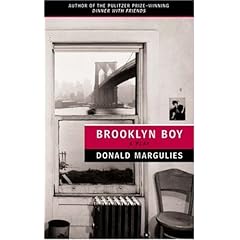
Brooklyn Boy

Appealing ‘BROOKLYN BOY’ at JCC

‘BROOKLYN BOY,’ now being performed in a joint production between the Jewish Community Center and Cuyahoga Community College Eastern Campus Theatre Arts programs, harkens back to the days when Jewish-themed plays were a main staple of Broadway theatre. Those days are long gone. The Jewish experience, that which centered on the Eastern European immigrant seeking to assimilate into the Euro-American scene is basically history. So, plays investigating anti-Semitism, trying to adjust to the land where the streets are paved with gold, and the overbearing mother or emotionally-absent father, complete with “Yiddish” accents, are seen less-and-less on the present day stages.

However, there must still seems to be a sizeable number of people who want to examine that experience. The opening night of ‘BROOKLYN BOY’ had a very sizeable house. And, in 2005 a staged version starring Adam, had a successful run in the Big Apple.

Written by Donald Margulies, who was awarded a Pulitzer Prize for Drama for his ‘DINNER WITH FRIENDS,’ the story centers on Eric Weiss, a novelist whose most recent work has made the New York Times Best Seller’s List. The story, an autobiographical novel, has brought both fame and financial success to the boy from Brooklyn. The Brooklyn from which he has psychologically tried to divorce himself. He has turned from his religion, distanced himself from his family and friends, but mostly has hidden from himself.

We observed, as Weiss visits his father, a patient in Maimonides Hospital, Brooklyn’s “Jewish” Hospital. His father, who spent his entire life as a shoe salesman, absent from family, was never a warm man. His near impending death has not improved his disposition. While in the hospital Weiss runs into Ira, his former “best” friend. Ira, now an Orthodox Jew, tries unsuccessfully to reach out by offering the obviously unhappy Weiss, a serving of help through faith. Weiss’s frustrating attempt to seduce a young woman who comes to one of his book signings, his conflicts with his Hollywood agent, and finally a denouement after his father’s death, complete the scripts investigative cycle.

Though the script was not well received by the New York critics because of its so-called “trite” plot and that it deals with a “a standard son-trying-to-earn-his-father's-approval story line,” I think local audiences will like the concept. It’s filled with experiences and “hamish” (warm and familiar) ideas, and enough comedy and pathos to make for a positive evening at the theatre.

The JCC/CCC production, under the adept direction of Brian Zoldessy, gets every nuance out of the script. The cast understands their characters, playing them with just the right touch…not over the top, not overly dramatic, not pleading for laughs. The acting is universally top notch. Ben Needham’s turntable set is impressive and becomes an integral part of the action, highlighting the play’s structure of a series of six scenes in six different settings. Trad Burns’ lighting enhances the action and moods. Stan Kozak’s musical interludes are mood correct.

Charles Kartali’s Eric Weiss is so natural, it is easy to forget that he is acting, not the real Weiss. His development of the last scene of the play is so emotion-laden that silence proceeded the appreciative applause.

Bernard Canepari effectively develops Manny, Weiss’s father. It would have been easy to overplay the role, but Canepari uses the correct restraint to develop a man whose life was spent running away, hiding from honest feelings.

Noah Budin is both humorous and appealing as Ira, Eric’s former boyhood friend, while Dawn Youngs hits the right notes as Weiss’s “shiksa” (non-Jewish) wife, whose jealousy over her husband’s success destroys their fragile and childless marriage. Jane Conway as the girl in the hotel, Maryann Elder as the agent and Ron Cuirle as an actor who wants to play Weiss in the movie version of the book, are all excellent.

Is the play autographical? While contending that it is a work of fiction, Margulies does not deny that many of the characters and incidents do, in fact, relate to his life.

Capsule judgement: ‘BROOKLYN BOY’ should be favorably received by those attending the production. This is a “nice” play, written in a comfortable way, that gets a great production at JCC/CCC. I’d strongly recommend a “go see it!”

Saturday, February 23, 2008

The Breakup Notebook: The Lesbian Musical

‘THE LESBIAN MUSICAL,’ fun, but…

For a show that has only been staged at three venues (Los Angles, New York and San Diego), the ‘THE BREAKUP NOTEBOOK: THE LESBIAN MUSICAL,’ which is now on stage at Beck Center, has engendered a lot of national press and attention.

The show, whose sold-out opening night audience included the author, Patricia Cotter, musical originator and lyricist, Lori Scarlett, and the creator of the show’s additional music, David Manning, received an enthusiastic welcome.

It’s the kind of show that should have strong cult appeal to a target audience…lesbian women. That’s not to say others wouldn’t appreciate the often fine music and some clever lines, but there is a definite identification with the lesbian dating scene and life style that will allow for a kinship to grow with the material that might not be bridged with those not in on the many “in-jokes” that populate the script.

The story centers on Helen Hill, a thirty-three year-old who has been dumped by her long time girl friend. Helen is heart-broken, bitter and obsessed. Moving on is difficult. With the help of her friends (a bevy of stereotype lesbians and her gay fey confidant Bob), she attempts to get back into the dating scene, with disastrous, oft-hysterical results. In her path toward happiness, she faces alcoholic line dancers, an S&M leather dyke, a commitment phobic biker, and a kooky lawyer. Even a “Ms. Perfect,” who turns out to be less then perfect.

The music is more endearing than the book. The mainly pop songs poke fun at lesbian life, the meaning of love, how dyads choose songs to represent their couplehood, and the difference between lesbians and gay men.

Beck’s production, under the direction of Victoria Bussert, is somewhat on target. One has to question the dichotomy between Russ Borski’s comic book set and the production. With walls covered with comic strip cells, many with clever bubbled speeches, the tone is bigger than life, thus putting the audience into a farcical mind set. The production starts the same way…over the top with the song, “Ghost of My Ex-Girlfriend.” Then, someplace during the first act, the show settles into a light comic tone, losing its outrageousness. By the second act, it’s more comic drama, then comic farce.

The cast is generally good. Though Jodi Dominick effectively develops the role of Helen, her voice is thin on the high notes and, even though she is miked, doesn’t have the necessary power. This is especially true when drummer Joey Scale lets loose like this is a rock concert, drowning out much of the vocals. Let’s hope, that as the play settles in, the band will tone down and allow the lyrics to shine through.

Tracee Patterson gives Frances, the “almost perfect girl-friend, but…,” the right look and edge. Her “What Do You Want From Me?/Your Way of Loving,” co-sung with Dominick, is one of the show’s musical highpoints.

Kayce Cummings, who, along with much of the ensemble, is dual-cast, is totally hot in “I’m on Fire.”

Eric Van Baars has such a good time, and is so natural in playing Bob, that he appears to be adlibbing rather than speaking memorized lines.

When Helen, after avoiding the issue for a long time, finally picks up a call from her mother, a side-splitting scene results. Alison Garrigan accurately portrays every lesbian’s worst nightmare, a mother who attempts to be “understanding” while being clueless to the reality of sexual orientation.

The rest of the cast does a nice job of developing their characterizations.

The show’s over all highlight is Martin Cespedes’s choreography. His creativity adds to the visual illusions of the script, and stresses the exaggerations with overstated poses and facial expressions that mirror the moods of the music being interpreted.

CAPSULE JUDGEMENT: Beck’s ‘THE BREAKUP NOTEBOOK: THE LESBIAN MUSICAL,’ is the kind of production that many will love, while others will like. Don’t be surprised if, in the future, the script gets an extended off-Broadway production.

Side comment: Congrats to Scott Spence and the staff at Beck for embracing scripts like ‘THE LESBIAN MUSICAL.’ They throw caution to the wind when they pick a script which may be outside their traditional audience and reach out to a broader community. Keep it up!

Sunday, February 17, 2008

Two Rooms

Compelling, outstanding ‘TWO ROOMS’ at Charenton/CPT

‘TWO ROOMS,’ now in joint production by Charenton Theatre and Cleveland Public Theatre, is both a love story and a debate. Set in the turbulent 1980s, author Lee Blessing’s taut psychodrama was deservedly named by Time Magazine as "Best Play of the Year" in 1988.

The action switches between two stark rooms. One is the windowless cubicle in Beirut, Lebanon where hostage Michael Wells, a history professor at that city’s American University, lies blindfolded as a captive of an unknown militant Islamic group. The other room is Michael’s study in the United States. As months turn into years and her husband's fate hangs precariously, Mike's wife, Lanie, strips the room to the bare walls in order to feel closer to him and his plight. For her, a thin mat she has dragged into his office represents "all the corners of the room," and where she imagines she can speak with, and even touch, her missing husband.

In this staging, the same space serves for both rooms and is the locale for not only the imaginary conversations between the hostage and his wife, but also for the real talks between Lanie, a reporter and a State Department official.

Walker is the reporter. At the start he appears to be someone who hopes to develop the situation into a major personal accomplishment, maybe a journey to a Pulitzer Prize. Bby the end, we are not sure. Ellen is a coolly, efficient, dispassionate, State Department representative whose task is to keep Lanie off-balance and uninformed of the political machinations which include using her husband as a pawn.

Eventually, the wife speaks out against the government policy and in so doing triggers a series of events that brings the play to its unnerving conclusion.

The script is penetrating and powerful in examining the perspective of individuals , of the public, and of the government. In the end there are no winners, only losers, and the sense of futility and despair that comes when we realize that logic, compassion and fairness are meaningless when dealing with those who would commit barbarous acts with a totally different definition of what it means to be ethnical, and a government that apparently has no conscience or morals of its own.

Charenton’s production, under the keen directorial guidance of Jacqui Loewy, is outstanding. The deliberately slow pace makes the pain of not knowing excruciating. The cast is clear in their motivations, the messages of the story are well etched. Everything, from Michel Ostaszewski’s projections, to Nathan Tulenson’s sound effects, to the sparse set, works.

Jeffrey Grover is chilling in his controlled characterization of Michael. As the play progresses Grover’s eyes become deader and deader. By the end, when he matter-of-factly explains his fate, his eyes are hollow and lifeless.

Sarah Morton, as Lanie, holds her emotions in perfect check. The characterization develops clearly and her frustration and angst are well honed. In the hands of a lesser actress the believability level would have been destroyed as it would have been so easy to overact the role.

Mary Alice Beck is chilling as the State Department official who shows no emotion, is programmed to act like a robot, and is so loyal to the government that she almost appears to be brainwashed.

Though he is quite acceptable as Walker, Jason Markouc sometimes loses contact with the character. Some of his lines sound automatic, rather than meaningful.

The production is being staged in Cleveland Public Theatre’s newest performance space, the former bookstore next to CPT. Though the space is intimate and very appropriate for ‘TWO ROOMS,’ it also has several handicaps. The street noises come through the entrance doors, the applause and laughter from the adjoining theatres leak through, and the sound of patrons coming to and exiting from the second floor Levine Theatre is distracting.

Capsule judgement: Charenton/CPT’s two hour production of ‘TWO ROOMS’ is one of the local season’s highlights. The production deserves sold out houses. Because of the subject matter, don’t assume the show is depressing. It will stimulate the senses and reveal a great deal of the “real” world of politics and the present state of the world.

Thursday, February 14, 2008

Gee's Bend


CPH’s ‘GEE’S BEND,’ production exceeds script

Gee’s Bend, Alabama, the physical setting for Elizabeth Gregory Wilder’s ‘GEE’S BEND,’ now on stage at the Cleveland Play House, is a real place. It came into prominence because of the discovery and museum displays of the quilts made by the women of the community. Those quilts are not only pieces of art, but they represent the very fabric of the community.

Wilder’s 90-minute intermissionless play basically tells the story of one of the quilting families. But, in reality, it opens the lens to the entire community.

According to Wilder, this is the first play she has written that isn’t solely born of her own imagination. She interviewed many of the quilting women and felt an obligation to tell about their miraculous journey of community.

Wilder's drama weaves the history of Gee’s Bend into the dialogue. We discover that following the Civil War there was an opportunity for the slaves to flee, but they didn’t leave as they had no place to go. In the 1930s, the Farm Administration gave the community the opportunity to own their own land, and they took advantage of the offer. In the 1960s, Gee’s Bend gained the attention of civil rights leaders because it was one of the few communities where all of the negroes owned their own land. Then, in 2002, came national attention when the quilts were discovered.

It’s interesting that the overall effect of the CPH production exceeds the quality of the play. The script, in many instances, is quite sophomoric in its structure and language. For example, the play ends several times. The audience broke out into strong applause at one point, thinking the show was over, only to be surprised when another scene, supposedly needed to wrap up the story, started. Due to the added “everything turns out wonderful” ending, the final applause was not as strong as the original outburst.

The cast is generally strong, though Shirley Jo Finey’s directing often makes the consistent development of characterizations inconsistent. For example, Shanesia Davis, who portrays the unmarried sister, is wonderful in early scenes, but when she becomes older, she does a shuffle like a character in the old-time minstrel shows and her voice makes her sound retarded rather than old.

Erika LaVonn, does an excellent job of creating a real person as Sadie, the “intelligent” sister who marries young and lives in an abusive relationship until she gains the courage to break out. The money she makes from selling her quilts allows her to become an independent woman.

Wanda Christine is moderately successful doing double duty as the mother and Sadie’s daughter.

Wendell B. Franklin, as Sadie’s husband Macon, gives a creditable performance.

The play works well in the reconfigured Baxter Stage’s 3-sided stage. The new layout makes the space less confined.

CAPSULE JUDGMENT: ‘GEE’S BEND’ tells a nice story, but it is far from a well written script. In spite of the weakness of the writing, the message of the play, and the tenacity of the women of Gee’s Bend, comes through.

Saturday, February 09, 2008

Monsieur Chopin

Hershey Felder & Fryderyk Chopin hit the right notes at CPH

For the last several weeks, a visit to the Cleveland Play House would have allowed you to meet George Gershwin in performance. This weekend, it’s Fryderyk Chopin. Well, actually, it’s not Gershwin or Chopin, its Hershey Felder, portraying each. No, not portraying, inhabiting the theatrical body and piano talents of both men.

Felder, who is a classically trained pianist with an interest in musical composers, has delved not only into the music of various composers, but into their personal lives. As a result he has developed a three-movement theatrical series, ‘THE COMPOSER SONATA.’ It consists of ‘BEETHOVEN,’ the dramatic, architectural, deeply thoughtful and emotional first movement; ’MONSIEUR CHOPIN,’ the lush and beautiful expression of soul, the second movement; and, ‘GEORGE GERSHWIN ALONE,’ the dance-like, extroverted, and joyous third movement.

In ‘MONSIEUR CHOPIN,’ Felder exposes personal information of the bi-polar Polish composer, who reached his height of popularity in Paris after departing his beloved country because of political unrest. Musically, Chopin is noted for his compositions for the piano, an instrument which was newly perfected during his life time. As for his private life, the major event was that for ten years he was in an often tumultuous relationship with writer George Sand. He died at the age of 39. Interestingly, though his body is buried in Paris cemetary, his heart was taken to Poland where it is enshrined in a church crypt.

For the production, Felder takes on the role of Chopin as he was in life, a teacher and composer. He speaks to the audience in a subtle accent which often comes and goes. He introduces us to Chopin’s love, classical music, with a Polish tilt, including the Polonaise and Mazurka. He continues to remind us that “you make beautiful music because you are an artist, not to please someone else.”

Felder, who showed good piano abilities in his Gershwin piece, really shines in the Chopin exercise. He is a much better performer of classics than modern tunes.

Through the first part of the program, the scripted segment is quite interesting and a good lesson in music history. It is in the second, the ad-libbed segment, in which Felder shines. He takes questions from the audience and responds as if he were Chopin. The results were both funny and impressive. He really knows the ins-and-outs of Chopin’s life and music.

As with ‘GEORGE GERSWIN ALONE,’ Scenic Designer Yael Pardess has created a beautiful and appropriate setting and Michael Gilliam’s mood lighting creates the right atmosphere, heightened by pictures and illusions.

CAPSULE JUDGMENT: ‘MONSIEUR CHOPIN,’ as was ‘GEORGE GERSHWIN ALONE, was both an educational and artistic success. Hershey Felder has the ability to teach music appreciation in such a way that one could only hope that professors could do as well. If you missed either show, you missed a wonderful experience.

Wicked

Wonderful ‘WICKED’ wows but is almost drowned out by orchestra


‘WICKED,’ that wonderful, often wacky Broadway smash hit is back at the State Theatre. The touring company went through town in June of 2006 and played to sold out audiences. This version should also pack the place.

One of the fears of seeing a retreaded tour is that it will be a wattered down version. Do not be concerned. This is a full-blown, Broadway level production with impressive sets and a professional cast that wowed the audience. Wowed, in spite of the fact that during the first act on opening night, the orchestra drowned out composer Steven Schwartz’s oft-clever words. The sound techie must have been on the rebound from a rock concert and didn’t realize that, in theatre musicals, the words of the performers must be heard. Someone must have gotten to him during intermission, because the second act was under decibel control.

The show has everything to make for a hit! Great music and lyrics, creative staging, and a delightful yet philosophical story line with a message which includes comments which could be applied to the Bush administration’s diminishing of personal rights, and what happens when a small group of zealots determines what is “best for everyone,” and tells lies to get their way.

‘WICKED,’ is the “behind the story” tale of two young women, Glinda and Elphaba, in the ‘WIZARD OF OZ’ story. You know them better as the good and the wicked witches.

The script also reveals “truths” about Oz. Do you know how Dorothy got the red slippers? Are you aware of how the tin woodsman, the cowardly lion or the scarecrow came to be? Think that the wicked witch really was melted by a bucket of water? All of these questions are answered in the Stephen Schwartz, Winnie Holzman musical which is based on a novel by Gregory Maguire.

The sets are amazing. They include a dragon whose wingspan is the same as a Cessna 172. There is enough electrical current on stage, according to the show’s press release, to supply twelve houses with power. Monkeys fly, Glenda appears and disappears in a magical bubble, large gears grind, bubble machines spray rainbows and 175,000 pounds of scenery cover the stage.

Carmen Cusack, slathered in green makeup, gives a lustrous performance as Elphaba, generally known as the “Bad Witch.” Bad, as we find out, she isn’t.

Katie Rose Clarke as Glinda, the blond, air-headed “Good Witch,” is also wonderful. She glows on stage. Cliffton Hall, he of pumped up body and an Elvis-hairdo, has a nice singing voice and effectively develops the role of Fiyero, the playboy whose goodness shines through.

Canton’s Lee Wilkof disappoints as the Wizard. He just doesn’t have the pixie-yet-evil quality of Clevelander Joel Gray, who was in the Broadway production. Alma Cuervo starts fine, but loses her characterization as the evil Madame Morrible, the brains behind the evil goings on (think Dick Chaney in drag).

The show has a strong Cleveland connection. Matthew Rego, Michael Rego and Hank Unger are the ARACA Group, one of the shows producers.

CAPSULE JUDGEMENT: ‘WICKED’ is wonderful and worth seeing. If you missed it the first time around, go! If you saw it before, go!