Sunday, January 27, 2008

Groundworks and Verb Ballets (1/25, 1/26)

Area’s premiere dance companies perform same dates, next to each other

For a period of time our area’s dance aficionados felt lost when The Cleveland-San Jose Ballet ditched us for the west coast. C-SJB’s place was taken by some small companies, several of whom have matured to the point of gaining recognition by local and national dance critics for excellence.

Interestingly, the two premiere companies, Verb Ballets and Groundworks, performed this past weekend on Playhouse Square, each to near sold out audiences. Groundworks performed in the Idea Center, Verb in the Ohio. Both gave their followers, many of whom saw Groundworks on Friday and then Verb on Saturday, fine evenings of entertainment.

GROUNDWORKS (seen 1/25)
The Idea Center at Playhouse Square is a perfect venue for David Shimotakahra’s up-close and personal philosophy of dance.

The program opened with yet another staging of ‘ALWAYS’ as choreographed by Gina Gibney. The piece has became a staple in Groundworks performances. Well danced by Amy Miller, Sarah Perrett, Mark Otloski and Damien Highfield, it uses the music of Patsy Cline to create a country music meets contemporary dance mélange. Clever transitions between dance segments, interesting lifts, creative hand movements, creative carries and touches led to a pleasant program opener.

‘KNOW,’ choreographed by Shimotakahara, was performed to the music of Leonard Bernstein played live by the talented Solaris Woodwind Quintet. Originally conceived for two men—Michael Medcalf and Shimotakahara, it has recently been danced by Amy Miller and Felise Bagley. Though different when performed by two women than by two men, the visual effect is very positive. Strong and powerful Miller is balanced nicely by the cool and delicate Bagley. The two create a mood in which music and movements blend together to create a very appealing action-reaction cohesive piece of dance.

A musical interlude, “The Golden Cannon,” performed by the Solaris Woodwind Quintet, was met with very appreciative reaction by the audience.

‘DELAYED,’ a world premiere, was choreographed by Israeli choreographer, Zvi Gotheiner, who has been in residence and was present at the performance. The piece, which was too long, was performed to the abstract atonal music of Terry Riley. The sound, after a while, becomes unnerving. The bodily movements interpreted well Gotheiner’s concept of established and lost connections, opportunities not fulfilled and interactions never resolved. The company danced effectively, but the music and the choreography did not always grab and hold attention. The audience’s response was polite applause.

VERB BALLETS (seen 1/26)
Verb opened its program with Heinz Poll’s sensual, precise, mesmerizing ‘BOLERO,’ danced to the music of Ravel. The choreography, which was restaged by Amy Miller, ironically of Groundworks, ended with the audience screaming appreciation. Strong dancing by Catherine Meredith was supported by an inspired corps.

‘DUET,’ another Poll piece, was beautifully danced by the lovely Danielle Brickman and Brian Murphy, who seems to have emerged from the shadow of the now departed Mark Tomasic, to become the powerhouse performer among local male dancers. The duo’s partnering was point perfect. Their control and flow, as they moved to the music of Johann Sebastian Bach’s “Adagio for Organ,’” which was played with artistic perfection by David Fisher at the piano and cellist Greg Fiocca, was wonderful to watch.

‘SONGS,’ originally created by the company’s artistic director Hernando Cortez in 2007, has been reworked. The German vocalization of Gustav Mahler’s heavy Symphony just doesn’t help the audience understand the tone-poem’s message. Though well performed, the piece became ponderous after a while. Highlights included solo performances by Robert Wesner, Brian Murphy and Sydney Ignacio.

The final piece of the evening, ‘FRONTROW,’ was in its world premiere. Also choreographed by Cortez, it was a compelling visual creation. Trad Burns’ iridescent Mylar columns and creative lighting made the stage shimmer. Brittney and Gina Dudek’s brief Mylar costumes added to the visual excitement. The well conceived and danced piece left both the audience and the dancers happily exhausted. This is a fine addition to the Verb repertoire.

Sunday, January 20, 2008

The Very Hungry Caterprillar

Children’s theatre—a wonderful opportunity to educate the young

Taking a child to a theatrical production especially geared at youth is a wonderful way to introduce future theatre audience members to the wonder s of live entertainment.

Recently, Playhouse Square Center brought to the Ohio Theatre the Mermain Theatre of Nova Scotia to perform three one-act plays based on the stories of Eric Carle. The presentation was part of the Rainbow Babies and Children’s Hospital Discovery Theatre Series. The plays included the ‘LITTLE CLOUD,’ ‘MIXED-UP CAMELEON’ and ‘THE VERY HUNGRY CATERPILLAR.’

The company uses black lights, puppetry, and a policy of “no shushing” as they want children to yell out and interact and explore the stories as the production proceeds. The stagings allowed the viewers to see the hungry caterpillar munch his way to becoming a beautiful butterfly, the little cloud change shapes before their eyes, and the mixed-up chameleon teach the importance of being true to oneself. In the process, the kids learned numbers, counting, colors and the names of various beings.

As has been my custom with children’s theatre, or plays which are child friendly, I took Ian, my youngest grandson, who has recently joined the ranks of “The Kid Reviewers” to be my child’s eyes and ears regarding the show. Ian, at the mature age of 8 (or, as he reminded me, he was actually 7 and 364/365ths), said he had read the stories when he was “little” but was still engrossed by the puppetry techniques and black light effects. He rejoiced in figuring out the technique used by the puppeteers to allow the caterpillar to “eat” its way through apples and oranges. He was very interested when, during the question-and-answer session which followed the performance, the puppeteers explained how they made and manipulated the animated creatures. He discussed what he had learned all the way home.

Capsule judgment: Taking children to live theatre is a wonderful way of aiding young ones to realize the excitement of live theatre. Thanks to all of the theatres in the area who make these opportunities possible.

2 Man Kidnapping Rule

Disappointing opening at Fourth Wall Productions’ new venue

After giving Fourth Wall Productions’ ‘MALICIOUS BUNNY’ several Times Theatre Tributes last season, including one for Outstanding Play, I was looking forward to seeing ‘2 MAN KIDNAPPING RULE,’ the theatre’s first production of its second season.

Unfortunately, my positive expectations were dashed.

Joseph Gallo’s ‘2 MAN KIDNAPPING RULE’ is a sophomoric script, obsessed with redundant sexual commentary, sexual innuendos and excessive references to body parts, for no obvious reason. In a well-developed piece of writing such references have a purpose in moving the plot forward. In ‘2 MAN KIDNAPPING RULE’ they appear to be included for titillation and the author implying “I’m young and hip and can say whatever I want, and young hip members of the audience will love it.”

My view of the script may be a minority evaluation. According to the program, Gallo’s play had a reading at the Soho Think Tank in New York and was “really well-received.” (I have no idea who received it “well” as that wasn’t explained.)

Even if the script had been sterling, the level of directing, and much of the acting, left much to be desired.

The director, in his self-proclaimed directorial debut, did little to help the audience gain the intent and purpose of the writer. (Maybe he, like me, couldn’t figure out what Gallo was trying to tell the viewer.) The pacing was inconsistent, there was little action, some of the acting sounded like unexpressive statements of memorized lines, and the casting was confusing. Two of the three men were supposed to have been former college football players. One was a winner of the Heisman Trophy as the best collegiate player in the country, the other received a tryout with a pro team. Unfortunately, the Heisman winner looked like an undersized college freshman and the pro player more like a cross-country runner. Moral: if a show requires certain physical types, and you don’t have them available, don’t do the show. You can’t fake required physical descriptions.

Of the three actors, only Nate Bigger had the acting chops to make his character’s lines consistently believable.

Capsule judgement: If Fourth Wall is going to be taken seriously as a viable theatre it has to chose scripts that deserve production and stage them in a way that makes audiences want to return. They need to do more ‘MALICIOUS BUNNY’-type productions. They’ve proven they are capable of that level of excellence. Let’s hope in the future they return to that level.

‘2 MAN KIDNAPPING RULE’ is being staged by Fourth Wall Productions at their new home, Suite 221, the Enterprise Center of Glenville, through January 27. For tickets call 330-283-2442 or visit www.fourthwallproductions.com.

Saturday, January 19, 2008

Orange Flower Water

Bang & Clatter’s ‘ORANGE FLOWER WATER, theatre at its best

Craig Wright, the author of ‘ORANGE FLOWER WATER,’ now being performed by The Bang and The Clatter, writes plays about people in families, people who question the course of their lives. He is a very talented writer. His ‘THE PAVILION’ was nominated for a Pulitzer Prize. His HBO series, “Six Feet Under,” was critically acclaimed.

In “ORANGE FLOWER WATER,’ he delves into the lives of two couples who, for many years, have each given the illusion of being happy. Unfortunately, the facade is a fraud. The charade comes to a head when one member of each couple unite in an adulterous affair. Through a series of scenes which take place around and in a single bed, which represents various beds, we watch as four lives unravel. Questions arise. What will happen to the children? Was the affair a mistake or a necessary intrusion to bring about needed changes? Was the action the pursuit of selfishness or a search for personal happiness? Will the results be like the fragrance of orange flower water, sweet but overpowering?

This is a raw, painful and graphic tale. It is a challenging play which forces us to ask, “In the end, is a happy ending worth the pain?

B&G’s production, under the well defined direction of Sean McConaha, is compelling. The pacing is appropriately precise, the acting performances well-honed and the idea development clear.

Jean Klika (Beth) is excellent as the wife of a controlling, abusive husband. The actress has several monologues in which the character comes close to nervous breakdowns. Each is done with realism and elicits compassion.

Daniel McElhaney (Brad) is properly vile as Beth’s controlling husband. He paces the stage like a caged tiger, about to attack. He transforms himself into a character whom the audience comes to hate.

Teresa McDonough, as the uptight Kathy, draws sympathy as the perfectly organized mother and wife who is put upon by a husband who cannot accept her version of life and love. Her librarian glasses, coifed hair and prim clothing create the perfect visual image for her ice lady emotions.

Mark Mayo creates a completely etched character as David, the pharmacist who wants to escape his present life, but has an unrealistic view of the consequences that will be wrought by his pursing a married woman.

Written with assurance and constructed with drama and humor, the play is emotionally wrenching. The tribute to both the script and the production was the reverent silence at the play’s conclusion. There was nary an audible sound after the lights went off signally the end. When, after an appropriate pause, the lights came on, the audience was brought back to the reality of being in the theatre, and gave the performers a hearty ovation.

Capsule judgment: Bravo B&G! ‘ORANGE FLOWER WATER’ is a not-to-be-missed production. It should stimulate long discussions and encourage a replay in the viewer’s mind, long after the final bows. (Be aware that the play contains nudity and a sex scene.)

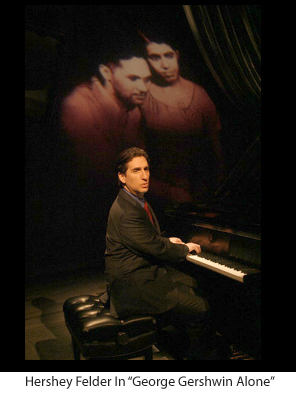
George Gershwin Alone

Hershey Felder & George Gershwin hit the right notes at CPH

Hershey Felder has done extensive research about George Gershwin, who many consider the greatest of American popular music composers. He has used that information to create an evening of song and narration entitled ‘GEORGE GERSHWIN ALONE,’ which is now on stage at the Cleveland Play House.

How biographically accurate is the script? Who knows. Gershwin died at age 38 of a brain tumor before he had reached a high enough level of fame for historians to document every phase of his life. So, we have to trust Felder as he gives us a picture of a person who felt passionately about his work. A character filled with pathos and humor and, as with many artists, self-centered.

In his brief lifetime Gershwin gave the world such songs as “The Man I Love,” “Someone to Watch Over Me,” "Embraceable You," "Fascinating Rhythm," "I Got Rhythm," and "They Can’t Take That Away from Me." And, then there is “Summertime,” which many musical critics consider to be the most perfect song ever written. He also created the musicals ‘AN AMERICAN IN PARIS’ and ‘PORGY AND BESS.’

Though the show, which is filled with nostalgia and humor, is billed as centering purely on the story of George Gershwin, Felder, an accomplished classical pianist with a decent singing voice, abandons the Gershwin persona about two-thirds of the way through the performance, has the lights come up in the theatre, and proceeds to ask for Gershwin requests from the audience. He then plays and sings those requests, and encourages theatre-goers to participate. He goes as far as selecting audience members to sing solos.

Scenic Designer Yael Pardess has created a beautiful and appropriate setting and Michael Gilliam’s mood lighting creates the right atmosphere.

CAPSULE JUDGMENT: Before he switches to the audience-centered segment of the show, Felder concludes the historical Gershwin exposition playing “Rhapsody in Blue.” It was a perfect conclusion to an evening of musical education, entertainment and recognition of a great composer. Anyone who loves music and good theatre will thoroughly enjoy ‘GEORGE GERSHWIN ALONE.’

Wednesday, January 16, 2008

Avner the Eccentric in Exceptions to Gravity

‘AVNER THE ECCENTRIC IN EXCEPTIONS OF GRAVITY’ convulses audience

If you were not one of the fortunate theatre-goers who witnessed the performance of ‘AVNER THE ECCENTRIC in EXCEPTIONS TO GRAVITY,’ you missed one fun time. If you didn’t take your children or grandchildren to see Avner, you deprived them of an experience they would not quickly have forgotten.

As is the case with shows that are “child-friendly,” I took my grandsons (Alex—12, Noah—10 and Ian—7), who have picked up the tag-name “The Kid Reviewers,” to see the show presented by the Jewish Community Center and Playhouse Square Center. Their evaluation? A perfect 10 out of 10 from each of them. Noah wanted to know if he could give Avner a 12, but rules are rules, so 10 it is!

Take a creative elder statesman, add a broom, a sweater, an alarm clock, a hat, popcorn, paper cups, a ladder, a newspaper, toilet paper and napkins and you have all you need for a show of magic, illusion and audience pleasure.

Avner Eisenberg has the knack of knowing how to “play an audience.” He jumps off the stage, has the light person bring the illumination up and down to introduce his coming down into the audience, plays around with those in the front rows, and then sets the mood for his on-stage shticks. He “scolded” the late comers. He took a paper away from a man in the second row, proceed to rip it up, balance the pieces on his nose, and then put it back together. He made people change seats. He grabbed a purse from one woman and proceeded to pull out a roll of toilet paper, much to her embarrassment. He had some female in the first row kiss his “boo-boo” every time he did a prat-fall.

Avner balanced a 20-foot aluminum ladder on his forehead, ate 15 napkins, divided the audience into sections and had one group stomp on the floor while another moaned and yet another screamed louder and softer as he conducted his “human orchestra.” It was all totally delightful. And, he did the whole 90-minute show without saying one word!!!

Ian had difficulty staying in his seat. He wanted to be part of the action. His brothers had to grab him a couple of times as he vaulted toward the stage. Alex was laughing so hard at one point, he slipped off the chair. Even “cool and controlled” Noah was hysterical.

Capsule judgment: Avner the Eccentric was Avner the delightful in his recent Ohio Theatre performance. If you missed it, you missed a show that the Kid Reviewers called “great,” “terrific,” “funny,” “hysterical” and “my favorite play, ever!”

Avenue Q


‘AVENUE Q’ delights at the Palace

According to one of the songs in ‘AVENUE Q,’ which is now being staged as part of the Broadway series at the Palace Theatre, “life sucks on Avenue Q.” Don’t tell that to the near capacity audience who attended the opening night performance of the touring show. They loved life on ‘AVENUE Q’!!!

Known as the “porn puppet musical,” ‘AVENUE Q’ won the 2004 Tony Award for Best Musical.

The show, which was conceived by Robert Lopez and Jeff Marx, opened off –Broadway in 2002, was transferred on-Broadway in 2003 and went to Las Vegas in 2005 instead of doing the usual touring production routine of major musicals. The Vegas run is why it has taken so long to get here.

The script is largely inspired by ‘SESAME STREET.’ Most of the characters in the show are puppets. In contrast to the tv show, the actors who operate the puppets are clearly seen. It’s delightful to watch the human facial expressions and body actions paralleled by the puppets. The set depicts several tenements on a rundown street known as Avenue Q, in New York City. Many of the characters are pure parodies of Sesame Street. The major difference is that the “Q” characters are young adults facing adult problems who sometimes use profanity.

The story is about a bright-eyed college graduate named Princeton who finds himself in a search for purpose. When Princeton moves onto Avenue Q, he encounters a group of delightful misfits including Kate Monster, a lovelorn kindergarten assistant, who falls in love with Princeton; Nicky, a good-hearted slacker who lives with Rod; Rod, a closeted gay Republican investment banker; Brian, an out-of-work comedian, engaged to Christmas Eve, a Japanese psycho-therapist; Gary Coleman, yes, the former child actor; Trekkie Monster, think a porn obsessed Cookie Monster; and, Lucy T. Slut – a slutty night club singer.

The songs are delightful. They include "What Do You Do with a B.A. in English?,” "It Sucks to Be Me, " "Purpose," "Everyone's a Little Bit Racist," and "I'm Not Wearing Underwear Today."

Many of the topics and song lyrics brought sustained laughter because of their connection to the audience. For instance, during the song “For Now,” which lists things that are only going to be around for a short time, the name “George Bush” was sung. The audience broke out in prolonged applause and cheering.

What about the advertised porno inclusions? Yes, there is some swearing and the use of “those” words. And, yes, there are puppet sex acts. However, except for those with severe red state attitudes, the viewers will find the going-ons fun, not perverse.

The touring production is excellent. The cast is strong and the staging and special effects are well conceived.

Audience favorites included Robert McClure, who performed the roles of Princeton and Rod. This is a talented young man, who was in the Broadway production of the show, has an excellent singing voice, great acting skills and a compelling stage presence. Kelli Sawyer (Nicky, Trekkie Monster) has a strong singing voice and interacted well with McClure. Angela AI was delightful as Christmas Eve and Carla Renata made for a great Gary Coleman.

Capsule judgment: ‘AVENUE Q’ is a total delight. Go, you’ll have a great time!

Tuesday, January 15, 2008

Proof (Actors' Summit)


‘PROOF’ adds up at ACTORS’ SUMMIT

Is there a thin line between genius and mental illness? Can a person “burn out” when s/he gets near the age of 40, no longer able to muster up the deep thoughts that appeared so easily in their early twenties? Can a woman be a mathematical genius? These are only three of the questions broached by playwright David Auburn in his prize winning play ‘PROOF.’

‘PROOF’ centers on Catherine, a young woman who has spent years caring for her father, Robert, who was a brilliant mathematician in his younger years. As he passed forty, he lost his acuity. He wrote continually, but the material was irrational. After he dies, Hal, a former student, probes into his ramblings with the hope of finding something worth publishing, thus pushing ahead Hal’s stalled career. With Catherine’s help, Hal discovers a paradigm-shifting proof about prime numbers in Robert's office. He assumes it was Robert’s work. Catherine claims the proof was conceived by her. Hal questions this conclusion, doubting that a woman with little in-depth knowledge of mathematics could create such brilliance. His reaction not only ends their relationship, but brings front-and-center Catherine's fear of following in her father's footsteps--mathematical genius and mentally ill.

‘PROOF’ was awarded the 2001 Pulitzer Prize for Drama and the Tony Award for Best Play.

What’s interesting to many is that Auburn attended the University of Chicago where he studied political philosophy, not mathematics. In reality, it matters little as there is no actual inclusion mathematical concepts. This should relieve those who fear the show because it might be too abstract and technical.

Actors’ Summit’s production, under the guidance of Wayne Turney, is excellent. It is well paced and each of the actors develops a clear character.

Constance Thackaberry gives the right edge to her performance as Catherine. Is she a clone of her father…brilliant and on the way to insanity? Or, is she the product of her sister Claire’s attempt to control her out of guilt for the failure to provide aid to their father as she plotted her own life track? You’ll leave the theatre appropriately asking those questions.

A. Neil Thackaberry gives a meaningful performance as Robert. He walks the line between insanity and brilliance with surety.

Alicia Kahn is properly up-tight as Catherine’s sister, Claire. Her pronunciation, body language, clothing, hair style and attitude are character perfect.

Keith Stevens is on-target as Harold Dobbs, Robert’s former student.

CAPSULE JUDGEMENT: Actors’ Summit’s ‘PROOF’ is a well conceived production of an excellent script. There isn’t a weak link in the production chain.

Sunday, January 13, 2008

REVIEW OF THE REVIEWER'S REVIEWS (Blanche Valancy)


Thank you, Roy. Jack & I just got to see the production ['I HAVE BEFORE ME A REMARKABLE DOCUMENT GIVEN TO ME BY A YOUNG LADY FROM RWANDA'] last night & were similarly impressed & effected.

Best regards,
Blanche Valancy

I Have Before Me a Remarkable Document Given to Me by a Young Lady from Rwanda

Dobama does it again: fine script, well performed and directed

Dobama’s ‘I HAVE BEFORE ME A REMARKABLE DOCUMENT GIVEN TO ME BY A YOUNG LADY FROM RWANDA,’ is typical Dobama. As it has done over and over, Dobama is showcasing yet another theatrical gem. The lightly financed theatre with no home, just keeps coming up with the right script, the right cast and the right director as it wanders the Cleveland landscape.

‘I HAVE BEFORE ME...’ is a touching, humorous, meaningful story of the emotional and intellectual relationship between Juliette, a young woman who was a survivor of the 1994 Rwanda massacres, and Simon, a British poet who tries to help her write her personal story. In the process, he finds his literary voice and psychological substance, and she finds a meaningful life.

The play has been called “A remarkable achievement…a stirring tale of human bravery in the face of adversity.” And, “an important, timely piece of theatre that manages to explore political issues and express moral outrage without ever once lapsing into moralizing and political rhetoric.”

Sonja Linden, the play’s author based the material on an experience she had while working at the Medical Foundation for the Care of Victims of Torture. She met a young woman from Rwanda, whose impulse to write had started in a refugee camp shortly after the murder of her entire family. What began as a testimonial act became a journey of healing, which resulted in her feeling once again 'clean.'

As the daughter of refugees from Nazi Germany, Linden felt compelled to draw attention to the appalling situation in Rwanda so that holocausts like this “would never happen again.”

Dobama’s production is outstanding. Director Brian Zoldessy grasps the concept and has brought all the correct nuances into play. The production moves smoothly, accenting the humor and pathos in just the right ways.

Scott Miller develops Simon perfectly as the angst-filled and frustrated British poet. At the start we realize that Simon has lost his productive voice. As the play proceeds we experience his getting in touch with the emotions he needs to return to be his creative self. Miller does an excellent job of nonverbally transition from emotionally frozen to emotionally euphoric.

Andrea Belser makes Juliette live, she inhabits the role. We feel her terror, we experience her losses, we silently cheer for her to achieve her goal, we revel in her reattachment with a family member, we are driven to understand the horror of horror.

Richard Ingraham’s sound design adds great depth and. The sounds of Rwanda underscore the beauty of the country and the misery of yet another senseless destruction of precious human life.

CAPSULE JUDGEMENT: What a way to start a new theatrical season!!! ‘I HAVE BEFORE ME A REMARKABLE DOCUMENT GIVEN TO ME BY A YOUNG LADY FROM RWANDA’ is a MUST SEE production. Bravo Dobama!

Thursday, January 03, 2008

Times Theatre Tributes--2007


TIMES THEATRE TRIBUTES--2007

Greater Cleveland is blessed with a vital theatre scene. It is the purpose of the TIMES THEATRE TRIBUTES to recognize theatrical experiences that, in the mind of this reviewer, were excellent and deserve special recognition.

Only shows performed in 2007 which I reviewed were considered. Selections were limited to locally produced stagings, so none of the professional touring shows are recognized, though actors, directors and technicians who were imported by local theatres were considered. Actors are not separated by gender or leading or supporting roles.

If you would like to read any of my reviews for the year, please go to www.royberko.info, enter the blog and click on “2007 Reviews” or click on the name of the producing theatre and scroll through their performances. Reviews from previous years may also be accessed.

Thanks to the following for making the 2007 theatre scene in the Cleveland area stimulating and memorable:

PLAY
DEATH OF A SALESMAN (Actors’ Summit)
EQUUS (Beck Center)
FAT PIG (The Bang and Clatter)
HAY FEVER (GLTF)
JEKYLL & HYDE (Beck Center)
LINCOLNESQUE (CPH)
LUNACY (Dobama)
MALICIOUS BUNNY (Fourth Wall Productions)
MEASURE FOR MEASURE (GLTF)
NINE (Cain Park)
PHANTOM OF THE OPERA (BW)
QED (Actors’ Summit)
ROUNDING THIRD (Actors’ Summit)
TAKE ME OUT (Dobama)
THE CHOSEN (CPH)
THE PRICE (Ensemble Theatre)
TWO HEADED (Titlewave)

DIRECTOR
Charles Fee, HAY FEVER (GLTF)
Constance Thackaberry, ROUNDING THIRD (Actors’ Summit)
Dorothy Silver, THE PRICE (Ensemble Theatre)
Greg Vovos, TWO HEADED (Titlewave)
Mark Alan Gordon, LUNACY (Dobama)
Michael Bloom, LINCOLNESQUE (CPH)
Risa Brainin, MEASURE FOR MEASURE (GLTF)
Scott Plate, TAKE ME OUT (Dobama)
Scott Spence, JEKYLL & HYDE (Beck Center)
Sean McConaha, FAT PIG (The Bang and The Clatter)
Seth Gordon, THE CHOSEN (CPH)
Vicki Bussert, NINE (Cain Park)
Vicki Bussert, THE PHANTOM OF THE OPERA (BW)
Wayne Turney, QED (Actor’s Summit)
William Roudebush, EQUUS (Beck Center)

PERFORMER
A. Neil Thackaberry, QED (Actors’ Summit)
Amiee Collier, JEKYLL & HYDE (Beck Center)
Andrew May, ARSENIC AND OLD LACE (GLTF)
Andrew May, MEASURE FOR MEASURE (GLTF)
Andrew Pastides, THE CHOSEN (Cleveland Play House)
Aric Generette Floyd, NINE (Cain Park)
Bernadette Clemens, LUNACY (Dobama)
Brian Marshall, FORBIDDEN BROADWAY (Hanna/Playhouse Square)
Caleb Sekeres, TAKE ME OUT (Dobama)
Carmen Keels, FORBIDDEN BROADWAY (Hanna/Playhouse Square)
Charles Kartali, THE PRICE (Ensemble)
Chris Seibert, OUR TOWN (CPT)
Chris Seibert, TWO HEADED (Titlewave)
Dan Folino, EQUUS (Beck)
Dan Folino, JEKYLL & HYDE (Beck)
Dan Hammond, LUNACY (Dobama)
David Anthony Smith, ARSENIC AND OLD LACE (GLTF)
David Anthony Smith, MEASURE FOR MEASURE (GLTF)
Dedriu Ring, FROZEN (Beck)
Donald Carrier, LINCOLESQUE (CPH)
Emily Leonard, THE PHANTOM OF THE OPERA (BW)
Emily Pote, PETER PAN (Porthouse)
Eric van Beers, SWEET CHARITY (Porthouse Theatre)
Fabio Poanco, NINE (Cain Park)
Fred Maurer, TAKE ME OUT (Dobama)
George Roth, OLIVER (Cain Park)
George Roth, THE CHOSEN (GLTF)
Greg Violand, FORBIDDEN BROADWAY (Hanna/Playhouse Square)
Jason Markouc, FROZEN, (Beck)
Jason Markouc, A LOSS OF ROSES (Ensemble)
Jean Zarzour, CHRISOPHER COLUMBUS, Cesear’s Forum
Jeffrey Evan Thomas, OF MICE AND MEN (CPH)
Jenna Messina, FAT PIG (THE BANG AND THE CLATTER)
Jeremy Rishe, THE CHOSEN (GLTF)
John Kolibab, CHRISTOPHER COLUMBUS, Cesear’s Forum
Juliette Regnier, DEAR WORLD (Kalliope Stage)
Keith Stevens, ROUNDING THIRD (Actors’ Summit)
Kristin Netzband, JOLSON & FRIENDS (JCC)
Laura Theodore, REFLECTIONS (Beck Center)
Laurel Johnson, SOME GIRL(S) (The Bang and Clatter)
Lynn Allison, ARSENIC AND OLD LACE (GLTF)
Mark Tomasick, SONG AND DANCE (Beck Center)
Marla Berg, DEAR WORLD (Kalliope Stage)
MaryAnn Black, SWEET CHARITY (Porthouse Theatre)
Matthew Wright, EQUUS (Beck)
Michael Reginer, LUNACY (Dobama)
Nate Bigger, MALICIOUS BUNNY (Fourth Wall Productions)
Nick Koesters, DEATH OF A SALESMAN (Actors’ Summit)
Patty Lohr, OLIVER (Cain Park)
Philip Hernandez, MAN OF LA MANCHA (CPH)
Rachel Warren, MAN OF LA MANCHA (CPH)
Reuben Silver, THE PRICE (Ensemble)
Richard Klautsch, MEASURE FOR MEASURE (GLTF)
Sandra Simon, PASSION (Beck Center)
Sara Bruner, THE TEMPEST (GLTF)
Scott Plate, THOM PAINE--based on Nothing (Dobama)
Sean Derry, FAT PIG (THE BANG AND THE CLATTER)
Sean Derry, POUNDING NAILS IND THE FLOOR WITH MY HEAD (B&C)
Stephanie Iannarino, WEST SIDE STORY (Carousel Dinner Theatre)
Tina Fabrique, ELLA (Cleveland Play House)
Tracee Patterson, SONG AND DANCE (Beck Center)
Tricia Bestic, FORBIDDEN BROADWAY (Hanna/Playhouse Square)

Laurel Johnson(Composite cast
EQUUS (Beck)
FORBIDDEN BROADWAY (Hanna/Playhouse Square)
HAY FEVER (GLTF)
LUNACY (Dobama)
NINE (Cain Park)
TAKE ME OUT (Dobama)
THE PRICE (Ensemble)


TECHNICIANS
Aimee Kluiber, costume design, OLIVER (Cain Park)
Allison Garrigan, costumes, OUR TOWN (CPT)
Andromache Chalfant, set design, THE CLEAN HOUSE (CPT)
Charlotte Yetman, costume design, THE PHANTOM OF THE OPERA (BW)
Don McBride, set design, FROZEN (Beck)
Don McBride, set design, JEKYLL & HYDE (Beck)
Don McBride, theatre reconception, EQUUS (Beck)
Gage Williams set design, HAY FEVER (GLTF)
James Swonger, sound design, THE CHOSEN (CPH)
Jeff Hermann, set design, OLIVER (Cain Park)
Jeff Herrmann, set design, TAKE ME OUT (Dobama)
Jeff Lockshine, lighting design, TAKE ME OUT (Dobama)
Jeff Merrmann, scenic and light designs, THE PHANTOM OF THE OPERA (BW)
Jenniver Sparano, costume design, FROZEN (Beck)
John Konopka, set design, PERMANENT COLLECTION (Karamu)
Lydia Chanenka, set design TWO HEADED (Titlewave)
Michael Klaers, light design, MEASURE FOR MEASURE (GLTF)
Michael Lincoln, light design, THE CHOSEN (CPH)
Michael Raiford, scenic design, THE CHOSEN (CPH)
Molly Richard, costume design, SEUSSICAL! THE MUSICAL (Mercury Summer
Theatre)
Richard B. Ingraham, sound design, EQUUS (Beck)
Ron Newell, set decoration, THE PRICE (Ensemble)
Ross Borski, scenic and lighting design, NINE (Cain Park)
Russell Metheny, set design, MEASURE FOR MEASURE (GLTF)
Russsell Metheny, set design, ARSENIC AND OLD LACY (GLTF)
Sean Derry, set design, FAT PIG (THE BANG AND THE CLATTER)
Terry Pieritz, costume design, NINE (Cain Park)
Todd Rosenthal, scenic design, LINCOLNESQUE (CPH)
Trad A. Burns, lighting design, EQUUS (Beck)
Trad Burns, lighting design, JEKYLL & HYDE (Beck)
Trad Burns, lighting design, JOLSON & FRIENDS (JCC)

MUSICAL DIRECTION
George Caldwell, ELLA (Cleveland Play House)
Jodie Ricci, OLIVER (Cain Park)
Larry Goodpaster, JEKYLL & HYDE (Beck Center)
Larry Goodpaster, REFLECTIONS (Beck Center)
Larry Goodpaster, SONG AND DANCE (Beck Center)
Marge Adler, FORBIDDEN BROADWAY (Hanna/Playhouse Square)
Nancy Gantose-Maier, NINE (Cain Park)
Stuart Raleigh, THE PHANTOM OF THE OPERA (BW)

CHOREOGRAPHY
Martin Cespedes, EQUUS (Beck)
Martin Cespedes, OLIVER (Cain Park)
Martin Cespedes, JEKYLL & HYDE (Beck Center)
Martin Cespedes, NINE (Cain Park)

SPECIAL RECOGNITION
Maryann Elder Goldstein for her authorship of BOTH SIDES OF THE FAMILY, an original play

Roe Green, financial and leadership support for the arts, including Fusionfest, Kent State University, Porthouse and the JCC theatre

Sandra Perlman, for her authorship of LUNACY, an original play

Matthew Sprosty, for his authorship of MALICIOUS BUNNY, an original play

Conceptual development of PETER PAN (Matthew Earnest), Porthouse

The mesmerizing “horses” of EQUUS (Beck): Franklyn Singley, Jose Ayala III, Bill DePetro, E. Ray Goodwin, Jr., Ryan Lahetta and Vincent Martinez

THE BEST OF THE BEST

I have been asked why I don’t select my “best of the best” for each season. So, to satisfy those requests, I present my selections:

2007 BEST OF THE BEST DRAMAS:
EQUUS (Beck Center)
LUNACY (Dobama)
FAT PIG (B&C)
THE CHOSEN (CPH)

2007 BEST OF THE BEST MUSICALS:
JEKYLL & HYDE (Beck Center)
NINE (Cain Park)

2007 BEST PERFORMANCES:
Bernadette Clemens, LUNACY (Dobama)
Dan Folino, JEKYLL & HYDE (Beck)
Dan Folino, EQUUS (Beck)
Dedriu Ring, FROZEN (Beck)
Jenna Messina, FAT PIG (B&C)
Michael Regnier, LUNACY (Dobama)
Sean Derry, POUNDING NAILS IND THE FLOOR WITH MY HEAD (B&C)

Sunday, December 16, 2007

Red{the orchestra}


RED {AN ORCHESTRA}

Several weeks ago, Red {an orchestra} performed ‘A RED SOLSTICE.’ A classical orchestra with a twist, Red’s mission is to redefine, redesign and rediscover classical music. It offers a perfect venue to get those young and old, seasoned classical music lovers and neophytes who know nothing about the classics, to experience the sounds of the masters, emerging and emerged. All this with musical proficiency.

Johathan Sheffer, the artistic director and conductor, packages programs that excite and entice. Their solstice program featured the amazing veteran violin soloist, early-teenaged Caroline Goulding, not only playing Vivaldi’s “Concerto No. 4 in F minor,” but also a fast paced Irish fiddling tune. Also featured was 20 year-old Andrew Lipian, he of astounding countertenor voice, and soprano Jung Euh Oh in Heinrich Schultz’s “The Christmas Story.”

Pounding Nails in the Floor with My Forehead

Sean Derry gives tour-de-force acting performance at BANG AND CLATTER

As Sean Derry was literally pounding his head on the floor at the conclusion of ‘POUNDING NAILS IN THE FLOOR WITH MY FOREHEAD,’ now in production at The Bang and Clatter Theatre, I totally empathized.

For two acts I, and members of the audience, had been subjected to and immersed in a series of attacks and tirades using language that was vulgar, angry and outrageous. Almost all things political, social, moral and ethical had come under attack. Almost every foul word and image had been used to assault our senses.

Throughout I could not help but wonder what it felt like for Derry to go through a nervous breakdown nightly. Not only did he have hundreds and hundreds of words to memorize and spit out each night, but the emotional level of the one-person show allows for little time to relax. Almost every line is explosive, there is no calm within the storm.

Eric Bogosian’s ‘POUNDING NAILS IN THE FLOOR WITH MY FOREHEAD’ is a series of character studies, concentrating on men who range from the seriously troubled to those positively repugnant. The monologues were originally portrayed by Bogosian, himself. Since then, a number of actors have taken up the role. I doubt if any one them did a better job than Derry, Bang and Clatter’s co-artistic and managing director.

Bogosian is the writer of ‘TALK RADIO,’ a Pulitzer Prize finalist. He also authored ‘subUrbia,’ ‘GRILLER’ and ‘SEX, DRUGS, ROCK & ROLL.’

The opening segment, “Molecules,” finds a bum in a subway talking in detail about the molecules that infect others from his bodily excretions. It verbally slaps the audience into an awareness of Bogosian’s hateful reaction to the ills of this nation.

Other characters include a guilt-ridden suburbanite, a doctor prescribing the worst medicine in the world, and a “recovering male” who confesses his shame to fashion models in magazines because of the fantasies he harbors about them.

As a reviewer of a previous production stated, “Bogosian has deep-seated anger, and the author’s anguish swings between the longing for numbness and the desire to feel something. Monotony is never a problem in this show.”

Capsule judgment: The show is not for gentlefolk, definitely not for redstaters. It is, however, for anyone who wants to see an amazing performance, probably one of the best performances on local stages this year, and have their mental and physical senses assaulted.

Saturday, December 08, 2007

Santa Land Diaries


‘SANTALAND DIARIES’ a pleasant holiday escape at CPT

David Sedaris, author of ‘THE SANTALAND DIARIES, which is getting its umpteenth local production, this time at Cleveland Public Theatre, credits his fame to the attention he got when he read his “SantaLand” essay on National Public Radio.

In 2001, Sedaris was selected to receive the Thurber Prize for American Humor and was named by Time magazine as “Humorist of the Year.” He is the author of the best selling ‘NAKED’ and ‘ME TALK PRETTY ONE DAY,’ both collections of his personal life experiences.

‘THE SANTALAND DIARIES’ is a one-man show which is supposedly a true account of Sedaris’ stint as an elf at Macy’s department store in New York. First read as an on-air essay on December 23, 1992, the material was reworked into a play in 1996 by Joe Mantello. It has since become a staple of the holiday season on both professional and amateur stages.

Under the direction of B. D. Bethune, Cleveland Public Theatre’s production, which stars Doug Kusak, is a pleasant evening of theatre.

Kusak has a mobile face, a good sense of comic timing, nicely underplays the role and is generally delightful as Crumpet, the elf in green velvet smock and red and white stockings. He interacts well with the audience, without making anyone uncomfortable. His highlights are a Billie Holliday interpretation of “Away in the Manger,” and his compassionate final speech when he relates a tale of what may be his working with the “real” Santa Claus.

CAPSULE JUDGEMENT: If you are in the holiday mood, and can put up with another jolt of festive cheer, Cleveland Public Theatre’s ‘SANTA LAND DIARIES’ will entertain you.

Friday, December 07, 2007

A CHRISTMAS STORY

‘A CHRISTMAS STORY’ delights audience

The gentleman sitting behind me at opening night of ‘A CHRISTMAS STORY’ at the Cleveland Play House, seemed to be an “expert” on all things “A CHRISTMAS STORY.’ Unfortunately, almost everything he was telling his companions in a very loud voice, was mainly incorrect.

According to the self-anointed expert the play “was written by a Clevelander” and “that’s why it is set in Cleveland.” Fact: The story on which the movie and play were both based was written by Jean Shephard who was a Chicago native. The play was written by Philip Grecian, a native of Topeka, Kansas. The play is not set in this area. It is located in the fictional town of Hohman, Indiana.

The “font of knowledge” went on to recount how the movie was made in Cleveland. Well, he was almost right on that one. Some of the scenes were shot in Cleveland, but due to a lack of big snows during January through March of 1983, when the movie was being shot, most of the filming was done in Canada. Yes, it was at 3159 West 11th Street in Tremont, where The Christmas Story Museum is now located, that some of the exterior hourse shots took place. (The interiors were filmed in a studio in Toronto.) And, yes, the parade scene was in front of the now closed Higbee’s Department Store in downtown Cleveland. The film makers had to make fake snow for those scenes.

He also said that the majority of the cast of the film were Clevelanders. Again, nope. The leads were Hollywood professionals, including Darren McGavin who played the Old Man, Melinda Dillon as the mother and Scott Schwartz as Flick. His information on the role of Ralphie was also off-base. He stated that Tom Hanks played Ralphie. No, Peter Billingsley played the role. Hanks did appear on stage in Cleveland as a member of Great Lakes Shakespeare Festival, but he was not in the movie of ‘A CHRISTMAS STORY.’ I guess if you count all the extras in the parade scene (including yours truly) and other street scenes (which also included this reviewer) he might be right on the number of Clevelanders in the film.

And then there was his final pronouncement: “The Chinese restaurant the Parkers went to for Christmas dinner is still in business here.” Wrong, again. The restaurant scene was shot in Toronto. (Some locals have dubbed the C&Y Chinese Restaurant on St. Clair as the present day stand-in for the play’s Bo Ling’s Chop Suey Palace).

With that out of the way, what’s the play about? It relates a delightful, warm and fuzzy 1950s tale, about a mom who knows best; a dad who is a lovable boob; young Ralphie, who wants "an official Red Ryder, carbine action, two-hundred shot range model air rifle, with a compass in the stock and 'this thing' which tells time"; and the adventures of Ralphie and his friends.

There are subplots concerning the major prize the Old Man wins, how Flick is “triple dog dared” into sticking his tongue to a freezing metal pole, Ralphie’s disappointed reactions to his “Little Orphan Annie Secret Society decoder pin,” how Ralphie finally stands up to the bully Scut Farkas, and the next door neighbors' hound dogs who create a worldly hell for the Old Man.

The CPH production, under the direction of Seth Gordon, is generally delightful. It is nicely paced and visually creates the right moods.

Charles Kartali, playing The Old Man for the third time in this venue, populates the role. His tirades, his over-reactions, his anti-Father Knows Best persona is one of lynch pins of the show. Local favorite, Elizabeth Ann Townsend is properly compassionate as Ralphie’s mom. Kolin Morgenstern is delightful as Flick. (He probably should have been cast as Ralphie.) Lily Richards as Esther Jane, the girl who has a crush on Ralphie and Naomi Hill as Helen, the class brainiac, are fine. Christopher McHale, in his third appearance as Ralph (Ralphie all grown up) is full of youthful spirit as the narrator.

It is always dangerous to critique the performances of children. But, since CPH is a professional theatre, which can draw its cast from the entire country’s theatre community, the level of expectations has to be maintained, no matter the age of the performers. So, here goes. Though Billy Lawrence was generally acceptable as Ralphie, he is a little long in tooth to be playing the role. He is more a teenager than a child in size and mannerisms. Some of his performance was robotic, making the audience aware that he was acting, not living the role. Justin Montgomery Peck (Schwartz) had some nice moments, but his poor articulation made it almost impossible to understand his lines. Cameron McKendry (Scut Farkas) was not menacing enough to be playing the bully. He showed good acting presence and would have been better cast in another role.

Capsule judgement: ‘A CHRISTMAS STORY’ is the perfect holiday production to which to bring children and introduce them to the world of live theatre. Unless you’re a theatre critic, the few flaws with the show should not bother you, and all should leave with a warm feeling of life in the “good old days” before Iraq wars, Fox news and the concern over terrorist attacks. Oh, for the street cars on Euclid Avenue and downtown with shopping at Higbee’s and May Company, and being able to have lunch at Mills Cafeteria.

Monday, December 03, 2007

Pulp


‘PULP,’ a reliving of lesbian fiction of the 1950s, gets a good production at CPT

‘PULP,’ now making its Ohio and regional debut at Cleveland Public Theatre, is a parody of lurid lesbian fiction of the 1950s which centered on the “love that dare not speak its name.” The script, which was written by Patricia Kane, concentrates on the themes of many of those fictions novels: the outsider, the tough broad, the siren and the hyper-sexuality of a renegade sub-society, all of which take place in a gritty urban setting.

The play’s outsider is Terry Logan, a butch woman from Texas, just discharged from the Women's Army Corps. On a train bound for Chicago during a hot summer in 1956, she meets Pepper who figures out that Terry is a kindred spirit and invites her to The Well, a Chicago (gritty urban setting) lesbian nightclub where she works. The club, which features drag performances (women dressing as men) is owned by Ms. Warren, the ice princess (the siren). Terry lets her libido draw her initially to Eva (the hypersexual). As a plot developing device, several other characters have hidden or misguided loves, but by the time the lights go out after 90-minutes of sexual innuendos, sexual explicity, and sexual trysts, three couples have been formed and, if fairy tale endings are your thing, you’ll accept that they will live happily ever after.

An original score of period-sounding songs, with music by Andre Pluess and Warren, are performed with various degrees of proficiency as nightclub numbers. The score sounds familiar, but careful listening will reveal, like pulp novels, that the songs contain strong, overly ripe lyrics. Lyrics like, "Lips that taste of tears lose their taste for kissing."

The script, which is a combination of melodrama, farce and musical review, lends itself to an over-the-top production. How can a play which repeats and repeats and repeats the line, "I'm a lesbian plain and simple. I don't make any bones about it," be done seriously?

Fortunately, for those who will venture to CPT, director Scott Plate uses asides, over-exaggeration and physical underscoring to accomplish the generally well-done production.

Plate keeps the goings centered. The laughs come from the overdrawn characters and the way they are over-played. The cast, with the exception of Maggie Arndt (Terry), are excellent. Arndt is not macho enough, not sure enough, not cocky enough to make us believers. She has an underbelly of vulnerability that is off-setting. Her singing also leaves much to be desired.

Sheffia Randall Dooley, the only Equity member of the cast, and purely the audience favorite, overdoes the role of Eva/Bing, with appealing certainty. She effectively wails her musical vocals.

Allison Garrigan as bar owner Viviane, develops a clear and convincing character as the rigid appearing ice princess. Her opening musical number sets the right mood for what’s to come.

Kimberly Lauren Koljat is consummately sweet as the bartender who befriends Terry. Her crush on Sarge/Winny, one of the drag entertainers who is also an excellent marksman (hey, what did you expect, this is a lesbian-centered script), is tenderly developed. Elizabeth Wood is convincing as Sarge/Winny.

Butch Marshall, the Music Director, plays one mean piano to back up the cross-dressing devas.

CAPSULE JUDGEMENT: CPT’S ‘PULP’ takes an appropriately contrived script, and makes it into a well planned over-the-top production that generally works well, in spite of a weakly portrayed linchpin character. Will non-lesbian audience members enjoy the show? The very conservative will not. They will probably be uncomfortable with all the same-sex kissing and touching and sexual innuendos. Those of the more liberal ilk probably will appreciate the cleverness for what they see and hear.

Wednesday, November 28, 2007

Twelve Angry Men


‘TWELVE ANGRY MEN’ gets superlative production at Palace

In the program notes for ‘TWELVE ANGRY MEN,’ now on stage at the Palace Theatre, Gina Vernaci, Vice President of Theatricals for Playhouse Square Foundation writes, ’TWELVE ANGRY MEN’ reminds us that a fair trial by our peers is among our essential rights as Americans.” In these days of reduction of our civil rights by the Bush administration, the issue is probably as relevant, if not even more significant, than it was in 1954, the year in which the play was set.

Vernaci also comments that the play raises the issues of a jury made up of 12 white male jurors deciding the fate of a minority offender. Though not as common these days, since women and minorities have been added to juries, the problem of being “judged by our equals” is still an issue in some jurisdictions and parts of the country. The O.J. Simpson murder trial is a case in point.

TWELVE ANGRY MEN’ was originally written as a teleplay which was shown in 1954 on ‘STUDIO ONE.’ It became a major motion picture starring Henry Fonda, Lee J. Cobb, Ed Begley, E.G. Marshall, Jack Warden, Ed Binns, Martin Balsam and Jack Klugman. The script was rewritten into a stage play in 1964 by Reginald Rose. In 2006, Roundabout Theatre Company opened the first New York production of the script. It was such a success that it was extended seven times, finally running 32 weeks. The success of that production inspired the touring version.

The story centers on a jury meeting to decide the fate of a black delinquent teenager. It appears that a guilty verdict will be quickly decided upon until a juror raises the possibility of “reasonable doubt.” From that point on, the happenings take strange and unexpected twists and turns.

The touring production is flawless. The acting, the directing, even the set add up to make an exciting evening of theatre.

Under the direction of Scott Ellis, a play that could be static, sizzles. From the very start, as we hear the off-stage voice of the judge giving the jury their instructions, the oppressive heat in the room, both the temperature and the temperaments, are crystal clear. The conflicts and even the humor are well developed. Each character is purely etched.

Richard Thomas, probably best know for his role as John Boy on ‘THE WALTONS,’ has an impressive theatrical background that takes him far beyond his media fame. He is the perfect catalyst for questioning the youth’s guilt, underplaying the role to get maximum effect.

Kevin Dobson (Juror Ten), who is best known for his role as Telly Savalas's partner in the 1970s crime drama ‘KOJAK,’ is impressive.

Julian Gamble (Juror Three) is the epitome of self hatred as the angriest of the jurors. Mark Morettini (Juror Seven) is excellent, as is Alan Mandell (Juror Nine) as the old man with an understanding of the angst of life. In fact, there is no weak cast member.

Capsule judgment: ‘TWELVE ANGRY MEN’ is an impressive production that should capture and keep the attention of audiences, even if they’ve seen the film or the play before. Applause! Applause!!

Sunday, November 25, 2007

THE NUTCRACKER (San Jose Ballet)


‘NUTCRACKER’ returns as Ballet San Jose comes home

On December 12, 1979, The Cleveland Ballet premiered its version of ‘THE NUTCRACKER.’ Twenty-three hundred people attended the production at Cleveland Public Music Hall. Much has happened to the ballet scene on the north coast since that momentous day.

In 1986 a group of California Silicon Valley benefactors offered a partnership to the Cleveland Ballet. Productions would be staged both in San Jose and Cleveland. With this new arrangement the local ballet company, which was co-founded by Ernie Horvath and Dennis Nahat, was able to offer the dancers added performing exposure and would provide each community a great company for a moderate, shared investment.

Much to the chagrin of Clevelanders, Nahat, much like Art Model, the owner of the Cleveland Browns, took “our” creation and left town. Thus, in 2000 Ballet San Jose Silicon Valley was born. The reasons for the “failure” of the local company are numerous, and lots of finger-pointing followed. Over-spending and lack of constraint by Nahat, the exodus of large corporations from the Cleveland area which eliminated funders, and poor management by the ballet’s board, have all been blamed.

Whatever the past, a sold out house was present for the opening night of ‘THE NUTCRACKER’ at the State Theatre. In contrast to the negative greetings given even the mention of Model’s name, the audience gave loud applause to Nahat’s initial appearance as Godfather Drosselmeyer (a part which he trades off with local favorite Raymond Rodriguez).

‘THE NUTCRACKER’ is a fairy tale-ballet in two acts with music by Peter Ilyich Tchaikovsky. It is based on “The Nutcracker and the King of Mice,” a story by E. T. A. Hoffmann. It was first presented in 1891.

The story concerns a young girl who dreams of a Nutcracker Prince, a fierce battle against a Mouse King and the romantic adventure in which she is taken on a journey by a handsome prince. In their travels they experience a snowstorm, and journeys to Muscovy, The Land of the Shifting Sands, and the Land of the Ivory Pagoda.

Production highlights include the Dance of the Snowflakes and The Dance of
The Sugar Plum Fairy (actually a performance by the Trsarina and Tsar).

Since the story is set around the holidays, productions usually are staged during the Christmas season.

Except for the overly long opening scene, which contains a lot of walking and little dancing, the choreography is excellent. Nahat uses that exposition scene to add some of his signature attempts at humor.

Because the production has seven alternating principal casts, who you see in the lead roles of Maria, the Nutcracker/Prince Alexis and the Tsarina Tatianna and Tsar Nikolai is a matter of chance.

Fortunately, on opening night Karen Gabay, a long time local favorite and artistic director of Point of Departure, which is in local residence during the summers, danced the Tsarina. As always, she was radiant and commanded the stage. Maykel Solas (Tsar) partnered Gabay well.

Maria Jacobs was our Maria. She is petite, lovely and moved with ease. Her point work was excellent and she floated in her leaps. Her Prince was danced by Ramon Moreno whose small stature was a perfect match for Jacobs. His circle turns and partnering were well done and elicited much applause.

The sets were beautiful as were the costumes, though I prefer the snowflakes in tutus rather than long skirts,

Capsule judgment: Ballet San Jose’s ‘THE NUTCRACKER’ is one of the better stagings of the ballet. It is nice to see classical ballet in a local venue. It can only be hoped that Gabay and Rodriquez will be able to develop their POINTE OF DEPARTURE into an all year company and allow us to get the bad taste of the departure of The Cleveland Ballet out of our psyche.

We Got Bingo


‘WE GOTTA BINGO’ an interactive happening that encourages the audience to “let loose.”

Don’t go to see Bingo, now on stage at the 14th Street Theatre in Playhouse Square, expecting to see a great theatre epic. What you’ll participating in is a free-wheeling, interactive, mostly adlibbed experience, filled with playing Bingo, polka music (what else?), dancing, being dragged up on stage to participate in shenanigans, and winning prizes such as a fake stuffed turkey or a used sweater or sitting on a throne if you are lucky enough to actually achieve a bingo.

The “plot,” and I’m using the word in the broadest sense, centers on the decision to combine an Italian Catholic parish with an Irish one (let the bickering and insults begin). By mistake, the wrong church is destroyed by the wrecking company, so a fund-raiser has to be held to get the money to redo the building. Far fetched? Of course, that’s what leads to the ridiculousness of the double sexual inuendos, the entrance of the archbishop (who was sitting next to you just two minutes ago in normal clothing), and the mad racing around by the cast. It’s also what caused one of my tablemates to fake a leg injury so he didn’t have to do the Chicken Dance.

Performed in the vein of the long running ‘TONY N’ TINA’S WEDDING,’ ‘WE GOTTA BINGO,’ which is being performed both here and in St. Paul, places you in a German beer garden. The “meal” consists of Bruschetta San Dominica,
Insalata del Lotto, homemade lasagna, warmed garlic bread and an
assortment of Wunderbars. Now, don’t get the idea this is gourmet food. It’s served on paper plates, you eat with plastic forks, and the bread comes wrapped in aluminum foil. Think, Ladies Auxiliary food served in a church basement!

Many names familiar to local audiences are in the cast including Eileen Burns (who sings up a storm), Liz Conway, Paul Floriano (as his usual ill-tempered curmudgeon), Patrick Carroll, Lissy Gulick (the lady can actually play the bass), June Lang (who portrayed Mrs. Vitale in ‘TONY & TINA’S WEDDING) and Dan Marshall (who looked fetching at the conclusion in a fishnet off-the-shoulder outfit). And, Paul Hupalowsky, from where else than Parma, playing the accordion. The affair is guided by Resident Director Jacqi Loewy and Director Ross Young.

Capsule judgment: The cast seems to be having a good time. The audience, depending on an individual’s possessing the ability to let loose and just let things happen, including being a willing or unwilling participant in the shenanigans, leaves smiling. (This would make a great holiday party occasion. Groups of 16 or more get priority seating and special ticket prices.)

Thursday, November 15, 2007

CHRISTOPHER COLUMBUS OR (DID YOU SAY SPHERE?)

‘CHRISTOPHER COLUMBUS’ is ridiculous beyond belief!

Michel de Ghelderode, the author of ‘CHRISTOPHER COLUMBUS OR (DID YOU SAY SPHERE?),’ the play now being performed by Cesear’s Forum, was a Belgian playwright who reached his writing peak between 1930 and 1945. He was quite prolific. In fact, no one is sure exactly how many plays he wrote. He gained an international reputation because of the controversial 1938 Paris production of ‘FASTES D'ENFER’ (“Chronicles of Hell”), which explored the heights of religious exaltation. At the opening night it is reported that there was a near riot in the theatre.

His plays resound with violence, demonism, holy madness, and off-the-wall humor. Often it seems like the actors are ad-libbing their lines and the actions seem spontaneous. Most plays can be classified as dramas or comedies or musicals. Ghelderode’s works defy classification. Theatre of the absurd? Well, much of what goes on is absurd, but that’s not really the definition of “absurd” as it applies to “theatre of the absurd.” Absurd in that form of play script means out of sync, not ridiculous. It explains the works of Edward Albee and John Paul Sartre, not Ghelderode.

How about vaudeville? Maybe, kinda of. As the public relations for the play states, “a satirical vaudevillian farce.” I’ll buy that. Kind of.

Story line? You kid! There isn’t any storyline, per se. Christopher Columbus and his attempt to prove the world was not flat. Kind of. We do learn that Chris, who stumbled upon the Americas, did so supposedly trying to escape from the “erratics” of his age . As Ghelderode states, “Columbus escapes...man has always tried to escape.” Make no sense? Don’t worry about it. Don’t look for the production to make sense. Just go to see ‘CHRISTOPHER COLUMBUS OR (DID YOU SAY SPHERE?)’ to have a good time. And, be sure that you go with the attitude of having a good time. A Three Stooges, Monty Python, Marx Brothers good time.

The Cesear’s Forum production, under the directorship of Greg Cesear, pulls out all the stops. John Kolibab, he of Zero Mostel mobile face and body, is hysterical as Columbus. His lines flow as if he is making them up on the spot. He is often as surprised by what he says as is the audience.

Jean Zarzour, known locally as the owner of LIPSCHTICK, lets out all the stops as The Woman. The woman who, as the show biz terms states, “eats the scenery” (destroys everything in her path) as she dances, sings and acts like someone one-step away from being deranged. She is hilarious.

The rest of cast tries hard, can’t keep up with Kolibab and Zarzour, but, again, it matters not as the entire happenings are so outrageous, it’s hard not to laugh at about everything that takes place.

Capsule judgement: If you are in the right mood (manic) and appreciate comedy (way out comedy) and the ridiculous (really ridiculous) you’ll fall off your chair laughing at ‘CHRISTOPHER COLUMBUS OR (DID YOU SAY SPHERE?).’ On the other hand, if you want a plot, and aren’t in the mood for mental chaos, you’ll not be a happy theatre-goer.

Wednesday, November 14, 2007

Phantom of the Opera (Baldwin Wallace College)

‘PHANTOM OF THE OPERA’ GETS FINE PRODUCTION AT BW

Baldwin Wallace’s Music Theatre Program is consistently recognized as one of the finest educational experiences for students interested in musical performing arts. Under the sage leadership of Victoria Bussert, graduates have gone on to successful careers in various phases of the theatre including starring on and off-Broadway.

It is no wonder, with the reputation of the program, when there was an investigation to designate several schools to do the first amateur productions of Andrew Lloyd Webber’s ‘THE PHANTOM OF THE OPERA,’ that BW was chosen.

The show deservedly ran from November 6 to 18, to sold out houses. Performed by two different casts, this dual approach gave more students a chance to perform major roles. In addition, due to the vocal difficulty of the score, it allowed for conservation of the voices in training.

‘ THE PHANTOM OF THE OPERA’ is based on the novel by Gaston Leroux. The music was composed by Webber, with lyrics by Charles Hart and additional lyrics by Richard Stilgoe.

The story focuses on Christine Daaé, a beautiful young performer who becomes the obsession of a mysterious, disfigured musical genius known as "The Phantom of the Opera," who terrorizes the Paris Opera. It was a smash hit in London and New York.

Normally, I do not review college performances, but since the BW production was a world amateur debut, I am breaking the pattern.

Phantom is a difficult show. It has a very complex score. It requires massive sets, numerous special effects, many period costumes and a large and very talented cast. It is a challenge for professionals, let alone the limits of a college budget and on and off stage talent.

Bussert wisely altered the script so that some of the special effects could be eliminated. The famous crashing to the stage floor of the chandelier was modified and the boat floating on water was eliminated. It mattered little. The overall effect was positive. This was a very, very good production.

Emily Leonard, who played Christine ,was enchanting. Pretty and petite, her voice was radiant. Her acting was believable, even when saying Webber’s over-stylized lines. This young lady is Broadway ready!

Handsome Paul Rawlings portrayed Raoul, Christine’s lover. He has a fine voice and a dashing air that fit the role well.

Erin Childs belted out the role of Carlotta, the opera diva who Christine has replaced. She properly overdid the role. Why Bussert had Childs and several other members of the cast present their lines to the audience, rather than directing them at the person to whom they were speaking, is a mystery. Kate Merrick was excellent as the ballet mistress who has a special relationship with the Phantom.

Unfortunately, Javar Parker, who played the role of the Phantom the night I saw the show, was not as strong as needed. He has a pleasant voice, but the role requires more vocal abilities than he displayed. His acting stayed on the surface and he was often difficult to hear, in spite of being miked.

The singing and dancing choruses were excellent. The choreography by Janiece Kelley-Kiteley and Associate Choreographer Martin Cespedes was excellent.

The orchestra, under the direction of Stuart Raleigh, was superb. There was a full sound, and the complicated musical arrangements were easily handled.

Jeff Herrmann’s scenic and lighting designs were outstanding. Charlotte Yetman’s costumes, which were era correct, were amazing in their detail.

CAPSULE JUDGEMENT: BW’s ‘THE PHANTOM OF THE OPERA, though not of professional level, was much more than anyone would expect from a college production. Bravo!!!

Tuesday, November 13, 2007

Spotlight on Pierre-Jacques Brault

Profile: Pierre-Jacques Brault—theatre founder with an eye on the future

In this age of diminishing corporate support for the arts, the tight economy, limited theatre venues and a competitive market for audiences, what would motivate a young college graduate and some of his friends to create a professionally based, not-for-profit community supported stock theatre?

The odds obviously didn’t phase creative and dedicated Pierre-Jacques Brault and his life-partner, Brian Marshall. In 1998, they dedicated themselves to providing entertaining, enlightening and high quality premiere or rarely performed works for the audiences of Greater Cleveland. Ten years later, while other well-intentioned theatrical venues have come and gone, Mercury Summer Stock (MSS) is alive and well.

How and why did MSS come into being? In a recent interview, with eyes flashing and an endearing smile creasing his handsome face, Brault, a 1997 Notre Dame-Cathedral Latin graduate, related the story of a stage struck Beachwood kid, with a dream to create theatre. He started at age 8, being the only child in the Music School Settlement’s ‘AMAHL AND THE NIGHT VISITOR.’ He continued to perform under the guidance of Jill Koslen and Laura Gee, the artistic directors of the Beachwood and the Heights Youth Theatres. He even found himself on stage with his mother in Solon Player’s production of ‘MAME.’ It was only natural that he gravitated to Baldwin Wallace, with its nationally recognized musical theatre program headed by Vicky Bussert.

During their freshman and sophomore years, Brault and Marshall wanted a new challenge. They realized that Cleveland had no musical summer stock company. Borrowing seed money from friends and family, the dynamic duo, produced ‘FALSETTOS’ in the Ensemble Theatre space in the Civic in Cleveland Heights. They continued to use the venue through 2001 after which Ensemble had to abandon the space when the building was sold.

Brault, who has directed and taught at Stage Door Manor, the well-known Catskill Mountain summer theatre camp for aspiring theatre students (grads include Natalie Portman, Zach Braff and Jon Cryer), directed at the Virginia Musical Theatre, Chagrin Valley Little Theatre and Willoughby Fine Arts. He also was involved in productions of the Repertorie Theatre of St. Louis and the Great Lakes Theatre Festival, where he was the assistant to Choreographer Janet Watson for ‘GYPSY,’ which starred Donna McKechnie.

Kids often recognize Pierre-Jacques for his run in ‘BLUES CLUES.’ Broadway? Well, close. He appeared in the off-Broadway show, ‘IN MY DREAMS I’M SURROUNDED BY NAKED MEN. (“Yes,” he said, with a sly grin and a slightly red face, “I was a naked man!”)

Since MSS found a home at Parma Little Theatre, it has grown its audience by 47%. The patrons include young families, adults ranging from 25-45 and a strong senior citizen following (about 40% of the audiences.) Braunt feels the theatre is having an impact on the west-side of Cleveland, Parma, Parma Heights and Bedford Heights.

The future for Mercury Summer Stock? For its 10th anniversary MSS will present revivals of ‘HONK,’ ‘BLOOD BROTHERS,’ and a premiere production of ‘THE UTTER GLORY OF MORRISEY HALL.’

The future for Pierre-Jacques Brault? Next spring he will be directing ‘THE FANTASTICS’ for Ensemble Theatre and the summer will find him directing at Cain Park. He and Marshall, who is presently appearing in the Hanna Theatre’s ‘FORBIDDEN BROADWAY,’ have been out and partnered since their freshman year of college and are house looking. The duo who graduated from Baldwin Wallace in 2001, have “a healthy jealousy” and “challenge and learn from each other.” “I’m looking for a place to do my masters.” “I’d like to direct in New York.” “I’d like to …! “You know, anything is possible!”

Yes, for this special and talented young man, anything is possible!

Sunday, November 11, 2007

A LOSS OF ROSES


Weak Inge play gets equally weak production at Ensemble


‘A LOSS OF ROSES,’ now on stage at Ensemble Theatre, was William Inge’s least successful plays. In contrast to such hits as his Pulitzer Prize winning ‘PICNIC,’ ‘COME BACK LITTLE SHEBA,’ ‘BUS STOP’ and ‘DARK AT THE TOP OF THE STAIRS, which many consider to be his most significant play, ‘A LOSS OF ROSES’ was a failure on Broadway. It ran only 25 performances and earned the nickname, “A Loss of Grosses.”

Inge, who was a troubled soul, was one of the three most heralded modern era playwrights who dominated the dramatic theatre scene in the 1950s and 60s. Arthur Miller asked, “What’s the best way to live?” Tennessee Williams showcased people who found themselves in places and situations they didn’t understand and in relationship with people who didn’t understand them. Inge looked for the shadows and darkness of life.

‘A LOSS OF ROSES’ is a poignant story, but, unfortunately, it touches on so many themes that it doesn’t develop any of them well. It is talky, unfocused and drenched with symbolism and metaphoric layers. The motivations of its characters are often unclear. Part of this may have been Inge’s own psychological confusion. A closeted homosexual, he fought his “demons” for years, finally committing suicide by carbon monoxide poisoning in 1973 at the age of 60.

The story concerns a relationship between a mother (Helen), whose husband drowned trying to save their son Kenny, and the son. She claims to love him, but wants to have him become more independent. He wants to give her everything, but resents her authority and feels tied down. When Lila, an actress and the boy’s former baby sitter, comes to stay, a new factor enters the equation. Kenny is boiling with unbridled hormones, and Lila is beautiful, open and charming. The darkness in each of them hangs over their heads and the ending leaves each disappointed.

Ensemble’s production, under the direction of Bernard Canepari, doesn’t do much to help the script’s weaknesses. The pacing is slow, the tensions not totally developed, and many of actors have difficulty developing clear characterizations.

Only Jason Markouc, as the son, textures his character well. His angst, frustration, confusion and rudderless existence are clear. Amy Pawlukiewicz as Lila, the actress and former baby sitter, has some good moments, but just isn’t consistent. Her scenes with Markouc lack sexual tension. In fact, the major kissing scene between the two found no smolder, their lips not even squarely meeting and their bodies unengaged.

Julia Kolibab, as Helen, has some good moments, but at times loses her believability. Robert M. K. Daniels, as the next door neighbor and Douglas Kusask, the supposedly domineering “bad guy,”never develop clear characterizations and are unbelievable. Dorothy Canepari does well in a brief appearance as a faded actress.

CAPSULE JUDGEMENT: Between a weak script and very amateur production qualities, Ensemble’s production of ‘A LOSS OF ROSES,’ is a less than satisfying theatrical experience.

High School Musical


‘HIGH SCHOOL MUSICAL’ leaves kids reviewers, tweens and teens screaming at The Palace

On the way out of ‘HIGH SCHOOL MUSICAL,’ the touring show which is now on stage at The Palace Theatre, an adult male, who was accompanying a fellow reviewer said, “I really enjoyed that. I didn’t know anything about it beforehand.” I’m not sure what planet he’s been on, but he must not have a television set, know or be related to any tweens or teens, or read the entertainment section of a newspaper.

’HIGH SCHOOL MUSCIAL’ is BIG! The story is typical after-school boob-tube fodder. Troy Bolton, super stud captain of the East High basketball team, and Gabriella Montez, a pretty, shy transfer student who excels in math and science, try out, and against the odds, beat out the school’s drama queen, Sharpay and her twin bother Ryan, for the lead parts in their high school’s musical. Despite other students' attempts to thwart their dreams, Troy and Gabriella resist peer pressure and rivalry, inspiring others along the way to “be everything they can be.” (Okay, as a former junior high school counselor, I’m a sucker for plays with a healthy moral!) And, of course, it all ends with a kiss and a great curtain call production number.

First released as a telefilm in January, 2006, it was not only the most successful of Disney Channel’s original movies, but it spawned an entire industry. ‘HIGH SCHOOL MUSCIAL 2’ was released in August of 2007, an ice show version is touring and there is a casting call out for “3,” which will be released to movie theatres in 2009. The merchandise sales are booming, all the way from pink boa pens to key chains in the form of basketball shoes to “I love Troy” t-shirts. Disney has released the script for high school and student productions which will bring in even more bucks through royalty fees.

It has made household names out of Zac Efron, who plays Troy Bolton in the tv versions, and Vanessa Hudgens, the portrayer of Gabriella Montez. They are now the king and queen of gossip magazine front pages.

Not only has the show caught on with tween age girls, it is a big hit with junior and senior high school kids of both sexes. At the Palace production there were numerous males, some dressed in Albuquerque East High Wildcat basketball jerseys (another product of the Disney product blitz).

With the youth audience in mind, I took my “kid” theatre reviewers Alex (12 and a talented pianist) and Noah Berko (a 10 year-old jock), to critique the show. On a scale of 1 (low) to 10 (high), they gave the production a “9 1’2”(Alex) and “8 1/2” (Noah). Reasoning: “There were some real clever special effects.” (They especially liked the staging of the winning shot of the championship basketball game.) “There was more humor in the play than the movie.” “It was more interesting watching real people dancing and singing, than seeing it on a screen.” “The play tryout scene had some funny parts.” “The scene in detention was hysterical. The worm was a riot.” (Dante Russo, doing an inch-worm dance, was a stitch and brought laughter and applause.) “I liked watching the clever way they changed the scenery.” “The quality of the singing and dancing was good.” “The ending was dynamic.”

From an adult perspective: The stage version, which follows the story of the movie, and adds two new numbers, is every bit as good as the film, and in many cases better. (Yes, I’ve seen both tv productions!) Seeing the characters in real life is more engaging. . The singing is professional quality. The casting is right-on. I especially liked John Jeffrey Martin (Troy), a tall athletic looking and engaging young man who adds a more real quality to the character than the aesthetically perfect Zac Effron who didn’t have the “jock” aura. Arielle Jacobs (Gabriella) is totally engaging. The duo has nice interpersonal chemistry. Chandra Lee Schwartz (Sharpay) is properly repulsive as the drama queen, while Bobby List, a terrific dancer, gives a nice sensitivity to Ryan, Sharpay’s henpecked twin. Ellen Harvey is delightful as Ms. Darbus, the diva drama teacher. The rest of the cast is also excellent. The choreography is creative and nicely executed. The orchestra is excellent.

There are some locals in the show. Ashley Campana, who is in the ensemble, was born in Elyria and raised in Vermillion and Westlake. Guitarist Joe Parker is from Lyndhurst, and bass player Paul Reich is from Akron, as is Dan Bailey, the show’s Associate Conductor.

Capsule judgment: The touring company of ‘HIGH SCHOOL MUSICAL’, which is composed of many Actor’s Equity performers, is an audience pleasing production. It’s a wonderful way of introducing tweens and teens to the world of live theatre.

Side-note: I hate to be a grouch, but it is annoying to be the victim of a mother of the three and five-year olds, who sat behind me, explaining everything in her “outside” voice to her cherubs. Much to the irritation of those around her, who paid $67.50 for each of their premium seating tickets, she did little to control the three-year old’s crying through the last ten minutes of the show. (Maybe a minimum age of 7 would be appropriate for evening performances of shows that last over two hours.) Also, don’t be surprised when the wrappers of the candy bought at the concession stands, are ripped open mid-song and empty soft drink cups are thrown on the floor and roll noisily down the raked auditorium floor. (I know, Play House Square makes lots of money from the concession sales, but how about restricting food inside the theatre?)

Thursday, November 08, 2007

The Chosen

Play House’s ‘THE CHOSEN’—a thought provoking, near perfect production

On stage, at the start of ‘THE CHOSEN,’ now being performed at the Cleveland Play House, are two desks, each in its own pool of light. A volume of the same book lies on each desk. Two scholars scan the books. Though they live but five blocks away, they live in different worlds and the wisdom and insights they gain from reading THE TALMUD (the book of rabbinic commentary pertaining to Jewish law, ethics, customs, and history) is also totally different.

Set in 1944, writers Aaron Posner and Chaim Potok use the strife between opposing Jewish viewpoints of the Orthodox (adherent Jews) and the Hasidim (those who maintain the highest standard of religious observance) to probe into the social issues of communication, friendship and education. The script also displays a political underbelly, probing into the controversy of the founding of Israel, the Holocaust and the role of modern thinking

Danny is the son of Reb Saunders, a Hasidic rabbi. Reuven comes from a more liberal Jewish family. The two find friction, and then common ground through baseball and a shared fervor for scholarship and debate. They struggle to reconcile their fathers honed beliefs and find their own paths, separate from those that their elders envision for them.

The concept of silence permeates the goings-on. From the very first word of the play ("Silence"), ‘THE CHOSEN’ explores the difficulties, and eloquence, and blessedness of silence. Danny tells Reuven that "you can listen to silence; it talks to you… sometimes it cries." These are the lessons taught to him by what appears to be a distant father. On the other hand, Reuven's abba (father) has taught him to "learn to listen behind the words, to that which is not spoken." And, in the end, Reb Saunders teaches both boys that "the heart speaks through silence."

Potok’s book ‘THE CHOSEN’ was published in 1967. It was made into a movie starring Robby Benson and Rod Steiger in 1981. The play script was first performed in 1999. A musical version had an abbreviated eight performance run off-Broadway in 1988. Potok, who wrote ‘THE PROMISE’ as a sequel to ‘THE CHOSEN,’ died in 2002.

The CPH production, under the keen eye of director Seth Gordon, is near perfection. Local actor, George Roth gives a sensitive, nuanced and intelligent performance as David Malter. Adam Richman, as the adult Reuven Malter, the play’s narrator, involves the audience with his comfortable and direct manner. Jeremy Rishe makes Young Reuven live. He has a real and natural manner that breathes honest life into the role. Andrew Pastides takes Danny from a rigid and stiff youth through his journey to awareness with introspective understanding.

Though he inhabits the character of Reb Saunders, Kenneth Albers fails to produce the cadence, rhythm and texture of speech and gestures that permeated the communication of older Jewish men who came from eastern Europe. It is a physical and verbal sound that I heard over and over from my grandfather and his friends. It created them, it was them. It gave them "taam," their flavor and essence. Albers was missing that “taam.” I’m not sure those unfamiliar with those sounds and mannerisms will know that they should have been present, but for those who are aware, it will make a difference.

Michael Lincoln’s lighting design and James Swonger’s sound design added dimension to the production. Michael Raiford’s set was practical and impressive though the overuse of candles which dropped from “heaven” became a bit much after a while.

Capsule judgement: ‘THE CHOSEN’ is a must see production. Don’t be afraid that if you are not Jewish, you will be lost in the language or the philosophy. The script explains all and Gordon has paced the production so the ideas come through with clarity. (The program does an excellent job of defining terms and concepts…get there early enough to read it.)