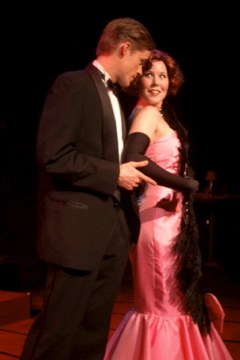
Tuesday, January 30, 2007

Permanent Collection (Karamu)


‘PERMANENT COLLECTION,’ thought provoking, but inconsistent at Karamu

‘PERMANENT COLLECTION’ by Thomas Gibbons is presently in production at the Arena Theatre of Karamu. On the surface the play is about museums, race and culture. But, as one probes deeper, it is about how each of us perceives the world from our own perspective.

Gibson took his inspiration from the true story of the Barnes Foundation, an educational organization focused on art, located in Merion, Pennsylvania, just outside Philadelphia. The Foundation, which boasts one of the greatest collections of post Impressionist art in the world, has suffered great public turmoil since its eccentric founder, Dr. Albert Barnes, died in 1951. In a mind boggling action, Barnes left the foundation’s operation to Lincoln University, a historically black school. Eventually, because of a perceived racial divide, a number of lawsuits drained the Barnes of its endowment.

In the story, Gibbons explores the conflict between the newly-appointed African American director and the museum's longtime Caucasian education director who holds strongly to the museum's charter which forbids any changes to be made in the way the museum’s art is displayed. Fueled by an overzealous newspaper reporter, the private debate becomes public, and both men face off across the great racial divide.

The conflict is captured in a speech by the African American director who states, 'We pretend all things are equal, no culture is higher than another -- but in our hearts we know it's a lie. Shakespeare is better than folk tales. Bach is better than rap."

The play lays bare assumptions, beliefs, and bigotry as it defines itself.

Audience members are very likely to state, “He (Sterling North, the African American director) is right.” “No, (Paul Barrow, the caucasian director) is right.” No, North. No, Barrow. Gibbons’ well conceived use of language and plot devices carries us along on a journey of ever shifting darkness and light.

One of the most fascinating aspects of the play is that Gibbons is a white male. As he did in his wonderful ‘BEE LUTHER HATCHEE,’ which got a fine production at Karamu several years ago, Gibbons treads the line between the races with a deft and articulate hand.

The Karamu production does not live up to the potential of the script. The cast is inconsistent. Director Terrence Spivey failed to work with some of the actors on texturing their performances. Many of the lines are tossed away and lose their meaning. Yelling consistently substitutes for frustration and distress. In spite of this, some of the performances are acceptable.

John Busser is excellent as Barrow, but even he fades in the final scenes and seems to lose his characterization. Joseph Primes (Sterling North) has some excellent scenes as the museum director, especially those in which he is presenting controlled feelings. But he loses control of his voice and the character when he needs to show frustration and strength and fades into an unbelievable shell of the character.

Katrice Monee Headd nicely develops the role of Kanika, the African American assistant. Anne McEvoy consistently develops the role of a reporter, though she needed to be more cunning trying to develop the conflict into her fifteen-minutes of journalistic fame.

Rollin Mac Michael displays no understanding of how to effectively develop a role. He overacts and screams unnecessarily. Iris D. Tucker-Berry says words, avoiding the fact that those words have meaning.

John Konopka’s set design is wonderful. The floor of the theatre-in-the-round is a series of well-created impressionist art. Richard Morris, Jr.’s lighting design allowed for clear transitions.

CAPSULE JUDGEMENT: ‘PERMANENT COLLECTION’ is an excellent script which has a powerful and though-provoking message. Unfortunately, the Karamu production fails to give full-life to the author’s powerful words and message.

‘PERMANENT COLLECTION’ runs through February 11 at the Arena Theatre of Karamu. For tickets call 216-795-7077.

Karamu’s next productions are the world premiers of ‘GREENSBORO FOUR,’ which runs from January 27 through February 18 in the Jelliff Theatre, and ‘JIM: FLESH AND BLOOD,’ a play about football player Jim Brown.

Sunday, January 28, 2007

Groundworks Dancetheatre 1/07


GROUNDWORKS continues to entrance audiences

It’s been 9 years now since David Shimotakahara left Ohio Ballet to found his own dance company. GroundWorks Dancetheater bills itself as a highly innovative company of ballet trained artists dedicated to the development and presentation of new choreography and encourages collaboration with other art disciplines. It is that, and more!

It is one of the few companies that revels in not having a home of its own. The troupe can be found performing in churches, dedicated entertainment venues (such as Cleveland Public Theatre) and public buildings (e.g., The Cleveland Botanical Garden).

Its mottos include: “undiluted,” “unfiltered,” and “unprocessed.”

In its short history, GroundWorks has established itself as a major force in Cleveland dance. As evidenced by the sold-out performances at their recent run at the Botanical Garden, David and his dancers, have gained a loyal following. The dance-ophiles show up no matter the venue.

In their most recent program, part of the Landmarks Series 2007, the company premiered, “U ME U,” choreographed by Artistic Associate Amy Miller.
Centering on the theme “the repetition of an idea in continually changing contexts,” the piece was a collaborative effort between Miller, dancers Felise Bagley and Mark Otloski, and guitarist/music composer James Marron. The selection, though very precise in its movements, had the feeling of being created on the spot. The visual interaction between the dancers and the musicians, who seemed to pick up their cues from each other, was strong. As Marron’s strumming slowed, the dancers moved slowly. When the performers sped up, so did the music. The sounds varied from discordant, to riffs, to a flow of melodic sound. The piece was, at times, serious, at other times playful. This kind of performance takes a special relationship between the choreographer, musician and dancers. Fortunately, Groundworks has all three in place! “U ME U” is a fine addition to the company’s repertoire.

The remaining two segments, Shimotakahara’s ‘MAJOR TO MINOR” and “THE MUSIC ROOM” were restagings of former presentations. Both were danced to a collection of musical creations.

“MAJOR TO MINOR” used such music as “I Wished On The Moon,” “The Way You Look Tonight,” and “Every Time We Say Goodbye” to investigate the bittersweet and sometimes humorous take on people in the pursuit of love.” Dancers Felise Bagley, Amy Miller, Mark Otloski and David Shimotakahara were excellent in making the transition from jazzy, to finger snapping, to humorous, with ease. The highlight was the delightful segment created around the song, “Peanut Vendor.”

“THE MUSIC ROOM” centers around a door, created by Narelle Sissons’, which becomes the sixth performer as it moves, flips, is slammed and opens and closes as it serves as a means for entrances, exits, being a barrier, a hindrance, and finally, a piece of bewilderment.

One must wonder how long some of the company members will continue to carry on their arduous dancing. Several of the group are no long youngsters and have passed the age at which dancers tend to slow down or retire. It would be a shame for Groundworks to cease its wonderment because of the lack of new performers. It is rumored that the company has been holding tryouts to expand its dancing corps. It’s going to be hard to have anyone come in and match the skills of Shimotakahara, Miller, Bagley and Otloski. We’ve seen the difficulty that Jennifer Lott, a well trained dancer has had in matching the precision of the present company. When she dances in tandem with Bagley or Miller, as happened in the Botanical Garden program, the differences in technique and polish shine through. It can only be hoped that when necessary, Shimotakahara can find the likes of the present company.

Capsule judgment: Groundworks is one of the top dance companies in the area and deserves the adulation it is receiving.

Thom Pane (based on nothing)


‘NOTHING’ is something at DOBAMA

During the day on Friday, I spent a class period trying to explain the workings of the human mind to my Psychology class. I recounted that the brain is the product of both heredity and environment. I shared that it often goes off on tangents for no presently identified reason. I also shared that sometimes, based on the situation and our mood and motivation, disorganization of ideas, emotional breakdowns, and the resulting flow of thoughts can reveal a great deal about a person.

Oh how I wish my students had been able to share with me the opening night performance of Dobama Theatre’s ‘THOM PAIN (based on nothing)’. My “brilliant” lecture actually came to life through the talented one-man performance of Scott Plate as Thom Pain.

Will Eno’s ‘THOM PAIN (based on nothing)’ was a finalist for the 2005 Pulitzer Prize in Drama. It has been called funny, edgy, honest, engaging and raw.

It can’t be defined by traditional terms used for a theatrical script—drama, comedy, tragedy or farce. It defies description. What it is, is a look at life, the terror of life, the greatness of mortality, and the fragility and realities of existence. It is an odd and intoxicating affirmation of the value of being alive, with an underbelly probing into the uselessness and sometimes joy of being alive. It has the qualities of a Sartre and Camus existential probing into why one lives. It screams, “Why do we exist?”

The story is told with many stops and starts, pauses and digressions. The language is sometimes gross and often poetic. An ill-fated love affair is explained away with, “I disappeared in her and she, wondering where I went, left.” The language often contradicts itself. The character is so inconsistent that we never know whether we should believe anything he says.

Sound weird? It is. It’s probably one of the oddest plays you’ll ever see. For some it will be exciting, for others off-putting.

Someone actually got up about ten minutes into the play and walked out. He crossed right through the acting area to get into the cold night air. Was he a plant meant to highlight the nature of the production? When the man departed, Plate seemed confused. After a momentary pause, he launched into an “ad libbed” speech that tied the exit to his flow of thought and then used the device throughout the rest of the production to bridge ideas together. The same thing happened later when he “spontaneously” brought an audience member on stage and used him as a prop for yet another rambling tale.

I should have figured that this was going to be one of “those” evenings when, at the start of the show, Plate started to talk to the audience while he was standing in the dark. Was there a blown light cue by the techie in charge of illumination? The lights suddenly flashed on as the actor was telling us about the dark. The contradictions were startling.

Even the ending was not traditional. At one point, mid-sentence, Plate just left the stage and didn’t return. The audience sat, quietly, waiting to figure out whether we were in intermission, the actor had forgotten his lines and panicked, or the whole experience was really over. There was no closing curtain, no sudden rise in lighting level to signal, “it’s over.” Someone finally got up and left. Others followed. Yes, our experience was over.

Plate is marvelous! His confusion is real. The tears he sheds, the bodily shakes, the confused look in his eyes, the underplayed manic expressiveness on his face are real. Plate’s pain and Pain are real!

The show was directed by Joel Hammer, but who knows what his role was. Is this Plate’s conception or Hammer’s creation? It’s all part of those questions about the play that will never be answered.

CAPSULE JUDGEMENT: ‘THOM PAIN (based on nothing)’ is a 70-minute, no intermission or late seating, compelling piece of theatre. Is it for everyone? No. If you like escapist comedy or light musicals this is not for you. But, if you want to think, and see a marvelous performance, get down to Shaker Square and have a meaningful, if thought confusing experience.

Wednesday, January 24, 2007

QED (Actors' Summit)


Outstanding ‘QED’ at Actors' Summit

I’m about to tell you that a lecture about physics makes for fascinating theatre.

You might think, “This reviewer has gone off the deep end.” Whether the latter statement is true or not isn’t the issue. The fact remains that physics, cancer treatment and musical theatre blended with marvelous acting and focused directing, does make for an enticing evening of theatre. Where? It’s on stage Actors’ Summit which is presenting Peter Farnell’s play ‘QED’ about Richard Feynman, the renowned physicist, professor and Nobel Prize winner.

QED stands for Quantum Electrodynamics, which was Feynman's field. QED is also the abbreviation for 'quod erat demonstrandum,' which basically means 'that proves it.' And what Farnell proves is not only that Feynman was a genius, who was part of the team that developed the atomic bomb, but a person of enormous warmth, creativity and passion. He was a real person who was as at home at the blackboard figuring out abstract formulas as playing the King of Bali Hai in a college production of ‘SOUTH PACIFIC.’

Alan Alda portrayed Feynman in both the Los Angeles and Broadway productions of ‘QED.’ A review stated of his Big Apple performance, “Alda's everyman demeanor is perfectly suited to this play; he is capable of winning over the audience immediately and guiding them, with a gentle hand, through what might otherwise be impossibly difficult subject matter. It is, however, always Feynman onstage. Alda has no problem vanishing into the character of Feynman here, with his manic mannerisms and strong adaptation to the ‘stream of consciousness’ style of Parnell's script.”

The reviewer could have penned those words about Neil Thackaberry’s performance. His is a tour de force enactment.

Under Wayne Turney’s capable directing, Thackaberry spends his almost one-and-a half hours on stage in what is close to a solo piece, talking to the audience, yakking on the phone and briefly interacting with a female student (Miriam, capably portrayed by Jocelyn Roueiheb), who may be as interested in him as an intellect as a potential sex mate.

Throughout, we remain fascinated. We are compelled to share in his intimate decisions about whether or not to have yet another operation to curb his raging cancer, his dealings with a group of visiting Russian dignitaries, and his performance in the musical.

CAPSULE JUDGEMENT: Actors’ Summit seems to deal exceptionally well with solo shows. Their ‘CLARENCE DARROW: A ONE MAN SHOW,’ which starred Thackaberry and ‘GIVE ‘EM HELL HARRY,’ which starred Turney, the play’s director, were both outstanding. Add ‘QED’ to that list! This is a must see performance.

Sunday, January 21, 2007

Fat Pig (The Bang and The Clatter)


A MUST SEE! ‘FAT PIG’--thought provoking, well performed at BANG AND CLATTER

The Bang and The Clatter is dedicated to producing “innovative, challenging works, of exceptional quality and imagination with a particular emphasis on modern American plays.” They intend not only to entertain, but “to push the envelope, and lick it.” They accomplish those objectives in ‘FAT PIG,’ which is getting its local premiere at B&C.

Neil LaBute, the play’s author, is noted for his ability to expose the underbelly of human behavior. He often focuses on the casual cruelty that one person can inflict on another, either intentionally or unintentionally. His recent feature film, ‘IN THE COMPANY OF MEN,’ showcases two male co-workers who relieve their boredom by deciding to both court a deaf woman, build up her self-esteem, and then simultaneously dump her.

‘FAT PIG’ highlights the pettiness and meanness of people who deride others because of their physical appearance. It showcases the effect of peer pressure to conform to arbitrary evaluation of others. To make matters even more pointed, LaBute writes in such a way that we laugh through our tears. He makes the viewer feel guilty about laughing, even psychologically restricting the audience from applauding at the end of brilliantly written and conceived scenes.

The script centers on a romance between an attractive guy (Tom) with an upscale career and an amply endowed Rubenesque woman (Helen).

Tom and Helen have their first encounter at a self-service restaurant. She is eating three slices of pizza and dessert while he pecks away at a salad. They talk, she is charming and full of self-put downs over her weight. He, after a series of bad relationships, including one with a co-worker, is charmed with her unaffected realism. They begin to date. He hides the fact from his co-workers. Eventually, the need to face reality hits and leads to an emotionally drenched ending.

The Bang and The Clatter production, though a little slowly paced, is enveloping. Director Sean McConaha has finely honed the skills of his actors. He highlights the emotional highs and lows, effectively keys the pauses, glances and awkward moments. He is aided by a cast which ranges from brilliant to effective.

Jenna Messina, as the full-bodied Helen, takes on a very difficult role. The actress who plays the role must not only physically fit the part, but have a personal attitude that allows the audience to truly believe that in real life she is proud of who she is, yet vulnerable to the attacks of others. Messina plays the role with total believability. This is a tour-de-force performance!

Sean Derry is not as physically attractive as might be expected for the actor playing Tom . He doesn’t have the Brad Pitt looks that make women weak-kneed, but he is such a fine actor that he makes us believe the illusion is true. He is brilliant in the final scene as he glances toward where his friends are congregated, probably making fun of the hefty Helen, while carrying on a conversation with the woman he supposedly loves.

Tony Waver shines as Tom’s caustic co-worker who exemplifies all the shallowness of our advertising-driven culture which stresses superficiality and appearance over substance. Alana Romansky is convincing as Jeannie, a co-worker who yearns for a permanent relationship with Tom, but, at times her character slips and we get words rather than meanings.

The production is aided by a well-conceived scenic design by Sean Derry. Sean McConaha’s selection of musical interludes helped bridge the often overly long between-scenes pauses.

In other productions of the play, the titles for each of the seven scenes are projected on a screen. The device reinforces the theme of each segment. It is an effective device which could have helped the B&G’s excellent production to be even more pointed.

Capsule judgment: Several years go, while visiting in Washington, DC, I saw a production of ‘FAT PIG.’ The show was outstanding and went on to win several Helen Hayes’ Citations, DC’s equivalent of the Tony Awards. The Bang and The Clatter production is every bit as effective as the presentation in the nation’s capital. THIS IS A MUST SEE THEATRICAL EXPERIENCE!!!!!

Sleep Deprivation Chamber (Cleveland Public Theatre)


Purposeful, but poorly written SLEEP DEPRIVATION CHAMBER at CPT

Racial profiling, using race as a primary determinant in the characterization of a person considered likely to commit a particular type of crime, is alive in the United States. Whether for traffic stops, following certain people in grocery or department stores, or checking and rechecking individuals in airports, the practice is carried on. It affects African Americans, Arabs and all others who those in-charge might consider to be of “questionable character.”

Adrienne and Adam Kennedy’s ‘SLEEP DEPRIVATION CHAMBER,’ now on stage at Cleveland Public Theatre, highlights an authentic case in which a Black college student (in real life, Adam Kennedy) is pulled over for having a non-functioning rear taillight on his car, and is beaten by the arresting officer. Eventually, after a period of excruciating experiences which affect not only the young man, but his entire family, the charges are dismissed by a judge after hearing the “facts” of the case.

While well-meaning, the Kennedy’s script is not well written. It is often redundant and adds much material that elongates the experience with little pay-off. The flash-forward and flash-back format causes confusion. This story would make an effective 15-minute one act, but should not have been crafted as a 90-minute presentation.

Besides the script problems, the production gets lost in the large Gordon Square Theatre. This is an intimate piece which would have been much more appropriate for CPT’s smaller Levin Theatre space.

Clevelanders will find themselves familiar with many of the play’s references. Local streets and comments about the Indians and Bob Feller pepper the dialogue. But after a while, even that loses its effect.

Director Caroline Jackson Smith does an acceptable job of staging. She uses all parts of the facility...the main stage and the overhanging loges for settings for the scenes. She has not, however, honed the skills of some of her actors. Some of the performances are excellent, others quite poor.

Lisa Langford is effective as the narrator and mother of Teddy Alexander, the young man accused of the “crime.” At times, however, she is difficult to hear in the vastness of the auditorium.

Daniel H. Taylor, is excellent as Teddy, the falsely accused son. He is very natural and is believable in his role development.

Stuart Hoffman is a cast highlight as the Caucasian officer who shows disdain and lacks remorse for his actions. Derek Koger portrays Teddy’s lawyer with accuracy.

On the other hand, Yolanda Wilson (lawyer) and Dolores Boda (the Assistant DA) lack meaning in their line presentations.

Capsule judgment: ‘SLEEP DEPRIVATION CHAMBER’ sends an important message regarding racial profiling. Unfortunately, the script is not well conceived, and the presentation not convincing, which leads to an overly long performance experience.

Wednesday, January 17, 2007

Allen White reviews the reviewer

I was one of the fortunate people who got to see the
> show (THE LIGHT ON THE PIAZZA)in New York, and
> again last night. After seeing the NYC production I
> told people the show was "stunningly beautiful", and the performances, especially Victoria Clark and Kelli O'Hara, were incredible.
>
> My wife did not see the New York production, and
> didn't understand what I saw in the show. She was mostly bored, and felt that Margaret was completely lost. On the way out of the theatre I heard others who wanted to know why this show won the Tony Award for best musical, because it certainly wasn't very good. (It didn't, but it was nominated for that honor --Victoria Clark did win the Tony for Best
> Actress in a Musical.)
>
> Mr. Berko's review was accurate, because the beauty of the show was mostly
> lost in last night's performance. I fear much of that was because of the
> understudy not having the range to portray a role as complicated as
> Margaret. I can say that I love the song "Dividing Day", because of its
> complicated message of love somewhere lost, and I barely recognized it last
> night.
>
> The show requires the woman playing Margaret to have incredible range, both
> in acting and in singing. Perhaps the woman scheduled to play her has that
> range, but Ms. Brockman certainly does not. I wouldn't say that you should
> avoid the show, because it's a wonderful show, but last night was certainly
> not representative of that.
>
> Allen White

The Light in the Piazza (Playhouse Square Center)


A dim ‘LIGHT IN THE PIAZZA’ at the Palace

A rather surprising thing happened at the Palace Theatre in Playhouse Square on the opening night of the touring production of ‘THE LIGHT IN THE PIAZZA. During the curtain call following the show, no one stood up. Yes, it was Cleveland, Ohio, the home of the automatic standing ovation, and nary a soul jumped out of a seat!

‘THE LIGHT IN THE PIAZZA,’ Craig Lucas and Adam Guettel’s musical, based on the novel by Elizabeth Spencer, tells the story of a mother ((Margaret) and daughter (Clara) traveling through Italy, the daughter's romance with a Florentine (Fabrizio), and the mother's determined efforts to keep the two apart.

Margaret is in a loveless marriage and has brought her daughter to Florence, home of art and beauty, to escape the mother’s reality and flashback to a happier time. Clara was kicked in the head as a child by an errant pony at a birthday party. Though she has the body of a woman, she has the emotions of a 10-year old. Fabrizio is a twenty-year old Italian who, in a chance meeting, falls in love with Clara. As happens in all good soap operas, true love wins out in the end.

The show garnered six 2005 Tony Awards. The score by Adam Guettel, who is the grandson of Richard Rogers of ‘SOUND OF MUSIC’ fame, has been praised for its ability to create the mood of falling in love and evoking strong emotional feelings.

So, with all these positives, why did the touring production receive luke-warm applause from the less than sold-out opening night audience?
•Maybe it was the fact that the play is an intimate experience, which was nurtured by the small New York theatre in which it was performed, while it was lost in the vastness of the Palace.
•Maybe it was because the role of Margaret was portrayed by Jane Brockman, an understudy who gave a stiff, one-dimensional veneer to the character and had only an acceptable singing voice.
•Maybe it was because the score, in spite of the superlatives that have been used to describe it, doesn’t have a single hummable or memorable song.
•Maybe it was because the soap-opera/melodramatic story line didn’t evoke the emotional response in the audience that it should have because the show is almost more operetta than musical theatre. In fact, this show may have given life to a new format in theatre, the soap operetta.
•Maybe because the show failed to live up to the image of the traditional musical. There is no dancing or show stopper in this vehicle, no message to carry from the theatre..

That is not to say there are not highlights in the production. Handsome David Burnham has a strong and well-trained operatic voice and develops a well-textured Fabrizio. And, as Clara, Elena Shadow is totally believable as the waif-like woman/child. She has a lovely singing voice. The duo are worth seeing.

The full orchestra was excellent. The sets and costumes quite acceptable.

Capsule judgment: Don’t Go To See ‘THE LIGHT IN THE PIAZZA’ with the expectation of being “blown away.” It is a pleasant diversion which never reaches the level of expectation of a six Tony Award winner.

Saturday, January 13, 2007

Of Mice and Men (Cleveland Play House)


Emotional 'OF MICE AND MEN' at CPH

‘OF MICE AND MEN,’ John Steinbeck’s play, which is now on stage at the Cleveland Play House, was the author’s attempt at writing in a format which he entitled a play novelette.

Steinbeck envisioned that the novel and the play would have the same format and be interchangeable. For example, each chapter is arranged as a scene, and each scene is confined to a single place.

In spite of the fact that the book is a classic which is read by most high school and college students, and sold over 120,000 before it was even published in 1937, Steinbeck considered the work a failure in the sense that it did not accomplish his goal since the play version was rewritten by George Kaufman, who directed its first production.

The novel/play which was transformed into five films, an opera and numerous stage productions, is not without controversy. In the 1990s several school libraries banned the book for “promoting euthanasia.” In fact, the book is number six on the list of the American Library Association’s 100 Most Frequently Challenged Books.

The play, which is set on a ranch in the Salinas Valley in California during the Great Depression of the 1930s, centers on George Milton and Lennie Small, two migrant workers who dream of owning their own farm. Unfortunately, like the line in Robert Burns’ poem, “To a Mouse,” which laid the foundation for the title and the script’s theme, “The best laid plans of mice and men often go awry,” the dream is not achieved.

George, is large, strong, unintelligent and innocent at heart. He lives to touch soft and furry things (rabbits, mice, soft materials), but often acts out physically when the animal nips or someone pulls away from him. George is his caretaker, friend and conscience. George and Lennie are like mice in the maze of life. Their extraordinary friendship distinguishes them from other lonely migrant workers who are individualists, afraid to show their softer feelings or bond with another person.

The CPH production, under the direction of Seth Gordon, is generally effective. The cast, with a few exceptions is excellent.

Jeffrey Evan Thomas is outstanding as Lennie. This is a difficult role. There is a temptation to overdo the character and make him pathetic or comic. Thomas walks the fine line with perfection. This is an amazing performance.

Harry Carnahan is believable as George. His affection and desire to protect Lenny from hurt, including his making a startling decision at the play’s final curtain, is clear. Even his oft repeated “If I was alone I could live so easy,” is clearly developed as a ploy to cover his need for the bonding.

Chet Carlin is convincing as Candy, the old man who has little for which to live. Jeremy Holm develops the role of Slim well , as does Wiley Moore as the “nigra.”

Amanda Rowan weakly stays close to the surface as the daughter-in-law of the ranch’s owner. Vayu O’Donnell is not believable as her husband. Caleb Sekeres (Whit) who uses a flat, no-affect delivery, fails to develop any characterization.

Hugh Landwehr’s multi-set design works well and James C. Swonger’s sound design helps develop the mood.

The first act is well-paced, but the second act lagged.

The power of the conclusion was disrupted by Gordon’s decision to bring up the lights too quickly, startling the audience back to reality, thus breaking their emotional envelopment.

CAPSULE JUDGMENT: ‘OF MICE AND MEN’ is a generally effective presentation with two srong performances by Jeffrey Evan Thomas and Harry Carnahan. It is a production that should be attended not only by the many students who study the show, but by those who like a good script which gets a good production.

Sunday, January 07, 2007

Both Sides of the Family (Charenton Theater)


‘BOTH SIDES OF THE FAMILY,’ a thought provoking probe at Charenton

She is an Episcopalian, married to a Jew, who is bringing up her daughter in the Hebrew faith.


He is a Jew, married to a Catholic, who is feeling guilty because he knows little about his heritage, has allowed his son to be brought up out of the faith, realizes that he wants to probe his roots, and is frustrated because he can’t pass on his history to his son.


Thus, we have the premise for Maryann Elder Goldstein’s ‘BOTH SIDES OF THE FAMILY, which recently had its world premiere at Charenton Theater Company.

The one-hour play, has an interesting format. Its two characters, who are on stage throughout the production, never speak to each other, don’t interact, and only at the end have a passing but significant connection.

Both humorous and poignant, Goldstein has probed not only inter-religious marriage, but the purpose of religion, the importance of tradition, and the bond of family. The dialogue is natural. The humor is appropriate to the situation, not gimmicky. The angst is nicely developed. This is a good script!

The Charenton production, under the adept directing of Jacqi Loewy, is nicely paced, the concepts stand out, and the acting realistic. Author Maryann Elder Goldstein, who may well be playing her real-life self, is totally believable as She. Jeff Grover, who, besides playing He, added material to the script. He was realistic as the frustrated He.

Capsule judgement: ‘BOTH SIDES OF THE FAMILY’ is a well-written script which received a fine production at Charenton.
Charenton, which finds itself in the same nomadic state as Ensemble and Dobama, is looking to make their home in Gallery 324 at the Galleria. They are looking for an “angel” to finance their desire into a reality. Potential donors may contact the theatre at www.cherenton or call 216-469-9160.

Sunday, December 31, 2006

Time Tributes--2006


Times Theatre Tributes--2006

Greater Cleveland is blessed with a vital theatre scene. It is the purpose of the TIMES THEATRE TRIBUTES to recognize theatrical experiences that, in the mind of this reviewer, were excellent and deserve special recognition.

Only shows performed in 2006 which I reviewed were considered. Selections were limited to locally produced stagings, so none of the professional touring shows are recognized, though actors, directors and technicians who were imported by local theatres were considered. Actors are not separated by gender or leading or supporting roles.

If you would like to read any of my reviews for the year, please go to www.royberko.info, enter the blog and click on “2006 Reviews.” Reviews from previous years may also be accessed.

Thanks to the following for making the 2006 theatre scene in the Cleveland area stimulating and memorable:

PLAY
A FUNNY THING HAPPENED ON THE WAY TO THE FORUM (GLTF)
A NUMBER (Dobama)
A MAN OF NO IMPORTANCE (Beck)
BEAUTY AND THE BEAST (Beck)
BUDDY: THE BUDDY HOLLY STORY (Carousel)
CHARLOTTE’S WEB (CPH)—Alex and Noah Berko’s special children’s recognition
citation
DIARY OF ANNE FRANK (Beck)
FEFU AND HER FRIENDS (CPT)
LIES AND LEGENDS: THE MUSIC OF HARRY CHAPIN (Beck)
M4M (CPT)
MO PAS CONNIN OR TORMENT (CPT)
MY FAIR LADY (CPH)
NIGHT BLOOMERS (Dobama)
OUR TOWN (Porthouse)
RABBIT HOLE (CPH)
SORROWS AND REJOICINGS (Ensemble)
SUNDAY IN THE PARK WITH GEORGE (Lakeland Theatre)
THE PILLOWMAN (Dobama)
WELL (CPH)


DIRECTOR
Michael Bloom, WELL (CPH)
Raymond Bobgan, FEFU AND HER FRIENDS (CPT)
Michael Brown, RABBIT HOLE (CPH)
Vicki Bussert, BUDDY, THE BUDDY HOLLY STORY (Carousel)
Victoria Bussert, A FUNNY THING HAPPENED ON THE WAY TO THE FORUM
(GLTF)
Licia Colombi, SORROWS AND REJOICINGS (Ensemble)
Amanda Dehnert, MY FAIR LADY (CPH)
Matthew Earnest, OUR TOWN (Porthouse)
Martin Friedman, SUNDAY IN THE PARK WITH GEORGE (Lakeland Theatre)
Craig J. George, M4M (CPT)
Mark Alan Gordon, CHARLOTTE’S WEB (CPH)
Sarah May, DIARY OF ANNE FRANK (Beck)
Sonya Robbins, A NUMBER (Dobama)
William Roudebush, LIES AND LEGENDS: THE MUSIC OF HARRY CHAPIN,
(Beck)
Eric Schmiedl, NIGHT BLOOMERS (Dobama)
Scott Spence, A MAN OF NO IMPORTANCE (Beck)
Fred Sternfeld, BEAUTY AND THE BEAST (Beck)

PERFORMER
Denise Astorino, AND BABY MAKES 7 (convergence)
Starla Benford, STREETCAR NAMED DESIRE (CPH)
Sonia Bishop, SORROWS AND REJOICINGS (Ensemble)
Mary Ann Black, DAMES AT SEA (Porthouse)
Lucy Bredeson-Smith, A MURDER OF CROWS (covergence)
Lucy Bredeson-Smith, ICARUS (convergence)
Jodi Brinkman, THE PARTY (Kalliope Stage)
Michael Butler, CUSTODY OF THE EYES, (CPH)
Lucas Caleb , STREETCAR NAMED DESIRE (CPH)
Bernadette Clements, MRS. WARREN’S PROFESSION (BECK)
Glenn Colerider, WHEN THE WORLD WAS GREEN (Cesear’s Forum)
Aimee Collier, SUNDAY IN THE PARK WITH GEORGE (Lakeland Theatre)
Liz Conway, CAT ON A HOT TIN ROOF (Lakeland Theatre)
Timothy Crowe, MY FAIR LADY (CPH)
Troy Deutsch, RABBIT HOLE (CPH)
Denny Dillon, WELL, (CPH)
Nina Domingue, MO PAS CONNIN OR TORMENT (CPT)
Keith Faris, THE FULL MONTY (Beck)
Heather Farr, DIARY OF ANNE FRANK (Beck)
Dan Folino, BEAUTY AND THE BEAST (Beck)
Tom Ford, A FUNNY THING HAPPENED ON THE WAY TO THE FORUM
(GLTF)
Natalie Green, BEAUTY AND THE BEAST (Beck)
Joel Hammer, A NUMBER (Dobama)
Jeffrey C. Hawkins, A FUNNY THING HAPPENED ON THE WAY FORUM
(GLTF)
Geoffrey Hoffman, POONA, THE ****DOG, (continuence)
Holly Holsinger, FEFU AND HER FRIENDS (CPT)
Alicia Kahn, ARMS AND THE MAN (Actors’ Summit)
Geoff Knox, M4M (CPT)
Nick Koesters, NIGHT BLOOMERS (Dobama)
Nick Koesters, GREATER TUNA (Beck)
Julia Kolibab, PACK OF LIES (Cesear’s Forum)
Todd Krispinski, A NUMBER (Dobama)
Todd Krispinski, THE PILLOWMAN (Dobama)
Emily Leonard, DAMES AT SEA (Porthouse)
Kelly Mares, STREETCAR NAMED DESIRE (CPH)
William Clarence Marshall, PORGY AND BESS (Beck)
Renee Mathews-Jackson, SORROWS AND REJOICINGS (Ensemble)
Michael Mauldin, M4M (CPT)
Mitch McCarrell, HAIR (Cain Park)
Pat McRoberts, BUDDY: THE BUDDY HOLLY STORY (Carousel)
Jason Miller, CHARLOTTE’S WEB (CPH)
Melodie Moore, THE PARTY (Kalliope Stage)
Sarah Portz, SPITFIRE GRILL (Clague Playhouse)
Angela Reed, RABBIT HOLE (CPH)
Alicia Roper, WELL (CPH)
George Roth, DIARY OF ANNE FRANK (Beck)
Wes Shofner POONA, THE ****DOG, (continuence)
Dorothy Silver, MRS. WARREN’S PROFESSION (Beck)
Clyde Simon, ICARUS (convergence)
Lenne Snively, A MAN OF NO IMPORTANCE (Beck)
Lenne Snively, THE FULL MONTY (Beck)
Richard Strimer, SINGING IN THE RAIN (Carousel)
Jeanne Task, FROM DOOR TO DOOR (JCC)
Lelund Durond Thompson, CHARLOTTE’S WEB (CPH)
Rachel Warren, MY FAIR LADY (CPH)
John Woodson, OUR TOWN (Porthouse)
Matthew Wright, A MAN OF NO IMPORTANCE (Beck)

Ensemble cast:
FEFU AND HER FRIENDS (BECK)
LIES AND LEGENDS: THE MUSIC OF HARRY CHAPIN (Beck)
M4M (CPT)

TECHNICIANS
Russ Broski, set design, NIGHT BLOOMERS, (Dobama)
Kim Brown, costume design, NITE CLUB CONFIDENTIAL (Kalliope)
Kim Brown, costume design, WILD PARTY (Kalliope)
Trad Burns, lighting design, PORGY AND BESS (Beck)
Nicole Franchiseur, costume design, A FUNNY THING HAPPENED ON THE
WAY TO THE FORUM (GLTF)
Richard Gould, set design, DIARY OF ANNE FRANK (Beck)
Joan Horvitz, costume design, FEFU AND HER FRIENDS (CPT)
Richard Ingraham, sound design, HAMLET (Beck)
Richard Ingraham, sound design, DIARY OF ANNE FRANK (Beck)
Richard Ingraham. sound design, NIGHT BLOOMERS (Dobama)
Aimee Kluiber, costume design, BEAUTY AND THE BEAST (Beck)
Todd Krispinski, scenic design, A NUMBER, (Dobama)
Jeff Lockshine, lighting design, DIARY OF ANNE FRANK (Beck)
Don McBride, scenic design, HAMLET (Beck)
Ben Needham, scenic design, BEAUTY AND THE BEAST (Beck)
Devon Painter, costume design, MY FAIR LADY (CPH)
Russell Parkman, scenic design, RABBIT HOLE (CPH)
Neil Patel, set design, RFK (CPH)
Maureen Patterson, lighting design, NIGHT BLOOMERS (Dobama)
Steven Shultz, projections, LET FREEDOM RING! (Ensemble)
Jenniver Sparano, costume design, MRS. WARREN’S PROFESSION (Beck)
Jenniver Sparano, costume design, M4M (CPT)
Nicole Franchiseur, costumes design, A FUNNY THING HAPPENED ON THE
WAY TO THE FORUM (GLTF)
Don Wadsworth, dialects, MY FAIR LADY (CPH)
Donald Wasson, costume design/hats, FEFU AND HER FRIENDS (CPT)

MUSICAL DIRECTION
John Jay Espino, A FUNNY THING HAPPENED ON THE WAY TO THE FORUM (GLTF)
John Franks, SPITFIRE GRILL (Clague Playhouse)
Larry Goodpaster, A MAN OF NO IMPORTANCE (Beck)
Larry Goodpaster, BEAUTY AND THE BEAST (Beck)
Larry Goodpaster, SUNDAY IN THE PARK WITH GEORGE (Lakeland Theatre)
Larry Goodpaster, THE FULL MONTY (Beck)
Nancy Maier, LIES AND LEGENDS: THE MUSIC OF HARRY CHAPIN (Beck)
Nancy Maier, LET FREEDOM RING! (Ensemble)
Michael P. Hamilton, THE WILD PARTY (Kalliope)
Steve Parson, BUDDY: BUDDY HOLLY STORE (Carousel)
Tim Robertson, vocal supervision, MY FAIR LADY (CPH)
Matthew Webb. HAIR (Cain Park)

CHOREOGRAPHY
Martin Cespedes, THE FULL MONTY (Beck)
Martin Cespedes, BEAUTY AND THE BEAST (Beck)
Janeice Kelley-Kitely, HAIR (Cain Park)
Janet Louer, A FUNNY THING HAPPENED ON THE WAY TO THE FORUM
(GLTF)
Michael Medcalf, WILD PARTY (Kalliope)
Sean Morrissey , DAMES AT SEA (Porthouse)
Monica Olejko, LIES AND LEGENDS: THE MUSIC OF HARRY CHAPIN (Beck)
David Shimotakahara and Pandora Robertson, LET FREEDOM RING (Ensemble)

SPECIAL RECOGNITION
Dean Gladden. For service to the Cleveland Play House and the Cleveland
theatre community
Julie Fogel. For outstanding public relations services at the Cleveland Play House

THE BEST OF THE BEST

I have been asked why I don’t select my “best of the best” for each season. So, to satisfy those requests, I present my selections:

2006 BEST OF THE BEST DRAMAS: DIARY OF ANNE FRANK (Beck), A NUMBER (Dobama), M4M (CPT)

2006 BEST OF THE BEST MUSICALS: A MAN OF NO IMPORTANCE (Beck), MY FAIR LADY (CPH), BUDDY, THE BUDDY HOLLY STORY (Carousel)

Tuesday, December 12, 2006

Wednesday, December 06, 2006

Jesus Star Superstar (Playhouse Square Foundation)


Ted Neeley, Corey Glover and SUPERSTAR all rise to the occasion at the Palace

It is appropriate that at this time of the year Playhouse Square Center has brought in a touring production of ‘JESUS CHRIST SUPERSTAR.’ And quite a production it is.

Superstar opened on Broadway in 1971. Jeff Fenholt played Jesus. In 1972 Neeley was cast in the lead role for the touring production which seemingly has run forever. He also played the role in the 1973 movie version.

Every once in while a play and a performer became synonymous. Think Carol Channing and ‘HELLO DOLLY’ and Zero Mostel and ‘FIDDLER ON THE ROOF.’ When ‘JESUS CHRIST SUPERSTAR’ is mentioned Neeley and Jesus have become parallel elements.

Touring productions, especially those that have been on the road for a long time, often aren’t fresh. This can’t be said for this touring show. It sizzles. It is vital. It is fresh. It is exciting. The singing, the dancing and the story interpretation are all on-key.

Much of the excitement is mustered by the excellent chorus who play the apostles and numerous other roles. However, Corey Glover, best known as a member of the rock band “Living Color,” makes the production special. He is dynamic as Judas. Glover has a full voice and becomes so involved in the role that he sucks the audience right into the action.

Neeley never seems to age or go into automatic pilot as some performers do after playing a role for a long time-span. I’ve seen him do this role several times, and, if anything, he has deepened his Jesus-like presence. No matter what your religious orientation, Neeley makes you believe, as he floats upward on the cross at the end of the play, that he is on his way to a special place, and that his presence will long be felt.

Christina Rea-Briskin makes the role of Mary Magdalene hers. She sings well, interprets songs proficiently and acts the role with conviction. “I Don’t Know How to Love Him,” her duet with Neeley, is compelling. “Could We Start Again, Please,”her duet with Chris Gleim (Peter) brought screaming appreciation from the audience.

Aaron Fuksa’s “King Herod’s Song,” was a sight and sound show-stopping delight.

Capsule judgment:. This, the 2006 national tour of Superstar, is supposedly Neeley’s swan song. Supposedly it is his final appearance in the role. So, if the public relations is true, you’d better get down to the Palace and see him now. It’s worth the trip

Monday, December 04, 2006

Rocky Horror Show (Cleveland Public Theatre)


‘ROCKY HORROR’ very rocky at CPT

In 1973, while on a trip to England, I saw the ‘ROCKY HORROR SHOW’ during its first week of production. It was a wild and wonderful experience. The creativity, vitality, and breaking down traditional theatre walls (literally and figuratively) are forever etched in my brain.

Many are surprised to know that the Richard O’Brien script began as a play, not as a film. O’Brien had a life-long passion for schlocky horror movies. He also had a flare for writing. While appearing in a production of ‘JESUS CHRIST SUPERSTAR’ in London, he produced a 3-chord rock musical entitled ‘THEY CAME FROM DENTON HIGH’ in a small space above the theatre where Superstar was playing. Redubbed ‘THE ROCKY HORROR SHOW,’ the play is based on a combination of grade B Horror movies, Steve Reeve’s muscle flicks and fifties rock 'n' roll. It starred Tim Curry, who had appeared with O’Brien in a production of ‘HAIR,’ as Dr. Frank-N-Furter, a kinky scientist who creates "Rocky Horror", his personal Adonis.

The play, which opened as a six-week workshop project, got fantastic reviews and packed houses. It was named Best Musical of 1973 in the London Evening Standard's annual poll of drama critics.

But, all was not success. A Broadway version of the play flopped, running only forty five performances. A film, which had been made shortly before the New York opening, also bombed except in New York and LA.

But all was not lost. A marketing director came up with the idea of running it as a midnight movie. The film was reformatted, became a cult hit complete with audience members showing up dressed like the film’s characters and making sound effects and yelling out lines and doing the film’s famous “Time Warp” dance as the movie rolled. The rest, including a 2000 Broadway revival, is cult history.

Cleveland Public Theatre has decided to take on this cult-rock musical. Based on its past history of staging edgy shows such as ‘HEDWIG AND THE ANGRY ITCH,’ ‘VARLA JEAN,’ and ‘CONFESSIONS OF PUNCH AND JUDY,’ it would seem CPT would be the logical place for the staging.

Unfortunately, their production is off the mark. Though it seems like a romp, this is not an easy script to stage. The characters must be clearly etched and done with exaggerated realism. There has to be a total over-the-top staging within a well thought-out concept.

The production has lots of gimmicks, many of which are misguided (e.g., the gross yelling out by the band and others off stage which, I assume, were intended to be clever, but did little but distract from the on-stage action.) The performances go from good to bad. The poor sound system and the size of the venue makes for difficult hearing and echos that mute the lyrics and spoken dialogue. But, mainly, the production lacks focus.

Scott Plate is one of the area’s best actors and his previous directing forays were excellent. In spite of his fine director’s comments in the program, he seemed overwhelmed with this script. He made several questionable decisions, including deciding to gender bend the casting. This technique often works. For example, CPT’s ‘M4M’ did it with great success. In this case, however, it didn’t work and seemed like a gimmick for gimmick’s sake. Sometimes the gender references in songs made for confusion when applied to the “wrong” sex such as having Rocky, the supposedly perfectly formed male specimen played by a woman. In other cases, the result was blatantly homoerotic which rather than enhancing the decadence of the already decadent piece, seemed forced.

Andrew Marikis and Liz Conway were excellent as the naive, nerdy Brad and Janet. They both sing well and could be understood, a quality not present with some of the other cast members. Alison Garigan, who seems to have been born with an edge, didn’t reek with her usual sexuality. If anything, she was too restrained.

Carlos Antonio Cruz and James Ronald Jones II as Magenta and Riff Raff, were almost unintelligible. Very few of their lines or lyrics could be understood. Amy Bistok’s Narrator lacked character. She often sounded like she was reading blandly from a phone book. Amy Pawlukiewicz didn’t have the necessary physical presence needed for the role of Rocky. On the other hand, Elizabeth Wood was Shirley Temple adorable as Columbia.

The highlight of the production was The Phantoms, Brad Wyner’s rock group. I wish that these talented guys had just played a concert of the show’s score. That would have been worth sitting through in the very cold, cavernous, near-empty theatre.

CAPSULE JUDGEMENT: In my long history of theatre commentary, I have never walked out of a show that I have reviewed before it was over. I left the CPT production of ‘THE ROCKY HORROR SHOW’ at intermission. ‘Nuff said.

‘THE ROCKY HORROR SHOW’ runs through December 23 at CPT’. For tickets call 216 631-2727.

Saturday, December 02, 2006

Landmark Series--Trinity Cathedral (Groundworks)


Groundworks continues to impress

Now in its eighth season, Groundworks Dancetheater continues to impress. Artistic Director David Shimotakahara has built a solid company which breaks outside traditional dance descriptions. The philosophy of combining the arts by having musicians create new works, which are then choreographed to both fit the venue and the dancers’ skills, while incorporating various electronic and theatrical devices, makes for exciting performance evenings.

In the company’s latest presentation, part of their Landmark Series, which places the dancers in various venues, they chose to perform in Trinity Cathedral. The combination of the glory of the gothic cathedral and the exciting choreography of Shimotakahara, Art Bridgman, Myrna Packer and Amy Miller, melded with the original music of Ryan Lott and Gustavo Aguilar and traditional music of J. S. Bach, brought about sustained applause from the near sold-out audience. Added to the over-all effect were costumes by Ray Zander and Janet Bolick which perfectly fit the mood of the dance and the creative lighting of Dennis Dugan.

The evening’s pieces, “Before With After,” “eleveneleven,” and “Through the Lens,” were each well-crafted.

Shimotakahara’s ‘Before With After,” examines life’s encounters and the intersection of joy and sorrow which reflected Bach’s keyboard tones. A piece which used the exceptional talents of Amy Miller, Felise Bagley, Jennifer Lott, Mark Otloski and Shimotakahara, consisted of flowing jumps, powerful gymnastics and controlled arm and body movements. The result was a compelling segment of dance.

Company member Amy Miller explored the implications of interconnectedness in choreographing “eleveneleven.” Ryan Lott’s original contemporary score was filled with energy and power that lent itself to Miller’s creative take on the moods and sounds. Bagley, Jennifer Lott, Damien Highfield and Otloski worked well together to create an interactive blend of carries, lifts and writhing movements on the floor, that was enveloping.

The highlight of the evening was ‘Through the Lens,” choreographers Bridgman and Packer’s break-through concept. Almost defying description, the piece was performed in front of and behind a massive opaque curtain. The dancers dove and rolled under the material, danced behind the screen, displaying configurations in varying degrees of large and small shadows, as well as realistically appearing before the curtain. This was a “WOW!” presentation.

In past reviews of the company I have recounted that newcomer Jennifer Lott had not yet matured to the level of the rest of the dancers. Shimotakahara’s choreography requires total body control and perfection in execution. Anyone who wavers from that weakens the over-all effect. It is a pleasure to announced that Lott, in this program, displayed tremendous growth in becoming an equal to the rest of the company.

Capsule judgement: Groundworks next, not to be missed presentation, will be at the Cleveland Botanical Garden on January 26, 27 and 28. For tickets call 216-721-1600 or visit the company’s website at www.notsoobvious.com.

Beauty and the Beast (Beck Center)


Noah and Alex agree with grandpa, ‘Beauty And The Beast’ is a beaut at Beck!

‘DISNEY’S BEAUTY AND THE BEAST,’ which is now on stage at Beck Center, tells a "tale as old as time." It was originally conceived in 1740 as a dark and scary fable. In 1992 Disney released a lighter version which became the first animated feature to be nominated for the Academy Award’s Best Picture. In 1994 Disney transformed the script into an award winning Broadway musical.

Last year Beck offered the show as an option to the usual holiday fare. It was a good idea. I called the production “a delightful experience,” and advised “see it!”

Fred Sternfeld has proven that he is a master at directing mass crowd musicals and scripts of high quality (e.g., ‘MAN OF LAMANCHA’ and ‘RAGTIME’). He has a knack for involving the entire cast, working with the leads to fine-tune the show, and getting audiences emotionally involved.

‘BEAUTY AND THE BEAST’ concerns a prince who, because he has no love in his heart, is transformed into a beast by an enchantress. To break the spell, the Beast must learn to love another and earn her love in return. If not, he will be doomed to remain a beast for all time.

Into the Beast’s life comes Belle, a beautiful young woman who lives with her eccentric father in a small town near the Beast’s castle. Belle longs for a life of adventure like those she reads of in books. Her father gets lost in the woods and wanders into the Beast’s castle, where he is imprisoned. Upon finding her father in the Beast's clutches, Belle offers herself as a captive in return for her father’s release. And...you can guess the rest. Yes, the Beast learns kindness and love, it is reciprocated by Belle, and we all go out of the theatre singing the likes of “If I Can’t Love Her,” “Be Our Guest,” and the title song, “Beauty and the Beast.”

Natalie Green again is glorious as Belle. She is beautiful, lights up the stage with her smile, sings like an angel and dances with ease. Her version of “A Change in Me” is enchanting.

Dan Folino, one of my very favorite local actors, has a full and powerful voice and gives a vulnerable texture to the role of the Beast that adds much to the characterization. His “If I Can’t Love her” is captivating. He and Green make the perfect fairy tale prince and princess. Two tween girls seated behind me, who couldn’t control themselves (giggle, giggle, giggle) during the show, squealed with delight at the end when the beast became a “real” person and then kissed Belle. They simultaneously shrieked, “He is so cute, I bet they really are in love” (giggle, giggle, giggle).

I still don’t buy Josh Noble as Gaston. In spite of his good singing voice and pearly white teeth, he feigns bravado, it doesn’t come naturally. He also doesn’t have the muscle-tone that is referred to in the score. Obviously, my view is in the minority, as he got a screaming ovation during the opening night curtain call.

Zac Hudak (Lefou) makes for the perfect punching bag for Gaston. He needs to be careful, however, as he is telegraphing the “shticks” and has become so automatic that he is losing laughs. And, getting laughs is the reason for his being in the show.

Doug Collier as Cogsworth (the clock), and Larry Nehring, who gives a Danny Kaye quality to Lumiere, are both delightful. Tracee Patterson, who played Madame de la Grande Bouche (the dresser) last year, is charming as Mrs. Potts.

Martin Cespedes is a master of choreography. It is amazing what he can do with a group of performers who, in general, are not proficient dancers. “Be Our Guest” and “Gaston” were absolute show stoppers!

Larry Goodpaster’s orchestra is excellent, remembering the rule that the orchestra in a musical plays backup to the singers and are not giving a concert.

Ben Needham’s scenic design is excellent. It is amazing how he used every inch of space on the small stage area to allow for ease of movement.

Since the show is aimed at kids of all ages, I took my trusty “kid’s viewpoint experts”-- my grandsons--Alex and Noah Berko to see the show. Their capsule judgements: “The music was great, the singing and dancing were great. I really liked it, except for the kissing!” (What can you expect, he’s anb 11-year old boy!) And, “I really liked the funny guy (Zac Hudak), and it was really creative, especially the costumes and the sets, but the kissing...blech!” (I guess 9 year-old males aren’t into the smoochy stuff either.) The boys were alert and paid attention throughout, and were a great audience, hysterically falling for all of Sternfeld’s gimmicks. They were especially impressed by the ending. “How did they get the beast out of the makeup and make him real so fast?” Hmm...only Sternfeld knows.

CAPSULE JUDGEMENT: Beck’s “BEAUTY AND THE BEAST” is a delightful production. It is appropriate for kids over 8. Younger ones may be scared by the beast and the wolves. Oh, please tell the tween-aged girls that relating the whole story out loud throughout the production is not good theatre etiquette. And, as the boys said, “All the giggling, yuck!”

For tickets to ‘BEAUTY AND THE BEAST’ which runs through December 31 at the Beck Center for the Arts, call 216-521-2540.

Monday, November 27, 2006

Greater Tuna (Beck Center)


‘GREATER TUNA’ an enjoyable escape at Beck


Tuna, Texas is the third smallest city in Texas. Well, if there was such a place as Tuna, Texas, it would be the third smallest city. Tuna is the mythical setting for the trilogy of comedic plays written by Jaston Williams, Joe Sears and Ed Howard. Their first script was ‘GREATER TUNA,’ which is now on stage at Beck Center.

The plays examine the redneck, red-state mentality of people who are members of the clan, see UFOs, sell used assault weapons, set up a “limited” Spanish language program which consists of five phrases, regularly destroy rock-and-roll records, and try and remove books from the library. The books and the reasons? ‘ROOTS’ only tells one side of the slave story; ‘ROMEO AND JULIET’ encourages teen-age sex; and ‘HUCK FINN’ tells of a relationship between a delinquent white youth and a black man.

Though it was written a quarter-century ago, most of the humor is still topical.

There are 20 characters in the script. Wow, a huge cast! Actually, not so. All twenty characters are played by 2 men! How do they do it? They change their vocalizations, toss wigs on and off, become quick change artists as the costumes change constantly. Kudos to Jinniver Sparano, the costume designer and dresser, who has recently become the queen of stripping and reclothing actors. (She recently carried out the same task for the cast of ‘M4M’ at Cleveland Public Theatre.)

Who are the characters? "Hanging Judge" Buckner was found dead of a stroke while he was wearing a Dale Evans one-piece swimsuit. R.R. Snavely, aided by a bottle of Mogen-David, saw a UFO that looked like "a giant hovering chimichanga without the guacamole." Elderly Pearl Burras loves nothing better than to slip a strychnine pill into a biscuit, wrap it in a dough ball and feed it to dogs. And the loonies are commented upon by Thurston and Arles who run the local radio station.

Nicholas Koesters (Arles)portrays an array of characters including the gun-selling Didi, the over sympathetic director of the Humane Society, both a brother and his sister, and the leader of the “Smut Snatchers.” He does all of them well.


Kevin Joseph Kelly (Thurston) is delightful as the dog Yippy, an old lady, a misguided mother and the sheriff. The eulogy he delivers as Reverend Spikes at Judge Brucker’s funeral, is hilarious. Though his characterizations are not quite as keyed as Koesters’ portrayals, Kelly is excellent.

Sparano’s costumes are perfectly tacky. A higher compliment could not be given. Richard Ingraham’s sound design enforces and bridges the various segments.

CAPSULE JUDGEMENT: Need an escape from holiday stress and the same-old, same-old holiday entertainment? Well, hook up the sleigh, or the trusty SUV, and get out to Beck Center in Lakewood for an hour-and-a-half of fun.

Saturday, November 25, 2006

Santaland Diaries (Cleveland Public Theatre)


Cute, but not wonderful ‘SANTALAND DIARIES’ at CPT

Want a fun holiday job? How about working as one of Santa’s elfs in a major department store? Think of it this way: you’d be surrounded by lots of toys, be in a winter wonderland setting, listen to cute kids tell their wishes to a wise Santa, and hobnob with “the” man--the guy in the red suit.

When David Sedaris was 33-years old and desperate for a job while waiting for his big break in New York, he saw an ad for a Santa’s helper at Macy’s Department store. A perfect holiday job, he thought. Oh, how wrong he was.

Sedaris, who is a National Public Radio humorist and author of such delightful books as ‘NAKED’ and ‘ME TALK PRETTY ONE DAY,’ delves into his own life for his stories. This is the case with ‘SANTALAND DIARIES,’ a story which is both humorous and sardonic. It can be viewed locally on stage at Cleveland Public Theatre.

Andrew Tarr, who portrays Sedaris in this one-person show, is quite entertaining. However, he misses that extra spark that is needed to get all the laughs out of the piece which includes comments about Santas, parents, kids and coworkers. The Santas run from the insane to the philosophical. He recounts tales of maniacal parents whose main goal in life is to get the “perfect” holiday picture and have their kids enjoy themselves even if the parent has to beat the kid into being the happy. The kids range from the pleasers to the “pee-ers.” Co-workers vary from the dwarf to the ditz who wants to be an elf “all year long.”

Director Mindy Childress Herman needed to work with Tarr on comic timing. Some of the necessary pauses, stresses and facial gyrations, which make for comedy, were not well-keyed. That is not to say Tarr isn’t entertaining. He is, but he could have been hysterical with the right guidance.

Capsule judgement: “SANTALAND DIARIES” is a creative piece which gets a pleasant production at Cleveland Public Theatre. P.S. It is not for the kids!

Monday, November 20, 2006

Spitfire Grill (Clague Playhouse)


Clague’s ‘THE SPITFIRE GRILL’ is well-done

In 1997 Lee David Zlotoff’s film version of ‘THE SPITFIRE GRILL’ received the Audience Award at the Sundance Film Festival. When writers James Valcq and Fred Alley transformed the screenplay into a musical for the stage, the off Broadway production won the Richard Rogers Production Award. That script is now on stage at Clague Playhouse.

As the play starts, Percy is singing of “A Ring Around the Moon” from her jail cell, yearning for a view without bars on the window. When she is released she decides to start a new life in Gilead, Wisconsin, a location she selected because of a nature picture she found in an old travel book. The authors’ choice of the city’s name is not accidental. In the Old Testament a reference is made to a salve noted for healing--the balm of Gilead (Jeremiah 46:11). This allusion supports the play’s themes of healing and hope.

The town sheriff, Joe Sutter, takes Percy to the Spitfire Grill. Here, Percy meets Hannah, a seemingly hardened woman, who reluctantly takes her in and gives her a job.

Effy, the town postmistress and busybody, is immediately suspicious of Percy, as is Caleb, Hannah’s nephew. They make it known that a jailbird isn’t welcome in their midst. It is the shy Shelby, Caleb’s wife, who is the only one willing to suspend judgment. Hannah accidentally falls and injures her leg, Percy gets her medical help, Effy spreads the story that Percy pushed Hannah down a flight of stairs, Hannah puts Percy in charge of the grill. Percy’s cooking proves to be nearly lethal, Shelby helps out, Percy also takes over Hannah’s unexplained ritual of leaving a loaf of bread next to a stump behind the grill. Hannah has been trying to sell the grill for years with no luck. Percy and Shelby, come up with a scheme for an essay contest with an entry fee of $100 with the winner awarded the restaurant. And so, the pieces are all set in place for an obvious, but audience pleasing climax.

One of the keymarks of a well-crafted book musical is that each of the songs focuses on the development of the story line. “THE SPITFIRE GRILL’ fulfills that definition as throughout, there is a perfect flow of lyrics and script that carry the story along.

Why did such a wonderful little musical not get its deserved attention? Theatre audiences never really got the opportunity to experience the production because the show opened only three days before the 9/11 tragedy. The calamity closed down much of New York theatre. The show lasted only four weeks.

Clague’s production, which is peopled by amateur actors, is excellent. Director Don Irven has paced the show well, staged it with intelligence, makes sure that the lyrics are sung for meaning, and most of the characters are clearly drawn.

Heather Balogh makes Percy live. She has a nice country twanged voice. Sarah Portz, as the put-upon Shelby, is character-perfect. She has the finest singing voice in the cast. George Kukich, who has an acceptable singing voice, develops a believably shy Joe. Mary Jane Nottage is delightful as Hannah and does a nice job of presenting her songs in spite of a limited singing range. Mitch Manthey is inconsistent as Hannah’s nephew Calab. His character comes and goes and often doesn’t build into his argumentative self, just explodes. Only Paige Reich, as Effy, the town gossip, fails to be close to believable. She is much too emotionally controlled, not meddling and chattering enough.

Ron Newell’s fragmented set, Lance Switzer’s lighting and Casey Jones’ sound effects enhance the production.

Musical Director John Franks’ orchestra, which consists of an accordion, violin, guitar, mandolin, cello and keyboard, is excellent.

Capsule Judgement: Clague’s ‘THE SPITFIRE GRILL,’ which is a delightful and imaginative journey of self-discovery, is a very good amateur production. It is well worth a trip to Westlake!

Saturday, November 18, 2006

Pack of Lies (Cesear's Forum)


‘PACK OF LIES’--interesting script, ponderous production

Hugh Whitemore’s ‘PACK OF LIES,’ now in production at Cesear’s Forum, is based on the 1961 arrest of a husband-and-wife Soviet spy team in England. (The couple were convicted and sentenced to twenty years imprisonment.) The spies, Americans Peter and Helen Kroger (really Morris and Lona Cohen), appear to be a typical suburban couple, but nothing could be farther from the truth.

Set in London, the play reveals the stresses placed on the up-tight and up-right Jackson family who get thrust into the middle of an investigation by the mysterious Stewart, who talks them into allowing observers to spy on their neighbors by taking up residency in the Jackson home. The family is eventually forced to chose between loyalty to their country and allegiance to their friends.

As Whitemore explains regarding the play and his motivations (and which might be applied to the 2006 United States), "...in addition to the themes of loyalty and deception, I became increasingly preoccupied with the role of the ordinary citizen in our society. Is it ever possible for the average, relatively powerless man or woman to make anything more than a token stand against officialdom? Is it not potentially risky to allow the state (albeit for well argued reasons) greater moral license than the individual? Or is it, perhaps, naive to expect more than an approximate degree of truthfulness from governments and their spokesmen?"

In its various productions, the play has been called “compelling,” “an exciting flash of history,” and “a real who-done-it, which evokes attention.”

Unfortunately, none of these terms can be used to identify Cesear’s production under the guidance of director Greg Cesear. The show is slow, beyond sluggish. The excitement, the humor, the twists-and-turns are lost in the plodding pace. The matter is not helped by the uncomfortable seating in Kennedy’s Down Under, where the play is being staged.

The cast varies from excellent to misguided. Julia Kolibab as Barbara Jackson, who is forced to chose between friendship and forced honor, is excellent. As the stress builds, Kolibab, has a near nervous breakdown before our eyes. Though overly deliberate, Steven Hoffman, is quite good as the husband who puts aside his loyalty to his wife to do his perceived civic duty. Jennifer Mae Hoffman is basically on-target as their teenage daughter.

Juliette Regnier, usually one of the area’s more competent actresses, seems lost in the role of the “ditsy” spy Helen. She never settles into a character. If the real Helen couldn’t act any better than Regnier, she would have been found out in an instant. Tom Jessup (Peter Kroger) never makes us believe that the character is a real person.

Paul Floriano, who I always expect to be excellent, disappoints, as he doesn’t ring true as Stewart, the spy chaser. His levels of concentration seemed to leave him at times. In several scenes with Steven Hoffman, there appeared to be line problems.

Capsule judgment: ‘PACK OF LIES’ is an interesting play that gets less than a stellar production at Cesear’s Forum.

Christopher Fortunato reviews the reviewer

Dear Mr. Berko,

I enjoyed reading this review of Cats. I have had the fortune of being in performances you have reviewed.

I especially liked your note of cats grooming themselves etc, ie, being cats. Previous productions of CATS I have seen involved cats grooming themselves, being social to other cats while the performance was going on since cats would do that in feline life.

Good observation.

Christopher Fortunato, EMC

Friday, November 17, 2006

Cat (Playhouse Square Center)


Touring production of ‘CATS’ is cat-lite

Midnight. Not a sound from the pavement. Suddenly an explosion of music and lights reveals a larger-than-life junkyard. Probing lights dart across the darkened landscape, catching the darting image of a running feline. Tonight is the one special night each year when the tribe of Jellicle Cats reunites to celebrate who they are. The stage explodes as one by one the cats appear! Thus starts ‘CATS,’ Andrew Lloyd Weber’s musical, based on “Old Possum’s Book of Practical Cats,” by T. S. Eliot. A touring company is now performing the show at the Palace Theatre in Playhouse Square.

With no plot and a few memorable songs (“Memory” and “The Moments of Happiness”) one must wonder why ‘CATS,’ which opened twenty-five years ago has become such a hit. In fact, it holds the record as the longest running play in the history of Broadway musical theatre.

The answer may have been given by an original cast member of the New York show during a Smithsonian Museum’s symposium ,“The Actor’s Role in the Musical,” which I attended in Washington, D.C. several years ago. A member of the audience asked why the show is such a cult hit. The response centered on the belief that the audience became so entranced by each actor “becoming” the cat he or she was portraying, that the viewers were transported into the world of cats. He went on to say that the costumes, the special effects and the makeup were also important elements.

That answer explains why this production is less than wonderful. It’s too bad that tour director and choreographer Richard Stafford and his cast didn’t attend that lecture. At no time during this staging did I forget that actors were “pretending” to be cats, not being cats, themselves. Former productions I have seen made that transition. The actors stayed in character throughout. They cleaned themselves, they stretched, they rubbed against each other, they WERE cats. Part of this lack of character depth may be that the cast members are almost all in their first touring show and few have had professional experience. Besides being cat-lite, they are experience-lite.

A friend commented at intermission, “I’ve seen this play numerous times and something is missing.” When I mentioned the cat-factor, she smiled and said, “That’s it!”

The elaborate sets work, the musical sounds are fine, the cast sings and dances well, the choreography is good (not electric, but good), but the show doesn’t have the necessary spark that would make it great.

Did the production get a standing ovation? Of course. Cleveland audiences seem to believe that they have to stand and cheer no matter whether the quality of a production deserves it or not. It’s like giving every student in class an “A.” It makes the receiver feel good, but it is disingenuous. How do you really praise excellence when it happens? But, that’s a topic for another review...

CAPSULE JUDGEMENT: For the majority of the audience, ‘CATS’ will be a positive experience. For those who can discern the acceptable from the great, this production of ‘CATS’ will be less than ‘purr-fection.”

Monday, November 13, 2006

Nite Club Confidential (Kalliope Stage)


Kalliope’s ‘NITE CLUB CONFIDENTIAL’ short on substance

Since its inception three years ago, Kalliope Stage has had many exciting and well executed shows such as ‘THE SUMMER OF ‘42,’ OPAL,’ ‘CABARET’ and ‘BABY.’ Unfortunately, their latest offering, ‘NITE CLUB CONFIDENTIAL’ can’t be added to that list.

The shallowness of the show is surprising since, according to program notes, the show, as directed by Kalliope’s artistic director Paul F. Gurgol, was nominated for five Barrymore awards in Philadelphia. How? I’m not sure. The story line is weak, many of the songs in the cabaret-formatted script are bland, and the staging lacks dynamism.

At the start, the theatre goes black. Three shots are heard, sirens sound, the lights come up and a body is sprawled on the stairs. The corpse rises and he tells us that we are going to view a dramatic parody that highlights an Eisenhower administration/jazz-era time period musical, and have a glimpse of club glamour of the times.

‘NITE CLUB CONFIDENTIAL,’ with book by Dennis Deal and songs and arrangements by Deal and Albert Evans, revolves around the fading career of Kay Goodman, a Sinatra wannabe Buck Holden, and a group named The High Hopes.

The score includes “Comment Allez-Vous?,” “Love Isn’t Born, It’s Made,” “Nothing Can Replace a Man,” “The Canarsie Diner,” “He Never Leaves His Love Behind,” and “Crazy New Words.” Never heard of them,? Don’t worry, you haven’t missed much. On the other hand, “Goody Goody,” “I Thought About You,” and “That Old Black Magic” may be familiar.

The story doesn’t hold together well, the lines are often corny, the reprises are excessive and the personalities don’t ring true.

Gurgol’s directing doesn’t help much. Segments drag, the choreography is stilted, and the characterizations are often flat. With the exception of the song “Cloudburst,” the song renditions aren’t memorable. At intermission a jazz aficionada was overheard commenting on the lack of effective arrangements.

The cast is uneven. Slight, handsome Steve Parmenter fails to create a believable character as Buck, the manipulating limited in talent singer/dancer who attempts to sleep his way to the top. As with the script, Parmenter is more show that substance.

Trudi Posey tries too hard as the washed up former star. She is quite unbelievable. There is no sexual energy between her and Parmenter, a requisite for the parts. The same can be said for Parmenter and Liz O’Donnell, who portrays Trudi, supposedly Buck’s real love. O’Donnell comes out as the strongest performer and singer in the production. Charles Statham and Mark Ludden sing well but are less than convincing as the remaining members of The High Hopes.

Technically, the show is solid. Kim Brown’s costumes, especially the women’s dresses are smashing. Lance Switzer and Steven Shack’s lighting design and Krystyna Loboda’s red and black tacky set works well. Musical Director Michael Hamilton and his orchestra are quite good.

CAPSULE JUDGEMENT: Kalliope Stage has proven it is so much better than their present staging of ‘NITE CLUB CONFIDENTIAL.’ Let’s hope the real talent of the director and the cast comes forth in their next production.

Sunday, November 12, 2006

Singing in the Rain (Carousel Dinner Theatre)


The sun almost shines at SINGING IN THE RAIN at Carousel

A recent survey revealed that the five most liked movie musicals are ‘CHICAGO,’ ‘WEST SIDE STORY,’ ‘THE SOUND OF MUSIC,’ ‘THE WIZARD OF OZ,’ and ‘SINGING IN THE RAIN.’ The first three were original plays which transformed into cinematic form. The latter two were transformed from the silver screen to the stage. While Oz is an enchanting story with lots of societal implications, Rain is a piece of escapism that was brought to fame because of the wonderful performances of Donald O’Connor, Debbie Reynolds and Gene Kelly.

The story is based at a time when Hollywood was making the transition from silent films to talkies. Don Lockwood and Lina Lamont are the king and queen of the silent screen. (Think Douglas Fairbanks, Sr. and Mary Pickford.) Unfortunately, after the ‘JAZZ SINGER’ became a hit, the day of the silent film was gone. Lamont, a dumb blond with a squealing voice, can’t make the transition, so an idea is hatched to have the charming and vocally proficient Kathy Seldon lip-sinc for her. As happens in feel-good musicals, all turns out well as Lamont is revealed for what she is, and Seldon winds up with stardom and Lockwood.

Macio Herb Brown and Arthur Freed’s musical score is filled with audience pleasers including “Fit as a Fiddle,” “You Stepped out of a Dream,” “You Were Meant for Me,” “Good Morning,” and “Would You.”

Because of a slightness of the Betty Comden and Adolph Green plot, the stage version, which closely follows the movie story line, must have three super talents to pull it off. The Carousel Dinner Theatre production does have two of the necessary three. Amanda Rose is pretty, charming and gifted. Her Kathy is delightful. Richard Strimer is wonderful as Cosmo, the Donald O’Connor character. He sings, dances and clowns well. His only clunker is the usually delightful “Make “Em Laugh’ which fails to amuse. It isn’t his fault, he gives his all, but the segment is poorly conceived by director/choreographer Marc Robbin.

The missing performance element is the character of Don Lockwood, the Gene Kelly role. This is a case of miscasting. Curt Dale Clark doesn’t physically look like nor does he effectively act the role of the handsome and charming swashbuckler. He has an adequate singing voice and his dancing leaves much to be desired. In comparison to Strimer, who lights up the stage, the chunky Clark barely lifts his feet. In the usually wonderful “Singin’ in the Rain” number he spends most of his time splashing the audience with water. None of the Gene Kelly magic here.

Besides the performances of Strimer and Rose, the Carousel show does have many other positives. Rain, yes real rain, falls on the stage several times. The patrons in the first several rows have been given slickers so they don’t get totally soaked. The wet gimmick is a sure audience pleaser.

In addition, Barbara Helms is wonderfully obnoxious as the scheming Lina Lamont and Dominic Sheahan-Stahl displays a fine voice in “You Are My Lucky Star.” The singing and dancing choruses are fine.

CAPSULE JUDGEMENT: Carousel’s ‘SINGING IN THE RAIN’ has enough laughs and gimmicks to please most audience members. Too bad for the miscasting of the lead male role. With the right person in that part, this could have been a total winning production.

Arms and the Man (Actors' Summit)


‘ARMS AND THE MAN’ highlights Shaw’s message at Actors’ Summit

George Bernard Shaw’s ‘ARMS AND THE MAN’ is presently in production at Actors’ Summit.

A director of ‘ARMS AND THE MAN’ has a decision to make. Should the play be staged as a comedy or as a no-holds-barred farce? The former approach allows Shaw’s lines to carry the humor and create the message. The latter allows the audience to have a whale of a good time laughing at the outlandishness of the actors, the setting, overblown concept, and even the costumes.

When the Shaw Festival of Canada produced the show earlier this year, the director did it as a no-holds-barred farce. The characters were much bigger than life. The lines were so broadly presented that everything short of holding up “laugh now” signs was present.

The result was that Shaw’s messages, including women’s rights (“People don’t live up to their ideals.”), the ridiculousness of the upper classes (“Everything I think is mocked by everything I do.”), the stupidity of war (“War is a sham, like love.”), and the absurdity of existence (“Life’s a farce.”) were often not on the surface for all to grasp, but the audience had one heck of a good time.

A. Neil Thackaberry, the director of the Actor’s Summit production, decided to follow Shaw’s own words, “Life isn’t a farce,” and present the play as a comedy. In general, the languid pace and Shavian message-centered-approach worked well.

The story concerns Raina, the wealthy young daughter of a rich Bulgarian nobleman and her relationships with a pompous, weak-minded yet extremely handsome military bumbler, as well as the “Chocolate Soldier,” an intelligent, charming mercenary who is befriended when he sneaks into her bed chamber in order to avoid being killed by her countrymen. Through a series of unbelievable and silly incidents, everything turns out exactly as it should.

The production is blessed with some wonderful performances by Alicia Kahn, Dana Hart, Dorothy Silver and Reuben Silver.

Kahn creates her Raina as a spoiled, dreamer of fairy-tale love, who is also a pragmatist. She is both charming and delightful in creating a consistent characterization.

Hart, as Captain Bluntschli, is right on key as the clever mercenary, who, like his beloved chocolate creams, is crusty on the outside, but soft on the inside. He creates an appealing “chocolate soldier.”

The Silvers, as always, texture their characters as Raina’s parents, with meaningful double-takes and delightful character development.

On the other hand, Joe Bishara as the supposedly arrogant Sergius, just isn’t pompous and self-puffed up enough. He looks the role, but plays at being Sergius, rather than being the character. His inconsistency is the major weakness of the production. Sally Groth as Louka, the servant, is adequate, but doesn’t have the spark, the incendiary characteristics needed to make her more royalty than servant.

Working on a limited budget, Mary Jo Alexander’s costumes are quite representative of the era, but lack of the quality to make for total believability. The set was not of the opulence that would be expected by the “only family in Bulgaria to have a library.” The humor of the “only library” was ruined because the room was missing books. There should have been a few clearly highlighted volumes to draw the irony of Shaw’s stressing the literary storage area. (This is another of Shaw’s hits on the inept educational system and showmanship rather than actual edification of the upper classes.)

CAPSULE JUDGEMENT: Actors’ Summit’s ‘ARMS AND THE MAN’ makes for a pleasant evening of theatre, which has a languid pace that cuts down on the gaiety, but does increase understanding of Shaw’s concepts, making it a production worth seeing.