Sunday, June 26, 2005

Secret Garden (Cain Park)


‘SECRET GARDEN’ fails to enchant at Cain Park

Most young girls have read Frances Hodgson Burnett’s ‘THE SECRET GARDEN,’ which tells the story of Mary Lennox, a lonely little English girl who is sent to live with her Uncle Archibald after being orphaned by a cholera epidemic in India. Still grieving over the loss of his beloved wife Lily, who died ten years earlier during childbirth, and distraught over the physical condition of his bedridden son, Archibald casts a dark shadow over the manor and its inhabitants until Mary discovers a secret garden that had once belonged to Lily. By nursing this garden back to full bloom, Mary restores life to her grieving uncle and his son.

‘THE SECRET GARDEN’ was first published as a novel in 1910 and became an instant best selling children’s book. In 1937 a statue of its heroine was dedicated in New York’s Conservatory Gardens located in Central Park. The art piece has become a tourist attraction, not only because of the popularity of the book, but for some inexplicable reason Mary is practically naked.

In 1949 the book was turned into a movie starring Margaret O'Brien and Dean Stockwell. Later it was transposed into a musical with Marsha Norman serving as playwright and lyricist and is scored by Lucy Simon . The stage version, which won Norman a Tony Award for “Best Book of a Musical,” opened in 1991 and ran for 706 performances. At that year’s Tony Awards ceremony, Daisy Eagan became the youngest actress ever to win a Tony for her portrayal of Mary.

Cain Park’s production, though quite acceptable, misses its emotional mark due to the one-tone directing of Meryl Friedman. The staging lacks texturing. There are no emotional highs and lows so it lacks the necessary realistic emotional depth to carry the true meaning of the book.

The vocal elements of the play are excellent. The singing voices highlight the lush music. The acting of the cast, with few exceptions, is good.

The children, Sara Masterson (Mary) and Lincoln Sandham (Colin) are quite acceptable though neither has the singing or acting depth to expect them to be on their way to Broadway as has been the case recently with several local Cleveland kids. Patrick Janson sings and acts the role of the tortured Archibald effectively, though at times he goes over the edge in his display of angst. Sandra Simon, as the dead wife, has a big and pure voice, but is difficult to understand in the opening number. Part of this may have been due to the excessive volume of the orchestra.

Russ Borski’s representative sets don’t work well with the realistic story. When the dead garden comes to life there is little on stage to excite the audience, to show the marvelous effect that Mary has had on everything and everyone she touches.

As I’ve done in the past with shows that have been aimed at children, I took my grandsons Alex (9 1/2), Noah (8) and Ian (5) to see ‘THE SECRET GARDEN.’ Alex’s summary, “I liked the singing.” Noah, “I liked the scene with the thunder.” Ian didn’t contribute a summary as he fell asleep early in the second act. Those are not exactly ringing endorsements.

CAPSULE JUDGEMENT: ‘THE SECRET GARDEN’ was advertised as a show appropriate for children. I think not. There just isn’t enough fantasy to hold their attention. This was evidenced when, at the performance I attended, many children and their parents left at intermission. This is not to say the production is bad, it’s just not all it could be.

Saturday, June 25, 2005

Baby (Kalliope Stage)

Kalliope Stage delivers a fine "Baby"!

Lyricist-librettist Richard Maltby and composer David Shire's musical ‘BABY,’ which opened in New York in 1983 and ran for 276 performances, is considered by many theatre buffs to be one of the most underrated concept musicals ever written. It is now being performed at Kallliope Stage.

This is a musical not about babies but about the life-altering challenges of having a baby. It takes place at an unnamed American college, where three couples face pregnancies. They are a pair of unmarried juniors, a set of married 20 something athletic coaches, and a 40-something couple that has just sent their kids off to college. We follow them through nine months that lead to lots of laughs, some truthful awareness and some eye-welling moments.

I wouldn’t go so far as a reviewer who stated that “‘BABY’ is a masterpiece and Sybille Pearson's book is one of the strongest original libretti ever written for Broadway,” but I would say that when I first saw the musical at Berea Summer Theatre many years ago, I was enthralled. I wouldn’t classify this with ‘WEST SIDE STORY’ or ‘CHORUS LINE,’ but it has so much charm, pathos and wonderful songs, that it holds its own against many musicals.

So, why is ‘BABY’ underrated? The Broadway show, which opened on December 4, 1983, probably suffered from an accident of timing. Debuting in the same season as ‘SUNDAY IN THE PARK WITH GEORGE,’ ‘THE RINK’ and ‘LA CAGE AUX FOLLES,’ it was never able to win the attention -- or the Tonys -- it deserved. This, in spite of excellent reviews.

Another reason is that this is a small theatre musical. Kalliope Stage is a perfect venue for the show. It, like intimate musicals such as ‘I DO, I DO’ and “THEY’RE PLAYING OUR SONG,’ need the audience to be up-close so the ideas speak directly to the audience. The Broadway house in which it played was anything but intimate.

The Kalliope production is adeptly directed by Paul F. Gurgol. He has perfectly paced the show, creatively staged it, and gets wonderful performances out of his talented cast.

Andrew Smith and Carrie Hall play the college students. Smith is an all around performer. He develops a clear character, sings well, has a fine sense of timing and dances with ease. This is a very talented young man. Hall has a big and well-pitched voice. She lacks the physical looks probably needed for the role, but makes up for it with her singing. The duo’s “What Could Be Better” was cute and well sung. There did, however, appear to be a lack of emotional connection between them throughout the show...kisses weren’t real, the handholding was tentative, there was a lack of direct connection when they spoke and sang.

Scott Posey (Nick) and Kris Comer (Pam) were right on as the athletic coaches who have trouble conceiving. They both have strong singing voices and keen acting talent. Their “With You” was so tender that there was an emotional pause on the part of the audience following it’s conclusion followed by appreciative applause.

The always engaging Adina Bloom (Arlene) and the excellent John Jensen (Alan) were surperb as the older couple faced with the decision of whether they wanted to start their lives all over as “older” new parents. Their voices soared and their scene development was perfectly keyed. They played off each other as the performance pros they are. Their version of “And What If We Had Loved Like That” was an emotional show-stopper.

Kimberly Koljat and Rita Linger added their fine vocal talents in supporting roles.

Show highlights included the trio of Hall, Comer and Bloom belting out “I Want It All” and the male quartet of Smith, Posey, Jensen and John Paul Boukis presenting a cleverly staged “Fatherhood Blues.” Another show highlight was a very funny scene in which Boukis, portraying a doctor with new contact lenses, explains why one of the couples was having difficulty conceiving. Normally this wouldn’t be perceived as a funny scene, but Boukis took the concept and worked it to perfection.

The only flaw in the show was the poor costume choices. The play takes place in 1983, but many of the costumes were inappropriate for the era and often were ill-fitting.

CAPSULE JUDGEMENT: If you don't know the musical ‘BABY,’ it is high time you made its acquaintance. If you’ve seen it before, you won’t see a better production than that at Kalliope Stage!

Saturday, June 18, 2005

Spitfire Grill (Porthouse/KSU)


‘SPITFIRE GRILL ‘ a well crafted crowd pleaser at Porthouse

In 1997 Lee David Zlotoff’s film version of ‘THE SPITFIRE GRILL’ received the Audience Award at the Sundance Film Festival. When writers James Valcq and Fred Alley transformed the screenplay into a musical for the stage, the off-Broadway production won the Richard Rogers Production Award. As attenders at the opening night of Porthouse Theatre’s 2005 season discovered, the production is everything it is trumpeted to be.

As the play starts, Percy, an ex-convict, is getting off a bus. She has decided to start a new life in Gilead, Wisconsin, a location she selected because of a picture she found in an old travel book. The authors’ choice of the city’s name is not accidental. In the Old Testament a reference is made to a salve noted for healing--the balm of Gilead (Jeremiah 46:11). This allusion supports the play’s themes of healing and hope.

Sheriff Joe Sutter takes Percy to the Spitfire Grill, since it has the only guest room in town. Here, Percy meets Hannah, a seemingly hardened woman, who reluctantly takes her in, but eventually gives her a job.

Effy, the town postmistress and busybody, is immediately suspicious of Percy, as is Caleb, Hannah’s nephew. They make it known that a jailbird isn’t welcome in their midst. It is the shy Shelby, Caleb’s wife, who is the only one willing to suspend judgment. Hannah accidentally falls and injures her leg, Percy gets her medical help, Effy spreads the story that Percy pushed Hannah down a flight of stairs, Hannah puts Percy in charge of the grill, Percy’s cooking proves to be nearly lethal, Shelby helps out, Percy also takes over Hannah’s unexplained ritual of leaving a loaf of bread next to a stump behind the grill. Hannah has been trying to sell the grill for years with no luck. Percy and Shelby, come up with a scheme for an essay contest with an entry fee of $100 and award the restaurant to the writer of the best “Why I Want the Spitfire Grill” essay. And so, the pieces are all set in place for an obvious, but audience pleasing climax.

One of the keymarks of a well-crafted book musical is that each of the songs focuses on the development of the story line. “THE SPITFIRE GRILL’ fulfills that definition as throughout, there is a perfect flow of lyrics and script that carry the story along.

Why did such a wonderful little musical not get its deserved attention? In reality, theatre audiences never really got the opportunity to experience the production because the show opened only three days before the 9/11 tragedy. The calamity closed down much of New York theatre. The show lasted only four weeks, but has increased in popularity as it is done by some of the country’s leading community and regional theatres.

The music of ‘THE SPITFIRE GRILL’ is appropriately rife with the sounds of banjos, guitars, fiddles, and the other instruments closely associated with American folk music.

Terri Kent’s directing is right on target. The pacing is crisp, with just enough stress on pathos and comedy to make the show pleasing without being maudlin or trite.

The cast ranges from outstanding to adequate. As she did in her Times Tributes performance as Lauri in Porthouse’s ‘OKLAHOMA,’ Kayce Cummings lights up the stage with her wonderful singing voice and fine acting skills as Shelby. Her “When Hope Goes’ was not only well sung, but well-interpreted.

Lenne Snively makes Hannah a real person with her textured acting. Her singing versions of “Come Alive’ and “Forgotten Lullaby’ were perfectly interpreted.

Another Times Tribute Award winner, MaryAnn Black, is delightful as Effy, the town gossip. Everything from her prissy walk to her controlled over-the-top characterization works.

As the sheriff, Steel Kurkhardt displayed a nice singing voice, but demonstrated some character-development shallowness. Lisa Marie Schueller seemed miscast in the role of Shelby. She had difficulty with the singing requirements and stayed on the acting surface. There was little visual and oral transition as she traveled from the hardened released criminal to the town savior. Eric van Baars’ singing showed some raggedness which was countered by his fine character development as Caleb.

Melissa Fucci and her orchestra were excellent, Steve Pauna’ set design worked well, and Cynthia Stillings lighting aided in proper mood development.

CAPSULE JUDGEMENT: ‘THE SPITFIRE GRILL’ offers some mystery, a little romance, lots of nice music, some views of friendship and familial love mingled with themes of starting over, unconditional love, and life in small-town America. In the hands of Terri Kent and her wonderful cast, Porthouse’s version is a must see production!

Friday, June 17, 2005

Hairspray - Playhouse Square Center


TOURING COMPANY’S ‘HAIRSPRAY’ FUN, BUT....

During the curtain call on opening of night of ‘HAIRSPRAY,’ at the State Theatre in Playhouse Square, the audience was on its feet, clapping in harmony and moving in time to the music. They obviously had enjoyed this touring production of the multi Tony Award winning musical.

Now, don’t get the idea that ‘HAIRSPRAY’ is a great musical. It’s not. It will never be ranked with the likes of ‘A CHORUS LINE,’ ‘WEST SIDE STORY,’ or ‘CAROUSEL.’ What it is, as reviewers of the Broadway production stated, is “an audience pleaser,” “bubble gum-flavored confection,” “tons of fun,” and sweetly subversive.” It’s more in the realm of ‘THE PRODUCERS’ ‘FOOTLOOSE’ and ‘SEUSSICAL, THE MUSICAL.’

Based on the 1988 movie penned by John Waters, the musical, like the film, takes place in segregated Baltimore in the '50s. Change is in the air and Tracy Turnblad, a big girl with big hair and an even bigger heart, has only one passion--to dance on "The Corny Collins Show." Through a series of quirks she is transformed from outsider to irrepressible teen celebrity who might even get her second and third wishes, winning the love of heart throb, Link Larkin, and integrating the television show while not denting her 'do’?

Walters grew up in Baltimore in the 50s. With his weird counter-culture friends he started making films that outraged the traditionalists and entranced underground audiences. By the early 70s he was regularly making films like ‘PINK FLAMINGOS,’ a deliberate exercise in ultra-bad taste. It was his crossover film ‘HAIRSPRAY,’ which reflected Walters playfulness and his life-long obsessions, including integration and the need for social change, that brought Walters to national prominence.

Songs from the show include, “Good Morning Baltimore,” the delightful opening number, the pretty ballad “Timeless to Me,” and the compelling “I Know Where I’ve Been.”

The musical, which is appearing in Cleveland as part of the Broadway Series, does not have the sparkle, the life or the spirit of the original New York production. Missing most are Marissa Jaret Winokur as Tracy Turnblad and Harvey Fierstein as her irresistible stage mother (played in drag).

Keala Settle’s Tracy is quite endearing. She sings and dances well, but doesn’t light up the stage like Winokur. J. P. Dougherty feigns being outrageous, a quality that comes so easy for Fierstein, but Dougherty can’t quite pull it off. He is funny, but the role requires being outrageous.

Chandra Lee Schwartz is wonderful as the mousey Penny, Tracy’s best friend. Charlotte Crossley wails as Motormouth Maybelle. Alan Mingo, Jr., sings and dances up a storm as Seaweed, Penny’s boyfriend. Serge Kushnier is quite adequate as Link, but lacks that special 50s stud luster needed for the role. Stephen DeRosa is fine as Tracy’s eccentric father.

A major issue is the sound. The orchestra is so loud that it often drowns out the performers. Since much of the charm of the show is Scott Wittman and Marc Shaiman’s clever lyrics, some of the sheen is taken off the production by this technical glitch.

Jerry Mitchell’s choreography is fun and perfectly fits the 50s era. The sets, the lighting, the special effects all work well.

Capsule Judgment ‘HAIRSPRAY’ is a fun show. The Broadway series production will be enjoyed by the audience, though it is not of the same quality as the original show.

Monday, June 13, 2005

Stratford Festival of Canada--2005, Part 1


A glimpse at the Stratford Festival of Canada

When most people think of the Stratford Festival of Canada, they think Shakespeare. In the 2005 season, that thinking is right on. The two finest productions I saw on my recent reviewing trip were ‘AS YOU LIKE IT’ and ‘THE TEMPEST.’

‘AS YOU LIKE IT’

‘AS YOU LIKE IT’ is one of Shakespeare’s greatest romantic comedies. It was written just before he moved on to his major tragedies. It is not an original concept as it is based on Thomas Lodge's extremely popular prose romance ‘ROSALYNDE,’ though Shakespeare changed a great deal of the details.

The play follows the pastoral tradition of writing in which a story involves exiles from the court going into the countryside. While in the rural area, they would hold singing contests and philosophically discuss the various merits of each forms of lifestyle. Shakespeare used the same concept in ‘A Midsummer Night's Dream.’

The story begins with the ousting of the Duke, father of Rosalind, from the throne by his own brother. With some loyal servants, he hides in the Forest of Arden, while back in the court Rosalind falls in love with the orphan Orlando and is subsequently also expelled. Rosalind disguises herself as a man, a common Shakespearean device. (‘TWELFTH NIGHT’ for example has gender-bending antics). She brings along her friend Celia and Touchstone, the court jester. As always in Shakespeare's comedies, following unmasking and resolution the couples sort themselves out appropriately and all is happy.

The play is notable for having the most songs of any of Shakespeare's plays and for being largely amusement rather than plot based. Besides fine acting and very effective directing by Antoni Cimolino, the musical aspect is enhanced in the Stratford Festival’s production with wonderful new songs composed by Steven Page and produced by the group, Barenaked Ladies. Dan Chameroy did an excellent job as lead singer.

The entire cast is fine with special credit going to Dion Johnstone as Orlando, Sophie Goulet as Celia, and Sara Topham as Rosalind. Graham Abbey (Jaques) presents a compelling underplaying of the play’s most famous soliloquy, “All the world’s a stage.” Stephen Ouimette comes close to stealing the show with his delightful performance as Touchstone.

Technically the show was perfect. Santo Loquasto’s set design, in which he created a forest made of hanging opened umbrellas with ladders for tree trunks was wonderfully creative. The costumes and the lighting greatly enhanced the production.

‘THE TEMPEST’

There are several reasons to see the Stratford Festival’s ‘THE TEMPEST.’ The main on is the presence of William Hutt. On October 28 of this year, the day that the show closes, Hutt will be retiring. His Stratford record spans 128 roles as an actor or director in 40 seasons. In this production he will again play the pivotal role of Prospero. In 1962 he was the Festival’s first Prospero. The second reason is that the production is excellent. Under the clear direction of Richard Monette, the pacing is appropriate, the characterizations clear and the total effect is Shakespeare at his finest.

‘THE TEMPEST’ opens in the midst of a storm, as a ship, containing the king of Naples and his party, struggles to stay afloat. On land, Prospero and his daughter, Miranda, watch the storm envelop the ship. Prospero has created the storm with magic, and he explains that his enemies are on board the ship.

Prospero relates that he is the rightful Duke of Milan and that his younger brother betrayed him, seizing his title and property. Twelve years earlier, Prospero and Miranda were put out to sea in little more than a raft. Miraculously, they both survived and arrived safely on this island, where Prospero learned to control the magic that he now uses to manipulate everyone on the island. Upon his arrival, Prospero rescued a sprite, Ariel, who had been imprisoned by the witch Sycorax.

And, so, as is the pattern in Shakespeare’s plays, the plot weaves in and out until in a final speech, Prospero tells the audience that only with their applause will he be able to leave the island with the rest of the party. And, as can be expected, Prospero, in the person of the wonderful William Hutt, leaves the stage to the audience's thunderous applause.

Besides Hutt, Adrienne Gould is wonderful as Miranda, Jean-Michael LeGai is properly love struck as Ferdinand, Bernard Hopkins is purposeful as Sebastian. Jack James as Ariel, the spirit, is much too human-like and not enchanting enough.

The technical aspects of the show are very effective. The storm, the magic effects, the costuming, the lighting are all well designed. The dancing was excellent.

HELLO DOLLY

U. S. Americans don’t tend to do British farce and comedy well. Canadians don’t always to do U.S. musicals as effectively as they do other theatrical forms. This is especially true with shows that require some understanding of U.S. regions of the country.

Dolly Levi, the lead character in the Tony Award winning musical HELLO DOLLY, is a lower-east side New Yorker. There is needed cadence to her speech, an exaggeration of her purpose and a determination in her walk. Unfortunately, the miscast Lucy Peacock had none of these. Peacock, who was so wonderful in the company’s production of THE KING AND I, just doesn’t have the right personality or the vocal qualities to pull off Dolly. She sounded like an off-key sophisticate. And, to add to the production’s problems was Peter Donaldson, who also was miscast as Horace Vandergelder, the man Dolly plots to marry.

With a few exceptions, director Susan Schulman missed the musical theatre boat on this production. The exceptions were the wonderful choreography, Lawrence Haegert’s interpretation of Barnaby Tucker, Amy Walsh’s Minnie Fay and the production numbers: “Before the Parade Passes By,” “Put On Your Sunday Clothes” and “Waiters Galop.”

As was the case with every major production, the technical aspects of the show were terrific. The costumes, set design and lighting were all top rate.

As one U. S. American said as she left the production at intermission, “This is the most misinterpreted production of this show I’ve ever seen.”

In my next column I’ll review: ‘THE BROTHERS KARAMAZOV,’ ‘INTO THE WOODS,’ and ‘WINFIELD’S INFERNO.’

THE STORY OF THE FESTIVAL

The Stratford Festival of Canada takes place in Stratford, Ontario, Canada. The ride from Cleveland is about six hours through Buffalo. Go on-line to the festival to get directions.

Hotels, motels and bed and breakfasts abound to fit any wallet. My favorite B&B is “The Jennie Forbes Cottage,” a charming regency cottage erected in 1857 (www.jennieforbescottagebb.com). Owners Don and Kathy Spiers are wonderful hosts.

As for shopping, I recommend Davis Canadian Arts (106 Ontario Street). This is an art gallery that offers well-crafted Canadian traditional and contemporary sculptures, ceramics and paintings. For women’s quality clothing make sure to stop at The Touchmark Shop (137 Ontario Street). The establishment offers unique and one-of-a kind products at excellent prices.

For moderate cost and high quality food, try The Annex Room (38 Albert Street) and The Keystone Alley Cafe (34 Brunswick Street). For inexpensive food try Demetre’s Family Eatery (1100 Ontario Street). We had a disastrous experience at “38,” a new restaurant in town. No air-conditioning on a hot and humid evening, an uninformed waiter and a lack of ability to honor any requests for deviating from their very limited menu, caused us to leave without eating.

Stratford Escapes, a division of Niagara Falls Tours, is an efficient way to make reservations. For information call 877-356-6385 or go on line to www.niagarafallstours.com. For individual tickets call 800-567-1600 or go on-line to www.stratfordfestival.ca.

Saturday, June 04, 2005

Nature Moves (Verb Ballets)

Verb Ballets and Natural History Museum in perfect sync

How important is it for a performing art company to have a dynamic and creative artistic director and executive director. One only has to look as far as Cleveland’s Verb Ballets to find out. It’s only taken a couple of years for Executive Director Dr. Margaret Carlson and Artistic Director Hernando Cortez to transform the little recognized Repertory Project into an audience-centered, community-responsive, dynamic entity.

The excitement the company generates was again demonstrated at ‘NATURE MOVES!’ a program presented in collaboration with the Cleveland Museum of Natural History in the museum’s attractive Murch Auditorium. This is a follow-up to the company’s sold out Playhouse Square performance earlier this year, and Cleveland Public Theatre’s capacity presentations.

It was exciting to see that the audience of over 300 who attended the opening night of ‘NATURE MOVES!’ was composed of multi-age and multi-ethnic groups. In contrast to many of the arts companies who are hurting for audiences since their base is made up of mature arts patrons who, unfortunately are dying off and not being replaced, Verb has been able to attract young people through creative advertising, partnering and thoughtful programming.

The segments of the program were chosen to fit the museum setting. “The Man and the Echo,” choreographed by Cortez to the beautiful “Holdberg Suite” by Edvard Grieg is a contemporary lyric ballet inspired by the words of William Butler Yeats. His poem explains how humans need their intellect and sight to grow before they “sink at last into the night.” Clothed in flowing costumes created by Edward Sylvia, the company danced in shadows created by the effective lighting design of Trad Burn. The company, many of them dancing barefoot, flowed through the piece with precise discipline. The highlight was Mark Tomasic’s leaping free fall into the arms of the other dancers, as he floated as an “Echo: into the night.”

“Jia Gu Sui Xiang: Inscriptions on Oracle Bones from the Shang Dynasty,” which featured a solo performance by Huang Dou Dou, was self-choreographed. Danced to music played by Tibetan monks on ancient temple bronze bells from 500 BC, the piece can best be summarized by the phrase “Oh, my God!,” uttered by a woman sitting behind me as Dou Dou performed a series of movements which extended the body beyond its normal limits. Barechested, and adorned with a tall slender feathered head dress, the dancer totally mesmerized the audience which rose to its feet enmasse and screamed their appreciation at the end of the number. This was a virtuoso performance!

The Feathered Dinosaur exhibit is presently on display at the museum. As you enter the gallery a large animated version of an ostrich confronts you. It was appropriate, therefore, that the programming include some reference to that exhibit. Cortez picked the gem, “Awassa Astrige/Ostrich.” The short but effective piece showcased solo dancer G. D. Harris, whose feathered costume, and ostrich-like moves gave a clear image of the elegance of what many consider to be a strange bird best known for putting his head in the sand when danger approaches.

Every company needs its “special” piece, one that elicits an immediate reaction from the audience. Verb has theirs. It’s entitled “The Envelope.” As described in the program notes, this is “A farcical and hysterical romp where the dancers are pitted against a renegade piece of stationery.” Dressed in dark glasses and black, body covering loose fitting costumes, the selection centers on passing an envelope from dancer to dancer as the company hops, tickles each other, jumps, grabs, twists, shimmies and does incredible body bends. Originally choreographed by David Parsons, Verb has made it its own through a restaging by Katarzyna Skarpetowska. It was a perfect piece to balance the more serious nature of the rest of the program.

“Nero’s Fiddle,” in its world premiere, was choreographed by Hernando Cortez to “Speed,” the music of Matthew Hindson. It featured Huang Dou Dou. The dancer had requested that he be given the chance to do a contemporary western piece rather than his usual Chinese routines. Though the dancer was wonderful, the piece did not have the depth needed to show off his extraordinary talents. Since he is often called the young Mikhail Barishnikov, it would have been exciting to see him totally let loose with the turns and monumental leaps that he is so well known for.

The program concluded with the Cortez-choreographed “Planet Soup.” This is a dancer and audience exhausting experience which incorporates African ritual, Filipino folk and Irish reel dancing, Wayang Golek puppets from Indonesia, Indian traditional movements and pole jumping. The cross-cultural fusion, with contemporary dance dynamics, is high energy. The dancers, clothed at first in sarongs and then in loin cloths, showed great understanding of the need to vary their dance styles and body movements to fit the music and the choreography. Highlights included a strong gymnastics segment danced by Bobby Wesner, Glynn Owens and Jason Ignacio. Ignacio ignited the audience with his blindfolded pole dance. The piece ended with an emotionally charged segment in which the dancers, using large white square pieces of cloth, performed what might be called the Chinese ribbon dance meets marching band flag twirling.

CAPSULE JUDGEMENT: Verb Ballets did it again with its wonderful performances in ‘NATURE MOVES.’ It is so exciting to be able to look forward to every performance of this wonderful group.

Stone Cold Dead Serious (TITLEwave Theatre)


Befuddeling 'STONE COLD DEAD SERIOUS' at TITLEwave Theatre

Adam Rapp is one of the new breed of young American playwrights. He uses modern day situations, surreal ideas and often implausible plot twists and turns to create an illusion of a society under the microscope.

Rapp has been called a cross between writers Christopher Durang and Sam Shepard. But, as one critic states, “This writer of young adult sci-fi novels has neither the ingenuity of the former or the searing honesty of the latter.” Another observer states that ‘STONE COLD DEAD SERIOUS,’ the play TITLEWave Theatre is now co-producing with Cleveland Public Theatre, illustrates “one dilemma when producing new works. . .cultural ephemera quickly become clichés. Problems worsen when bizarre characters combine with a stale sci-fi theme.”

This view is counter-balanced by critics, who, after seeing the same production stated, “If you’re interested in playwriting talent and want to see it muscling toward maturity, you’ll find no more fascinating example than ‘STONE COLD DEAD SERIOUS.’ Another stated, ‘STONE COLD DEAD SERIOUS’ is a gritty, funny, surreal journey through extreme psychic landscapes.”

So, what’s all the fuss about? The Ledbetters are, what has been termed in self-help psychology, as a dysfunctional family. They are definitely a group who should appear on Jerry Springer as freaks or as candidates for serious help by Dr. Phil.

Husband and father Clifford is on worker's comp, a semi-zombie skidding along on pain pills and beer. Wife Linda works overtime as a waitress, obsesses about saints and vainly tries to retain a sense of family. Daughter Shaylee has bailed out, and now lives on the street as a drug-addicted whore. The only one who has a floating glimpse of reality is brother Wynne, a computer whiz, who has managed to offset a sense of duty to this sick group with his own obsession: a Samurai-themed computer game at which he is so good he finds himself as one of three finalists invited to come to New York for a live reenactment/contest in which the winner will get $1 million. He ventures forth stopping along the way to pick up one of the other competitors, a mute girl named Sharice, with whom he has fallen in love online. What follows are some scenes which could have been left out (a hitchhiking sidetrack in which he earns $100 participating in a sex act and a visit from Snake Lady, a colorful East Village denizen who occupies the room next door). After a brutal and bloody competition there is an unclear resolution.

I found the script riddled with detours, and in the end the writer seems at a loss as to how to wrap up the whole thing.

I’m still trying to figure out what message I was supposed to carry from the play. But that may be my issue...I like plays that when they set out to teach me something, make that message clear. I’m willing to think, but not to dig and create meaning as that is the job of the playwright.

The good news for this production is that there's a lot worthwhile to see. Young Stephen Dale gives an outstanding performance as Wynne. He gets the very most out of a character which is often given lines that are both unrealistic and not well written.

Meg Kelly Schroeder, as the mother and the Snake Lady, Robert Ellis as the father and the auto driver, and Magdalyn Donnelly as the sister and girlfriend, all are quite good.

Director Gregory Vovos has paced the play well and has pointed the cast in the right direction.

‘STONE COLD DEAD SERIOUS’ is not a play for everyone. If you like pseudo/contemporary plays you’ll probably like this one. If you are a traditionalist, you will probably leave the theatre upset that you paid money to see the play. No matter, be aware that the show contains blunt language, simulated decapitation and sexual situations. Again, these are a turn-on for some and a turn-off for others.

CAPSULE JUDGEMENT: I pass on recommending or not recommending. (Gee, does that make me like the playwright, unable to come to a clear ending?)

Friday, May 27, 2005

Chorus Line (Carousel Dinner Theatre)


Carousel's 'CHORUS LINE' grabs the gold ring!

So there is no question about the basis of this review: I am ‘A CHORUS LINE’ fanatic. I love the show! This affection carries with it a problem...I go into productions of the show, which I’ve seen probably 15 times, with the fear that the director/choreographer/actors are going to give me visual and emotional mind-burn. Fear not in going to the production of the show at Carousel Dinner Theatre. It is one of the best I’ve seen, including the three times I experienced it on Broadway.

‘A CHORUS LINE’ was originally conceived, directed, and choreographed by Michael Bennett, the recognized genius of theatre choreographers. It has music by Marvin Hamlisch and lyrics by Edward Kleban. The book was assembled by James Kirkwood (an Elyria native) and Nicholas Dante. After a successful Off-Broadway run, the show opened at the Shubert Theatre in 1975 and closed in 1990 after 6,137 performances, making it one of the Great White Way’s longest running shows.

‘A CHORUS LINE’ dominated the 1975 Tony Awards. It also won the Pulitzer Prize for drama, one of the few musicals ever to receive that honor.

The setting is a Broadway theater. Young hopefuls are auditioning for a job in the chorus line of a musical. As each speaks, sings and dances we learn about their hopes, insecurities and dreams.

The script was not written by the traditional means of a writer scribbing a plot. ‘A CHORUS LINE’ began as a workshop "share" session. A group of dancers met after rehearsals for other shows to talk about their personal and professional lives. The sessions were tape recorded, written down, and a libretto was pieced together. Their combined work, guided closely by Bennett, resulted in a staging scheme that filled the songs and book with overlapping layers. A little known fact is that comedy writer Neil Simon was called in to do some uncredited book doctoring, adding some of the great one-liners.

When it opened in New York, ‘A CHORUS LINE’ was hailed as: “The best blending of all the elements of musical theatre yet achieved by a theatre artist.”

What helps make the show unique, besides the manner in which it was written, is Bennett’s choreography. Throughout his career he used a unique style of dance for each show. For ‘A CHORUS LINE,’ he incorporated what he called "cinematic staging." There is a constant "jump-cutting" as the audience's attention is shifted from one figure to another. This draws focus to the character by placing the visual spotlight on that person. Bennett also used a series of mirrors to spotlight performers and make them stand out bigger than life in the eyes of the audience.

Instead of a standard plot, the show has what might be called a "staging scheme." This allows for each character to tell us his or her story in verbal or musical form. For example, "I Can Do That" has Mike recalling his first experience with dance, watching his sister's dance class when he was a pre-schooler. "At The Ballet" is a poignant tribute to Sheila, Bebe, and Maggie who found escape in the beauty of ballet. "Sing" comically makes it cringe-ably clear that Kristine is tone deaf. In "Hello Twelve, Hello Thirteen, Hello Love" all of the dancers share memories of their traumatic early teens. In “Nothing” Puerto Rican, Diana, recollects the affect on her resulting from a horrible high school acting class, and in "Dance Ten, Looks Three," Val explains that talent doesn't count for everything with casting directors.

The Carousel production, under the direction and choreography of Donna Drake, who was in the original Broadway show, is almost perfectly conceived. She wisely reproduces the original choreography of Michael Bennett and Bob Avian. She is aided by the fact that all but two of the actors have previously appeared in professional productions of the show. This meant that the four to six-day usual prep time given to Carousel directors were spent polishing, rather than creatiing. Most professional, and even amateur productions, rehearse four to six weeks before they open but due to financial constraints Carousel has a short rehearsal time and uses the first week of the run to polish the show which sometimes leaves the early performances a little ragged. Not so with this show.

The cast is generally excellent. Highlight performances were given by Kathryn Mowat Murphy whose Cassie was the best I’ve seen. That is saying a lot as I saw Donna McKechnie do the show several times. Murphy adds a special dimension to what many consider to be the overly long dance segment ”The Music and the Mirror.” Her fine acting, as well as her dancing abilities, help flesh out the pivotal character.

Scottie Gage, as Paul, stands on a dark stage in a solo spotlight and exposes his painful past in a heart rending monologue. It is one of the most challenging moments the musical theater offers an actor. Gage captivates the audience with a performance that is mesmerizing.

Elena Gutierrez has a wonderful singing voice and nails the role of the hispanic Diana. Jessica Goldyn’s “Dance: Ten; Looks: Three” was a show stopper. (Little known local fact--Elyria’s Crissy Wilczak was in the original production of the show and often performed “Dance: Ten”.) Kristopher Thompson-Bolden lights up the stage as Ritchie.

The only flaw in the production was the staging of the speech preceding “What I Did for Love” in which the characters reveal why they are willing to put up with the stress and humiliation which is part of being a Broadway chorus member. The scene, which is supposed to be an interaction between the characters was, for some inexplicable reason, relayed directly to the audience. This forced characters to come forward, speak, and then backpedal into their original positions. Having the actors“talking to each other” would have been much more effective and believable.

More than a quarter century after its premiere, ‘A CHORUS LINE’ remains one of the ultimate expressions of what the musical theater can be, should be. This belief is affirmed by the fact that the show will soon be revived on Broadway. Members of the Carousel cast have been invited to try out for that production.

CAPSULE JUDGEMENT: Carousel's 'A CHORUS LINE' is a top level proffessional production of a great musical! See it!

Sunday, May 22, 2005

Ohio Ballet - Playhouse Square


Ohio Ballet presents overly-long generally pleasing program

Ohio Ballet’s Artistic Director Jeffrey Graham Hughes obviously has never heard the old adage, “The mind can absorb what the seat can endure.” If so, he would have realized that his recently conceived ‘SPRINGFEST PROGRAM,’ which was staged both in Akron and Cleveland, was much too long.

The program was so lengthy, that following the second intermission, there was a mass exit of the already sparse audience. It was a shame that many left as Hughes’ nicely conceived “Upon Rays of Light” wrapped up the program.

The evening started with Victoria Morgan’s staging of ‘PETER AND THE WOLF’ danced to the recorded music of Sergei Prokofiev. The piece is intended to teach children about the sounds of the various musical instruments. Morgan transformed the setting onto a school’s playground and included a basketball hero, a swim team captain and the school principal. Though the idea was clever, the effect was problematic. The scenery, mainly consisting of a jungle gym and blow-up swimming pool, restricted the dancing. In addition, the decision to read the narration and then dance it caused a doubling in length of the piece and made the dancing redundant. In addition, the choreography was not coherent. The interpretation lacked needed playfulness.

Sam Watson’s ‘HI JINKS,’ which was inspired by the TV variety and comedy shows of the 1950’s and 60’s, was delightful. Well paced and often danced with abandon, the dancers nicely exaggerated the moves and were aided by bizarre costumes and wigs. The highlight segment was “Fooling Around” as performed by Larissa Freud, Katie Keith, Eric Carvill and Seth Parker.

The ‘GRAND PAS CLASSIQUE’ was a presentation of classic ballet. Daniel Francois Aubert’s music was adeptly played by pianist David Fisher, though the solo piano’s sound failed to fill the auditorium. The tall and attractive duet of Eva Trapp and Toby George were quite adequate, though not of world class quality. Trapp’s toe work and circle turns were done with nice control. Though he had some trouble with some of his leaps and landings, George did a fine job of partnering. Cynthia Gregory’s elegant costumes created the proper visual illusion.

The 12 part uninspiring ‘MAZURKAS’ was too much of the same thing. Choreographed by Jose Limon the piece needed cutting. Highlights included a wonderful duet by Kristin Knapp and Brian Murphy. Alicia Pitts’ solo (Opus 30, no. 2 in B minor) was compelling. She displayed excellent body control, ease of movement, and appropriate facial expression. Brian Murphy, the company’s most talented male dancer, presented Opus 59, no 2 in A-flat, which was danced with the right dramatic tone and sure moves. Chopin’s music was well played by pianist David Fisher.

The evening eventually ended with the beautifully costumed and well-conceived ‘UPON RAYS OF LIGHT.’ Danced to recorded music of Ravi Shankar, the company was at its best in this piece. Kristin Knapp’s opening solo was beautifully interpreted. The second segment, danced by the entire company, showed disciplined body control, fine partnering and a nice parallel between the often exotic sounds of the music and movements of the bodies.

Talley's Folly (Ensemble Theatre)


‘TALLEY’S FOLLY’ gets good performance at Ensemble

The lights in the theatre are at full level. A male wanders onto the stage, looks around at what appears to be a fragmented old boat house, turns to the audience and tells us that the play we are about to see runs for ninety-seven minutes with no intermission. He relates that the story will unfold as a waltz, a valentine. “If all goes well,” he says, “the play will end with a romance.”

Thus, the tone is set for Ensemble Theatre’s production of ‘TALLEY’S FOLLY,’ Lanford Wilson’s two-person character study of one evening in the courtship of two unlikely lovers, Sally Talley and Matt Friedman.

First produced in 1979, the Broadway production, which starred Judd Hersch, won the Pulitzer Prize, the New York Drama Critics’ Circle Award for Best Play, and the Brandeis University Creative Arts Award. It was well received by critics and audiences and is considered one of Wilson’s most hopeful and affirming plays.

Wilson is noted for his Talley Family series. The first play, FIFTH OF JULY,’ takes place in 1977 and examines the changing mood of the country regarding war and capitalism. The second script, ‘TALLEY’S FOLLY’ was written by Wilson as an afterthought. The story goes that when the actress playing Sally in the original production of ‘FIFTH OF JULY’ asked Wilson for help in understanding her character. He wrote ‘TALLEY’S FOLLY’ to show how Sally and her husband Matt became a couple in 1944. Two years later Wilson added a third episode to the story, ‘TALLEY & SON.’

‘TALLEY’S FOLLY’ is a character, rather than a plot-driven play. It is a conversation, not an action saga.

Matt is a Jewish accountant. He is an immigrant whose early life consisted of changing countries, losing family members, and horrific emotional episodes from which he needs to protect himself. The experiences are so painful that when he does reveal them it is in allusions rather than directly relating the truth.

Sally is white, Methodist, wealthy, and reasonably attractive, but does not fit in with her family or community because she does not embrace the capitalism that has secured her family’s fortune. She has been fired as a Sunday school teacher for encouraging her students to think positively about labor unions. Perhaps most scandalous to her family, Sally is still unmarried at thirty-one.

As the play unfolds the duo reveal the painful secrets of their lives. Matt’s alienation and Sally’s desire to retain family ties are logically tied to Wilson himself. Born in Lebanon, Missouri, the town in which he set the Tally series, Wilson’s had few real roots. His parents divorced when he was five years old, and although he has described his youth as a happy time, he never had what he created for the Talley family: a permanent home with a stable extended family. Wilson is noted as never having really “fit in.”

The Ensemble production, under the direction of Lucia Colombi, is nicely paced. Thought talky, it maintains attention. Elizabeth Ann Townsend is excellent as Sally. She clearly creates a character caught with a secret she is compelled to hide. The character’s standoffishness, yet vulnerability are clearly developed.

Miller has more difficulty with his role. Forced to use an accent which comes and goes, he often gives the impression of still getting used to the lines and the characterization. His over-articulation and surface level awkwardness make the character unreal and wooden at times. If he drops the forced “sound” the character should grow as he becomes more comfortable with the lines.

A question arises for both the director and Miller. Was Miller’s wearing a wedding band an oversight? As the play developed the question arouse as to whether his “secret” was that he was really married or had a wife who died. Since it was neither, the ring was a major distraction. While on the subject of distractions, why were fake cigarettes used? If the actors were uncomfortable smoking, then drop the charade. There was no dramatic reason for the smoking and it added a dimension of unreality to a real situation.

Ron Newell’s shabby boat house set was excellent. On the other hand the lighting was distracting. The stage was much too dark. And the inconsistent band sound from across the lake often created confusion.

CAPSULE JUDGEMENT: ‘TALLEY’S FOLLY’ is an interesting play which gets a nice production at Ensemble, greatly due to Elizabeth Ann Townsend’s fine performance. It is a production worth seeing.

Sunday, May 15, 2005

The Secretaries (Cleveland Public Theatre)


‘THE SECRETARIES’--good production, qualities, bad play at CPT

Every once in a while I see a theatrical production that evokes many questions. The Five Lesbian Brothers’ play ‘THE SECRETARIES,’ now on stage at Cleveland Public Theatre is such an offering. As I watched the play, and on the way home, I was filled with inquiries. My mind probed to find answers to “Why did CPT pick such a script?” “What inspired the authors to write such a piece?” “Why would a talented cast and an equally talented director want to spend their time presenting that material to an audience?”

As you can tell, I am not a big fan of the play. In fact, I come close to agreeing with a fellow playgoer who stated on the way out, “That was the worst play I’ve ever seen.” Well, not quite the worst play, because the production was actually quite good, but it did come close to being one of the worst scripts. I’m not alone in that opinion. A New York review stated that the play grossed out the audience within the first five minutes of the show.

Who are the Five Lesbian Brothers? They are Maureen Angelos, Babs Davy, Dominique Dibbell, Peg Healey, and Lisa Kron, a group of actresses and playwrights . Their stated purpose in writing and performing is to promote affirmation of lesbianism through hilarious plays.

Before I go any further....the play did win the Obie Award in 1995. I’m not sure what the criteria or the competition was, but there must have been something that brought about that recognition. So, I turned to an expert on the subject. A Cornell University Professor who used the play as part of her dissertation on the radical lesbian movement may have some clues. She indicates that “by focusing on violent acts perpetrated by women, rather than violent acts suffered by or inflicted upon women, this work examines the ways in which bodily injury serves as both an indicator of and a response to political and institutionalized oppression.”

She comments that “The Five Lesbian Brothers’ ‘SECRETARIES’ underscores the fact that terrorism is primarily an aesthetic phenomenon, a political performance, and that the most powerful weapon is “camp.” From their sexy publicity posters, such as the bikini-clad, gun toting, afro-sporting “We Recruit” revolutionary, to their mass public kiss-ins, the Lesbian Avengers understand the erotics of resistance.”

Randy Rollison and his cast all do their best with what they’ve got. Rollison paces the production well, has his characters go over the top in order to wring all the intended comedy and pathos from the script.

Ali Hernan makes for one wicked tyrant, complete with costumes right out of the Victoria Secrets meets porno leather shop. Liz Conway transforms from sweet innocent to blood thirsty monster with a vengeance. Meg Chamberlain’s portrayal of a lesbian and a lumberjack were convincing. Sheffia Randall plots and schemes with purpose. Denise Astorino chows down like food is going out of fashion.

Trad Burns scenic and light designs are excellent, Esther Montgomery’s costumes help create the proper images.

CAPSULE JUDGEMENT: My hang-up with the play is not the lesbian activity, the simulated sex or subject matter. The bottom line is I found the script neither funny nor edifying. The tepid applause at the conclusion of the production seemed to indicate the audience was watching with the same eyes as I was, but maybe you might not.

Sunday, May 08, 2005

To Know Him (Jewish Community Center)


‘TO KNOW HIM’--a fitting production for the closing of the Halle Theatre

The drama program at the Jewish Community Center has a unique mission. It was founded to showcase dramatic, musical and comedy scripts that either have a Jewish theme or were written by Jewish playwrights. It has accomplished this mission well for many years. First in whatever venue they could find, then in a store front on Lee Road and then at the “new” theatre in the Mayfield JCC, which was called the Halle Theatre in honor of the donors who gave the money to build the performing arts space. The decision has been made to sell the facility and it will soon become rubble as it is replaced by condominiums. This leaves the JCC with no performing arts center. (If you know of a donor who would like to have his or her name inscribed on an arts facility, I’m sure that the board of the JCC would listen with an open ear.)

The theatre produced Yiddish and American plays until Yiddish became a language understood by fewer and fewer members of its audience. For the last number of years the offerings have been those written in English.

It is only fitting that ‘TO KNOW HIM,’ the final production at Halle, is being directed by Dorothy Silver, stars Brian Zoldessy and Reuben Silver and is produced by Fred Sternfeld. For many years Dorothy was the artistic director of the J’s drama program. The JCC’s playwriting competition is dedicated to her in honor of her many years of service. Her husband, Reuben, has appeared in and directed many of the “J’s” plays. By the way...the duo was recently inducted into the Ohio Senior Citizens Hall of Fame in a State House ceremony in Columbus.

Zoldessy, who is Director of Theatre Arts at Cuyahoga Community College, Eastern Campus, was instrumental in allowing the JCC drama program’s rebirth, after a year of hiatus, to perform its outstanding production of ‘RAGTIME, THE MUSICAL’ last year. Sternfeld not only directed ‘RAGTIME’ but was also the guiding hand behind ‘MAN OF LAMANCHA’ and other J productions and will be directing their fall production of ‘SOUTH PACIFIC.’ Zhe serves as the organization’s Theatre Consultant.

‘TO KNOW HIM,’ written by Albi Gorn, was the 2002 winner of the Dorothy Silver Playwriting Contest. It is the story of Rick, a gay man dying of AIDS, who receives an obligatory visit from Penny, a student in her last stages of preparation for the rabbinate. Her final assignment is to do visitations to hospital patients. Her enthusiasm and zealousness butt up against the Jewish, but agnostic Rick, a college professor of film, who wants none of her ministering. To add to the mix is Rick’s father, a traditional man who said “kaddish,” the prayer for the dead when he found out his son was homosexual. The two have been alienated for many years. Penny encourages prayer and reconciliation. Rick responds, “When you have heard kaddish said for you, what else is there to pray for?”

The plot of ‘TO KNOW HIM’ is obvious, but it matters little. The overall effect is quite palatable. It makes its statement about prayer, forgiveness, the Jewish philosophy “Tikun Olam” (repairing the world), and how life can be meaningful if there is someone in it to share both your joys and sorrows.

Director Silver has paced the show well and has honed a nice cohesiveness in the cast. Brian Zoldessy’s Rick not only looks the part of a sick man but conveys the difficulty leading to death well, including a phlegm-sounding rasp. Zoldessy needs not go too far to get the motivation for the role. He, himself, has been in precarious health for a period of time, so much of his psychological memory is immediate. His is an excellent performance.

Alicia Kahn as Penny has some strong moments. During her opening scene she shows proper angst, but overdoes it to the point that she is almost unbelievable as a real person and especially one who has come this far in her rabbinical training. As the play develops she becomes more real and grows as the character grows.

Reuben Silver doesn’t make his entrance until the second act. Not only was he met with applause, but an elderly man sitting behind me loudly pronounced, “Finally, there he is already.” Silver knows how to milk each line for meaning. He suffers verbally and physically, he mumphers to perfection. He makes the father, Harry, completely believable. Reuben Silver is Reuben Silver...what greater tribute can be given an actor?

Tony Kovacic’s set is excellent. The hospital room’s back wall is a scrim which allows us to see a backdrop composed of large movie posters from many of the films discussed in the bantering between movie buff Penny and film expert Rick.

CAPSULE JUDGEMENT: ‘TO KNOW HIM’ is an appropriate tribute to the history of JCC. It is a play worth seeing and this is your last chance to feel the warmth of the venue and emotionally touch and feel the history that has taken place there. Personally, having done much of my early theatrical performing in that facility, I dread seeing the wrecking ball destroy one of my “theatrical homes.”

Friday, May 06, 2005

Oklahoma (Playhouse Square Center)


Joyous ‘OKLAHOMA!’ sweeps into Palace Theatre

The historical role of the musical ‘OKLAHOMA! is well-known. When it opened on March 31, 1943 it became the first book musical play. It not only had a meaningful story line that swept throughout the entire play, but the lyrics and the dancing all integrated into the story. Before then, with the exception of SHOW BOAT, which was really an operetta, no musical show had really used this technique.

Besides the integration,, ‘OKLAHOMA!’ laid the structural foundation for musical plays that would follow it. There was a major love story (in ‘OKLAHOMA!’ Curly and Laurey, in ‘CAROUSEL,’ Billy and Julie, in ‘ANNIE GET YOUR GUN,’ Frank and Annie) supported by a couple who served as the comic relief (in ‘OKLAHOMA!’ Will and Ado Annie, in ‘CAROUSEL,’ Mr. Snow and Carrie, in ‘ANNIE GET YOUR GUN,’ Tommy and Winnie).

It also set the format for the first act to end with a conflict that the audience wouldn’t find out the results of unless the audience came back for the second act. For example, in ‘OKLAHOMA!’ the dream ballet, the question is: Would Laurie’s fantasy that her two suitors would have a conflict with one of them killed come true? In “MY FAIR LADY,’ would Eliza be found out to be a fake when she made her societal debut?

Another Rogers and Hammerstein contribution as developed in ‘OKLAHOMA!’ was the major theme of the musical being highlighted by a key song. In ‘OKLAHOMA!’ it’s “The Farmer and the Cowman” which outlines the formation of the future of the territory becoming a state and the need for universal understanding. In ‘SOUTH PACIFIC’ it’s “You Have to Be Carefully Taught,” the song that explains the basis for prejudice. In ‘THE KING AND I,’ “It’s a Puzzlement” is an inquiry into the differences between cultures.

Other interesting facts surround this culture changing musical. Its original backers saw a 2500% return on their investment. It received not only a Pulitzer Prize, but two Academy Awards, induction into the Grammy Awards Hall of Fame and a special Tony Award. It’s original touring production lasted ten-and-a-half years and encompassed every State in the Union while being seen by over 10 million people. It was the first Broadway musical to be commemorated in a U.S. postage stamp and is the only Broadway show with a tune that became a state song.

A little know fact is that the show’s original title was ‘AWAY WE GO!’. The name ‘OKLAHOMA!’ was substituted a week before the show opened when the song “Boys and Girls Like You and Me,” which was intended to be a duet between Curly and Laurey, was dropped from the second act, and a choral number was added. The name of the choral number? Yes, “Oklahoma.”

The production which is now appearing at the Palace Theatre in Playhouse Square is a non-union staging. This traditionally has meant bad news for local attenders of the Broadway series. Fortunately, this cast makes up for its lack of experience with enthusiasm, good voices, focused acting and some wonderful dancing.

Show highlights include a raucous staging of “Kansas City,” a fine version of “Many A New Day,” a playful “The Farmer and the Cowman” and a brilliantly conceived “Out of My Dreams.” The latter is the plot advancing ballet in which Ginger Thatcher has recreated choreographer Susan Stroman’s dance moves to include the lead actor and actress performing the dream sequence. (In Agnes DeMille’s 1943 choreography a pair of dancers stepped in to represent Laurey and Frank). This new interpretation makes the dance much stronger as we actually experiencing the foreshadowing of what is to come in the climactic conflict scene near the end of the play.

Julie Burdick makes a spunky and charming Laurey. She has a beautiful voice and dances well. Jeremiah James’s version of Curly is a little to down-home twangy and automatic, but he has a big voice. J. Michael Zygo is a dancing and gymnastic machine who makes Will Parker a delight. Carrie Love tries hard as Ado Annie, but she is just too much style and little true substance. She falls far short of the interpretation of the role by local dancer/actress Mary Ann Black in a Porthouse production of the show a couple of seasons ago.

Ready for a trivia question? Who played Ali Hakim in the original production of ‘OKLAHOMA!’ and what was his Cleveland connection? The answer.......Joseph Buloff. Buloff was a well known Yiddish theatre actor who went on to star in ‘THE UNTOUCHABLES’ television show. He often made appearances in productions at the Jewish Community Center of Cleveland. He directed their productions of ‘FIFTH SEASON’ and ‘THE WALL.’

Sorah Wadia, who plays Ali in this production is a total delight. Pat Sibley, who is a little young to be portraying Laurey’s Aunt Eller, generally does a nice vocal and acting job. Andre Loban is properly understated as the menacing Jud Fry. The dancing and singing choruses are excellent.

The small orchestra, which is supplemented by electronic support, lacks the full orchestra richness that the Rogers and Hammerstein music demands, but it is adequate.

The sets, costumes and lighting all work well.

CAPSULE JUDGEMENT: Every once in a while a theatre-goer needs a shot of Rodgers and Hammerstein to make the world seem like a better place or allow newbies to gain an appreciation of what true musical theatre is all about. The production now on stage at the Palace is a fine way to relive good past experiences or lose your R and H virginity

Marty Simonsen reviews the reviewer

It was so refreshing to read such an insightful and educational theatre review. I especially enjoyed the historical perspective. Keep up the good work!

Marty Simonsen

Sunday, May 01, 2005

Battery (convergence-continuum)

Convergence-continuum attempts to electrify audience

A student in a playwriting class that I taught turned in a script that consisted of line after line of idioms referring to the game of baseball. This was the 1970s, the era of “hip” theatre, happenings, in your face language and messages, going against the grain, letting the audience figure it out for themselves. After the class had digested and commented on the manuscript, I asked the student, “Are you more interested in playing word games then in getting a message across?” He sat for a few moments, a sly grin stole across his face and he said, “I really love baseball!”

Daniel Therriault, the author of ‘BATTERY’ presently on stage at convergence continuum, Cleveland’s avant garde theatrical space, must really love electricity. As with my student, I found Therriault’s script to be mostly affect with an emphasis on language rather than story effect.

‘BATTERY’ has been described as “...a psychological tour of tortured souls.” It has also been called as “as much a multidimensional rap symphony as it is a play.” Further comments include, “Overly long and at times maddeningly redundant." Commentary also referred to “the playwright's excesses and twisting thought line.” One production was described as "Incredibly funny and totally disgusting.”

The play’s overriding metaphor is "A battery is two or more cells placed in a common container; one dominant." Set in Rip's Electric, a home appliance repair shop in Chicago, the play juxtaposes Rip (Brin Metzendorf) and Stan (Tim Coles). Rip is not only the dominant cell in his relationship with Stan, he also dominates Brandy (Meg Cavanaugh), who functions as little more than a sex toy to him to “set his electricity flowing.” Rip gives homemade shock treatments to his manic-depressive assistant, but when the treatment takes effect, the assistant yearns for his own independence and encourages the master’s battered girlfriend to do the same. In the end, Rip is left alone surrounded by his electrical repair equipment and worn out appliances, his opposing source of electricity gone.

As always, Clyde Simon’s direction is on course. There is no major problem with the production. His actors each develop a consistent characterization. The play is properly paced.

Jim Smith’s set design works well. No credit is given in the program for who collected the overwhelming number of electrical appliances and gadgets. The masses of Apple IIE computers, burned out toasters and out-dated vacuum cleaners would make a junk collector drool.

Those of you who are regular readers of my reviews know that I often find myself in an intellectual battle with convergence-continuum’s Artistic Director Clyde Simon over his play selections. He often picks scripts that I find obtuse, more flash than substance, more affect than effect, such offerings as Mac Wellman’s ‘7 BL*WJ*BS’ and “SINCERELY YOURS.’ On the other hand, he also picks what I would consider wonders like “HOT N THROBBING” and “QUILLS.” Okay, he wants to choose scripts that others in the area are afraid to select because of box office appeal and that’s good. But to pick abstraction for the sake of abstraction baffles me; but, it’s his theatre and his financial investment so he can do what he wants. I just hope that the niche audience he is aiming at continues to buy tickets as it would be a shame for the area not to have a “different” type of theatre.

Capsule Judgment: Daniel Therriault’s ‘BATTERY’ doesn’t say much to me. I was neither entertained nor repulsed, neither elated nor bored, neither electrified nor short circuited. Whether you will like the play depend on your tolerance for the over extended metaphor and the Twilight Zone-like subject matter.

Bad Dates (Cleveland Play House)


Where did they get all those shoes for CPH's BAD DATES?

‘BAD DATES,’ now on stage at the Cleveland Play House, isn’t so much a bad date as it is an unmemorable one. On the way home from the theatre I could remember laughing at the goings-on of the main character who is a restaurant manager, shoe connoisseur, mother and frustrated divorced woman named Haley Walker. What I laughed at, or why I was neither bored nor entranced, weren’t part of my active memory bank. What is there is the image of all the shoes in Haley’s apartment, and all the footwear piled in the closets of the other apartments pictured and wondering, “Where did they get all those shoes?”

If the major thing I can remember is the shoes, then something had to be off-kilter. It’s not usually the purpose of a play to leave a single visual. That is, unless it’s a play about Imelda Marcos and we learned that the footwear were signs of her extravagance while the peasants didn’t have enough food. Or, trying to get us to accept that ‘SEX AND THE CITY’ is now in reruns and we’ll never hear Kerry Bradshaw moaning afresh about paying $400 for Manolo Blahnik’s latest footwear designs.

Okay, Roy think hard...what did you learn as Haley related a series of tales from her past as she tried on shoes, changed clothes, and had one-sided conversations with her daughter? Let’s see, I learned that there is a bizarre social ritual between men and women that is the basis for the continuation of the human species. I learned that hearing about some else’s bad dates is better than having to experience them myself. I learned that Haley’s path toward finding Mr. Right was littered with encounters with colorful suitors such as Cholesterol Man and Bug Guy. I gained insight into how women fret about the “perfect outfit” and despair over a poorly-fitting pair of Chanel pumps. I gained a new insight into Joan Crawford and her famous “do me” pumps. And, I was exposed to the concept that “Maybe men and women were not put on this earth to torture each other. Maybe they were put on earth because they need each other.” Hey, maybe there was a message, but what was it?

Hawking, the solo performer, established a rapport with the audience by addressing us with a welcoming smile and attitude. Though adept at delivering the author’s dryly witty observations about human interaction, she is also capable of holding attention in the most serious moments. In spite of this, at times she seems a little more actress than person, especially when she isolates syllables in words and over-articulates words and phrases.

Narelle Sissons has provided an attractive New York apartment, while Miranda Hoffman's wide array of costumes clearly represents Haley at each point in the play's roller coaster of events.

CAPSULE JUDGMENT: There is nothing really great or terrible about CPH’S ‘BAD DATE.’ That’s both the good news and the bad news. Well, for me there is some bad news…I’m still wondering why nowhere in the program are thanks offered to the source of all that footwear. Well, I guess I did get fixated. Too bad it wasn’t whatever message there was in the play.

FOOTnote (sorry, I couldn’t resist the pun): And so the curtain drops on the Peter Hackett era at CPH. ‘BAD DATES’ is the last of the plays selected by the departed CPH Artistic Director. As had been the case in recent past seasons, this year’s script choices were problematic. It is now time to forget the past and move forward. Next season’s offerings are the brain-child of Michael Bloom, the new Artistic Director. I look forward to next season with renewed hope for The Cleveland Play House.

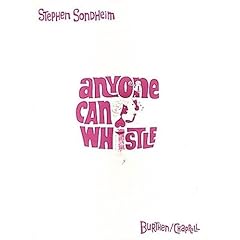
Anyone Can Whistle (Willoughby Fine Arts)

‘ANYONE CAN WHISTLE’ gets vaiant try at Willoughby Fine Arts

When the Stephen Sondheim-Arthur Lareunts musical ‘ANYONE CAN WHISTLE,’ which is now on stage at Willoughby Fine Arts Association, opened on Broadway in 1964 it was an instant flop. It was met with devastating reviews. The New York Times said, "There is no law against saying something in a musical, but it's unconstitutional to omit imagination and wit.” The show ran only 9 performances.

The musical was Sondheim's second solo effort. After being so successful with ‘A FUNNY THING HAPPENED ON THE WAY TO THE FORUM,’ and having been hailed as Broadway’s new “wunderkindt” for his work on ‘WEST SIDE STORY’ and “GYPSY,’ the negative reactions to ‘ANYONE CAN WHISTLE’ were extremely surprising.

Sondheim's score is a quirky blend of dissonant music which is hard to perform and sing and often hard for the audience to listen to. His musical choice was probably to parallel the discordant thoughts and idea of the characters. Unfortunately, since the plot doesn’t work well, neither does the music.

Sondheim is noted for having one marvelous song in each of his shows. Think “Send in the Clowns” from ‘A LITTLE NIGHT MUSIC’ or “Everything’s Coming Up Roses” from ‘GYPSY.’ There is no such song in ‘WHISTLE.’ The score contains such unremembered tunes as "Me and My Town", "Everybody Says Don't", and "With So Little to Be Sure Of." Interestingly, “There Won’t Be Trumpets’ which became a big cabaret favorite, was part of the original score, but was cut before the show opened. (The WFAA production has reinserted the song.)

Despite the flop status, there is a cast album of the show. Goddard Lieberson, who had optioned the rights to the cast album, felt that it was an important work and decided to proceed with the recording. Over the years, its popularity has continued to endure thanks to the talents of the original cast which starred Angela Lansbury, Harry Guardino and Lee Remick.

Even Sondheim admitted the show has serious flaws, despite what he considers “its considerable charm and humor.” The plot which basically asks the question of who the loonies really are, those in the asylum or those outside, much in the vein of ‘THE CURIOUS SAVAGE ,’ has an unconventional and often satirical, cartoonish and overly obvious plot. It tells the story of a town that's gone bankrupt because its only industry is manufacturing something that never wears out. In order to revive the economy Mayoress Cora Hoover Hooper and her town council fake a miracle -- water flowing from a rock -- to attract tourists. When patients at the local mental hospital, the Cookie Jar, escape and mix with the townspeople and tourists, chaos ensues. Of course there is a love story which develops between J. Bowden Hapgood, a psychiatrist who isn't really a psychiatrist, and Fay Apple, a nurse at the Cookie Jar who disguises herself as a miracle verifier sent from Lourdes.

This brings us to the Willoughby Fine Arts Association production. WFAA is a community theatre housed in a wonderful facility. As with many community theatres it has a limited pasture of talent from which to cast shows. Many of those who try out are of school age with a mixture of well-meaning adults. It would be difficult for professionals to pull off a palatable production of ‘ANYONE CAN WHISTLE,’ let alone a group of children, teens and a couple of equity actors. One must ask why Artistic Director Fabio Polanco thought he could save what the likes of Broadway director Arthur Laurents and actress Angela Lansbury couldn’t.

Palanco pulled out all the shticks and gimmicks he could. In order to make the proceedings absurd he has a preteen play a psychiatrist, a teen play the city’s comptroller, and even adds a reversal of the Hollywood 1930s dance number showcasing Shirley Temple/Bill Robinson (African American child and White man). The effort is valiant. The cast tries hard but just can’t overcome the vehicle.

The casting of professionals Larry Nehring (J. Bowden Hapgood) and Gina Shmukler (Fay) may have seemed like a good idea, but, in the end, all it did was show the lack of stage maturity of the rest of the cast. Both Nehring and Shmukler are excellent, though Nehring, with his Danny Kaye looks and flair for exaggerated comedy, might have been better cast as the Comptroller.

Paul Gatzke’s set is wonderful and Kristen Buchs lighting works well. Though Sondheim’s music is hard to play, Matthew Webb’s small orchestra basically accomplishes the task and in contrast to many local theatre pit orchestras wisely does not drown out the singers.

CAPSULE JUDGEMENT: The opening lines of the show’s theme song state, “Anyone can whistle, that's what they say, easy. Anyone can whistle, any old day, easy. It's all so simple: Relax, let go, let fly! So someone tell me, why can't I?” The answer to anyone planning on staging ‘ANYONE CAN WHISTLE,’ and probably the advice that WFAA should have followed is, “It’s not easy when you have a bad vehicle and a limited talent source.”

Sunday, April 17, 2005

Ten Minutes to Cleveland (Dobama Theatre)


Cleveland's will delight in 'TEN MINUTES TO CLEVELAND’


It was with both delight and sorrow that I recently watched ‘TEN MINUTES FROM CLEVELAND’ at Dobama Theatre.

The delight was in being part of the world premiere of Eric Coble’s generally well crafted play about what it is like living on the North Coast, the Mistake By the Lake, the city whose river caught fire, the one city that has two different personalities, and the town where if you don’t like the weather you can wait five minutes and it will change. Ah, yes, Coble knows Cleveland well. It’s even more amazing that this young playwright who has pegged this city right on, was born in Edinburgh, Scotland and was brought up on the Navajo and Ute reservations in New Mexico and Colorado.

The sorrow is that this is the last major production to be staged in Dobama’s ex-bowling alley home in the basement on Coventry. Having been part of the company since its start as an actor and public relations director; having helped pull out the bowling lanes; having mourned the deaths of both Donald and Marilyn Bianchi, the hearts of Dobama; watching the production was painful. Yes, Dobama will live on, but with an entirely new aura.

Do you have to be from Cleveland to appreciate ‘TEN MINUTES TO CLEVELAND?” Well, let’s put it this way. If you don’t know about the failing conditions of the Detroit/Superior Bridge, who operates the stalls in the West Side Market, the foibles of RTA, the village within the village at Legacy Village, the size of the Cleveland Clinic, the attempts to gentrify Tremont, the frustration of being a Cleveland Indians’ fan, the folly known as the Rock and Roll Hall of Fame, and the goings on in the Flats...well, then you won’t get most of Coble’s in-jokes.

Each member of the cast, under the adept directing of Eric Schmiedl, plays multiple roles. They generally change characters, accents, attitudes, and costumes with ease. Nick Koesters, who goes ballistic when his West Side Market vendor parents decide to sell Lo-Carb pierogies, turns in a highlight performance. He is also wonderful as the drunken Indians fan, a resident of Legacy Village, and the Lakeview Cemetery spray paint artist. His attempts at dancing as he changes set pieces is worth the price of admission.

Nan Wray is alternately hysterically funny as a Legacy Village shopper who decides to live there permanently and a the wife of a Janis Joplin groupie who wants to have sex in the backseat of Joplin’s car which is now housed in the Rock and Roll Hall of Fame. She is touching as the daughter whose mission is to put flowers on her mother’s grave while saving the city from graffiti.

Mark Moritz hits a high note as the ex-Case physics professor who predicts that if one more bolt falls out of the Detroit/Superior Bridge, the structure will fall, and as the developer of the low-carb pierogi and the Joplin groupie. Unfortunately, he was much too literate as the Tremont owner of a garbage strewn backyard complete with a car up on cinder blocks.

Jimmy Woody hit emotional chords as the African American father holding two menial jobs which he gets to by riding the RTA. His scene with Sadie Grossman was the play’s dramatic highlight. He was less successful as a Clinic patient.

Kimberly Brown plays the perfect foil as the jogger who Moritz convinces that if she runs across the bridge it could fall down, is properly indignant as a Tremont urban pioneer and is perfectly harried as a Cleveland Clinic doctor with a quota to treat.

Sadie Grossman’s dull look as a drunken flat’s party-goer was the height of visual comedy.

Set Designer Todd Krispinsky’s inspiration was the well crafted painting “Cleveland in Motion for the Millennium” by local artist Hector Vega. It is a perfect choice. Each of the scenes is depicted in the painting, which is inscribed on the floor and walls.

Coble’s play is uneven. Parts were hysterically funny, others emotionally satisfying. However, several scenes such as the Cleveland Clinic and Rock Hall segments begged to be funny and the Flats segment tried but failed to develop a message. The play’s ending, with the snow falling and bolt cascading onto the stage, was priceless.

CAPSULE JUDGEMENT: Every Clevelander, east or west sider, should see ‘TEN MINUTES FROM CLEVELAND.’ It is a trip through the city that even Lolly the Trolley won’t reveal. And you should attend to say goodbye to Dobama in the converted bowling alley that has been its home since 1964!

Monday, April 11, 2005

Contemporary Artists Collection (Verb Ballets)

Verb Ballets again proves its worth

During an intermission interview at Verb Ballets recent ‘CONTEMPORARY ARTISTS COLLECTION,’ which was presented as part of Cleveland Public Theatre’s Dance Works 05 program, Artistic Director Hernando Cortez shared that the company is going to hire his dancers to 30-week contracts. This is an exciting announcement. In these days of arts organizations cutting back on expenses, for a local company to give full-time employment to a corps of dancers is exceptional. It is a tribute to the wonderful job that Cortez and Executive Director Dr. Margaret Carlson have done in bringing this wonderful company to rapid prominence.

The opening piece, “MOZART PIANO TRIO IN C MAJOR,” was originally choreographed by Sean Curren in 2004. Dancing to the beautiful classical music the company interpreted well the feel of the music with flowing leaps, smooth gestures, extended arms, skipping, twirls, jigs, and gender neutral lifts and carries. Trad Burns’ lighting and Janet Bolick’s costumes added to the visually lovely presentation. Kallie Marie Bokal and Tracy Vogt were especially wonderful in their dancing.

Dancer-turned-choreographer Mark Tomasic’s ‘THE MEMORY ROOM,’ was first presented in 2004. Danced to the strong beat of music by Steve Reich and Moby, dancers Marcela Alvarez, Kallie Marie Bokal, Erin Conway, Elizabeth Flyyn and Anna Roberts were polished and poised. Trad Burns’ lighting created wonderful shadows which seemed to increase the 5 dancers into many more. Tomsic’s choreography fit the music.

Choreographer David Parsons’ SLEEP STUDY’ found the dancers costumed in pajamas, sleeping on the floor. As they tossed and turned in their sleep, they rolled on top of, over and spooned with each other. The delightful piece was summarized by one audience member as “the most adorable dance I’ve ever seen.” Right she was! ‘SLEEP STUDY’ is a sure audience pleaser.

Robert Wesner is not only a dancer with Verbs Ballet, but is a choreographer and performer for his own company, Neos Dance Theatre. His world premiere piece, ‘THE CHILD EPHEMERAL’ was performed to the lullabies of Armenian composer Masmik Harutyunyan as played by The Shoghaken Ensemble. The slow methodical choreography showed off the talents of the harlem clothed corps of dancers. The piece, with its sensual overtones, was beautifully danced, but was overly long.

Francis Poulenc’s piano music was the inspiration for ‘UNQUIET MINDS,’ a new piece choreographed by Hernando Cortez. Originally conceived for the American Ballet Theatre, Cortez did not finish the dance and it was never performed for the public. The present staging is a reinterpretation of the original choreography. The dance was placed in an imaginary space outlined by white tape on the floor which served as a box where a Grand puppeteer controls the thoughts and movements of the Commedia del Arte characters. The piece represents a yearning to be free of the commands of others and to be in control of one’s self. Trad Burns’ shadow-inducing lighting aided in mood development. The piece was well danced, but unfortunately the selection did not have the power or audience appeal to be a closing number.

CAPSULE JUDGEMENT: Verb Ballets ‘CONTEMPORARY ARTISTS COLLECTION’ consisted of five well-conceived pieces. Each segment was uniquely different which added interest, but the length of the program far exceeded the attention span of the audience. This is not the first time the company’s programs have exceed a reasonable time limit. In the future, Cortez would be wise to take this into consideration.

Sunday, April 10, 2005

Season of Imagination-Ohio Dance Theatre (Ohio Dance Theatre)


Appreciative audience greets Ohio Dance Theatre

According to founder and Artistic Director, Denise Gula, “Ohio Dance Theatre is a professional ballet-based contemporary dance company that presents works with a strong theatrical element. The company’s mission is to enhance the quality of life in Northern Ohio by presenting quality arts productions of richness and variety, excellence and motivation.”

Based in Lorain County, the company reaches out of the area to spread its version of dance into not only Cuyahoga County, but nationally. One of its outreaches was its recent performance in the Playhouse Square’s Ohio Theatre.

An audience of approximately 500 responded very positively to the four pieces presented as the company’s ‘SEASON OF IMAGINATION.’

The opening number was Gula’s version of ‘FIREBIRD,’ with recorded music by Igor Stravinsky. The vague start failed to set a clear exposition of the dance’s central theme of the conflict between good and evil. These became clearer however as the piece progressed through Paula Drakes’s black and white costuming and the music. The separation might further have been accented if the dancers had more clearly physically and facially expressed their opposing roles. For example, the bad Minions, were not aggressive enough, their hand movements and facial expressions did not well develop their menace.

Ericka Shannon as Tsarevna was elegant. She is a talented dancer whose point work and physical control are excellent. She was nicely partnered by Damien Highfield as Ivan. Tito Reyes, who looks more like a football linesman than a dancer, was surprisingly light-footed as Kastchei, the Dark One, though he, too, needed more facial menace. His dance to death was well executed as were the fight scenes between him and Highfield.

Rejane Duarto as the Firebird was striking with her tall legs and erect posture. Again, as with some of the other dancers, she failed to portray the facial attitude needed to carry the part’s meaning.

A more dyanamic version of music should have been selected. The music’s power and tone did not fill the large theatre, causing for a lack of emotional involvement on the part of the audience.

The second selection, ‘LA PETITE MORTE,’ with intense and beautiful music by Bela Bartok, took the audience visually into high grasses to observe the life and mating of the preying mantis. Costumed in bug green, the dancers executed well Gula’s choreography which was nicely accented by Diana Nelson’s lighting. As with the opening selection, more varied facial expression would have aided in idea development. A combination of unusual lifts and body intertwinings were the highlights of the piece. The final destruction of the males by the dominant females could have been highlighted by a more aggressive conclusion.

The highlight of the evening was ‘LE CORSAIRE,’ danced to music by Stravinsky. Choreographed by Gula, the short piece was beautifully performed by Orlando Ballet’s Chiaki Yasukawa and Eddy Tovar. The petite couple glowed. Their partnering and solos were excellent. Yasukawa’s point work and turns were elegant, Tovar’s circle jumps and powerful leaps brought strong positive reactions from the audience. It’s too bad this piece was so short, as the audience was cheering for more.

‘WHO CARES,’ with choreography by George Balanchine and music by George Gershwin ,was a wonderful ending segment to the program. Dancing to the cosmopolitan sounds of such musical compositions as “Fascinating Rhythm” and “I Got Rhythm,” the company and audience alike enjoyed themselves immensely. Especially outstanding were Ericka Shannon and Fidel Garcia. Garcia displays a nice sense of contemporary moves along with balletic competence. His cocky attitude fit perfectly the pieces he danced.

CAPSULE JUDGEMENT: Ohio Dance Theatre is attempting to reach out beyond its Lorain County home and be a more regional company. Without a permanent company it is often hard to develop a clear identity, but they are succeeding on many levels. Gula’s reputation and ability to attract guest dancers helps broaden the base of the company.

Sunday, March 27, 2005

Restoring the Sun (Cleveland Play House)


‘RESTORING THE SUN’ in world premiere at CPH

On March 23, 1989, Stanley Pons and Martin Fleischmann announced their discovery of "cold fusion." It was the most heavily hyped science story of the decade, but the awed excitement quickly evaporated amid accusations of fraud and lack of a provable scientific process. When it was over, Pons and Fleischmann were humiliated, their reputations ruined, and they dropped out of sight. "Cold fusion" and "hoax" became synonymous.

Despite the scandal, laboratories in at least eight countries are still spending millions on cold fusion research. This work has yielded a huge body of evidence, which has remained virtually unknown because most academic journals adamantly refuse to publish papers on the subject. According to many scientists, cold fusion, the process that would eliminate the world’s dependence on oil and other fossil fuels for energy, remains a colossal conspiracy of denial.

Playwright Joe Sutton seized upon the Pons/Fleischmann/Cold Fusion story and has developed it into a play which is receiving its world premiere at the Cleveland Play House. The script, which was featured in last season’s “Next Stage Festival of New Plays,” was originally commissioned and developed by The Ensemble Studio Theatre/Alfred P. Sloan Foundation Science and Technology Project.

The subject is fascinating, the play is not. That is not to say audiences will be bored. They won’t. The subject matter insures that the viewer is going to be interested. It is just that the script needs work, especially when comparing it to ‘COPENHAGEN,’ another story of scientists which is tightly written and lends itself to a strong performance, such as that at Actors’ Summit last season.

The play’s dialogue is often forced and unnatural. In some cases, language is manipulated rather than being natural. For example, characters explain what they have just experienced to other characters who have also had the same experience. Also, in most plays we quickly learn the necessary character names and information about the situation. Not in this script. The exposition wanders throughout the entire first act. In addition, some of the staging devices are forced. People step in and out of scenes with no motivation, appearing in doorways for no reason, inserting themselves into conversations with no incentive.

Director Connie Grappo doesn’t help matters by pacing the production slowly . She also seems to have failed to probe deeply into character motivations with her cast.

Joseph Adams, who plays Professor Stevens, lacks cunning. Here is an unknown academician who hooks his star to an old, but respected scientific researcher in order to gain notoriety, but seems relaxed and unscrupulous throughout. Daniel Cantor, who portrays a public relations opportunist, stays on the surface, not revealing his underlying motivations. Keira Naughton, who portrays a journalist who is suspicious of the process, underplays the role to the degree that one wonders about her incentive. Stephen Bradbury is unconvincing as the University President who encourages the work of the two scientists. Only Geddeth Smith, as the old scientist who wants so much to make real his “pet theory,” is totally believable.

This is not to say the performances are bad, they aren’t. They just lack texturing and the nuances necessary to portray real people with real agendas. Part of this is caused by the script, part of it is the directing.

Side note: As has happened with most of the productions in the poorly conceived Baxter Theatre, ‘RESTORING THE SUN’ isn’t aided by the configuration. It can only be hoped that new CPH Artistic Director Michael Bloom will recognize the folly of the space and not use it in the future.

CAPSULE JUDGMENT: The Cleveland Play House should be applauded for producing a new play. It should also be applauded for presenting a vehicle which probes a fascinating topic. Unfortunately, neither the script nor the production live up to their potential.