Sunday, January 30, 2005

Johnnie Taylor is Gone - Karamu


Performances make 'JOHNNIE TAYLOR IS GONE' worth seeing

Each year Karamu holds the R. Joyce Whitley Festival of New Plays Arenafest. The last one was held in May of 2004. From the offerings, Gregory S. Carr's 'JOHNNIE TAYLOR IS GONE' was selected for inclusion in the theatre's regular 2005 season.

The play takes place in the Golden Zodiac Lounge, a bar in North St. Louis which appears to have outlived the high points of its existence. It is peopled by a group of "Old School" misfits. The music selected on the juke box centers on the "oldies" with special emphasis on Johnny Taylor who once stopped in at the lounge.

Who is Johnny Taylor? He was a real recording great. Despite Taylor's awesome run of hit records, he remains somewhat of an enigma, perhaps one of the most underrated recording artists of all time. His offerings embraced Gospel, Pop, Blues, Doo Wopp, Memphis Soul, and even Disco. His hits included: "Somewhere To Lay My Head," "I Had A Dream" and "I've Got To Love Somebody's Babe" and "What About My Love."

Every once in a while a theatrical offering overcomes a mediocre script with high production qualities. This is the case with 'JOHNNIE TAYLOR IS GONE.' This is not to say the script is bad, it just isn't the quality of works by such Black writers as Lorraine Hansberry, August Wilson or LeRoy Jones.

Lots of topics are covered: black men dating white women, baseball, the Ku Klux Klan, politicians, UPN (under paid negroes), riots, the St. Louis black community, retirement, rap music, Presidents Bush and Clinton, old versus new styles of music, and Chinese food. But, in the end, this is probably more a set of character studies rather than a well-constructed play. There are no intriguing mysteries or conflicts, though some soap-opera like problems regarding relationships, financial needs and philosophical ideals are present.

With that said, Director Caroline Jackson Smith and her cast should be proud of the final outcome. In general, the characterizations are well honed so the play's humor comes across well and the audience left in a jovial mood.

Cornell Calhoun, III is excellent as the bar's proprietor. The character's stubborn streak of pride and purpose are well developed. Eva Withers-Evans, as a single mom and the chief bar-keep, targets in well on the woman's determination. Marvin A. Hayes is character-perfect as a henpecked bar patron, instantly becoming the audience's favorite. Hayes keeps delivering laugh line after laugh line with perfect interpretation. Though he shouts too much for the small theatre space, James Seward is good as one of the long-time patrons and Kenny Johnson is on target as the beer delivery person.

Many Black community members have been brought up in an interactive story-telling society. In church services they are encouraged to participate vocally. The Karamu audience takes their participant role seriously. They make comments regarding the statements and actions of the actors. They express pleasure and displeasure as they see fit. This breaking down of the traditional staid reactions of audience members at many theatres adds greatly to this production.

The show is being performed in Karamu's intimate Arena theatre, which is a perfect setting for the show. Be aware that if you sit at one of the tables on the main floor, you will be treated like a bar patron and given snacks and even maybe a bottle of beer.

apsule Judgment Black history month is upon us. Many theatres will be doing shows highlighting the plights and delights of Blacks in US history. You won't get a great history lesson, won't see a perfect play, but if you want to go to an offering and have fun, put 'JOHNNIE TAYLOR IS GONE' on your see list.

Wednesday, January 26, 2005

Honky Tonk Angels - Carousel Dinner Theater


'HONKY TONK ANGELS' at Carousel a country music fan's "thang"

Okay, I have to be honest. I am not a lover of review-type musicals, and I don't favor country music. With that said, for me to pronounce that 'THE HONKY TONK ANGELS,' now on stage at the Carousel Dinner Theatre is an "okay" evening, is taking a long step.

I have never figured out why reviews are called theatre. They are a series of songs, much like that presented in a cabaret or night club. Sometimes the songs are connected with some trite kind of plot. But, in general, that, in my opinion, is a concert, not musical theatre.

As for country music, after a while all the wallowing in self-pity, death, wife-beating and cheating husbands, and the near-same twanging sounds, just gets to me. (Okay, country music lovers, before you fill up my e-mail box, you have the right to listen and love anything you want. I'm sure that if I was brought up on The Grand Old Opera, Loretta Lynn and Dolly Parton I'd probably be on your side, but I wasn't. I'm just not a fan.)

With that said....The slight plot unfolds with three woman from varying backgrounds developing a friendship on a Greyhound bus on their way to Nashville, the country music capital. As the "story" goes on we see their performances and how they handle the changes in their lives. In the process they sing some of the most recognized country-western songs, including "Harper Valley PTA," "Stand By Your Man," "Angels Among Us," "I Will Always Love You," and "Coal Miner's Daughter."

The three characters are Darlene (Elizabeth Stanley) who moved to the Mississippi delta before heading for Nashville. We are led to believe that she has been kind of stuck between being a child and an adult for a long time. The show is her journey into adulthood.

Angela (Trudi Posey) is a Texas housewife. Between her truck driving husband, repetitive daily life, and out-of-control kids, she needs to take a break, to try something different for a while.

Sue Ellen (Barbara Helms) is a native Texan, living in Los Angeles, who realizes that life is not turning out the way she wants it to.

'HONKY TONK ANGELS,' written by Ted Swindley, who also created 'ALWAYS PATSY CLINE,' gives each of the actresses a chance to shine in several solos as well as a number of medleys.

The show has a much stronger first than second act. The first segment is filled with some humor and allows the performers to show their acting as well as their singing abilities. The second act is a concert which often turns sappy and centers on how angels affect our lives (Angles Among Us," "The Circle is Unbroken," and "I'll Fly Away." (Don't blame me, I didn't write the so-called script!) A segment dedicated to the County Music "Hall of Fame" is pathetic.

All three of the Carousel performers are quite good. They are obviously soloists, for their individual efforts far outshine their blendings.

Of the three, Elizabeth Stanley stands out. She has a nice stage presence, interprets her spoken lines well, sings meanings rather than words to her songs, and has a nice voice. Her versions of "Fancy" and "I Believe in Music" were exceptionally fine.

Barbara Helms displays nice comic timing and has a fine voice, though her version of "These Boots Are Made For Walking" was given a poor vocal interpretation. She does a fun version of "Cornell Crawford" while gliding across the stage on roller skates.

After a while, Trudi Posey's speaking voice just becomes too raspy, too loud, too hard to listen too. She needs to tone down the screech. Her "Stand By Your Man" was nicely humorous and "The Pill" was fun.

While the show's costumes are wonderful, the wigs are awful. Many scenes found the wearers having to hold on the obviously fake pieces, which were often poorly coiffed.

Capsule Judgment If you love or even like country music and aren't put off by a flimsy plot, you'll be find Carousel's "HONKY TONK ANGELS a "Paradise Road" and have a "Fancy" for the goings-on. If not, "These Boots are Made for Walking" in another direction.

Saturday, January 22, 2005

The Children's House (Beck Center)


‘THE CHILDREN’S HOUR’ receives fine production at Beck

Some might claim that Lillian Helman’s ‘THE CHILDREN’S HOUR,’ now on stage at the Beck Center, is outdated, at least regarding its sexual identity content. The argument goes that this is an age of enlightenment and such a subject as lesbianism is not that shocking. There is a cable series dedicated to the “L” word. Two women can get married in Massachusetts, most of Canada and much of Europe. What’s the big deal?

Well, only the naive believe that times have really changed. There is still a major movement against same-sex relationships as was witnessed just last November when 11 states passed anti-gay marriage acts and elected a president who is proposing a Constitutional amendment against same-sex marriage. The right wing religionists are still pushing their agenda to make the rest of the US culture follow their beliefs. Add to this the other major topics of the play: gossip, lying, blackmail, the power of the rich, and you’ve got even a broader basis for saying that in spite of its stilted melodramatic mold and language, the play is present-day relevant.

The plot concerns two female friends who run a school for girls. Enter the sociopathic student Mary Tilford whose purpose in life is to get what she wants, when she wants it, and damn the costs. Mary has a strong weapon...her influential grandmother..who is in the social position to control the community and the fate of the school. Mary makes up a lie, expands on the truth, blackmails a fellow student to back up her tale, and grandma spreads the rumor to the other parents, who then remove their children from the school. The end result is the closing of the school, the disintegration of one of the women’s engagements and eventual total tragedy. As in all good melodramas the truth comes out at the end, but it is too late.

When ‘THE CHILDREN'S HOUR’ opened on Broadway in 1934, it was well-received by critics. However, it was banned in Chicago, Boston, and London. The Pulitzer Prize committee refused to consider the play for its reward due to the “shocking” subject matter.

An early movie of the play changed the relationship into an implied ménage-a-trois between the teachers and one of their fiances. Though many were upset with the forced changes in the story, Hellman, in her autobiographical work, said she was happy with the film because the subject of false accusation and gossip were the central issue of the story rather than the nature of the gossip.

In 1952, Lillian Hellman was called before the House Un-American Activities Committee. She was so upset by the McCarthy witch-hunting that the same year she personally financed a revival of ‘THE CHILDREN’S HOUR.’ The themes of secrets and lies and malice and persecution struck a high chord and led to additional praise for the work.

1962 saw the release of a more faithful film version of ‘THE CHILDREN'S HOUR’ starring Audrey Hepburn and Shirley MacLaine. Due to the controversial subject matter, the film was a direct challenge to the Hays Code, and, eventually, brought about a revision of the code to permit "tasteful treatments of homosexual themes."

The Beck production, under the able direction of Sarah May is good. The adults in the cast are extremely proficient. Kristie Lang and Jennifer Clifford are outstanding in their portrayal of the teachers. They weave their roles with the right amounts of spirit and frustration. Nicholas Koesters, as the fiancé, perfectly walks the difficult tight rope between emotional control and compassion. Mary Jane Nottage gives a wonderful portrayal of the air-headed, needy, self-involved aunt. Rhoda Rosen is marvelous as Mary’s manipulated grandmother.

The roles of the young girls are difficult to portray. The character of Mary Tilford, the manipulator, is extremely challenging. 15-year old Mary Tilford does a very creditable job as Helen, though she sometimes fails to add the necessary texturing to the role. This results in a rather one-key characterization. Several of the other girls lose concentration when they are not speaking lines, but, as a whole, the young actresses are more than acceptable.

Don McBride’s creatively designed set works well, in spite of some shoddy workmanship. May has included some cleverly choreographed set changes to add to the production qualities. Jeff Smart’s costumes are period and aesthetically correct.

CAPSULE JUDGEMENT: ‘THE CHILDREN’S HOUR’ is a historically important play. Though somewhat dated in language, it is a play that conveys strong messages. The Beck production deserves to be seen.

Thursday, January 20, 2005

The Producers (Playhouse Square Center)

‘THE PRODUCERS’ produces laughs once again!

Britain’s Prince Harry has been getting bad press for his wearing a Nazi swastika arm band to a costume party. Ironically, comedian and writer Mel Brooks has received raves for his displaying swastikas in his musical ‘THE PRODUCERS,’ THE NEW MEL BROOKS MUSICAL.’ The difference? Harry was oblivious to the reaction his unthoughtful act would evoke. Brooks, on the other hand, knew that by mocking Hitler and about every other group including gays, Jews, Swedes, old ladies, World War II vets, hillbillies, blacks, and the Irish, he’d start a riot. In his case, a laugh riot.

‘THE PRODUCERS THE NEW MEL BROOKS MUSICAL’ is the most awarded show in Broadway history. It won a record 12 Tony Awards and 11 Drama Desk Awards, and is still playing to sold out houses in The Big Apple. Clevelanders loved the show when it played in Play House Square in 2002. It is back for an abbreviated visit (January 18-23) before this professional touring company calls it quits.

From exit comments it became apparent that the audience on opening night loved the production. What is not to like? There are a chorus line of old ladies dancing with walkers, flapping pigeons singing backup, and a chorus line of convicts. This is funny stuff concocted in the mind of a genius comedic madman.

The musical is based on Brooks’ Academy Award winning 1968 film, THE PRODUCERS. It centers on the fortunes of Max Bialystock, an unsuccessful theatrical producer, and Leo Bloom, a nebbish accountant. They dream-up a scheme to raise money, produce the world’s worst musical staged by the world’s worst director, close the show quickly, and run off with the profits. The problem? Their choice, "Springtime for Hitler" turns out to be a smash hit and they wind up going to jail. "Springtime for Hitler?" That title’s offensive! Well, the entire production can be offensive if you don’t have a sense of humor.

After having been sold amateur productions as being professional (e.g., the recent embarrassing ‘OLIVER’), some people in the area are suspicious of Play House Square offerings. Be assured, this was not a "second rate" tour. Lewis Stadlen was a delight in the role created by Nathan Lane in New York. Hunter Foster, who recently joined the cast, is not the quality of Mathew Broederick (who will play the role in the forthcoming film version along with Lane) or Don Stephenson who played the part in the former Cleveland showing, but he was adequate as Leo Bloom, the nebbish who wants to “be a producer.” The rest of the cast is excellent.

CAPSULE JUDGEMENT: ‘THE PRODUCERS,’ THE NEW MEL BROOKS MUSICAL’ is fun. There won’t be another first-line professional tour so if you want to see a legit production, and aren’t planning on going to New York, this is it!

Sunday, January 16, 2005

Momix - Playhouse Square


Momiz Dance Theatre mesmerizes in spite of box offic snafu

It was an exciting night for dance in downtown Cleveland. Dance Cleveland and the Cuyahoga County Community College Center for Arts and Culture combined to bring Momix Dance Theatre to the State Theatre. This, combined with pre and post program parties sponsored by the coolcleveland.com website, produced an announced audience of 2500.

Under the creative direction of Moses Pendleton, Momix is noted for displaying its dancer/illusionists via a unique mix of breathtaking images, creative humor and eclectic music. "OPUS CACTUS,' the program presented in their Cleveland appearance, a botanically-inspired creation, is a series of hallucinatory visions of the great American desert landscape.

What style of dance is MOMIX? Don't think ballet or modern dance or gymnastics. Think all of those combined. This is anything other than the usual. Artistic Director/Choreographer Moses Pendleton, who calls his performers "dancer illusionists," requires them to blend dance, gymnastics and circus acrobatics into mesmerizing performances.

The program contained dancers in silhouette against varied color-lit backdrops, a performer who did her entire number without leaving a hammock, a gila monster made up of four intertwined bodies, skateboards used for body surfing, and a metal geometric sculpture employed as a rolling jungle gym, huge fans acting as skirts for the female dancers, a giant puppet, performers balanced on swings suspended from the fly gallery, florescent human balls which roll and bounce, a human totem pole, a dance conceived totally around the use of vaulting poles. Flowers bloom, bugs crawl, storms are created, stars twinkle, tumbleweeds tumble, lizards leap and rattlesnakes slither.

As one reviewer stated, "Pendleton has conjured 19 desert scenes, and devised such stunning imagery (set to New Age and traditional music) that you may never think of the desert in the same way again."

The exciting evening was not without its problems. The performance started over thirty minutes late due to a snafu at the box office. Long lines snaked out onto Euclid Avenue as people attempted to buy tickets and pick up prepaid orders. The situation resolved itself when a wise decision by the house manager allowed everyone in to the theatre to find an available seat. The Playhouse Square box office needs to investigate what went wrong so that this situation does not happen again.

Thursday, January 06, 2005

Tuesday's With Morrie (Cleveland Play House)


‘TUESDAYS WITH MORRIE’--a good visit at the Cleveland Play House

Several months ago I heard Mitch Albom speak about his beliefs, attitudes and books Tuesday With Morrie and The Five People You Meet in Heaven. He talked about how his reconnection with his former Brandeis University sociology professor, Morrie Schwartz, and how it made him reexamine who he was and how he was proceeding through life.

If you have read Albom’s books, you know that he is a writer who combines pop psychology and emotional triggers to get his points across. He writes of topics, such as death, which could be daunting and scary, in words that are easily digested and thought-provoking.

‘TUESDAYS WITH MORRIE,’ now on stage at the Cleveland Play House, is the play version of the book. It tells the story of how Albom, now a well-known sports reporter, discovers Schwartz is dying of Lou Gehrig's disease. Albom, whether out of guilt or need, agrees to meet with Schwartz every Tuesday and, in doing so, learns lessons about love and understanding. He discovers that something is missing from his success-driven life.

The play, as the book, is based on many of Morrie's pronouncements including: "Love is the only rational act," and "There's two big F words in the English language and one of them is forgive." Other gems that the audience gets to consider are: “Are you at peace with yourself? Are you trying to be as human as you can?” and “Once you learn how to die, you learn how to live.” Albom caps off his mentor’s ideas with the haunting, “the kind of things you say to someone at the end are the things you should say everyday.” These may sound pop-psych and hokey, but they are the reason that the book held its place on the New York Times best seller list for four years.

In its off-Broadway production the play was greeted with such reviewer comments as: “No matter how well you know the story, the play makes it more vivid, more shattering, more humorous.” "I was unprepared for how moving and powerful it turned out to be.” And, “A love song to a wise old professor who taught a young man how to feel."

The CPH production is well-conceived by director Seth Gordon. It is nicely paced, doesn’t become too sappy and plays all the right musical notes....literally and figuratively. Charles Kartali displays the right level of guilt and angst as Albom. The last scene, when he finally allows himself to feel emotion, is finely honed. Bernie Passeltiner is the perfect curmudgeon to portray Morrie. His eyes twinkle, he nags with delight, he stands on his philosophical soap box with gentle power, he dies with dignity. The only flaw in his performance was during the last scene in which he was supposedly totally paralyzed but gestured with his hands which distracted from the illusion of this brilliant man trapped inside a frozen body.

CAPSULE JUDGEMENT: The fine CPH cast does its job of bringing Albom’s message to life. Whether you like ‘TUESDAYS WITH MORRIE’ is going to be based on your tolerance for the tender but preachy concept.

Wednesday, January 05, 2005

Clarence Darrow - Actors' Summit


‘CLARENCE DARROW’ wins at Actors' Summit

Clarence Darrow was probably the most celebrated American lawyer of the 20th century. Though he died in 1938, his fame continues. He is often quoted in matters of evolution, religion, unionism and freedom of expression.

Darrow’s life has been put on the stage in several formats. In the 1970s a one-man production, ‘CLARENCE DARROW: A ONE MAN PLAY,’ starred Henry Fonda.
“COMPULSION’ centered on Darrow’s defense of murderers Leopold and Loeb. ‘INHERIT THE WIND,” by Cleveland and Elyria’s Jerome Lawrence and Robert E. Lee, illuminated Darrow’s defense of the evolution teaching science instructor John Scopes. And David W. Rintels wrote the play ‘CLARENCE DARROW,’ which is now being staged by Actors’ Summit, Hudson’s professional theatre.

Darrow has deep Ohio roots. He was born in1857, near Kinsman, Ohio. He lived all of his youth and young adulthood in that small community which helped set his life-belief patterns. He was admitted to the Ohio bar
in 1878 at the age of 21.

He later moved to Chicago where he established himself as a proficient lawyer and a powerful speaker. He gained a national reputation as a labor and criminal lawyer thanks to his 1895 defense of Eugene V. Debs, president of the American Railway Union, who had been arrested on a federal charge of contempt of court over difficulties arising out of the Pullman strike of
1894.

Darrow did not shy away from controversy. He took on cases and causes which he felt would advance human rights and protect against human indignity. His two most famous trials were the Leopold-Loeb murder case
of 1924 and the 1925 trial of John T. Scopes. He
saved Nathan Leopold and Richard Loeb from execution--but not from prison--for the murder of
14-year-old Robert Franks. The Scopes trial
concerned the teaching of evolution, which was against Tennessee law. The prosecuting attorney in this famous "monkey trial" was William Jennings Bryan.


Darrow had strong convictions on many subjects, especially religion. Once, when asked his attitude toward that subject, Darrow replied: "I am an Agnostic because I am not afraid to think. I am not afraid of any god in the universe who would send me or any other man or woman to hell. If there were such a being, he would not be a god; he would be a devil."

Though historical, Rintels’ play is very contemporary.
Several comments about the corruption of politicians, especially in the wake of the recent Bush administration’s brushes with honesty, brought huge laughs and even applause from the audience. The teaching of evolution is in the forefront of the news with the push by religionists to force the teaching of the pseudo-science, “intelligent design,” in public school science classrooms. The questions over the
death penalty are still with us. Darrow’s view on
these topics is clear....politicians have to be monitored and questioned; evolution is science, creationism is not; and “I’m proud of the fact that
102 of my clients faced the death penalty and none were hanged!” As one openong-night attendee stated during the reception following the performance, “Where is Darrow when we need him?”

A. Neil Thackaberry is Darrow. His task is daunting.
The number of lines to memorize is awesome...35 or so pages...all are his speeches! Thackaberry is excellent! His performance is relaxed and offhanded.
He wisely doesn’t fake an orator’s voice. He invites
us into his thoughts and memories as if they are completely spontaneous. He adds vocalized pauses and
thought spaces to create total naturalism. He
clearly separates casual conversation from appeals to the jury by not only changing his physical demeanor,
but by putting on or taking off his jacket. His is a
well-thought out performance which has been well-honed by director Alex Cikra.

MaryJo Alexander has done a stellar job with props and the single costume. The stage is littered with age-perfect “things.” Things like an old upright typewriter, an old fashioned lamp, weathered books, and a worn leather chair. Darrow, who was noted as often looking like he slept in his clothes, which he often did, was perfectly dressed in an ill-fitting wrinkled suit, crinkled shirt and scuffed shoes.

Capsule Judgment One-man shows are hard to stage
as it is difficult to grab and hold an audience with little action and no interaction. Actors’ Summit seems to have a way of pulling it off. Last yer Wayne Turney won acting raves (including a Times Tribute Award) for his performance as Harry Truman, and now Thackaberry pulls off this fine portrayal as Darrow. Go see this production! You will not only get a fine history lesson, but see a wonderful performance.

Friday, December 31, 2004

Times Tributes--2004


TIMES TRIBUTES--2004

Greater Cleveland is blessed with a vital theatre scene. It is the purpose of the TIMES THEATRE TRIBUTES to recognize theatrical experiences that, in the mind of this reviewer, were excellent.

I did not see all of the productions in the area, so only shows performed in 2005 that I reviewed were considered. Selections are limited to locally produced performances, so none of the professional touring shows are recognized, though actors, directors and technicians who were imported by local theatres were considered. Actors were not separated by gender or leading or supporting roles.

Thanks to the following for making the theatre scene in the Cleveland area vital and exciting:

Production
“By Jeeves,” Beck Center
‘Copenhagen,” Actors’ Summit
“Hot N Throbbing,” convergence-continuum
“Julius Caesar,” GLTF
“Leading Ladies,” CPH
‘Miss Saigon,” Beck Center
“Nickel And Dimed,” GLTF & CPT
“Our Town,” Ensemble
“Private Lives,” GLTF
“Confessions of Punch and Judy,” CPT
“Ragtime, The Musical,” JCC
“Summer of ‘42,” Kalliope
“Vincent in Brixton,” CPH
“Agnes of God,” Beck Center
“Five Guys Named Moe,” Beck Center

Director
Michael Rogaliner, “By Jeeves,” Beck Center
Gregory Vovos, “Charge,” TITLEWave THEATRE
Wayne Turney, “Lend Me A Tenor,” Actors’ Summit
A. Neil Thackberry, “Copenhagen,” Actors’ Summit
Clyde Simon. “Hot and Throbbin,” convergence-continuum
Ray Roderick, “I Love You, You’re Perfect, Now Change,” Playhouse Square
Risa Brainin, “Julius Caeser,” GLTF
Ken Ludwig, “Leading Ladies,” CPH
Seth Gordon, “Lobby Hero,” Beck Center
Scott Spence, “Miss Saigon,” Beck Center
Melissa Kievman, “Nickle and Dimed,” CPT & GLTF
Lester Currie, “Nine,” Cassidy Theatre
Victoria Bussert, “Private Lives,” GLTF
Raymond Bobgan, “Confessions of Punch and Judy,” CPT
Fred Sternfeld, “Ragtime, The Musical,” JCC
Paul Gurgol. “Summer of ‘42,” Kalliope
Seth Gordon, “Vincent in Brixton,” CPH
Victoria Bussert, “tick, tick...Boom!,” Cain Park
Seth Gordon, “Agnes of God,” Beck Center
Martin Cespedes, “Five Guys Named Moe,” Beck Center

Performance
Tracee Patterson, “Bright Room Called Day,” CPT
Charles F. Kartali, “Bright Room Called Day,”CPT
Larry Nehring, “By Jeeves,” Beck Center
Nina Domingue, “For Colored Girls Who Have Considered Suicide When the Rainbow is Enuf,” Karamu
Christopher Bohan,, “Lend Me A Tenor,” Actors’ Summit
Tina Stump, “Menopause the Musical,” Playhouse Square
June Lange, “Menopause the Musical,” Playhouse Square
Maryann Nagel, ,“Menopause the Musical,” Playhouse Square
Wayne Turney, “Copenhagen,” Actors’ Summit
A. Neil Thackaberry, “Copenhagen,” Actors’ Summit
Lucy Bredeson-Smith,“Copenhagen,” Actors’ Summit
Lavonda Elam, “Crowns,” Cleveland Play House
Angela Gillespie Winborn, “Crowns,” Cleveland Play House
Joel Hammer, “Ears on a Beatle,” Dobama
Wayne Turney, “Give “Em Hell Harry,” Actors Summit
MaryAnn Black, “Guys and Dolls, Porthouse
M. R. Culver, “Guys and Dolls,” Porthouse
Paul Floriano, “Highway Ulysses,” Dobama
Lucy Bredeson-Smith, “Hot and Throbbin,” convergence-continuum
John Regan, “Hot and Throbbin,” convergence-continuum
Tricia Bestic, Julie Hogan, Nicholas Koesters and Larry Nehring (the ensemble cast), “I Love You, You’re Perfect, Now Change,” Playhouse Square
Douglas Frederick, “Importance of Being Earnest,” GLTF
Richard Klautsch, “Julius Caeser,” GLTF
Geoffrey Hoffman, “‘La Turista” convergence-continuum
Brent Barrett, “Leading Ladies,” CPH
Christopher Duva, “Leading Ladies,” CPH
Matthew Joslyn, “Lobby Heros,” Beck Center
Robin Lee Gallo, “Miss Saigon,” Beck Center
Scott Plate, “The Last Five Years,” Dobama
Nan Wray, Sheffia W. Randall, Nina Domingue, George Roth, Tracee Patterson, Jill Levin (the ensemble cast), “Nickle and Dimed,” GLTF & CPT
Robert McCoy, “Of Mice and Men,” Beck Center
Greg DeTorto, “Of Mice and Men,” Beck Center
Andrew May, “Private Lives,” GLTF
Laura Perotta, “Private Lives,” GLTF
Tannis Kowalchuk, “Confessions of Punch and Judy,” CPT
Ker Wells, “Confessions of Punch and Judy,” CPT
Kyle Primous, “Ragtime, The Musical,” JCC
Maggie Stahl Wirfel, “Ragtime, The Musical,” JCC
Sean Szaller, “Ragtime, The Musical,” JCC
Sandra Emeric, Joseph and His Amazing Technicolor Dreamcoat,” Beck Center
Tracee Patterson, “Seussical, The Musical,” Beck Center
Andrew May, “Taming of the Shrew,” GLFT
Laura Perrotta, “Taming of the Shrew,” GLFT
Alex Wyse, “Summer of ‘42,” Kalliope
Jodi Brinkman, “Summer of ‘42,” Kalliope
Nina Dominque, “Uncle Tom’s Cabin,” CPT
George Roth, “Uncle Tom’s Cabin,” CPT
Simon Kendall, “Vincent in Brixton,” CPH
Patrick Janson, ‘tick, tick...Boom!,” Cain Park
Emily Keieger, ‘tick, tick...Boom!,” Cain Park
Lucy Bredeson-Smith, “Tone Clusters,” convergence-continuum
Clyde Simon, “Tone Clusters,” convergence-continuum
Renee Matthewws-Jackson, “Bee-Luterh-Hatchee,” Karamu Theatre
Sherri Briton, “Agnes of God,” Beck Center
Alicia Kahn, “Agnes of God,“ Beck Center
Kyle Primous, “Five Guys Named Mo,” Beck Center

Technical
Trad Burns, set design, “Bright Room Called Day,” CPT
Zach Humes, sound design, “Charge,” TITLEWave THEATRE
Richard Morris, Jr., light and stage design, “For Colored Girls Who Have Considered Suicide When the Rainbow is Enuf, ” Karamu
Tony Straiges, scenic design, “Enchanted April,” CPH
Alejo Vietti, costume design, “Enchanged April,” CPH
Gage Williams set design, “Importance to Being Earnest,” GLTF
Kim Krumm Sorenson, costume design, “Importance to Being Earnest,” GLTF
Todd Krispinsky, set design“Nickle and Dimed,” GLTF & CPT
John Ezell, sets design, “Private Lives,” GLTF
Charlotte Yetman, costumes, “Private Lives,” GLTF
Richard Gould, set design, “Ragtime, The Musical,” JCC
Dana Romeo, costume design, “Ragtime, The Musical, JCC
Russ Borski. scenic design, “Summer of ‘42,” Kalliope
Kim Brown, costume design, “Summer of ‘42,” Kalliope
Richard Morris, ”Bee-Luther-Hatchee,” Karamu Theatre

Choregraphy
MaryAnn Black, “Godspell,” Porthouse
Martin Cespedes, “Miss Saigon,” Beck Center
Janiece Kelley-Kiteley, “Anything Goes,” Carousel Dinner Theatre
Martin Cepedes, “Ragtime, The Musical,” JCC
Martin Cespedes, “Seussical, The Musical,” Beck Center

Musical Direction
Larry Goodpaster, “By Jeeves,” Beck Center
Brian Laakso, “Godspell,” Porthouse
Josh Senick, “Highway Ulysses,” Dobama
Larry Goodpaster, “Miss Saigon,” Beck Center
David Dettloff, “Nine,” Cassidy Theatre
David Williams, “Five Guys Named Mo,” Beck Center

Sunday, December 19, 2004

Friday, December 17, 2004

Miss Saigon (Playhouse Square Center)


‘MISS SAIGON’ proves the show must go on

There is a motto in the theatre that the show must go on. In the opening night performance of the road show production of ‘MISS SAIGON,’ which has a short December 14-19 run at the Allen Theatre in Playhouse Square, reality confronted the myth. It seemed obvious as the first act proceeded that Jennifer Paz, who was portraying the leading female role of Kim, was losing her voice. After an extended intermission an announcement was made that in the second act the role would be played by Laurie Cadevida. Cadevida plays the role at matinee performances so this was not a case of someone unfamiliar with the part taking over, but it was a first in my many years of acting, directing and reviewing theatrical productions in which a switch took place mid-show. Yes, the show did go on!

‘MISS SAIGON’ is set in 1975 during the final days leading up to the American evacuation of Saigon. The multi-award winning play is from the hands of Alain Boublil and Claude-Michel Schönberg who also wrote ‘LES MISÉRABLES.’‘

It is the story of two young lovers torn apart by the fortunes of destiny and held together by passion and the fate of a small child. As one of the authors said, “We have an epic tale still to tell, but we also hope that when we focus on the passionate longing of a woman for her lover, and her unconquerable love for her son; when the Saigon pimp hurls himself demoniacally into action; when we are with real people: spurned lover, helpless children, the ones who matter, then the surroundings are put into perspective.”

The score contains "The Heat is On in Saigon," "The Movie in My Mind," "Why God Why?," "Sun and Moon," "The Last Night of the World," "I Still Believe," "Bui-Doi," and "The American Dream."

One of the problems confronting theatre organizations such as Playhouse Square is that some of the road shows touring the country are non-union groups which travel with minimal orchestras and performers who haven’t quite cut their teeth on professional stages. This means that audiences are paying to see mid-professional level shows. The shows are often peopled by recent college grads who are willing to take on the hard task of performing for a couple of days in one city and then packing up and dragging their weary bodies off to another short stopover. It’s wonderful experience for the cast, but not always such a wonderful experience for the audiences, who often think they are going to see experienced professionals.

‘MISS SAIGON’ is a case-in-point. The show is quite acceptable. In fact, in places it is very good, but it is not equal to earlier professional productions. In fact, the script has been released for local production and Beck Center staged a production this past summer. It was excellent and, in some cases, superior to the non-union show that is performing at the Allen Theatre.

The cast is quite uneven. Both of the women who played Kim were effective. Both had fine singing voices.

A pivotal character, The Engineer is supposed to be a slimy guy who will do anything to make a buck and reach his goal to become part of the American dream. Johann Michael Camat is much too young to play the role and lacked the necessary sleaze factor. His singing voice was excellent. His rendition of “The American Dream” was a show stopper.

Alan Gillespie, who portrayed Kim’s lover Chris, has a nice singing voice but has not developed the acting skills to pull off the role. His face showed a constant grimace rather than emotional texturing and there was a shallowness in his character development. D. J. Oliver, as John, who both makes arrangements for Chris to meet Kim and then reconnect with the son he fathered, lacks the charisma necessary to make”Bui-doi” the potent song that it should be. Tadeo is not menacing enough as Thuy the man to whom Kim has been promised in marriage and whom she kills when he searches her out and attempts to hurt her son.

Highlights of the show were the beautifully sung “Sun and Moon” by Paz and Gillespie, the powerful “You Will Not Touch Him” as rendered by Paz , and “Now That I’ve Seen Her” as performed by Rachel Kopf, who portrayed Chris’s American wife. The chorus was excellent and the choreography quite effective.

This production has a stripped down set which makes for some awkward staging. The famous helicopter flight is done with projections. Actually, the effect is quite good as are the pictures used during the emotionally heart-effecting song “Bui-Doi” in which pictures are shown of orphaned children born to Vietnamese mothers and U.S. GIs.

Much of the musical accompaniment was produced by a sinfonia, an electronic musical instrument which substitutes for many of the instruments used in a complete orchestra. This saves on costs but also produces less than a full orchestra sound as only ten musical instruments are actually playing in the orchestra pit.

CAPSULE JUDGEMENT: Though this production of ‘MISS SAIGON’ is quite acceptable, it is a non-union show which should be advertised as such. It is unfair to lead potential audience members to believe that they are seeing a Broadway-level production when that is not the case.

Sunday, December 12, 2004

NEOS Dance Theatre


NEOS Dance Theatre a pleasant surprise

One of the problems with many dance productions in the Cleveland area is that they usually run for one performance or no more than a weekend so if a company comes along which is outstanding, it is impossible to get the word out in time for them to build an audience.

This was definitely the case with the recent performance by NEOS DANCE THEATRE at the Cleveland Public Theatre. NEOS is a company who have only recently left their confines in Ashland, Ohio to venture into the Cleveland market.

The company’s goal is to make dance accessible through outreach programs that are both lectures and performances, as well as doing traditional dance concerts.

The company is led by Robert Wesner, who serves as the artistic director and lead male dancer. The rest of the company consists of Sarah Cyders, Kari Nikolaus, Justin O’Donnell, Gabrielle Smith and Brooke Wesner (the wife of the artistic director). The individual dancers are well versed in traditional ballet as well as eclectic movements including tap and modern dance.

The CPT program opened with “Rondo Capriccioso,” in which the young and talented dancers worked with choreography by Robert Wesner that was perfectly timed to the mood and beat of the music. Using creative body movements and excellent control, the black-clad dancers combined classic and modern movements effectively. There was a wondrous whimsical quality to the staging that fit the recorded sounds of the Saint-Saens music.

“Missing Person” was meant to expose the different emotional states that one goes through when considering, committing to, and dealing with an abortion. Appropriate facial expressions and controlled and expressive bodily movements allowed for clarity of Wesner’s choreographic mission.

“Trilogy,” the third selection, was a combination of sprightly and then serious movements. Effective lighting helped create the proper moods as the music made its transitions. Using interesting body angles to form geometric shapes, intricate lifts, appropriate facial expressions and body intensity, the piece was well received by what unfortunately was a sparse audience.

“Song of Solomon,’ danced to the music of George Gershwin, was elegantly performed by Brooke and Robert Wesner. Dressed in formal wear, the duo performed a modern ballet piece with classical overtones. Brooke was on toe for much of the selection. The pair displayed fine partnering skills.

“Draw Back” was a tap number staged with no music. Choreographed by Justin O’Donnell, it was performed by O’Donnell and Wesner. Unfortunately, the duo was not well matched. Wesner’s dancing ability far outstripped his younger partner, making for some disjointed timing and dynamics. O’Donnell looked like he was laboring throughout, displaying almost no facial expression except for occasional grimaces.

“Norm and Cleo” was danced to an organ rendition of JS Bach’s “Toccatta and Fugue in D Minor.” A bench served as a staging platform for examining a trying time in the lives of Pastor Norman Johnson and his wife. Though well done, the piece became laborious with its heavy religious overtones.

The final program segment was “Flash Forward” a very creative piece staged by Wesner. Using flashlights, smoke, spotlights and special lighting effects, the piece accurately developed Paul Ruskay’s chanted music. The dancing combined balancing of bodies, gymnastic movements and unusual carries. This was a well executed and fascinating piece.

Excellent dance perfomances were consistently given by Robert Wesner, Sara Cyders, Gabrielle Smith and Brooke Wesner.

Capsule judgement: Robert Wesner proved in NEOS DANCE THEATRE’s recent short residency at Cleveland Public Theatre that he is a very gifted choreographer and dancer. His company is well-trained and disciplined. He does have to make a decision regarding his thematic selections. The program presented at CPT contained several religious-based pieces. If he wants NEOS to be a Christian-based company, then he has to advertise it as such. It is a production decision he is going to have to make as he moves his group from a local to a regional or national company.

Saturday, December 04, 2004

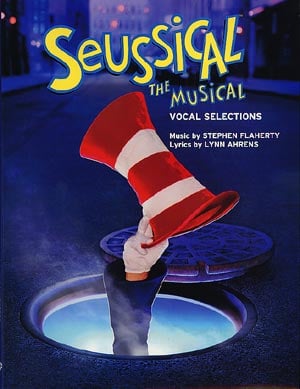
Seussical! The Musical (Beck Center)


'SEUSSICAL! THE MUSICAL' gets an "okay" production at Beck

Theodor Seuss Geisel was born in 1904 in Springfield, MA. He held a doctorate in literature from Oxford University in England. In 1936, on the way to a vacation in Europe, while listening to the rhythm of the ship's engines, he came up with And to Think That I Saw It on Mulberry Street. It was the first in what was to be a long line of children’s books. Ironically, the volume was rejected by the first 43 publishers to whom he showed it.

In 1954, a report concerning illiteracy among school children stated that kids were having trouble reading because their books were boring. Using a list of 250 words, which was considered to be the number a first grader could absorb at one time, he designed and wrote The Cat in the Hat. It became an instant success. What followed was a series of children’s books that have sold over 100 million volumes.

Why are the books so engaging? Geisel created whimsical characters, wrote in convoluted rhyme and rhythm schemes and allowed children’s imaginations to run wild. Most important from the standpoint of adults, are the morals and messages the books taught including respect for differences, the keeping of promises and the uniqueness of each individual.

In 2001 the author’s reputation took another step forward with the Broadway opening of ‘SEUSSICAL! THE MUSICAL,’ a contemporary re-imagining of Dr. Seuss, which weaves together many of his most famous stories and characters. The Tony Award winning team of Lynn Ahrens and Stephen Flaherty (‘RAGTIME’ and ‘ONCE ON THIS ISLAND’) created a score which includes pop, gospel, blues and R & B music.

On its opening ‘SEUSSICAL! THE MUSICAL’ was greeted with reviews that called it, “imaginative,” whimsical,” and “abounding with invention and visual surprises.” Any production of the show, in order to fulfill the Dr. Seuss philosophy, must contain those qualities.

The Beck Center production, under the direction of Scott Spence, fulfills some of the requirements, but falls short on others. The major missing element was the whimsy. There has to be consistent exaggeration and the unexpected. In spite of some clever gimmicks, such as the use of roller skating and scooters used in “It’s Possible,” and the flashlights and Groucho-eyebrows-and-nosed glasses in “Havin’ A Hunch, too much of the show lacked excitement, lacked the needed pizzazz.

The performances ranged from wonderful to acceptable. Tracee Patterson stole the show as Gertrude McFuzz, the bird with the short tail, who is infatuated with Horton the Elephant. Her renditions of “The One Feather Tail of Miss Gertrude McFuzz” and “All for You” were show stoppers. Jarred Nichols had exactly the right tone of exaggeration as Mr. Mayor (the leader of The Whos). Sean Szaller danced with proper abandonment as one of the Wickershams. The chorus, as a whole, stayed in character and sung and danced with the right moods and feelings.

Patrick Carroll had the proper slow moving gate of Horton the Elephant, but lacked the vocal ability to develop the moods of his solos and the acting dynamics necessary to build a compelling character. As Boy, young Christopher Gaertner displayed a nice singing voice, but was too automatic in his performance. He needed to play himself--a real boy--instead of trying to act like a boy. As Sour Kangaroo, Tonya Broach displayed nice vocal abilities, but it was impossible to understand the words that she was singing due to either poor articulation.

In the pivotal role of The Cat in the Hat, Marc Moritz needed to create a character who was a delightfully spirited boy inside the body of a man, or, in this case, a rambunctious kitten in the body of a full grown cat. He needed a constant sparkle in his eye and movements which got the audience ready for him to verbally pounce at any moment. The show depends on his setting the proper mood. He did that in several scenes, but just wasn’t consistent, wasn’t whimsical enough in others.

Martin Cespedes, is quickly establishing himself as THE major local musical theatre choreographer. He does not disappoint in this show. The creative movements, which change to fit each musical variation, were wonderful and he prepped his performers well. Richard Gould’s scenic design is delightful and functional. Sharon Stark’s costume renderings are wonderful.

Musical Director Larry Goodpaster’s orchestra played well, but at times drowned out the performers. If we can’t hear the words to songs, there is no sense in the cast singing them.

Roland Massatti’s sound design was lacking. Many of the performers couldn’t be heard (at least not from the side section of the theatre where I was seated). When I asked the technician if the sound system was working correctly I was told it was. Obviously, not so from the standpoint of my well functioning ears.

A question that parents might ask, is whether ‘SEUSSICAL’ is a kids’ show? Though grown-ups, teens and tweens should find the show reminds them of why they came to love the stories, young children may find it difficult sitting through the production as the story line does not follow the books they may be familiar with. In addition, there may not be enough abandonment in the two-and-a-half hour production to hold a little one’s attention.

CAPSULE JUDGEMENT: ‘ SEUSSICAL! THE MUSICAL’ is a cute script. The Beck Center give it an acceptable, but not the promised “loosey-gooseical lollapaloozical magical” performance promised on the show’s program cover.

Thursday, December 02, 2004

Big River (Playhouse Square Center)


‘BIG RIVER’ flows triumphantly at the Palace

Billed as a celebration of silence and sound, ‘BIG RIVER THE ADVENTURES OF HUCKLEBERRY FINN,’ now on stage at the Palace Theatre in Playhouse Square, is a unique and entertaining experience.

Using deaf, hard-of-hearing and hearing actors, the show, which had a recent on Broadway production, was developed by The Roundabout Theatre Company and Deaf West.

Adapted from the novel by Mark Twain, ‘BIG RIVER THE ADVENTURES OF HUCKLEBERRY FINN’ is a tale of adventure and self-discovery. It takes the audience on a trip down the Mississippi River in the 1840s on a raft where Huck, escaping from his drunken father, is traveling with Jim, a runaway slave. The story of their journey captures the rhythms, sounds and spirit of life on the big river. Their adventures bring to life Tom Sawyer, the Widow Douglas, the sinister Pap Finn and Mary Jane Wilkes- the love of Huck’s life.

As Jeff Calhoun, who directs and choreographs the musical states, “The tradition of theatre for deaf audiences places an interpreter on the side of the stage, forcing the eye away from the physical drama. What I tried to accomplish is a marriage of the hearing world and the deaf culture. Every moment of the show is both signed and spoken. I didn't want there to be one moment in the show that favored the hearing audience or the deaf audience."

How does Calhoun accomplish this? The hearing actors sing and speak their lines and use American Sign Language (ASL) to accompany their performance. For example, Shaker Heights native Michael McElroy, who portrays the role of Jim, both speaks and sings. On the other hand, Tyrone Giordano, who was born deaf, portrays Huck, but his singing and speaking voice is provided appropriately by Mark Twain (in the person of Daniel Jenkins). Giordano makes no attempt to do a lip sink, but signs as his lines are presented. What makes it totally involving is that Giordano, as is the case of all the deaf cast members, moves his hands in perfect time to the music. He actually sings with his hands.

Director Calhoun has intentionally made it obvious when someone is projecting for another actor. The person stands next to, or is spotlighted on a balcony or a platform. No hiding here, no need to even look for the person. As the synchronized ballet of speaking and signing are interwoven with the music, the dancing and the storytelling a "third language" is created which the audience has no trouble in understanding and embracing.

The Tony winning music for the show, which is a mix of Cajun, gospel, folk, country and blues songs was written by Grammy Award winner Roger Miller, one of the great country singer-songwriters. The score includes “Do You Want to Go To Heaven,” “Waiting for the Light To Shine,” “Hand for the Hog,” “Muddy Water,” “When the Sun Goes Down in the South” and “Worlds Apart.”

The touring production is top-notch in every aspect. Ray Klausen’s ingenious set design allows the audience to participate as the raft floats down the river, often transfer to land, and returns to the flow of the river. Pages of the Mark Twain novel are hung from the fly gallery, stand on the stage, and sometimes even turn for us to gain a view of what is happening. Michael Gilliam’s lighting design helps lead the eye to the proper place on stage to view the center of the action.

The singing, dancing and acting are perfectly keyed. McElroy makes his local fans proud with his big well-tuned voice, engaging acting and total grasp of the character of Jim. Giordano makes Huck a delightful combination of a free-spirit who marches to a different drummer while having a strong moral core. Jenkins is believable as both Twain and the singing and speaking voice of Huck. The supporting cast is of equal quality.

CAPSULE JUDGMENT: ‘BIG RIVER THE ADVENTURES OF HUCKLEBERRY FINN’ is a wonderful theatrical experience. The show itself is a joy, but this particular production, incorporating the hearing and the deaf performers in a seamless manner, makes it even more special. THIS IS A MUST SEE PRODUCTION!

Sunday, November 28, 2004

Trip to the Bountiful (Ensemble Theatre)


‘THE TRIP TO BOUNTIFUL’ gets an acceptable voyage at Ensemble

It is fitting that at this time of year Ensemble Theatre chose to reprise one of its most memorable shows, ‘THE TRIP TO BOUNTIFUL.’ The play contains a wish for peace, in this case inner peace, and a desire to travel to where the happy memories of life took place.

The play by Horton Foote originally was an hour-long TV drama with Lillian Gish in 1953. Foote expanded it for Gish and it had a Broadway opening that same year. It was transformed into a film in 1985. Foote is also the author of the scripts for ‘TO KILL A MOCKINGBIRD,’ ‘TENDER MERCIES.’

The story concerns Carrie Watts who, in the 1940’s is living in the twilight of her life, trapped in a small Houston, Texas apartment with a controlling, self centered daughter-in-law and a hen-pecked son. Her fondest wish is to revisit Bountiful, the small Texas town of her youth which she still refers to as "home." Mrs. Watts imagines that if she can get away and return to her old home in the town of Bountiful, she is sure to regain her strength, dignity and peace of mind.

After numerous attempts she finally gets on a bus for “home.” With the help of the local sheriff, she eventually fulfills her dream, but learns that the friends of her youth have all died or scattered, and her home is no longer the spacious mansion of her memories, but a crumbling wreck. But she has the supreme satisfaction of plunging her hands into the earth, which leaves her with a sense of that strength and dignity which will give her the courage to survive. When her son and daughter-in-law appear on the scene to take her back to Houston, she consents to return quietly, secure in the knowledge that the remainder of her existence will be enriched as a result of her last contact with Bountiful.

Sound a little too hokey and contrived, too pat to believe? It is, but that’s part of what this time of year is all about. Visions of sugar plums dancing, reindeer flying, a small vial of oil burning brightly for eight days instead of the prescribed single day are what make for “good will for all.”

The role of Carrie Watts is a dream role. Besides Lillian Gish, it has been played by the likes of Geraldine Paige. On the local scene, Dorothy Silver, the crowned Queen of Cleveland drama, was compelling in the Ensemble Theatre’s previous production of the show. Their present production also features a strong performance by Bernice Bolek, a Scene Magazine winner of “Best Actress of the Year” for her performance in Ensemble’s ‘THREE TALL WOMEN.’ Bolek consistently has control over the role. She is properly tender and headstrong, humorous and dramatic.

Mark Cipra is totally engaging as the controlled and conflicted Ludie. As one audience member mumbled, “I’d like to knock Ludie on the head and knock some sense into him.” No finer compliment could be given an actor.

Meg Kelly Schroeder is inconsistent as Jessie Mae. We need to really detest this self-centered woman from the first word out of her mouth. Unfortunately, at times she sparkles, at other times she is emotionally dead. Celeste Costentino is fine as Thelma, a woman who helps Mrs. Watts during her travels. The rest of the cast stays on the surface.

Stephen Vasse-Hansell’s fragmentary set designs would not have been a problem if they were well executed, but they are not. The sets were poorly built, unbelievable, and caused awkward pauses as the sets are changed. On the other hand, Corby Grubb’s sound design was excellent. Also on the positive side, the Texas drawls were consistent throughout the production.

Director Lucia Columbi has paced the show much too slowly, extending the playing time at least fifteen minutes longer than it should be. Also, there were some strange technical decisions. Why were obviously fake cigarettes used? If the actors wouldn’t smoke, why fake it? There would have been nothing lost as smoking was not an integral part of any character’s role. And why was no liquid poured in the drinking glasses or coffee cups?

CAPSULE JUDGEMENT: ‘THE TRIP TO BOUNTIFUL’ is a soap-opera script which, when well done, can evoke an emotional tug and some thought provoking reactions. In spite of fine performances by Bernice Bolek and Mark Cipra, the Ensemble production is acceptable, not as compelling as it could have been.

Saturday, November 27, 2004

The Christmas Carol Rag (Kalliope)


Kalliope’s ‘THE CHRISTMAS CAROL RAG’ a lesser holiday gift


‘Tis the season to be jolly. Well, that may be true for most of us, but this is a tough time of year for theatrical producers. There just aren’t enough good holiday shows. Yes, there’s the old chestnut, ‘A CHRISTMAS CAROL’ but how many times can a theatre do that script and still grab audiences? Okay, Great Lakes Theatre Festival has been doing the show for a million years (or so it seems) and keeps pulling in the crowds, but most theatres aren’t that lucky and don’t want to duplicate the same thing. So, the search for a viable holiday show becomes a major headache for theatres.

In this search, Kalliope Stage, Cleveland’s only venue dedicated to musical theatre, stumbled upon ‘THE CHRISTMAS CAROL RAG.’ The show comes with good credentials. It received the 2002-2003 Charles MacArthur Award for Outstanding New Musical, given by the Washington, DC theatre critics. Of course this was for the Signature Theatre’s staging by the their brilliant Artistic Director Eric Schaeffer. Eric (yes, I can call him by his first name, having volunteered at the theatre while I was spending an extended sabbatical in the DC area), in his search for a holiday show probably said, "We can dig up the old Scrooge chestnut, cast a female lead, put in some turn-of-the-century ragtime tunes, set it in New York and we'll have a blast." And, in Shaeffer’s hands and ingenious mind, it worked well. In lesser hands, well....

Playwright Norman Allen has adopted Dicken’s ‘CHRISTMAS CAROL’ by shifting the emphasis from a male Scrooge to a female. Evelyn Scrooge is a bitter older woman. As has happened in the umpteen staged editions,14 film versions and 27 TV movies about the male version of the character, the ghosts that come to visit and make this female version of the originator of the phrase “bah-humbug” see the evilness of her deeds. In this edition, we understand why she is so bitter. A meager upbringing, the death of her beloved sister and a failed love affair all have given her a nasty disposition. But, true to the spirit of the season, all comes out well in the end.

That is, all comes out well for the characters. As for the audience who attend the Kalliope Stage version, I’m not so sure.

Part of the problem with the production is that the music doesn’t always fit into the story line. For those of us who like plays to have a beginning, middle and end in which all the parts fit together, the format is a little unnerving.

Then there are the production qualities. The Kalliope Stage is postage stamp small. This is an advantage in such shows as their superlative ‘THE SUMMER OF ‘42,’ but is problematic when director Paul Gurgol tries to shove 19 performers onto the small platforms. Often the sight is that of a mob scene with people dodging around each other.

Gurgol shows little of his usual directing genius in this show. For example, he had Mrs. Scrooge (Adina Bloom) sing all three of her major songs in exactly the same spot on stage, looking exactly the same way, all with no gestures and controlled facial expressions. Bloom is noted for her dynamic vocal sounds and overblown facial gyrations. She is best when she does her Ethel Merman thing. Restricting her physically while singing takes away some of her power. The songs sounded good, but could have been so much more if she hadn’t been physically hand- cuffed.

The vocal elements of the show were generally fine, but much of the acting was overdone and unbelievable. Yes, the tale is a fable, but we still must believe the characters are real.

Highlights of the show include: “Where Did Robinson Crusoe Go?” (I told you the songs don’t fit into the story line), was well executed. This is a vaudeville act with tap dancing by Gurgol. “Go Tell It on the Mountain” (can you believe a Dickens-based show with that spiritual) rocked the house. On the other hand, “If I Were On The Stage” was over the top with affected acting and a mockingly bad Yiddish accent by one of the characters was embarrassing. Bottom line--if you can’t do an accent well, don’t use one!

Brad Wyner’s piano accompaniment was top notch as were performances by Bloom, Chris Pohl, Elizabeth Rubino and Marni Task.

CAPSULE JUDGEMENT: Maybe in the hands of Eric Schaeffer at DC’s Signature Theatre ‘THE CHRISTMAS CAROL RAG’ was an award winner. The same can’t be said for KALLIOPE STAGE’s version. The show isn’t terrible, but it sure isn’t the best gift for the holiday season.

Sunday, November 21, 2004

Highway Ulysses (Dobama)


Dobama present multi-award winning 'HIGHWAY ULYSSES'

‘Highway Ulysses,’ now being presented in its midwest premiere at Dobama Theatre, began as a workshop at ART (The American Repertory Theatre) in Cambridge, Massachusetts. It tells the story of Ulysses, a Vietnam war veteran who receives an urgent call in the middle of the night which causes him to embark on a journey to find his son. A journey, much like the that of the mythological Ulysses, in which he must come in contact with and conquer creatures, fears and beliefs. On his way, he gets waylaid by a kaleidoscope of characters including a waitress at a truck stop, a one-eyed librarian, and a woman in a tattoo parlor. These bizarre characters embrace Ulysses, forcing him to confront his violent past and propelling him on to accomplishing his task.

Rinde Eckert, who authored the play, is not unique in his use of the traveler motif. The odyssey concept was the model for Mark Twain's ‘HUCKLEBERRY FINN,’ Jack Kerouac's ‘ON THE ROAD,’ as well as Homer's ‘ODYSSEY.’

‘HIGHWAY ULYSSES’ started out as a solo piece that Eckert, who is a writer and a performer as well as a composer, wrote for himself. The work has been transformed into a multi-character construction.

Eckert states of the piece, “When I looked at ‘THE ODYSSEY,’ I started asking questions about the relationship between a returning war hero and the operations of a state. I understand the search for redemption in the original play, though I'm skeptical of the degree to which Odysseus is redeemed, given his opacity and lack of self-criticism. He never reproaches himself, though his failures are legion.”

As for the musical aspects, the sound is both atonal and archaic-sounding, incorporating chanting as well as the sung and spoken word, and is not always pleasing to the ear.

The play is a difficult piece to breath life into. It is basically a monochromatic with little variance of texture in either the music or the words. With this said, Dobama gives the play a creditable if uninspired production. Sonya Robbins has tried to make the journey one of clarity, but that is hard to do as much of the meaning is implied, not readily obvious. In spite of the fact that most of the cast are actors, not necessarily singers, the sound is acceptable because this is not music that needs well trained singers. The points to be made are in the words, not in their musical sound.

Paul Floriano is properly tortured as Ulysses. He develops a consistent character who acts from emotions, from flashbacks, rather than rational clarity. Meg O’Halloran’s portrayal as the son lacked idea development. Her quiet singing and speaking is difficult to hear. Juliette Regnier is excellent as the waitress, siren and wife. The rest of the ensemble cast--Brittany Hicks, Kimberly Koljat, George Roth, Joe Milan, Ray McNeice and Alison Hernan--perform effectively.

Musical director Josh Senick has assembled a fine group of musicians who play the difficult music well.

CAPSULE JUDGEMENT: In spite of the play being selected as the Best play of 2003 by the Boston Globe and winning the Norton Award for Best New Play in Boston ‘HIGHWAY ULYSSES’ is definitely not a show for everyone. The ninety-minute production is performed without an intermission, but still makes a long sit as there is not a great deal of action and a there are a lot of words.

Saturday, November 20, 2004

Holiday Dreams (Carousel Dinner Theatre)


FEATURED ACTS IN ‘HOLIDAY DREAMS’ AT CAROUSEL ARE EXCELLENT

This is the time of year when theatres seek ways to use the holiday season to entertain audiences. Some decide to take the serious route and present the likes of ‘A CHRISTMAS CAROL’ (Great Lakes Theatre Festival) while others go the ‘PLAID TIDINGS’ route (The Cleveland Play House). Still others decide that they should present a series of acts, surrounded by holiday sounds and songs. The later decision was made by the producers of the Carousel Dinner Theatre in Akron.

To accomplish their goal the theatre’s producers decided, according to one of their public relations team, to turn to Las Vegas, the home of the very best in review-type entertainment. Their mission was to provide stellar specialty acts and embed these into a holiday sing-and-dance-along. Therefore, ‘HOLIDAY DREAMS, AN INTERNATIONAL HOLIDAY SHOW,’ was created especially for Carousel by Q Productions Las Vegas.

On the positive side, Q Productions did find some excellent specialty acts. Romano Frediani is an eighth generation juggler. Handsome, charming and talented the young man mesmerized the audience with his juggling golden boxes and playing the drums with balls while juggling the spheres. He convulsed the audience by making himself the cog-pin in a “ring the juggler” routine in which members of the audience were asked to frisbee-toss silver rings over Frediani’s head. He put life and limb at stake as he dove, slid and cartwheeled across the stage to get neck-cuffed by the errant throws. The more the tossers missed, the more hysterical the proceedings became.

Danny D’Oscar, a mass of muscles, received much applause for his balancing and flying routines. The Cuban defector used apparatus in the first act to perform balancing acts of super strength. His second act actions consisted of an impressive display of flying and swinging high above the heads of the audience while twisting and turning on long red sheets of material.

The Los Huincas Gauchos, a trio of Argentineans, has been awarded the title, “Best Specialty Act in Las Vegas.” Their drum routines and synchronized dances with the use of dangerous weapons, delighted. Even their use of audience members, which in other venues is often both awkward and embarrassing, was entertaining.

Unfortunately, the rest of the show varied from amateurish to just plain awful. This was best exemplified when about half way through the show a cast member asked the audience, “Are you having a good time?” and was answered by a very weak number of positive responses. Even when he kidded the audience about their lack of enthusiastic response, they didn’t perk up much.

Michael Chambers’ choreography was generally uninventive and often poorly executed. The supposed “Las Vegas’s best” performers proved adequate at best. Statuesque Betsy Allen, who has headlined shows for the Luxor and the Las Vegas Hilton hotels has a pleasant voice. Jeff Hutson, the other featured singer, was inconsistent in his renditions and displayed little stage presence. Both the male and female dancing and singing choruses showed little depth of talent. Their vocal blends were often off and their dance timings left much to be desired. There are many local talents who far exceed these supposed pros. The “original music” was repetitious and lacked creativity. How much variety can there be in hearing the same rock and roll beat applied over and over to versions of Christmas carols?.

CAPSULE JUDGEMENT: The featured acts of Carousel Dinner Theatre’s ‘HOLIDAY DREAMS’ are excellent and highly entertaining. If you can put up with the dancing and singing, and place all your attention on Romano Frediani, Danny D’Oscar and Los Huincas Gauchos, you’ll have a fine time.

Sunday, November 07, 2004

Give 'Em Hell Harry (Actors' Summit)


Harry Truman appears at Actors' Summit

It only takes a few minutes into ‘GIVE ‘EM HELL HARRY,’ now on stage at Actors’ Summit Theatre, for the viewer to forget that it’s Wayne Turney speaking to us and not the 33rd President of the United States.

Every wonder where the phrase, “Give ‘em Hell, Harry” originated? Legend tells us that during a speech by Truman attacking the Republicans during the 1948 Presidential election campaign a supporter yelled out, "Give 'em Hell, Harry!". Truman replied, "I don't give them Hell. I just tell the truth about them and they think it's Hell." Subsequently, "Give 'em Hell, Harry!" became a lifetime slogan for Truman supporters.

‘GIVE 'EM HELL HARRY’ was written by Samuel Gallu. It allows us to share in many of Truman's biographical high points: his diplomatic and emotional handling of the Korean War; deciding to drop the atomic bomb; and managing less-than-kind critics, including one who criticized his daughter’s musical debut. We are treated to a walk down memory lane as he relives his moments with the "Dizzy D's," an army group he whipped into action during World War II, as a proud builder of roads who defied political pressure to give contracts to those who tried to gain favors by political connections (think Halliburton circa 2004), when he stands courageously toe-to-toe against the Ku Klux Klan and when he fires General Douglas MacArthur for insubordination.

We also witness Truman mowing the lawn, chatting with reporters and making conversation with people on the street. We even see a beaming Truman, after he had won re-election, as he holds up the famous edition of The Chicago Tribune whose headline declared, "Dewey Defeats Truman."

The key component in bringing all of this to life is the man who plays the role of Truman. And Turney is a wonderful choice. He so skillfully wraps himself in the role that Truman’s words and ideas are all the audience experiences. This is a wonderful history lesson and an examination of the little man from Missouri who “shot from the lip” and took personal responsibility for his actions. As the sign on his desk states, “The buck stops here.” Truman put himself on the line for what he believed in, not for what was necessary to win an election. He was not a man who allowed someone else to plot his campaigns. He was not a man who backed down from his beliefs in a liberal philosophy which included equal rights for all. This is the man that Turney so compellingly captures that he makes the entire experience a personal triumph.

CAPSULE JUDGEMENT: Perhaps the idea of viewing a one-man show about the life and times of President Harry S. Truman doesn't sound terribly compelling. Well, in the capable hands of Turney it becomes a captivating experience. As the late-President might have said, “This is one hell of a show.”

Enchanted April (Cleveland Play House)


Enchanting 'ENCHANTED APRIL' at the Cleveland Play House

In ‘ENCHANTED April,’ the romantic comedy by Matthew Barber, four mismatched but equally unhappy English women decide to vacation together in Italy. During their sojourn in the Mediterranean spring, they rediscover laughter and romance, and learn new truths about themselves.

Barber adapted the play from the best-selling novel of the same title by Elizabeth von Arnim (1866 –1941). This play version was preceded by a 1925 Broadway production which lasted but 32 performances. Movie audiences are probably familiar with the story from the popular 1992 film version which starred Joan Plowright, Miranda Richardson, Alfred Molina, Josie Lawrence and Polly Walker.

Like the novel and the film, the play with its predictable happy ending, is easy to write off as a trite woman's story. However, von Arnim, besides focusing on the confusion of the women in the kirche-küsche-kinder society (church, kitchen, children) also manages to examine some broader unsettled feelings, feelings which are reflected by World War I, the expected role of women, and the societal attitudes of the time. The combination of humor blended with sadness and confusion explains the story's appeal.

The CPH production's chief pleasures derive from the wonderful performances of the women in the cast.

Blake Lindsley and Roxanna Hope, portraying two London housewives desperately in need of a little enchantment to offset their joyless daily lives with husbands who have proved disappointing, perfectly capture their characters. Lindsley as Lotty, a woman who has been described by her husband as “a hummingbird who never alights,” is a bundle of determination and joy. We see her blossom before our eyes as she finds beauty and delight in life. She truly shows us what happens “to those who appreciate wisteria and sunshine” and find it. Arnott, as Rose, the wife of a philandering husband and has lost a child, finds herself turning inward to escape reality. Her performance allows the audience to experience the character’s recapturing joy as she finds herself in the glow of the Italian sunshine. These are two fine, fine performances.

Monette Magrath as the socialite Caroline, is compelling as she transforms from a cold oft-hurt woman who has attracted men by her wealth and beauty, but has not found emotionally satisfying love, into a real and feeling person. Jill Tanner, as the up-tight, rule-oriented Mrs. Clayton Graves, a London matron, who refuses to let life intrude on the past she prefers, is perfectly cast. Her ramrod straight posture, pronunciation, and use of a walking stick make her a potential villain. But, as expected in stories such as this, Tanner, true to the character, convincingly changes her physical mannerisms and presence as the written character changes. Jayne Taini is absolutely perfect as the scene- stealing expressive and exasperated Italian housekeeper.

Curtis Billings as Antony, the artist and owner of the villa, is the only male who completely captures his character. He develops a person who is both charming and endearing. On the other hand, John Hines as Lotty’s solicitor husband Mellersh, tries too hard to create his up-tight role. His posturing and over-articulation create a caricature rather than a believable character. The same has to be said for Sean Haberle who fails to develop a believable being as Rose’s husband.

Director Michael Wilson has nicely combined the elements to give CPH a visually and theatrical quality production.

Scenic designer Tony Straiges deserves cudos for his wonderful visual concepts. The first act is staged in a series of stilted fragmented settings. These perfectly fit the mood of the characters. As with the story, the second act setting blossoms forth with a warm, enchanting exterior of a Tuscan castle, with brightly painted walls and masses of flowers. Straiges has created a place where psychological change can easily take place. Alejo Vietti's costumes work perfectly in aiding the transition from darkness to light, from restrained to unrestrained feelings. Rui Rita’s lighting help us to visualize the right moods.

CAPSULE JUDGEMENT: I defy anyone who sees ‘ENCHANTED APRIL’ at the Cleveland Play House not to want to make immediate plans to go to Italy and rent a Tuscan villa. The Cleveland Play House is on a roll. This is their third outstanding production of the season.

Saturday, November 06, 2004

Tone Cluster/Whirlgig (convergence-continuum)


Convergence-continuum ends season with two one-acts

Tone Clusters are musical notes which are more tightly grouped than those normally found in chords. They are built by starting with a chord in its normal state and then applying non-chordal tones which produce the eventual cluster. This process enables the musical writer to retain the original chord function. It is this musical device that gives both the title and writing style to Joyce Carol Oates play, ‘TONE CLUSTER.’

First produced in 1989 at the Actors Theatre of Louisville, the unnerving drama centers on a father and mother enduring an unnerving, often absurd interview with a voice that pries into a family tragedy.

To explore the themes of violence and responsibility, the play combines realistic elements with stark and surreal imagery. The production makes use of film, projected slides, and live audio and video along with two actors who sit on stage facing the audience throughout the production. The play’s structure includes flashbacks, flash forwards, digressions, and interruptions in the normal flow of organized thought.

Oates, who is an author of film scripts (e.g., ‘WE WERE THE MULVANEYS ‘ and ‘BLONDE’) and novels, as well as plays, explains her theatrical style by stating, “In my writing for the theater I always have in mind, as an undercurrent shaping and guiding the surface action, the ancient structure of drama as sacrificial rite.” This is evident in ‘TONE CLUSTERS.’ The audience is never allowed to divorce themselves from the action. Excessive theatricalism doesn’t give the viewer the luxury of just sitting back and watching. One jarring effect after another, one startling revelation after another invades the theatre.

The convergence-continuum production, under the direction of Douglas H. Snyder, accomplishes Oates intentions.

Times Tributes multi-award winner Lucy Bredeson-Smith gives yet another outstanding performance. She completely conveys the anguish, angst, frustration, shame, confusion and guilt of the mother trying to defend her son from being convicted for committing a horrendous act of raping and killing a neighborhood teenager. Her consistent nervous mannerisms, deer-in-the-headlights stare and twitching body are the embodiment of an actress who has transformed herself into a character she completely understands. Clyde Simon is her anguished equal. He rages, rants, and tries to control his conflicted outrage with conviction. On the other hand, Brian Breth doesn’t clearly establish a tone as the heard but not seen interviewer. Is he accusing, is he neutral, does he have an agenda for the interview? None of this is made clear. In addition, his stumbles during the interview were distracting.

Several audience members complained about the loud blaring audio. Yes, the play needs to be jarring, but not so overly loud that people had to sit with their hands over their ears. Another question arose concerning why the pictures being seen and the vocals didn’t match. In many cases this was necessary to illustrate that what was being said didn’t parallel to what was being seen, thus creating a conflict in reality. However, at times, references to the blue painted house and the muscular physicality of the son, needed to be real to create the idea that some of what was being said was, in truth, factual.

The second of the one acts on the convergence-continuum program is Mac Wellman’s ‘WHIRLIGIG.’

Wellman is a favorite of Clyde Simon, the theatre’s Artistic Director. As he says in the program, “A bunch of us in the convergence-continuum company like his stuff.” He loves Wellman’s “wild use of words, his conjuring up of unconventional characters and strange world in which the weird appears familiar and the familiar seems bizarre.”

To be honest, I, on the other hand, find Wellman to be tedious, intentionally abstract, using endless words to create confusion in the mind of the audience. Each time I have gone to see any of the four Wellman plays that the theatre has produced I hope to see what Simon views in the plays. After enduring ‘WHIRLIGIG’ I still don’t see eye-to eye with Simon.

With that said, a whirligig is a child's toy that whirls or spins, as a pinwheel. The play ‘WHIRLIGIG, shares many qualities of the child’s toy. The rendering is full of energy and motion, but like its namesake, is not quite sure of its direction. Because of this it spins out of control, thus coming out short of achieving the full effect on its audience.

The setting is an anonymous bus station somewhere in America. GIRL is a young rebellious woman with streaked green hair and the overwhelming desire to escape her present existence. She waits, with two suitcases, for a bus headed anywhere. She shares her one desire to become one of the Mongolian Huns, who "obeyed no laws and had no rules." XUTHUS, a silver-painted man appears. He explains that his original planet, the sand world of Plinth, was blown up in a nuclear accident. He has arrived on Earth to figure out what it is that makes humans happy. A BUS MAN appears and tells them that the vehicle will not be coming. SISTER appears and is “killed” by an oath uttered by GIRL. The same SISTER appears again, is killed and she is replaced by yet another who meets the same fate. (Honestly, I’m not making this up.) The climax is supposed to allows us to realize Wellman’s supposed message, “the surface of things is obscure.”

As one critic, with whom I totally agree, wrote, “Is this a play about human happiness? Is it attempting to express contempt for a particular kind of human existence, steeped in traditional values and safe attitudes? The play is obviously searching for an escape from rules and laws, but in doing so, it leaves its audience without a path to follow. Just when we think we have grasped the integral qualities of the characters and where they are going, we are dismayed to find that the action completely shifts and we have not understood anything at all.”

Simon, as almost everything he directs, does a very competent job. The performances are quite fine as are the production qualities.

CAPSULE JUDGEMENTS: ‘TONE CLUSTERS’ is an interesting play that gets a thought provoking production. As for “WHIRLIGIG,’ if you like Wellman’s writing, you’ll like this play. If not, leave after the first act. You’ll get your money’s worth just having seen the performances in ‘TONE CLUSTERS.’

Sunday, October 31, 2004

Ragtime (Jewish Community Center)


‘RAGTIME’ hits right tune at JCC

‘RAGTIME, THE MUSICAL’ is an awesome undertaking. It
can’t be done for full effect without a heavy investment in costumes, sets and special effects. It requires a huge and talented cast. But, most importantly, it takes a director who has the insight, creativity and ability to blend all these elements together. Fortunately for the newly revived Jewish Community Center’s theatre program, their production of ‘RAGTIME’ has the talented cast, the expert technicians, and a quality director in the person of Fred Sternfeld.

‘RAGTIME’ is set in the early 1900s during the era of vast social changes. It was an era, much like ragtime did for music, that transformed the United States into a new country.

The play, based on the epic book “RAGTIME’ by E. L. Doctorow, chronicles the lifestyles of those blessed and not-so-blessed by weaving together the fictional stories of Coalhouse Walker, an educated African-American musician and Sarah, the love of his life; Tateh and his young daughter, Jewish immigrants seeking opportunity in America; and an upper-class
family clinging to the “good life” in the affluent and peaceful community of New Rochelle, New York. Further woven into the plot are real historical characters in the personages of Harry Houdini, Evelyn Nesbit, Henry Ford, J. P. Morgan, and Emma Goldman.

The show was billed, on its New York opening as: “The number one theatrical event of the year.” Other comments included, “A brilliant work of musical storytelling, social comment that marks a glorious culmination for the American musical at the end of its first century.” Further, it was called “A powerful liberal statement at a moment when such statements are rare.” It was also declared that “’RAGTIME’ is one of those rare musicals that can be mentioned in the same
breath of “SHOWBOAT,’ ‘PORGY AND BESS’ and ‘FIDDLER ON THE ROOF’.”

I’m not an easy sell, but I echo those reviews. I consider ‘RAGTIME’ to be one of the top ten musicals ever written.

With that said, I go into productions of the show with great fears. With the daunting production requirements, this is a musical, no matter the brilliance of the script and musical score, that can crash and burn with ease.

My fears evaporated early into the JCC‘s production, which is being staged in the theatre at Cuyahoga County Community College-Eastern Campus. It became apparent from the inspiring opening scene that Sternfeld had put the whole thing together with style and skill. Each person on stage was sure of what to do and how to do it. The chorus vocal blends were wonderful. Martin Cespedes’ choreography perfectly fit the multi-musical moods underscored by the ragtime sound. The costumes transport us back to the turn of century. And, in spite of the fact that the music was sometimes so loud it drowned out the spoken and sung words of the cast, the sound-feel was right.

Before us unfolded a large Victorian house in New Rochelle, New York. There is Harlem, with crowds dancing to the music of ragtime. There is a “rag ship” with a Lithuanian widower named Tateh (father) with his dreams of escaping with his daughter to America to be part of the “golden medina”—the country where the streets are paved with gold.

And as the play developed, the visual images continued to be crystal clear through both the development of the script and the interpretation of the music, music that carries us through the high and lows of the story. Songs like “Crime of the Century,” which tells of a murder which gained of nation-wide attention; “Goodbye, My Love” in which Mother bids farewell to Father who is joining Admiral Perry on an expedition to the North Pole; “Journey On” which gives
us our exposition to Tateh and the Little Girl as they enter America; and, “Getting Ready Rag” which introduces us to Coalhouse Walker, Jr.

Highlight production numbers include: “The Tempo Club in Harlem” with has some electrifying dancing, “Henry Ford’s Auto Factory” in which humans become cogs in the machinery for producing the Model T, “Courtship” a well-staged composite singing number, and “What a Game” which was an obvious audience favorite.

The JCC cast is generally excellent. Kyle Primous makes Coalhouse a living symbol. His version of “Coalhouse’s Soliloquy” was powerful. His dance numbers were equally good. Maggie Stahl Wirfel brought understanding and compassion to the role of Mother. She has a fine singing voice which was well showcased in “Goodbye, My Love,” “Back to Before” and
“What Kind of Woman.” “Our Children,” her duet with Marc Moritz (Tatah) was beautifully tender. Moritz’s Tatah was fine, except for the distracting accent which seemed inappropriate and kept coming and going.

Sean Szaller as Younger Brother perfectly captured the mood of the young man caught between his liberal ideals and WASP upbringing. As with all the cast, he displayed a fine singing voice which was used effectively in his segments of “He Wanted To Say.” Amiee Collier (Emma Goldman) and Primous helped make that song one of the emotional highlights of the evening.

Chris McCarrell (The Little Boy) and Emma Wahl (The Little Girl) both showed stage awareness beyond their youth. (Emma will leave shortly for NYC to join the original cast of the soon to open ‘CHITTY CHITTY BANG BANG.’)

Yolanda Christine Davis (Sarah) has a beautiful voice but her facial expressions while she sung were sometimes distracting, creating looks of anguish rather than happiness. Kristin Netzband was not seductive and playful enough as Evelyn Nesbitt.

CAPSULE JUDGEMENT: As a line from the show says, “And we will ride on the wheels of a dream.” My recommendation: Go see this dream of a production!