Sunday, November 28, 2004

Trip to the Bountiful (Ensemble Theatre)


‘THE TRIP TO BOUNTIFUL’ gets an acceptable voyage at Ensemble

It is fitting that at this time of year Ensemble Theatre chose to reprise one of its most memorable shows, ‘THE TRIP TO BOUNTIFUL.’ The play contains a wish for peace, in this case inner peace, and a desire to travel to where the happy memories of life took place.

The play by Horton Foote originally was an hour-long TV drama with Lillian Gish in 1953. Foote expanded it for Gish and it had a Broadway opening that same year. It was transformed into a film in 1985. Foote is also the author of the scripts for ‘TO KILL A MOCKINGBIRD,’ ‘TENDER MERCIES.’

The story concerns Carrie Watts who, in the 1940’s is living in the twilight of her life, trapped in a small Houston, Texas apartment with a controlling, self centered daughter-in-law and a hen-pecked son. Her fondest wish is to revisit Bountiful, the small Texas town of her youth which she still refers to as "home." Mrs. Watts imagines that if she can get away and return to her old home in the town of Bountiful, she is sure to regain her strength, dignity and peace of mind.

After numerous attempts she finally gets on a bus for “home.” With the help of the local sheriff, she eventually fulfills her dream, but learns that the friends of her youth have all died or scattered, and her home is no longer the spacious mansion of her memories, but a crumbling wreck. But she has the supreme satisfaction of plunging her hands into the earth, which leaves her with a sense of that strength and dignity which will give her the courage to survive. When her son and daughter-in-law appear on the scene to take her back to Houston, she consents to return quietly, secure in the knowledge that the remainder of her existence will be enriched as a result of her last contact with Bountiful.

Sound a little too hokey and contrived, too pat to believe? It is, but that’s part of what this time of year is all about. Visions of sugar plums dancing, reindeer flying, a small vial of oil burning brightly for eight days instead of the prescribed single day are what make for “good will for all.”

The role of Carrie Watts is a dream role. Besides Lillian Gish, it has been played by the likes of Geraldine Paige. On the local scene, Dorothy Silver, the crowned Queen of Cleveland drama, was compelling in the Ensemble Theatre’s previous production of the show. Their present production also features a strong performance by Bernice Bolek, a Scene Magazine winner of “Best Actress of the Year” for her performance in Ensemble’s ‘THREE TALL WOMEN.’ Bolek consistently has control over the role. She is properly tender and headstrong, humorous and dramatic.

Mark Cipra is totally engaging as the controlled and conflicted Ludie. As one audience member mumbled, “I’d like to knock Ludie on the head and knock some sense into him.” No finer compliment could be given an actor.

Meg Kelly Schroeder is inconsistent as Jessie Mae. We need to really detest this self-centered woman from the first word out of her mouth. Unfortunately, at times she sparkles, at other times she is emotionally dead. Celeste Costentino is fine as Thelma, a woman who helps Mrs. Watts during her travels. The rest of the cast stays on the surface.

Stephen Vasse-Hansell’s fragmentary set designs would not have been a problem if they were well executed, but they are not. The sets were poorly built, unbelievable, and caused awkward pauses as the sets are changed. On the other hand, Corby Grubb’s sound design was excellent. Also on the positive side, the Texas drawls were consistent throughout the production.

Director Lucia Columbi has paced the show much too slowly, extending the playing time at least fifteen minutes longer than it should be. Also, there were some strange technical decisions. Why were obviously fake cigarettes used? If the actors wouldn’t smoke, why fake it? There would have been nothing lost as smoking was not an integral part of any character’s role. And why was no liquid poured in the drinking glasses or coffee cups?

CAPSULE JUDGEMENT: ‘THE TRIP TO BOUNTIFUL’ is a soap-opera script which, when well done, can evoke an emotional tug and some thought provoking reactions. In spite of fine performances by Bernice Bolek and Mark Cipra, the Ensemble production is acceptable, not as compelling as it could have been.

Saturday, November 27, 2004

The Christmas Carol Rag (Kalliope)


Kalliope’s ‘THE CHRISTMAS CAROL RAG’ a lesser holiday gift


‘Tis the season to be jolly. Well, that may be true for most of us, but this is a tough time of year for theatrical producers. There just aren’t enough good holiday shows. Yes, there’s the old chestnut, ‘A CHRISTMAS CAROL’ but how many times can a theatre do that script and still grab audiences? Okay, Great Lakes Theatre Festival has been doing the show for a million years (or so it seems) and keeps pulling in the crowds, but most theatres aren’t that lucky and don’t want to duplicate the same thing. So, the search for a viable holiday show becomes a major headache for theatres.

In this search, Kalliope Stage, Cleveland’s only venue dedicated to musical theatre, stumbled upon ‘THE CHRISTMAS CAROL RAG.’ The show comes with good credentials. It received the 2002-2003 Charles MacArthur Award for Outstanding New Musical, given by the Washington, DC theatre critics. Of course this was for the Signature Theatre’s staging by the their brilliant Artistic Director Eric Schaeffer. Eric (yes, I can call him by his first name, having volunteered at the theatre while I was spending an extended sabbatical in the DC area), in his search for a holiday show probably said, "We can dig up the old Scrooge chestnut, cast a female lead, put in some turn-of-the-century ragtime tunes, set it in New York and we'll have a blast." And, in Shaeffer’s hands and ingenious mind, it worked well. In lesser hands, well....

Playwright Norman Allen has adopted Dicken’s ‘CHRISTMAS CAROL’ by shifting the emphasis from a male Scrooge to a female. Evelyn Scrooge is a bitter older woman. As has happened in the umpteen staged editions,14 film versions and 27 TV movies about the male version of the character, the ghosts that come to visit and make this female version of the originator of the phrase “bah-humbug” see the evilness of her deeds. In this edition, we understand why she is so bitter. A meager upbringing, the death of her beloved sister and a failed love affair all have given her a nasty disposition. But, true to the spirit of the season, all comes out well in the end.

That is, all comes out well for the characters. As for the audience who attend the Kalliope Stage version, I’m not so sure.

Part of the problem with the production is that the music doesn’t always fit into the story line. For those of us who like plays to have a beginning, middle and end in which all the parts fit together, the format is a little unnerving.

Then there are the production qualities. The Kalliope Stage is postage stamp small. This is an advantage in such shows as their superlative ‘THE SUMMER OF ‘42,’ but is problematic when director Paul Gurgol tries to shove 19 performers onto the small platforms. Often the sight is that of a mob scene with people dodging around each other.

Gurgol shows little of his usual directing genius in this show. For example, he had Mrs. Scrooge (Adina Bloom) sing all three of her major songs in exactly the same spot on stage, looking exactly the same way, all with no gestures and controlled facial expressions. Bloom is noted for her dynamic vocal sounds and overblown facial gyrations. She is best when she does her Ethel Merman thing. Restricting her physically while singing takes away some of her power. The songs sounded good, but could have been so much more if she hadn’t been physically hand- cuffed.

The vocal elements of the show were generally fine, but much of the acting was overdone and unbelievable. Yes, the tale is a fable, but we still must believe the characters are real.

Highlights of the show include: “Where Did Robinson Crusoe Go?” (I told you the songs don’t fit into the story line), was well executed. This is a vaudeville act with tap dancing by Gurgol. “Go Tell It on the Mountain” (can you believe a Dickens-based show with that spiritual) rocked the house. On the other hand, “If I Were On The Stage” was over the top with affected acting and a mockingly bad Yiddish accent by one of the characters was embarrassing. Bottom line--if you can’t do an accent well, don’t use one!

Brad Wyner’s piano accompaniment was top notch as were performances by Bloom, Chris Pohl, Elizabeth Rubino and Marni Task.

CAPSULE JUDGEMENT: Maybe in the hands of Eric Schaeffer at DC’s Signature Theatre ‘THE CHRISTMAS CAROL RAG’ was an award winner. The same can’t be said for KALLIOPE STAGE’s version. The show isn’t terrible, but it sure isn’t the best gift for the holiday season.

Sunday, November 21, 2004

Highway Ulysses (Dobama)


Dobama present multi-award winning 'HIGHWAY ULYSSES'

‘Highway Ulysses,’ now being presented in its midwest premiere at Dobama Theatre, began as a workshop at ART (The American Repertory Theatre) in Cambridge, Massachusetts. It tells the story of Ulysses, a Vietnam war veteran who receives an urgent call in the middle of the night which causes him to embark on a journey to find his son. A journey, much like the that of the mythological Ulysses, in which he must come in contact with and conquer creatures, fears and beliefs. On his way, he gets waylaid by a kaleidoscope of characters including a waitress at a truck stop, a one-eyed librarian, and a woman in a tattoo parlor. These bizarre characters embrace Ulysses, forcing him to confront his violent past and propelling him on to accomplishing his task.

Rinde Eckert, who authored the play, is not unique in his use of the traveler motif. The odyssey concept was the model for Mark Twain's ‘HUCKLEBERRY FINN,’ Jack Kerouac's ‘ON THE ROAD,’ as well as Homer's ‘ODYSSEY.’

‘HIGHWAY ULYSSES’ started out as a solo piece that Eckert, who is a writer and a performer as well as a composer, wrote for himself. The work has been transformed into a multi-character construction.

Eckert states of the piece, “When I looked at ‘THE ODYSSEY,’ I started asking questions about the relationship between a returning war hero and the operations of a state. I understand the search for redemption in the original play, though I'm skeptical of the degree to which Odysseus is redeemed, given his opacity and lack of self-criticism. He never reproaches himself, though his failures are legion.”

As for the musical aspects, the sound is both atonal and archaic-sounding, incorporating chanting as well as the sung and spoken word, and is not always pleasing to the ear.

The play is a difficult piece to breath life into. It is basically a monochromatic with little variance of texture in either the music or the words. With this said, Dobama gives the play a creditable if uninspired production. Sonya Robbins has tried to make the journey one of clarity, but that is hard to do as much of the meaning is implied, not readily obvious. In spite of the fact that most of the cast are actors, not necessarily singers, the sound is acceptable because this is not music that needs well trained singers. The points to be made are in the words, not in their musical sound.

Paul Floriano is properly tortured as Ulysses. He develops a consistent character who acts from emotions, from flashbacks, rather than rational clarity. Meg O’Halloran’s portrayal as the son lacked idea development. Her quiet singing and speaking is difficult to hear. Juliette Regnier is excellent as the waitress, siren and wife. The rest of the ensemble cast--Brittany Hicks, Kimberly Koljat, George Roth, Joe Milan, Ray McNeice and Alison Hernan--perform effectively.

Musical director Josh Senick has assembled a fine group of musicians who play the difficult music well.

CAPSULE JUDGEMENT: In spite of the play being selected as the Best play of 2003 by the Boston Globe and winning the Norton Award for Best New Play in Boston ‘HIGHWAY ULYSSES’ is definitely not a show for everyone. The ninety-minute production is performed without an intermission, but still makes a long sit as there is not a great deal of action and a there are a lot of words.

Saturday, November 20, 2004

Holiday Dreams (Carousel Dinner Theatre)


FEATURED ACTS IN ‘HOLIDAY DREAMS’ AT CAROUSEL ARE EXCELLENT

This is the time of year when theatres seek ways to use the holiday season to entertain audiences. Some decide to take the serious route and present the likes of ‘A CHRISTMAS CAROL’ (Great Lakes Theatre Festival) while others go the ‘PLAID TIDINGS’ route (The Cleveland Play House). Still others decide that they should present a series of acts, surrounded by holiday sounds and songs. The later decision was made by the producers of the Carousel Dinner Theatre in Akron.

To accomplish their goal the theatre’s producers decided, according to one of their public relations team, to turn to Las Vegas, the home of the very best in review-type entertainment. Their mission was to provide stellar specialty acts and embed these into a holiday sing-and-dance-along. Therefore, ‘HOLIDAY DREAMS, AN INTERNATIONAL HOLIDAY SHOW,’ was created especially for Carousel by Q Productions Las Vegas.

On the positive side, Q Productions did find some excellent specialty acts. Romano Frediani is an eighth generation juggler. Handsome, charming and talented the young man mesmerized the audience with his juggling golden boxes and playing the drums with balls while juggling the spheres. He convulsed the audience by making himself the cog-pin in a “ring the juggler” routine in which members of the audience were asked to frisbee-toss silver rings over Frediani’s head. He put life and limb at stake as he dove, slid and cartwheeled across the stage to get neck-cuffed by the errant throws. The more the tossers missed, the more hysterical the proceedings became.

Danny D’Oscar, a mass of muscles, received much applause for his balancing and flying routines. The Cuban defector used apparatus in the first act to perform balancing acts of super strength. His second act actions consisted of an impressive display of flying and swinging high above the heads of the audience while twisting and turning on long red sheets of material.

The Los Huincas Gauchos, a trio of Argentineans, has been awarded the title, “Best Specialty Act in Las Vegas.” Their drum routines and synchronized dances with the use of dangerous weapons, delighted. Even their use of audience members, which in other venues is often both awkward and embarrassing, was entertaining.

Unfortunately, the rest of the show varied from amateurish to just plain awful. This was best exemplified when about half way through the show a cast member asked the audience, “Are you having a good time?” and was answered by a very weak number of positive responses. Even when he kidded the audience about their lack of enthusiastic response, they didn’t perk up much.

Michael Chambers’ choreography was generally uninventive and often poorly executed. The supposed “Las Vegas’s best” performers proved adequate at best. Statuesque Betsy Allen, who has headlined shows for the Luxor and the Las Vegas Hilton hotels has a pleasant voice. Jeff Hutson, the other featured singer, was inconsistent in his renditions and displayed little stage presence. Both the male and female dancing and singing choruses showed little depth of talent. Their vocal blends were often off and their dance timings left much to be desired. There are many local talents who far exceed these supposed pros. The “original music” was repetitious and lacked creativity. How much variety can there be in hearing the same rock and roll beat applied over and over to versions of Christmas carols?.

CAPSULE JUDGEMENT: The featured acts of Carousel Dinner Theatre’s ‘HOLIDAY DREAMS’ are excellent and highly entertaining. If you can put up with the dancing and singing, and place all your attention on Romano Frediani, Danny D’Oscar and Los Huincas Gauchos, you’ll have a fine time.

Sunday, November 07, 2004

Give 'Em Hell Harry (Actors' Summit)


Harry Truman appears at Actors' Summit

It only takes a few minutes into ‘GIVE ‘EM HELL HARRY,’ now on stage at Actors’ Summit Theatre, for the viewer to forget that it’s Wayne Turney speaking to us and not the 33rd President of the United States.

Every wonder where the phrase, “Give ‘em Hell, Harry” originated? Legend tells us that during a speech by Truman attacking the Republicans during the 1948 Presidential election campaign a supporter yelled out, "Give 'em Hell, Harry!". Truman replied, "I don't give them Hell. I just tell the truth about them and they think it's Hell." Subsequently, "Give 'em Hell, Harry!" became a lifetime slogan for Truman supporters.

‘GIVE 'EM HELL HARRY’ was written by Samuel Gallu. It allows us to share in many of Truman's biographical high points: his diplomatic and emotional handling of the Korean War; deciding to drop the atomic bomb; and managing less-than-kind critics, including one who criticized his daughter’s musical debut. We are treated to a walk down memory lane as he relives his moments with the "Dizzy D's," an army group he whipped into action during World War II, as a proud builder of roads who defied political pressure to give contracts to those who tried to gain favors by political connections (think Halliburton circa 2004), when he stands courageously toe-to-toe against the Ku Klux Klan and when he fires General Douglas MacArthur for insubordination.

We also witness Truman mowing the lawn, chatting with reporters and making conversation with people on the street. We even see a beaming Truman, after he had won re-election, as he holds up the famous edition of The Chicago Tribune whose headline declared, "Dewey Defeats Truman."

The key component in bringing all of this to life is the man who plays the role of Truman. And Turney is a wonderful choice. He so skillfully wraps himself in the role that Truman’s words and ideas are all the audience experiences. This is a wonderful history lesson and an examination of the little man from Missouri who “shot from the lip” and took personal responsibility for his actions. As the sign on his desk states, “The buck stops here.” Truman put himself on the line for what he believed in, not for what was necessary to win an election. He was not a man who allowed someone else to plot his campaigns. He was not a man who backed down from his beliefs in a liberal philosophy which included equal rights for all. This is the man that Turney so compellingly captures that he makes the entire experience a personal triumph.

CAPSULE JUDGEMENT: Perhaps the idea of viewing a one-man show about the life and times of President Harry S. Truman doesn't sound terribly compelling. Well, in the capable hands of Turney it becomes a captivating experience. As the late-President might have said, “This is one hell of a show.”

Enchanted April (Cleveland Play House)


Enchanting 'ENCHANTED APRIL' at the Cleveland Play House

In ‘ENCHANTED April,’ the romantic comedy by Matthew Barber, four mismatched but equally unhappy English women decide to vacation together in Italy. During their sojourn in the Mediterranean spring, they rediscover laughter and romance, and learn new truths about themselves.

Barber adapted the play from the best-selling novel of the same title by Elizabeth von Arnim (1866 –1941). This play version was preceded by a 1925 Broadway production which lasted but 32 performances. Movie audiences are probably familiar with the story from the popular 1992 film version which starred Joan Plowright, Miranda Richardson, Alfred Molina, Josie Lawrence and Polly Walker.

Like the novel and the film, the play with its predictable happy ending, is easy to write off as a trite woman's story. However, von Arnim, besides focusing on the confusion of the women in the kirche-küsche-kinder society (church, kitchen, children) also manages to examine some broader unsettled feelings, feelings which are reflected by World War I, the expected role of women, and the societal attitudes of the time. The combination of humor blended with sadness and confusion explains the story's appeal.

The CPH production's chief pleasures derive from the wonderful performances of the women in the cast.

Blake Lindsley and Roxanna Hope, portraying two London housewives desperately in need of a little enchantment to offset their joyless daily lives with husbands who have proved disappointing, perfectly capture their characters. Lindsley as Lotty, a woman who has been described by her husband as “a hummingbird who never alights,” is a bundle of determination and joy. We see her blossom before our eyes as she finds beauty and delight in life. She truly shows us what happens “to those who appreciate wisteria and sunshine” and find it. Arnott, as Rose, the wife of a philandering husband and has lost a child, finds herself turning inward to escape reality. Her performance allows the audience to experience the character’s recapturing joy as she finds herself in the glow of the Italian sunshine. These are two fine, fine performances.

Monette Magrath as the socialite Caroline, is compelling as she transforms from a cold oft-hurt woman who has attracted men by her wealth and beauty, but has not found emotionally satisfying love, into a real and feeling person. Jill Tanner, as the up-tight, rule-oriented Mrs. Clayton Graves, a London matron, who refuses to let life intrude on the past she prefers, is perfectly cast. Her ramrod straight posture, pronunciation, and use of a walking stick make her a potential villain. But, as expected in stories such as this, Tanner, true to the character, convincingly changes her physical mannerisms and presence as the written character changes. Jayne Taini is absolutely perfect as the scene- stealing expressive and exasperated Italian housekeeper.

Curtis Billings as Antony, the artist and owner of the villa, is the only male who completely captures his character. He develops a person who is both charming and endearing. On the other hand, John Hines as Lotty’s solicitor husband Mellersh, tries too hard to create his up-tight role. His posturing and over-articulation create a caricature rather than a believable character. The same has to be said for Sean Haberle who fails to develop a believable being as Rose’s husband.

Director Michael Wilson has nicely combined the elements to give CPH a visually and theatrical quality production.

Scenic designer Tony Straiges deserves cudos for his wonderful visual concepts. The first act is staged in a series of stilted fragmented settings. These perfectly fit the mood of the characters. As with the story, the second act setting blossoms forth with a warm, enchanting exterior of a Tuscan castle, with brightly painted walls and masses of flowers. Straiges has created a place where psychological change can easily take place. Alejo Vietti's costumes work perfectly in aiding the transition from darkness to light, from restrained to unrestrained feelings. Rui Rita’s lighting help us to visualize the right moods.

CAPSULE JUDGEMENT: I defy anyone who sees ‘ENCHANTED APRIL’ at the Cleveland Play House not to want to make immediate plans to go to Italy and rent a Tuscan villa. The Cleveland Play House is on a roll. This is their third outstanding production of the season.

Saturday, November 06, 2004

Tone Cluster/Whirlgig (convergence-continuum)


Convergence-continuum ends season with two one-acts

Tone Clusters are musical notes which are more tightly grouped than those normally found in chords. They are built by starting with a chord in its normal state and then applying non-chordal tones which produce the eventual cluster. This process enables the musical writer to retain the original chord function. It is this musical device that gives both the title and writing style to Joyce Carol Oates play, ‘TONE CLUSTER.’

First produced in 1989 at the Actors Theatre of Louisville, the unnerving drama centers on a father and mother enduring an unnerving, often absurd interview with a voice that pries into a family tragedy.

To explore the themes of violence and responsibility, the play combines realistic elements with stark and surreal imagery. The production makes use of film, projected slides, and live audio and video along with two actors who sit on stage facing the audience throughout the production. The play’s structure includes flashbacks, flash forwards, digressions, and interruptions in the normal flow of organized thought.

Oates, who is an author of film scripts (e.g., ‘WE WERE THE MULVANEYS ‘ and ‘BLONDE’) and novels, as well as plays, explains her theatrical style by stating, “In my writing for the theater I always have in mind, as an undercurrent shaping and guiding the surface action, the ancient structure of drama as sacrificial rite.” This is evident in ‘TONE CLUSTERS.’ The audience is never allowed to divorce themselves from the action. Excessive theatricalism doesn’t give the viewer the luxury of just sitting back and watching. One jarring effect after another, one startling revelation after another invades the theatre.

The convergence-continuum production, under the direction of Douglas H. Snyder, accomplishes Oates intentions.

Times Tributes multi-award winner Lucy Bredeson-Smith gives yet another outstanding performance. She completely conveys the anguish, angst, frustration, shame, confusion and guilt of the mother trying to defend her son from being convicted for committing a horrendous act of raping and killing a neighborhood teenager. Her consistent nervous mannerisms, deer-in-the-headlights stare and twitching body are the embodiment of an actress who has transformed herself into a character she completely understands. Clyde Simon is her anguished equal. He rages, rants, and tries to control his conflicted outrage with conviction. On the other hand, Brian Breth doesn’t clearly establish a tone as the heard but not seen interviewer. Is he accusing, is he neutral, does he have an agenda for the interview? None of this is made clear. In addition, his stumbles during the interview were distracting.

Several audience members complained about the loud blaring audio. Yes, the play needs to be jarring, but not so overly loud that people had to sit with their hands over their ears. Another question arose concerning why the pictures being seen and the vocals didn’t match. In many cases this was necessary to illustrate that what was being said didn’t parallel to what was being seen, thus creating a conflict in reality. However, at times, references to the blue painted house and the muscular physicality of the son, needed to be real to create the idea that some of what was being said was, in truth, factual.

The second of the one acts on the convergence-continuum program is Mac Wellman’s ‘WHIRLIGIG.’

Wellman is a favorite of Clyde Simon, the theatre’s Artistic Director. As he says in the program, “A bunch of us in the convergence-continuum company like his stuff.” He loves Wellman’s “wild use of words, his conjuring up of unconventional characters and strange world in which the weird appears familiar and the familiar seems bizarre.”

To be honest, I, on the other hand, find Wellman to be tedious, intentionally abstract, using endless words to create confusion in the mind of the audience. Each time I have gone to see any of the four Wellman plays that the theatre has produced I hope to see what Simon views in the plays. After enduring ‘WHIRLIGIG’ I still don’t see eye-to eye with Simon.

With that said, a whirligig is a child's toy that whirls or spins, as a pinwheel. The play ‘WHIRLIGIG, shares many qualities of the child’s toy. The rendering is full of energy and motion, but like its namesake, is not quite sure of its direction. Because of this it spins out of control, thus coming out short of achieving the full effect on its audience.

The setting is an anonymous bus station somewhere in America. GIRL is a young rebellious woman with streaked green hair and the overwhelming desire to escape her present existence. She waits, with two suitcases, for a bus headed anywhere. She shares her one desire to become one of the Mongolian Huns, who "obeyed no laws and had no rules." XUTHUS, a silver-painted man appears. He explains that his original planet, the sand world of Plinth, was blown up in a nuclear accident. He has arrived on Earth to figure out what it is that makes humans happy. A BUS MAN appears and tells them that the vehicle will not be coming. SISTER appears and is “killed” by an oath uttered by GIRL. The same SISTER appears again, is killed and she is replaced by yet another who meets the same fate. (Honestly, I’m not making this up.) The climax is supposed to allows us to realize Wellman’s supposed message, “the surface of things is obscure.”

As one critic, with whom I totally agree, wrote, “Is this a play about human happiness? Is it attempting to express contempt for a particular kind of human existence, steeped in traditional values and safe attitudes? The play is obviously searching for an escape from rules and laws, but in doing so, it leaves its audience without a path to follow. Just when we think we have grasped the integral qualities of the characters and where they are going, we are dismayed to find that the action completely shifts and we have not understood anything at all.”

Simon, as almost everything he directs, does a very competent job. The performances are quite fine as are the production qualities.

CAPSULE JUDGEMENTS: ‘TONE CLUSTERS’ is an interesting play that gets a thought provoking production. As for “WHIRLIGIG,’ if you like Wellman’s writing, you’ll like this play. If not, leave after the first act. You’ll get your money’s worth just having seen the performances in ‘TONE CLUSTERS.’

Sunday, October 31, 2004

Ragtime (Jewish Community Center)


‘RAGTIME’ hits right tune at JCC

‘RAGTIME, THE MUSICAL’ is an awesome undertaking. It
can’t be done for full effect without a heavy investment in costumes, sets and special effects. It requires a huge and talented cast. But, most importantly, it takes a director who has the insight, creativity and ability to blend all these elements together. Fortunately for the newly revived Jewish Community Center’s theatre program, their production of ‘RAGTIME’ has the talented cast, the expert technicians, and a quality director in the person of Fred Sternfeld.

‘RAGTIME’ is set in the early 1900s during the era of vast social changes. It was an era, much like ragtime did for music, that transformed the United States into a new country.

The play, based on the epic book “RAGTIME’ by E. L. Doctorow, chronicles the lifestyles of those blessed and not-so-blessed by weaving together the fictional stories of Coalhouse Walker, an educated African-American musician and Sarah, the love of his life; Tateh and his young daughter, Jewish immigrants seeking opportunity in America; and an upper-class
family clinging to the “good life” in the affluent and peaceful community of New Rochelle, New York. Further woven into the plot are real historical characters in the personages of Harry Houdini, Evelyn Nesbit, Henry Ford, J. P. Morgan, and Emma Goldman.

The show was billed, on its New York opening as: “The number one theatrical event of the year.” Other comments included, “A brilliant work of musical storytelling, social comment that marks a glorious culmination for the American musical at the end of its first century.” Further, it was called “A powerful liberal statement at a moment when such statements are rare.” It was also declared that “’RAGTIME’ is one of those rare musicals that can be mentioned in the same
breath of “SHOWBOAT,’ ‘PORGY AND BESS’ and ‘FIDDLER ON THE ROOF’.”

I’m not an easy sell, but I echo those reviews. I consider ‘RAGTIME’ to be one of the top ten musicals ever written.

With that said, I go into productions of the show with great fears. With the daunting production requirements, this is a musical, no matter the brilliance of the script and musical score, that can crash and burn with ease.

My fears evaporated early into the JCC‘s production, which is being staged in the theatre at Cuyahoga County Community College-Eastern Campus. It became apparent from the inspiring opening scene that Sternfeld had put the whole thing together with style and skill. Each person on stage was sure of what to do and how to do it. The chorus vocal blends were wonderful. Martin Cespedes’ choreography perfectly fit the multi-musical moods underscored by the ragtime sound. The costumes transport us back to the turn of century. And, in spite of the fact that the music was sometimes so loud it drowned out the spoken and sung words of the cast, the sound-feel was right.

Before us unfolded a large Victorian house in New Rochelle, New York. There is Harlem, with crowds dancing to the music of ragtime. There is a “rag ship” with a Lithuanian widower named Tateh (father) with his dreams of escaping with his daughter to America to be part of the “golden medina”—the country where the streets are paved with gold.

And as the play developed, the visual images continued to be crystal clear through both the development of the script and the interpretation of the music, music that carries us through the high and lows of the story. Songs like “Crime of the Century,” which tells of a murder which gained of nation-wide attention; “Goodbye, My Love” in which Mother bids farewell to Father who is joining Admiral Perry on an expedition to the North Pole; “Journey On” which gives
us our exposition to Tateh and the Little Girl as they enter America; and, “Getting Ready Rag” which introduces us to Coalhouse Walker, Jr.

Highlight production numbers include: “The Tempo Club in Harlem” with has some electrifying dancing, “Henry Ford’s Auto Factory” in which humans become cogs in the machinery for producing the Model T, “Courtship” a well-staged composite singing number, and “What a Game” which was an obvious audience favorite.

The JCC cast is generally excellent. Kyle Primous makes Coalhouse a living symbol. His version of “Coalhouse’s Soliloquy” was powerful. His dance numbers were equally good. Maggie Stahl Wirfel brought understanding and compassion to the role of Mother. She has a fine singing voice which was well showcased in “Goodbye, My Love,” “Back to Before” and
“What Kind of Woman.” “Our Children,” her duet with Marc Moritz (Tatah) was beautifully tender. Moritz’s Tatah was fine, except for the distracting accent which seemed inappropriate and kept coming and going.

Sean Szaller as Younger Brother perfectly captured the mood of the young man caught between his liberal ideals and WASP upbringing. As with all the cast, he displayed a fine singing voice which was used effectively in his segments of “He Wanted To Say.” Amiee Collier (Emma Goldman) and Primous helped make that song one of the emotional highlights of the evening.

Chris McCarrell (The Little Boy) and Emma Wahl (The Little Girl) both showed stage awareness beyond their youth. (Emma will leave shortly for NYC to join the original cast of the soon to open ‘CHITTY CHITTY BANG BANG.’)

Yolanda Christine Davis (Sarah) has a beautiful voice but her facial expressions while she sung were sometimes distracting, creating looks of anguish rather than happiness. Kristin Netzband was not seductive and playful enough as Evelyn Nesbitt.

CAPSULE JUDGEMENT: As a line from the show says, “And we will ride on the wheels of a dream.” My recommendation: Go see this dream of a production!

Sunday, October 24, 2004

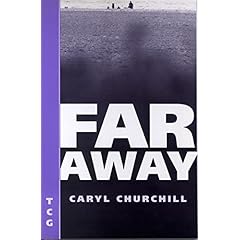
Far Away (Cleveland Play House)


“FAR AWAY” too far out for most audience members

Caryl Churchill, the author of Cleveland Play House’s ‘FAR AWAY’ is considered to be one of England's premier modern playwrights. She strives to make audiences question their world, their role in dealing with violence as well as political and sexual oppression.

Churchill’s plays are difficult to watch or understand. It is easy to get lost in her words, abstract ideas, and lack of linear play structure.

In most plays, the story line is important. In the 50-minute ‘FAR AWAY,’ which is about a descent into the dark ages, and that tells us Western civilization is slowly sliding into barbarism, the story line is less a straight line that a curve into nowhere. In light of the increase of terrorism and cruelty of recent times, she may be sending the message that no one is getting what they want, and there appears to be no light at the end of the tunnel to get us there.

Unfortunately, the message isn’t very obvious. As a CPH audience member stated as he dazedly wandered in the parking lot following the show, “What in heck was that we just saw?” A British reviewer seemed to agree when, after seeing the 2000 opening of ‘FAR AWAY’ he stated, “it moves from the real to the surreal in ways I found less than convincing and was prepared to accept.” Another reviewer stated, “there is no disguising the fact that the drama's gloom-and-doom seems both glib and modish, nor is there enough detail in the writing to persuade us to care about the characters."

The CPH cast, Cat Maddox, Matthew Joslyn, Derdriu Ring and Angela Holecko, under the direction of Peter Hackett, were excellent. Scenographer Pavel Dobrusky’s set was outstanding. Robin Heath’s sound design was right on target, and Larry Delinger’s background music was effective.

CAPSULE JUDGEMENT: ‘FAR AWAY’ is an abstract play which is hard to decipher and will leave most audience members frustrated though it is well presented at the Cleveland Play House. Churchill's response to the new century, it seems, is to stretch our belief to confusion point.

Saturday, October 23, 2004

Balanchine and Sinatra Tribute (Miami City Ballet)


Miami City Ballet captivates State Theatre audience

Miami City Ballet is among the largest ballet companies in the United States. It has 48 dancers and a yearly budget of just under $10 million. Anyone seeing the program they presented at the State Theatre from October 21-24 would immediate know why MCB is also noted as being a world class production company.

MCB has four home counties in South Florida: Broward, Miami-Dade, Palm Beach, and Collier (on Florida's west coast).

Edward Villella, the company’s founding Artistic Director was the first American-born male star of the New York City Ballet . He is credited with establishing the male's role in classical dance in the U.S. Villella’s influence permeates the company...creativity, discipline, fine training and a balanced company which features dancers, not stars. Anyone seeing the company will be awed by the quality of the male dancers. Most companies are happy to have one or two fine males. Their local showing reflects the high quality of their large stable of male dancers .

Mr. Villella's vision and style for the company is based on the techniques established by choreographer George Balanchine who believed all the attention should be placed on the dancers and not on sets and other visually distractions. Two of the selections danced in MCB’s Cleveland program were Balanchine inspired.

The program opened with ‘BALLO DELLA REGINA’ a slight tale of a fisherman’s (Mikhail Ilyin) search for the perfect pearl (Mary Carmen Catoya). The corps of females, dressed in short aqua flowing dresses, were beautifully framed against an aqua-lit backdrop. The flowing movements and the light and airy music by Verdi were a perfect match. The piece was highlighted by a well-disciplined female corps whose timing was impeccable. Ilyin was light on his feet and his unusual bent knee leaps were done effortlessly. Catoya moved with grace and accomplished the difficult double toed point work with competence. The couple partnered beautifully, giving the illusion of a true emotional bonding. Demi-solos by Kristen Kramer, Callie Manning, Tricia Albertson and Patricia Delgado were well performed.

‘NINE SINATRA SONGS,’ the second offering, was choreographed by Twyla Tharp. Anyone who has seen a production of ‘MOVING OUT,’ which is soon to be seen in Cleveland as part of the Broadway Series, will again become aware of Tharp’s genius for blending pop music and modern ballet movements into a delectable dance experience. Be aware, as with ‘MOVING OUT,’ that the words to the song are not being interpreted in the movements. It’s the attitude of the music that holds court. Highlight segments of ‘NINE SINATRA SONGS,’ are “Somethin’ Stupid,” which featured Tricia Albertson and Luis Serrano (who is not only a wonderful dancer, but a rubber-faced comedian); “My Way” in both its renditions; and “All the Way” featuring Deanna Seay and Mikhail Nikitine. The segment’s conclusion evoked bravos from the audience.

“STRAVINSKY VIOLIN CONCERTO” was a hit on two levels. Gabriel Bolkosky’s violin solo rendition of “Violin Concerto in D” by Igor Stravinsky was superb. Balanchine’s choreography, as restaged by Bart Cook and Maria Calegari, was perfectly executed. Balanchine’s signature flipped wrists, angled heads, hip moves and pronounced gestures were all in place. The duet sections as performed by Deanna Seay, Isanusi Garcia-Rodriguez, Jennifer Kronenberg and Carlos Guerra showed clearly what happens when finely trained and talented dancers and quality choreography combine. As was the case the entire evening, the male dancers, as well as the female performers, were excellent, especially in their execution of some very difficult leaps.

The only weakness of the program was pickup orchestra under the direction of Akira Endo. They were ragged in places, especially at the very start of the program when the players entered at different times, throwing off the timing of the dancers. There were also some jarring gaffs by individual instruments throughout the evening, especially by the brass and strings.

CAPSULE JUDGEMENT: “BALANCHINE AND SINATRA TRIBUTE,’ as executed by the Miami City Ballet was a total audience pleaser. It would be wonderful if the company added our fair city as its fifth home. We could use such consistently wonderful programs as MCB stages. Or, at the least, it would be nice to know that MCB would become a permanent part of the Playhouse Square Center’s Ballet Series.

A Bright Room Called Day (Cleveland Public Theatre)


Overstated but relevant Tony Kushner play at CPT

One of the characters in Tony Kushner’s play, ‘A BRIGHT ROOM CALLED DAY,’ now being staged at Cleveland Public Theatre intones, “"Overstatement is your friend. Use it.” This is Kushner's writing device...overstating and continuing to overstate until the message is firmly implanted in the listener’s mind.

Kushner, the author of the epic ‘ANGELS IN AMERICA’ is noted for his poetic verbiage and his daunting soliloquies. Some viewers find him to be tedious and preachy, others hang on every word. No matter your view of his writing, one must admit that he takes on causes with directness and enthusiasm.

“A BRIGHT ROOM CALLED DAY’ is set in the New York City of now and Berlin of then. As the play opens we find Zillah Katz (Allison Hernan), a Long Island Jew who is disenchanted with the current American political scene, listening to television reports of the race for the 2004 Presidency. She is surrounded by masses of research. In a series of flash-forward and flashback scenes, we see what happened in 1932 and 1933 as Hitler came into power and Kushner’s view of how Hitler’s actions parallel to the US political situation.

When playwright Tony Kushner first put the words "We are perched at the brink of a great historical crime" in the mouth of one of his play’s characters, he was taking his stand against what he perceived to be international and domestic crimes committed by Reagan-era America in the mid-1980s.

As explained by David Templeton in a review of a California Bay area production of the play,“Today, in post-9-11 America, such comparisons seem ludicrously naive; at the same time, they manage to appear unnervingly prophetic. As daily reports appear in our newspapers revealing a parade of war crimes in Iraq; as the Supreme Court considers whether the U.S. government's state-sanctioned disappearing of its own citizens is constitutional; as Americans passively debate the efficacy of the Patriot Act, while hard-fought freedoms are eradicated beneath our very noses, the numerous social and political harms brought about during the Reagan years seem like a mere warm-up for what many see as the "great historical crimes" of the Bush era.”

To make the move into the present, with the permission of Kushner, the CPT production team has updated the play so that it contains the same message of warning and prediction of dire consequences if George W. Bush is re-elected as President.

The production qualities of the CPT staging are generally excellent. Trad Burns’ set thrusts itself out like a dagger into the audience. We are each “stabbed” by its presence. The fragmentation, which harks back to the theatrical movement entitled Alienation, makes the audience realize that we are seeing what was, but need to be aware of what is. The characters speak, but they are really representing each of us. Theatrical devices being used include projected titles to lead us through the maze of disconnected scenes, and a narrator, Zillah, sitting in a separate set installed in front of the playing area. Again, the disconnectedness doesn’t let the listener sit back and let the words wash over. The theatricalism means to alert that the words should be heeded.

Director Lester Thomas Shane has well staged the play, but needed to quicken the pace. And, since he had Kushner’s permission to alter the script, he needed to cut some of the extraneous characters and overly long speeches. The sit is very long. He also needed to work with the actors on projection. Lines were lost to the fly gallery and backstage due to the openness of the set and characters being placed with their backs to the audience.

Allison Hernan is excellent as the driven Zillah, filled with rage and angst. Jill Levin seemed tentative in her lines, but developed the fragility of the play’s central character. Randy Rollison is totally believable as a frustrated and revenge-filled Hungarian film maker. Tracee Patterson finely tunes the role of an apolitical actress who, in spite of her fame and connections, is forced to flee the country. Charles F. Kartali gives an enthralling portrayal of the devil. His sneering and smirking is unnerving, and whether intentional or not, makes one think of President Bush’s facial expressions during the first debate of this election season.

On the other side of the acting coin, Michael Seevers, Jr. is unbelievable as Baz, a homosexual who once had the gun and the opportunity to kill Hitler. Bernice Bolek never establishes a characterization as an old ghost-like woman who appears and vanishes throughout the production.

CAPSULE JUDGEMENT: Kushner’s play will incite strong feelings depending on the viewer’s political viewpoints. It is very preachy, but as history demonstrates, and this production reminds us, whenever we find ourselves perched at the brink of great national calamity, a bit of preaching is maybe not only tolerable, but perhaps necessary.

Wednesday, October 20, 2004

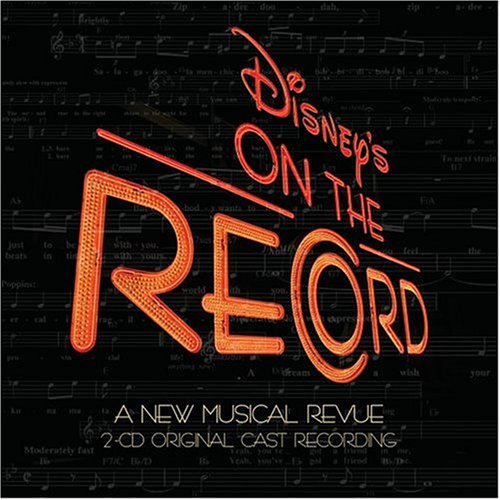
On the Record (Playhouse Square Center)


Disney's ‘ON THE RECORD’ a crowd pleaser at the Palace

When theatre-goers think Disney, they imagine amazing special effects (think the huge animal puppets in ‘LION KING’), lush sets and costumes (imagine ‘BEAUTY AND THE BEAST’) and pageantry (consider ‘AIDA’). Well, none of these are present in the newest Disney stage creation, ‘ON THE RECORD.’ What is displayed are 64 of the most beloved songs ever written, music that has been showcased during the past 75 years in Disney created films and theatrical productions. Songs like “Supercalifragilisticexpialidocious” from ‘MARY POPPINS,’ “Colors of the Wind” found in the animated film ‘POCAHONTAS, “When I See an Elephant Fly” from ‘DUMBO,’ “You Got a Friend in Me” which was featured in ‘TOY STORY,’ and “When You Wish Upon a Star,” the wonderful message-oriented song from ‘PINOCCHIO.’

Those expecting a full-scale Disneyesque production might be disappointed, but once they switch their minds to accepting that this is a display of wonderful music and not a showcase for sets, costumes and lighting effects, they will undoubtedly enjoy themselves. This was evidenced by the thunderous applause that met many of the musical numbers and the roaring standing ovation at the conclusion of the show during opening night of the show. It was further evidenced by the comments by patrons as they excitedly left the theatre, comments such as “That was wonderful,” “I loved it” and “I’ve seen it three times already and I’m coming back on Sunday.” The latter was stated by one of the area’s premiere director of musicals.

Highlight numbers included a mesmerizing version of “Out There” (‘THE HUNCHBACK OF NOTRE DAME’) sung by Andrew Samonsky, and the ensemble performed “Pink Elephants on Parade” (‘DUMBO’) and “Be Our Guest” (‘BEAUTY AND THE BEAST’). The latter was presented with film clips and sung in French, German, Japanese, Swedish and English. “Reflection” from the movie ‘MULAN’ received a gorgeous interpretation by Ashley Brown. “Minnie Yoo-Hoo” from the animated ‘THE SHINDIG’ featured creative choreography. And the duet of “HIGH-HO” and “THE WORKING SONG” from ‘SNOW WHITE’ brought roars of approval from the sold out audience. “Everybody Wants to Be a Cat” (‘ARISTOCATS) was another choreographic and performance winner.

Robert Longbottom, who served as both director and choreographer not only displayed a strong creative bent, but also a wise selector of talent. The cast was outstanding. There wasn’t a weak link in the unit.

Ashley Brown is both beautiful and talented. She is a casting director’s dream. Think Belle in ‘BEAUTY AND THE BEST,’ think a living Snow White. She makes a presence each time she sings, smiles and lights up the stage. Remember her name, you’ll be hearing it again as she rises to the top of the Broadway heap.

Handsome, cocky, Andrew Samonsky was her equal. He of ripped body, dazzling smile, wonderful singing voice, and strong acting talents had the teenage girls in the front row screaming for more and, a female senior citizen behind me moaning, “He’s just adorable.” His version of “I Won’t Say” from ‘HERCULES’ was compelling.

Emily Skinner as the “mature” female in the cast, has a strong voice, much in the mode of Barbara Cook who has made singing Disney songs her career. She was nicely balanced by Brian Sutherland as the other senior member of the cast.

The supporting quartet of Meredith Inglesby, Andy Karl, Tyler Maynard and Keewa Nurulah are super dancers and singers.

With all this said, issues arise. The local production is the world premiere. Forever, it will be noted that on November 9 ‘ON THE RECORD’ previewed in Cleveland. Will that notation be met with a long run on Broadway, following an extended road trip? Will Broadway audiences be willing to pay big bucks to see a contrived plot show driven by strong singing and dancing, but no impressive set or visual gimmicks? Will the fact that ‘ON THE RECORD’ doesn’t fit past Disney molds be a detriment? Since the show is obviously not aimed at children, many of whom aren’t familiar with the songs and want “action,” can eight very talented singers and dancers be enough to hold their attention? Will the producers decide that they need to add more traditional Disney to the format and junk this version and rewrite and restage to give the audience what they expect? Only time will tell.

CAPSULE JUDGMENT: ‘ON THE RECORD’ IS AN AUDIENCE PLEASER. Only a sour faced cynic wouldn’t be delighted by the talent and music of ‘ON THE RECORD.’ Only time will tell whether it can catch on to be another in the long line of Disney hits. Because of the format, the odds are against it, but whoever expected a show with the title of ‘URINETOWN’ to be a smash hit, or a musical about women going through menopause to light up theatres?

Oliver (Playhouse Square Center)


‘OLIVER!’ is a major disappointment at The Palace

On my very first visit to London in 1960 I was told by the booker, from whom I ordered theatre tickets, that one of the shows I was supposed to see had been canceled. If it was all right, she stated, she could give me a free ticket to a musical based on a Charles Dicken’s novel that was opening that night.

Yes, I saw the world premiere of ‘OLIVER!,’ based on ‘OLIVER TWIST’ with book, music and lyrics by Lionel Bart. The amazing cast included Ron Moody as Fagin and Georgia Brown as Nancy. Moody was a delightful rogue and Brown’s “As Long As He Needs Me” was the most emotionally engaging song I had ever heard. After 18 curtain calls I left the theatre entranced.

I went to New York to see the show again after it transferred across the Atlantic, this time to see Clive Revill infuse the show with his wonderful version of Faigan, Georgia Brown revive her role of Nancy, and Davie Jones, who gained notoriety as a member of The Monkees, delight as The Artful Dodger.

I was not alone in my love of the show. A review of the New York production stated, “Oliver! came singing, bouncing and bubbling its way into the Imperial theatre last night, and if ever there was a musical to please everybody, that is it. Overflowing with singable tunes and a solid singing cast, it is a good clean joy of a show.” Another reviewer called it, “One of the smasheroo hits of recent seasons.”

As good as the London, Broadway and many local productions of the show, including a wonderful staging by Elyria Summer Theatre some seasons back, is as bad as the present staging of ‘OLIVER!’ at the Palace Theatre. To make the matter all the worse, this show is part of the Broadway Series. Believe me, Broadway quality this isn’t!

The present production is miscast and misdirected. The choreography is static and stale. The show is paced too slowly. The music is tinny sounding due to the tiny size of the touring orchestra and the cadence of the music is way too slow. The sets don’t work well. It’s hard to find anything right about the show. To go on with details would be worthless.

Suffice to say my love affair with the show will live on in spite of the bad taste in my eyes and ears from this embarrassing production. I’ll just pretend that I never saw this production and, as I’m doing as I write this review, just listen to the original Broadway cast recording.

CAPSULE JUDGEMENT: Playhouse Square Foundation should be ashamed of itself to be charging Broadway rates for this amateur, misconceived production of ‘OLIVER!’.

Monday, October 18, 2004

Crowns (Cleveland Play House)


'CROWNS' worn with pride and purpose at the Cleveland Play House

Based on the acclaimed book of photographs and interviews, Crowns: Portraits of Black Women in Church Hats (Doubleday, 2000), the musical ‘CROWNS,” now on stage at the Cleveland Play House, lovingly evokes the lives and stories of 54 “hat queens.” These queens are African American who women range in age from 22 to 78. They were photographed in the hats they wear to church each Sunday, hats which serve as their crowns, their visual proof of their sovereignty.

The accomplished actor and writer Regina Taylor distilled the women represented in the book to six female characters (and one man) and created a new character — a young woman from Brooklyn who is sent to live with her grandmother in South Carolina after her brother is shot. Directed by Taylor, ‘CROWNS’ received its world premiere in October 2002.

The script is a Gospel music-driven piece, a crazy quilt of music and movement and storytelling that takes the audience through the rituals of a Sunday in the South with characters delivering arias and direct addresses to the audience. These segments start in the Sunday church service but jump off into memories of life experiences in different times and different places.

The play captures the cultural heritage of Black Americans that reaches from modern America through slavery in the United States back to Africa. Little by little, through down home stories and songs sung by her grandmother and women friends, all wearing hat creations that make them stand up tall and confident reach out to Yolanda (the young woman) who eventually shows her acceptance by embracing her grandmother’s world through a river baptism. The stories range from an undertaker figuring out how to accommodate a dead woman wearing her favorite hat in the coffin to the role of Black women’s hats in the civil rights movement.

Staging devices help carry us through the stories and songs. First appearing in white slips, the ladies use costume changes and many hats, glorious hats, to set each story in a context. The visual images are aided by the projection of scene titles such as Prologue, Morning, Morning Service, Jumpin’ the Broom, Funeral, and Recessional.

The cast is generally superlative. Especially appealing are Lavonda Elam, dancer extraordinare; Edwina Findley, who “cops the right attitude” as the modern rappin’ young lady; and Cleveland native Angela Gillespie Winborn, who not only is delightfully funny, but can vocally wail. Michael W. Howell, who plays multi-roles as “The Man” has a wonderful singing voice and displays a great sense of comedy and dramatic timing. Queen Esther Marrow, who is the most heralded member of the cast, was wearing an ankle boot when I saw the production. Whether she was in pain or uncomfortable because of an injury, her characterization wavered and her movements were sometimes restricted.

One thing does sully the evening. Since the playing time is just under two hours without an intermission, some cutting would benefit the overall enjoyment. After a while it just became too much of a good thing.

CAPSULE JUDGEMENT: It is especially enjoyable to see that the play is drawing a great racial cross-section of the community. For many reasons, ‘CROWNS’ is a must see. Oh, and make sure you take time to see the Millinery Arts Coalition’s “Hats ON!” exhibit and sale in the rotunda at CPH.

Sunday, October 17, 2004

The Mercy Seat (Ensemble Theatre)


Thought provoking but flawed 'MERCY SEAT' at Ensemble

The attack on the World Trade Center on September 11 was an event which forever changed American’s attitudes about our lives. It is against that backdrop that Neil LaBute sets his play ‘THE MERCY SEAT,’ now on stage at Ensemble Theatre.

It’s September 12, and the day before young Ben Harcourt was scheduled to attend a morning meeting at the World Trade Center. Instead, he was having sex with his mistress and boss Abby, in her Manhattan department. He is still at Abby’s flat, watching the devastating events unfold on television and consciously choosing to ignore his mobile phone that is ringing in his hand. He seizes on the terrorist attack as an opportunity to start a new life with his mistress and to allow his wife and children to believe that he died in the terrorist attacks. Abby, on the other hand, wants Ben to call his wife and say he is leaving her and live an “honest” life.

Sounds like it could be intense, interesting. Well, it’s not. After the exposition, we spend an hour and forty minutes of dialogue in which we discover what a spineless, self-absorbed, self-deluded repugnant individual Ben is and how desperate his older mistress is to have him for herself. After a while all the dialogue, the self-pitying, the self-loathing become tedious.

The question is: why should we care about either of these people? On one hand, the characters represent those who manipulate situations for their own needs. On the other hand, the characters, as written, don’t seem to care about each other, so I found myself not caring about them. After a while I just wanted them to shut up and let me go home to the real world where I might find people who actually have joy and woes that are of relevance.

Neil LaBute has built a reputation for writing disquieting plays that center on despair. He stated in one interview that ‘Great good can come from showing great evil.’ If that’s what he is trying to say in ‘THE MERCY SEAT,’ he doesn’t succeed. In addition he indicated that the play's title is a Biblical reference. The Mercy Seat was the top of the Ark of the Covenant that in the temple was the one space where God could come and man or the priests could speak before him. As it relates to the script, it could be interpreted that the situation brought the characters to the real truth of their actions. That, however, if not completely clear.

In the Ensemble Theatre production the performers, John Kolibab and Meg Kelly Schroeder try hard, but aren’t capable of overcoming the tediousness of the script. In addition, the beautiful Schroeder appears to be too young to be 12 years older than Kolibab. Kolibab, on the other hand, doesn’t develop the intellect nor does he have the physical sensuality to have a successful businesswoman, who has smashed her way through the glass ceiling, to want to give it all up for the likes of him.

CAPSULE JUDGEMENT: If you are a fan of LaBute’s movie scripts, “THE SHAPE OF THINGS” or “IN THE COMPANY OF MEN,” you may like ‘THE MERCY SEAT.’ If not, you probably could find better ways to spend an evening.

Saturday, October 09, 2004

Laughter in 3 Languages (Actors' Summit)


Fireworks greet Dorothy & Reuben at Actors' Summit

Okay, let’s start off with a confession. I am the self-appointed President of the Reuben and Dorothy Silver fan club. The rest of the world can have their Lunt and Fontaine, Tandy and Cronin. I’ll take OUR Reuben and Dorothy. When they perform or direct I’m there, clapping and qvelling (a Yiddish term meaning “beyond loving” that fits well into this review).

Several years ago the Silvers conceived a reader’s theatre style presentation which they could take on the road. Entitled ‘LAUGHTER IN 3 LANGUAGES’ its been performed in on the north coast, in the Sunshine state, and all the rest of the globe including performances in Russia for Refusniks (Jews who were being denied exit out of the Soviet Union). Their latest presentation is a two-week run at Hudson’s Actors’ Summit.

The opening night’s performance was delayed for half-an-hour due to a fireworks presentation. Well, to be honest, it wasn’t for the dynamic duo, it was for the opening of a new shopping center in downtown Hudson, about a quarter of a mile from the theatre. The Silver didn’t need the external fireworks, they sent off their own with wonderful performances.

The show centers on a series of personal story telling and the reading of writings by famous and not-so-famous Jewish writers. The show is performed in English, Yiddish (the Jewish “mother tongue”) spoken with simultaneous translations and “Yinglish” (a mixture of Yiddish and English, such as “Ya vant maybe a bowl mit panans [bananas]?”)

The script is both charming and heart-warming. Some of the most winning segments include the letters sent to the advice column which appeared in the Forward, the most popular of the Yiddish language newspapers. The column, which in English was entitled, “Packet of Letters” was the forerunner to Ann Landers and Dear Abby, two Jewish ladies who may well have borrowed the idea. The topics include sage advice on women’s right to vote, dimples in the chin, immigrant homesickness and arranged marriages. Reuben, who is fluent in Yiddish, reads. Dorothy does simultaneous and often hysterically funny English interpretations. It’s like being at an opera where you don’t understand the Italian being sung, but the billboard above the stage clarifies for you. The difference is that Dorothy adds facial expressions, pauses and intonations that add to the hilarity. It’s often fun just to listen to the audience. Those who understand Yiddish, laugh as Reuben is reading. The rest echo the hysteria when Dorothy finishes her translations. It’s a device that works very, very well.

The reading of a chapter from Leo Rosten’s ‘THE EDUCATION OF HYMAN KAPLAN’ is a total delight. Reuben was made to play Kaplan. I’d love to see him play the role in the play of the same name. “Dear Bella,” a story which includes a tender segment about of the relatives distributing the money mamma had in her piano is touching and a segment in which an immigrant places $20 in the bank is hysterical.

CAPSULE JUDGEMENT: The year 2004 marks the 350th celebration of the founding of a permanent Jewish settlement in the United States. It seems only fitting that the Silvers use their extraordinary skills to help take some people on a trip through nostalgia and to introduce others to the joys of Yiddish literature and thought. Its a journey that is well worth taking.

Julius Caesar (Great Lakes Theatre Festival)


'JULIUS CAESAR' reigns at Great Lakes Theatre Festival

‘JULIUS CAESAR,’ now running at the Great Lakes Theatre Festival, deals with corrupt governments, one’s conscience, doing what will be good for everyone rather than thinking about one’s self, and the ability to change the populace’s minds. It also reaches into the area of grandness and becoming too ambitious.

The plot centers on Julius Caesar, who, after another of his successful battles, is encouraged by a worshiping crowd to become emperor. He refuses, though a number of Rome’s senators think he, in truth, wants to become the dictator. A group of conspirators, including Caesar’s friend Brutus, plot to murder him. Following the murder, Brutus ill-advisedly lets Mark Anthony give a funeral oration. With his “friends, Roman, countrymen” speech, Anthony stirs up the people and civil war ensues. Brutus commits suicide after it is apparent that his SIDE has lost. Still eloquent, Anthony delivers Brutus' funeral oration, calling him the noblest Roman of them all. This is the stuff of which Freshman English classes is made.

The play’s the thing, but, in reality, few people realize the effect of Shakespeare on our modern day perceptions. Yes, many of the Bard’s lines are quoted, many of his poems are memorized by unwilling teens, but the lasting effect of Shakespeare’s words are often ignored.

One of the major places where this picture of “what was” and “what you should believe” is displayed is in the Bard’s ‘JULIUS CAESAR.’ As one theorist states, “The play captures with remarkable fidelity the ethos and rhetorical style of late-republican Rome--so much so, indeed, that it may be said that Shakespeare's portraits of Caesar and his contemporaries have largely formed our impressions of how the ancient Romans thought and talked and conducted their civic affairs. Recent studies of the play's references to philosophy indicate, moreover, that Shakespeare knew a good deal about Roman Stoicism and perceived it as one of the characterizing traits that separate people, the rigid, from the flexible.

Interestingly, the concept of stoicism is one of key factors in our present-day Presidential election. A number of scholars have confirmed the validity of writer and critic Mark Van Doren's early century perception that in his portrayal of Brutus Shakespeare was drawing on a widely held tradition that regarded Stoicism as a philosophy that rendered its adherents so assured of their own virtue as to be largely incapable of recognizing or repenting of their faults. Hmm...sounds like a line right out of one of the present day Presidential candidate’s attacks on the other.

The GLTF production is excellent. The concept is well conceived by director Risa Brainin. Taking a modern approach, she has used Shakespearean language, but flattened out the tones to make it palatable to the American ear. Using scenic designer Russell Metheny’s modern set, and the contemporary Armani-type clothing styles of Kim Krumm Sorenson, she has given the audience a chance to realize the modern implications of the play.

Richard Klautsch develops an introspective Marcus Brutus with an excellent underplay development. Without raging and ranting, Klautsch clearly shows the inner turmoil that Brutus goes through in making his painful decisions. Douglas Frederick, who portrays a Cassius filled with rage, is also effective. Mark Alan Gordon is excellent as Decius Brutus. Laura Perrotta makes for a fine Portia, wife to Brutus.

On the other hand, Aled Davies is not nearly cunning enough as Julius Caesar. His feigned ambition doesn’t come through. As he did with his Lady Bracknell role in ‘THE IMPORTANCE OF BEING EARNEST,’ Davies seems to miss the true characterization. Kelly Sullivan is unbelievable as Calphurnia, wife to Caesar. She, for some inexplicable reason, whines her way through the part. And, why David Anthony Smith decided to interpret Marcus Antonius as a fool is not clear.

CAPSULE JUDGEMENT: ‘JULIUS CAESAR’ is an important Shakespearean play. It takes on additional meaning during this election year. The GLTF production is well worth seeing.

Phantom of the Opera (Playhouse Square Center)


'THE PHANTOM' gets deserved standing ovation at the Allen Theatre

Saw ‘THE PHANTOM OF THE OPERA’ before? Afraid that the touring production might be one of those slapped together non-union actor productions? Well, fear not. The rendition of the show which is appearing at the Allen Theatre has a superb cast and all the spectacle of any edition of the show, including the Broadway production. Yes, the falling chandelier, Hannibal’s elephant, the sumptuous costumes, the boat which floats across the stage, they are all there. And the cast is outstanding!

“THE PHANTOM OF THE OPERA” opened at Her Majesty’s Theatre in 1986.
Since then, it has been seen in 110 cities in 20 countries by over 70 million people. Worldwide, the box office revenues are higher than any film or stage play in history, including “TITANIC”, “ET” and “STAR WARS.”

On February 4 of this year, PHANTOM became the 2nd longest-running show in Broadway history. That version has been running for 16 years.

In June of 1993 the show made its first appearance in Cleveland. Almost 200,000 people attended that run.

The musical, which has won over 50 major theatre awards, including seven Tonys, is scheduled to be released as a motion picture during this year’s holiday season.
The movie trailer can be accessed at:
http://phantomthemovie.warnerbros.com.

As for the story line: It is 1911 and the contents of an Opera House are being auctioned off. Present are the auctioneer and bidders. As the auctioneer displays the Opera House chandelier, he explains that it is connected with the legend of The Phantom of the Opera. With a flash of light, the audience is flung back in time, when the Paris Opera was at its height.

We are in the middle of a rehearsal for the opera ‘HANNIBAL.’ The retiring manager of the Opera is showing the new managers the great stage. As the prima donna is singing, a backdrop falls to the floor, nearly killing her. The cry is raised, "It's The Phantom of the Opera!" And, the story of a young singer, her lover, and the phantom who loves her, play out before our eyes. As the plot deepens we discover the real story of the phantom and, in the end, the Phantom gives Christine (the young singer) a choice. She can stay with him forever, or he will kill Raoul (her lover). That decision brings an end to the story.

Don’t go to see the production thinking this is musical comedy. Comedy, it definitely is not. It is high drama. High dark drama. And, be warned, there are scenes that are not visually appropriate for young children...skeletons, murders, scary masks, hangings, gun shots, light flashes, and strong illusions. On opening night, a child exited screaming.

The Allen production is suburb. Gary Mauer, makes the Phantom his own. He does not do a Michael Crawford (the original Phantom) imitation. He makes the role softer, more vulnerable, more human. His voice is marvelous. His rendition of “The Music of the Night” is what musical theatre is all about...superb, enthralling. His “All I Ask” is emotionally draining.

Rebecca Pitcher who portrays Christine, gives a believable acting performance which graces her marvelous voice. She makes for a perfect Christine. The duets between Mauer and Pitcher, which include “The Phantom of the Opera,” “I Remember,” and “The Point of No Return” were production highlights.

Tim Martin Gleason effectively sings the role of Raoul, Christine’s lover. He physically fits the role of the handsome suitor. But he sometimes seems on the surface in his character development, not totally immersed in the role. “”All I Ask of You” his major duet with Pitcher, was riveting.

CAPSULE JUDGEMENT: The production of ‘THE PHANTOM OF THE OPERA’ now playing at the Allen Theatre, is as close to a perfect production of the Andrew Lloyd Webber, Charles Hart, Richard Stilgoe musical as you will ever see. If you haven’t experienced the show before see this production. If you have seen it before, go again. You won’t be disappointed. As is the habit of Cleveland audiences, the opening night production received a standing ovation. This is one of the few shows that deserved it!

Tuesday, October 05, 2004

Lobby Hero (Beck Center)


‘LOBBY HERO’ gets a fine production at Beck Center

“How are you supposed to know if you’re right and everyone else is wrong?” “Do you stick by your feelings, no matter what?” These are two of the questions at the center of Kenneth Lonergan’s ‘LOBBY HERO,’ now on stage at Beck Center’s Studio Theatre.

Lonergan's play is presently one of the most popular plays in regional theatre. It is a serious comedy that had its off-Broadway premiere at Playwrights Horizons in New York during the spring of 2001. One publication called it the "best drama, best comedy and the best romance of the year, all rolled into one." After seeing the production you’ll understand why Lonergan is noted for excelling in the naturalistic conversational style of his characters.

Set in the lobby of a Manhattan high-rise, a security guard tries to make the most of the graveyard shift, cajoling, joking, and talking his way through the night. But when his boss's brother is implicated in a brutal murder and he is complicit in covering for him, the hapless lobby guard is confronted with a mind-bending problem: he wants to do the right thing, but he can't figure out what "the right thing" is. A rookie policewoman and her swarmy partner complete the cast.

Beck Center’s production is outstanding. In fact, the staging and acting outshine the script. That is not to say the writing is poor. It isn’t. It’s just that the play is overly long and lacks consistent emotional tension but the production makes the most of what it has to work with.

Director Seth Gordon has pulled out all the stops to make what could potentially be a talky evening, one of interest. He is aided by a terrific cast. The actors make the characters real enough so that we care about them and project what might happen to each in the future. That’s a tribute to the quality of the performances.

Matthew Joslyn, who portrays the lobby guard is wonderful. He makes hyper-hysteria and self-loathing a way of life. Joslyn alternates between being manic and depressed with ease. His confusion, his frustration, his desire to do the right thing, are finely conceived.

Jimmie D. Woody makes the supervisor believable, though his characterization isn’t always consistent. The conflict within isn’t always evident, but all in all, we empathize with his conflict.

As the policeman Paul Floriano makes being slimy look totally natural. The character isn’t as completely drawn as some of the others, but Floriano fills in all the writing gaps. We love to hate him.

Jennifer Clifford makes the novice policewoman appropriately, vulnerable yet manipulative. Her quick fade from innocent to viper is well developed.

Don McBride’s scenic design, Jeff Smart’s costumes and Jeff Lockshine’s lighting all work well.

CAPSULE JUDGEMENT: Beck’s ‘LOBBY HERO’ gets an excellent production at Beck Center. Here is a production that takes a script to it highest level through wise directing and fine acting.

Monday, October 04, 2004

Triple Expresso (Playhouse Square Center)


‘TRIPLE ESPRESSO’ a bad cup of coffee

As the public relations release for ‘TRIPLE ESPRESSO,’ the show which recently opened at the Hanna Theatre relates, “Early in 1995, Bill Arnold, Michael Pearce Donley, and Bob Stromberg, three successful solo performers who admired each other's work, gathered over coffee, never knowing the full impact the caffeinated brew would have on their future. They decided to write something they could perform as a trio. Wanting to set a reasonable goal, they decided to write "the funniest show in America"; and booked a performance for three weeks later in a local church.”

Since then, the show has received welcoming arms. In San Diego the show has been running for five years. A Denver reviewer stated, “Triple Espresso is light, funny and family friendly. Yeah, it may not be all that sophisticated, but it sure is fun!” A St. Louis
commentary indicated, “Its good mood jumps down from the stage right into the audience - and so, sometimes, do the actors.”

I hate to rain on the parade, but I don’t know what those reviewers found so wonderful. Count me as one of those who wasn’t impressed. I found most of the show to be trite and begging for laughs.

"TRIPLE ESPRESSO" supposedly takes place at a coffeehouse where pianist Hugh Butternut (Michael Pearce Donley) is marking his silver anniversary at the keyboard. This is not exactly the career Hugh envisioned; he used to belong to a trio with big dreams of "The Mike Douglas Show" and appearances on Cable Zaire. (Honest, I didn’t make this up.) For the anniversary, he reunites with his old partners, magician Buzz Maxwell (George Tovar) and comedian Bobby Bean (Bob Stromberg). Sharing memories and renewing old squabbles, they go through a series of routines intended to show why their act didn’t work. Hmmm......

Donley and Stromberg are two of the original conceivers of the doings. Donley has a fine singing voice and is a wonderful pianist. Too bad he just didn’t spend the evening singing and playing, it would have been a treat. The segment where he took audience requests and played and sang the likes of Elton John and Billy Joel was great. His children’s song take-offs was also a treat.

Stromberg, who tries to be a combination of Dickie Smothers and Jerry VanDyke, elicited laughs from the audience who seemed to enjoy his over-the-top broad farce. I guess if you like to see the same goofy facial expressions, vocal sounds and prat falls over and over, you’d enjoy Stromberg. To his credit, a segment of shadow play using his hands was excellent.

Tovar is a delight. His static face, intentionally bad magic routines and droll comedy offered some of evenings best highlights.

CAPSULE JUDGEMENT: When I go to the theatre I want to leave with a feeling of having spent my time well. That was not the case with ‘TRIPLE ESPRESSO.’ The trite premise was just not to my liking. If you want to see a wonderful review, walk right past the Hanna and go into the 14th Street Playhouse and see ‘MENOPAUSE, THE MUSICAL’ a premise that works!

Sunday, October 03, 2004

The Confessions of Punch and Judy (Cleveland Public Theatre)


CPT presents ‘PUNCH AND JUDY’--a blow-by-blow look at love

Reaching back to 1742 there have been Punch and Judy puppet shows in the United States. If fact, it’s been recorded that George Washington bought tickets for a puppet play featuring Punch prior to the famous winter at Valley Forge.

It seems obvious that if someone wanted to write a play about relational conflict they could do no better than examine the lives of Punch and Judy since the puppets spend most of their time dishing out verbal and physical abuse. It’s taken a long time for that mission to be completed but Raymond Bobgan, Tannis Kowalchuk and Ker Wells have accomplished the task.

The conceivers began the development in what they have named, ‘THE CONFESSIONS OF PUNCH AND JUDY’ (subtitled ‘YOU ALWAYS HURT THE ONE YOU LOVE’) in 2001 in Toronto. In 2004 the present version of the script premiered on August 14, 2004 at the Catskill Festival of New Theatre. The show will play at Cleveland Public Theatre through October 9, move to New York for a February opening and then to Toronto in April, 2005.

In contrast to a traditional script which is developed by an author or authors working alone, ‘THE CONFESSIONS OF PUNCH AND JUDY’ is a collaboration, a movement in drama entitled “devised theatre.” It is generated by the director and actors all of whom function as the playwrights of the piece. A similar technique was used for developing the classic musical ‘A CHORUS LINE.’

‘THE CONFESSIONS OF PUNCH AND JUDY’ professes the concept that Mr. Punch is a chauvinist who believes in knocking trouble on the head. He is portrayed as the victim of a nagging wife, a crying child, personal attacks by the authorities, the restriction of laws and the fear of damnation. Though this was an acceptable pattern in the Victorian age, in the present age of woman’s liberation, attitudes are different. Mainly, Judy fights back. She refuses to be dominated.

The show is performed by two actors who leap between realism and surrealism, exposing the horror and beauty of a relationship. In the case of Cleveland Public Theatre, the very proficient actors are two of the show’s conceivers, Tannis Kowalchuk (Judy) and Ker Wells (Punch).

Telling the “sweet tale of love blow by blow” the two bicker about moon exploration, ballroom dancing classes, relational honesty, the secret codes of male and female language, and fighting techniques. The lines include such questions as “What are you doing?” which gets the retort. “Driving you crazy.” A hysterical scene portrays Judy cutting up vegetables, decapitating legumes and chopping up a head of cabbage, as the duo examines “love without possession.”

Raymond Bobgan, as he did in his direction of the Times Theatre Tribute award winning ‘BLUE SKY TRANSMISSION: A TIBETAN BOOK OF The DEAD’ shows he has a total grasp of script and how to get his actors to achieve the message.

CAPSULE JUDGEMENT: The CPT production of ‘THE CONFESSIONS OF PUNCH AND JUDY’ is a total success. It should be must viewing for any married couple or anyone contemplating a long term relationship. The pacing is right on, the humor is high keyed, the lessons are clear.

For Colored Girls Who Have Considered Suicide When the Rainbow is Enuf' (Karamu)


Karamu opens season with thought-provoking production

They come on stage one at a time, each woman dressed in a different color. Each sings, dances, and recites poetry. Each tells tales of their experiences with men. Often men they loved far more than they loved themselves. These are men who have dominated, abused and taught them about life. Their words ring with passion, heartache, desire, rage and love. And, in the end, they come to the joint conclusion that “I found God in myself and I loved her!”

Ntozake Shange’s ‘FOR COLORED GIRLS WHO HAVE CONSIDERED SUICIDE WHEN THE RAINBOW IS ENUF’ is a choreopoem, a format which allows a group to speak as individuals, and yet as one. Sometimes, they dialogue with one another, at other times take part in each other's tales.

The piece gives "colored girls" a chance to speak out. The material ranges from the evening when one woman lost her virginity to a group diatribe about the lousy excuses that men tend to give for their behavior. "It was the senior prom and I was the only virgin in the class" began one. "I used to live in the world but I moved to Harlem and now my universe is just six blocks" started another. The segments range from funny to sad to heartbreaking.

Since the play was written in 1976 some of the material seems slightly outdated. In the intervening years, black women have been given more venues in which to speak out and reveal themselves. But while many things have changed, others have stayed the same.

The women are identified by color, not of their skin but of their clothes, for example, the Lady in Red, Lady in Purple. This allows each actress to play different characters and weave in and out of stories without a character identification.

The Karamu production brings many of emotions to the fore. Unfortunately, the overall effect is one of uneveness. The play itself, though powerful, is not consistently well written and balanced. The first act tends to drag with less variety and fewer emotionally powerful scenes. The best material is in the second act. And, as often happens with amateur productions, the talent on the Karamu stage ranges from astounding to adequate which makes for lulls in the emotional effect.

Terrency Spivey, in his second year as Karamu’s Artistic Director, has done a good job of creating effective stage pictures. He clearly leads the viewer’s eye to the proper place on stage. His creative use of scarves helps develop a visual unity to the production. He is aided by an excellent light design by Richard Morris, Jr. Morris’s stage design also works well.

The amazing Nina Domingue (Lady in Red), a former recipient of a Times Theatre Tribute, again proves she is one of the area’s acting divas. Her portrayal of a mother whose husband returns from Vietnam with Post Tramatic Stress Syndrome and destroys her family, has to be one of the most emotionally draining scenes ever seen. It is worth attending just to see her in action.

Other strong performances were consistently given by Monte Escalante (Lady in Purple), Corene Woodford (Lady in Green). Sonia N. Bishop (Lady in Blue) and Kimberly Brown (Lady in Orange).

CAPSULE JUDGEMENT: If you are interested in sharing what it is like to be a black woman from a black woman’s point of view, Karamu’s ‘FOR COLORED GIRLS WHO HAVE CONSIDERED SUICIDE WHEN THE RAINBOW IS ENUF’ is well worth seeing. If you are interested in observing one of the area’s all time great performances, go see Nina Domingue weave her magic.

PS.....Take time before the show and during intermission to read the encounters of African American women who have thought of or accomplished in committing suicides. Materials from the likes of Oprha Winfrey, Dorothy Dandridge and Mia Angelou are posted in the lobby.

Summer of '42 (Kalliope Stage)


Tender, delightful 'SUMMER OF '42' opens Kalliope's 2nd season

Kalliope Stage, one of Cleveland’s newest theatres and the only area theatre dedicated to producing only musicals, has opened its second season with a wonderful production of ‘SUMMER OF ‘42.’

Does the show’s name sound familiar? It should. ‘SUMMER OF ‘42’ was the hit coming-of-age movie in 1971.

The plot concerns Hermie, an awkward, gawky, confused teenager whose summer of fun becomes a bittersweet lesson in love when he falls in love with a young war bride in a seaside town.

The play, which is based on the novel and screenplay by Herman Raucher, has words and music by David Kirschenbaum and a book by Hunter Foster. The duo has remained faithful to the film and even improved upon it. They have created a fully integrated work, where dialogue and songs interweave seamlessly, complementing each other with precision. The addition of the music adds a dimension of reality and tenderness to the story.

Kirshenbaum's score makes use of World War II-era music and incorporates self-perceptive and emotionally laden ballads which add more to the happenings than Michel LeGrand's Oscar-winning score for the movie, which centered on the song "The Summer Knows."

Kalliope Stage’s production, under the watchful eye of Paul Gurgol, is excellent. Gurgol gets all of the laughs, the tenderness and the reality out of the script. He allows the audience to become swallowed up in the era He is aided greatly by Russ Borski’s mood setting and workable set, Kim Brown’s period right costumes, Marcus Dana’s lighting design and Chad Helm’s sound design. The playing space also aids. This is a play that needs intimacy and since no viewer is more than 15-feet from the action in Kalliope’s small theatre, the personal tie to the performers is easily accomplished.

The Kalliope cast is excellent. Beachwood High School senior Alex Wyse was born to play Hermie. His skinny frame, which features flailing arms and weak-kneed legs, gives him a look which is perfect for the role. But more important is Wyse’s total control over the character. His small, yet well-pitched voice, is plaintive in the love songs, his yearnings perfectly revealed. It’s worth seeing the show just to share Hermie’s anguish and angst as Wyse lives them.

Jodi Brinkman is the perfect Broadway-leading lady. She is a wonderful actress, beautiful and possesses a compelling and big vocal sound. She makes for a perfect Dorothy. Wyse and Brinkman not only sing well together, but seem to have a powerful emotional connection.

Jay Strauss, a veteran New York actor, plays the drug store owner, Walter Winchell and the aged Hermie with total delight. He is a wonderful character actor.

Both Dan O’Neil (Benjie) and Aaron Dore (Oscy) portray Hermie’s teenage friends well. O’Neil hits the role of the bird-watching intellect right on. Dore would be more effective if he would let his natural personality carry him, rather than trying to act his role. He often appears to be trying too hard to be the hormone driven Oscy.

Jamie Finkenthal, Elizabeth Kelly and Julie Marx are fine as both as the younger version of Andrews Sisters-type singers and teenage girls.

Highlights of the show include the drugstore scene in which Hermie attempts to buy condoms, the hysterically funny movie scene in which the boys attempt to make their first “scores,” and the “unfinished business” scene in which the boys are getting ready for their first conquests. Cheat notes have never been so hilarious!

CAPSULE JUDGEMENT: The recent trends in American musicals are in your face offerings such as ‘RENT’ and ‘ASSASSINS.’ Sometimes it’s just nice to see a musical offering that is charming, full of smiles and laughs, and contains pleasant music. It also helps if the production is of high quality. If that’s what your looking for, Kalliope Stage’s second season opener, ‘SUMMER OF ‘42’ will delight you.