Saturday, November 29, 2003

V-E Day (Dobama)


V-E DAY’ IN WORLD PREMIERE AT DOBAMA

In 1992 a box of newsletters written during the Second World War were dropped off at The Cleveland Jewish News. Fortunately, the material found its way to Faye Sholitan, one of the paper’s writers. ‘Hello Again,” the monthly publication was circulated to Cleveland GIs as a morale booster. It contained hometown gossip centering on those who had attended Glenville High School, ate at Mawby’s on Lee Road, danced their nights away at the Statler Bar, were tended to in Mount Sinai Hospital, and attended Silver’s Temple on Ansel Road and East 105th Street. It noted the happy events in life back home.

Besides being a reporter, Sholitan is a playwright. As such, she was moved by the voices whom she later knew as her parents’ friends. ‘V-E DAY’ is her salute to the people who wrote and whose lives were noted in “Hello Again.” The original publications can be found at the Western Reserve Historical Society. Copies are at the Beachwood Branch of the Cuyahoga County Public Library.

‘V-E DAY’ was recently awarded first prize in the Arlene R. and William P. Lewis Playwriting Contest sponosred by Brigham Young University which honors women writers.

‘V-E DAY’ tells the tale of the now 79-year old Evelyn Bergfeld, who appears to have spent her happiest years during World War II. It reveals how she won and lost Bernard Cohen, the real love of her life. It relates how she went on to marry another man. How she traversed through that marriage and motherhood with little joy. How she literally and figuratively buries her life. How, in her later years, she submerges into depression, unable to find happiness in anything except buying unneeded goods on the Home Shopping Network and harassing her daughter and caretakers. Depressed until....(let’s stop there, no sense in giving away the whole plot). Let’s just say, it’s amazing what happens when the potential for happiness, no matter what age, becomes a possibility.

Sholiton presents the material through a series of present day happenings and simultatenous flashbacks. We meet all the major characters in their present as well as their early selves. Several times the cross fades between this and the past worlds get blurred due either to lighting errors or a lack of verbal or physical transitional qualities, but the writing device generally works well. The ending of the play confused the audience. After what appeared to be an ending line and a blackout, and hardy applause, the lights came up on yet another scene which didn’t add much to the play’s purpose.

Director Jacqi Loewy honed the performance well. She kept the action crisp and left little unclear and aided her actors to develop realistic characters.

Set designer Mark Kobak created a workable and well-detailed set. The only confusion came with an imaginary entrance door. The first arrival through the invisible entry gave the illusion that the character might be a figment of Evelyn’s confuision or imagination rather than a real person. Since all other aspects of the set were so realistic, a real entrance space was needed.

The cast was outstanding. As Evelyn, Rhoda Rosen walked the tight-rope between depression and senility with clarity. She was absolutely believable in what could have been a caricature performance. Talent, talent, talent!!!! It was easy to grasp Mitch Field’s years of longing to have spent his life with Evelyn. Jennifer Clifford, Michael John Sestli, and Holly Humes were totally believable as the young Evie and Bernie and Bernie’s sister Lil. Juliette Regnier was alternately frustrated and empathic as Evelyn’s daughter Aimee. Jennifer Salkin was fine as Young Aimee.

CAPSULE JUDGEMENT: ‘V-E DAY’ is a lovely little play filled with humor and pathos. Its life expectancy might be limited with all the Cleveland references. Local people who lived through the WWII era will “qvell” over reliving that time. Others will be intrigued by this slice of historical life.

Three Tall Woman (Ensemble)


‘THREE TALL WOMEN’ thought provoking at Ensemble

In the late 1950s the United States was searching for a new understanding of itself. The country had just been involved in the war to end all warsand was in ascendence as THE world leader. The theatre, along with the other arts, took on the role of creating a look at what the country was and should be. Writers like Tennessee Williams, William Inge and Arthur Miller brought dramatic arts into the world of theatrical realism. By the late 60s, however, with the birth of movements toward integration, stands against repression, and frustration with the political paths taken by the US government, the Theatre of the Absurd reared its head. Represented by the likes of Samuel Beckett and Edward Albee the movement was based in existentialism asking “Why do we exist?” Albee is one of the only writers of that era to remain on the theatrical scene. He is still writing in the absurdist mode. Absurd, in this case, doesn’t mean ridiculous, it stands for “out-of-kilter.” It allows the writer to pen one thing, while representing something else, something with deeper meanings. Think “Who’s Afraid of Virginia Woolf.” Virginia Woolf doesn’t appear in the play, her words are not spoken, yet her philosophy and beliefs are strongly alluded to in the play’s messages of frustration, impotency, failure and futility.

One of Albee’s most recent writings, ‘THREE TALL WOMEN’ continues his absurdist bent. This play takes place in the bedroom of a sick and forgetful old woman, named (A). In the first act she is cared for by a middle-aged companion (B) and visited by a young woman (C) sent by the lawyer to settle some financial affairs. They discuss the human condition with its love, pain, wit, sex, and inevitable decline. At the end of the first act, (A) suffers a stroke that leaves her on the edge of death. The irony of the play centers in the second act when we realize that A, B and C are all the same person at different stages of her life.

As he did in ‘WHO’S AFRAID OF VIRGINIA WOOLF, Albee lays bare the pettiness and self deception in our lives. He asks, “What if you could see and speak to the person you once were? What if you were able to speak to the person you are predetermined to become?” What difference would it make in your life? Would you live life differently?

Albee also adds a twist by having A’s alienated son turn up at her bedside to say goodbye. This may have been Albee’s own way of dealing with his negative relationship with his adoptive mother. The son, who speaks not a word in the play though he is on stage for almost all of the second act, has tears streaming down his face as the play draws to a close. Yet another question arises. “Is the Albee’s stand-in crying because of the lack of a good relationship or finally being able to say goodbye? What’s the message for the audience on how to live?

Interestingly, ‘THREE TALL WOMEN”won Albee his third Pulitzer Prize even though it never has played Broadway.

Ensemble Theatre’s production does not quite live up to the words “witty, hilarious, haunting, and swimming in the dark pools of the human heart's most inner secrets,” which were used by reviewers of other productions to describe their theatrical experience. Though they tried valiantly, director Licia Columbi and her cast just couldn’t overcome this very wordy script, full of shaded dialogue and long monologues and little action.

Columbi uses the small intimate space of the Cleveland Play House’s Black Box Theatre well. She continues to create triangles of staging so that all the actors can easily be seen by the audience which surrounds the stage on three-sides. Like the corners of an equilateral triangle, each character has the same strength and power. The reason for this becomes clear in the second act, when we realize that we are seeing the same person at different times in her life.

All three actresses are proficient. Bernice Bolek as (A,) the old lady, swings from mean to manipulating to insightful but sometimes misses the extremes of rationality and irrationality. Sherri Britton as (B), though at times appears to be in control of the character, is somwhat inconsistent, especially in the first act when she fails to establish a clear personality concept. After a stiff and uncertain first act, Bernadette Clemens as (C) blossoms in the second act, allowing for an understanding of why A becomes irascible in her later life. Jesse Kamps portrays the tortured son with amazing control. He flows forth real tears at exactly the right moment.

CAPSULE JUDGEMENT: Ensemble seems to be doing its best work since moving to the CPH space. Though it does not have the emotional highs and lows of ‘WHOSE AFRAID OF VIRGINIA WOOLF’, ‘THREE TALL WOMEN’ does carry a clear probing set of messages in question form. If you love theatre, and can endure a very talky show, you’ll appreciate the Ensemble production.

Sunday, November 23, 2003

Jeffrey (Beck Center)


'JEFFREY' agonizes at Beck

The theatre has been an important vehicle in spreading the word about needed social changes. The women’s movement and African Americans both have used the stage to show the necessity for alterating attitudes towards their groups.

The emerging gay movement has also taken on the theatrical vehicle to shout for equal rights. When gay message plays are well-focused and honed they serve the movement well. Such shows as ‘ANGELS IN AMERICA,’ ‘BOYS IN THE BAND,’ ‘LA CAGES AUX FOLLES,’ ‘TAKE ME OUT’ and ‘THE GENE POOL’ have investigated religious intolerance, homophobia, gays in sports, AIDS, homosexual parenting, self guilt, and gay marriage.

Unfortunately, such plays as ‘THE PARTY,’ ‘MAKING PORN,’ and ‘PUPPY DOG TALE’ center on only looking at the sexual aspects of gay life, feeding into the stereotype of gays as being solely carnal beings. Though it attempts to be a message play, ‘JEFFREY,’ now on stage at Beck Center’s Studio Theatre, fringes on being one of the latter writings.

Written by Paul Rudnick, author of the hysterically funny ‘I HATE HAMLET,’ the plot centers on Jeffrey, a young gay male who, in the 90s age of AIDS vows eternal celibacy in the now dangerous world of sex and relationships.

The vehicle is billed as a “hysterical comedy.” Though there are laughs, this is more than a comedy, as the author attempts to make this a message play. In the process, he creates audience confusion. He takes a serious subject and pushes it to such extremes that the gimmickry often overpowers the message. In one scene, while agonizing over the death of his partner, a character proposes, “We want no more prejudice, no more disease.” Rudnick then changes course when he extends the speech with the phrase, “and no more chintz.” He takes away the power of the message by adding the “fey” stereotype. In another scene he states, “life is radio active” and goes on seriously to show the audience the effects of AIDS. No comedy here.

The play covers every aspect of gay-oriented subjects...physical obsession; evangelism; illness; gay bashing; gay stereotypes of the love of opera, theatre, decorating, clothing; 12-step programs; parental attitudes; and sexual acting out. Also thrown in is Mother Teresa, who wanders in and out of scenes.

This is not to say the play is bad. It will appeal to a “certain” audience. It did win the Obie Award and the Outer Critics’ Circle Award. This notwithstanding, the play is superficial and stresses the sexual aspect so that even the “happy ending” allows the lead character to give into his sexual desires. It’s as if sex conquers all. Is that really what Rudnick wants us to believe?

Director Brian Zoldessy works some of the laugh angles well. The emotional content is left somewhat unattended.

As he did at Actors’ Summit when he portrayed Alan in ‘PICNIC,’ Scott Esposito proves he is one of the best of the area’s young new crop of actors. He textures the role of Jeffrey with humor and drama. His is a very fine performance.

Mark Cipro adds the right levels of exaggerated humor and pathos as Sterling, the aging interior decorator who loses his young lover to AIDS. Molly McGinnis is fine as she covers all the women’s roles including portraying an evangelist, a sexoholic and Mother Teresa. Some of the other cast members do not fare as well as they are placed in performing stereotypes which become unbelievable.

The set adds to the plays consistent inconsistence. Don McBride’s set is a visual delight. However, it, as the play and production, creates confusion. The comic book intense colors and drawings of the New York skyline give a feeling of glee that overshadows the serious message of the play.

Capsule judgement: ‘JEFFREY,’ due to its subject matter, language, production qualities and writing style is not for everyone. Audience members seemed divided on their appreciation. About one-quarter of the house left at intermission, others applauded with delight, if for no other reason, than having seen handsome Scott Esposito in nothing but his tighty-whities.

Plaid Tidings (Cleveland Play House)


‘PLAID TIDINGS’ happily rings in the holiday at CPH

It’s that time of year again. Entertainment centers are raising their curtains on ‘A CHRISTMAS CAROL,’ ‘THE NUTCRACKER’ and a lot of other holiday treats. Why should the Cleveland Play House be different?

Cleveland audiences have had a long time love-affair with the Plaid offerings. ‘FOREVER PLAID,’ this show’s predecessor, re-opened the Allen Theatre in Play House Square. ‘PLAIN\D TIDINGS’ has been performed two other times in the country, but it has been re-written for the CPH presentation and is being called a “near premiere performance”

Just before the opening night performance, CPH Artistic Director Peter Hackett, in a delightful speech, informed the audience that Randy Rineck, one of the performers, had laryngitis and was being replaced by the show’s Associate Director Robert Randle. The audience, in a jovial mood (the gala party before the show had “whetted” many throats) just took it all in. The substitution mattered little as the show went on with nary a hitch.

Complete with boy-group gestures of the 50s, the quartet, mellowed-in with tributes to Rosemary Clooney, the Ed Sullivan Show, and Perry Como. They used gimmicks galore to delight the audience. Sing alongs, audience participation, bell interludes, and video clips all added to the fun.

“Let It Snow” was a total delight. The beat version of “Twuz Duh Night Before Christmas” was met with prolonged applause. A cleverly staged “Matilda, Matilda” complete with Italian, Hawaiian, Spanish, Irish and Jewish calypso was a show stopper.
You name the holiday song it was included, plus some.

The cast, consisting of Jody Ashworth, Jonathan Brody, Scott Fedderly and Robert Randle were very good. Fedderly, who has a fine voice, an electric stage presence and can dance, was especially good.

CAPSULE JUDGEMENT: Some might say that ‘PLAID TIDINGS,’ a musical review with a meager plot and oft-done holiday songs, is not an appropriate offering for a theatre which proposes to be “one of the greatest theatres in America.” Well, BAH, HUMBUG! If you want to sit back, feel good, and escape from the world’s problems...’PLAID TIDINGS’ is your thing!

Sunday, November 16, 2003

Ohio Ballet Fall Repertory Program-2003 (Ohio Ballet)


OHIO BALLET PRESENTS ENTERTAINING FALL PROGRAM

In contrast to the Kirov’s packed houses, the recent performances by the Ohio Ballet at the Ohio Theatre had much smaller attendance. Too bad, because the Ohio Ballet’s Fall Repertory Program was one of their best offerings since Jeffery Graham Hughes took over as the company’s Artistic Director.

A smorgasbord of offerings, the audience was exposed to everything from serious classical ballets, dynamic humorous moves, and drum-band accompanied movements.

The evening opened with the world premiere of “Rossini Dances.” The number was choreographed by former Cleveland Ballet prima ballerina Cynthia Gregory. Gregory was an elegant dancer who captivated the stage with her control and excellence. Though the ballet doesn’t quite hit her level of performance, it was a fine example of classic choreography. The women were joyous, the men had some difficulty in their timing. Fine stage pictures and movements well fit Rossini’s “String Sonata No. 6 in D Major.”

A series of very short pieces followed. “In Nuit,” which was accompanied by David Fisher on the piano, Larissa Freude performed effectively. Her toe-work was outstanding.

The ever-beautiful “Dying Swan” was presented with the classic choreography of Michael Fokine as restaged by Isabelle Fokine. Performed to the piano artistry of David Fisher, the music of Camille Saint-Saens from the “Carnaval des Animaux Suite” was beautiful. Eva Trapp was competent in the role of the swan in the final stages of life. She fluttered to her death compassionately, though the enthralling elegance of prima ballerinas was missing.

“Esmeralda Pas De Deux,”presented as a company premiere, is a nice patterned piece. Toby George, whose forte is high leaps, and Amanda Cobb who moves well and is lovely with her constant smile, partnered well. Again David Fisher accompanied the duo playing Cesare Pugni’s music.

One of the highlights of the evening was Sam Watson’s contemporary “Wired.” Actually, the title “Unwired” might have been better for this Pilobus-type number. Bouncing, intertwining, bouncing off each other, rolling on the floor, the piece defies description. How about, “it was a blast, a hoot, a fun interlude.” Damien Highfield and Brian Murphy appeared to have a ball in this non-traditional piece.

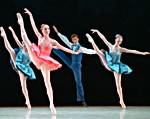
Jeffrey Graham Hughes’ “Ballet Ramajay” received its world premiere as the finale of the program. Danced to a combination of sprightly, reggae, contemporary music performed by the excellent University of Akron Steel Drum Band, the choreography fit the music well. Though at times there was a lack of coordinated timing in the dancing there was enough creativity to make up for the minuses. A.Christina Giannini’s costume design was wonderful. The dancers flashed across the stage in multi-colored creative pieces of material. Hughes did an excellent job of coordinating the movements to the sounds. The highlights were “The Girl From Ipanema”a sprightly interpretation by Amanda Cobb and Toby George, and “Six Dances in Bulgarian Rhythm” finely performed by Ashley Bowman and Damien Highfield.

CAPSULE JUDGEMENT: Ohio Ballet’s “Fall Repertory Program” was a fine evening of dance. Let’s hope that future programs live up to this.

La Bayadere--Kirov Ballet (Playhouse Square Center)


Prestigious Kirov Ballet not up to par at the State Theatre

The Kirov Ballet of St. Petersburg, Russia is truly one of the world’s class dance organizations. For more than 200 years the company has performed with excellence, no matter the political climate of the country. It is the company that probably, more than any other, conceived what we know as classical ballet. Their traditional moves, costumes and story line development is the model for what other companies do if they want to emulate the established pattern of excellence. This is the company that produced such luminaries as Rudolph Nureyev and Mikhail Baryshnikov.

It is fortunate that the company has 130 dancers as they experienced a series of problems as they headed for their Cleveland performances. Injuries and dancers going with other companies resulted in our area not seeing the Kirov at its best. I saw the Saturday night performance of ‘LA BAYADERE.’ It lacked excitement. The lead dancers had no charisma. The cast, at times, seemed to have been walking through the performance. It was too bad as the productions, fanned in part by the large local Russian immigrant audience, had near full-houses.

Even with the second-team performers, anyone having viewed the productions was immediately aware of the differences between contemporary ballet and the traditional style. Exaggerated hand movements, bigger than life facial and body reactions, and posturing were seen throughout. Like classic opera, realism is not the issue, visual imagery is.

The most spectacular segment of the production took place during Act III, “The Kingdom of Shades.” A line of thirty female dancers on point dressed in white tutus, wove their way one at a time down a series of ramps. The effect was breathtaking.

Capsule judgement: The Kirov Ballet was not up to its prestigious reputation in its presentation in Cleveland

Sunday, November 09, 2003

Carole Clement reviews the reviewer

To: Roy Berko
From: Carole Clement
Subject: review: Discordia (CPT)

Roy--

I was at CPT Friday, and sadly, I must agree with everything you wrote in your
review--and perhaps more. Other reviews that are coming out today are
vicious. Essentially, they say what you said, but with venom & personal
attacks against actors. Their reviews are so mean-spirited that it's easy
for those involved with Discordia to deny them.

And that's a shame, because there is some truth in those reviews.

While the Discordia company isn't happy about what you said, they aren't
dismissing it out of hand, & that's because of your measured & tempered
evaluation. You are an asset to the Cleveland theater scene & a credit to
thoughtful humanity.

Thanks for being there.

Carole

Wednesday, November 05, 2003

Varla Jean Merman (Cleveland Public Theatre)


VARLA JEAN MERMAN WAS BACK AT CPT

Varla Jean Merman is a sensation on the drag queen impersonation circuit. Her third appearance at the Cleveland Public Theatre, like her other stays-in-residence, delighted the audience.

Her signature shticks: the hot dog puppet that speaks, singing while shooting canned cheese whiz down her throat, her double entendre tales, her allusion to being the daughter of a moment of wild passion between Earnest Borgnine and Ethel Merman, and the home movies of her life, were all present.

I know it’s not her purpose, but sometime I’d really like to hear Jeffery Roberson, who portrays Varla Jean, just stand on stage and sing. This guy/gal has a wonderful voice. But, like the late Victor Borge, who was an accomplished pianist, Roberson has chosen to settle on comedy as his vehicle to fame. And, there is no doubt he has found a positive means of showcasing himself. Varla Jean Merman makes for a fun evening of theatre.

Capsule judgement: Next time Roberson is back in town, catch his act. You’ll enjoy yourself.

Thoroughly Modern Millie (Playhouse Square Center)


‘THOROUGHLY MODERN MILLIE’ less than expected

At the 2002 Tony Award ceremony when ‘THOROUGHLY MODERN MILLIE’ was announced as the winner of the Best Musical there was an audible gasp in the audience. It was expected that ‘URINETOWN’ was going to receive that coveted award. Clevelanders who subscribe to the Playhouse Square Broadway series will be allowed to make the evaluation themselves.

Having seen both shows, I know that I would have definitely chosen the creative, tune-worthy, staging-worthy ‘URINETOWN.’ I find MILLIE to be a pedestrian musical with a weak book, a weaker score, and repetitious music. That is not to say audiences will not like it. They will, as was demonstrated by the partial standing ovation the show received at its opening performance in the local run. Of course, standing ovations in Cleveland are not symbols of great shows or performances as they’ve become as common as clapping.

Based on the 1967 movie of the same name, the hokey story-line of Millie centers on the arrival in New York of a Kansas “hick” named (no surprise here) Millie. In contrast to the lead character in ‘42ND STREET,’ the musical most like MILLIE, this cutie is out to get a husband, a rich husband. Millie accidentally runs into Jimmy, a handsome young man, while she is chasing a thug who has stolen her purse and a shoe. (Yes, one shoe. Now do you understand the hokeyness of this story?) He is some “poor” guy who doesn’t fall into her description of a future husband (well, not yet). Through a series of incidents which include a kidnapping ring who capture orphan Caucasian young ladies and ship them to the Orient (I told you this was hokey), a young debutante from “California” (the quote marks because, of course, that is not true and unravels as the story proceeds), a pair of Chinese who are working as part of the kidnapping ring because they have been promised if they cooperate their mother will be brought to the US (can you believe that one?), a famous African American female singer who married for money, and...well, you get the point. This goes on and on and on and doesn’t get any better.

Songs from the show include “The Nuttycracker Suite,” “Only in New York,” “Forget About the Boy,”and the four-time reprised “Not for the Life of Me.” Never heard of any of them? That about summarizes the score. Oh, yes, there is the title tune, “Thoroughly Modern Millie,” and though it is included, it wasn’t even written for this show, as were three other numbers that are included.

The cleverest parts of the show are when there are actually take-offs of other musicals and songs. A Chinese version of Al Jolsen’s “Mammy” and a Nelson Eddy, Jeanette MacDonald-like duet of “I’m Falling in Love with Someone” are delightful. Of course, they have nothing to do with the story line, but who cares. Another “neat-o” shtick is a screen over of the actors’ heads, which displays the English translations of spoken and sung Chinese. It’s like the Cleveland Opera telling us what the words to ‘CARMEN’ mean.

The touring production doesn’t use the State Theatre stage well. They usually perform in smaller venues, so the scenery and movements scrunch in the action. The postage stamp design doesn’t work well.

Even the dancing fails to make an impact. Though enthusiastically carried out by the cast, the movements become boring due to repetition. How many flapper hand and foot movements can one appreciate?

The cast is adequate. Darcie Roberts as Millie has a wonderful voice, but not the infectious personality and cuteness that is needed to captivate an audience. Matt Cavenaugh is handsome enough to portray Jimmy, and his voice has good range, but a false attitude takes the edge off the character. Diana Kaarina as Dorothy is Bernadette Peters cute and has a similar voice. Hollis Resnik’s Mrs. Meers, the head of the kidnapping ring, becomes more and more irritating as the show progresses. On the other hand, Pamela Isaac, as the rich chanteusse, has a wonderful voice and belts “Only in New York” with pizzazz.

CAPSULE JUDGEMENT: ‘THOROUGHLY MODERN MILLIE’ is a pleasant-enough escapist piece of fluff. If you liked ‘42ND STREET’ you’ll like this. If not, wait for ‘URINETOWN.’ It’s a creative winner.

Monday, October 27, 2003

2 piano, 4 hands (Cleveland Play House)


Cleveland Play House hits right keyes in ‘2 PIANOS, 4 HANDS’

Alex Berko is 7 years old. He has had three piano recitals and has been asked to participate in a piano competitions. He has a bright future, right? Well, after watching Ted Dykstra and Richard Greenblatt’s ‘2 PIANOS 4 HANDS,’ Alex, and anyone else who has aspirations of being a top flight pianist, might have different thoughts. And anyone who has ever taken piano lessons, or knows anyone who has, will be carried back to those glorious (?) days.

Ted Dykstra and Richard Greenblatt are the subjects of their own play. They, in their own words, are “the best pianists in the neighborhood.” Neither of them started out that way. Much like Alex, as children they became fascinated with the piano, an instrument for which they apparently had great talent. As we follow their lives and careers in music we experience their musical journey from adolescence to adulthood. A journey that is filled with laughter, euphoria, pain and tears.

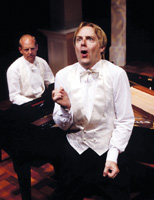
The CPH cast is composed of Mark Anders portraying Ted, and Carl Danielsen as Richard. The two are both excellent pianists and actors. Without such a talented cast, the play wouldn’t work. We need to see the two actually playing, mature through the years. Taped music just wouldn’t have done it. The playing of less accomplished performers also wouldn’t have worked. This is not a play that will be done by amateur groups. The whole task would be too daunting.

The audience is confronted by two grand pianos, nicely nestled in a room with plush royal blue walls and busts of Bach and Beethoven. Through flashbacks, we watch as the two are confronted by parents, teachers, professors and numerous others who invaded their real and musical lives. The two even musically and psychologically directly wrestle with each other at piano competitions and during their training.

The production is wonderful. It hits all the right keys. It is filled with great music, covering everything from Bach to Billy Joel, from Beethoven to jazz. The script, which centers around the music, allows us to experience the fun and pain of trying to achieve in the world of music.

CAPSULE JUDGEMENT: If you love classical music, if you appreciate fine performances, and are willing to expand your definition of what theatre should be, you’ll love ‘2 PIANOS, 4 HANDS.”

Groundworks Dancetheater--October, 2003 (Groundworks)


GROUNDWORKS DANCETHEATRE excites once again!

I was once asked by a reader of my reviews, “If you had only one entertainment event to attend, and wanted to be assured that you’d experience excellence, where would you go?” Without any hesitation I answered, “Groundworks Dancetheater.” Why? I have never attended a performance of David Shimotakahara’s dance troupe that has been wanting. David has the ability and foresight to be able to blend audience appeal, creativity, and constructive vision to insure an evening of entertainment. He has assembled a corps of dancers who buy in to his philosophy and enjoy working together and creating exciting and involving illusions for an audience. The company has been called intelligent, fresh and invigorating. It is that, and more!

Groundworks latest event was performed at St. Peter’s Church, in downtown Cleveland. It was part of the company’s Landmarks Series. These productions take place in settings not usually thought of as dance venues. Pilgrim Church in the historic Tremont district, the Icehouse in Akron, and St. Peter’s have all been enhanced with the company’s works. This format brings people to interesting locations in the community with the possibility of experiencing dance and music in new places.

The St. Peter’s program consisted of the wonderful “Major To Minor” in which a point and counterpoint of music and dancers were evident. Performed to five musical recordings of different moods and paces, Felise Bagley, Amy Miller, Mark Otloski and Shimotakahara, all classically trained ballet dancers, performed contemporary and modern dance movements with ease. They danced slowly to “I Wished on the Moon,” and let loose and had fun with “Peanut Vendor.” They used their bodies, the floor and a banana to captivate the sold-out audience.

“Lavender” was a musical interlude performed by Gaelyn Aguilar and Derek Keller. Though it was sometimes difficult to hear the words in the vast, highly arched cathedral, the emotional tone of the music was involving.

“Ephemeral,” precisely choreographed by Shimotakahara, and perfectly performed by Felise Bagley and Mark Otloski, was based on music composed and played by Gustavo Aguilar and Alan Lechusza. The audience, seating no more than twenty feet from the dancers observed powerful bodies performing slow controlled movements, with little physical contact, doing counter movements to the discordant sounds. The audience appeared awed by the performance and responded to the conclusion with long and continuous applause.

“Take 2,” in its Cleveland premiere, is a collaborative piece between the dance corps and the musicians. Developed through ongoing exploration, the piece’s open structure allows both dancers and musicians to improvise and react. The overall effect was a visual and emotional roller coaster ride which was met with appreciative audience response.

Capsule judgement: If you haven’t had the privilege of seeing Groundworks Dancetheater perform, do so!

Love of Mike (Cleveland Play House)


'LOVE OF MIKE' at CPH--performers outclass material

Want to produce a musical review? The songs are usually not the problem...they are readily available unless you are writing an all original score. You pick a theme, decide on what songs to do, and put them in an order based on the effect you are trying to achieve. Sounds easy? Nope! Musical reviews are hard devices to conceive. More miss than hit.

William Hoffman, the conceiver of ‘FOR THE LOVE OF MIKE’ now being staged in the Cleveland Play House Club, decided to do a musical celebration of a vaudeville life. He selected about 20 songs and conceived it as a tribute to Mike. He assembled a very talented cast, rehearsed the materials, and invited audiences to attend.

Audiences will hear some wonderful songs like “The Bowery,” “The Streets of New York,” and “Hard Hearted Hanna.”

Unfortunately, the evening doesn’t work very well. Much of the evening seemed forced. The script is so weak that the performers had to force-feed the notions to the audience, material which they didn’t appear to have much belief in. In addition, rehearsal time was obviously limited and the performers had to learn a lot of patter and unfamiliar songs such as “I’m Looking for Daddy Long Legs,” “Cleaning and Dyeing,” and “The German 5th.” (Yep, I’m not making these up.) Because of this there were lyric and line problems.

The cast, Greg Violand, Maryann Nagel, Kevin Joseph Kelly and Charles Eversole are all solid performers. Violand’s “That’s the Reason Noo I Wear a Kilt” is delightful. His voice soars in “I Belong to Glasgow.” Nagel and Violand are wonderful in “Yiddisha Nightingale” though at times Irish seems to creep into their Yiddish patter. The company does a rousing “Alabamy Bound” and “Are You From Dixie?” Kelly‘s “Oh What a Gal” was fun. Eversole plays the piano with pizazz.

CAPSULE JUDGEMENT: This is a very talented group of performers. I wish they had just stood and sung and forgotten about Hoffman’s attempt at creating a hat tree on which to hang the material. Shticks like “Cleaning and Dyeing” were close to embarrassing and the “surprise” ending was not clever. GO HEAR THE VOICES.

Forest City (Cleveland Play House)


Cast and staging outstanding in CPH's 'FOREST CITY'

When you attend a play, whether at a professional or amateur theatre, do you have any idea of the process that the playwright has gone through to get that script ready for production? Many people naively believe that a person sits down at a computer and spews forth a finished product. ‘Taint so. Scribing a play is usually an arduous task which requires writing and rewriting and rewriting. The process is often for naught as, in the end, in spite of valiant efforts, the script doesn’t work. It may not succeed because it just doesn't get the authors’ ideas across, or it doesn’t look and sound right on stage, or it is too complex to stage, or the audience doesn’t respond positively.

The Cleveland Play House is presenting the world premiere of ‘FOREST CITY,’ a play by Bridgette Wimberly. How did this script come to being? If typical, Wimberly had an idea. She, worked for a period of time to get the plot clear, the lines meaningful, the characters set and the production qualities clear. Then started her real work. A script on paper is not the same as one on stage. A reader can fill in the blanks, can imagine that which is and isn’t. On stage all of these things must be made crystal clear to hold the audience’s attention and allow each listener to gain the playwright’s intentions. What is most valuable to a playwright is to have the play staged in some way that the voice of the script can be heard. This “hearing” often takes place at a staged reading in which actors take the script and create an audio version. In some cases these readings are actually staged so the author can both see and hear the script.

Fortunately for Wimberly, for the last eight years the Cleveland Play House has produced the “Next Stage Festival of New Plays.” It provides a venue to a select group of playwrights to be allowed to see, hear and hone their scripts. And so ‘FOREST CITY’ was given the opportunity to go from childhood toward maturity. As my review of that first reading indicated, I felt that the script needed a lot of work. It was very long, very wordy, unfocused, lacked texturing. The play had requisite conflicts- infidelity, financial problems, illness, big business versus the citizenry, inner family conflict. It had an interesting idea that was based on a real series of incidents. To make it a viable script, it needed some heavy rewriting.

The tinkering has been completed. ‘FOREST CITY’ is being given a full-scale production at CPH. The redoing did wonders. The play has been tightened up, shortened, extraneous materials eliminated, and humor added. Unfortunately, Wimberly has still not decided on an ending. There are at least four conclusions that could be interpreted as, “okay, this is it.” The final, final one, is not the strongest. In fact, it changes the tone of the play and makes it almost hokey. If the play is going to be produced elsewhere, Ms. Wimberly is going to have to rethink the final several scenes by asking herself what message she really wants to leave with her audience. She also needs to ask why she introduces a child character near the end whose physical presence plays no real role in the play’s meaning.

The play is set in Cleveland in the late 1960s. Carl Stokes has become the first African American mayor of a major city, segregation is finally coming to an end, the Glenville riots have brought attention to the plight of blacks in the Forest City. We see it all through the eyes of the Taylor family: JT, his wife Sandra Mae, his mother and his half brother. JT is trying to fend for his family on a railroad day-laborer’s salary. The family lives in a home they purchased, and are fighting to keep. Though not much, it is theirs. A small black-owned and operated hospital wants to expand. To do so, they will need to tear down the family’s residence. The situation is complicated by the fact that JT’s half brother is a doctor on the hospital’s staff.

Seth Gordon, who is not only the director of this production, but the Director of New Play Development at CPH, has nurtured this script from its infancy to this staging. He has created a well-paced, creatively staged, generally well-acted show. He has keyed the laughs and has stressed empathy in the right places.

The cast is universally excellent. Margaret Ford-Taylor, as Mother Taylor milks the role for all it is worth. She has excellent comic timing and builds the emotional levels with ease. Her role of “witch doctor,” family center and peacemaker are clearly developed.

Caroline S. Clay, as Sandra Mae, shows the pain of a wounded woman with much clarity. Johnny Lee Davenport gives us a JT that is both strong and weak. He clearly shows us the hard head and the soft underbelly.

Wiley Moore, as the doctor brother, could have textured his performance more. His sometimes monotone presentation and lack of facial expression makes him appear to be less than involved in the goings-on. Count Stovall, though having line problems, gives a clear picture as an old-time doctor whose dreams have been overshadowed by the times.

Scenic designer Beowulf Boritt has been forced to create a set that must reveal many settings...porch, living room, bedroom, doctor’s office, banquet hall lobby, staircase and dock. To do this he has created an impressive complex piece of work on a turntable and moving platforms. It works moderately well though the action is often slowed down by all the changes.

CAPSULE JUDGEMENT: ‘FOREST CITY’ is worth seeing. As a former dramturg for the Festival, I would urge Ms. Wimberly to keep working on the script. That additional tinkering could result in a modern day “A Raisin in the Sun.”

Saturday, October 25, 2003

Tartuffe (Great Lakes Theatre Festival)


'TARTUFFE' delights, Andrew May is wonderful at Great Lakes Theatre Festival

Based on his spoken belief that, “The most effective way of attacking vice is to expose it to public ridicule” Moliere, considered to be France’s greatest dramatist, laid the foundation for his revered farce, ‘TARTUFFE.’ The play, which is also known as ‘THE HYPOCRITE,’ relates the story of an attempt by Tartuffe, a scheming hypocrite, to destroy the happiness of Orgon, a well-to-do Parisian householder. Orgon is so deceived by the villain’s manipulations that he makes Tartuffe the master of the house, including promising the marriage of the charletan to Marianne, Orgon’s daughter. The play illuminates how right wins out over wrong through a series of hysterically funny scenes.

Though the approach may seem time-worn by modern day standards, when Molliere crafted this work, he was assailing Parisian foibles in a new theatrical mode. The play, which now seems delightfully harmless, incited some theatre-owners to ban it from production. That withstanding, Moliere has drawn admiration few dramatists have equalled. He has developed characters like Orgon and Tartuffe which are considered to be classically crafted. His works, along with Shakespeare’s, have stood the test of time and have become classics.

Drew Barr, except for a casting error, has created a fine production. The pace, keying of laughter, and the creation of visually pleasing stage pictures is well done. The epitome for setting the farcial tone was Scott Plate’s heaven-sent entrance as the King’s soldier, complete with fanfares and billowing smoke and a long, elegant march down the staircase.

Little did Moliere know, when the play was produced for the first time at Versailles in 1664 that an Andrew May would come along in a 2003 production of ‘TARTUFFE’ at the Great Lakes Shakespeare Festival to make his Orgon everything that the writer intended. No one--repeat--no one can play farce better than May. He makes an art form of mumfering, fumphering, bulging out his eyes, getting caught in mid-word stutter, and displaying enormous pain in the most hysterical of ways. He does it with ease and naturalism. This is not acting a role, this is May being Orgon. If you loved May in the Cleveland Play House’s ‘I LOVE HAMLET’ several seasons ago, you will fall in love with him all over again in ‘TARTUFFE.’ May is nothing short of astoundingly outstanding. Applause, applause, standing ovation!

Laura Perrotta as the sharp-tongued maid, Dorine, is a perfect foil for May. She inserts all the right pins to set him off in anguish. This is Perrotta at her finest!

Aled Davies is delightful as Cleante, Orgon’s brother-in-law who can’t say anything other than with pompous long-windedness. Paula Duesing, as Orgon’s mother, gets caught in the rhyming trap of stressing beat and cadence rather than meaning in her early speeches, but recovers well, speaking ideas as the play progresses. Sara M. Bruner, who has made a career of playing “sweet young things,” is a very competent sweet young thing, once again, as Orgon’s daughter Mariane. Wayne Turney is delightful as the bailiff. He gets the most out of a brief appearance.

Steve Tague feigns Tartuffe. As the gentlemen sitting behind me said at intermission,” “Come on now, how could Orgon be fooled by that obvious act being put on by Tartuffe?” Right on, fellow theatre-goer. Tague’s was an all surface portrayal with little texture. Left to Tague’s sole performance, ‘TARTUFFE’ would have missed the mark as much as ‘HAMLET’ did when he failed to well-develop that lead role. But, fortunaely, an otherwise strong cast saved the day.

Gage Williams scenic design and Kim Krumm Sorenson’s costumes aid greatly in creating the right illusions.

CAPSULE JUDGEMENT: ‘TARTUFFE’ is a “go see.” You get to experience Andrew May in action, while also enjoying one of the great comedic plays by one of the world’s greatest writers in a solid production.

Sunday, October 19, 2003

Discordia (Cleveland Public Theatre)


'DISCORDIA' in world premiere at Cleveland Public Theatre

Creating a musical from scratch is a daunting task. Musical theatre is the most complex of the arts. It combines the format of a drama or comedy. It requires music, much like a symphony or band. There are the lyrics, the words to the songs, much like a pop or country singer needs. Choreography parallels the part of musicals that make it like ballet or modern dance. Art in the form of sets and costumes is also needed. Then, the production must be staged using actors to create characters and develop the intent and purpose of the creators and a band or orchestra must be rehearsed.

It is amazing that so many musicals get written and staged.

‘DISCORDIA,’ in its world premiere at Cleveland Public Theatre, is the brain-child of James Levin and Linda Eisenstein. According to the theatre’s public relations notes, ‘DISCORDIA’ tells the story of the innocent Percival as he searches for the Holy Grail, trying to do good in dangerous, confusing times. It is billed as an “astutely observed political satire.”

The production introduces the audience to the necessity for delivering democracy to all the world, the role of God and prayer, toxic waste and the environment, a country in disarray, the role of the drug industry in controlling prices, weapons of mass destruction, the Arabic fatah, Human Rights, big business as our savior, “protecting” countries even if they don’t want the protection (think Iraq and Afghanistan), right wing pseudo manners, and the philosophy of spending as a requirement to national success. Also touched upon is the question of whether the leader, King Arthur in this case, has limited intelligence. There is a rebuke of a political party for having control of the Presidency, the House and Senate and for not taking advantage of their chance to make a difference, (Think Clinton and universal health care.) And then we encounter a search for a Knight to lead us out of our present abyss. (Think the present race for a Democratic candidate.) The story asks who the grail serves, who benefits from the “things,” the money, the requirement to spend, spend, spend. The concept centers on the constant chanted mantra, “Arthur, God, Shopping.”

Sound like a lot to cover in two and-half hours? It is! The story line covers so much that it doesn’t take time to develop any of them in depth, often leaving the audience tired and confused.

Linda Eisenstein’s music is excellent; however, it too covers too much of the musical spectra. The musical sound of ballads, chanting, folk songs, blues, vaudeville patter and rock are all presented. Her strength is the ballads. Songs like “Mother, I Found My Calling,” “The Presence of the Grail,” and “Take Off Your Armour” are excellent. “Whom Does It Serve” is probably the best message song in the score.

Director Raymond Bobgan, who staged last year’s Times Tribute Award production of “Tibetan Book of the Dead”has added some excellent production qualities . Unfortunately, because of the expanse of the play, even Bobgan loses his course.

The cast is uneven. Alison Hernan as Morgan Le Fay, who offers the perspective on the play, has both a powerful singing voice and develops a clear character. Perren Hedderson as Percival, who is on a quest, has a very pleasant singing voice and the physical attractiveness and acting ability to play young leading man roles. (Think ‘PIPPIN’ and ‘JOSEPH AND HIS TECHNICOLOR DREAMCOAT.) Amiee Collier as Percival’s lady love has a very nice singing voice. Jill Levin as the announcer and our guide through the maze of ideas, speaks and sings well. The choral sounds are fine. Much of the others are just not up to the task of grasping their characterizations and singing their roles.

Michael Flohr’s music direction is on target. His musicians don’t drown out the singers and are musically competent. Trad Burns’ scenic design works well considering the number of settings that are required. Inda Blatch-Geib’s costumes leave much to be desired except for Hernan’s excellent clothing. The designs are often unflattering on the female body types in the production.

CAPSULE JUDGEMENT: ‘DISCORDIA’ is a gallant attempt at developing a musical. Unfortunately, it just has too many problems to work in its present form. It is not unusual for authors to relook at and rework their material to make it successful. Let’s hope that that’s the case with ‘DISCORDIA.’

Boy Gets Girl (Beck Center)


'BOY GETS GIRL' captures audience at Beck

In spite of the title, don’t go to see Beck Center’s production of ‘BOY GETS GIRL’ expecting to see a TV-sitcom-like escapist piece of fluff. The play definitely is not fluff. It is a revealing, upsetting, involving investigation of how a woman’s life is quickly destroyed by a disturbed admirer. It is a suspenseful tale about the unraveling of a strong woman’s sense of security.

At the start of the play, we meet Theresa Bedell, a successful thirty-something magazine writer as she encounters Tony, with whom she has been fixed-up on a blind date. It appears that we are in for a boy meets girl, boy likes girl, girl disses boy, boy pursues girl, and that’s it. But, since the boy is a psycho and can’t take “no” for an answer, we watch in horror as boy stalks girl, threatens girl, and finally causes her to give up all she has, including her name, to hopefully get rid of him. This is definitely a case of bad winning out over good.

Time Magazine called Rebecca Gilman’s ‘BOY GETS GIRL’…gripping and important—the finest, most disturbing American play in years!" The review was right on.

Beck’s production is absorbing. Director Sarah May has honed in on the intent and purpose of the play and has given her cast a clear course, though there was some audience confusion at the end of the play when they were unaware that the experience was over until the cast came out for the curtain call. Except for that, everything works...Don McBride’s set, Casey Jones’ sound design, Jeff Lockshine’s lighting, and Jenniver Sparano’s costumes, all enhance the performances.

Elizabeth Ann Townsend, known locally and nationally for her acting excellence, doesn’t play Theresa, she IS Theresa. She textures the role with physical and vocal scoring that makes us suffer with her.

How the audience didn’t boo loudly when Paul Kaiser, who plays Tony, came out for his curtain call, I’ll never know. Kaiser was so despicable that it was impossible to not believe that he was the “sicky” that he was portraying. Boo, Tony! Hurray Paul!

Robert Hawkes as Theresa’s boss, James Savage, Jr. as a young reporter, Besty Kahl as the ditzy secretary, Rose A. Leininger, as the policewoman assigned to Theresa’s case, and Donald Krosin, as a sleazy X-rated film producer, are excellent.

As you walk into the lobby of Beck Center for the Arts on the way to see ‘BOY GETS GIRL,’ you will be confronted by a series of t-shirts. These clothing items are not for sale. They are part of The Clothesline Project, a visual display of T-shirt that bear witness to violence against women--stalking, rape, incest, battery, withheld love. These are memorials and memories of clients and their families as accumulated by the Lorain County Rape Crisis Center.

READ EACH AND EVERY ONE OF THE INSCRIBED PIECES BEFORE GOING IN TO SEE ‘BOY MEETS GIRL.’ It will make an intensely important play even more vivid.

CAPSULE JUDGEMENT: Sarah May has crafted an involving production of Rebecca Gilman’s emotional revealing play. If you have space on your calendar fill in ‘BOY MEETS GIRL’ in the spot. You won’t be disappointed.

The Domino Heart (Dobama)


Dobama's 'THE DOMINO HEART' is a must see!

Dobama Theatre’s production of Matthew Edison’s ‘THE DOMINO HEART’ is everything good theatre should be. The play is well written and carries a potent message. The acting is superb. Joyce Casey’s directing is concept perfect.

Interestingly, the script is everything that they teach a scribe never to do in playwriting classes. The script is made up completely of monologues. The actors never appear on stage at the same time and never directly interact with each other. To add to the unusual concept, there is no action, little humor, and no great dramatic scenes. It is a quiet play.

In an interview about the script, which he wrote in 10 days, Matthew Edison indicated that he sees “the monologues not as undramatic declarations but as the sort of inner dialogue we all experience when trying to work out an emotional problem.” He went on to say, "I used to be quite surprised how close you can come just using imagination and common sense." Because of the way the play unfolded in the writing process, Edison, whose original intention was to make this a traditional interactive script, fortunately never rewrote it.

The ‘DOMINO HEART’ consists of three characters connected to each other by one transplanted heart. There's a grieving and conflicted woman whose husband has been killed in a car accident, a well intentioned reverend awaiting the heart salvaged from the crash, and a souless, almost heartless ad executive who gets the vital instrument through the domino process in which, if the original transplant doesn’t work, the organ is passed along to another patient.

The play's central symbol offers plenty of opportunity to deal with emotions, love and other matters of the heart. In one particularly effective section, the reverend describes a volunteer program to help babies born with drug addictions. They're soothed by strangers who hold them close to their hearts.

A review of the play’s first performance, which took place in March of 2003 states, “You know you're watching something special when 90 coughless, fidgetless minutes go by as quickly -- to borrow an image reworked in Matthew Edison's luminous first play -- as a heartbeat.” The same can be said of Dobama’s U. S premiere production. It appears effortless. It flows, you become involved, the actors aren’t acting, they are speaking to you. You get entrapped in the experience.

Edison's words are performed by a trio of actors who couldn't be better. Carla Dunlavey, as the wife who is emotionally ripped apart by her role in the events leading up to her husband's death, presents a perfectly textured performance. We feel with her, we mourn with her, we wish things could be different. She has total control of the character.

The veteran Glenn Colerider, who is noted for his fine acting, outdoes himself as the Reverend.

Fabio Polanco as the self-destructive ad exec horrifies us with his dead-eyed, seen-it-all smugness that hides his real fear. As he writhes on the floor in emotional and physical pain we don’t know whether to rush up and help him, or hate him for receiving a heart that could have gone to someone who deserves it, would value it, would give it purpose.

CAPSULE JUDGEMENT: Dobama’s production, under the deft guidance of Joyce Casey, is quiet but powerful. It will stay with you long after you leave the theatre. Put this play and production on your must see list!

Monday, October 13, 2003

Hamlet (Great Lakes Theatre Festival)


'HAMLET' somewhat unfulfilling at GLTF

Since it was first performed in 1603, ‘THE TRAGEDY OF HAMLET, THE PRINCE OF DENMARK’ has been credited as being the best English-language play ever written. Due to its complex themes and multi-layered text it has received a great deal of analysis. Some of that analysis, however, doesn’t agree with your high school English teacher’s view of the play’s greatness.

As T. S. Elliot once wrote, “So far from being Shakespeare's masterpiece, the play is most certainly an artistic failure. In several ways the play is puzzling, and disquieting as is none of his others. Of all his plays it is the longest and is possibly the one on which Shakespeare spent most pains; and, yet, he has left in it superfluous and inconsistent scenes which even hasty revisions should have noticed.”

Besides the play itself, the character of Hamlet is considered one of the most compelling ever written. The part has also been subjected to numerous interpretations and studies, his thoughts analyzed and reanalyzed. As with the play, there are arguments concerning the quality of the way the character is conceived. Most of Shakespeare’s major characters are clearly crafted, their motives clear...think Macbeth, Lady Macbeth, Iago. This is not the case with Hamlet.

The Great Lakes Theatre Festival has decided to undertake ‘HAMLET’ as the opening show in their “new/old” schematic. GLTF has reestablished itself as a repertory company after abandoning the pattern 18 years ago. Repertory centers on hiring a company of actors who perform different plays in tandem with the performers playing different roles from night to night. For example, the same actors will appear in ‘TARTUFFE’ which opens October 18. Andrew May, who is the Ghost in ‘HAMLET’ is Orgon in ‘TARTUFFE.”

This concept is exciting for Clevelanders as Charles Fee, GLTF’s Producing Artisitc Director, has employed many local artists who have sporadically been employed since the Cleveland Play House abandoned its company of actors. It’s nice to see names like Scott Plate, Laura Perrota, Wayne Turney and Paula Duesing in the cast.

GLTF’s three-hour production lacks texturing and effective pacing. Director Fee has decided to make sure that the audience grasps each word. To achieve this he has slowed down the speech and actions which makes the production flat. It lacks excitement. This will be great for the school groups who attend as they will have no difficulty in grasping the words, but it doesn’t make for compelling theatre.

Though the audience hears the words, it is nearly impossible to feel much toward the characters, and this is a play that is character driven. Is Hamlet crazed, crazy, demented, deranged? Is he motivated to get revenge for his father’s murder or obsessed by his need for attention? What are his real feelings toward his mother? Toward Ophelia? Steve Tague, in the lead role, looking demonic with his goatee, mustache and shaggy black hair, lacks the fire to give us the needed clues. Even the famous “to be or not to be” speech lacks clarity....what’s the motivation for those words?

Wayne Turney is delightful as Polonius, the Councillor of State and later as the gravedigger. Sara Bruner’s Ophelia is beautifully vulnerable. Her underplayed crazed scene, caused by the murder of her father and rejection by Hamlet, is one of the play’s highlights. Scott Plate plays Horatio, Hamlet’s friend with compassion.

Aled Davies is not evil enough as Claudius, Hamlet’s uncle and killer of his father. We need to hate him, he gives us no reason to react to him in a negative way.

Fee’s use of music to highlight scenes and the creative use of scenic staging devices are excellent. Rick Martin’s lighting and Gage Williams sets enhance the mood of the production.

CAPSULE JUDGEMENT: ‘THE TRAGEDY OF HAMLET, PRINCE OF DENMARK’ at GLTF lacks the excitement, pacing and clarity needed to make this a major classic production.

7 BL*WJ*BS (convergence-continuum)


Convergence-continuum presents another Wellman play

I’ve always believed that the value of any of the arts was in the mind of the beholder. While one person might think of Jackson Pollack’s paintings as random purposeless blots of paint, others will wax eloquently about Pollack’s creativity. Phillip Glass’s atnonal music is like the scratching of fingernails on the blackboard to some and engrossing to others. The same is true of theatrical scripts and productions. Not everyone agrees on what is great theatre.

Convergence-continuum is in a run of Mac Wellman’s ‘7 BL*WJ*BS.’ The theatre’s Artistic Director Clyde Simon is an admirer of Wellman’s works. He loves the writers“unconventional material and characters.” I, on the other hand, am not a fan of Wellman’s creations.

Last spring I revealed in a review of the theatre’s production of ‘SINCERITY FOREVER’ that Wellman purports that, “It is not interesting at this point in human time to portray the real world as it seems to be in its own terms; but it is interesting to unfold, in human terms, the logic of its illogic and so get at the nut of our contemporary human experience.” I stated, “The production of ‘SINCERELY YOURS’ is outstanding. It far surpasses the quality of the wordy play.”

My reaction to ‘7 BL*WJ*BS’ is exactly the same...good production of a script that is of questionable value. I don’t think Wellman said anything that hasn’t been said before, often better. And, I also think that Simon’s directing was right on target.

Audience members were also of mixed mind. At intermission, some of the audience disappeared. During the production some laughed hysterically, many others, myself included, were more restrained. At the curtain call while some screamed and applauded, others clapped politely.

I’m not the only theatre critic who responds negatively to Wellman’s work. One states, “Mac Wellman's ‘7 BL*WJ*BS’ attempts to poke fun at right-wing prudes but its thin, repetitive script doesn't stand up for the play's entire two-act length.” Further comments include, “Unfortunately, the play doesn't rise to the promise of its initial concept.” Another intones, “The play's badly overworked main joke is stretched from the two minutes it's worth to two acts.”

That said, what’s the play about? The plot centers on what happens when a right-wing senator's office receives a package of seven indecent pictures. Gawking disapprovingly at the scandalous pictures, the senator's staff are later joined by the senator and a religious leader who continue to discuss the pictures. We are exposed to the scandals, religious influences on decision making, corruption in government, and pseudo attitudes of both conservatives and liberals in our government.

The cast is quite good, especially given what they have to work with. Especially strong are Chuck Richi as the Senator, Cliff Bailey as Reverend Tom, and Brian Breth and Lauri Hammer as two of the staff members.

CAPSULE JUDGEMENT: If you like Wellman’s writing style you will have yet another chance to experience it when convergence-continuum presents his script, ‘CLEVELAND’ in December. I’ll go because I really think Simon has a knack for directing Wellman’s work, but if the “plot” and the story development aren’t anything more than ‘SINCERELY FOREVER’ and ‘7 BL*WJ*BS,” I’ll again wind up applauding the actors and the production, but not the play.

Thursday, October 09, 2003

Les Miserables (Playhouse Square Center)


'Les Miserables' visits Cleveland, and wows the audience, once again

I have to admit it, I’m a sucker for ‘LES MISERABLES.’ It remains one of my very favorite musical theatre scripts, along with the likes of ‘FIDDLER ON THE ROOF,’ ‘WEST SIDE STORY,’ ‘CAROUSEL,’ ‘MY FAIR LADY,’ ‘PIPPIN,’ ‘THE KING AND I,’ ‘MAN OF LAMANCHA,’ ‘CHORUS LINE,’ AND ‘RAGTIME.’

It was, therefore, a little disappointing, that during the first act of the opening night performance of the present production, I found myself getting very antsy. All the elements were there...the full Broadway set with its awe-inspiring turntables and huge barricade and cityscapes, the marvelous costumes, a lush orchestra, fine vocal sounds, and the good singing voices of the lead characters. So, what was missing. I often found that the actors were singing words, not meanings of the words, some of the timing was off, such as in the usually raucous “Master of the House.” Fortunately, by the second act, the cast settled in, the pacing of the show picked up, and the audience got swept away. Whew!!

The musical is based on Victor Hugo’s epic and classic pre-French revolutionary war novel. It foreshadows what will soon happen in France. It asks, “What is the moral way to act?,” and how much do we have to pay for our small or large transgressions. Think of the television series and the movie, ‘THE FUGITIVE’ with music.

The story centers on Jean Valjean, who, at the start, is released on parole after 19 years in prison for stealing a loaf of bread to fee his ailing nephew. He finds that the yellow ticket-of-leave he must, by law, display condemns him to be an outcast. Only the saintly Bishop of Digne treats him kindly and Valjean, embittered by years of hardship, repays him by stealing some silver. Valjean is caught and brought back by police, and is astonished when the Bishop lies to the police to save him, also giving him two precious candlesticks. Valjean decides to start his life anew. The rest of the musical follows him through the rest of the his life.

Songs include the compelling, “Soliloquy,” the gorgeous, “I Dream a Dream,” the social commentary, “Who Am I?,” the enthralling, “Do You Hear the People Sing?,” the heart rending, “On My Own,” and the haunting, “Bring Him Home.”

Randal Keith, who was one of the many who played Jean Valjean on Broadway was outstanding. He has a big voice and clear grasp of the character. James Clow, portraying the policeman Javert who dedicated his life to finding and punishing Valjean, did not have the evil-edge needed for the role, though his singing voice was glorious. Amanda Huddelston, portraying Cosette, an orphan who Valjean adopts to be his daughter, has a fine voice but failed to get full worth out of her songs. She often overlooked the implications of the words she sang. Josh Young was appealing as Marius, Cosette’s lover and idealistic student. Ma-Anne Dionisio was voice and performance perfect as a street walker who loved Marius. Michael Kostroff got laughs as the innkeeper, but was far inferior to most who have played the roll. The children in the cast were weak in both singing and acting.

Capsule judgement: Missed “Les Miz” this time around? Don’t worry, if the past is prologue, it will tour through town again.

Saturday, October 04, 2003

Romeo and Juliet, the ballet (Ohio Ballet)


Pleasing ‘ROMEO AND JULIET’ by Ohio Ballet

Shakespeare’s ‘ROMEO AND JULIET’ is the classic love story. It contains unrequited love, passion, conflict and pathos. It has been translated into many forms. Plays, films, even a musical (‘WEST SIDE STORY’) have told and retold the story. It has also been done in various dance forms, including a ballet with lush music by Segei Prokofiev. The latter was recently performed by the Ohio Ballet at the Ohio Theatre as the company’s season opener. The performance will be repeated on October 10 and 11 at E. J. Thomas Performing Arts Hall in Akron (Friday and Saturday at 8:00 p.m. and Saturday at 2:00 p.m.).

Though the OBT production can never be compared to that performed by the Bolshoi or other world class companies, it is a very pleasing, enjoyable and nicely created piece.

Choreographer Bengt Jorgen, artistic director of Ballet Jorgen Canada, decided to do a traditionally costumed, but modern balletic interpretation of the piece. Thus, the story seems more accessible and easier to follow than more classical versions. Jorgen’s gymnastic, interactive, often tense, often humorous choreography allows the performers latitude to create characters, thus forcing the performers to be actors as well as dancers. Some of the corps is capable of the necessary stretch, others are not so adept.

Alicia Pitts is glorious as Juliet. She is young, childlike without being childish, and dances with style and ease. She appears to float as she moves across the stage on toe. She partners well with her Romeo. Most impressive is her acting ability. She goes from glee to being forlorn, from indifference to love, with ease. This is impressive, very impressive!

Young Eric Carvill is more than adequate as Romeo. Last year, in a review of the OBT, I indicated that Carvill had grown in his short tenure with the troop. I never dreamed that he was ready to play the lead in a full-length story-line production. In a world class company, he wouldn’t have had the opportunity. At OBT, where except for Brian Murphy, who is too old to play Romeo, there is no stellar male dancer, he was the right choice. Carvill danced well, was properly youthful, partnered superbly. His major problem was his lack of character development. He showed few mood changes. His face was generally static. Smiles appeared not to be part of his acting repertory. His was a case where an acting coach, to supplement the dancing direction, was needed.

Toby George, a newcomer to the OBT corps, danced Mercutio with style. He was especially proficient in the comic scenes. He is a welcome addition to the troop and it can only be hoped that with more experience he will control his tendency to react in stylized movements and reactions and expand his dance proficiency.

Ashley Bowman as the nurse, Amanda Cobb as Lady Capulet, and Damien Highfield as Tybalt were all excellent.

The sword fight choreography was outstanding. On the other hand, the physical confrontations were marred by Jorgen’s annoying tactic of using and reusing two handed pushing as his major conflict vehicle. It often made the performers look like pre-schoolers on the playground.

The final dual-death scene is compelling. Romeo dances with the “dead” Juliet in his arms, then the format reverses as Juliet is revived from her coma-like state and caresses her lover. It is a fine, fine visual illusion.

Glenn Davidson’s set design is beautiful. It is made functional by choreographing set changes so that the staging flows smoothly. Unfortunately, his lighting design is not as successful. There are many dark spots on stage and, at times, lights seem to go on and off at whim, causing some confusing moments. Gary Dahm’s sumptuous costumes are era-correct and add greatly to the visual illusion of the ballet.

CAPSULE JUDGEMENT: ‘ROMEO AND JULIET’ was one of OBT’s better productions since the ascension of Jeffrey Graham Hughes to the role of artistic director.

Wait! (TITLEWave Theatre)


Acting in ‘WAIT!’ exceeds script

It seems ironic in this era when some local theatres are disbanding or cutting their seasons due to the financial crunch that a new performance arts company would blossom forth. Believing that Cleveland has a strong theatre tradition and had a need to enhance local offerings by prvoiding a place for new, untested plays to be produced, TITLEWave Theatre, the brain child of Gregory and Jean Marie Vovos, has emerged.

Having been the co-producer, along with Wayne Turney, of Lorain County Community College’s “New Ohio Play Festival,” I am aware of the difficulties of not only getting a new project off the ground, but of sustaining it. It can only be hoped that the Vovos’s adventure sails forth on a tidal wave of success.

They have chosen to mount Julie Jensen’s ‘WAIT’ as their first venture. Ms. Jensen has a Ph.D. in theatre and has taught playwriting at various universities including heading the graduate playwriting program at the University of Nevada, Las Vegas. It is there that Greg Vovos met her and decided to produce and direct one of her shows.

In spite of her credentials, if ‘WAIT!’ is typical Jensen, then there is much to be desired in her style. The play rambles, leaving the audience wondering what it is all about. Yes, the central character, Wendy Burger (yep, that’s her name), has a coming of age experience, but so what? If this is intended to be a play of character studies, only Wendy seems to be a complete character. All of the others are prototypes, paper cut outs of people. Do we really care about any of them? Carrying about, identifying with, feeling empathy toward the characters is the central building block of good theatre. This is almost missing in ‘WAIT!.’

In spite of the play, the production is worth seeing for the performances and Vovos’s directing skills. He gets everything he can from the script, plus some. He is aided by a very talented cast.

Jennifer Clifford is charming, sensitive, and endearing as Wendy, a shy young woman adrift, but focused on a career in the theatre. Randy Rollison transfers between three different characters with ease.

As Wendy’s loutish, hard drinking dad, he is Archie Bunker at his verbal worst. As Lu, a flamboyant gay theatre director, he is a mincing delight. As Hazar, a nasty, almost comatose foreigner, he is compelling. This is a fine performance.

Meg Chamberlin plays two roles with complete separation. Her Floating Pinata Head is a Kathryn Hepburn-type theatre diva on her worst day and her meat cutter Modesto is properly tramp-like.

Marni Task is endearing as the cheerleader/actress O Vixen My Vixen. She does, however, lose some of her appeal in the closing scenes of the play as she has trouble making the transitions between the air-headed teenager and the resigned-to-the realities-of-life woman.

CAPSULE JUDGEMENT: TITLEWave Theatre has undertaken an important task...to share with audiences new, untried plays. It is to be expected that they will experience highs and lows as they bring these untested works to the stage. If the production qualities of ‘WAIT!’ continue, audiences can look forward to high quality on-stage work in spite of potential script weaknesses.

Tuesday, September 23, 2003

Blue Sky Transmission: A Tibetan Book of the Dead


'BLUE SKY TRANSMISSION: A TIBETAN BOOK OF THE DEAD' fascinating at CPT

Every once in a while a very special event takes place in a theatre. It usually entails a theatre undertaking a subject or a script that takes the audience on a mythical journey into thought and introspection. It also requires that the production live up to the performance levels demanded by the script. Such an experience will be encountered by those lucky enough to get tickets to 'BLUE SKY TRANSMISSION: A TIBETAN BOOK OF THE DEAD' at Cleveland Public Theatre

Don’t let the title throw you. You don’t need to know about Tibetan Buddhist death processes. You just need to be open to see another view of life and death. You need to recognize that each process of dealing with death and understanding death is neither right nor wrong, it’s just different.

This is an intelligent probing into a sacred text that leads us to understand a soul seeking enlightenment. Don’t get the idea that you will understand everything. You won’t, but it will matter little. The whole is more important than the parts. As the script states, “Do not judge, do not try to understand.” It goes on to say, “Everything lies in the journey so don’t grasp at the destination.”

Raymond Bobgan, the director, who also served as the primary playwright, has honed a 90-minute intermissionless engaging experience. He has created a seamless production. He blended his cast, Lisa Black, Tracy Broyles, Kishiko Hasegawa, Holly Holsinger, Brett Keyser, Amy Kristina, Karin Randoja, Sophia Skiles, Rebecca Spencer, and Chi-wang Yang, into a coherent unit.

The entire production is supported by Hamlim El-Dabh’s music. Michael Guy-James has created a flower-like canopy that covers the stage which is surrounded on four sides by seats that stretch to four rows. The configuration allows each viewer to become part of the experience.

Capsule judgement: Near the end of the play several lines summarize the thought-invoking effect of the production. These include: “Do not waste the life to come” and “You are so lucky your pain is so much less than the world’s.”
Following its run in Cleveland the show will move to New York’s La Mama Theatre, ETC. for a four-week run. This is significant as CPT’s Executive Director James Levin began his theatrical career at La Mama and has modeled the local theatre after La Mama’s dedication to social justice issues and innovative live performances.

Stomp (Playhouse Square Center)


'STOMP' stomps the audience

What else can be said of an all-engrossing show that has won the Olivier Award for Best Choreography, the Obie Award, the Drama Desk Award for Unique Theatre Experience?

What else can be said about a show that has been playing to sold-out crowds for over nine seasons and continues to pack them in world-wide?

What else can be said about a show which is the longest-running show in Off-Broadway history and has been called “a sensory delight,” “amazing,” “a romp” and “a sure fire crowd pleaser.”?

‘STOMP’ which recently appeared on the stage of the Palace Theatre in Playhouse Square for eight performances, uses trashcans, plastic bags, plungers, hubcaps, brooms, water, poles, sand, mop heads, hatchet handles, and hammers, among others, to make sounds that inspire dancing feet, clapping hands, and an audience that scream for more.

Capsule judgement: If you missed the show in its latest return to the area, you missed a fun, exciting and amazing evening. Too bad...it was well worth your being there! Hopefully it will return again.

No Shirt, No Shoes, No Weapons of Mass Destruction (Second City)


The Second City matures well!!

The first show presented by Cleveland’s The Second City several years ago was an acceptable, if not totally satisfying production of improvisation and scripted humor. Their latest show, ‘NO SHIRT, NO SHOES, NO WEAPONS OF MASS DESTRUCTION, is much, much, much better.

The title may indicate that you’ll be hearing a lot of anti federal administration put downs. And, though that group in DC deserves it, they only get a small bashing. Most of the humor is aimed at Cleveland, but not the local politicians, with the exception of our own presidential candidate Dennis Kucinich. Too bad the cast wasn’t in tune with local goings-on like the convention center fiasco; Queen Jane’s do-nothing reign; the three stooges, otherwise know as the county commissioners; the pitiful Indians; the score-nothing Browns and the pre-LeBaronCavs. TV newsman Ted Henry did get his due, however.

What is presented is mainly funny stuff. Highlights included the group getting stuck on the elevator during the blackout, Giant Eagles push for getting people to sign up for bonus cards, being fixed-up on a date by one’s ever-present mother, life with a windup girl friend, the birth of a baby and his desire to return to the womb, the chat room date, the metrosexual, and an all guys weekend at a cabin minus the much needed beer.

Several weak segments slowed down the proceedings including a lame skit about a personal trainer, a totally misguided piece centering on a pool noodle which continued to surface in an attempt to get some laughs from the bad idea, a portion about an accountant, and a misguided smoking segment.

Only one of the original Cleveland cast remains. And, that one, Cody Dove, is still the strongest member of the ensemble. He frowns, grimaces, and looks spaced-out in the best of comedic ways. He delivers lines with the right punch. Don’t be surprised if you see him appear on “Saturday Night Live” where such Second City alumni as Dan Aykroyd, John Belushi, Gilda Radner, John Candy, Rick Morani and Martin Short eventually emerged. Yes, he’s that good. Lauren Dowden is also excellent. She adjusts well both physically and verbally to the goings-on. The rest of the local cast (Kiff Vanden Heuvel, Katie Caussin, Randall Harr, Nathan Cockerill) is fine, a long step up from most of the original local neophytes.

The first two acts of semi-scripted material is normally followed by an audience participation unit. It was disappointing that on opening night, that latter, popular and potentially funny segment, was omitted. This is where the viewers really find out, who is a quick thinker, who can hold his or her own in the midst of potential disaster. It can only be hoped that at future productions the improv segments are returned.

CAPSULE JUDGEMENT: If you were disappointed by previous productions, it is now time to return to THE SECOND CITY CLEVELAND and see the new, better version. If you liked past shows, you’ll love this one!