Tuesday, September 23, 2003

Blue Sky Transmission: A Tibetan Book of the Dead


'BLUE SKY TRANSMISSION: A TIBETAN BOOK OF THE DEAD' fascinating at CPT

Every once in a while a very special event takes place in a theatre. It usually entails a theatre undertaking a subject or a script that takes the audience on a mythical journey into thought and introspection. It also requires that the production live up to the performance levels demanded by the script. Such an experience will be encountered by those lucky enough to get tickets to 'BLUE SKY TRANSMISSION: A TIBETAN BOOK OF THE DEAD' at Cleveland Public Theatre

Don’t let the title throw you. You don’t need to know about Tibetan Buddhist death processes. You just need to be open to see another view of life and death. You need to recognize that each process of dealing with death and understanding death is neither right nor wrong, it’s just different.

This is an intelligent probing into a sacred text that leads us to understand a soul seeking enlightenment. Don’t get the idea that you will understand everything. You won’t, but it will matter little. The whole is more important than the parts. As the script states, “Do not judge, do not try to understand.” It goes on to say, “Everything lies in the journey so don’t grasp at the destination.”

Raymond Bobgan, the director, who also served as the primary playwright, has honed a 90-minute intermissionless engaging experience. He has created a seamless production. He blended his cast, Lisa Black, Tracy Broyles, Kishiko Hasegawa, Holly Holsinger, Brett Keyser, Amy Kristina, Karin Randoja, Sophia Skiles, Rebecca Spencer, and Chi-wang Yang, into a coherent unit.

The entire production is supported by Hamlim El-Dabh’s music. Michael Guy-James has created a flower-like canopy that covers the stage which is surrounded on four sides by seats that stretch to four rows. The configuration allows each viewer to become part of the experience.

Capsule judgement: Near the end of the play several lines summarize the thought-invoking effect of the production. These include: “Do not waste the life to come” and “You are so lucky your pain is so much less than the world’s.”
Following its run in Cleveland the show will move to New York’s La Mama Theatre, ETC. for a four-week run. This is significant as CPT’s Executive Director James Levin began his theatrical career at La Mama and has modeled the local theatre after La Mama’s dedication to social justice issues and innovative live performances.

Stomp (Playhouse Square Center)


'STOMP' stomps the audience

What else can be said of an all-engrossing show that has won the Olivier Award for Best Choreography, the Obie Award, the Drama Desk Award for Unique Theatre Experience?

What else can be said about a show that has been playing to sold-out crowds for over nine seasons and continues to pack them in world-wide?

What else can be said about a show which is the longest-running show in Off-Broadway history and has been called “a sensory delight,” “amazing,” “a romp” and “a sure fire crowd pleaser.”?

‘STOMP’ which recently appeared on the stage of the Palace Theatre in Playhouse Square for eight performances, uses trashcans, plastic bags, plungers, hubcaps, brooms, water, poles, sand, mop heads, hatchet handles, and hammers, among others, to make sounds that inspire dancing feet, clapping hands, and an audience that scream for more.

Capsule judgement: If you missed the show in its latest return to the area, you missed a fun, exciting and amazing evening. Too bad...it was well worth your being there! Hopefully it will return again.

No Shirt, No Shoes, No Weapons of Mass Destruction (Second City)


The Second City matures well!!

The first show presented by Cleveland’s The Second City several years ago was an acceptable, if not totally satisfying production of improvisation and scripted humor. Their latest show, ‘NO SHIRT, NO SHOES, NO WEAPONS OF MASS DESTRUCTION, is much, much, much better.

The title may indicate that you’ll be hearing a lot of anti federal administration put downs. And, though that group in DC deserves it, they only get a small bashing. Most of the humor is aimed at Cleveland, but not the local politicians, with the exception of our own presidential candidate Dennis Kucinich. Too bad the cast wasn’t in tune with local goings-on like the convention center fiasco; Queen Jane’s do-nothing reign; the three stooges, otherwise know as the county commissioners; the pitiful Indians; the score-nothing Browns and the pre-LeBaronCavs. TV newsman Ted Henry did get his due, however.

What is presented is mainly funny stuff. Highlights included the group getting stuck on the elevator during the blackout, Giant Eagles push for getting people to sign up for bonus cards, being fixed-up on a date by one’s ever-present mother, life with a windup girl friend, the birth of a baby and his desire to return to the womb, the chat room date, the metrosexual, and an all guys weekend at a cabin minus the much needed beer.

Several weak segments slowed down the proceedings including a lame skit about a personal trainer, a totally misguided piece centering on a pool noodle which continued to surface in an attempt to get some laughs from the bad idea, a portion about an accountant, and a misguided smoking segment.

Only one of the original Cleveland cast remains. And, that one, Cody Dove, is still the strongest member of the ensemble. He frowns, grimaces, and looks spaced-out in the best of comedic ways. He delivers lines with the right punch. Don’t be surprised if you see him appear on “Saturday Night Live” where such Second City alumni as Dan Aykroyd, John Belushi, Gilda Radner, John Candy, Rick Morani and Martin Short eventually emerged. Yes, he’s that good. Lauren Dowden is also excellent. She adjusts well both physically and verbally to the goings-on. The rest of the local cast (Kiff Vanden Heuvel, Katie Caussin, Randall Harr, Nathan Cockerill) is fine, a long step up from most of the original local neophytes.

The first two acts of semi-scripted material is normally followed by an audience participation unit. It was disappointing that on opening night, that latter, popular and potentially funny segment, was omitted. This is where the viewers really find out, who is a quick thinker, who can hold his or her own in the midst of potential disaster. It can only be hoped that at future productions the improv segments are returned.

CAPSULE JUDGEMENT: If you were disappointed by previous productions, it is now time to return to THE SECOND CITY CLEVELAND and see the new, better version. If you liked past shows, you’ll love this one!

Sunday, September 21, 2003

And The World Goes Round (Actors' Summit)


Actors' Summit presents pleasureable, but unpolished review

What do ‘THE HAPPY TIME,’ ‘ZORBA,’ ’‘CHICAGO,’ ‘THE RINK,’ ‘KISS OF THE SPIDER WOMAN,’ and ‘CABARET’ all have in common? Didn’t know the answer? Well, that’s not surprising. They are all musicals written by the team of John Kander and Fred Ebb, the best known musical writing team that you’ve probably never heard of. John Kander and Fred Ebb not only are one of the greatest songwriting teams on Broadway, but they presently are the longest-running music-and-lyrics partnership in Broadway musical history. Unfortunately, their names do not trip off the tongue like Rogers and Hammerstein, Sondheim, and Lerner and Loewe.

Their works have been blended together into the musical review, ‘AND THE WORLD GOES ROUND,’ now on stage at Actors’ Summit. This is a difficult review to get right. Kander and Ebb write complicated music. Many of their songs don’t do well out of their original plot-driven context and don’t seemlessly fit into the review context. Often their songs are long and strain the musical abilities of the singers. And their songs often require gimmickry, such as singing, dancing and acting while on roller skates, the hallmark of their ‘THE RINK.’

Actors Summit, the professional theatre located in Hudson, has put together an acceptable if unpolished production. Most of the cast just isn’t strong enough to carry the vocal requirements of the songs. Singers need full-ranges to sing the likes of “Colored Lights,”“Maybe This Time,” and “Kiss of the Spider Woman.” There is a vocal and physical sizzle that needs to be present in “All that Jazz.” “Marry Me” needs a special appealing approach. Unfortunately, these elements weren’t present. There was a need for masterful vocal blendings for ensemble numbers. Musical Director Michelle Makhlouf needed to spend more time working on vocal sounds and timing.

On the other hand, some things worked well. The songs “Coffee In A cardboard Cup,” and “The Grass is Always Greener” were delightful. Mary Jo Alexander’s set is beautiful.

Sasha Thackaberry, the show’s choreographer, wisely used mostly cross-over steps and wandering, with a limited kick-line thrown in. The attempts for more complicated and stylized movements were thwarted by the limited dancing abilities of the cast. The highlight of the movements was a rollerskating sequence from “The Rink.”

Director Neil Thackaberry has incorporated some clever staging gimmicks into the production. He also has added many set and props changes which slow down the flow of the show.

Tricia Bestic displayed a nice Liza Minelli-style voice and mannerisms. Her “And the World Goes Round” was very well done, as was “Isn’t this Better?.” Dana Hart won the audience with his rendition of “Mr. Cellophane” which was properly pathetic and endearing. Thomas R. Cummings and the audience had a ball chomping on “Sara Lee.”

CAPSULE JUDGEMENT: If you attend ‘AND THE WORLD GOES ROUND’ at Actors’ Summit expecting a polished, well-sung, well-danced review, you’ll be disappointed. If you go to just listen to some of the best music that has come from Broadway, you will have a pleasant time.

The Fix (Beck Center)


Astounding ‘FIX’ at Beck Center!

Several years ago I saw the Washington, D.C. Signture Theatre production of John Dempsey and Dana Rowe’s political musical, ‘THE FIX.’ The production won 10 Helen Hayes Awards, the DC area Tonys. I thought the production was very good, the script somewhat wanting.

Beck Center is presently staging ‘THE FIX.’ THE BECK PRODUCTION IS BETTER THAN THE DC STAGING!

In ‘THE FIX,’ the pillars of democracy are ready to collapse. These columns literally teeter as politicians, strategists, and mafioso scramble to win at any cost.

‘THE FIX’ follows the Chandler family, whose members seem to be a composite of the Kennedy dynasty and the Clinton clan. Before the musical has time to get past its first few notes, Reed Chandler, a front-runner for the White House, dies--while in the throws of having sex with his mistress.

We follow Chandler’s wife and brother as they plot to place Chanlder’s son, the wayward, pot-smoking son Cal, in his place. Cal surprises few by continuing to be the baddy, but gets away with it because of charm and “honesty.” The ending is right out of “The Sopranos.” The musical’s seriousness and the overblown premise doomed the musical when it was done last year in London.

The score could be called contemporary eclectic, drawing its inspiration from a variety of sources. There’s rock, pop, gospel, country and show-biz flash. Many of the songs are excellent.

Director Scott Spence has pulled out all the stops to make this a polished production that overshadows the quality of the writing. He is blessed with an astounding cast with singing voices that far exceed what is heard in local productions. There is not a bad voice in the ensemble.

Dan Folino, who found local fame, and won a Times Tribute Award as the lead character in ‘HEDWIG AND THE ANGRY INCH’ at Cleveland Public Theatre, is amazing as the son, Cal. This young man is everything you’d expect of a star...a phenomenal singing voice, acting finesse, good looks, and a sparkling personality. His may well be THE local musical theatre performance of the year!

The rest of the cast are also splendid. Paul Floriano as Cal’s crippled uncle is totally compelling. Watch for the name Matthew Wright in future local performances. This area newcomer plays Cal’s father. He has a powerful singing voice and acting ability to match. Jessica Cope has a dynamic voice and is completely believable as Tina, Cal’s mistress. Tracee Patterson is properly loathsome as Cal’s Lady Macbeth-like mother.

Don McBride’s excellent set design helps develop the plot. One can feel the pillars about to tumble around us.

The newsreel inserts which feature the likes of local newsman Adam Shapiro, added greatly to the realism of the show. Alison Hernan’s costumes aided in creating just the right visual images.

Larry Goodpaster has done a wonderful job as musical director. The vocal blends are excellent and the orchestra plays well and does not drown out the singing.

Unfortunately the lighting and sound didn’t work as well as the rest of the show’s elements. There were many dark spots on stage and the follow spot work was inconsistent. There were distracting audible thuds and fading in and out while lines were sung and spoken.

CAPSULE JUDGEMENT: ‘THE FIX’ is an outstanding production of a less than perfect script. Go see it to hear the wonderful voices, see the fine acting, and experience a wondrous performance by Dan Folino.

Sunday, September 14, 2003

Frankie and Johnny (Ensemble)


'FRANKIE AND JOHNNY' an outstanding, must see at Ensemble

Last year one of the biggest Broadway hits was a revival of Terrance McNally’s ‘FRANKIE & JOHNNY IN THE CLAIR DE LUNE’. It was produced by the wunderkinds of producers, Cleveland’s Hank Unger, Matt Rego and Mark Rego. The show starred Edie Falco (of “The Sopranos”) and Stanley Tucci. The original 1987 off-Broadway production featured Kathy Bates and Bruce Weitz in the title roles. A 1991 film adaptation called ‘FRANKIE AND JOHNNY’ starred Michelle Pfeiffer and Al Pacino. None of these stars has anything on Charles Kartali and Julia Kolibab, who are portraying the roles in Ensemble Theatre’s production.

‘FRANKIE AND JOHNNY IN THE CLAIR DE LUNE’ is a simple show about simple people in complicated times. In this age of bigger than life plays, movies which center on explosions, car chases, space shots and super heroes, this story of “little” people with real problems, is a totally different entertainment experience.

This is the story of a short-order cook and a waitress who purge their loneliness with a night of casual sex. When the sexual act is over, Frankie just wants to eat a cold meatloaf sandwich and go to sleep alone. However, Johnny would rather "bask in the afterglow" and spends the wee hours of the morning trying to convince Frankie that they have something special together. The resulting conflict contains laughs as well as dialogue that allows the audience to examine their own perceptions of loneliness, sex, love and what it means for people to connect.

This is a dialogue show, not one of action. In order for a production to work both characters have to be played with strength, control, correct timing and clarity. The director must have a complete understanding of the plays’ nuances. All of these are present in the Ensemble Theatre production.

Kolibab and Kartali are so comfortable and charming in their portrayals that audience members cannot help but empathize with them, feeling their pain and joy.

Kartali (Johnny)is absolutely endearing as he verbally and physically leaps from emotion to emotion, ever babbling, ever cajoling. He is totally natural, totally believable. This is a flawless performance.

Kolibab (Frankie) is his match. You feel her hurt, you feel her joy, you understand her motives. She adds a vulnerable reality to a performance that makes her and the character one.

Licia Colombi’s direction is probably the finest she has done. She understands the script, and her actors, and weaves the fine line between comedy and drama. The show is perfectly paced and the script well interpreted.

The set, as designed by Stephen Vasee, is totally functional, though the television set in the center of the stage did block some audience members view of the bed, on which much of the action takes place. Corby Grubb’s sound design is well conceived and helps develop a very necessary segment of the production.

Capsule judgement: Ensemble’s production of ‘FRANKIE & JOHNNY IN THE CLAIR DE LUNE’ is one of those special nights of theatre that makes us know what theatre should be all about. It is one of the finest productions seen at a local theatre. It should be noted that this show contains sexual situations, adult language and nudity by both actors.

Wednesday, September 10, 2003

Cleveland Repertory Project/Verb Ballets (Cain Park)


Cleveland Repertory Project (a.k.a. Verb Ballet) wonderful at Cain Park

One of the problems with viewing dance at venues such as Cain Park is that the presentations are for one night only. They are here, they are good, the word needs to get out as to the excitement of attending such productions, and they are gone before the support can build. This has been the case with all three of the local dance companies reviewed this summer at Cain Park. Groundworks Dance, Pointe of Departure, and most recently, Cleveland Repertory Project. All received standing ovations, positive commentaries, and left their audiences wanting more.

The positive side is that the Cleveland area, even in the midst of the financial famine, has been able to nurture such companies, though barely. They all hang on by a financial thread and the donations of local dance aficionados. Another positive is that with the hole left by the demise of Cleveland San Jose Ballet Company, and the less than thrilling productions by Ohio Ballet, there is still good dance to attend.

Cleveland Repertory Project is in its sixteenth season. It is considered one of the premiere modern dance groups in the area. It has been blessed with a wonderful new Artistic Director in the person of Hernando Cortez. His works and programming show creativity, precision and exciting variations.

“Planet Soup,” the opening number, featured an enchanting melange of dances to world music. Filipino folk dances, Irish reels, African ritual dances and Indian traditional forms were all displayed. Beautifully costumed by Edward Sylvia, the bare-chested, tie dyed skirted males and sarong draped females created exotic images. The dancers, who obviously were enjoying themselves as much as the audience, spun, partnered, flowed and performed with exhausting and cohesive movements. The highlight of the piece was Jason Ignacio’s blind-folded step-dancing between clapping poles.

For long-time local dance attenders it was like a shift back into time with the presentation of the second number, 'Laura’s Women.” The contemporary ballet was choreographed in 1975 by the late Ian Horvath, who was a co-founder of Cleveland Ballet. Danced to the music of Laura Nyro, with copies of the original costumes by Ginger Shane and using the original lighting design of Jennifer Tipton, the piece flowed beautifully. Kallie Marie Bokal, Elizabeth Flynn and Shannon Mulchay made the composition their own.

"Speed" (2003) was Cortez’s humorous approach to a comic-strip-in-dance. A smile piece from beginning to end, tiny Jason Ignacio was the exact image of the TV character Speedracer. Along with his living “wings,” composed of three female dancers, he flew threw the number taking the audience on a delightful journey. This is no great number, but it is fun to watch normally staid dancers let loose and do it so well.

Aaron Copland’s “Appalachian Spring” is a beautiful and haunting piece of music. It lends itself well to dance interpretation. Originally choreographed and costumed by the renowned Martha Graham, the piece was reconstructed by Diana Gray and Gary Galbraith for local presentation. The story-ballet centers on a celebration by a man and a woman who build a house in the wilderness with joy, love and prayer. They are helped on their journey by a revivalist and his followers and a pioneering woman who dreams of the Promised Land. The piece was given a meticulous production. Every character was clearly developed. Tall and powerful Mark Tomasic was properly stern as the Revivalist. Catherine Meredith was enchanting as the bride. Gary Galbraith, who was part of the revival team, effectively danced the Husbandman. Elizabeth Flynn was strong as the Pioneering Woman. This was a wonderful reincarnation of a very important piece of modern dance.

CAPSULE JUDGEMENT: Call 216-397-3757 and request a schedule of Cleveland Repertory Project’s season brochure and attend one or more of their presentations. You won’t be disappointed. They will be repeating “Appalachian Spring” in their November program.

Sunday, September 07, 2003

Kimberly Akimbo (Dobama)


Dobama's ‘KIMBERLY AKIMBO’ is funny but misdirected

Progeria is a rare genetic condition characterized by an appearance of accelerated aging in children. About one in 8 million newborns are born with the disease. Since it was described in 1886 about 100 cases have been identified in the world. The child, who quickly races into adulthood at about the rate of seven aging years per single real year. It affects both sexes equally and all races. Characteristics include dwarfism, baldness, a pinched nose, small face and jaw relative to head size, delayed tooth formation, aged looking skin, stiffness of joints, and cardiovascular problems.

Dobama Theatre has chosen to open its 44th season with David Lindsay-Abaire’s play ‘KIMBERLY AKIMBO’ which investigates a girl/woman going through life rapidly with Progeria. This is, you might surmise, an afternoon special, illness of the week, weepy play. Wrong! This is a comedy! Now, you are probably saying, “How can a play be funny when we see the sixteen-year-old victim near death?” Well, in the hands of Lindsay-Abaire it is possible.

The play exposes us to Kimberly Levaco and her dysfunctional family who flee one New Jersey city for another under dubious circumstances. We watch as Kimberly evaluates her life while contending with a hypochondriac mother, a rarely sober father, a scam-artist aunt, her own mortality and the possibility of first love.

On opening night the audience was convulsed in laughter for much of the play. Unfortunately, don’t confuse that with the production being well developed and performed. Part of this is an issue with director Walter Eugene Grodzik’s take on how the play should be interpreted, part is the fault of the play itself.

Grodzik seems to confuse the words “comedy” and “farce.” Rather than let the many, many funny lines develop on their own, he has directed his cast to go over the top. The constant yelling, over-acting, double-takes, and almost begging the audience to laugh, takes away from the true wit of the play. In spite of the hyper-hysterical pace and acting, some of the performers shine. Sean Fitzgerald is wonderful as the nerdy Jeff. One can only imagine how wonderful he would have been if he had been allowed to use his natural sense of timing, instead of imitating a windmill with arms flailing, and a super high-pitched voice. Paula Duesing walks the fine line between teenager and aged adult with precision. John Kolibab has a wonderful scene at the start of the second act in which his desperate, short-lived sobriety comes ringing clear. Unfortunately, in most of the play he over does it. The rest of the cast is over the edge. We laugh at the actors, not with the characters.

In Lindsay-Abaire’s defense is the fact that the author has not given the director a totally good script with which to work. Reviews of previous productions state: “The play doesn’t entirely come together as a play” and ‘KIMBERLY AKIMBO ‘is somewhat problematic and unpolished, and “The characters are broadly painted, and maybe three-quarters defined, as if Lindsay-Abaire had to cram a lot of quirkiness and exposition into the already svelte running time of 105 minutes.”

CAPSULE JUDGEMENT: Many audience members will find ‘KIMBERLY AKIMBO ‘ to be an evening of laughs and appreciate the fact that a severely depressing subject can be dealt with in a humorous manner without mocking the disease. On the other hand, the play and the production are not wonderful theatre.

Thursday, September 04, 2003

Pointe of Departure needs your help...a commentary


Wonderful dance company, Point of Departure, needs your help!

With the demise of The Cleveland-San Jose Ballet several years ago, the area was left without a major ballet company. This is a major missing link in the arts chain of excellent in Greater Cleveland. The Cleveland Symphony and Cleveland Museum of Art symphony have international reputations. The Playhouse Square area is renowned for its theatres. The Cleveland Play House is the oldest theatre of its type in the country. The Great Lakes Theatre Festival is in the midst of a wondrous rebirth. The Cleveland Opera and many smaller theatres such as Dobama and Cleveland Public Theatre have given the area a solid performance reputation. Without a ballet company, however, Cleveland can’t be considered a complete arts center.

The two wonders of the CSJB, dancers Karen Gabay and Raymond Rodriguez, Clevelanders by choice, want to do something about filling the void. There is a love affair between Gabay, Rodriguez and Cleveland ballet audiences. We have seen them grow from wunderkindts to mature dancers and Gabay into a creative choreographer. This was clearly seen at their recent appearance at Cain Park. The applause was great. In the talk-back following the program, accolades from the audience pored forth.

Point of Departure is what the area needs. So, what’s the problem? The answer: $$$$$$. Without money the company can’t exist.

Point of Departure been living on a subsistence since it was conceived. Dancers are jobbed-in. They want to come here and run a complete season. The area has a fine reputation and Gabay and Rodriguez reek from talent, drive and dedication. Why can’t the company get the likes of $45,000 to stage shows like that done at Cain Park? They aren’t extravagant. They don’t throw money around like the CSJB did. They perform without sets and a culled-down production staff, yet the productions are glorious.

Where have the CSJB donors gone? Why aren’t local businesses giving the needed funds? Why has no local production venue offered their home to Point of Departure? Yes, there is a recession going on. Yes, companies have left the area. Yes, all of the arts organizations need funds as was displayed by the number of theatres last year who had to cut their seasons short and the disappearance altogether of the Berea Summer Theatre and the Halle Theatre at the Jewish Community Center. But, there are still very wealthy people around and very productive companies. Average folks can help by giving small donations, but that’s not enough.

The window of opportunity for Pointe of Departure is closing fast. Gabay and Rodriguez are near the end of the their dance careers. They will move on to other activities if the local area doesn’t come through. This is not a threat, it’s real. They each want to settle down someplace and produce their art. If it is not here, and they get funding elsewhere, they will go elsewhere and do their thing. It will be this area’s lose.

Some person or persons or group needs to step forward and fund this fledgling organization. No one better deserves this support than Karen Gabay and Raymond Rodriguez, the co-artistic directors of Point of Departure. If you have a check to write, a suggestion of who might be the angel to give the area its ballet company, contact Point of Departure at 216-881-0353 or write Gabrod, Inc. at P.O. Box 719, Lakewood, OH 44107 or go on-line to www.pointeofdeparture,com.

Sunday, August 17, 2003

Stratford Festival of Canada: General Information--2003


The Stratford Festival of Canada: A Fall Wrap-up

The Stratford Festival of Canada takes place in Stratford, Ontario, Canada. The ride to Stratford from Cleveland is about six hours through Buffalo. Go on-line to the festival to get directions. (I found the directions offered by both the AAA and Yahoo maps to be confusing and miles longer.)

Productions run through November 9. Fall offerings include: ‘THE TAMING OF THE SHREW,’ ‘THE KING AND I,’ ‘PERICLES,’ ‘LOVE’S LABOUR’S LOST,’ ‘GIGI,’ ‘THE HUNCHBACK OF NOTRE DAME,’ ‘PRESENT LAUGHTER.’ The headlines of my previous reviews were: ‘KING AND I’ SUMPTUOUS; ‘GIGI’ IS AUDIENCE PLEASING BUT MISDIRECTED; ‘PERICLES’ TRIUMPHS!; ‘THE HUNCHBACK OF NOTRE DAME’ RINGS WRONG BELLS. Shows carrying over only in September are: ‘ANTONY AND CLEOPATRA,’ ‘THE BIRDS,’ ‘’TROILUS AND CRESSIDA,’ ‘QUIET IN THE LAND,’ and ‘AGAMEMNON.’ Of these, on my late June visit I only saw ‘ANTONY AND CLEOPATRA’ which I found boring.

What’s the lodging like? I stayed at The Victorian Inn, which bills itself as “a place to rejuvenate your family and revel in the richness desired.” I found it little more than an older Holiday Inn. By the way, don’t spend the extra money to get a room with a view. Our additional investment garnered a view of the parking lot. I’d opt for one of the many bed and breakfasts. Sorry, I can’t recommend a specific choice as it’s been years since we stayed at one.

As for shopping, I strongly recommend Davis Canadian Arts (106 Ontario Street). This is a wonderful art gallery that offers Canadian traditional and contemporary sculptures, ceramics and paintings. For women’s quality clothing make sure to stop at The Touchmark Shop (137 Ontario Street). The establishment offers unique and one-of-a kind products at excellent prices.

Hungry? For moderate cost, high quality, try The Annex Room (38 Albert Street). For a slightly higher priced meal Bentley’s, a sister to The Annex, is good. I had a very negative dining experience at Carters on Downie. My expensive halibut main course consisted of a fish stick-sized piece of fish and four asparagus spears. It’s lunch portions at upscale dinner prices. And, unlike most Canadian restaurants, the service was poor. For a relaxed and fairly inexpensive breakfast treat try Demetre’s Family Eatery (1100 Ontario Street)..

Stratford Escapes, a division of Niagara Falls Tours, is an efficient way to make reservations. For information call 877-356-6385 or go on line to www.niagarafallstours.com. For individual tickets call 800-567-1600 or go on-line to www.stratfordfestival.ca.

THE SHAW FESTIVAL

The Shaw Festival is conducted in three lovely theatres in Niagara on the Lake, Ontario, Canada, an easy four-hour trip from Cleveland. You travel through the wine countries of Ohio, New York and Canada enroute.

Productions run through November 30. September through the end of season productions include: ‘THE ROYAL FAMILY,’ ‘THE CORONATION VOYAGE’, THE PLOUGH AND THE STARS,’ ‘BLOOD RELATIONS,’ ‘AFTERPLAY,’ ‘MISALLIANCE,’ ‘DIANA OF DOBSON’S,’ ‘HAPPY END,’ ‘WIDOWERS’ HOUSES,’ and ‘ON THE TWENTIETH CENTURY.’ Of those that I saw, I’d strongly recommend ‘THE CORONATION VOYAGE,’ ‘AFTERPLAY,’ ‘DIANA OF DOBSON’S,’ and ‘WIDOWERS’ HOUSE.’

The Niagara area is dotted with wineries, many of which, besides offering wine tastings and sales, have restaurants . I have, in general, been disappointed in the winery restaurants with the exception of Inn on the Twenty, located in historic Jordan Village (www.innonthetwenty.com), about forty minutes from Niagara-on-the-Lake.. This ranks as one of my favorite restaurants in the world. The service is always wonderful, the facility is beautiful, the gardens behind the facility lovely, and the food is outstanding! This is a “must go-to.”

Also on the must do list is eating at The Queenston Heights Restaurant. Located in a park just over the Canadian line, the facility has a breathtaking view of the Niagara River gorge. I’ve been there a dozen times and never had a meal that was anything less than outstanding. Try and get seated at one of Christine’s tables. She’s a total delight and a wonderful server.

Disappointing for dinner was Epicurean, which is excellent for lunch. Service was poor and the dollar for value quotient weak. Fans Court Chinese Restaurant (135 Queen Street) is a much better buy. It has a very pleasant outdoor patio and the food is nice. Try the fruit chicken dish for a different taste treat.

Greaves Jams and Marmalades is famous for its products since 1927. A Niagara tradition is the Maple Leaf Fudge store. Also, don’t miss out on the several stores that sell yogurt which is blended before your eyes with Niagara fresh fruits.

The area has many excellent hotels and bed-and-breakfasts. We have found Abbotsford House Bed and Breakfast to be our home-away-from-home. Owner Margaret Currie is a total delight. Her breakfasts are scrumptious, she gives a new meaning to the word “clean,” and the antiques and decorations are impeccable. Return guests are the rule here. For reservations and/or information call 905-468-4646 or e mail AbbotsfordBandB.com.

For theatre information, lodging suggestions or tickets call 800-511-7429 or go on-line to www.shawfest.com. Ask about packages that include lodging, meal and tickets. Also be aware that the festival offers Sunday night specials, rush tickets and senior matinee prices.

For those so-inclined, Niagara Falls has an excellent gambling casino and there is a very large outlet store complex besides being able to take in the attractions connected to the magnificent falls.

This is a wonderful time of year to travel to our neighbor to the north. Friendly people, good value and wonderful theatre awaits you.

Sunday, August 10, 2003

Midsummer Night's Dream, The Ballet (Ohio Dance Theatre)


Ohio Dance Theatre presents 'Midsummer Night's Dream: The Ballet'

Ohio Dance Theatre, which is housed in Oberlin, recently completed its inaugural summer series at the Cleveland Play House. Normally the company performs at Lorain County Community College and has developed a very large following there. According to Artistic Director Denise Gula the company attracted a new base while in residence at the nation’s oldest professional theatre. As always happens with groups new to an area it takes a while for the word to get out, so audience size was generally smaller than the company is used to getting in its “real” home. Cleveland’s economic woes, which have strongly affected other arts organizations, did not help the situation.

Founded in 1992 by Gula, the company’s mission is to “enhance the quality of life throughout the northeastern Ohio area by offering quality dance performances and educational programs.”

Due to Gula’s strong drama background as an actress and director, the company is one of the few in the country which incorporates theatricality into their program. For example, their recent production of ‘MIDSUMMER NIGHT’S DREAM’ consisted of a blend of dance and spoken dialogue.

A theatrical production in two acts, ODT’S ‘MIDSUMMER NIGHT’S DREAM’ uses as its theme the Shakespeare play of the same name. It is danced to the music of Felix Mendelssohn. Blending spoken dialogue with dance, it makes for an interesting evening of entertainment.

Allen Schissler and Jody Skye danced well as Oberon and Tatania, the king and queen of the fairies. Their closing duet was outstanding. Though he could have displayed a little more pixie quality, Alfiero Supan made a nice Puck. The Fairies formed a beautiful corps, with good point movement and excellent timing of the group movements.

Capsule judgement: Ohio Ballet Theatre is a small dance company which seems to be headed for a bright future.

Saturday, August 02, 2003

Goodbye to Halle Theatre (Jewish Community Center)


HOPEFULLY, THIS IS NOT GOOD BYE TO “MY” HALLE THEATRE

I made my local community theatre debut at the Jewish Community Center’s theatre. It was located in a store front on Lee Road and was headed by the noted former New York theatrical actor and director, Mark Feder. I was featured in ‘OUR TOWN’ and ‘COLD WIND AND THE WARM’ in that inviting setting. Later, after the theatre moved to the “brand new” JCC on Mayfield Road, I continued my theatrical career there. Joseph Buloff, of TV’s “The Untouchables” and Broadway fame, came to Cleveland to direct ‘THE FIFTH SEASON ‘ which playwright Betty Fields had written for him to star in on Broadway. A year later he returned and I had a major role in the first not-on-Broadway production of ‘THE WALL,‘ the story of Warsaw Ghetto uprising. It was a privilege to work with this great man. I learned much of my directing skills from him. Skills which I later shared with students at several local junior and senior high schools, Lorain County Community College, and casts at numerous community theatres.

It was, therefore, with much sadness that I learned that JCC’s Halle Theatre was going on sabbatical. The announced plan is to revive the program next year. The skepticism in the theatrical and lay community is running high. Activities put on hold often stay on hold forever. It will be a genuine shame if this community permanently loses the JCC theatre program. It is the only venue for plays specifically written about or by Jews.

With the great amount of funds donated by Jewish philanthropists in this town, it is a shame that someone has not stepped forward to save this treasure. Yes, lots of “little” guys have offered donations. It will, however, take some big giver to provide the needed funds to underwrite the program. Arts programs, in general, can’t be supported by ticket sales and small contributors. It takes major donors, whether it be a person, a city, a corporation, or a non-profit organization to float the funds to support the project.

I can only trust that Enid Baum Rosenberg, one of my former Beachwood students who benefitted from my JCC training, will lead the Board of JCC to find some way to breathe life back into this needed theatre program.

Point of Departure--2003 (Cain Park)


POINT OF DEPARTURE deserves standing “O”

Most local dance lovers know Karen Gabay as the long-time premiere female dancer with the Cleveland San Jose Ballet. Few realize, however, that she is also a very creative and talented choreographer. As her dance career comes to its climax she has segued into the role of dancer-choreographer. She is proficient in both roles.

She, along with her long-time talented partner, Raymond Rodriquez, followed the local dancers to California when financial problems, poor artistic choices, and a changing economy forced the CSJ Ballet to void its Cleveland ties. The duo loves the audiences in this area. They wanted to return and form their own company. Entitled Point of Departure the three year-old fledgling group is seeking financial means to create the kind of company that will again make Cleveland proud of its ballet tradition.

Point of Departure’s latest performance was staged at Cain Park. A near capacity audience was on it’s feet at the conclusion, applauding and screaming. The standing O was deserved as they had just seen a fine evening of dance.

This is not to say the performances were flawless. The ensemble, because of financial constraints, had only eight rehearsals to polish their dancing. Even making this more difficult was that Gabay had created “The Other Side of the Road.” a lengthy piece specifically for Rodriquez. It had its world premiere at this appearance. All of this led to some uncertainty at times. This did not, however, take away from the over-all wonder of the program.

Gabay’s “Nouveau Flamenco” danced to the music of Ottmar Liebert, found the cast in traditional flamenco costumes. Consisting of interesting couplings, often each pair doing different moves at the same time, the choreography showed creativity. The dancers executed stylized Spanish movements which nicely paralleled the moods of the guitar music. Gabay featured each of the dancers as soloists. The individual dancing and partnering were fine, but they were slightly off-sync when everyone was required to move as a unit.

“Meditation,” was a pas de deux displaying the fine partnering abilities of Rodriquez and Gabay. This was a selection using classical movements with modern overtones. The couple’s hand and arm use and their synchronization was superb. The dancers were accompanied by the excellent live piano fingering by Carolyn Warner and the fine bowmanship of violinist Lev Polyakin.

Sayaka Tai and Ivan Bielik were featured in the Pas de Deux from ‘DON QUIXOTE.’ After a mechanical start the duo’s confidence increased and shined brightly in their featured solo segments. Tai’s toe work and Bielik’s circle leaps were excellent.

Danced to a series of musical selections from Polyakin’s new jazz recording “The Other Side of the Road,” the ballet by the same name gave the youthful forty-something Rodriquez a chance to display his multi-talented abilities in classical ballet, modern dance, soft shoe, swing-dance, and theatrical movement. Gaby’s talent as a creative choreographer was showcased throughout. “Feast or Famine” which featured Rodriquez in a kick-line routine with four women was cheered loudly by the audience. He partnered effectively with Christine Schwaner in a pas de deux. Gabay and Rodriquez delighted as an exercise class duo in “Running out of Time.” The program’s highlight was the concluding segment. The entire company displayed fine style and message development in a reenactment of dancers trying out for a theatrical chorus line, portraying “Life is an Audition.”

CAPSULE JUDGEMENT: The Pointe of Departure company deserves financial and audience support to keep giving the area their high level of dance performance. Their recent Cain Park presentation showed again the quality and talent of Gabay and Rodriquez, not only as dancers, but as co-artistic directors.

Bat Boy (Cain Park)


BAT BOY, a fun-filled flight of fantasy at Cain Park

The headlines in the tabloids state, “Batboy Found In W.Virginia Cave ,”
“Batboy Escapes,” “New Wave Of Batboy Sightings!,” and “ Batboy Attacks Girl, 10!”.

What is this all about? According to the Weekly World News, the Bat Boy saga began in 1992 when the 19-pound mutant, described by scientists as half human and half bat, was captured in a cave in Virginia's Shenandoah Mountains. Supposedly, the strange creature had enormous amber eyes that enabled him to see in the dark and oversized ears that worked like radar! The feisty creature was taken to a secret federal laboratory near Wheeling, W.Va., where experts from all over the world came to study him. In 1993 and again in 1994, government officials denied rumors that Bat Boy had escaped from the lab and was on the loose. His present whereabouts are unknown.

And what does that have to do with the theatre? Keythe Farley and Brian Flemming decided to write the story into a stage production. Laurence O’Keefe added the music and lyrics. The results? ‘BAT BOY: THE MUSICAL’ made its Off Broadway debut in 2001. It developed an instant cult following and was selected as the Best Off-Broadway musical that year.

The musical ostensibly tells the tale of finding the Bat Boy and his struggle to assimilate and gain societal acceptance against great odds. It takes on a ‘MY FAIR LADY’ meets sci-fi horror aura as Bat Boy is taught how to behave like a respectable citizen and finds out the “real” story of his conception. The moral? Who cares! It’s the over-all effect of the production that matters. You go to see ‘BAT BOY: THE MUSICAL’ to be entertained. It’s the National Inquirer version of theatre.

Director Victoria Bussert, not only has the talent to unearth wonderful unknown scripts, like ‘AVENUE X’ and ‘SIDE SHOW,’ but also todirect them with ingenuity. She has done it again. Add the creative bat-in-action/townsfolk-in-panic choreography by Janiece Kelley-Kiteley, and the power-packed (but often ear shattering) music by Leonard DiCosimo, and you have a fun, fun show.

As for the music, you’ve never heard any of it. And that matters little. You’ll laugh your way through such ditties as “Another Dead Cow” and “Show You a Thing or Two.” “Inside Your Heart” is the strangest love song every written. “A Home For You” and “”Let Me Walk Among You” are beautiful ballads. “Children, Children” is a hysterically funny, raunchy number featuring stuffed animals. (You have to see it to believe it.)

The cast is wonderful. There is not a weak link in the group. The ten actors/singers play about a zillion different roles, changing wigs and costumes and characters with lightning speed, while singing with aplomb, displaying enough energy to set a rocket in flight, while dancing like maniacs, and having one heck of a good time.

Gary Walker is Bat Boy incarnate. He hangs from the rafters, sings with gusto, textures the role with pathos, and captivates the audience. Adina Bloom is wonderful as his ditzy “mother.” She hits and holds high notes that could shatter a glass. Scott Plate is obviously having a ball playing Dr. Parker, a true melodrama character. Emily Krieger is both funny and tender as Bat Boy’s “sister” and lover...don’t ask me to explain that combo! Patrick Janson, Phillip Carroll, Alana Simone Purvis, Hannah Laird, Fabio Polanco and Mitch McCarrrell all are terrific in their gender-bender switching and fast- change roles.

CAPSULE JUDGEMENT: ‘BAT BOY: THE MUSICAL’ is the kind of theatre that will appeal to only certain audience members. You have to go to fun, realizing that you are participating in a tabloid fantasy and be willing to set aside all your traditional beliefs about what theatre should be. You need to just let Bussert, Kelley-Kiteley, DiCosimo and the wonderful cast take you on a fun-filled flight of fantasy. If some local theatre has any brains it will sign up the cast and put the show in an open-ended run. The cult following will develop quickly. Hey, Hanna Theatre or Kennedy’s Down-Under, are you reading this?
Thanks to Cain Park for continuing to allow Bussert to use her creative genius to bring this type of theatre to the area. Few other local entertainment venues would financially back and encourage this show.

Sunday, July 27, 2003

Those Seven Little Words (Playhouse Square Center)


‘THOSE SEVEN LITTLE WORDS’ entertains at Kennedy's

“If you’re here tonight you’re gay, know someone who is gay or are my family.” With that statement Cleveland comedian and diva, Greta Rothman, opened her one-woman show, ‘THOSE SEVEN LITTLE WORDS.” It recounts her dating and mating attempts on the local scene, as well as in New York. Rothman recently returned to the area after trying her hand at hooking a husband and starting an entertainment career in the Big Apple.

The seven little words? They are “I love you, so you’re probably gay.” They account for why Rothman is still unmarried. They also account for why she put together a show which consists of eleven songs and an equal number of funny comic shticks about her relational life.

Rothman was raised in University Heights. Her high school prom date was gay, the guys she feel in love with during her teen years were gay, her best friends in New York were gay. The Jewish Rothman even recounts that when she followed her mother’s advice and went to a synagogue on the upper west side in Manhattan, and found so many “gorgeous men” that she pined to return the next week, she found out that the men had only been there because it was gay pride weekend. Oi!

Rothman, who prefers that she be called a “flame dame” rather than a “fag hag” or a “fruit fly,” which are terms to describe straight woman who love gay men, has a fine singing voice. She sings with meaning rather than just mouthing words, which makes her songs both understandable and engulfing. Her voice was especially well used in the Cy Coleman song “No Man Left For Me.” The theme song was delightfully sung. “She Loves Me,” sung with backup singer Eric Alan, showed nice blending. “Sisters,” sung with her other backup, Mike Caraffi was a cute idea and nicely done. Both Alan and Caraffi need to loosen up on stage to match Rothman’s naturalness.

The musicians, Charles Eversole and Greta’s brother, Andrew Rothman, were excellent, though Eversole’s synthesizer was often too overpowering for the small size of the theatre. The duo also sang backup in several songs.

Most of the musical selections for the one-running -joke show were appropriate, fitting well with the comedy. “The Rose,” a Bette Middler song which was selected to end the show, however, seemed out of place. “Someday My Prince Will Come” would have been a more appropriate ending considering Ms. Rothman’s stated desire to continue her quest to find the right man.

Kennedy’s does not lend itself to the intimacy needed for this show, especially as the seating is configured. Rather than setting up the theatre so that the audience surrounded the performer the decision was made to run the seating the length of the bowling alley shaped space. Adding tables in front of the seats made for difficult viewing and pushed the audience even farther away. Consideration should be given to alerting the stage/seating arrangement.

Capsule Judgement: This is a show which will delight a certain theatre-going set. Someone with liberal leanings, those who are gay or know someone who is gay, or those wanting to hear of a fun search for “mister right,” that continues to garner “mister wrong,” will enjoy themselves.
P.S. If you know a nice STRAIGHT Jewish man, about 30-something, looking for a talented comedian and singer for a wife, Greta’s mother would love to hear from you.

Oklahoma (Porthouse Theatre/KSU)


Oh what a beautiful 'Oklahoma' at Porthouse

Based on ‘GREEN GROW THE LILACS,’ a stage play by Lynn Riggs, ‘OKLAHOMA!’ brought together for the first time composer Richard Rodgers and lyricist/librettist Oscar Hammerstein II. The duo would go on to write nine Broadway musicals, but none would be as important for the development of American musical theatre as ‘OKLAHOMA!’ The show fused together story, song and dance in a way that had never been done before. This laid the foundation for the musicals that followed.

The plot is simple, revolving mainly around the question of who will take Laurey to the box social--the decent Curly or the sinister Jud Fry, and the ramifications of her decision.

Since its opening in March of 1943 ‘OKLAHOMA!’ has become one of the most oft done musicals, with productions ranging from professional theatres to high schools. The question, therefore, is, how many times can you see “that old play?” The answer? As many times as you can see a fine production of it. And, have no doubts about it, the Porthouse Theatre’s production of ‘OKLAHOMA,’ under the creative eye of talented director Teri Kent, is one fine production.

Kent, whose own warmth and charm come shining through in the production, has honed the cast and professional team into an audience-pleasing team. The humor, the pathos, the wonder of quality theatre are all present. A sign of a good musical production is often keyed by watching what the chorus is doing. In this production the chorus doesn’t just stand around and wait for their chance to sing or say an occasional line, each person is emotionally involved in every scene.

John R. Crawford’s choreography is not only creative, but is well executed by the dynamic cast. He makes the dances his own, not copying the style of the Agnes de Mille, the award winning choreographer of the original production. The dream ballet, which reveals the main characters’ hidden fears and desires is the finest I’ve ever seen. It is mesmerizing as danced by Kaitlyn Black and J. Cole Burden and the supporting cast.

The singers blend well and the orchestra, under the direction of Melissa Fucci, generally performs well. They wisely don’t drown out the singers. Nolan O’Dell’s sets, Kazuko Inoue’s costumes and Cynthia Stillings’ lighting design all work.

In each Roger and Hammerstein show, one song carries the authors’ message which is often a need for peace and harmony. In ‘OKLAHOMA’ the tune is “The Farmer and the Cowman.” It is given a rousing production number. Other highlights include “Kansas City,” “I Cain’t Say No,” “All or Nothin’” and “Oklahoma.”

Kayce L. Cummings is charming as Laurey. She gives a unique spin to the role. Instead of playing it “sweet and innocent,” she adds a level of spunkiness to the character. Her singing voice is superb. She is beautiful to top it off.

Eric van Baars as Will and MaryAnn Black as Ado Annie electrify the stage whenever they appear. It is impossible not to smile every time they sing, dance or speak a line. Each of their songs is a show stopper.

Lissy Gulick makes a delightful Aunt Eller. Rosario Costanzo does the best Ali Hakim since Joseph Buloff portrayed the role in the original Broadway production. Sarah Lyon’s giggling Gertie is delightfully grating. After a slow emotional start Michael Sherman grows into the role of the menacing Jud Fry. He has a nice singing voice and physically fits the role.

James Love as Curley, who is a trained opera singer, has a marvelous singing voice and physically fits the role. Unfortunately, his lines are generally delivered in a flat, emotionally-void manner. Because of this, there is very little of the needed spark between him and Laurey. His body is stiff and he appears out of his acting element in this fine cast.

A minor glitch in the emotional involvement takes place at the show’s climax when Jud falls on his knife and dies during a fight with Curley. For some inexplicable reason, Kent has the cast roll the body over so that we can clearly see that Jud wasn’t stabbed at all. It breaks the spell since the audience is so close to the action.

Capsule Judgement: Saddle up your trusty colt (or the SUV) and ride out to Porthouse to see what will probably be the best production of ‘OKLAHOMA’ “ya evur mite see.”

Monday, July 21, 2003

Dance Brazil (Cain Park)


Uneven Dance Brazil at Cain Park

For over 25 years, the celebrated dancers and musicians of DanceBrazil have been among the foremost interpreters of Afro-Brazilian culture. The company's signature qualities are power, precision, passion, and eye-popping virtuosity. Under the banner, “We've got movement! “ the company is now on an international tour. In between stops in Germany and such US sites as NY, Washington, DC and Chicago, they stopped for a single night at Cleveland Heights’s Cain Park.

The group’s purpose is to spread their cultural message by bringing the art of capoeira to audiences. Capoeira is the Afro-Brazilian martial art that has become a cultural phenomenon. It is music and movement blended into the elements native to the Brazilian traditions of the samba, candomblé, and modern dance. It was originated with slaves who used to dance to hide their fighting techniques. It consists of twisting, turning, somersaulting, and posing.

If only the company had stuck to their capoeira task in the program at Cain Park. As is, though the capacity audience gave the troupe a standing ovation, the program was uneven. The very short first segment consisted mainly of singing by four musicians. Because the audience came to see dance, and the quartet was in the orchestra pit below the viewers, and the music was repetitious, the reception was not positive. Many patrons talked all through the musical interludes.

The second act exploded. It was exciting and enthralling. Here, we got to see true capoeira in action. Too bad the whole program didn’t hit that level.

The male dancers were superb, especially the capoeiristas--Francisco Braga, Francisco Dalforne Dos Santos, Danilo Portugal and Leandro Silva.

The printed program did little to help the evening. It gave no hint that what was to be viewed was a series of short dances. It also failed to explain the art of capoeira. It did not explain that there would be as much music as there was dancing. There was no list of the musical or dance offerings so trying to anticipate what was coming, or who was dancing in any segment was impossible. Whoever prepared the program needs to realize that the purpose of the printed words is to aid the audience to understand and appreciate the staged offerings.

In part because of the printed program, and the lack of clarity on the part of the performance programming, the audience was completely caught by surprise when intermission came. People sat, unsure of what to do. The same thing happened at the end when the audience was unaware that the curtain call was in progress.

Capsule Judgement: Segments of DANCE BRAZIL’s presentation were explosive, exciting and enthralling and met the viewer’s high expectations. As a whole, however, this was a somewhat unfulfilling presentation.

Into the Woods (Lakeland Theatre)


‘INTO THE WOODS’ strays off the path at Lakeland

The initial concept for the award winning musical ‘INTO THE WOODS’ was for writer James Lapine to devise an entirely original story. Instead, he hit upon the notion of uniting numerous characters from familiar literature: Cinderella, Little Red Ridinghood, Jack (of Beanstalk fame) and Rapunzel.

Lapine’s self-explained purpose was to show what happened in reality, in contrast to the “they lived happily-ever-after” endings purported in the fairy tales. A child psychologist explained the symbolism of the woods in these tales as "the place in which inner darkness is confronted and ...where uncertainty is resolved about who one is ... or who one wants to be." It is only when we see the light that we can really find our way and face our hidden fears.

Lapine's book is dark, wise and oft-times enchanting. When combined with the words and music of America’s most brilliant musical author Stephen Sondheim, the delightful first act was intended to be a sharp contrast to the lesson-teaching second segment.

Sondheim's score is gorgeous and witty, especially in the first act. The show contains such wonders as “Stay With Me” (often called “Children Will Listen” because of its key line), the poignant “No More,” and the lovely “No One is Alone.”

Unfortunately, instead of following the authors’ intent and purpose, Lakeland Theatre’s director Martin Friedman decided to stray from the path. As he states in his director’s notes, “With this production I have chosen to eliminate any of the sarcasm and excess cynical humor that the original production utilized.” With this change of emphasis, Lakeland’s production loses the play’s purpose. In contrast to words “delightful,” “wise,” “adorable,” and “meaningful” which were found in most of the reviews of the original 1987 Broadway show and its 2001 revival, words like “dreary,” “boring” and “gloomy” seem to better fit.

In the Lakeland production, Alex Wyse is delightful as Jack. This lad can sing and act. Sandra Emerick sings and interprets well the role of the Baker’s wife. Paul Floriano develops a believable character as the Baker. Emerick and Floriano’s rendition of “It Takes Two” is one of the show’s highlights. Toni Cervino is enchanting as Cinderella. She has a fine singing voice and gave a textured acting performance. As the witch, Maryann Nagel lets loose in the second act, after a too controlled first act. Her singing voice, as always, is radiant. Tiffany Gates sings the role of Rapunzel effectively. Donnie Long has a nice singing voice, but his portrayal of Cinderella’s Prince was shallow. Ryan Bergeron proficiently sings the role of Rapunzel’s Prince, but he overacts at times. Doug Farren was not believable as either the narrator or the mysterious man.

Some questionable blocking, awkward set changes, a good but over-loud orchestra which drowned out many of the spoken lines, boring choreography consisting mainly of cross-over steps and marching in place, mumbled lines, lack of articulation of song lyrics, some poor singing blends, and dark lighting spots on the stage, didn’t add to the festivities.

Capsule Judgement: This is not to say the show is to be avoided. That’s not the summary message. There are enough good moments to make the production enjoyable. But go realizing that instead of finding the clearing, the production gets lost in the woods.

Monday, July 14, 2003

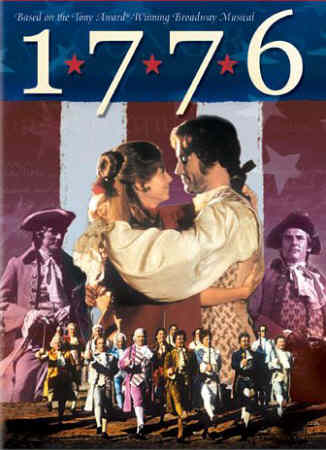
1776 (Beck Center)


‘1776’ examines our country's birth at Beck

Are you aware that the New York delegation was the last of the 13 original colonies to vote in favor of the Declaration of Independence? Did you know that John Dickinson, a delegate from Pennsylvania, refused to sign the Declaration? Does the name James Wilson mean anything to you? If not, your American history teacher didn’t share that his not wanting to be noted as a historical figure resulted in the deciding vote regarding the passage of the document that declared the colonies in revolt. Did your history book explain that without John Adams’ nagging and tirades there might never have been a United State of America? If you didn’t know these facts you need to attend the Beck Center’s production of ‘1776’ and get a refresher course in the founding of this country.

‘1776’ is a musical based on the events surrounding the creation and adoption of the Declaration of Independence, and therefore, the birth of the United States. It is set in Philadelphia in the months of May, June, and July of 1776. The composer, Sherman Edwards, spent nine and one-half years researching and creating the show. The original Broadway production was nominated for 5 Tony Awards in 1969, winning four of them, including the best musical. A movie version was produced in 1972. A short time ago ‘1776’ was revived on Broadway.

‘1776’ is a difficult show for any theatre to produce. It requires 24 males who can act, sing and dance, as well as two talented females. The musical score is difficult to sing. The show does not contain the usual show-stopping song and dance numbers that often make musicals so entertaining. With this in mind, Beck Center deserves applause for even attempting the show.

The production, under the direction of Scott Spence, is entertaining and will fulfill the patriotic needs of many. It is, by no means, however, a polished presentation. The acting and singing are uneven and the choreography is wanting in parts.

The production is blessed with the very talented Greg Violand as the irasible John Adams. Violand has a strong singing voice, is an excellent actor who knows how to milk reactions from an audience, and obviously has a keen understanding of Adams. Unfortunately, Molly McGinnis, as Abigail Adams, did not match Violand’s singing or acting. She often had trouble maintaining her musical sounds and her line interpretations were often flat.

G. A. Taggett has a fine singing voice which was well displayed in “Molasses To Rum.” Jim Reilly was delightful as Stephen Hopkins, the elderly alcoholic representative from Rhode Island. Bill Kelly looks like Benjamin Franklin. His portrayal missed some of Franklin’s curmudgeon qualities, but had some fine moments. Rob Gibb was excellent as John Dickinson, the Pennsylvanian who did not believe in breaking from England. Gibb developed a clear character and has excellent vocal abilities. Ian Atwood had the right boyish charm for the studious Thomas Jefferson. He has a fine singing voice. Too bad he didn’t have any solo opportunities. Kevin Joseph Kelly appeared to have a wonderful time performing “The Lees of Old Virginia” the only song in the show with a built-in reprise. The male chorus had difficulties in blending musical sounds in many of their renditions.

Larry Goodpaster’s orchestra did a fine job of balancing off the performers and controlling the habit of many theatre orchestras of drowning out the singers. Don McBride’s scenic design worked well. The rented costumes were period perfect.

If you attend a performance be aware that the air conditioning is cranked way up as the actors are costumed in heavy clothing and wigs. Dress accordingly as many patrons were complaining about the frigid conditions.

Capsule judgment: The production, under the direction of Scott Spence, is entertaining and will fulfill the patriotic needs of many. It is, by no means, however, a polished presentation. The acting and singing are uneven and the choreography is wanting in parts.

Sunday, July 13, 2003

Shaw Festival--2003 Wrap-up


2003 Shaw Festival Season filled with highlights

The Shaw Festival, which is performed from April through the end of November in lovely Niagara-on-the-Lake, Ontario, Canada is the only theatre in the world that specializes in the plays of Bernard Shaw and his contemporaries (1856-1950). These plays represent the beginning of what is known historically as “the modern world.” It also offers Greater Clevelanders a short drive through the wine country of both the Northern US and lower Canada to escape for a few days and view high quality theatre offerings, drop in at the casino in Niagara Falls, and stay in well-tended B&Bs or plush hotels. All of this is made even more appealing due to the very favorable exchange rate of the American dollar. At present the purchasing power of the dollar allows for savings of about 1/3 on Canadian prices.

This season Jackie Maxwell has assumed the role of Artistic Director. She follows the legendary Christopher Newton who did much to establish the festival’s wonderful reputation. She invites audiences, in her Shaw program book remarks, to “Join me, on the first step of what I intend to be a delightfully surprising journey.” If Maxwell’s direction of ‘THE CORONATION VOYAGE’ is any indication, the theatrical journey she wishes to take us on should be very successful.

‘THE CORONATION VOYAGE’

It is May 1953. The ship, Empress of France, sets sail from Montreal enroute to England. On the pretext of attending the celebrations marking the coronation of Queen Elizabeth II, an important mafioso is on board. He secretly plans to live in exile with his two sons. Aboard this floating palace in the middle of the ocean, the lord of the Montreal underworld must face the most important decision of his dubious career: will he sacrifice his youngest son for a safe-conduct?

The script has an interesting construction. A biographer is on-board to write the “true” story of the mafioso leader. We hear what he writes, in tandem with what is really happening. We gain an understanding that history is made up of interpretations and its interpretators.

Jeff Lillico is captivating as the 14-year old son. Dylan Trowbridge, portraying Etienne, the older brother, a budding pianist whose hands were smashed by some of his father’s underworld opponents, is emotionally right on target. Jim Mezon is properly hateful as the mafia don. Peter Krantz completely captivates as the Diplomat who has ice in his blood and evil in his heart. George Dawson’s stylized speech as the Biographer helps make him stand apart from the goings-on, while allowing for clarity in his role as our guide to the happenings. Donna Belleville is wonderful as the wife of the Canadian minister who will represent the country at the coronation. Susie Burnett is the only weak cog. Her portrayal of the young love interest of Etienne is all surface.

This is a fine, well planned, finely acted and technically well developed production. The boat set, the sumptuous costumes, the lighting effects, all work well. The surprise ending brought gasps from the audience. If you have time for only one Shaw production this season, this should be it.


‘DIANA OF DOBSON’S’

The Shaw Festival is noted for finding selcom-produced scripts, plays like ‘DIANA OF DOBSON’S.’ This is the story of a young shopkeeper's assistant who inherits a modest sum of money and decides to spend it all on a lavish tour of the continent. While vacationing in the Swiss Alps, she meets a young aristocrat who, in reality, has only a little more money than she. If this were a made-for-TV movie, it is obvious where this story will go. But in the hands of feminist writer Cicely Hamilton the viewer is not sure.

It is appropriate that the play be staged at this festival. G. B. Shaw, who was known for his entertaining fiction, was also strong on social conscience. It could have been Shaw, not Hamilton who wrote, “Girls, have you ever grasped what money really is? It's power! Power to do what you like to do, to go where you like, say what you like.” The lead character, Diana Massingberd, is also in the best tradition of Shaw's heroines. She's a feisty, intelligent and impoverished young woman, the daughter of a deceased country doctor who left her to fend for herself as a shop girl at Dobson's Emporium.

As with many other Shaw productions ‘DIANA OF DOBSON’S’ teaches the audience historical lessons such as the concept of the "live-in" system common at employment establishments at the time. It created a class of indentured servitude, with the girls herded together in ill-equipped dormitories, dependent upon the whims of their employers. We also observe the contrast between classes and the unproductive role of the so-called ornamental class.

Director Alisa Palmer has a fine understanding of the play and has developed an effective production. Severn Thompson makes a fine Diana. Evan Buliung is splendid as Bretherton, Diana’s love interest. Goldie Semple, as always, delights as Mrs. Cantelupe, Bretherton’s conspiring aunt.

Fine costumes, effective set design and tone setting music all help to make this a polished and very seeable production.


‘MISALLIANCE’

History has it that during the first rehearsal of the first production of George Bernard Shaw’s ‘MISALLIANCE,’ the cast walked out because they couldn’t understand what the play was going on about. The cast was not alone. At intermission, many of the attenders of the Shaw Festival production also departed. One was heard mumbling, “What is this mess?”

Part of the problem with the play, and this production, was that Shaw, in his attempt to stay modern, wrote the script in a manner of alientation, a new theatre movement of his time.

It is the purpose of alienation to force the audience not to transfer their feelings to the characters in a play, but to be aware that the play is about them, their lives, their society. To achieve this writers and directors of the early twentieth century broke the action of the play, spoke directly to the audience, built in devices to insure that the audience was aware that this was a play, not a display of reality. In alienation staging it is common to have lights in full view, scenery changes made without dimming the lights, and non-real set pieces.

Some of these techniques were incorporated into the Shaw Festival production. Actors often went to lecterns on stage to read parts of the script. On a screen above the playing area a film of G. B. Shaw himself, commenting on the play and the ideas he was presenting, was shown. All of this added up to a confused audience who were used to traditional story development and presentation.

The story centers on John Tarleton, a self-made millionaire and manufacturer. He has built his business out of new products, new technologies, and new efficiencies. The Tarleton family occupies the new seat of power in the modern England of the day. The wealthy scions of commerce are now the only ones who can afford the best real estate and the best educations. The members of the hereditary aristocracy may no longer have the money to back up their social power, but they represent an old power base that still wields substantial power in government and high society. A marriage between the aristocracy and the merchant classes--the marriage proposed between Hypatia Tarleton and Bentley Summerhays--might be considered a "misalliance"; but it represents the consolidation of power between the classes that, for better or for worse, hold the reins of power.

The question that ‘MISALLIANCE ‘ poses is: "how do you live your life in the old world while waiting for the new world to come into existence?" Unfortunately, the audience, at least this Shaw, didn’t seem to care.

The production, under the seemingly misguided hand of Neil Munro, simply never captivated or sped along. The pacing was static, the delight muted, the clarity missing. There was too much talking and too little action. The characters were either too rigid or too overdrawn, but never the twain did meet. All in all, this was not a case of the Shaw Festival doing what it does best...Shaw!


‘THE PLOUGH AND THE STARS’

Neil Munro was also the director of Sean O’Casey’s ‘THE PLOUGH AND THE STARS.’ As with ‘MISALLIANCE’ the play missed its mark.

The almost 3-hour production centers on the 1916 Easter uprising in Ireland. It concerns bitter, disheartened people who illustrate Irish woe concerning their lack of independence from the British. It showcases their poverty and their frustrations.

Acts one and two look forward to the citizen-led liberation of Ireland, while acts three and four expose the reality of the suppression of that revolution. The myths of the past and fervent response to the leaders' rhetoric stirred the people to give their lives. Eventually, the events overtake them. In contrast to “hero” plays, the revolutionaries we see are not presented sympathetically. O'Casey argues that the defeat at the hands of the British was inevitable.

Events are presented in relation to many characters, with no central protagonist. This leaves the audience with no one to cheer for, to hate, or with whom to emphathize. We sit as outsiders observing, but not being involved.

The vivid colloquialism and regional accents of the script, and slurring of words often lead to difficulty in understanding. Munro needed to decide whether authenticity or understanding was his goal. From the standpoint of the audience, he unwisely chose the former.

Characters were generally not well developed. Concepts were not well articulated. The scenery was not well designed nor constructed.

The production, as a whole, was much less than what should be expected at the prestigious Shaw Festival.


WIDOWERS’ HOUSES

It’s a play about a slum landlord, an idealist who falls in love with the slumlord’s daughter but rejects her because of the source of her father’s income, and how the story resolves itself in a happy ending. Sound like an old fashioned melodrama? Not quite. It’s the plot of George Bernard Shaw’s very first play, ‘WIDOWERS’ HOUSES.’

The play foreshadows the messages of future Shavian plays including society as a villain, socialism as the answer, and morals versus greed. It includes lines that helped make Shaw famous including, “The love of money is the root of all evil” and “People who live in glass houses have no right to throw stones.”

This isn’t a play about widowers, so where does the title come from? Supposedly, it is based on an alteration of the biblical phrase 'widows' houses,' which suggests that the misfortunes which befall widows can also afflict widowers. Somehow, I’m guessing the average viewer will miss that point entirely.

As Harry Trench, Dylan Trowbridge follows up his fine performance in ‘THE CORONATION VOYAGE’ with another excellent portrayal. Patrick Galligan is delightful as Harry’s sidekick, the overly pompous William. Jim Mezon gives a polished performance as the slumlord. His lecturing speech about the need for slumlords is so convincingly presented that if you don’t listen closely, you’ll get conned into agreeing with him. Lisa Norton has some fine moments as Blanche, the daughter and fiancee.

In spite of the misleading title the Shaw production is quite good. The sets are lovely and functional, the costumes period correct, the comic timing excellent, a lover’s fight scene is wonderfully staged. All in all, director Joseph Ziegler did a competent job with a less than perfectly written script. ‘WIDOWERS’ HOUSES’ is not often done. This is a chance to see the initial Shaw effort in a fine production.


THREE SISTERS

Anton Chekhov is generally recognized as one of the Western world’s greatest dramatists. He, along with Henrik Ibsen, are credited with taking theatrical literature to new meaning as during the early twentieth century they transitioned western drama from escapism to examining realistic problems. Chekhov, in many of his writings, foretold of the Russian revolution.

Chekhov insisted that his plays were comedies. However, in most productions, the tragic elements are stressed. Chekhov described his purpose in writing as wanting to say to people, “Have a look at yourselves and see how bad and dreary your lives are. The important thing is that people should realize that, for when they do, they will most certainly create another and better life for themselves.”

It is Chekhov's examination of character that makes ‘THREE SISTERS’ a great play. We are less captured by the plot then by the characters. In an effective production we should feel for each of the people we encounter.

Considered to be his masterpiece, in ‘THREE SISTERS’ Chekhov examines the three Prozorov sisters who live in a small town with their brother, Andrei. They are bored with provincial life, and look forward to the day when they will move to Moscow, where all their unattainable dreams will take place. Eventually, the sisters' illusory hopes fade away.

The Shaw production does not captivate as it should. Part of the problem is the new translation by Susan Coyne. She has lost much of the Russian flavor of the play. The language is too North American. The angst, the heavy tones are gone. This missing element is further showcased by director Jackie Maxwell’s failure to texture the production with Chekhov overtones. As she did with last season’s misguided production of ‘PICNIC’ Maxwell does not stick to the writer’s intent, fails to showcase and reflect the place of origin of the material.

The performances are generally good. All three sisters develop separate and clear characters, though Tara Rosling’s Masha often stays on the surface of the role. Caroline Cave is vivacious early on as Irina and effectively transitions to the frustration of unfulfilled dreams. Kelli Fox leaves no doubt of sister Olga’s despair. Ben Carlson never quite creates a clear characterization for Andrei.

The production of ‘THREE SISTERS’ is not bad, it is just bland. Too bad, since Chekhov’s works are not commonly done and a good production of this “before his time” writer is usually an experience to look forward to.


AFTERPLAY

Have you ever exited a play and asked, “I wonder what happens to those people? What will their lives be like in ten or twenty years?” Irish writer Brian Friel obviously had those very reflections. In contrast to most of us who only think the thought, Friel did something about it.

It’s the 1920s. Two people come together in a deserted Moscow cafe. Both have stories to tell and only a single evening to share them. We are allowed to eavesdrop.

What is ironic about this meeting is that the two are characters from plays written by Anton Chekhov. Andrei Prozorov, is the lackadaisical brother from ‘THE THREE SISTERS’ and Sonya Serebriakova is from ‘UNCLE VANYA.’ Freil’s approach allows us to revisit the characters twenty years after the original plays ended.

‘AFTERPLAY’ premiered at the Gate Theatre in Dublin last year to great acclaim. The
Shaw production should also be hailed. This is a well directed effort by Daryl Cloran. The pacing is on key. The Russian feel is evident. He gets two fine performances from Simon Bradbury and Helen Taylor. Each is character perfect. We feel for both of them. We are concerned about them. We want to bridge forward another twenty years to see what their lives will be like then.

The 50-minute show is part of the lunch time series. It is a must see!

Only part of the Shaw season was reviewed here. The season also includes ‘THE ROYAL FAMILY,’ ‘ON THE TWENTIETH CENTURY,’ ‘BLOOD RELATIONS,’ and ‘HAPPY END.’ Of what was seen I’d strongly recommend: ‘AFTERPLAY,’ ‘DIANA OF DOBSON’S,’ ‘WIDOWERS’ HOUSES,’ and ‘THE CORONATION VOYAGE.’

Friday, July 04, 2003

The Lion King--The Broadway Music (Playhoue Square Center)


'THE LION KING' gets glowing review from Alex and Noah

The major theme of ‘THE LION KING--THE BROADWAY MUSICAL’ centers on the circle of life. The show, through music, dance and the spoken word illustrates how each life has a beginning, an existence, and an ending, yet continues on through a new generation. What was more appropriate, therefore, than attending a production of the Disney spectacular with those who are the keys to my circle of life...with my grandsons Noah, age 6 and Alex, age 7 1/2 (not 7, but 7 and one-half). And, since youngsters are a major component of the audiences for the musical, what is more appropriate than looking at the show through the eyes of children.

For those of you who have been hiding outside the savanna and missed the movie, haven’t heard the sound track, been subjected to the commercialization which included everything from McDonald Happy Meal toys to lunch boxes and t-shirts, ‘THE LION KING: THE BROADWAY MUSICAL’ celebrated its world premiere in 1997. It has been playing to sold out audiences ever since.

Based on the Disney animated movie, ‘THE LION KING’ the play has drawn rave reviews for its dazzling special effects, staging and music. The spectacle uses masks and puppetry to combine with live acting to capture the audience’s imagination.

The show, which won almost every major theatrical award, broke new ground in theatrical technology, bringing to the stage such vast and sweeping elements as the rolling African savannah. The staging includes more than 200 puppets which represent 25 kinds of animals, birds, fish and insects. Eighteen-foot exotic giraffes and a 13’ long elephant march down the aisles. There are 125 ants, 39 hyenas, and 52 wildebeasts prancing before our eyes. The show’s original director said that she wanted a feeling of elegance. She succeeded!

The music by Tim Rice, Elton John, Hans Zimmer, and Lebo M. is a combination of African rhythms which collide with pop songs to create a memorable sound. The blended African-style choral arrangements engulf the viewer. That the show should be music-centered is entirely appropriate. In Africa, lives are permeated with music. Music has a function in society beyond simple entertainment -- songs are to teach, encourage, mourn and heal. Music serves a social function, helping to strengthen the circle of society.

The story? It is sunrise on the savanna. All the animals gather at Pride Rock to see Mufasa, the Lion King, and his queen introduce their newborn son, Simba. Simba grows into a cocky young cub. Mufasa tells Simba that everything lives together in a delicate balance called the Circle of Life. Life appears good for Simba’s future. But the plot thickens when Scar, Musafa’s evil brother, plans the deaths of Simba and Mufasa so that he, along with his evil henchmen, the hyenas, can rule the kingdom. Scar orchestrates a stampede and manages to kill Mufasa. He then convinces Simba that Mufasa's death was all Simba's fault. Scar tells Simba to leave the Pridelands and never return. The cub flees and life no longer appears good. Well...you get the idea.
Of course, through obvious twists and turns everything ends up happily. This is a Disney production...how else could it end?

So, what did Alex and Noah think? “It was great!” were their synchronized screams of joy.

What was the story about? Alex spent ten minutes giving a detail-by-detail recounting of the plot, with Noah adding details. Obviously the show clearly gets its idea across and, of course (as their grandfather knows), Alex and Noah are smart kids so they got the point.

Their favorite part? “The Lion Sleeps Tonight.” Close follow-up was “Hakuna Matata” the song which introduces us to Simba’s new friends, a warthog and a weasel.
What does “Hankuna Matata” mean? No problem for the dynamic duo...it means, (sung, of course) “no worries of the rest of your days.”

Who did you like the best? Noah’s face lit up immediately and giggled, “The funny guy...the green one.” He was referring to Rafiki, who acts as our narrator and visionary on what is to happen. The two boys then demonstrated the moves from “I Just Can’t Wait to Be King” which includes a series of hip-wiggling gyrations. Hey, these kids did love this show!

What did you learn? Alex responded, “Be kind to animals.” Noah stated, “Be respectful.”

The unqualified dual opinion, “I want to see “Lion King” again!”

Don’t be surprised if some children, like the 5-year old sitting in front of us burst into tears at the death of Mufasa. This is a “real” person, not a movie cartoon character. He wailed, “I don’t like those bad-guy hyenas at another part of the action. It might be wise to avoid taking a very sensitive child to see the show. Also, be aware that this is a long production. Evening performances may be a “stay awake” problem. Things were not helped on opening night when the curtain went up 20 minutes late.

Taking the kids on-line to www.lionking.org would be a good introduction and playing the CD on the way to the theatre helps set the mood.

Capsule judgement: As for us, in the car the next day Alex and Noah both wanted to listen to “their” music...”THE LION KING--THE BROADWAY MUSIC.”

Saturday, June 28, 2003

Scott Miller reviews the reviewer

Roy,

I sent your review of the Shakesphere Festival on to my cousin Scott. Thought you might like to know how he answered me. Can you ad one more name to your list of "subscribers"?

Marcia

Dear Marcia,
Thank you so much for sending the Berko reviews. He is indeed a thoughtful
reviewer, one of the few. I get a real sense that he loves the theater and
wishes that everything he saw was marvelous. When he's critical he's
gracious, when he's positive he's generous and clear in terms of what he
likes. He knows the work he's reviewing, it's plot, history and themes and
sees his job in part to educate his readers which in turn motivates them to
attend the shows he reviews since they would come knowing more about the
them. It's nice to read reviews that don't put the reviewer first but
rather feature the work with a sense of respect and endearment. Thanks!

Scott

Friday, June 27, 2003

Die Fledermaus (Lyric Opera)


Poorly conceived 'DIE FLEDERMAUS' at Lyric Opera

In the 1860s the Parisian operettas were a tremendous vogue in Vienna. The central figure in this movement was Offenbach whose works delighted and provided escapist entertainment.

Offenbach was succeeded by Johann Strauss, the composer of the popular “Blue Danube” waltz. Strauss wrote fifteen operettas which included the incomparable ‘DIE FLEDERMAUS.’ Strauss' association with the dance band naturally resulted in his operettas containing the rhythms of the dance. In order for ‘DIE FLEDERMAUS.’ to be effective the singing, the acting and the dancing must all by joyous and proficient. Unfortunately, under the stiff direction of Jonathon Field, Lyric Opera Cleveland’s production, is proficient in none of these.

As with all operettas, ‘DIE FLEDERMAUS’ is an exaggeration of life. Gabriel von Eisenstein has been sentenced to prison for insulting an official. Before embarking on his sentence he attends a costume ball. He has lied to his wife about where he is going. A series of mistaken identifies including the wife, the parlor maid and numerous other characters leads to some delightful incidents. Well, should be delightful. In this production, poor acting, poorly executed dancing, and some moderately successful singing, are the rule.

One of the traditional problems with Lyric Operas productions has been the poor acoustics. This has been taken care of with the move to the wonderful Drury Theatre in the Cleveland Play House complex. Other problem have been the often poor acting, questionable casting and stilted staging of their productions. Unfortunately, as ‘DIE FLEDERMAUS’ proves, these conditions have not been altered.

The only real highlight of the show is a brief, but joyously delicious pas de deux danced with professional grace and spirit by Karen Gabay and Raymond Rodriguez, formerly of the Cleveland-San Jose Ballet Company. Too bad the whole evening could not have been their dancing. (If you’d like to see them in performance their company, Point of Departure will be performing at Cain Park on July 31.)

Kudos go to Glen Cortese who has done a fine job with the orchestra and Michael Grube whose set design is attractive and functional.

Risa Renee Harman sang and acted the role of the maid with delightful enthusiasm and has a fine singing voice. Christian Elser, as von Eisenstein, displayed nice vocal abilities but his characterization was unconvincing. Scott Guinn also has a nice singing voice, but he was both physically wrong for the role of Dr. Falke, and displayed shallow acting skills. Michael Bragg was totally unconvincing as the lawyer. Elizabeth Sutton’s portrayal of Ida was delightful. Leodigario B. del Rosario was difficult to understand and was unconvincing as Alfred, the wife’s suitor. Terese Cullen’s wife lacked acting texture.

Capsule judgement: A line in ‘DIE FLEDERMAUS’ states, “bribe only the very best critics.” Not even a bribe would have brought this weak production a positive review.”