Sunday, July 27, 2003

Those Seven Little Words (Playhouse Square Center)


‘THOSE SEVEN LITTLE WORDS’ entertains at Kennedy's

“If you’re here tonight you’re gay, know someone who is gay or are my family.” With that statement Cleveland comedian and diva, Greta Rothman, opened her one-woman show, ‘THOSE SEVEN LITTLE WORDS.” It recounts her dating and mating attempts on the local scene, as well as in New York. Rothman recently returned to the area after trying her hand at hooking a husband and starting an entertainment career in the Big Apple.

The seven little words? They are “I love you, so you’re probably gay.” They account for why Rothman is still unmarried. They also account for why she put together a show which consists of eleven songs and an equal number of funny comic shticks about her relational life.

Rothman was raised in University Heights. Her high school prom date was gay, the guys she feel in love with during her teen years were gay, her best friends in New York were gay. The Jewish Rothman even recounts that when she followed her mother’s advice and went to a synagogue on the upper west side in Manhattan, and found so many “gorgeous men” that she pined to return the next week, she found out that the men had only been there because it was gay pride weekend. Oi!

Rothman, who prefers that she be called a “flame dame” rather than a “fag hag” or a “fruit fly,” which are terms to describe straight woman who love gay men, has a fine singing voice. She sings with meaning rather than just mouthing words, which makes her songs both understandable and engulfing. Her voice was especially well used in the Cy Coleman song “No Man Left For Me.” The theme song was delightfully sung. “She Loves Me,” sung with backup singer Eric Alan, showed nice blending. “Sisters,” sung with her other backup, Mike Caraffi was a cute idea and nicely done. Both Alan and Caraffi need to loosen up on stage to match Rothman’s naturalness.

The musicians, Charles Eversole and Greta’s brother, Andrew Rothman, were excellent, though Eversole’s synthesizer was often too overpowering for the small size of the theatre. The duo also sang backup in several songs.

Most of the musical selections for the one-running -joke show were appropriate, fitting well with the comedy. “The Rose,” a Bette Middler song which was selected to end the show, however, seemed out of place. “Someday My Prince Will Come” would have been a more appropriate ending considering Ms. Rothman’s stated desire to continue her quest to find the right man.

Kennedy’s does not lend itself to the intimacy needed for this show, especially as the seating is configured. Rather than setting up the theatre so that the audience surrounded the performer the decision was made to run the seating the length of the bowling alley shaped space. Adding tables in front of the seats made for difficult viewing and pushed the audience even farther away. Consideration should be given to alerting the stage/seating arrangement.

Capsule Judgement: This is a show which will delight a certain theatre-going set. Someone with liberal leanings, those who are gay or know someone who is gay, or those wanting to hear of a fun search for “mister right,” that continues to garner “mister wrong,” will enjoy themselves.
P.S. If you know a nice STRAIGHT Jewish man, about 30-something, looking for a talented comedian and singer for a wife, Greta’s mother would love to hear from you.

Oklahoma (Porthouse Theatre/KSU)


Oh what a beautiful 'Oklahoma' at Porthouse

Based on ‘GREEN GROW THE LILACS,’ a stage play by Lynn Riggs, ‘OKLAHOMA!’ brought together for the first time composer Richard Rodgers and lyricist/librettist Oscar Hammerstein II. The duo would go on to write nine Broadway musicals, but none would be as important for the development of American musical theatre as ‘OKLAHOMA!’ The show fused together story, song and dance in a way that had never been done before. This laid the foundation for the musicals that followed.

The plot is simple, revolving mainly around the question of who will take Laurey to the box social--the decent Curly or the sinister Jud Fry, and the ramifications of her decision.

Since its opening in March of 1943 ‘OKLAHOMA!’ has become one of the most oft done musicals, with productions ranging from professional theatres to high schools. The question, therefore, is, how many times can you see “that old play?” The answer? As many times as you can see a fine production of it. And, have no doubts about it, the Porthouse Theatre’s production of ‘OKLAHOMA,’ under the creative eye of talented director Teri Kent, is one fine production.

Kent, whose own warmth and charm come shining through in the production, has honed the cast and professional team into an audience-pleasing team. The humor, the pathos, the wonder of quality theatre are all present. A sign of a good musical production is often keyed by watching what the chorus is doing. In this production the chorus doesn’t just stand around and wait for their chance to sing or say an occasional line, each person is emotionally involved in every scene.

John R. Crawford’s choreography is not only creative, but is well executed by the dynamic cast. He makes the dances his own, not copying the style of the Agnes de Mille, the award winning choreographer of the original production. The dream ballet, which reveals the main characters’ hidden fears and desires is the finest I’ve ever seen. It is mesmerizing as danced by Kaitlyn Black and J. Cole Burden and the supporting cast.

The singers blend well and the orchestra, under the direction of Melissa Fucci, generally performs well. They wisely don’t drown out the singers. Nolan O’Dell’s sets, Kazuko Inoue’s costumes and Cynthia Stillings’ lighting design all work.

In each Roger and Hammerstein show, one song carries the authors’ message which is often a need for peace and harmony. In ‘OKLAHOMA’ the tune is “The Farmer and the Cowman.” It is given a rousing production number. Other highlights include “Kansas City,” “I Cain’t Say No,” “All or Nothin’” and “Oklahoma.”

Kayce L. Cummings is charming as Laurey. She gives a unique spin to the role. Instead of playing it “sweet and innocent,” she adds a level of spunkiness to the character. Her singing voice is superb. She is beautiful to top it off.

Eric van Baars as Will and MaryAnn Black as Ado Annie electrify the stage whenever they appear. It is impossible not to smile every time they sing, dance or speak a line. Each of their songs is a show stopper.

Lissy Gulick makes a delightful Aunt Eller. Rosario Costanzo does the best Ali Hakim since Joseph Buloff portrayed the role in the original Broadway production. Sarah Lyon’s giggling Gertie is delightfully grating. After a slow emotional start Michael Sherman grows into the role of the menacing Jud Fry. He has a nice singing voice and physically fits the role.

James Love as Curley, who is a trained opera singer, has a marvelous singing voice and physically fits the role. Unfortunately, his lines are generally delivered in a flat, emotionally-void manner. Because of this, there is very little of the needed spark between him and Laurey. His body is stiff and he appears out of his acting element in this fine cast.

A minor glitch in the emotional involvement takes place at the show’s climax when Jud falls on his knife and dies during a fight with Curley. For some inexplicable reason, Kent has the cast roll the body over so that we can clearly see that Jud wasn’t stabbed at all. It breaks the spell since the audience is so close to the action.

Capsule Judgement: Saddle up your trusty colt (or the SUV) and ride out to Porthouse to see what will probably be the best production of ‘OKLAHOMA’ “ya evur mite see.”

Monday, July 21, 2003

Dance Brazil (Cain Park)


Uneven Dance Brazil at Cain Park

For over 25 years, the celebrated dancers and musicians of DanceBrazil have been among the foremost interpreters of Afro-Brazilian culture. The company's signature qualities are power, precision, passion, and eye-popping virtuosity. Under the banner, “We've got movement! “ the company is now on an international tour. In between stops in Germany and such US sites as NY, Washington, DC and Chicago, they stopped for a single night at Cleveland Heights’s Cain Park.

The group’s purpose is to spread their cultural message by bringing the art of capoeira to audiences. Capoeira is the Afro-Brazilian martial art that has become a cultural phenomenon. It is music and movement blended into the elements native to the Brazilian traditions of the samba, candomblé, and modern dance. It was originated with slaves who used to dance to hide their fighting techniques. It consists of twisting, turning, somersaulting, and posing.

If only the company had stuck to their capoeira task in the program at Cain Park. As is, though the capacity audience gave the troupe a standing ovation, the program was uneven. The very short first segment consisted mainly of singing by four musicians. Because the audience came to see dance, and the quartet was in the orchestra pit below the viewers, and the music was repetitious, the reception was not positive. Many patrons talked all through the musical interludes.

The second act exploded. It was exciting and enthralling. Here, we got to see true capoeira in action. Too bad the whole program didn’t hit that level.

The male dancers were superb, especially the capoeiristas--Francisco Braga, Francisco Dalforne Dos Santos, Danilo Portugal and Leandro Silva.

The printed program did little to help the evening. It gave no hint that what was to be viewed was a series of short dances. It also failed to explain the art of capoeira. It did not explain that there would be as much music as there was dancing. There was no list of the musical or dance offerings so trying to anticipate what was coming, or who was dancing in any segment was impossible. Whoever prepared the program needs to realize that the purpose of the printed words is to aid the audience to understand and appreciate the staged offerings.

In part because of the printed program, and the lack of clarity on the part of the performance programming, the audience was completely caught by surprise when intermission came. People sat, unsure of what to do. The same thing happened at the end when the audience was unaware that the curtain call was in progress.

Capsule Judgement: Segments of DANCE BRAZIL’s presentation were explosive, exciting and enthralling and met the viewer’s high expectations. As a whole, however, this was a somewhat unfulfilling presentation.

Into the Woods (Lakeland Theatre)


‘INTO THE WOODS’ strays off the path at Lakeland

The initial concept for the award winning musical ‘INTO THE WOODS’ was for writer James Lapine to devise an entirely original story. Instead, he hit upon the notion of uniting numerous characters from familiar literature: Cinderella, Little Red Ridinghood, Jack (of Beanstalk fame) and Rapunzel.

Lapine’s self-explained purpose was to show what happened in reality, in contrast to the “they lived happily-ever-after” endings purported in the fairy tales. A child psychologist explained the symbolism of the woods in these tales as "the place in which inner darkness is confronted and ...where uncertainty is resolved about who one is ... or who one wants to be." It is only when we see the light that we can really find our way and face our hidden fears.

Lapine's book is dark, wise and oft-times enchanting. When combined with the words and music of America’s most brilliant musical author Stephen Sondheim, the delightful first act was intended to be a sharp contrast to the lesson-teaching second segment.

Sondheim's score is gorgeous and witty, especially in the first act. The show contains such wonders as “Stay With Me” (often called “Children Will Listen” because of its key line), the poignant “No More,” and the lovely “No One is Alone.”

Unfortunately, instead of following the authors’ intent and purpose, Lakeland Theatre’s director Martin Friedman decided to stray from the path. As he states in his director’s notes, “With this production I have chosen to eliminate any of the sarcasm and excess cynical humor that the original production utilized.” With this change of emphasis, Lakeland’s production loses the play’s purpose. In contrast to words “delightful,” “wise,” “adorable,” and “meaningful” which were found in most of the reviews of the original 1987 Broadway show and its 2001 revival, words like “dreary,” “boring” and “gloomy” seem to better fit.

In the Lakeland production, Alex Wyse is delightful as Jack. This lad can sing and act. Sandra Emerick sings and interprets well the role of the Baker’s wife. Paul Floriano develops a believable character as the Baker. Emerick and Floriano’s rendition of “It Takes Two” is one of the show’s highlights. Toni Cervino is enchanting as Cinderella. She has a fine singing voice and gave a textured acting performance. As the witch, Maryann Nagel lets loose in the second act, after a too controlled first act. Her singing voice, as always, is radiant. Tiffany Gates sings the role of Rapunzel effectively. Donnie Long has a nice singing voice, but his portrayal of Cinderella’s Prince was shallow. Ryan Bergeron proficiently sings the role of Rapunzel’s Prince, but he overacts at times. Doug Farren was not believable as either the narrator or the mysterious man.

Some questionable blocking, awkward set changes, a good but over-loud orchestra which drowned out many of the spoken lines, boring choreography consisting mainly of cross-over steps and marching in place, mumbled lines, lack of articulation of song lyrics, some poor singing blends, and dark lighting spots on the stage, didn’t add to the festivities.

Capsule Judgement: This is not to say the show is to be avoided. That’s not the summary message. There are enough good moments to make the production enjoyable. But go realizing that instead of finding the clearing, the production gets lost in the woods.

Monday, July 14, 2003

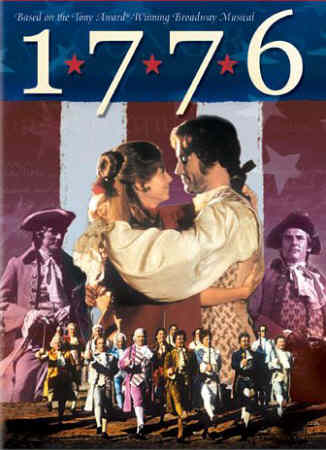
1776 (Beck Center)


‘1776’ examines our country's birth at Beck

Are you aware that the New York delegation was the last of the 13 original colonies to vote in favor of the Declaration of Independence? Did you know that John Dickinson, a delegate from Pennsylvania, refused to sign the Declaration? Does the name James Wilson mean anything to you? If not, your American history teacher didn’t share that his not wanting to be noted as a historical figure resulted in the deciding vote regarding the passage of the document that declared the colonies in revolt. Did your history book explain that without John Adams’ nagging and tirades there might never have been a United State of America? If you didn’t know these facts you need to attend the Beck Center’s production of ‘1776’ and get a refresher course in the founding of this country.

‘1776’ is a musical based on the events surrounding the creation and adoption of the Declaration of Independence, and therefore, the birth of the United States. It is set in Philadelphia in the months of May, June, and July of 1776. The composer, Sherman Edwards, spent nine and one-half years researching and creating the show. The original Broadway production was nominated for 5 Tony Awards in 1969, winning four of them, including the best musical. A movie version was produced in 1972. A short time ago ‘1776’ was revived on Broadway.

‘1776’ is a difficult show for any theatre to produce. It requires 24 males who can act, sing and dance, as well as two talented females. The musical score is difficult to sing. The show does not contain the usual show-stopping song and dance numbers that often make musicals so entertaining. With this in mind, Beck Center deserves applause for even attempting the show.

The production, under the direction of Scott Spence, is entertaining and will fulfill the patriotic needs of many. It is, by no means, however, a polished presentation. The acting and singing are uneven and the choreography is wanting in parts.

The production is blessed with the very talented Greg Violand as the irasible John Adams. Violand has a strong singing voice, is an excellent actor who knows how to milk reactions from an audience, and obviously has a keen understanding of Adams. Unfortunately, Molly McGinnis, as Abigail Adams, did not match Violand’s singing or acting. She often had trouble maintaining her musical sounds and her line interpretations were often flat.

G. A. Taggett has a fine singing voice which was well displayed in “Molasses To Rum.” Jim Reilly was delightful as Stephen Hopkins, the elderly alcoholic representative from Rhode Island. Bill Kelly looks like Benjamin Franklin. His portrayal missed some of Franklin’s curmudgeon qualities, but had some fine moments. Rob Gibb was excellent as John Dickinson, the Pennsylvanian who did not believe in breaking from England. Gibb developed a clear character and has excellent vocal abilities. Ian Atwood had the right boyish charm for the studious Thomas Jefferson. He has a fine singing voice. Too bad he didn’t have any solo opportunities. Kevin Joseph Kelly appeared to have a wonderful time performing “The Lees of Old Virginia” the only song in the show with a built-in reprise. The male chorus had difficulties in blending musical sounds in many of their renditions.

Larry Goodpaster’s orchestra did a fine job of balancing off the performers and controlling the habit of many theatre orchestras of drowning out the singers. Don McBride’s scenic design worked well. The rented costumes were period perfect.

If you attend a performance be aware that the air conditioning is cranked way up as the actors are costumed in heavy clothing and wigs. Dress accordingly as many patrons were complaining about the frigid conditions.

Capsule judgment: The production, under the direction of Scott Spence, is entertaining and will fulfill the patriotic needs of many. It is, by no means, however, a polished presentation. The acting and singing are uneven and the choreography is wanting in parts.

Sunday, July 13, 2003

Shaw Festival--2003 Wrap-up


2003 Shaw Festival Season filled with highlights

The Shaw Festival, which is performed from April through the end of November in lovely Niagara-on-the-Lake, Ontario, Canada is the only theatre in the world that specializes in the plays of Bernard Shaw and his contemporaries (1856-1950). These plays represent the beginning of what is known historically as “the modern world.” It also offers Greater Clevelanders a short drive through the wine country of both the Northern US and lower Canada to escape for a few days and view high quality theatre offerings, drop in at the casino in Niagara Falls, and stay in well-tended B&Bs or plush hotels. All of this is made even more appealing due to the very favorable exchange rate of the American dollar. At present the purchasing power of the dollar allows for savings of about 1/3 on Canadian prices.

This season Jackie Maxwell has assumed the role of Artistic Director. She follows the legendary Christopher Newton who did much to establish the festival’s wonderful reputation. She invites audiences, in her Shaw program book remarks, to “Join me, on the first step of what I intend to be a delightfully surprising journey.” If Maxwell’s direction of ‘THE CORONATION VOYAGE’ is any indication, the theatrical journey she wishes to take us on should be very successful.

‘THE CORONATION VOYAGE’

It is May 1953. The ship, Empress of France, sets sail from Montreal enroute to England. On the pretext of attending the celebrations marking the coronation of Queen Elizabeth II, an important mafioso is on board. He secretly plans to live in exile with his two sons. Aboard this floating palace in the middle of the ocean, the lord of the Montreal underworld must face the most important decision of his dubious career: will he sacrifice his youngest son for a safe-conduct?

The script has an interesting construction. A biographer is on-board to write the “true” story of the mafioso leader. We hear what he writes, in tandem with what is really happening. We gain an understanding that history is made up of interpretations and its interpretators.

Jeff Lillico is captivating as the 14-year old son. Dylan Trowbridge, portraying Etienne, the older brother, a budding pianist whose hands were smashed by some of his father’s underworld opponents, is emotionally right on target. Jim Mezon is properly hateful as the mafia don. Peter Krantz completely captivates as the Diplomat who has ice in his blood and evil in his heart. George Dawson’s stylized speech as the Biographer helps make him stand apart from the goings-on, while allowing for clarity in his role as our guide to the happenings. Donna Belleville is wonderful as the wife of the Canadian minister who will represent the country at the coronation. Susie Burnett is the only weak cog. Her portrayal of the young love interest of Etienne is all surface.

This is a fine, well planned, finely acted and technically well developed production. The boat set, the sumptuous costumes, the lighting effects, all work well. The surprise ending brought gasps from the audience. If you have time for only one Shaw production this season, this should be it.


‘DIANA OF DOBSON’S’

The Shaw Festival is noted for finding selcom-produced scripts, plays like ‘DIANA OF DOBSON’S.’ This is the story of a young shopkeeper's assistant who inherits a modest sum of money and decides to spend it all on a lavish tour of the continent. While vacationing in the Swiss Alps, she meets a young aristocrat who, in reality, has only a little more money than she. If this were a made-for-TV movie, it is obvious where this story will go. But in the hands of feminist writer Cicely Hamilton the viewer is not sure.

It is appropriate that the play be staged at this festival. G. B. Shaw, who was known for his entertaining fiction, was also strong on social conscience. It could have been Shaw, not Hamilton who wrote, “Girls, have you ever grasped what money really is? It's power! Power to do what you like to do, to go where you like, say what you like.” The lead character, Diana Massingberd, is also in the best tradition of Shaw's heroines. She's a feisty, intelligent and impoverished young woman, the daughter of a deceased country doctor who left her to fend for herself as a shop girl at Dobson's Emporium.

As with many other Shaw productions ‘DIANA OF DOBSON’S’ teaches the audience historical lessons such as the concept of the "live-in" system common at employment establishments at the time. It created a class of indentured servitude, with the girls herded together in ill-equipped dormitories, dependent upon the whims of their employers. We also observe the contrast between classes and the unproductive role of the so-called ornamental class.

Director Alisa Palmer has a fine understanding of the play and has developed an effective production. Severn Thompson makes a fine Diana. Evan Buliung is splendid as Bretherton, Diana’s love interest. Goldie Semple, as always, delights as Mrs. Cantelupe, Bretherton’s conspiring aunt.

Fine costumes, effective set design and tone setting music all help to make this a polished and very seeable production.


‘MISALLIANCE’

History has it that during the first rehearsal of the first production of George Bernard Shaw’s ‘MISALLIANCE,’ the cast walked out because they couldn’t understand what the play was going on about. The cast was not alone. At intermission, many of the attenders of the Shaw Festival production also departed. One was heard mumbling, “What is this mess?”

Part of the problem with the play, and this production, was that Shaw, in his attempt to stay modern, wrote the script in a manner of alientation, a new theatre movement of his time.

It is the purpose of alienation to force the audience not to transfer their feelings to the characters in a play, but to be aware that the play is about them, their lives, their society. To achieve this writers and directors of the early twentieth century broke the action of the play, spoke directly to the audience, built in devices to insure that the audience was aware that this was a play, not a display of reality. In alienation staging it is common to have lights in full view, scenery changes made without dimming the lights, and non-real set pieces.

Some of these techniques were incorporated into the Shaw Festival production. Actors often went to lecterns on stage to read parts of the script. On a screen above the playing area a film of G. B. Shaw himself, commenting on the play and the ideas he was presenting, was shown. All of this added up to a confused audience who were used to traditional story development and presentation.

The story centers on John Tarleton, a self-made millionaire and manufacturer. He has built his business out of new products, new technologies, and new efficiencies. The Tarleton family occupies the new seat of power in the modern England of the day. The wealthy scions of commerce are now the only ones who can afford the best real estate and the best educations. The members of the hereditary aristocracy may no longer have the money to back up their social power, but they represent an old power base that still wields substantial power in government and high society. A marriage between the aristocracy and the merchant classes--the marriage proposed between Hypatia Tarleton and Bentley Summerhays--might be considered a "misalliance"; but it represents the consolidation of power between the classes that, for better or for worse, hold the reins of power.

The question that ‘MISALLIANCE ‘ poses is: "how do you live your life in the old world while waiting for the new world to come into existence?" Unfortunately, the audience, at least this Shaw, didn’t seem to care.

The production, under the seemingly misguided hand of Neil Munro, simply never captivated or sped along. The pacing was static, the delight muted, the clarity missing. There was too much talking and too little action. The characters were either too rigid or too overdrawn, but never the twain did meet. All in all, this was not a case of the Shaw Festival doing what it does best...Shaw!


‘THE PLOUGH AND THE STARS’

Neil Munro was also the director of Sean O’Casey’s ‘THE PLOUGH AND THE STARS.’ As with ‘MISALLIANCE’ the play missed its mark.

The almost 3-hour production centers on the 1916 Easter uprising in Ireland. It concerns bitter, disheartened people who illustrate Irish woe concerning their lack of independence from the British. It showcases their poverty and their frustrations.

Acts one and two look forward to the citizen-led liberation of Ireland, while acts three and four expose the reality of the suppression of that revolution. The myths of the past and fervent response to the leaders' rhetoric stirred the people to give their lives. Eventually, the events overtake them. In contrast to “hero” plays, the revolutionaries we see are not presented sympathetically. O'Casey argues that the defeat at the hands of the British was inevitable.

Events are presented in relation to many characters, with no central protagonist. This leaves the audience with no one to cheer for, to hate, or with whom to emphathize. We sit as outsiders observing, but not being involved.

The vivid colloquialism and regional accents of the script, and slurring of words often lead to difficulty in understanding. Munro needed to decide whether authenticity or understanding was his goal. From the standpoint of the audience, he unwisely chose the former.

Characters were generally not well developed. Concepts were not well articulated. The scenery was not well designed nor constructed.

The production, as a whole, was much less than what should be expected at the prestigious Shaw Festival.


WIDOWERS’ HOUSES

It’s a play about a slum landlord, an idealist who falls in love with the slumlord’s daughter but rejects her because of the source of her father’s income, and how the story resolves itself in a happy ending. Sound like an old fashioned melodrama? Not quite. It’s the plot of George Bernard Shaw’s very first play, ‘WIDOWERS’ HOUSES.’

The play foreshadows the messages of future Shavian plays including society as a villain, socialism as the answer, and morals versus greed. It includes lines that helped make Shaw famous including, “The love of money is the root of all evil” and “People who live in glass houses have no right to throw stones.”

This isn’t a play about widowers, so where does the title come from? Supposedly, it is based on an alteration of the biblical phrase 'widows' houses,' which suggests that the misfortunes which befall widows can also afflict widowers. Somehow, I’m guessing the average viewer will miss that point entirely.

As Harry Trench, Dylan Trowbridge follows up his fine performance in ‘THE CORONATION VOYAGE’ with another excellent portrayal. Patrick Galligan is delightful as Harry’s sidekick, the overly pompous William. Jim Mezon gives a polished performance as the slumlord. His lecturing speech about the need for slumlords is so convincingly presented that if you don’t listen closely, you’ll get conned into agreeing with him. Lisa Norton has some fine moments as Blanche, the daughter and fiancee.

In spite of the misleading title the Shaw production is quite good. The sets are lovely and functional, the costumes period correct, the comic timing excellent, a lover’s fight scene is wonderfully staged. All in all, director Joseph Ziegler did a competent job with a less than perfectly written script. ‘WIDOWERS’ HOUSES’ is not often done. This is a chance to see the initial Shaw effort in a fine production.


THREE SISTERS

Anton Chekhov is generally recognized as one of the Western world’s greatest dramatists. He, along with Henrik Ibsen, are credited with taking theatrical literature to new meaning as during the early twentieth century they transitioned western drama from escapism to examining realistic problems. Chekhov, in many of his writings, foretold of the Russian revolution.

Chekhov insisted that his plays were comedies. However, in most productions, the tragic elements are stressed. Chekhov described his purpose in writing as wanting to say to people, “Have a look at yourselves and see how bad and dreary your lives are. The important thing is that people should realize that, for when they do, they will most certainly create another and better life for themselves.”

It is Chekhov's examination of character that makes ‘THREE SISTERS’ a great play. We are less captured by the plot then by the characters. In an effective production we should feel for each of the people we encounter.

Considered to be his masterpiece, in ‘THREE SISTERS’ Chekhov examines the three Prozorov sisters who live in a small town with their brother, Andrei. They are bored with provincial life, and look forward to the day when they will move to Moscow, where all their unattainable dreams will take place. Eventually, the sisters' illusory hopes fade away.

The Shaw production does not captivate as it should. Part of the problem is the new translation by Susan Coyne. She has lost much of the Russian flavor of the play. The language is too North American. The angst, the heavy tones are gone. This missing element is further showcased by director Jackie Maxwell’s failure to texture the production with Chekhov overtones. As she did with last season’s misguided production of ‘PICNIC’ Maxwell does not stick to the writer’s intent, fails to showcase and reflect the place of origin of the material.

The performances are generally good. All three sisters develop separate and clear characters, though Tara Rosling’s Masha often stays on the surface of the role. Caroline Cave is vivacious early on as Irina and effectively transitions to the frustration of unfulfilled dreams. Kelli Fox leaves no doubt of sister Olga’s despair. Ben Carlson never quite creates a clear characterization for Andrei.

The production of ‘THREE SISTERS’ is not bad, it is just bland. Too bad, since Chekhov’s works are not commonly done and a good production of this “before his time” writer is usually an experience to look forward to.


AFTERPLAY

Have you ever exited a play and asked, “I wonder what happens to those people? What will their lives be like in ten or twenty years?” Irish writer Brian Friel obviously had those very reflections. In contrast to most of us who only think the thought, Friel did something about it.

It’s the 1920s. Two people come together in a deserted Moscow cafe. Both have stories to tell and only a single evening to share them. We are allowed to eavesdrop.

What is ironic about this meeting is that the two are characters from plays written by Anton Chekhov. Andrei Prozorov, is the lackadaisical brother from ‘THE THREE SISTERS’ and Sonya Serebriakova is from ‘UNCLE VANYA.’ Freil’s approach allows us to revisit the characters twenty years after the original plays ended.

‘AFTERPLAY’ premiered at the Gate Theatre in Dublin last year to great acclaim. The
Shaw production should also be hailed. This is a well directed effort by Daryl Cloran. The pacing is on key. The Russian feel is evident. He gets two fine performances from Simon Bradbury and Helen Taylor. Each is character perfect. We feel for both of them. We are concerned about them. We want to bridge forward another twenty years to see what their lives will be like then.

The 50-minute show is part of the lunch time series. It is a must see!

Only part of the Shaw season was reviewed here. The season also includes ‘THE ROYAL FAMILY,’ ‘ON THE TWENTIETH CENTURY,’ ‘BLOOD RELATIONS,’ and ‘HAPPY END.’ Of what was seen I’d strongly recommend: ‘AFTERPLAY,’ ‘DIANA OF DOBSON’S,’ ‘WIDOWERS’ HOUSES,’ and ‘THE CORONATION VOYAGE.’

Friday, July 04, 2003

The Lion King--The Broadway Music (Playhoue Square Center)


'THE LION KING' gets glowing review from Alex and Noah

The major theme of ‘THE LION KING--THE BROADWAY MUSICAL’ centers on the circle of life. The show, through music, dance and the spoken word illustrates how each life has a beginning, an existence, and an ending, yet continues on through a new generation. What was more appropriate, therefore, than attending a production of the Disney spectacular with those who are the keys to my circle of life...with my grandsons Noah, age 6 and Alex, age 7 1/2 (not 7, but 7 and one-half). And, since youngsters are a major component of the audiences for the musical, what is more appropriate than looking at the show through the eyes of children.

For those of you who have been hiding outside the savanna and missed the movie, haven’t heard the sound track, been subjected to the commercialization which included everything from McDonald Happy Meal toys to lunch boxes and t-shirts, ‘THE LION KING: THE BROADWAY MUSICAL’ celebrated its world premiere in 1997. It has been playing to sold out audiences ever since.

Based on the Disney animated movie, ‘THE LION KING’ the play has drawn rave reviews for its dazzling special effects, staging and music. The spectacle uses masks and puppetry to combine with live acting to capture the audience’s imagination.

The show, which won almost every major theatrical award, broke new ground in theatrical technology, bringing to the stage such vast and sweeping elements as the rolling African savannah. The staging includes more than 200 puppets which represent 25 kinds of animals, birds, fish and insects. Eighteen-foot exotic giraffes and a 13’ long elephant march down the aisles. There are 125 ants, 39 hyenas, and 52 wildebeasts prancing before our eyes. The show’s original director said that she wanted a feeling of elegance. She succeeded!

The music by Tim Rice, Elton John, Hans Zimmer, and Lebo M. is a combination of African rhythms which collide with pop songs to create a memorable sound. The blended African-style choral arrangements engulf the viewer. That the show should be music-centered is entirely appropriate. In Africa, lives are permeated with music. Music has a function in society beyond simple entertainment -- songs are to teach, encourage, mourn and heal. Music serves a social function, helping to strengthen the circle of society.

The story? It is sunrise on the savanna. All the animals gather at Pride Rock to see Mufasa, the Lion King, and his queen introduce their newborn son, Simba. Simba grows into a cocky young cub. Mufasa tells Simba that everything lives together in a delicate balance called the Circle of Life. Life appears good for Simba’s future. But the plot thickens when Scar, Musafa’s evil brother, plans the deaths of Simba and Mufasa so that he, along with his evil henchmen, the hyenas, can rule the kingdom. Scar orchestrates a stampede and manages to kill Mufasa. He then convinces Simba that Mufasa's death was all Simba's fault. Scar tells Simba to leave the Pridelands and never return. The cub flees and life no longer appears good. Well...you get the idea.
Of course, through obvious twists and turns everything ends up happily. This is a Disney production...how else could it end?

So, what did Alex and Noah think? “It was great!” were their synchronized screams of joy.

What was the story about? Alex spent ten minutes giving a detail-by-detail recounting of the plot, with Noah adding details. Obviously the show clearly gets its idea across and, of course (as their grandfather knows), Alex and Noah are smart kids so they got the point.

Their favorite part? “The Lion Sleeps Tonight.” Close follow-up was “Hakuna Matata” the song which introduces us to Simba’s new friends, a warthog and a weasel.
What does “Hankuna Matata” mean? No problem for the dynamic duo...it means, (sung, of course) “no worries of the rest of your days.”

Who did you like the best? Noah’s face lit up immediately and giggled, “The funny guy...the green one.” He was referring to Rafiki, who acts as our narrator and visionary on what is to happen. The two boys then demonstrated the moves from “I Just Can’t Wait to Be King” which includes a series of hip-wiggling gyrations. Hey, these kids did love this show!

What did you learn? Alex responded, “Be kind to animals.” Noah stated, “Be respectful.”

The unqualified dual opinion, “I want to see “Lion King” again!”

Don’t be surprised if some children, like the 5-year old sitting in front of us burst into tears at the death of Mufasa. This is a “real” person, not a movie cartoon character. He wailed, “I don’t like those bad-guy hyenas at another part of the action. It might be wise to avoid taking a very sensitive child to see the show. Also, be aware that this is a long production. Evening performances may be a “stay awake” problem. Things were not helped on opening night when the curtain went up 20 minutes late.

Taking the kids on-line to www.lionking.org would be a good introduction and playing the CD on the way to the theatre helps set the mood.

Capsule judgement: As for us, in the car the next day Alex and Noah both wanted to listen to “their” music...”THE LION KING--THE BROADWAY MUSIC.”

Saturday, June 28, 2003

Scott Miller reviews the reviewer

Roy,

I sent your review of the Shakesphere Festival on to my cousin Scott. Thought you might like to know how he answered me. Can you ad one more name to your list of "subscribers"?

Marcia

Dear Marcia,
Thank you so much for sending the Berko reviews. He is indeed a thoughtful
reviewer, one of the few. I get a real sense that he loves the theater and
wishes that everything he saw was marvelous. When he's critical he's
gracious, when he's positive he's generous and clear in terms of what he
likes. He knows the work he's reviewing, it's plot, history and themes and
sees his job in part to educate his readers which in turn motivates them to
attend the shows he reviews since they would come knowing more about the
them. It's nice to read reviews that don't put the reviewer first but
rather feature the work with a sense of respect and endearment. Thanks!

Scott

Friday, June 27, 2003

Die Fledermaus (Lyric Opera)


Poorly conceived 'DIE FLEDERMAUS' at Lyric Opera

In the 1860s the Parisian operettas were a tremendous vogue in Vienna. The central figure in this movement was Offenbach whose works delighted and provided escapist entertainment.

Offenbach was succeeded by Johann Strauss, the composer of the popular “Blue Danube” waltz. Strauss wrote fifteen operettas which included the incomparable ‘DIE FLEDERMAUS.’ Strauss' association with the dance band naturally resulted in his operettas containing the rhythms of the dance. In order for ‘DIE FLEDERMAUS.’ to be effective the singing, the acting and the dancing must all by joyous and proficient. Unfortunately, under the stiff direction of Jonathon Field, Lyric Opera Cleveland’s production, is proficient in none of these.

As with all operettas, ‘DIE FLEDERMAUS’ is an exaggeration of life. Gabriel von Eisenstein has been sentenced to prison for insulting an official. Before embarking on his sentence he attends a costume ball. He has lied to his wife about where he is going. A series of mistaken identifies including the wife, the parlor maid and numerous other characters leads to some delightful incidents. Well, should be delightful. In this production, poor acting, poorly executed dancing, and some moderately successful singing, are the rule.

One of the traditional problems with Lyric Operas productions has been the poor acoustics. This has been taken care of with the move to the wonderful Drury Theatre in the Cleveland Play House complex. Other problem have been the often poor acting, questionable casting and stilted staging of their productions. Unfortunately, as ‘DIE FLEDERMAUS’ proves, these conditions have not been altered.

The only real highlight of the show is a brief, but joyously delicious pas de deux danced with professional grace and spirit by Karen Gabay and Raymond Rodriguez, formerly of the Cleveland-San Jose Ballet Company. Too bad the whole evening could not have been their dancing. (If you’d like to see them in performance their company, Point of Departure will be performing at Cain Park on July 31.)

Kudos go to Glen Cortese who has done a fine job with the orchestra and Michael Grube whose set design is attractive and functional.

Risa Renee Harman sang and acted the role of the maid with delightful enthusiasm and has a fine singing voice. Christian Elser, as von Eisenstein, displayed nice vocal abilities but his characterization was unconvincing. Scott Guinn also has a nice singing voice, but he was both physically wrong for the role of Dr. Falke, and displayed shallow acting skills. Michael Bragg was totally unconvincing as the lawyer. Elizabeth Sutton’s portrayal of Ida was delightful. Leodigario B. del Rosario was difficult to understand and was unconvincing as Alfred, the wife’s suitor. Terese Cullen’s wife lacked acting texture.

Capsule judgement: A line in ‘DIE FLEDERMAUS’ states, “bribe only the very best critics.” Not even a bribe would have brought this weak production a positive review.”

Fiddler on the Roof (Cain Park)


'FIDDLER ON THE ROOF' is audience pleaser at Cain Park

September 22, 1964 is a significant date. ‘FIDDLER ON THE ROOF’ opened, and forever after, the term musical comedy was changed. With Fiddler’s emphasis on music and dance sequences to extended and perfectly integrate into the story, the art form moved into a new era. Without Fiddler there would have been no modern concept musicals such as ‘CABARET’, ‘COMPANY,’ or ‘A CHORUS LINE.’

Jerry Bock’s score, reeking of Jewish harmonies and prayer-like intonations, and the sensitive lyrics of Sheldon Harnick, resulted in a show that ran 3242 performances in its first Broadway showing. They proved that art, universality and popularity can all come together.

Based on the stories of Yiddish writer Sholom Aleichem’s description of life in the shtelle’s (small villages) of eastern Europe, especially on “Tevye and His Daughter,” the musical has been staged in such far reaching places as Japan and Argentina with equal success. It’s major reason for success? It has emotional heart power. Audiences come back again and again to “qvell”--a Yiddish word meaning to laugh and cry with delight.

The original sets were modeled after the works of Jewish Russian painter Marc Chagall. One of his most famous pieces pictures a fiddler on a roof. It laid the foundation for Harnick's’ opening musical statement, “In our little village of Anatevka you might say everyone of us is a fiddler on a roof, trying to scratch out a pleasant, simple tune without breaking our back.” The story is a metaphoric history of the Jewish people..traditions broken, violated and changed.

There have been thousands of amateur and professional productions of the show. Some are good. Some, especially the amateur versions, are bad. Cain Park’s rendition, based on the strong staging by Fred Sternfeld, proficient musical direction by Larry Hartzell, wonderful reproduction of the original choreography by Eric van Baars, and Jeff Herrmann’s fine scenic and lighting designs, is one of the better versions.

Tom Fulton makes Tevya his own. This is not a Zero Mostel or Topol imitation. His Tevya is strong, yet sensitive. He plays for drama, and gets both laughs and emotional responses. His voice is strong, his acting right on-key. Sean Szaller is delightful as Motel the Tailor. He vocally and acting-wise matches with Kari Kandel, who portrays Tzeitel, the eldest daughter. Their “Miracle of Miracles” enchants. Jennifer Zappola gives a well-developed and musically solid portrayal as Hodel. Hannah DelMonte finely engenders daughter Shprintze’s with the right emotional highs and lows. Elaine Rembrandt has some nice moments as Yente, the Matchmaker. Unfortunately, Paula Duesing does not give Tevya’s wife Golda the right emotional shadings. This is a one dimensional characterization. The same can be said for Noah Budin’s Lazar Wolf, the Butcher. The men’s chorus is extremely strong as is the vocal power and blending of the cast. The dancing is well-tuned.

The production is blessed with violinist Michael Winer. His playing enhanced the production. The mini-concert he performed at intermission was outstanding. Too bad some members of the audience found their need for conversation more important than listening to his music.

Wisely, director Sternfeld, eliminated the often poorly done accents, and was very sensitive to the religious traditions that help make for an authentic portrayal.

The show’s highlights include the beautifully staged “Sabbath Prayer,” the creatively developed “The Dream,” and “Tradition,” the opening number which lays the foundation for the play.

Capsule judgement: If you have never seen ‘FIDDLER ON THE ROOF,’ or if you have seen it and want to renew acquaintances with this wonderful story, go to Cain Park. You will experience one of the better amateur productions! The show runs through July 6 in the Evans outdoor covered ampitheater.

Wednesday, June 18, 2003

A Chorus Line (Porthouse)


‘A CHORUS LINE’ A MUST SEE AT PORTHOUSE

In 1975 I went to New York to see Lorain County Community College graduate Chrissy Wilczak in the Broadway production of ‘A CHORUS LINE.’ The Elyrian had been in the off-Broadway rendition of the show whose book was also written by an Elyrian--James Kirkwood. That production was a seminal theatrical experience.

Each time I see a production of the musical I wonder if my emotional illusion will be broken. Oft times it is. This is a hard show to stage, especially for a non-professional cast. I need not have worried about The Porthouse Theatre production. Under the able direction of Victoria Bussert, with choreography by the gifted MaryAnn Black, “A CHORUS LINE’ kicks high. It is a wonderful experience.

Based on true stories of the original off-Broadway cast, which Kirkwood and Nicholas Dante wove into a compelling story, and augmented with music by Marvin Hamlisch and lyrics by Edward Kleban, the show tells the tale of trying out for a musical. The show is an audition--an audition of dancers to be in the chorus. It is filled with humor, pathos, and explosive visual images.

The elements of the musical score are legends. Songs like the opening number, “I Hope I Get It,” “At the Ballet,” and “One” have become classics. The visual images of a line of dancers, dressed in white spangled tuxedos doing high kicks is etched in the minds of all theatre junkies. The use of a wall of mirrors to reflect the images of the dancers’ inner souls to the audience is a touch of staging genius.

The winner of nine Tony Awards and a Pulitzer Prize for Drama, the show has all the elements that make for an exciting and entertaining evening of theatre. The elements are there, but in weak hands, the show can seem laborious. Laborious is not the word to describe the high powered Porthouse staging.

This is not to say that this is a perfect production. It isn’t. But the weaknesses--some questionable characterizations and some uneven singing and dancing--get lost in the excitement of this young cast that has a clear idea of how to wow an audience.

An ensemble piece, there are no real stars in the show. Certain people, do, however stand out. As he has proven time after time, Kristopher Thompson-Bolden explodes onto a stage. He captivates an audience with his enthusiasm, fine singing and electric dancing. Kaitlyn Black’s rendition of “Dance: Ten; Looks: Three” was a show stopper. Lisa Kuchmen, Kelly Meneer, and Lauren Champlin melded perfectly in “At the Ballet.” Kuchnen’s portrayal of Sheila was right on. Jessica Cope has a powerful and compelling voice, as was displayed in both “Nothing” and the poignant, “What I Did For Love.” Too bad her acting doesn’t quite match her singing abilities. Matt Lillo’s “I Can Do That” was an audience pleaser, but he could have toned down the mincing in other scenes. Eli Zoller did a delightful segment on the trama of coming of age.

The highlight acting scene was Gary Walker’s long soliloquy. He brought tears while recounting his character’s self-perceived shameful life. Kelly Simmons and Joshua Gordon did an engaging rendition of “Sing.” Gordon has a strong singing voice. Daniel Puck’s mimed striptease pleased those looking for eye candy.

Capsule judgment: Combine a talented cast, focused directing, creative choreography by a professional who performed one of the roles in the Broadway production. Mix those elements with a fine orchestra, a precise conductor, a well conceived set, well-conceived lighting and well-designed costumes. The results? Porthouse Theatre’s must see production of “A CHORUS LINE.”

Sunday, May 18, 2003

Grease (Playhouse Square Center)


‘GREASE’ slides through Cleveland

Audience members who came to the Palace Theatre to hear Frankie Avalon recreate his film portrayal of Teen Angel in the film version of ‘GREASE’ got their money’s worth. He not only appeared briefly during the show, but did a Las Vegas stand-up act during the curtain call.

Those who came to see a classic production of ‘GREASE’, the rock and roll musical that captured the true picture of the ‘50s, should have been disappointed. Should have been, but probably weren’t upset because many in the audience didn’t have any idea of what the 50s were all about.

The audience, mostly made up of teens, probably weren’t aware of the lack of era correctness. The costumes were not really those of the era...no poodle skirts, no turned up cuffs on the Levi 501s, no black or white t-shirts with cigarette packs rolled up the sleeves. They didn’t realize that the music had been transposed to make it lose its mellow and true rock sounds. They didn’t realized that the disk jockey didn’t sound like Bill Randall, Phil McLean or Alan Fried, but was a jiving 2003 incarnation.

Those who did know, like the mature lady sitting in front of me who, during the precurtain music was clapping and jumping in her seat with anticipation of the reliving of her youth, knew. As the play went on she sunk further and further into her chair. At the curtain call, when the kids rose screaming to their feet, she sat, clapping, politely, but unenthusiastically.

Director Ray DeMattis has supposedly directed ‘GREASE’ on numerous tours. Why he decided not to capture the roots of the show which gave birth to such Fifties craze productions as the classic ‘AMERICAN GRAFFITI’ film, and the top-rated ‘HAPPY DAYS’ television show, is beyond understanding. The film version of ‘GREASE’ which added some songs, but duplicated the clear picture of the ‘50s, was the top money making musical film ever, even surpassing ‘THE SOUND OF MUSIC’. Why did he decide to throw away that tradition? Who knows.

Before the show a group of high schoolers, who had obviously just performed their version of the show were in the Palace Theatre’s grand lobby. There they were with their duck-tailed haircuts and poofed hair, dressed in what must have been their production’s costumes, looking like and acting like what they were expecting on stage. “Who’s playing me,” the Danny Zuko-look alike asked? Unfortunately, no one really played the youth. From what I saw and heard in the lobby, I would have preferred seeing their production.

Capsule judgement: The quick in-and-out five performance schedule for this the umpteenth touring production of the show is now gone. It’s publicized “hottest ride in town” turn out to be a slide through a script and music that was not given its due.

Picnic (Actors' Summit)


‘PICNIC’ fine at Actors' Summit

In the mid-nineteen fifties and for the next decade, three playwrights dominated the U.S. dramatic scene: Arthur Miller, Tennessee Williams and William Inge. Known as the Modernists, since their writing examined real people and real issues of the post World War II modern era, they each left their mark on American theatre.

Miller constantly asked, “Is this the best way to live” while centering his plays along the eastern seaboard. Think of ‘DEATH OF A SALESMAN,’ ‘ALL MY SONS,’ ‘THE CRUCIBLE,’ and ‘THE PRICE.’

Williams, the southerner, continued to observe women who found themselves in societies which didn’t understand them, and which they didn’t understand. Think of Blanche DuBois in ‘STREETCAR NAMED DESIRE” and ‘Amanda Winfield’ in ‘THE GLASS MENAGERIE.’

Then there was William Inge, the troubled midwesterner who explored the darker recesses inside each person. His plays often reflected his depressed state which finally lead to his committing suicide. His autobiographical “DARK AT THE TOP OF THE STAIRS” and his classic “COME BACK LITTLE SHEBA’ are but two of his probing inquiries. Many critics, including this one, consider his1955 play ‘PICNIC’ to be his signature work. It won the Pulitzer Prize, the Drama Critics Circle Award, the Outer Circle Award, and the Theatre Club Award.

The action of the play is set in a small Kansas town outside the home of Flo Owens, a middle-aged widow who lives with her two daughters and a spinster boarder. When drifter Hal Carter arrives in time for the town’s Labor Day celebration the women’s lives are disrupted and transformed.

On the surface ‘PICNIC’ appears to be a simple play to produce. Everything needed to develop clear characters is present in the script, and the setting is a backyard with a single house as the backdrop. ‘PICNIC’ is anything but simple to stage. Based on Inge’s midwestern quiet voice a production requires a director and cast who are aware of the power of underplay. This is not a play of great emoting. It is a play that requires clear character etching, as Inge is a person writer, not a plot developer. Too many productions are ruined by not understanding the need for midwestern restraint.

It was with daunting task that Neil Thackaberry and his Actors’ Studio cast staged ‘PICNIC.’ They did a very, very creditable job. In spite of some minor glitches, such as some line flubbs and the inexplicable use of southern accents by some of the cast, this is one of the theatre’s best productions. The director and cast were in harmony on their interpretation, understanding of Inge, and grasp of the right nuances make the play work.

Though not completely the right physical types for the lead roles, Constance Thackaberry and Keith Stevens well developed their characters. Hal’s total charade of life would have been better developed if Stevens, in earlier scenes, had displayed a little more braggardness in his speech and swagger, but, as is, this was a creditable performance. Thackaberry needs to show a little more depth of vulnerability for being a physical trophy rather than appreciated as a person; but, again, this was a respectable performance.

Ellen Rankin was properly pathetic as Helen Potts, the next door neighbor. Eryn Murman’s tomboyish Millie was on target. MaryJo Alexander gave one of her best career performances as Flow, Millie and Madge’s mother. Scott Espositio was physically and performance close to perfect as Alan.

One of the most difficult scenes in American modern theatre is the “Rosemary and Howard scene” in which Rosemary, a matron school teacher begs in beau, Howard, a milktoast-type store owner, to marry her. Too many times the scene is overacted and played for laughs. The test of any production is whether the audience sits in stunned silence during the scene. The opening night Actors’ Summit audience stopped breathing and was held in rapt silence by the stunning performances by Lucy Bredeson Smith and Bob Keefe. This was one of the very best presentations of this scene I have ever experienced. Bredeson-Smith is perfection in all of her scenes.

Capsule judgement: Once the cast gets settled into their roles, and the line stumbles and exact characterizations are developed, ‘PICNIC’ at Actors’ Summit should be one of the theatre’s very best presentations to date.

Sunday, May 11, 2003

A..My Name Will Always Be Alice (Jewish Community Center)


Pleasant “A...MY NAME...” at Halle/JCC

Watching ‘A...MY NAME WILL ALWAYS BE ALICE’ at the JCC’s Halle Theatre is like eating Chinese food. It’s filling while you are experiencing it, but shortly afterwards you are left with an empty feeling. The strength of the production is also its weakness. It’s a nice, safe, mildly messaged review type musical. It doesn’t go out on a limb and take strong stands, it will offend no one, most of the musical numbers are pleasant, but none stands out. You smile, clap, and then leave the theatre.

Joan Micklin Silver and Julianne Boyd, the play’s creators, seem to have assumed the mission of teaching the viewers what it’s like to be a woman. Unfortunately, most of the pieces aren’t edgy enough to do that. The closest are “Friends” which takes a short journey from two teenagers daily talking on the phone to their still daily talking on the phone as they traverse into old-age and “Nonbridaled Passion” about a woman coming to the reality of an unfulfilled life.

The cast, consisting of Tiffany Gates, Paula Kline-Messner, Maryann Nagel, Tina D. Stump and Casandra Vincent are all excellent. They sing, act and dance well. Highlights include a very funny sequence of poetry readings by the very talented Nagel; a plaintiff “I Sure Like the Boys” sung by Tiffany Gates; Nagel and Kline Messner’s “Welcome to Kindergarten, Mrs. Johnson” and “Friends;” Gates’ “Nonbridaled Passion;” and Vincent and Nagel’s “Hot Lunch.”

Director Douglas Farren, Choreographer Eric van Baars, Musical Director Marc Baker, Costumer Alison Hernan and Scenic Designer Tony Kovacic have all done their things efficiently. All of the technical and aesthetic aspects work.

Capsule judgement: ‘A...MY NAME WILL ALWAYS BE ALICE” is a pleasant evening of theatre. If you go to experience “entertainment-light” you’ll appreciate the production.

Thursday, May 01, 2003

Sincerely Yours (convergence-continuum)


Outstanding production outshines script at convergence-continuum

In the late 1960’s and early to mid-70s the big thing in theatre were plays which investigated the “whys of being.” Often based on asking“why do we exist?” these often wordy, esoteric and thought-bending scripts were aimed at that fringe audience who wanted to go to the theatre to think, to be challenged, to experience the out-of the-ordinary. Such a script is Mac Wellman’s ‘SINCERELY YOURS’, now being staged at convergence-continuum.

Convergence-continuum is a small professional theatre tucked into a storefront in Tremont. ‘SINCERELY YOURS’ is its third production. Obviously Artistic Director Clyde Simon and Executive Director Brian Breth have decided that the likes of Neil Simon are not their thing and that Cleveland needs a totally alternative drama center. They intend to make convergence-continuum just that. They have assembled a talented group of actors who share their vision.

Mac Wellman, the most prolific writer you’ve probably never heard of is a former Clevelander. He grew up when this area was dubbed "The Mistake by the Lake." This Cleveland often populates Wellman’s writing, including his signature piece, “Cleveland.” The Poetry Project Newsletter said, "Mac Wellman continues his exploration. . .of a low-rent rural America, festering in the backwater pollution from the urban environment. Wellman's astonishing Ohio-like world has been tagged by some theatre-goers and critics as 'Macland,' a world peopled by cantankerous, wistful, confused and frightened people who have lost parts of their body, their minds and their souls to the perpetual machine of the American dream."

Wellman writes audaciously deconstructive and rambling text. It is often based on the concept that the whole modern view of the world lies in the illusion that the so-called laws of nature are the explanations of natural phenomena. He purports that “It is not interesting at this point in human time to portray the real world as it seems to be in its own terms; but it is interesting to unfold, in human terms, the logic of its illogic and so get at the nut of our contemporary human experience.”

Director Clyde Simon is creative in his staging, most of which takes place in the front seat of an old car, centered in the theatre’s 50-seat, 12 by 20 foot theatre. He is blessed with an outstanding cast. Nina Domingue, as JH--the stranger with a heavy suitcase, is amazing. Her long, curtain closing speech, is riveting. Brian Breth, Lara Mielcarek, Geoff Knox and Josh Spencer shine. The rest of cast is well-focused. Even the pre-show music by Eskimo Taylor is on-target.

The production of ‘SINCERELY YOURS’ is outstanding. It far surpasses the quality of the wordy play. This is a must see for people interested in experiencing fantastic acting, a creatively-staged show, and are willing to wade through a 90-minute intermissionless experience to get Wellman’s obvious message that society is all messed up.

For tickets to “SINCERELY YOURS’ which are a reasonable $12 for adults and $9 for students CALL 216-687-0074. Due to the small audience capacity, early reservations are encouraged.


‘THE BLUE ROOM’ TEDIOUS AT CPH

The woman seated behind me leaned over to her companion about two-thirds of the way through the Cleveland Play House’s production of ‘THE BLUE ROOM’ and sighed, “This is tedious.” The luke warm applause at the conclusion of the production attested to her judgement. ‘THE BLUE ROOM’ David Hare’s adaptation of Arthur Schnitzler’s ‘LA RONDE’ lacked the spark, creativity and variance needed to keep the audience’s attention.

Through a series of vignettes, ‘THE BLUE ROOM’ tells a circular story of seduction in which ten different couples seek intimacy, love and connection. Each of their encounters, however, brings emptiness, unraveling their illusions and leaving them yearning for something more. Two actors play all of the roles which range from a prostitute to an actress, a cab driver to an aristocrat.

Schnitzler was strongly influenced by his friend Sigmund Freud who, in a 1922 birthday card wrote to Schnitzler, “Your preoccupation with the truths of the unconscious and of the instinctual drives in man, your dissection of the cultural conventions of our society, the dwelling of your thoughts on the polarity of love and death; all this moves me with an uncanny feeling of familiarity." If only Hare’s adaptation and Edward Payson Call’s direction reached those lofty goals.

Hare recognized the possible tedium of the concept when he indicated when adapting the story line that he felt challenged by the potential fatal flaw of the repetitiousness of scene after scene.

When the play opened it became an instant hit. A hit not based on the script or the production, but on the titillation provided of briefly seeing Nicole Kidman in the buff.

In the local production, Bradford Dover and Emily Frankovich perform their roles adequately well. They attempt to give different images to each of the people they portray. Accents, hairstyles, costumes, gestures, and facial expressions vary appropriately. The weakness of the production is not totally theirs.

Besides the same-old, same-old of the stories, Edward Payson Calls’ direction centers on finding a clever gimmick and then beating it to death. Each scene change, and the scene changes are many and long, is accompanied by humorous visualized messages about love, marriage and sex from the likes of Mae West, Bette Davis, Oscar Wilde, Willie Nelson, Dorothy Parker and Shakespeare. At first, this is clever. After a while I stopped looking up to the screens suspended above the stage. In addition, each sex act was accompanied by a slide telling the length of time it took for the coupling to take place. Again, ten time alerts was too much. The number of laughs decreased to silence before the last notification.

Capsule judgement: ‘THE BLUE ROOM’ brings to a close The Cleveland Play House’s mediocre season which was highlighted by two outstanding productions. Let’s hope that next season brings more of the likes of ‘DIRTY BLOND’ and “PROOF’ to the audiences of the nation’s oldest professional theatre. If not, in these times of economic tightness, CPH could be in serious trouble.

Sunday, April 13, 2003

Dirty Blonde (Cleveland Play House)


'DIRTY BLONDE' totally delights at CPH

When I'm good, I'm very good," Mae West says with a wink, "but when I'm bad, I'm better."

When you attend ‘DIRTY BLONDE,’ now on stage at The Cleveland Play House, and you should, you’ll laugh and thoroughly enjoy yourself as you peer beneath the surface and meet the woman that was Mae West, the performer who became a caricature of herself. ‘DIRTY BLONDE’ earned five Tony nominations for its successful Broadway run in the1999-2000 season.

The story line centers on following two of West's fans as they discover a bit of the Mae West swagger in their own shy and lonely lives and allow the audience to peek inside West’s life. Charlie is a film librarian who met West in his teens and was given one of her beautiful gowns. Jo is a struggling actress who meets Charlie at West’s gravesite. What follows is a sweet love story that gives us a full view of Mae West, her songs and her life.

Why was West such a hit? As one researcher says, “Instead of hiding the fact that she was all about sex, she learned to play it up. She became this sexy creature who would always be in control of the men around her. She uses her sexuality to maintain control.”

West’s career, which spanned the ’20s, ’30s and ’40s was fodder for plenty of Hollywood gossip. Speculation flew that West’s personal life was as sexy as her roles. Eventually, the actress turned from a temptress in her prime to a lampoon of herself in her old age.

Be aware that the play contains nudity, well, one boob gets flashed, and like West, herself, the lines and double-takes are full of innuendo. The bottom line, however, is that it has a fair amount of raunch contained in a tender little love story.

Claudia Shear’s play has been called clever, witty, intelligent, touching, entertaining, unpredictable. It’s that and more under the able direction of Peter Hackett and a wonderful cast.

There are only three performers and they are all brilliantly versatile. Elizabeth Meadows Rouse does a great Mae West imitation, while also portraying Jo, the frustrated actress wanna be. She looks enough like the legend to be mistaken for her, especially when she struts around in the hallmark sequinced gowns, large feather crested hats and blonde wigs.

Tom Frey is wonderful as “The Man.” He plays the piano, sings, dances, switches characters, does shticks with the audience, plays straight and gay with ease. He’s in his CPH debut and deserves to be asked back again and again.

Nick Sullivan plays Charlie, the librarian, among other roles which include being a star struck teenager. He shadows each character perfectly, making each of them unique. He is a very talented performer who brings a quirky humor to his roles.

The staging of the play is clever. We clearly know and understand what is taking place. This is difficult because the script keeps jumping in time and there are numerous characters. The scenes blend seemlessly together in a way that aids us to keep track of the action. The lighting and set designs aid in developing the entire mood.

Unlike some plays which have their slow moments, "DIRTY BLONDE" starts off with a bang and never lets up. Ms. Shear is deserving of every bit of praise that she has received.

Capsule Judgement: The play, which runs about 1 hour and 45 minute, with no intermission, is one of the few highlights of this year’s CPH season, proving that it, like West, when it’s good, it’s very, very good. Go see ‘DIRTY BLONDE,’ it’s CPH at its best.

Proof (Cleveland Play House)


'PROOF' adds up at the Cleveland Play House

You do not have to know anything about math to appreciate 'PROOF,' now on stage at The Cleveland Play House. In fact, there are no math formulas even presented. This is a poignant drama about relationships and the search for self, not numbers.

PROOF is the story of 25 year-old Catherine and her relationships with her brilliant father, estranged sister, and the father’s former student. They are all pieces of the puzzle in the search for the truth behind a mysterious mathematical proof. Questions arise. Who is responsible for the brilliant mathematical results that Hal, the student finds while searching through notebooks that Robert, the father, left behind? Is Catherine following her father on the
path of the fragile line between his brilliance and insanity? Are Hal’s affections toward Catherine real or a put-on to obtain the formula?

PROOF, which recently closed on Broadway, won the 2001 Tony Award for Best Play,
the Pulitzer Prize for Drama and the Outer Critics Circle Award for Outstanding Broadway Play. It has been called "stunning and riveting , ""rich and compelling," "full of life, laughter and hope," and "One elegant piece of work."

Seth Gordon, who recently was given a Times Theatre Tribute Award for his direction of 'THREE IN THE BACK, TWO IN THE HEAD' at Dobama Theatre, again is right on his directorial target. The play is well-staged, has a clear purpose, and achieves its goal. Only the very ending is slightly flawed by a lack of finality in the closing speech. The audience was unaware that the play was over.

Derdriu Ring is nothing short of brilliant as Catherine. Her flaming red hair and flashing eyes
light up the stage. She flows from depression, to satire, to glee with ease. Mike Hartman as the father and Carol Dunne as Catherine’s sister Claire are also excellent. There is clarity and consistency in their performances. Only Chad Willett, as the student, falters. His is not a bad performance, it just lacks depth. He stays on the surface, his concentration sometimes slips, and he often acts rather than reacts to his lines and those of others.

Michael Ganio’s set is wonderful. The backstage porch is appropriately surrounded by hundreds of suspended student theme books. He wisely pulled the whole set forward, toward the audience, thus creating the closeness that the Baxter Theatre’s designers had promised.

Capsule judgement: The Cleveland Play House has selected a brilliant play well-worth performing and given it a wonderful interpretation. Go see PROOF!

Monday, April 07, 2003

Credeaux Canvas (Ensemble Theater)


CREDEAUX CANVAS ‘-- Ensemble's last production at the Civic

Lucia Columbi, Artistic Director at Ensemble Theatre writes a somber message to theatre patrons in the program of their present show. It states, “The mounting of this production is a memorable one. It marks the last play Ensemble theatre will present at the Civic. After 18 years as the theatre’s home, it is fitting that we exit with a play about ‘art’.”

Rumor has it that Ensemble is in final negotiations for a new home. We hope so, for the theatre is an important link in the chain of small professional theatres. It is also hoped that, in the future, the theatre reaches out to present challenging shows like their present production, Keith Bunin’s ‘THE CREDEAUX CANVAS.’

The story centers on an interesting premise. When Jamie, the emotionally fragile son of a now-deceased art dealer, finds out he is cut out of his father’s will, he hatches a scheme whereby his roommate, a struggling artist, will create a “newly discovered” painting by Credeaux, an unknown but emerging European painter. The Credeaux canvas will be sold to a very wealthy, and supposedly very gullible, art collector. If it works, they'll be set for life. But if it doesn't...

On the surface it sounds like the potential for an excellent show. Unfortunately, in spite of acceptable performances by the cast, and some fine technical contributions, the total effect is not completely positive. The problem lies with Bunin’s dialogue. His characters often speak in platitudes, not real-sounding words. They describe their own and other’s psychological motivations, rather than allowing the audience to get to know the characters through their own statements. He often sounds like a someone who has taken one too many theoretical psychology classes. The result is an over-reaching and fragmented drama. His play keeps the viewer an arm’s distance away from feeling the emotions of the characters.

Bunin devotes most of the play's first scene into setting up the flim-flam to give us a view of Winston, the painter, Jamie, the schemer, and Amelia, Jamie’s girlfriend. Early in the second act we meet Tess, the potential buyer of the fake painting who eventually asks the right questions to blow the sham.

Winston, Jamie, and Amelia are three rudderless souls, and as such are recognizable. Jamie is the poor rich kid who doubts his own abilities. His contriving to compensate for what he feels he lacks only succeeds in making him believe in himself less. Amelia , who appears to have modest talent has come to New York to make a splash. She slowly realizes she's wading aimlessly through puddles rather than getting swept into the mainstream. Winston is a compulsive loner who can only see the path he's set himself on, a path on which he stumbles and eventually falls.

Colombi’s directing is generally on target, though she may have helped the performers by working on shadowing the intentions of the writer. She is aided by Vincent Polowy’s set which fulfills its purpose. His lighting design does much to key the required perceptible elements of the play, allowing us to visualize the painting elements described.

Sherri Britton is wonderful as Tess. She captivates the audience as she describes the depth of meaning of the painting. Joel Nunley’s Winston is inconsistent. He stumbles through some of his lines but does allow us to see many of the nuances of the character in the spite of being given some very superficial lines to speak. Michael John Sestili has some fine moments as Jamie, but is generally on the surface. Only part of that is his fault. The author has often given very little motivations for developing a meaningful character. Caise Rode, like Sestili, often gets little help from the script in developing a multi-leveled character.

Be aware that there is male and female nudity in the production, thus the warning that the production is for mature adults. It is artistically done. We see both Rode and Nunley mostly in silhouette, with their bodies bathed in light that makes each appear as carved marble statues.

Capsule judgment: In spite of a fascinating concept, the production does not live up to the potential.

Sunday, March 30, 2003

Full Monty (Playhouse Square Center)


'FULLY MONTY' full of fun at the Palace

I was fortunate enough on opening night of ‘THE FULL MONTY, now on stage at the Palace Theatre in Playhouse Square, to have seats in the third row. Bonnie, a female friend, came running down the aisle after she saw where I was sitting and asked if I’d be willing to change seats. She wanted to be up front, “as close as possible.”

Since it opened in October, 2000, there have been two main questions asked about this Tony nominated musical. Question 1 is “do the actors really strip naked at the end of the show?” The answer is “yes.” But, if your main reason for attending the show is to see male nudity, you’d be better off spending your money at one of the local male strip joints because you aren’t going to see much physical equipment in this production. As the men remove their g-strings, blinding lights glare into the eyes of the audience and a blackout quickly follows. Sorry Bonnie!

The second question is, “Where does the title come from?” Legend has it that it is a British expression meaning “to take to the fullest extent.” And stripping before 2000 or so audience members is the full extent.

The basic story line centers on Jerry and his five Buffalo, New York buddies.. Jerry is a great Dad. But he's unemployed, broke and divorced. If he doesn't get enough money together soon to pay support, he’ll be unable to see his son. Jerry and five equally desperate out-of-work friends embark on an unexpected and revealing journey in which they plan to make money in a show in which they will do the “full monty.” Of course, complications set in and the audience is the recipient of the fun.

Jack O’Brien’s musical comedy version of the biggest ever box office grossing British movie retains the heart and soul of the film without attempting to copy it. Terrence McNally’s adaptation is very funny and engenders lots of pathos. David Yazbek’s score maps the character-based comedy with some stand out numbers, especially “Breeze Off The River,” a beautiful ballad, the moving “You Walk With Me” and the gorgeous “You Rule My World.”

The touring production is top notch. The acting and singing are wonderful. So great that the ensemble stands together and no single performance stands out. That’s a triubute to good acting and fine directing. The sets are a little chintzy, but it matters little. You will smile, you will laugh, you will root...you’ll enjoy yourself immensely. This is what good musical theatre is all about.

Capsule judgement: ‘THE FULL MONTY’ is a slick celebration the resilience of the human spirit. You’ll be on your feet at the end cheering and feeling good all the way home.

La Cage Aux Folles (Beck Center)


'La Cage Aux Folles' fun at Beck, but...

“Is the biblical condemnation of homosexuality a rigid commandment broken at dire risk to the sinner?” This was a question recently raised in a southern US city when a publicly funded theatrical presentation was to be staged. The core of the controversy was a production of ``La Cage Aux Folles.''

Fear not, Lakewood’s Beck Center’s production of La Cage is in no danger of being picketed or the funds withdrawn. In fact, it will probably rake in the dollars.

The supposedly controversial musical, ‘LA CAGE AUX FOLLES’, which won 6 Tony Awards, is based on the movie ‘THE BIRDCAGE.’ It is the story of gay nightclub owner Georges, his star attraction and love interest, Albin, and their "son" Jean-Michel. Complications set in when Jean-Michel falls in love with the daughter of an uptight, political moralist. The hijinks which result from the mismatch of family types, are both amusing and telling.

A play’s director has many decisions to make. In the case of La Cage, the major one is how much of the action will be based on letting the script and music carry the humor and meaning, or how broad and farcical will the cast be encouraged to go in order to entertain. Fred Sternfeld, Beck’s director, decided to go with the latter approach. He pulls no punches. Every shtick, double-take, and farcical device is used to get laughs.

If the opening night audience, which consisted of lots of the cast member’s friends and family, plus a group who obviously had been partying long before curtain time, was any indication, Sternfeld made the right choice.

On the other hand, if the characters had been presented as real people we would have seen a love story, with lovers, gay and straight, who simply love each other. We probably would have asked, "and, what's wrong with that?" And, answered, nothing! In this age of war, bullyism, and terrorism, it was nice to be entertained, but developing the message of tolerance, being proud of who you are, and awareness of who is really important in one’s life, would have added much.

La Cage is a very, very difficult show to stage. Any theatre presenting this script knows that they are undertaking a formidable task. The demands are partly at fault for the less than polished production at Beck. The many light cues, the need for numerous set changes, the sheer number of costumes, and the necessity for a uniformly talented cast created difficulties.

Greg Violand is excellent as Georges, the more “macho” of the couple. He has a strong singing voice, dances well, develops a clear and consistent character, and weaves the role with the proper pathos. Kevin Joseph Kelly has the more difficult role as the character of Albin is very complex. Kelly needed to make the audience love him for who he is and why he is that person, while being amusing, yet sometimes serious. Kelly doesn’t totally pull it off. He wanders in and out of character. He does the comic parts with ease, but has difficulty texturing the serious segments. He does perform the show’s highlight. Experiencing his rendition of the first act curtain closer, “I Am What I Am,” is worth the price of permission. Violand and Kelly’s humorous love song “With You on My Arm,” was sheer delight.

Brian Etchell is acceptable as their son, Jean-Michel. He has a nice, if nasal singing voice. He fails to make the audience really care about him, to realize his conflict between his love of family versus his love of a new relationship. Howard Pippin, though generally funny, often goes over the top as the maid/butler Jacob. This is again a case of begging for laughs, rather than letting them come naturally.

In general, the Les Cagelles, the transvestite dance line, had more enthusiasm than talent. This was especially obvious in the opening number, which lacked cohesion. At most productions of this script, the question is often, “who are the males and who are the females in the chorus line?” There was never any question with this group.

Charles Eversole’s orchestra and musical arrangements were wonderful. Martin Cespedes’s choreography was creative, though the requirements of tapping, doing the cancan, and performing soft-shoe routines often were beyond the abilities of some of the cast. Allison Hernan and Jeff Smart had the unenviable task of producing hundreds of costumes. In the main, they did an acceptable job.

Capsule Judgement: Beck Center deserves credit for undertaking such a daunting show in these times of short finances. Worry not. In spite of some flaws, the word should spread quickly about how much fun the show is, and that should equate to good box office sales.

Sunday, March 23, 2003

In the Blood (Dobama)


‘IN THE BLOOD’ awesome at Dobama

The average theatre-goer has probably never heard the name Suzan-Lori Parks. It does not flow out of the memory bank like Lorraine Hansberry, considered to be America’s best Black woman playwright. But Suzan-Lori Parks is a playwright to be reckoned with. The New York Times named her as "1989’s most promising playwright.” She has won the MacArthur Award, was the first African-American woman to win a Pulitzer Prize for Drama, has been awarded two Obies (best off-Broadway play awards), and was a Pulitzer Prize nominee for ‘IN THE BLOOD’.

Parks’ writes plays that dissect the black experience in collision with a white-dominated society. Parks's plays have been hailed for their creative mix of fantasy, myth, and history, expressed in language that captures the sounds heard on the inner-city streets and in the rural backwaters of America. All of these qualities are present in the brilliantly written ‘IN THE BLOOD’ getting its Ohio Premiere at Dobama.

‘IN THE BLOOD’ uses Hawthorne's classic “A Scarlet Letter” as a stepping-stone for the tale of Hester La Negrita, a black woman with five children from various fathers. We experience Hester’s fears, frustrations, and elation as she confronts sterilization, hunger, living under a bridge, rejection, dejection, and falling through the cracks of the welfare system. This is unsettling stuff.

Director Sonya Robbins leaves no emotional leaf unturned in her staging. The scenes are riveting. The performances are honed to a high-level. Even the technical qualities are first rate. Bill Ransom’s original music sets the emotional tone. Todd Krispinsky has created a totally realistic bridge abutment. Andrew Kaletta’s lighting is mood perfect.

You will not see a finer performance than Rasheryl McCreary’s emotionally shattering Hester. Her pain is our pain. Her frustrations are our frustrations. She is magnificent! Victor Dickerson, Anthony Elfonzia, Renee Matthews-Jackson, Kevin Brewer and Cassandra Vincent are all wonderful.

Capsule judgment: Every once in a while theatre-goers have the experience of knowing they have experienced greatness. This has to be the case of anyone who has attended a performance of ‘IN THE BLOOD” at Dobama Theatre.

Arms and the Man (Great Lakes Theatre Festival)


‘ARMS AND THE MAN' marches to victory

“Patriotism is your conviction that this country is superior to all others because you were born in it.” “Oh, war! war! the dream of patriots and heroes! A fraud...a hollow sham...” What do these lines have in common? Of course they are speeches, recently spoken at pro and anti-war rallies. If that’s what you thought, you’re wrong. They were written in 1894 by George Bernard Shaw for his play, ‘ARMS AND THE MAN.” Like much of Shaw, his ideas are as relevant today as they were when he penned them.

‘ARMS AND THE MAN’ is one of Shaw's earliest and most popular plays. He took the title from the opening line of Virgil's epic poem the "Aeneid," which begins "Of arms and the man I sing." Virgil glorified war. Shaw, on the other hand, uses the play to attack the romantic notion of war by presenting a depiction of war, devoid of the idea that death and destruction are noble. It is not an anti-war statement, but rather a satirical assault on those who glorify war.

The setting of the play is in war-torn Bulgaria. The story focuses not only on the romance between the young people of the play, but the atrocities that go on during war times and the ability of people to ignore the horrors completely. Written just a few years before World War I, Shaw's play turned out to be sadly prophetic. When war was declared, young men flooded to sign up, carrying with them the wholly romantic but inaccurate ideas of the glory of combat.

The secondary theme of the play is love and marriage. Shaw, in his usual satirical way states, “When two people are under the influence of the most violent, most insane, more delusive, and most transient of passions, they are required to swear that they will remain in the excited, abnormal, and exhausting condition continuously under death do them part.”

As one theatre expert stated about the play, “The success of ‘ARMS AND THE MAN’ has been consistent right from its first production. The original staging of the play was so well received that Shaw's reputation as one of the greatest wits in the London drama scene was almost instantly established.” The Great Lakes Theatre production, under the creative and able hand of Artistic Director Charles Fee, will do little to harm Shaw’s reputation. This is a well-designed, expertly-acted, thoroughly enjoyable and edifying evening of theatre.

The cast, which consists of both local and imported actors, give highly professional performances. Dudley Swetland is perfectly stuffy as the Major. Carole Healey is wonderful as the flighty wife. Sara Bruner is adorable and charming as their love struck daughter. David Anthony Smith is right on target as the self-loving philandering Major. Ashley Smith, with his matinee idol good looks, makes the perfect Chocolate Soldier. Laura Perrotta creates a delightful tart with a mind of her own as the maid. Tom Ford makes buttling fun.

Although the script is now more than a hundred years old, its themes of love and war are as valid as ever. Its comedy is still fresh and entertaining and its story of love and romance appeals to all.

Capsule Judgment: Congratulations to Charles Fee for teaching us what quality level professional theatre in Cleveland can be. He is a much welcomed addition to the local performance scene. Hopefully, he will be with us a long, long time and continue in his already successful quest to make GLTF the cream of local professional theatres.