Thursday, November 10, 2022
THE WILD PARTY
The Wild Party is a musical by Andrew Lippa, based on Joseph Moncure March’s 1928 narrative poem of the same name.
The Wild Party is a musical by Michael John LaChiusa and George C. Wolfe based on the same poem. The poem was a sensation. It was considered so lascivious that it was banned in many places when it was published in 1928. In spite of the shunning, the poem was a success. Ironically, the only success of March’s writing career.
To add to the confusion, both versions of The Wild Party opened during the 1999-2000 season, one on Broadway (the LaChiusa/Wolfe creation), the other off-Broadway (the Lippa concept).
The versions differ in format, but still contain the same story line of decadence, bathtub gin, uninhibited sexual behavior, and people who engender little reason to be liked. The LaChiusa/Wolfe version is presented as a series of vaudeville acts. Each segment is introduced by signs with titles of what “act” will be performed. The Lippa version is a more conventional theatrical story with a beginning, middle and end.
The Lippa version is now being staged by Baldwin Wallace’s nationally recognized Musical Theatre program.
According to the writer, the story is “about the masks we wear culturally and the removal of those masks over the course of the party [life]. Unfortunately, the characters illicit no reason to be liked. They lead unproductive, rudderless lives, with seemingly no redemptive qualities. They are self-centered to the degree that we really don’t care what happens to them. There are no “good guys” to root for, no protagonists, only antagonists.
Victoria Bussert, the Queen of the BW program of the play, states in Director’s Welcome, “THE WILD PARTY is one of those true gems in the musical theatre catalog—a show filled with wildly eccentric characters set in the roaring 1920s with an extraordinary jazz score.” (The score is dynamically played by Matthew Webb’s well-tuned jazz band, suspended high above the heads of the audience.)
She goes on to state, “Jeff [Hermann] and I decided to recreate the space [that we had develop for our 2009 edition of THE WILD PARTY at BW] but added more opportunities for an immersive experience.” The stage design is a runway that is placed between segments of the audience seated on both sides of a long narrow stage, which creates no emotional space between the actors and the viewers. (The effect is electric.)
Another change from the 2009 production was to use a slice from the LaChiusa/Wolfe version of the script, and have the leads perform their vaudeville act. (A wonderful chance to give student actors expand on the usual acting experiences of the student actors.)
Bussert continues, “THE WILD PARTY is filled with dance, so choreographers Greg Daniels and Lauren Tidmore spent many hours creating totally original numbers filled with 1920/s physical abandon.” (These are some of most sensual and abandoned dancing you will ever see on stage.)
Featuring Costume Designer Charlotte Yetman’s see through, lots of skin-exposing glitz encrusted clothing that leave no question of cross-dressing, gym cut, sexual trasitioning/transitoned, impressively toned bodies.
The over-all effect is everyone being invited to a wild, wild party!
The story centers on Queenie, a well-known party giver and purveyor of bathtub gin and drugs, and her relationship with Burrs, a “clown” with a violent streak.
They live a decadent life style that March indicates was the way the “in” Hollywood crowd lived during the swinging 1920s, the era of prohibition, speakeasies, uninhibited sex, orgies, eccentricism, acceptance of various sexual life styles, and wild parties. (Obviously, the attendees, cannot be Evangelical prudes, as the goings-on, will cause that crowd to quickly run for the doors.)
During one of the parties, Mr. Black, a well-dressed, handsome, suave, seemingly wealthy man of impeccable manners appears. Queenie falls hard for him, and incites Burrs into a jealous rage, with a tragic outcome.
(Note: BW double-casts its shows so the students can have as many educational experiences as possible. The comments here are for the Queenie cast which includes the talented Queenie (Mia Soriano), her equally talented playmate Burrs (Ricky Moyer), Mr. Black (Praise Oranika) and sensational Kate (Alexa Lopez). Others in this assemblage are Bella Serrano, Jaedynn Latter, Eileen Brady, Noah Wohlsen, Mack Hubbard, Trey Milcowitz, Noah Rodriques, Zach Mackiewicz and Kate Day Magocsi.
Special notice to Trevor Gill-Snow for his sensational dance interpretation of “Jackie’s Last Dance.”
CAPSULE JUDGMENT: If watching decadence is your thing, you’ll be turned on by The Wild Party. If you prefer being in the presence of characters who have redeeming values so you can feel empathy, this is not going to be your show. The singers, actors, dancers, and the musicians are top-notch. They reach levels of excellence that far exceed those of college students. But, what else can you expect? They are part of the respected and oft-revered Baldwin Wallace Musical Theatre Program. Bravo!
(Added note: THE WILD PARTY brings down the curtain on the Costume Designing career at BW of the brilliant, multi-award-winning Charlotte Yetman. She, and her costumes, will long be remembered!!!)
THE WILD PARTY runs through November 19. For tickets https://www.bw.edu/events/theatre-dance/
Sunday, November 06, 2022
THE GREAT LEAP
THE GREAT LEAP at CPH is a slam dunk! |
Friday, November 04, 2022
Ensemble’s DESCRIBE THE NIGHT is a lesson in Russian conspiracy theory with modern day implications
| ||
Monday, October 31, 2022
Reprised BREAKOUT SESSION Misses Opportunity to be Meaningful @ Cleveland Public Theatre
Nikkole Slater, BREAKOUT SESSION (OR FROGORSE), was commissioned in 2020 by CPT, with funding from the National New Play Network (NNPN). It was the intention of funding to have the author write a play that cast a spotlight on racism, bias and violence. Her goal was to ask, “Can a society legislate a change of heart?” It was “inspired by Cleveland’s Consent Decree with the U.S. Department of Justice, which required the Police Department to go through anti-bias training.”
It is as relevant today as it was several years ago. Maybe more, as the controversy over the Cleveland decree is still in the headlines.
Director Beth Wood, contended back then that “This play is about blind spots due to our unconscious bias.” She went on to state, “We all have blind spots and we must interrupt them—but how? How do we know when our automatic associations are hurting other people?”
Raymond Bobgan, the theatre’s Executive Artistic Director, at the original opening stated, “To believe another’s perspective, there must be trust. How can we build two-way bridges of trust between us with all of our history—with all that’s happening in the present? Can society legislate a change of heart? Can we mandate cultural change?”
He went on to state, “Theatre nurtures a hunger for connection and has the potential for greatness when it deals with complexity.”
Those views set high levels of anticipation for BREAKOUT SESSION (OR FROGORSE to be a mind-shattering, new and insightful experience.
As I said in my original review, “In spite of a nicely honed production, the over-all effect is unfortunately, not that impactful.”
I had hoped that the revival would be improved and be more meaningful than the original rendering.
In the play, we find ourselves in a training session with three Cleveland police people, an African American male and female and a Hispanic male. The session is conducted by a training firm that has hired a Caucasian, with an acting degree, who is supposed to follow a preset lecture/power point presentation. She fails to hold the attention of the trio, so she diverts from the research-oriented, statistic-centric format, much to the consternation of her female African American supervisor.
Conflicts over teaching style, experiential role-plays and activities, and interjections by a “bat scientist,” “mantis shrimp,” “crocodile magician” and “catfish comedian,” are intended to highlight the author’s “Bias Bubble” diagram.
The Bias Bubble concept centers on our conscious experiences leading us to social psychological perceptions that we make unconscious associations that lead to judgements, prejudices and beliefs, which evolve into ideas which evoke actions.
Frogorse centers on the concept that two people can see the same incident, or piece of art, and perceive different things. A drawing of a horse may be perceived as a turtle, depending on the angle at which we see it or our pre-conceived attitudes.
Nikkole Salter’s use of the concept source of bias is not unique. The idea is commonly espoused in social science literature and been musically expressed in “You’ve Got to Be Carefully Taught” in SOUTH PACIFIC and “Everyone’s a Little Bit Racist” in AVENUE Q.
I wish I could say that Salter has added some new dialogue to the stage in his edit of BREAKOUT SESSION (OR FROGORSE), but she hasn’t.
The use of real incidents that led to the consent decree, the showing clearly how the biases develop through actual examples, the effective use of the teaching model to make the audience think of their own experiences, and a plan of action to actually help the police, all would have helped make the experience more meaningful.
As for CPT’s production. The cast (Jess Moore, Nicole Sumlin, Joshua McElroy, Tina D. Stump, Joey Florez Jr. and Troian Soo) puts out full effort and are all very believable in their roles.
Beth Wood, doing double duty as director and actress, is outstanding as Sara, the well-meaning but ill-equipped trainer, the white workshop leader, with wonderful intentions, but poor understanding of the reality of prejudice.
As the director she keeps the action zipping along and gets all she can from the problematic script.
The technical aspects, especially the electronic media effects, are well-conceived. Inda Blatch-Gelb’s mantis shrimp costume is outstanding.
Capsule judgement: BREAKOUT SESSION (OR FROGORSE) has an important purpose with lofty goals. Unfortunately, the play’s format and development do not satisfy the need to truly explain, “something is not working, people” and teach the reality of the “Bias Bubble.” I wish that the director had taken the comments from reviews of the first staging and made the necessary changes to make the follow-up performance more meaningful. Both CPT and Salter wasted a marvelous opportunity to make this a really important play! So sad, such a wasted opportunity.
BREAKOUT SESSION (OR FROGORSE), runs through November 12, 2022. For tickets call 216-631-2727 or go on line to http://www.cptonline.org/.
Tuesday, October 25, 2022
INSURRECTION: HOLDING HISTORY
INSURRECTION: HOLDING HISTORY less than it should be at Con-Con Roy Berko (Cleveland Critics Circle, American Theatre Critics Association) Is it true that in order to understand your present, you must understand your past? If you understand the past, and could insert yourself into the events happening, could you change your present? Could you actually change the course of history? Those and other esoteric questions are at the base of Robert O’Hara’s INSURRECION: HOLDING HISTORY, now on stage at convergence-continuum. The plot centers on Ron, a gay, black student, who attends a family reunion to celebrate his great-great-grandfather T.J.’s 189th birthday. Despite the fact that T.J. can’t move, hear, or speak, T.J., given voice by a spirit of a relative, long dead, convinces Ron to take him back to his old home in Virginia. Fracturing the space-time continuum, they arrive on the eve of Nat Turner’s doomed 1831 uprising. Encouraged by the facts of the historical rebellion, the desperation of the slaves that encouraged them to face certain death with little chance of success, and the historical pattern of being gay, Ron gains a grasp of his past. This leads him to an understanding of his present, and that how the authenticity of history unfolds depends on the perception of the storyteller. He realizes that his frustration with his thesis is based on the concept that his writing will only make sense when he accepts that he is the product of his history. Jeannine Gaskin, the director of the play, did not seem to grasp the concept of the satire in the script, and staged the show as a realistic drama. This was unfortunate as that approach eliminated the whimsy and creative writing that was described by one critic of a previous staging as “remarkably exciting, deeply provocative, [and] comically profound.” There was no humor in the cc production, thus fracturing much of O’Hara’s writing and seemingly confounding the audience, thus making for a long sit. The cast, which featured Andrew Pope, Chelsea Anderson, Isaiah Betts, Kadijah Wing, Laprise Johnson, Matthew Raybeam, Mike Frye, Sydney Smith, and Wesley Allen, put out full effort. Capsule judgment: Insurrection, will confound many, satisfy some, gets a less than effective production at con-con. Insurrection: Holding History opened Friday, October 14 and runs Thu-Sat at 8 p.m. through November 5, at convergence-continuum’s Liminis Theater, 2438 Scranton Rd., Cleveland. Tickets and information are available at www.convergence-continuum.org and 216-687-0074. | ||
Friday, October 14, 2022
LES MIZ! still Les Okay, in its tour kick-off at the Key Bank State Theatre
| |
Sunday, October 09, 2022
Dobama’s THE THIN PLACE, a pseudo-intellectual play that confuses rather than clarifies
Out-of-town published comments about THE THIN PLACE, now on stage at Dobama, include: “a Horror Drama that You Think You’ll Forget, Then Won’t.” “It’s a story about storytelling that defies your ability to tell a story about it.” And, it’s a twisty tale that throws you off the scent and doubles back behind you.”
Other comments about the play states that it is a “sort of elusive, atmospheric piece.” And, “it bristles with disquieting suggestion, probing the most timeless questions about reality, the impressionability of the mind, and the omnipresence of death as we float through life. Ever gifted at taking the pulse of the world around him, Hnath matches these universals with a timely resonance, distilling collective feelings of national chaos—and our political and spiritual vulnerabilities therein—to a chillingly personal scale.” Sound like double-talk? It, like the play, is!
Exiting the theatre, the most common comment heard was, “What was that all about?” “Did I miss what the author was trying to say?”
Yes, the touted Lucas Hnath’s THE THIN PLACE seems to avoid the purpose of a play--that of having a purpose.
Guess I’m still living in the modern era of theatre, the Arthur Miller, Eugene O’Neil, William Inge, Tennessee Williams times, when a play had a clear story to tell and left a moral, or a lesson, or a challenge to accomplish. This play is definitely not part of that era.
“THE THIN PLACE is the story of two women, Hilda and Linda. Linda communicates, professionally, with the dead, who are still here, just in a different part of here, in the "thin place." She can make those who believe that they hear their departed, offering the remaining soul peace and closure and meaning. Hilda, a keen listener and observer who’s grappling with loss, takes a great interest in Linda’s abilities. She befriends the veteran medium, seeking answers that lie across the fragile boundary between our world and the other one.”
The Dobama production, under the direction of Colin Anderson, is effectively staged.
That is, if you can avoid the problems that the powers that be have created by imposing a stage area in which there is probably no good seat. The long narrow performing area makes it often impossible to hear, or in some cases see the action. This is especially true when the performers are extreme stage right or left. (But, that is for another column, this one if about the other misguided issue, THE THIN PLACE. Wait, that could be that name for the performance space. Woops, I digress.)
The cast is strong.
As expected, multi-Cleveland Critics Circle and BroadwayWorld best actress award winner, Derdriu Ring, is dynamic as Linda, the skilled con-artist, who has learned the art of giving people what they want, a taste of the unreal, that meets their self-centered needs.
Kelly Strand creates a Hilda whose thin voice and halting language appears to be very needy, but may, in fact, be a bigger con-artist than Linda.
Anjanette Hall’s Sylvia is a wealthy young woman, who uses the world and its people as her play things.
Jerry (James Rankin) seems to have no rhyme or reason to be included in the cast. One can only wonder why the author included the character. But, again, Hnath’s motives are often unclear.
Capsule judgment: THE THIN PLACE is a disappointing script that gets a better-than- deserved production at Dobama. If you are a true theater- buff and like trying to figure out if an author has an intent and purpose, while observing good performances, this may be a show for you.
THE THIN PLACE runs through October 30, 2023 at Dobama. For tickets call 216-932-3396 or go to: https://www.dobama.org/tickets
Monday, October 03, 2022
THE CURIOUS INCIDENT is well-conceived at Beck, but… The director states, “Working with this gifted Neuro-diverse actor, Maurice Kimball, has been an unfolding, surprising revelation for me, as a director. He continues, “Maurice quietly teaches me more and more each day of rehearsal. He informs the telling of this bountiful story. The rehearsal process challenges me every day and I'm as intimidated as I am excited to walk into that rehearsal tonight and learn how to tell this story of surviving life from his uniquely different, deeply human perspective.” | ||
Monday, September 26, 2022
Compelling and relevant Clybourne Park by Ensemble Theatre
Bruce Norris’s Clybourne Park is now on stage as the opening play in Ensemble Theatre’s debut year in its residency at Notre Dame College. The play highlights racial, sexual and gender attitudes. It won both the 2011 Pulitzer Prize for Drama and the 2012 Tony Award for Best Play. Clybourne Park is a follow-up to Lorraine Hansberry’s Raisin in the Sun, which looks at a house in a fictional Chicago urban area, before and after the Younger family moved in to it. Hansberry’s play, titled after Cleveland poet Langston Hughes’ “Dream Deferred,” was the first script by a Black woman to be produced on Broadway. It starred Sidney Poitier, Cleveland native Ruby Dee, Louis Gassett, and Claudia McNeil as Lena “Mama” Younger, the woman of the family, who decides to invest the payment from her dead husband’s insurance into the purchase of a house in Chicago’s all-white Clybourne Park neighborhood in order to allow the family to have a better life. The play won the 1969 Tony Award for best play. Raisin in the Sun was based, in part, on Hansberry v. Lee (1940), a real court case that centered on a class action suit by Lorraine’s father and the NAACP against Chicago’s restrictive covenants against Blacks living in certain areas of the city. Hansberry wrote of the situation and the lawsuit: “That fight also required our family to occupy disputed property in a hellishly hostile ‘white neighborhood’ in which literally howling mobs surrounded our house. ... My memories of this ‘correct’ way of fighting white supremacy in America include being spat at, cursed and pummeled in the daily trek to and from school. And I also remember my desperate and courageous mother, patrolling our household all night with a loaded German Luger (pistol), doggedly guarding her four children, while my father fought the respectable part of the battle in the Washington court." Norris, who is white, portrays fictional events, based on his imagination of what happened when, after the Clybourne Park neighborhood became almost all black due to white flight, and then later became an “in-place” for young white “liberal” families to buy and restore, or wreck and replace properties in the now gentrified area, complete with a Whole Foods. Clybourne Park introduces Bev and Russ, who are in the process of packing to move out of their recently sold home in Chicago’s Clybourne Park neighborhood in September, 1959. The house is filled with negative memories. Kenneth, their son, a depressed Korean War vet, who was accused of slaughtering civilians, hung himself in the home’s attic. The neighbors, rather than befriending the couple, shuns them. In Raisin in the Sun, when the neighborhood association finds out that the house at 406 Clybourne Street has been sold to “negroes,” in order to “save the community’s property values” because of extrapolated Black in-flight, the association sends Karl Lindner to attempt to bribe the Youngers to not move into “their” neighborhood. The pay-off is rejected. In Clybourne Park, about an hour after Lindner went to the Younger family’s apartment, he comes to the Clybourne Street house to plead with Bev and Russ to consider the neighbors and the property values and cancel the sale. Conversations reveal that Bev and Russ turned over the sale to a realty company, so they did not know anything about who bought the house. They refuse to revoke the sale to the Youngers. Arguments, the history of Bev and Russ’s conflicts with the neighbors and their need to move, ensue. Their black housekeeper and her husband, who has come to take her home from work, become involved, when a trunk containing Kenneth’s mementos, which was buried in the backyard, are unearthed. This lays the foundation for the riveting second act. The setting for the second act of the play is exactly fifty years later in the same 406 Clybourne Street house as the first act. Now it is dilapidated. Present are an African American couple, the wife, who we find out is the great niece of Lena “Mama” Younger, a young white couple who are planning to demolish the house and building a grand new house on the property, and several lawyers. There is underlying tension. The planned replacement house doesn’t fit the building code requirements, and there are problems over the wording of the deed, but, most importantly, there are unspoken issues. After much running around in verbal circles, racial, gender and sexual orientation issues emerge, full blast. Offensive jokes, accusations, and insults abound. What hasn’t been said, is now vividly addressed. During the mayhem, a workman, who is preparing the ground for the excavation for the new house’s foundation, enters. He brings in the buried trunk, which is eventually opened. The contents lead to the emotional climax of the play. The play’s humor and pathos are nicely refined. The cast (Brian Pedaci, Mary Werntz, Jailyn Sherell Harris, Christian Achkar, Nnamdi Okpala, Dan Zalevsky and Hannah Storch), except for some projection issues by several performers, are on target. They generally don’t act; they realistically are the person they are representing. In the past, Ensemble has been noted, and received awards for their use of electronic media to create proper illusions. It is too bad that they didn’t use their skills to better represent the house as it transforms from a nice facility in act one to a run-down hovel seen in act two. We needed to see the ripped wallpaper, boarded up windows and wooden floor streaked with water stains, not a map of the area. That visual effect would have helped complement and complete this strong production. CAPSULE JUDGMENT: Clybourne Park is a unique evening of theater. The Pulitzer Prize play is well written and relevant. The production is basically well-conceived by director Celeste Consentino. This is a go see production! Clybourne Park runs through October 9. For tickets call 216-321-2930 or go to https://www.ensembletheatrecle.org/ Special note: After many years in the former Coventry Elementary School in Cleveland Heights, has emerged from the pandemic as the resident theatre partner of Notre Dame College, located in the Performer Arts Center of the campus located at 4545 College Road in South Euclid. There is free parking in a lighted lot, adjacent to the theatre entrance. | ||
Sunday, September 25, 2022
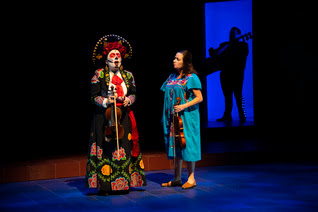
AMERICAN MARIACHI @ Cleveland Play House
Music, humor, empathy--AMERICAN MARIACHI hits all the right notes @ CPH | |
Monday, September 19, 2022
LITTLE SHOP OF HORRORS cult followers will be devoured by Great Lakes production
“The Reluctant Orchid,” a tale of a humble florist who uses a man-eating plant to get rid of his enemies and raise his own status was transformed into a low-budget 1960 black comedy film named LITTLE SHOP OF HORRORS. Alan Menken (music) and Howard Ashman (lyrics and book) transformed it into a musical, which is now on stage at The Great Lakes Theater.
The film, and later the off-Broadway musical, developed cult followings. It was so popular that when it moved from off-off Broadway to off-Broadway, it had a five-year run.
When it closed, it was the highest-grossing production in Off-Broadway history.
Since then, it has had many, many reincarnations including a 2019 smash revival which starred Jonathan Groff, who appeared in Great White Way’s SPRING AWAKENING and HAMILTON, as well as TV’s smash hit GLEE.
Filled with rock and roll, doo-wop and early Motown, the musical’s catchy score, which includes “Skid Row” “Somewhere That’s Green, and “Suddenly Seymour” often evoke singing from those in attendance, and cult followers sometimes bellow out imitations of the “Feed Me” sounds of Audrey II, the blood thirsty plant who plays a major part in the story’s warped plot. In its full glory, attending it is a lot like going to a staging or screening of THE ROCKY HORROR SHOW. (Side note: the staid GLT audience displayed few of the cult-followers tenacity.)
Howard Ashman, who wrote the lyrics and book, in the introduction to the acting edition of the libretto, states that the show "satirizes many things: science fiction, "B-movies, musical comedy itself, and even the Faust legend."
The musical opens with a trio of street urchins named Crystal, Ronette, and Chiffon setting the 1960’s mood and foreshadow the tale, singing the title song and then acting as our Greek chorus, explaining the plot.
We meet Seymour Krelborn, a geeky young man who was taken as a child from an orphanage by Mr. Mushnik, the owner of a failing florist shop located on skid row. Also present are cranky Mr. Mushnik and Audrey, a pretty blonde who is in an abusive relationship with Orin Scrivello, a sadistic dentist.
Seymour buys a mysterious plant that looks like a large Venus flytrap. Since Seymour is secretly in love with Audrey, he names the plant Audrey II.
Though Seymour takes very good care of it, the plant does not thrive in its new environment. He accidentally pricks his finger on a rose thorn, which draws blood, and Audrey II's pod opens thirstily. Seymour realizes that Audrey II requires blood to survive.
Thus starts the farcical tale of how Audrey II’s blood-needs are met. The florist shop becomes famous because of Audrey II, the abuser gets “done-in,” Seymour finds a way to be with Audrey, and a lot of other weird “stuff” happens. Unless you are into “sadistic,” you’ll probably go home and toss out all your greenery.
The GLT production, under the spot-on direction by Victoria Bussert, Baldwin Wallace University’s Director of Music Theatre, and who has served for 36 years at Great Lakes, will delight the many LITTLE SHOP cult-nerds.
Andrew Faria is geek perfect as Seymour. He squeaks, physically stumbles, acts nerdy and endears himself in the process. His “Grow for Me,” charms. His scenes with the air-brained Audrey, delightfully performed by Sara Masterson, are comic classics. Her rendition of “Somewhere That’s Green” evokes endearing sympathy for the character.
Aled Davies fully develops the role of Mr. Mushnik. Alex Syiek, a former Cleveland Critics Circle Best Actor in a Musical winner, is properly obnoxious as the sadist dentist. Sydney Alexandra Whittenburg, Savannah Cooper and Kris Lyons sing, swing and dance with outright glee as the street urchins.
Elijah Dawson steals the show as the voice of Audrey II. Chad Ethan Shohet, the puppeteer, makes Audrey II scarily real.
Nancy Maier’s musicians, Jaclyn Miller’s choreography, and Jeff Herman’s scene design, Trad A Burns lighting design, and Danae Iris McQueen’s costumes all added to the quality of the production. Too bad David Gotwold was not capable of balancing the voices with each other and the singing voices with the orchestra so that each voice could be clearly heard. Many lyrics were lost due to sound problems.
Capsule Judgment: LITTLE SHOP OF HORRORS is the kind of show that many love to hate while others love it. The topics of abuse and drug use, which are not in the wheelhouse of musicals, sometimes turn people off, as does the phy-sci-centered plot. The GLT production is as good as you are going to get. It solidly hits all the comic and horror notes. It’s a must see for the script’s fans!
LITTLE SHOP OF HORRORS runs through October 2, 2002 at the Hanna Theatre. For tickets https://www.greatlakestheater.org/or call (216) 241-6000
Monday, September 12, 2022
BUYER AND CELLAR puts Beck at the delightful center of the gay world
Barbra Streisand’s career started in the gay nightclub, The Lion, located in New York’s Greenwich Village. Her films and music have amassed huge support, especially from the gay community. She, and her works, are larger than life, leading to her being selected by “Out Magazine” as one of the “12 Greatest Female Gay Icons of All Time.”
Many drag and gay entertainers have taken on the Streisand persona, singing her songs and acting out their idealization of her. None, probably has placed a more interesting spotlight on Barbra than Jonathan Tolins in his one-man comedy, BUYER AND CELLAR, now on stage at Beck Center for the Arts.
The play premiered on April 2, 2013 at the Rattlestick Playwrights in NYC. The production starred out gay actor, Michael Urie, best known known for his performances on television’s UGLY BETTY and YOUNGER.
The play follows Alex More, a struggling gay actor who is down on his luck after being fired from Disneyland because of his impatience with the annoying kids at the Magic Kingdom. He lands a job keeping the basement shopping mall in Barbra Streisand’s Malibu home clean, organized, as well as servicing the customers – of whom there is only one – Ms. Streisand, herself. “He comes to learn there are few bigger or more spoiled kids in the world than those with privilege and money.”
In the play, after assuring the audience that the entire play is about a fictional person, working in a fictional location, for a celebrity so popular she is almost fictional herself, we are introduced to Barbra’s secretary, who administers the shopping center and its one employee. More fantasizes about meeting the real icon. At first he does not meet her, but eventually Streisand comes to peruse her collection, and the two strike up a friendly relationship.
Side comments: Streisand did construct a series of Main Street storefronts beneath the barn on her Malibu property, inspired by the Winterhur Museum in Delaware, where she houses her dolls and “tchotchkes” (brick-a-bracs), which are written about in Streisand’s 2010 coffee table book “My Passion for Design.”
Also be aware that the script is liberally laced with Yiddish words and phrases. Though not a requirement, “farshteyn” (understanding) Yiddish helps in grasping some of the humor.
Winner of the 2014–2015 Lucille Lortel Award for Outstanding Solo Show, the playwright “ruminates with delicious wit and perspicacity on the solitude of celebrity, the love-hate attraction between gay men and divas, and the melancholy that lurks beneath narcissism.”
This seriously funny slice of absurdist whimsy creates the illusion of a stage filled with multiple people, all of them with their own droll point of view
Reviews for productions of the 90-minute play state: “Hilarious!” “Beyond brilliant.” “This show will go down like butta'!” and “Fantastically funny.”
Beck’s production features multi-talented Scott Esposito, who has received recognition for his acting skills by Cleveland Critics Circle and Broadwayworld.com. He has been seen locally in productions at Seat of the Pants Productions, Cain Park, Ensemble Theatre, French Creek Theatre, Lakeland Civic Theatre, Blank Canvas, Beck Center and Dobama.
Esposito has memorized and speaks hundreds of lines as the sole performer, portraying not only Alex More, but More’s boyfriend, Streisand, Sadie (Streisand’s alter-ego), and the great one’s secretary.
He handles all of the characters with consistency of sound and mannerisms. He has a nice approach to comedy and his timing is excellent.
What is really impressive is not only Esposito’s grasp of all of the lines in this production, but that several weeks ago he portrayed the leading role in OUR COUNTRY’S GOOD at Seat of the Pants Productions, in which he also had many, many lines to memorize.
The show was creatively staged by director Jamie Koeth.
CAPSULE JUDGMENT: BUYER AND CELLAR is a show that will delight gay audiences who will be able to laugh at themselves, as well as appreciate their perceived hero-worship of the world of divas, but should be a fun experience for the uninitiated into all things gay. Scott Esposito gives a finely tuned performance in this well-conceived play. So, “bubalah,” If you want to escape from the world of covid and political stress, go see B&C, you may get “verklempt.”
BUYER & CELLLAR runs September 9-October 9 in the Studio Theater of the Beck Center, 17801 Detroit Avenue, Lakewood. For tickets call 216-521-2540 or go on line to beckcenter.org
Monday, August 15, 2022
FROZEN--Key Bank Broadway Series
As I exited the opening night of FROZEN, part of the Broadway Series, which is now on stage at the Key Bank State Theatre, I was surrounded by hundreds of little girls in their “princess” dresses and tiaras, happily dragging their parents, grandparents and reluctant brothers toward the counters selling the show’s memorabilia. Listening to their conversations, they were less interested in the story, the score and the lyrics then in “How did they make it snow on-stage?” “How did they make all those icicles?, and “How did Elsa’s dress change so fast?”
There is an old theatre adage that states, “When you see a musical, you should come out humming the music, not commenting on the sets and costumes.” Disney, the producers of FROZEN, obviously hadn’t heard that concept.
Well, maybe they did. In transferring the show from film (the 2013 flick of the same name which, to date, is the top grossing animated film of all time), to the stage version (2018), as “30% of the show was rewritten between the tryout and the Broadway opening. As the writers indicated, “with the musical taking a deeper dive into the characters psyches and aimed at a more adult audience.”
So, grandparents and parents, be aware that this musical, whose underlying message of being true to yourself and fully embracing who we are, may not enchant your “princesses.”
FROZEN, the musical with music and lyrics by Kristen Anderson-Lopez and Robert Lopez and book by Jennifer Lee, premiered on Broadway in March 2018 to very mixed reviews. Typical of the professional evaluations is, ‘FROZEN doesn’t entirely go wrong, but it does evidence signs of the struggle to establish a consistent, unifying tone and to settle on a center in a story inherently bifurcated by having two heroines kept apart for most of the action. It ends up being merely adequate, a bland facsimile when it should have been something memorable in its own right.” Others stated, "fun but not transporting, and "rousing, often dull, alternately dopey.”
Is the stage version the same as the film? In transferring it, the writers augmented their score for the original film, which featured just eight songs to 20 songs in the stage version. It is also probably why, both the two young boys in front of me and the trio of female tweens sitting behind, all were over-heard saying, “This isn’t like the film.”
Due to the COVID-19 pandemic, the Broadway production closed on March 11, 2020, after 825 regular performances. When pandemic restrictions were eliminated, it was decided that the show would not open again on Broadway, but tour instead.
Locals were not thrilled by the Broadway no-up, as Baldwin Wallace University Musical Theatre grad Ciara Renée had assumed the lead role of Elsa, less than a month before the covid shutdown.
So, what’s it all about?
A Greek Chorus introduces serious Princess Elsa of Arendelle and her high-spirited younger sister, Princess Anna. While the family knows about Elsa's magical powers, it is kept a secret from the people of Arendelle. One night, Elsa and Anna build a magical snowman and name it Olaf. In their excitement, Elsa accidentally injures Anna in an icy magic rage. Their parents, call for the aid of a colony of hidden folk. For their own protection, The King isolates the princesses within the castle.”
Years pass. The king dies. The day before Elsa's coronation as Queen of Arendelle, Anna asks if there is anything she can do for her sister. Elsa, her room coated in ice, refuses to open her door out of fear of hurting Anna again.
The day of the coronation Anna meets and falls in love with Hans. He asks to marry her. (As we find out later he has a sinister reason for the proposal.) The couple asks for Elsa's blessing. She objects because the two have only known each other for a day.
After intense questioning from Anna about shutting her out of her life, Elsa accidentally unleashes her icy powers before the court.
Elsa flees to the North Mountain without realizing that her magic has engulfed Arendelle in an eternal winter.
Thus, we enter into a world of ice, a compassionate reindeer, Olaf becoming a living snowman, Anna falling in love again, a revelation about Hans, and, of course, a happy ending.
During the goings on, we hear a rather uninspiring score consisting of such songs as “Hans of the Southern Isles,” “Dangerous to Dream,” “Reindeers are Better than People,” “Hygee” and “Colder by the Minute.” On the other hand, “Love Is an Open Door” is cute and catchy.
The visual effects are astounding. Anna’s costumes are breathtaking. The lighting effects, which help create Elsa’s magic, are confounding. The full-body costume to represent the reindeer, Sven, (Colin Baja inside holding stilts in his hands and walking on tiptoe) is impressive, as is the puppet of Olaf (F. Michael Haynie) the snowman. They are much in the realm of the compelling horses in WARHORSE.
The entire cast has impressive voices. Lauren Nicole Chapman delights as Princess Anna. She displays a wonderful sense of comic timing. Beautiful Caroline Bowman, is perfect as Elsa, the Ice Princess/Queen. Her “Let It Go” is the show’s musical highlight. Handsome Ryan McCartan is both charming and evil as Hans. Zach Trimmer is macho-right as Kristoff, Anna’s nice-guy second love.
Capsule judgment: Disney has created some of Broadway’s most memorable musicals including THE LION KING, BEAUTY AND THE BEAST, MARY POPPINS and NEWSIES THE MUSICAL. FROZEN, unfortunately, does not deserve to join that exalted list. It’s not terrible, but kids will probably not be enchanted, adults should be adequately interested, and all will be awed by the special effects and lighting.
FROZEN runs through September 11 at the Key Bank State Theatre. For tickets call 216-241-6000 or go to www.playhousesquare.org
Thursday, August 11, 2022
Kent and Céspedes join forces for exceptional WEST SIDE STORY at Porthouse
In the fall of 1957, I had a mind-blowing experience. I saw the newly opened Broadway production of WEST SIDE STORY. At the time, all I knew about the show was that it was based on ROMEO AND JULIET and it had opened to positive reviews two days before.
I left the show with aching hands from clapping and clapping and clapping during the extended curtain calls. I became a WEST SIDE STORY junkie, seeing the show time-after-time on the Great White Way before it closed, then the revival, and many other performances since.
WEST SIDE STORY had an interesting road from concept to Broadway.
In 1974 Jerome Robbins conceived the idea of a contemporary musical adaptation of Shakespeare’s ROMEO AND JULIET. His concept was to center the focus on the conflict between an Irish Catholic family and Jewish family living on the Lower East Side of Manhattan set during the Easter-Passover season. The Catholic “Jets” and the Jewish “Emeralds” were “gangs” in conflict.
Originally titled, EAST SIDE STORY, Bernstein proposed an operatic musical score. Difficulty with the book, music and lyrics eventually caused the idea to be dropped.
A number of years later, the idea re-emerged as WEST SIDE STORY. The story is set in New York in the mid 1950s. Sharks came from Puerto Rico, and the Jets, are a collection of white working-class hoodlums. Tony, one of the Jets, falls in love with Maria, the sister of the leader of the Sharks, with disastrous results.
As the score and script developed, tension and comic relief increased, leading to the powerful impact of the play’s tragic ending. Effort was made to ensure that the show would be a musical drama, not a musical comedy, thus making it different from the Broadway shows of the day.
It is a musical with a serious theme, sophisticated music, extensive dancing and an investigation of social problems. The memorable score includes Something's Coming, Maria, America, Somewhere, Tonight, I Feel Pretty, and A Boy Like That.
Cast members, especially the dancers, were treated as actors and singers, not just as bodies to be choreographed, which opened a new way for chorus members to be treated, and laid the foundation for such shows as A CHORUS LINE.
In 2007, Arthur Laurents decided it was time to adjust the script. His “new” WSS opened on March 19, 2009. The production wove Spanish lyrics and dialogue into the English libretto. The show had an attitude adjustment, more serious, with some of the lightness eliminated. The characters were made more authentic.
The Porthouse production, under the adept direction of Terri Kent, is filled with the right attitudes, especially the emotionally wracked ending.
The right tone to the music, which is a highlight to Bernstein’s brilliance, was well performed by Jonathan Swoboda and his large orchestra. The sounds are full and lush where they should be and powerful when appropriate. It also underscored the performers, allowing Sondheim’s lyrics to be heard clearly. The vocals were generally strong.
The choreography of Martin Céspedes, as has become expected from this multi-award winner, is the cement that holds the show together. The dancers are well-honed and show a discipline not often displayed on any but Broadway stages.
CĂ©spedes avoids copying the Broadway dance patterns and invented new ways to stage the numbers, centering on the abilities of his performers. Especially effective were “The Dance at the Gym,” “America,” and “Ballet Sequence.”
Strong performances are given by Alexa Lopez (Maria), Victoria Mesa (Anita), Maya Galipeau (Anybodys), Zachary Mackiewicz (Riff), Rasario Guillen (Bernardo), Kirstin Angelina Henry (Rosalia), Steven Scionti (Schrank) and Rohn Thomas (Doc). Each developed a clear character. Impressive vocals include: “America,” “I Feel Pretty,” “A Boy Like That,” “One Hand, One Heart,” and “Jet Song.”
I wish that the dialogue between the Puerto Ricans was in Spanish, but it isn’t. The difficulty of finding the number actors needed to do that is great, so this void is understandable.
CAPSULE JUDGEMENT: WEST SIDE STORY is near the top of my list of all-time great musicals. The creative choreography and solid character development of the Porthouse production did nothing to dissuade my love for the show. Bravo!!! I look forward to more shows produced by the Terri Kent and Martin Céspedes dynamic duo!
The show runs through August 13. Due to a week of covid cancellations there may be additional performances added. Check the theatre’s website https://www.kent.edu/porthouse/west-side-story. Call 330-672-3884.