Showing posts with label Jewish Community Center. Show all posts

Friday, June 26, 2009

Pangs of the Messiah


Sadness and frustration greet final curtain at JCC’s ‘PANGS OF THE MESSIAH’

As the stage went dark at the Brooks Theatre following JCC’s production of ‘PANGS OF THE MESSIAH,’ I was struck with a feeling of sadness. Having been an active member of the Jewish Community Center’s theatre program, both acting and directing plays on the stage of the Halle Theatre, and it’s predecessor, the storefront on Lee Road, I was struck with the realization that the days of “Jewish” theatre in Cleveland was probably coming to an end.

When the Mandell JCC was built without a theatre, and the Mayfield JCC was destroyed by the wrecking ball, and the staff members of the theatre program were let go, the end was in sight. Now, unless there is an unexpected about face, the end is here. How sad that the voice of Jewish oriented plays has been snuffed out.

My other feeling after PANGS ended was frustration. Watching a play about a peace potential in Israel, and the prospective consequences of following the paths available, and realizing that all of the hopes and dreams of those who desire a true peaceful homeland for the Jewish people, may potentially be leading to another holocaust, is not a pleasant thought. On the way to our car, my wife and I talked about the play and what may well be a hopeless situation. As we drove home, we fell into a pall of silence as we were consumed by what appears to be a problem with no ideal solution or maybe not even a hopeful solution.

‘PANGS OF THE MESSIAH,’ a play by Israeli playwright, Motti Lerner, was originally written in 1986 and performed in Tel Aviv. Its English translation premiered at Theatre J in Washington, in 2007. It had a staged reading in Cleveland.

Set in 2012 amidst the signing of a peace treaty between Israel and the Palestinians, the script is an apocalyptic yet human drama which centers on a group of religious West Bank Jewish settlers pitted against an Israeli leadership they feel betrayed by. The family not only finds itself torn between fighting to stay in their settlement, but obeying their government’s decision to dismantle it. In addition, they are caught between realism versus philosophy.
Lerner doesn’t attempt to provide answers to the unanswerable. This may frustrate some, but it is reality. He avoids the temptation to demonize, leaving us with frustration and a sorrowful meditation on how it might all end. “Questions are over,” Shmuel (the rabbinical leader of the community) says early on. “Maybe there’ll be some answers.” Yes, maybe, but we come to the conclusion that the answers may not be the ones that those who are interested in the welfare of the Jews of Israel, and the state itself as a homeland for the Jewish people, want. The play is not for those wanting escapist theater. This is reality. It is scary and provocative.

The JCC production, under the direction of Scott Plate, is generally well done. It is apparent that the time the production team spent with the playwright, rabbis and Jewish consultants, has helped in using the correct rituals and understanding the plight of those living on the West Bank. What makes this most impressive is that many members of the cast are not Jewish.

Laura Carlson Tarantowski’s scenic design and Amber Michalak’s painting of the background sets a correct mood. Stan Kozak’s sound effects, especially the sound of the barking dog and the Kol Nidrah chanting at the conclusion, enhances the effect.

One might ask why several characters use accents since it seems apparent that everyone is speaking in Hebrew, though we hear them in English. This stage effect becomes even more frustrating as the accents come and go.

Strong performances are put in by Charles Kartali as Shmuel, Jean Zarzour as his wife, Karon Sabo as his daughter-in-law, Amy Pawlukiewicz as his daughter, and Ryan Jagru, as Shmuel’s conflicted son-in-law. Ethan Rosenfeld is outstanding as Nadav the autistic son whose simplistic obsessive mannerisms mirror the narrowness of the situation, yet mirror the breath and frustration of the conflict. On the other hand, Neal Poole is a overly whinny as Benny’s father and Mark Mayo’s characterization of Avner (Shumuel’s oldest son) comes and goes.

CAPSULE JUDGMENT: And, so, it appears we say goodbye to the Jewish Community Center’s long running theatre program. At least it will be remembered for closing with a thought-provoking well conceivedproduction.

(Thanks to Roe Green for her continued generous support for the JCC arts program.)

Sunday, March 01, 2009

Cleveland Heights


JCC’s ‘CLEVELAND HEIGHTS’ off the mark!

At intermission, and following the opening night performance of the Jewish Community Center’s ‘CLEVELAND HEIGHTS,’ the major topic of conversation was the lack of “Yiddisha” [Jewish] Cleveland in the shallow and obvious script. Except for half-a-dozen references, which had almost nothing to do with the plot, the play could have been set in Pittsburg, Indianapolis or any other city that has a couple of Jewish families and has gone through economic changes.

In a brave move to insure that the Cleveland Jewish story be told and archived, JCC commissioned playwright and actor Keith Reddin to write the script. Supposedly, Reddin did a year of research before writing play. In spite of his moderate success as a playwright, Reddin, who is a Chicago fixture, doesn’t appear to be the person to have undertaken the job.

The script didn’t highlight the transition of the Jewish population and their institutions from inner city to the eastern suburbs, and the problems and joys this caused. It didn’t highlight the terminology that went with these moves and conflicts, phrases like “Heights Mockies” and “Kinsman Cowboys.” Yes, there were a few reference to The Temple and Rabbi Silver and Camp Wise, but they were throw-ins, not integral to the plot. The story included many deaths, with that of the father being integral to the story. What’s a Cleveland Jew’s death without referencing the ceremony at Berkowitz’s? Where was the shiva food from Sherwins, Ungers and Corky and Lenny’s, depending on the era? The transition of Jewish students from Glenville to Shaker Heights and Cleveland Heights High Schools was part of the era that Reddin chose to write about, but there was none of this in his script. No, these names shouldn’t have been just dropped in, but in developing the story, twists and turns that centered on those places and events should have been a paramount plot guideline. (Think Les Roberts’ writing about Slovenians and their role in the Cleveland landscape.)

The play takes place in a Cleveland Heights home. The 1940s was when much of the Jewish population shifted from East 105th, and from Kinsman, to the heights areas. Why couldn’t the author have the family moving into their new home and discussing where they came from and why they moved? Why during the discussion of failing businesses in the 1970s didn’t he give references the demise of the Cleveland clothing manufacturing by referencing be the likes of Richman Brothers and Kaufman Kock (Joseph & Feiss). As is, the real” tam” [taste] of what made Jewish life in this unique city was missing.

Reddin uses trite stock characters to develop the obvious plot. The hard working Jewish business man who puts business ahead of family, the understanding wife, the sibling rivalry which caused the two brothers to go through less-than desired lives, intermarriage in which the non-Jewish wife becomes the “good” Jew, the nebbish family friend, the “ferbissinah’ [embittered] aunt, the rebellious daughter. Oy, couldn’t he have invented some new personas for these characters? Couldn’t he have created some tensions and unusual twists into the story line?

Director Brian Zoldessy, in spite of being saddled with this weak and unfulfilling script, managed to wring a few laughs and mild pathos thanks to some excellent acting. Charles Kartali, as the wanna be lawyer-son, Maryann Elder, double cast as the “shiksa” [non-Jewish] wife and the embittered aunt, Elizabeth Townsend as the rebel marijuana smoking daughter, Scott Miller s the put-upon brother, and Sharmon Sollitto as the hand-wringing mother were very good. The acting highlight was Zoldessy, himself. No one does hand-wringing hyper hysterical nerds like Zoldessy.

Ben Needham’s massive set made the cast appear to be guppies swimming in a large aquarium. It’s not his fault. The Cuyahoga Community College’s massive stage just doesn’t lend itself to intimate plays. Maybe the little theatre would have been a better place to stage the play.

CAPSULE JUDGMENT: JCC did not get its money’s worth from their investment in commissioning Keith Reddin, an outsider with little intimate history of the Cleveland Jewish community, to write the definitive story about Jewish Cleveland. What they got was a trite, non-memorable script that probably, and wisely, will never see the light of day again. Too bad, yes, too bad, for the idea for such a story was right, especially in light of this probably being the last season for theatre at the J.

Monday, June 09, 2008

Pangs of Messiah


POTENTIALLY INCENDIARY PIECE READ BY AND IS GOING TO BE STAGED BY JCC

The Jewish Community Center of Cleveland presented a staged reading of award-winning contemporary Israeli playwright Motti Lerner’s script, ‘PANGS OF THE MESSIAH.’ This was a preview of the play which will be fully staged next season.

The reading, directed by Cleveland Play House’s Seth Gordon, featured an excellent cast.

The play, as was obvious during the after-reading talk session, is going to incite much discussion within the community. It is a probing script which is filled with words, not on-stage actions. And the words are incendiary.

The interactions center on what may happen, in the near future, when a peace treaty with the Palestinians, is about to be enacted. What will happen to those “settlers,” mostly ultra-religious Jews who live in Samaria, basically the northern part of the West Bank of the Jordan River. How will they respond? Will they be willing to give up what they think is the very heart of religious Israel for peace?

Capsule judgement: Look for the staged version next year!

Monday, February 25, 2008

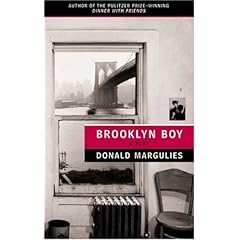
Brooklyn Boy

Appealing ‘BROOKLYN BOY’ at JCC

‘BROOKLYN BOY,’ now being performed in a joint production between the Jewish Community Center and Cuyahoga Community College Eastern Campus Theatre Arts programs, harkens back to the days when Jewish-themed plays were a main staple of Broadway theatre. Those days are long gone. The Jewish experience, that which centered on the Eastern European immigrant seeking to assimilate into the Euro-American scene is basically history. So, plays investigating anti-Semitism, trying to adjust to the land where the streets are paved with gold, and the overbearing mother or emotionally-absent father, complete with “Yiddish” accents, are seen less-and-less on the present day stages.

However, there must still seems to be a sizeable number of people who want to examine that experience. The opening night of ‘BROOKLYN BOY’ had a very sizeable house. And, in 2005 a staged version starring Adam, had a successful run in the Big Apple.

Written by Donald Margulies, who was awarded a Pulitzer Prize for Drama for his ‘DINNER WITH FRIENDS,’ the story centers on Eric Weiss, a novelist whose most recent work has made the New York Times Best Seller’s List. The story, an autobiographical novel, has brought both fame and financial success to the boy from Brooklyn. The Brooklyn from which he has psychologically tried to divorce himself. He has turned from his religion, distanced himself from his family and friends, but mostly has hidden from himself.

We observed, as Weiss visits his father, a patient in Maimonides Hospital, Brooklyn’s “Jewish” Hospital. His father, who spent his entire life as a shoe salesman, absent from family, was never a warm man. His near impending death has not improved his disposition. While in the hospital Weiss runs into Ira, his former “best” friend. Ira, now an Orthodox Jew, tries unsuccessfully to reach out by offering the obviously unhappy Weiss, a serving of help through faith. Weiss’s frustrating attempt to seduce a young woman who comes to one of his book signings, his conflicts with his Hollywood agent, and finally a denouement after his father’s death, complete the scripts investigative cycle.

Though the script was not well received by the New York critics because of its so-called “trite” plot and that it deals with a “a standard son-trying-to-earn-his-father's-approval story line,” I think local audiences will like the concept. It’s filled with experiences and “hamish” (warm and familiar) ideas, and enough comedy and pathos to make for a positive evening at the theatre.

The JCC/CCC production, under the adept direction of Brian Zoldessy, gets every nuance out of the script. The cast understands their characters, playing them with just the right touch…not over the top, not overly dramatic, not pleading for laughs. The acting is universally top notch. Ben Needham’s turntable set is impressive and becomes an integral part of the action, highlighting the play’s structure of a series of six scenes in six different settings. Trad Burns’ lighting enhances the action and moods. Stan Kozak’s musical interludes are mood correct.

Charles Kartali’s Eric Weiss is so natural, it is easy to forget that he is acting, not the real Weiss. His development of the last scene of the play is so emotion-laden that silence proceeded the appreciative applause.

Bernard Canepari effectively develops Manny, Weiss’s father. It would have been easy to overplay the role, but Canepari uses the correct restraint to develop a man whose life was spent running away, hiding from honest feelings.

Noah Budin is both humorous and appealing as Ira, Eric’s former boyhood friend, while Dawn Youngs hits the right notes as Weiss’s “shiksa” (non-Jewish) wife, whose jealousy over her husband’s success destroys their fragile and childless marriage. Jane Conway as the girl in the hotel, Maryann Elder as the agent and Ron Cuirle as an actor who wants to play Weiss in the movie version of the book, are all excellent.

Is the play autographical? While contending that it is a work of fiction, Margulies does not deny that many of the characters and incidents do, in fact, relate to his life.

Capsule judgement: ‘BROOKLYN BOY’ should be favorably received by those attending the production. This is a “nice” play, written in a comfortable way, that gets a great production at JCC/CCC. I’d strongly recommend a “go see it!”

Wednesday, January 16, 2008

Avner the Eccentric in Exceptions to Gravity

‘AVNER THE ECCENTRIC IN EXCEPTIONS OF GRAVITY’ convulses audience

If you were not one of the fortunate theatre-goers who witnessed the performance of ‘AVNER THE ECCENTRIC in EXCEPTIONS TO GRAVITY,’ you missed one fun time. If you didn’t take your children or grandchildren to see Avner, you deprived them of an experience they would not quickly have forgotten.

As is the case with shows that are “child-friendly,” I took my grandsons (Alex—12, Noah—10 and Ian—7), who have picked up the tag-name “The Kid Reviewers,” to see the show presented by the Jewish Community Center and Playhouse Square Center. Their evaluation? A perfect 10 out of 10 from each of them. Noah wanted to know if he could give Avner a 12, but rules are rules, so 10 it is!

Take a creative elder statesman, add a broom, a sweater, an alarm clock, a hat, popcorn, paper cups, a ladder, a newspaper, toilet paper and napkins and you have all you need for a show of magic, illusion and audience pleasure.

Avner Eisenberg has the knack of knowing how to “play an audience.” He jumps off the stage, has the light person bring the illumination up and down to introduce his coming down into the audience, plays around with those in the front rows, and then sets the mood for his on-stage shticks. He “scolded” the late comers. He took a paper away from a man in the second row, proceed to rip it up, balance the pieces on his nose, and then put it back together. He made people change seats. He grabbed a purse from one woman and proceeded to pull out a roll of toilet paper, much to her embarrassment. He had some female in the first row kiss his “boo-boo” every time he did a prat-fall.

Avner balanced a 20-foot aluminum ladder on his forehead, ate 15 napkins, divided the audience into sections and had one group stomp on the floor while another moaned and yet another screamed louder and softer as he conducted his “human orchestra.” It was all totally delightful. And, he did the whole 90-minute show without saying one word!!!

Ian had difficulty staying in his seat. He wanted to be part of the action. His brothers had to grab him a couple of times as he vaulted toward the stage. Alex was laughing so hard at one point, he slipped off the chair. Even “cool and controlled” Noah was hysterical.

Capsule judgment: Avner the Eccentric was Avner the delightful in his recent Ohio Theatre performance. If you missed it, you missed a show that the Kid Reviewers called “great,” “terrific,” “funny,” “hysterical” and “my favorite play, ever!”

Avenue Q


‘AVENUE Q’ delights at the Palace

According to one of the songs in ‘AVENUE Q,’ which is now being staged as part of the Broadway series at the Palace Theatre, “life sucks on Avenue Q.” Don’t tell that to the near capacity audience who attended the opening night performance of the touring show. They loved life on ‘AVENUE Q’!!!

Known as the “porn puppet musical,” ‘AVENUE Q’ won the 2004 Tony Award for Best Musical.

The show, which was conceived by Robert Lopez and Jeff Marx, opened off –Broadway in 2002, was transferred on-Broadway in 2003 and went to Las Vegas in 2005 instead of doing the usual touring production routine of major musicals. The Vegas run is why it has taken so long to get here.

The script is largely inspired by ‘SESAME STREET.’ Most of the characters in the show are puppets. In contrast to the tv show, the actors who operate the puppets are clearly seen. It’s delightful to watch the human facial expressions and body actions paralleled by the puppets. The set depicts several tenements on a rundown street known as Avenue Q, in New York City. Many of the characters are pure parodies of Sesame Street. The major difference is that the “Q” characters are young adults facing adult problems who sometimes use profanity.

The story is about a bright-eyed college graduate named Princeton who finds himself in a search for purpose. When Princeton moves onto Avenue Q, he encounters a group of delightful misfits including Kate Monster, a lovelorn kindergarten assistant, who falls in love with Princeton; Nicky, a good-hearted slacker who lives with Rod; Rod, a closeted gay Republican investment banker; Brian, an out-of-work comedian, engaged to Christmas Eve, a Japanese psycho-therapist; Gary Coleman, yes, the former child actor; Trekkie Monster, think a porn obsessed Cookie Monster; and, Lucy T. Slut – a slutty night club singer.

The songs are delightful. They include "What Do You Do with a B.A. in English?,” "It Sucks to Be Me, " "Purpose," "Everyone's a Little Bit Racist," and "I'm Not Wearing Underwear Today."

Many of the topics and song lyrics brought sustained laughter because of their connection to the audience. For instance, during the song “For Now,” which lists things that are only going to be around for a short time, the name “George Bush” was sung. The audience broke out in prolonged applause and cheering.

What about the advertised porno inclusions? Yes, there is some swearing and the use of “those” words. And, yes, there are puppet sex acts. However, except for those with severe red state attitudes, the viewers will find the going-ons fun, not perverse.

The touring production is excellent. The cast is strong and the staging and special effects are well conceived.

Audience favorites included Robert McClure, who performed the roles of Princeton and Rod. This is a talented young man, who was in the Broadway production of the show, has an excellent singing voice, great acting skills and a compelling stage presence. Kelli Sawyer (Nicky, Trekkie Monster) has a strong singing voice and interacted well with McClure. Angela AI was delightful as Christmas Eve and Carla Renata made for a great Gary Coleman.

Capsule judgment: ‘AVENUE Q’ is a total delight. Go, you’ll have a great time!

Friday, April 27, 2007

Jolson & Company


Entertaining ‘JOLSON & COMPANY’ at JCC

Al Jolson, the subject of ‘JOLSON & COMPANY’ now being staged in a joint production of the Jewish Community Center and Cuyahoga Community College-East, was a very talented entertainer, who was also filled with rage and insecurities.

Asa Yoelson was born in Lithuania and came to the United States as a child. Under the name of Al Jolson he had a career that spanned from 1911 to 1940. Often referred to as “the world’s greatest entertainer,” he was known for his black-face makeup, exuberant gestures, operatic-style singing, whistling, and directly addressing his audience. His initial musical training was under the guidance of his father, a well-known New York Jewish cantor. The cantorial sound echoed through Jolson’s vocal chanting in many of his hits.

As youngsters Al and his brother were a minor hit on the vaudeville circuit. A personal rift between the brothers sent Jolie off on his own and resulted in a Broadway career which was unmatched for its length and popularity). One reviewer noted that Jolie had such an "electric" personality, along with the ability to make each member of the audience believe that he was singing only for them, that his audiences often literally “stopped the show” with prolonged applause.

Today, he is probably best remembered for his appearance in 1927 in the first successful movie “talkie", ‘THE JAZZ SINGER.’ In that movie Jolie performed the song "Mammy" in black face.

Jolson’s other hits included "You Made Me Love You (I Didn't Want to Do It)", "Rock-A Bye Your Baby With A Dixie Melody", "Swanee" (songwriter George Gershwin's first success), "April Showers", "Toot, Toot, Tootsie, Goodbye", "California, Here I Come", "When the Red, Red Robin Comes Bob-Bob-Bobbin' Along,” and "Sonny Boy."

He died at the age of 64 of a massive heart attack while playing cards. Appropriately, Jolson’s supposed last words, taken from one of his most famous songs, were "Boys, I'm going."

‘JOLSON & COMPANY’ is a scrapbook of Al Jolson’s life. It covers his youngest memories including the death of his mother, his career successes and failures, his marriages and divorces. It gives a glimpse of his talent, his egotism and his renowned temper.

The script, by Stephen Mo Hanan and Jay Berkow is problematic. The story telling centers on a radio show being narrated by Barry Gray (George Roth). Jolson steps in and out of the broadcast to sing and act out various phases of his personal life and career. The format is an obvious device which wears thin after a while and breaks the story line.

The transitions are weak and the writing often fails to create the needed emotional bridges. There are many pauses that result in a loss of audience attention. For example, when wife Ruby Keeler, who was supposed to perform at a charity event with Jolson, serves him with divorce papers and walks out, what should have been an emotional highlight, turns flat as Jolson takes an extended period of time to put on black face before he sings his signature, “Swanee.” The idea is good, but doesn’t work theatrically.

JCC’s production, under the direction of Fred Sternfeld, will entertain audiences, especially Jewish audiences. There are enough “Yiddish” allusions to capture the older members who attend JCC productions and know and love Jolson. On the other hand, cutting out some of the extraneous scenes and picking up the pace a little would make the well over 2-hour show, more compelling.

Don’t go to see ‘JOLSON AND COMPANY’ expecting to experience a reincarnation of Al Jolson. Mark Moritz, who plays Jolie, has a good singing voice, and tries hard to incorporate some of Jolson’s signature sounds and moves into his presentation, but he is much too static to become electrifying. He plants his feet, rather than bouncing around the stage. His face lacks the dynamic quality of Jolson’s unbridled stage presence. His sound is appealing, not mesmerizing. Mortiz makes for a very acceptable Jolson-light, but he is not Jolie!

Kristin Netzband, as the female member of the three-person cast, is appealing in multi roles. She is especially delightful as May West and on-target as Ruby Keeler. She sings extremely well and her dancing is excellent. JCC attendees will remember her as Evelyn Nesbit in the company’s production of ‘RAGTIME, THE MUSICAL.’

George Roth, as always, is on target in each of his characterizations. The Times Theatre Tribute Award winner changes voices and facial expressions and makes bodily adjustments to fit each of his nine characters.

Larry Goodpaster and his three piece “orchestra” efficiently back up the performance.

Capsule judgement: ‘JOLSON AND COMPANY’ will be a pleasant trip down memory lane for those who know and appreciate the musical sounds of Al Jolson.

Saturday, October 21, 2006

Modern Orthodox (Jewish Community Center/Cuyahoga Community College)


‘MODERN ORTHODOX’ pleases some, upsets others at JCC

When ‘MODERN ORTHODOX,’ the play now being produced by the Jewish Community Center in association with Cuyahoga Community College, opened in New York, it was met with very mixed reviews. Most theatre observers forecast a short run. In actuality it stayed open for six-months. This neither made it a hit nor a flop, kind of in-between.

An on-line site surveyed people coming out of the Big Apple production. Their comments included: “It’s hysterical.” “It's an awful, unfunny, sexist, overly schticky, cliched, trite show.” “I loved it!” “I hated it!” “It’s insulting.” Listening to reactions at the opening night of the local production, opinions were about the same. Thumbs up, thumbs down, and some hands wiggled from side-to-side.

Daniel Goldfarb’s ‘MODERN ORTHODOX’ attempts to examine love, relationships and sex from a Jewish cultural stereotypic viewpoint. The use of stereotypes isn’t necessarily wrong, it’s just that Goldfarb doesn’t have the writing ability to pull off the comedy while making relevant points. This doesn’t mean there isn’t humor. There are plenty of laughs. But at the end of the play the question arises as to what was the author’s intent? Comedies are intended to have a message. Neil Simon, for example, wrote for laughs, but his plays make a point. What is Goldfarb trying to tell us?

Maybe from Goldfarb’s view, religion and relationships are inextricably linked. His two major characters, Ben Jacobson and Hershel Klein, are at opposite ends of the religious spectrum. Ben is a "high holiday Jew," while Hershel is Orthodox in dress, speech, and behavior. Ben wants to buy a diamond ring from Hershel so he can propose to Hannah, his live-in girlfriend of six years. Hershel disapproves of the live-in arrangement. As they bicker, Ben's innate distaste for Orthodox Jews becomes evident, even taunting Hershel to remove his yarmulke in order to seal the deal. Hershel does so. The question must be raised as to the significance of that act. Is this a comment on the role of the Jew being more in love with money than religion? This is not the only unanswered question in Goldfarb’s script. He wanders around making fun of orthodox sexual practices, Jewish dietary concepts, wedding rituals, the guilt of those who aren’t “true” believers, attitudes toward women. And, for what purpose? For laughs? To make a point? You got me...I’m not sure. It’s always been my belief that comedy writers use humor to make a point. What’s Goldfarb’s point?

Logical questions arise. Why, when Herschel appears at his doorstep doesn’t Ben toss him out on his tuchis (Yiddish for rear-end)? Is Herschel’s presence enough to stimulate Ben and Hannah having a relationship crisis? Why is Rachel, a woman with a master’s degree who Ben finds as a potential wife for Hershel on the on-line Jewish dating service so shallow? Is she so desperate to have sex that she’ll marry anyone?

The local production, under the direction of Fred Sternfeld, generally does a nice job with what they have to work with. Brian Zoldessy is hilarious as Hershel. Zoldessy, as is his classic trademark, flits around with his feet hardly ever hitting the stage. He is appropriately a “cheleria” (nervous wreck) of the highest order. It’s worth going to the production just to see him in action.

Larry Nehring, is believable in his “nice guy” role, often looking like a puppy dog whose purpose in life is only to please. Unfortunately, the script never gives us a clue as to why he would act this way.

Lara Mielcarek makes Hannah as real as she can be with the lines she’s been given. The kissing scene with Hershel, while hysterically funny, is again one of those unexplainable Goldfarb moments.

Holly Facer, is off-key as Rachel, Hershel’s intended wife. Part of the problem is her inappropriate costume. No orthodox Jewish woman would be seen in costume designer Aimee Kluiber’s ill designed garb. Long sleeves, long skirt are requirements, not low cut revealing clothing. Facer doesn’t seem to get the underlying motives of the character to crave sexual attention because she isn’t allowed to express natural desires. She is not a sex-pot as Facer seems to make her.

Ben Needham has the difficult task of attempting to design a supposedly small New York apartment in the massive CCC theatre stage.

Richard Ingraham’s musical interludes are appropriate to the script.

CAPSULE JUDGEMENT: Its difficult to predict any audience member’s reaction to this production. There are lots of laughs, but for what purpose? There is the potential to offend many in the audience, yet please others. “All I can say is OY VEY.”

Tuesday, May 09, 2006

From Door to Door (Jewish Community Center)


‘FROM DOOR TO DOOR’ fits JCC mission

James Sherman, whose play ‘DOOR TO DOOR,’ is presently being produced by the Jewish Community Center, is also the author of ‘’BEAU JEST, the off-Broadway hit.

The title of the play, ‘DOOR TO DOOR, is based on a phrase in the Hebrew prayer book, "l'dor v'dor," which means "from generation to generation." And, from generation to generation is exactly what the play illustrates. The plot focuses on three generations of the same family." Sherman explains, "There's no secret this play is inspired by my mother. She knows it, she's seen it. The play is to honor her and the women of her generation." He continues, "One woman of my grandmother's generation, one woman of my mother's generation and one woman of our generation.” To accomplish the task, the play covers 65 years, from 1935 to just about the present.

It is written in memory format. It begins in the present. Mary, who represents Sherman’s mother, is sitting shiva for her husband. (Shiva is the seven-day mourning period which begins after burial. Survivors concentrate on their inner feelings to begin the healing process and take the first step into re-entering normal life without the deceased.) She is there with her daughter and, as the play develops, we flashback to various incidents in Mary’s life.

Sherman has used the script as a means of personal awareness. "When I was working on the play, it gave me an excuse for my mother to sit down and talk about herself, which is not something she loves to do," Sherman said. "I also talked to a number of women of her generation, and women like my sister, and what started to interest me about these mothers and daughters is how we take what we get from our parents and then make choices about what we will pass on to our children and not pass onto our children."

The play, which premiered in Chicago in 1999, showed regionally and then was produced off-Broadway in 2004 . It played nine previews and had a respectable 110 performance run in the Big Apple.

‘FROM DOOR TO DOOR’ fits well into the JCC’s arts mission of showcasing plays about Jewish topics and/or by Jewish authors. This concentration allows members of the Jewish and non-Jewish community alike to be exposed to ethnic shows that might not otherwise be produced on local stages.

The JCC production is nicely paced by director Fred Sternfeld. The flashbacks and flash forwards could get confusing as Sherman’s writing stratagem has left little time for costume changes. Sternfeld has handled this potential problem very well and the time eras are clear.

The production generally works, but a miscasting makes for some lack of believability. While Jeanne Task (Mary) and Liz Conway (Deborah, the daughter) fit their roles well, Barbara Haas just doesn’t create the right sound or illusion as the Jewish grandmother. Her accent, her demeanor, her presence, lack the needed “tam,” (the taste) and the “yiddishkeit,” (the Jewishness). There is a cadence that makes for a believability to the Jewish sound. It is not something that one can act, it is almost something which someone must acquire from being around, living with, experiencing European Jewish women of that era. Haas lacked that quality. She is not the first actress who has had trouble with this. Valerie Harper didn’t have it in her recent Cleveland appearance as Golda Meir. Jessica Tandy lacked the right feel in the film, “DRIVING MISS DAISY.’ This is a role which is a much better fit for such local actresses as Elaine Rembrandt and Dorothy Silver.

Jeanne Task developed the nuances of Mary. She clearly understands the role of mother and wife. She was real, natural, convincing. Liz Conway, for the most part, was excellent. She was at her strength as the young Deborah, who was willing to defy her lack of Jewish upbringing by marrying a non-Jew (a “shaygetz”). She was excellent as the daughter who has transformed into the mother to her mother. There were some instances in the transitional scenes, however, in which she lost some of the characterization.

Ben Needham’s creative set design, which consisted of a series of interlocking doors on various levels, was excellent. The symbolism of the multi-doors which could have been opened in Mary’s life, but of which only a few were actually opened, expanded the script’s imagery.

Richard Ingraham selected excellent music, including a vocal version of the play’s title, ‘L’dor V’dor,” to tie the sound to the plot.

CAPSULE JUDGEMENT: JCC’s ‘FROM DOOR TO DOOR’ is a perfect fit into the theatre’s mission. The production is quite acceptable, but could have been better with more appropriate casting.

Tuesday, November 01, 2005

South Pacific (Jewish Community Center)


‘South Pacific’ pleases opening night audience at JCC

Richard Rogers and Oscar Hammerstein II, America’s premiere traditional musical theatre writers, were social theorists and activists. Each of their shows, including ‘SOUTH PACIFIC,’ now being staged by the Jewish Community Center’s Arts and Culture Division, carries a message of societal problems and lectures on the need for change. This message is highlighted by one key song in the score of each of their shows. In the case of ‘SOUTH PACIFIC’ it is the poignant “You’ve Got to Be Carefully Taught,” which explains that prejudice is not inborn but is passed from generation to generation.

The musical, based on James Michener’s ‘TALES OF THE SOUTH PACIFIC,’ basically asks the question of whether a young military nurse from Little Rock, Arkansas, can overcome her family taught prejudices and find happiness with a mature French planter she met “one enchanted evening” on a Pacific Island. When she finds out he was formerly married to an island native and fathered two children, she must decide whether “to wash that man right out of her hair.” On another level the tale examines another pair, American GI Joseph Cable and the Bali Ha’i born Liat, who are also the victims of prejudice. The love affairs are wrapped inside the reality of World War II when, in 1943 the United States Navy established bases in the Solomon Islands, in preparation for an invasion towards the Central Pacific. On one such island Michener created a fantasy about a French planter named Emile de Becque, whom the Navy wishes to employ as a scout to nearby Japanese held islands. He eventually agrees to assist and thus the story races to it denouement.

The Broadway version of ‘SOUTH PACIFIC’ opened in 1949 and closed in 1954 after 1925 performances. It won the Tony Awards for Best Musical, Libretto and Original Score and the Pulitzer Prize for Drama. Three of the show’s original cast also won Tonys. Ezio Pinza as best actor, Mary Martin, best actress and Juanita Hall for best featured actress in a musical. In 1958 the play was made into a movie staring Rossano Brazzi, Mitzi Gaynor, John Kerr, Ray Walston and Juanita Hall.

The musical score, which many theatre experts believe contains the best score ever written for an American musical, includes such classics as, “A Cockeyed Optimist” “Some Enchanted Evening,” “There is Nothin' Like a Dame,” “Bali Ha’I,” “Younger Than Springtime,” and “This Nearly Was Mine.”

Musicals are the most complex of arts, combining acting, singing, dancing, musicianship, scenic and fabric design and construction. It is why so few musicals are truly outstanding, especially on the non-professional level. No matter how much we want to think that our friends and relatives are “better than Broadway,” the reality is that they usually are not.

Yes, every once in a while a local production soars. Yes, there are near wonders like the recent ‘URINETOWN’ at Beck Center, ‘SONGS FOR A NEW WORLD’ at Cain Park, ‘CHORUS LINE’ at Carousel Dinner Theatre and JCC’s award winning ‘RAGTIME,’ but those are the exceptions. Most local musical productions are, “okay.” They are pleasant experiences, with performers and staff who try hard and give their all to please an audience. JCC’s ‘SOUTH PACIFIC’ falls into the latter category. Don’t go expecting to see another ‘RAGTIME.’ It isn’t. Does that mean it’s bad? No, it just doesn’t reach the level of that superb production.

Tom Fulton is excellent as Emile. He creates a clear physical and vocal character. His rendition of “This Nearly Was Mine” was wonderful. Cheryl Campo’s Blood Mary is generally on target. Colin Cook has a nice singing voice and has a grasp of Lt. Cable’s motivations. For some reason his version of “You’ve Got to Be Carefully Taught” seemed truncated. Since it is the key to the show’s meaning, one must question why that was done. The male singing chorus and the orchestra are superior.

The usually terrific Larry Nehring is much too controlled as the wheeling-dealing Billis. He doesn’t appear to be having fun...a vital element in making the character delightful. Joan Ellison (Nellie) has an excellent singing voice. Unfortunately she often says and sings words rather than creating meanings. It was difficult to accept her as a real person. There appeared to be little emotional connection between Nellie and Emile. John Lynch had trouble creating a realist character in the pivotal role of Captain Brackett.

CAPSULE JUDGEMENT: JCC’s ‘SOUTH PACIFIC’ is an acceptable but not an outstanding production. If judged by the opening night audience those who attend will enjoy themselves.

Sunday, May 08, 2005

To Know Him (Jewish Community Center)


‘TO KNOW HIM’--a fitting production for the closing of the Halle Theatre

The drama program at the Jewish Community Center has a unique mission. It was founded to showcase dramatic, musical and comedy scripts that either have a Jewish theme or were written by Jewish playwrights. It has accomplished this mission well for many years. First in whatever venue they could find, then in a store front on Lee Road and then at the “new” theatre in the Mayfield JCC, which was called the Halle Theatre in honor of the donors who gave the money to build the performing arts space. The decision has been made to sell the facility and it will soon become rubble as it is replaced by condominiums. This leaves the JCC with no performing arts center. (If you know of a donor who would like to have his or her name inscribed on an arts facility, I’m sure that the board of the JCC would listen with an open ear.)

The theatre produced Yiddish and American plays until Yiddish became a language understood by fewer and fewer members of its audience. For the last number of years the offerings have been those written in English.

It is only fitting that ‘TO KNOW HIM,’ the final production at Halle, is being directed by Dorothy Silver, stars Brian Zoldessy and Reuben Silver and is produced by Fred Sternfeld. For many years Dorothy was the artistic director of the J’s drama program. The JCC’s playwriting competition is dedicated to her in honor of her many years of service. Her husband, Reuben, has appeared in and directed many of the “J’s” plays. By the way...the duo was recently inducted into the Ohio Senior Citizens Hall of Fame in a State House ceremony in Columbus.

Zoldessy, who is Director of Theatre Arts at Cuyahoga Community College, Eastern Campus, was instrumental in allowing the JCC drama program’s rebirth, after a year of hiatus, to perform its outstanding production of ‘RAGTIME, THE MUSICAL’ last year. Sternfeld not only directed ‘RAGTIME’ but was also the guiding hand behind ‘MAN OF LAMANCHA’ and other J productions and will be directing their fall production of ‘SOUTH PACIFIC.’ Zhe serves as the organization’s Theatre Consultant.

‘TO KNOW HIM,’ written by Albi Gorn, was the 2002 winner of the Dorothy Silver Playwriting Contest. It is the story of Rick, a gay man dying of AIDS, who receives an obligatory visit from Penny, a student in her last stages of preparation for the rabbinate. Her final assignment is to do visitations to hospital patients. Her enthusiasm and zealousness butt up against the Jewish, but agnostic Rick, a college professor of film, who wants none of her ministering. To add to the mix is Rick’s father, a traditional man who said “kaddish,” the prayer for the dead when he found out his son was homosexual. The two have been alienated for many years. Penny encourages prayer and reconciliation. Rick responds, “When you have heard kaddish said for you, what else is there to pray for?”

The plot of ‘TO KNOW HIM’ is obvious, but it matters little. The overall effect is quite palatable. It makes its statement about prayer, forgiveness, the Jewish philosophy “Tikun Olam” (repairing the world), and how life can be meaningful if there is someone in it to share both your joys and sorrows.

Director Silver has paced the show well and has honed a nice cohesiveness in the cast. Brian Zoldessy’s Rick not only looks the part of a sick man but conveys the difficulty leading to death well, including a phlegm-sounding rasp. Zoldessy needs not go too far to get the motivation for the role. He, himself, has been in precarious health for a period of time, so much of his psychological memory is immediate. His is an excellent performance.

Alicia Kahn as Penny has some strong moments. During her opening scene she shows proper angst, but overdoes it to the point that she is almost unbelievable as a real person and especially one who has come this far in her rabbinical training. As the play develops she becomes more real and grows as the character grows.

Reuben Silver doesn’t make his entrance until the second act. Not only was he met with applause, but an elderly man sitting behind me loudly pronounced, “Finally, there he is already.” Silver knows how to milk each line for meaning. He suffers verbally and physically, he mumphers to perfection. He makes the father, Harry, completely believable. Reuben Silver is Reuben Silver...what greater tribute can be given an actor?

Tony Kovacic’s set is excellent. The hospital room’s back wall is a scrim which allows us to see a backdrop composed of large movie posters from many of the films discussed in the bantering between movie buff Penny and film expert Rick.

CAPSULE JUDGEMENT: ‘TO KNOW HIM’ is an appropriate tribute to the history of JCC. It is a play worth seeing and this is your last chance to feel the warmth of the venue and emotionally touch and feel the history that has taken place there. Personally, having done much of my early theatrical performing in that facility, I dread seeing the wrecking ball destroy one of my “theatrical homes.”

Sunday, October 31, 2004

Ragtime (Jewish Community Center)


‘RAGTIME’ hits right tune at JCC

‘RAGTIME, THE MUSICAL’ is an awesome undertaking. It
can’t be done for full effect without a heavy investment in costumes, sets and special effects. It requires a huge and talented cast. But, most importantly, it takes a director who has the insight, creativity and ability to blend all these elements together. Fortunately for the newly revived Jewish Community Center’s theatre program, their production of ‘RAGTIME’ has the talented cast, the expert technicians, and a quality director in the person of Fred Sternfeld.

‘RAGTIME’ is set in the early 1900s during the era of vast social changes. It was an era, much like ragtime did for music, that transformed the United States into a new country.

The play, based on the epic book “RAGTIME’ by E. L. Doctorow, chronicles the lifestyles of those blessed and not-so-blessed by weaving together the fictional stories of Coalhouse Walker, an educated African-American musician and Sarah, the love of his life; Tateh and his young daughter, Jewish immigrants seeking opportunity in America; and an upper-class
family clinging to the “good life” in the affluent and peaceful community of New Rochelle, New York. Further woven into the plot are real historical characters in the personages of Harry Houdini, Evelyn Nesbit, Henry Ford, J. P. Morgan, and Emma Goldman.

The show was billed, on its New York opening as: “The number one theatrical event of the year.” Other comments included, “A brilliant work of musical storytelling, social comment that marks a glorious culmination for the American musical at the end of its first century.” Further, it was called “A powerful liberal statement at a moment when such statements are rare.” It was also declared that “’RAGTIME’ is one of those rare musicals that can be mentioned in the same
breath of “SHOWBOAT,’ ‘PORGY AND BESS’ and ‘FIDDLER ON THE ROOF’.”

I’m not an easy sell, but I echo those reviews. I consider ‘RAGTIME’ to be one of the top ten musicals ever written.

With that said, I go into productions of the show with great fears. With the daunting production requirements, this is a musical, no matter the brilliance of the script and musical score, that can crash and burn with ease.

My fears evaporated early into the JCC‘s production, which is being staged in the theatre at Cuyahoga County Community College-Eastern Campus. It became apparent from the inspiring opening scene that Sternfeld had put the whole thing together with style and skill. Each person on stage was sure of what to do and how to do it. The chorus vocal blends were wonderful. Martin Cespedes’ choreography perfectly fit the multi-musical moods underscored by the ragtime sound. The costumes transport us back to the turn of century. And, in spite of the fact that the music was sometimes so loud it drowned out the spoken and sung words of the cast, the sound-feel was right.

Before us unfolded a large Victorian house in New Rochelle, New York. There is Harlem, with crowds dancing to the music of ragtime. There is a “rag ship” with a Lithuanian widower named Tateh (father) with his dreams of escaping with his daughter to America to be part of the “golden medina”—the country where the streets are paved with gold.

And as the play developed, the visual images continued to be crystal clear through both the development of the script and the interpretation of the music, music that carries us through the high and lows of the story. Songs like “Crime of the Century,” which tells of a murder which gained of nation-wide attention; “Goodbye, My Love” in which Mother bids farewell to Father who is joining Admiral Perry on an expedition to the North Pole; “Journey On” which gives
us our exposition to Tateh and the Little Girl as they enter America; and, “Getting Ready Rag” which introduces us to Coalhouse Walker, Jr.

Highlight production numbers include: “The Tempo Club in Harlem” with has some electrifying dancing, “Henry Ford’s Auto Factory” in which humans become cogs in the machinery for producing the Model T, “Courtship” a well-staged composite singing number, and “What a Game” which was an obvious audience favorite.

The JCC cast is generally excellent. Kyle Primous makes Coalhouse a living symbol. His version of “Coalhouse’s Soliloquy” was powerful. His dance numbers were equally good. Maggie Stahl Wirfel brought understanding and compassion to the role of Mother. She has a fine singing voice which was well showcased in “Goodbye, My Love,” “Back to Before” and
“What Kind of Woman.” “Our Children,” her duet with Marc Moritz (Tatah) was beautifully tender. Moritz’s Tatah was fine, except for the distracting accent which seemed inappropriate and kept coming and going.

Sean Szaller as Younger Brother perfectly captured the mood of the young man caught between his liberal ideals and WASP upbringing. As with all the cast, he displayed a fine singing voice which was used effectively in his segments of “He Wanted To Say.” Amiee Collier (Emma Goldman) and Primous helped make that song one of the emotional highlights of the evening.

Chris McCarrell (The Little Boy) and Emma Wahl (The Little Girl) both showed stage awareness beyond their youth. (Emma will leave shortly for NYC to join the original cast of the soon to open ‘CHITTY CHITTY BANG BANG.’)

Yolanda Christine Davis (Sarah) has a beautiful voice but her facial expressions while she sung were sometimes distracting, creating looks of anguish rather than happiness. Kristin Netzband was not seductive and playful enough as Evelyn Nesbitt.

CAPSULE JUDGEMENT: As a line from the show says, “And we will ride on the wheels of a dream.” My recommendation: Go see this dream of a production!

Saturday, August 02, 2003

Goodbye to Halle Theatre (Jewish Community Center)


HOPEFULLY, THIS IS NOT GOOD BYE TO “MY” HALLE THEATRE

I made my local community theatre debut at the Jewish Community Center’s theatre. It was located in a store front on Lee Road and was headed by the noted former New York theatrical actor and director, Mark Feder. I was featured in ‘OUR TOWN’ and ‘COLD WIND AND THE WARM’ in that inviting setting. Later, after the theatre moved to the “brand new” JCC on Mayfield Road, I continued my theatrical career there. Joseph Buloff, of TV’s “The Untouchables” and Broadway fame, came to Cleveland to direct ‘THE FIFTH SEASON ‘ which playwright Betty Fields had written for him to star in on Broadway. A year later he returned and I had a major role in the first not-on-Broadway production of ‘THE WALL,‘ the story of Warsaw Ghetto uprising. It was a privilege to work with this great man. I learned much of my directing skills from him. Skills which I later shared with students at several local junior and senior high schools, Lorain County Community College, and casts at numerous community theatres.

It was, therefore, with much sadness that I learned that JCC’s Halle Theatre was going on sabbatical. The announced plan is to revive the program next year. The skepticism in the theatrical and lay community is running high. Activities put on hold often stay on hold forever. It will be a genuine shame if this community permanently loses the JCC theatre program. It is the only venue for plays specifically written about or by Jews.

With the great amount of funds donated by Jewish philanthropists in this town, it is a shame that someone has not stepped forward to save this treasure. Yes, lots of “little” guys have offered donations. It will, however, take some big giver to provide the needed funds to underwrite the program. Arts programs, in general, can’t be supported by ticket sales and small contributors. It takes major donors, whether it be a person, a city, a corporation, or a non-profit organization to float the funds to support the project.

I can only trust that Enid Baum Rosenberg, one of my former Beachwood students who benefitted from my JCC training, will lead the Board of JCC to find some way to breathe life back into this needed theatre program.

Sunday, May 11, 2003

A..My Name Will Always Be Alice (Jewish Community Center)


Pleasant “A...MY NAME...” at Halle/JCC

Watching ‘A...MY NAME WILL ALWAYS BE ALICE’ at the JCC’s Halle Theatre is like eating Chinese food. It’s filling while you are experiencing it, but shortly afterwards you are left with an empty feeling. The strength of the production is also its weakness. It’s a nice, safe, mildly messaged review type musical. It doesn’t go out on a limb and take strong stands, it will offend no one, most of the musical numbers are pleasant, but none stands out. You smile, clap, and then leave the theatre.

Joan Micklin Silver and Julianne Boyd, the play’s creators, seem to have assumed the mission of teaching the viewers what it’s like to be a woman. Unfortunately, most of the pieces aren’t edgy enough to do that. The closest are “Friends” which takes a short journey from two teenagers daily talking on the phone to their still daily talking on the phone as they traverse into old-age and “Nonbridaled Passion” about a woman coming to the reality of an unfulfilled life.

The cast, consisting of Tiffany Gates, Paula Kline-Messner, Maryann Nagel, Tina D. Stump and Casandra Vincent are all excellent. They sing, act and dance well. Highlights include a very funny sequence of poetry readings by the very talented Nagel; a plaintiff “I Sure Like the Boys” sung by Tiffany Gates; Nagel and Kline Messner’s “Welcome to Kindergarten, Mrs. Johnson” and “Friends;” Gates’ “Nonbridaled Passion;” and Vincent and Nagel’s “Hot Lunch.”

Director Douglas Farren, Choreographer Eric van Baars, Musical Director Marc Baker, Costumer Alison Hernan and Scenic Designer Tony Kovacic have all done their things efficiently. All of the technical and aesthetic aspects work.

Capsule judgement: ‘A...MY NAME WILL ALWAYS BE ALICE” is a pleasant evening of theatre. If you go to experience “entertainment-light” you’ll appreciate the production.

Monday, March 17, 2003

The Chosen (Jewish Community Center)


‘THE CHOSEN’ well-done and thought provoking

When on July 23, 2002 Chaim Potok died, the English speaking world lost one of the few voices who has been able to paint a picture of Hasidic life in America. Hasidics are ultra-Orthodox Jews whose belief in a divine God who must be listened to and adored have been unwavering in their convictions for many generations. They still adhere to the dress codes of ancient times and spend their days and nights in religious study. It is this world that Potok illuminates. He does it from authority. As he once said, “I grew up. . .in a Hasidic world.” His world, however, was not the religious extreme. He, therefore, is capable of looking at the movement through clear eyes.

Potok started writing fiction at the age of 16. With the publication of his novel ‘THE CHOSEN’ in 1967, Potok entered the American literary scene and he grew in stature with eight subsequent publications.

The play version of “THE CHOSEN’ is now being staged at the Halle Theatre of the Jewish Community Center. With dramatic force, it tells of the powerful bonds of love and pain that join fathers and sons and how that love differs, yet is the same in divergent settings.

It’s the 1940's in the Williamsburg neighborhood of Brooklyn. Two boys who have grown up within a few blocks of each other, but in two entirely different worlds, meet for the first time in a bizarre and explosive encounter--a baseball game between two Jewish parochial schools that turns into a holy war. The assailant is Danny Saunders- moody and brilliant. He is driven by his pent-up torment. He feels imprisoned by the tradition that destines him to succeed his awesome father in an unbroken line of great Hasidic rabbis. The victim of Danny's rage is Reuven Malther, the gentle son of a gentle scholar. He is one of the less-Orthodox Jews whom the Hasids regard as little better than infidels. Their lives become entwined and we are carried into an investigation of what it really means to love a son and finally fulfill the obligation of letting him go into the world he wants and needs.

Director Dorothy Silver has crafted an engrossing evening of theatre. She has molded a cast, most of whom had no understanding of the religious implications and philosophical concepts of Hasidism, into a body that allows audience member, Jews and non-Jews alike, to understand the universal themes of the script.

Sean Szaller is outstanding as the Young Reuven Malter. He totally grasps the slightest nuances of the character. Doug Rossi, develops a believable Danny, but one must wonder why an American-born young man would be speaking with an accent. An accent which is not well sustained. Larry Nehring, as the adult Reuven, acts as the show’s narrator with ease. He seamlessly weaves in and out of scenes and is the audience’s eyes and ears. One of Cleveland’s acting treasurers, Reuben Silver, is texture-perfect as Reb Saunders. The character alternately frustrates in his rigidness and surprises with his insights. This is a fine, fine performance. Michael Regnier, as Reuven’s father illustrates the rational, caring man who understands his limitations yet is driven by his intellectual passions.

Larry Gorjup has designed an impressive evening of sound. Consisting of 1940s radio broadcasts and the appropriate music, the audio transports the audience into the proper mood and illuminates the era perfectly. The postage stamp-sized stage is always a challenge to scenic designers. Tony Kovacic has done a wonderful job of using the limited space. Alison Hernan’s costumes are period and religiously correct.

Sunday, January 19, 2003

Cherry Docs (Jewish Community Center)


'CHERRY DOCS' examines hate at the Halle

The lights come up on a representation of the scales of justice. Each side of the scale looks like a prison...bars pointing to the ceiling encircling a confining platform. In each area we will soon meet and experience two men who are very alike, and very different. The combatants are a skinhead perpetrator of a vile hate crime (Mike) and his Jewish legal-aid lawyer (Danny). Two men who are troubled by their pasts and have different paths to their futures. We will observe them going through belief changes. We will see them, as one of the lines states, “go through the eye of the needle.”

The play? David Gow’s CHERRY DOCS. The place? The Halle Theatre.
The title? Cherry Docs are red colored sturdy shoes with steel covered toes that are so endangering that they can kick though a wall. They are the “boot of choice” for the Nazi-attitude group known as skinheads.

On the surface the play concerns murder and hate. It uses the analogy of life being a fabric made from threads to tie the themes together. That analogy allows us to see how Danny’s liberalness and spirituality become woven into his latent prejudices and ambitions. As these threads weave together he begins to crumble. On the other-hand, the punk, who once said to his lawyer, "In an ideal world I'd see you eliminated," comes to realize that his cloth of evil must become a fabric that includes tolerance.

Many of the speeches are direct addresses to the audience, making us participants in Danny’s insistence that the young offender helps construct his own defense in order to "stand up" and be accountable. It also allows us to be involved in their personal transitions. We share in the epilogue, a cutting from The Book of Daniel, which proposes that like Daniel the world must reach toward righteousness.

Reuben Silver’s direction is on-target. He has taken the play from staged reading last year to a full-blown production. This was a real challenge. The play has little action, is basically a duet of words, and sometimes is too talky, complete with three epilogues. To make it an involving experience took inspiration.

Scott Plate, complete with shaved head and body tatoos, is unbelievably good as the skin-head. He creates a character the audience must hate, yet by the conclusion, comes to understand.

Joel Hammer’s Danny is involving , but, at times, his rage lacks motivation, sometimes caused by the weakness of the script.

Tony Kovacic’s scene design is excellent, as are Casey Jones’ musical interludes which transition moods clearly from scene to scene.

Capsule judgment: CHERRY DOCS asks a simple, but harrowing, question: Can we eliminate hate? Though the play doesn’t answer the unanswerable question, it does make us think.

Saturday, October 12, 2002

Man of La Mancha (Jewish Community Center)


'MAN OF LA MANCHA' gets a dream production at Halle

In the dark days of the Spanish Inquisition, the poet Cervantes created Don Quixote, his alter ego, an errant-knight who dares “To Dream the Impossible Dream.” Through the writing device of a play-within-a-play we watch as Quixote, aided by his sidekick, Sancho, and his "lady" Dulcinea, go forth on a quest “to fight the unbeatable foe, to reach the unreachable star,” and to see life, not as it is, but as it ought to be. During the play when questioned about his absurd valor Quixote replies, "I hope to add some measure of grace to the world." It is this premise that was used as the lynchpin by the musical’s script writer Dale Wasserman, musical writer Mitch Leigh and lyricist Joe Darion as the basis for the amazing musical MAN OF LA MANCHA.

The musical is a challenging task for any theatre to undertake. The music is difficult to play and sing, the cast is large, a strong men’s chorus is a necessity, the lead male must be outstanding, and fine technical features are needed to enhance the cast. The Halle Theatre production, under the masterful directing hand of Fred Sternfeld, the musical direction of Larry Hartzell, and the choreography by Martin Cespedes, is outstanding! Keith Nagy’s lighting and scenic designs and Alison Hernan’s costumes amplify the happenings.

The intimacy of the Halle Theatre aids the production. As in its original New York staging at the now-gone ANTA Theatre, the production is “right in your face.” It makes the happenings intimate and involving.

The Halle cast is generally strong. Tom Fulton leaves nothing to be desired in his performance as Cervantes/Don Quixote. His voice is powerful, his stage presence striking, his acting skills character-focused. David Robeano is delightful as Sancho, but his constant cuteness becomes wearing after a while. Tracee Patterson, who sings adequately well, fails to make a real harlot out of Eldonza at the start of the production, thus robbing the audience of the true depth of her transformation to the pure Dulcinea pictured by Don Quixote, a center theme of the story. R. Scott Posey displays an impressive singing range as The Padre. Scott Spence as the Barber and Kevin Joseph Kelly as the Governor/Innkeeper are also strong. The men’s chorus is vocally outstanding, as was the orchestra.

Capsule judgement: MAN OF LAMANCHA is a well-thought out, impressive production. This, along with the stagings of PARADE at Beck Center and Cassidy, give further evidence that the musical theatre is alive and very well in Greater Cleveland’s local venues.

Notwithstanding the excellence of this production one must ask, as the program notes do, “So what’s a theater with a mission of producing plays on Jewish themes doing opening its season with MAN OF LAMANCHA?” In spite of dramaturg Faye Sholiton’s well-written and impassioned attempt to explain, the question is not answered. Halle Theatre plays a role very different from other local theatres. It is subsidized by and is an important part of the Jewish community. It has an obligation to do what other local theatres do not do...present exclusively Jewish-themed plays. When they stray from that, they betray the mission of the theatre.

Sunday, May 26, 2002

Joseph and his amazing Technicolor Dreamcoat (JCC/Halle Theatre)


Halle’s 'DREAMCOAT' aimed at the kids and their parents

Every production of 'JOSEPH AND HIS TECHNICOLOR DREAMCOAT' is uniquely. Because it is a series of songs, with no script or stage directions, each director does his or her own thing. I’ve seen the show at least 15 times and I’ve never seen the same concept.

Years ago Beck Center did a smashing professional-level adult-centered production starring local actor/director Rob Gibb. Playhouse Square brought in a professional production several years ago that was so outstanding that it made the Biblical story glisten. Last year Berea Summer Theatre did a production which starred the always terrific Craig Recko as Joseph. Now, the Halle Theatre has taken its turn.

Director Jacqi Loewy decided to make her production kid-oriented. It is short, has some nice gimmicks, incorporates a large children’s chorus, and is aimed at the parents and grandparents of the children in the cast and the less-sophisticated theatre goer. My five and six -year old grandson's (Alex and Noah Berko) laughed when the brothers turned their “butts” toward the audience and for some odd reason found the prison scene to be “fun.” Go figure!

Andrew Kay sings well and makes an acceptable Joseph. Sheri Levy Gross, portraying the Narrator, has a nice voice. Tom Wang’s Pharaoh needed more abandonment in his Elvis imitation. The very talented Greg Violand seemed wasted with the minor roles of Jacob and Potiphar. The kids chorus sings well and are kids...how bad can that be?

Don’t go to see this production expecting anything close to a polished show. Take your kids, enjoy the wonderful music and expose them to the theatre. It’s family theatre. No one even minded the exits for “potty” breaks by some younger audience members or the kid who wandered the aisles for most of the production.

Capsule judgement: As a cute blue-haired elderly lady sitting next to me said as we exited, “It’s a nice show.”

Thursday, March 14, 2002

The Interview (Halle Theatre/JCC)


Powerful script bring audience to tears at Halle/JCC

Every once in while a script is so powerful, so well written, that even when give a mediocre production, it brings the desired effect from an audience. This is the case with THE 'INTERVIEW' at the Halle Theatre.

Local write Fay Sholiton has crafted a play that delves the emotional depths. On the surface it might be viewed as another Holocaust play, but it is more, much, much more. It examines survivor guilt, mother/daughter issues, rejection, generativity (what happens to one generation as they receive the traditions from the previous generation), what happens when one person wants to share and another doesn’t want to receive the message and vice versa, and what it feels like to walk in someone else’s shoes. That’s a lot of stuff to unload in an hour-and-a-half. But Sholiton manages to weave it well!

Unfortunately, the Halle production is not of the same quality as the material. Tom Fulton’s direction just doesn’t delve deeply enough. In general his characters are saying lines, not experiencing emotions. Yiddish (the Jewish language) contains many very descriptive words. One of these is “taum” which is defined as “taste.” It really means the shadings of taste that make foods or events extra special. This production lacks “taum.”

Ann Meshenberg as the interviewer comes closest to delivering a stirring performance. Her meek, bird-like personality in the first act gives way in Act II to an overwhelmed woman who has suffered the emotional loss of not being allowed to share her mother’s experiences, to understand the depths of her torment.

Marji Dodrill, as Holocaust survivor Bracha Weissman, gives a serviceable performance, but fails to lay bare the underlying depth of the woman’s hurt. Dodrill uses anger instead of agony as her acting catalyst resulting in some audience alienation rather than understanding.

Kathryn Wolfe Sebo’s words lacked the depth and nuances needed to display her frustration and bitterness fully.

Michael Roache gives a nice reading of his part as the youthful photographer.

Capsule judgement: 'THE INTERVIEW' is worth seeing. It is a powerful script that left the audience with tear-soaked wads of Kleenex.