Sunday, October 11, 2009

Verb Ballets--80 Years of Contemporary Dance


Varied Verb program on pointe!

For its latest offering Verb Ballets, Cleveland’s “National Repertory Dance Company,” celebrated 80 years of contemporary dance. The results, showcased at the new Breen Center for the Performing Arts on the St. Ignatius High School campus, were very positive.

The program was introduced with a mini-lecture by Dr. Margaret Carlson, Verbs’ Chief Executive and Artistic Officer, concerning the development of contemporary dance and the founders of the movement.

Following the well-presented introduction, the dance segment opened with a fascinating interpretation of ‘LAMENTATION,’ Martha Graham’s 1930 ballet, which finds a solo dancer seated on a bench, enclosed in a long tube of material stretching and pushing the textile to its boundaries of elasticity. Katie Gnagy, emotionally moved within the boundaries of the fabric to show the frustration of the confinement and its resulting grief and emotion.

‘CROSS CURRENTS,’ a company premiere of a 1964 Merce Cunningham dance, was danced to the atonal piano music of Conlon Nancarrow. Using stylistic moves, in a robotic pattern, the controlled bodies of the dancers were a vision of pure abstraction. The overall effect was excellent, thanks to Ashley Cohen and Katie Gnagy who were in total control of their moves. Unfortunately, Antwon Duncan seemed uncomfortable, tentative and had difficulty holding the necessary freezes.

Ian Horvath was the cofounder of Cleveland Ballet. One of his high point choreographic creations is the 1975 ‘LAURA’S WOMEN,’ based on the music of Laura Nyro’s “Poverty Train.” An excerpt from the ballet was presented with a restaging by Carlson. Erin Conway Lewis gave an absorbing interpretation to an exploration of Schizophrenia.

A company standard, Heinz Poll’s ‘DUET,’ was again danced by the company’s strong male dancer, Brain Murphy, but with a new partner. Due to an injury, Andrea Blankstein, a member of the Ballet Theatre of Ohio, stepped in. The result was a different, but charming interpretation. Blankstein added a delicate presence. Her toe work, smooth movements and partnering skills were all on pointe. The lifts and carries were well executed. Blankstein and Murphy made the work look effortless and were in perfect sync with each other and the music.

‘SLEEP STUDY,’ David Parson’s 1987 choreographed piece to the music “High Wire,” was restaged by Carlson. Costumed in pajamas, the dancers rolled on the floor, sometimes along side each other, sometimes onto someone, sometimes in tandem with other sleepers. The overall effect of everyday sleeping movements, well-timed to music, was totally enjoyable.

Heinz Poll’s brilliant 1996 creation, ‘BOLERO,’ was mesmerizing. The enveloping Maurice Ravel score lends itself to a well-disciplined corps of dancers. And, in the main, Amy Miller’s restaging developed the needed patterned movements. A fusion of Indian and Spanish movements, the precision piece concluded to screams of pleasure from the audience.

Combine martial arts with music and the results can be compelling, as demonstrated by ‘TAI-QI KUNG FU FAN FORM,’ a piece developed for the 2008 Chinese-hosted Olympics. Having been in China shortly before those games, I saw groups of people in the parks in various cities doing this “routine.” Little did I realize that it would some day be included in a contemporary dance program. Using fans to create both visual illusions and a strong snapping sound, the piece required precision. In general, most of the company was capable of creating the right illusions.

‘THE GATHERING,’ choreographed by Terence Green, who, among other credits, has worked with students at the Cleveland School of the Arts, received its world premiere as the closing number on Verbs’ program. The four movement composition about vision of community and belonging, centered its movements around, on and under ten chairs and a table. The dancers often vaulted off and balanced on the set pieces, to enthusiastic reaction.

Verbs’ evening of dance was audience pleasing. However, they still need to find male dancers to accompany the always excellent Brian Murphy. Their latest applicants don’t totally fill their needs. Antwon Duncan often moves without enthusiasm and precision. Gary Lenington seems well disciplined, but his fullback build seems to limit his freedom of movement. Nehemia Spencer and Lloyd Amir Boyd III, both students at the Cleveland School of the Arts, have great potential, but need more training and experience. So, the search should go on for males to balance the excellent females in the company.

Capsule judgement: Verbs’ ’80 YEARS OF CONTEMPORARY DANCE,’ was a bravo evening of dance. It passed the difficult test of holding the rapt attention of a large contingent of students from the Cleveland School of the Arts, who even stopped texting long enough to be an appreciative audience. Well done!

Saturday, October 10, 2009

Twelfth Night


TWELFTH NIGHT farce for the sake of farce at GLTF

Charles Fee, the Director of ‘TWELFTH NIGHT’ now playing in repertory at the Great Lakes Theatre Festival, loves farce. He appears to see almost any play as a palate on which to paint brightly colored visual images in hysterical poses. Up to his usual tricks, he has staged Shakespeare’s play about mistaken identities and love with an eye toward laughs. And, since the script is slight on realism and message, his vision works.

Shakespeare wrote the script in either 1600 or 1601, supposedly as entertainment for the Christmas season. (Twelfth night, is the last night of the holiday season.) It was the last of his so-called "mature comedies." The others were ‘MUCH ADO ABOUT NOTHING’ and ‘AS YOU LIKE IT.’ Like most of his comedies ‘TWELFTH NIGHT’ celebrates romantic love and contains many of the devices found in other Elizabethan romantic comedies such as separated twins and gender-crossing disguises.

The story centers on Viola, who is shipwrecked on the shores of Illyria, a mythical Mediterranean coastal area with Turkish and Persian flavor. Viola loses contact with her twin brother, Sebastian, believing he has drowned. She masquerades as Cesario, a young male page, and enters the service of Duke Orsino. Orsino is in love with the bereaved Lady Olivia, whose father and brother have recently died. His love is not returned. Orsino decides to use Cesario as an intermediary. Olivia, believing Viola to be a man, falls in love with him (her). Viola, in turn, has fallen in love with the Duke, who also believes Viola is a man, and who regards him (her) as his confidant. (Getting confused? Actually, on stage it’s easy to follow.)

Adding extreme humor to the goings-on is a comic subplot involving Olivia's heavy drinking uncle Sir Toby Belch, her servants Maria and Fabian, her steward Malvolio, her suitor Sir Andrew Aguecheek, and, the fool Feste.

Fee’s directing, as is his custom, often goes over the top. This is much to the delight of the audience, who, on opening night convulsed with laughter every time there was a pratfall, overdone characterization or three-stooges type exaggeration.

Andrew May is fun incarnate as Toby. Ian Gould, complete with his clownish white make-up, is delightful as Aguecheek. Eduardo Placer sings well and taunts with ease as the jester, Feste. Laura Perrotta manipulates with glee as Olivia’s gentlewoman, Maria. David Anthony Smith is the perfect foil as the pathetic love struck Malvolio.

Sara Bruner carries off the role of Viola with charm, while Jodi Dominick is generally effective as Olivia, though at times her characterization wavers. The rest of cast nicely fulfills Fee’s directing philosophy.

Choreographer Helene Peterson and Fight Coordinator Ken Merckx add a nice tone with their contributions. Gage Williams’ set design creates the right Moorish image.

CAPSULE JUDGEMENT: If you like your Shakespearean comedies smothered with outlandish farce, you’ll enjoy yourself at GLTF’s TWELFTH NIGHT.

Monday, October 05, 2009

Lady


So long Bang and Clatter, BUT…………..

About five years ago Bang and Clatter, an Akron based theatre, the dream child of Sean Derry and Sean McConaha, appeared on the local scene. Dedicated to producing innovative, challenging works of modern American playwrights, it set a high level of theatrical creativity. Shows like ‘FAT PIG’ and ‘ORANGE FLOWER WATER,’ were outstanding, some of the finest productions in the area.

Not happy to stay just in Akron, the duo decided also to venture into Cleveland. They constructed and opened another theatre in the abandoned Cole’s Shoes Store on Euclid Avenue near Public Square. Their world crashed down around them as grants, and other money agreements were late in arriving or fell through. That, along with little money for public relations, losing their Akron performance space, and personal chaos in each of the lives of the “Seans,” resulted in the closing of both the Akron and Cleveland facilities. Too bad. The area will miss their creativity.

BUT, there may still be a light at the end of the tunnel. A recent conversation with Sean Derry indicated that he is venturing out, sans McConaha, and opening a theatre on the river bank in Cuyahoga Falls. He hopes to open in the Spring of 2010, but there may be a December production. Let’s hope so, as the area needs the kind of productions that Bang and Clatter put forth.

The last B&G show is Craig Wright’s ‘LADY.’ Mainly known for his writing for television shows such as Six Feet Under, Lost, Brothers and Sisters and developing his own show, Dirty Sexy Money, Wright is also a prolific playwright.

‘LADY,’ according to the author, is "about unfaithfulness: unfaithfulness to spouses, unfaithfulness to friends, unfaithfulness to patriotic ideals and unfaithfulness to the simple innocence of life's desire to live.''
Originally commissioned and performed by Northlight Theatre in suburban Chicago, the drama is set in the woods of Southern Illinois, hours from Skokie, where Northlight makes its home.

The story concerns a hunting trip which turns tragic when a U.S. Congressman reveals to his closest friends that he is changing his political party and stance on the war in Iraq. While the friends struggle with their conflicting thoughts and feelings, one hunter's dog, Lady, wanders in the forest, with tragic results. One thing seems certain: after this experience in the woods, their lives and relationships will never be the same.
B&G’s production, under the direction of Sean Derry, is compelling. The acting, by Jeffrey Grover (Graham, a Democratic congressman who has adopted Republican ideals), Richard Worswick (Dyson, a college professor who master- minded Graham’s election), and William Martin (Kenny, whose wife is dying of cancer and fears losing the world as he knows it) is excellent. All men develop believable and clear characters.

The setting, in B&G’s 30-seat temporary home in Akron, is an authentic woods scene, complete with huge rocks, sand floors and dead or dying trees. Believe me, the set was real, as was attested to by my emerging allergies as I sat through the 90-minute production.

Capsule judgment: It’s to bad Bang and Clatter has come to the end of its run, but at least it went out on a high note. ‘LADY’ is a thought-provoking, well acted play.

Dixie's Tupperware Party


Tupperware party at the 14th Street Theatre is actually a Tupperware party

There is a conundrum going on at the 14th Street Theatre in Playhouse Square. Is ‘DIXIE’S TUPPERWARE PARTY’ a play or a standup comedy show, more suited for the likes of Hilarities, rather than a theatre. And, then there is the question which was on the lips of many who attended the opening night show, “Is she a he?”

Whatever, there are a lot of people who will find themselves entertained by Dixie Longate, the self-proclaimed #1 Personal Seller of Tupperware.

‘DIXIE’S TUPPERWARE PARTY’ is exactly what it is billed as, “A Tupperware party.” And, from the comments of those around me who have attended those affairs, the purpose is the same: To entice attendees into buying the plastic containers, cups, mugs, pans and do dingles. And, do they buy! After the show many women were searching through their catalogues deciding on what "treasures" they couldn’t live without. In addition, there was a long line of those waiting to shell over their checks and credit cards after the show.

According to Dixie, she is from Mobile, Alabama, moved to Los Angeles as a condition of her parole, had three husbands, has three kids, and started selling the “Plastic crap” in order to make some money. She contends that her Tupperware party caught the eye of some New York Theatre producers and in 2007 she had a big off-Broadway opening. For her efforts, she garnered a Drama Desk Award nomination for Outstanding Solo Performance.

Her humor, based on double entendres and gross innuendoes, regaled many in the audience. More than a few of whom wound up either on stage being the butt of jokes, or were verbally accosted in their seats. She went as far as singling out a shy young lady, who by the end of their interaction, was swearing like a longshoreman. She also enticed one of the area’s professional actors onto the stage to spar with. (I doubt whether she knew who she was using as her foil.) He played along well, to the delight of those of us who knew who he was.

Warning: If you want to be the butt of his/her jokes, sit at the front tables or volunteer to be one of the three audience members who sit on stage during the festivities.

CAPSULE JUDGEMENT: Depending on your mood and sensibilities, ‘DIXIE’S TUPPERWARE PARTY’ could be fun, especially if you are there with a bunch of women friends and have a half-dozen or so cocktails before the show. For me, I’d prefer to go down the street and see “THE MYSTERY OF EDWIN DROOD” at the Great Lakes Shakespeare Festival.

Sunday, October 04, 2009

The Mystery of Edwin Drood


‘Drood,’ a British Music Hall romp at GLTF

Charles Dickens had a stroke and died about two-thirds of the way through his novel ‘MYSTERY.’ Not wanting to waste any writing by the great British master, tune-smith Rupert Holmes transposed the material into an audience involving musical mystery now on stage at the Great Lakes Theatre Festival.

The musical is unique. First, it is one of the few modern examples of a show in which the book, lyrics, music, and orchestrations are all by the same creator. Secondly, it seems to be one of the only Broadway musicals which has multiple endings, depending on the whim of the audience.

The Broadway production, which ran from 1985 to 1987 starred Betty Buckley and Cleo Lane, to name a few, and won numerous Tony Awards.

The story centers on John Jasper, a Jekyll-and-Hyde choirmaster, who is madly in love with his music student, Rosa Bud. Miss Bud however is engaged to Jasper's nephew, Edwin Drood. Drood mysteriously disappears one stormy Christmas Eve. Is he dead? If so, was he murdered? If so, who did it? Ah, a mystery!

The source for the musical was originally published in episodic installments, as were most of Dickens’ other novels. Upon Dickens demise, various authors, including Dickens’ son, tried to write an ending, but to no avail.

Holmes conceived the central premises of the show from the Dickens work, but changed the format. His concept was that of a play within a play, set in a typical British musical hall. Ironically, my first experience with the show was at London’s Victorian Club, where I was taken by a former student who was a member of the company.

Holmes used the vaudeville, slapstick, overacting, melodramatic characterizations that are the stock of the musical hall. The productions are narrated by ‘The Chairman” and there is always a “Lead Boy” played by a female, and audience participation.

Using the unfinished aspect of the Dickens’ script, during the second act, voting takes place to determine whether Drood was killed, and, if so, by whom. There is much encouraged hissing and booing during the selection process.

The Great Lakes production, under the directorship of Victoria Bussert, is mostly fun. It does not, however, compare to the show of my London experience. From start to finish, that performance was a romp due to the ability of the British to do farcical comedy so well. In the local production there are places in the first act, when the whole thing bogs down. But the second act, mostly due to a quickened pace, Martin Céspedes’s marvelous choreography, and the audience participation, picked up and the show concluded on a fun high.

Aled Davies is delightful as “The Chairman,” Jonas Cohen is correctly evil as John Jasper (including wearing black costumes and looking like the devil with his beard), Laura Perrotta is right on as the opium den operator, and Danny Henning delights and dances up a storm as the dim-wit deputy. The singing is good and “over-doing” characterizations is well honed.

The only major flaw is the over-exuberant orchestra under the direction of Matthew Webb. Often, the sound was so loud that it drowned out the lyrics being sung. When there is no hearing of lyrics, especially in a show like this in which the songs are not well known, the meaning of the words gets lost.

Céspedes stops the show with his choreography of “Setting Up the Score,” “Off to the Races,” and “Don’t Quit While You’re Ahead.” All perfectly fit the music and kept to the music hall premise.

Jeff Herrmann’s scenic design, Charlotte Yetman’s costumes, Norman Coates’ lighting and Stan Kozak’s sound designs all helped develop the correct musical hall atmosphere.

‘CAPSULE JUDGEMENT: ‘DROOD’ is not a great script. It doesn’t have a great musical score. It, is, however, fun and is a nice evening of theatre for those who like escapism, extended melodrama and creative choreography.

Monday, September 28, 2009

Fiddler on the Roof


Beck’s FIDDLER is white bread, not challah

‘FIDDLER ON THE ROOF,’ now in production at Beck Center, is one of those perfect musicals. Based on a meaningful story, with a pointed message, it contains memorable music, vivid characters, and perfectly fits the model for the well-made musical. The music, dance and script all meld into a combination that, no matter the production level, audience’s like.

‘FIDDLER’ is based on a compilation of Yiddish humorist and story-teller Sholem Aleichem’s stories, including “Tevye and his Daughters.”

It is 1905, and life for Jews in the fictional “shtettle” (village) of Anatevka, someplace in the Russia-Polish pale, is as precarious as a fiddler on the roof; yet, through their traditions, the villagers endure.

Yes, traditions. Traditions that for generations have told Jews how to live, including what to eat, what to wear, who should marry who and how to live the righteous life. It has been those traditions that have held the Jewish people together in the great Diaspora, which spread them across the world after being expelled from Palestine. It is still the thread that holds Jews together, whether pious believers or not.

We meet Tevye, a poor milkman, who has five daughters, and not enough dowry to match them with the cream of Anatevka’s men. Tevye tries to uphold the traditions to the best of his ability, but the times are changing and the old ways of doing things come under repeated questioning. Will he remain steadfast or bend or even break?

With music by Jerry Bock, lyrics by Sheldon Harnick, and book by Joseph Stein, when ‘Fiddler’ had its first out-of-town try-out in Detroit, there was debate over whether the show would ever have the mass appeal to make it to Broadway. How wrong were a reviewers who predicted a quick open and close on the Great White Way. The show opened on September 22, 1964, ran until July 2, 1972, logged over 3000 performances, and set a record as the longest running musical. A record which stood for ten years.

The original production starred Zero Mostel, Beatrice Arthur , Bert Convy, Julia Migenes, and later, Bette Midler.

In Jewish tradition, the challa, an egg-twist bread is eaten on the Sabbath. It, unlike white bread, has a special “tam” (taste). Both nourish, but one has a special purpose and pleases more than the other.

Beck’s production, under the direction of Paul Gurgol, though serviceable, is missing the “tam.” There is a cadence to Yiddish speech, there is an indefinable spirit that underlies the likes of Tevya and his fellow villagers, there is a vibrancy to living the traditions, in spite of the limitations that it places on life. That’s what is missing in the Lakewood production.

This is not to say that audience’s won’t like it. As witnessed by the near standing ovation the night I saw the show, the Beck audience will eat up what they see and hear. But, of course, many haven’t been brought up with the tradition and the “tam” and won’t miss it. White bread is fulfilling enough.

Many of the traditions are included. The mezuzah, a piece of parchment in a decorative case inscribed with Hebrew verses from the Torah and placed on door frames are kissed upon entering buildings, the males wear “tsitsahs” (the fringe on prayer shawls) and cover their heads at all times. Tzeitel and Motel get married under a “chupah” (marriage canopy) and the symbolic stomping on a glass is done by the groom.

However, mistakes in Orthodox tradition run rampant. Major among the blunders is the scene in which men and women mingle together in a Jewish bar and eventually dance together. No, no, no! The women wear “shaetles” (wigs) in the wedding scene but, they should have been wearing them throughout. The wigs are not dress-up accessories, they are part of Bibical commandments. Motel’s costume during the wedding was incorrect. He needed to be wearing a “kittel’, a white robe. I could go on, but you get the idea.

Why all the emphasis on the exactness needed to make the production authentic? It is the obligation of a director, choreographer and costumer to research the traditions of a culture in order to produce a play about that culture. There were just too many flaws caused by their lack of knowledge.

As for the cast. George Roth gives his own twist to Tevya. This is not a Zero Mostel imitation. There are times when his cadence gets off, when he loses the characterization, but in general, Roth is on course. Adina Bloom gets the singing right, but her Golda lacks the motherly warmth which has to be the underbelly behind the shrillness. She should nag, but nag with love. “Do You Love Me,” as performed by Roth and Bloom is charming.

Tim Allen, (Motel the tailor), Kyle Downing (Perchik, the revolutionary) and Andy Weyenerg (Fyedka, the Russian who falls in love with Chava, one of Tevya’s daughters) are all excellent. Morgan Greene (Tzeitel), Patricia O’Toole (Hodel) and Dani Apple (Chava) are good as the oldest daughters. Amiee Collier’s vocals gives the dream sequence a special tone.

Lisa Lock’s choreography goes wanting. Most of the dancing was walking and stepping in time to the music. With few exceptions, she appears to have been blessed with a cast that is dance –ability deprived, but even so, there are ways of getting around that.

Russ Borski’s set is quite clever. His use of walls of blooming flowers and living corn stalks, which transform to dead growth, is an excellent device to show the changes of seasons. The rest of the many settings are nicely handled by multi-sided buildings on moving platforms.

Larry Goodpaster’s musical direction was excellent. His orchestra underscored the singers, allowing for the words to the glorious score to be heard.

CAPSULE JUDGEMENT: Beck’s ‘FIDDLER ON THE ROOF’ is a serviceable production. Much too white bread for my taste, but I’m not the only one eating, and many of those who are, will probably like the staging.

Saturday, September 26, 2009

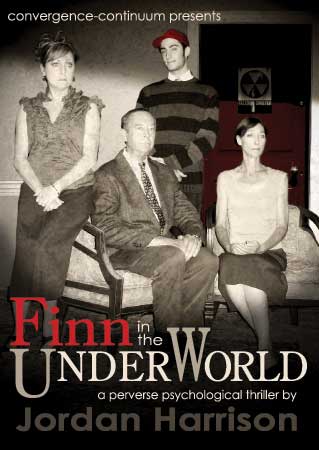
Finn in the Under World


It’s another one of “those” shows at convergence continuum


At the conclusion of ‘FINN IN THE UNDERWORLD,’ at convergence –continuum, the woman sitting next to me said, “Yep, this is another one.” What she was referring to was that before the show she said, “I keep coming back here because you never know what you are going to see and hear. A lot of their stuff is weird, yes, just plain weird.”

Jordan Harrison has written what is billed as “an erotic thriller.” ‘FINN’ has been called “a cocktail of sex and suspense to attract and titillate audiences, but with less comforting implications about human nature.”

The plot line concerns a pair of sisters who go back to their family home to divide and pack up their parent’s belongings. The house has an intriguing history. A subterranean air raid shelter was built there during the cold war scare. A neighborhood boy was found dead in the basement. Cause of death? Asphyxiation. It could have been self-induced or murder. Owwww…murder??? Is this house haunted by ghosts? Owwww…ghosts? Who is that guy who appears, but is supposedly dead?

As a clock with a projected face gives us a minute-to-minute update, and moves forward and backward to accommodate the play’s time jumps, we watch as the sisters, Rhoda and Gwenn, bicker with other, while Gwen’s 20-year old son, Finn, plays sex games with a creepy neighbor (Carver) in the shelter. The games turn into a “boy” and “daddy” scenario, and seems to parallel a relationship between Carver and the neighbor boy who was found dead. Owwww…was his death asphyxiation with a sexual twist?

The major problem is that ‘FINN’ really isn’t that well written. It promises more than it delivers and comes off as more pointless than genuinely affecting. Nothing wrong with making audiences leave the theater scratching their heads and wondering, “What the heck was that?,” but aside from its attempt at a “naughty” shock factor, it’s pretty thin.

The convergence production, under the direction of Geoffrey Hoffman, is presented in a two-act version, instead of the original script’s 90-minute format. The reason is unclear as nothing is gained by the pause.

Hoffman keeps the pacing on target, most of the actors fulfill what the script gives them, especially the always bizarre and creative Lucy Bredeson-Smith as Gwen, she of pill popping and manic mood swings. Scott Gorback gives a nice tone to the hormone-guided Finn.

Unfortunately, the sexual titillation, a key element in Harrison’s intent, is kept to a minimum by Hoffman’s awkward direction of the sex scenes between Gorback and Clyde Simon (Carver). Neither of the actors seems comfortable with the goings on. In addition, the faking of interactions leaves the audience unengaged and confused. Because of convergence’s intimate theatre, the faking of the sex doesn’t work. The audience is too close to be fooled. Hoffman should have committed to either being explicit or going to blackouts after the implications are out there. Not that this would have helped the plot, but it might have given some of the audience Harrison’s erotic intent.

Capsule Judgement: ‘FINN IN THE UNERWORLD’ is not a well-written script and gets a minimally satisfying production at convergence.

Ten More Minutes From Cleveland


Dobama moves into new home and presents a new play at a gala event


Dobama is fifty years old. The theatre company celebrated its birthday by moving into its long awaited new home on Lee Road in Cleveland Heights with a gala sold-out fund-raising event that found many of the area’s theatre people rejoicing in the birth of an arts venue.

As is befitting of Dobama, whose previous abodes have been a bar in a hotel, a converted bowling alley and nooks and crannies in various buildings, other theatres and churches, their new digs are the former swimming pool of an old YMCA building, which is connected to a library. It is a wonderful black box theatre that will serve this wonderful theatre well, thanks to yeoman work by a dedicated board, chaired by Bill Newby, Managing Director, Dianne Boduszek, Artistic Director Emeritus, Joyce Casey and Artistic Director, Joel Hammer.

There are many myths, many of them wrong, about how the theatre company came into being and got its name. Here’s the skinny…the real story. How do I know? I was there, the second that the idea came out of Don Bianchi’s mouth. I was there when the plan was further developed. I was there when the first production took form.

Spring, 1959. The setting? The gymnasium/auditorium of Euclid Shore High School, the home of Euclid Little Theatre. A rehearsal of William Inge’s ‘PICNIC,’ with Don Bianchi as the Director. Don left the practice to go before the ELT board with his proposal for the next season. Fifteen minutes later he came storming back. Don was livid. He came in shouting, “Okay, that’s it! We’re out of here! I’m going to set up a theatre where we don’t have to get permission to do any kind of play we want to do. We don’t have to have tryouts!” We sat down on the floor of the gym and started to toss out ideas. ‘PICNIC’ was presented and we never looked back. A meeting was held within the next several weeks in the Bianchi’s dining room and DO (Don), BA (Barry Silverman) and MA (Mark Silverberg), gave their names to the endeavor. No, Dobama doesn’t mean anything in Swahili or any other language. It was simply named for the artistic director, the key actor and p.r. guy, and the major financial backer. Some other people who were in on the formation include Shirley Singer, Marilyn Bianchi, Glenn Beurkel, Ivan Wolpaw, Rhoda Koret, Lee Zinner, Marv and Fran Buffington, and myself. We opened the first show at Chagrin Valley Little Theatre, moved to Quad Hall Hotel’s bar, and then to the bowling alley on Coventry. Then, the community became the theatre’s home. And, now, Nirvana!

As for the opening show at the new facility? It’s a farcical often self-loathing look at Cleveland, the city we love to hate. It’s our city, the city that award-winning playwright Eric Coble now claims as his home, and the setting for his latest script, ‘TEN MORE MINUTES FROM CLEVELAND.’

Coble offers a view of the city in 10 different venues, with each segment taking about ten minutes. He keeps the scenes glued together by concentrating on two characters. One, a life-long resident, who during the course of the goings-on, attempts to search for his Cleveland security, his “blankie” of remembrances…going back to his family’s Catholic church, visiting Patterson’s Fruit Farm the site of childhood pleasures, stopping in at the coffee shop at CWRU, his alma mater where he met his wife.

The other lynch pin of the play is a young lady who has recently come to town to house sit and work on a temp job assignment as a p. r. consultant. Since she is geographically challenged, she runs into all sorts of problems finding her way to her place of employment. In the process she finds out about all the rules and regulations of Shaker Heights, where she is living. (Did you know that you can get fined for front lawn grass over two inches and there are strict rules about what are considered recyclables and how to pack them?) Her ride on the Euclid Corridor HealthLine, with miles of Cleveland Clinic buildings, weird fellow passengers, and her attempt to find someone in the vast wilderness, void of people, which is known as Public Square, add to her frustrations. She runs into a group of perpetual tailgaters at the Municipal Parking Lot, finally arrives in Little Italy, where by some immaculate intervention she finds a parking space on Mayfield Road (now you know this is a fantasy/farce) and eventually gains an understanding of the “mistake on the lake,” “the best location in the nation,” and “the city on the burning river.”

The quality of the script is inconsistent. Some scenes are well written and delightful, such as “Shaker Heights,” “Little Italy” and “Cleveland Heights.” On the other hand, “City Hall,” and “Municipal Parking Lot” just don’t hold together well.

The acting is appropriately over-the-top. Joel Hammer lets his performers play around because as is his mantra, “This is only a play.” Realism has no place here.

Nick Koesters, is hysterical, as the man who searches for security after losing his job, and becomes more and more maniac as the “plot” unravels. Carly Germany is wonderful as the newcomer who exposes us to a view of the city from someone who hasn’t been taught to be happy in misery. Maryann Elder, Laurel Brooke Johnson, Nathan Lilly and Michael Regnier, add to the insanity.

CAPSULE JUDGEMENT: If you are looking for reality, a well-integrated script, and are uncomfortable by gross exaggeration, ‘TEN MORE MINUTES FROM CLEVELAND,’ isn’t going to be your thing. On the other hand, if you can just sit back, accept that this is a piece of writing that attempts to make fun of, while trying to explain why we, the locals, put up with the weather, the embarrassment of our athletic teams, and the flaws of our politicians, you’ll have a good time.

Sunday, September 20, 2009

All's Well That Ends Well


ALL’S WELL doesn’t end well for CWRU MFA program

Last season Case Western Reserve’s MFA Acting Program presented a fine production of ‘AUTOBAHN.’ This season they undertook Shakespeare’s ‘ALL’S WELL THAT ENDS WELL.’ Unfortunately, the results were not as positive an experience.

The plot concerns Hellen, a lowborn beauty, who serves in the household of the Countess of Rousillion. Hellen is secretly in love with Bertram, the Countess’s son. Bertram goes off to serve the king, who is terminally ill with a peptic ulcer. Helena’s late father, a physician, has left her his potions. Hellen goes to the King, gives him a drug which cures him and gets, in return, her choice of marrying any male in the King’s court. Of course, she chooses Bertram, who under pressure reluctantly marries her, but before the marriage is consummated he runs off to Italy supposedly to fight in a war. While in Italy, he writes Hellen that, "When thou canst get the ring upon my finger, which never shall come off, and show me a child begotten of thy body that I am father to, then call me husband." That message causes great angst, plot twists result, and eventually everything is resolved as supposedly, all’s well that ends well.

There is no evidence that ‘ALL'S WELL’ was popular in Shakespeare's own lifetime. It has remained one of his lesser-known plays, in part due to its odd mixture of fairy tale logic, supposed realism and its chauvinistic attitude.

Hellen's love for the seemingly unlovable Bertram is difficult to explain. With the right production, however, one in which Bertram, at the start appears to be naïve, and, in the end apologetically comes to his senses, it might be fathomable. That’s exactly what happened in the fine Canadian Shakespeare Festival’s production I saw several seasons ago. But, unfortunately, that is not the tack taken by either director Geoff Bullen nor Tom Picasso, who plays Bertram. The scowling Picasso introduces Bertram as a bully, ends him as a bully, and that is one of the reasons this production stumbles.

It appears, in spite of an impressive resume, that Bullen isn’t sure where the script should go. There is farce, comedy, melodrama inconsistently all mixed into one. Even the music he selected as backup is often off-putting, especially the melodramatic inserts.

As for the cast, Leigh Williams, who was so wonderful in ‘AUTOBAHN,’ seems awash in the role of Hellen. The same for Tom White, who also stood out in last season’s production. His King is right on the surface, showing no depth of characterization. Picasso spends most of the play displaying exaggerated facial expressions and making little sense of his lines. On the other hand, Catherine Albers (a widow who befriends Hellen) and Sarah Nedwek (her daughter) are excellent.

Jeffrey Van Curtis’s costumes and Jill Davis’s set designs are era right and effective.

CAPSULE JUDGMENT: A combination of poor directing, some misguided acting and producing one of Shakespeare’s weakest plays resulted in a CWRU MFA Acting Company production that was less than a satisfying experience.

Beethoven, As I Knew Him


‘BEETHOVEN, AS I KNEW HIM’ hits most of the right notes at CPH

Last season Hershey Felder performed ‘MONSIEUR CHOPIN’ and ‘GEORGE GERSHWIN, ALONE’ to sold out houses at the Cleveland Play House. CPH decided to open this, its 95th consecutive season, with another of Felder’s creations, ‘BEETHOVEN, AS I KNEW HIM.’

Felder is a talented playwright, pianist, actor and singer. This time, rather than writing a script in which he portrays a well-known composer directly, he decided to use a more dramatic format. Portraying both Beethoven and a man whose father was a friend of the composer, Felder weaves a tale which exposes us to not only the life, but the very personality of the man who is considered one of the world’s greatest creators of music.

From ages 12 to fourteen, Gerhard von Breuning not only took piano lessons from the composer, but made sure that the great man ate. Beethoven, it appears, got so involved in feeding his need to create music that he forgot to feed his body. Felder’s script melds Von Breuning's personal recollections, recounts stories told by his father, and material published years after Beethoven's death.

We are exposed to Beethoven’s abusive father, difficult relationships with his brothers, failed romances, and the hearing loss that began in his late twenties which was, in part, responsible for his aggressive personality. We learn of Beethoven’s role in changing the course of western music and get a good dose of music history and theory.

Part concert, part lecture/demo and part dramatized play, the production works, on many levels, stumbles slightly on others.

While the ideas flow well, some of the specifics get lost due to a blend of Felder’s difficult to understand German accent, his not opening physically to the whole audience and a finicky sound system which squealed and muffled the spoken word. A combination of some questionable choices of recordings, which were not always of the highest quality, and the poor acoustics of the Bolton Theatre, caused some aesthetic problems.

Francois-Pierre Couture’s setting was both visually attractive and created a perfect mood. Using what appeared to be a large book on the rear of the stage, the ever changing pages, created through rear projections, were pen-and-ink drawings which visually explained creations of Beethoven’s mind, as well as pictures of real people who populated his life. Richard Norwood’s dim stage lighting design added to the somber mood.

I normally take my grandson Alex (one of the Kid Reviewers) to a production to evaluate whether he perceives the show to be kid friendly. In this case, however, I took him as my music evaluator. A talented pianist and award winning composer, the thirteen year old gave an over-all evaluation of 8 1/2 out of ten to the production. He said he gained a great deal of personal knowledge about Beethoven and thought that Felder’s piano playing was “really good.” However, he was aware that in Mozart’s “Requiem,” Felder came in late at the start of the piece, and “he made a couple of notation errors in other selections.” In addition, both he and I questioned why there was text tacked on after the natural ending of the production-- the playing of “The Ode to Joy” from the composer’s greatest masterpiece, “The Symphony No, 9 in D minor. “ Especially since this was Beethoven’s last complete work and was a symbolic summary of his life.

CAPSULE JUDGMENT: ‘BEETHOVEN, AS I KNEW HIM,’ should please most audience members. Though not as engaging as either ‘MONSIEUR CHOPIN’ or ‘GEORGE GERSHWIN, ALONE,’ it is a great lesson in music history and a commendable evening of theatre.

Sunday, September 13, 2009

GroundWorks (Akron Ice House 9/13)


GROUNDWORKS presents Tenth Annual Concert at Akron’s Ice House

The Akron Ice House, where GroundWorks Dancetheater is performing its tenth annual production, is not the ideal setting for most arts performances. But the rough brick and cement walled, high ceilinged 1870 ice factory and storage unit, works well for this dance company, which thrives on audience intimacy and unusual settings. Groundworks has no home, per se. The community is its abode. The community of Trinity Cathedral, Cain Park, the Botanical Gardens, an outdoor stage in Lincoln Park. They all work for Groundworks.

GroundWorks’ mission is to develop and perform new works. Many are created by David Shimotakahara, the company’s artistic director, who for many years danced regularly with the company, but now makes less frequent appearances on stage. Others are created by emerging choreographer Amy Miller, who is also a company dancer and its Artistic Associate, and by guest choreographers.

The present evening of dance consisted of three pieces. The selections were each based on a theme and joint creations between choreographer and dancer(s) and/or musicians.

‘TIPPING POINT’ found Felise Bagley, Amy Miller, Sarah Perrett, Kelly Brunk and Damien Highfield, mainly seated on the floor, exploring isolation and group mind interactions, with little physical contact. Costumed in brown pants and blue tops, the ensemble jerked and twitched forward and back, from side to side, sometimes athletically lifting their bodies off the ground, and, on rare occasions, upright and moving around. Julie Keenan and Dennis Dugan’s lighting design allowed for odd-shaped shadows to appear on the roughly plastered side wall, developing a counter visual image to the dancers. The exhausting piece, which may have been a bit too long, was choreographed by KT Niehoff, with music composed and recorded by Sarah Murát.

‘VALANCE,’ in its world premiere, was choreographed by Amy Miller. Like Miller, the dance was athletic, powerful, and full of focused movement. Incorporating strong use of arms and body, there were unusual visual combinations of physical entanglements and out-of-the norm lifts and carries. The under-tow sound of running feet was often created visually, with both the piece’s starting and ending, consisting of actors in motion, first in a circle and then randomly. The “music,” which was composed and recorded by Peter Swendsen, was more electronic sound combined with human and mechanical interjections, than traditional music. As the program notes indicated, “’VALENCE’ began as an exploration of how dance could be music and music could become dance.” With this as the fulcrum for creation, the final outcome was a total integration of the two mediums. Miller’s choreography had the corps moving consistently in sync to the sounds.

The closing selection, Shimotakahara’s OPEN SEATING, from the company’s repertoire, creatively used four chairs positioned inside a square. The dancers moved over, under, on top of and beneath the seating to create a number of illusions. Basically five segments, it ranged from the powerful, to the operatic, to jazz, to the sensual and the nonsensical. Typical of Shimotakahara’s choreography, creativity and movement cohesion dominated. It was a nice conclusion to a fine evening of dance.

CAPSULE JUDGEMENT; GroundWorks Dancetheater, is one the area’s best dance companies. Its talented and well-trained corps work as a cohesive group, displaying total awareness of the needs of contemporary dance to create segment after segment of audience pleasing performances.

Sunday, September 06, 2009

Hedwig and the Angry Inch


Dan Folino a powerhouse in ‘HEDWIG AND THE ANGRY INCH’

The Hi Fi Concert Club is a perfect venue for ‘HEDWIG AND THE ANGRY INCH.’ A grungy rock ‘n roll club, with dark walls, movable chairs, a blasting sound system, an open cash bar amid the wafting odor of stale beer. It so much better fits that mood and the lines of the script than the Cleveland Public Theatre stage where last we saw the multi-talented Dan Folino premiere the piece eight years ago.

‘HEDWIG AND THE ANGRY INCH’ is a rock musical based on a fictional, but somewhat real person, who was author John Cameron Mitchell’s babysitter. The setting was Junction City, Kansas, where Mitchell’s father was stationed as an Army Major General.

The story concerns a band fronted by Hedwig, who is an East German transgender singer. Hedwig has spent her life looking for her soul mate. She finds him in the body of an adolescent who she baby sits. We observe Hedwig rant as he realizes that Tommy, her protégé, has become a major star and she is left to play in dumps like The Hi Fi Concert Club. Occasionally Hedwig opens the stage door and we hear Tommy's concert which is playing in an adjoining venue. Eventually the two concerts meld into one.

The song "The Origin of Love," according to the writer, is based on a speech in Plato’s ‘SYMPOSIUM,‘ which explains that human beings were once two-headed, four-armed, and four-legged beings. Angry gods split these early humans in two, leaving the separated people with a lifelong yearning for their other half. Hedwig believes that Tommy is her soul mate and that she cannot be whole without him. She feels driven to either reunite with Tommy or destroy him.

The title derives from, as Hedwig shares, “My sex change operation got botched; my guardian angel fell asleep on the watch; now all I got is a Barbie doll crotch; I've got an angry inch! “

The stage show premiered Off-Broadway in 1998 and has been performed throughout the world in hundreds of productions. A 2001 American film based on the play won several awards at the Sundance Film Festival.

Like ‘THE ROCKY HORROR PICTURE SHOW,’ ‘HEDWIG AND THE ANGRY INCH’ has become a cult musical.

The local production centers on the talents of Dan Folino and the band, The Angry Inch (Dennis Yurich, Brian Hager, Jason Giaco, Derek Poindexter and Allison Garrigan).
One of the issues with the production is that the lyrics to the songs are drowned out by the loud thumping rock sound and the overly loud electronics. That, of course, comes from a theatre-goer who thinks that words to show songs carry the meaning of the writer, and if I can’t understand the words, the character could just be singing nonsense rhymes. But, that obviously isn’t the attitude of others in the audience who screamed and yelled after every song. Guess this is a generational issue.

Folino, as he normally does with every role he takes on, develops a total character. Sometimes crying through his spatula applied makeup, sometimes scratching at his chest which leaves deep red marks, Folino holds nothing back. I prefer his tender, quieter songs, but admire his ability to wail the rock songs.

CAPSULE JUDGEMENT: ‘HEDWIG AND THE ANGRY INCH’ is not for everyone. If you are easily offended, have sensitive ears to highly electrified thumping music, you will probably be less than enamored with the show. On the other hand, if you are turned on by big rock and roll music, it’s worth going to see and hear Dan Folino and his band in action.

Thursday, August 27, 2009

Pippin


‘PIPPIN’ reigns at Cain Park!

‘PIPPIN,’ the musical with words and lyrics by Stephen Schwartz, that is now on stage at Cain Park, according to musical theatre scholar Scott Miller, "is a largely under-appreciated musical with a great deal more substance to it than many people realize.” He goes on to say, “the show has a reputation for being merely cute and harmlessly naughty; but if done the way director Bob Fosse envisioned it, the show is surreal and disturbing."

I thoroughly agree with Miller. ‘PIPPIN’ is one of my most liked scripts and contains my favorite Broadway song, “Corner of the Sky.”

I go to see productions of the show with fear. Happily, joyously, there is little to fear about the Cain Park production. The show proves, as the opening number states, that “There is Magic to Do.”

Take the intimate Alma Theatre stage, and place upon it Martin Céspedes’s brilliant choreography, the charming and talented Cory Mach (Pippin), add Nancy Maier’s finely honed musical direction, sprinkle in a generally talented cast, and top it off with the deft direction of Victoria Bussert. The results is a must see production.

The show, which was originally conceived by Schwartz when he was a student at Carnegie Mellon, was written while he was also working on ‘GODSPELL.’ (How’s that for a duo of shows from an unknown college student.)

‘PIPPIN’ is the story of Prince Pippin's quest to find personal significance. The Leading Player narrates the story. Pippin wanders through frustration, wars, politics, and love before he comes to a realization. His awareness is reached when the Leading Player offers him the perfect emotional and life satisfying high. (You don’t think I’m going to tell you what it is, do you?)

The show opened on October 23, 1972 in New York City with a cast that included Ben Vereen, Jonathan Rubenstein, Irene Ryan, Jill Clayburgh, and the then unknown member of the chorus, Ann Reinking. It was directed and choreographed by Bob Fosse.

Having seen that production, I can tell you, that Fosse’s building the show around the leading player, rather than Pippin, took the show off-message. The leading player’s magic is less the subject, than Pippin’s quest.

Bussert works her own magic by placing Pippin front and center. She even goes so far as eliminating the magic tricks commonly included in the staging and using the leading player as an audience guide, rather than as Pippin’s controller. Bussert has also used the alternate ending for the script. Her choice, wisely, plays up Pippin’s search and the wish for future awareness. (What is the “new” ending? You’ll have to go and see it for yourself!)

Céspedes is the area’s most creative choreographer. He performs his magic once again on the Alma Stage. He is blessed with a fine set of dancers, many of whom have been trained in Baldwin Wallace’s nationally recognized musical theatre program.

The cast, headed by the multi-talented Corey Mach, who has quickly established himself as a big time talent, was born to play Pippin. He inhabits the role. Blue eyes twinkling and filling with frustration and tears, he hits all the right notes. Jessica Cope (Leading Player) has a great singing voice and stage charisma, but often shouts her way through songs. The theatre is small. She is miked. Why all the excessive, ear splitting volume? Old pro, Maryann Nagel, delights with her sprightly version of ‘Simple Joys.” (I do wish, however, that the oft-used device of putting the words on a screen so the audience has them available when they are invited to sing along, had been used. I felt a little ridiculous singing out alone!) Devon Yates makes for a lovely Catherine and Joey Stefanko, a very talented “kid actor,” is character-right as her son Theo.

Some of the casting seemed off. Chris McCarrell, as Lewis, Pippin’s half brother, simply doesn’t have the physicality or personality to fit the role. Jay Ellis did a nice job as a member of the band of players, but wasn’t powerful enough as Charles. I also missed the real duck. The puppet didn’t do it me. But, with all the positives, these seem like nit-picking concerns.

CAPSULE JUDGEMENT: As the score states, because of the “Simple Joys” of the production, which is “Right on Track,” and “Extraordinary,” there is “Glory” at Cain Park. Go see ‘PIPPIN.’ I repeat, GO SEE ‘PIPPIN!’

Sunday, August 23, 2009

Review of the reviewer (Tom Kuby)


You write such wonderful, cogent, coherent, concise and perceptive reviews and you help those who were there gain insight, depth and renewed appreciation for what they experienced.

Thank you!

Tom Kuby

Joffrey Ballet


Joffrey Ballet, Cleveland Orchestra and Blossom….a wonderful blend!

Combine the world class Joffrey Ballet, with the world renowned Cleveland Orchestra, and place them in the lush Blossom Center on a crisp August evening. The results? A very special experience.

Blossom Music Center has hosted such ballet luminaries as Nureyev, Baryshnikov, New York City Ballet, San Francisco Ballet and the Vienna State Opera Ballet. But that was in the 60s, 70s and 80s. Most recently, the Blossom stage has been void of dance. Now, thanks to DANCECleveland, the Heinz Poll Summer Dance Festival and the University of Akron, for two performances, the stage was alight with marvelous dancing, the orchestra pit filled with the Cleveland Orchestra, and the large audience treated to the best of the best.

The program consisted of five selections of various moods and lengths. The opening number, ‘KETTENTANZ,’ was a chain dance set to the music of Johann Strauss Sr. and Johann Mayer. Combining classical movement with waltzes, gallops and polkas, the company was sprightly in showcasing various dancers in the nine pieces. The highlights were “Kettenbrück Waltz” performed by Jonathan Dummar and Victoria Jaiani, “Eisele und Beisele Sprüng,’ highlighted by the dancing of the delightful and adorable Anastacia Holden, “Schnofler Tanz,” with excellent toe work by Christine Rocas, and “Chachucha Galop” featuring fine parallel dancing by April Daly and Victoria Jaiani. In all segments, the dancers were proficient, movements perfectly timed to the musical alterations, and performer synchronizations well coordinated. Time flowed by during the thirty-two minute charming and challenging piece.

Alexander Calder developed an art movement centering on Moving Objects Behaving In Linear Equiposie, known to many as mobiles (using the first letter of his apt description). Choreographer Tomm Ruud used the Calder image to create his piece, ‘MOBILE.’ Interrupted by constant applause and sighs of “ohs” and “ahs,” Caitlin Meighan, Tiani Shuai and Abigail Simon awed the audience with their strength and fluidity. It was a study in body control and skill. Jack Hehler’s lighting added to the effect by casting shadow movements onto the back and side walls of the stage, creating a constant moving mobile of bodies and shadows. This was a show highlight!


‘CLOVEN KINGDOM,’ as choreographed by Paul Taylor, pictured man as a civilized social animal who also has the natural instincts of a wild beast. Danced to a baroque score, contrasted with contemporary percussive music, the dual level dance actions paralleled the dual musical sounds. Civilized and primitive, the dancers walked and stalked, and were elegant and animalistic. Though overly long, the point-counter point of the movements was effective in developing the conceiver’s intent. The male dancers were extremely effective in this selection.

Choreographed by Gerald Arpino to the music of Gustav Mahler, ‘ROUND OF ANGELS’ was lovely and soothing. The image of two central figures (Victoria Jaini and Thomas Nicholas) surrounded by five men representing broken-winged angels, created a strong depth of feeling. Only twelve minutes in length, the emotional sound of the music, coupled with the heartfelt movement of the dancers, made this a very special piece of dance telling the story of the depth of loss.

Rodgers and Hammerstein’s ‘CAROUSEL’ is one of the great pieces of musical theatre. Choreographer Christopher Wheeldon decided to develop a balladic piece as a tribute to Rodgers. Using the “Carousel Waltz” music from the play, combining it with other music from the show, mainly “If I Loved You” and “The Soliloquy,” Wheeldon tried to recreate the entire storyline in an abbreviated time. Though the visual effects were excellent, especially the recreation of a moving carousel, using the bodies of the dancers and some poles, the overall effect was somewhat lacking. Unless you could insert the necessary “rest of the story,” the heartbreak of the tale was not present. Part of the problem, was Fabrice Calmels unemotional Billy. He did not give the needed tortured feelings that drive Billy to his reactions to falling in love and making life changing decisions. April Daly was lovely as Julie.

Assistant conductor Tito Munoz and the Cleveland Orchestra moved through the music with precision and the needed variances, allowing the dancers to create the needed illusions. It was a fine melding of two art forms into a cohesive whole.

Capsule judgement: What a wonderful night! We can only hope that the forces that brought the Joffrey and the Cleveland Orchestra together will take swift action to make dance a regular part of future Blossom seasons.

Tuesday, August 18, 2009

Theatre calender, Fall/2009


Fall is coming and the theatre season looks exciting!

In spite of the downturn in the economy, there’s a lot of local theatre that’s going to take place in the Great Cleveland area this fall. Here are some of the offerings:

Playhouse Square
Tickets: In person at the Box Office: Daily, 11-6, by phone--216-241-6000 or toll-free at 1- 866-546-1353, on line--http://www.playhousesquare.org. Smart Seats offers $10 tickets to a broad variety of performing arts engagements at PlayhouseSquare. Smart seats are available for MAMMA MIA! JESUS CHRIST SUPERSTAR, and FIDDLER ON THE ROOF. Go to: http://www.playhousesquare.org/Events/smartseats.aspx.

Dixie’s Tupperware Party
September 30-October 18
14th Street Theatre
Join Dixie as she travels the country throwing good ol’ fashioned Tupperware Parties filled with outrageous tales, free giveaways, audience participation and the most fabulous assortment of Tupperware ever sold on a theatre stage.

Young Frankenstein
October 13-25
Palace Theatre
A musical comedy version of the classic Mel Brooks movie about the Frankenstein legend follows a young doctor as he creates a monster.

Mama Mia!
November 10-15
Palace Theatre
Abba’s songs propel this tale of love, laughter and friendship. A mother. A daughter. Three possible husbands. What more could you ask for?

Wicked
November 18-December 13
State Theatre
The winner of 20 major awards, it tells the story of what happened before Dorothy dropped into Oz. There were two witches…one born green, the other beautiful and ambitious and…

Dobama Theatre
2340 Lee Road Cleveland Heights
Tickets: 216-932-3396

Ten More Minutes From Cleveland
By Eric Coble
September 25-October 18
If you think you know Cleveland, think again. Experience the eternal Browns tailgaiting party, watch students at CWRU falling in love using only their laptops, and find out how tall your grass can grow in Shaker Heights before you are arrested.

Gutenberg! The Musical!
By Scott Brown and Anthony King
Two aspiring playwrights, a piano and a musical about Johann Gutenberg, the printing press inventor.

The Cleveland Play House
8500 Euclid Avenue
Tickets: 216-795-7000

Beethoven, As I Knew Him
September 15-October 4
By Hershey Felder
Mr. Felder now brings the enthralling music and captivating life of Beethoven to the stage.

The American Songbook Sing-Along
October 6-October 11
By Hershey Felder
Hershey Felder brings you into the salon of America’s greatest composers of the past 100 years: Berlin, Kern, the Gershwins, Rodgers & Hammerstein, Bernstein, Sondheim, and more.

Inherit the Wind
October 23-November 15
by Jerome Lawrence & Robert Edwin Lee
Eighty years after the “Scopes Monkey Trial,” this classic courtroom drama about evolution, creationism, and an American society struggling to balance science and scripture.

A Christmas Story
November 27-December 20
By Phil Grecian
Based on the Cleveland based movie, this classic holiday comedy is a funny and sweet tale of growing up in the 1940s. A theatre experience for the whole family! FINAL YEAR!

Actors Summit
86 Owen Brown Street, Hudson
Tickets: 330-342-0800.

Are We There Yet?
By James Hindman, Ray Roderick, & Cheryl Stern; Music by John Glaudini
October 1 – 18
A musical revue about family.

For Better
By Eric Coble
November 5 – 22 (Changed)
A comedy about love in the Age of Twitter.

Guys on Ice
Book & Lyrics by Fred Alley
Music by James Kaplan
December 3 - December 27
An ice fishing musical comedy.

Ensemble Theatre of Cleveland
Cleveland Play House
8500 Euclid Avenue Cleveland
Tickets: 216-321-2930

The Man Who Came to Dinner
By George Kaufman and Moss Hart
October 2-25
A comedy set in a small Ohio town in the 1930s. An outlandish radio wit comes for a family diner and chaos ensues.

Beck Center for the Arts
17801 Detroit Avenue, Lakewood
Tickets: 216-521-2540

Fiddler on the Roof
By Joseph Stein, Jerry Bock and Sheldon Harnick
September 19-October 18
Based on tales by Sholem Aleichem, the musical centers on Tevye (George Roth), the father of five daughters, and his attempts to maintain his family and religious traditions while outside influences encroach upon their lives.

Peter Pan, the musical
December 4-January 3
Based on the play by James M. Barrie, with music by Mark Charlap and Jule Styne and lyrics by Carolyn Leigh, Betty Comden and Adolph Green.
A return engagement of last year’s holiday hit about a boy who won’t grow up.

The Hi Fi Concert Club
11729 Detroit Ave., Lakewood
Tickets $20 at HedwigCleveland.com

Hedwig and the Angry Inch
Text by John Cameron Mitchell
Music and Lyrics by Stephen Trask
Starring: Dan Folino as Hedwig
September 4th-October 3rd
A rock musical about a fictional rock and roll band fronted by an East German transgender singer.

Tuesday, August 11, 2009

Dance, dance and more dance (Pointe of Departure, Verb Ballets)


Dance, dance and more dance!

The area has had a healthy dose of dance in the last couple of weeks, with more to come. Since the past programs aren’t going to be repeated, here are some quick comments about each and then some previews of what’s next.

POINTE OF DEPARTURE

On July 31, POINTE OF DEPARTURE, Karen Gabay and Raymond Rodriguez’s ballet company, took center stage at Cain Park. The duo, the former wunderkinds of the Cleveland San Jose Ballet, are local favorites. Several years ago they returned to the area for a summer concert with the promise of forming a permanent ballet company. Such a corps is needed as local companies are basically modern and contemporary groups.

The program, which was a series of duets, was danced to recorded music, and was well balanced as the classics blended with more modern pieces. The highlights included a delightful opening (COPPELIA, EXCERPT FROM ACT II) staring Gabay and Rodriguez. Also appealing was NUTCRACKER, GRANDE PAS DE DEUX, ACT II. Jing Zhang was lovely and the dynamic, high flying Damir Emric, displayed compelling stage presence. RAYMONDA, PAS DE DEUX AND VARIATIONS, ACT III, which showcased Gabay and the exciting Ramon Moreno, was another program highpoint. NUTCRACKER, SNOW PAS DE DEUX, ACT I, was exquisitely performed by Zhang and Emric.

The women dancers were generally good, the males with the exception of Moreno and Emric, were weak, doing more posing and walking then dancing.

Capsule judgement: The area needs a ballet company. It’s too bad the economy won’t support making POINTE OF DEPARTURE a local fixture.


VERB BALLETS

On August 7, the stage of Cain Park lit up with the reinvigorated Verb Ballets. Having reorganized itself, adding new performers, and expanding its repertoire, the company took another forward step, though there were a few glitches.

The program opened with what appeared to be the under rehearsed URBAN STUDY, a mirror of the gritty and cold atmosphere of NYC, as choreographed by Ginger Thatcher. The unit timing was generally off, and the hand and body angles of dancers often not in sync. The highlight was a duet section performed by Brian Murphy and Jennifer Moll Safonovs.

ELEGIAC SONG, a Heinz Poll piece, as restaged by Jan Startzman, was a “wow” selection, with choreography perfectly matching the plaintive tones of Shostakovich’s music. Jennifer Moll Safanovs, again shone forth. Unfortunately, newcomer Antwon Duncan, as was the case throughout the evening, was flatfooted, not precise, and showed little enthusiasm. The women were excellent and Trad Burns lighting added greatly to setting the proper mood.

Safonovs and Murphy were strong in TSCHAIKOVSKY PAS DE DEUX as choreographed by George Balanchine. The duo works well together. Their partnering is precise, their moves fully executed, their talent shining through.

LADY BE GOOD, in its world premiere, closed the program. Choreographed by Gary Pierce to the music of George Gershwin, it was a well danced piece with formality, fun and smart moves. It was a pleasant way to end the evening.

Capsule judgement: The Cain Park Verb performance was a solid program. With the exception of several male dancers, the company did an excellent job of changing moods and dance style requirements.


JOFFREY BALLET

The Blossom Festival will present ballet performances, for
the first time since the 1988 season. On August 22 and 23 The Joffrey Ballet will perform four signature works, accompanied by the Cleveland Orchestra. Place: Blossom Music Center, 1145 W Steels
Corners Rd., Cuyahoga Falls, OH 44223. For tickets: (330) 920-8040 or
www.ticketmaster.com.


DANCING WHEELS

On August 20, Dancing Wheels, will perform at Cain Park. The company is the first modern dance ensemble to integrate professional stand-up and sit-down (wheelchair) dancers. . For tickets call 216-371-3000.


DANCE SHOWCASE AT PLAYHOUSE SQUARE

Playhouse Square presents its seventh annual Dance Showcase on Friday, September 11 at 7 p.m. in the Ohio Theatre. Featuring eight of Northeast Ohio ’s professional dance companies, the performance highlights a wide array of dance styles from contemporary to ballet.

The companies performing are Antaeus Dance, Dance/Theater Collective, The Dancing Wheels Company, Foreground Dance, Inlet Dance Theatre, Ohio Dance Theater, Travesty Dance Group and Verb Ballets.

For tickets call 216-241-6000 or go to www.playhousesquare.org.

Sunday, August 09, 2009

Me and My Girl


‘ME AND MY GAL,’ Mercury Summer Stock’s attempt at farce


On the surface, ‘ME AND MY GIRL,’ which is now on stage at Mercury Summer Stock, appears to be a light, escapist show that should be easy to stage, since its goal is out and out fun. Nothing could be further from the truth. The script is farce, and to make it more difficult, British farce. That style of theatre is very, very difficult to pull off well. It takes good underplaying, exquisite timing, and the perfect balance between realism and fantasy.

This musical tale concerns a cockney lad who inherits an earldom when his aristocratic father, who has had an affair with the lad’s working class mother, dies. Billy is tracked down, and the family finds out, much to their snobbish horror, that the only male heir, is everything they abhor….gross, out spoken and from Lambeth, a low class area of London. Chaos ensues, until, of course, all can live happily ever after, with the various romantic confusions settled nicely.

The musical, with book and lyrics by L. Arthur Rose and Douglas Furber, and music by Noel Gay, had its original London production in 1937, and ran four years. A revised London version had an even longer run in 1985 and the Broadway version, which opened in 1986, ran 1,420 performances.

Interestingly, the production’s show stopper, “The Lambeth Walk”, became a political cause, when in 1938, The London Times stated, “While dictators rage and statesmen talk, all Europe dances — to The Lambeth Walk.”

The Mercury production tries hard to create the right feel for the show. Maybe it tries too hard. Director Pierre-Jacques Brault pulls out all the stops, and shtick follows shtick which follows shtick. Normally, in British farce, the director lets the material develop its own image. Here Brault doesn’t seem to trust the script’s natural fun and inserts puppets, bubbles, over exaggeration of characters, use of every stereotype he could think of, and putting his lead actor in physical danger to do prat fall after prat fall.

Does he succeed? Depends on your viewpoint. The audience, the night I saw the show, laughed and laughed (but didn’t give it the traditional Mercury standing ovation). The elderly man sitting behind me audibly repeated every gimmick to his wife between giggles. On the other hand, what would have happened if Brault had let the book and lyrics speak for themselves? As Billy, the lead character might say, “Dun’t knuw. Din’t see et.”

His choreography is often quite clever, though some of the dancers struggle to do the steps without verbally counting.

Mercury Summer Theatre, though it bills itself as a “professionally based,” theatre is, for all practical purposes, an amateur community theatre populated by high school and college kids, with one professional thrown in, along with some adults of various theatrical backgrounds. This makes the acting pool rather inexperienced. Considering that, Brault gets some good performances.

Jennifer Myor sparkles as Sally, Bill’s “girl.” She has a nice singing voice, good stage presence, and a nice touch with humor. Cleveland favorite, Hester Lewellen, has the right airs as Maria, Bill’s stuffy aunt. Cindi Verbelun has a cute bit as Joan of Arc.

Brian Marshall, the only equity member of the cast, is very talented, but, in this role seems to have no restraint. He sings and dances well, but he literally throws himself all over the stage in attempts at humor. He did not need to be all Three Stooges rolled into one.

Some of the others feign and exaggerate; acting, rather than reacting to their lines and motivations.

The sets and, costumes, considering the minimal budget the theatre has, are quite impressive. Especially creative are the Pearly costumes, with their numerous button patterns.

Eddie Carney does a nice job of musical direction and his orchestra is very good.

CAPSULE JUDGEMENT: If you love slapstick and a production full of uncontrolled shticks, you’ll appreciate Mercury’s ‘ME AND MY GIRL.’

Sunday, August 02, 2009

Shaw Festival 2009/review #2


SHAW FESTIVAL (second of a series of two)


In my previous article reviewing The Shaw Festival, located in Niagara-on-the-Lake, Ontario, Canada, I discussed Eugene O’Neil’s ‘STAR CHAMBER’ and ‘BRIEF ENCOUNTERS, as well as giving some hints of other-than-theatre events in the most beautiful little city in Canada. If you are interested in that review go on-line to www.royberko.info


One of the usual highlights of going to The Festival is to see plays by George Bernard Shaw, himself. Of the two Shavian works I saw this trip, one was outstanding, the other boring and poorly directed.


‘THE DEVIL’S DISCIPLE’, which gets a fine production, was Shaw's eighth play and the only one set in America. It, as is Shaw’s writing tradition, mocks religion, politicians, superstition and holier-than-thou members of society.


Set in a New England village during the Revolutionary War, Richard Dudgeon, a self-proclaimed devil’s disciple, finds himself mistaken for the local reverend. He is arrested by the British army as a rebel and in a twist of Shavian tradition, Dudgeon sacrifices himself in a Christ-like gesture. Evan Buliung develops a well-textured persona as Richard Duygeon. The play is purposefully directed by Tadeusz Bradecki and is one of the season’s highlights.


On the other hand, ‘IN GOOD KING CHARLES’S GOLDEN DAYS,’ is an overlong, boring, talky show which gets a weak production. Accents come and go, there is some shallow acting (especially by Lisa Codrington as the Duchess of Portsmouth and Ken James Stewart as Godfrey Kneller). Ric Reid (George Fox) screams his way through his role. This poor acting is shocking for a Festival production. The play is ill directed by Eda Holmes. At the end of the first act, the afternoon I saw the show, many in the audience left. At the end of the second act they fled for the exits, leaving a very small house to see the rest of the production.


But, then there was ‘SUNDAY IN THE PARK WITH GEORGE.’ The Sondheim piece is not a tune-filled escapist musical. The script was inspired by the painting, "A Sunday Afternoon on the Island of La Grande Jatte" by pointillist, Georges Seurat. The show, which met with mixed reviews when it opened on Broadway, revolves around a fictionalized Seurat. In the first act we see the artist immersed in single-minded concentration while painting his masterpiece. In the second act we meet his grandson, also a single-minded artist. Other than “Putting It Together, the title song is the only tune that audiences might have heard, as the music and lyrics are so integrated into the story line that the songs seem like dialogue.


The show is well directed by Alisa Palmer. Steven Sutcliffe (George) is capable of portraying both Seurat and his grandson with good voice and character development.

This may not be a musical for everyone, but for those who like Sondheim and meaningful musicals, it is well worth seeing.


‘PLAY ORCHESTRA, PLAY’, part of Coward’s ‘TONIGHT AT 8:30” series, consists of three one-act plays, ‘RED PEPPERS, a British Vaudeville House comedy with music, ‘FUMED OAK’, and, ‘SHADOW PLAY,’ a farce with music. Christopher Newton’s direction was weak. All three shows dragged.


CAPSULE JUDGEMENT: Of the shows I saw at The Shaw Festival this year I would strongly recommend ‘THE DEVIL’S DISCIPLE,’ ‘SUNDAY IN THE PARK WITH GEORGE,’ ‘STAR CHAMBER,’ and ‘BRIEF ENCOUNTERS.’ I did not see ‘BORN YESTERDAY,’ but, people whose judgement I trust indicate it is delightful.


Saturday, August 01, 2009

Big Love


BIG LOVE,’ a fun, bizarre experience at convergence continuum


If you’ve ever attended a play at convergence continuum, Tremont’s 40-seat off-off Playhouse Square theatre, you know that the weirder the script, the more Clyde Simon, the venue’s artistic director, likes it. Charles Mee’s ‘BIG LOVE perfectly fits Simon’s passions.


‘Big Love’ is an adaptation of ‘THE SUPPLIANT MAIDENS, an ancient Greek play by Aeschylus. In its updated version, it is set on the southern coast of modern Italy. The story concerns 50 brides who flee their 50 grooms and seek asylum at a costal Italian villa. The brides arrive clothed in their wedding dresses, supposedly having swum to shore (from where we do not know). They are met by the villa’s colorful family (a swinging old stereotypically dressed Italian lady who has mothered a brood of boys), her gay attendant, her devoted oldest son, and a couple of eccentric visitors. Attempts to convince the brides to consent to marry don’t work and the women come to the conclusion that they will marry, kill their husbands on the wedding night, and then live happily ever after. (I told you Simon loves the bizarre.) Of course, there are lots of twists and turns and dead body parts flying around.

The convergence stage won’t hold 50 couples, so we only meet three of them. One “bride” is a strident feminist, while her groom is the ultimate misogynist; a second bride is a slightly airheaded Cinderella who only wants a man to take care of her, and she is betrothed to a puppy dog man who is none too bright. The third couple represents the happy medium.

Author Mee says of the script, "I wanted to go back to one of the earliest plays of the Western World and see how it would look today. See if it still spoke to the moment, and of course it does. It’s all about refugees and gender wars and men and women trying to find what will get them through the rubble of dysfunctional relationships, and anger and rage and heartache.”


Convergence’s production is basically well done. The cast, with a couple of exceptions is fine. Lauren Smith (Thyona) is right on target as the women’s libber bride (and, if you say differently, she appears like she can beat the bejeebers out of you). Laurel Johnson looks like she just escaped from a Barbie doll wrapping and plays the air headed Olympia with perfect ease. Liz Conway (Lydia) plays the “normal” bride with the right touch of certainty and uncertainty. Their “grooms” are equal to the task. Scott Gorbach (Nilos) does a perfect Forrest Gump. His constant dazed expression is priceless. Studly Geoffrey Hoffman (Constantine) is the macho Alpha man incarnate and Stuart Hoffman plays straight, straight.


Lucy Bredeson-Smith (Bella) is hysterical as the “innocent” promiscuous old lady who has a history of mothering children with various men who are the “loves of her life.” Her polishing tomatoes scene is a show stopper.


Guitarist Mark K uses his guitar well to bridge scenes and moods.


Bobby Williams as Piero, Bella’s son, spends too much time feigning and posing to develop a realistic presentation, while Tony Thai overdoes every fay gay stereotypical movement to portray Marco. His feet hardly hit the floor as he flits around.


Jeremy Paul has created some impressive animation videos and Jim Smith’s set is impressive.

There are production problems. The bride’s crawl on shore, after being in the water, and emerges totally dry. Also, we can see clearly through the gauzy front screen and see the fake pantomiming of the“killings,” and….(but it matters little, the whole bizarre thing works).


Capsule Judgement: Charles Mee’s ‘BIG LOVE,’ in all of its craziness has a message or two and gets a fun production at convergence-continuum. The theatre only has 39 seats, so if you are planning on going, call now!