Sunday, September 20, 2009

Beethoven, As I Knew Him


‘BEETHOVEN, AS I KNEW HIM’ hits most of the right notes at CPH

Last season Hershey Felder performed ‘MONSIEUR CHOPIN’ and ‘GEORGE GERSHWIN, ALONE’ to sold out houses at the Cleveland Play House. CPH decided to open this, its 95th consecutive season, with another of Felder’s creations, ‘BEETHOVEN, AS I KNEW HIM.’

Felder is a talented playwright, pianist, actor and singer. This time, rather than writing a script in which he portrays a well-known composer directly, he decided to use a more dramatic format. Portraying both Beethoven and a man whose father was a friend of the composer, Felder weaves a tale which exposes us to not only the life, but the very personality of the man who is considered one of the world’s greatest creators of music.

From ages 12 to fourteen, Gerhard von Breuning not only took piano lessons from the composer, but made sure that the great man ate. Beethoven, it appears, got so involved in feeding his need to create music that he forgot to feed his body. Felder’s script melds Von Breuning's personal recollections, recounts stories told by his father, and material published years after Beethoven's death.

We are exposed to Beethoven’s abusive father, difficult relationships with his brothers, failed romances, and the hearing loss that began in his late twenties which was, in part, responsible for his aggressive personality. We learn of Beethoven’s role in changing the course of western music and get a good dose of music history and theory.

Part concert, part lecture/demo and part dramatized play, the production works, on many levels, stumbles slightly on others.

While the ideas flow well, some of the specifics get lost due to a blend of Felder’s difficult to understand German accent, his not opening physically to the whole audience and a finicky sound system which squealed and muffled the spoken word. A combination of some questionable choices of recordings, which were not always of the highest quality, and the poor acoustics of the Bolton Theatre, caused some aesthetic problems.

Francois-Pierre Couture’s setting was both visually attractive and created a perfect mood. Using what appeared to be a large book on the rear of the stage, the ever changing pages, created through rear projections, were pen-and-ink drawings which visually explained creations of Beethoven’s mind, as well as pictures of real people who populated his life. Richard Norwood’s dim stage lighting design added to the somber mood.

I normally take my grandson Alex (one of the Kid Reviewers) to a production to evaluate whether he perceives the show to be kid friendly. In this case, however, I took him as my music evaluator. A talented pianist and award winning composer, the thirteen year old gave an over-all evaluation of 8 1/2 out of ten to the production. He said he gained a great deal of personal knowledge about Beethoven and thought that Felder’s piano playing was “really good.” However, he was aware that in Mozart’s “Requiem,” Felder came in late at the start of the piece, and “he made a couple of notation errors in other selections.” In addition, both he and I questioned why there was text tacked on after the natural ending of the production-- the playing of “The Ode to Joy” from the composer’s greatest masterpiece, “The Symphony No, 9 in D minor. “ Especially since this was Beethoven’s last complete work and was a symbolic summary of his life.

CAPSULE JUDGMENT: ‘BEETHOVEN, AS I KNEW HIM,’ should please most audience members. Though not as engaging as either ‘MONSIEUR CHOPIN’ or ‘GEORGE GERSHWIN, ALONE,’ it is a great lesson in music history and a commendable evening of theatre.

Sunday, September 13, 2009

GroundWorks (Akron Ice House 9/13)


GROUNDWORKS presents Tenth Annual Concert at Akron’s Ice House

The Akron Ice House, where GroundWorks Dancetheater is performing its tenth annual production, is not the ideal setting for most arts performances. But the rough brick and cement walled, high ceilinged 1870 ice factory and storage unit, works well for this dance company, which thrives on audience intimacy and unusual settings. Groundworks has no home, per se. The community is its abode. The community of Trinity Cathedral, Cain Park, the Botanical Gardens, an outdoor stage in Lincoln Park. They all work for Groundworks.

GroundWorks’ mission is to develop and perform new works. Many are created by David Shimotakahara, the company’s artistic director, who for many years danced regularly with the company, but now makes less frequent appearances on stage. Others are created by emerging choreographer Amy Miller, who is also a company dancer and its Artistic Associate, and by guest choreographers.

The present evening of dance consisted of three pieces. The selections were each based on a theme and joint creations between choreographer and dancer(s) and/or musicians.

‘TIPPING POINT’ found Felise Bagley, Amy Miller, Sarah Perrett, Kelly Brunk and Damien Highfield, mainly seated on the floor, exploring isolation and group mind interactions, with little physical contact. Costumed in brown pants and blue tops, the ensemble jerked and twitched forward and back, from side to side, sometimes athletically lifting their bodies off the ground, and, on rare occasions, upright and moving around. Julie Keenan and Dennis Dugan’s lighting design allowed for odd-shaped shadows to appear on the roughly plastered side wall, developing a counter visual image to the dancers. The exhausting piece, which may have been a bit too long, was choreographed by KT Niehoff, with music composed and recorded by Sarah Murát.

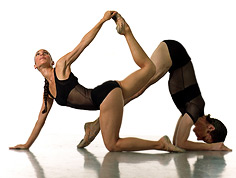
‘VALANCE,’ in its world premiere, was choreographed by Amy Miller. Like Miller, the dance was athletic, powerful, and full of focused movement. Incorporating strong use of arms and body, there were unusual visual combinations of physical entanglements and out-of-the norm lifts and carries. The under-tow sound of running feet was often created visually, with both the piece’s starting and ending, consisting of actors in motion, first in a circle and then randomly. The “music,” which was composed and recorded by Peter Swendsen, was more electronic sound combined with human and mechanical interjections, than traditional music. As the program notes indicated, “’VALENCE’ began as an exploration of how dance could be music and music could become dance.” With this as the fulcrum for creation, the final outcome was a total integration of the two mediums. Miller’s choreography had the corps moving consistently in sync to the sounds.

The closing selection, Shimotakahara’s OPEN SEATING, from the company’s repertoire, creatively used four chairs positioned inside a square. The dancers moved over, under, on top of and beneath the seating to create a number of illusions. Basically five segments, it ranged from the powerful, to the operatic, to jazz, to the sensual and the nonsensical. Typical of Shimotakahara’s choreography, creativity and movement cohesion dominated. It was a nice conclusion to a fine evening of dance.

CAPSULE JUDGEMENT; GroundWorks Dancetheater, is one the area’s best dance companies. Its talented and well-trained corps work as a cohesive group, displaying total awareness of the needs of contemporary dance to create segment after segment of audience pleasing performances.

Sunday, September 06, 2009

Hedwig and the Angry Inch


Dan Folino a powerhouse in ‘HEDWIG AND THE ANGRY INCH’

The Hi Fi Concert Club is a perfect venue for ‘HEDWIG AND THE ANGRY INCH.’ A grungy rock ‘n roll club, with dark walls, movable chairs, a blasting sound system, an open cash bar amid the wafting odor of stale beer. It so much better fits that mood and the lines of the script than the Cleveland Public Theatre stage where last we saw the multi-talented Dan Folino premiere the piece eight years ago.

‘HEDWIG AND THE ANGRY INCH’ is a rock musical based on a fictional, but somewhat real person, who was author John Cameron Mitchell’s babysitter. The setting was Junction City, Kansas, where Mitchell’s father was stationed as an Army Major General.

The story concerns a band fronted by Hedwig, who is an East German transgender singer. Hedwig has spent her life looking for her soul mate. She finds him in the body of an adolescent who she baby sits. We observe Hedwig rant as he realizes that Tommy, her protégé, has become a major star and she is left to play in dumps like The Hi Fi Concert Club. Occasionally Hedwig opens the stage door and we hear Tommy's concert which is playing in an adjoining venue. Eventually the two concerts meld into one.

The song "The Origin of Love," according to the writer, is based on a speech in Plato’s ‘SYMPOSIUM,‘ which explains that human beings were once two-headed, four-armed, and four-legged beings. Angry gods split these early humans in two, leaving the separated people with a lifelong yearning for their other half. Hedwig believes that Tommy is her soul mate and that she cannot be whole without him. She feels driven to either reunite with Tommy or destroy him.

The title derives from, as Hedwig shares, “My sex change operation got botched; my guardian angel fell asleep on the watch; now all I got is a Barbie doll crotch; I've got an angry inch! “

The stage show premiered Off-Broadway in 1998 and has been performed throughout the world in hundreds of productions. A 2001 American film based on the play won several awards at the Sundance Film Festival.

Like ‘THE ROCKY HORROR PICTURE SHOW,’ ‘HEDWIG AND THE ANGRY INCH’ has become a cult musical.

The local production centers on the talents of Dan Folino and the band, The Angry Inch (Dennis Yurich, Brian Hager, Jason Giaco, Derek Poindexter and Allison Garrigan).
One of the issues with the production is that the lyrics to the songs are drowned out by the loud thumping rock sound and the overly loud electronics. That, of course, comes from a theatre-goer who thinks that words to show songs carry the meaning of the writer, and if I can’t understand the words, the character could just be singing nonsense rhymes. But, that obviously isn’t the attitude of others in the audience who screamed and yelled after every song. Guess this is a generational issue.

Folino, as he normally does with every role he takes on, develops a total character. Sometimes crying through his spatula applied makeup, sometimes scratching at his chest which leaves deep red marks, Folino holds nothing back. I prefer his tender, quieter songs, but admire his ability to wail the rock songs.

CAPSULE JUDGEMENT: ‘HEDWIG AND THE ANGRY INCH’ is not for everyone. If you are easily offended, have sensitive ears to highly electrified thumping music, you will probably be less than enamored with the show. On the other hand, if you are turned on by big rock and roll music, it’s worth going to see and hear Dan Folino and his band in action.

Thursday, August 27, 2009

Pippin


‘PIPPIN’ reigns at Cain Park!

‘PIPPIN,’ the musical with words and lyrics by Stephen Schwartz, that is now on stage at Cain Park, according to musical theatre scholar Scott Miller, "is a largely under-appreciated musical with a great deal more substance to it than many people realize.” He goes on to say, “the show has a reputation for being merely cute and harmlessly naughty; but if done the way director Bob Fosse envisioned it, the show is surreal and disturbing."

I thoroughly agree with Miller. ‘PIPPIN’ is one of my most liked scripts and contains my favorite Broadway song, “Corner of the Sky.”

I go to see productions of the show with fear. Happily, joyously, there is little to fear about the Cain Park production. The show proves, as the opening number states, that “There is Magic to Do.”

Take the intimate Alma Theatre stage, and place upon it Martin Céspedes’s brilliant choreography, the charming and talented Cory Mach (Pippin), add Nancy Maier’s finely honed musical direction, sprinkle in a generally talented cast, and top it off with the deft direction of Victoria Bussert. The results is a must see production.

The show, which was originally conceived by Schwartz when he was a student at Carnegie Mellon, was written while he was also working on ‘GODSPELL.’ (How’s that for a duo of shows from an unknown college student.)

‘PIPPIN’ is the story of Prince Pippin's quest to find personal significance. The Leading Player narrates the story. Pippin wanders through frustration, wars, politics, and love before he comes to a realization. His awareness is reached when the Leading Player offers him the perfect emotional and life satisfying high. (You don’t think I’m going to tell you what it is, do you?)

The show opened on October 23, 1972 in New York City with a cast that included Ben Vereen, Jonathan Rubenstein, Irene Ryan, Jill Clayburgh, and the then unknown member of the chorus, Ann Reinking. It was directed and choreographed by Bob Fosse.

Having seen that production, I can tell you, that Fosse’s building the show around the leading player, rather than Pippin, took the show off-message. The leading player’s magic is less the subject, than Pippin’s quest.

Bussert works her own magic by placing Pippin front and center. She even goes so far as eliminating the magic tricks commonly included in the staging and using the leading player as an audience guide, rather than as Pippin’s controller. Bussert has also used the alternate ending for the script. Her choice, wisely, plays up Pippin’s search and the wish for future awareness. (What is the “new” ending? You’ll have to go and see it for yourself!)

Céspedes is the area’s most creative choreographer. He performs his magic once again on the Alma Stage. He is blessed with a fine set of dancers, many of whom have been trained in Baldwin Wallace’s nationally recognized musical theatre program.

The cast, headed by the multi-talented Corey Mach, who has quickly established himself as a big time talent, was born to play Pippin. He inhabits the role. Blue eyes twinkling and filling with frustration and tears, he hits all the right notes. Jessica Cope (Leading Player) has a great singing voice and stage charisma, but often shouts her way through songs. The theatre is small. She is miked. Why all the excessive, ear splitting volume? Old pro, Maryann Nagel, delights with her sprightly version of ‘Simple Joys.” (I do wish, however, that the oft-used device of putting the words on a screen so the audience has them available when they are invited to sing along, had been used. I felt a little ridiculous singing out alone!) Devon Yates makes for a lovely Catherine and Joey Stefanko, a very talented “kid actor,” is character-right as her son Theo.

Some of the casting seemed off. Chris McCarrell, as Lewis, Pippin’s half brother, simply doesn’t have the physicality or personality to fit the role. Jay Ellis did a nice job as a member of the band of players, but wasn’t powerful enough as Charles. I also missed the real duck. The puppet didn’t do it me. But, with all the positives, these seem like nit-picking concerns.

CAPSULE JUDGEMENT: As the score states, because of the “Simple Joys” of the production, which is “Right on Track,” and “Extraordinary,” there is “Glory” at Cain Park. Go see ‘PIPPIN.’ I repeat, GO SEE ‘PIPPIN!’

Sunday, August 23, 2009

Review of the reviewer (Tom Kuby)


You write such wonderful, cogent, coherent, concise and perceptive reviews and you help those who were there gain insight, depth and renewed appreciation for what they experienced.

Thank you!

Tom Kuby

Joffrey Ballet


Joffrey Ballet, Cleveland Orchestra and Blossom….a wonderful blend!

Combine the world class Joffrey Ballet, with the world renowned Cleveland Orchestra, and place them in the lush Blossom Center on a crisp August evening. The results? A very special experience.

Blossom Music Center has hosted such ballet luminaries as Nureyev, Baryshnikov, New York City Ballet, San Francisco Ballet and the Vienna State Opera Ballet. But that was in the 60s, 70s and 80s. Most recently, the Blossom stage has been void of dance. Now, thanks to DANCECleveland, the Heinz Poll Summer Dance Festival and the University of Akron, for two performances, the stage was alight with marvelous dancing, the orchestra pit filled with the Cleveland Orchestra, and the large audience treated to the best of the best.

The program consisted of five selections of various moods and lengths. The opening number, ‘KETTENTANZ,’ was a chain dance set to the music of Johann Strauss Sr. and Johann Mayer. Combining classical movement with waltzes, gallops and polkas, the company was sprightly in showcasing various dancers in the nine pieces. The highlights were “Kettenbrück Waltz” performed by Jonathan Dummar and Victoria Jaiani, “Eisele und Beisele Sprüng,’ highlighted by the dancing of the delightful and adorable Anastacia Holden, “Schnofler Tanz,” with excellent toe work by Christine Rocas, and “Chachucha Galop” featuring fine parallel dancing by April Daly and Victoria Jaiani. In all segments, the dancers were proficient, movements perfectly timed to the musical alterations, and performer synchronizations well coordinated. Time flowed by during the thirty-two minute charming and challenging piece.

Alexander Calder developed an art movement centering on Moving Objects Behaving In Linear Equiposie, known to many as mobiles (using the first letter of his apt description). Choreographer Tomm Ruud used the Calder image to create his piece, ‘MOBILE.’ Interrupted by constant applause and sighs of “ohs” and “ahs,” Caitlin Meighan, Tiani Shuai and Abigail Simon awed the audience with their strength and fluidity. It was a study in body control and skill. Jack Hehler’s lighting added to the effect by casting shadow movements onto the back and side walls of the stage, creating a constant moving mobile of bodies and shadows. This was a show highlight!


‘CLOVEN KINGDOM,’ as choreographed by Paul Taylor, pictured man as a civilized social animal who also has the natural instincts of a wild beast. Danced to a baroque score, contrasted with contemporary percussive music, the dual level dance actions paralleled the dual musical sounds. Civilized and primitive, the dancers walked and stalked, and were elegant and animalistic. Though overly long, the point-counter point of the movements was effective in developing the conceiver’s intent. The male dancers were extremely effective in this selection.

Choreographed by Gerald Arpino to the music of Gustav Mahler, ‘ROUND OF ANGELS’ was lovely and soothing. The image of two central figures (Victoria Jaini and Thomas Nicholas) surrounded by five men representing broken-winged angels, created a strong depth of feeling. Only twelve minutes in length, the emotional sound of the music, coupled with the heartfelt movement of the dancers, made this a very special piece of dance telling the story of the depth of loss.

Rodgers and Hammerstein’s ‘CAROUSEL’ is one of the great pieces of musical theatre. Choreographer Christopher Wheeldon decided to develop a balladic piece as a tribute to Rodgers. Using the “Carousel Waltz” music from the play, combining it with other music from the show, mainly “If I Loved You” and “The Soliloquy,” Wheeldon tried to recreate the entire storyline in an abbreviated time. Though the visual effects were excellent, especially the recreation of a moving carousel, using the bodies of the dancers and some poles, the overall effect was somewhat lacking. Unless you could insert the necessary “rest of the story,” the heartbreak of the tale was not present. Part of the problem, was Fabrice Calmels unemotional Billy. He did not give the needed tortured feelings that drive Billy to his reactions to falling in love and making life changing decisions. April Daly was lovely as Julie.

Assistant conductor Tito Munoz and the Cleveland Orchestra moved through the music with precision and the needed variances, allowing the dancers to create the needed illusions. It was a fine melding of two art forms into a cohesive whole.

Capsule judgement: What a wonderful night! We can only hope that the forces that brought the Joffrey and the Cleveland Orchestra together will take swift action to make dance a regular part of future Blossom seasons.

Tuesday, August 18, 2009

Theatre calender, Fall/2009


Fall is coming and the theatre season looks exciting!

In spite of the downturn in the economy, there’s a lot of local theatre that’s going to take place in the Great Cleveland area this fall. Here are some of the offerings:

Playhouse Square
Tickets: In person at the Box Office: Daily, 11-6, by phone--216-241-6000 or toll-free at 1- 866-546-1353, on line--http://www.playhousesquare.org. Smart Seats offers $10 tickets to a broad variety of performing arts engagements at PlayhouseSquare. Smart seats are available for MAMMA MIA! JESUS CHRIST SUPERSTAR, and FIDDLER ON THE ROOF. Go to: http://www.playhousesquare.org/Events/smartseats.aspx.

Dixie’s Tupperware Party
September 30-October 18
14th Street Theatre
Join Dixie as she travels the country throwing good ol’ fashioned Tupperware Parties filled with outrageous tales, free giveaways, audience participation and the most fabulous assortment of Tupperware ever sold on a theatre stage.

Young Frankenstein
October 13-25
Palace Theatre
A musical comedy version of the classic Mel Brooks movie about the Frankenstein legend follows a young doctor as he creates a monster.

Mama Mia!
November 10-15
Palace Theatre
Abba’s songs propel this tale of love, laughter and friendship. A mother. A daughter. Three possible husbands. What more could you ask for?

Wicked
November 18-December 13
State Theatre
The winner of 20 major awards, it tells the story of what happened before Dorothy dropped into Oz. There were two witches…one born green, the other beautiful and ambitious and…

Dobama Theatre
2340 Lee Road Cleveland Heights
Tickets: 216-932-3396

Ten More Minutes From Cleveland
By Eric Coble
September 25-October 18
If you think you know Cleveland, think again. Experience the eternal Browns tailgaiting party, watch students at CWRU falling in love using only their laptops, and find out how tall your grass can grow in Shaker Heights before you are arrested.

Gutenberg! The Musical!
By Scott Brown and Anthony King
Two aspiring playwrights, a piano and a musical about Johann Gutenberg, the printing press inventor.

The Cleveland Play House
8500 Euclid Avenue
Tickets: 216-795-7000

Beethoven, As I Knew Him
September 15-October 4
By Hershey Felder
Mr. Felder now brings the enthralling music and captivating life of Beethoven to the stage.

The American Songbook Sing-Along
October 6-October 11
By Hershey Felder
Hershey Felder brings you into the salon of America’s greatest composers of the past 100 years: Berlin, Kern, the Gershwins, Rodgers & Hammerstein, Bernstein, Sondheim, and more.

Inherit the Wind
October 23-November 15
by Jerome Lawrence & Robert Edwin Lee
Eighty years after the “Scopes Monkey Trial,” this classic courtroom drama about evolution, creationism, and an American society struggling to balance science and scripture.

A Christmas Story
November 27-December 20
By Phil Grecian
Based on the Cleveland based movie, this classic holiday comedy is a funny and sweet tale of growing up in the 1940s. A theatre experience for the whole family! FINAL YEAR!

Actors Summit
86 Owen Brown Street, Hudson
Tickets: 330-342-0800.

Are We There Yet?
By James Hindman, Ray Roderick, & Cheryl Stern; Music by John Glaudini
October 1 – 18
A musical revue about family.

For Better
By Eric Coble
November 5 – 22 (Changed)
A comedy about love in the Age of Twitter.

Guys on Ice
Book & Lyrics by Fred Alley
Music by James Kaplan
December 3 - December 27
An ice fishing musical comedy.

Ensemble Theatre of Cleveland
Cleveland Play House
8500 Euclid Avenue Cleveland
Tickets: 216-321-2930

The Man Who Came to Dinner
By George Kaufman and Moss Hart
October 2-25
A comedy set in a small Ohio town in the 1930s. An outlandish radio wit comes for a family diner and chaos ensues.

Beck Center for the Arts
17801 Detroit Avenue, Lakewood
Tickets: 216-521-2540

Fiddler on the Roof
By Joseph Stein, Jerry Bock and Sheldon Harnick
September 19-October 18
Based on tales by Sholem Aleichem, the musical centers on Tevye (George Roth), the father of five daughters, and his attempts to maintain his family and religious traditions while outside influences encroach upon their lives.

Peter Pan, the musical
December 4-January 3
Based on the play by James M. Barrie, with music by Mark Charlap and Jule Styne and lyrics by Carolyn Leigh, Betty Comden and Adolph Green.
A return engagement of last year’s holiday hit about a boy who won’t grow up.

The Hi Fi Concert Club
11729 Detroit Ave., Lakewood
Tickets $20 at HedwigCleveland.com

Hedwig and the Angry Inch
Text by John Cameron Mitchell
Music and Lyrics by Stephen Trask
Starring: Dan Folino as Hedwig
September 4th-October 3rd
A rock musical about a fictional rock and roll band fronted by an East German transgender singer.

Tuesday, August 11, 2009

Dance, dance and more dance (Pointe of Departure, Verb Ballets)


Dance, dance and more dance!

The area has had a healthy dose of dance in the last couple of weeks, with more to come. Since the past programs aren’t going to be repeated, here are some quick comments about each and then some previews of what’s next.

POINTE OF DEPARTURE

On July 31, POINTE OF DEPARTURE, Karen Gabay and Raymond Rodriguez’s ballet company, took center stage at Cain Park. The duo, the former wunderkinds of the Cleveland San Jose Ballet, are local favorites. Several years ago they returned to the area for a summer concert with the promise of forming a permanent ballet company. Such a corps is needed as local companies are basically modern and contemporary groups.

The program, which was a series of duets, was danced to recorded music, and was well balanced as the classics blended with more modern pieces. The highlights included a delightful opening (COPPELIA, EXCERPT FROM ACT II) staring Gabay and Rodriguez. Also appealing was NUTCRACKER, GRANDE PAS DE DEUX, ACT II. Jing Zhang was lovely and the dynamic, high flying Damir Emric, displayed compelling stage presence. RAYMONDA, PAS DE DEUX AND VARIATIONS, ACT III, which showcased Gabay and the exciting Ramon Moreno, was another program highpoint. NUTCRACKER, SNOW PAS DE DEUX, ACT I, was exquisitely performed by Zhang and Emric.

The women dancers were generally good, the males with the exception of Moreno and Emric, were weak, doing more posing and walking then dancing.

Capsule judgement: The area needs a ballet company. It’s too bad the economy won’t support making POINTE OF DEPARTURE a local fixture.


VERB BALLETS

On August 7, the stage of Cain Park lit up with the reinvigorated Verb Ballets. Having reorganized itself, adding new performers, and expanding its repertoire, the company took another forward step, though there were a few glitches.

The program opened with what appeared to be the under rehearsed URBAN STUDY, a mirror of the gritty and cold atmosphere of NYC, as choreographed by Ginger Thatcher. The unit timing was generally off, and the hand and body angles of dancers often not in sync. The highlight was a duet section performed by Brian Murphy and Jennifer Moll Safonovs.

ELEGIAC SONG, a Heinz Poll piece, as restaged by Jan Startzman, was a “wow” selection, with choreography perfectly matching the plaintive tones of Shostakovich’s music. Jennifer Moll Safanovs, again shone forth. Unfortunately, newcomer Antwon Duncan, as was the case throughout the evening, was flatfooted, not precise, and showed little enthusiasm. The women were excellent and Trad Burns lighting added greatly to setting the proper mood.

Safonovs and Murphy were strong in TSCHAIKOVSKY PAS DE DEUX as choreographed by George Balanchine. The duo works well together. Their partnering is precise, their moves fully executed, their talent shining through.

LADY BE GOOD, in its world premiere, closed the program. Choreographed by Gary Pierce to the music of George Gershwin, it was a well danced piece with formality, fun and smart moves. It was a pleasant way to end the evening.

Capsule judgement: The Cain Park Verb performance was a solid program. With the exception of several male dancers, the company did an excellent job of changing moods and dance style requirements.


JOFFREY BALLET

The Blossom Festival will present ballet performances, for
the first time since the 1988 season. On August 22 and 23 The Joffrey Ballet will perform four signature works, accompanied by the Cleveland Orchestra. Place: Blossom Music Center, 1145 W Steels
Corners Rd., Cuyahoga Falls, OH 44223. For tickets: (330) 920-8040 or
www.ticketmaster.com.


DANCING WHEELS

On August 20, Dancing Wheels, will perform at Cain Park. The company is the first modern dance ensemble to integrate professional stand-up and sit-down (wheelchair) dancers. . For tickets call 216-371-3000.


DANCE SHOWCASE AT PLAYHOUSE SQUARE

Playhouse Square presents its seventh annual Dance Showcase on Friday, September 11 at 7 p.m. in the Ohio Theatre. Featuring eight of Northeast Ohio ’s professional dance companies, the performance highlights a wide array of dance styles from contemporary to ballet.

The companies performing are Antaeus Dance, Dance/Theater Collective, The Dancing Wheels Company, Foreground Dance, Inlet Dance Theatre, Ohio Dance Theater, Travesty Dance Group and Verb Ballets.

For tickets call 216-241-6000 or go to www.playhousesquare.org.

Sunday, August 09, 2009

Me and My Girl


‘ME AND MY GAL,’ Mercury Summer Stock’s attempt at farce


On the surface, ‘ME AND MY GIRL,’ which is now on stage at Mercury Summer Stock, appears to be a light, escapist show that should be easy to stage, since its goal is out and out fun. Nothing could be further from the truth. The script is farce, and to make it more difficult, British farce. That style of theatre is very, very difficult to pull off well. It takes good underplaying, exquisite timing, and the perfect balance between realism and fantasy.

This musical tale concerns a cockney lad who inherits an earldom when his aristocratic father, who has had an affair with the lad’s working class mother, dies. Billy is tracked down, and the family finds out, much to their snobbish horror, that the only male heir, is everything they abhor….gross, out spoken and from Lambeth, a low class area of London. Chaos ensues, until, of course, all can live happily ever after, with the various romantic confusions settled nicely.

The musical, with book and lyrics by L. Arthur Rose and Douglas Furber, and music by Noel Gay, had its original London production in 1937, and ran four years. A revised London version had an even longer run in 1985 and the Broadway version, which opened in 1986, ran 1,420 performances.

Interestingly, the production’s show stopper, “The Lambeth Walk”, became a political cause, when in 1938, The London Times stated, “While dictators rage and statesmen talk, all Europe dances — to The Lambeth Walk.”

The Mercury production tries hard to create the right feel for the show. Maybe it tries too hard. Director Pierre-Jacques Brault pulls out all the stops, and shtick follows shtick which follows shtick. Normally, in British farce, the director lets the material develop its own image. Here Brault doesn’t seem to trust the script’s natural fun and inserts puppets, bubbles, over exaggeration of characters, use of every stereotype he could think of, and putting his lead actor in physical danger to do prat fall after prat fall.

Does he succeed? Depends on your viewpoint. The audience, the night I saw the show, laughed and laughed (but didn’t give it the traditional Mercury standing ovation). The elderly man sitting behind me audibly repeated every gimmick to his wife between giggles. On the other hand, what would have happened if Brault had let the book and lyrics speak for themselves? As Billy, the lead character might say, “Dun’t knuw. Din’t see et.”

His choreography is often quite clever, though some of the dancers struggle to do the steps without verbally counting.

Mercury Summer Theatre, though it bills itself as a “professionally based,” theatre is, for all practical purposes, an amateur community theatre populated by high school and college kids, with one professional thrown in, along with some adults of various theatrical backgrounds. This makes the acting pool rather inexperienced. Considering that, Brault gets some good performances.

Jennifer Myor sparkles as Sally, Bill’s “girl.” She has a nice singing voice, good stage presence, and a nice touch with humor. Cleveland favorite, Hester Lewellen, has the right airs as Maria, Bill’s stuffy aunt. Cindi Verbelun has a cute bit as Joan of Arc.

Brian Marshall, the only equity member of the cast, is very talented, but, in this role seems to have no restraint. He sings and dances well, but he literally throws himself all over the stage in attempts at humor. He did not need to be all Three Stooges rolled into one.

Some of the others feign and exaggerate; acting, rather than reacting to their lines and motivations.

The sets and, costumes, considering the minimal budget the theatre has, are quite impressive. Especially creative are the Pearly costumes, with their numerous button patterns.

Eddie Carney does a nice job of musical direction and his orchestra is very good.

CAPSULE JUDGEMENT: If you love slapstick and a production full of uncontrolled shticks, you’ll appreciate Mercury’s ‘ME AND MY GIRL.’

Sunday, August 02, 2009

Shaw Festival 2009/review #2


SHAW FESTIVAL (second of a series of two)


In my previous article reviewing The Shaw Festival, located in Niagara-on-the-Lake, Ontario, Canada, I discussed Eugene O’Neil’s ‘STAR CHAMBER’ and ‘BRIEF ENCOUNTERS, as well as giving some hints of other-than-theatre events in the most beautiful little city in Canada. If you are interested in that review go on-line to www.royberko.info


One of the usual highlights of going to The Festival is to see plays by George Bernard Shaw, himself. Of the two Shavian works I saw this trip, one was outstanding, the other boring and poorly directed.


‘THE DEVIL’S DISCIPLE’, which gets a fine production, was Shaw's eighth play and the only one set in America. It, as is Shaw’s writing tradition, mocks religion, politicians, superstition and holier-than-thou members of society.


Set in a New England village during the Revolutionary War, Richard Dudgeon, a self-proclaimed devil’s disciple, finds himself mistaken for the local reverend. He is arrested by the British army as a rebel and in a twist of Shavian tradition, Dudgeon sacrifices himself in a Christ-like gesture. Evan Buliung develops a well-textured persona as Richard Duygeon. The play is purposefully directed by Tadeusz Bradecki and is one of the season’s highlights.


On the other hand, ‘IN GOOD KING CHARLES’S GOLDEN DAYS,’ is an overlong, boring, talky show which gets a weak production. Accents come and go, there is some shallow acting (especially by Lisa Codrington as the Duchess of Portsmouth and Ken James Stewart as Godfrey Kneller). Ric Reid (George Fox) screams his way through his role. This poor acting is shocking for a Festival production. The play is ill directed by Eda Holmes. At the end of the first act, the afternoon I saw the show, many in the audience left. At the end of the second act they fled for the exits, leaving a very small house to see the rest of the production.


But, then there was ‘SUNDAY IN THE PARK WITH GEORGE.’ The Sondheim piece is not a tune-filled escapist musical. The script was inspired by the painting, "A Sunday Afternoon on the Island of La Grande Jatte" by pointillist, Georges Seurat. The show, which met with mixed reviews when it opened on Broadway, revolves around a fictionalized Seurat. In the first act we see the artist immersed in single-minded concentration while painting his masterpiece. In the second act we meet his grandson, also a single-minded artist. Other than “Putting It Together, the title song is the only tune that audiences might have heard, as the music and lyrics are so integrated into the story line that the songs seem like dialogue.


The show is well directed by Alisa Palmer. Steven Sutcliffe (George) is capable of portraying both Seurat and his grandson with good voice and character development.

This may not be a musical for everyone, but for those who like Sondheim and meaningful musicals, it is well worth seeing.


‘PLAY ORCHESTRA, PLAY’, part of Coward’s ‘TONIGHT AT 8:30” series, consists of three one-act plays, ‘RED PEPPERS, a British Vaudeville House comedy with music, ‘FUMED OAK’, and, ‘SHADOW PLAY,’ a farce with music. Christopher Newton’s direction was weak. All three shows dragged.


CAPSULE JUDGEMENT: Of the shows I saw at The Shaw Festival this year I would strongly recommend ‘THE DEVIL’S DISCIPLE,’ ‘SUNDAY IN THE PARK WITH GEORGE,’ ‘STAR CHAMBER,’ and ‘BRIEF ENCOUNTERS.’ I did not see ‘BORN YESTERDAY,’ but, people whose judgement I trust indicate it is delightful.


Saturday, August 01, 2009

Big Love


BIG LOVE,’ a fun, bizarre experience at convergence continuum


If you’ve ever attended a play at convergence continuum, Tremont’s 40-seat off-off Playhouse Square theatre, you know that the weirder the script, the more Clyde Simon, the venue’s artistic director, likes it. Charles Mee’s ‘BIG LOVE perfectly fits Simon’s passions.


‘Big Love’ is an adaptation of ‘THE SUPPLIANT MAIDENS, an ancient Greek play by Aeschylus. In its updated version, it is set on the southern coast of modern Italy. The story concerns 50 brides who flee their 50 grooms and seek asylum at a costal Italian villa. The brides arrive clothed in their wedding dresses, supposedly having swum to shore (from where we do not know). They are met by the villa’s colorful family (a swinging old stereotypically dressed Italian lady who has mothered a brood of boys), her gay attendant, her devoted oldest son, and a couple of eccentric visitors. Attempts to convince the brides to consent to marry don’t work and the women come to the conclusion that they will marry, kill their husbands on the wedding night, and then live happily ever after. (I told you Simon loves the bizarre.) Of course, there are lots of twists and turns and dead body parts flying around.

The convergence stage won’t hold 50 couples, so we only meet three of them. One “bride” is a strident feminist, while her groom is the ultimate misogynist; a second bride is a slightly airheaded Cinderella who only wants a man to take care of her, and she is betrothed to a puppy dog man who is none too bright. The third couple represents the happy medium.

Author Mee says of the script, "I wanted to go back to one of the earliest plays of the Western World and see how it would look today. See if it still spoke to the moment, and of course it does. It’s all about refugees and gender wars and men and women trying to find what will get them through the rubble of dysfunctional relationships, and anger and rage and heartache.”


Convergence’s production is basically well done. The cast, with a couple of exceptions is fine. Lauren Smith (Thyona) is right on target as the women’s libber bride (and, if you say differently, she appears like she can beat the bejeebers out of you). Laurel Johnson looks like she just escaped from a Barbie doll wrapping and plays the air headed Olympia with perfect ease. Liz Conway (Lydia) plays the “normal” bride with the right touch of certainty and uncertainty. Their “grooms” are equal to the task. Scott Gorbach (Nilos) does a perfect Forrest Gump. His constant dazed expression is priceless. Studly Geoffrey Hoffman (Constantine) is the macho Alpha man incarnate and Stuart Hoffman plays straight, straight.


Lucy Bredeson-Smith (Bella) is hysterical as the “innocent” promiscuous old lady who has a history of mothering children with various men who are the “loves of her life.” Her polishing tomatoes scene is a show stopper.


Guitarist Mark K uses his guitar well to bridge scenes and moods.


Bobby Williams as Piero, Bella’s son, spends too much time feigning and posing to develop a realistic presentation, while Tony Thai overdoes every fay gay stereotypical movement to portray Marco. His feet hardly hit the floor as he flits around.


Jeremy Paul has created some impressive animation videos and Jim Smith’s set is impressive.

There are production problems. The bride’s crawl on shore, after being in the water, and emerges totally dry. Also, we can see clearly through the gauzy front screen and see the fake pantomiming of the“killings,” and….(but it matters little, the whole bizarre thing works).


Capsule Judgement: Charles Mee’s ‘BIG LOVE,’ in all of its craziness has a message or two and gets a fun production at convergence-continuum. The theatre only has 39 seats, so if you are planning on going, call now!

Thursday, July 30, 2009

Review of the Reviewer (Tom Kuby)


Thank you for your insightful reviews; I learned a lot about what I saw; very illuminating. Thank you.

Tom Kuby

Wednesday, July 29, 2009

Shaw Festival 2009/review #1


A BITTERSWEET VISIT TO CANADA’S THE SHAW FESTIVAL

The Shaw Festival is conducted in theatres in Niagara-on-the-Lake, Ontario, Canada, an easy four-hour trip from Cleveland. Once you arrive, you will be entranced by the most beautiful little city in Canada. Lovely flowers, classical home architecture and inviting well-stocked shops and galleries make for an inviting experience.

I have contended for years that THE SHAW is the best venue in North America for seeing classical theatre. It is therefore, with frustration that I found some of what I saw this season, less than expected.

‘TONIGHT AT 8:30,’ is a cycle of 10 short plays written by Noel Coward to be performed across three evenings. As Coward explained his purpose for the format, “A short play, having a great advantage over a long one in that it can sustain a mood without technical creaking or over padding, deserves a better fate, and if, by careful writing, acting and producing I can do a little towards reinstating it in its rightful pride, I shall have achieved one of my more sentimental ambitions."

He wrote the series for Gertrude Lawrence and himself in which to star. The Shaw decided to do the entire series, thus using up about half of their performance times. Maybe seeing some of the productions might have been fine. Staging all of them was overkill and may be one of the reasons the Festival’s attendance is down ten percent this year.
Of the seven Cowards that I viewed, I was most pleased with ‘STAR CHAMBER’ and ‘BRIEF ENCOUNTERS.’

‘STAR CHAMBER’ was the last of the ‘TONIGHT AT 8:30’ series written by the author. It is the only one intended to be shown separately. It is being presented as a noon-time offering. The show is a hysterical look at a meeting of the management committee of a theatrical charity to benefit a retirement home for destitute actresses. The committee consists of egocentric actors, who drive the fund’s financial director to distraction through constant interruption of his report by telling stories, breaking into song, gossiping and paying attention to the president’s huge Great Dane. One of the highlights is a songfest of “Mad Dogs and Englishman.” The cast is universally excellent and the direction Kate Lynch is right on the mark. Quickly paced and stressing the humor, this must be one of the season’s highlights.

Of the other Coward’s, ‘BRIEF ENCOUNTERS’ was the most pleasing overall. All three plays, under the adept direction of Jackie Maxwell, were well paced, hit the emotional highlights and captured the right “Coward” balance of sarcasm, ridiculousness and purpose. ‘STILL LIFE’ allows us to view the unexpected love affair between Alex and Laura, who accidentally meet at a train station when he, a doctor, takes a spec of dust out of her eye. Both, obviously in less than satisfying marriages, meet at the station over a period of twelve months. Theirs is a serious affair contrasted with the teasing, flirtatious relationship of Myrtle and Albert, two of the station staff. The ending is filled with pathos. The cast is universally excellent and the setting extremely effective, as we see the trains pull in and out of the station, a parallel to the lives of the transient lovers.

When it opened in 1936, ‘WE WERE DANCING’ was heralded as "a witty little piece.” It is full of ridiculousness and was a perfect acting, singing, and dancing vehicle for Gertrude Lawrence and Coward. The Shaw production is delightful. Two stylish people, Karl and Louise (a married woman), fall in love at a country club dance. They spend the night planning their future. In the morning, when they are tired and hungry, they realize that their love has died, and they have nothing in common. It is so, so British! And, so, so well done.

The last of the ‘BRIEF ENCOUNTERS’ trio is ‘HANDS ACROSS THE SEA.’ Two people “drop in” on a British upper class couple. Who are these guests? Who knows? Who cares? Commander Peter Gilpin and his wife Lady Maureen ("Piggy") Gilpin, have invited so many people to their home on their travels that they can't entirely remember who they invited, so the guests are there, and, as is the custom, are included in the goings on. Among the arrivals, departures, telephone calls and free-flowing alcohol, confusions abound. Rumor has it that the play mirrored the life of Lord Mountbatten and his wife, friends of Coward. As with the two other shows on the bill, this production is delightful, well conceived and acted.

In future reviews I’ll cover some of the less successful Coward productions, several GB Shaw plays (one outstanding and the other frustratingly weak), and a fine Sondheim’s ‘SUNDAY IN THE PARK WITH GEORGE.’

A VIEW OF THE SHAW FESTIVAL AREA

Besides the plays themselves, the Festival includes a reading series, Sunday coffee concerts, a Village Fair and Fete, seminars, backstage tours and pre-show chats.

The area itself is filled with activities ranging from a golf course within the city limits; an art park (www.artpark.net), The Good Earth Cooking School (www.goodearthcooking.com), the Jordan Village, a diverse blend of fine shopping, dining, and antique treasures (www.jordanvillage.com), an international chamber music festival (www.niagramusicfest.com), learning vacations at Niagara College (www.niagaralearning vacations.com), bike paths,Mystery on the Lake, a new interactive theatre (www.motl.ca), and a Niagara river jet boat trip.

The Niagara area is dotted with wineries, many of which, besides offering wine tastings and sales, have fine dining restaurants. My favorite is Hillebrand Estates Winery. Friends love Peller Estates. Be aware that these are quite expensive, even with the favorable exchange rate.

Helpful hint: To satisfy border requirements carry your passport. Right now, some of the officers are checking them, others are not. But, to be safe, carry it or you might become a resident of Canada.

For information on the Festival and tickets call 1-800-511-SHAW or online, SHAWFEST.COM.

Sunday, July 26, 2009

Annie Get Your Gun


‘ANNIE GET YOUR GUN’ off mark at Porthouse!

‘ANNIE GET YOUR GUN’ was the first musical I directed. I go to productions of the show with fond expectations. Unfortunately, Porthouse Theatre’s present production of Annie didn’t totally fulfill my needs.

‘ANNIE GET YOUR GUN’ is a musical with lyrics and music written by Irving Berlin. The book was developed by Herb Fields and his sister Dorothy, who conceived the piece for the legendary Ethel Merman, the show’s first Annie.

It is basically a fictionalized version of the professional life of Annie Oakley, a sharpshooter from Cincinnati, Ohio, and her husband, Frank Butler. Its score includes such wonderful songs as "Doin' What Comes Natur'lly", "You Can't Get a Man with a Gun", "They Say It’s Wonderful.” And, depending on which version you see ,"Colonel Buffalo Bill", "I'm A Bad, Bad Man" and "An Old-Fashioned Wedding" may or may not be included. Even characters come and go.

Same show, different songs, different characters? Yes. Each time there was a revival of the show, there were changes.

The show’s history is filled with Broadway gossip and legends. Originally, Jerome Kern wrote the music, but he died and was replaced by Irving Berlin. The production’s show stopper, "There's No Business Like Show Business," was almost left out because Berlin got the impression that one of the producers did not like it. Ethel Merman only agreed to the 1966 revival if more focus was placed on her. Singing sections by Annie’s brother and sisters were dropped, a sub-plot involving the romance between Winnie, the sister of Frank Butler's assistant and Tommy, her part-Native-American boyfriend were dropped, along with two the show’s most endearing songs. Other tidbits include that Nick Jonas (of the now famous Jonas Brothers) played Little Jake in the 2001 revival and besides Merman, Annie has been portrayed by the likes of Bernadette Peters, Betty Hutton, Susan Lucci, Reba McEntire, Marilou Henner and Mary Martin.

With all that said, what’s with the Porthouse production? I found the pacing too languid, the musical numbers often lacking dynamism, the humor level weak and some questionable casting.
That’s not to say the production is terrible. It’s not. It just isn’t everything it could have been, which is surprising, as this is the kind of material that director Terri Kent usually does so well.

Beautiful and vocally talented Kayce Cummings is just too much of a lady as Annie. Even with dirty clothes and a smudged face and a gallant try to sound back woodsy, Cummings is just too classy. Fabio Polanco has a great singing voice, but is missing the charisma, the matinee idol looks and dynamic personality to make Frank Butler live. The duo doesn’t ever interpersonally connect and convince that they are really in love. Though their “Old Fashioned Wedding” is well paced, “Anything You Can Do” lacked fun. It was well sung, but not as delightful as necessary.

Brian Duncan sang well, but lacked any depth of character as Tommy, while Alyssa Bruno sparkled as Winnie. Their “fun” song, “Who Do You Love, I Hope,” was too automatic, not filled with mirth.

The always dependable Maryann Black was properly air-headed as Dolly and Marc Moritz was fun as Charlie Davenport. Black, who also served as the show’s choreographer, did a nice job of creating some clever numbers, especially her kneeling kick-line in the show’s opening. Unfortunately, she was blessed with a group of male dancers who were less than up to the task. (Talking about Black, has consideration been given to starring her in a production of ‘HELLO DOLLY’?)

Why Little Jake was played by a girl, I’ll never understand. The part demands an impish, scene stealing little boy.

As was the case in Porthouse’s opening show, ‘A FUNNY THING HAPPENED ON THE WAY TO THE FORUM,’ Jonathan Swoboda’s musical direction left much to be desired. The pacing lagged and there were instrumental problems, especially with the brass.

The special effects in the shooting scenes were lacking in creativity and “wow.” I missed the omitted Sitting Bull adoption of Annie ceremony, which includes the delightful song, ”I’m An Indian Too.”

CAPSULE JUDGMENT: As demonstrated by the standing ovation at the conclusion of the second-night-of-the-run production, audiences will enjoy ‘ANNIE GET YOUR GUN.’ For me, on the way home I envisioned the production that I know Terri Kent was capable of placing on the Porthouse Stage. It was great!

‘ANNIE GET YOUR GUN’ runs until August 9 at Porthouse Theatre . For tickets call 330-672-3884 or go online to www.porthousetheatre.com.

Tuesday, July 21, 2009

Mary Poppins (Playhouse Square/State Theatre)


‘MARY POPPINS,’ almost perfect in every way, flies into the State Theatre


“Anything Can Happen,” ”Chim Chim Cher-ee,” and “Let’s Go Fly a Kite.” Honestly, did you read those song titles and not have the tunes and words flowing through your head? Yes, ‘MARY POPPINS’ has come to town. And the event is so significant that the segment of Euclid Avenue, directly in front of the theatre, has been renamed Cherry Tree Lane (where nanny Mary Poppins comes to live in the Banks’ home, the setting for the musical).


Mary arrived accompanied by impressive sets, exciting special effects and very high expectations. Opening night found a packed theatre of adults and kids in the State Theatre to see one of the area’s most anticipated theatrical events of the year.


‘MARY POPPINS, is a musical based on a series of children's books by P. L. Travers and a 1964 Disney film. The stage version features the film's music and lyrics by the Academy Award winning Sherman Brothers, along with additional tunes by George Stiles and Anthony Drewe.

As Ian (9), one of the Kid Reviewers, who I bring along to give the youngster’s view of child friendly productions, stated, “This isn’t exactly like the movie.” He’s right, songs have been added, special effects like statues that come to life have been created, and some scenes have been dropped.


The amazing visual image--Mary flying over the heads of the audience up to the level of the balcony; Bert dancing vertically up the side of the proscenium arch, hanging upside down as he moved across the bottom side of the arch, then down the other side; a lark being set free by Mary to fly over the heads of the audience, and the chimney sweeps dancing on the roofs of houses, all add to the awe-factor. It’s those special moments that make this, the live version, superior and more involving than the movie.


Don’t go expecting to see an enduring musical. As Alex (13) the other Kid Reviewer said, “The plot isn’t great, but the music and the lyrics and the production qualities, are.” Without the gimmicks, the script doesn’t hold well. The first act drags a little. The second act is the fun of a giant amusement park ride!


The Cleveland presentation, which is the first stop on the show’s national tour, is well done. The cast includes the two lead actors from the Broadway version.


Ashley Brown, who Clevelanders saw in the world premiere of the national tour of ‘ON THE RECORD,’ is wonderful as Mary. Brown has a lovely voice and much stage presence. Some may be surprised because she is not the warm and fuzzy nanny that some imagine. As written in the books, she is a very structured woman, who has the whimsy and creativity to let a spoon full of sugar make the medicine go down. Mary Poppins is explained in the song “Practically Perfect” and that’s the character Brown presents.


Gavin Lee, a Brit who plays Bert, is delightful. He lights up the stage each time he smiles. His dancing and singing are high quality. His “Step in Time,” was one of the many show stoppers. Other crowd pleasers were, “Jolly Holiday” and “Supercalifragilisticexpialidocious,” which turned into a sing-along with the words written on a front curtain.


“Feed the Birds,” was tenderly delivered by Mary VanArsdel.


The boys gave the show an 8 out of 10, making it pretty high on their “like” list. They both agreed that “girls will probably like it better than boys, but boys will like all the fly and theatrics.”


CAPSULE JUDGEMENT: Go see ‘MARY POPPINS’ for the sheer joy of the music, the production shticks and the feel good quality. You’ll leave smiling and knowing that you have seen a show that was staged with audience pleasure in mind.

Saturday, July 18, 2009

The Shadow Box


‘’THE SHADOW BOX’ emotionally draining at CSU

“This lifetime doesn’t take forever.” “Every life has to make sense on its own terms.” With these two sentences ringing in my ears, and emotions welling, I left Cleveland State University’s 2009 Summer Stages production of ‘THE SHADOW BOX.’

Michael Cristofer’s ‘THE SHADOW BOX came to Broadway on March 31, 1977, with a cast that included, Mandy Patinkin and Geraldine Fitzgerald. It went on to win a Tony Award for Best Play and a Pulitzer Prize for Drama. The script was made into a television movie in 1980, which was directed by Paul Newman.

In the act of shadow boxing, a person fights with an imaginary opponent, often while encased in a psychological container, which holds his/her thoughts and may allow others to look inside. Since in Cristofer’s play we get to “eavesdrop” into the lives of three terminally ill patients as they live the last weeks of their lives in hospice cottages on the grounds of a hospital, the title is quite appropriate.

Adding to the shadow box effect is the writer’s device of having the characters sitting on an isolated stool and being asked questions about the dying process by a voice which represents the audience’s thoughts. And, there is also the fight each is having, boxing with the illusion of their upcoming death.

It helps in viewing the play to be aware of Elizabeth Kubler-Ross’s theory of the five stages which a person, and those in relationships with them, often go through when diagnosed with a terminal illness. These stages are: denial (“This can’t be happening”), anger (“It’s not fair”), bargaining (“I’ll do anything not to die”), depression (“There is no point of treatment”) and acceptance (“I accept that my life is over”). As we watch ‘THE SHADOW BOX,’ we see the participants in or transition into these stages.

Joe, a middle-aged, blue-collar family, man has accepted his fate, but his wife Maggie is in denial. She refuses to even step into the hospice cottage as this action will take her into acceptance.

Brian, a bisexual English professor is being cared for by his lover, Mark. Each appears to be in acceptance, yet Brian is escaping into a world of illusion by submerging himself into nonsensical writing. And, when forced to face reality during a visit by Brian’s ex-wife, Mark shows that he is actually in depression. His reality climaxes in a brilliantly written monologue which, in part says, “We are dying here, lady. That's what it's about. Brian looks at me and I can see it in his eyes. One stone slab smack in the face, the rug is coming out from under, the light is going out. It's sick and putrid and soft and rotten and it is killing me.”

And then there is Felicity, a crusty old woman who has been living a life of delusion, a delusion that is keeping her alive.

CSU’s production, under the direction of Everett Quinton, hits most of the right notes. The pacing is good, the emotional levels held in proper check, the intensity is well defined. The staging, in which we see all three families working in the same set, at the same time, yet in isolation, is extremely creative. The weakness is the lack of balance in the level of acting between the Equity cast members and the student performers.

Greg Violand (Brian) walks his character’s fine line between reality and escapism. He is totally believable as the intellect who attempts to fool both himself and all about him, that he has accepted his fate.

Tom Woodward (Joe), looking gaunt and gray, is totally natural in his characterization. The emotional strain between Joe and his wife Maggie is like viewing a tightly pulled rubber band, ready to snap, with each actor on an opposite end. Ursula Cataan is totally on target as the denying wife.

Story Comeaux, as Beverly, Brian’s flighty ex-wife, who keeps her emotional distance from the death issue, has some excellent scenes. Lydia Chanenka, (Felicity), the strongest of the non-professional cast members, is appropriately pathetic as the old lady.

The rest of the cast is acceptable, but not outstanding. Justin Steck, does fine as the unseen narrator, but is on the acting surface when he appears before our eyes. Randy Muchowski as Mark, is fine in most of his scenes, but doesn’t have the acting depth to plumb out what should have been the play’s most emotionally wrenching monologue. (Oh, to have seen the then young Mandy Pantinkin wring pathos out of that speech.) Denise Astorino as Agnes, Felicity’s daughter, gives a properly emotional portrayal. Charles Hargrave has little to do as Joe and Maggie’s son.

Don McBride’s set design works beautifully, Dennis Dugan’s lighting was spotty. In some scenes there were light spillages that allowed for the wrong actors to be highlighted, and, at times, light shone into the eyes of audience members. Alison Garrigan’s costumes hit the 1970s well. It would have been helpful if the program had indicated the date of the play so that Garrigan’s clothing didn’t have to carry the whole burden.

The selection of “Don’t Sit Under the Apple Tree” as the play’s final music, was era and emotionally wrong. It is a 1942 song (incidentally, written by Clevelander Sam Stept), which came on loud and sprightly after the play’s serious emotional ending, jarring the audience’s senses.

CAPSULE JUDGEMENT: ‘THE SHADOW BOX’ is a very well written, purposeful, and emotion-laden script. It gets a very serviceable production at CSU, that is worth seeing.

Monday, July 13, 2009

RETURN TO THE FORBIDDEN PLANET


‘RETURN TO THE FORBIDDEN PLANET” a silly delight at CSU

The theatre people at Cleveland State University are trying to tell us their 2009 Summer Stages’ ‘RETURN TO THE FORBIDDEN PLANET,’ is a musical version of Shakespeare’s ‘THE TEMPEST.’ Well, don’t believe them. What it is, is a zany blend of faux Shakespeare (think of it as Fakespeare), mixed with science fiction, a whole canon of quips and puns, all highlighted with rock-and-roll hits. This is a zany hoot!

Don’t attend with any idea that you are going to take the goings on seriously. Go expecting to get beach balls thrown at you. Balls which will continue to be tossed about by the audience, while you are holding your hands on your head, doing squats, and trying to stop from laughing at the ridiculousness.

The hardest thing to believe about the whole experience is that this bizarre show won the 1990 Olivier Award (the British Tony Award) for Best Musical, beating out ‘MISS SAIGON.’

This is the kind of script and production that cult shows are made of. Think ‘THE ROCKY HORROR SHOW,’ ‘EVIL DEAD’ and ‘SPAMALOT.’

This is the “tale of the future.” Well, actually the past of the 1950s when the atomic bomb had everyone scared, Mad Scientists ran amok, and fear was in the air. Fear of fear of science, fear of sex, fear of the Russians, fear of ourselves, and the fear of rock and roll! It was a time when the most innocent lab experiments could result in giant monster bugs and mutated humans.

Specifically, we participate as the crew of a routine spaceship flight is drawn mysteriously to the planet D'Illyria where mad scientist Doctor Prospero and his lovely daughter Miranda are marooned. (Sounds like a 1950 black and white television show, huh?)

For music, conceiver Bob Carlton uses many rock and roll oldies, which are dropped in between lines, often for no reason. Songs include “Great Balls of Fire,” “Shake, Rattle and Roll,” “Don't Let Me Be Misunderstood,” “Good Vibrations,” and “Only the Lonely.” I defy you to stop your bouncing legs and swaying bodies as musical director/keyboardist John Kroll, and the “ship” musicians, wail.

The CSU production, under the creative direction of Michael Mauldin, is well staged and has all the right ridiculousness needed to make this a fun production. Lynn Deering’s fine choreography adds to the hilarity.

The cast is universally excellent. Handsome Lew Wallace plays the Ken doll-like thick-headed, emotion absent, captain of our ship, with the right degree of seriousness. He has a fine singing voice and dances well. Greg Violand, he of great singing voice, whose career has seen him transition from ingénue to nasty old man, is properly fake-evil as scientist Prospero, who gives his life to “save us.” John Paul Soto sparkles as a endearing roller-skating robot. Tracee Patterson sings and mugs her way through the role of the bad/good Gloria. Her limp rag doll segment is nothing short of hysterical. The rest of the cast is up to the task of creating the right degree of the faux seriousness. This is a difficult undertaking, because there is often a temptation in this type of show to over- do the action. This would have brought about a less comic result.

Don McBride’s set (with the exception of a door design flaw which caused problems on opening night), Alison Garrigan’s costumes and properly horrific wigs, Dennis Dugan’s lighting and Jim Swonger’s sound designs all enhance the production.

CAPSULE JUDGEMENT: ‘RETURN TO THE FORBIDDEN PLANET’ is a laugh delight at CSU’s 2009 Summer Stages. This is a must go-see for summer entertainment!

Saturday, July 11, 2009

Goodspell


Updated GODSPELL appealing at Mercury Summer Stock

‘GODSPELL,’ now on stage at Mercury Summer Theatre, has a strong Cleveland connection. This is often overlooked in the stories about the rock musical which is based on the Gospel According to St. Matthew, and supposedly tells the story of the last seven days of Christ's life..
Playwright John-Michael Tebelak was a 1966 graduate of Berea High School. At age 22, while a student at Carnegie Mellon University, he wrote the script as his masters thesis project.

As legend goes, Tebelak, who had thoughts of becoming an Episcopal minister before he decided to become a theatre director, had attended an Easter service in Pittsburgh and was struck by the lack of joy and celebration in the service, as well as by the personal hostility he felt from some of the older churchgoers because of his clothing and long hair. To put this in perspective, remember, this was the height of the Vietnam War, the hippie/peace movement, and the open clash between generations.

He dropped out of college, completed the musical, eventually hooking up with musical composer Stephan Schwartz (who would eventually go on to write ‘PIPPIN,’ ‘WICKED,’ and “CHILDREN OF EDEN’). The rest is theatre history. Working with Schwartz they retained the song "By My Side" from the original version, and wrote the rest of the score during preparations and rehearsals for the off-Broadway production.

The show opened Off-Broadway on May 17, 1971. Ironically, in August of that year, Tebelak directed a production of the script at the Great Lakes Theatre Festival, which was then housed in the Lakewood High School Auditorium.

John-Michael returned to Berea to direct the 10th Anniversary production of ‘GODSPELL’ at Berea Summer Theater in the summer of 1980. He subsequently directed ‘CABARET’ there in the summer 1981. He was named an Outstanding Ohioan by then-Governor John J. Gilligan.
The musical is noted for its score, which is a mixture of rock, folk, pop and Broadway and includes “Day by Day,” “Learn Your Lessons Well,” ”Light of the World,” and “By My Side.” Some of the lyrics are original, with others taken from either the BIBLE or the 1940 EPISCOPAL HYMNAL.

As conceived by Tebelak, in his attempt to add joyousness to the proceedings, the cast is traditionally dresses in clown-like costumes, or tie-dye materials which were popular during the “hippie” era. The Christ figure often has a Superman logo on his chest.

Since Director Pierre-Jacques Brault has added all sorts of references to today’s world, to modernize the parables, his cast is dressed in 2009 casual clothing. The likes of American Idol, Bernie Madoff, Kevin Bacon, Donald Trump and Sarah Palin get referenced. The setting is a school library, which allows for some creative, if overused, use of tables to create visual levels and walkways on the stage. Brault has some cast members seated within the audience and singing so that there is a feeling that the “congregation” is participating in the action.

Brault’s staging and choreography are sprightly and well-conceived.

The cast, mostly made up of young college students, creates many good vocal blends, though individual voices are not always good. Standouts include Sara Masterson who has a pretty voice and makes for an adorable disciple, and Jen Myor who also sings well. The musical renditions and staging of “All for the Best,” “We Beseech Thee,’ and “All Good Gifts” are excellent.

Since the main story is displayed in the subtext, the way the players interact with their leader and come together to create a loving community, the Christ figure must have a special charisma. Unfortunately, though he tries hard and has some appealing qualities, Zach DeNardi neither has the emotional presence or the voice to pull off the role. It was obvious that he, and Brian Marshall, who has both the fine singing talent and the required charisma, should have reversed roles.

Eddie Carney’s musical direction and his pit orchestra were excellent. Zach DeNardi’s set design, with library wall’s covered with philosophical phrases was engaging and appropriate.
The use of visuals to create a worldly meaning to the death of Christ at the end of the show were more distracting than appealing.

CAPSULE JUDGEMENT: Though John MichaelTebelak died on April 2, 1985, at age 35, he will long be remembered for giving the world of theatre a major work that can be staged by and for groups of all ages. I think he would have approved of the updates and staging at Mercury. Yes, it’s all for the best!

Saturday, July 04, 2009

The Odd Couple

‘ODD COUPLE’ delights at Porthouse!

Neil Simon, author of ‘THE ODD COUPLE,’ which is now on stage at Porthouse Theatre, is known as the Crown Prince of Broadway Comedies. He authored 33 shows that appeared on the Great White way, with the first, ‘COME BLOW YOUR HORN,’ opening in 1961. Since then, he has garnered seventeen Tony nominations and won three. He won the Pulitzer Prize for ‘LOST IN YONKERS.’

Historically, Simon set a record in 1966 when he had four shows running on Broadway at the same time: ‘SWEET CHARITY,’ ‘THE STAR-SPANGLED GIRL,’ ‘THE ODD COUPLE,’ and ‘BAREFOOT IN THE PARK.’

‘THE ODD COUPLE’ was not only a Broadway hit, but became a successful film, television series, and animated cartoon. There was also a female version of the script.
The plot concerns two mismatched adult male roommates, one neat and uptight (Felix), the other more easygoing but slovenly (Oscar).

The original show, directed by Mike Nichols, ran for 966 performances and won several Tony Awards, including Best Play.

Well known stars who have been seen in the various versions include Tony Randall, Jack Klugman, Walter Matthau, Jack Lemon, Martin Short, Matthew Broderick, Nathan Lane, Art Carney, Sally Struthers and Rita Moreno.

The success of the play is also one of the weaknesses of putting it on a theatre’s production schedule. Because of its popularity, it has been done extensively by summer stock, community theatres and educational institutions. It’s been staged to death. In the last several months, for example, it’s been performed at least three times in the Cleveland area.
So are audience’s tired of the show? From the reaction of the opening night assemblage at Porthouse, the answer must be no. Well, it may be yes, but the Porthouse production, under the adept direction of Rohn Thomas, and a stellar cast, could make a staged reading of the telephone book appealing.

Thomas pulls out all the stops. He combines the comedy lines with farce shticks, making the production hilarious. There are the Keystone cops, Abbott and Costello, and the Marx Brothers rolled into one. Think of the speed and exaggeration of British farce complete with door slamming, a chaotic race through multiple swinging doors, a plate of spaghetti (excuse me, linguini) splattering on a wall, and over done angst, and you have a picture of the goings on.
This is one of the best productions of the script I’ve ever seen, and believe me, I’ve seen a lot of them.

Eric van Baars is nothing short of hysterical as Felix, the up-tight, hypochondriacal, drama queen. It’s not only fun to watch him in action, but since he is on the theatre faculty at Kent State, and many of his students were present on opening night, it was a hoot to see his cherubs, watching their mentor appropriately making a total fool of himself.

John Woodson gives his own take to the role of slovenly Oscar. He doesn’t overdo it the way that others have. His underplay makes van Baars’ out-of-control Felix even funnier.

Elizabeth Ann Townsend and Katherine Burke are delightful as the Pigeon sisters, the odd couple’s British neighbors. Their squealing, laughing and feigning were right on target.
The rest of the cast, Paul Floriano (Speed), Chuck Richie (Murray), Tony Zanoni (Roy), and Arthur Wise (Vinnie) are all character right. Richie displays wonderful comic timing.
Things went so well on opening night that even the set changing crew got applause on their exits.

CAPSULE JUDGMENT: ‘THE ODD COUPLE’ has been performed and performed, but few, if any of those productions, compares to the wonderful version appearing on the Porthouse stage. If you want to laugh and laugh a summer evening away, get thee to the theatre on the grounds of Blossom.